Lungo and Ripasottile Lakes Reserve (RI)
In short. The Lungo and Ripasottile Lakes Regional Nature Reserve has its administrative office at via Cintia 87, 02100 Rieti, phone 0746 200999, email riservalaghi@regione.lazio.it.

The Lungo and Ripasottile Lakes Regional Nature Reserve has its administrative office at via Cintia 87, 02100 Rieti, phone 0746 200999, email riservalaghi@regione.lazio.it. Entry to the protected area is free and open to everyone: there is no ticket office, no turnstile, no opening hours, because the reserve's 3,278 hectares are a piece of living countryside, crossed by municipal roads, canals and farms. The Ripasottile Lake Visitor Center, which is instead an enclosed building, is in the pumping station in the locality of Lanserra, in the municipality of Colli sul Velino, and opens by reservation and during guided visits. By car from Rome you take the Salaria SS4 as far as Rieti, then follow the signs for Terni on the SS79 and turn off toward the lakes: about an hour and a half from the Grande Raccordo Anulare. The reserve touches the territories of Rieti, Cantalice, Colli sul Velino, Contigliano, Poggio Bustone and Rivodutri, and is managed by the consortium of those six municipalities.
One blunt recommendation before everything else: bring binoculars. Without them, this reserve is just two flat sheets of water in the middle of wheat fields. With a pair of 10x42s in your hands, it becomes one of the three or four places in Lazio where you can count 40 species of birds in a single morning without moving 300 meters.
Where the Lungo and Ripasottile Lakes Reserve Is and How to Get There
The Rieti basin is a closed plain, the bottom of a bowl about a dozen kilometers wide, ringed to the east by the Terminillo massif, to the north by the Reatini mountains, and to the west by the ridges that separate Lazio from Umbria. The Velino river runs through this bowl, and the two lakes that give the reserve its name stretch along the Velino. The average elevation of the plain is around 370 meters: that is low for an Apennine territory, and it explains why in winter the fog here behaves as it does in the Po Valley and why the water birds of northern Europe choose it as a wintering ground.
By Car to the Lungo and Ripasottile Lakes Reserve
From Rome the simplest route is still the Salaria, the SS4, which climbs from Settebagni toward the Sabina and in about 70 kilometers brings you to Rieti. If you prefer the motorway, exit the A1 at Ponzano Romano Soratte and rejoin the Salaria at Passo Corese. From the center of Rieti to the lakes it's a little under seven kilometers: take the SS79 toward Terni and after a few minutes the plain opens up on the left, with Lago Lungo appearing suddenly beyond a row of poplars. The reserve's internal roads are municipal, narrow, often gravel on the last stretches: drive slowly, park in the wide spots, and don't leave your car in the middle of the farm tracks, which are needed by the tractors.
The distances, for those planning the day: about 7 kilometers from Rieti, 29 from Terni, 61 from L'Aquila, 84 from Viterbo. From Rome you travel a good hour and a half, and with Friday evening traffic even two. The Salaria is unforgiving: a beautiful road and a very slow one.
By Train and Public Transport
Rieti is served by the Terni-Rieti-L'Aquila-Sulmona railway, a single-track line that crosses the plain not far from the reserve. Connections are sparse and should be checked on the operator's website before you leave. From Rieti station to the lakes you still need a taxi or an intercity bus: the service exists, but the runs are few and designed for commuters from the villages, not for visitors. If you don't drive, factor this in before setting out. The truth: the Lungo and Ripasottile Lakes Reserve is easy to visit by car or by bike, and hard to visit by public transport.
By Bike Inside the Lungo and Ripasottile Lakes Reserve
The plain is flat as a billiard table and the secondary roads have very little traffic: the bike is by far the best way to get around. The full loop of the two lakes, using the levee roads and the authorized paths, can be done in a morning at an easy pace, with two or three stops at the observation points. A gravel bike or a leisure mountain bike is more than enough. With a road bike you have to give up the most beautiful dirt stretches, which are also the ones that make the trip worth it.
The Numbers of the Lungo and Ripasottile Lakes Reserve
The protected area was established by Lazio regional law number 94 of June 17, 1985, published in the Official Bulletin on July 10 of the same year. The protected surface amounts to 3,278 hectares. Six municipalities are involved: Cantalice, Colli sul Velino, Contigliano, Poggio Bustone, Rieti and Rivodutri. Management is entrusted to the consortium made up of those same six municipalities, based in Rieti at via Cintia 87. Inside the perimeter there are two basins, Lago Lungo and Lago di Ripasottile, plus a very dense network of artificial canals, drainage ditches, springs and smaller wetlands that together are worth, from the ornithological point of view, as much as the two lakes combined.
3,278 hectares sounds like a lot, and it is: the reserve is bigger than many European city parks lined up in a row. But it has to be read for what it is. This is not a fenced-off wilderness: it is an inhabited farm landscape, with farmhouses, barns, corn and wheat fields, poplar plantations for timber, and in the middle two lakes and a heronry that is the most important in Lazio. Protection here has not frozen anything, it has regulated the way the land continues to be worked.

Lacus Velinus: The Lake That Vanished Underfoot
To understand the Lungo and Ripasottile Lakes Reserve you have to accept a counterintuitive idea: what you see today is a remnant. In antiquity the whole Rieti basin was occupied by a large body of water that the Latin sources call Lacus Velinus. The Velino, blocked downstream by the travertine threshold of Marmore, could not flow out toward the Nera and stagnated on the plain, producing a system of shallow waters, marshes and grassy islands that the Sabine shepherds used for summer grazing and that became impassable in winter.
The Land Reclamation of Manius Curius Dentatus
The act that changed the geography of the Rieti area is dated by the historiographic tradition to 271 BC, and is attributed to the consul Manius Curius Dentatus, the conqueror of the Samnites and of Pyrrhus. Curius had a channel opened through the rocky threshold of Marmore, the so-called Curiano cut, to discharge the waters of the Velino into the Nera river. From that cut comes the artificial drop that today is called the Marmore Falls, the highest waterfall in Europe among those of man-made origin, and from it also comes the dry plain on which Rieti has built its agriculture for two millennia. Anyone who visits the Marmore Falls is looking at the outlet of a hydraulic work whose inlet is here, between Lago Lungo and Lago di Ripasottile.
It must be said honestly that the chronological picture comes from the ancient literary tradition and from the reconstruction of modern scholars: the date of 271 is the one established in the studies, while the exact extent of the Roman works and their reach remain a matter of discussion among geologists and archaeologists. What nobody disputes is the effect: since then the Rieti basin has been a farmable plain with two lakes in it, and not a lake with a few farmable shores around it.
The Pianare, the Floods That Came Back Every Winter
The cut at Marmore did not solve the problem forever. The travertine threshold keeps re-forming, because the water of the Velino is loaded with calcium carbonate and deposits concretions: the channel tends to rise, the outflow slows down and the plain becomes marshy again. In the Rieti dialect the winter overflows of the Velino are called pianare, and in the stories of the local old-timers it is a word with the weight of a household calamity: water coming into the barns, wheat rotting, roads cut off for weeks.
For this reason the hydraulic history of the basin is a sequence of interventions running from the Roman age to the 20th century: new cuts, new canals, centuries-long disputes between Rieti and Terni, expert reports signed even by famous engineers. Every generation has laid hands on the Velino again, and every generation has discovered that the river went back to depositing travertine. The Lungo and Ripasottile Lakes Reserve is the current result of this endless contest between a river and a plain.
The Pumping Stations, Machines That Shaped the Landscape
The modern reclamation of the Rieti basin ended with a mechanical pumping system: the idrovore, plants that lift the water from the drainage canals and put it back into the Velino, keeping the fields below the danger level. The pumping station building in the locality of Lanserra, in the municipality of Colli sul Velino, is exactly this: a hydraulic machine built to regulate the lake levels and defend the farmland from flooding. Today it houses the reserve's Visitor Center, and I find it one of the smartest museum choices I've seen in Lazio: the nature of the area is told from inside the structure that tamed that nature.
The Two Lakes of the Lungo and Ripasottile Lakes Reserve
The surviving basins of the ancient Lacus Velinus are two, very close and very different. Both lie on the bottom of the basin, separated by a few kilometers of countryside and connected by the network of reclamation canals. Anyone who arrives expecting to find two twins is thrown off: the shape, the depth, the human presence and, as a result, the birds found above them all change.
Lago Lungo, or Lago di Cantalice
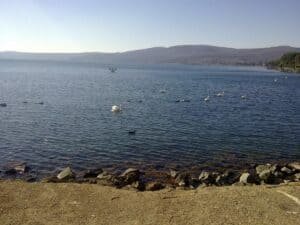
Lago Lungo takes its name from its long, narrow shape, almost a wide canal. The locals also call it Lago di Cantalice, after the hilltop village that looks down on it. It is the easternmost of the two and the closest to the road to Terni, so it is the easiest to reach and the first one you meet when arriving from Rieti. The shores are fringed with dense reed beds of common reed, with patches of wet woodland where the ground stays soft all year. From here the view toward the Terminillo is the best in the whole reserve: on clear January mornings the snowy massif is mirrored in the water and the yellow reed bed frames it.
Sport fishing is practiced on Lago Lungo, regulated by the managing body, and anyone who wants to cast a line should find out the rules in force first: they change from season to season and the reserve publishes specific notices. It is also the basin most frequented by runners and Sunday cyclists, because the loop is short and the levee road is comfortable.
Lago di Ripasottile
Lago di Ripasottile is rounder, more secluded, wilder. Its northern shores host the ringing station and, above all, the heronry: the most important colony of nesting herons in Lazio. Here the water is shallow, the reed bed is tens of meters wide and the marsh vegetation pushes inland with wet meadows and sedges. It is not a basin for a tourist stroll: it is a basin for observation, and anyone who goes there must move slowly and stay on the paths.
A firm opinion, from a professional: if you have only one morning, go to Ripasottile and not to Lago Lungo. Lago Lungo is more photogenic, Ripasottile is richer. The difference between the two is measured in number of species, and it is not close.
Birdwatching in the Lungo and Ripasottile Lakes Reserve
This is the reason the reserve exists and the reason the trip from Rome is worth it. The Rieti basin works as a moisture trap in the middle of the Apennines: it is low, flat, rich in water and food, and sits exactly on the route that migratory birds follow along the Apennine ridge. The result is that between November and March the two lakes host concentrations of water birds that have no equal in inland Lazio, and that in the months of the migration passages transit species appear that stay a few days and then leave again.
The Heronry of Lago di Ripasottile
A heronry is a marshy area where herons nest in a colony, all together, in the trees and in the reed bed. The one at Lago di Ripasottile counts more than 700 nests in total and has been monitored continuously since 2011 by the reserve's Ornithological Station. Seven species of water birds breed there regularly: gray heron, night heron, little egret, squacco heron, cattle egret, cormorant and European shag.
The numbers deserve to be spelled out, because they are what make this reserve a site of national importance and not a local curiosity. Gray herons exceed 500 nests: it is the largest colony in the region. Night herons exceed 120 nests: here too, the largest colony in Lazio. These are not brochure figures, they are counts carried out year after year by the reserve's ringers.
The Heronry Calendar, Month by Month
What surprises even ornithologists is the calendar. Nesting in the Ripasottile heronry begins in November, that is, well ahead of what happens in most European colonies. The first eggs hatch in December. In January the gray herons arrive in force and the colony reaches its moment of peak winter activity. In March the cormorants come onto the scene. In April the night herons and the cattle egrets settle in. In May it is the turn of the little egret and the squacco heron, which occupy the reed bed beneath the trees.
Translated into practical advice: if you want to see the heronry at the height of its activity you have to come in winter, between January and February, and not in spring as instinct would suggest. It is the reverse of the usual tourist calendar, and it is also the reason why in August some visitors go home disappointed.
The Ornithological Station of the Lungo and Ripasottile Lakes Reserve
In 2001 the reserve started a ringing station on the shores of Lago di Ripasottile. From that experience came the present structure, housed at Casale Rinaldi. It is a real research center, not a showcase: studies on birdlife and mammals are carried out there in collaboration with universities, university internships and degree theses take place there, and educational meetings and field excursions are organized there for schools and visitors. The ongoing research concerns scientific ringing, censuses of targeted species and breeding monitoring, and on the mammal side the wolf, the red deer, the fox and the porcupine.
A day spent with the ringers is worth 10 generic guided visits. Seeing a kingfisher in a researcher's hand, measured, weighed, ringed and released in 40 seconds, is the kind of experience children remember for years. The activities can also be followed through the station's social channels.
The MonITRing Project
The Ripasottile station, located on the north shore of the lake, takes part in MonITRing, the national project coordinated by the ISPRA National Ringing Center. The program's stated goal is to standardize the many existing ringing projects and collect uniform data across the whole Italian territory, with methods set at the national level and collection spread over the entire year.
The species ringed at Ripasottile include the kingfisher, the moustached warbler, the great tit, the hoopoe and the nightingale. The data accumulated over these years has fed four degree theses and international scientific publications, and was presented at the 11th Symposium on Wild Fauna held in Viterbo in 2019. For anyone who wants to arrange a visit to the station, the contact given by the reserve is the number 328 2175541.
When to Go to the Lungo and Ripasottile Lakes Reserve
December, January and February for the wintering birds and for the heronry. March and April for the spring passage, when waders and transiting raptors appear. September and October for the autumn passage. May and June for the reed bed nesters, which are heard more than they are seen. July and August are the worst months: the water drops, the heat of the basin is heavy, the mosquitoes are serious and the birds are few. If someone suggests the reserve as a Ferragosto outing, politely decline.
The hour matters as much as the month. Arrive at dawn or in the two hours before sunset: in between, the light is flat, the birds rest in the thick cover and the wind ripples the water, making the spotting scope useless.

The Wildlife of the Lungo and Ripasottile Lakes Reserve
The lake environment of the Rieti basin supports a rich animal community, and the richness begins underwater. The fish fauna of the two basins includes pike, tench, carp, rudd, eel and trout: this is the food base that explains why herons, cormorants and kingfishers have such high numbers here. A lake without fish does not make a heronry of 700 nests.
Water Birds
On the open water and in the reed beds you can see the coot, the teal, the moorhen, the garganey, the great crested grebe, the little grebe, the little bittern, the little egret, the squacco heron and the gray heron. In some winters, under particular conditions, the rare presence of the flamingo has also been recorded: it is an occasional event, not a fixed appointment, and anyone who leaves Rome with the idea of photographing flamingos risks coming back empty-handed. The cormorant and the European shag complete the picture of the fish-eaters, both nesting in the heronry.
Reed Bed Birds
The marsh vegetation fringing the Lungo and Ripasottile Lakes allows the nesting of the penduline tit, the great reed warbler, the sedge warbler and the Cetti's warbler. These are species recognized mostly by ear: the great reed warbler has a rasping, repetitive song that fills the whole reed bed in summer, the penduline tit gives a thin, sad whistle, the Cetti's warbler produces a mechanical trill that sounds like a buzz. Bringing a recording of the songs along completely changes how the visit goes.
Raptors
Among the raptors tied to water is the rare osprey, which is seen here mainly during the migration passages, the marsh harrier, which patrols the reed beds with that low, rocking flight that makes it unmistakable, and the Montagu's harrier, more elegant and harder to find. Seeing them takes patience and the right position: you put the sun at your back, wait, stop talking. The reward, when it comes, lasts 15 seconds and pays back two hours of waiting.
Mammals
The monitoring carried out by the Ornithological Station is not limited to birds: it includes research on wolf, red deer, fox and porcupine. The presence of the wolf in the Rieti basin and on the slopes that border it is documented by the ongoing studies, and should alarm no one: it is a shy animal that avoids humans. The porcupine leaves its quills along the paths and is the easiest trace to recognize for anyone walking early in the morning.
The Flora of the Lungo and Ripasottile Lakes Reserve
The tree component of the protected area is more limited than you would expect, and the reason is agricultural: the crops come too close to the shores and squeeze the strip of riverside vegetation. Where the wet woodland has survived, however, the specimens reach remarkable sizes: white willow, black willow and white poplar form patches of damp forest that in summer give a coolness out of scale with the surrounding plain.
The Nupharetum, the Botanical Rarity of the Lungo and Ripasottile Lakes
Among the plant associations present in the two basins, the Nupharetum deserves a separate mention, a very rare formation made up of the yellow water lily. It is an aquatic plant rooted on the bottom, with wide floating leaves and round yellow flowers that surface between June and August. It is seen in still, shallow waters, often in inlets sheltered from the wind. For a botanist it is the best reason to come here in high summer, when the birdlife languishes.
The Reed Bed
The common reed forms continuous belts along the shores, and it is not an ornamental detail: it is the ecological infrastructure of the whole reserve. It filters the nutrients that arrive from the fields, supports the nests, hides the chicks from predators and produces the organic matter that feeds the lake's food chain. When the reed bed retreats, everything else retreats. The management policies of the protected area revolve in large part around its conservation.
The Santa Susanna Spring, Inside the Lungo and Ripasottile Lakes Reserve
In the locality of Piedicolle, in the municipality of Rivodutri, inside the perimeter of the protected area, one of the largest springs in Europe by flow rate gushes out: about 5,000 liters per second. The figure should be read slowly. 5,000 liters per second means that every minute 300,000 liters of water come out of the ground, and that the channel flowing from it is born already as a small river a few tens of meters from the spring pool.
The Santa Susanna spring was declared a Natural Monument in 1977 and is protected as a Special Area of Conservation with the code IT6020011. Its waters are so clear and transparent that you can make out the gravel bottom with the naked eye. Mute swans, mallards and moorhens swim on it, and along the banks you can see herons, cormorants and several species of woodpeckers.
The Underwater Nativity Scene
During the Christmas period an illuminated underwater nativity scene is set up in the spring's waters, visible until the first days of January. It is a custom that draws families from all over the Rieti area and that, for once, has nothing kitsch about it: the submerged figures seen through still, transparent water, with the light filtering up from the bottom, produce an effect that has to be seen.
How to Visit the Spring
The area is equipped for picnics, with spaces suited to families with children and trees that offer plenty of shade: it is the right place to end a morning of birdwatching with a packed lunch. The reference address is via Santa Susanna 27, in Rivodutri. On summer weekends and holidays attendance is high and the parking lots fill up early: arrive before 10:00 or, better still, come on a weekday.
The Visitor Center of the Lungo and Ripasottile Lakes Reserve
The Ripasottile Lake Visitor Center occupies the pumping station building in the locality of Lanserra, in the municipality of Colli sul Velino. The structure was built during the reclamation of the Rieti basin to control flooding: the pumps regulated the water levels of the lakes, and the building that housed them is now the welcome point of the protected area.
What You Find Inside
On the top floor a panoramic terrace overlooks the lake and is used for wildlife monitoring and for counting water birds: it is the best observation point in the whole reserve, because it puts your eye above the reed bed instead of behind it. On the first floor a multimedia room is dedicated to promoting the territory and its natural, historical and cultural aspects. The center also holds the Pietro Dohrn Archive, which is part of the Historical Archive of the Regional Nature Reserve.
Hours, Reservations and Accessibility
The Visitor Center opens by reservation and during guided visits: it has no continuous schedule and does not present itself to the public as a civic museum. Anyone who arrives without having called first will most likely find the gate closed. The number to call is that of the reserve's office, 0746 200999. The building has an elevator and is also usable by people with disabilities: among protected areas in Lazio this is a rare fact, and it deserves saying.
It is better to build the day around this reservation, not to add it at the last minute. The terrace of the pumping station changes the quality of the visit, and without the key to the gate it remains a photograph on the managing body's website.

The Trails of the Lungo and Ripasottile Lakes Reserve
The managing body has marked and mapped a network of routes that cover both basins and the countryside around them. The names already say what they are for: Sentiero dei Due Laghi, Sentiero degli Aironi, Sentiero dei Cormorani, Sentiero degli Svassi, Sentiero Vottone and Vicenna Riara, plus the stretches of the Cammino di Francesco that cross the reserve. Almost all of them can be done on foot and by bike, because the elevation change is zero or nearly zero.
The Sentiero dei Due Laghi
This is the main itinerary, the one that connects Lago Lungo to Lago di Ripasottile across the farmland strip that separates them. You walk among cultivated fields, tree rows, reclamation canals and farmhouses: it is a route of farm landscape more than wild nature, and for that very reason it tells well what this reserve really is. For anyone with half a day and only one choice to make, it is the right trail.
The Sentiero degli Aironi and the Sentiero dei Cormorani
The two ornithological routes lead to the areas of greatest bird concentration. They should be walked in silence, without dogs, and with the awareness that the goal is not to reach the end but to stop often. Anyone walking at a trekking pace sees nothing: here the right speed is that of someone who stops every 200 meters for 10 minutes.
The Sentiero degli Svassi and the Sentiero Vottone e Vicenna Riara
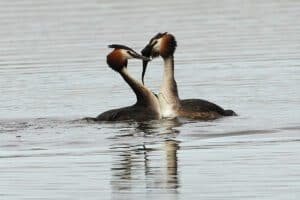
The first takes its name from the great crested grebe, the long-necked bird with the black crest that populates the open water in winter and in spring performs the famous courtship display, with the two partners rising face to face on the water. The second crosses the smaller wetlands of Vottone and Vicenna Riara, those marginal zones that hurried visitors ignore and that often yield the best sightings, because they are the least disturbed.
Rules of Conduct in the Lungo and Ripasottile Lakes Reserve
Stay on the marked paths. Do not enter private farmland. Do not pick plants. Dogs must be kept on a leash and, in nesting areas, it is better to leave them at home. Do not use drones, which cause nest abandonment at nesting sites. Do not light fires. Take your trash home. They sound like trivialities, but in a heronry of 700 nests one wrong behavior costs a breeding season.
The Way of St. Francis and the Rieti Holy Valley
Around the two lakes stretches what the Rieti area calls the Holy Valley, because of the four Franciscan sanctuaries that guard its slopes: Greccio, Santa Maria della Foresta, Poggio Bustone and Fonte Colombo. The Way of St. Francis, which links the four places, crosses the reserve and is listed among the official itineraries of the protected area, in two variants that can be done on foot and by bike.
Why the Way Passes Right by the Lakes
The reason is geographic before it is devotional: the sanctuaries are on the slopes, the lakes on the bottom of the basin, and to get from one sanctuary to another you have to cross the plain. Francis and his companions made the same route on foot in the early 13th century, when the plain was still largely marshy and the paths followed the dry rises. Walking today on the Sentiero dei Due Laghi with the four sanctuaries visible on the mountains around gives the exact measure of that territory.
The Four Sanctuaries, One by One
Greccio is the place of the first nativity scene, set up according to tradition at Christmas of 1223. Fonte Colombo is tied to the writing of the Rule and to the eye operation that Francis underwent there. Poggio Bustone overlooks the basin from a rocky balcony and is the sanctuary where tradition places the forgiveness. Santa Maria della Foresta preserves the memory of the miracle of the grapes. They are four stops that can be visited in one full day, by car, and that double the value of a trip to the Lungo and Ripasottile Lakes Reserve.
The Historic Rural Landscape of the Rieti Plain
The reserve's territory is dotted with farmhouses that keep alive the ancient rural imprint of the basin: courtyard buildings, barns, hay barns, threshing floors, boundary tree rows. It is not a scenic backdrop, it is a production system still working, and its conservation is one of the explicit goals of the protected area's planning. The reserve's Management Plan has taken the landscape as its key of interpretation and as a model for regulating and enhancing the territory, recognizing in the great historic farm landscape the ultimate value to be conserved.
The Plan has given rise to several enhancement projects, including a museum dedicated to the landscape promoted together with the municipality of Rivodutri, an ecomuseum of the plain, a center dedicated to the artistic expressions tied to this landscape and a visitor center on the ancient history of the basin, designed to tell what the plain was like when it held a great lake. On the progress of each it is best to ask the managing body directly, because the timing of completion depends on the individual funding.
Woad, the Blue Gold of the Rieti Countryside
There is a chapter of Rieti farming history that almost nobody knows and that even explains an Italian saying. For centuries the Rieti basin was a capital of woad, the dye plant from which blue was obtained before indigo arrived from the Indies. At the end of the processing cycle, cakes of dye called coccagne were produced, and from that term comes the expression paese di cuccagna. The Valle della Cuccagna, in the local historical vocabulary, is exactly this plain, and its wealth came from color.
The reserve has picked up the thread of this story with dedicated meetings and presentations, also hosted at the Santa Susanna Springs. Telling the story of woad growing next to a lake where 500 herons nest is the best way to make people understand that here nature and human work have been the same thing for 2,000 years.

How the Lungo and Ripasottile Lakes Reserve Came to Be
Naturalistic interest in this portion of the Rieti basin is recent: it took hold only in the 1970s, whereas before then the two lakes were considered a remnant of marsh to be reclaimed or exploited. Three events, in quick succession, overturned the collective judgment.
The Blocked Hydroelectric Project
At the end of that decade Enel proposed a project providing for the hydroelectric exploitation of the two basins. The plan drew widespread criticism and was blocked by the Rieti city council led by Ettore Saletti. It is the founding episode of local environmental awareness: for the first time the plain defended itself from an infrastructure project presented as progress.
The Expressway That Was Meant to Pass Between the Two Lakes
Shortly afterward the affair of the Rieti-Terni expressway caused a stir. In the initial plans the route was to pass between the two lakes, following the corridor of the old state road. The protests that followed its approval led to moving the work to another route. Anyone driving on the expressway today and looking at the lakes from afar should know that this distance is the result of a civic battle, not of a technical choice.
The Urban Expansion of Rieti
The third factor was building pressure: the expansion of Rieti to the north threatened to join the city to the strip of the lakes. Taken together, the three episodes sped up the institutional path to protection, which ended with regional law number 94 of June 17, 1985. For 40 years the Lungo and Ripasottile Lakes Reserve has existed because someone, 40 years ago, said no three times.
What to See Around the Lungo and Ripasottile Lakes Reserve
A trip to the lakes takes a full morning. The afternoon fills up easily, because the Rieti basin packs a remarkable number of things into 20 kilometers.
Rieti and the Center of the Basin
Seven kilometers from the lakes, Rieti keeps a compact historic center, the circuit of the medieval walls, the Papal Palace, the cathedral and the underground of the Roman city. It is also the place where you eat best in the area, and where you find up-to-date tourist information on the reserve.
Cantalice, Contigliano and the Villages Overlooking the Lakes
Cantalice is the village that gives Lago Lungo its alternative name: a vertical village clinging to the mountain, with a view over the plain that by itself justifies the climb. Contigliano guards the opposite side of the basin, with the collegiate church of San Michele Arcangelo dominating the rooftops. Rivodutri is the municipality of the Santa Susanna spring. They are three short stops that complete the picture: from the lakes you look at the villages, from the villages you look at the lakes.
The Mountains: Terminillo, Leonessa, Antrodoco
The Terminillo closes the eastern horizon and is reached in half an hour of hairpin turns: in winter it is the Romans' ski mountain, in summer a plateau for hikes. Leonessa, beyond the pass, is one of the best-preserved villages of the central Apennines. Antrodoco guards the Velino gorges upstream of the basin, where the river enters the plain.
The Other Lakes and the Sabina
Anyone who has developed a taste for the Rieti basins can extend the trip to Lake Salto and Lake Turano, two artificial reservoirs from the 1930s set between the mountains, of a completely different character. On the way back toward Rome, the Abbey of Farfa is worth the detour: it is one of the most important monastic complexes in central Italy and is a few kilometers from the Salaria.
The Marmore Falls, the Other End of the Story
29 kilometers separate the lakes from the Marmore Falls. Doing the two visits on the same day, in the right order, is the most effective geography lesson you can give a kid: first the lake that remains, then the point where the Romans made it come down. Between the two places run 2,290 years and a single idea.
The Lungo and Ripasottile Lakes Reserve with Children
It works, on two conditions. The first is not to present it as an amusement park: children here have to look, and looking is something you learn. The second is to give them a tool of their own, even an inexpensive pair of binoculars, because a child who shares an adult's binoculars gets bored in 10 minutes.
The best combination is this: a morning on the Sentiero dei Due Laghi, with short stops and a bird identification sheet printed before leaving. A packed lunch in the equipped area of the Santa Susanna Springs, where the transparent water and the swans catch the attention even of the youngest. A free afternoon, possibly in Rieti. The educational activities organized by the Ornithological Station, when available, are worth double any improvised program: they are booked in advance through the reserve.
A practical warning that nobody gives: from May to September the mosquitoes of the plain are aggressive, especially at dawn and dusk, which are exactly the good hours for observing. Repellent and long sleeves, or the trip ends sooner than planned.
Accessibility and Services in the Lungo and Ripasottile Lakes Reserve
The Ripasottile Lake Visitor Center, inside the Lanserra pumping station building, has an elevator and is also usable by people with disabilities: it is the reference point for anyone with mobility problems, because it makes it possible to reach the panoramic terrace and to observe the lake from above without tackling the trails.
The outdoor routes, by contrast, are dirt roads and country levee roads: flat, which helps a lot, but with an uneven surface and no paving. An outdoor wheelchair or a joelette can handle them, a city wheelchair cannot. There are no public restrooms along the trails, there is no refreshment point inside the protected area, and services are found in the villages. Anyone organizing a visit for a group with special needs should phone the office beforehand: the managing body knows the territory and points you to the suitable stretches.
Frequently Asked Questions About the Lungo and Ripasottile Lakes Reserve (RI)
Where is the Lungo and Ripasottile Lakes Reserve?
The Lungo and Ripasottile Lakes Reserve is in the Rieti basin, in the province of Rieti, along the course of the Velino river, in the territories of Cantalice, Colli sul Velino, Contigliano, Poggio Bustone, Rieti and Rivodutri. The average elevation of the plain is about 370 meters.
How much does it cost to visit the Lungo and Ripasottile Lakes Reserve?
Access to the Lungo and Ripasottile Lakes Reserve is free, because there is no ticket office at all and the protected area is open territory. The only expenses concern services, such as the guided visits organized by the managing body or by affiliated associations and the educational activities of the Ornithological Station.
Do I need to book to visit the reserve?
For the trails and lakes of the Lungo and Ripasottile Lakes Reserve you don't need to book. For the Ripasottile Lake Visitor Center you do, because it opens by reservation and during guided visits: the number to call is 0746 200999, with the office at via Cintia 87 in Rieti.
When is the best time for birdwatching in the reserve?
The best time for birdwatching in the Lungo and Ripasottile Lakes Reserve runs from November to March, when the Rieti basin, which sits exactly on the route followed by migratory birds along the Apennine ridge, hosts some of the highest concentrations of water birds in Lazio.
Is the reserve's Visitor Center wheelchair accessible?
Yes, the Ripasottile Lake Visitor Center, in the Lanserra pumping station building, has an elevator and is also usable by people with disabilities, with access to the panoramic terrace without tackling the trails. The outdoor routes, by contrast, are dirt roads and country levee roads.
Is the Lungo and Ripasottile Lakes Reserve suitable for a trip with children?
The Lungo and Ripasottile Lakes Reserve works well with children on two conditions: do not present it as an amusement park, because here you learn by observing, and give them binoculars of their own, because a child who shares an adult's pair gets bored in a few minutes. The Sentiero dei Due Laghi with short stops is the recommended combination.
What can I see near the Lungo and Ripasottile Lakes Reserve?
Just seven kilometers from the lakes is Rieti, with a compact historic center, the circuit of the medieval walls, the Papal Palace, the cathedral and the underground of the Roman city. It is also the best place in the area to eat.
Are the reserve's two lakes natural?
Lago Lungo and Lago di Ripasottile are the surviving remnants of an ancient, larger basin, the Lacus Velinus, which occupied the whole Rieti basin in antiquity. The cutting of the Marmore travertine threshold, attributed to the consul Manius Curius Dentatus in 271 BC, started the outflow of the waters and gave rise both to the Marmore Falls and to the farmable plain that now surrounds the two lakes.
How Much It Costs to Visit the Lungo and Ripasottile Lakes Reserve
Access to the protected area is free. There are no entrance tickets, no reduced rates, no first Sunday of the month, because there is no ticket office at all: the reserve is open territory. The only expense items concern services: guided visits organized by the managing body or by affiliated associations, the educational activities of the Ornithological Station, any bike rental in the villages, and parking in the equipped areas during events.
For a group coming from Rome the real cost item is transport and the guide. Professional accompaniment, here, is not a luxury: it is the difference between seeing two lakes and understanding a basin. Anyone organizing outings for groups, companies or schools can turn to an operator specialized in professional tourist accompaniment, who coordinates the logistics and the local suppliers.
A Curiosity About the Lungo and Ripasottile Lakes Reserve (RI)
The gray herons of Ripasottile begin nesting in November. Put like that it seems a detail for specialists. In reality it is an anomaly that overturns common sense about bird reproduction. Across almost all of Europe, ardeids occupy their nests between February and April, when the days lengthen and temperatures rise. Here the colony gets going in late autumn, the first eggs hatch in December, and in January, while the plain is covered in frost and the fog rises from the canals, the trees of the heronry hold the year's highest concentration of herons.
The explanation, as far as the research carried out on site is reconstructing it, has to do with food availability: the Rieti basin guarantees unfrozen waters and accessible fish even in the cold months, and whoever nests first secures the best spots in the trees and an advantage over the chicks of the following season. The continuous monitoring since 2011 has made it possible to document the phenomenon year after year instead of relying on impressions.
For the visitor this curiosity has an immediate and counterintuitive practical consequence: the best season to come to the Lungo and Ripasottile Lakes Reserve is winter. January, with the snowy Terminillo in the background, the ocher-colored reed bed, the fog lifting around nine and 500 gray heron nests in activity, is the moment when this place is at its best. In August, when the tourists arrive, the heronry is empty and the water is low. Few places in Italy have a calendar so upside down compared with the habits of travelers, and almost no guide says so.
One Thing Nobody Tells You About the Lungo and Ripasottile Lakes Reserve (RI)
That the real monument of the reserve is not a lake: it is an industrial building. The Lanserra pumping plant, in the municipality of Colli sul Velino, was built to drain, not to protect. Its pumps lifted the water from the drainage canals and put it back into the Velino, lowering the level of the lakes and giving fields back to agriculture. That machine is the reason Lago Lungo and Lago di Ripasottile have the shape and extent they have today: without pumping stations they would be larger, more irregular, surrounded by marshes.
Today the same building houses the protected area's Visitor Center, with the panoramic terrace on the top floor used to count water birds and the multimedia room on the first floor. The irony is perfect and nobody ever points it out: you observe the marsh wildlife from the top of the machine built to eliminate the marsh. Inside, the Pietro Dohrn Archive keeps the documentary memory of this story, as part of the reserve's Historical Archive.
The practical consequence is that the Lungo and Ripasottile Lakes Reserve is not a natural environment that survived by chance: it is a balance actively maintained. The water levels still depend on technical decisions, the reed beds depend on the levels, the heronries depend on the reed beds. Anyone who visits the area with the romantic idea of seeing a piece of untouched nature is looking at the wrong thing. What there is to see is more interesting: a landscape in which hydraulic engineering and biology have stopped fighting each other and have found an agreement.
My Advice for Visiting the Lungo and Ripasottile Lakes Reserve (RI)
Build the day around a phone call. The number is 0746 200999, the office is at via Cintia 87 in Rieti, and the call serves two purposes: booking access to the pumping station Visitor Center and asking what is being observed right now on the two lakes. The second question is the one that changes everything. The people who work in the reserve know if the heronry is active, if the osprey has arrived, if the water level has uncovered the shallows that attract waders. A morning planned on this information is worth 10 mornings planned on the weather.
Then, the timing. Arrive before dawn or three hours before sunset, never at noon. In the middle of the day the light is flat, the wind ripples the surface and the spotting scope becomes useless, and the birds take refuge in the reed bed. With low-angle light, on the other hand, the colors of the water and the reed bed change every 10 minutes and the silhouettes on the water read sharply.
Third element: the position of the sun. Choose your spot on the shores so that you have the sun at your back, otherwise you are observing against the light and every bird becomes a black shape. On Lago di Ripasottile this means being on the south side in the morning and on the north side in the afternoon. It sounds pedantic. It is the difference between recognizing a garganey and noting down an unidentified duck.
Last piece of advice, the one nobody will give you: give up on seeing everything. Two lakes, five trails, a spring, four sanctuaries and a visitor center do not fit in one day. Pick one lake, one trail and the Santa Susanna spring, and leave the rest for a second trip. The Lungo and Ripasottile Lakes Reserve punishes haste more than any other place in the Rieti area, because here what you see depends on the time you devote to standing still.
Another Well-Known Fact, Yet Rarely Mentioned
That the Marmore Falls and these two lakes are the same hydraulic work, seen from its two ends. It is a notion that appears in every manual and that nobody ever connects with the visit. In 271 BC, according to the chronology established in the studies, the consul Manius Curius Dentatus had the travertine threshold of Marmore cut to discharge the waters of the Lacus Velinus into the Nera river. On one side of that cut an artificial waterfall more than 150 meters high was born, today one of the most visited attractions in central Italy. On the other side the Rieti plain was born, and the two lakes we see today are what remained when the water stopped covering everything.
What is rarely mentioned is how unstable that act has been. The Velino carries calcium carbonate and deposits travertine continuously: the threshold rises, the outflow slows, the plain becomes marshy again. This is why the history of the basin is an unbroken chain of new cuts and new canals, from the Roman age through the Renaissance to the reclamations of the 20th century, accompanied by a centuries-long dispute between Rieti and Terni, because increasing the outflow meant flooding the valley below and reducing it meant flooding the one above.
The winter floods, in the local dialect, are called pianare. In the memory of the basin's farming families that word weighs as much as a famine: water in the barns, lost sowings, cut-off connections. The pumping stations that now house the Visitor Center are the latest technical answer to that problem. Looking at the Lungo and Ripasottile Lakes knowing all this changes the view: they are not two decorative sheets of water, they are the negotiated remnant of a conflict that lasted 23 centuries between a plain and a river that did not want to leave.
The Right Photo to Take at the Lungo and Ripasottile Lakes Reserve (RI)
The photograph that sums up this place is only one: the snowy Terminillo mirrored in Lago Lungo, with the strip of yellow reed bed in the foreground. You take it in January or February, at dawn, from the western shore of the basin, when the still, cold air turns the water into a mirror and the massif catches the pink light even before the sun reaches the plain. You need a tripod, a lens around 50 millimeters equivalent and the patience to arrive half an hour before the time you had calculated, because the good moment lasts eight minutes.
The second photograph, the one almost nobody takes home, is the fog. On winter mornings in the Rieti basin the mist rises from the canals and hangs two meters above the ground: the poplars emerge at half height, the farmhouses become silhouettes, the herons in flight cross a white backdrop. It is rare photographic material in central Italy and it is found here with a regularity that surprises. Shoot it from the levee roads, in partial backlight, underexposing by a good full stop.
The third is the heronry, and it must be said clearly: it is photographed from far away, with a long telephoto lens, from the Visitor Center terrace or from the permitted observation points. Getting close to a nesting colony to take a better photograph is behavior that causes nest abandonment and the loss of clutches. Drones are out of the question. A photograph that costs 500 pairs of herons a breeding season is not a good photograph: it is documented damage.
One last technical note for those who come with serious equipment: on the shores of the Lungo and Ripasottile Lakes the humidity is high and condensation on lenses is the rule on January mornings. Keep your equipment in the car, unheated, and give it 20 minutes before setting up. Otherwise the photograph of the year stays fogged.
Some Important Events That Happened Here in History
The first is the cutting of the Marmore threshold, dated by the historiographic tradition to 271 BC and attributed to the consul Manius Curius Dentatus. It was a work of hydraulic engineering on an enormous scale for the time: opening a passage in the rock to drain an entire lake. From that building site came, at the same time, the Marmore Falls and the farmable Rieti plain, and the two lakes of the reserve are what remained of the ancient Lacus Velinus when the water found its way to the Nera.
The second event is spread out over time and concerns the pianare, the winter floods of the Velino that for centuries inundated the basin. Every pianara produced interventions, expert reports, court disputes between the communities of Rieti and Terni, new canal projects. It is a hydraulic history that runs through the Middle Ages, the Renaissance and the modern age, and that ends only in the 20th century with mechanical reclamation and the lifting plants.
The third is the passage of the Franciscan movement. In the early 13th century Francis of Assisi and his companions spent long periods in the Rieti basin, founding or living in the four hermitages of Greccio, Fonte Colombo, Poggio Bustone and La Foresta. At Greccio, according to tradition, the first representation of the nativity was set up at Christmas of 1223. The Holy Valley that surrounds the lakes owes its name to this story, and the Way of St. Francis that crosses the reserve retraces his movements.
The 20th Century: From Reclamation to Protection
The fourth event is the construction of the pumping stations and the completion of the basin's reclamation, which gave the plain its present look: regular fields, straight canals, scattered farmhouses, lakes with controlled levels.
The fifth is the tug-of-war of the 1970s. At the end of the decade Enel presented a project for the hydroelectric exploitation of the two lakes, blocked by the Rieti city council led by Ettore Saletti after widespread criticism. In the same period the approval of the Rieti-Terni expressway, whose initial route passed between the two basins along the corridor of the old state road, set off protests that led to moving the work to a different route. To these two episodes was added the pressure of Rieti's building expansion to the north.
The sixth and last event is the date that closes the story: June 17, 1985, regional law number 94, establishment of the Lungo and Ripasottile Lakes Regional Nature Reserve. From that moment 3,278 hectares of the Rieti basin have a legal status of protection, and the history of the place stops being a sequence of emergencies and becomes a management policy.
Who Has Passed Through the Lungo and Ripasottile Lakes Reserve (RI)
The first name is that of Manius Curius Dentatus, a three-time Roman consul, victor over the Samnites in 290 BC and over Pyrrhus at Benevento in 275. The historiographic tradition attributes to him the Marmore cut of 271, that is, the work that created the plain where the reserve now extends. Curius is also the figure to whom Roman tradition attributes the image of the consul who farms his own field himself: that he should be the one responsible for the greatest agrarian reclamation of ancient central Italy has a coherence of its own.
The second is Francis of Assisi. Between 1217 and 1225 he frequented the Rieti basin assiduously, stayed in the four hermitages of the Holy Valley and crossed the plain several times to move from one to another. At Fonte Colombo, according to the Franciscan sources, he dictated the Rule and underwent the cauterization of his eyes. At Greccio he set up the nativity scene of 1223. At Poggio Bustone tradition places the episode of the forgiveness. Anyone walking today on the Sentiero dei Due Laghi follows, on a different road surface, the same connections.
The Scientists and Researchers
The third name is Pietro Dohrn, whose archive is kept at the Ripasottile Lake Visitor Center as part of the reserve's Historical Archive. The Dohrn family is tied to the history of naturalistic research in Italy, and the presence of the documentary collection in the Rieti basin bears witness to the relationship between this territory and scientific studies of the environment.
The fourth group does not have a single name: it is the researchers and ringers who have worked since 2001 on the shores of Lago di Ripasottile. From the ringing station started that year came the Ornithological Station of Casale Rinaldi, which has produced four degree theses, international scientific publications and a presentation at the 11th Symposium on Wild Fauna in Viterbo in 2019, and which has monitored the heronry continuously since 2011. They are not famous figures, and that is exactly why they should be named: the scientific reputation of the Lungo and Ripasottile Lakes Reserve is their work.
The Administrators Who Said No
The fifth name is that of Ettore Saletti, mayor of Rieti, whose council blocked at the end of the 1970s the project for hydroelectric exploitation of the two lakes proposed by Enel. Together with him we should remember, without names because the available documentation does not give them one by one, the citizens who protested against the route of the Rieti-Terni expressway between the two basins. They are the ones who handed this reserve down to those who visit it today.
Quick Questions About the Lungo and Ripasottile Lakes Reserve (RI)
How much does it cost to enter the Lungo and Ripasottile Lakes Reserve?
Nothing. The protected area is open territory, with no ticket office or entry hours. You pay only for services: guided visits, educational activities, any rentals.
Do I need to book to visit the reserve?
Not for the trails and the lakes. For the Ripasottile Lake Visitor Center, yes: it opens by reservation and during guided visits. The number is 0746 200999.
Where exactly is the Lungo and Ripasottile Lakes Reserve?
In the Rieti basin, in the province of Rieti, on the territories of the municipalities of Cantalice, Colli sul Velino, Contigliano, Poggio Bustone, Rieti and Rivodutri. The administrative office is at via Cintia 87, 02100 Rieti.
How big is the reserve?
3,278 hectares, established by regional law number 94 of June 17, 1985.
How much time do I need to visit the Lungo and Ripasottile Lakes Reserve?
A morning for one lake and one trail. A full day for both basins, the Santa Susanna spring and the Visitor Center. Two days if you add the sanctuaries of the Holy Valley.
What is the best time of year?
Winter, between December and February, for the wintering birds and for the heronry in full activity. March, April, September and October for the migration passages. July and August are the weakest months.
How far is the reserve from Rome?
About an hour and a half by car, along the Salaria SS4 as far as Rieti and then the SS79 toward Terni. From the center of Rieti it is seven kilometers.
Can I get to the Lungo and Ripasottile Lakes Reserve by train?
You can get to Rieti on the Terni-Rieti-L'Aquila-Sulmona line, but connections are sparse and from the station you still need a taxi or an intercity bus with few runs. Without a car the visit is complicated.
Can I go by bike?
Yes, and it is the best way. The plain is flat, the secondary roads have little traffic and most of the reserve's trails can be done on foot and by bike.
Can I take photographs?
Yes, with common sense. You approach the heronry and the nesting sites only from the permitted points, using a telephoto lens. Drones cause nest abandonment and must not be used.
Can I swim in the lakes?
No. Lago Lungo and Lago di Ripasottile are not bathing waters nor equipped for swimming: they are nature reserve environments with muddy bottoms and dense reed beds.
Can I fish in the Lungo and Ripasottile Lakes Reserve?
Sport fishing is practiced and regulated by the managing body, which publishes notices and seasonal updates. Before setting out with your gear it is best to check the rules in force with the reserve's office.
Is it suitable for children?
Yes, as long as each one has their own pair of binoculars and the day includes a stop at the Santa Susanna Springs, which have a picnic area and shaded spaces.
Is the reserve wheelchair accessible?
The Lanserra Visitor Center has an elevator and is usable by people with disabilities. The outdoor trails are dirt and flat, suitable for outdoor wheelchairs but not for city ones.
Can I bring dogs?
On a leash on the common routes. In nesting areas it is better to leave them at home: a loose dog in the reed bed disturbs the clutches.
What do you see in the heronry of Lago di Ripasottile?
More than 700 nests in total, with more than 500 gray heron nests and more than 120 night heron nests, the largest colonies in Lazio. Little egret, squacco heron, cattle egret, cormorant and European shag also nest there.
Can I see flamingos at the Lungo and Ripasottile Lakes Reserve?
Occasionally. The presence of the flamingo is reported as rare, not regular: setting out with that goal almost always means ending up disappointed.
What is the difference between Lago Lungo and Lago di Ripasottile?
Lago Lungo, also called Lago di Cantalice, is narrow and elongated, more accessible and more photogenic toward the Terminillo. Lago di Ripasottile is more secluded and hosts the heronry: it is the richest from the ornithological point of view.
What is the Santa Susanna spring?
One of the largest springs in Europe by flow rate, about 5,000 liters per second, at Piedicolle di Rivodutri. It has been a Natural Monument since 1977 and is a Special Area of Conservation, IT6020011.
Is it true that there is a nativity scene underwater?
Yes. During the Christmas period an illuminated underwater nativity scene is set up in the waters of the Santa Susanna spring, visible until the first days of January.
What was the Lacus Velinus?
The great lake that occupied the Rieti basin before the cutting of the Marmore threshold, attributed by tradition to Manius Curius Dentatus in 271 BC. Lago Lungo and Lago di Ripasottile are its remnants.
Does the Way of St. Francis pass through the reserve?
Yes, and it is listed among the official itineraries of the protected area, in two variants. It links the four sanctuaries of the Holy Valley by crossing the plain of the two lakes.
Are there bars or restaurants inside the reserve?
No. Services are found in the villages of the basin. Inside the protected area it is best to move around with water and a packed lunch.
Can I visit the Ornithological Station?
The Casale Rinaldi structure organizes educational meetings and field excursions. The contact given by the reserve for visits is the number 328 2175541.
Is it worth combining it with the Marmore Falls?
Yes, and in the right order: first the lakes, then the falls, which are 29 kilometers away. They are the two ends of the same ancient hydraulic work.
What should I bring to the Lungo and Ripasottile Lakes Reserve?
Binoculars, waterproof shoes, mosquito repellent from May to September, layered clothing in winter, and a spotting scope if you have one. The rest is superfluous.
The Last Word on the Lungo and Ripasottile Lakes Reserve
People who come here react in two opposite ways. Those who arrive looking for a postcard panorama stay lukewarm: two low lakes in the middle of fields don't compete with the Castelli Romani or with Bolsena. Those who arrive willing to stop, on the other hand, leave with the feeling of having seen something that is hardly seen anymore in central Italy: a working farm plain, a lake that feeds 500 pairs of herons, a research center that does real work, and under all of this a Roman work from 23 centuries ago that still decides where the water ends and the wheat begins.
If I had to pick a single day of the year, I would say a January morning, with fog on the canals and the Terminillo white in the background. Bring binoculars, phone ahead, and don't try to see everything. Anyone planning a broader itinerary in Lazio and Italy will find useful ideas in the day trip guides and in the one-week itinerary from ItalyPlanner, while those organizing outings for groups or companies can rely on TourLeaderPro's professional services in Rome and Lazio.
Article written by the TourLeaderPro editorial team, contact them for Private/Corporate/V.I.P. Tours and Experiences.
Planning a trip to Rome? The English guides to visiting the city are on ItalyPlanner.com.