Sanctuary of Santa Maria della Foresta
In short. There are places you understand only by arriving on foot, and the Sanctuary of Santa Maria della Foresta is one of them.
There are places you understand only by arriving on foot, and the Sanctuary of Santa Maria della Foresta is one of them. It stands just outside Rieti, on a knoll a little over 500 meters above sea level, among chestnuts and oaks, and it has the unassuming look of a country house to which someone, over the centuries, kept adding rooms. No monumental facade, no scenic staircase, no colonnade that forces you to lift your head. And yet here, according to a tradition 800 years old, a sick and nearly blind man dictated or meditated some of the most famous verses in the Italian language, and a vineyard ravaged by visitors produced more wine than the year before. The thing that matters, right away: if you come to La Foresta expecting spectacle, you will be disappointed. If you come to understand, you will leave changed.
Those who arrive here, pilgrims with backpacks, parish groups, couples of curious people who came by mistake while looking for Greccio, react almost always in the same way: first a moment of disorientation, then silence. La Foresta doesn't impose itself, it creeps in. Here you have everything you need not to cross it like a scenic parking lot: the real history and the hagiographic one kept well apart, the architecture, the frescoes, the miracle basin, the cloister, the cave, the life that still goes on today within these walls, and the practical advice that will spare you the most common mistakes.
What the Sanctuary of Santa Maria della Foresta is
The Sanctuary of Santa Maria della Foresta, which everyone in Rieti simply calls "La Foresta," is a Franciscan convent complex made up of two churches layered over time, a small cloister, a convent, a cave, a vineyard and a vegetable garden. It is not a cathedral and never wanted to be. It is the third of the four sanctuaries of the so-called Holy Valley of Rieti, the ring of Franciscan places that surrounds the Rieti basin together with Greccio, Fonte Colombo and Poggio Bustone. Each of the four has a different vocation: Greccio is Christmas and the nativity scene, Fonte Colombo is the Rule and the eye operation, Poggio Bustone is forgiveness and the beginning, and La Foresta is the Canticle and the wine.
The distinction is not a modern advertising invention. It goes back to the way the Fonti Francescane, that is, the corpus of biographies, collections of episodes and testimonies that the friars put together between the 13th and 14th centuries, tied a precise episode to each place. It must be said honestly, and it holds for everything that follows: this is hagiographic tradition, not archival documents contemporary with the events. That does not make them less important, it simply makes them a different thing. A miracle told 80 years later by a friar who was writing to edify his readers is a precious source on how the Franciscans saw the world. It is not a notarial record.
The two churches of the Sanctuary of Santa Maria della Foresta
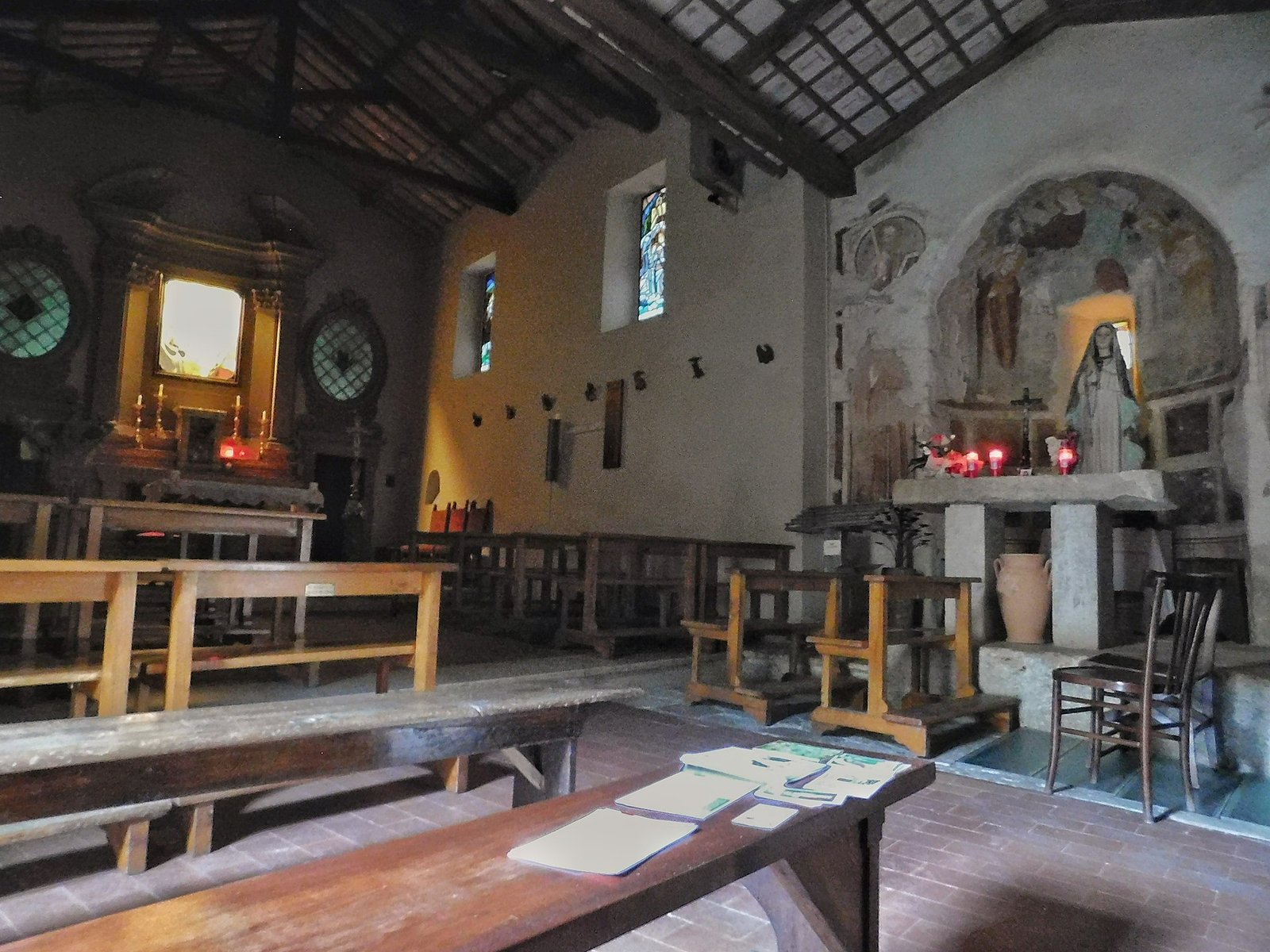
The first thing that confuses visitors is that here there are two churches, nested one inside the other like Chinese boxes. The older one is the little church of San Fabiano, a rural building documented at least from the 11th century, tiny, with a frescoed apse. The second is the church of Santa Maria della Foresta, built in the 14th century by the Hermits who settled here after Francis and gradually enlarged, which today serves as the main church of the sanctuary. Over the centuries the second has practically swallowed the first, reducing it to a side chapel. Anyone walking in distractedly risks not even noticing that the niche on the right is, in fact, the oldest and most important building of the whole complex.
It is exactly the opposite of what happens in the great basilicas, where the most venerable piece is put in the center, lit, framed. Here the heart of the place is hidden in a corner, and someone has to point it out to you. Consider me that someone.
Why it is called "Foresta"
The place name is more banal and more beautiful than you might imagine. "Foresta" does not allude to an impenetrable forest in the romantic sense, but to medieval Latin forestis, the woodland outside (foris) the cultivated lands, land subject to a special regime, often reserved. In the place names of central Italy the word frequently indicates a wooded area under collective or lordly ownership, distinct from arable land. The sanctuary takes its name from the place, not the other way around: there was a foresta, and inside that foresta there was a little church with a priest, a vineyard and a vegetable garden. That is where it all began.
Where the Sanctuary of Santa Maria della Foresta is
We are about 5 kilometers from the center of Rieti, heading north, along the road that climbs toward Castelfranco and Terminillo. The address is via Foresta, and the elevation is around 520 meters above sea level: enough to gain a few degrees of coolness in summer and a bit of ice trouble in winter, not enough to talk about mountains. The sanctuary stands on a natural terrace overlooking the Rieti basin, with the plain widening to the south and the Terminillo massif behind it.
The position is the key to understanding everything else. Rieti in the 13th century was an important city, a bishop's seat, and for long periods the seat of the itinerant papal court. The basin was, and is, one of the most fertile agricultural plains of the central Apennines, reclaimed since Roman antiquity. Whoever wanted to be near the city without being inside it, whoever sought a secluded place but one reachable on foot in an hour, whoever needed the doctors of the pontifical court but didn't want the crowds, found at La Foresta the exact distance. Five kilometers: far enough not to hear the cathedral bells, near enough for a man on horseback to arrive in 20 minutes.
The landscape around the Sanctuary of Santa Maria della Foresta
Going up, you cross a belt of olive groves and then of chestnut and mixed oak woods, with a few surviving terraces. It is an agrarian landscape of the middle Apennine hills, shaped by centuries of peasant labor and partly reclaimed by the woods in the last 50 years, when the Rieti mountains lost their population like all of inland Italy. The sanctuary still preserves, within its walls, this double character: on one side the religious building, on the other the farm. Vineyard, vegetable garden, fruit trees. It is the continuation of a function this place has had without interruption since the 11th century, not a folkloric reconstruction.
I advise you, if you arrive by car, to stop for a moment on the last stretch before the plaza and look back toward the plain. You will understand why the place was chosen: you see everything, and from below you see nothing. It is the geographic definition of a hermitage.
The Holy Valley of Rieti and the place of the Sanctuary of Santa Maria della Foresta
The expression "Holy Valley" is late and devotional, but it describes a precise geographic reality well: the Rieti basin, closed in by mountains, with four Franciscan sanctuaries arranged almost at the four cardinal points. To the northeast Poggio Bustone, to the southwest Fonte Colombo, to the west Greccio, and to the north, at the gates of the city, La Foresta. Look at a map and you will see that they form a crown around the plain. The medieval friars hadn't planned it at a desk, but the pattern that results is so clear that over the centuries it has itself become a cultural fact: people speak of a "ring," a "quadrilateral," a "cross" drawn on the territory.
The role of the Sanctuary of Santa Maria della Foresta in this system is that of the place closest to the city, and therefore the most exposed and the least hermit-like of the four. Greccio is perched on a cliff, Fonte Colombo is immersed in the woods on a mountainside, Poggio Bustone overlooks the valley from a natural balcony. La Foresta instead stands a step from the houses: it was, and is, the threshold sanctuary. The one where the world enters most easily. It is no accident that the episode that makes it famous is precisely an episode of invasion, the crowd that arrives, tramples, plunders the vineyard, and of remedy.
A visiting order that makes sense
If you have two days and want to do all four sanctuaries, the order I recommend is chronological with respect to Francis's life: first Poggio Bustone, which tradition ties to the first stay in Rieti and the forgiveness of sins. Then Greccio, with the nativity scene of 1223. Then Fonte Colombo, with the Rule of 1223 and the eye operation. And finally La Foresta, with the summer of 1225 and the Canticle. This way the day ends in the sweetest and most agricultural place, and the story has a narrative arc instead of being a collection of stops.
If you have only half a day, then choose: Greccio if you want the image, the scenery, the cliff. La Foresta if you want the substance. The choice depends on the visitor's temperament, not on the worth of the two places.
Before Francis: the church of San Fabiano
800 years of Franciscan storytelling have ended up obscuring the fact that this place already existed, and for some time. The little church of San Fabiano is documented at least from the 11th century: a rural chapel like hundreds in central Italy, serving a handful of scattered houses and those who worked the fields. It had no chapter of canons, no substantial income, no saint to draw pilgrims. It had a priest, and the priest had what all country priests had: the rectory, a small house, a vegetable garden and a vineyard. From there he ate, from there he drank, and with that he paid the few expenses.
The dedication to Fabian is not accidental. Fabian was pope from 236 to 250 and died a martyr under Decius. His cult is ancient and well attested in Lazio and the Sabina. Rural churches of the early medieval period readily chose Roman martyrs, both for the tie to the Church of Rome and because relics circulated along the consular roads. In the Sabina, Via Salaria was for centuries the highway of cults as well as of goods: salt, grain, saints.
What remains today of the church of San Fabiano
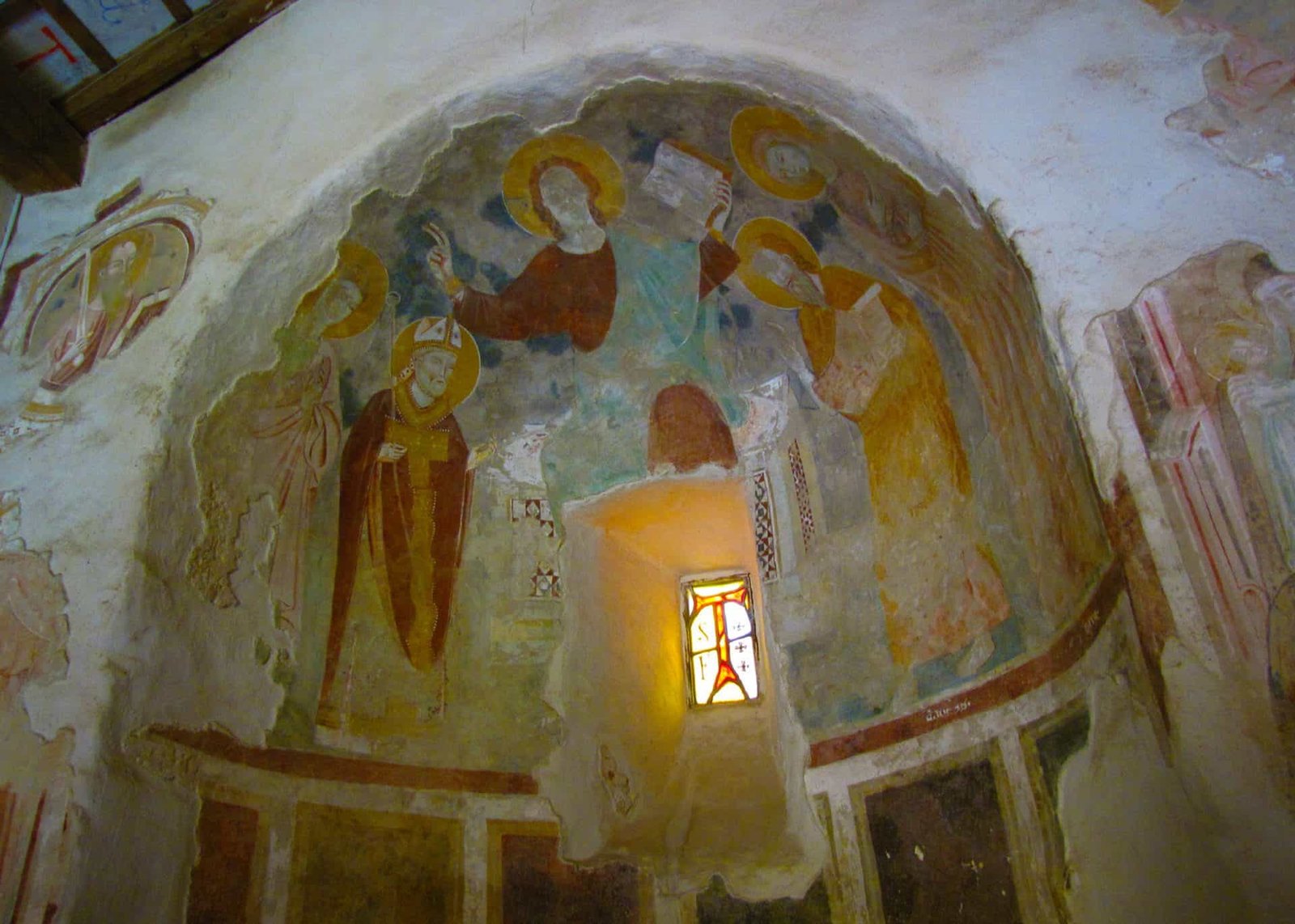
More remains than you would expect, and it is the main reason it is worth coming to La Foresta even if you don't care much about Saint Francis. The chapel preserves a cycle of frescoes of great interest, in different layers: you can recognize figures attributable to the 13th and 14th centuries, of Roman culture, and a later campaign, generally placed in the late 15th and early 16th century. In the apse and on the walls you can make out a Christ with the Baptist, the titular Saint Fabian, and a procession of saints among whom you recognize Louis of Toulouse, the Franciscan saint par excellence, whose presence is a precious chronological marker, Peter and Paul. On the side walls appear a Saint Catherine, an Archangel Gabriel and a Madonna with the Magi.
The thing to note is the quality of the drawing compared to the humility of the container. This is not second-rate painting: whoever frescoed San Fabiano knew the solutions of Roman painting and had seen, directly or through intermediaries, what was being done in the basilica of Assisi. In a rural chapel of 4 meters by 6, 5 kilometers from Rieti, this means only one thing: that the place already had, in the 13th and 14th centuries, a prestige greater than its size. Francis's passage had turned it into a destination.
The vineyard priest
We don't know his name, and this is one of history's small injustices. In the sources he is simply "the priest," or "the poor priest," or "the priest of that church." And yet he is a fully rounded character, one of the few who in the Franciscan biographies allows himself to complain openly and to be right. Tradition hands him down to us despairing as he looks at the stripped vines: this year my vineyard is lost. Anyone who has ever had a vegetable garden understands exactly the tone of voice.
The sources do not paint him as a miser. They paint him as a man who has welcomed an uncomfortable guest, a sick man who brings a crowd with him, and who is paying for the hospitality with the only capital he owns. The miracle, in the logic of the story, does not reward the priest's holiness. It rewards his hospitality. It is a theologically subtle distinction and a narratively perfect one.
The summer of 1225: why Francis arrives at the Sanctuary of Santa Maria della Foresta
In 1225 Francis of Assisi is a little over 40 and is, physically, a finished man. Years of extreme fasting, of travel, of exposure to cold and sun, and above all a serious eye disease contracted in all likelihood in the East during the journey to Egypt in 1219-1220. The sources speak of an ailment that forced him to cover his head and flee the light, and the most accredited retrospective diagnosis is trachoma, that is, a granular conjunctivitis caused by chlamydia, endemic in the eastern Mediterranean basin. He saw very little. He wept continually. The pain was constant.
The one insisting that he get treatment is Cardinal Ugolino dei Conti di Segni, protector of the Order, who two years later will be elected pope with the name Gregory IX and who in 1228 will canonize Francis in record time. Ugolino is a formidable jurist, a politician of the first rank and the man who worked more than anyone to bring the Franciscan movement inside the structures of the Church. He wants Francis to get treatment because he is fond of him and because he needs him alive.
The papal court of Honorius III was at that time in central Italy, and Rieti was one of the seats where the pope and the curia stayed for long periods. The best doctors available in Christian Europe traveled with the court. Hence Rieti: not for the landscape, but because that was where the eye specialists were.
Why not in the city
Here a very human and very revealing detail comes into play. Francis did not enter the city. The sources tell that, having learned of his arrival, the people of Rieti were preparing to welcome him en masse, and that he, to avoid the celebration, stopped outside, at San Fabiano. The official explanation is humility. The practical one is that a man with eyes in that condition, exhausted and suffering, had no desire to be carried in procession. The two things are not mutually exclusive.
The stay at the Sanctuary of Santa Maria della Foresta is placed by the sources in the summer-autumn of 1225, and the duration indicated is over 50 days. 50 days is a lot. It is a long stay, with everything that implies in terms of logistics, food, people coming and going. And it is precisely this duration that makes the vineyard episode plausible, and almost inevitable.
The eye ailment, the doctors of the 13th century and the Holy Valley
It is worth spending a few lines on the medicine of the time, because it helps to understand what "going to get your eyes treated" really meant in 1225. Medieval ophthalmic therapy, heir to the Greek tradition filtered through the great Arab physicians, included eye washes, poultices, bloodletting, purges and, in cases considered serious, cauterization. The latter is the procedure that Franciscan tradition associates with Fonte Colombo: a red-hot iron applied to the temples, from the jaw to the eyebrow, to "dry" the humors believed responsible for the ailment.
The Fonti Francescane tell that Francis, faced with the glowing iron, addressed the fire, calling it "brother" and asking it to be courteous to him. It is one of the most famous and most cited episodes, and it must be taken for what it is: hagiographic tradition, not a medical chart. But the fact that the compilers chose precisely this scene to illustrate Francis's relationship with the elements says something essential about the figure as the Order wanted him remembered, and it prepares the ground for the Canticle, where fire is "bello et iocundo et robustoso et forte."
The link with the Sanctuary of Santa Maria della Foresta
La Foresta and Fonte Colombo are the two faces of the same biographical episode. At Fonte Colombo the therapy is placed, at La Foresta the convalescence and the waiting. This is the reason the two sanctuaries should be visited, if possible, on the same day: together they tell a single year, the next to last of Francis's life, the one in which a nearly blind man, ill in stomach and liver, with the stigmata received at La Verna the year before, composes the most luminous poetic text of the Italian Middle Ages. The contrast between the physical condition and the quality of the writing is the most striking aspect of the whole story.
The grape miracle at the Sanctuary of Santa Maria della Foresta
And here we come to the episode that made this place famous. I tell it as the sources hand it down, warning once again that we are in the field of hagiographic tradition: the texts that report it belong to the strand of the Franciscan collections and find wide circulation in the Fioretti, that is, in a 14th-century vernacular compilation that reworks older material. No notary drew up a deed, and no serious historian claims otherwise.
The scene is this. Francis is a guest at the church of San Fabiano, convalescing. The news of his presence spreads, and the people of Rieti begin to climb up. Not one at a time: in groups, by the dozens, day after day, for 50 days. The little road passes through the priest's vineyard, and the vineyard is ripe. Whoever arrives picks a bunch, whoever stays long sits among the rows, whoever goes back down carries something away. Within a few weeks the vineyard is plundered: the vines stripped, the stakes crooked, the earth trampled.
The priest, who gets his only income of the year from that vineyard, despairs. He does not make a scene with Francis, and the sources are careful not to make him look hostile, but he complains out loud, and his sentence, in the vernacular versions, is of a disarming concreteness: this year my harvest is lost. Francis calls him and asks how much wine the vineyard usually made. The priest answers: 13 somas. Francis tells him not to grieve, to gather what is left and take it to the vat, and promises him that he will get 20 somas from it. The harvest is done, the press turns, and the wine comes out in the promised quantity, abundant, and of better quality than usual.
What a "soma" of wine is
It is worth pausing on the detail of the measure, because it is what gives the story its flavor. The soma (or salma) was the amount a pack animal could carry, so two skins or two barrels loaded on the packsaddle. In medieval central Italy it corresponded roughly, with notable local variations, to about a hundred liters or a little more. 13 somas therefore make something on the order of 13 to 14 hectoliters, and 20 somas exceed 20 hectoliters. We are talking about a small vineyard, what today we would call barely half a hectare, and an increase of about 50 percent.
Note the sobriety of the number. The story does not say that a thousand barrels came out of the vineyard, it does not multiply by a hundred, it does not turn water into wine as at Cana. It says: 20 instead of 13. It is an accounting miracle, sized to the needs of a country priest, and for that very reason it sounds plausible in its narrative structure. Whoever built this story, or whoever passed it on, knew the farming world and knew that the unit of measure of grace, for a peasant, is the survival of next year, not splendor.
How to read the grape miracle
There are at least three levels of reading, and each person can choose theirs. The first is devotional: Francis obtains from God the reward for the hospitality received, and the abundant wine is the visible sign of the blessing. The second is literary: the episode takes up, turning it upside down, a frequent biblical motif, the devastated vineyard as an image of the abandoned people, and resolves it in a key of mercy. It also recalls, without citing it, the first sign at Cana. The third is historical and social: behind the story lies the very concrete problem of the costs that Francis's fame unloaded on the communities that hosted him.
This last point is the most interesting and the least told. In the last years of his life, Francis was a celebrity. Wherever he went he brought a logistical problem with him: people to feed, trampled fields, full churches, offerings to manage. The Franciscan sources let it show faintly in the background, and the vineyard episode is perhaps the most explicit testimony of the discomfort. At La Foresta, for 50 days, a poor priest paid out of his own pocket for someone else's holiness. That the story ends with compensation is the moral of the tale.
The winepress and the miracle basin at the Sanctuary of Santa Maria della Foresta
Here lies the reason why a visit to La Foresta is different from that of almost all other Franciscan places. Because the story, in this sanctuary, has a material support you can touch: the treading basin, the palmento carved into the rock and walled in, which tradition identifies as the one in which the grapes of the miracle were trodden.
Before anyone raises an eyebrow: nobody can say that this basin is the same one as in 1225. It is a rural artifact, of an extremely common type and very difficult to date, because palmenti were all built in the same way from Roman times to the 19th century. What we can say with certainty is that it stands in the right spot, that it is consistent with the agricultural use of the site and that local tradition has associated it with the story for a very long time. In the guide's trade you must know how to distinguish between "authentic" and "true": the basin is authentic as an object of peasant labor, and it is true as a place of memory. They are two different statuses, both respectable.
How a palmento worked
The palmento is the simplest and oldest structure for making wine, and in central-southern Italy they are found by the thousands, often carved into tuff or limestone. It consists of two basins at different levels: the upper one, wide and shallow, where the grapes were poured and trodden by foot. The lower one, smaller and deeper, where the must ran down through a channel or a hole. From the lower basin the must was drawn with buckets and carried to the vats or barrels for fermentation. The press, when there was one, served to squeeze the remaining pomace.
Treading with the feet was, and technically still is, the method that best breaks the berry without crushing the seed, which would release bitter tannins and unpleasant oils. The most refined wineries in the world, today, have reintroduced foot treading for certain prestige wines. The priest of San Fabiano, without knowing it, worked like a contemporary winemaker.
Why the basin is the most moving object in the sanctuary
Because it is the only place in Italy where a Franciscan story coincides with a work tool. In churches people venerate altars, reliquaries, painted panels. Here you look at a basin where someone, for centuries, crushed grapes with dirty feet. The Christianity of the Franciscan origins lies exactly in this distance between the sacred and gold: Francis left no treasures, he left a vineyard that yields 20 somas instead of 13. The basin is the moment when the faces of the visitors change.
The Canticle of the Creatures and the Sanctuary of Santa Maria della Foresta
We come to the most delicate point, the one on which the utmost intellectual honesty is needed. The Canticle of Brother Sun, or Canticle of the Creatures, is the first great poetic text of Italian literature, composed in an Umbrian vernacular with strong median features, and tradition places it in the last two years of Francis's life, between 1224 and 1226. Most scholars, following the oldest sources, place the composition of the main core at San Damiano, near Assisi, in the hut where Francis was hosted, ill, next to Clare's monastery.
That said, the Rieti tradition has tied La Foresta to the Canticle for centuries, and not without arguments. The period of the stay, summer and autumn 1225, falls exactly in the chronological window in which the text is composed or completed. The conditions are the same ones the sources describe for San Damiano: a nearly blind man, suffering, who cannot bear the light. And the Canticle contains a stanza, the one on forgiveness and illness, that the sources connect to a later moment, and one, the final one on "sora nostra Morte corporale," that was supposedly added just a few days before the end.
The correct formula is this: tradition ties the Canticle to Francis's stay at La Foresta. Not "the Canticle was written here," but "here tradition holds that the Canticle was meditated, or completed, or dictated." The difference between the two sentences is the whole difference between a serious guide and a brochure.
What the Canticle really says
It is worth rereading it with the head, not only with the heart, because it is a much more constructed text than it seems. The creatures are praised not for being beautiful, but as signs: the sun "de te, Altissimo, porta significatione." The preposition used to introduce them, that "per" of "laudato si', mi' Signore, per frate sole," has been ambiguous for 700 years, and scholars still debate whether it should be understood as causal ("on account of"), instrumental ("by means of") or agentive ("on the part of"). Each reading changes the theology of the entire text.
The structure is that of a psalm, with a precise progression: first the celestial elements (sun, moon and stars), then the earthly ones and the four classical elements (wind and air, water, fire, earth), then the human dimension with the stanza of forgiveness, and finally death. It is a whole cosmos, ordered, that rises and descends again. The fact that it was written by a man who could no longer see is, from the literary point of view, a paradox worth carrying with you while you walk in the woods around the sanctuary.
The Canticle told by the stained-glass windows of the Sanctuary of Santa Maria della Foresta
The link between the place and the text has been made visible in the contemporary age. In the atrium of the sanctuary are polychrome stained-glass windows painted with scenes of the Canticle: sun, moon, water, fire, earth, translated into images. It is not ancient art and doesn't pretend to be. It is an enhancement project that has the merit of openly declaring what the theme of the place is. When the afternoon light passes through them, the floor fills with colored patches, and it is one of the few scenic effects La Foresta allows itself.
The work of the sculptor Lorenzo Ferri is also tied to the complex, an artist active in the 20th century and known above all for his studies on the Shroud and for a sacred production of strongly figurative character, who dedicated a sculptural group to the moment of the composition of the Canticle. It is a presence that divides visitors: some find it rhetorical, some find it moving. It can be considered useful, because it forces you to ask how one represents a man who writes with his eyes closed.
The cell of Saint Francis at the Sanctuary of Santa Maria della Foresta
Inside the convent is preserved the small cell that tradition indicates as the place where Francis slept and prayed during the stay of 1225. It is a tiny space, the kind in which a tall man struggles to stretch out, with a small window and little else. Here too the methodological warning holds: there is no 13th-century document that says "this room." There is an unbroken convent memory and a series of late attestations. Over the centuries the cell has been an object of devotion, reworked, protected, framed by later structures.
The value of a cell like this does not lie in its cadastral authenticity, but in the fact that for 8 centuries generations of friars and pilgrims have decided that this was the place. It is a form of collective truth, sedimented. Whoever enters with the spirit of an appraiser will find nothing. Whoever enters with the spirit of someone who wants to understand how the first Franciscans lived will find a great deal, starting with the dimensions: because these cells tell, better than any treatise, what poverty meant as an architectural choice.
The dimensions of poverty
Compare this cell in your mind with a Benedictine cell in a great monastery, or with the apartment of a cathedral canon. At stake is a different idea of what a man needs, even before the square meters. Early Franciscanism rejected not only personal property but also collective property, and the "places," as they called them, loca, not convents, were to be taken in use, not owned, and built "poorly," with humble materials, without stone vaults and without masonry bell towers.
The Regula bullata of 1223, approved by Honorius III with the bull Solet annuere of November 29 of that year, and the later constitutions insist on this point. What you see today at La Foresta is already the result of two centuries of softening of that original harshness: enlarged churches, a built cloister, an organized convent. The complex tells, in its very wall stratigraphy, the story of how a radical movement becomes an institution.
The hermitage and the cave of the Sanctuary of Santa Maria della Foresta
Below the level of the cloister opens a natural cavity, widened and arranged over time, which tradition indicates as the speco, the place where Francis withdrew to pray. It is a low, damp space, with the living rock in view. It has no decorations, nothing to look at in the strict sense. It is exactly the point where most distracted visitors lean in, say "ah," and climb back up.
Stop. The speco is the oldest part, in the deepest sense, of the whole complex: before the churches, before the friars, before Christianity, natural cavities were places of worship throughout the Apennines. The Franciscan choice to inhabit caves, which is found identical at Greccio, at Fonte Colombo, at Poggio Bustone, at La Verna, is not a logistical fallback but a precise citation of the hermits of the East and the Desert Fathers, mediated by the Italian monastic tradition.
What a Franciscan hermitage is
The hermitage is a Franciscan invention of extraordinary intelligence. Francis wrote a very brief Rule for Hermitages, a text of a few lines that provided for groups of three or four friars, of whom two "mothers" took care of material needs and one or two "sons" devoted themselves to prayer, with the roles swapped periodically. The mothers protected the sons from interruptions, procured food, spoke with whoever arrived. Then it was reversed.
It is a flexible model of contemplative life, which shuts no one into perpetual enclosure and which holds action and contemplation together. The Holy Valley of Rieti is the place in the world where this model can be read best on the ground, because the four sanctuaries were born exactly this way: small groups in secluded places, near inhabited centers but not within them. La Foresta, with its preexisting little church, the cave, the vineyard and the priest's house, had everything it needed.
The church of Santa Maria and the Hermits of the 14th century
On to the architecture. After Francis's death, which took place on the evening of October 3, 1226 at the Porziuncola, and after his very rapid canonization in July 1228, the places tied to his memory become destinations. La Foresta is no exception. At the beginning of the 14th century the Hermits settled here, and to them is owed the construction of the church of Santa Maria della Foresta, which stands alongside and then absorbs the old San Fabiano. The oldest known document relating to the new church is from 1319: a precious date, because it fixes a fixed point in an otherwise nebulous story.
In 1346 the complex passes under the control of the bishop of Rieti. It is a passage that recurs in the history of the minor Franciscan sanctuaries: the institutional fragility of the hermitages, which were not abbeys with estates and privileges, left them exposed to changes of jurisdiction. Afterward the place is entrusted to the Clareni, a rigorist branch born from the preaching of Angelo Clareno, one of the protagonists of the long and dramatic internal battle of the Order over poverty.
Clareni, Observants and Friars Minor
The story of the Clareni deserves a few words, because it is one of the most gripping and least known of 14th-century Italy. Angelo Clareno, from the Marche, was among the friars who rejected the softenings of evangelical poverty, suffered prison, exile and persecution, lived in Greece and southern Italy and gave life to a congregation that considered itself the authentic heir of the original Franciscan ideal. His followers held, for a long period, many of the most isolated hermitages of the central Apennines, and remained at La Foresta until 1568.
After 1568 the community changes: the Observants settle in, that is, the reformed branch that in the 15th century had brought the Order back to a stricter discipline, and in 1648, with the reorganizations that followed the Council of Trent and the suppressions of small convents decided by Innocent X, the complex enters permanently into the orbit of the Friars Minor. It is a succession you can read in the stones: each community added a piece, an altar, a corridor, a staircase.
The frescoes of the Sanctuary of Santa Maria della Foresta
If I had to name the art-historical reason why this sanctuary deserves a visit even from those with no devotional interest, I would name the frescoes. There are two great families of them, two and a half centuries apart, and seeing them side by side is a lesson in the history of Italian painting in 10 square meters.
The 13th- and 14th-century group
In the chapel of San Fabiano are preserved fragments attributable to the 13th and 14th centuries, of Roman culture. I translate what that means: in the 13th century Rome was an artistic capital of the first rank, with workshops that worked on the mosaics of Santa Maria in Trastevere and Santa Maria Maggiore, and with artists like Pietro Cavallini and Jacopo Torriti who were rewriting the relationship between figure and space. That language, solid faces, draperies that have weight, earthy colors with highlights, spread throughout Lazio and the Sabina through itinerant workshops. At the same time, in Assisi, the construction site of the upper and lower basilica attracted the best of Italian painting and exported new solutions.
The Sabina of Rieti lies geographically and culturally halfway between the two poles. That is why in the frescoes of La Foresta scholars recognize both Roman and Assisi influences. It is proof that this tiny country sanctuary was connected to the most up-to-date artistic circuits of its time, and that someone paid to have it decorated by competent hands.
The late Gothic and 16th-century group
The second decorative campaign belongs to the late 15th century and the early 16th, and concerns both San Fabiano and the church of Santa Maria. In the apse and on the back wall of San Fabiano you can make out a Christ flanked by the Baptist, the titular saint, and figures of saints including Louis of Toulouse, Peter and Paul. On the side walls appear Saint Catherine of Alexandria with her spiked wheel, an Archangel Gabriel of the Annunciation and a Madonna with the Magi. In the church of Santa Maria remain scraps of 15th-century frescoes and 16th-century interventions.
The repertoire is the classic one of peripheral Franciscan devotion, but with some interesting choices. The presence of Louis of Toulouse, the Angevin prince who renounced the throne of Naples to become a Friar Minor and died at 23 in 1297, canonized in 1317, is a precise marker: that saint appears in Franciscan cycles mainly from the second half of the 14th century onward, and his image, mitre and cope over the habit, was the banner of those who wanted to show that poverty and ecclesiastical dignity could coexist. In a sanctuary that had belonged to the rigorist Clareni, the choice has an almost polemical flavor.
How to look at these frescoes without ruining your visit
Practical advice. The frescoes of La Foresta are fragmentary, partly faded, and the natural light is scarce. Whoever arrives demanding the legibility of an altarpiece in a great museum gets angry. The right method is the opposite: look first for the contour lines, then the faces, then the attributes that identify the saints, and only at the end the color. And give your eyes time to adapt, a good five minutes, before saying you can't see anything. In a chapel like this, patience is an optical instrument.
The cloister of the Sanctuary of Santa Maria della Foresta
The cloister is 15th-century, small, with octagonal-section pillars and the well in the center. It is the textbook definition of a Franciscan cloister: no carved capital, no paired column, no marble. Local stone, plaster, correct proportions. If you have in mind the cloister of a Cistercian abbey or that of a great urban Dominican convent, forget it. Here the architecture says: we are poor, but we know how to do things properly.
The octagonal pillar deserves a technical note. It is an economical solution, very widespread in the convent building of 15th-century Italy: it is obtained by chamfering the corners of a square pillar, requires no turning or monolithic blocks, and can be made with blocks of modest size and local labor. At the same time it gives the eye an effect of lightness that the square pillar lacks. It is the kind of constructive intelligence the Franciscans practiced for two centuries across the whole peninsula.
The well
The well in the center of the cloister is not an ornament. In a hillside complex, with no spring at that altitude, water supply was the constraint that decided how many people could live there. The cistern that collected rainwater from the roofs through the sloping plane of the cloister was the most important infrastructure of the building, more than the church. When I visit a convent, the well is the first thing I look at: it tells you how many there were and how long they could hold out.
The cloister as a place of the Canticle
There is a curious coincidence. The Canticle names "sor'acqua, la quale è multo utile et humile et pretiosa et casta." None of the four adjectives is decorative: useful because it serves, humble because it always goes down, precious because in a world without private aqueducts it was the critical resource, chaste because it has neither smell nor color. They are the four things a 13th-century man thought while looking at a well. Standing beside a convent well while reviewing that stanza is the most effective exercise for understanding that the Canticle speaks of the economy of survival, even before nature.
The majolica Way of the Cross of the Sanctuary of Santa Maria della Foresta
One of the most surprising, and most photographed, elements is the Way of the Cross that accompanies the access road: 14 stations made with polychrome majolica panels of the Neapolitan school, of the 18th century. Local tradition dates their blessing to 1735 and says they came from the convent of San Bonaventura in Frascati, from which the panels are said to have been transferred.
The curious thing is the contrast. Everything at La Foresta is gray stone, plaster, dark wood, colors dulled by time. And suddenly along the road appear the blues, yellows and dazzling greens of Neapolitan majolica, with that quick, theatrical drawing that is the hallmark of the Campanian workshops of the 18th century. It looks like an intruder, and is instead a perfect document of how the circulation of devotional furnishings worked in religious orders: a convent closes or is renovated, and its furnishings migrate to another house of the same province.
Why an outdoor Way of the Cross
The Way of the Cross as a devotion structured in 14 stations is an essentially Franciscan creation, codified between the 17th and 18th centuries, and its widespread diffusion is owed above all to the preaching of Saint Leonard of Port Maurice, who in the 18th century erected dozens of them across Italy, the most famous at the Colosseum, in 1750, a Holy Year. The outdoor placement, along an uphill road, is not accidental: it reproduces the climb to Calvary and turns the stretch of road between the parking lot and the church into a spiritual path. It is landscape architecture applied to devotion.
Practical advice: walk it on foot, slowly, even if you believe in nothing. It takes five minutes, and it completely changes how you arrive in front of the church door. La Foresta is built for those who arrive walking.
The 1947 restoration and the rediscovery of San Fabiano
Over the centuries the little church of San Fabiano had been practically erased: swallowed by later structures, partitioned, plastered over, reduced to a storeroom or service space. It is the ordinary fate of the oldest cores in complexes that go on living: you build on top, not alongside. In 1947 a restoration identified and restored the original building, bringing its space and paintings back to light.
It is worth looking at the context of that date. 1947 is the year immediately after the end of the war, in an Italy that had other priorities and very few resources. That at that moment it was decided to invest in a rural chapel of 5 meters by 8 says a lot about how much Franciscanism mattered to the local community in Rieti. The season of postwar restorations, all over Italy, was marked by a precise philosophy: free the ancient from later additions, bring buildings back to their "original" phase. Today that philosophy is regarded with more caution, because every "liberation" involves the destruction of later layers that were themselves history.
The documentary value of what you see
When you enter San Fabiano, therefore, keep in mind that you are looking at the result of an interpretive choice made 80 years ago. What you see is what the 20th-century restorers considered to be the ancient core, cleaned of centuries of additions: neither the 11th-century church just as it was, nor the one that Francis saw. This takes nothing away from the charm of the place, but it teaches you to read historic buildings as palimpsests, that is, as parchments scraped and rewritten several times, in which the text we read is always the last one.
The Sanctuary of Santa Maria della Foresta as a farm
Here lies the real particularity of La Foresta compared with Greccio, Fonte Colombo and Poggio Bustone. The other three are sanctuaries. This is a sanctuary with a farm inside. And not for show: the vineyard exists, the vegetable garden exists, the fruit trees exist, and they produce. The agricultural activity is not a historical reenactment but the continuation of a function never interrupted from the 11th century to today.
I find it the most moving and least told aspect of the place. The miracle celebrated here is a grape harvest, not an apparition and not a healing. And for 8 centuries, in this place, the harvest has really kept happening. Every September. Be it the Hermits, the Clareni, the Observants, the Friars Minor or whoever came after, someone has always pruned those rows.
What is grown
The crop picture is the classic one of the middle hills of Rieti: vines, olive trees where the exposure allows, vegetables, fruit trees, and around them the mixed woods of chestnut and downy oak. The Rieti basin has a very ancient agricultural tradition, tied to the land reclamations that from Roman times onward drained the lake basin of the Velini, and the territory is known for niche products, from mountain legumes to meats raised at altitude, which in recent decades have found recognition.
The vine, at the altitude of La Foresta, gives light wines, ready to drink, with lively acidity. It is house-wine country, the kind the priest in the story measured in somas, not country for great aging reds. In this too the place is consistent with its history.
The community that runs the Sanctuary of Santa Maria della Foresta today
The complex is today a living place, and this is perhaps the most important piece of information for those who visit it. Alongside the religious presence, the convent and its lands are tied to the activity of a social agricultural cooperative: an experience in which work in the fields, the vineyard and the garden becomes a tool of reintegration and rehabilitation for people in difficulty, following the model of social agriculture that in Italy now has a consolidated tradition and legal recognition.
Over the years the sanctuary has hosted experiences of therapeutic community and hospitality, and those who arrive today find, besides the Franciscan places, people at work. This is the reason La Foresta does not work as a museum. During a visit you may run into someone carrying crates, pruning, fixing a low wall. I ask only one thing of you: treat them as the hosts, because they are.
Why social agriculture makes sense right here
There is an almost perfect coherence between the history of the place and its present function, and I don't think it is accidental. The episode that makes La Foresta famous tells of a poor community welcoming a guest who costs it dearly, and of a remedy that passes through work, because the wine, in the story, does not appear by magic: the priest still has to harvest and tread. The miracle multiplies the result of work done, it doesn't replace it. That today in this same place agricultural work serves to put people back on their feet is the best possible exegesis of that page.
The Way of Francis and the Sanctuary of Santa Maria della Foresta
La Foresta is a stop on the Way of Francis, the network of walking routes that links the Franciscan places and which, in the Rieti stretch, draws the ring of the Holy Valley by joining the four sanctuaries. It is one of the Italian walks that has grown the most in recent years, supported by local institutions and the Region, and it has the merit of being doable in a few days and with manageable elevation gains.
The stretch that directly concerns this sanctuary is the one that climbs from the city of Rieti to La Foresta and continues toward Poggio Bustone, or, in the opposite direction, the one that descends from La Foresta toward the historic center. These are short distances, the order of magnitude is a good hour of walking between the city and the sanctuary, but with a sharp change of landscape: you leave the asphalt, enter the woods, arrive at the rows of vines.
Arriving on foot changes everything
The point deserves insistence, because it is the most useful advice. La Foresta is designed, in its very layout, for those who arrive tired. The uphill Way of the Cross, the avenue, the narrow door, the shaded atrium: it is a sequence that makes sense after an hour of walking and makes none after three minutes of parking. If you have the chance to leave the car in Rieti and walk up, do it. If you don't, at least leave the car at the farthest point allowed and walk the last stretch.
The credential and the stamp
Like all walks of tradition, the Franciscan one too provides a pilgrim's credential to be stamped at the stops, and the sanctuaries of the Holy Valley are stamp points. It is a ritual that seems childish to some and in fact works very well: it gives rhythm, it gives memory, and it turns a sheet of paper into the most personal document you will take home. Ask politely and at hours when someone is there: whoever keeps the stamp is not an employee.
How to get to the Sanctuary of Santa Maria della Foresta
By car from Rieti you take the route north, toward Terminillo and Castelfranco, and follow the signs for the sanctuary. The final road is narrow and uphill, with limited parking near the complex. Those coming from Rome take the Salaria to Rieti, with a travel time that, without unusual traffic, is around two hours. Those coming from Terni descend along the valley and reach Rieti in under an hour.
By public transport the situation is the typical one of the inner Apennines: you get to Rieti fine, with scheduled buses from Rome and rail connections on the line to Terni, and from there you have to organize yourself. Local connections exist, but the frequencies are designed for residents, not tourists. The most rational solution, if you don't have a car, is to arrive in Rieti and walk up. As already said, it is the best way to arrive.
Parking and accessibility
The parking space near the sanctuary is small and fills up on spring weekends and holidays. Plain advice: arrive early, or arrive in the early afternoon after reopening, avoiding the middle of the morning when organized groups arrive. The layout of the complex, with elevation changes, steps, narrow rooms and the cave below, poses serious problems for anyone with mobility difficulties: the avenue and the main church are the most practicable part, while the speco and some convent rooms are not. Whoever travels with a wheelchair should do the math beforehand.
When to visit the Sanctuary of Santa Maria della Foresta
The sanctuary is open all year with the typical schedule of Italian religious places: opening in the morning, closing in the middle hours, reopening in the afternoon until late afternoon. Hours may vary with the season and the needs of the community, and on feast days the morning is taken up by the celebration. Always check before leaving, because a living place is not a museum with union shifts.
Spring
April and May are, for me, the best period. The woods are new, the meadows around are full of flowers, the light is long and the temperature allows walking without suffering. It is also the period when the Way of Francis is busiest, so you will find other walkers. If you seek absolute solitude it is not the right season, if you seek atmosphere it is.
Summer
July and August in the Rieti basin are hot, but at the altitude of the sanctuary and under the chestnuts you can breathe. It is the season when the landscape most resembles what Francis saw in 1225: ripening grapes, loaded rows, dust on the road. I recommend the early morning hours or late afternoon. At noon the walk up from Rieti is a test of character.
Autumn
September and October are the thematic season par excellence, that of the grape harvest and chestnuts. The color of the woods is what it is: yellow chestnuts, reddish downy oaks, and the plain below filling with thick morning mists. October 3, the eve of the feast of Saint Francis, and October 4 itself, are days of great participation throughout the Holy Valley: wonderful for the atmosphere, difficult for those seeking tranquility.
Winter
From November to February the sanctuary is nearly empty, and whoever can stand the cold finds the most authentic version of the place. The road can be treacherous with ice or snow, the days are short and the afternoon hours get shorter. In compensation, a January afternoon in the chapel of San Fabiano, alone, with the low light entering through the small window, is an experience worth a trip.
What to see at the Sanctuary of Santa Maria della Foresta, in order
Here is a reasoned route, because the order in which you look at things changes the meaning of the visit.
First: the avenue and the Way of the Cross
Don't go in right away. Walk the avenue, look at the majolica stations, take five minutes. It serves to switch from driving mode to contemplative mode, and it serves to understand the topography of the place: where you climb from, where the fields are, where the woods end.
Second: the atrium and the Canticle windows
Entering, stop in the atrium. The stained-glass windows with the scenes of the Canticle declare the theme. It is the right moment to read aloud, if you are in a group, the first stanzas of the text: afterward, everything you see will have a key.
Third: the church of Santa Maria
The main church, 14th-century in layout and reworked several times, keeps scraps of 15th-century frescoes and furnishings of the modern age, including a statue of the Child Madonna from the 17th century. Look at the roof, look at how the arches rest on the walls: you can read the history of the enlargements.
Fourth: the chapel of San Fabiano
The showpiece. Take all the time you need and let your eyes adapt. Look for the Christ with the Baptist, the titular saint, the side saints. This is where the complex has its root.
Fifth: the cloister and the well
Go out into the cloister, walk the perimeter, look at the octagonal pillars and the well. It is the space where the friars lived the communal part of the day.
Sixth: the cell and the basin
Francis's cell and the miracle basin should be seen in sequence, because together they tell the whole stay of 1225: the sick body and the plundered vineyard, solitude and economy.
Seventh: the speco
Finish with the cave. It is the lowest, darkest and quietest point of the complex, and it should be left for last because no other space holds up in comparison afterward. Stay there a few minutes without speaking.
The silence of the Sanctuary of Santa Maria della Foresta
The sound of places matters too, and La Foresta is an interesting case. The complex is close enough to the city to receive, on windy days, a very distant background hum, but the shape of the knoll and the mass of chestnuts filter it almost entirely. What you hear, under normal conditions, is wind in the leaves, birds, and every now and then a dog in the distance. In the church the reverberation is short, because the rooms are small and the surfaces irregular: the voice doesn't boom, it fades.
This dry acoustic is the reason why, if you happen to catch a chant, the effect is nothing like that of a cathedral. There is no six-second sound tail that transfigures any voice: there is the naked sound. It is, if you think about it, the acoustic equivalent of poor architecture. The great Gothic basilica is designed to amplify man until he seems more than human. The Franciscan hermitage is designed so that man stays his own size.
An exercise I recommend
In the cloister, stand in a corner and stay still for three minutes without speaking and without your phone. Count the distinct sounds you manage to isolate. Most people get to five or six: wind, leaves, a bird, another bird, a distant engine noise, their own steps. It is the simplest exercise I know for understanding why someone, in the 13th century, decided to come and live here instead of in the city.
The Sanctuary of Santa Maria della Foresta and the other sanctuaries of the Holy Valley
A reasoned comparison helps place La Foresta in the system, and decide what to expect.
Greccio
Greccio is the sanctuary of the nativity scene: here, on Christmas night of 1223, according to the sources, Francis had a manger set up with the ox and the donkey and Mass celebrated, giving rise to a tradition that has crossed the world. Architecturally it is the most imposing of the four, set against a rock wall and visible from afar. It is also the most visited, and at Christmastime it becomes extremely crowded.
Fonte Colombo
Fonte Colombo is the sanctuary of the Rule: tradition places there the drafting of the definitive text approved in 1223, and also places there the cauterization of the eyes. It is immersed in the woods, with the famous Sacro Speco and the chapel of the Magdalene. It is the most severe of the four, and the most suitable for those who love secluded places.
Poggio Bustone
Poggio Bustone is the sanctuary of the beginning and of forgiveness: tradition ties it to Francis's first greeting to the inhabitants, "Good morning, good people," and to the certainty of the forgiveness of sins received in the hermitage up above. It has the widest panorama over the basin, and whoever comes all the way up here at sunset understands why the Holy Valley is called that.
And La Foresta
La Foresta is the sanctuary of the Canticle and the wine: the lowest, the closest to the city, the most agricultural, the least scenic and the most concrete. If the four were four ways of telling Francis, Greccio would be the imagination, Fonte Colombo the law, Poggio Bustone the conversion and La Foresta the body, with its aches, its hunger, its thirst and its surprising ability to sing all the same.
The Fonti Francescane: how to read a miracle
Since "tradition" is cited continually here, it is right to explain what this corpus is and why it should be handled with discernment. The expression Fonti Francescane indicates the collection of Francis's writings, few, brief and authentic: the Rule, his last will, some letters, the praises, the Canticle, and the whole of the biographies and compilations produced in the 13th and 14th centuries.
The main ones are the Vita prima by Thomas of Celano, written right after the canonization of 1228 on commission from Gregory IX. The Vita seconda by the same Celano, from about 10 years later, which gathers the memories of the companions. The Legenda maior by Bonaventure of Bagnoregio, drafted around 1263 and destined to become the official biography. And then the collections of the companions, the Compilatio Assisiensis, the Actus beati Francisci et sociorum eius and their famous vernacular translation, the Fioretti, from the 14th century.
Why the distinction matters
Every text was written for a purpose. Celano wrote to fix the figure of the newly canonized saint. Bonaventure wrote to pacify an Order torn by conflicts over poverty. The Fioretti were written to edify the laity with memorable stories. Nobody wrote to inform a historian of the 21st century. This doesn't mean they are unreliable. It means they must be read knowing what they are.
When I say that the vineyard episode belongs to hagiographic tradition, I am not belittling it. I am saying that its documentary value concerns the Franciscan culture of the decades after Francis's death, and that on the material fact of 1225 we can say neither yes nor no. Miracles should neither be told as chronicle nor dismissed as tall tales: they are documents, and they should be read with the same seriousness with which one reads a notarial deed, only with different questions.
The vocabulary of the Sanctuary of Santa Maria della Foresta
Some words you will hear or read here, explained once and for all.
Romitorio (hermitage)
A small hermit settlement, often of three or four people, distinct from the convent proper. In the Franciscan vocabulary of the origins the term locus, "place," was used precisely to avoid the word "monastery," which implied stable property.
Speco
From the Latin specus, "cavern." It indicates the cave used as a place of prayer. The term has a long history in the Italian monastic tradition, the Speco of Subiaco, tied to Saint Benedict, is the most famous example, and the Franciscans naturally inherited it.
Palmento
The masonry basin, or one carved into the rock, where grapes were trodden. The term, from the Latin pavimentum, is very widespread in central-southern Italy and in Sicily.
Soma
A unit of measure for liquids and goods, corresponding to the load of a pack animal. Variable from place to place, on the order of a hundred liters for wine.
Clareni
A rigorist branch of the Franciscan order born around the figure of Angelo Clareno between the end of the 13th century and the first half of the 14th, advocating a literal observance of evangelical poverty.
Observants
A reform movement within the Order of Friars Minor that took hold in the 15th century, which led to an institutional separation between Observants and Conventuals sanctioned in 1517 by Leo X.
Mistakes not to make at the Sanctuary of Santa Maria della Foresta
I list a few from direct experience, having seen them made dozens of times.
Treating it as a 40-minute stop
The first and the most serious. La Foresta has nothing that gets used up quickly: there is no masterpiece to photograph and be done. If you have less than an hour, better to give up and go to Greccio, which gives back more in a short time.
Arriving at closing time
Many visitors go wrong because they think in museum hours. Italian places of worship close in the middle of the day, and not out of laziness: because the people who live there are having lunch. Plan accordingly.
Photographing people
People live and work here, not staff in costume. Photographs of the rooms, where permitted, are one thing. Pointing the lens at someone hoeing is another. Ask, always.
Raising your voice
The acoustic is dry and the rooms are small: two people talking at normal volume in the cloister can be heard throughout the complex. If you are a group, let only one person speak at a time and do it in a low voice.
Looking for the souvenir shop
It is not that kind of place. There are products from the community's activity, which is quite another thing: buying something here means supporting a project, not taking home a magnet.
Around the Sanctuary of Santa Maria della Foresta
Whoever comes all the way up here would do wrong not to widen the radius, because the Rieti basin is one of the least trodden and most interesting areas of Lazio.
Rieti
The historic center of Rieti deserves at least half a day. It has a medieval city wall largely preserved, a cathedral with a Romanesque crypt that is among the most beautiful in central Italy, the bishop's palace with the magnificent space known as the Arcone, and the Roman bridge over the Velino. Rieti proclaims itself "Umbilicus Italiae," the geographic center of Italy, and in the main square a plaque recalls it. The claim is debatable, like all claims of this kind, but it has an ancient history tied to the passage of Via Salaria.
Castelfranco and the Terminillo road
Continuing north you climb toward Terminillo, the mountain that in the 20th century was promoted to the reference ski resort for Rome and that preserves a heritage of mountain architecture of the 1930s of great interest to those who love the Italian 20th century.
The lakes Lungo and Ripasottile
A few kilometers away, on the plain, survive the two residual stretches of water from the ancient basin of the Velini, today a nature reserve. They are a paradise for birdwatching and offer a perfect counterpoint to the visit to the sanctuaries: from above you look at the plain, from below you look at the mountains.
The Marmore Falls
Just outside the basin, in Umbrian territory, is the most imposing hydraulic work of Roman antiquity still in operation: the channel dug on the order of the consul Manius Curius Dentatus in 271 BC to drain the plain of Rieti, which plunges more than 160 meters in three drops. It is the technical reason why the Rieti basin can be farmed, and it is the reason why there is a vineyard at La Foresta. Everything holds together.
Frequently asked questions about the Sanctuary of Santa Maria della Foresta
How much time does the visit take?
A good hour for an attentive visit to the complex. Two hours if you also want to walk around and sit a while. If you arrive on foot from Rieti, count the trip there and back.
Can you visit for free?
Access to the sanctuary is free, as in almost all Italian places of worship. Offerings support the upkeep of the complex and the community's activities.
Is it suitable for children?
Yes, and more than you would think. The story of the plundered vineyard and the abundant wine works very well with children, because it is concrete and has a culprit, a victim and a happy ending. The cave always wins them over. Watch out for steps and elevation changes.
Are there guided tours?
Availability depends on the community and the time of year. For groups it is always best to contact the sanctuary in advance, even just to check that no celebrations are underway.
Was the Canticle of the Creatures written here?
Tradition ties it to Francis's stay at La Foresta during the eye treatment. Scholars, following the oldest sources, place the composition of the main core at San Damiano near Assisi. The two things have coexisted for centuries, and the correct formula is that here the Canticle was, according to tradition, meditated or completed.
Can you sleep at the sanctuary?
The Franciscan facilities of the Holy Valley have historically offered hospitality to pilgrims of the Way, but availability varies. Those who walk must organize the stages in advance by contacting the places directly.
The 800 years and the Sanctuary of Santa Maria della Foresta
Whoever visits the Holy Valley today does so at a particular moment. 1225 is the year to which tradition ties the composition of the Canticle, and 1226 is the year of Francis's death, which took place at the Porziuncola on the evening of October 3. Exactly eight centuries separate those events from the present, and the whole Franciscan world has built around these anniversaries a season of celebrations that touches Assisi, the Holy Valley of Rieti, La Verna and all the places of memory.
For La Foresta this means one concrete thing: more visitors, more attention, more initiatives. And it also means the risk of turning a place made of silence into a container of events. The anniversary is an opportunity if it serves to make the sanctuary known to those who didn't know it. It is a problem if it brings here in a single afternoon more people than the place can hold. If you can choose, come outside the symbolic dates.
Why 800 years is not just a number
There is a vertigo you feel here every time. It is not the vertigo of antiquity: in Lazio you walk on roads from 2,300 years ago without being moved. It is the vertigo of continuity. This place is a building that has functioned uninterruptedly, never abandoned and never resurfaced. Someone has opened and closed these doors every day for eight centuries. Someone has harvested grapes 800 times. It is a chain of daily gestures that has never been broken, and its fragility is the real heritage to protect.
The poor architecture of the Sanctuary of Santa Maria della Foresta
It is worth devoting a chapter to the architectural language of this complex, because it is dismissed too quickly as "simple" when it is in fact a choice with a precise grammar.
The materials
Local limestone, roughly dressed and laid with abundant mortar, with more carefully worked blocks only in the jambs and corners. Brick where regularizing is needed. Lime plasters. Roofs with timber trusses and curved tiles. No marble, no imported cut stone, no cladding. Every material comes from a radius of a few kilometers.
The proportions
The rooms are low, and this is what most strikes those who come from Roman churches. The height is the functional minimum, not the symbolic one. A Gothic nave 30 meters high costs a fortune and declares the power of the patron. A Franciscan convent church 7 meters high declares that the patron did not want to declare anything.
The openings
Small windows, few, placed according to the lighting of the altar and not for scenic effect. In an Apennine climate this also has a thermal reason: less glazed surface means less heat loss, and in an unheated building, where people lived in winter, it is not a detail.
The result
An architecture that is not looked at, it is inhabited. It is the reason photographs of La Foresta almost always disappoint: there is no view that sums up the building, because the building is not meant to be summed up. It has to be walked through.
Wine, the Franciscans and the Sanctuary of Santa Maria della Foresta
We close the thematic part with a reflection. Why wine, specifically? Why does the episode that identifies this place concern a grape harvest and not, say, bread or water?
The reasons are three, and they add up. The first is economic: in medieval central Italy the vineyard was the most valuable crop per unit of surface, the one that turned a small property into an income. Losing the harvest meant losing the year. The second is liturgical: wine is needed for Mass, and a priest without wine has a problem that goes beyond hunger. The third is symbolic: in the biblical and gospel tradition the vineyard is the image par excellence of the people of God and wine is the sign of the messianic feast, from the wedding at Cana onward.
A story that unites the three dimensions, material survival, liturgical need and symbol, is a well-built story. Be it born from the pen of a compiler or from the memory of a witness, it works on all levels at once, and that is why after eight centuries we are still telling it.
Wine as the measure of hospitality
There is one last layer, the most interesting. In the story, the priest does not offer Francis the wine: he offers him a roof, and the wine goes off on its own, eaten by the visitors. Hospitality, in this story, is measured in an economic loss suffered. And it is precisely this that makes it true hospitality. Anyone who has hosted someone for 50 days knows what I am talking about.
A curiosity about the Sanctuary of Santa Maria della Foresta
The curiosity nobody expects concerns the measures of the miracle. In almost all medieval miracle narratives the quantities are hyperbolic, generic or symbolic: multitudes, abundance, overabundance. Here instead tradition preserves a figure before and a figure after, 13 somas, then 20, and this accounting precision is extremely rare. It is as if the narrator wanted to leave the reader the possibility of doing the math: an increase of about 50 percent. Not fourfold, not a hundredfold. 50 percent.
Why is it interesting? Because a vineyard can really vary its yield by 50 percent from one vintage to another, depending on rain, late frosts, hail and health condition. The story, put differently, stays inside the perimeter of the agronomically possible. The prodigy does not consist in breaking the laws of nature but in making them work at their maximum in favor of someone who has done a good deed. It is an unusually sober theology of the miracle, much closer to a blessing of the fields than to a suspension of the natural order.
The second curiosity lies in the detail of the complaining priest. It is one of the very few cases in which a Franciscan source stages a character who explicitly protests against the collateral damage of Francis's holiness, and who is right. In a corpus built to exalt the saint, leaving room for that complaint is a courageous editorial choice. The result is that the episode, instead of being one of many edifying stories, stays imprinted: because it contains a real conflict, and real conflicts are what memory keeps.
Something nobody tells you about the Sanctuary of Santa Maria della Foresta
Nobody will tell you that the most important part of this sanctuary is not Franciscan. The little church of San Fabiano existed centuries before Francis arrived, and its history is that of a rural community that needed a place to baptize, marry and bury. If you erased the summer of 1225 from the map, La Foresta would remain a precious document of minor religious building and mural painting of central Italy all the same. The fact that almost all visitors perceive it exclusively as "a place of Saint Francis" is an optical effect produced by eight centuries of storytelling.
The second thing nobody tells you is that the sanctuary was never rich, and that is what saved it. In the 16th, 17th and 18th centuries the great Italian churches were systematically remodeled according to the taste of the moment: medieval frescoes covered by stucco, apses made Baroque, 14th-century cycles demolished to make room for altarpieces. La Foresta didn't have the money to do it. Poverty was its conservator: what we see today survives because nobody could ever afford to replace it.
The third, and perhaps the most useful to know before coming, concerns rhythm. This is a place you frequent, more than visit once. Whoever passes through once takes home a handful of facts. Whoever returns in different seasons discovers that the building completely changes character. With the woods bare in winter the complex appears naked, exposed, almost austere. With the leaves of July it disappears into the green and becomes a hideout. They are two different buildings. No guide will tell you, because no guide assumes you will come back.
My advice for visiting the Sanctuary of Santa Maria della Foresta
Advice number one is to come on foot from Rieti. The reason is about the design of the place, not pilgrimage rhetoric. The sanctuary has an uphill entrance, an avenue with the stations of the Way of the Cross, a shaded atrium and low rooms. This whole sequence is designed for a body that arrives warmed up from the walk and needs to stop. If you step out of a car with the air conditioning on, the sequence doesn't work: you enter a small dark building and wonder what you came to do. A good hour of walking, on a moderate climb, and everything changes.
Advice number two concerns timing. Go in the early afternoon, right after reopening, on a weekday. It is the window when the organized groups have left, the morning pilgrims have already set off for the next stage and the sanctuary returns to its natural dimensions. The mid-afternoon light, besides, is the one that enters the chapel of San Fabiano best and lights up the windows of the atrium.
Advice number three is to bring the text of the Canticle with you. Printed, handwritten, on your phone, as you like, but bring it, because reading it here, seated in the cloister or at the entrance to the cave, is the only thing that turns the visit into an experience. I warn you that the original vernacular text takes some effort: "altissimu, onnipotente, bon Signore, tue so' le laude, la gloria e l'honore et onne benedictione." But it is precisely that effort that makes you realize how far that language is and how close that way of looking at the world is.
Advice number four, the one almost nobody follows: don't do the whole Holy Valley in one day. Four sanctuaries in 8 hours means four parking lots, four chapels and no memories. Do two, calmly, and come back. This land is not a list to be checked off.
Another well-known fact, yet rarely cited
Everyone knows that Francis came to the Rieti basin to treat his eyes. Almost nobody dwells on a fact that follows directly from this news and that changes the reading of everything: when tradition places the meditation of the Canticle here, it is saying that the sunniest text of Italian literature was composed by a man who could no longer bear the light.
The sources are explicit on the point: in his last years Francis had to cover his head, avoided the sun, had eyes that watered constantly, and the pain was such as to leave him sleepless. Trachoma, in its advanced phase, produces deformation of the eyelids and continual abrasion of the cornea by the inward-turned lashes: it means having something scratching the eye with every blink, day and night, for years. It is in this condition that the praise of "frate sole, lo qual è iorno, et allumini noi per lui. Et ellu è bellu e radiante cum grande splendore" is born.
The fact is well known, it is in all the biographies, and it is rarely cited because it ruins the postcard. The popular version of the Francis who sings to the little birds presupposes a man in harmony with nature. This version presupposes a man at war with his own body who decides to praise anyway. It is not the same thing, and the second is infinitely more interesting. The Canticle is a poem written against the evidence, composed by a man who was not well.
There is a corollary that concerns this place directly. If you accept the traditional reading, then everything you see at La Foresta, the green, the rows of vines, the light filtering through the chestnuts, the panorama over the plain, is precisely what Francis, here, could not see. He walked in the midst of all this remembering it. The beauty of the place and the blindness of the guest are, in this sanctuary, the same story told from two sides.
The right photo to take at the Sanctuary of Santa Maria della Foresta
First the wrong photo, because it is the one everybody takes: the front facade of the sanctuary, from the plaza, with the sky above. It doesn't work, and it doesn't work for an objective reason: the building has no monumental facade, so in that framing it simply looks like a farmhouse with a cross. The photograph returns insignificance, not humility, and the difference is everything.
The right photo is inside the cloister, with the well in the off-center foreground and the octagonal pillars marking out the backlit background. Stand under the portico, not in the middle of the open space: the arcades frame the shot and the shadows give depth. Take it in the afternoon, when the sun cuts in from the side and the pillars cast a regular sequence of shadows on the floor. It is the only point in the complex where the architecture does the composing work by itself, and where the photograph really tells what a Franciscan cloister is: small, orderly, essential.
The second photo I recommend is a detail, not a space: the palmento basin, framed up close and slightly from above, with the stone and the marks of use. Fill the frame, with no sky and no context. It is the image that, shown at home, requires an explanation, "and what is this?", and therefore it is the only one that will let you tell the story. The best photos of minor places are always the ones that force you to talk.
A technical note, because the question keeps coming up. Indoors the light is very scarce and flash is, besides often being forbidden, aesthetically disastrous on a fresco: it flattens, reflects and burns the highlights. Rest your phone or camera on a low wall, on a bench, on any stable surface, and shoot with long exposures. And above all: always check whether and where photography is allowed, and never photograph during a celebration. Respect, in an inhabited place, comes before the framing.
Some important events that happened here in history
The first event in order of time has no date and no known protagonists: it is the construction of the church of San Fabiano, attested at least from the 11th century. It is the founding act of the place, and it is worth remembering because everything else descends from it. Without that rural chapel and without the priest who served it, Francis in 1225 would have had nowhere to stop, and La Foresta would not exist.
The second is the summer-autumn of 1225, Francis's stay, which the sources describe as lasting over 50 days, with the procession of visitors, the damage to the vineyard and the story of the abundant wine. It is the event that gives the place its identity and its fame, and that places it in the network of Franciscan sanctuaries. Everything that came afterward revolves around those 50 days.
The third is the canonization of Francis, celebrated in Assisi by Gregory IX in July 1228, less than two years after his death. It is an event that takes place elsewhere but has direct and immediate consequences here: from 1228 La Foresta stops being a country church and becomes a destination. Within a few decades the Hermits arrive, and at the beginning of the 14th century construction begins on the church of Santa Maria della Foresta, whose oldest known document is from 1319.
The dates of the modern age
1346 marks the passage of the complex under the jurisdiction of the bishop of Rieti, an institutional reorganization that testifies to the financial fragility of the Franciscan hermitages. There follows the long season of the Clareni, the rigorist branch that held the place until 1568, when the community passed to the Observants. In 1648, in the framework of the reorganizations of the religious orders decided in the mid-17th century, the sanctuary entered permanently into the orbit of the Friars Minor.
The 18th century brings the episode of the Way of the Cross in Neapolitan majolica, with the blessing attributed by local tradition to 1735 and the provenance from the convent of San Bonaventura in Frascati. It is a minor event compared with the others, but it tells well the ordinary life of a sanctuary: things arrive, move, get adapted.
The 20th century
1947 is the date that gave visitors back the oldest core: the postwar restoration that identified and restored the church of San Fabiano, freeing it from the structures that had swallowed it. It is the intervention that makes it possible today to see the frescoes and understand the stratigraphy of the complex.
The late 20th century brings two decisive transformations. The first is the institutional recognition of the sanctuaries of the Holy Valley as heritage to be protected, with protective measures that have affected the whole system of Franciscan places in Rieti along the Way of Francis. The second is the arrival of community experiences and social agriculture that put the vineyard and the garden back to work, restoring to the complex its double nature as a place of worship and a farm. In the balance of the 800 years, the latter is perhaps the most Franciscan thing that has happened here in quite some time.
Who has passed through the Sanctuary of Santa Maria della Foresta
The first name is obviously that of Francis of Assisi, who stayed here in the summer and autumn of 1225, ill in the eyes, waiting and then convalescing from the treatments of the doctors of the papal court. He was not alone: the companions were with him, and the sources suggest a continual coming and going of friars, the curious and the devout. Everything, here, starts from those 50 days.
The second name is that of Cardinal Ugolino dei Conti di Segni, protector of the Order, the man who convinced Francis to get treatment in Rieti and who in 1227 became pope with the name Gregory IX. Ugolino is the great director of the Franciscan story: jurist, diplomat, man of the Church to the marrow, he canonized Francis in 1228 and wanted the basilica of Assisi. That it was he who sent Francis to the Rieti basin binds this sanctuary indissolubly to the events of the universal Church.
The third is the priest of San Fabiano, whose name we do not know and who is, in his own way, the true protagonist of the place. He stands for all the country priests of European history: those who lived off a garden and a vineyard, who left no documents and who kept standing the fine network of rural Christianity. That one of the most famous pages of the Franciscan tradition revolves around his harvest is a small posthumous justice.
The friars of the centuries
After them came the Hermits of the 14th century, who built the church of Santa Maria. The Clareni, followers of Angelo Clareno, the friar from the Marche who paid with prison and exile for his literal fidelity to evangelical poverty and who is one of the most dramatic figures of 14th-century Italy. The Observants of the late 16th century. And the Friars Minor from the 17th century onward. They are collective names, but behind each of them are dozens of people who lived here for entire decades, pruned that vineyard and watched those frescoes grow old.
Saint Bonaventure of Bagnoregio should also be remembered, minister general of the Order and author of the Legenda maior, the official biography of Francis drafted around 1263: not for a documented physical presence in this place, but because it is through his pen and that of Thomas of Celano that the episodes of Rieti have reached us. And Angelo Clareno should be remembered a second time, because his spiritual legacy inhabited these rooms for more than two centuries.
Modern passages
In the contemporary age the Holy Valley of Rieti has entered permanently into papal itineraries and the attention of the Italian Church, and the four sanctuaries have received visits at the highest level over the 20th century and the new one, particularly on the occasion of Franciscan anniversaries. Also tied to the Sanctuary of Santa Maria della Foresta is the name of the sculptor Lorenzo Ferri, author in the 20th century of the group dedicated to the composition of the Canticle, and that, anonymous but no less concrete, of the Neapolitan craftsmen who in the 18th century painted the majolica of the Way of the Cross.
But the most interesting list is another, and it is impossible to compile: that of the pilgrims. Eight centuries of people who climbed up here on foot, in any weather, for reasons we rarely know. They are the ones who wore down the steps, who made the stone shiny at the corners of the passages, who kept the story of the vineyard alive. Every time I enter the cloister I think that the true monument of La Foresta is none of the buildings, but the wear that all of them together have left.
Article written by the editorial team of TourLeaderPro, contact them for Private/Corporate/V.I.P. Tours and Experiences.
Planning a trip to Rome? The English-language guides to visiting the city are on ItalyPlanner.com.