Rieti (RI)
In short. Rieti is the capital of the northernmost province of Lazio and stands at about 400 meters above sea level in the Rieti basin, on the banks of the Velino River, at the foot of Terminillo.
Rieti is the capital of the northernmost province of Lazio and stands at about 400 meters above sea level in the Rieti basin, on the banks of the Velino River, at the foot of Terminillo. From Rome you get there by car in about an hour and a quarter (80 km) along Via Salaria (SS4) or on the A1 motorway to the Fiano Romano exit and then the Salaria itself. By bus, take the Cotral runs leaving from the Roma Tiburtina bus station (about an hour and 40 minutes, a ticket of a few euros, schedules on the Cotral site). By train, take the Trenitalia regional trains from Roma Tiburtina to Rieti, some direct via Terni and some with a change at Terni, taking between an hour and 40 minutes and two and a half hours depending on the run, so it's best to check the schedule for the day. The train station is a 10-minute walk from the center. You leave the car in the parking lots along the Velino and around the walls (the lot on Via Cintia, the Porta d'Arci area, the station lot). The historic center is for long stretches a limited-traffic zone. Strolling through the city, going into the Cathedral, the crypt, Sant'Agostino and the other open churches costs nothing. The Museo Civico (history and art section in the Palazzo Comunale, Piazza Vittorio Emanuele II 1, archaeological section in the former monastery of Santa Lucia, Via Sant'Anna 4) is run by a concessionaire that gives opening Friday through Sunday, 10:00-13:00 and 15:00-19:00, full ticket 8 euros, reduced 6, free under 12 years old. The hours change by season and need to be checked on the site museo.comune.rieti.it before leaving. The Museo Diocesano, covering the baptistery, crypt and Papal Palace, usually opens Saturday afternoon (16:00-18:00) and Sunday (10:00-12:00 and 16:00-18:00) with free entry, with contacts at 0746 482720. The guided visit of underground Rieti, the Roman viaduct beneath Via Roma, is held Saturday at 18:00 and Sunday at 11:00, lasts an hour and three quarters, costs 7 euros and is booked by phone (347 7279591) with departure from Piazza Cavour. For a full day you need six hours in the city. With the Franciscan sanctuaries of the Valle Santa, two days.
Anyone looking for other destinations in Lazio will find them on the tourist attractions page of EstateRomana, while the Rieti mountain has its own guide under Terminillo.
Rieti (RI) in a Nutshell: The Navel of Italy on the Water
Rieti is the umbilicus Italiae, the geographic center of the peninsula according to a tradition that the people of Rieti defend with a monument, a plaque and a good dose of irony. But the reason it is worth a trip from Rome is another: here you get together a medieval city with intact walls, a 12th-century Cathedral on which Bernini and his pupils worked, a 19th-century theater with famous acoustics, the Roman viaduct that still holds up the main street, and around them a plain that was a lake until Roman times, ringed by four sanctuaries founded by Saint Francis of Assisi. I add a cooking of the land, honest and abundant, and the fact that, unlike Tivoli or the Castelli, nobody arrives here by chance: Rieti is chosen, and whoever chooses it finds it empty of tour groups.
The city stands at about 400 meters in the fertile Rieti valley, on the slopes of Monte Terminillo, on the banks of the Velino. In ancient times the plain was covered by the waters of the enormous Lacus Velinus. The reclamation of the Roman era opened a gap among the limestone banks that had built up over the centuries at Marmore and gave rise to the Cascata delle Marmore, today in Umbria but a child of this basin. Of the vanished lake smaller bodies of water remain: Lake Piediluco in the province of Terni, Lake Ventina, Lago Lungo and Lago di Ripasottile, the last two protected by the nature reserve of the same name.
Rieti is a city of water in every direction. Just outside the town spring the Fonti di Cottorella, a low-mineral water that is bottled and known all over Lazio. In the neighboring municipality of Cittaducale rise the Peschiera springs, which with the Peschiera-Capore aqueduct supply Rome with an enormous share of its water needs (current figures speak of hundreds of millions of cubic meters a year, and the exact figure is on the operator's site). At Cotilia sulfurous waters flow, used by a spa since antiquity. In the northern part of the valley are the Santa Susanna springs, while two kilometers east of the city, at 400 meters, are the Cantaro springs. If someone tells you that Rome drinks water from Rieti, they are not exaggerating.

How to Get to Rieti (RI) and How to Get Around the City
The historic road is the Salaria, the salt road that the Romans laid out precisely to connect Rome to the Sabina and the Adriatic. Today the SS4 remains the most direct route from Rome: you leave the Grande Raccordo Anulare at Settebagni and head up toward Passo Corese, Osteria Nuova and the Rieti basin. Anyone who prefers the motorway takes the A1 toward Florence, exits at Fiano Romano and rejoins the Salaria. The times are similar, a little over an hour in good hours. By bus the connections are by Cotral from the Tiburtina bus station, with frequent runs on weekdays and sparser ones on weekends. By train Rieti is a station on the Terni-Rieti-L'Aquila line. From the capital there are a couple of direct runs a day from Roma Tiburtina via Terni, and for the rest of the day you change at Terni. The train is the slowest choice, but also the most beautiful, because the last stretch runs along the lakes and reed beds of the plain.
In the city you walk. The historic center measures a little over a kilometer from Porta d'Arci to Porta Cintia and the climbs are gentle. The only real difference in level is the one between the Velino and Via Roma, which the Romans solved with the viaduct. Anyone with mobility problems will find stone paving and a few steps in the churches, but the Cathedral, Piazza Vittorio Emanuele II and the riverfront can be reached without barriers. For an accompanied visit, with a guide who can explain the Bernini sculptures of the Cathedral and not just list them, private tours and experiences for small groups are organized with TourLeaderPro. If you read English, you'll find a concise guide to the city on ItalyPlanner.
The Name of Rieti: Reate and Its Three Legends
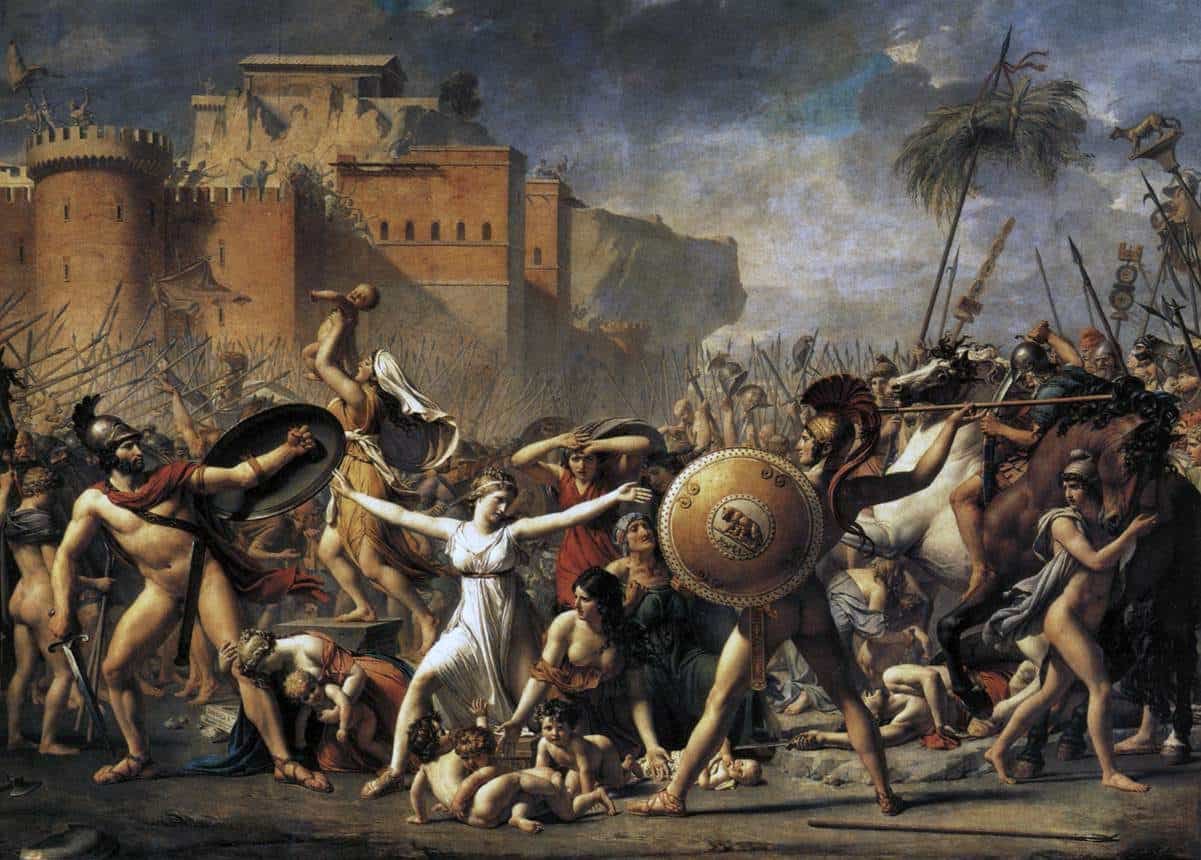
The name comes from Reate, the Latin place name of the city, and on Reate there are three versions, all ancient and none provable. The first ties it to Rhea Silvia, the mother of Romulus and Remus, who according to a local tradition was supposedly buried alive right here by her uncle Amulius, furious about the vow of chastity broken by his niece. This reading underlines Rieti's role as mother of Rome, a role that legend assigns to the Sabina also through the Rape of the Sabine Women, which traces the descent of a large part of the Roman people to the Sabine stock, and which history confirms in the very dense relations between Romans and Sabines, a powerful people even before the founding of Rome and who gave the city two of its seven kings. The second version derives Reate from Rhea, the mother of the gods and wife of Cronus. The third, the one I prefer because it has a basis in the landscape, invokes the Greek root reo, to flow: an evident reference to water, the ancient wealth of the Rieti territory, and to the Velino lake that shaped its history and development. Varro, who was a son of Rieti, would have appreciated the dispute.
The History of Rieti (RI) from Its Origins to Today
Sabine Reate and the Roman Conquest
Ancient Reate was born at the start of the Iron Age, between the 9th and 8th centuries BC. The ancient sources tell that the lands around Rieti were inhabited by the Umbrians, then conquered by the semi-legendary people of the Aborigines, among whom Reate gained importance after the inhabitants of Lista took refuge there, and finally taken by the Sabines, whom archaeological finds show settled as far as the lands near the Tiber. The first contacts with Rome have no defined outlines. It is certain, however, that between Romans and Sabines there was an interpenetration and that from a certain moment the Sabines settled on the Quirinal, contributing to the growth of the city. The legend of the Rape of the Sabine Women traces the relations between the two peoples to right after the founding of Rome, when Romulus, in search of alliances and of women with whom to populate the city, abducted the Sabines' women by trickery and unleashed war with the neighboring peoples, of whom only the Sabines remained unbeaten. The battle of Lake Curtius ended when the abducted women threw themselves between the weapons of the combatants, imposing a truce between Romulus and Titus Tatius and the collaboration of the two peoples. A more historical reading holds that it was the search for lowland pastures that pushed the Sabines toward Rome and onto the Quirinal.
However it went, the Sabines, enrolled in the Roman tribe of the Tities, gave Rome two kings, Numa Pompilius and Ancus Marcius, and some of the oldest gentes: Curtia, Pompilia, Marcia, Claudia, Valeria and Hostilia. This did not prevent centuries of wars between Romans and Sabines. In 290 BC the Sabina was definitively subjugated by Rome at the hands of the consul Manius Curius Dentatus: large territories of the plain of Reate and of Amiternum were confiscated and distributed to Roman colonists. The Sabines were offered citizenship without the right to vote, and already in 268 BC full citizenship, with enrollment in two new tribes, the Quirina and the Velina. To the same Curius Dentatus is owed the reclamation of the lacus Velinus: the waters were made to flow into the Nera by opening the cut that created the Marmore Falls and gave back to agriculture a vast plain. The conquest also transformed the city: the Roman Bridge and the viaduct beneath present-day Via Roma allowed the Salaria to cross the Velino and the marshy zone and climb to the forum, today's Piazza Vittorio Emanuele II.
Many Sabine families made careers in Rome. Among them the gens Flavia: its most famous member, the emperor Titus Flavius Vespasian, began construction of the Flavian Amphitheater, the Colosseum. And a native of Rieti, born in 116 BC, was Marcus Terentius Varro, called the Reatine, the scholar whom the ancients themselves considered the most learned of the Romans. The Christianization of the territory is attributed by tradition to Saint Prosdocimus in the 1st century. The diocese of Rieti is documented from the 5th century.
Rieti in the Middle Ages: Commune, Popes and Saint Francis
With the empire fallen, in the 6th century the Lombards arrived, having entered the peninsula in 568. Pagan, they soon converted thanks to the Benedictine monks of the nearby Abbey of Farfa. In 592 the Sabina entered the Duchy of Spoleto and Rieti became the seat of a gastaldate. After the Saracen sack in the 10th century the city was rebuilt. In 1151 it was besieged, taken by starvation and destroyed by Roger II the Norman. In 1171 Rieti became a free commune and sided with the Guelph front, under the protection of the pope. On August 23, 1185 the marriage between Constance of Hauteville and Henry VI of Swabia, son of Barbarossa and future emperor, was celebrated there in the presence of the bride alone, because Henry was held back in Germany for his mother's funeral. The marriage was repeated in Milan on January 27, 1186. Rieti was chosen for the political value of the Church's approval in the first city outside the borders of the Kingdom of Sicily that Constance met on her journey from Palermo to Milan, a journey made with a retinue of princes and barons.
The 13th century was the golden century. Rieti was several times the seat of the papal curia: Innocent III (1198), Honorius III (1219 and 1225), Gregory IX (1227, 1232 and 1234), Nicholas IV (1288-1289) and Boniface VIII (1298) resided there. In those years Saint Francis of Assisi frequented the Rieti plain, since then called the Valle Santa: a first time probably in 1209, then with a long stay in 1223 and finally from autumn 1225 to April 1226, a few months before his death. During these stays he founded the four sanctuaries of Greccio, La Foresta, Poggio Bustone and Fonte Colombo. At Greccio he set up the first nativity scene (Christmas 1223), at Fonte Colombo he wrote the definitive Rule of the order, and according to some scholars in this valley he composed, at least in part, the Canticle of the Creatures. In 1228, after the tumult of Holy Thursday, the Romans forced Gregory IX to leave the city, granting him however a safe-conduct to Rieti. The affair arose from the excommunication imposed on Frederick II for the continual postponement of the crusade promised to Honorius III. On July 13, 1234, in the Cathedral, the same Gregory IX canonized Saint Dominic, founder of the Order of Preachers. On May 29, 1289 Charles II of Anjou was crowned in the Cathedral king of Sicily and Jerusalem by Nicholas IV.
During the Avignon papacy Rieti was conquered by the king of Naples and torn apart by the struggles between Guelphs and Ghibellines, of which the great Roman houses, the Orsini above all, took advantage to create a feudal domain for themselves. Cardinal Albornoz's expedition in 1354 stopped the barons and prepared the pope's return to Rome in 1377. In 1378 the city gave itself in lordship to Cecco Alfani, whose family governed it until 1425.
Rieti in the Modern Age: Latifundia, Woad and the Risorgimento
The 16th century saw the rise of the great landowning families, Vincentini, Vecchiarelli and Potenziani, who exploited the plain, still being reclaimed, to set up farming estates. Their palazzi are still the finest in the city. In the 18th century the plain was known for woad, the dye plant that grew in the lake lands and that served, it is said, to dye the uniforms of the Napoleonic troops blue. Between 1798 and 1799, during the Roman Republic, Rieti was a district seat in the Department of the Clitunno, with Foligno and Spoleto. After the Papal State was annexed to the Napoleonic empire in 1809, the city entered the Department of Rome and in 1812 was the head of an arrondissement. With the Restoration, in 1816, Pius VII divided the State into 17 delegations: Rieti was the seat of a third-class delegation, the least important, with district governments in Rieti and Poggio Mirteto. In 1850 Pius IX merged the delegations into five legations and Rieti ended up in the Legation of Umbria with Perugia as its seat.
The position on the border between the Papal State and the Kingdom of the Two Sicilies made Rieti very active in the Risorgimento. On March 7, 1821 the Battle of Rieti-Antrodoco, considered the first of the Italian Risorgimento, saw the defeat of the Neapolitan constitutionalists of Guglielmo Pepe by the Austrians of General Johann Maria von Frimont, who for the victory obtained from Ferdinand I the title of Prince of Antrodoco. In the brief Roman Republic of 1849 three Reatines and a Mirtense (Francesco Battistini, Giuseppe Maffei, Mario Simeoni and Ippolito Vicentini) sat in the constituent assembly, and Giuseppe Garibaldi, with his wife Anita, was in Rieti for almost three months, from January 29 to April 13, 1849, to guard the border with the Kingdom of the Two Sicilies. The general lodged in the palazzo of the marchesi Colelli and requisitioned the Bishop's Palace as a dormitory for his Legion. On his departure many volunteers followed him, among them the young Michele Paolessi and Carlo Tosi, who fell in the defense of Rome.

Rieti and the unification of Italy
On the eve of unification, Cavour's international agreements provided that Rieti would remain with the pope, but the Reatines obtained the separation of their territory from the Patrimony of Saint Peter and therefore the chance to join the Kingdom of Italy immediately, unlike other papal territories such as Viterbo, which had to wait for Porta Pia. On September 23, 1860, in a city covered with tricolor flags, the Italian army entered with two regiments of grenadiers who accompanied the Royal Commissioner for the province, Count Oreste Biancoli of Bagnacavallo. On November 3 and 4 the plebiscite decreed annexation with 1963 votes in favor, 3 against and 4 void. In 1867 Rieti and the Sabina saw the campaign of the Agro romano: on October 23 Garibaldi passed through the city a second time on his way to Rome, and at Mentana 80 Reatine volunteers fought, among whom Pietro Boschi and Ettore Lucandri fell. Three years later, in the breach of Porta Pia, the Reatine Domenico Martini died.
In the Kingdom of Italy Rieti was the seat of a circondario within the province of Perugia, together with Terni and the rest of Umbria. The request to unite Rieti and Cittaducale in a province of the Sabina went unanswered and the city's role remained marginal. An attempt at renewal is owed to Giacinto Vincenti Mareri, who founded a farm open to new crops and, in 1846, the Cassa di Risparmio di Rieti. Following his example, Prince Giovanni Potenziani started the cultivation of sugar beet. The city remained tied to that plant for a long time: in 1873 the Rieti sugar refinery was inaugurated, the first in Italy, which from 1887, with Emilio Maraini, produced on a national scale. At the beginning of the 20th century the studies of Nazareno Strampelli, conducted right in Rieti, gave Italy high-yield wheat varieties resistant to adverse conditions: the "battle for grain" of the 1920s was fought with seeds selected in this plain.
From the 1927 province to today
In 1923 the territory of Rieti was detached from Umbria and placed in the province of Rome. With Royal Decree no. 1 of January 2, 1927, the government established 17 new provinces, including that of Rieti, joining the circondario of Rieti to the former circondario of Cittaducale, until then part of the province of L'Aquila, with the declared aim of recomposing the historic region of the Sabina. The following year the municipalities of Contigliano, Cantalice, Poggio Fidoni and Vazia were suppressed and merged into Rieti. Only after the war did the first two become autonomous again. Promotion to provincial capital accelerated growth. The shift to the industrial economy was marked by the Supertessile, a large artificial silk plant set up by Baron Alberto Fassini and later acquired by SNIA Viscosa, which employed thousands of workers and made Rieti one of the major manufacturing centers of Lazio. Then came Montecatini and the airport, which favored the birth of the aeronautical industry ORLA.
The Second World War hit hard: the Allied bombing of November 19, 1943 damaged the plants on Viale Maraini, the station and the airport. On April 9, 1944 the massacre of the Fosse Reatine took place. On June 6, 1944 the bombing of the Borgo district caused many victims and razed part of the rione to the ground. On June 12 and 13 the retreating Germans blew up Porta Cintia and the Roman bridge rebuilt in 1939, damaged the airport, sugar refinery and factories, and looted the city. On June 16, 1944 the British entered. From the 1960s the Rieti-Cittaducale industrial nucleus, financed by the Cassa per il Mezzogiorno, gave a new push. Then the end of public contributions and the lack of fast connections opened a crisis that is still going on, and the city debate revolves around the reclamation of disused industrial areas, sugar refinery and Supertessile first among them, now absorbed into the urban fabric.
A curiosity about Rieti (RI)
In Piazza Cavour, facing the Ponte Romano, stands the only Italian monument dedicated to a defunct currency: the Monumento nazionale alla Lira, inaugurated on March 1, 2003, a year after the definitive farewell to the old currency. The work, designed by Daniela Fusco and cast by the Fonderie Caggiati of Parma, was made by melting 2,200,000 coins of 200 lire collected for the occasion: it represents turreted Italy holding up a large one-lira coin, while on one of the drapes wrapped around her runs the inscription "L'Italia per la Lira". The front face reproduces the lira minted in 1951. The back originally reproduced the lira of 1861 but was replaced in 2008, and today the statue holds in its hands a coin bearing the obverses of the first and last lira minted. On one side runs a trickle of water that symbolizes the Velino, the true wealth of Rieti and its province. Why Rieti? Because the Sabine capital city is, by tradition, the center of the peninsula: and a coin that had unified the country deserved to be remembered in its navel. I'll add a detail the Reatines like to tell: the monument to the Umbilicus Italiae in Piazza San Rufo, from 2001, is low and round, and the city has renamed it "la caciotta". A people who make fun of their own center of the world is a people you enjoy being at the table with.

What to see in Rieti (RI): the historic center place by place
The historic center occupies a slight rise at the edge of the basin, protected on the north side by a medieval wall among the best preserved in Lazio and on the south side by the Velino. Via Roma, the liveliest street, cuts it in two and separates the medieval rioni of San Francesco, San Rufo, della Verdura and Santa Lucia. The city has two Franciscan sanctuaries in its own territory, Fonte Colombo and La Foresta, and two more a few kilometers away, at Greccio and Poggio Bustone: many pilgrims arrive in the Valle Santa to retrace the steps of the two saints with the Cammino di Francesco or the Cammino di San Benedetto. But before the sanctuaries comes the city, and the city is visited like this.
The Cathedral of Santa Maria Assunta, religious heart of Rieti (RI)
The Cathedral dominates Piazza Cesare Battisti and tells eight centuries in a single building. Work began on April 27, 1109 under Bishop Benincasa. The first part completed was the lower basilica, the crypt, consecrated in 1157, a single space marked by 16 reused columns in nine small aisles, with groin vaults and traces of 14th-century frescoes. The upper church was consecrated on September 9, 1225 by Honorius III. The exterior is Romanesque: stone facade, portal, the portico added in 1458 at the wish of Bishop Angelo Capranica, which connects the baptistery to the cathedral, and the bell tower by the Lombard masters Pietro, Andrea and Enrico, raised around 1252-1253 and about 40 meters high, badly damaged by the earthquake of 1898. The interior is instead Baroque, redone in the 18th century. The earthquake of 1785 brought down the apse, rebuilt with the dome in 1794-1795. In 1841 Gregory XVI raised the church to a minor basilica.
The reason an art lover comes all the way here is the chapel of Santa Barbara, patron saint of the city: the design is by Gian Lorenzo Bernini, and the statue of the saint was carved by Giovanni Antonio Mari from a sketch by Bernini himself, while the altar, by Sebastiano Cipriani, dates to 1725. In the church there are sculptures by Bernini, Mari, Lorenzo Ottoni and Federico di Filippo di Ubaldo da Firenze, and paintings by Antoniazzo Romano, his son Marcantonio Aquili, Lorenzo Torresani, Andrea Sacchi, Giovan Francesco Romanelli, Lattanzio Niccoli and Vincenzo Manenti: a sampler of Roman and Rieti painting between the 15th and 17th centuries. It's best to go in twice: the first time in the morning, when the light comes in from the portico and the crypt can be visited at leisure, the second at sunset, when the Bernini chapel lights up. And don't neglect the baptistery of San Giovanni in Fonte, today the core of the Museo Diocesano. Here, on July 13, 1234, Saint Dominic was canonized. Here, on May 29, 1289, Charles II of Anjou was crowned.
The Bishop's Palace or Papal Palace and the Arch of Boniface VIII
To the right of the Cathedral, with its long side on Via Cintia, rises the Bishop's Palace, also called the Papal Palace because it was built in 1283 to host the papal curia and gave lodging to several popes. The Romanesque facade, with the loggia restored to its original appearance by a restoration of the early 20th century, hides on the ground floor one of the most spectacular medieval halls in Lazio: a large two-aisle hall covered by Gothic groin vaults supported by six pillars, the so-called Sala delle Volte, now used for exhibitions and ceremonies. On the first floor the Audience Hall has housed the picture gallery of the Museo Diocesano since 2005. Spanning Via Cintia and leaning on the palace is the Arch of Boniface VIII, also called the Bishop's Arch, built by the pope in 1298 after he himself, a guest in Rieti, had watched in terror an earthquake: a covered link between the palace and the Cathedral so that he would not have to cross the street. Anyone who knows the Palace of Boniface VIII in Anagni will find here the same idea of papal power turned into architecture.
The Museo Diocesano of Rieti (RI)
The Museo Diocesano of ecclesiastical heritage is a multi-stop route inside the Cathedral complex: the Museum of the Cathedral Treasury in the baptistery, first set up in 1974 by Luisa Mortari. A collection of liturgical furnishings in the rooms next to the crypt. The lapidary collection in the vestibule leading from the crypt to the Bishop's Palace. The Diocesan Picture Gallery in the Audience Hall. In the baptistery is kept a Renaissance baptismal font with sculptures of prophets and saints. Among the goldwork stands out a series of about 20 processional crosses of the 13th-14th century and reliquary pyxes of the 15th century, with the cross of Vallecupola of around 1563, commissioned by the Farnese from Jacopo del Duca, a pupil of Michelangelo. Among the sculptures are marble lions of the 12th century and processional stone statues. Among the ivories is a crozier scroll of the 14th century that has become the museum's logo. The picture gallery gathers frescoes detached from the mendicant churches, among them a 14th-century cycle with Franciscan stories from San Francesco, and paintings from the 16th to the 18th century, with a Presentation in the Temple by Baciccio of around 1704. The openings indicated are Saturday afternoon and Sunday, with free entry. For a group it's best to phone and ask for an opening by reservation.
The Basilica of Sant'Agostino
Raised in the middle of the 13th century, it is one of the most important churches in the city and the current site of the celebrations of the Giugno Antoniano. The Romanesque-Gothic stone facade has a portal topped by a tympanum and a rose window and ends with a barely projecting attic. The single-nave interior is covered by wooden trusses and closes with three apses on which open a three-light window and two two-light windows: a mendicant spatiality, sober and tall, designed for preaching rather than for show. Anyone coming from Rome and familiar with Baroque churches will be amazed at how little is needed, in a church like this, to feel in the right place.
The Church of San Domenico and the Dom Bedos-Roubo Organ
San Domenico was built from 1266, right after the canonization of the founder of the order, which took place in Rieti itself in 1234. After almost two centuries of abandonment it has been recovered and reopened. The interior is consequently rather bare, but two frescoes by Liberato da Rieti, the Rieti painter of the early 15th century, survived, one of which was detached and moved to the Museo Civico in the 1960s. The surprise is the Dom Bedos-Roubo organ, 14 meters tall, built following two 18th-century treatises on organ building, one of the few instruments in the world made with that philological rigor. If you happen to be in the city during a concert, go in, because you won't forget it.
The Convent of San Domenico: Cloister of Blessed Colomba and Oratory of San Pietro Martire
Next to the church stands the former convent, which includes the cloister of Blessed Colomba, with frescoed lunettes and an Italian garden, and the oratory of San Pietro Martire, a small chapel that holds a Last Judgment by the brothers Lorenzo and Bartolomeo Torresani (1552-1554), the most ambitious painting enterprise of 16th-century Rieti. The complex, however, is part of the Verdirosi barracks and is visited only on set days and with permission: ask the tourist office or the parish, because opening is not guaranteed and can't be improvised.
The Church of San Francesco, Second in the World After Assisi
Built in 1253 on the square of the same name, it was the second church dedicated to the saint after the basilica of Assisi. Romanesque-Gothic, it has a very simple pedimented stone facade, with a splayed portal topped by a lunette and a small rose window. The three-nave interior is covered by trusses that replaced the Baroque vault collapsed in the earthquake of 1898. Next to it stand the oratory of San Bernardino and the former convent with the cloister, home of the Carlo Jucci science high school. From here the Procession of the Ceri of the Giugno Antoniano traditionally starts. In recent years the celebrations have been based in the basilica of Sant'Agostino, and before planning a visit for the festival it's best to check which of the two churches is open, because the city's historic buildings still bear the marks of the earthquakes of 2016.

The Church of Sant'Antonio Abate
Commissioned from Vignola in 1570 and completed in the 17th century, it is part of a 14th-century complex that included a hospital and a cemetery. The building is closed and in an advanced state of decay: you look at it from outside, for the architect's name and for the tradition of the carters of Porta d'Arci, who brought their horses here for the blessing on January 17, a tradition revived in 1980 with the parade of the ribboned horses.
Santa Lucia, the Paroniana Library and Bernini's Nieces
The church and convent of Santa Lucia were founded in 1253 through the interest of Blessed Angelo Tancredi, one of the first companions of Francis. The church seen today is the result of work in the first half of the 18th century. The convent was important: three nieces of Gian Lorenzo Bernini were nuns there, and for this reason the master made for the church two statues and the high altar, still preserved, and perhaps a painting that scholars more readily assign to Ciro Ferri, his collaborator. Expropriated after unification, the convent today houses a cultural hub with the Paroniana municipal library and the archaeological section of the Museo Civico. It is the rare case of a family Bernini, made out of affection and not for a pope: and you can see it in the restraint.
San Rufo and Spadarino's Guardian Angel
The church of San Rufo faces the small square of the same name, where tradition places the center of Italy. The origins are early medieval, but the current building dates to 1748 and is the work of Melchiorre Passalacqua: neoclassical exterior, Baroque interior. Here is kept the most important painting in the city, the Guardian Angel, today assigned by critics to Giovanni Antonio Galli called Spadarino, one of the most refined of the Roman Caravaggisti, but attributed in the past even to Caravaggio. That the attribution has come down a notch takes nothing from the canvas: the light that strikes the angel and the child is that of the Rome of 1620, and finding it in a neighborhood church, without a ticket, is one of the pleasures of Rieti.
The Former Church of Santa Scolastica, Auditorium Varrone
Built between 1696 and 1717 to a design by Francesco Fontana, son of the more famous Carlo, it is the only church in Rieti with a Greek-cross plan. Deconsecrated, it is today the Auditorium Varrone, the city's concert hall, returned to the diocese's ownership but kept available for musical life. Anyone who loves Benedictine monasteries will find the real Monastery of Santa Scolastica at Subiaco. Here what remains is the dedication and a lovely late Baroque architecture.
San Pietro Martire and the Portal of 1546
Built in 1266 by the Cistercians, it has a very simple facade of travertine blocks bounded by two pilasters. The notable element is the portal of 1546, the work of Giacomo da Locarno and Stefano da Como, with six small stone columns, three per side, each resting on a shield with the bust of Saint Peter, which support the architrave. The portal was originally on the facade of the oratory of San Pietro Martire near San Domenico and was moved here in 1576: a case of Renaissance reuse that explains why the facade and the door don't speak the same language.
The Former Church of San Pietro Apostolo, Now a Bookshop
Earlier than the 12th century, it is on Via Roma. Deconsecrated, it houses a bookshop. It is the right place to buy a historical guide to the city or a book on the Cammino di Francesco, sitting under a medieval vault.
The Convent of Sant'Antonio al Monte
Built at the end of the 15th century on the hill of San Biagio, south of the city, with the church extensively renovated in the mid-17th century. You go up mainly for the view, which takes in the historic center, the Velino and the Terminillo.
Santa Maria della Scala, the Auditorium of the Poor and Thorvaldsen
The former church of San Giovenale and San Vincenzo Ferreri, called Santa Maria della Scala, is deconsecrated and known as the Auditorium of the Poor. It hosts cultural events. Inside is the bas-relief The Genius of Death by Bertel Thorvaldsen, the great Danish sculptor trained in Rome in Canova's circle, commissioned by the poet from Rieti Angelo Maria Ricci for the tomb of his wife Isabella Ricci Alfani. A Thorvaldsen in Rieti is one of those things you discover by chance and tell about for years.
The Other Places of Worship in Rieti (RI)
The city also has a Christian Orthodox church of the Saints Barbara and Joseph the New of Patros, the Mosque of Peace and an International Missionary Evangelical Christian Church: a sign of a community that, though small, stopped being only Sabine a long time ago.
Something Nobody Tells You About Rieti (RI)
The main street of Rieti is fake. Via Roma, the cardo of the historic center, doesn't rest on the earth but on a series of Roman arches of the 3rd century BC, the viaduct by which Via Salaria crossed, raised up, the marshy zone between the Velino and the forum. For centuries the arches stayed buried and built into the cellars of the noble palaces that line the street. Today they are visited with the guided route of underground Rieti, which enters through an anonymous door, goes down into the underground and walks beneath the cars and shop windows along the ashlar masonry of the Romans, with the cuts of the Sabines, the medieval enlargements and the counts' cisterns. The visit lasts about an hour and three quarters, costs 7 euros, is held Saturday at 18:00 and Sunday at 11:00 with departure from Piazza Cavour, next to the Roman Bridge, and is booked by phoning 347 7279591. Groups over 15 people have dedicated times. The thing nobody says is that the Roman Bridge itself, also from the 3rd century BC and part of the Salaria, the main access to the city from the south and the link between the center and the Borgo, was demolished in the 1930s because it was too low relative to the river level, which had flooded and damaged it several times. Its remains were laid in the water and still emerge from the bed of the Velino, next to the modern bridge built after the war. A Roman bridge you look at from above, at water level, while ducks swim over it: no guide puts it on the cover, and it is the right place to start.
The Palaces of Rieti (RI): Power in Stone
The Palazzo Comunale and the Museo Civico of Rieti (RI)
It is the most important palace on Piazza Vittorio Emanuele II, home of the town hall and of the history and art section of the Museo Civico. It dates from the 13th century and has undergone repeated enlargements and reconstructions. The facade is by Filippo Brioni (1748), late Baroque, with two orders of windows and a small bell tower, and on the ground floor a portico under which are the busts of Giuseppe Garibaldi and Victor Emmanuel II. On the left side rises a five-story tower faced in travertine, from 1940. The Museo Civico is made up of two sections. The history and art section, on the top floor of the Palazzo Comunale, keeps a Hebe by Antonio Canova, the original plaster with gilding from around 1815, coming from Palazzo Ricci. A polyptych by Luca di Tommè from 1370. Works by Antoniazzo Romano, including the Madonna of the Milk of 1464, the oldest attributed to him. The triptych of the Crucifixion by Zanino di Pietro. Works by the Rieti artists Antonio Gherardi, Carlo Cesi and Antonino Calcagnadoro, to whom an entire room is dedicated. The archaeological section, in the former monastery of Santa Lucia, displays sculptures, coins, goldwork and objects from prehistory to the Roman age, passing through the Etruscan and Hellenistic phases, with an Iron Age hut urn from the necropolis of Campo Reatino, Roman inscriptions and the wing dedicated to the Sabines with materials from recent excavations. The current hours and prices are those in the first paragraph: other fees and days still circulate among the sources, so go by the museum's site.
Palazzo Dosi Delfini
It too stands on Piazza Vittorio Emanuele II and is home to the Sabina Universitas. The limestone rusticated facade mixes late Baroque and first hints of neoclassicism. Inside is a small elliptical courtyard, and on the first floor a bronze statue of Santa Barbara.
Palazzo Vincentini, of the Prefecture or of the Government
A Renaissance palace on Piazza Cesare Battisti, today home to the Prefecture. Its reconstruction in the present forms began in 1589 on a design long attributed to Vignola, for the forms that recall him. Critics today assign it to Giovan Domenico Bianchi. The side toward the Cathedral has a loggia with two orders of arches that opens onto an Italian garden with a view of the south side of the city. The garden has been public since 1927, when the Vincentini ceded the palace to the newborn province. The ground floor is decorated with paintings of 1932 depicting Varro and Vespasian. On the first floor, in the Prefect's apartments, a 16th-century fireplace in polychrome marbles with gold inscriptions. The garden is the right spot for a break in the shade a couple of steps from the cathedral.
Palazzo Vecchiarelli
On Via Roma, with an imposing portal and an elegant late Renaissance facade. It was built at the end of the 16th century to a design by Carlo Maderno, the architect of the facade of Saint Peter's. It is striking that Rieti had Maderno before Rome did.
Palazzo Vincenti Mareri
The historic residence of the Vincenti Mareri counts, it owes its 19th-century neoclassical appearance to Giuseppe Valadier, who enlarged it by merging it with the preexisting palaces of the Aligeri and the Cerroni. Two rusticated portals lead to the inner court with an Italian garden and a fountain topped by a terracotta Ceres, a copy of a Roman original.
Palazzo Ricci
Neoclassical architecture with the facade on Piazza Oberdan and the side on Piazza Mazzini. It belonged to the family of the poet Angelo Maria Ricci and today houses municipal offices. A notable collection of mostly 17th-century paintings was gathered there, whose crown jewel was the original plaster of Canova's Hebe, now in the Museo Civico.
Palazzo Potenziani Fabri
On Via dei Crispolti, with a series of frescoes inside. Founded in the 13th century, it belonged to the Fabri and then to the Potenziani until 1979, when a long restoration returned it to its original appearance. Today it is the seat of the Fondazione Varrone and is visited only during exhibitions and events.
Palazzo Secenari, Palazzo del Seminario, Palazzo Crispolti
Palazzo Secenari, from the 14th century, on Via Roma, is recognized by a 15th-century two-light window. The Palazzo del Seminario rose in place of the Palazzo Pretorio and of the Podestà of the late 13th century and was inaugurated as a diocesan seminary in 1564: the first seminary established according to the norms of the Council of Trent, if one excludes the tiny seminary of Larino. The work was directed by Vignola, although later enlargements make his hand hard to recognize. Palazzo Crispolti was built at the start of the 18th century by Michele Chiesa of Como, with the facade redesigned in 1814 by Giuseppe Subleyras. In 1877 it passed to the Cassa di Risparmio di Rieti, which refitted it to a design by the engineer Angelo Blasetti and made it its main headquarters.
The Post Office Palace and the Carabinieri Command
The Palazzo delle Poste, from 1934, closes off Via Garibaldi and is the work of Cesare Bazzani, the architect of the Galleria Nazionale d'Arte Moderna in Rome: good-quality monumentalism of the regime. The seat of the Provincial Carabinieri Command, in the Micioccoli district, is from 2003 to a design by Manfredi Nicoletti, the only contemporary designer-signed building in the city.
The Teatro Flavio Vespasiano, the Jewel of Rieti (RI)
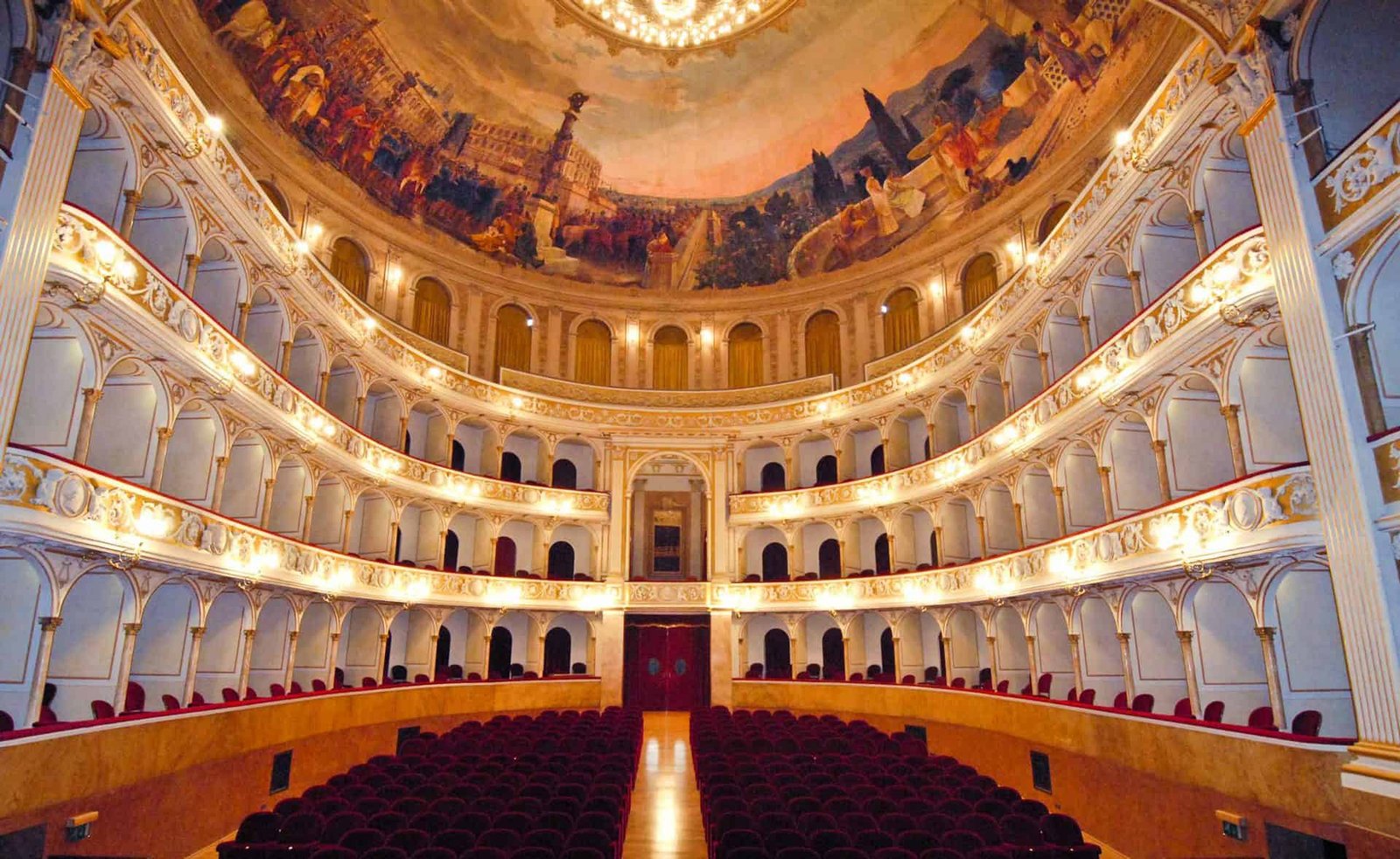
On Via Garibaldi stands the city theater, built between 1883 and 1893 to a design by Achille Sfondrini, the Milanese who had just signed the Teatro Costanzi in Rome, today the Teatro dell'Opera. The foundation stone was laid on December 16, 1883. The inauguration took place on September 20, 1893 with Gounod's Faust and Mascagni's Cavalleria rusticana. The hall has 230 seats in the stalls, three tiers of boxes for 72 boxes and a gallery. The dome is decorated with a tempera by Giulio Rolland with the triumph of Titus and Vespasian (1901), the foyer with an Allegory of Music by Federico Ballester (1892), and the historic curtain is the Surrender of Jerusalem by Antonino Calcagnadoro (1910), a tempera on canvas of more than 13 meters by seven, restored in 2019. The theater is famous for its acoustics: in 2002 Uto Ughi gave it the national prize for Acoustics, and Bruno Cagli, of the Accademia di Santa Cecilia, called it the best in the world in this respect. The great restoration of 2005-2009 brought it back to splendor. The drama season, the Reate Festival and the Rieti Danza Festival are held there. If there is a show on the program, organize your day around it.
My Advice for Visiting Rieti (RI)
Come on a Saturday, and come early. I say this because Rieti has a flaw that no guidebook admits: its museums are open very little. The Museo Civico is open Friday through Sunday, the Museo Diocesano on Saturday afternoon and Sunday, Underground Rieti on Saturday evening and Sunday morning, and the San Domenico convent with the Giudizio dei Torresani only with permission. A tourist who arrives on a Tuesday sees the churches, the walls and the river, which are beautiful, but goes home without having seen Canova's Ebe, the Duomo treasury and the Roman viaduct. A tourist who arrives on a Saturday at 10 sees it all. The recommended itinerary is this: you park along the Velino, look at the submerged Roman Bridge and the Monumento alla Lira, walk up Via Roma to Piazza Vittorio Emanuele II, go into the Museo Civico, continue along Via Cintia to the Cathedral, the crypt and the Papal Palace, have lunch in the San Rufo district, touch the caciotta at the center of Italy, leave through Porta d'Arci and climb to the Colle San Mauro viewpoint for the afternoon photograph. At 16:00 you head back for the Museo Diocesano and at 18:00 you go down beneath Via Roma with the guided tour. Sunday is for the Franciscan sanctuaries, Fonte Colombo and La Foresta in the morning, Greccio in the afternoon, and then back to Rome for dinner. If you have only one day, choose the city and leave the sanctuaries for a second trip: done in a rush, they give you nothing. If you want a guide who can hold Bernini, Francis and the Sabines together without mixing up the eras, and maybe an organized lunch, contact TourLeaderPro, which organizes private tours and tours for corporate groups outside Rome too.
The walls and gates of Rieti (RI)
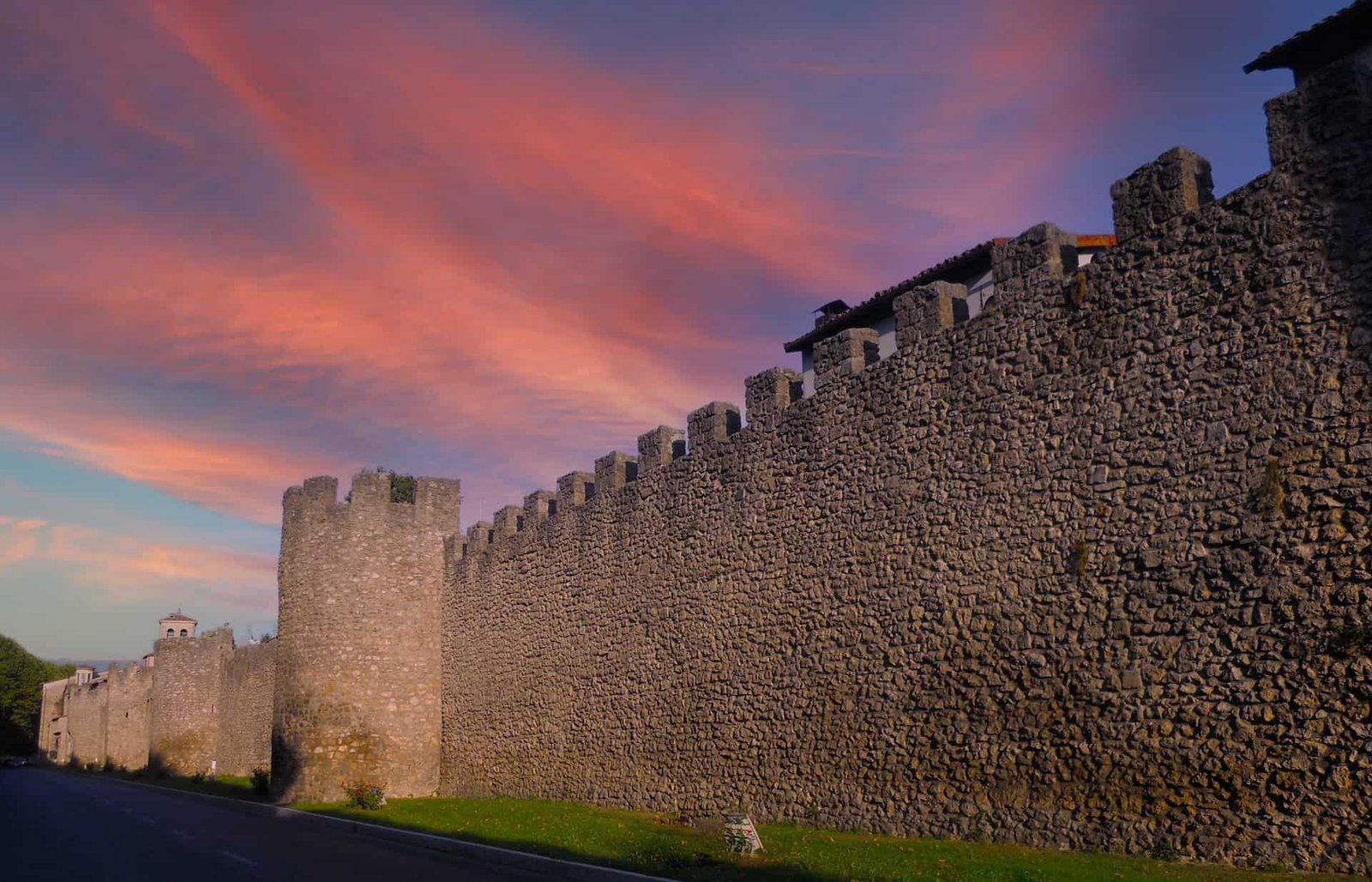
Little remains of the Roman-era circuit, but the traces are many, above all where later buildings reused its blocks. The medieval walls, on the other hand, are a monument in their own right: they date to the 13th century and are considered among the most imposing and best preserved in Lazio. They enclose the city along the whole northern side and, together with the Velino and the cavatelle, the now-dry canals of Borgo and Fiume de' Nobili, they formed a complete defensive system. Five gates opened along the walls. Porta d'Arci, to the east, on the Salaria toward Cittaducale, L'Aquila and Ascoli Piceno, is the gate of the carters and of horses decked out with ribbons. Porta Conca, to the north, still has its wooden shutters from the 1500s: look at them, because city gates with original doors from five centuries ago can be counted on the fingers. Porta San Giovanni, also to the north, at the end of Via Pennina, which with Via Roma forms the north-south axis of the center, was walled up in the 15th century. The traces are visible and a small opening lets pedestrians through. Porta Cintia, to the northwest, on the road to Terni, was destroyed in World War II, blown up by the Germans in June 1944, and two Rationalist reinforced-concrete buildings now stand in its place. Porta Romana, to the south, beyond the river, faced the Salaria toward Rome. The most beautiful walk is the outside one, along Piazza Marconi and Viale Morroni, where the walls run unbroken with their towers and walkways: in the morning the sun lights them from the front, and that is the right moment.
Medieval streets, squares and arches of Rieti (RI)
Piazza Vittorio Emanuele II
It is the main square, the ancient forum, and it is overlooked by Palazzo Comunale, Palazzo Dosi and the historic Gengarelli and Quattro Stagioni cafes, with the 17th-century Dolphin Fountain at the center. It is the living room where the city meets and the point from which all visits start.
Via Roma, the cardo on the viaduct
The main street of the center runs over the arches of the Roman viaduct of the 3rd century BC, the urban stretch of the Salaria, which can be visited with Underground Rieti among the cellars of the noble palaces. Shops, the bookstore in the former San Pietro Apostolo, Palazzo Vecchiarelli and Palazzo Secenari: you walk it slowly, with your nose in the air and the awareness of walking on a Roman road still in use.
Via Cintia and Via Garibaldi, the decumanus
Together they make up the city's decumanus and line up some of the most important buildings, from the Bishop's Palace with the Arch of Boniface VIII to the Teatro Flavio Vespasiano and the Palazzo delle Poste.
Piazza San Rufo, the center of Italy
A medieval small square reachable by four narrow alleys, with the church of San Rufo and, by tradition, the exact location of the geographic center of the peninsula, the Umbilicus Italiae. A plaque and the monument of 2001, low and circular, which the city calls the caciotta, recall it. Modern geography, which calculates centers of gravity with satellites, places the center of Italy elsewhere, but tradition is older than satellites and in Rieti it counts for more.
The Arch of Boniface VIII and the other arches
Besides the Bishop's Arch of 1298, which spans Via Cintia, the streets of the historic center are scattered with medieval arches: that of Santa Lucia, from the 13th century, that of the Seminario, that of Via del Forno. They are the urban planning signature of a city that in the 13th century grew by additions and raised stories, and that needed to connect houses and palaces over the streets.
The Pozzi Area and the Pincetto
The area of Via dei Pozzi keeps the typical fabric of the medieval city, narrow alleys and arches, and is the part to walk without a map. The Pincetto is the ramp that connects Piazza Oberdan with Via Centuroni, so called by analogy with the climb of the Pincio in Rome: the people of Rieti have always looked at the capital with a mix of pride and irony, and the place names say so.
Another Well-Known Fact, Yet Rarely Cited
Everyone knows that the Colosseum is called the Flavian Amphitheater. Few connect that name with this basin. The gens Flavia was a Sabine family from the area of Reate: Titus Flavius Vespasian was born in 9 AD at Falacrinae, in the upper Velino valley, in the territory of present-day Cittareale, about 40 kilometers from Rieti, and his family owned lands in the Rieti basin, so much so that local tradition has it that he returned there often and that he died there, in 79, in the waters of Cotilia, where the sulfurous springs still flow today. The city theater bears his name, and the ground floor of the Prefecture depicts him next to Varro. The other illustrious man of Rieti, Marcus Terentius Varro, born in 116 BC, was the most prolific scholar of antiquity: he wrote dozens of works on language, agriculture, religion and Roman antiquities, of which we have the De lingua latina in part and the De re rustica in full, and in the De re rustica he describes precisely his Rieti lands and the livestock raising on the plain, with the pastures of the Rosea, the countryside beneath the Terminillo that the ancients called the sumen Italiae, the udder of Italy, for its fertility. The Colosseum, the Latin language and the udder of Italy: three things Rome owes to the Sabina, and which Romans remember less willingly than the people of Rieti do. The city has repaid them by naming the theater after Vespasian and the auditorium and the banking foundation after Varro: memory, here, is well managed.
The Monuments of Rieti (RI)
The National Monument to the Lira
It is also discussed among the curiosities: it stands in Piazza Cavour, facing the Roman Bridge, and is the right place to begin the visit because it sums up in bronze the identity of the city, center of the peninsula and land of water. Stop and look at the trickle running on the side: it is the Velino in miniature.
The War Memorial
In Piazza Mazzini, the work of the sculptor Giuseppe Inghilleri and of Giuseppe Calcagnadoro, it represents Victory holding up a mortally wounded hero. It was inaugurated on June 13, 1926 together with the Palazzo degli Studi, home of the classical high school and the teacher training institute: a piece of 1920s city that is worth a detour for those who love the architecture of the period.
The Right Photo to Take in Rieti (RI)
There is only one photograph of Rieti, and it is taken from Colle San Mauro. You go out through Porta d'Arci, take the road that climbs the hill east of the center and after 400 meters you find the equipped pine grove, and a few hundred meters farther on the viewpoint. From there the historic center presents itself compact, with the Cathedral bell tower, the tower of the Comune and the walls as a border, the Velino glittering below and the green plain behind, closed by the Sabine mountains: it is the photo of the images on this page, and it needs no filters. The right time is late afternoon, when the sun comes from the west and lights the facades. In the morning the city is backlit. The second photo is from the riverfront: from the left bank of the Velino, at the footbridge between Piazza San Francesco and Piazza Cavour, you frame the church of San Francesco with the river in the foreground and, on clear days, the snow-covered Terminillo behind, exactly as in the image above. It is done from November to April, when the snow is there, and with a medium telephoto lens to compress the planes. The third, for those who love details, is inside the Roman viaduct, with the flash off and a long exposure: the ashlar blocks come out better in the light of the lamps. Avoid instead the photo of the caciotta in Piazza San Rufo unless you are willing to smile: it is low, it is round, and in a photograph it really looks like a wheel of cheese.

Rieti (RI) and Water: The Velino, the Lakes and the Springs
The Velino River in the City
The Velino runs through Rieti and bounds the historic center to the south, separating it from the Borgo district. With the walls it formed the natural defense of the city. It has kept a good part of the clarity that has always characterized it, so much so that the urban stretch is inhabited by geese and mallards, visible even in the most central spots. In Rieti the riverside avenues are few, and for this reason the banks have kept a green and little-urbanized look. The left bank, the southern one, is followed in its entirety by a pedestrian and cycle path used by joggers and strollers, a kind of linear park, equipped in the first stretch with benches and exercise equipment, the so-called Giorlandina. Seven bridges cross it, from west to east: the Ponte di ferro, for road and rail. The pedestrian and cycle bridge of the Campo Scuola. The Giovanni XXIII bridge. The Roman Bridge. The pedestrian and cycle bridge between Piazza San Francesco and Piazza Cavour. The Cavallotti bridge. From any one of these bridges, at sunset, you understand why the city was born here.

Fonte Cottorella
The springs of Fonte Cottorella flow about one kilometer south of the city and give a low-mineral water that is bottled and distributed throughout the region. Around the springs there is a green area with benches and tables, a plant and a restaurant: the short outing of the people of Rieti on summer evenings.
The Rieti Plain
The plain where Rieti stands is a predominantly cultivated area and still little built up. Surrounded by the Terminillo and the Sabine mountains, it offers a landscape of corn and sunflower fields, rural farmhouses and watercourses that recalls, to those who know the North, certain Lombard countrysides. In the good season the people of Rieti stroll and exercise there along the farm roads and on the cycle route of the Conca Reatina, a flat loop suitable for children too.
The Nature Reserve of Lago Lungo and Lago di Ripasottile
About seven kilometers from the provincial capital, in the plain, the Nature Reserve of Lago Lungo and Lago di Ripasottile extends over 3,200 hectares, divided between Rieti and the neighboring municipalities. Here are Lago Lungo and Lago di Ripasottile, the only natural bodies of water left after the draining of the Velino lake, surrounded by a reed-bed wetland where you can observe mallards, moorhens, herons and other migratory birds. With binoculars and two hours of patience, at dawn, you see more species than in any oasis near Rome.
The Mountains and Hills of Rieti (RI)
Monte Terminillo, the Mountain of Rome
A good part of the Terminillo (2,216 meters), the third peak of Lazio, falls within the municipality of Rieti. It is the ski resort closest to the capital and in the 1960s and 1970s the crowds of Romans earned it the nickname Mountain of Rome. Since then tourism has fallen for decades, because of obsolete lifts and slow connections, while Romans moved to the Abruzzo mountains reached by the A24 motorway. Today they are trying to relaunch the mountain with the lighting of a stretch of the cross-country trails for night skiing and the modernization of some lifts. In summer the Terminillo is worth at least as much as in winter: the CAI-marked trails lead to the summit, to the Sella di Leonessa and to the mountain huts, and the road climbing from Rieti in 20 kilometers of hairpin turns gives, in autumn, one of the loveliest beech woods of the Apennines.
The Colle della Foresta
The Colle della Foresta (600 meters) rises to the northeast of the city, the last southern offshoot of the Reatini mountains, between the Micioccoli and Campoloniano districts. The summit is reached by following provincial road 7 for about four kilometers. There you find the hamlet of Castelfranco and the sanctuary of Santa Maria della Foresta. Several trails, especially around the sanctuary, enter the dense vegetation that covers the hill. On the hill there are also a restaurant and a golf club.

Colle San Mauro
Colle San Mauro (530 meters) is east of the historic center and south of the Villa Reatina district. After 400 meters of road from the very central Porta d'Arci you reach the pine grove equipped as an urban park, with picnic tables, and a few hundred meters farther on the viewpoint with the panorama over the historic center. On the hill also stand the convent of the Capuchin friars and Villa Potenziani, now a hotel. The vegetation is holm oaks, firs and Aleppo pines. It is the destination of the afternoon walk, and of the photograph.
The City Parks of Rieti (RI)
The main public park is the park "vittime April 6, 2009" on Via Liberato di Benedetto, two and a half hectares named for the victims of the L'Aquila earthquake, where the Festa dello studente is held every year. About one hectare each are the "June 6, 1944" park in Campomoro, which commemorates the bombing of the Borgo, the "Coriandolo" park in Madonna del Cuore, home of the Rieti Sport Festival, and the "Paul Harris" park in Micioccoli. For those traveling with small children they are the alternative to churches in the hot hours.
The Valle Santa: The Franciscan Sanctuaries of Rieti (RI)
In the surroundings of Rieti are the four sanctuaries founded by Saint Francis that give the plain the name Valle Santa. Two, Fonte Colombo and Santa Maria della Foresta, fall within the municipal territory, isolated on two rises at the edge of the plain, near the hamlets of Sant'Elia and Castelfranco. The other two, Greccio and Poggio Bustone, are in the neighboring municipalities. The route that links them is the Cammino di Francesco, a well-known and much-traveled pilgrimage.
The Sanctuary of Fonte Colombo
The sanctuary of Fonte Colombo, on the hill above Sant'Elia to the southwest of the city, is the Franciscan Sinai: in 1223, in a cave, Francis dictated the definitive Rule of the order, later approved by Honorius III. And here, in 1225, with his eyes by then diseased, he underwent the cauterization of the temples with a red-hot iron, the operation that according to the Franciscan sources he bore without pain after asking the fire to be gentle with him. You visit the little church of the Maddalena with the Tau painted by the saint, the Sacro Speco, the cave of the Rule, and the convent church. It is the most intense of the four sanctuaries, and the one where the silence is still real.

The Sanctuary of Santa Maria della Foresta
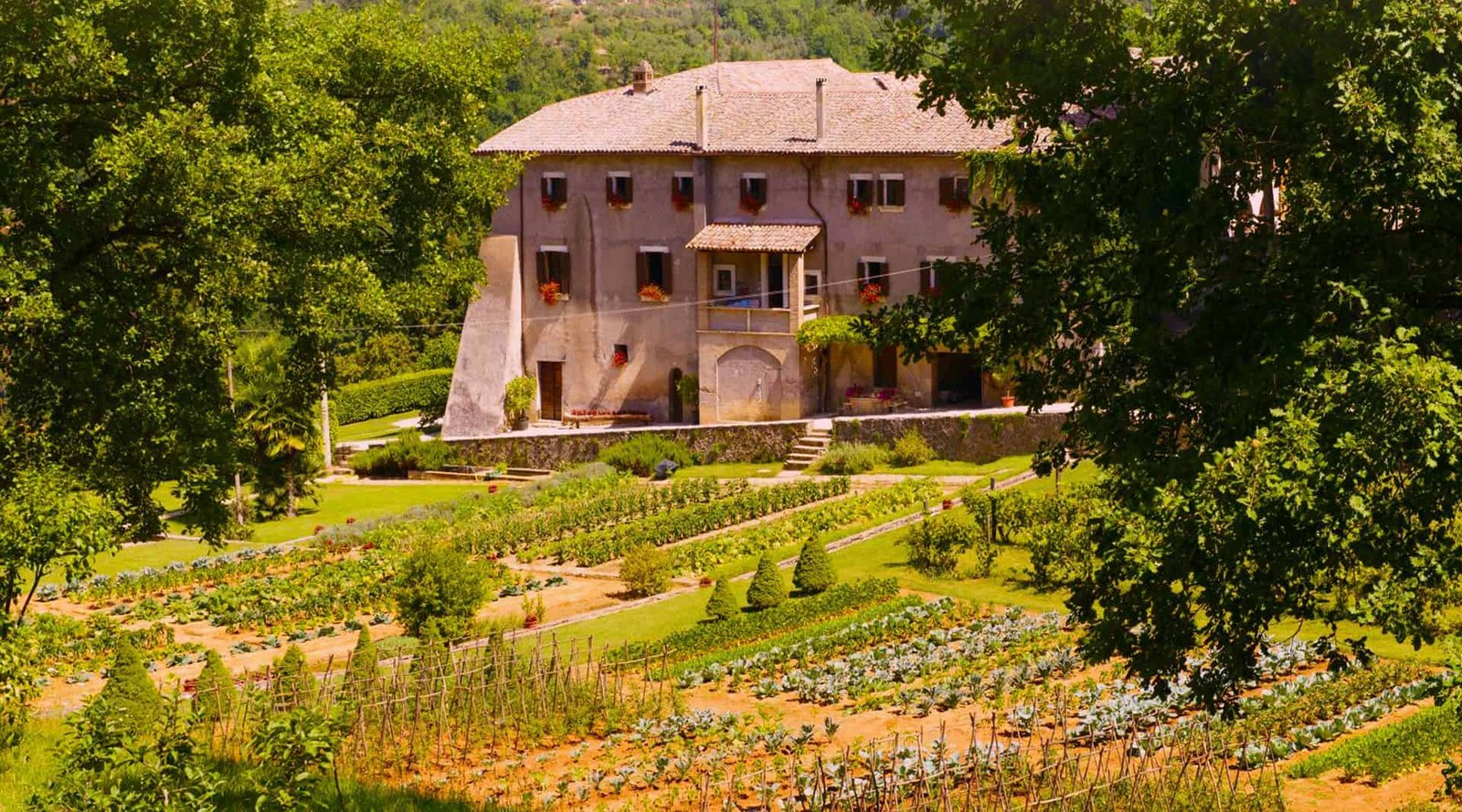
On the Colle della Foresta, to the northeast of the city, the sanctuary of Santa Maria della Foresta preserves the little church of San Fabiano, the small church of the priest who hosted Francis in 1225. Tradition tells that the pilgrims who had come running to see the saint devastated the priest's vineyard, and that Francis promised a double grape harvest, which duly arrived. The miracle of the grapes is still depicted in the convent, and the winepress can be visited. Around it, the wood and the friars' gardens, which host a recovery community: the sanctuary is visited with discretion, and is worth more for the place than for the art.
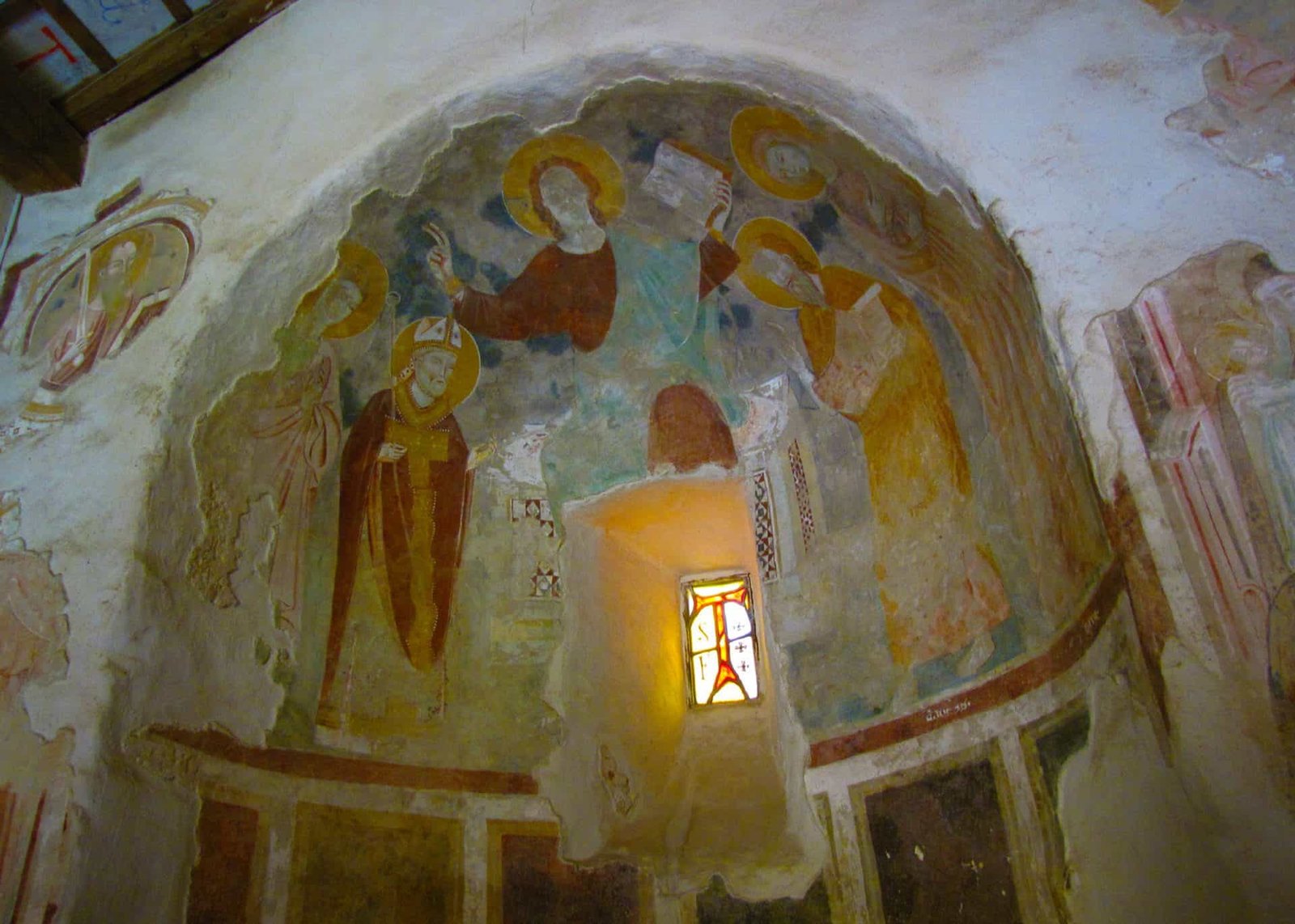
Greccio and Poggio Bustone
To the west, clinging to the rock above the plain, the sanctuary of Greccio is the place of the first nativity scene, on Christmas night of 1223, and the cave can still be visited. To the north, above the town of Poggio Bustone, the sanctuary of San Giacomo recalls Francis's arrival in the valley, in 1209, with the greeting "Buongiorno, buona gente" that the town repeats every October 4. The two destinations combine into half a day by car.
The Cammino di Francesco and the Cammino di San Benedetto
The Cammino di Francesco is the pilgrimage that winds through the plain and retraces the saint's steps in the Valle Santa, touching the four sanctuaries and other Franciscan places. About 80 kilometers long and divided into eight stages, it passes through the center of Rieti. Since 2003 it has been marked with signs and directions, and there is a Passport to be stamped at each stage, documenting completion of the route. It is a valid proposal for religious tourism and for nature tourism, and in the stages between Poggio Bustone and Greccio you really walk among the reed beds of the ancient lake. Rieti is also a stop on the Cammino di San Benedetto, the long route that from Norcia, where the saint was born, descends through Cascia, Monteleone di Spoleto, Leonessa and Poggio Bustone to Rieti, and continues through Rocca Sinibalda, Castel di Tora, Orvinio, Mandela, Vicovaro, Subiaco, Trevi nel Lazio, Collepardo, Casamari, Arpino and Roccasecca as far as Montecassino. For pilgrims Rieti is the city of the two saints: the urban stretch between Porta Cintia, the Cathedral and the Velino puts them together in half an hour of walking.

Some Important Events That Happened Here in History
Few provincial cities can list, in a single cathedral, a canonization and a royal coronation. On July 13, 1234 Gregory IX, who had fled to Rieti after being driven out of Rome, canonized Dominic de Guzmán before the entire curia: from that ceremony was born, 30 years later, the church of San Domenico. On May 29, 1289 Nicholas IV crowned Charles II of Anjou king of Sicily and Jerusalem, in a ceremony that Cardinal Giacomo Stefaneschi described in detail and that the city reenacts every late August with a costume parade. Even earlier, on August 23, 1185, the marriage between Constance of Hauteville and Henry VI had been celebrated here, by proxy, the act that brought the Swabians to the throne of Sicily and prepared Frederick II. In 1298 Boniface VIII, a guest of the Papal Palace, witnessed an earthquake and had the arch that bears his name built. In 1223 Francis wrote the Regula Bullata at Fonte Colombo. At Christmas of the same year, at Greccio, he invented the nativity scene. On March 7, 1821 the battle of Rieti-Antrodoco opened the Risorgimento with a defeat. From January 29 to April 13, 1849 Garibaldi and Anita lived in the city, and on October 23, 1867 the general passed through again on his way to Mentana. On September 23, 1860 the Italian army entered Rieti and the November plebiscite sanctioned annexation almost unanimously. 1873 saw the first sugar refinery in Italy. January 2, 1927 saw the birth of the province. November 19, 1943, April 9 and June 6, 1944 remain the dates of sorrow: bombings, the massacre of the Fosse Reatine, the destruction of the Borgo. June 16, 1944 saw the liberation. On March 1, 2003 the lira had its monument here. On August 24, 2016 the Amatrice earthquake struck the province and left marks on the churches of the capital as well. A city that has seen popes, kings, saints and generals pass through, and that talks about them without emphasis: that is what makes me prefer it to many more celebrated destinations.
Festivals, Traditions and Events in Rieti (RI)
In Rieti the calendar of festivals follows the liturgical year and that of the river. The Procession of the Ceri is the culmination of the Giugno Antoniano, the celebrations in honor of Saint Anthony of Padua, for whom there is a very strong veneration in the city, organized by the Pia Unione Sant'Antonio di Padova. On June 12 the statue of the saint is displayed and the Fiera di Sant'Antonio opens. The procession is held two Sundays later (in 2026 on June 28, with the blessing of the children on June 23), and the statue, which with its wooden machine exceeds a ton, travels through the streets of the historic center, strewn with flowers and decked with festive lights. The name comes from the large votive candles, the ceri, that most of the faithful carry lit for the whole duration. At nightfall the spectacle is one you don't forget, and for me it remains the right evening to be in the city.
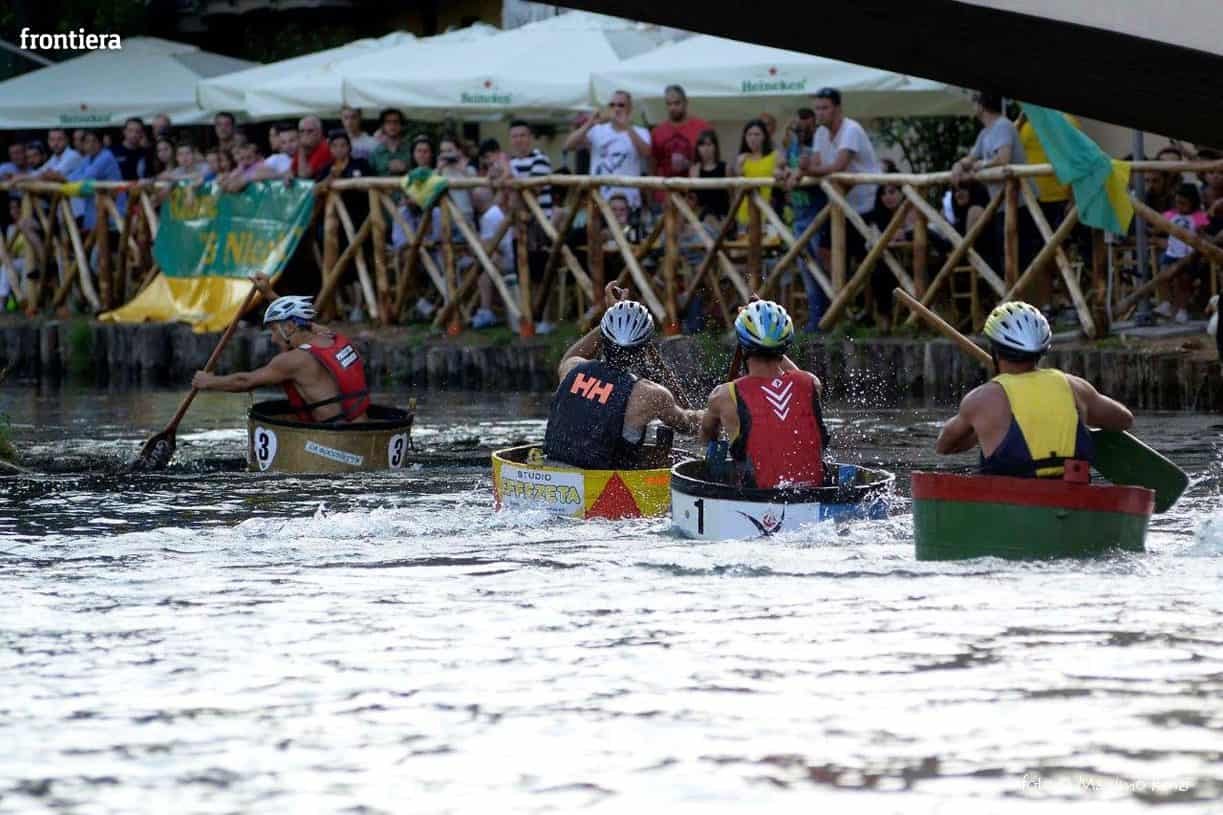
The Fiera di Santa Barbara begins on December 3, the so-called "apparsa", and ends the following day, the feast of the patron saint. It used to take place in the historic center, today it is along the streets of the Molino della Salce district. The move has taken from the fair a more beautiful backdrop, but the streets fill all the same with people looking for the most varied goods, while in the Foro Boario area a market of livestock, equipment and farm machinery is held. The Festa del Sole with the Palio della Tinozza is held at the end of July (in 2026 on July 26, 56th edition) and consists of a series of water contests in the Velino, with side events. It has recent origins but is dearly loved by the people of Rieti, who watch it from the Roman Bridge. The contests include a duel in which competitors from the districts try to knock their opponent into the water by striking him with a pole, a race of bicycles fitted with floats and paddles in place of wheels, a race of river boats, a swimming race and the Palio della Tinozza, the most awaited contest, in which competitors seated in a tub, a kind of half vat, push themselves with an oar. Two of the city's twinnings are owed to this tradition.
The reenactment of the ribboned horses, since 1980, is held on the first Sunday after January 17: a parade of riders in historic costume on decorated horses, from Piazza Chiesa del Suffragio to the church of Sant'Antonio Abate. It recalls the start of the 20th century, when the most common trade in the Porta d'Arci district was that of carter and on the day of the protector saint of animals the horses were blessed in front of the church. The reenactment of the coronation of Charles II of Anjou, which took place in 1289 at the hands of Nicholas IV, is a parade in medieval costume held at the end of August since 1998, in the same places and in the manner described by Cardinal Stefaneschi, preceded by the setting up of medieval-themed spaces and by games among the districts: ring palio, traglia race, tug-of-war and donkey race. The custom of the lights of the Ascension is almost lost: a lamp used to be placed outside the windows, on the feast of the Ascension, to show the way to the Lord rising to heaven.
The Rieti Danza Festival, born in 1991, takes place every year at the Teatro Flavio Vespasiano with classical, pas de deux, modern-contemporary and choreographic composition sections. The Reate Festival, since 2009, is an international festival that ranges from bel canto to jazz to sacred music. The final concert of the 2010 edition, in Piazza Cesare Battisti, was broadcast by Rai International in Australia, South Africa and the Americas. Rieti Cuore Piccante, the world chili pepper fair, has become the city's most popular event: in 2026, its 15th edition, it filled the historic center for 10 days, from August 28 to September 6, with stands, free concerts and spicy-food endurance contests. The calendar is completed by the Sagra dei pizzicotti alla liscianara in July, in Lisciano, the hamlet that gives its name to this hand-made pasta, and the Festa di San Biagio in February. Anyone who wants to attend one of these festivals with an organized program, perhaps for a corporate group, can turn to TourLeaderPro, which builds custom experiences outside Rome too.
Who Passed Through Rieti (RI)
The list is long and confirmed by the chronicles. Marcus Terentius Varro was born here in 116 BC and owned the lands he describes in De re rustica. Titus Flavius Vespasian, born at Falacrinae in AD 9, belonged to a family from this basin and, according to tradition, died in 79 at the waters of Cotilia, a few kilometers from the city. Constance of Hauteville married here by proxy on August 23, 1185. Saint Francis of Assisi came here in 1209, in 1223, and from autumn 1225 to April 1226. He founded the four sanctuaries, wrote the Rule, set up the nativity scene, and was treated here for his eyes by the doctors of the papal curia. Five popes lived in the city in the 13th century: Innocent III in 1198, Honorius III in 1219 and 1225, Gregory IX in 1227, 1232 and 1234, Nicholas IV in 1288-1289, Boniface VIII in 1298. Charles II of Anjou was crowned here in 1289. Cardinal Albornoz passed through with his troops in 1354. Gian Lorenzo Bernini worked here on the Cathedral and on Santa Lucia, where three of his nieces were nuns. Carlo Maderno, Vignola, Francesco Fontana, Giuseppe Valadier and Cesare Bazzani each left a palace or a church. Antoniazzo Romano, Andrea Sacchi, Spadarino, Baciccio and Bertel Thorvaldsen have a work here. Giuseppe Garibaldi and Anita lived here for almost three months in 1849 in Palazzo Colelli, and the general came back on October 23, 1867. Achille Sfondrini built the theater here, and the operas of Charles Gounod and Pietro Mascagni inaugurated it in 1893. Nazareno Strampelli selected here the wheat that fed Italy. Uto Ughi praised its acoustics in 2002. And every year tens of thousands of pilgrims on the Way of Francis and the Way of Saint Benedict cross Via Roma with their backpacks, without knowing they are walking over a Roman viaduct. For a day trip in English that ties together Rieti and the sanctuaries, the Rome day trips section of ItalyPlanner is the place to start, and the page on Lazio collects the guides to the nearby villages.
What to eat in Rieti (RI) and where
Rieti cooking is mountain and plain cooking together. The signature dish of the province is amatriciana, which was born in Amatrice, an hour from the provincial capital, with guanciale, pecorino and tomato. In its original white version, the gricia, you find it in the trattorias of the center. Pizzicotti alla liscianara, little pieces of pasta made of just water and flour, torn by hand and dressed with sauce, are the pasta of the hamlet of Lisciano, celebrated in July with a festival. Stracci and fregnacce are the poor pastas of the Sabina. The beans and lentils of the basin, the chestnuts of the mountains, the pecorino and ricotta of Terminillo, the cured meats of black pig and, in season, the truffles of the Sabina complete the table. Among the sweets, look for the "terzetto" and the anise ring cookies. The oil is Sabina DOP, the first designation of origin for Italian olive oil, produced between Rieti and the Tiber valley. The water is of course Cottorella, which they will bring you at the table first. The historic restaurants are concentrated in the San Rufo district and around Piazza Vittorio Emanuele II. The family trattorias of the Borgo, across the river, are cheaper and just as good. Be wary of pizzerias with a tourist menu in four languages: in Rieti you don't need them, because tourism here is still of good quality and prices are those of a real provincial town. A full lunch in a trattoria costs between 25 and 35 euros per person today.
The province of Rieti (RI): three trips to take from the provincial capital
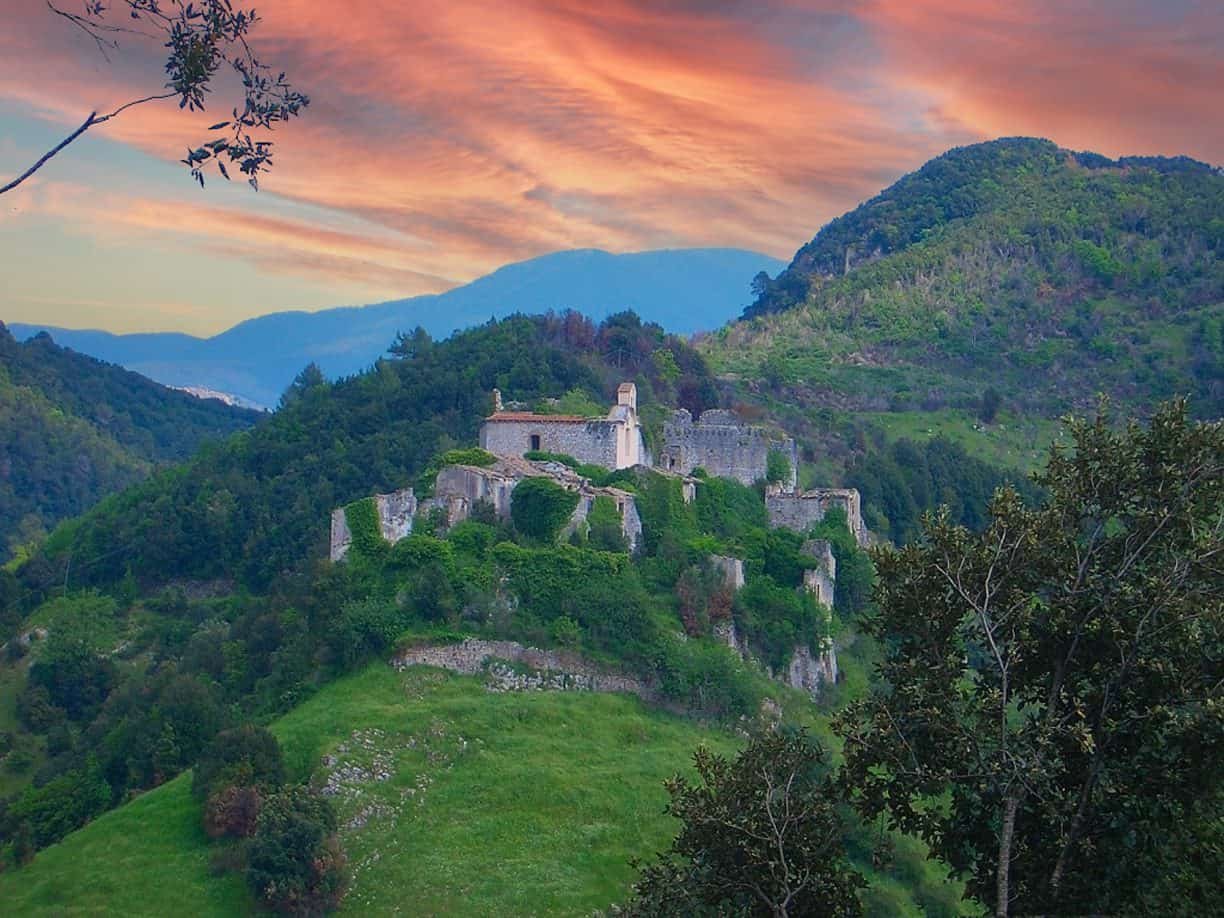
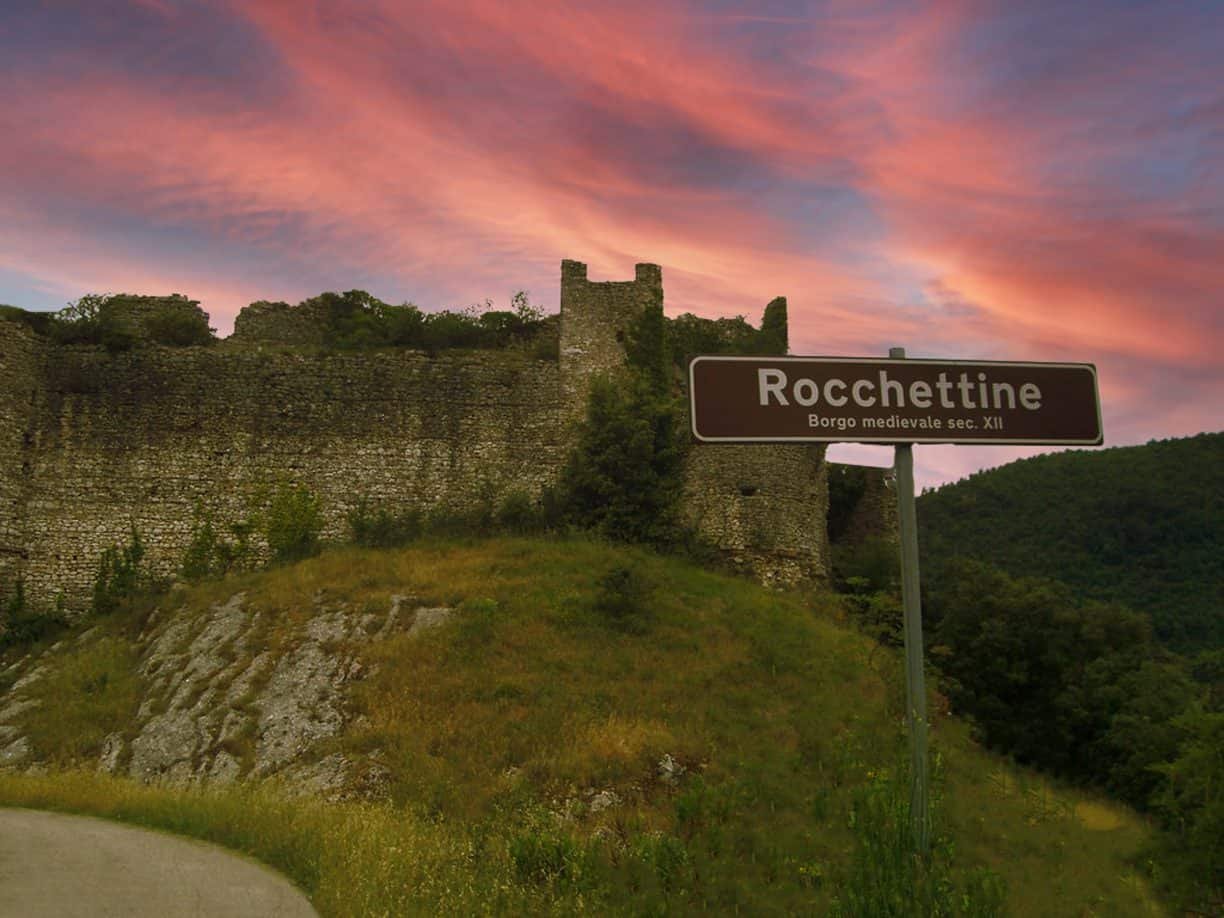
The province is large and sparsely populated, and the provincial capital is the ideal base for exploring it. Three destinations can be reached in under an hour and complete the picture: the Angevin city of Cittaducale, Poggio Mirteto, the capital of the Tiber Sabina, and the ghost village of Rocchettine. Others, like Casperia, Roccantica, Fara in Sabina with the Farfa Abbey, Lake Salto and Lake Turano, have their own guide on EstateRomana.
Cittaducale, the city of the duke
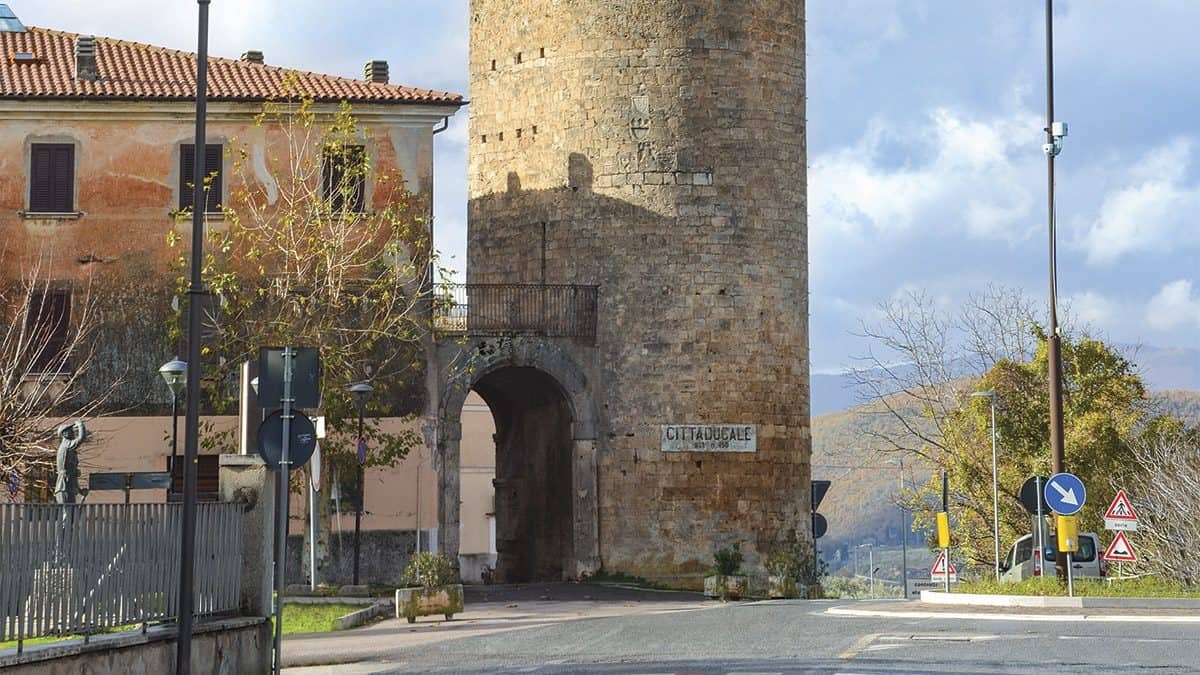
10 kilometers from Rieti along the Salaria toward L'Aquila, Cittaducale is a founded city. Charles II of Anjou, the same king crowned in the Cathedral of Rieti, wanted it in 1308 as an outpost of the Kingdom of Naples on the border with the Papal States, and he named it after his son Robert, Duke of Calabria and heir to the throne. The plan is that of a Roman castrum, elliptical, with two perpendicular streets that cross in Piazza del Popolo. On it face the church of Santa Maria del Popolo, cathedral of a diocese suppressed in 1818, and the 16th-century palaces. Not far away is the church of Sant'Agostino, from the 15th century, with a fine Gothic portal. The earthquake of 1703 forced restorations and changes, but the urban design is intact. In the municipal territory spring the sources of the Peschiera, second in Italy by flow, which quench the thirst of Rome, and the sulfurous waters of Cotilia, where the Romans had their baths and where tradition places the death of Vespasian. The remains of the so-called Baths of Vespasian are near the hamlet of Cesoni. Until 1927 Cittaducale was Abruzzese, the seat of a district in the province of L'Aquila: its union with Rieti was the reason for the new province. Half a day is enough. The ideal is to combine it with a soak at the baths.


Poggio Mirteto, the capital of the Tiber Sabina
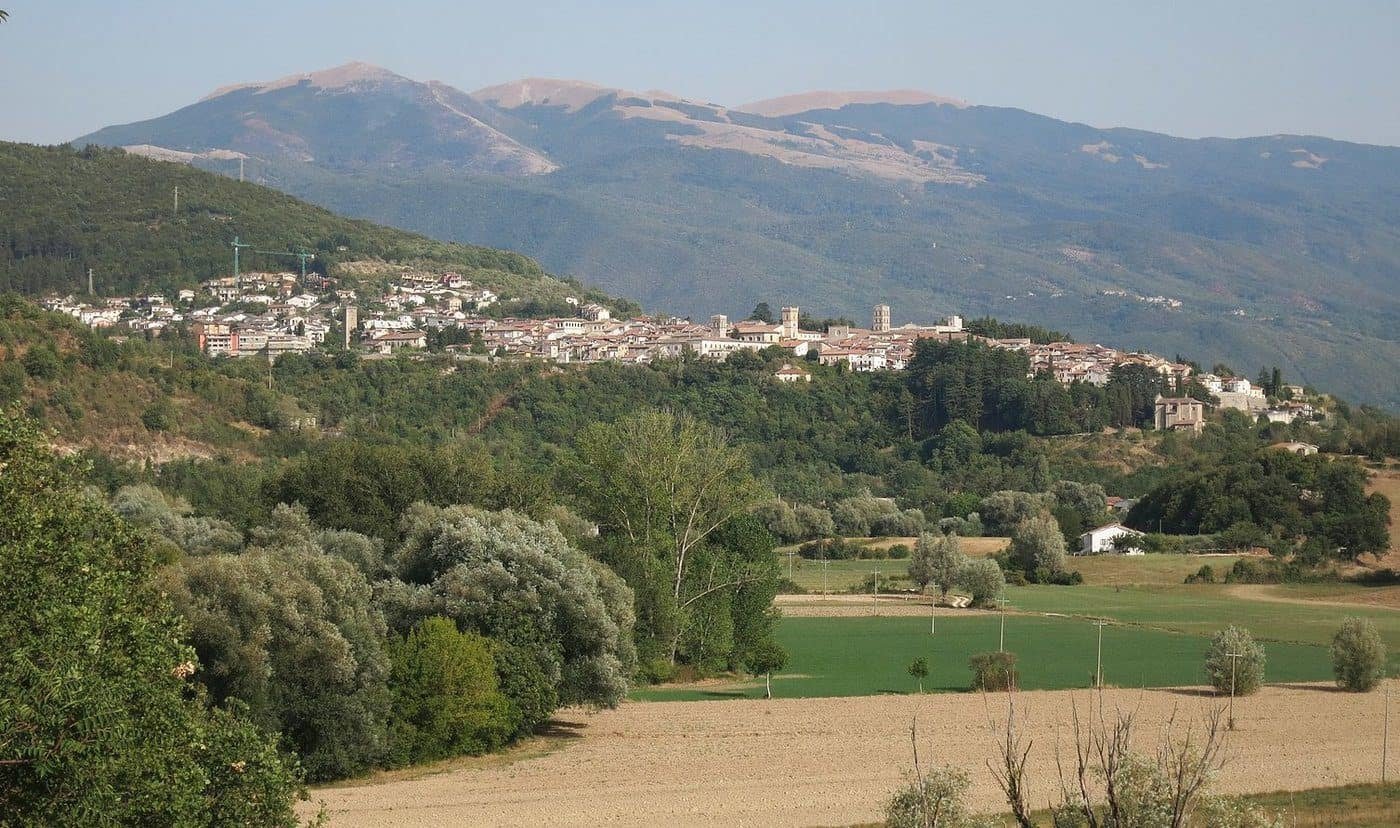
Poggio Mirteto is the city of the lower Sabina, at 250 meters above sea level over the Tiber valley, about 50 kilometers from Rieti and less than an hour from Rome. The Poggio Mirteto Scalo station, eight kilometers below the town, is on the Rome-Florence line and is served by FL1 trains from Roma Tiburtina and Ostiense, which makes it the gateway to the Sabina for those traveling without a car. The historic center opens with the Renaissance Porta Farnese and gathers around the Cathedral of the Assunta, built between 1641 and 1725 with a brick facade and a three-aisle interior, seat, together with Rieti, of one of the two dioceses of the province, the suburbicarian diocese of Sabina-Poggio Mirteto. Next to it are the Bishop's Palace and the mid-16th-century Clock Tower. The church of San Paolo, from the 13th century, preserves frescoes by Lorenzo Torresani, the same painter of the Judgment in Rieti. Poggio Mirteto is famous for the Carnevalone liberato, the festival that comes from the popular revolt of February 24, 1861, when the town was still papal, and that is celebrated on the first Sunday of Lent, with an openly anticlerical character. Suppressed in 1929 and restored in 1977, it is one of the most anomalous carnivals in Italy. The town was also the seat of the second district government of the Delegation of Rieti in 1816, and one of its sons sat in the Roman constituent assembly of 1849.


Rocchettine, the abandoned castle of Torri in Sabina
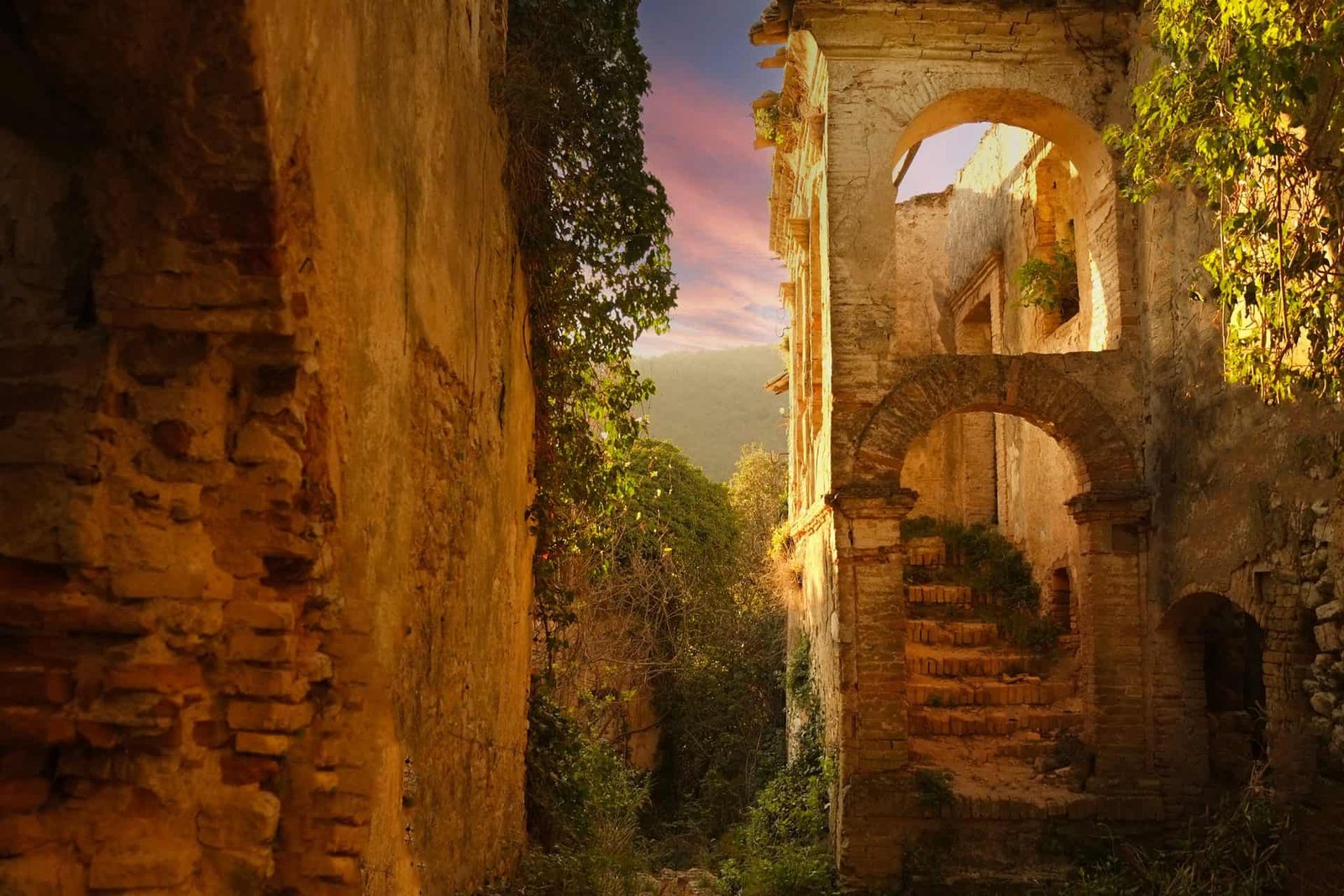
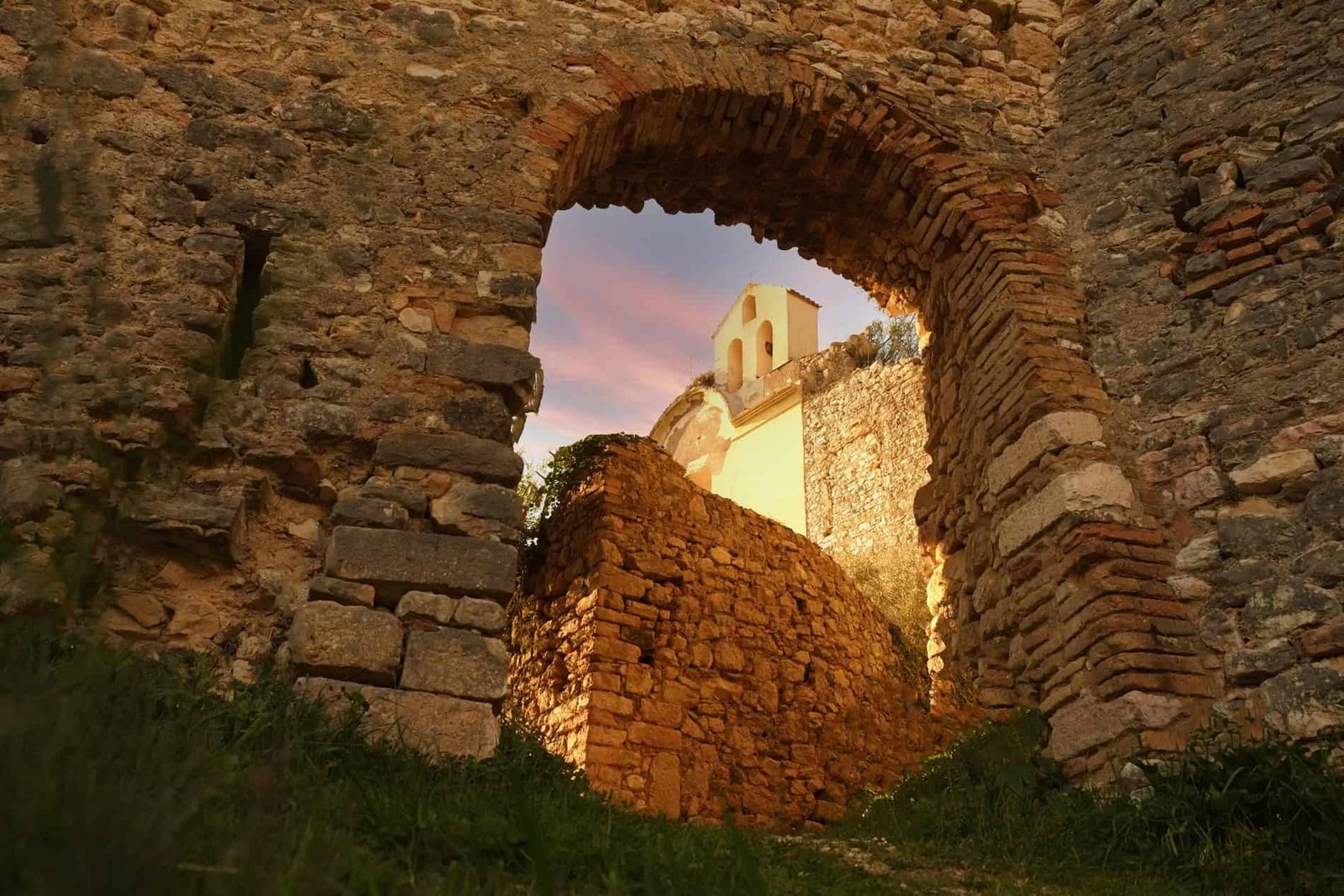
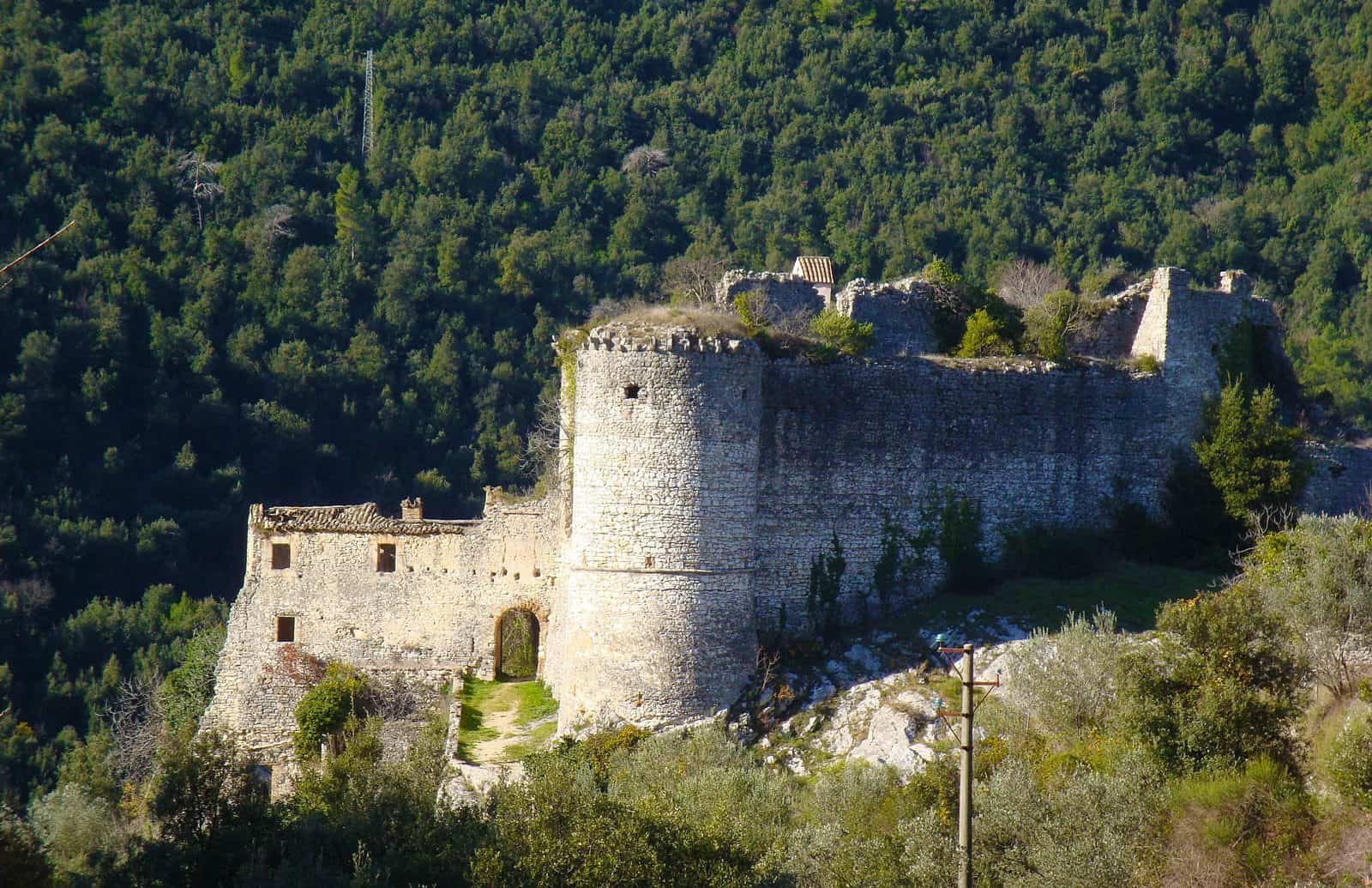
In the municipality of Torri in Sabina, across from the inhabited village of Rocchette, on the other side of the Laia stream, stands Rocchettine, the Rocca Guidonesca: a castle with its village, founded in the 13th century to protect the road that linked Rieti to the Tiber valley, first of the Bishop of Sabina, then of the Church and, at the end of the 16th century, of the Savelli. In the 17th century the village slowly emptied. In 1728, when it passed to the Apostolic Chamber, it was already abandoned, and in November 1817 Cardinal Consalvi assigned its territory to Torri in Sabina. What remains is the circular tower with its defensive scarp, a square tower from the original layout, the walls and the houses in blocks of local limestone overrun by trees, and the church of San Lorenzo, rebuilt in the 18th century. You reach it from Rocchette on a dirt road, cross the bridge over the Laia and leave the car in a clearing. Access is free and unguarded, so go in with closed shoes, without small children in your arms and without leaning on the walls. The two twin fortresses, Rocchette alive and Rocchettine dead, are a lesson in Sabina history at a glance: the same stone, two destinies.

Rieti (RI) with children, accessibility and when to go
With children Rieti works better than many art cities, because it is small, flat in the center and full of water and animals: the ducks of the Velino, the Giorlandina path, the submerged Roman Bridge to look for in the river, the caciotta at the center of Italy to touch, the underground viaduct that kids from six years up like more than any museum, and Terminillo half an hour away for snow or for meadows. The museums are short and Canova's Hebe, with her golden cup, wins over even the youngest. In the basin the bike path is flat and safe. On accessibility: Piazza Vittorio Emanuele II, Via Roma, Via Cintia, the Cathedral and the riverfront can be done in a wheelchair, with some stretches of paving stones. The crypt, the underground viaduct and the sanctuaries on the hills cannot, and the Civic Museum on the fourth floor of the Town Hall depends on the elevator, which you have to ask for at the ticket office. When to go: spring and autumn are the right seasons, with Terminillo green or red and the plain in bloom. Summer brings the Festa del Sole at the end of July and the chili pepper festival at the end of August, but the days are hot, though less than in Rome because of the 400 meters of elevation. Winter is the season of the Cavalli infiocchettati in January, the Fiera di Santa Barbara in December and skiing. Avoid Monday, the day when everything that has a ticket is closed.
Quick questions about Rieti (RI)
How far is Rieti (RI) from Rome and how long does it take?
About 80 kilometers along the Salaria. It takes an hour and a quarter by car, an hour and 40 minutes by Cotral bus from Tiburtina, and between an hour and 40 minutes and two and a half hours by train via Terni depending on the run.
Can you visit Rieti (RI) in a day from Rome?
Yes, and it is the most underrated day trip in Lazio. Leave at eight, spend six hours in the city, and be back for dinner. The Franciscan sanctuaries require a second day.
How much does it cost to visit Rieti (RI)?
Churches, walls, river and squares are free. The Civic Museum costs €8 full price and €6 reduced according to the concessionaire's rates, the Diocesan Museum is free admission, and Underground Rieti is €7. With a lunch in a trattoria you stay under €50 per person.
What are the opening hours of the Civic Museum of Rieti (RI)?
The concessionaire lists Friday, Saturday and Sunday from 10 to 13 and from 15 to 19, last entry half an hour before. Hours change during the year: check museo.comune.rieti.it.
Where is the center of Italy in Rieti (RI)?
In Piazza San Rufo, where a plaque and the 2001 monument (the "caciotta") recall the Umbilicus Italiae. It is a tradition, not a geodetic calculation.
What is Underground Rieti?
The guided visit of the Roman viaduct of the 3rd century BC that supports Via Roma, among the cellars of the palaces. Saturday at 18 and Sunday at 11, €7, reservation by phone, departure from Piazza Cavour.
How long does a visit to Rieti (RI) take?
Three hours for the historic center with the Cathedral, six hours with the museums and Underground Rieti, two days with the sanctuaries and Terminillo.
Is Rieti (RI) suitable for children?
Very much: a small city, a river with ducks, a flat bike path, an underground viaduct, Terminillo half an hour away. The museums are short.
Can you visit Rieti (RI) in a wheelchair?
The center, the Cathedral and the riverfront yes, with some paving stones. The crypt, the underground spaces and the sanctuaries on the hills no. The Civic Museum has an elevator, which you have to ask for at the ticket office.
Where do you park in Rieti (RI)?
In the parking lots along the Velino and around the walls, in particular at Porta d'Arci, on Via Cintia and at the station. The historic center is largely a limited traffic zone.
Can you take photographs in the churches and museums of Rieti (RI)?
In churches yes, without flash and outside services. In museums usually yes without flash, but the rule should be asked at the entrance. In the underground viaduct you need a long exposure.
Do you need to book to visit Rieti (RI)?
Only for Underground Rieti, for the convent of San Domenico (permit) and, for groups, for the Diocesan Museum. Churches and the Civic Museum can be visited without a reservation.
Is the Civic Museum of Rieti (RI) free on the first Sunday of the month?
The first-Sunday free admission applies to state museums. The Civic Museum is municipal and run under a concession, and it does not usually apply it. The free admissions provided are for children under 12, people with disabilities, guides and journalists.
What is there to see near Rieti (RI) within 10 minutes?
Fonte Cottorella, Colle San Mauro, the sanctuary of La Foresta, Fonte Colombo, the Lungo and Ripasottile Lakes Reserve, Cittaducale with the baths of Cotilia.
What is the difference between Rieti (RI) and Terni?
Terni, 35 kilometers away, is an Umbrian industrial city with the Marmore Falls at its gates. Rieti is an intact medieval city in Lazio, with the Holy Valley around it. They combine well in a weekend.
When is the Procession of the Ceri held in Rieti (RI)?
Two Sundays after June 12, as part of the Giugno Antoniano. In 2026 it is June 28. The Festa del Sole with the Palio della Tinozza is at the end of July, and the chili pepper fair between the end of August and the first days of September.
Who was Vespasian and what does he have to do with Rieti (RI)?
The emperor who started the Colosseum came from a Sabine family, born at Falacrinae in the upper Velino valley. Tradition has him die at the waters of Cotilia. The theater of Rieti bears his name.
What do you eat in Rieti (RI)?
Amatriciana and gricia, pizzicotti alla liscianara, stracci and fregnacce, Terminillo pecorino, Sabina DOP oil, Cottorella water. Trattorias in San Rufo and in the Borgo.
Which Franciscan sanctuaries are in the municipality of Rieti (RI)?
Fonte Colombo and Santa Maria della Foresta. Greccio and Poggio Bustone are in nearby municipalities. Together they form the Holy Valley and the Way of Francis.
Does Rieti (RI) have a train station?
Yes, on the Terni-Rieti-L'Aquila line, 10 minutes on foot from the center. From Rome there are a couple of direct runs a day via Terni, otherwise with a change at Terni.
Can you reach Terminillo from Rieti (RI) without a car?
With the Cotral buses from Rieti, with more frequent runs in the ski season. Check the schedule on the Cotral site because it varies a lot between summer and winter.
The last piece of advice is an opinion: Rieti is the city in Lazio that least deserves to be passed through and most deserves to be lived in for a day. Whoever uses it as a base for Terminillo or as a stop on the Way sees the walls and the cathedral and leaves. Whoever gives it a whole Saturday, with the Roman viaduct under their feet and Spadarino's Angel before their eyes, goes back to Rome with the feeling of having discovered something that Romans have right under their noses and haven't looked at in centuries. Go before they discover it.
Article written by the editorial team of TourLeaderPro, contact them for Private/Corporate/V.I.P. Tours and Experiences.
Planning a trip to Rome? The guides in English for visiting the city are on ItalyPlanner.com.