Leonessa (RI)
In short. Leonessa rises on the Apennine plateau that separates Lazio from Umbria, at about 1,013 meters above sea level, in the province of Rieti.

Leonessa rises on the Apennine plateau that separates Lazio from Umbria, at about 1,013 meters above sea level, in the province of Rieti. The municipality covers 204 square kilometers and has about 2,200 inhabitants spread over 36 hamlets. There is no railway station: you arrive by car from Rome via the A24 motorway to the Borgorose exit, then the SS578 toward Leonessa (about 110 kilometers from the capital, an hour and 40 minutes of driving). From Rieti you follow the SS578 Salto-Cicolana for about 40 kilometers. The Comune di Leonessa offers on its website up-to-date information on local offices and events. Leonessa has held the Touring Club Italiano's Orange Flag since 2003 and belongs to the Associazione Nazionale Borghi Autentici d'Italia. In 2021 it received the recognition of "Borgo del Respiro" for air quality and its vocation for slow tourism. Tickets and admissions to the cultural attractions (Museo Civico, Sanctuary) should be checked directly on site or at the local IAT office, since hours and fees may vary seasonally.
Those who want to extend the visit to the whole Rieti area will find a complete overview in the guide devoted to Rieti, the provincial capital 40 kilometers to the southeast.
The history of Leonessa (RI): Angevin foundation and contested identity
The Angevins and the medieval synoikism of 1278
Leonessa was born from a deliberate political act. In 1278 Charles I of Anjou, king of Sicily and Naples, ordered the merging of a series of small castles and villas scattered on the plateau around the site of the castle of Ripa di Corno. The procedure, called synoikism, was common in central-southern Italy in the 13th and 14th centuries: concentrating the population in a single center strengthened defense and made it easier to collect taxes. Charles called it "Nove terre Nostre Gonesse," recalling the place name of his French homeland. The Angevin foundation was not an aesthetic whim: it served to keep under control a strategic plateau, a hinge between papal Lazio to the west, the Rieti territory to the northeast and the Kingdom of Naples to the south. The position on the northern edge of the plateau, where already from the late 12th century the border between the Papal States and the Kingdom of Sicily had settled, explains why Leonessa spent more than six centuries, from 1278 to 1861, under the Neapolitan crown while being geographically surrounded by papal territories.
The Angevin Tower, erected on the northern flank of Monte Tilia (1,750 m) immediately behind the village, was the first visible sign of the new power. It was not only a defensive structure: it was the materialization of royal possession over a territory that had every reason to consider itself a frontier.

The Sesti: governing the Leonessa territory
From the late 1300s the territory of Leonessa was organized into six districts called Sesti: Sesto di Corno, Sesto di Croce, Sesto di Forcamelone, Sesto di Poggio, Sesto di Torre and Sesto di Terzone. This subdivision was not only administrative: the Sesti were social and competitive entities, each with its own factions and its own resources. The 36 hamlets of the present municipality still reflect today this original fragmentation, which the Palio del Velluto reenacts every year in the form of an equestrian race. In the medieval economy the Sesti were the load-bearing structure of a prosperity based on wool: in the 14th century Leonessa had 114 active businesses in the textile sector, of which 82 were merchants. A manufacturing industry that animated fairs and markets along the whole Apennine ridge.
Farnese rule and the long papal period
In the 16th century Leonessa entered the Farnese sphere through marriage: Margaret of Austria, illegitimate daughter of Charles V, brought it as a dowry to the Farnese when she became duchess of Parma. From her takes its name the Fontana Margaritiana (or Farnesiana), commissioned in 1548 and placed in Piazza VII Aprile. At the death of Madama Margherita, in 1586, the city passed under the direct rule of the Farnese, then in 1735 to the Bourbons, until the Unification of Italy. This long Farnese-Bourbon interlude did not erase the character of crown city that Charles of Anjou had conferred on it: Leonessa had never been the fief of a single baron, and its citizens had jealously defended that condition through the centuries.
1927, the lost Abruzzo and the 2008 referendum
For more than six centuries Leonessa was Abruzzo: it belonged to the district of L'Aquila and shared its culture, dialect, cooking and identity. In 1927 the Fascist regime transferred it by authority into the new Province of Rieti, Lazio. The trauma has never fully healed. In 2008, an advisory referendum recorded 76.5 percent of votes in favor of joining Umbria: 926 yes out of 1,207 voters. The quorum required for the validity of the vote, set at 1,146 valid votes, was not reached by 220 ballots. The result tells of a community that still feels like a frontier today, not fully Lazio, no longer Abruzzo, potentially Umbrian. A city that carries in its very name, like the heraldic lioness, something irreducible.
Piazza VII Aprile and the historic center of Leonessa (RI)
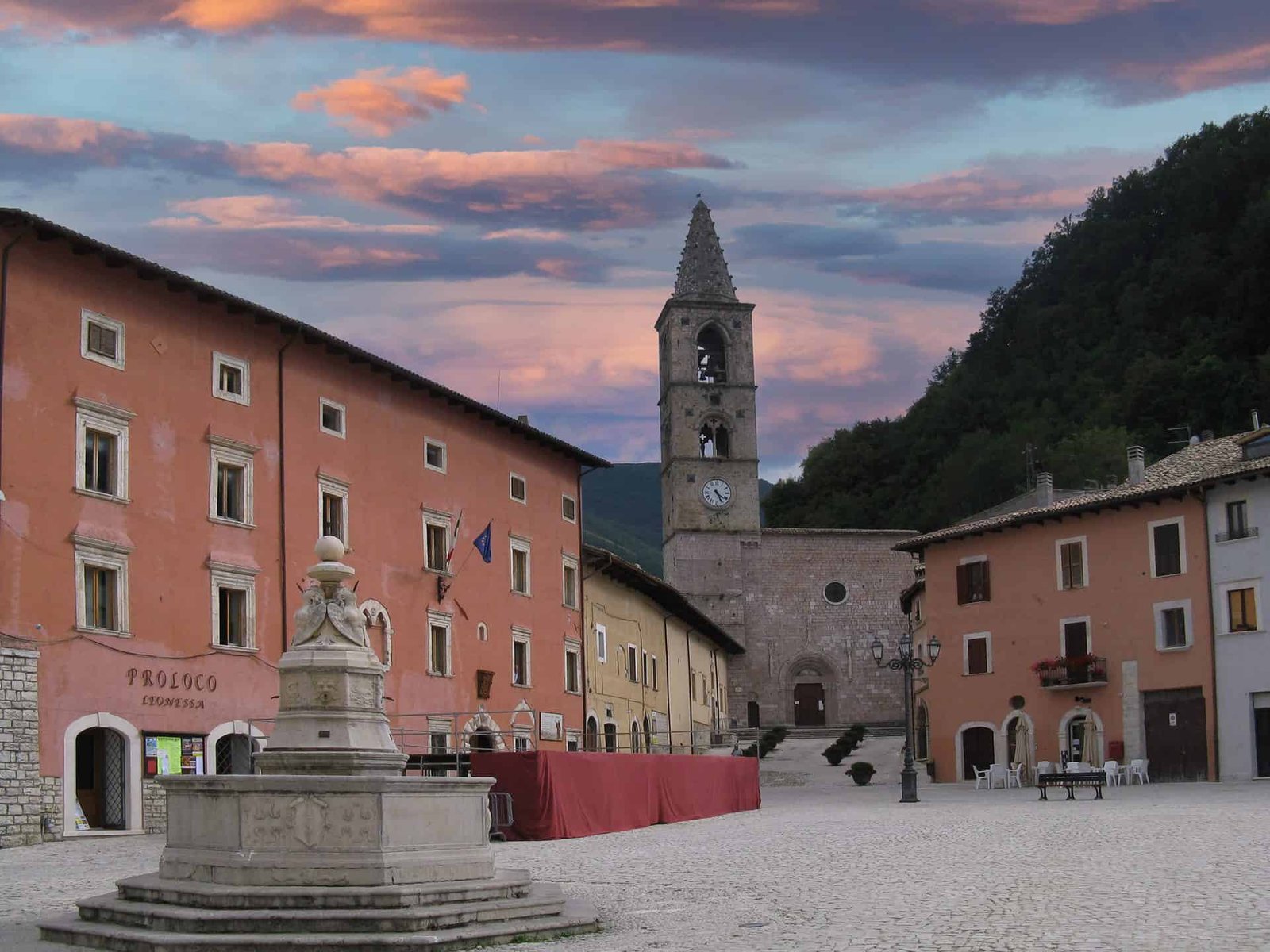
Piazza VII Aprile is the heart of the village. It takes its name from the darkest date in Leonessa's history: April 7, 1944, Good Friday, when a column of German SS massacred 23 civilians at the Fossatello, near the local power plant. The square named for that massacre is today one of the most beautiful of central Abruzzo remaining on Lazio soil: an arcaded rectangle, run through by a rhythm of low arches in local limestone, with the Fontana Farnesiana at the center and on the short side Palazzo Mongalli. Anyone arriving from Rome in high summer notices at once being in another climatic dimension: at a thousand meters of elevation the city heat doesn't exist, and the square is alive even in the peak hours.

The Fontana Farnesiana: Florentine stone at a thousand meters
The Fontana Margaritiana was commissioned in 1548 by Margaret of Austria. The octagonal shape in "Florentine" stone (a white limestone of refined workmanship) makes it an anomalous object for a mountain village: it is a piece of Renaissance taste dropped into a context of Abruzzo tradition. The basin collects water from a local spring, and is still functional. Not many know that in the following centuries the fountain took on a double name: Farnesiana for the house of the patron, Margaritiana for Margaret's personal name. Both names still circulate in local historical texts, and the duplication testifies to the persistence of the memory of the duchess in a village she never visited in person.
Palazzo Mongalli and civil architecture
On the short side of the square, Palazzo Mongalli (15th-16th century) houses the town hall. The stone facade, with windows framed in sharp-cut stone, represents the type of Apennine civil architecture without monumental pretensions: it doesn't try to impress, but articulates space with a measure that still holds. Among the palaces of the historic center stand out Palazzo Ettorre (17th-18th century, the largest in the town), Palazzo Bisini, Palazzo Morelli, Palazzo Vanni, Palazzo Viscardi and Palazzo Cherubini, birthplace of the composer Bixio Cherubini. This last is a detail passing tourists usually miss: Leonessa gave birth to a notable musician, and the palace still preserves the commemorative plaque.
The medieval gates and walls of Leonessa (RI)
Porta Spoletina: the pink stone opening of the 1300s
The Porta Spoletina, erected in the 14th century, is the main gate of the village toward the west, in the direction of Spoleto and Umbria. The material is the local pinkish limestone: a stone that takes its color from iron oxide and that in the hours of raking light takes on amber shades. The round arch, set on massive jambs, still preserves the socket for the hinges of a door that is no longer there. Above the arch runs a stretch of wall walk, accessible from the inner moat. Seeing Porta Spoletina at dawn or at sunset, when the low sun strikes it head on, is to understand why Leonessa was included among the most beautiful villages in Lazio.
Porta Aquilana and the Angevin Tower
The Porta Aquilana, older (13th century), opened the city toward the east, in the direction of L'Aquila: the gate that looked toward the kingdom it belonged to. The medieval defensive system also included the Angevin Tower, which is not inside the walls but on the flank of Monte Tilia, controlling the southern slope. It was a lookout tower, not a bell tower: the difference is appreciable even today, in the slenderness of the structure and the lack of belfry features. In summer, a chairlift takes visitors almost to the top of Monte Tilia, from which you dominate the whole Leonessa plateau and, on clear days, the Terminillo massif, the Gran Sasso and the Sibillini.

The churches of Leonessa (RI): a heritage of stone and fresco
Leonessa has a number of churches out of proportion to its population: 12 religious buildings of historical importance in a village of 2,000 inhabitants. The figure is explained by its history: for centuries a crown city and therefore free of a single ecclesiastical master, Leonessa accumulated religious foundations through the initiative of local classes, confraternities, mendicant orders. The result is a fabric of diversified sacred architecture, where different styles coexist with a coherence all their own.
The basilica of San Francesco at Leonessa (RI): the frescoes and the terracotta nativity scene
The church of San Francesco is the most visited after the Sanctuary. Construction began in the 13th century and ended in the 15th, with a Romanesque-Gothic facade that presents a well-preserved central rose window and a splayed portal with sculpted capitals. The three-aisle interior, divided by octagonal stone pillars, is a repertoire of 15th-century painting of remarkable coherence: the paintings attributed to Domenico da Leonessa show scenes from the life of Christ and of Saint Francis with a narrative vitality that has nothing provincial about it. The palette is the one typical of the Umbrian-Lazio tradition of the 1400s: warm ochres, deep blues, rosy flesh tones. Particularly relevant is the fresco cycle in the apse, partly lost but still legible in the sequence of figures.
But the most singular piece of the church is the monumental terracotta nativity scene of the 15th century: 36 figures at almost life size, distributed in a diorama that occupies a side chapel. Terracotta is a technique that in central Italy of the 1400s produced masterpieces (think of the workshops of the Della Robbia or the sculptures of the niccolodeolandesi), but finding a concentration of this scale in a mountain village is rare. The nativity scene is an extraordinary document of Leonessa's popular devotion.
The church of San Francesco is one of the stops of the Cammino di Greccio and of the wider route of the Cammino di San Benedetto, which connects Norcia to Montecassino. Anyone arriving at Leonessa on foot finds here a point of spiritual refreshment with centuries of visitors behind it.

The church of San Pietro at Leonessa (RI): Lanfranco and the Gothic crypt
San Pietro is the oldest church in the historic center: it dates to the 13th century, with a Renaissance facade redone in the 15th. The Baroque interior is of unexpected quality: it preserves canvases by Giacomo Siciliano, by Ercole Orfeo Presutti and, above all, by Giovanni Lanfranco. This is the name that stops the cultured visitor: Lanfranco (1582-1647) is one of the great painters of Roman Baroque, a pupil of Annibale Carracci, author of the dome of Sant'Andrea della Valle in Rome. Finding works by him at Leonessa is no chance: his link with Rieti and Abruzzo patrons is documented, and the presence of a painting of his in this church testifies that Leonessa, though remote, was in contact with the circuits of Roman painting. The specific subject of the canvas should be verified on site, since the sources consulted do not agree on the exact title.
The Gothic crypt, accessible from a staircase in the central nave, is a space of great evocative power. The cross vaults rest on monolithic columns of white limestone, and the light filtering through the side slits creates a very effective chiaroscuro. It is rare to find crypts of this date and this construction quality in a village of this size.
Santa Maria del Popolo and the minor churches
The church of Santa Maria del Popolo, begun in the late 1200s and completed in the 1500s, is recognizable by its late Gothic portal, with a pointed archivolt and sculpted panels on the jambs. The interior is simpler than the facade would lead you to expect: a single nave with side chapels added over time. The church of San Carlo Borromeo (17th-18th century) and of Santa Maria della Visitazione (14th century) complete the catalog of the major sacred architecture. The Capuchin Convent, with the church of Santa Maria di Loreto, preserves the little cell where Saint Joseph of Leonessa spent long periods of retreat: a space that pilgrims still visit today as a place of recollection.
The Sanctuary of San Giuseppe da Leonessa (RI)
The Sanctuary of San Giuseppe da Leonessa is the devotional focus of the city and the most accomplished architectural monument of its historic center. It was built in the first half of the 1700s by the architect Filippo Brioni on the site of the saint's birthplace, and it holds his relics. The structure is a "fine example of Baroque architecture," as the historical literature defines it: two circular halls with hemispherical domes, connected by a short drum, create an unusual floor plan that has no parallels in the religious architecture of the area. The interior is decorated with frescoes by Giacinto Boccanera and Virginio Monti, Roman painters of the Baroque area. The pipe organ, dated 1759, is still working and is played on the occasion of liturgical celebrations.

Who Eufranio Desideri was: the Capuchin friar of Leonessa
Eufranio Desideri was born at Leonessa on January 8, 1556, third son of a local middle-class family. He entered the order of the Friars Minor Capuchin on January 3, 1572, moving on to the novitiate in the convent of the Carceri at Assisi, one of the most austere places of Franciscan spirituality. He became a priest in 1580 and received his preacher's license on May 21, 1581. In religion he took the name Giuseppe da Leonessa, keeping in his convent name the link with his native village. This choice was not automatic: it indicated a strong identity, a root whose trace he didn't want to lose.
The missions to Constantinople and the torture of the hook
In 1587 Giuseppe da Leonessa was sent as a missionary to Constantinople, where he assisted about 4,000 Christians reduced to slavery in the Ottoman prisons. The circumstance was already extraordinary in itself: an Italian friar of the 1500s working inside the Ottoman Empire, in conditions of permanent danger, with the sole protection of the Capuchin habit. But in 1589 he performed an act that defies reason: he tried to sneak into the sultan's palace to preach the Christian faith. He was captured, tried and condemned to the torture of the hook: three days hanging from an iron hook driven into his arm, with flames lit under his feet. A torture designed to kill slowly. He survived. According to Catholic tradition, the survival was miraculous. Historically, the sentence was commuted to expulsion, probably for diplomatic reasons tied to relations between the Ottoman Empire and the European powers. He returned to Italy in 1589 with the physical scars of detention but without giving up his missionary vocation.
The return to Italy, death at Amatrice and relics at Leonessa
Back in Italy, Giuseppe da Leonessa traveled the regions of Abruzzo and Umbria preaching and founding Monti frumentari, Monti di pietà, hospitals and other works of charity. The Monti frumentari were institutions that lent grain to poor peasants before the harvest, to be returned after the reaping with a small percentage: a medieval form of agricultural microcredit. He also founded houses for the poor, anticipating by centuries lay welfare institutions. He died on February 4, 1612 at Amatrice, of a tumor. The liturgical date of his feast, February 4, recalls this day. The remains were moved to Leonessa on October 18, 1639 and placed in the church that would later give way to the present Baroque Sanctuary.
Beatification, canonization and the current cult
Giuseppe da Leonessa was beatified by Pope Clement XII in 1737 and canonized by Pope Benedict XIV in 1746. The double procedure, with two distinct pontiffs, reflects the caution with which the Holy See proceeded with canonizations in the 18th century. The liturgical feast is celebrated on February 4. The patron feast of Leonessa falls on the second Sunday of September, with a solemn procession that runs through the historic center. The relics, kept in the Sanctuary, include parts of the saint's body and personal objects. Saint Joseph of Leonessa is venerated as patron of missionaries and preachers, and as protector of the poor. His cult extends well beyond the borders of the province of Rieti.
A curiosity about Leonessa (RI)
The most surprising curiosity concerns Leonessa's relationship with the rest of Lazio: it was never Lazio by choice. For more than six centuries, from 1278 to the middle of the 19th century, the village belonged to the Kingdom of Naples, then to the Kingdom of the Two Sicilies. Linguistically, culturally and gastronomically, Leonessa is still closer today to mountain Abruzzo than to the Lazio of the plains. The Leonessa dialect has Abruzzese morphology, not Lazio morphology. The fresh pasta made here, li sfusellati and li strengozzi, belongs to the culinary tradition of L'Aquila, not Rome. The fountain in the square carries the name of the Farnese, but it was wanted by a duchess who governed by delegation of the Spanish crown over a territory that modern cartography calls Lazio. When in 1927 the Fascist regime moved Leonessa from the province of L'Aquila to that of Rieti, it did not change the nature of the place: it changed the label. The 2008 referendum, with 76.5 percent of votes in favor of Umbria, is proof that the label never fully convinced the people of Leonessa.
A second curiosity concerns the name itself: Leonessa does not derive from the heraldic lion, as many suppose. The most likely etymology, supported by medieval documentation, connects it to the archaic place name "Lione" or "Lionessa", which indicated a type of flat terrain on the heights. The lioness on the town coat of arms is therefore a later heraldic interpretation, an image constructed after the fact to give an ennobling meaning to a word of more prosaic origin.
Something Nobody Tells You About Leonessa (RI)
The fact that no ordinary tourist guide tells is this: the medieval economy of Leonessa was based almost entirely on wool. In the 14th century the village had 114 active businesses in the textile sector, of which 82 were wool merchants. Not sheep farmers: merchants. Leonessa was a redistribution hub for Apennine wool, a place where the raw product was processed, transformed and sent on to the markets of Rieti, L'Aquila, Rome and beyond. Leonessa wool was quoted at international fairs, and the village's merchants had documented commercial relations with partners in Florence and Tuscany. This explains the quality of the civic architecture in the historic center: it was not built by a feudal aristocracy, but by a merchant middle class with money to spend and a taste acquired in the markets.
Nobody says this either: the Sanctuary of San Giuseppe da Leonessa was not built where the saint's original church stood, but directly on his family's birthplace. Filippo Brioni, the architect, received the commission to build a sacred building that incorporated the remains of the private house. Inside the Baroque Sanctuary, if you know where to look, you can still find traces of the medieval masonry of the Desideri house. A layering that tells, physically, the transformation of a man into a saint.
The Advice I Give You for Visiting Leonessa (RI)
There is only one piece of advice, and it is worth more than any list of attractions: come to Leonessa on a weekday, outside the peak summer season (July-August) and outside the ski season (December-February). The ideal time is late spring, between mid-May and mid-June, or September, on the weekend of the patron saint's festival. In these windows the village is still fully lived in, the local food shops are open, the restaurants serve seasonal cooking without adapting to the tastes of summer vacationers, and the streets are not clogged with lines of cars.
If you come in summer, consider adding a night. Leonessa, at a thousand meters, does not have the heat of the Lazio plain. Sleeping here is a physically different experience from sleeping in Rome or Rieti. The night chill is such that you need a sweater even in August. The local B&Bs and agriturismi should be booked a few weeks ahead for the weekend of the Palio del Velluto (fourth Sunday of June) and for that of the Sagra della Patata (second Sunday of October). On these weekends the town transforms, the Sesti show off their historical costumes, and the squares come alive until late in the evening.
For those who want to organize a group or corporate experience in this area, TourLeaderPro offers professional tourist accompaniment with expert tour leaders for the Rieti and Sabina area: a useful service for anyone who does not want to rely on do-it-yourself logistics in a mountain area with narrow roads and irregular signage.
Finally: bring walking shoes, even if you don't think you'll be hiking. The historic center of Leonessa has uneven paving, sudden ups and downs, and alleys that end without warning. Beach sandals are the wrong choice.
Another Well-Known Fact, Yet Rarely Mentioned
Leonessa officially belongs to the circuit of the "Cities of Art" of Lazio and has had the Touring Club Orange Flag since 2003. This is the well-known fact. What is rarely mentioned is the precise reason why the Touring Club considered Leonessa worthy of the Orange Flag. The recognition, reserved for inland villages with fewer than 15,000 inhabitants, rewards not only the historical and artistic heritage but the overall quality of hospitality, dining, welcome and environmental management. Leonessa passes the criteria in all categories, but it is the management of the surrounding plateau, with the beech forests of community interest of the Vallonina and the northern slope of Terminillo, that makes the difference compared with other villages that have an interesting historic center but a compromised surrounding territory.
Even less often mentioned is the fact that in 2021 the village obtained the title of "Borgo del Respiro", a recognition promoted by some environmental associations for mountain municipalities with air quality documented as above the national average. It is not marketing: it is the consequence of low industrial density and a position exposed to the Apennine winds that clean the air constantly. Leonessa has one of the lowest PM10 and PM2.5 values recorded in the entire province of Rieti.
The Nature Around Leonessa (RI): From Terminillo to the Vallonina

The Northern Slope of Terminillo: Skiing and Hiking in Leonessa (RI)
The entire northern slope of Monte Terminillo (2,216 m) falls within the municipal territory of Leonessa. The Campo Stella ski resort, completely renovated in 2013, can be reached from the town in a few minutes by car. The Terminillo ski areas have long been divided between the Rieti side (better known and more frequented) and the Leonessa side: Campo Stella offers moderately difficult slopes, suited to intermediate and advanced skiers, and has the advantage of being less congested than the lifts on the Rieti side on peak weekends. In summer, the same slopes become mountain bike tracks and the ridges of Terminillo can be walked in crossings of one or two days. The highest point, the summit of Terminillo at 2,216 m, can be reached from Leonessa in about three hours of walking for a trained hiker.
The fauna of the massif is typical of the central Apennines: deer (present in growing numbers after the protection of recent decades), roe deer, wild boar, the Apennine wolf (sighted with increasing frequency on the Leonessa side), peregrine falcon, and golden eagle in the highest sectors. The beech forests that cover the slopes between 1,000 and 1,700 meters are among the most extensive in Lazio, and in autumn they offer a show of color of remarkable intensity.
The Vallonina and the Beech Forests of Community Interest
The Vallonina is the valley that descends from the Sella di Leonessa toward Umbria, along the course of the upper Fiume Corno. The beech forests of the Vallonina are included among the Sites of Community Interest (SIC) of the Natura 2000 Network, which protects them from any building work or systematic cutting. For the visitor, this means finding mature beech woods with trees of considerable diameter, an undergrowth of ferns and blueberries, and a silence that on working weeks is almost absolute. The main trail of the Vallonina is marked by the CAI and takes two to three hours round trip from Leonessa. The blueberry bloom (June) and the porcini mushroom harvest (August-September, with the appropriate permit) are the moments of greatest attendance.
Monte Tilia and the Summer Chairlift
Monte Tilia (1,750 m) rises immediately south of the village, almost touching it. In summer a chairlift carries visitors to the arrival station, from which the summit is reached with a 20-minute walk on a trail. The view from the Tilia is 360 degrees: the Leonessa plateau with its 36 hamlets, Terminillo and Monte Cambio (2,081 m) to the east, the Vallonina to the west, and in exceptional visibility the Gran Sasso d'Italia to the southeast. The chairlift runs in the summer months (check the updated hours on the website of the Comune di Leonessa) and in the high ski season. Access to the summit is free for those who walk: the trail starts from the center of the town.
The Right Photo to Take in Leonessa (RI)
The photo that identifies Leonessa and not some other mountain town is the one taken from the summit of Monte Tilia looking down, with the village in the foreground and the open plateau behind it. In that frame you see immediately what makes Leonessa different: it is not a town clinging to a steep slope, like Anticoli Corrado or Calcata, and it is not a valley-floor town either, like Rieti. It is a village that occupies a wide terrace, almost a natural platform, with the high mountain behind it and the open plateau in front. This original layout, readable from above, is the first reason why the village is classified as "Bandiera Arancione": not many Italian villages have this relationship with the surrounding territory.
The second photo to take is in Piazza VII Aprile at dawn, when the raking light hits the Fontana Farnesiana and the limestone of the porticoes. The hour before sunrise, in summer, is the coldest and quietest: the square does not yet have the bars open, there are no tourists, and the stone has an almost bodily texture in the low light. The contrast between the geometric rigor of the octagonal fountain and the irregular weave of the medieval porticoes is much more readable in this light than in full daylight.
The third useful photo is the one inside the basilica of San Francesco, toward the apse: the three naves with octagonal pillars create a very regular perspective that works well photographically both in artificial light and with the natural light filtering from the rose window. If you have a camera with good sensitivity in low light, the cycle of 15th-century frescoes gives a high level of photographic quality.

The Food of Leonessa (RI): Mountain and Abruzzese Tradition
Leonessa cooking is mountain cooking with Abruzzese roots, not Lazio roots. This clarification is not pedantry: it changes the register of the food. The pasta is fresh and handmade, not bronze-drawn. The sauce is meat ragù or local black truffle, not cacio e pepe. The bread is tall and airy, not unsalted like in central Lazio. Anyone arriving from Rome expecting something like the cooking of the Sabina is surprised by the difference.
The Leonessa Potato DE.CO.: A Story Centuries Long
The Patata di Leonessa has the DE.CO. recognition (Denominazione Comunale d'Origine) and appears on the list of Traditional Agri-food Products of Italy of the Ministry of Agriculture. It is not a recent product and it is not a niche product: it has been grown on the Leonessa plateau for centuries, on volcanic and limestone soils at over 900 meters of altitude that give the potatoes a dry texture and a characteristic sweetness. The main varieties grown today are Desiree, Angria and Marfona, but there are native varieties being recovered that local producers are reintroducing. The Sagra della Patata Leonessana, held on the second Sunday of October since 1989, is one of the best-attended food markets of the central Apennines: it attracts visitors from Rome, L'Aquila and Perugia. The dishes of the sagra are the same as in the home tradition: boiled potatoes with pancetta (the panonta), potato gnocchi with meat sauce or truffle, potato cream with mountain herbs.
Li Sfusellati, Li Strengozzi and Lo Faricello
Leonessa fresh pasta has dialect names that are not found elsewhere. Li sfusellati are fresh pasta worked by hand on a thin stick (the "sfusello", precisely), which produces a long, hollow shape similar to a maccherone with a core. Li strengozzi (or strozzapreti in the more Roman interpretation) are fettuccine without egg, rough, which hold well sauces based on porcini mushrooms or truffle. Lo faricello is a soup of hulled spelt with legumes and mountain herbs: a substantial winter dish that requires hours of slow cooking and very simple ingredients. Li cannellotti a la Cima de' Monte are instead cannelloni filled with ricotta and mountain spinach, a local variant of a widespread shape, with the specific feature that the spinach is picked at altitudes above 1,400 meters and has a much greater concentration of flavor than that of the plains.
Black Truffle, Saffron and Plateau Cheeses
The prized black truffle (Tuber melanosporum) is present on the Leonessa plateau, in particular in the beech woods and mixed oak woods between 800 and 1,200 meters. Gathering is regulated and requires the regional license card. The local truffle hunters work with dogs trained on the specific species of the territory. Locally produced saffron is less known than that of Navelli in Abruzzo or of L'Aquila, but it is grown in small plots with traditional methods and is sold mostly on the spot. The cheeses are mostly made from sheep's milk: the aged pecorino of the Leonessa plateau has a compact paste and an intense flavor, shaped by the diet of the sheep grazing on mountain herbs. Also worth mentioning is the buffalo mozzarella of Terzone, produced in the Sesto of the same name with milk from buffalo raised on the plateau: an unusual product at this latitude, the result of a livestock recovery effort started in the 1990s.
Where to Eat in Leonessa (RI) and What to Buy
The restaurants of the village almost all offer seasonal cooking with local products. The average quality is good, prices are lower than the Rome or Rieti average, but seats are few: on peak weekends (Palio del Velluto in June, Sagra della Patata in October, Christmas) a reservation is indispensable. The food shops of the historic center sell local products (potatoes, truffle, cheeses, cured meats, dried pasta) at fixed and verifiable prices. It is the best way to take home something from Leonessa: not the bottles of grappa with the name of the village written in Gothic type, but the DE.CO. potato in a paper bag and the pecorino wrapped in straw paper. Those who want to plan a food itinerary in the Sabina and the Rieti mountains will find useful the guide to excursions from ItalyPlanner on the best day trips in Italy, which includes routes in the villages of inland Lazio with practical information.
Some Important Events That Happened Here in History
The history of Leonessa is dotted with events that, for a village of 2,000 inhabitants, have a disproportionate intensity. Three in particular deserve extended attention.
The Palio del Velluto of 1464: The Medieval Race and Its Violent Suspension
The Palio del Velluto was established on June 17, 1464, on the occasion of the feast of Saints Peter and Paul. It was a horse race run between the six Sesti of the town, with a velvet cloth as the prize for the winner, following a custom common in Italian Renaissance cities. The particular feature of Leonessa was the extreme competitiveness: the rivalry between the Sesti was social before it was sporting, and the factions were rooted in decades of forced coexistence. In 1556, because of bloodshed that took place during or around the race (the sources do not agree on the precise circumstances), the Palio was suspended. The suspension lasted until 1997, when the Comune di Leonessa decided to reintroduce it on the fourth Sunday of June, with 600 costumed participants and the original rules of the horse race. Today the Palio del Velluto is the largest folkloric event in the province of Rieti by number of participants and quality of historical reconstruction.
The Massacre of April 1944: The Good Friday of Leonessa
Between March 31 and April 9, 1944, in the framework of Operation "Easter Egg", units of the German SS carried out a series of massacres against the civilian population of Leonessa and the surrounding hamlets. The context was the German attempt to re-establish control of an area that a partisan formation, the Garibaldi Brigade "Antonio Gramsci", had occupied on March 16. The German response was systematic and ferocious.
April 7, 1944, Good Friday, was the bloodiest day: 23 civilians were taken to the Fossatello, near the local power plant, and killed in groups of three to five people with a machine gun. Among the victims was don Concezio Chiaretti, assistant parish priest of Leonessa and president of the local CLN (Comitato di Liberazione Nazionale), captured as he was leaving the church. In total, over the course of a week, the civilians killed were 51. Among the earlier episodes: on April 1 at Vallunga (3 victims), on April 2 at Villa Carmine (6 victims), on April 4 at Villa Pulcini (1 victim), on April 6 at Cumulata (12 victims), on April 7 at Ponte Riovalle (3 victims in addition to the 23 of the Fossatello). A role of active collaboration was attributed to Rosa Cesaretti, a Leonessa citizen who pointed out to the SS the partisan hideouts and the names of some civilian victims.
The main square of the village bears the name of Piazza VII Aprile. It is no accident that the date chosen to name the square is that of Good Friday 1944: in the Christian liturgy, Good Friday is the day of the unjust death. Leonessa chose to overlay the two memories, the religious one and the civil one, in a way that still today, decades later, has an intact symbolic force.
The 2008 Referendum: The Town That Doesn't Want to Be Where It Is
In 2008, the Comune di Leonessa called a consultative referendum on possible annexation to the Umbria region. 76.5 percent of votes were in favor: 926 yes out of 1,207 voters. The result had no legal effect (the quorum of 1,146 valid votes was not reached), but its political meaning was very clear. Almost three people in four in Leonessa, when given the chance to choose, voted to leave Lazio. The matter has remained unresolved: no later measure has addressed the question, and Leonessa has remained in Lazio. The frontier identity, more Abruzzese than Lazio, more Umbrian than Rieti, continues to mark the village in a way that no administrative label manages to erase.
The Right Photo to Take in Leonessa (RI): Extra Notes for the Photographer
For those who shoot with more serious equipment: the afternoon light (from 15:00 to 18:00, in summer) hits the facade of the basilica of San Francesco from a favorable angle, bringing out the rose window and the moldings of the portal. The interior of the churches requires high ISO sensitivity or a tripod: the windows are small and the natural light limited. For the frescoes, the artificial lighting in the churches is often inadequate: it is worth bringing a portable light.
The village from above is better photographed from the ridge of Monte Tilia than from the chairlift (the chairlift has pylons in the field of view). In winter, with snow on the plateau, the most interesting frames are those that contrast the dark stone houses and the white roads: a geometry that looks like nothing Roman.
Who Passed Through Leonessa (RI)
San Giuseppe da Leonessa (1556-1612): The Most Famous Son
The most famous figure linked to Leonessa did not "pass through": he was born here, and his remains returned here after his death. Eufranio Desideri, who became San Giuseppe da Leonessa, is the name that gave the village its dimension as a holy town: the Sanctuary built on the birthplace, the name given to a street in every town of the diocese of Rieti, the statue that rises above the main altar. He is not a niche figure or one of local devotion: he is a canonized saint of Pope Benedict XIV, attested by the Treccani, studied by modern missionary historiography. His life, from the son of Leonessa townspeople to missionary in the prisons of Constantinople, survivor of the Ottoman hook torture, is a biography that, if it were that of a layman, would be an adventure novel. As the biography of a saint, it is documentation of how an individual of the 16th century could build a vocation that crossed the borders of the known world.
Bixio Cherubini: The Composer Born in Palazzo Cherubini
Bixio Cherubini, a composer of the early 20th century known above all for light popular songs, was born in Leonessa. Palazzo Cherubini, in the historic center, preserves the commemorative plaque. He is not the most illustrious figure in the history of Italian music, but it is a real and documented fact: Leonessa gave birth to a professional of the entertainment world who had a career recognizable at the national level. In the small history of the village, this counts.
Gentile da Leonessa and Domenico da Leonessa: The Medieval Artists
Two artists link their name to the village: Gentile da Leonessa, a medieval painter of whom few documented works are known (he was the subject of an academic conference in 2006 in Leonessa itself), and Domenico da Leonessa, a 15th-century painter to whom the paintings of the basilica of San Francesco are attributed. Both belong to the most fertile season of Apennine painting of the 15th century: not court artists, not protected by princely patrons, but painters rooted in the territory who worked for local ecclesiastical clients. Their paintings, in Leonessa and in the churches of the hamlets, are the visual document of a local culture that did not wait to be discovered by art criticism in order to exist.
The Pilgrims of the Cammino di San Benedetto
Leonessa is a stop on the Cammino di San Benedetto, the route that connects Norcia to Montecassino passing through the center of the Apennines. The pilgrims who walk this itinerary cross the village at a rate of a few a day out of season, and dozens a day in spring and autumn. The church of San Francesco, with its position on the route, is the most frequented point of rest and devotion. Leonessa was on the way already in the Middle Ages: the registers of the Capuchin convent document hospitality to wayfarers since the 16th century. The tradition has never been fully interrupted, and the modern revival of the walk has given back to the town a function of welcome that belongs to its long history.
The Palio del Velluto and the Traditions of Leonessa (RI)
The Palio del Velluto is held on the fourth Sunday of June, with 600 participants in period costume distributed among the six Sesti. The preparation lasts months: the costumes are made following accurate historical reconstructions, with fabrics of medieval style and tailored accessories of quality. The parade crosses the historic center before the race: it is a procession almost two kilometers long that goes through the main streets of the village, with drummers, standard bearers and the delegations of the Sesti in hierarchical order. The race proper is run on a predefined course in the outlying area of the town: the competing jockeys are chosen from among the best of the Rieti and Abruzzo area. The velvet cloth, made by local artisans following the medieval model, is the prize that the winning Sesto keeps until the following year.
The Ballo della Pupazza, on the other hand, is a propitiatory rite of agrarian origin, held on dates tied to the farming calendar. The papier-mache dummy, carried in procession and then burned, is a ritual of purification that has parallels in many Alpine and Apennine cultures. More than folkloric tourism, it is living anthropology: Leonessa has practiced it for centuries without anyone formalizing it into a tourist event, and for this reason it keeps a genuineness that the improvised sagre of the 1990s do not have.
The festival of San Giuseppe da Leonessa (RI), on the second Sunday of September, is different from the Palio in tone and participation. It is a religious festival before it is a tourist one: the procession with the statue of the saint crosses the streets of the historic center in the silence of the faithful, with the clergy of the diocese of Rieti present in significant numbers. Pilgrims arrive from the whole province and from neighboring areas of Abruzzo and Umbria. The most intense moment is the final blessing in Piazza VII Aprile, when the statue of the saint is displayed on the churchyard of the Sanctuary and the square is full of people in prayer and recollection. It is not a show for tourists: it is a scene of authentic popular devotion that you do not find in big cities.
The Estate Leonessana, throughout the month of August, offers concerts, theater shows and cultural initiatives in the squares of the village. The level of the events varies from year to year. The program can be found on the website of the Comune some time ahead of the dates. Christmas in Leonessa, finally, has a tradition of musical and theater shows in the winter season, with the snow on the plateau as a natural backdrop. The living nativity scene in the streets of the historic center, when it is organized, uses as its setting the same medieval stones that the town lives with every day of the year.
How to Get to Leonessa (RI) and How to Plan Your Visit
By Car from Rome and from Rieti
From Rome the most direct route is the A24 motorway (Roma-L'Aquila) to the Borgorose exit, then the SS578 north to Leonessa: about 110 kilometers, an hour and 40 minutes in normal conditions. Alternatively you take Via Salaria (SS4) to Rieti, then the SS578 east: a longer but more scenic route. From Rieti the quickest route is the SS578 Salto-Cicolana east, with some 40 kilometers of provincial roads through the Cicolano. The mountain roads on the last stretch have tight curves and an irregular road surface in some sections: drive carefully, especially in case of snow or ice (October-April).
By Public Transport
There is no railway station. Public transport from the nearest city (Rieti) is run by regional bus lines (Cotral): check the updated times on the official Cotral website, since runs are few and vary on weekends. In the high summer and ski seasons, private shuttle services are active from Rieti and L'Aquila: ask at the IAT Office of Leonessa or the Comune. For those arriving without a car, the most practical option is car rental in Rieti.
Length of Visit and Parking
The historic center can be covered on foot in two to three hours for a visit to the main churches, the Sanctuary and Piazza. A full day allows you to add Monte Tilia (chairlift + short hike to the summit), a walk in the Vallonina and a proper food stop. Parking is available in the outlying areas of the village: in high season the parking lots along the SP fill up quickly on weekends. If you arrive early (before 9:00) you find a space without difficulty.
Villages and Sanctuaries Near Leonessa (RI)
The Leonessa plateau is surrounded by villages of different interest, all reachable by car in less than an hour. Poggio Bustone (30 km to the northwest) is the town where Saint Francis of Assisi received the forgiveness of sins in 1209: the Santuario di Poggio Bustone is one of the most significant Franciscan places in Lazio. The Santuario di Greccio (35 km to the northwest) is the place where Francis invented the living nativity scene in 1223: a rock convent clinging to the cliff with a view over the upper Velino Valley that is among the most beautiful in Lazio.
Contigliano is a medieval village on the first foothills of Terminillo, 20 kilometers from Leonessa, with a well-preserved historic center and a quality olive oil production. Cittareale (15 km to the south) is a small mountain municipality that preserves medieval remains and a natural territory of great interest. Antrodoco (25 km to the east) is the gateway to the Velino Valley, with the Velino gorges and the Roman bridges: a required stop for anyone descending toward Rieti along the Strada Panoramica del Terminillo.
Amatrice (30 km to the east) is the town where San Giuseppe da Leonessa died in 1612 and where, four centuries later, the 2016 earthquake destroyed a large part of the historic center: today it is being rebuilt. Visiting it means understanding what the loss of Apennine historic building heritage means, and at the same time witnessing a reconstruction process that has few precedents in Europe. Accumoli (25 km to the southeast) went through the same tragedy in 2016: the two villages, now being rebuilt, are a chapter apart in the history of the central Apennines.
Toward the Umbrian border, Norcia (40 km to the west, through the Sella di Leonessa and the Nera Valley) is the homeland of Saint Benedict and the Italian capital of pork butchery. Castel di Tora (45 km to the west) is a medieval village on Lago del Turano: a completely different setting from the Leonessa mountains, useful for anyone who wants to combine two landscapes in a single trip. The Abbazia di Farfa (60 km to the west) is the great Benedictine monument of the Sabina, with its medieval scriptorium and Romanesque cloister: a place of study and spirituality of European importance. Farfa, the village that grows around the abbey, preserves an authentic village life around a monument of international fame. Roccantica (65 km to the west) is a village of the Bassa Sabina with a panorama over the Rieti plain and the Tiber Valley.
Those who want to organize a guided tour of these territories, including the Franciscan villages, the Benedictine abbeys and the Terminillo mountain, can rely on TourLeaderPro, which operates with professional tour leaders in the area of inland Lazio and the central Apennines. For excursions from Rome to the villages of central Italy, a complete selection of itineraries is available in the guide Best Day Trips from Rome by ItalyPlanner, in English, useful for those traveling with foreign colleagues or friends.
Quick Questions About Leonessa (RI)
How Far Is Leonessa (RI) from Rome?
About 110 kilometers, covered in an hour and 40 minutes by car via the A24 motorway (Borgorose exit) and then the SS578. There is no direct train connection.
What Is the Altitude of Leonessa (RI)?
The historic center is at about 1,013 meters above sea level. The surrounding plateau ranges between 900 and 1,100 meters. The peaks of the territory reach 2,216 meters (Monte Terminillo).
When Is the Santuario di San Giuseppe da Leonessa (RI) Open?
The Sanctuary is open for liturgical celebrations all year. The exact hours and the possibilities for a guided visit must be checked directly with the Capuchin friars of the convent or on the notice posted on site. The patron saint's festival falls on the second Sunday of September.
When Is the Palio del Velluto in Leonessa (RI)?
The fourth Sunday of June. The event includes a costumed parade of about 600 participants and a horse race between the six Sesti of the town. It is the main folkloric event of the province of Rieti.
When Is the Sagra della Patata Leonessana?
The second Sunday of October, since 1989. It is one of the main food markets of the central Apennines: you find DE.CO. potatoes, cheeses, cured meats, porcini mushrooms and dishes of traditional Leonessa cooking.
Can You Ski in Leonessa (RI)?
Yes. The Campo Stella ski resort, on the northern slope of Monte Terminillo, is in the municipal territory of Leonessa and was renovated in 2013. It offers slopes of medium and advanced difficulty. Check the opening of the lifts and the snow conditions on the website of the operator or the Comune.
What Do You Eat in Leonessa (RI)?
The local cooking is of Abruzzese mountain tradition: li sfusellati and li strengozzi (fresh handmade pasta), gnocchi with black truffle, lo faricello (spelt soup), the panonta (pancetta on bread), sheep cheeses, Terzone buffalo mozzarella, DE.CO. Leonessa potato in all its variants. The classic mountain meal: a generous first course, cheese, cured meat, seasonal fruit.
Who Was San Giuseppe da Leonessa?
A Capuchin friar born in Leonessa in 1556 with the name of Eufranio Desideri. A missionary in Constantinople in 1587, he survived the Ottoman hook torture in 1589. He died in Amatrice in 1612. Beatified in 1737 and canonized in 1746. His relics are kept in the Baroque Sanctuary built on his birthplace.
Is There a Civic Museum in Leonessa (RI)?
Yes, the Museo Civico di Leonessa has ethno-anthropological and archaeological sections. Opening hours and fees must be checked directly with the Comune di Leonessa or the local IAT Office, since seasonal openings may vary.
Is Leonessa (RI) Suitable for Families with Children?
Yes, with some caveats. The historic center has uneven paving and ups and downs: not ideal for strollers, excellent for school-age children who walk. The Monte Tilia chairlift has an immediate appeal for kids. The Palio del Velluto in June and the Sagra della Patata in October are events suited to all ages. The open spaces of the plateau lend themselves to games and walks even for the little ones.
Is Leonessa (RI) Wheelchair Accessible?
Accessibility is limited: the historic center has irregular paving and many sloping stretches. Some shops and the town hall have equipped access. The Santuario di San Giuseppe da Leonessa has a level entrance but the interior has steps. Check with the individual venues before the visit.
What Is Meant by the "Sesti" of Leonessa (RI)?
The Sesti are the six historical districts into which the territory of Leonessa was divided from the 14th century: Sesto di Corno, di Croce, di Forcamelone, di Poggio, di Torre and di Terzone. They are still today the organizational basis of the Palio del Velluto: each Sesto takes part with its own jockeys, costumes and representatives.
Why Is the Square of Leonessa Called Piazza VII Aprile?
In memory of April 7, 1944, Good Friday, when a column of German SS massacred 23 civilians of Leonessa at the Fossatello, near the power plant. That was the bloodiest day of a week of massacres (March 31 to April 9, 1944) in which 51 civilians lost their lives in total. The square carries the date as an act of permanent memory.
What Is the Fountain of Piazza VII Aprile in Leonessa (RI) Called?
The Fontana Margaritiana, also called Fontana Farnesiana. It was commissioned in 1548 by Margaret of Austria, Duchess of Parma, wife of Ottavio Farnese. The shape is octagonal, in finely worked limestone. It is still working.
What Are the Most Important Churches to Visit in Leonessa (RI)?
The Santuario di San Giuseppe da Leonessa (Baroque, 18th century, with frescoes by Boccanera and Monti and an organ of 1759), the basilica of San Francesco (13th-15th c., 15th-century frescoes by Domenico da Leonessa, terracotta nativity scene with 36 figures), the church of San Pietro (13th c., Gothic crypt, canvases by Giovanni Lanfranco), Santa Maria del Popolo (late Gothic portal).
Is Leonessa (RI) on the Cammino di San Benedetto?
Yes. The Cammino di San Benedetto, which connects Norcia to Montecassino, passes through Leonessa. The stop in the town includes a visit to the basilica of San Francesco, which was a Franciscan settlement since the 13th century. The walking route from Leonessa to Poggio Bustone is among the most frequented of the Cammino.
Does Leonessa (RI) Have the Orange Flag?
Yes, since 2003. The Touring Club Italiano recognition is reserved for inland villages with fewer than 15,000 inhabitants that excel in quality of hospitality, historical and artistic heritage, environmental management and dining. Leonessa has passed the criteria in all categories.
Can You Go Mountain Biking in Leonessa (RI)?
Yes. In summer the ski slopes of the Leonessa side of Terminillo become mountain bike tracks. There are also marked routes on the plateau and in the Vallonina. Mountain bike rentals in the village are limited: it is better to bring your own or rent one in Rieti before going up.
Those traveling from abroad and looking for information in English on how to organize a visit to the villages of Lazio will find the guides they need on ItalyPlanner.com, the reference site for English-speaking travelers in Italy.
Leonessa is one of those towns that stay with you not because they have a single monument or a sensational story, but because they have an internal coherence that is not easy to find: the village, the square, the churches, the saint, the mountain and the food form a compact whole, not a catalog of attractions. Those who go to Leonessa expecting Abruzzo find Lazio. Those who go expecting Lazio find Abruzzo. This ambivalence is not a flaw: it is the character. Bring comfortable shoes, book where to sleep in advance if you come in June or October, and leave time for a morning of walking aimlessly among the hamlets of the plateau. The plain is always there, an hour and 40 downhill.
Article written by the editorial team of TourLeaderPro, contact them for Private/Corporate/V.I.P. Tours and Experiences.
Planning a trip to Rome? The English guides to visiting the city are on ItalyPlanner.com.