Farfa Abbey (RI)
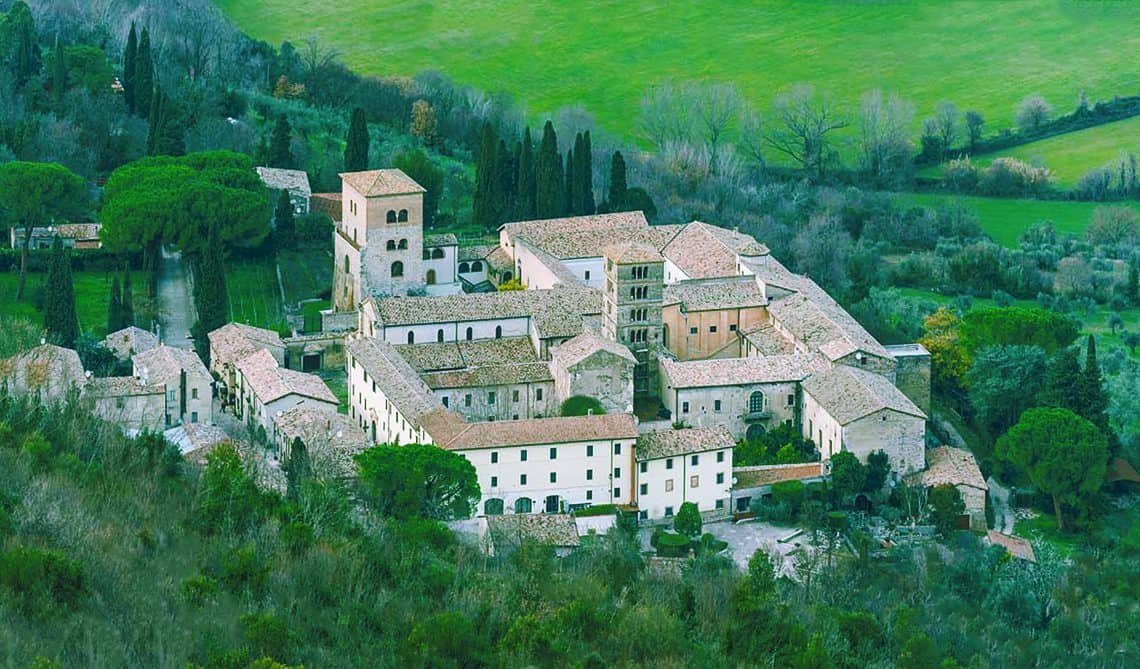
In short. Farfa Abbey is at Via del Monastero 1, in Fara in Sabina, province of Rieti, at the foot of Monte Acuziano and about a hundred meters from the stream that gave it its name.


Farfa Abbey is at Via del Monastero 1, in Fara in Sabina, province of Rieti, at the foot of Monte Acuziano and about a hundred meters from the stream that gave it its name. The monastery's phone number is 0765 277065. Visits are only possible with staff authorized by the abbey, with departures at fixed times: in the morning at 10, 11 and noon, in the afternoon at 15 and 16 during standard time, at 15.30 and 16.30 during daylight saving time. No visits on Mondays. Groups of up to 10 people can just arrive and join the next departure. For organized groups, associations, parishes and schools, booking is mandatory and goes through the abbey's tourism office, which answers at 0765 277271 and 338 6077654 in the 10-13 and 15-17 time slots, or at turismo@abbaziadifarfa.it. The individual ticket quoted by the abbey is 6.50 euros, 5 euros for children between seven and 12, free under six. Tour operator groups pay 6 euros, parishes 5.50, schools 5. The guided visit of the village is an extra 2.50 euros. It's always worth rechecking rates and hours on the monastery's website before you leave, because the community adapts them to the needs of liturgical life.
For Mass: on weekdays at 7.30, on Sundays and solemnities at 9, 10.30, noon and 19, with vespers at 18.30 on weekdays and at 18 on Sundays. This is not a parish bulletin detail. It's the reason Farfa Abbey is not visited the way you visit a museum. A Benedictine community of the Subiaco-Cassinese congregation lives inside, and the basilica is also a parish and the sanctuary of Santa Maria di Farfa. You are entering a place of spiritual work, not an exhibition hall.
From Rome it's just under 60 kilometers. By car, take the A1 north and exit at Fiano Romano, then go up the Salaria and turn onto the Farense, following the signs for Fara in Sabina and Farfa. The last road is narrow and downhill, and the final kilometer crosses olive groves that look like they've always been there. By train you reach the Fara Sabina-Montelibretti station on the FL1 line, which runs from Roma Tiburtina every 15 minutes, but the station is at Passo Corese, about 15 kilometers from the abbey. Without a car or a ride the last stretch is uncovered, and you should plan on a taxi or a rental. The parking lot is outside the village, on the entrance square. Cars don't go inside, and that is one of the reasons Farfa has stayed Farfa.
If you are putting together a day in Sabina, the village has a page dedicated to the village of Farfa and the municipality has its own, Fara in Sabina. You'll find the valley around it described in the pages on the Farfa gorges and on the Nazzano Tevere-Farfa reserve. What follows is instead the long story of the abbey: the history, the church work by work, the museum, the library, the village and the right way to spend a couple of hours in here.
What Farfa Abbey Really Is
Calling it an abbey is correct and also reductive. For four centuries, between the eighth and the 12th, Santa Maria di Farfa was not a large monastery. It was a territorial power with its own militia, a trading fleet exempt from duties, an archive that today counts as a state library and an abbot who dealt as an equal with emperors and pontiffs. If you want an understandable comparison, imagine a body that owns hundreds of churches, dozens of castles, ports, salt works, mills and two entire cities at the same time, and that answers to the emperor instead of the pope. That was Farfa.
Geography explains almost everything. The abbey stands in a fold of the Sabina, in a valley closed in between Monte Acuziano and the olive-covered hills, half a day's walk from the Salaria, the road that linked Rome to the Adriatic across the Apennines. It was far enough from Rome not to be swallowed up by papal power and close enough to count in every game played between the Tiber and the Apennines. Whoever controlled Farfa controlled a piece of the strategic corridor between the patrimony of St. Peter and the Lombard duchy of Spoleto.
In our judgment Farfa Abbey is the most underrated medieval monument in Lazio. It doesn't have the vertical scenery of Subiaco hanging on the rock, it doesn't have the universal name of Montecassino, and for exactly that reason it doesn't have the crowd either. You get there in an hour from Rome and find yourself inside a European story, told by an archive that historians of the European Middle Ages still consult today. If you have only one day trip to spend in the Sabina, spend it here.
The Name: Ovid's Farfarus
The monastery takes its name from the river that runs beside it, the Farfa, which the Latins called Farfarus and which appears in Ovid's verses among the shady waterways of the Sabina. The village around the abbey takes its name from the same watercourse, and from the village the fair that for centuries was one of the most important in central Italy. A small river with an ancient name that baptized an archive, a market and a piece of continental history: it rarely happens.
Why It Is Called Abbazia di Farfa (RI)
The abbreviation in parentheses is not a bureaucratic whim. It serves to distinguish this Farfa from other places of the same name and to place it in the province of Rieti, which for many Romans is still terra incognita even though it starts 40 minutes from the Grande Raccordo Anulare. Administratively the abbey falls in the municipality of Fara in Sabina. Ecclesiastically the Sabina answers to the suburbicarian see of Sabina-Poggio Mirteto. Whoever looks for it as Abbazia di Farfa (RI) finds it, and also finds the less intuitive fact: we are in Lazio, not in Umbria, even if the landscape and the history tell another geography.
The Origins of Farfa Abbey: Saint Lawrence the Syrian
The Farfa tradition has everything begin between 560 and 570, with a bishop named Lawrence, called the Syrian because he is said to have come from the East. He held the see of Forum Novum, the Roman town that is now called Vescovio and that preserves the oldest cathedral of the Sabina. Monastic memory credits him with the first founding of a cenobium in this valley, at a time when central Italy was emerging in pieces from the Greek-Gothic war and the fabric of rural dioceses was coming apart.
On Lawrence the Syrian the documentary certainties are few and the legends many. The most beautiful is told by the Chronicon Farfense, which credits him with freeing the Acuzian valley from an enormous dragon nesting in a well. The Latin text speaks of an immanis draco who lived in quondam puteo loci qui dicitur Acutianus. The dragon, in early medieval hagiographic grammar, is almost never a reptile. It is leftover paganism, the malarial marsh, the local cult to be uprooted. Defeating the dragon means reclaiming, evangelizing, taking possession. That the well really existed and that the air of the valley was terrible is entirely probable.
This first foundation did not survive. The Gothic wars first and the Lombard raids then reduced it to a ruin, and for about a century the valley remained without monks. A visitor today sees nothing of that cenobium. The oldest archaeological traces recognizable in the complex belong to later phases. But the memory of Lawrence the Syrian was never erased, and the abbey's museum keeps a late 15th-century panel that portrays him next to Saint Benedict: a way of saying, five centuries later, that the house had two fathers.
Forum Novum, Vescovio and Christian Sabina
To understand where Farfa comes from you have to look about 10 kilometers away, toward Vescovio. Forum Novum stood there, a Roman municipium and then a bishop's see, with an episcopal complex that excavations have identified starting in the 1980s. When city organization falls apart, between the sixth and seventh century, the function of religious and civil stronghold passes progressively to the monasteries. Farfa is born exactly in this transition, and it carries the inheritance with it for a thousand years. Until 1841 the abbot of Farfa headed an ecclesiastical territory of his own, an abbatia nullius dioecesis, that is, exempt from the jurisdiction of neighboring bishops.
The Refounding of Farfa Abbey: Thomas of Maurienne
The rebirth has an approximate date, around 680, and a protagonist with a name that seems to come out of a chanson de geste: Thomas of Maurienne, a Frankish monk from the Savoyard Maurienne. The Constructio monasterii Farfensis tells that Thomas, a pilgrim in Jerusalem, while praying before the Holy Sepulchre had a vision of the Virgin ordering him to return to Italy and raise Farfa up again. The same night, according to the account, the same vision came to Faroald II, Lombard duke of Spoleto, with the order to help him. The two met, the duke provided land and means, and the monastery rose again.
Modern historiography reads this story for what it is: a political act of foundation disguised as a miracle. Faroald II needed a Lombard outpost on the southern borders of his duchy, in an area contested with Rome. A monastery led by a Frank, that is, by a man foreign to local feuds, was the perfect tool. The vision served to make the choice incontestable. That Thomas was also a real pilgrim and a real ascetic is likewise probable. The two things don't exclude each other.
The interesting point is the rule. Thomas did not immediately set up pure Benedictinism. The community lived for a long time under a mixed rule that held together the discipline of Saint Columbanus, which arrived with the Irish monasticism then crossing Europe, and the rule of Saint Benedict. Full Benedictine uniformity would come only with the general reform of Benedict of Aniane, in the early Carolingian ninth century. Farfa was born, then, as a laboratory, not as a branch. That explains why two other decisive monasteries came out of its circle, San Vincenzo al Volturno and San Salvatore Maggiore in the Cicolano.
Thomas died around 720, after governing the house for about 40 years. For more than a century after him, the abbots of Farfa were Franks: Walderpert, Mauroald, Fulcoald, Probatus, Ingoald, Sicard. Reading the list of Farfa abbots of the eighth and ninth centuries is like reading a list of imperial officials, because that is exactly what they were.
Faroald II and the Duchy of Spoleto
Faroald II ruled Spoleto between the end of the seventh and the beginning of the eighth century, and he ended badly. Deposed and forced into monastic tonsure by his son Transamund II, he closed his life in a monastery. Before that epilogue, however, he had done two things that left a very long trace. He had supported the refounding of Farfa and he had tried to shift the Lombard balance toward the sea by occupying Classe, the port of Ravenna. The first outlived him by 13 centuries. In the history of the powerful it often happens: what they thought was their political masterpiece is dust, and what they considered a devotional investment is still standing with the monks inside.
Farfa Abbey as an Imperial Abbey: Charlemagne and the Privileges
The leap in scale comes in 774. That year, as Charlemagne dismantles the Lombard kingdom, Abbot Probatus picks the right side and obtains imperial immunity for Farfa. The monastery passes under the direct protection of the king of the Franks, removed from the jurisdiction of the dukes and, politically decisive, not subject to the temporal power of the popes. From that moment and for four centuries, Farfa Abbey is an imperial abbey, that is, a piece of the empire set 60 kilometers from St. Peter's.
This is not a textbook legal detail. It means the abbot answers to the emperor, the monastery's property can't be touched, disputes go before the imperial envoys and not the Roman curia, and the abbey becomes an instrument of foreign policy. Farfa was, in effect, the empire's permanent embassy to the Holy See and at the same time the armed outpost of imperial interests in Lazio. It was said, with a formula that has come down to us, that the abbot of Farfa could overshadow the pope. The truth is more prosaic and more interesting, because his power was that of a legate, not of a rival.
Charlemagne in person climbed up here. The Farfa sources place the visit a few weeks before the coronation in St. Peter's on Christmas Day of 800. The future emperor stopped at the abbey, and the community kept the memory of it as the founding moment of its fortune. During his reign the complex went through the most imposing building phase of its early medieval history, with a construction site that altered the earlier layout so much that only the archaeology of recent decades has made it possible to reconstruct its lines. In a few decades Farfa became one of the most prestigious centers in Europe, on a par with the great Frankish and Rhenish houses.
Abbot Ingoald's Ship
There is a document worth more than 10 pages of praise. In the third decade of the ninth century, under Abbot Ingoald, the abbey owned a commercial ship of its own, exempt from duties in all the ports of the Carolingian empire. The privilege dates to 822. Let's pause a second on what that means. A monastery in the Sabine interior, 50 kilometers from the sea, armed and sailed a ship of its own, and that ship docked tax-free from Marseille to Ravenna. Farfa was not a place of prayer receiving alms. It was a continental enterprise with a monastic rule.
Everything else follows from here: the mills, the salt works, the river ports, the fairs. And so does the character of the Farfa archive, which is an archive of administrators before it is one of theologians. When you read in the museum that the monks kept registers of grants and leases with a notary's precision, remember the ship. It was the same mentality.
Abbot Sicard, Relative of Charlemagne
Among the Frankish abbots the most celebrated at Farfa is Sicard, in office around the middle of the ninth century, whom the sources say was related to Charlemagne's family. The monastery keeps a gravestone of his, found in 1959 inside the church where it had been reused as building material. It is one of the pieces you meet along the visit route, and it is a small treatise on history in itself. An imperial abbot of the ninth century ends up, six or seven centuries later, cut and walled in by some master builder who needed a squared stone. The Middle Ages were not sentimental about their own past.
The Feudal Estate of Farfa Abbey
The numbers of the Farfa estate have circulated for centuries and come in large part from the survey of the charters done in the modern age, beginning with Ludovico Antonio Muratori. At its moment of greatest extension, between the 10th and 11th centuries, the abbey controlled 683 churches and monasteries, 132 castles or strongholds, 16 fortresses, seven ports, seven salt works, 14 villas, 82 mills, five castaldates and an enormous number of lakes, pastures and lands, plus more than 300 villages and boroughs. Two entire cities appear in the list: Centumcellae, that is Civitavecchia, and Alatri.
Add a militia of its own, because an estate like that isn't defended without armed men, and you'll understand why for four centuries nobody in central Italy could ignore the Abbey of Farfa. The abbot wasn't an administrator of ecclesiastical property: he was a territorial lord who covered a stretch of Lazio, Umbria, the Marche and Abruzzo with his officials, his contracts and his courts.
This wealth is also the explanation for the crises. Every time the estate grew, the number of people interested in getting their hands on it grew: relatives of the abbots, Roman baronial families, popes who wanted to bring the Sabina back under control, emperors who wanted to keep it for themselves. The internal history of Farfa is a succession of reforms and relaxations, and in between there are very harsh episodes. Between 1119 and 1125 the community split in the rivalry between Abbot Guido and the monk Berardo, both determined to govern: years of excommunications, occupations and exiled monks, among them, for a period, Gregorio di Catino himself.
The abbot at the head of a diocese
There's a detail that throws off anyone who knows modern canon law: the abbot of Farfa was at the head of an ecclesiastical territory of his own, with episcopal-type powers over a vast area, which originally followed the Apennine orography until it touched the first core of the papal estate, the one carved from the Byzantine corridor with the donation of Sutri. The present suburbicarian see of Sabina-Poggio Mirteto is only a part of it. This condition, technically an abbey nullius, ended in 1841 with the erection of the diocese of Poggio Mirteto: 1,000 years of autonomy ended with a decree.
The Saracen raids and the fire at the Abbey of Farfa
At the end of the ninth century the pressure of the Saracen bands that had come up from the Garigliano reaches the Sabina too. The Farfa chronicle tells of a resistance lasting seven years, conducted by the militias under the orders of the monastery's chapter: seven years is an enormous time, and by itself says that Farfa was a stronghold even before it was a church. In the end Abbot Peter I understood that the position was no longer tenable and organized the evacuation. The monastery was taken, sacked and burned at the beginning of the tenth century.
The monks split into three groups. One took shelter in Rieti, one in Fermo on the Adriatic, one in Rome. They carried with them what was transportable and above all the charters, and this explains why the Farfa archive survived a fire that devoured the rest. The communities in exile preserved their own identity and their own discipline, which in the tenth century was not at all a given.
Of the Roman group an archaeological trace remains that few know and that is worth the mental trip. In the zone that would later become the insula of the French, between the church of San Luigi dei Francesi and the area anciently occupied by the Baths of Nero, during the restoration works on the basements of Palazzo Madama carried out by the Senate administration at the end of the 1980s, traces were found of a cemetery belonging to the chapter of the abbots of Farfa. Under the palace of the Senate of the Republic, then, rest Sabine monks fleeing the Saracens. Rome is like that: you dig to redo an electrical system and you find the tenth century.
Why Farfa was a target
The bands coming up from the Mediterranean weren't looking for martyrs: they were looking for metal, textiles and men to resell. A monastery as rich as Farfa, with gold and silver liturgical furnishings, full storerooms and a large servile population, was a rational economic target. That the siege lasted seven years says something else, however: the valley was defensible and the people of Farfa knew how to defend it. When you visit the complex it's worth remembering this, because the gentle basilica you see today covers the foundations of a structure that for centuries was also military.
The rebirth of the Abbey of Farfa: Ratfredo and Abbot Hugh
Ratfredo leads the return, bringing the chapter back to the valley, and in 913 completes the church. It's a hard reconstruction, in a century when resources are scarce and the neighbors take advantage. The true refounding comes at the end of the tenth century with Hugh I, abbot on several occasions between 998 and 1039, a man of government and culture of a kind found rarely in the whole of the Italian Middle Ages.
Hugh does three things at once. He puts the estate back in order, recovering usurped lands with a systematic judicial and documentary campaign. He introduces the Cluniac reform at Farfa, that is the most rigorous and most modern model of monastic life of his time, the one that was rewriting European monasticism from Cluny on down. And he reorganizes the scriptorium, giving Farfa script a recognizable physiognomy that paleographers still call romanesca farfense today.
The result is that in the 11th century Farfa becomes a first-rank center again, with a library that the sources place among the richest in Europe and a book-producing capacity like that of a great workshop. That a monastery burned a century earlier could reach this level says a lot about the resilience of monastic institutions: buildings burn, the organization doesn't.
What the Cluniac Reform Meant
It's worth explaining, because at Farfa it is the keystone. Cluny proposes a monasticism centered on solemn and prolonged liturgy, on exemption from interference by lay lords and local bishops, on internal discipline and administrative order. In practice: fewer relatives of the abbots dividing up the land, more hours in choir, more well-kept registers. For an estate like Farfa's, the reform is both spirituality and a business turnaround. Hugh I understood that the two things had to be done together, and this clarity is the reason his abbey produces, a few decades later, the greatest archivist of the Italian Middle Ages.
Gregory of Catino and the Regesto di Farfa
If only one thing were to remain of Farfa Abbey, the thing to save would be the archive. And the archive, in the form we know it, is the work of one man: Gregory of Catino, born around 1060 in Poggio Catino to a family of the Sabine lesser nobility, son of Dono and Theodoranda, who entered Farfa as a child oblate and stayed in the monastery almost 50 years, with the exception of a period of exile due to the conflict with Abbot Berard II. He returned for good in 1099 and from then on did only one thing: copy, order, index.
The masterpiece is the Regestum Farfense, also called Liber Gemniagraphus sive Cleronomialis Ecclesiae Farfensis, begun around 1103: over 1,300 documents, 1,324 according to the traditional count, transcribed in chronological order starting from 705. Donations, privileges, exchanges, rulings, imperial diplomas. For the history of the duchy of Spoleto, of the Sabina and more generally of Italian society between the eighth and 12th century it is a source without rivals in southern Europe: you know the names of the peasants, the measures of the fields, the rents paid in oil and grain, the boundaries described tree by tree.
The Liber Largitorius
In the same years Gregory compiles the Liber Largitorius, also called Liber Notarius sive emphiteuticus: about 2,000 documents in abbreviated form, starting from 792, recording the grants made by the monastery to its tenants and leaseholders. It is the inventory of the relationship between the abbey and those who worked its lands. Scholars of Italian economic history still open it today, because it contains a continuous series of agrarian contracts over three centuries, something that, for the early Middle Ages, has few comparisons in Europe.
The Chronicon Farfense
Between 1107 and 1119 Gregory writes the Chronicon Farfense, the history of the monastery built on the charters: the foundation, the abbots, the territorial acquisitions throughout central Italy, with catalogs of popes and sovereigns serving as a chronological scaffold. It is not a naive chronicle. It is a work of advocacy. It serves to show, document in hand, that the Farfa properties belong to Farfa and that others' claims do not stand up to the test of the charters. That it is also one of the soundest historiographical texts of the century is, in a sense, a side effect of legal rigor.
The Liber Floriger
At 70, to be able to find his way around his own output, Gregory compiles a topographical index of his earlier works, the Liber Floriger chartarum cenobii Farfensis: a repertory that follows the properties from the Marche to Abruzzo to Campania. An old monk who, having reached the age when others stop, builds the search engine of his own archive. In the 11th and 12th century this was a revolutionary thought, and it is the reason the name of Gregory of Catino appears in any serious handbook of medieval diplomatics.
Why the Regesto Still Matters
Let me give a concrete example, because the word archive puts people to sleep and shouldn't. Thanks to the Farfa charters we know when and how incastellamento begins in central Italy, the process by which between the ninth and 11th century the population scattered in the countryside gathers into fortified hilltop villages. Many of the towns you can visit today in the Sabina, from Casperia to Torri in Sabina, exist in that form because someone, in a Farfa document, wrote that a castle was being built in a certain place in a certain year. The landscape you see from the abbey's esplanade is, literally, the landscape described in those parchments.
The Scriptorium of Farfa Abbey and the Romanesca Farfense
Under Hugh I the Farfa scriptorium becomes a writing workshop with an identity of its own. The minuscule in use in the Roman area, the so-called minuscola romanesca, is reworked at Farfa until it becomes a script recognizable at a glance: narrow letters, marked ascenders, an insistent vertical rhythm. Paleographers call it romanesca farfense and use it as a marker to attribute to this scriptorium codices scattered today across half of Europe.
This is not a specialist's detail. In the Middle Ages a recognizable script was a trademark and a guarantee of authenticity. Whoever received a Farfa document knew where it came from before even reading it. And a house that builds its own handwriting is a house that produces books in industrial quantity, with masters, students and correctors. At its peak, toward the end of the 11th century, the library of Farfa Abbey was considered among the richest on the continent.
What Was Copied
Liturgical books were copied first of all, because liturgy consumed volumes the way a building site consumes lime. Then Scripture and the Fathers, canonical texts, monastic rules, and of course administrative documents. Farfa's output was not for a museum. It was for daily use. When you enter the library room and see the shelves, keep in mind that what is preserved today is the tail of a river, not the river.
The Investiture Controversy: Farfa Abbey on the Side of the Empire
In the great clash between papacy and empire that runs through the 11th and 12th century, Farfa had no doubts. Faithful to its condition as an imperial abbey, the monastery sided with the Ghibelline party and also produced a battle text, the Orthodoxa defensio imperialis, in defense of the empire's case. The very collection of canonical texts inserted in the Regesto seems to deliberately omit the canons of the reforming pontiffs of the 11th century. A silence that, in so meticulous an archive, is taking a side.
This loyalty cost dearly and lasted long. The pro-German leaning of the Farfa monks runs through the whole Swabian period and ends only in 1268, when the defeat of Conradin closes the season of German domination in Italy. From that moment the wind turns, and Farfa enters a defensive phase from which it will never emerge. It is an exemplary political parabola: the abbey had been great because it was imperial, and it declines exactly with the empire.
An Archive That Chooses Sides
It is a passage that dismantles a comfortable idea, that of the neutral archive. Gregory of Catino was not an impartial notary. He was a Farfa monk defending his house. His extraordinary precision serves a thesis. This takes nothing away from the value of the source, indeed it makes it more interesting, because it forces the historian to read the gaps too. What is not in the Regesto is as good a question as what is.
From the Commenda to the Farnese: The Long Decline of Farfa Abbey
In 1399 Pope Boniface IX assigned Farfa in commendam. The word deserves an explanation, because it is the key to the decline of almost all the great Italian abbeys. A commendatory abbot is a churchman, often a cardinal, who receives the monastery's revenues without living there and without guiding its community. The estate serves to support him and his court, not the house. For a century and a half Farfa was the income of very powerful families, the Orsini in particular.
The paradox is that the commendatories left the most visible architectural imprint. The basilica you visit today is the work of the Orsini: construction begun in 1494, consecration in 1496. In 1494 Alexander VI had united Farfa to the abbey of San Salvatore Maggiore. In 1547, under Cardinal Alessandro Farnese, the monastery entered the Cassinese Congregation, that is, it returned to a regular life framed within a serious monastic network, and Farnese left Farfa a Renaissance cloister that bears his name.
In 1568 Jacopo Barozzi da Vignola, one of the most sought-after architects of the century, was called here for the fountain and the mill. The work was then completed by Giacomo Della Porta. That two names of that caliber worked at Farfa says how seriously the Farnese commission took it. But the center of gravity of power had shifted elsewhere long before, and over the following two centuries, between restorations and new buildings, the abbey progressively lost political and economic weight.
The Orsini and the Taste of the 15th Century
The Orsini were one of the two great Roman baronial families, historic rivals of the Colonna, and they treated abbeys held in commendam as pieces of their own territorial system. The Farfa construction project of the late 15th century answers two needs: to give the complex a modern church, in the Renaissance taste arriving from Rome, and to sign it. The Orsini coats of arms on the wooden ceiling are not a decorative detail. They are a notarial act painted and carved, 12 meters above the heads of the faithful.
Napoleon, the Unification of Italy and the Return of the Monks
The hardest blow comes at the end of the 18th century. In 1798 the Napoleonic suppression closes the monastery and scatters its goods and books. With the Restoration life resumes with difficulty, but in 1841 the abbey also loses its ancient ecclesiastical autonomy with the establishment of the diocese of Poggio Mirteto. After the annexation to the Kingdom of Italy in 1861, a large part of the Farfa holdings is seized by the State and sold to private citizens. It is the material end of the 1,000-year-old estate.
The climb back begins in the early 20th century. Count Giuseppe Volpi buys and then donates property and land to the monastery, giving the house an economic base again. In 1920 a group of monks sent by Alfredo Ildefonso Schuster, then head of the community of San Paolo fuori le Mura in Rome and later cardinal archbishop of Milan, repopulates Farfa and relaunches its regular life. In 1928 the abbey is declared a national monument, a status that guarantees the protection of its assets and opens the way to the restoration work of the second half of the 20th century.
The community that welcomes visitors today descends from that return of 1920. It is not a stage-set reconstruction. It is a line that was broken and tied back together, as happened at Montecassino, at Subiaco and in almost all the great Benedictine houses of Italy. It's worth knowing before you go in, because it changes the way you look at a monk crossing the cloister while you are photographing a capital.
Alfredo Ildefonso Schuster, the man who relit Farfa
Schuster deserves one more line. A Benedictine, a historian of the liturgy at a European level, abbot of San Paolo fuori le Mura and then archbishop of Milan from 1929, he was one of the most complex ecclesiastical figures of 20th-century Italy. The relaunch of Farfa is part of a broader plan of his for the rebirth of Benedictine monasticism in Lazio, which touches other complexes in the region too. Without that decision made in Rome in 1920, today we would probably find here a nice empty museum instead of a living community.
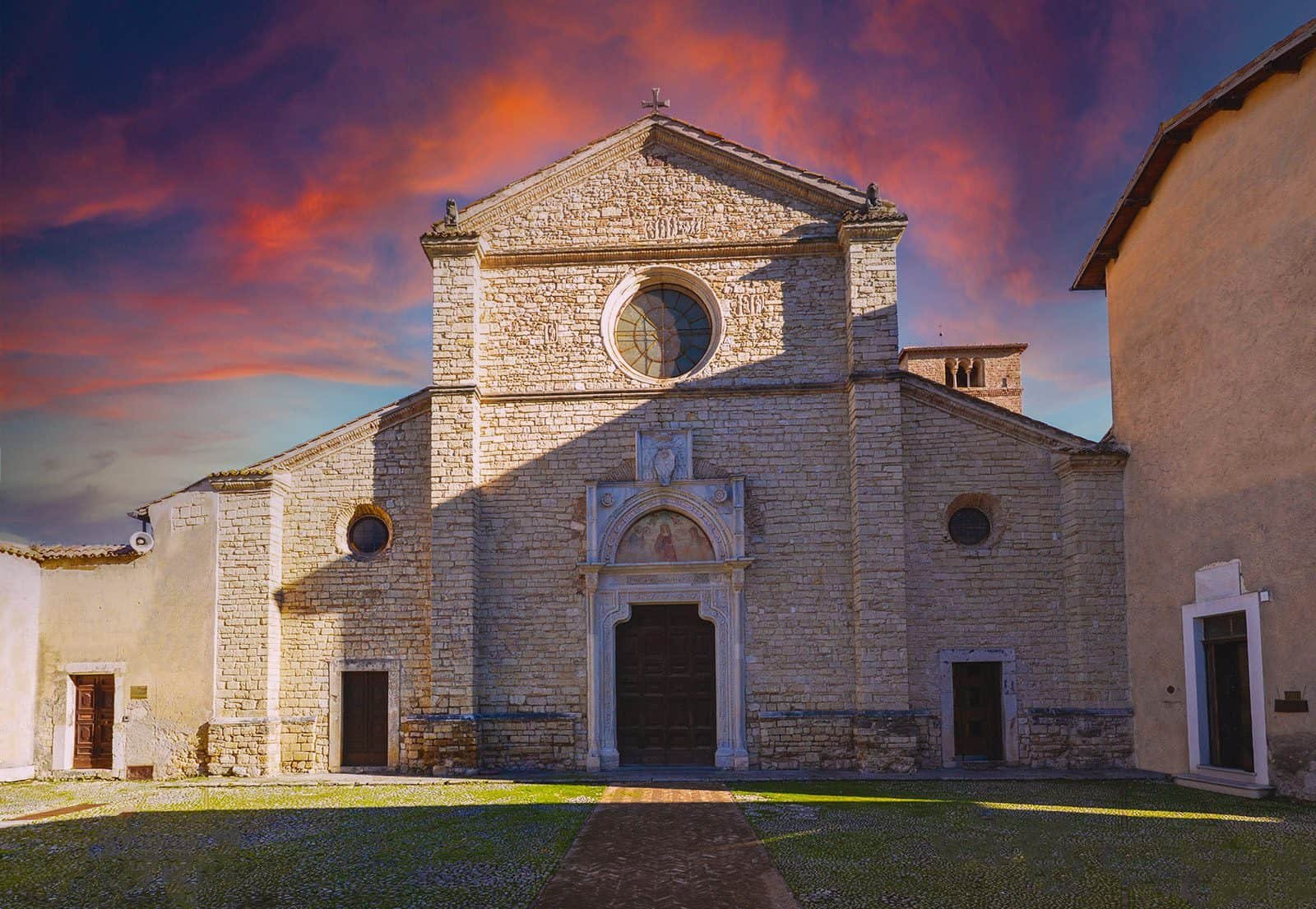
The Basilica of Farfa Abbey: the Facade
You reach the church from a small square, closed in between the side of the monastery and the houses of the village, and the first impression is one of almost severe sobriety. The facade is stepped, which means its slopes follow the line of the three interior naves, and it ends at the top with a simple triangular pediment. In the center opens the portal, framed in marble, topped by a frescoed lunette with the Madonna and Child crowned by two angels between Saint Benedict and Saint Scholastica: the two siblings from Norcia, the founder and his sister, who in every Benedictine house stand guard at the entrance.
Above are three rose windows, one for each nave, with the central one larger. It is a 15th-century layout that quotes the Romanesque without copying it, and that says exactly what the Orsini building site wanted to say: continuity with tradition, updated forms. Look at the masonry up close, especially on the left side: you can read repairs, infills, reused blocks. The facade is a palimpsest, like everything here.
The threshold and the portal
The marble frame of the portal is the first thing to touch with your eyes. The marble is not local: in the Sabina there are no quarries of this kind, and the best blocks in the Middle Ages and the Renaissance almost always came from Roman spolia or from purchases in Rome. Framing the door of the house with ancient marble is a gesture of legitimation: the monastery declares itself heir to Rome. Even when the stone was freshly worked, the message stays the same.
Inside the Basilica of Farfa Abbey
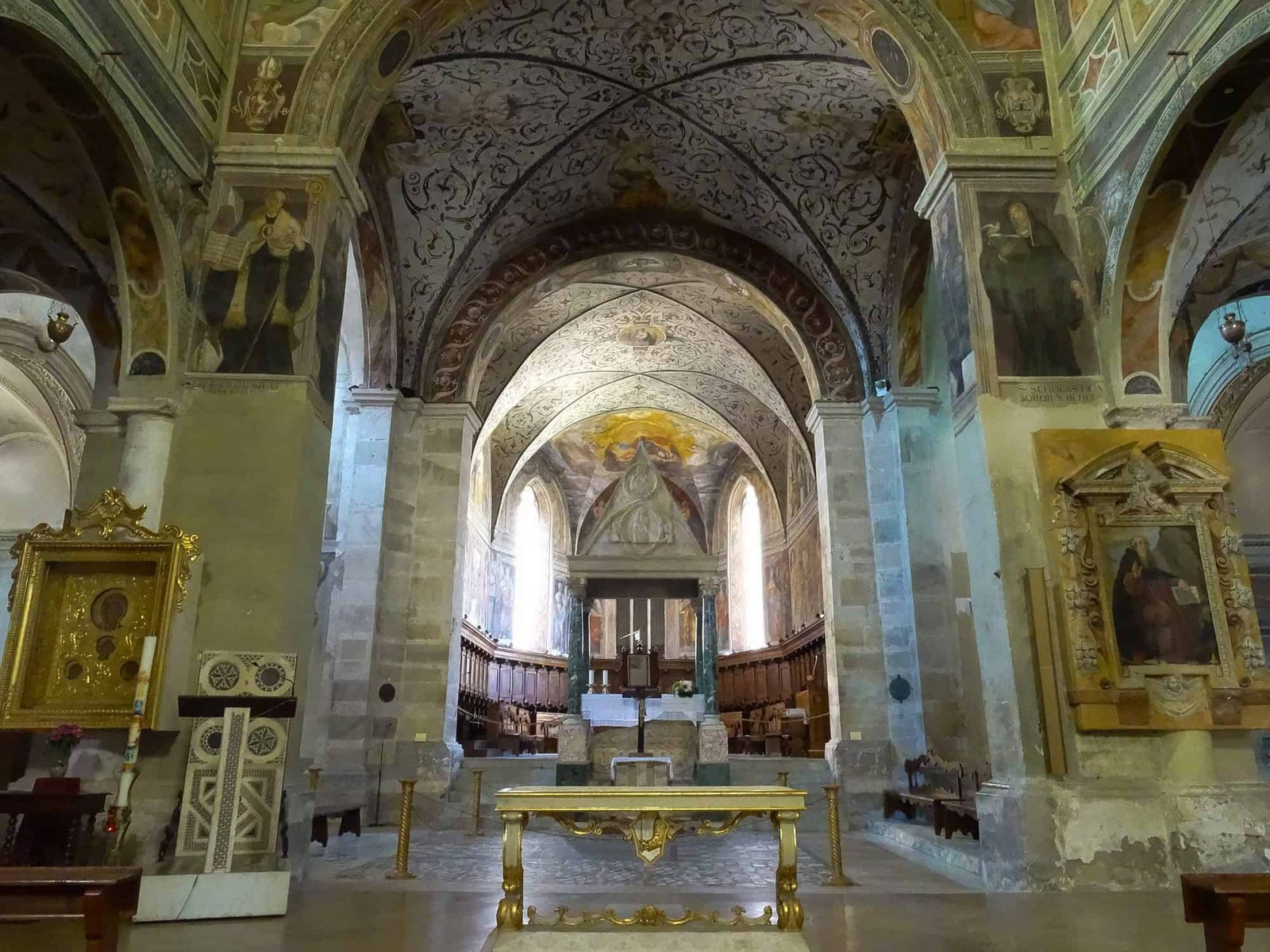
The interior is a Latin cross, with three naves divided by two rows of round arches resting on marble columns with Ionic capitals. The structure is the Renaissance one of the late 15th century, but the dress you see today is largely Baroque, the result of 17th- and 18th-century work: stuccoes, side altars, frames, the wooden choir of the apse. Anyone arriving expecting the Romanesque is thrown off for 30 seconds, then starts to enjoy it, because the layering is exactly the point.
The practical tip: go in, take five steps and stop. Don't look at the altar right away. Turn around and look at the wall you came in through. The strongest piece in the church is there, on the inner facade, and nobody sees it until they leave, when the guide is already talking about something else.
The columns and the light
The Ionic columns mark the space with a wide spacing, and the light enters from the rose windows and the high windows at an angle that in the early afternoon cuts the central nave diagonally. That is the reason I recommend the 15:00 or 15:30 visit: in that time slot the church reads better, the wooden ceiling takes on color and the floor stops being a dark carpet and becomes a map.
The transept and the apse
Beyond the crossing, in line with the central nave, opens the deep, polygonal apse, occupied by the Baroque wooden stalls of the monks' choir. It is the space of communal prayer, where the community lines up in two facing rows for the psalmody. When you happen to attend vespers, notice how the acoustics change when the voices start from inside the choir instead of from the nave: the church was built for that sound, not for our footsteps as visitors.
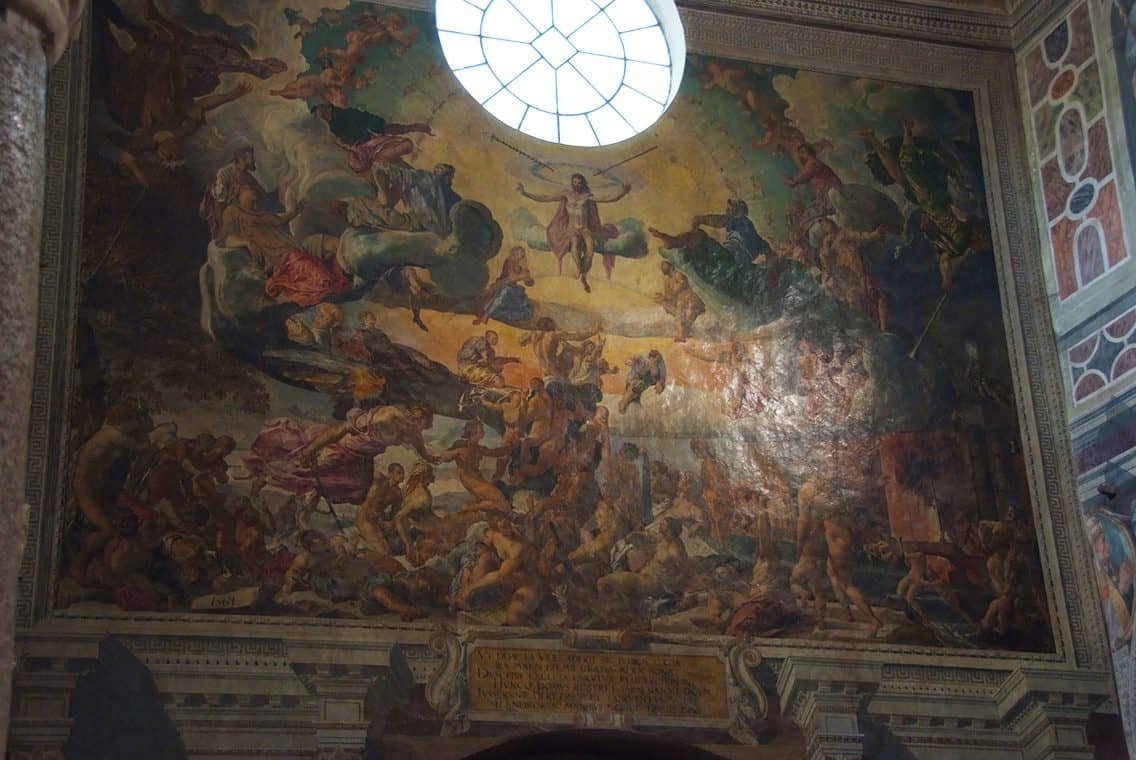
The Last Judgment on the Inner Facade of Farfa Abbey
The inner facade of the basilica is entirely painted with a Last Judgment signed and dated 1561 by Dirck Barendsz, a Dutch painter from Amsterdam who lived between 1534 and 1592 and was in Italy in the middle years of the 16th century. It is the work nobody expects to find in the Sabina and the reason Northern art historians come through here.
Barendsz is a painter of the generation that, in the Netherlands, absorbs the Italian lesson and reworks it. In Italy his contemporaries would have called him generically Flemish, as was done with all the painters who came from the North: the definition is imprecise in a geographic sense and very useful in a stylistic one, because it indicates a recognizable manner, made of elongated figures, crowded drama, minute detail even in the secondary areas. His best-known work in Amsterdam is a Judith. The Fall of Lucifer, painted for the city militia, was destroyed in the iconoclastic furies. The wall at Farfa is, in fact, his great Italian survivor.
The theme of the Judgment on the inner facade follows a very ancient logic: the worshipper sees it on the way out, not on the way in. You enter looking at the altar and salvation. You leave looking at the judgment and carrying it outside with you. In 1561 Michelangelo's Last Judgment in the Sistine was less than 20 years old and was already redefining the European iconography of the theme. Here you see an artist who knows that model and renders it with a syntax of his own, less titanic and more narrative.
A firm opinion: it is the best piece in the church and deserves at least 10 minutes on its own. Bring a small pair of binoculars or use your phone's zoom for the upper areas, where reading with the naked eye gets lost. And resist the temptation to just photograph it: here a photograph gives back a tenth of what you see.
The Coffered Wooden Ceiling of Farfa Abbey
Look up. The ceiling of the central nave is a coffered wooden ceiling dated 1494, that is, to the Orsini building site, decorated with the family's coats of arms. It is one of the few 15th-century ceilings in Lazio that remain essentially in place, and on its own it would justify a visit.
The Renaissance coffered ceiling is a technically complicated object: a load-bearing structure of beams, a grid of frames, a series of recessed panels with rosettes or coats of arms in the center, all of it suspended over a wide nave and subject to the seasonal movement of the wood. Making it last five centuries takes well-seasoned timber, a roof that doesn't leak and continuous maintenance. When you look at it, you are also looking at the silent work of generations of carpenters who climbed up there to change a peg.
The Orsini coats of arms
The Orsini coat of arms, with the rose and the bands, repeated in the panels, turned the ceiling into a declaration of permanent patronage. In the 15th century there was no donor plaque: there was heraldry, and heraldry was put where everyone raised their eyes. The fact that today that coat of arms sits above a Benedictine community that has nothing more to do with the Orsini is one of those ironies that time produces in series.
The Floor of Farfa Abbey: Cosmatesque and Carolingian Mosaic
The floor is the second surprise. In the area of the transept a portion of paving is preserved that is attributed to the 9th century, that is, to the Carolingian phase of the church: a fragment that survived the fire, the rebuilding and 1,000 years of feet. It is the oldest piece you walk on at Farfa.
Next to it and around it you can read the work of the Roman marble workers in the Cosmatesque tradition: tesserae of red porphyry and green serpentine taken from Roman columns sawn into slices, arranged in circles and ribbons inside panels of white marble. The technique is that of the great Roman churches, from Santa Maria in Cosmedin to San Clemente, and the principle is always the same: the material is ancient, the design is medieval. Every porphyry disc you see was, before, a piece of an imperial column.
Practical tip: look at the floor against the light, positioning yourself so the window is in front of you and not behind. Porphyry worn by footsteps gives back a reflection you can't see in flat light, and the differences in level between the different phases become evident. It is the best way to understand, without reading a line of archaeology, how many churches there are inside this church.
The High Altar, the Ciborium and the Choir
The high altar is topped by a ciborium of excellent workmanship, which has on its peak a bas-relief of the Assumption of Mary. The ciborium is the four-column structure with a canopy that marks and protects the altar: in the ancient liturgical tradition it delimits the most sacred space of the church, and in many Roman basilicas it is the visual focus of the whole building. Here it plays the same role, with the Marian dedication of the house carved up high, where the person at the altar doesn't see it and the person looking from the nave does.
Behind, the stalls of the Baroque choir close off the apse. The wood is dark, the design is that of post-Tridentine monastic choirs, made for a large community. Counting the stalls is an instructive exercise: it tells you how many monks that church expected to host, and the comparison with today's community tells five centuries of Italian religious history without needing comment.
The column of the ciborium and its reputation
On the rear left column of the ciborium circulates a curious story, reported by Umberto Cordier in his Guida ai luoghi misteriosi d'Italia: on contact it is said to give an inexplicable sensation of an electric shock. I'm not passing it off as a physical fact and I'm not inviting you to touch liturgical furnishings, which in churches are not touched. I report it because it is an interesting trace of how the literature of unusual places treated Farfa in the 20th century, and because nine visitors out of 10, after hearing it, look at that column with different eyes. Suggestion is a real phenomenon even when the electricity isn't there.
The Side Chapels and Frescoes of Farfa Abbey
Along the side aisles open the chapels, decorated between the 16th and 17th centuries. The first on the left holds a Triumph of Saint Ursula attributed to Orazio Gentileschi and executed at the end of the 16th century, in the years between 1597 and 1599. Gentileschi is the Pisan painter who in Rome moves from late Mannerism to Caravaggesque light, and is the father of Artemisia: seeing him here, in a still formative phase, is a privilege that doesn't happen often in Rome.
The workshop of the Zuccari also worked on the decorative cycle of the basilica, the family of painters from the Marche who in the second half of the 16th century dominated the Roman building sites, from Taddeo to Federico. Farfa thus enters, with full right, the geography of the great late Mannerist decoration of central Italy. These are names you expect to find at the Quirinale or in the Vatican, not half an hour from Rieti, and yet the cardinal commenda worked that way, and brought the best teams to the provinces.
How to look at a side chapel
A method that works: first you look at the altar of the chapel and understand who it is dedicated to, then you look at the side walls, then the vault, and only at the end do you go back to the altarpiece. The decoration of a chapel is a constructed discourse, not a collection of paintings: the side scenes comment on the central altarpiece, the vault opens the sky. With this reading order even a minor chapel becomes understandable in two minutes.
The Organ of the Basilica of Farfa Abbey
The pipe organ is placed behind the triforium of the back wall of the apse, with an independent movable console in the presbytery, and was built by the organ-building firm Pedrini in 1947. It has electro-pneumatic action, with 12 stops spread over two keyboards of 58 notes each and a concave-radiating pedalboard of 30.
Translated for those who are not organists: 12 stops are a small tonal palette, suited to liturgical accompaniment more than to the great concert repertoire. The electro-pneumatic action, typical of the first half of the 20th century, allows the console to be detached from the body of the instrument, and in fact the organist here sits in the presbytery while the pipes sound behind the apse. The acoustic result is peculiar: the sound arrives from behind and from above, reflected by the apse basin, and fills the nave without the source being seen. Anyone who happens to be at Farfa during an organ concert notices it right away.
The Bell Tower of Farfa Abbey and the Carolingian Traces
The bell tower is the most eloquent piece of archaeology in the complex and almost nobody looks at it carefully, because to see it well you have to leave the church and walk around. At the base it preserves features of Carolingian architecture, with pilaster strips still perfectly legible on the wall surfaces: they are the signs of the great building phase of the 8th and 9th centuries, the one that made Farfa one of the most important building sites in Europe. The triple-lancet windows of the upper parts belong instead to a later, Romanesque phase.
Medieval frescoes have been found at the base of the abbey tower, and it is one of the points where the visit route shows the layering without any need for explanation. Studies have also recognized in the complex traces of a westwerk, that is, that monumental western body, with a tower and raised rooms, which characterizes the great Carolingian and Ottonian churches north of the Alps. Finding it in the Sabina means only one thing: Farfa did not build the Italian way, it built the imperial way.
How to read a pilaster strip
A pilaster strip is a flat pillar, barely projecting, set against the wall: in early medieval architecture it serves to divide surfaces into vertical panels and to stiffen the masonry. Seeing them preserved on a bell tower is rare, because later rebuilding tends to plaster over and erase. Here you can read them. When you spot them, you have in front of you the only visible scrap of the Farfa of Charlemagne: everything else from that building site is below walking level or inside the walls.
The Cloisters of Farfa Abbey
The monastery is organized around the cloisters, and the visit touches more than one. The first, small, is the so-called Lombard cloister, with a Romanesque two-light window of the 13th century that is one of the most photographed elements of the complex. The name betrays the 19th-century habit of calling Lombard everything that was early medieval and not otherwise classifiable. The two-light window is later, but the layout of the space keeps a memory of the ancient phases.
The large cloister dates to the second half of the 17th century and gathers Roman sculptures and inscriptions, materials recovered in the area and set into the walls along the porticoes according to a common practice in monasteries: making the cloister a lapidary museum even before museums existed. From here, through a diamond-point portal, you pass into the library. Then there is the Renaissance cloister linked to Cardinal Alessandro Farnese, which is the most elegant space of the complex and the most visible sign of the Farnese season.
Why cloisters have a well at the center
Almost always at the center of a Benedictine cloister there is a well or a cistern. The reason is practical, water was needed, but the symbolism is just as strong: the cloister is the closed garden, the hortus conclusus, and the water at the center points to the fountain of life. When you cross the large cloister, look at the relationship between the square of the porticoes and the sky cut out above it: it is the only place in the monastery where the monk saw the sky while staying indoors. All monastic architecture turns around this compromise.
The Monastery of Farfa Abbey: Refectory and Chapter House
The visit route takes you into some of the rooms of communal life. The refectory preserves works of the 17th century: it was the hall in which the community ate in silence while a monk read from the pulpit, and the decoration had the function of giving food for thought to those who could not speak. The chapter house is the room of decisions, the one in which the chapter of monks met every day to hear a chapter of the Rule, hence the name, and to deliberate on the matters of the house.
In the chapter house of an abbey like this, things were decided that weighed on the history of central Italy: elections of abbots, political alliances, property lawsuits, the choice to side with the empire against the pope. Entering that space knowing this is a completely different visit from entering it thinking you will see an empty room with a few frescoes.
Along the route are displayed many pieces of medieval structure recovered in the complex: capitals, sculptural fragments, architectural elements. Among them the gravestone of Abbot Sicardo from the 9th century, found in 1959 in the church where it had been reused. They are the surviving bricks of Carolingian Farfa, and lined up they tell the building story better than any panel.
The Museum of Farfa Abbey
On the ground floor are the museum rooms, organized in a section dedicated to ancient Sabina and a medieval section. It is not a huge museum, but it holds at least three pieces that in any big city would be the headliners of a collection.
The archaic section and the Cippus of Cures
The archaic section displays archaeological materials of the peoples who lived in ancient Sabina, a territory much larger than the administrative Sabina of today, largely coming from the nearby necropolis of Colle del Forno, the great aristocratic burial ground connected to the Sabine city of Cures. Chamber tombs, grave goods, prestige objects: the portrait of an Italic aristocracy of the 7th and 6th centuries BC.
The piece that is worth the ticket is the Cippus of Cures, the only known example of Sabine epigraphy on stone, datable to the end of the 6th century BC. It was found in March 1982 in the bed of the Farfa stream, and its interpretation is still not complete. Stop in front of this stone longer than you would naturally. It is the only direct voice that remains of a people the Romans described in full and who left almost nothing in writing about themselves. The Sabines of the legend of the rape, of Numa Pompilius, of ancient virtue: their language is here, carved on a block found in a stream by someone passing by.
The Amalfitan ivory casket
In the medieval section the masterpiece is an ivory casket of the Amalfi school, from the second half of the 11th century, with inlays that document the birth of an ivory workshop on the coast of Amalfi. It was dedicated to the Virgin by the patron, a certain Mauro Comite of Amalfi, who also had the names of his six children carved on it, and it is counted among the major works of Mediterranean medieval art. In the first months of 2008 it was shown in Salerno in the exhibition dedicated to the enigmas of medieval ivories.
Why an Amalfitan object ended up at Farfa is no mystery: in the 11th century Amalfi was the bridge between the Islamic Mediterranean and Christian Italy, its merchants arrived everywhere, and an ivory casket was the prestige gift par excellence. The names of the six children carved on the reliquary are the detail that strikes the most: a merchant around the year 1000 who entrusts his whole family to the Madonna, in writing, hoping someone will read it. 1,000 years later we read it.
The panels from the school of Antoniazzo Romano
Also in the medieval section are two opisthographic panels, that is, painted on both sides, from the late 15th century, depicting Saint Lawrence the Syrian and Saint Benedict on one side, Saint Thomas of Morienne and Saint Placidus on the other: the work of a pupil of Antoniazzo Romano, the painter who in Rome held together the late Gothic tradition and the Renaissance novelties. Opisthographic panels served as a processional standard or as a movable shutter, and both faces were in use. The iconographic program is a declaration: the two founders of Farfa next to the two major saints of Benedictine monasticism. A painted family tree.
To this is added a canvas of the early 16th century with the Virgin and Child and an Angel, which completes the small core of old painting in the collection.
The scenes by Emanuele Luzzati
In a room of the monastic museum the artist Emanuele Luzzati created an installation with 12 scenes inspired by the writings of Gregorio di Catino and the Chronicon Farfense. Luzzati, from Genoa, a set designer and illustrator among the best loved of 20th-century Italy, twice nominated for the Oscar for his animated shorts, had a rare ability to make history readable without trivializing it. His 12 scenes are the best way to bring a child into the story of Farfa, and they work very well with adults too who know nothing about imperial diplomas.
I find this room one of the smartest museum choices made in an Italian monastery. Instead of filling a wall with panels of dates, they called in a storyteller in images. The result is that the visitor leaves actually knowing who Gregorio di Catino was.
The Library of Farfa Abbey
From the large cloister, through a diamond-point portal, you enter the library. It is a state library, which means that since 1964 the management of the collections has passed to the State while physically staying inside the national monument. In 2000 a major architectural restoration expanded its spaces and services. The holdings run to about 50,000 units, with an old core that includes medieval manuscripts, incunabula and 16th-century printed books.
The Farfa book heritage has gone through centuries of dispersal: the flight before the Saracens, the plundering by the commenda, the Napoleonic suppression of 1798, the seizure of 1861. What is preserved here is what in the difficult moments did not take the road to other places. The originals of the Regesto and of the Chronicon of Gregorio di Catino have not been at Farfa for centuries, and this must be said clearly: anyone who comes hoping to see the original parchment will be disappointed. What you see is the house that produced it, which is another thing and is no less moving.
How to consult it
The library has a study function and is not strictly part of the tourist circuit: the reading room is a work place for researchers. Those who need to consult the collections contact the library directly and agree on arrangements and hours, which vary in the summer periods and on holidays. The diamond-point portal, that one you do see during the visit: it is one of the most beautiful decorative elements of the complex, with the pyramid rustication that in the Italian Renaissance always signaled an important entrance.
The Village of Farfa Abbey
Leaving the church you enter the village, and here happens the thing that makes Farfa unique in Italy. It is not a town that grew up next to a monastery: it is the village of the abbey, built by the monks as a service structure of the monastery and left intact in its original form. Row houses of equal height, aligned along two short streets, with passage arches, outside staircases and small windows. A designed urban layout, not a spontaneous one.
The function was commercial. During the great fairs of April and September the monks rented these little houses to the wealthiest merchants who came to Farfa from half of Italy: they were warehouse, shop and lodging all at once. Outside fair days they stayed closed. The village, to put it another way, was a permanent fair in the form of architecture, and its uniformity depends exactly on this: nobody lived in it permanently, so nobody modified it to their own taste.
Today a few dozen people live there and the houses host craft shops, workshops and shops of local products. You find ceramics, handmade textiles, small antiques, wooden objects, food products of the Sabina. It is a continuity of function that is almost prodigious: in the same space where in the 13th century cloth and iron were sold, today crafts are sold. The goods change, not the trade of the place.
The abbey village as an architectural type
In Italy there are dozens of villages born from a monastery, but almost all of them have been absorbed into towns that grew over them, or have disappeared. Farfa is commonly cited as the only example left intact of an abbey village. Its plan can still be read in full, with the small piazza in front of the church, the two rows of houses, the covered passages. Those who study the history of medieval urbanism come here on purpose, because it is the only place where you can walk inside the model instead of studying it on a survey drawing.
The advice is to walk it twice, in two opposite directions. Going toward the abbey you read the hierarchy: the houses serve the monastery, the street leads to the church. Coming back you read the commerce: the thresholds, the stone counters, the worn steps. They are two different towns in the same space.
The Shops and Herbalist of Farfa Abbey
At the abbey's herbalist shop you find honey, olive oil, abbey liqueurs, chocolate, creams and herbs. It is the kind of shop that has always existed in monasteries and has a precise logic: the medieval monastic pharmacy, with its garden of medicinal herbs, is the direct ancestor of these shelves. The oil of the Sabina, then, is not a generic souvenir. We are in one of the historic olive-growing areas of Italy, and the municipality of Fara in Sabina belongs to the national association of olive oil cities.
In the village, next to the shops, there is also the caffetteria taverna del monaco, useful for a short stop. Personal opinion: if you have to buy just one thing, buy the oil. It is the product in which this area is objectively excellent, and unlike many monastic souvenirs it is not a sentimental object, it is good food.
The Market on the First Sunday of the Month
Every first Sunday of the month, from dawn to dusk, the village of the Benedictine Abbey of Santa Maria in Farfa holds a market of antiques, crafts, mid-century items and vintage collectibles, with stands reserved for professionals in the field and for hobbyists who want to show their creations. It is the day when Farfa fills up and when the village goes back, literally, to doing the job it was built for.
The flip side: the first Sunday of the month is not the right day for those who want to visit the abbey in peace. The parking lot fills early, the village streets become a river of people and the guided visit gets crowded. The advice is clear: if you come for the market, arrive early and plan to give the morning to the stands and the afternoon to the abbey. If you come for the abbey, pick another Sunday or, better still, a weekday.
The Farfa Fair and the First Musical Comedy
The Farfa fair was one of the most important in medieval Italy. It was held under the protection of the abbey, which guaranteed the safety of the merchants and collected the fees, and it drew traders from all over central Italy. In the medieval economic system a protected fair was strategic infrastructure: without the guarantee of a strong power, nobody would have set out with a load of goods along infested roads.
The name of this fair went down in the history of music. In 1639 the young Monsignor Giulio Rospigliosi, who in 1667 would ascend to the papal throne as Clement IX, wrote the text of a musical comedy titled Chi soffre speri, whose famous intermezzo is called precisely La fiera di Farfa and stages the Sabine market with its sellers, its hawkers and its confusion. Salvator Rosa also took part in its realization, a Neapolitan painter and at the same time a talented musician and comic actor.
Why it matters: Chi soffre speri is considered one of the first musical comedies in the history of theater, a moment when opera stops dealing only with gods and heroes and stages ordinary people buying and selling. That the model for those ordinary people was the Farfa market is a small badge of honor for this valley. The next time you walk past the shops of the village, think that this scene was sung in Rome in front of the Barberini court.
Why the Fairs Were Held in April and September
It is not a folkloric detail. April and September are the two moments when roads are passable and agricultural accounts are closed: in spring you sell what is needed for the season, in autumn you liquidate the harvest. The great European fairs of the Middle Ages all follow this rhythm. Farfa followed it, with the addition of a liturgical calendar that gave the dates a devotional cover. Fair and feast, market and pilgrimage: they were the same thing, and the monks knew it very well.
The Benedictine Community of Farfa Abbey Today
A community of Benedictine monks of the Subiaco-Cassinese congregation lives in the monastery. They are not custodians of a museum. They are a community whose day is marked by the liturgical hours, by work and by study, and the basilica is also a parish and the sanctuary of Santa Maria di Farfa, with the pastoral care of the territory. The abbey hosts a guesthouse, organizes cultural and musical activities, offers educational programs for schools and supports a mission in Sri Lanka.
This changes the rules of engagement for the visitor, and I'll state them plainly because they are the part most often overlooked. Speak in a low voice. Don't enter the church during services to do the tourist round, wait for the end. Don't photograph a monk without asking. Don't cross the choir. If you arrive during vespers, instead of turning on your heels sit at the back and listen for 20 minutes. It is the most authentically medieval thing you can do all day, because that chant in that place is an uninterrupted practice for 1,300 years, apart from the interruptions history imposed.
A clear opinion: whoever visits Farfa without allowing for at least a handful of minutes of silence has not seen Farfa. They have seen a well-preserved historic building, which is the least interesting part.
The Rule of Saint Benedict in Three Words
Ora et labora is a late slogan, but it gets the idea across. The Rule written by Benedict of Nursia in the sixth century organizes the monastic day by alternating communal prayer, meditative reading and manual labor, with an almost obsessive attention to measure and balance. It is the text that structured a thousand years of European communal life and that, in effect, invented the concept of a schedule. At Farfa, after the parenthesis of the mixed Columbanian rule of the origins, this Rule has governed for 12 centuries. When you hear the bell ring, you are witnessing the oldest form of time management still functioning in the West.
The Tevere-Farfa Nature Reserve and the Surrounding Landscape
A few kilometers away, where the Farfa flows into the Tiber, extends the Nazzano Tevere-Farfa Nature Reserve, established in 1979 and the first protected natural area created by the Lazio Region. Its characteristic element is a stretch of shallow water, several hundred hectares wide and in many places only a few decimeters deep, formed as a result of the hydroelectric dam built on the Tiber between 1953 and 1955. An industrial accident that produced one of the most important wetlands of central Italy: already in 1977 the area had been recognized as a wetland of international importance under the Ramsar Convention.
For birdwatchers it is one of the best places within reach of Rome: herons, egrets, ducks, birds of prey, plus a long list of migrants that use the Tiber valley as a corridor. There are trails, observation hides along the banks, equipped areas and a river museum. It is the natural complement to the visit to the abbey: the Middle Ages in the morning, binoculars in the afternoon. Updated information on access and visits is found on the reserve's official channels.
The Farfa Stream and Its Gorges
Going up the watercourse you meet the gorges carved by the Farfa, with pools, drops and dense riverside vegetation. In the warm months they are one of the favorite refuges of Romans looking for cool water without going to the sea, and in flood months they are a different and much more severe spectacle. If you are thinking of combining abbey and gorges in the same day, calculate your times carefully and remember that the conditions of the stream change quickly with rain.
The Olive Groves of the Sabina
The landscape surrounding the abbey is drawn by the olive tree, cultivated here continuously since Roman times. Some plants have dimensions that tell of centuries of pruning. The Sabina is one of the historic olive-growing areas of the peninsula, and the relationship between monastery and olive tree is direct: the Farfa charters are full of rents paid in oil, and oil was also a liturgical necessity, because without oil the lamps don't light. Looking at these rows after reading how many mills the abbey owned makes the landscape much more legible.
How to Really Visit Farfa Abbey
The visit is guided and lasts roughly an hour, an hour and a quarter. It starts from the basilica, continues in the monastery with the refectory, the chapter house and the cloisters, crosses the exhibition rooms with Luzzati's scenes dedicated to the Chronicon Farfense and exits into the village. Those who want to go deeper into the village can add the dedicated guided visit, which has a supplement of 2.50 euros.
That you don't walk around alone is, in our judgment, the greatest merit of this place and not a limit. Farfa without explanation is a nice provincial church. Farfa explained is a lesson in European history. The staff authorized by the abbey knows the complex by heart and knows where the things are that no printed guide points out.
How Much Time to Allow
An hour and a half for the guided visit and the round of the shops is the bare minimum. Three hours let you do things properly, with a stop at the cafe and time to sit in the church. A full half day, counting the trip from Rome, is the right measure. If you add the reserve or the Farfa gorges, the day is a full one and nothing else fits in.
Photographs: What You Can Do
The golden rule in a monastic church is to ask and to look at the signs, which override any advice read online. In general you don't photograph during services, you don't use flash on painted surfaces and you don't photograph the monks without permission. A tripod is not allowed in many spaces, both for safety reasons and because the route is guided and the group keeps moving.
Farfa Abbey with Children
It works better than you'd expect, on two conditions. The first is having something to tell, and at Farfa the narrative material is top quality: the dragon of the Acuzian valley killed by Saint Lawrence the Syrian, Thomas's vision in Jerusalem, the Saracens who besiege for seven years, the abbot's ship that paid no duties, Charlemagne arriving on horseback a few weeks before becoming emperor. These are stories that hold the floor better than any educational workshop.
The second condition is the Luzzati room. 12 scenes drawn by one of the greatest Italian illustrators, telling the Chronicon Farfense in images, are the perfect way to get across to an eight-year-old a story that would otherwise remain a list of abbots. Bring them there and let them look without hurry.
Good to know: the complex has stairs, level changes and old paving, so a stroller is awkward. A baby carrier or child backpack is better for the smallest ones. Outside, the village is pedestrian, so once you've parked there are no cars around and children can walk freely. The ticket is free up to age six and reduced to 5 euros from seven to 12.
Accessibility at Farfa Abbey
The basilica is at the level of the small piazza and the nave can be walked without particular difficulty. The rest of the complex, with the cloisters, the museum rooms and the connections between the monastery's spaces, has steps, thresholds and passages that in a building layered since the eighth century are hard to eliminate. Those with mobility problems or traveling with a wheelchair would do well to phone the abbey's tourism office in advance and agree on a route. The community is used to requests and knows how to say what can be reached and what can't.
The village, in practical terms, is easier than it looks: the two main streets are flat and paved, and the distances are very short. The parking lot is a few steps away. Even those who walk little can see the small piazza, the church facade, the interior of the basilica and at least part of the shops.
When to Go to Farfa Abbey
Spring is the best season by far: the valley is green, the olive groves have just finished pruning, the afternoon light enters the basilica the way it should. Autumn is the second good moment, with the olive harvest and the colors of the woods around Monte Acuziano. In summer the Sabina is hot but not scorching like Rome, and the church stays cool. The problem, if anything, is the market weekends.
Winter has an advantage few consider: you visit almost alone, the basilica is silent, the village is empty and the shops are open all the same. Dress well, because a stone church in January is a stone church in January, and bring a scarf even if the sun is out.
Days and Hours to Avoid
No visits on Monday, and it is the first piece of information to note down. Sunday mornings are taken up by the 9, 10.30 and noon Masses, so the church is not available for the tourist round at those times. On the first Sunday of the month, as I said, the village is full for the market. The best moment, for those who can choose, is a Tuesday or Wednesday afternoon out of season: the 15 or 15.30 departure, and with a little luck there are five of you.
What to See Around Farfa Abbey
The Sabina is one of the areas of Lazio that best supports a full day trip out of town, and the abbey combines well with quite a few destinations a short distance away. The town of Fara in Sabina, perched at almost 500 meters, offers one of the widest panoramas of the Tiber valley and a historic center of 15th- to 17th-century palaces. Castelnuovo di Farfa is a few minutes away and hosts the olive oil museum. Poggio Mirteto is the reference town of lower Sabina, a bishop's seat since 1841.
Those who want to see other villages can aim for Casperia, with its spiral layout and entirely pedestrian streets, for Torri in Sabina or for Poggio Catino, the town Gregory, the archivist of Farfa, came from. To the north you reach Rieti and the Franciscan holy valley, with the Greccio sanctuary and the one at Poggio Bustone. To the east, in a fold of the Lucretili mountains, is Orvinio.
For those who want to build a monastic itinerary, the natural comparison is with Subiaco and the Monastery of Santa Scolastica, that is, the place where Western Benedictinism was born, and with Montecassino Abbey. In Rome, Tre Fontane Abbey offers an interesting urban point of comparison.
A One-Day Itinerary
The route I recommend most often: leave Rome around eight 30, arrive at Farfa for the 10 o'clock visit, an hour and a half between abbey and village, lunch in the area, afternoon at Fara in Sabina for the panorama and the civic archaeological museum, back with daylight. If you are the nature type instead, replace the afternoon at Fara with the Nazzano reserve and its observation hides. In both cases you are back in Rome for dinner without rushing.
Where to Eat and Sleep Near Farfa Abbey
In the village the offer is small and that's fine: a caffetteria taverna run in an abbey setting for a short stop, and a few businesses in the immediate surroundings. For a real lunch it's worth moving to the nearby towns, where Sabine cooking presents itself with what you'd expect from an area of oil and pasture: legume soups, homemade pasta, grilled meats, pecorino, and of course new oil if you're here between November and December.
To sleep, the abbey has a guesthouse, which is the traditional formula of monastic hospitality: simple lodging, the house's schedule, respect for silence. It is not a hotel and should not be confused with a hotel, but for those looking for a few days of calm it is the solution most consistent with the place. Around it, the Sabina has a good offer of farm stays and country houses, often within olive-growing estates.
How Much a Day at Farfa Abbey Costs
Let's do some honest math. The ticket for the guided visit is 6.50 euros per person, 5 euros for kids between seven and 12, free under six. The village guide adds 2.50 euros. For a couple that comes to around 13 euros, 18 with the village. To that add fuel and the highway toll from Rome, or the regional train ticket to Fara Sabina plus the final transfer. Lunch in the area is priced at provincial levels, not at Roman historic-center levels.
The result is that a full day for two people, with the visit, lunch and a few purchases at the herbalist, stays well below what a single entrance ticket to two big attractions would cost in Rome. Put bluntly: it is one of the day trips with the best ratio between what you spend and what you take home in all of Lazio.
A Tip on Groups
If you are more than 10, booking is mandatory and it's worth doing it well ahead, especially on spring weekends. For organized tour operator groups the quoted rate is 6 euros, for parishes 5.50, for schools 5. Calling the abbey's tourism office during the 10-13 or 15-17 hours is the quickest way to set the right departure and avoid finding yourselves 12 people in front of a closed door.
A Curiosity About Farfa Abbey (RI)
The curiosity I like best concerns a ship. In the third decade of the ninth century, under Abbot Ingoald, Farfa Abbey owned a commercial vessel of its own, and in 822 obtained for it exemption from duties in all the ports of the Carolingian empire. A monastery of the inner Sabina, surrounded by olive hills, about 50 kilometers from the sea, had a tax-free ship that could dock from one end of the empire to the other. It wasn't a symbol. It was logistics.
If you think about it, that privilege says more than 10 imperial diplomas put together. It says Farfa produced and exported, it didn't only pray. It says the abbot dealt directly with the imperial chancery on customs matters. It says the monastery needed to move heavy goods, oil and grain probably, and that transport by water was the only convenient way. And it says someone at court considered this house important enough to grant it an advantage that lay merchants could only dream of.
Then there is the flip side of the curiosity, and it is the most interesting part. That ship is also the reason the Saracens, 70 years later, knew very well what was inside Farfa. Wealth attracts, and in the history of this abbey the moment of maximum economic power and the moment of the fire are separated by three generations. The privilege of 822 and the siege at the end of the century are the same story read from two sides.
Something Nobody Tells You About Farfa Abbey (RI)
That under the Senate of the Republic are the monks of Farfa. When the Saracen bands forced Abbot Peter I to abandon the valley, the community split into three groups headed to Rieti, Fermo and Rome. The Roman group settled in the area that would later become the insula of the French, between the present church of San Luigi dei Francesi and the remains of the Baths of Nero. At the end of the 1980s, during restoration work on the basements of Palazzo Madama carried out by the Senate administration, traces were found of a cemetery belonging to the chapter of the abbots of Farfa.
Thousands of people walk past it every day on their way to see the Caravaggios of San Luigi dei Francesi, and nobody knows that under that block lie Sabine monks who fled the fire in the 10th century. It is the kind of connection that makes Rome unbearably rich: you pull a thread in a provincial valley and a palace in the center moves.
The second thing nobody says is about why the archive was saved. In a flight you carry away what weighs little and is worth a lot: the Farfa monks carried the charters. That is why today we can read 1,300 documents of the eighth, ninth, 10th and 11th century about a community that saw its own church burn. Written memory traveled in three different directions inside the saddlebags of men on the run, and it has reached us. The stones, instead, fell back down.
I add a third thing, much less dramatic and very useful: almost nobody says that entry to the monastery is possible only with the guided visit at fixed times. Whoever arrives at 13 and finds everything closed thinks it is an extraordinary closure, when it is simply the rhythm of the house. Check the departure times before getting in the car, and you'll save yourself an hour of waiting in the small piazza.
The Advice I Give You for Visiting Farfa Abbey (RI)
Take the early afternoon departure, the one at 15 during standard time or at 15.30 during daylight saving time, on a weekday. There are three reasons. The first is the light: in that time slot the sun enters through the rose windows at an angle that lights up the coffered ceiling and makes the floor legible, while in the morning the nave stays flat. The second is calm: organized groups almost always prefer the morning, and on a midweek afternoon you may be among very few. The third is that when you come out you'll still have an hour and a half of light for the village, which at sunset is by far the most beautiful thing at Farfa.
Second piece of advice, less obvious: give the Last Judgment on the inner facade more time than the group will give it. Ask the guide if you can stay a few extra minutes while the others move on, or go back at the end, before leaving. That wall of 1561 is a piece of Northern painting with few equals in central Italy, and dismissing it in two minutes is a waste.
Third piece of advice, the most important and the least technical: allow 20 minutes of nothing. Sit at the back of the nave, turn off your phone, and just be. If you happen to be there at the hour of vespers, stay. Farfa isn't understood by looking at it. It's understood by being in it. It is a place built for long time, and tourism is by definition short time. The best compromise is to give yourself 20 minutes in which you do nothing, and I assure you they are the 20 minutes you will remember in 10 years.
Another Well-Known Fact, Yet Rarely Cited
That the Regesto of Farfa is one of the most important sources of the European Middle Ages is known by everyone who has taken a medieval history exam. What is rarely cited is the practical consequence: a large part of what we know about the birth of the towns of central Italy we know thanks to a Sabine monk who copied parchments in 1103.
Gregory of Catino was not doing disinterested historiography. He was building the legal arsenal of his house at a time when the Farfa properties were being contested by everyone. To do it he transcribed 1,324 documents starting from 705, then about 2,000 grant deeds in the Liber Largitorius, then the chronicle, then a topographical index to find his way around his own works. The side result is that today the historian can reconstruct, year by year, who owned what across an enormous piece of central Italy, and above all can date the phenomenon of incastellamento, that is, the shift from a population scattered in the countryside to fortified hilltop villages.
Translation for those looking at the landscape from the abbey's esplanade: the towns you see on the ridges around, with houses packed together and the bell tower on top, exist in that form because of processes documented in the Farfa charters. The Sabina is one of the few regions in Europe where you can say precisely when and why the inhabited landscape became what it is. And it is thanks to a man who, having reached the age of 70, instead of resting set about compiling the index.
The second well-known fact that is little cited concerns the legal status of the abbey. Farfa was an imperial and exempt abbey: the abbot was head of an ecclesiastical territory of its own, with powers of an episcopal type. This status lasted until 1841. 1,000 years of autonomy that close with the establishment of the diocese of Poggio Mirteto: a fact found in any manual and that almost no guide tells, although by itself it explains why this monastery was able to build itself a library fit for a capital.
The Right Photo to Take at Farfa Abbey (RI)
The right photo is not the facade. The facade is frontal, the little square is narrow, and you'll get that flattened photo you have already seen 1,000 times. The right photo is taken from the end of the village, looking toward the abbey along the street of the row houses: the two rows of identical facades make a perspective corridor and the bell tower closes the frame at the top. It is the only image that tells the monastery and the village together, which is the thing that makes Farfa different from any other Italian abbey.
Now the when. The best light for this shot is that of the last hour before sunset, when the raking sun lights up the pale plaster of the houses and the bell tower takes on a warm color. In winter that means showing up around four in the afternoon, in summer around 7:30. If you come at noon, the same framing will give you a very harsh contrast and a blown-out sky.
Inside the church, if you have to take home just one image, aim upward: the wooden ceiling of 1494 with the Orsini coats of arms photographed from the center of the nave, holding the phone horizontal and resting your elbows against your chest to stay still, gives back a geometry that surprises anyone. Alternatively, the detail of the Cosmatesque floor taken up close, with the porphyry discs, works very well and requires no equipment.
One warning worth more than any technical tip: shoot without flash, never during services, and don't photograph the monks. It is a community that lives here, not a backdrop. And the tripod, on a guided route, besides often not being allowed, is simply rude toward the group waiting for you.
Some important events that happened here in history
The first is the refounding around 680. Tommaso di Morienna, a Frankish monk from Savoy, arrives in an uninhabited valley with the support of the Lombard duke Faroaldo II of Spoleto and puts back on its feet a monastery ruined by wars. It is the act that generates everything else, and it happens at the moment when Irish monasticism of the Columbanian tradition is crossing Europe and bringing a new energy to Italy. Farfa is born from that crossing.
The second is 774, when Abbot Probato sides with Charlemagne against the Lombards and obtains imperial immunity. It is the day a provincial monastery becomes a continental political actor. From that moment and for four centuries Farfa answers to the emperor, not to the pope.
The third is the visit of Charlemagne, a few weeks before the coronation on Christmas Day of 800. The future emperor stops at the abbey on the road to Rome. In Farfa's memory that passage counts as a consecration, and opens the most imposing building season of the complex.
The fourth is the Saracen siege of the late 9th century, with seven years of resistance, the abandonment decided by Abbot Pietro I and the burning of the monastery at the beginning of the 10th century. It is the catastrophe that splits the history of Farfa in two and scatters the community among Rieti, Fermo and Rome.
The fifth is the return with Ratfredo, who brings the chapter back to the valley and in 913 completes the church, followed at the end of the century by the great reform of Ugo I, who introduces Cluniac discipline, recovers the usurped lands and relaunches the scriptorium.
The sixth is the undertaking of Gregorio di Catino, between 1103 and 1130: the Regesto, the Liber Largitorius, the Chronicon, the Liber Floriger. A single man who builds the most important archive of the Italian Middle Ages while around him the monastery tears itself apart among factions.
The seventh is the Orsini building site: basilica begun in 1494 and consecrated in 1496, with the coffered wooden ceiling dated 1494 and the family coats of arms. It is the church you visit today.
The eighth is 1547, when Cardinal Alessandro Farnese brings Farfa into the Cassinese Congregation, restoring regular life after a century and a half of commenda, and leaves the complex the Renaissance cloister that bears his name. In 1568 Jacopo Barozzi da Vignola comes to work here, on the fountain and the mill, works later completed by Giacomo Della Porta.
The ninth is the double suppression: the Napoleonic one of 1798 and the seizure of assets by the Italian State in 1861, with the sale to private individuals of a large part of the estate. They are the two blows that materially close the 1,000-year history of the feudal abbey.
The tenth is the rebirth of 1920, when a group of monks sent by Alfredo Ildefonso Schuster, then head of San Paolo fuori le Mura, repopulates the monastery. In 1928 Farfa is declared a national monument. The community that welcomes you there today descends from that return.
Who has passed through Farfa Abbey (RI)
The biggest name is Charlemagne, who according to the Farfa sources stopped at the abbey a few weeks before the imperial coronation in St. Peter's on December 25, 800. With him, and after him, the entire chain of command of the empire passed through here: imperial envoys, counts, court bishops. Farfa was a natural stop on the road that came down from the Apennine passes toward Rome, and an imperial monastery offered a traveling sovereign the one thing not found elsewhere, a safe roof hostile to no one.
Then there are the men of the house, who count as much as the sovereigns. Thomas of Maurienne, the Savoyard monk who rebuilt the monastery and died here around 720. Probatus, the abbot who in 774 chose the Franks. Ingoald, the one of the exempt ship. Sicard, related to the Carolingian family, whose gravestone came back to light in 1959. Peter I, the abbot who had to give the order to abandon the house to the Saracens, which is the kind of decision no handbook covers. Ratfred, who brought the community back and finished the church in 913. Hugh I, the reformer. And Gregory of Catino, the archivist, who arrived here as a child and died here old after half a century of work.
In the Renaissance and the modern age the great names of Roman patronage pass through Farfa. The Orsini, who built the basilica at the end of the 15th century and put their coats of arms on top of it. Cardinal Alessandro Farnese, nephew of Paul III and one of the most munificent patrons of 16th-century Europe, who in 1547 brought the house back into the Cassinese Congregation. With his patronage the best artists on the market came here to work: Jacopo Barozzi da Vignola in 1568, Giacomo Della Porta to complete the work, and on the painting side the workshop of the Zuccari and the young Orazio Gentileschi, author of the Triumph of Saint Ursula in the first chapel on the left between 1597 and 1599.
A Dutchman must be added, Dirck Barendsz, who lived between 1534 and 1592 and in 1561 painted the Last Judgment of the inner facade during his Italian stay. And a future pope also passed through here, at least with his pen: Giulio Rospigliosi, later Clement IX, who in 1639 wrote the text of Chi soffre speri, the musical comedy whose most famous intermezzo bears the name of the Farfa fair and stages this market. Salvator Rosa, painter, musician and actor, took part in its realization.
In the 20th century two names count more than all the others. Count Giuseppe Volpi, who with his donations gave the monastery back an economic base, and Alfredo Ildefonso Schuster, a Benedictine, historian of the liturgy and later cardinal archbishop of Milan, who in 1920 sent to Farfa the monks who relit its life. Without them, today there would be only a beautiful empty monument here. And finally, in recent times, Emanuele Luzzati, who left in a room of the museum 12 scenes dedicated to the writings of Gregory of Catino: a 20th-century artist in dialogue with an 11th-century archivist, which at Farfa is not out of place at all.
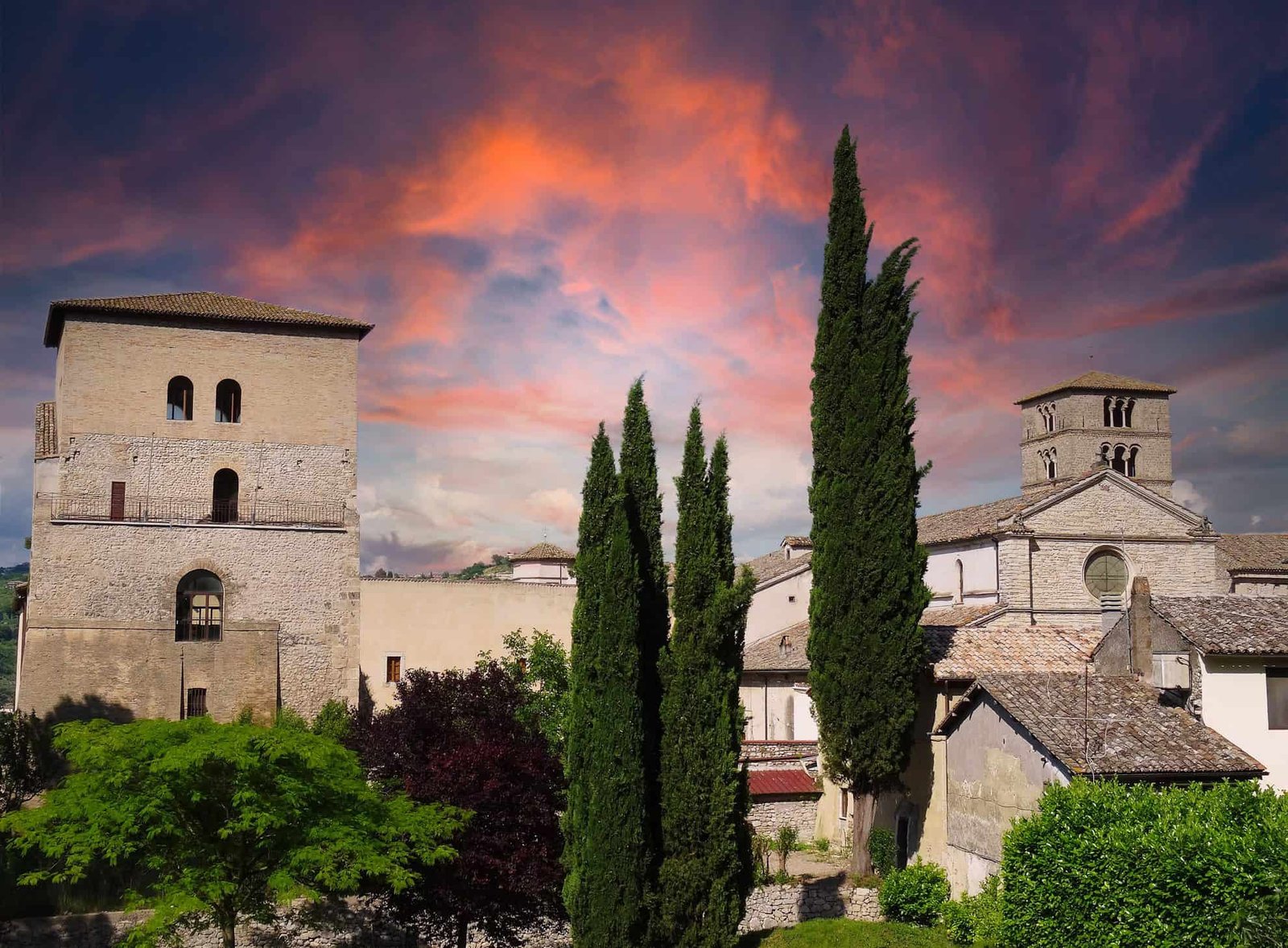
Quick Questions About Farfa Abbey (RI)
Where Exactly Is Farfa Abbey
At Via del Monastero 1, in the territory of the municipality of Fara in Sabina, province of Rieti, at the foot of Monte Acuziano, just under 60 kilometers from Rome. The village around the monastery is called Farfa and takes its name from the stream that flows nearby.
How Much Does It Cost to Visit Farfa Abbey
The individual rate quoted by the abbey is 6.50 euros. Children up to six get in free, from seven to 12 they pay 5 euros. Tour operator groups pay 6 euros per person, parishes 5.50, schools 5. The guided visit of the village costs 2.50 euros more. It's always worth rechecking the rates on the monastery's website before you leave.
What Are the Visiting Hours of Farfa Abbey
Departures are at 10, 11 and noon in the morning. In the afternoon at 15 and 16 during standard time, at 15.30 and 16.30 during daylight saving time. The monastery is not open for visits on Mondays.
Do I Need to Book to Visit Farfa Abbey
For groups up to 10 people it isn't necessary: you arrive and join the next departure. For organized groups, associations, tour operators, parishes and schools booking is mandatory and is made through the abbey's tourism office.
Can I Visit Farfa Abbey on My Own
No. Access to the monastery's spaces is exclusively with staff authorized by the abbey. The basilica, as a parish church and sanctuary, is accessible for prayer according to the times of the services.
How Long Does a Visit to Farfa Abbey Take
About an hour, an hour and a quarter for the guided route. Adding the village and a stop, you easily reach two and a half or three hours.
How Do I Get to Farfa Abbey from Rome
By car, take the A1 motorway north and exit at Fiano Romano, then the Salaria and the Farense road following the signs for Fara in Sabina and Farfa. By train, take the FL1 line from Roma Tiburtina to the Fara Sabina-Montelibretti station, which however is at Passo Corese, about 15 kilometers from the abbey. The last stretch has to be covered by car or taxi.
Is There Parking at Farfa Abbey
Yes, outside the village. Cars don't circulate inside the village, which is the main reason the whole has remained intact. On market days the parking lot fills up very early.
Is Farfa Abbey Open on Sundays
Yes, but in the morning the basilica is taken up by the 9, 10.30 and noon Masses, and this affects the visit route. Sunday afternoon is quieter, with the exception of the first Sunday of the month, when the village hosts the antiques market.
When Is the Market at Farfa Abbey
Every first Sunday of the month, from dawn to dusk, in the abbey village: antiques, crafts, mid-century items and vintage collectibles, with professional exhibitors and hobbyists.
Can I Take Photographs at Farfa Abbey
In general yes in the spaces open to the public, but without flash on painted surfaces, never during services and never of the monks without permission. The staff's directions and the signs on site always take precedence. A tripod is not allowed in many spaces.
Is Farfa Abbey Wheelchair Accessible
The basilica can be reached at the level of the small piazza and the nave can be walked without significant obstacles. The monastery's spaces, the cloisters and the museum rooms have steps and thresholds typical of a complex layered since the early Middle Ages. Those with special needs would do well to contact the tourism office in advance to agree on the possible route.
Is Farfa Abbey Suitable for Children
Very. The room with the 12 scenes by Emanuele Luzzati dedicated to the Chronicon Farfense works very well with the little ones, and the Farfa stories, from the dragon of the Acuzian valley to the siege of the Saracens, tell themselves. The pedestrian village lets children walk safely. A stroller is not recommended for the interiors.
What Do You See During the Visit to Farfa Abbey
The Renaissance basilica with the Last Judgment by Dirck Barendsz on the inner facade, the coffered wooden ceiling with the Orsini coats of arms, the ancient floor, the altar with the ciborium and the choir. Then the monastery's spaces, among them the refectory and the chapter house, the cloisters, and the exhibition rooms with the archaeological materials of the Sabina, the Amalfitan ivory casket and the medieval works.
What Is the Regesto of Farfa
It is the great documentary collection compiled by the monk Gregory of Catino starting in 1103: 1,324 documents transcribed in chronological order from 705 onward. Together with the Liber Largitorius, the Chronicon Farfense and the Liber Floriger it makes up one of the most important archival complexes of the European Middle Ages.
Who Founded Farfa Abbey
Tradition attributes the first foundation, between 560 and 570, to Lawrence the Syrian, bishop of Forum Novum. After its destruction the refounding took place around 680 at the hands of the Frankish monk Thomas of Maurienne, with the support of the Lombard duke of Spoleto Faroald II.
Why Was Farfa Abbey So Powerful
Because from 774 it enjoyed imperial immunity, that is, it depended directly on the emperor and not on the papacy, and because it accumulated an enormous estate: hundreds of churches and monasteries, 132 castles, 16 fortresses, seven ports, seven salt works, 82 mills, two cities and more than 300 villages and boroughs, with a militia of its own to defend them.
Is There Still a Community of Monks at Farfa Abbey
Yes. A Benedictine community of the Subiaco-Cassinese congregation lives in the monastery, which also looks after the parish and sanctuary of Santa Maria di Farfa. The present community descends from the return of the monks in 1920.
What Are the Mass Times at Farfa Abbey
On weekdays at 7.30. On Sundays and solemnities at 9, 10.30, noon and 19. Vespers are at 18.30 on weekdays and at 18 on Sundays. Times may vary with the liturgical calendar and should be rechecked on the monastery's website.
Can I Sleep at Farfa Abbey
The abbey has a guesthouse, in keeping with the tradition of Benedictine hospitality. It is not a hotel facility: you share the house's schedule and silence. Arrangements are agreed directly with the monastery.
What Can You Buy in the Village of Farfa
In the abbey's herbalist shop you find honey, olive oil, liqueurs, chocolate, creams and herbs. In the village shops you find ceramics, handmade textiles, craft objects and small antiques. The oil of the Sabina is the product in which this area is objectively strongest.
What Is the Difference Between Farfa Abbey and the Village of Farfa
The abbey is the monastic complex with the basilica, the cloisters, the museum and the library. The village is the set of row houses built by the monks around the monastery as a service structure for the fairs. They are visited together and it's worth adding the village guide, because the relationship between the two is the real particularity of Farfa.
What Is the Cippus of Cures
It is the only known example of Sabine epigraphy on stone, datable to the end of the sixth century BC, found in March 1982 in the bed of the Farfa stream and displayed in the archaic section of the museum. Its interpretation is not yet complete.
Who Painted the Last Judgment of Farfa Abbey
Dirck Barendsz, a Dutch painter from Amsterdam who lived between 1534 and 1592, who executed it in 1561 on the inner facade of the basilica during his stay in Italy. In Italy painters who came from the North were generically called Flemish, and with that label the work often appears in descriptions.
When Was the Basilica of Farfa Abbey Built
The present church was built by the Orsini in 1494 and consecrated in 1496. The coffered wooden ceiling with the family coats of arms bears the date 1494. The earlier phases, from the Carolingian church to the one completed by Ratfred in 913, can be read mainly in the bell tower, in the incorporated structures and in the ancient paving of the transept.
Can Farfa Abbey Be Visited in Half a Day
Yes, and it is the most frequent formula: leave Rome in the morning, guided visit, round of the village and back in the afternoon. If you want to add Fara in Sabina, the Nazzano reserve or the Farfa gorges, you need the whole day.
What to See Near Farfa Abbey
Fara in Sabina with its panorama and the civic archaeological museum, Castelnuovo di Farfa with the olive oil museum, Poggio Mirteto, the villages of Casperia, Torri in Sabina and Poggio Catino, the Nazzano Tevere-Farfa Nature Reserve and the gorges of the stream. Farther away, Rieti and the Franciscan holy valley.
What Is the Best Time to Visit Farfa Abbey
Spring for the light and the green, autumn for the olive harvest and the colors. Winter is the season of few visitors and real silence. Summer works well because the church stays cool, but on weekends the village fills up.
Is Farfa Abbey a National Monument
Yes, since 1928. The attached library has been a state library since 1964 and holds about 50,000 volumes, with an old core of manuscripts, incunabula and 16th-century printed books.
Can I Bring Dogs to Farfa Abbey
The village is outdoors and pedestrian, so for the outside walk there are no particular difficulties. For the interior spaces of the monastery and for the basilica the house rules apply, which are best checked on site or by phoning beforehand. In places of worship, in general, animals are not admitted except guide dogs.
The Conclusion on Farfa Abbey
There are quite a few places an hour from Rome that are worth a day. There is only one place an hour from Rome where you enter a European story of 13 centuries, with an archive that historians from half the world keep citing, a 15th-century church with a Northern Last Judgment on the inner facade, a medieval commercial village that has remained intact and a community of monks who sing vespers at six 30.
Go on a weekday afternoon, take the guided visit, ask the guide to tell you the story of Abbot Ingoald's ship, stay a few extra minutes in front of the wall painted by Dirck Barendsz, then go out into the village and walk to the end of the street of row houses. Turn your back to the piazza, look back toward the bell tower and stop there as long as it takes. That is the image you come to Farfa for, and no photograph fully captures it.
Article written by the editorial team of TourLeaderPro, contact them for Private/Corporate/V.I.P. Tours and Experiences.
Planning a trip to Rome? The English-language guides to visiting the city are on ItalyPlanner.com.