Roccantica (RI)
In short. Roccantica is a municipality of just over 500 residents in the province of Rieti, at 457 meters above sea level on the western slope of the Sabine Mountains, at the foot of Monte Pizzuto (1,288 meters).
Roccantica is a municipality of just over 500 residents in the province of Rieti, at 457 meters above sea level on the western slope of the Sabine Mountains, at the foot of Monte Pizzuto (1,288 meters). The town hall is at Via dei Nobili 3, postal code 02040, phone 0765 63020. From Rome you get there by car on the A1 to the Ponzano Romano-Soratte exit and then along the provincial roads of the Sabina (SP 48 for the last stretch), about an hour and a quarter from the Grande Raccordo Anulare. Alternatively, take Via Salaria to Passo Corese and the climb to Fara in Sabina. Without a car: regional train FL1 from Roma Tiburtina or Roma Ostiense to Poggio Mirteto Scalo, then a Cotral bus to Roccantica ending in Piazza San Valentino. Check the schedules on the Cotral site before leaving, because the runs are few and on Sundays almost absent. Parking is free along the road that skirts the town and in the wide spot at the entrance. The historic center is pedestrian and stepped. Entry to the village is free. The tower of Niccolò II, the church of Santa Caterina and the Historical Archive can be visited with on-request openings organized by the Comune and the Pro Loco (guided visits by reservation at 338 8756113). The food festivals and the August festival are free to enter, with food and drink paid for. Three hours are enough for half a day. For the town, the hermitage of San Leonardo and a walk on Monte Pizzuto you need the whole day. The patron saint is San Valentino, celebrated on the first Sunday after February 14.
To place the village in its territory, the page for the province of Rieti gathers all the towns of the Sabina I talk about in this guide. If you're coming from abroad, you'll find an overview in English in the ItalyPlanner guide to Lazio.
How to get to Roccantica from Rome and from Rieti
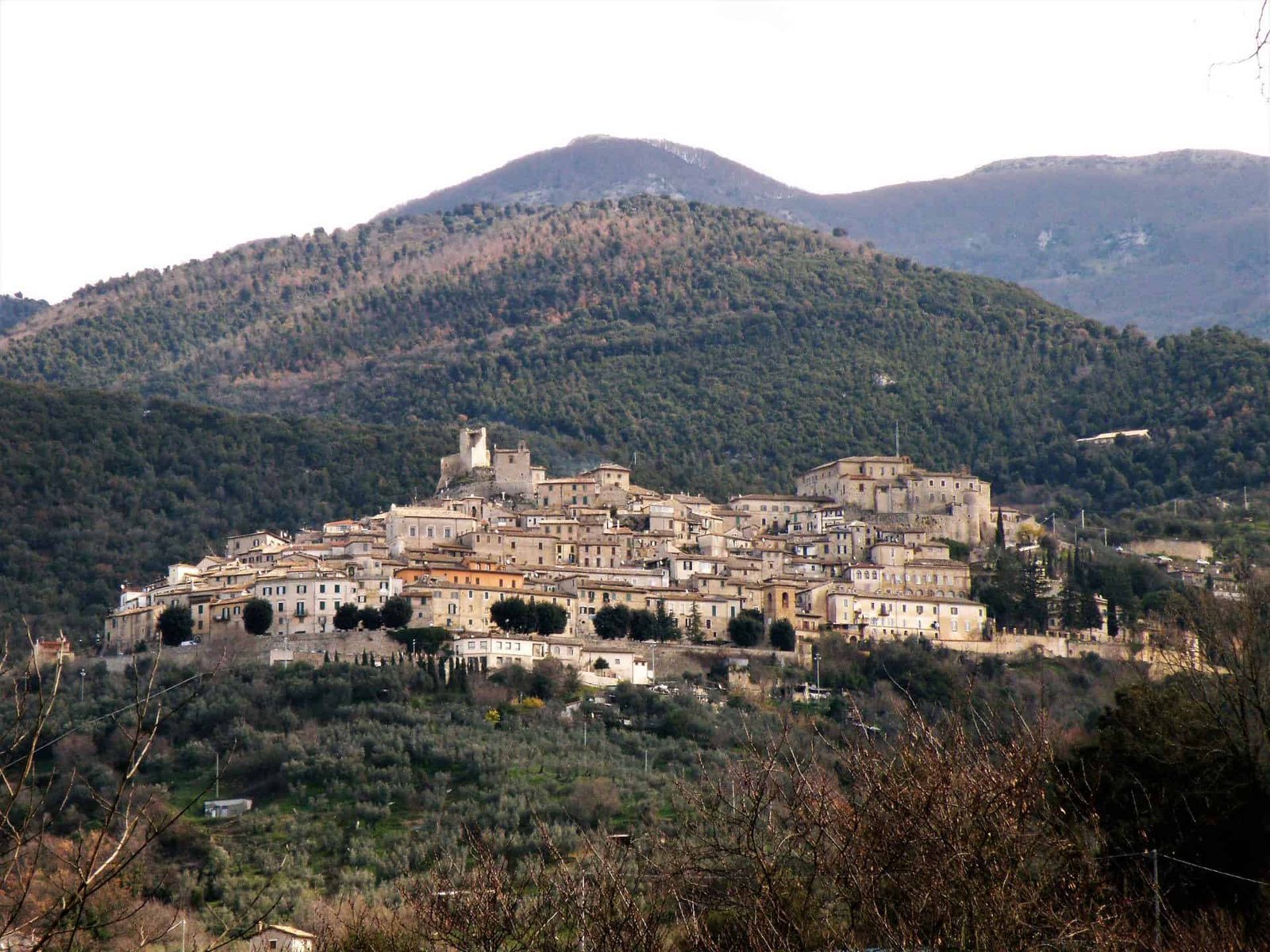
There are towns you reach by chance and towns you have to decide to reach. Roccantica belongs to the second category: you don't pass in front of it on the way somewhere else, no state road grazes it, no toll exit carries its name. You get there because you chose to get there, and this small initial effort is the first good thing the village gives. When the provincial road stops climbing and the band of light-colored houses appears clinging to the side of the mountain, with the tower on top like a finger pointing at the sky, you understand you have entered one of the least-trodden parts of the Rieti Sabina.
The distance is deceptive. Roccantica is a little under 60 kilometers from the Raccordo and about 35 from Rieti, but the real time from north Rome, with normal traffic, comes to between an hour and 10 minutes and an hour and 20 minutes, and from Rieti it doesn't drop in proportion to the kilometers, because the road crosses the ridge of the Sabine Mountains with a sequence of curves that forces you to slow down. Roccantica is not a hit-and-run destination of 90 minutes: it asks for a full half day to be understood and a whole day to be enjoyed.
By car from Rome: the route I recommend for Roccantica
The most direct route is the highway one. You take the A1 toward Florence and exit at Ponzano Romano-Soratte, an exit many Romans know for Monte Soratte, the isolated mountain visible from half of Lazio that marks the visual boundary between the Roman countryside and the Sabina proper. From there you continue east, cross the Tiber and enter the network of provincial roads that go up and down between Poggio Mirteto, Cantalupo in Sabina, Casperia and Roccantica. The last stretch runs on the SP 48. The signage is not generous: the brown signs exist but are sparse and some intersections call for attention. The GPS works, but look at the overall map before leaving: understanding the geography of the area makes the trip far more interesting.
The better alternative, when you're not in a hurry, is Via Salaria, the consular road that goes from Rome to Rieti and the Adriatic. You leave the Salaria at Passo Corese or Osteria Nuova and climb inland touching Fara in Sabina, with a detour to the Abbey of Farfa that deserves a stop regardless. It's a route about 20 minutes longer but much more beautiful, because it crosses the centuries-old olive groves that are the identifying landscape of this land. If you have time, do it on the way out and come back by the highway.
Whoever arrives from the north, from Terni or Umbria, has an easier time: you come down along the Flaminia or the Terni road, head for Configni and Cottanello and from there slide toward the western slope of the Sabine Mountains. It is the direction from which few tourists arrive, and for that very reason it gives the least predictable panorama: the meeting with Roccantica happens from above, and from above its band structure reads as on a map.
To Roccantica by public transport: you can, but you have to want to
Reaching Roccantica without a car is possible but complicated, and it's better to say so without telling fairy tales. The reference station is Poggio Mirteto, on the regional line FL1 that connects Fiumicino, Roma Tiburtina and Orte, with continuations toward Umbria. From Poggio Mirteto Scalo the village is still about 20 kilometers away, covered by the Cotral buses that connect the train station with Piazza San Valentino, the entrance square of the town. The runs are designed for students and commuters and are concentrated in the early morning and late afternoon: in the middle of the day the gaps are wide, and on Sundays the service is drastically reduced. Check the schedules on the Cotral site before leaving and allow for the fact that the evening return is the weak link in the chain.
Whoever has a spirit of adaptation can combine train and bicycle: the FL1 accepts bicycles in the equipped cars, and from Poggio Mirteto Scalo you climb inland pedaling among the olive groves. It's a serious climb, with elevation changes not to be underestimated, but the downhill return at the end of the day stays in the memory. To build multimodal itineraries in the province, the ItalyPlanner guide to Rieti gives an overview in English of the connections of the whole area.
Where to leave the car in Roccantica and how to get around the village
The historic center of Roccantica is pedestrian out of necessity: the alleys are narrow, often stepped, and a car physically can't get through. The parking areas are along the road that skirts the town and in the wide spot at the entrance, near Piazza San Valentino. They are not big, but for most of the year they are enough. The exceptions are the four days of Medioevo in Festa at Ferragosto, when the organizers activate free shuttles to and from the town, the Sunday of the Sagra del Frittello and the spring weekends with good weather, when the cars stretch along the provincial road and it's best to arrive early or park farther down and walk up.
Once you've left the car you need comfortable shoes and knees in order. Roccantica develops vertically: the lower part, with Piazza San Valentino and the parish church, and the upper part, with the tower of Niccolò II and the little church of Piedirocca, are separated by an elevation change you tackle by staircases. It isn't a climb, but it is a continuous ascent, and in summer it should be done early in the morning or late in the afternoon. Those with mobility difficulties can enjoy the lower part and the first ring of alleys well. The tower remains a goal for trained legs.
When to go to Roccantica: the recommended calendar
Spring is the queen season. From mid-April to mid-June the mountain behind the town bursts with green, the broom lights up the slopes, the trails are dry and the temperatures let you walk without suffering. It is also the period when the olive groves show their best texture, with the silver-gray of the leaves standing out from the acid green of the meadows, and when the Pro Loco organizes the Roccantica Montagna in Festa day, with guided excursions and a community lunch.
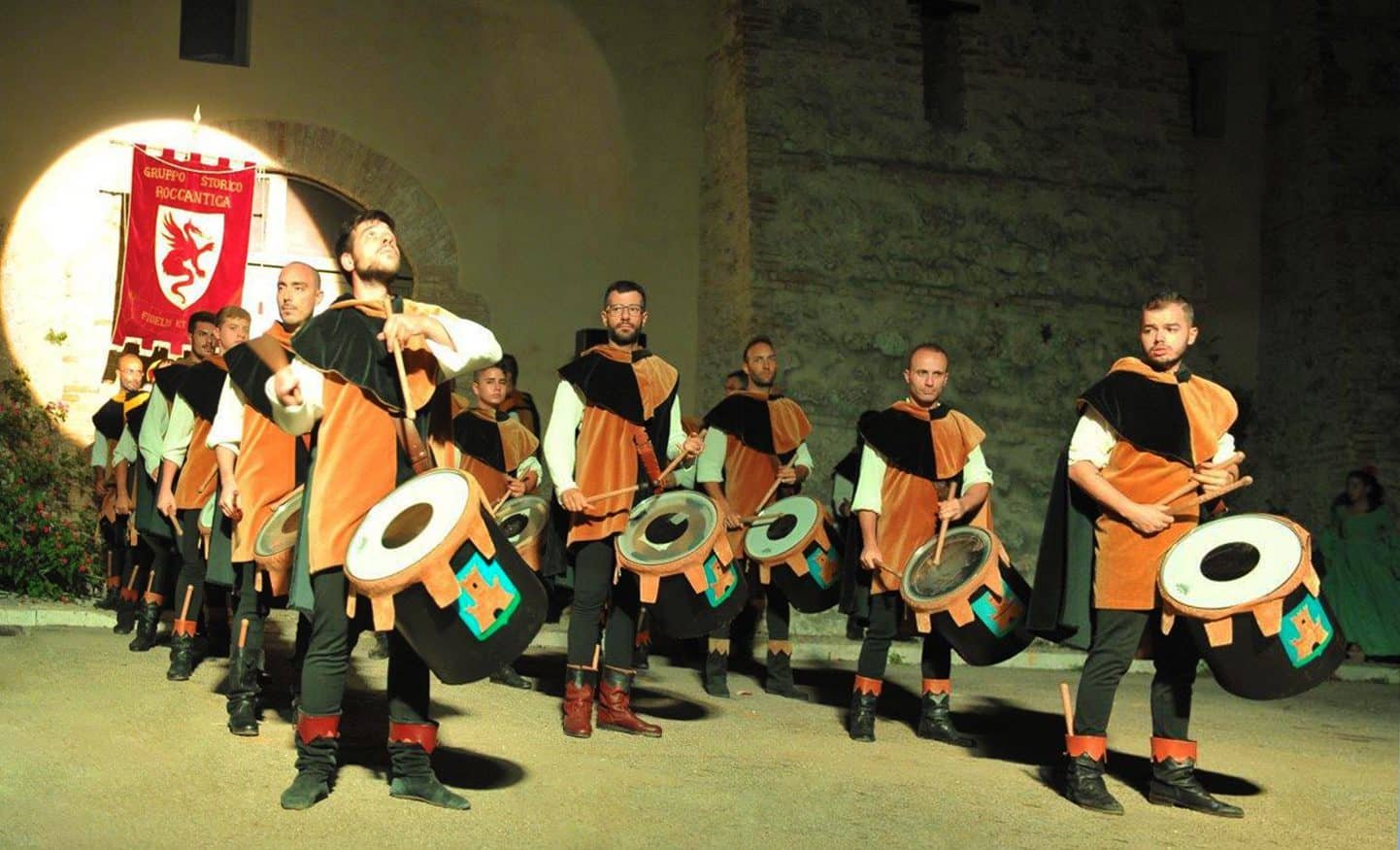
Summer has to be managed. The altitude gives cool evenings even in July, but the central hours on the light stone of the alleys weigh. The strategy is simple: morning in the town, afternoon up in the beech wood of Monte Pizzuto where the shade is total, evening back down for dinner. August is the month when Roccantica changes face: from the 12th to the 15th, Medioevo in Festa brings back to the town about a thousand costumes, the taverns open every evening from 20:00 and the emigrants come back for a few weeks.
Autumn is, in our judgment, the best season, without hesitation. Between October and November the olives are harvested, the landscape fills with spread nets and people at work, the olive mills start their engines and the air takes on the grassy, pungent smell of new oil. The beeches of Monte Pizzuto turn copper and gold, and the clear days after the first rains give enormous visibility toward Terminillo and toward the Tiber.
Winter is the season of reflection, but it isn't empty. In December the town sets up nativity scenes along the streets, small markets, choirs and mulled wine. In January, on the Sunday after Sant'Antonio, hundreds of animals are blessed in Piazza San Valentino and the confraternity offers cooked fava beans and ring-shaped cakes. In February the patron saint is celebrated. The exact dates change every year and should be asked of the Pro Loco. Whoever looks for a living nativity of great tradition in the same province will find it at the sanctuary of Greccio, where Francis of Assisi invented the idea in 1223.
Eating and sleeping in Roccantica: the real logistics
Roccantica has no industrial hospitality vocation, and that is both its limit and its merit. The offering is made up of a few family-run trattorias, a hostel in the village run by the local association, an agriturismo with a riding center in the countryside, and holiday houses made from restored homes. No chains, no big hotel, and in the low season some businesses reduce their opening days. The golden rule is to call or write first, especially for a Sunday lunch or a midweek stay out of season.
Whoever prefers a more structured base can rely on the nearby centers: Casperia, perhaps the most photogenic village in the Sabina, Poggio Mirteto, which is the service center of the area, or Poggio Catino, practically adjoining. Building an itinerary of two or three days with a fixed base and short trips is the best way to approach this part of the province: you avoid the shopping-list effect and enter the rhythm of the places. Whoever wants a professional guide to hold together logistics, bookings and storytelling will find the tourist accompaniment service of TourLeaderPro.
One last practical piece of advice, and it isn't trivial: bring cash. Electronic payments are widespread here too, but at food festivals, at producers' stalls and in some small businesses the card may not be accepted or the connection may act up. 50 euros in your pocket solves every embarrassment.
What to pack for Roccantica
Light trekking shoes or in any case with a lugged sole: even staying in town, the paving stones are smooth and slippery downhill. A windproof jacket even in summer, because at altitude there is wind. A water bottle, because the public fountains work and the water of the Sabina is excellent. Binoculars, if you're interested in raptors: on the slopes of Monte Pizzuto buzzards are at home. And finally time: the thing most often missing for those who visit these villages is not equipment, it is the mental availability to stop. Roccantica rewards whoever sits on a low wall and looks for 20 minutes doing nothing.
Roccantica under Monte Pizzuto: geography of a band-shaped village
To understand Roccantica you must first understand where it is, because in this part of Lazio geography dictated history with almost brutal precision. The village rests on the western flank of the Sabine Mountains, at the foot of Monte Pizzuto, which with its 1,288 meters is the highest peak of this stretch of the range, flanked by Monte Menicoccio (1,204 meters). Below the town the mountain drops rapidly toward the Tiber valley, and this slope explains everything: it explains why the houses are laid out in bands along the contour lines, why the alleys are stepped, why the tower is high up and the parish church low down, why from here on clear days you see a portion of Lazio that looks like a scale model. The municipal territory measures 16.72 square kilometers.
The term settlement scholars use for this structure is band village, or comb settlement: the dwellings line up along parallel axes that follow the course of the slope, linked by perpendicular staircases. It isn't an aesthetic choice, it's a building necessity. On a mountainside with slopes of 20 or 30 percent you don't build a chessboard: you build terraces, and on the terraces you rest the houses, each with its foundations on the roof or the wall of the one below. The result is a compact organism, almost impenetrable seen from outside, in which the built fabric forms a continuous curtain that in the Middle Ages was the first line of defense, reinforced by the triple circle of walls still recognizable in places.
The rock is limestone, and limestone in Roccantica is not a detail for geologists: it is the explanation of the Revotano, the collapse sinkhole 250 meters in diameter that opens a few kilometers from the town, and it is the explanation of the capricious water that rains abundantly, disappears underground and reappears downstream in springs far from the point of infiltration. The springs have had enormous value for centuries: around them place names, rights of use, disputes between neighboring communities and legends have coalesced. Whoever walks the trails above the town meets drinking troughs, watering places and basins that are not decorative furnishing: they are the oldest infrastructure of the territory.
The history of Roccantica from the Fundus Antiquus to the Vincentini marquises
The origins of Roccantica, unlike many neighboring villages, are not entirely lost in the documentary fog, because the Sabina is one of the best-documented areas of the early Italian Middle Ages thanks to the archive of the Abbey of Farfa. The area was inhabited in Roman times, a land of rustic villas and of oil already 2,000 years ago, but the town in the form we see it was born later, in the process historians call incastellamento: between the 9th and 11th centuries the scattered populations concentrated in fortified nuclei on defensible heights.
Roccantica in the Regesto Farfense: 792, 846, 966
The first document dates to 792: the Regesto Farfense records a donation to the abbey that mentions the church of San Valentino in the Fundus Antiquus, the ancient estate. The place name, then, is not a late claim to fame of a town proclaiming itself old: it is the name of an early medieval agricultural property. In 840 the estate is entirely in the hands of Farfa. After the Saracen raids of 846, the same ones that sacked Saint Peter's in Rome, the settlement receives a first circuit of walls and the name changes to Rocha de Antiquo, the fortress of the ancient estate. In 966 the place is defined as a castrum, that is, a fortified village. From Rocha de Antiquo to Roccantica is a short step. There is also a popular version according to which the name comes from a landowner called Antiquo who built the little church together with the village. It is tradition, not document, but it tells how the community has thought of itself over time.
1059: Roccantica, Nicholas II and the 12 survivors
The event that founds the town's identity dates to 1059. On the death of Pope Stephen IX, the Roman nobility led by the Crescenzi and the counts of Tusculum imposed a pope of their own, Benedict X. The reforming cardinals instead elected in Siena Gerard of Burgundy, bishop of Florence, with the name Nicholas II. In the war that followed, Roccantica sided with Nicholas and was besieged by the troops of the Crescenzi. Local tradition, taken up by all the town's sources, tells that the inhabitants held out until the arrival of the Normans of Robert Guiscard, allies of the legitimate pope, and that when the liberation came, the survivors were 12. On April 18, 1060, Nicholas II rewarded the loyalty with a privilege that placed Roccantica under the direct dominion of the Holy See: no one could claim possession of it, under penalty of excommunication. That status lasted until 1415. The number 12 and the sequence of events belong to local memory. The alliance between Nicholas II and the Normans, sealed in 1059 at the council of Melfi, is documented history.
The Orsini in Roccantica: from 1415 to 1698
In 1415 a bull of John XXIII, the Baldassarre Cossa of the great schism, declared an antipope only in 1947 when Angelo Roncalli chose the same name, gave Roccantica to Francesco Orsini, count of Gravina. In 1433 he ceded it to Cardinal Giordano Orsini, and from here was born the Bracciano branch of the family, the one that for three centuries would dominate the lake of the same name and half of Lazio. In 1427, in a phase of direct papal control, Martin V appointed as governor of the castle Armellao de' Bastoni of Ascoli, the patron of the frescoes of Santa Caterina. In 1454 Orsino Orsini obtained from Nicholas V approval to found the convent of the Reformed Minors that would become the Seminary. In 1576 the Orsini built the Borgo Nobile, the Renaissance residence-fortress, leaving the old castle to the Poor Clares. The branch died out in 1698 with the death of Flavio Orsini, duke of Bracciano and marquis of Roccantica. His widow, Marie Anne de la Trémoille, the princess of the Ursini who would make a career at the Spanish court, sold the town and the title to the governor Giuseppe Vicentini, whose family, later Vincentini, held Roccantica for a little over two centuries until its extinction.
Roccantica from the Unification of Italy to the first woman mayor
With the plebiscite of November 4 and 5, 1860, the Sabina passed to the Kingdom of Italy, and Roccantica was aggregated to the mandamento of Poggio Mirteto in the province of Perugia, an administrative anomaly that lasted until 1923, when the district passed to the province of Rome. In 1927 the newborn province of Rieti took it in but merged it with the comune of Aspra, today's Casperia. Autonomy returned in 1939. Then the 20th century of the mountain: emigration, depopulation, the seminary closed at the end of the 1980s, the slow recovery of the houses by those who return and those who arrive. In the middle, a date that gives Roccantica a national first and that I tell in the chapter on curiosities.
A curiosity about Roccantica (RI)
When you write about a village of 500 inhabitants the temptation is to fill the void with interchangeable legends. Roccantica doesn't need them, because it holds a first that no other Italian comune can claim: on April 8, 1946, with the war just over and even before the institutional referendum of June 2 that would bring women to the political vote for the first time, the town had the first woman mayor of Italy, Anna Montiroli widow Coccia. It is a fact the local sources repeat with pride and that is worth giving weight to: in a mountain village where the community had been emptied of men by war and emigration, the responsibility of leading the town hall fell on a woman, and it fell before Rome, Milan or Turin. Whoever enters the town hall on Via dei Nobili passes in front of the seat of the Historical Archive, which keeps, along with the medieval parchments, the papers of those years.
The Revotano and the blonde who runs: the legend of Roccantica
The second curiosity is geological and mythological at once. A few kilometers from the town, reachable only on foot, opens the Revotano, a collapse sinkhole about 250 meters in diameter, among the largest in central Italy. For centuries it was believed to be the crater of an extinct volcano. In reality it is the result of the dissolution of calcium carbonate by groundwater, which carved out cavities that then collapsed under their own weight. Legend has it that the first settlement of Roccantica stood right there and that, because of the wickedness and little faith of the inhabitants, it sank by divine will. A woman and her child were saved, having gone down to the Scifulente, the stream that runs fast below the sinkhole, to wash clothes. A voice warned them with the words the roccolani still repeat, "Corri bionda che la terra si sprofonda" (Run, blonde, the earth is sinking), and the two fled to the hill where the present town stands, founding it. It is a classic etiological tale, of the kind that explains a shape of the landscape with a collective guilt, and it has the merit of telling a geological truth in narrative form: here the earth, literally, sinks.
Roccantica in three provinces in 16 years
The third curiosity is administrative and makes anyone who knows Italian bureaucracy smile. From 1861 to 1923 Roccantica was Umbrian, in the province of Perugia, together with the whole district of Rieti. From 1923 to 1927 it was Roman. Since 1927 it has been of Rieti, but for 12 years it wasn't even a comune, because the Fascist reorganization merged it with Aspra, today's Casperia, which is a few kilometers away and with which the parish-pump rivalries are, as you can imagine, affectionately competitive. Autonomy returned in 1939. A roccolano born in 1915 changed province twice and comune once without ever moving house. If you are looking for a summary of the affairs of inland Italy, this is worth a textbook.
The name of Roccantica and the ancient estate
The last curiosity concerns the name, which unlike so many fanciful place names has a documented genealogy. Fundus Antiquus in 792, Rocha de Antiquo after the fortification of the 9th to 10th century, Roccantica in the modern form: the fortress of the ancient estate. The name says exactly what the town was for almost a thousand years, a point of control over a valley and over a piece of territory that someone wanted to own and someone else to take. In tourist prose it is often read translated as "ancient fortress," and it is a translation that works but loses the nuance: the estate was already ancient in the 8th century, which pushes the horizon of the place back to the Roman age, when the Sabina was a land of villas and olive mills.
Something nobody tells you about Roccantica (RI)
Guides gladly tell about the frescoes, the tower, the panorama and the oil. They tell much less gladly two uncomfortable things. The first is that the masterpiece of Roccantica, the cycle of Santa Caterina, can't be seen whenever you want: the church is privately owned, the frescoes have long been under restoration and access depends on openings agreed with the Comune and the Pro Loco. Getting all the way here and finding the door closed is a common experience, and you avoid it only by booking the guided visit at the number given in the opening dossier. The second is that Roccantica, like dozens of villages in the same belt, is playing a difficult game for its own existence, and the visitor, without knowing it, is one of the players on the field. Understanding the fragility of a place is part of understanding it, and an informed tourist is a better tourist.
The number nobody puts on the cover: the demographics of Roccantica
The residents are just over 500, and this figure contains everything. A town of 500 people has insufficient critical mass to support on its own the services we take for granted: a complete school, a clinic open every day, a grocery with a full range, frequent public transport. The consequence is a structural dependence on the larger centers: for the big shopping you go to Poggio Mirteto, for specialist healthcare to Rieti or to Rome, for high school out of town. Every service that leaves makes staying harder for those who remain, and every family that leaves makes it harder to keep the next service. It is a spiral, and every mayor in the Apennines knows it.
The spiral, however, is not irreversible, and this must be said or the picture is false. There are towns in this same belt that have stabilized their population, seen young families return, reopened businesses. The conditions are always the same: decent connectivity, acceptable distance from a service hub, building stock recoverable at reasonable cost, a community that doesn't give up. Roccantica has the first three to a good extent and works on the fourth with concrete tools: a Pro Loco that runs a hostel and the guided visits, an association that every summer brings young European volunteers to work with the Comune, a Ferragosto festival that mobilizes a thousand costumes sewn by a local tailor shop. Remote work during the pandemic years made it plausible to live an hour from Rome paying a fraction of the capital's property price. That movement has partly receded, but it has left in many Sabine villages a core of new residents that wasn't there before.
Second homes in Roccantica: the salvation that comes at a cost
Here is the topic that guides skip over and that is really discussed in the town's bars. The recovery of the historic center has happened largely thanks to the purchase of houses by non-residents: Romans, foreigners, descendants of emigrants. Without those purchases a substantial part of the building stock would have collapsed, literally. Empty houses don't wait: the window frames rot, the roofs give way, the water gets in, and in 20 years an abandoned house becomes a dangerous ruin. Second homes have saved the stones. But the stones are not the town. A perfectly restored historic center lived in three weeks a year is a museum of itself: beautiful to photograph, dead to live in. The phenomenon has a name, rural gentrification, and produces measurable effects: prices go up and local young people can no longer buy in town, businesses calibrate to seasonal peaks and close in the empty months, associational life thins because someone who is here two weeks doesn't join the festival committee.
The counterargument exists and is strong: without that money there would be nothing to defend, and many second-home owners take part, spend, get involved, and some really move in. It isn't a Manichean question, it is a question of balance that shifts continually. It's worth knowing, because it changes how you look. When you walk through Roccantica on a February day and find the alleys deserted and the shutters closed, you are not seeing a sleepy town: you are seeing the outcome of a precise economic process. And when you come back at Ferragosto and find the same streets full, you understand that the two images are the same story seen at two moments.
The mountain of Roccantica takes back what we have taken from it
The second thing nobody says concerns the landscape and flatly contradicts the rhetoric of the village immersed in unspoiled nature. The landscape around Roccantica is not nature: it is a human artifact, built over centuries of work and alive only as long as someone works it. The terraced olive groves, the dry-stone walls, the trails, the clearings, the hay meadows exist because someone created them and maintains them. When maintenance stops, nature resumes its course, and its course in the Apennines is only one: the forest. First brambles and broom, then pioneer shrubs, then forest species. In 20 years an abandoned olive grove is unrecognizable, in 40 it is woodland.
This process, which technicians call forest recolonization, is ambivalent. On one side it increases the wooded area, forest biodiversity, carbon absorption, the return of wildlife. On the other it erases a layered cultural landscape, reduces the open environments that host species different from those of the forest and, above all, increases the hydrogeological and fire risk in the abandoned intermediate belts. Whoever climbs toward the hermitage of San Leonardo sees it clearly: you go from olive groves in production to olive groves with tall grass, then to terraces where the olives survive smothered by brambles, then to scrub where the walls can be glimpsed under the vegetation. It is a chronology of abandonment readable in half an hour of walking. The practical consequence is twofold: the trails should be checked, because routes marked on old maps may be impassable, and buying oil from a producer here is an act of landscape maintenance, the concrete mechanism through which the olive grove you came to photograph continues to exist.
Water, earthquakes and the risks nobody shows the tourists of Roccantica
Third uncomfortable truth: this territory is seismic and hydrogeologically fragile. The parish church you see today exists because the previous one, still unfinished, collapsed in the earthquake of 1702, the same one that struck Amatrice. The tower of Nicholas II suffered damage from earthquakes and neglect before the restorations. And the province of Rieti knows what the tremors of 2016 meant at Amatrice and in the upper Tronto valley. Band villages, with rubble-and-mortar masonry, wooden floors and buildings leaning on one another, have complex seismic behavior: when you find a propped-up alley or a fenced-off building you are not looking at neglect, you are looking at prudence.
Then there is the instability tied to water. On steep slopes with a limestone substrate and debris cover, intense rain causes concentrated runoff, erosion, small landslides. The network of walls, channels and drains built over the centuries served to govern all this, and its abandonment increases vulnerability. For the visitor the translation is simple: respect the closures. If a trail is closed or a stretch of the fortress is not accessible, it isn't out of spite. And in case of a weather alert, postpone: the provincial roads of the Sabina under heavy rain can present slides and falling rocks.
The tourism Roccantica needs and the kind it doesn't
Fourth thing nobody says: not all tourism helps. The visitor who arrives at 11:00, takes 20 photos, eats the sandwich brought from home on the steps of San Valentino and leaves at one leaves the town zero euros and a bag of trash. The visitor who stops for lunch, buys a bottle of oil, has a coffee, maybe sleeps a night in the hostel, leaves a modest but real sum, which multiplied by a few thousand visits means the survival of two or three businesses and therefore of two or three resident families. Then there is the seasonal distribution: Ferragosto full, spring weekends full, everything else empty. A business that works 40 days a year is not an enterprise, it's a hobby. The tourism that is needed is midweek and low-season: November with the new oil, February with the deserted trails, a Tuesday in May. If you can choose, choose that way: you will find fewer services open but you will be infinitely more useful and you will see a real town.
And then there is the theme of circuits. A single village can't sustain a tourist offering. A territory can. Casperia, Toffia, Torri in Sabina, Poggio Catino, Fara in Sabina, Farfa and Roccantica work together much better than apart, and it is the logic with which those who design tailor-made trips, as TourLeaderPro does for private and corporate tours, treat the Sabina: as a system, not as a collection of dots.
The advice I give you for visiting Roccantica (RI)
In one sentence: don't treat Roccantica as a stop, treat it as a base. It is the most important advice, and it comes from a very common mistake. You arrive, park, climb to the tower, take 20 photos, go down, have a coffee and set off for the next dot on the map. In two hours you have seen everything and understood nothing. Roccantica doesn't have the monumental density of an art city: it has no museum that absorbs three hours or a square that takes your breath away. It has a fresco cycle from 1430, a tower, a rock hermitage, a sinkhole and an atmosphere, and atmospheres require exposure time. It is like analog photography: if you open the shutter for a hundredth of a second in a dark room you get nothing. You need exposure time.
Build your day in Roccantica backwards
The scheme that works is this: arrive early, climb right away, descend slowly. Arriving early means being in Piazza San Valentino by 9:00, when the light is raking and the alleys are walked only by those who live there. Climbing right away means tackling the staircase toward the tower of Nicholas II and the little church of Piedirocca with fresh legs, enjoying the Tiber valley at the moment the air is clearest. Descending slowly means devoting the next two hours to the historic center without an itinerary, from the three gates to the Borgo Nobile, letting the alleys guide you.
Midmorning, when the town really wakes up, comes the moment of Santa Caterina, which is approached in only one sensible way: with the visit booked. If you haven't done it, ask in town. In a village of this size the information chain is short and human, someone knows who has the key and is often willing to help. It's not a guaranteed service, it's a kindness, and should be treated as such. Lunch is the moment not to be in a hurry: in one of the town's trattorias you eat real Sabine cooking, stringozzi, wild boar sauces, sheep and goat cheeses, and everything starts from the oil. Ask for the oil at the table: it is the simplest and most revealing thing you can do.
The afternoon up high above Roccantica
After lunch, go up. From San Valentino starts the trail that in half an hour leads to the hermitage of San Leonardo, passing the remains of a water mill whose stone millstone can be recognized. It is the right walk for anyone. Those with more legs take the numbered trails toward Fonte Regna, at 880 meters in the beech wood, or toward the summit of Monte Pizzuto, or detour to the Revotano. Even a short walk changes the perception of the place: looking at Roccantica from above, with the village tight on its terrace and the valley opening below, explains in 30 seconds what 10 pages of history struggle to communicate. Those with less time can do by car the sequence Poggio Catino, Roccantica, Casperia, a little over half an hour of continuous views. But it is a fallback: the Sabina is understood on foot.
Sunset in Roccantica is the decisive moment
If you can stay until evening, do it. The sun sets toward the Tiber valley and the Tuscia hills, and in the last half hour the light stone of the houses absorbs an amber color that doesn't exist in the central hours. Soratte, by day a gray profile on the horizon, becomes a very sharp silhouette against a sky going from orange to violet. The public at that hour has vanished, those who came for the day trip are already on the highway. What remain are the inhabitants, a few cats and you. It is the moment when the villages of inland Italy stop being attractions and go back to being towns.
Roccantica in two days: the scheme I propose
The strategic advice is not to come only for Roccantica, not because it doesn't deserve it but because its value increases enormously inside a route. Day one: arrival from Rome in the morning, stop at the Abbey of Farfa, lunch in the area, afternoon at Fara in Sabina with its belvedere over the valley, night in an agriturismo. Day two: morning in Roccantica with the tower and Santa Caterina, lunch in town, afternoon split between Casperia and Torri in Sabina, return in the evening. Those with three days add Montebuono, Toffia, the Farfa Gorges and a day in the Sabine Mountains. If you're coming from abroad you'll find the English guide to the Abbey of Farfa on ItalyPlanner, which thinks in terms of real logistics.
Three mistakes not to make in Roccantica
The first is coming on a Monday without checking: in many small towns it is a closing day, and out of season you risk finding the town asleep. The second is arriving without having checked the openings: it applies to Santa Caterina, to the tower, to the Archive. Five minutes of phone call save a wasted trip. The third, the subtlest, is treating the town as a backdrop. Roccantica has inhabitants, and those inhabitants live in the alleys you are photographing. Say hello. Ask before photographing a person. Don't talk loudly at nine in the evening. Don't walk into courtyards even if the door is open, because in villages open doors are not an invitation, they are a custom.
Another well-known fact, yet rarely cited
Everyone in the Sabina knows there was a seminary in Roccantica. Few remember who said Mass there. The large complex that closes the town on the mountain side was born in 1454 as a convent of the Reformed Minors, on the initiative of Orsino Orsini with the approval of Pope Nicholas V, and for three and a half centuries was a convent and philosophy school of the Franciscans. The Napoleonic suppressions of 1810 emptied it. Then it became a house of study, prayer and summer retreat for the seminarians of the Pontificio Seminario Romano Maggiore, the seminary of the diocese of Rome. And it is here that a young priest from Bergamo enters the scene. Angelo Giuseppe Roncalli, ordained a priest in Rome on August 10, 1904, said in Roccantica, according to the town's memory, his second Mass. 56 years later, as Pope John XXIII, he came back: on September 12, 1960 he visited the Seminario Romano Maggiore in Roccantica and gave the seminarians a speech in which he asked for daily prayer for the Second Vatican Council that he was preparing, a text that the archive of the Holy See keeps with that date and that title. The pope who would change the Church of the 20th century prayed for his Council in a town of 500 souls in the Sabina.
The fact deserves to be cited more often for a further reason, almost ironic. The name Roncalli chose in 1958, John XXIII, had already been used in the 15th century by Baldassarre Cossa, the pope of the schism who in 1415 had given Roccantica to Francesco Orsini. Roncalli's choice confirmed that Cossa had been an antipope and removed his number from the series. Roccantica, then, has in its archive the bull of a John XXIII who doesn't count and in its memory the visit of the John XXIII who does. The seminary was enlarged in the 1920s with a new wing and touched up in the late 1950s. It closed as a seminary at the end of the 1980s, housed a religious community for a period and has been abandoned for over a decade. Inside is the church of Sant'Antonio da Padova. It cannot be visited. You look at it from outside, and already from outside the bulk tells how much that town has counted for the Church of Rome.
A second well-known and little-cited fact concerns the Poor Clares. The old castle of the Orsini, abandoned as a residence when in 1576 the family built the Borgo Nobile, was donated by Felice della Rovere, natural daughter of Pope Julius II and widow of Gian Giordano Orsini, to a pious woman, Maddalena Ferracuti, so that she could make a monastery of Poor Clares of it. Felice della Rovere is one of the most powerful female figures of Renaissance Rome, regent of the Orsini state of Bracciano for years. That her name appears in the papers of Roccantica says how much the village was inside the network of the great. The nuns stayed until the suppressions of 1810, the monastery was restored in 1816 and definitively dissolved in 1864. Today the building, after several changes of hands, is private and inhabited. When you pass under its walls you are passing under the Orsini fortress turned into a cloister.
Visiting Roccantica place by place
The body of the visit is done on foot, from the bottom up, and then out of the town toward the mountain. I describe each place in the order in which someone arriving from the road meets it, with what there is to know in front of every stone. The time indicated is that of an attentive visit, not of a rush.
Piazza San Valentino and the church of San Valentino, the gateway of Roccantica
You begin from the square at the entrance, where the bus arrives and where what remains of the church of San Valentino faces, the oldest in the town and the one that gives it its name in the documents. It appears in 792 in a donation pro remedio animae to the abbey of Farfa, in 870 it is cited again, around 1300 it was rebuilt in Gothic-Romanesque forms and became the parish church: it had a wide portico on the facade carried by four pillars, topped by an oculus. On the high altar there was a tempera on panel by Bartolomeo Torresani, a Veronese painter active in the 16th century in the Sabina and at Rieti, which today is in the parish church. The recent history is hard: in 1932 the church, in poor condition, was partly demolished and the area turned into a Park of Remembrance for the fallen. In the mid-1950s the park was filled in, and what remains is dedicated to a Monument to the Fallen of the two wars. In front of these walls a thought is in order: a building first cited when Charlemagne was not yet emperor survived 11 centuries and gave way to the 20th. Here, the Sunday after Sant'Antonio, animals are blessed. From here, the first Sunday after February 14, the patron saint's festival starts. And it is from here that the trail to the hermitage of San Leonardo starts.
The three gates of Roccantica: Porta Reatina, Porta Nuova, Porta dell'Arco
The village is entered by three gates, survivors of the three-ring wall: the Portone, also called Porta Reatina because it faced Rieti, Porta Nuova and Porta dell'Arco. Don't expect crenellated towers: they are openings in the curtain of houses, often topped by a building, which in the Middle Ages were closed at sunset. The game I recommend is to look, for each one, for the logic: where the people who used it came from, which outside road reached it, which mule track. The Portone served the road toward the interior of the Sabine Mountains. The other two served the connections with the valley and with the neighboring villages. Observe the jambs in squared stone and the repairs in small rubble: they are the building phases readable in the masonry texture, regular blocks in the noble portions, abundant mortar in the late parts, modern repairs where consolidation has intervened. Learning to make this reading makes every ruin infinitely richer, and then it applies to all the villages of the area.
The parish church of Santa Maria Assunta in Roccantica
The town's mother church has a history that begins with a collapse. The previous building, the only new construction in the village, fell still unfinished with the earthquake of 1702. The reconstruction was possible thanks to a bequest by Paolo Leonardi and the contribution of the community, while the Vincentini marquises did not share in the expense, a detail the town did not forget. The church was blessed in 1740 and consecrated in May 1743. The interior has a single nave with six chapels, and keeps the best things that came from San Valentino: the baptismal font, which also serves as a holy water font, of 16th-century workmanship, and the altarpiece of the Virgin enthroned with the Child attributed to Bartolomeo Torresani. There are two statues of the Virgin, a statuette of San Valentino the patron saint and a case with a relic attributed to San Feliciano, the Umbrian bishop who according to tradition consecrated Valentine bishop of Terni. The link with Terni is not accidental: the Valentine venerated here is the one of Interamna, and the Sabina has always looked to Umbria at least as much as to Rome. In our judgment it is a provincial 18th-century church, sober, and for this very reason Torresani's panel on the altar stands out, because it is the only object that speaks the language of the 16th century in a container that speaks that of the 18th.
The church of Santa Caterina d'Alessandria in Roccantica: the 1430 cycle
If the tower is the symbol of Roccantica, Santa Caterina is its treasure, and I use the word advisedly. It is a little church of the 13th century in the upper part of the medieval nucleus, rebuilt on a preexisting building at the wish of Armellao de' Bastoni of Ascoli, appointed governor of the castle by Pope Martin V in 1427, in anticipation of his eldest son's wedding. In 1430, with a date the sources fix at June 1, it was frescoed by Pietro Coleberti da Piperno, that is, from Priverno, a painter of Umbrian-Sienese training who worked between southern Lazio and the Sabina. The cycle is late Gothic: sinuous lines, gold, emphatic gestures, care for the details of clothes and architecture, the figurative language that in those same years Gentile da Fabriano and the Sienese spoke in the great cities, here translated for a provincial patron by a master who knew his trade. If the same cycle were in Tuscany or Umbria there would be lines and a bookshop. Here there is silence, and the silence is both a privilege for those who enter and a problem for conservation.
The church is privately owned and for years the frescoes have been under restoration. Access goes through the guided visits organized with the Comune and the Pro Loco. Book. The rule of every frescoed space applies here too: no flash, in any case, because direct light at close range damages the paint layers and produces terrible images anyway.
The eight stories of Santa Caterina painted by Pietro Coleberti
The walls tell in eight panels the life and martyrdom of Catherine of Alexandria, the philosopher saint who according to the Golden Legend defied the emperor Maxentius. It reads like a sacred comic strip, and it's best followed in order. The dispute with the philosophers: Catherine, young and learned, refutes the 50 scholars summoned by the emperor to convince her. Look at the faces of the learned men, rendered with the irony of someone who had seen many university disputes. The mystic marriage: the saint receives the ring from the Child in the Virgin's arms, the theme most loved by 15th-century painters for the tenderness it allows. The flagellation. The visit to prison and the conversion of the empress and of Porphyry, the head of the guards, an episode in which Coleberti concentrates the scene in an enclosed space and makes it live through gestures. The martyrdom of the converted philosophers, sent to the stake. On the back wall, the revelation to the empress and the torture of the wheel, the toothed machine that an angel breaks before it touches the saint: it is the most famous scene of Catherine's iconography and the one in which the Gothic painter enjoys himself with mechanics. To the right of the entrance, the martyrdom of the empress and of Porphyry, the beheading of the saint and her burial on Mount Sinai by angels. The cycle is completed by the Annunciation and the Coronation of the Virgin above, the Redeemer and saints to the left of the entrance and, above the altar, a Crucifixion that local sources attribute to Giovanni di Pietro called lo Spagna, the Umbrian painter and pupil of Perugino, while others more cautiously assign it to an anonymous Umbrian of the 15th century. It is in very poor condition and the attribution remains a hypothesis to be treated as such.
A tip when facing painting of this period: look at the backgrounds. The background is the place where the painter allows himself freedom, inserting hills, trees, towers and villages that suspiciously resemble those he had before his eyes. With a bit of attention you catch the 15th-century Sabine landscape filtered through the gaze of a man who worked inside it. And look at the clothes: the robes of the empress and the ladies are a fashion catalog of 1430, with puffed sleeves and the headdresses that Italian courts wore then. A cycle designed for those who could not read gives us back today information that written documents don't.
The monastery of the Poor Clares and the church of Santa Chiara in Roccantica
Going up you skirt the large building that was the Orsini castle and then, from the late 16th century, the monastery of the Poor Clares, with the church of Santa Chiara as palatine chapel. The story of Felice della Rovere's donation is told in the chapter on little-cited facts. What counts here is what you see: a mass of masonry that still has the stride of a fortress, reduced openings, the dominant position over the old nucleus. Local sources date the construction of the monastery to 1583, on the remains of the Ursino castle. The nuns, urbaniste and walled in, that is, strictly cloistered, lived here until 1810. The monastery was restored in 1816 and dissolved for good in 1864, when the laws of the Kingdom suppressed the orders. It passed to the Comune, then to private owners, and today it is inhabited. It cannot be visited. But the thought that behind those walls, for almost three centuries, a group of women lived without ever going out, in a town everyone dreamed of leaving, has a force of its own.
The Borgo Nobile and the chapel of San Giuseppe in Roccantica
On the east side of the town, what the roccolani simply call "the palace," stands the Borgo Nobile, the residence that the Orsini erected in 1576 when they left the castle to the nuns. It isn't a palace, it is a Renaissance fortress-village designed to be self-sufficient in case of siege: inside the walls were cellars for wine, oil and grain, a mill, an oil press, vat rooms, woodsheds, small gardens. In 1696 the governor Giuseppe Vicentini had the palatine chapel of San Giuseppe built there to a design by Francesco Fontana, son of the more famous Carlo Fontana and a leading architect in Rome at the end of the 17th century. Nine years later Vicentini bought from Marie Anne de la Trémoille, widow of Flavio Orsini, the town and the title of marquis. The chapel has fine marbles, an old organ and a painting of the Marriage of the Virgin that local sources attribute to an artist from Cortona, without giving names: it remains a generic attribution. The Vincentini remodeled the complex several times: they built a small theater, altered the sentry walk, opened on the south side an interior garden with a gazebo. The Borgo Nobile is private and cannot be visited. From outside you can appreciate its compactness and position. That a family of governors managed to buy a marquisate from a princess with a whiff of the Spanish court says a lot about how the papal State of the 18th century worked.
The tower of Nicholas II, the vertical mark of Roccantica
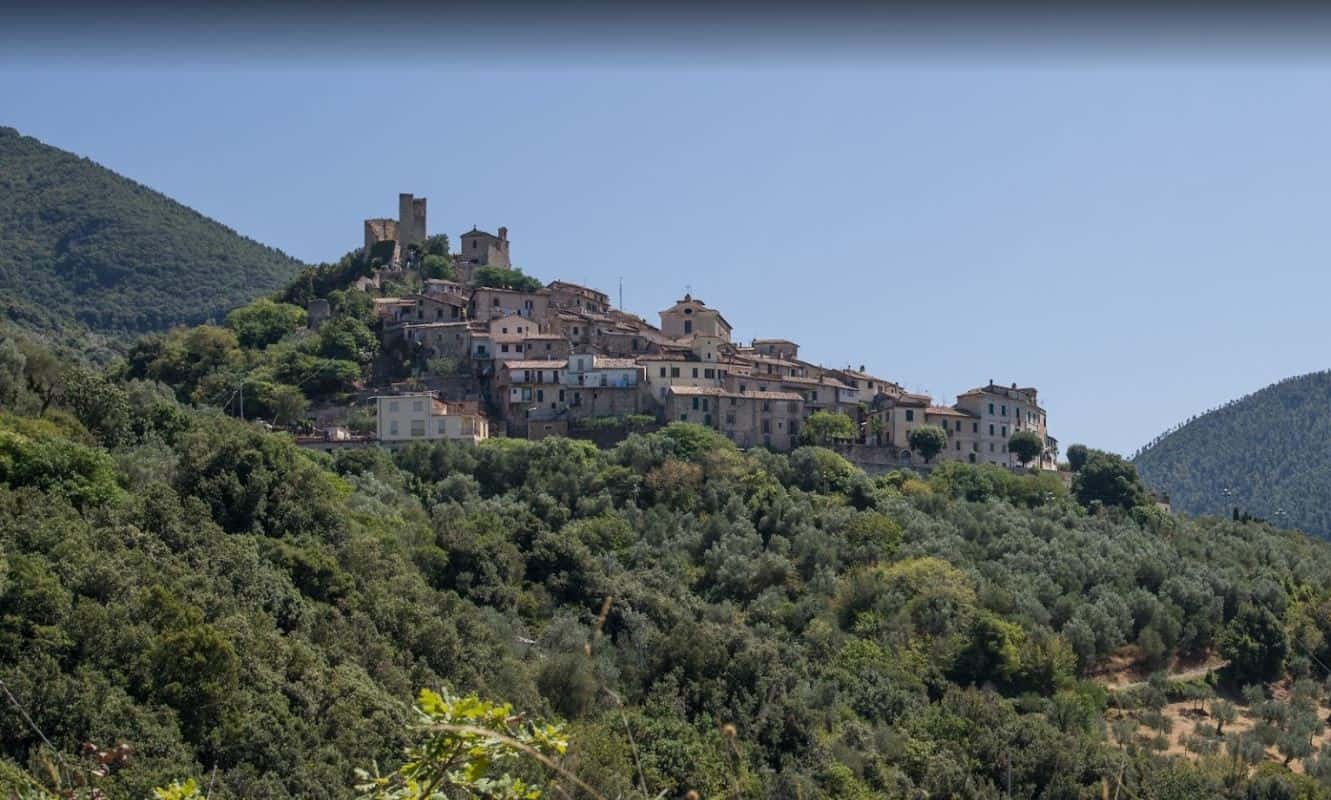
The tower is what identifies Roccantica from kilometers away: it is seen from the provincial road, from the valley, from several points of the neighboring villages. It stands in the highest part of the town, on one of the highest points of the western Sabina, and has a square section. Local sources claim it is Norman, erected after 1059 when the army of the Hauteville was lined up with Nicholas II, and that is why it bears the pope's name. The encyclopedia entry dates it more generically to before the year 1000. The two datings cannot be reconciled and should be taken for what they are: a local tradition tied to the town's founding event and a rough dating. What is certain is the function: a lookout and signal tower, not a defensive one, because in the Middle Ages the towers of the Sabina communicated with one another by fire and smoke signals, forming an alert network over the Tiber valley. It has suffered damage from earthquakes and neglect, has been restored and brought back, at least in part, to its original structure. It is hollow, and you climb by a staircase that runs along the inner walls up to a belvedere.
Climbing requires breath and a few minutes of stairs, and the tower opens on the organized visit days, so ask beforehand. The reward is twofold. The first is the panorama, which covers the whole Tiber valley up to the hills of the Tuscia, with Monte Soratte isolated at the center of the scene like a sculpture set on the plain. The second, less immediate, is the physical understanding of medieval defense: from up there you see that the village is a single system, in which the settlement is the wall and the wall is the settlement, and in which every house was also a piece of wall.
The church of the Madonna di Piedirocca at the foot of the tower
At the foot of the tower, at the highest inhabited point of the town, at Via della Torre 25, stands the little church of the Madonna di Piedirocca, dedicated to the Nativity of Mary. It was built in 1790 by the Vincentini marquises, and local sources give it a tasty political reading: it celebrated 100 years of possession of the town and was a sort of reparation for not having contributed to the reconstruction of the parish church. The church became, however, the symbol of the town: the festival of September 8, moved to the following Sunday, was the day the emigrants came back from abroad, and the evening procession is still today the most deeply felt by the roccolani. Inside is the fresco of the Virgin enthroned with the Child. In the 1970s the parish priest don Guerrino Giacobini adorned the walls with sacred images in wrought iron, an intervention that can be judged as you like but that is in its way a document of popular devotion. The building has been modified from the original layout. The advice is to come here last, at sunset: it is the right place to sit.
The Seminario Romano Maggiore and the church of Sant'Antonio
The bulk of the Seminary closes the town on the mountain side. Its history, from the Franciscan convent of 1454 to the visit of John XXIII on September 12, 1960, is told in the chapter on little-cited facts. In front of the building the phases can be read: the conventual nucleus, the new wing of the 1920s, the touch-ups of the late 1950s. It has been abandoned for over a decade and cannot be visited. The church of Sant'Antonio da Padova is inside. It is the largest building in Roccantica and the most melancholy, and in our judgment its fate is the real open question about the town's future: a container of that size, in a village of 500 inhabitants, either finds a function or becomes a ruin.
The Historical Archive of Roccantica
In the town hall, reorganized and placed in its present home between the 1980s and 1990s, the Historical Archive keeps parchments of notarial deeds, papal briefs and bulls, miscellanies of documents on the life of the village from the Middle Ages on, in original and in copy, together with objects of different periods: old keys, flintlocks, work tools. It can be visited on request. For a town this small it is a rare thing, and it explains why the history of Roccantica can be told with dates and names instead of with "they say": the memory is written and kept.
The alleys of Roccantica: the village that reads like a book of stone
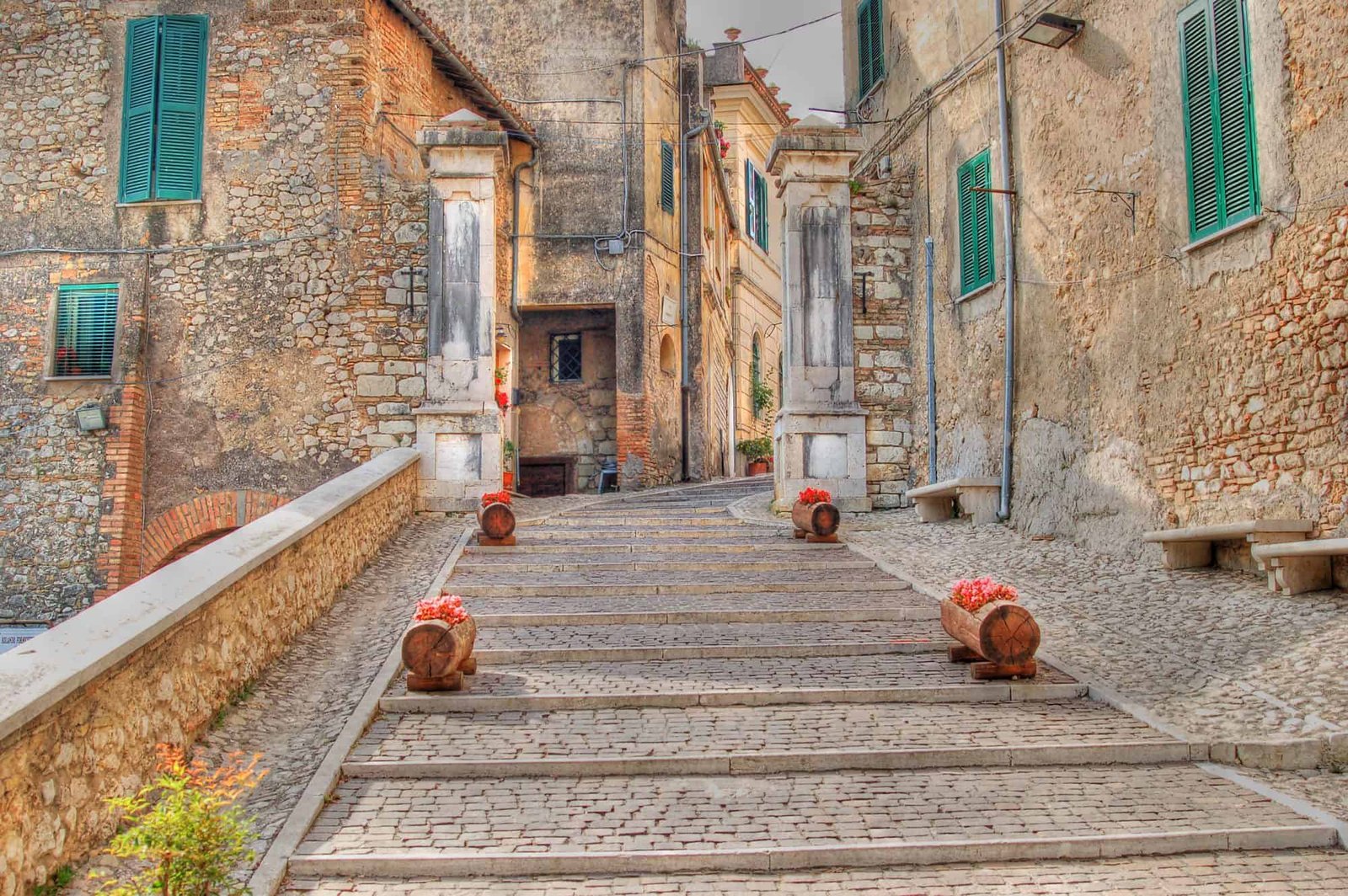
Roccantica, like all band villages, is a readable document, and learning to read it turns a stroll into an investigation. Look at the lintels: many doors carry engraved dates, initials, symbols, signatures of the families who built or renovated the house, and their distribution tells the phases of expansion. Look at the walled-up windows: when an opening is closed with different stonework, the building has changed function or ownership, two houses have been joined or separated, a floor has been sold. Look at the relieving arches above the doors, which reveal walls built to resist the thrusts of the slope. Look at the covered passages, where a building spans the alley: when you couldn't grow horizontally you built over the public street, with the authority's permission, and every covered passage is the trace of a negotiation that took place centuries ago between a private party and the community. And look at the interior level changes, the houses with the entrance on the ground floor on one side and on the second floor on the other: the signature of the sloping settlement.
Whoever takes to this reading discovers that the neighboring villages behave differently despite their similarity. Casperia has a concentric spiral structure around the hill. Toffia plays on an elongated layout along a ridge. Roccantica is band-shaped, leaning on the flank of the mountain. Three solutions to the same problem, all medieval, all a few kilometers from one another: an open-air lesson in urban planning that is worth the trip by itself.
The hermitage of San Leonardo and the mill: the walk from Roccantica
From the church of San Valentino starts the trail that in about 30 minutes leads to the hermitage of San Leonardo, on the flank of the mountain. Along the way you meet the remains of a water mill, recognizable by the stone wheel of the millstone: it is the mill that served the town when grain was ground at zero kilometers, and it deserves a stop because it is early medieval industrial archaeology without a sign. The hermitage is a rock structure that local sources date to the 8th to 9th century, the era when the hermit model of Leonard of Noblac, the French saint protector of prisoners, pushed devotees to seek solitude in caves. The dating is presumed, not documented, and should be taken as such. There are two little rooms carved into the rock, one to live in and one to pray in, with a small oven and a spring that, they say in Roccantica, always keeps the same level. On the walls, later frescoes with San Leonardo and Santa Caterina, attributed to Jacopo da Roccantica, whom local tradition makes a workshop pupil of Pietro Coleberti: a boy from the town who would have learned the trade watching the master paint Santa Caterina in 1430 and then brought the saint into the cave too. It's a nice story, and it has at least the coherence of the subjects. Next to the hermitage, a crag equipped for sport climbing, at about 500 meters above sea level among the woods, with an approach of a couple of minutes from the car: climbers know it as the Roccantica crag.
The Revotano, the sinkhole of Roccantica
The Revotano is reached by the numbered trails 6 and 3 of the local network, on foot only. It is a chasm 250 meters in diameter created by the collapse of the vault and walls of karst cavities, with walls that drop steeply into the woods. Don't expect an equipped viewpoint: it is a place to look at with respect, staying on the edge and away from unstable margins. For centuries it was believed to be a crater. It is the legend of the blonde who runs. If you have read the chapter on curiosities you already know why the earth sinks here.
Monte Pizzuto, Fonte Regna and the beech wood above Roccantica
The territory of Roccantica reads like a vertical section of the whole Sabina. At the bottom, on the exposed and drained slopes, the olive reigns, with centuries-old rows that make up the landscape of Sabina DOP oil. Going up, the olives give way to scrub, then to mixed woods of downy oak and hornbeam and finally, beyond 800 to 900 meters, to the beech woods of the cool slopes of Monte Pizzuto. Trail number 7 climbs to Fonte Regna, a spring at 880 meters in the beech forest. Number 6 heads to the summit of the Pizzuto, 1,288 meters. Walking in a mature beech wood is a specific experience: the canopy is so dense that the undergrowth stays almost bare, you walk on a carpet of leaves among gray, smooth trunks that rise straight for 20 meters, the light is green in spring and golden in autumn, the leaves absorb sounds. On foggy days the effect is frankly unreal. The bloom of March and April, before the leaves close off the light, covers the ground with anemones, squills and toothworts: it is the period when it's worth walking with your head down.
The fauna is that of the Apennines at middle altitudes: abundant wild boar, expanding roe deer, foxes, badgers, porcupines, buzzards and kestrels, tawny owls on spring nights. It isn't wild nature in the strict sense, it is nature that has lived with humans for millennia, and that is exactly why it is interesting. The trail network is partly marked and partly not: some routes are maintained, others are mule tracks that the vegetation is taking back. If you are aiming for the summit, bring adequate mapping, download the tracks because phone coverage is not guaranteed, and set out early: the elevation gain from the town to the summit altitudes exceeds 800 meters and should be respected. The Cammino dei Borghi Sabini and its cycle-tourism variant pass through here, as does the Cammino del nuovo Umanesimo. The local association organizes mountain excursions, and every spring the Roccantica Montagna in Festa day ends with a community lunch. From the nearby SP 46, toward Monte Tancia, you climb in a kilometer and 400 meters to the hermitage of San Michele Arcangelo, in the territory of Monte San Giovanni in Sabina: if you have another half day, it is the twin outing of San Leonardo.
The right photo to take in Roccantica (RI)
A not insignificant part of the reason we visit villages is that they are photogenic, and there is nothing wrong with that as long as the photograph doesn't replace the experience. Here I am very practical: where, when and how to make the images that convey the character of Roccantica, avoiding the interchangeable postcards that could be taken in any town in central Italy.
The main shot: Roccantica band-shaped, seen from outside
The photograph that identifies Roccantica better than any other is not taken inside the town, it is taken from outside. You have to move away along the provincial road, in the direction of Casperia or Poggio Catino, to one of the bends where the town shows itself in profile with its band structure perfectly readable: the curtain of houses following the contour line, the stepped roofs, the tower on top, the Pizzuto behind. It is the shot that explains, because the reason for being of this village is seen only from a distance. Inside the alleys you perceive the slope, not the design. Look for a spot that includes a portion of olive grove in the foreground: the silver of the leaves against the light stone always works. The time is late afternoon, when the dropping light sculpts the volumes and makes the layering of the roofs visible. At noon the same framing is flat. Early risers should try shortly after dawn, when low mist in the valley gives the effect of a suspended town.
The panorama from the tower of Roccantica
From the belvedere of the tower you reach the opposite point of view: not the town seen from outside, but the world seen from the town. Don't attempt the total panorama, which almost always produces generic images. Isolate: a medium lens or a telephoto compresses the planes and captures the sequence of overlapping hills, each with a different shade of blue, the effect painters call aerial perspective. An element in the foreground, a piece of masonry or a branch, gives depth. And if there are clouds, be grateful: a clear sky, in panoramas, is the most boring thing there is.
The details of the alleys of Roccantica
The images that pay off most are the details: a lintel with an engraved date, a wooden door with flaking paint, geraniums on a stone sill, a staircase that turns and disappears, a cat on a warm step, a covered passage that frames a rectangle of light. These subjects work in any light, even at noon, even under an overcast sky, even in the rain: wet paving stones produce reflections that dry ones don't have, and gray days give back the colors of the stone with a fidelity that full sun burns away. An exercise I recommend: take a whole tour of the historic center without shooting, only looking. Then do it again with the camera in hand. The difference is striking.
Santa Caterina and photography in front of the frescoes
Coleberti's cycle deserves to be photographed with three precautions. Ask permission from whoever opens. Don't use flash, ever. Respect the place: if there is a service or someone praying, the camera stays in the bag. Technically you need high sensitivity and a steady hand. A tabletop tripod, where allowed, solves a lot. Remember that a photo of a fresco is almost always inferior to the direct experience: take one or two as a reminder and then look with your eyes.
The beech wood and Medioevo in Festa: two special situations
The beech wood in autumn is the most spectacular subject in the territory and the trickiest: the contrast between lit canopies and shaded trunks defeats every light meter. Shoot on overcast days or in the early hours, with diffused light, and isolate groups of trunks instead of attempting the overall view. Medioevo in Festa, at Ferragosto, is a different test: evening parades, fires, a thousand costumes, crowds. You need a fast lens and above all discretion, because it is a community performance and not a set. The best images are those stolen from afar with a telephoto, which catch the concentrated faces without interfering. A rare advantage: the organizers lend period costumes to visitors for free, so you can end up inside the photograph instead of behind it.
The photo of Roccantica nobody takes and that I recommend
Everyone photographs the village, the tower, the panorama. Very few photograph the terraced olive groves below the town, and it's a mistake. Those terraces are the real monument of this territory: dry-stone walls built by hand, generation after generation, to wrest a few square meters of cultivable land from the mountain. They represent an amount of human labor that no castle equals. Photograph them in raking light, early in the morning or in the evening, when the shadows reveal the steps. Include the town above, small, as a crown. You will get an image that tells the Sabina better than any postcard: a built landscape, not a found one.
Some important events that took place here in history
For a town of 500 inhabitants Roccantica has an unusually dense calendar of documented events, and this is owed to the archive of Farfa first and to the municipal one later. I list them in order, distinguishing what is written from what is handed down.
792: Roccantica enters the documents
A donation to the abbey of Farfa, recorded in the Regesto Farfense, mentions the church of San Valentino in the Fundus Antiquus. It is the documentary birth certificate of the town, and it coincides with the years in which Farfa, protected by the Carolingians, was becoming the landholding power of the Sabina. In 840 the estate belongs entirely to the abbey. After the passage of the Saracens in 846 the place is fortified and in 966 it is a castrum: in less than two centuries an agricultural estate becomes a fortress.
1059-1060: the siege of the Crescenzi and the privilege of Nicholas II
It is the event the town re-enacts every Ferragosto. In the struggle between the reforming pope Nicholas II and the antipope Benedict X, backed by the Crescenzi and the counts of Tusculum, Roccantica sided with Nicholas and was besieged. Tradition has it that it held out until the arrival of the Normans of Robert Guiscard, whom the pope had just bound to himself at the council of Melfi in August 1059, and that in the end the survivors were 12. On April 18, 1060, Nicholas II granted the privilege that placed the castle under the direct dominion of the Holy See, with excommunication for anyone who claimed its possession: a status of protection that lasted until 1415. That the bull exists is an archival fact. The number of survivors is memory, and like all founding memories it should be respected without being taken for minutes.
1415-1433: Roccantica passes to the Orsini
The bull of John XXIII, the Pisan pope later declared an antipope, gives the castle to Francesco Orsini, count of Gravina. In 1433 the passage to Cardinal Giordano Orsini opens the story of the Bracciano branch. In between, in 1427, Martin V appoints Armellao de' Bastoni governor, and three years later, on June 1, 1430, Pietro Coleberti finishes the frescoes of Santa Caterina. These are the 15 years that gave Roccantica its masterpiece.
1454, 1576, 1583: the convent, the Borgo Nobile, the Poor Clares
Three building projects in a little over a century change the face of the town: the convent of the Reformed Minors approved by Nicholas V in 1454, the future seminary. The Orsini's Borgo Nobile in 1576. The monastery of the Poor Clares in the old castle, dated by the sources to 1583, with the donation of Felice della Rovere. From a military fortress Roccantica becomes a small center of religious and seigneurial power.
1698-1705: the end of the Orsini and the purchase by the Vincentini
On April 8, 1698 Flavio Orsini dies, the last duke of Bracciano of the branch, and Roccantica returns to the Holy See. A few years later the widow, Marie Anne de la Trémoille, sells the town and the title of marquis to the governor Giuseppe Vicentini, who in 1696 had already had the chapel of San Giuseppe built to a design by Francesco Fontana. A family of administrators becomes lord of the place it administered.
1702-1743: the earthquake and the new parish church
The earthquake of 1702, the same one that devastated the area of Amatrice and Norcia, brings down the new church, still unfinished. The reconstruction, paid for by a bequest from Paolo Leonardi and by the community, closes with the blessing of 1740 and the consecration of May 1743. In 1790 the Vincentini build the little church of Piedirocca.
1810-1864: the suppressions
The Napoleonic laws of 1810 close convent and monastery. The Poor Clares return in 1816 and are dissolved for good in 1864 by the laws of the Kingdom of Italy, which had arrived with the plebiscite of November 4 and 5, 1860. Roccantica ends up in the province of Perugia, where it stays until 1923.
1932, 1939, 1946: the 20th century of Roccantica
In 1932 the church of San Valentino, cited since 792, is partly demolished to make a Park of Remembrance. In 1939 the town regains the municipal autonomy lost in 1927. On April 8, 1946 Anna Montiroli widow Coccia becomes the first woman mayor of Italy. Three dates that tell a century: modernity that demolishes, bureaucracy that merges and gives back, democracy that arrives from below and before elsewhere.
September 12, 1960: John XXIII in Roccantica
The pope visits the Seminario Romano Maggiore and asks the seminarians for daily prayer for the Second Vatican Council, which would open two years later. It is the last great event of the town, and since then the history of Roccantica has been that, less spectacular but just as dramatic, of depopulation and return.
Who has passed through Roccantica (RI)
Roccantica is not a place of famous literary stays: no Grand Tour poet wrote famous pages about it, no handbook places a birthplace here. But the list of who really passed through, with dates and circumstances, is longer than the size of the town would suggest, and it's worth doing in full, with the degree of certainty of each name.
Nicholas II and Robert Guiscard: the pope and the Norman
No document attests that Gerard of Burgundy, Pope Nicholas II, physically entered Roccantica. It is certain that the town sided with him in 1059 and that in 1060 he rewarded it with a privilege. That Robert Guiscard, the Norman who became duke of Apulia precisely at Melfi in 1059, led or sent the troops that freed the castle is a local tradition consistent with the chronology: the alliance between the reforming papacy and the Normans dates from those months. Tradition, then, but tradition with the right dates.
The monks of Farfa
The first to pass through and stay were the Benedictines of Farfa. Between the 8th and 11th centuries the abbey was one of the most powerful monastic institutions in the West, and the monks were not only religious: they were administrators, judges, agronomists, de facto urban planners. They organized the territory in the form we recognize, promoted incastellamento, regulated land rights, spread agricultural techniques. The cultivation of the olive owes a great deal to that phase: the abbeys needed oil for liturgy, lighting and the table, and had a time horizon that individual farmers did not. An olive grove reaches full production after years, and only someone who thinks in decades plants it on a large scale. When you look at the centuries-old olives below Roccantica you are looking at the outcome of a thousand-year economic logic. The papers of Farfa, the Regesto and the Chronicon, give a picture of the medieval Sabina so detailed as to make this peripheral area among the best documented of early medieval Italy.
Armellao de' Bastoni and Pietro Coleberti: the patron and the painter
The governor from Ascoli appointed by Martin V in 1427 and the painter from Priverno who in 1430 painted Santa Caterina for him are the two best-documented names among those who passed through here, because the church itself left them written. Coleberti belonged to that category of itinerant professionals who in 15th-century central Italy moved from one center to another on commission from communities, confraternities or families: they prepared the plasters, drew the sinopias, worked by daily sections calculating how much surface to fresco before the lime set, carried with them repertoires of models and cartoons. His presence in Roccantica is one of the fixed points of his catalog. Next to him tradition places Jacopo da Roccantica, the workshop boy who would later paint San Leonardo and Santa Caterina in the hermitage: the only artist born here of whom a name remains.
The Orsini, Felice della Rovere, the princess of the Ursini
Francesco Orsini count of Gravina, Cardinal Giordano Orsini, Orsino Orsini founder of the convent, Gian Giordano Orsini and his widow Felice della Rovere, daughter of Julius II, who donated the castle to the Poor Clares. And at the end Flavio Orsini, who died in 1698, and Marie Anne de la Trémoille, who sold the marquisate before going to run the court of Philip V in Madrid as camarera mayor. These are changes of ownership, not documented stays, but for three centuries the fate of Roccantica was decided in the palaces of these people, in Rome and at Bracciano.
Francesco Fontana and Bartolomeo Torresani: the artists
Francesco Fontana, son of Carlo, signed in 1696 the design of the chapel of San Giuseppe in the Borgo Nobile: an architect of Baroque Rome in a Sabine village, called by a rising governor. Bartolomeo Torresani, of the clan of Veronese painters active in the Rieti area in the 16th century, painted the panel that was in San Valentino and that today is on the altar of the parish church. The attributions are those of the local sources. The Crucifixion of Santa Caterina remains instead an open question between lo Spagna and an anonymous Umbrian.
The shepherds of the transhumance
The least visible and oldest passage is that of the shepherds. The Sabina lies along the routes that for millennia connected the Apennine pastures to the wintering plains. The main sheep tracks passed elsewhere, but the secondary network crossed this area, and with it flocks, men, goods, news and diseases. The shepherds were the real travelers of preindustrial Italy: they covered hundreds of kilometers twice a year, knew very distant towns, carried cheeses and brought back stories. The traces are in the drinking troughs, in the stone shelters on the slopes, in the paved trails above Roccantica that lead to no house, in the sheep and goat dairy culture still eaten in town. It is the archaeology of a world that disappeared in two generations and that nobody thought to turn into a museum.
Angelo Roncalli, the seminarian and the pope
The young priest from Bergamo who according to the town's memory said one of his first Masses here in 1904 and the pope who returned on September 12, 1960 to ask for prayers for the Council: the story is told at length in the chapter on little-cited facts. He is the only figure of world importance whose physical passage through Roccantica is documented, with date and speech.
The emigrants, those who returned, those who arrived
The most recent and painful passage is the outgoing one. Between the late 19th and the 20th century many left the Sabina, first toward the Americas, then toward northern Europe, then toward Rome and the industrial cities. Every family in these towns has distant branches, cousins who speak other languages, photos of weddings celebrated thousands of kilometers away. The hemorrhage emptied the village but created a network: many building recoveries were done by descendants of emigrants who come back, often only in summer, and the Piedirocca festival in September was, until not many years ago, the day of the return from abroad. Alongside them have come the new residents, Romans and foreigners, northern Europeans and Anglo-Saxons, who chose the Sabina for the combination of affordable prices, landscape and closeness to Rome. It is a phenomenon that Roccantica shares with Casperia and Montebuono. And every summer, for a few years now, young European volunteers arrive who work with the Comune and the Pro Loco: the town celebrates them at the end of August with a day it calls Roccantica heart of Europe.
Today's travelers in Roccantica
Finally there are we: hikers, village enthusiasts, photographers, climbers headed for the crag, Roman families on an outing, walkers of the Cammino dei Borghi Sabini, organized groups who include the Sabina in themed itineraries. It isn't mass tourism and it never will be: accommodation is limited, access requires a car, the offering is niche. This visitor has a particular responsibility, because in a fragile ecosystem every behavior weighs more. Spend in town, buy oil from the producer, respect the trails and the quiet, come back in the low season: minimal gestures that, multiplied, make the difference between a village that survives and one that fades out. Whoever organizes trips in these areas for small groups, like the private experiences of TourLeaderPro, knows it and thinks about distribution of flows and real sustainability.
The festivals of Roccantica through the year
The town's calendar is marked more by festivals than by tourist seasons, and knowing it is the best way to choose when to come. The exact dates change every year. Here I give the rules, which are stable.
Sant'Antonio and San Valentino: the winter of Roccantica
In January, the Sunday after Sant'Antonio Abate, hundreds of animals are blessed in Piazza San Valentino and the confraternity of Sant'Antonio offers cooked fava beans and ring-shaped cakes: it is the farming festival par excellence, with dogs, horses and tractors lined up in front of the priest. The first Sunday after February 14 the patron saint is celebrated with a community lunch and a carnival party for children in the sports hall. Grilled polenta has its own winter food festival.
The Sagra del Frittello, the Sunday after San Giuseppe
The Sunday after March 19 the oldest and most loved food festival takes place: the broccoli fritters, broccoli tops dipped in batter and fried in Sabina extra virgin olive oil, with local wine and music. It is the festival that marks the end of winter, and the frittello is a lesson in poor cooking: a seasonal vegetable, flour, water, good oil. Whoever wants to understand what a DOP oil means in the kitchen should come here and eat one just drained.
Roccantica Montagna in Festa and the July amatriciana
Every spring a day dedicated to the mountain, with always different excursions led by the local association and a final community lunch. In July an evening under the stars with the tasting of amatriciana, the dish of the other Sabina, that of Amatrice, which here is cooked with the guanciale and pecorino of the province.
Medioevo in Festa in Roccantica: Ferragosto in 1059
From August 12 to 15 the town goes back to 1059. Medioevo in Festa, now in 2026 in its 29th edition, with the patronage of the Ministry of Culture and the Lazio Region and the artistic direction of Prospero Calzolari, re-enacts the siege of the Crescenzi and the defense of the pope: parades, tournaments, shows with fanfares, drummers, flag throwers, fire eaters and dancers of the local historical group, and the procession of the Assumption in medieval costume, which the town's sources count at about 600 participants. Over 1,000 costumes have come out of the local tailor shop, and visitors can wear one for free, becoming extras. The taverns open every evening at 20:00 with local cooking. There is medieval music and, on opening night, Celtic music and jesters. Free shuttles connect the parking lots to the town and the stands for the shows are free. An association of walkers organizes paid trekking and e-bike excursions, with mandatory reservation. Re-enactments in Lazio are of two kinds: those built to attract visitors, with professional extras, and those in which the town represents itself. Roccantica belongs to the second, and the difference is felt in the faces and in the way a man-at-arms greets a spectator because he is his cousin. It is the moment of the year when the scattered community physically comes back together. Dress light but bring something for the evening: at 457 meters, in August, after midnight it is cool.
Piedirocca in September and Christmas in Roccantica
The Sunday after September 8 the evening procession to the Madonna di Piedirocca closes the summer: it is the most deeply felt festival, the one of the return. In December, nativity scenes along the streets, small markets, choirs, mulled wine and the arrival of Santa Claus for the children. Whoever looks for the living nativity par excellence of the province goes to Greccio, in the Holy Valley.
Sabina oil and the cooking of Roccantica
In the Sabina oil is not a product, it is a calendar. The olive harvest in Roccantica, as in the whole area, remains a social event before an economic one: between the end of October and the first days of December, depending on the year and the altitude, the slopes fill with spread nets, ladders, mechanical shakers and hands that on the oldest trees do the work as they did 100 years ago. The Sabina DOP is among the oldest designations recognized in Italy for extra virgin oil and covers a territory straddling the provinces of Rieti and Rome. The historic cultivars of the area, Carboncella, Leccino, Raja, Frantoio, Moraiolo and other minor ones, give an oil with medium fruitiness, with grassy notes, bitterness and pungency present but balanced. It isn't a show-off oil, it is an everyday cooking oil, and perhaps that is why the Sabines treat it with a naturalness that to an outsider looks like nonchalance.
The olive mill in Roccantica and the November rite
If you happen to be in the towns of the area during the milling and you find an olive mill willing to let you in, go in. The smell of those hours is one of the strongest sensory experiences of inland Lazio: cut grass, artichoke, bitter almond, a vegetal base that stays in your clothes all day. Continuous-cycle plants have replaced the old presses with enormous gains in quality, but the ritual of the delivery is identical: you arrive with the crates, you weigh, you wait your turn, you chat, you argue good-naturedly about the yield. A consumer tip: if you buy oil, ask for the year and the milling date. Extra virgin does not improve with age: it gives its best in the first months and then loses its aromas. An oil from the harvest just ended, kept in the dark and used within the year, is the way to understand what this designation means.
What you eat in Roccantica
The cooking is that of the mountain Sabina, and the town's trattorias do it without frills: stringozzi, the fresh pasta of water and flour pulled by hand and cut thick, with wild boar sauces or with new oil and pecorino. Grilled meats. Broccoli fritters in season. Sheep and goat cheeses. Grilled polenta in winter. Amatriciana as a tribute to the other half of the province. Don't expect auteur cuisine, expect honest cooking, and always ask for the oil at the table. The desserts are those of the festivals, ring-shaped cakes and dry cookies, to be dunked in local wine. The lesson of this table is that with three good ingredients nothing else is needed, and that the ingredient that makes the difference is always the same: the one that grows on the terraces you photographed in the morning.
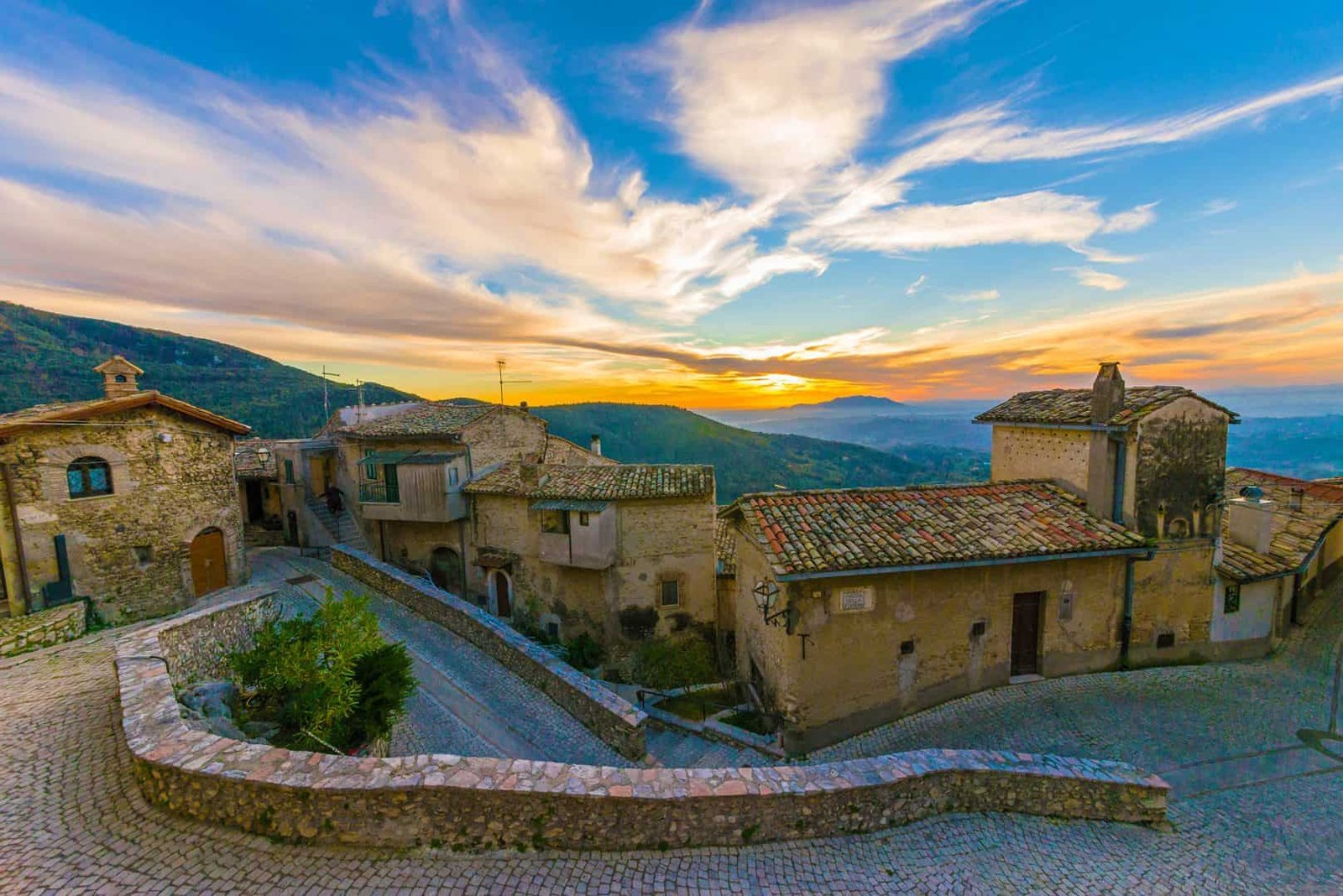
Roccantica with children, accessibility, costs
With children Roccantica works better than its verticality would suggest, provided you choose well. The walk to San Leonardo, half an hour on an easy trail with a mill and a cave inhabited by a hermit at the end, is a perfect story for a six-year-old. The legend of the blonde who runs, told on the rim of the Revotano, is worth a picture book. Medioevo in Festa, with the borrowed costumes, is probably the most fun thing you can offer a child in the whole Sabina. The village's staircases call for a light stroller or, better, a baby carrier backpack. The Sagra del Frittello and the animal blessing in January are family-sized festivals. The tower is climbed only with sure legs and on opening days.
Accessibility is the objective limit of a band village. Those with mobility difficulties can enjoy Piazza San Valentino, the parish church and the first ring of alleys. The upper part, the tower and Piedirocca are reachable only by staircases. Santa Caterina is in the upper part of the medieval nucleus, and access has to be arranged in any case. The mountain trails are not accessible. Whoever organizes a visit for a group with different needs does well to ask the Pro Loco in advance for a route.
The costs: entering the town costs nothing, parking costs nothing, the festivals are free to enter. The guided visits of the town are by reservation and the conditions are asked at the time. The tower, Santa Caterina and the Archive depend on those openings. A lunch in a trattoria falls in the range of mountain towns, not the Roman one. A bottle of oil from the producer is the most sensible purchase you can make, and it's worth asking in town who sells. Those who come by train spend the regional ticket to Poggio Mirteto plus the Cotral bus, a few dozen euros in all for two people.
What to see around Roccantica in 10 minutes and in a day
In 10 minutes by car: Poggio Catino, with its fortress, and Casperia, the pedestrian spiral village that is perhaps the most photogenic in the Sabina and with which Roccantica shared the Comune from 1927 to 1939. In 20 minutes: Poggio Mirteto, service center and station, Montebuono and Torri in Sabina. In half an hour: the Abbey of Farfa, which is the key to reading everything you have seen, Castelnuovo di Farfa with the oil museum, the Farfa Gorges for a walk, Fara in Sabina with the belvedere, Toffia. Toward the Tiber, the reserve of Nazzano Tevere-Farfa and, on the other side of the river, Monte Soratte, which you looked at from the tower. Toward Umbria, Orte. In an hour, Rieti and Terminillo. The Sabina is visited like this, in concentric circles, and Roccantica is a good center for the compass.
Quick questions about Roccantica (RI)
Where is Roccantica and which province does it belong to?
In the province of Rieti, in Lazio, at 457 meters above sea level on the western slope of the Sabine Mountains, at the foot of Monte Pizzuto. From 1861 to 1923 it was in the province of Perugia and from 1923 to 1927 in the province of Rome.
How far is Roccantica from Rome?
A little under 60 kilometers from the Raccordo, about an hour and a quarter by car with the A1 to Ponzano Romano-Soratte and then the provincial roads. From Rieti about 35 kilometers, but on a ridge road.
How do you get to Roccantica without a car?
Regional train FL1 from Roma Tiburtina to Poggio Mirteto Scalo, then a Cotral bus to Piazza San Valentino. The runs are few and concentrated at commuter hours. Check the Cotral site and plan the return.
How much does it cost to visit Roccantica?
The town, the parking and the festivals are free. The tower, Santa Caterina and the Archive are visited with the guided openings by reservation organized by the Comune and the Pro Loco. The conditions are asked at the time of booking.
How much time do you need to visit Roccantica?
Three hours for the village at an unhurried pace. A whole day adding the hermitage of San Leonardo and a walk at altitude. Two days if you combine it with Farfa, Casperia and the nearby villages.
Can you visit the church of Santa Caterina in Roccantica?
Only with an arranged visit: the church is private and the 1430 frescoes have long been under restoration. Book the guided visit before leaving. Without a reservation the risk of finding it closed is high.
Who painted the frescoes of Santa Caterina in Roccantica?
Pietro Coleberti da Piperno, that is, from Priverno, in 1430, commissioned by the governor Armellao de' Bastoni of Ascoli. They are eight panels with the life and martyrdom of Catherine of Alexandria in late Gothic style.
Can you climb the tower of Nicholas II?
Yes, by an interior staircase up to the belvedere, on the organized opening days. The tower bears the name of the pope the town defended in 1059 and was a lookout and signal tower.
Is Roccantica suitable for children?
Yes, with comfortable shoes and without a heavy stroller. The walk to the hermitage of San Leonardo, the legend of the Revotano and Medioevo in Festa with the borrowed costumes are the things children remember.
Is Roccantica wheelchair accessible?
Only the lower part: Piazza San Valentino, the parish church and the first alleys. The upper part, the tower and Piedirocca are reachable only by staircases.
Where do you park in Roccantica?
For free along the road that skirts the town and in the wide spot at the entrance. During Medioevo in Festa there are free shuttles from the outer parking lots.
When does Medioevo in Festa take place in Roccantica?
From August 12 to 15, every year. In 2026 it reached its 29th edition. Taverns from 20:00, parades, shows, the Assumption procession in costume, costumes lent free to visitors.
What do you eat in Roccantica?
Stringozzi, wild boar sauces, sheep and goat cheeses, broccoli fritters at the March food festival, grilled polenta in winter, and above all the Sabina DOP extra virgin olive oil.
Who is the patron saint of Roccantica?
San Valentino, celebrated the first Sunday after February 14. The church dedicated to him is cited in the documents since 792 and is today a Monument to the Fallen.
What is the Revotano of Roccantica?
A karst collapse sinkhole about 250 meters in diameter, among the largest in central Italy, reachable only on foot. Legend places the first settlement there, sunk by divine punishment.
What is the hermitage of San Leonardo?
A rock hermitage half an hour's walk from San Valentino, with two little rooms carved into the rock, a spring and frescoes of San Leonardo and Santa Caterina attributed to Jacopo da Roccantica. Next to it is a crag for climbing.
What is the difference between Roccantica and Casperia?
Casperia is a spiral village, entirely pedestrian, larger and better equipped for tourism. Roccantica is band-shaped, smaller, quieter, with the painted masterpiece of Santa Caterina. They are a few minutes apart and are visited together.
Was Roccantica really the first comune with a woman mayor?
According to local sources, yes: Anna Montiroli widow Coccia was appointed mayor on April 8, 1946, the first woman to lead an Italian comune.
When is the best time to visit Roccantica?
Spring for the trails and the blooms, November for the new oil and the red beeches, Ferragosto for Medioevo in Festa. Avoid the central hours of summer days and Mondays out of season.
Can you hike on Monte Pizzuto from Roccantica?
Yes, with the numbered trails that climb to Fonte Regna (880 meters) and to the summit (1,288 meters). You need mapping, downloaded tracks and an early start: the elevation gain exceeds 800 meters.
Is Roccantica part of any walking route?
Yes: the Cammino dei Borghi Sabini, its cycle-tourism variant and the Cammino del nuovo Umanesimo pass through the town, and the hostel in the village is designed for groups of walkers.
I'll tell you something unpopular: Roccantica is not understood at Ferragosto, with the costumes and the taverns, however beautiful the festival is. It is understood on a November weekday, when the olive mills are working, the beeches are red, there is nobody in the alleys and in front of Santa Caterina, if you have booked, you are alone with a painter of 1430. That is when this town is at its best, and it is worth the extra half hour of provincial road.
Article written by the editorial team of TourLeaderPro, contact them for Private/Corporate/V.I.P. Tours and Experiences.
Planning a trip to Rome? The English guides to visiting the city are on ItalyPlanner.com.