Montebuono (RI)
In short. Montebuono is a municipality of just over 800 inhabitants in lower Sabina, in the province of Rieti, at 325 meters above sea level on the slopes of Monte San Benedetto, a step from the Umbrian border.
Montebuono is a municipality of just over 800 inhabitants in lower Sabina, in the province of Rieti, at 325 meters above sea level on the slopes of Monte San Benedetto, a step from the Umbrian border. Town hall at Via del Municipio 1, 02040 Montebuono (RI), phone 0765 607631. From Rome it is 65 to 70 kilometers: by car you take the A1 Motorway toward Florence and exit at Ponzano Romano-Soratte or at Magliano Sabina, then follow the Sabina provincial roads. A good hour of travel, an hour and a half on summer weekends. By train the Rome-Orte regional line (FL1, from Tiburtina and Ostiense) stops at Stimigliano and at Poggio Mirteto. From the Stimigliano station there is a provincial-level Cotral line that touches San Polo and Montebuono, with a few runs a day and even fewer on holidays: the schedules must be checked on the Cotral site before leaving. The village can be visited for free and without a ticket. The church of San Pietro ad Muricentum, the main monument, is outside the built-up area in the locality of Spezzano and opens on the occasion of services and visits organized by the committee that looks after it: for the interior it's best to ask at the Comune or at the parish, because a fixed opening schedule is not published. The hamlet of Fianello, with its baronial palace and pentagonal tower, is a handful of kilometers toward the Tiber and is always accessible from the outside. Free parking at the entrances to the village. Half a day is enough for Montebuono and Fianello, a full day if you add the climb to the hermitage of San Benedetto or a stop at an olive mill. The overall picture of the province is on the page dedicated to Rieti, and the other destinations in the region are collected among the tourist attractions of the site.
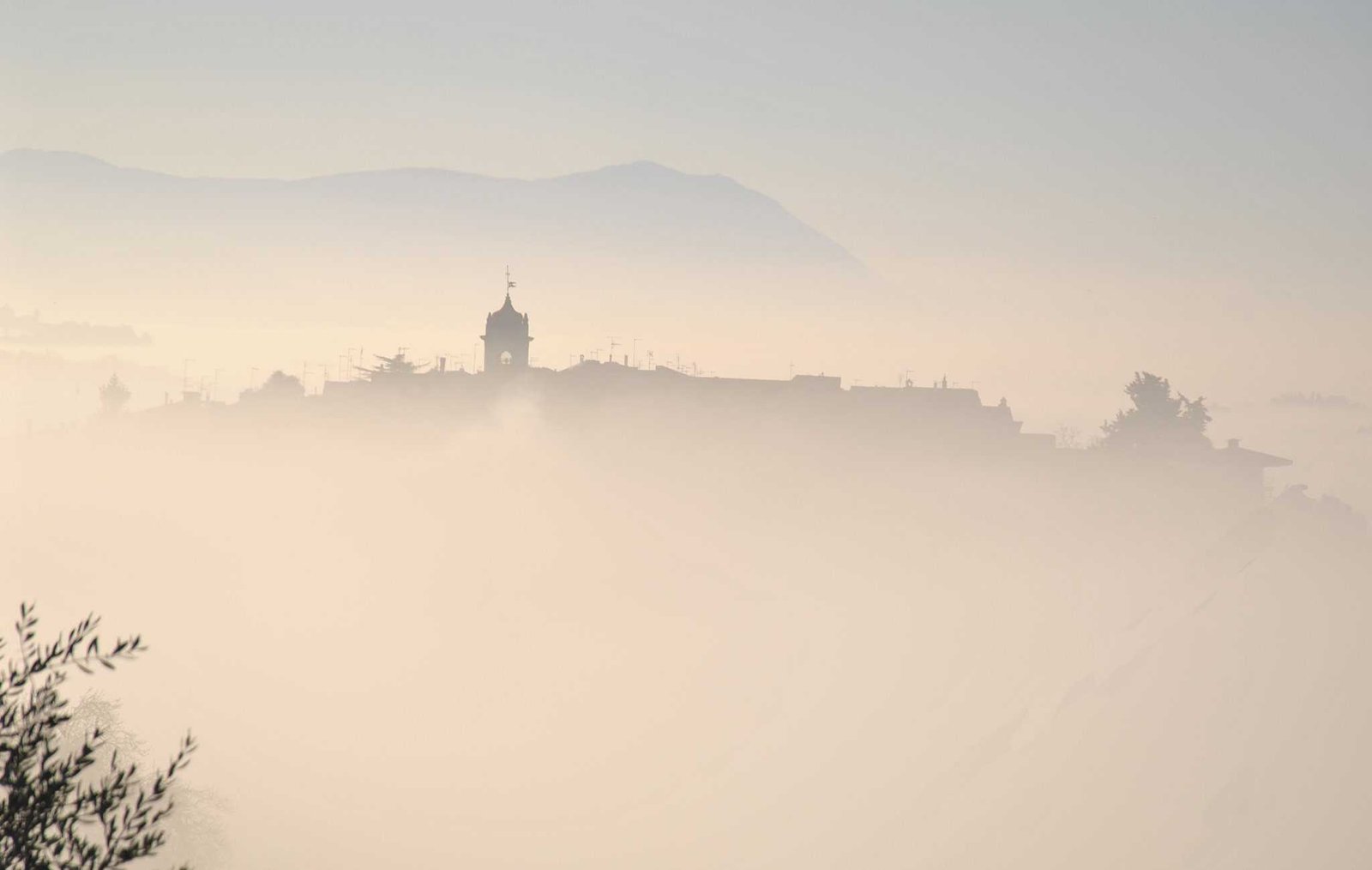
How to Get to Montebuono (RI) from Rome: The Three Roads and the Right Choice
There are places you reach and places you encounter. Montebuono, leaning on a ridge of olive groves a little over an hour from the capital, belongs to the second category. It isn't on the way to something else, it doesn't appear by chance to those rushing toward Umbria: you have to decide to go there, leave the highway, take a provincial road that climbs, descends, circles a hillock, and at a certain point see the bell tower poking up above the line of olive trees. That is the moment when you understand you have arrived in Sabina for real, not the Sabina of postcards but that of the villages that keep living on their own scale.
Logistics, in cases like this, isn't a detail: it's the first part of the experience. From Rome the main road is the A1 Milan-Naples Motorway heading north, the one Romans simply call the Autosole. There are two useful exits, and the choice changes the character of the trip more than you'd imagine. The first is Ponzano Romano-Soratte, the second is Magliano Sabina. Between the two there is no single answer: there is the right answer for the kind of day you have in mind.
The Ponzano Romano-Soratte Exit
Those who exit at Ponzano Romano-Soratte find themselves right away in the shadow of Monte Soratte, the isolated relief that rises from the Tiber plain like a limestone island left there by mistake and that the Latin poets sang more than any other mountain in Lazio. Horace saw it white with snow in a famous ode, and that silhouette is still the one that accompanies the traveler along the whole valley. From there you head east, cross the Tiber and enter lower Sabina, the one that begins with vineyards and ends with olive groves. The route is slightly longer in kilometers of secondary roads, but it's more beautiful: wide curves, gentle changes of elevation, farmhouses appearing and disappearing, and that precise feeling of passing from one mental region to another. I recommend it to those who have time and to those who travel for the pleasure of driving. A detail worth knowing: from precisely this side of the valley, from the hill of San Pietro, Soratte is seen opposite, across the river, and it is the same view the owners of the Roman villa on which the church was built had.
The Magliano Sabina Exit
Those who exit at Magliano Sabina save a few minutes and arrive from the north, descending toward Montebuono through the hills that slope down to the Tiber valley. Magliano is itself a town that deserves a stop, with its historic center stretched along the ridge and the civic archaeological museum that tells pre-Roman Sabina better than many volumes. From Magliano you take the network of the Sabina provincial roads, those that link one village to another with an ancient logic, made of ridges and not straight lines. And here one thing has to be said that holds for the whole territory: the Sabina provincial roads are not fast roads. They are scenic roads disguised as normal roads. Whoever expects to make good time will be disappointed. Whoever expects to look around will find them perfect.
Via Salaria, the Historic Entrance to Montebuono
A third entrance, less traveled but historically the most authentic, is the one along Via Salaria. The state road that bears this name is the salt road, the route that led from the Adriatic to Rome the most precious mineral of antiquity, and it crosses Sabina from side to side. Taking the Salaria from Rome toward Rieti and then turning west means arriving at Montebuono following historical geography instead of motorway geography. It's slower, and it's busy in the first kilometers, but if you're interested in understanding how this territory formed around a road, the Salaria is the best lesson. For those who prefer not to drive, a certified guide who knows Sabina solves everything: the tourist accompaniment service of TourLeaderPro works on exactly this kind of itinerary, departing from Rome.
Timing, Train and Bus for Montebuono
The distance from Rome is 65 to 70 kilometers, which in real time means a little over an hour if you don't meet queues leaving the Grande Raccordo Anulare, and a good hour and a half leaving on a Friday afternoon in summer. For Sabina the advice is always the same: leave early. Not out of morning fanaticism, but because the light of these hills in the early hours is something you don't recover in the afternoon, and because Sabine villages at eight in the morning have a life that by 11 has already gone back inside the houses.
On public transport you have to be realistic. Montebuono is served by provincial-level bus connections that work mainly for school and work trips to the larger centers, with frequencies that on weekends and in vacation periods thin out considerably. The possible combination is the regional train of the Rome-Orte line to Stimigliano (or Poggio Mirteto) and from there the Cotral run that goes up toward San Polo and Montebuono. It's a workable solution on a weekday, with schedules studied in advance, not a way to improvise. It isn't a territory designed for tourism without a car, and pretending otherwise would ruin someone's day. Those who arrive by train and want freedom of movement do well to arrange a rental or a private service. Those who want to see more villages in a day without going crazy with maps can rely on a private tour built to measure, like those TourLeaderPro organizes for small groups and companies.
Parking, Shoes and Water
On parking the matter is simple and pleasant: this is a municipality of a few hundred inhabitants, not an art city with buses lined up. You leave the car in the spaces available at the entrance of the built-up area or along the main road, go down on foot and enter the village walking, which is the only sensible way to enter a medieval town anyway. The inner streets are narrow, partly stepped, and the center can be crossed from one end to the other in a handful of minutes. You don't need a map, only the willingness to circle twice around the same square to notice what the first time escaped you.
Footwear matters more than you'd think. The paving is irregular, some ramps have serious slopes, and whoever decides to go down toward the countryside, to reach San Pietro or to climb to the hermitage soon finds themselves on packed earth. Closed shoes with a decent sole, always. And water, especially from June to September, because Sabina in high summer has a dry heat that doesn't warn before it hits: it isn't the city's mugginess, it's a dry scorching heat that dehydrates without making you visibly sweat.
When to Go to Montebuono: The Right Season
On seasonality there is a precise indication. The best period for Montebuono is late autumn, between the end of October and early December, when the olive harvest begins and all of Sabina changes its breathing. The nets spread under the trees, the little vans going up to the olive mills, the smell that reaches you on the road before you even see where it comes from: it's the moment when this territory stops being landscape and goes back to being work. Spring is the second choice, between April and May, with flowering meadows, long days and, on April 3, the festival of the patron saint San Vincenzo Ferreri. Summer should be lived at dawn or at sunset, never at noon. Winter gives clear days of a rare sharpness, in which from the heights you see an impressive distance, but it requires heavy clothing and the awareness that many services work at a reduced pace.
One last organizational note worth gold: Montebuono alone doesn't fill a whole day, and it shouldn't. It should be fitted into an itinerary that touches other nearby centers, because the sense of Sabina is understood only by lining up several villages and noticing how each has worked out the same geography in a different way. On the same day you can link the visit to Torri in Sabina and to Poggio Catino, or go as far as the Abbey of Farfa, which remains the reference monument of the whole district. For those who read English, the guide to the abbey published on ItalyPlanner is the natural complement of this page.
Last warning, and I give it with affection: phone signal coverage on some stretches of the Sabina provincial roads is capricious. Offline maps must be downloaded before leaving. It isn't a safety problem, it's a serenity problem: losing the signal while looking for a fork between two identical olive groves is one of the quickest ways to turn a trip into a family argument.
And if I really have to give an ideal schedule, here it is: leave Rome around half past seven, arrive at Montebuono shortly after nine, first walk in the village with the town still awake and not yet closed in the silence of midday, descent to San Pietro and Fianello in late morning, a long stop around noon, departure in early afternoon toward a second village, return with low light. It's a scheme that works in all seasons and that avoids the most common mistake of those who come here for the first time, which is treating Sabina as a checklist instead of a rhythm.
The Ridge of the Olive Trees: History and Landscape of Montebuono
To understand Montebuono you have to start from a geographical observation that holds for all of southern and western Sabina: here the villages are not in the valleys, they are above. Always above. On a hillock, on a ridge, on a spur that dominates a ditch. It isn't an aesthetic whim, it's a defensive choice sedimented over the centuries and then turned into a mental form. The valley floor was unhealthy, unsafe, exposed to floods and raids. The height was healthy, controllable, defensible. Every time you climb toward a Sabine village you retrace a decision made by someone a thousand years ago, and Montebuono is no exception: the old core organized itself around a control point, with the houses squeezing into compact blocks and the streets following the relief instead of challenging it.
The Name of Montebuono and the Climate of Monte San Benedetto
The name itself is a small declaration. Mons bonus, the good mountain: good because fertile, good because safe, good because it offered what an agricultural community needed to exist without depending too much on anyone. Local tradition adds a climatic explanation: Monte San Benedetto, which closes the village to the north, shelters it from cold winds and gives it a temperate microclimate, and it was precisely that mildness that would have suggested the adjective. It's a plausible reading, not documented by medieval sources, but coherent with the way place names in this area were born: almost always descriptive and not celebratory. Sabina is full of these honest names: mountains, hillocks, towers, fortresses, fields. Each signals exactly what was there.
The Sabines and the Rome of Agrippa at Montebuono
The long history of this territory begins well before the Middle Ages, with the people that gave it its name. The Sabines were one of the oldest Italic groups and one of the most resistant to Roman pressure, and their land was for centuries the first great space of expansion of the Republic. Rome fought them, absorbed them, inherited from them the fame of sobriety and moral severity, and made of them an archetype: the Sabine, in Latin literature, is the serious, thrifty farmer, little inclined to luxury, the exact opposite of the corrupt city dweller. That this image was in part an ideological construction is probable, but it is a construction that left deep traces in the territory's self-perception, so much so that even today those who live here willingly claim a certain unadorned roughness.
At Montebuono, however, Romanness is not an idea: it is under your feet. The territory preserves two rustic villas of the first rank. The first is the one on the hill of San Pietro, called for centuries the Baths of Agrippa because among the ruins a fragment of marble epigraph was found with the name of Marcus Vipsanius Agrippa, the general and son-in-law of Augustus, the man who built the first Pantheon and won at Actium. The attribution of the property to Agrippa is a tradition based on that fragment, not a certainty, but the cisterns, the bath rooms, the exedra and the floors in opus spicatum and opus sectile say it was a residence of rank. The second villa is at Fianello, near the cemetery and the church of Santa Maria Assunta, and is dated to the age of the Flavians: in 1950, opening the cemetery road, statues of the imperial age came out, now kept at the Museo Nazionale Romano. Even the plan of the historic center of Montebuono, with the main street cutting through the built-up area like a decumanus and the perpendicular streets like cardines, is read by local scholars as the legacy of a Roman layout, perhaps a camp or a fortification. It's a hypothesis, not an excavated fact, but it explains well the surprising regularity of a village you'd expect to be twisted.
Lombards, Farfa and the Incastellamento of Montebuono
With the fall of the imperial order and the arrival of the Lombards, Sabina becomes a border land, and border lands are always more interesting than central lands. The duchy of Spoleto controlled this strip for a long time, and the pentagonal tower of Fianello, dated by local tradition to the 6th-7th century, is considered precisely a trace of that presence. It is in this context that the phenomenon that shaped the landscape more than any other is born and grows: Benedictine monasticism. The Abbey of Farfa, a short distance from here, was not simply a monastery: it was for centuries a political and economic power of the first order, with possessions extending well beyond regional borders and with an archive that historians of the Middle Ages consider an unparalleled mine. The famous Regesto di Farfa, the collection of the abbey's acts, allows us to reconstruct with very rare precision who owned what, who cultivated where, which castles depended on whom. It is thanks to those papers that the church of San Pietro ad Muricentum appears for the first time in written history, in a document of 1105, and that Montebuono emerges from the fog of the dark centuries with a documented biography.
The historical mechanism that created these villages has a technical name: incastellamento. Between the 10th and 11th centuries the population scattered in the countryside, who lived in farmhouses and open villages, concentrates in fortified hilltop nuclei, often on the initiative of a lay or ecclesiastical lord who offers protection in exchange for obligations. It's a settlement revolution that in a few decades rewrites the map of central Italy, and Sabina is one of its best-studied laboratories precisely thanks to the Farfa documentation. For Montebuono the sources place the founding of the castle proper a bit later, between the end of the 13th century and the first years of the 14th. During the 14th century the castle was occupied by Luca Savelli, exponent of the powerful Roman baronial family, who then had to give it back to the Holy See. When you walk through the streets of Montebuono and notice that the houses seem wedged one into the other, that the outer walls form a continuous curtain, that the openings toward the outside are few and high, you are not looking at a coincidence: you are looking at the architectural fossil of that choice.
The Papal States, Umbria and 1927
Then come the centuries of the long belonging to the Papal States, which for Sabina means administrative stability and at the same time a certain economic marginality. It isn't a land of great Renaissance building sites nor of sumptuous courts: it is a land of parishes, of small local nobilities, of families managing farmland and olive mills. At Fianello the Orsini enlarged the palace in the 16th century and in 1571 had the parish church of San Giovanni Battista built. The Baroque arrives, but it arrives in provincial doses, and this, I say it with conviction, is a stroke of luck for today's visitor. It means medieval buildings weren't swept away by ambitious rebuildings, that Romanesque structures survived, that the urban fabric kept its original scale. Where wealth passes, the old is replaced. Where wealth doesn't pass, the old stays.
There is an administrative detail almost nobody knows and that says a lot about the position of Montebuono: until 1923 the municipality belonged to the province of Perugia, that is, to Umbria. It passed to the province of Rome that year and in 1927, with the reorganization of the districts decided by the regime, entered the new province of Rieti. Whoever finds that the landscape in these parts resembles the countryside of Terni more than the Castelli Romani is right: historically, Montebuono was Umbrian longer than it has been in Lazio. Today it is part of the Union of Municipalities Nova Sabina.
The Olive Groves of Montebuono and Sabina DOP
But the real monument of Montebuono, the one that covers everything else in extent and in economic importance, is not built: it is planted. It is the olive groves. Sabina is one of the oldest olive-growing territories in Italy, with a tradition that most probably goes back to before Romanization and that has produced Sabina DOP extra virgin olive oil, among the very first protected designations of origin assigned to an oil in Europe. Montebuono falls entirely within the production zone set by the specification. It isn't a label detail: it is the formal recognition of a productive continuity lasting millennia on the same soil, with the same cultivars, with the same criteria of exposure and altitude.
You only need to look at the hills around the village to see an irregular geometry made of terraces, dry-stone walls, rows following the curves of the terrain. Sabine olive trees are not lined up as in an industrial orchard: they are arranged according to the slope, with irregular distances, often around centuries-old specimens that nobody has ever had the courage to cut down. Some of these trees have hollow, twisted trunks that look like sculptures, and they keep producing. It's a landscape with a rare quality: it is at once natural and completely artificial. Every square meter has been shaped by human hands, and yet the result seems spontaneous.
The cultivars have names worth learning, because they are the signature of the territory. The Sabina DOP specification prescribes that at least 75 percent of the olives belong to Carboncella, Leccino, Raja, Pendolino, Frantoio, Moraiolo, Olivastrone, Salviana, Olivago and Rosciola, alone or together, and sets a maximum acidity of 0.6 grams per 100 grams. The profile that comes out is recognizable: yellow-green color with golden reflections, fruitiness of medium-light intensity, herbaceous and artichoke notes, bitterness and pungency present but balanced, never aggressive. It is an elegant oil more than a powerful one, suited to fish, boiled vegetables, legume soups, and capable of not overwhelming delicate flavors. Whoever has in mind the dense, pungent oils of other regions has to recalibrate their palate here.
The Tiber, the Farfa and the Sabine Mountains
The landscape is completed by water, and it's another founding element. To the west is the Tiber, which flows in its wide valley and was for centuries the communication route with Rome: river traffic carried timber, foodstuffs and oil toward the capital. Fianello sits right on a sandstone river terrace, of Pleistocene origin, bounded by the Campana stream. It is the lowest part of the municipality, at 193 meters, and the closest to the river. To the east is the Farfa, the river that gives its name to the abbey and that carves a narrow green valley, with wetland environments of notable naturalistic interest, protected today in the Nazzano Tevere-Farfa reserve. Between the two water systems stretches a hilly plateau stirred by ditches and small valleys, and in the background rise the Sabine Mountains, which close the horizon to the east and on clear days show profiles of an almost graphic sharpness.
This double exposure, toward the big river and toward the mountain, explains the microclimate and also the quality of the light. Sabina has a particular light, which photographers know well: in the low hours it takes on a golden tone that settles on the silvery leaves of the olive trees and creates a double-reflection effect hard to find elsewhere. It isn't a romantic impression, it's optics: the underside of the olive leaf is covered with hairs that reflect the light, and an entire slope cultivated with olives behaves like a semi-mirroring surface. When the wind passes, the slope changes color. Those who have never seen it think they have a problem with their eyes.
Montebuono and the Nearby Villages: A System, Not a List
The relationship between Montebuono and the nearby villages deserves a note. This isn't an area of isolated centers but a system, and each village has a recognizable specialization. Casperia, with its perfectly preserved spiral layout and total pedestrianization, is the model of the circular medieval village. Roccantica plays the card of the fortress and the vertical relationship with the mountain, and is the homeland of the painter who frescoed San Pietro. Fara in Sabina is the panoramic balcony and the gateway to the Farfa world. Poggio Mirteto is the service center with a particular civic history. Toffia preserves a medieval fabric of rare compactness. Montebuono, in this mosaic, has the role of the true country village, the one where the relationship with the land hasn't been mediated by tourism, with the added privilege of a frescoed church that in many provinces would be a national monument.
Finally, there's one dimension that written history struggles to record but that you can read in the landscape: the depopulation of the 20th century. Like all the small towns of the Apennines and their foothills, Montebuono went through decades of emigration, first toward Rome and then abroad, with a population decline that left empty houses and partly abandoned fields. The official figure as of January 1, 2024 is 811 residents. In recent years a partial reversal has appeared, made up of people coming back, of purchases by foreigners in love with the Sabina, and of small farms that have recovered abandoned olive groves. It's a fragile balance, one that depends on the ability of these areas to offer quality of life without asking residents to give up services entirely. Watching it up close, walking through a town like this one, is perhaps the most useful lesson an attentive visitor can take home.
Visiting Montebuono (RI) place by place
The municipal territory can be read in three stops, distinct by elevation and by period: the village on the ridge, the church of San Pietro on the hill toward the Tiber, and the hamlet of Fianello on the river terrace. For those with the legs and an extra half day, there is also the hermitage of San Benedetto on the mountain that gives its name to the local range. I describe them in the order in which I recommend visiting them.
Montebuono's historic center and Via Garibaldi
You enter on foot and almost immediately notice an anomaly: the village is more regular than you'd expect. The main street, today Via Garibaldi, crosses the town in an almost straight line and the minor streets meet it at an angle, following a logic that local scholars trace back to a decumanus and its cardines, that is, a layout of Roman origin, perhaps a military outpost. It's a traditional reading, not confirmed by excavations, but it has the merit of explaining what you see. Around this core the medieval wall-houses later clustered, with arches, underpasses, small stairways and alleys climbing in steps toward the upper part. Some Roman-era cisterns survive in the building fabric and are the most concrete sign of the settlement's continuity. My advice is to walk Via Garibaldi from one end to the other, then come back along the parallel alleys: only that way do you understand the double nature of the town, geometric in the center and organic at the edges.
The towers and castle of Montebuono
The castle of Montebuono, founded according to the sources between the end of the 13th century and the first years of the 14th, is not a stronghold you visit with a ticket today. It's a system of towers distributed around the historic core, partly absorbed into houses and some of them turned over time into fine residences. Look for them with your eyes raised, recognizing the oldest masonry, the blocked arrow slits, the unusual wall thickness. The 14th-century episode of the occupation by Luca Savelli and the return to the Holy See tells you a lot about the function of this castle: a control point on a border land contested between Roman barons and the Church, in a belt where the Savelli and the Orsini divided fortresses and towns between them. Anyone expecting flags will be disappointed. Anyone who can read a wall will find a whole fortress diluted into a town.
The church of Santa Maria Assunta in Montebuono
In the village the main church is Santa Maria Assunta, a Romanesque three-aisle building whose origin local sources date to around the year 1000, but which was reworked in the following centuries. It's worth a visit for a reason few people know: when the left aisle of San Pietro ad Muricentum was removed, its columns were reused right here in the parish church, for the organ and for the portal. So walking in, you see a piece of the other church. Hours follow the services. On weekdays it's best to ask in town.
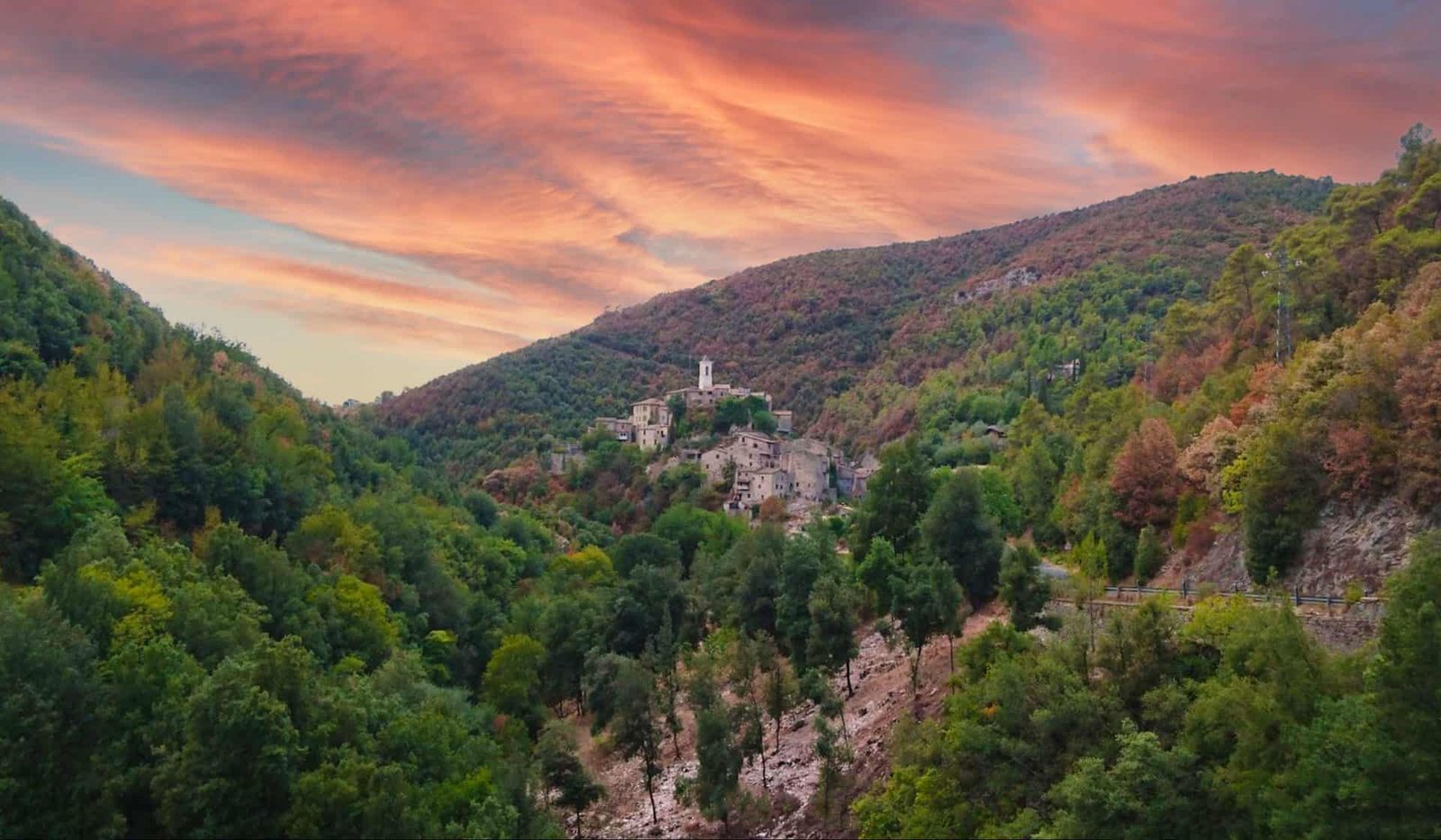
San Pietro ad Muricentum, the masterpiece of Montebuono
And now the monument that more than any other justifies a detour out here: the church of San Pietro ad Muricentum, also called ad Centum Muros or, in the local dialect, San Pietro ai Muricento. The name comes from the "100 walls," that is, from the ruins of the Roman villa on which the church was built and which in the Middle Ages must still have emerged from the ground like a labyrinth of broken walls. It's a Romanesque building, of the kind found outside the town, in an isolated position on a hill in the locality of Spezzano, with the Tiber below and Monte Soratte opposite, following a pattern typical of the rural parish churches of central Italy. Its presence says one precise thing: before the town gathered on the heights, the countryside was organized around churches that served a wide, scattered territory. When the population moved uphill, the church stayed where it was, and over time found itself alone among the fields. That solitude, which to a distracted eye looks like abandonment, is in fact proof of a stratigraphy: the church is older than the village that looks down on it from above.
The villa of Agrippa beneath San Pietro
Under the floor of the church, and inside its walls, there is a rustic villa from the imperial era. The excavations carried out during the restoration brought to light mosaic floors in opus spicatum and opus sectile, fragments of plaster painted in Pompeian red, a cistern fully plastered, stretches of opus reticulatum, and rooms that can be linked to a bath complex. The complex was large: local sources count two cisterns next to San Pietro and two more in the locality of Coste Adriane, an exedra, frescoed residential quarters, and a water supply from the so-called Grottoni di San Donato. Agrippa's name comes from a fragment of a marble inscription found among the ruins, hence the traditional name of Baths of Agrippa. That Augustus's son-in-law really owned this villa is a reasonable hypothesis, not a proof. That the villa was of senatorial rank is told by the materials. Whoever built the church around 1100 demolished nothing: they used the columns, the squared blocks and the fragments of Roman reticulate work as a quarry, and you can still recognize them in the outer walls. After the restoration, the floor was partly replaced by panels of shatterproof glass with dedicated lighting, so that visitors literally walk above the Roman mosaics and plasters. It's a clever museum solution that few people expect in a country church.
The Romanesque architecture of San Pietro ad Muricentum
The first written mention of the church is in a document of the Farfa register from 1105, and the construction is placed around that date. The Romanesque architecture of these rural Sabine churches has recognizable traits. Masonry in local stone with blocks not perfectly squared, with plenty of reuse of ancient material. A simple basilica plan. Few openings, splayed, calibrated to let light in in a controlled way. A tower bell tower. Originally San Pietro also had a left aisle, removed at an unknown date: its columns, as mentioned, ended up in the town's parish church. Today the building has the main nave, a chapel on the right side, the apse and, under the chapel, underground rooms used as ossuaries. The architectural restoration of 1992-1998, directed by the architect Maria Santa Valenti for the Soprintendenza ai beni monumentali del Lazio, removed many incongruous additions and restored the Romanesque linearity. There's no ostentation, no complex decorative program in the structures: the richness here is all on the painted walls. Someone arriving after seeing the great cathedrals of northern Italy may find it bare. Someone who looks at it for what it is, the architectural expression of a medieval peasant community that could afford a cycle of frescoes, finds it moving.
The apse by Iacopo da Roccantica, 1451: the Last Judgment
The artistic center of San Pietro is the apse, frescoed in 1451 by Iacopo da Roccantica, a 15th-century Sabine painter from the village you can see across the valley. An inscription says so, worth more than an archive: "Hoc opus fecit le bone donne de Monte Bonu ad honorem Magister Jacopus de Roccha Antiqua depincit MCDLI". The cycle was therefore commissioned by "the good women of Montebuono," a collective, female patronage which in a small town of the mid-15th century is a social fact before it is an artistic one. At the center the Eternal Father dominates in a mandorla, and below him the instruments of the Passion: the scourges, the crown of thorns, the hammer, the lance, the sponge. Angels sound trumpets and the dead rise from their tombs. In the hell zone the painter applied the contrappasso with the precision of a reader of Dante: the greedy forced to swallow molten gold, the envious with their eyes covered, vanity looking at itself in an erased image. Purgatory shows souls purifying themselves between flames and water. The entrance to Paradise is guarded by Saint Peter with the procession of saints. At the top, original sin, with the tempting serpent between Adam and Eve. It's a popular, didactic Judgment, designed to be read by people who couldn't read, and for exactly that reason it still works. Standing in front of the original, stop at the damned, the part where Iacopo had the most fun.
Saint Peter enthroned, the Nativity and the Annunciation
Next to the Judgment, in the apse, Iacopo painted Saint Peter enthroned, an imposing figure with the keys of Paradise, with the donor kneeling at the bottom. The Nativity shows Mary nursing the Child surrounded by shepherds. The women attending with the basin of water have been identified as the patrons themselves, the "bone donne" of the inscription, portrayed in their own fresco. Above the arch of the right chapel is the Annunciation, with a rare iconography: instead of the dove or the ray of light, God the Father physically pushes the body of the infant Jesus toward Mary. It's a theologically bold and visually naive solution, of the kind that in a city altarpiece a bishop would perhaps have had corrected, and which here has survived for almost six centuries. The Christ Pantocrator with the Evangelists in the apse basin and the Evangelists in the ribbed vault of the right chapel are instead attributed by scholars to a hand of the Giottesque school, earlier than Iacopo. For one of the Annunciations, of higher quality, someone has even put forward the name of Beato Angelico. It's a hypothesis to be taken for what it is, an undocumented attribution, but the mere fact that it was proposed tells you the level of what you see.
The right chapel: the stories of Saint John the Baptist
The chapel on the right side holds a cycle with the stories of Saint John the Baptist, still awaiting restoration and therefore less legible: the Baptism of Jesus in the Jordan, the Beheading with the head rolling on the ground and the executioner reporting back, Salome presenting the head at Herod's banquet, and a torture scene with the saint bound in a cauldron while henchmen feed the fire. Below the chapel the ossuaries open up. Precisely because it isn't restored, this part lets you measure how much the work on the apse has given back. The comparison between the two surfaces is the clearest lesson you can get on what a good restoration does.
The Madonna dell'Oliva and the Bianchi of 1399
On the inside of the front wall is the fresco that is the truly rare piece of Montebuono: the Madonna dell'Oliva (or of the Olive Tree). It documents an apparition that took place in Assisi on July 2, 1399: a child sees a figure dressed entirely in white come out of an olive tree, while his father sees nothing. The painter set the scene in a view of Assisi with the Rocca Maggiore, the Rocca Minore, a central church perhaps identifiable as San Rufino and a gate with a quadrangular tower. Above, two saints: one shows his hands with the stigmata and is probably Saint Francis, the other figure in white kneeling before him is perhaps Saint Clare. Beside it, the Martyrdom of Saint Lawrence and, in the lower register, the Mystic Marriage of Saint Catherine. Why this scene is in a Sabine church is explained by history: the Assisi apparition was the spark of the penitential movement of the Bianchi, processions of the faithful dressed in white linen with a hood, a red cross on the chest and a rope at the waist, who in the summer and autumn of 1399 crossed Italy from the Po plain southward, through Tuscany, Umbria, Abruzzo and Lazio, all the way to Rome for the Jubilee of 1400. The Sabina was on their route, and this wall is its painted memory: one of the few places where a mass movement of the late Middle Ages can be seen instead of read about.
The restorations and life at San Pietro today
The architectural restoration of 1992-1998 was followed, between 1998 and 2000, by the restoration of the frescoes under the direction of Dr. Alia Englen for the Soprintendenza ai beni artistici del Lazio, carried out by the Roman consortium Restaurea with the conservators Susanna Neri and Susanna Dati and the restorer Riccardo Mancinelli. The archaeological consolidation was overseen by Dr. Giovanna Alvino for the Soprintendenza archeologica. Since then the church, besides its devotional and pilgrimage function, hosts concerts of sacred polyphony and classical music, Masses sung in Gregorian chant, and sculpture and painting exhibitions, under the care of a local committee created to look after it. The FAI lists it among the Luoghi del Cuore and flags it as accessible. There is no fixed published schedule: it opens for services, for events and by appointment. Even closed, walking slowly around it tells you a great deal: the wall textures with the Roman blocks, the fragments of reticulate work, the blocked openings. But the interior is worth the phone call ahead, no argument.
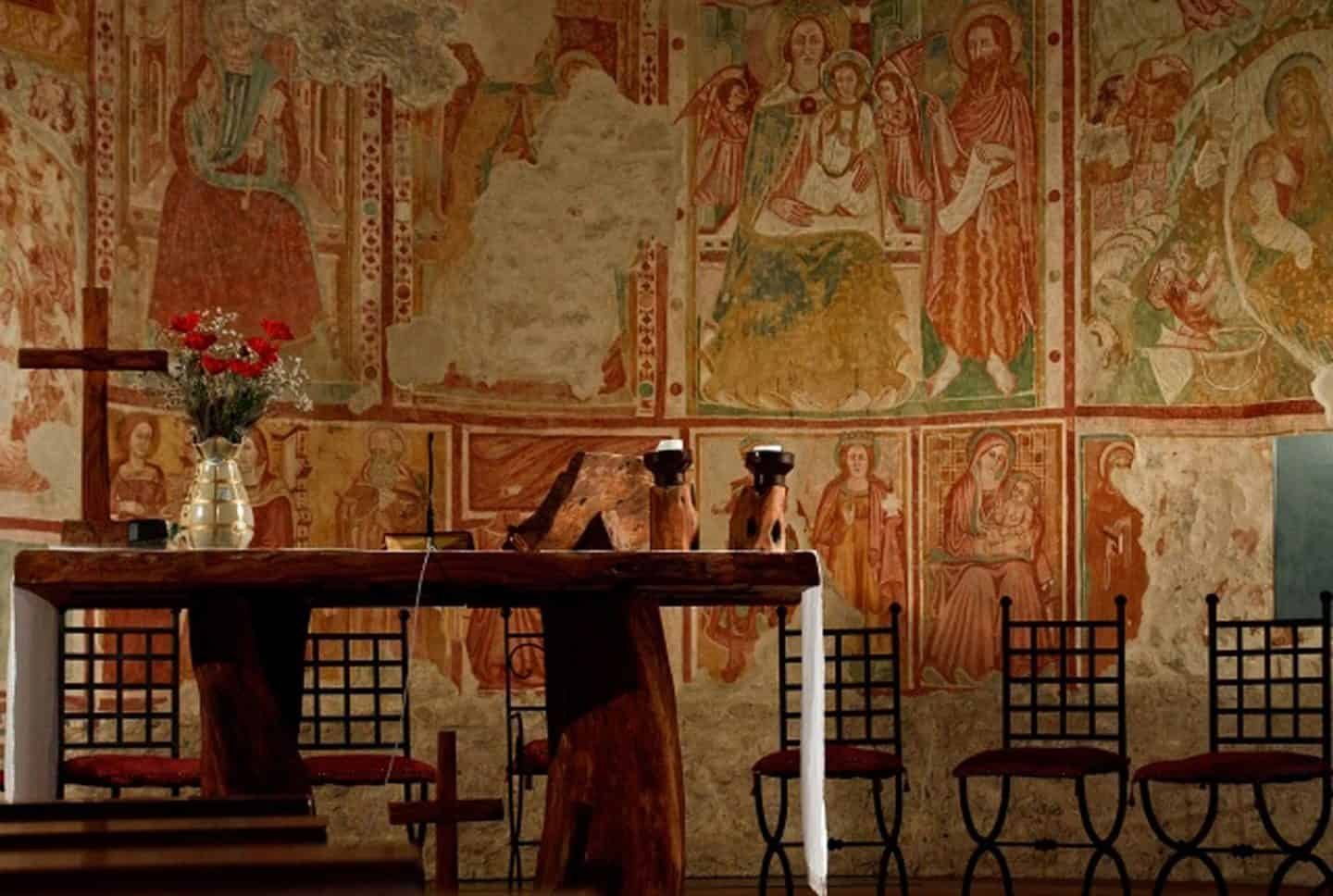
Fianello, the medieval hamlet of Montebuono on the Tiber
A few kilometers from the main town, toward the river, Fianello is a village in its own right, and in many ways an older one. It sits at 193 meters on a sandstone terrace of the Tiber, bounded by the Campana stream, and it is entirely medieval in appearance, with an air of abandonment that strikes you and shouldn't be hidden: the FAI has listed it among the Luoghi del Cuore precisely as a "medieval village to be saved." There are no equipped parking lots, restaurants or places to stay. You leave the car at the edge and enter on foot, discreetly, because someone still lives there.
Palazzo Orsini (or Savelli) in Fianello
The main monument is the baronial palace, which the sources call sometimes Palazzo Orsini and sometimes Palazzo Savelli, reflecting the changes of ownership between the two Roman families who fought over this stretch of the Sabina. According to local descriptions the core dates to the 11th-12th century, and it was enlarged in the 16th: what remains is a wide loggia closed by round arches and a fine Renaissance portal. The state of conservation is serious, with obvious structural decay. It's the building that tells better than any other the difference between a castle that became a town, as in Montebuono, and a castle that stayed a castle and is slowly giving way. Look at it with respect and without going in where you shouldn't.
The Lombard pentagonal tower of Fianello
Next to the parish church rises a tower with a pentagonal base, which local tradition dates to the 6th-7th century and attributes to the Lombards. The pentagonal plan is unusual in Lazio and such an early date is not supported by published excavations, so I treat it as tradition, not as fact. The fact remains that it's the most singular structure in the hamlet, and that the Duchy of Spoleto really did control this bank of the Tiber. If a material memory of that presence exists around here, this is it.
San Giovanni Battista, Santa Maria Assunta and San Sebastiano in Fianello
The parish church of San Giovanni Battista was commissioned by the Orsini in 1571. Santa Maria Assunta, near the cemetery, stands instead on the remains of the Roman villa of the Flavian era: it has a crypt and keeps in the apse a marble slab that was part of an ancient seat. It was while opening the cemetery road, in 1950, that the statues of the imperial era now in the Museo Nazionale Romano came out of the ground: a Dancer, a Maenad, an Athena, an Attis-Eros, a Silenus, an athlete and the portraits of Aeschylus and Demosthenes, according to the list given by local sources. A collection of sculptures at this level says that the owner of the villa had the taste of a Greek collector, not of a farmer. The small church of San Sebastiano holds a reused Roman cinerary urn. The picture is completed by the southern gate in red marble from Cottanello, the local stone you see in half of Baroque Rome, and a monumental oven from the end of the 15th century. Fianello was also a stop on the routes of pilgrims coming down along the Tiber, a thread that today reconnects to Via Francigena.
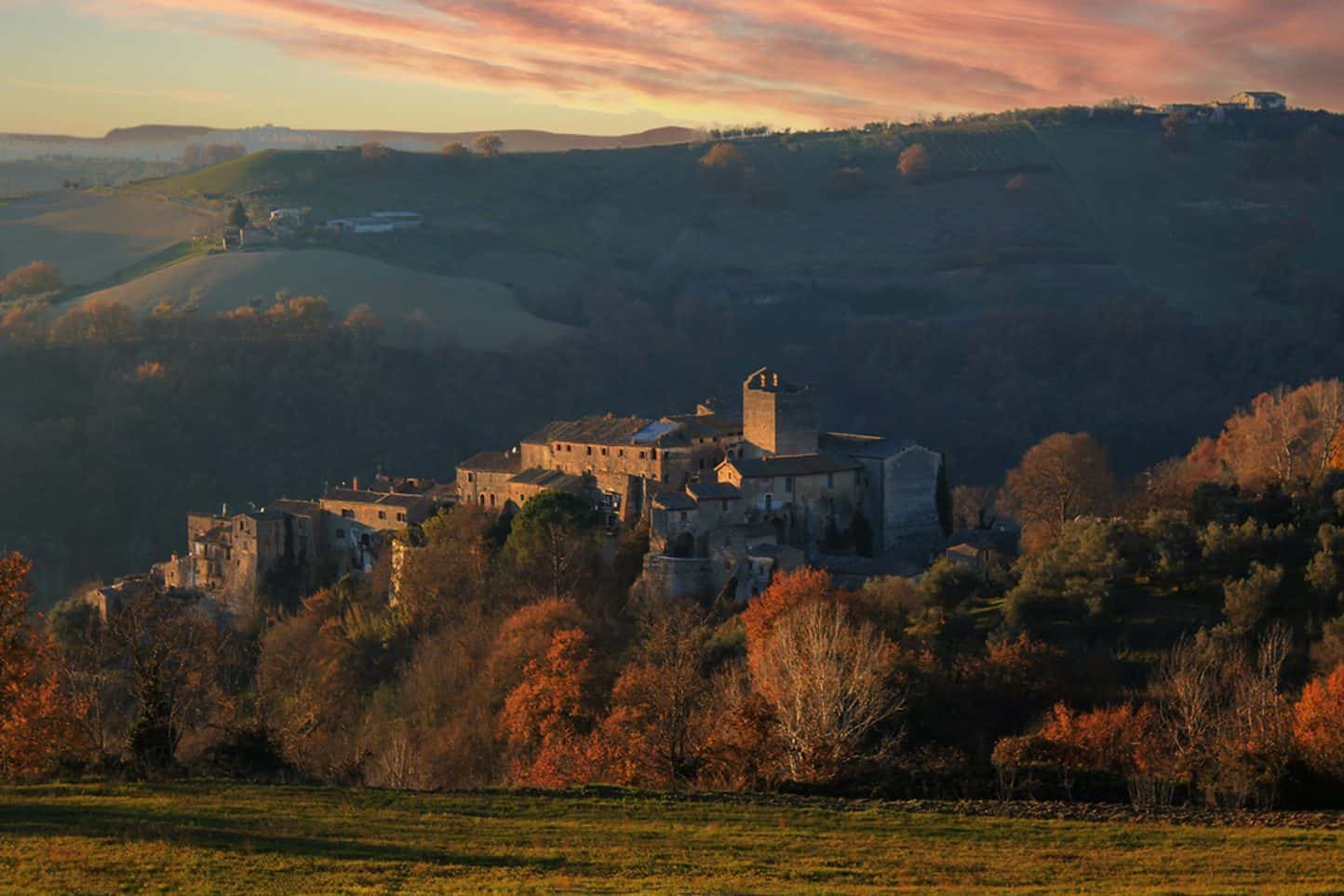
The hermitage of San Benedetto above Montebuono
On the mountain that shelters the town from the north winds stands the hermitage of San Benedetto, which began as a rural church in the 14th century and became a hermitage in the 17th, when the first hermit settled there. Since then it has been a destination for pilgrimages and walks, with a path that climbs between woods and olive groves. It's a place of silence with a terrible history, which I tell further on among the events: at dawn on April 13, 1944, eight American prisoners of war were surprised in their sleep and shot here by a German patrol. If you climb to the hermitage, do it knowing where you're stepping. There is no uniform tourist signage for the route: ask in town for the starting point and allow a couple of hours for the climb and descent, with suitable shoes and water.
A curiosity about Montebuono (RI)
The curiosities of small towns work differently from those of cities. In a city a curiosity is an isolated anecdote, a colorful fact that gets told and forgotten. In a town of a few hundred inhabitants a curiosity is almost always a key: it opens a door onto a way of living, explains why a building stands where it does, clarifies why a word is used a certain way. In Montebuono the curiosities are of this kind, and some are worth the detour more than any list of monuments.
The mystery of the name: why the mountain is good
Let's start from the beginning, that is, from the name, because it's the first curiosity and the most underrated. Montebuono clearly derives from a Latin or Late Latin mons bonus, but the adjective bonus in medieval place names doesn't have the generic meaning we'd give it today. It doesn't mean "beautiful" or even "pleasant." It means productive, favorable, suitable. A fundus bonus is a plot that yields. A terra bona is land that bears fruit. Calling a height "good mountain" amounted to recording its agronomic quality, as would be written in a land-registry appraisal today.
This linguistic detail opens an interesting perspective. It means that whoever named this place did so with an economic criterion, not an aesthetic one. They didn't see a view, they saw a resource. And the resource, in the Sabina, is always the same: a slope with the right exposure, natural drainage, enough elevation to avoid the valley-floor frosts and not so high as to compromise ripening. It's exactly the profile of ideal olive-growing land, and the tradition that ties the name to the shelter of Monte San Benedetto from the northern winds says the same thing differently. The name of the town is a certification of productive vocation issued 1,000 years before designations of origin existed.
There is also an alternative interpretation that circulates among enthusiasts of local place names and that I mention for completeness, even though it's less solid: the idea that the "buono" might derive from the deformation of a personal name, that is, the name of an owner. It's a very widespread phenomenon in the place names of central Italy, where dozens of localities carry the name of the early medieval owner of the estate. There is nothing decisive to prefer this reading, but the very fact that there are several competing explanations says something about the historical depth of the place: ambiguous names are always the ancient names.
This curiosity is a good exercise in reading the Sabine landscape. Try going around the province reading the road signs as documents: Poggio, Colle, Monte, Rocca, Torri, Casperia, Roccantica, Poggio Catino. Every name is a geographic photograph or a defensive one. And when you find a name that doesn't explain itself, that's the place where it's worth stopping to ask.
The church outside the town: an anomaly only in appearance
The second curiosity is of the kind the visitor notices at once and rarely understands. The church of San Pietro ad Muricentum is not inside the village. It's outside, isolated on a hill toward the Tiber, in a position that at first sight seems inconvenient for everyone. Why build the most important monument far from the houses?
The answer is that it wasn't built far from the houses: the houses moved. In the settlement system of late antique and early medieval central Italy, the rural church served a wide district of scattered farmsteads and was placed in a central position, often near a crossroads, a spring or, as here, above the ruins of a villa that offered already-cut stone. It didn't need to be inside a settlement because the settlement, in the concentrated sense, didn't exist yet: the population lived spread across the estates.
Then comes the incastellamento. People climb to the height, huddle inside a curtain of wall-houses, and the village we see today is born. In Montebuono the castle proper is founded between the 13th and 14th centuries, a century and a half after the first mention of the church. San Pietro stays where it was, because moving a consecrated church is not a decision taken lightly, and because it keeps serving the surrounding territory. In the new village Santa Maria Assunta is built, more convenient, while the old church keeps a legal and symbolic role for centuries, so much so that in the mid-15th century the women of the town are still paying to have it frescoed. The result is the configuration we find in front of us: a town up high and a Romanesque church in the middle of the fields.
This dynamic repeats throughout the Sabina and the whole central Apennines, and once you've understood it you can't stop seeing it. Every time you notice an ancient church isolated in the countryside, with a medieval village looking down on it from a few hundred meters away, you're reading the same story. It's one of the reasons it pays not to limit yourself to the historic center: the historic center is the second chapter, the first is outside.
There's a practical corollary. Isolated rural churches have limited opening hours or ones tied to services, and San Pietro is no exception. It's not an insurmountable problem: even seen from outside, walking slowly around it, a Romanesque church tells you a great deal. The wall textures, the reused materials, the traces of blocked openings, the differences in masonry between apse and nave are an open book for anyone who wants to look. And if you happen to come on a day when it's open, you've been lucky, and luck in the Sabina is repaid by standing in silence in front of the Judgment.
The olive mill as a social center: a curiosity that lasts three months a year
The third curiosity is seasonal, and for that reason it escapes anyone who visits the Sabina in spring or summer. From late October to December, the real social center of a town like Montebuono is not the café and not the square: it's the olive mill.
You have to have seen a Sabine olive mill in the middle of the oil season at least once to understand what I'm talking about. They work long shifts, often until late at night, because olives have to be milled within a few hours of picking if you want a quality oil: the more time passes between the tree and the millstone, the more the acidity rises and the more the aromas are lost. This means that whoever picked in the morning brings the crates in the afternoon and waits. And while waiting, talks.
In the waiting room of an olive mill, in November, a whole community gathers: the owner of 2 hectares and the one with 20, the retiree with 12 trees behind his house, the Roman family who bought the farmhouse and learned to pick, the agronomist, the son who came back from the city to help out. They discuss yields (how many kilos of oil per quintal of olives, the ritual question: the production code sets the ceiling at 25 percent by weight, and reality is almost always below it), degree of ripeness, olive fly, when it rained and when it didn't. It's an informal town council held amid the smell of crushed fruit and the noise of the centrifuges.
And here is the detail nobody tells tourists: the smell of an olive mill at work doesn't resemble the smell of the oil. It's much greener, more aggressive, almost pungent, with notes of cut grass and leaf that then soften in the finished oil. Whoever walks in for the first time is thrown off. It's the smell of polyphenols, that is, exactly the substances that make extra virgin oil a food with recognized health properties, and which degrade over time. A new oil stings in the throat: that sting, which non-experts mistake for a defect, is the most reliable quality signal there is.
If you happen to be in the Sabina at the right time and find an olive mill willing to let you watch the milling, accept without hesitating. It's the densest cultural experience this territory can offer, and it's worth more than 10 museums. Going on your own, with a bit of tact and asking first, you almost always find someone willing to open the door. If you prefer an organized day, with a guide who knows the producers, you can turn to the private experiences of TourLeaderPro.
Olives picked by hand and the reason for an apparently irrational choice
The fourth curiosity is technical but incredibly revealing. In many olive-growing areas of Italy, harvesting is by now mechanized with shakers, umbrella vibrators and straddle machines. In the Sabina mechanization exists, but it meets an insurmountable physical limit: the slope and the shape of the trees.
The historic Sabine olive groves are planted on terraced slopes, with dry-stone walls, irregular spacing and plants that are often centuries old with wide, untidy crowns, trained according to ancient criteria that favored longevity and not industrial harvesting. A 400-year-old olive tree can't be pruned to fit a machine: it would be ruined. And on a terrace three meters wide a farm vehicle simply can't pass.
The result is that an important part of the harvest continues to take place by manual or semi-manual methods: nets spread under the trees, electric or hand combs, ladders, and a lot of patience. From the standpoint of pure economic efficiency it's madness, and in fact the production cost of quality Sabine oil is high. From the standpoint of product quality, though, it's an enormous advantage: hand picking damages the fruit less, allows more careful selection, and makes it possible to choose the best moment tree by tree.
There's an economic lesson in this that goes beyond oil. These territories can't compete on price and shouldn't try: they can only compete on identity, traceability, certifiable quality. Every time someone buys a bottle of Sabina DOP directly from a producer instead of taking an anonymous oil at the supermarket, they fund the upkeep of a landscape. Because an abandoned terraced olive grove doesn't become a romantic woodland: it becomes an unstable slope that slides. Dry-stone walls hold as long as someone repairs them, and nobody repairs the walls of a plot that doesn't pay.
Silence as a measurable fact
The fifth curiosity is the hardest to communicate to someone who hasn't been there, and also the most concrete. The silence of Montebuono is not a rhetorical turn of phrase from a tourist brochure: it's a real acoustic condition and a fairly rare one in central Italy.
Try this experiment. Stop at any point on the edge of town, on a weekday, around mid-morning, and stay still for two full minutes without speaking. At first you'll hear nothing, and that will make you uncomfortable, because our ear is calibrated to a permanent background noise. Then you'll begin to tell things apart: the wind in the olive leaves, which has a dry, rustling sound completely different from that of a broadleaf wood. Ravens or crows, often heard here. A distant dog. A tractor in a valley kilometers away, perfectly recognizable. A bell. And that's all.
What soundscape studies call the drone is completely missing, the human-made continuous bass: traffic, air-conditioning units, construction sites, chatter. There's no major thoroughfare in the immediate vicinity, no heavy industry, no mass tourist flow. The result is that the ear recalibrates, and after half an hour it picks up details that in a city would be below the threshold. In the Sabina many visitors, after an hour, lower their voices spontaneously. Nobody asks them to: the place does it.
This acoustic quality has a value that is becoming economic. Slow tourism, wellness tourism, retreats and remote work in rural settings are all forms of demand looking for exactly this, and the Sabine villages have a competitive advantage that can't be built artificially. If you want to see how this type of offer fits into the rest of the region, you'll find the overview of Lazio, in English, on ItalyPlanner.
A town you read from its walls
The sixth and last curiosity of this section is an invitation to look differently. The walls of Montebuono are an archive. I'm not talking about tombstones or plaques: I'm talking about the stones themselves.
Walking in the historic center, raise your eyes to the facades and look for discontinuities. You'll see squared blocks of different sizes set into masonry of smaller pieces: these are reuses, material recovered from earlier buildings, here almost certainly from the Roman villas of the area. You'll see blocked arches, that is, doors or windows that at some point someone closed by walling them up, and the closing masonry is almost always recognizable because it uses a different technique. You'll see projecting brackets with nothing above them anymore, what's left of balconies or wooden structures that have disappeared. You'll see thresholds worn asymmetrically, which tell you which way people came in. At San Pietro the game reaches its maximum level: pieces of opus reticulatum set into a Romanesque wall, Roman columns under medieval arches.
Every intervention left a legible trace, because in poor towns nothing was ever completely demolished: it was adapted. And adapting means leaving the previous level visible. It's the exact opposite of what happens in contemporary renovations, which erase in order to make uniform. For this reason the historic center of a Sabine town that hasn't been aggressively restored is, for an architectural historian, a richer document than a perfectly preserved noble palace.
Bring this attention with you to the other villages of the area too. In Toffia the medieval fabric keeps covered passages and reinforcing arches that tell the same story. In Casperia the spiral structure makes the phenomenon even more evident because you climb in circles and see the same walls from different heights. Once you've acquired the eye, every town becomes legible, and that's the most lasting gift a day in the Sabina can give.
What nobody tells you about Montebuono (RI)
So far, the history, the landscape, the logistics and the monuments. What remains is the part that usually doesn't make it into tourist descriptions, not out of bad faith but because it's awkward to write: the things you only find out by coming, and that it would be honest to know beforehand. Here they are, without sweetening them, because an informed visitor is a happier visitor, and because places like this don't need to be sold: they need to be understood.
That nothing happens here, and that's exactly the point
The first thing nobody says is the simplest: in Montebuono, on any given day, nothing happens. There's no events program, no special opening, no flow of people generating that sense of animation we automatically associate with places to visit. Someone arriving on a Tuesday in February at three in the afternoon could cross the historic center without meeting anyone.
Many visitors read this emptiness as a negative sign: the town is dead, there's nothing to do, we picked the wrong destination. It's an understandable reaction but a wrong one, and it's worth taking apart. A town of 800 inhabitants can't, for arithmetic reasons, produce the social density of a center of 10,000. It isn't in decline because it's quiet: it's quiet because it's small. And the fact that it's small is exactly the reason it keeps an intact medieval urban fabric, an unspoiled farming landscape and an environmental quality that grown centers have lost.
There's more. The feeling of emptiness is almost always a timing mistake, not a structural fact. At eight in the morning there's movement. At six in the evening in summer there are people outside. On a Sunday after Mass the town is in the square. On April 3, for San Vincenzo Ferreri, the patron saint's festival fills it. In November, on a day of work at the olive mill, a whole community is active. The life of a small town isn't spread evenly over the hours like that of a city: it's concentrated in precise windows. Anyone who comes outside those windows doesn't see the absence of life, they see the absence of their own ability to read its calendar.
And let's admit it: a good share of the people who look today for a weekend outside Rome are looking for exactly nothing. Not a sad nothing, but an unfilled space, where there's no line to stand in, no ticket to book, no schedule to keep. That good has become rare and expensive everywhere, and here it's found for free. Calling it a lack of attractions means not having understood what the attraction is today.
The operational advice that follows is to plan the day the way you'd plan a walk, not a museum visit. Allow for downtime and treat it as content, not as an interval. If that seems like a luxury you can't afford, then maybe the Sabina isn't the right destination at the moment, and that's perfectly fine: Lazio has a huge number of more structured alternatives, many of them collected among the tourist attractions on this site.
That good oil costs money, and the reason is right in front of your eyes
The second thing nobody says concerns the wallet, and it has to be said clearly because it produces misunderstandings every single year. Anyone who buys a bottle of Sabina DOP extra virgin olive oil directly from a producer will find the price high compared to what they're used to at the supermarket. Many people react with distrust, suspecting a tourist markup. That's not what's happening.
Let's do the math in our heads, without specific numbers but with the logic. A terraced olive grove on a steep slope, with centuries-old trees at irregular spacing, requires mostly manual harvesting. The oil yield of olives is a fraction of their weight, and it varies a lot with the vintage: a drought year or a year hit by the olive fly can halve production. Pruning has to be done tree by tree by someone who knows how. The dry-stone walls have to be maintained. Transport to the mill has to happen within a few hours. Cold milling, which preserves the polyphenols, has lower yields than more aggressive processes. On top of all this comes the denomination certification, which brings inspections, a production limit per hectare (6,300 kilos of olives in specialized groves, says the production code) and paperwork costs.
The result of this chain is a product that can't compete on price with oils obtained from olives harvested mechanically on the plain, in countries with lower labor costs, and sometimes blended from different origins. It's simply not the same commodity. Whoever pays for a quality Sabine oil is buying a food with a different chemical and sensory profile, and is paying at the same time for the upkeep of a hillside that would otherwise be abandoned.
And here comes the point that truly nobody makes: an abandoned olive grove doesn't go back to nature, it becomes a problem. Terraces without maintenance give way, walls collapse, the rainwater that used to be slowed now runs straight down, and the slope begins to erode. The shrub cover that takes over increases the fuel load and so the fire risk in summer. The farming depopulation of the hills of central Italy has measurable hydrogeological consequences, and the main form of prevention is, quite simply, that someone keeps farming.
From this comes a recommendation worth more than any souvenir: if you come to the Sabina, go home with oil bought from a local producer. Ask for the vintage, ask for the cultivars, ask to taste it if possible. A new oil should be green in aroma, bitter on the palate and peppery in the throat. If it's sweet and neutral, it's either not new or not what you're looking for. The sting shouldn't discourage you: it's quality announcing itself.
A practical detail few people know. Oil fears three things: light, heat and oxygen. Taking it home and leaving it on the kitchen windowsill in a clear bottle means wasting, in two months, all the work described. Dark bottle or tin, a cool dark place, cap closed, consumed within the year. It's the minimum respect owed to a product that took a year of work on a hillside.
That the Sabina is not Tuscany, and shouldn't become it
The third thing nobody says is perhaps the most important, and it's a matter of cultural expectations. Many arrive in the Sabina with a precise model in mind: the Tuscan hills. Cypresses, farm stays with a pool, wineries equipped for tastings, polished signage, wine roads, starred restaurants in the middle of the countryside. And since the Sabina, seen from afar, has a not dissimilar hilly morphology, the expectation kicks in automatically.
Then you arrive, and the model doesn't hold up. Not all farms have a tasting room. The tourist signage is uneven. Some places of interest, San Pietro included, have irregular hours. Accommodation is sparser and less standardized. And at that point the visitor who had Tuscany in mind concludes that the Sabina is a backward version of the same thing, a territory that hasn't made it yet.
It's a deeply wrong reading, and it's worth explaining why. Rural Tuscany as we know it today is the product of 50 years of intensive tourist investment, international capital, targeted regulation and the construction of an imaginary. It has produced extraordinary results and has had an equally real cost: real estate prices out of scale for residents, villages turned into shop windows, farming that in some areas has become the scenery of its own image. That's not a moral judgment, it's a description of a model.
The Sabina didn't go down that road, for historical and geographic reasons: too close to Rome to develop an autonomous tourist identity, too far from the international circuits to attract that kind of investment, too fragmented administratively for unified direction. The result is that here farming has stayed farming, towns have stayed towns, and the relationship between those who live here and those who pass through has not yet been entirely mediated by the market.
This produces something that people coming from mature destinations recognize immediately and struggle to name: the absence of performance. In the Sabina nobody plays the role of the local farmer for the visitor's benefit. The woman hanging out laundry is hanging it out because she did the laundry. The tractor blocking the provincial road isn't scenery, it's a tractor. The closed church isn't closed to make you long for it to open, it's closed because the parish priest is in another parish. Everything you see happens independently of who is looking, and this is a rare and precious condition that gets used up at the exact moment tourism becomes the main economic line.
From this awareness comes a concrete responsibility for those who travel. Behaving in the Sabina the way you behave in an equipped destination, taking services for granted, demanding opening hours, treating residents as staff, is the fastest way to erode what you came looking for. Behaving as a guest, instead, works. Parking without blocking, saying hello, asking before photographing, buying something in the local shops, not leaving trash on the trails, respecting private land even when it isn't fenced: these are minimal gestures that carry a proportionally huge weight here, because in a community of a few hundred people every behavior is visible.
That Fianello is being lost, and that it's worth seeing now
The fourth thing nobody says has a name: Fianello. For those who love architecture, the hamlet is the most interesting place in the municipality after San Pietro, and it's also the one in the worst condition. The baronial palace has serious cracks, the village is emptying out, the FAI has listed it among the places to be saved. I say this without rhetoric: anyone who wants to see a 16th-century loggia and a pentagonal tower in their original context has reason to go before, not after. It's not an invitation to ruin tourism. It's the observation that in Italy places get saved when someone looks at them, and that a village nobody talks about doesn't make it into any restoration program.
There's also an aspect concerning the future on which it's worth being clear-eyed. Territories like this one are at a crossroads. On one side, the possibility of slow, distributed tourism that brings supplementary income to farms without replacing their activity, that fills a few empty houses, that justifies keeping minimal services. On the other, the opposite risk: staying out of any flow and continuing to lose inhabitants until the threshold where a community stops being self-sufficient. The first scenario isn't automatic and doesn't arrive by itself: it depends on a lot of small choices, including those of whoever decides where to spend a Sunday.
For this reason the advice that follows isn't touristic but almost civic. If you like the Sabina, come back. Not just once out of curiosity, but several times, in different seasons, maybe staying overnight instead of making a day trip. The tourism these towns need isn't the large numbers concentrated into a festival weekend: it's small steady numbers spread over 12 months, made of people who return and who over time stop being visitors.
My advice for visiting Montebuono (RI)
The advice I'm about to give is counterintuitive and risks sounding like a provocation, but it's the only way not to go home disappointed. Here it is: don't visit Montebuono. Inhabit it for a few hours.
The difference isn't rhetorical. Visiting means arriving with a list, ticking off items, photographing the notable points and leaving. It's a method that works perfectly in Florence, where the list is objectively long and every item is a recognized masterpiece. Applied to a Sabine village of 800 inhabitants, that method inevitably produces frustration: the list runs out in 40 minutes, the church that's worth the trip is closed, there's no monumental square to post, and the visitor gets back in the car thinking the trip wasn't worth the gas. The problem isn't the town. The problem is the method.
Inhabiting, instead, means arriving without a list and allowing yourself the time to enter the rhythm of the place. It means sitting down. It means letting the day offer things instead of going to look for them. It's a way of traveling that requires a quality contemporary tourism has almost unlearned, namely the ability to stay still without feeling guilty, and for exactly that reason it's the most precious thing a place like this can teach.
In practice the advice translates into three concrete moves, in order.
First move: arrive early and do nothing for the first half hour. Park, enter the village on foot, and instead of setting off on reconnaissance find any point from which you can see the countryside, a lookout, a low wall, the edge of a small square, and stay there. 30 real minutes, not three. Watch how the light changes on the slopes, listen to the sounds described a moment ago, let your nervous system get used to a different frequency. It'll seem like wasted time for the first 10 minutes. After the 15th you start noticing things. After the 20th the town seems like a different town. It's a repeatable effect: the perception of environmental details increases dramatically when the state of transit ends.
Second move: talk to someone. And here I have to spend a couple of words, because it's the point where visitors most often get the approach wrong. In Sabine towns people aren't hostile, but they're not performatively welcoming either, as in a place with a tourist vocation: they're normal, meaning they treat a guest the way they'd treat a neighbor they don't know yet. Someone who arrives with the attitude of a customer asking for information gets information. Someone who arrives with genuine curiosity gets a conversation, and the conversation is worth infinitely more.
The questions that work aren't "what is there to see." That question puts the person in difficulty because it forces them to judge their own town by outside criteria, and the answer will almost always be awkward. The questions that work are specific and concrete: how did the harvest go this year, which olive variety prevails around here, when is San Pietro open and who has the key, what do people eat in this season, where did the old road to Fianello run. These are questions that presuppose competence in the person you're talking to, and people offer competence gladly.
Third move: leave the town on foot. This is the part almost nobody does and it changes everything. The village is the observation point, but the landscape is the substance. Take a dirt road or a farm track going down toward the olive groves, better still the one leading to San Pietro, and walk for 20 minutes in one direction, then turn back. You don't need a marked itinerary, you don't need an app: you only need to choose a direction and hold it. In those 20 minutes you physically enter what until a moment before was a backdrop. You touch the bark of a centuries-old olive tree, you see a dry-stone wall up close, you understand how steep a terrace is, you notice that between one row and the next the ground is kept clean by someone who still works there.
Only by walking inside an olive grove do you understand something invisible from the car: that this landscape is a permanent construction site. Every tree has been pruned by a hand, every stone of the walls has been placed by someone, every drainage channel has been dug for a reason. It's the opposite of a natural landscape and the opposite of an artificial one in the urban sense: it's a historic agricultural landscape, a category Italy possesses to an almost unique degree in the world and tends to take for granted.
To these three moves I add three warnings, which are just as important.
The first concerns hours. In small towns the day has a rigid structure that the urban visitor tends to ignore. In the morning, roughly until 12:30, the town is active. Then comes a long pause in which everything really stops: it's not a symbolic closure, it's a void. The afternoon starts again late, and in the cold months the evening shuts down early. Anyone who organizes the visit ignoring this rhythm risks finding themselves in a deserted town and concluding it's abandoned, which would be a wrong and unfair reading. Better to plan your time in the village in the lively windows and use the pause for lunch or for the walk in the countryside.
The second concerns expectations about services. In a municipality of this size the dining and lodging offer is limited in number and concentrated: a few farm stays, a few bed and breakfasts, a vacation house, not a street of places to choose from. This isn't a flaw, it's an arithmetic consequence of demographics. The smart way to deal with it is to call or find out beforehand, and above all to widen your radius: in the surrounding area, among Poggio Mirteto, Fara in Sabina and the nearby towns, the offer is far more varied and travel times are a few minutes. Building the day around two or three towns solves the problem at the root and also improves the overall experience.
The third warning is the most personal. Don't come here hunting for spectacle. Montebuono has no twist. There's no suspension bridge, no waterfall, no castle with flags. What it has is a Last Judgment from 1451 in a country church, a Roman villa under a glass floor, and a widespread quality, spread evenly across the whole territory, that accumulates slowly and reveals itself at the moment you stop waiting for the highlight. Whoever arrives demanding the attraction goes away empty-handed. Whoever arrives open to a low-intensity, long-lasting experience leaves with something spectacular places rarely give, namely the feeling of having understood how a piece of the world works.
One last recommendation about the itinerary. If this is your first time in the Sabina, don't make the mistake of starting here. Begin with the Abbey of Farfa, which gives the historical key to the whole area, then go up to a panoramic village that gives the geographic picture, and only afterward come to Montebuono. You'll arrive with the right tools to read what you see, and you'll realize that the town you would have dismissed in 20 minutes has much more to say than it seemed. Whoever already knows the Sabina, on the other hand, finds in Montebuono exactly the kind of place to start over from: the second visit to a territory is always the one where you scale down. For anyone who wants a loop built with care, without wasting kilometers, the tailor-made experiences for small groups from TourLeaderPro leave from Rome with a guide. Anyone who prefers to organize on their own in English will find the guide to Rieti and its province on ItalyPlanner.
Another well-known fact, yet rarely cited
That there's a villa of Agrippa in Montebuono everyone in town knows, and the guides repeat it: "the Baths of Agrippa." What almost nobody cites is what that name really means, and how fragile and at the same time plausible it is. Marcus Vipsanius Agrippa, who died in Campania in 12 BC, was Augustus's right-hand man: he won the battle of Actium for him, built the first Pantheon and the first great public baths in Rome, married his daughter Julia and was the father of his designated heirs. A man like that owned dozens of properties all over Italy, and a productive villa on the Sabine bank of the Tiber, a day's sailing from Rome, in a land where the Augustan aristocracy happily invested, is not at all improbable. The link, however, rests on a single fragment of a marble epigraph with his name found among the ruins: an inscription can indicate an owner, but also a dedication, a freedman, a tribute. The archaeologists who followed the consolidation of the site speak of a rustic villa of the imperial era with a bath complex. Agrippa's name remains a learned tradition founded on a serious clue. It's worth keeping it that way, in balance, because it's more interesting than a certainty: you're standing before a place that in all likelihood belonged to the innermost circle of the first emperor, and on which the peasants of the year 1000 built their church with its stones.
The second well-known and rarely cited fact is the Umbrian belonging. Montebuono was part of the province of Perugia until 1923, and the whole Sabina, until the reorganization of 1927, had no provincial capital of its own. This explains why the landscape, the shapes of the churches, even the cadence of the speech look to Terni and Narni more than to Rome, and why the Madonna dell'Oliva of San Pietro depicts Assisi with such precision: in 1399 Umbria wasn't another region, it was the neighborhood. Whoever comes from Rome thinking they're staying in Lazio discovers they've entered a land in between, and the land in between is the most Sabine thing there is.
The third fact concerns the statues of Fianello. Everyone knows that "they found some statues." Few know that they're in the Museo Nazionale Romano, that is, in Rome, and that a portrait of Demosthenes and one of Aeschylus that came out of a country road in 1950 say more about the cultural level of this bank of the Tiber in the Flavian era than any wall left standing. An owner who decorates his villa with portraits of Greek orators and tragedians is not a farmer: he's a member of the cultured elite who chooses the Sabina to live far from Rome without giving up Rome. 2,000 years later, the newcomers who buy a farmhouse in Montebuono make exactly the same choice, with less marble.
The right photo to take in Montebuono (RI)
On this matter our opinion is firm. The right photo to take in Montebuono is not the photo of the village. It's the photo of the village inside its landscape, with the olive trees in the foreground and the houses emerging above the line of the crowns. The difference between the two images is the whole difference between an anonymous postcard and a photograph that tells something.
The reason is simple and concerns the identity of the place. A medieval stone village, isolated from its context and framed head-on, resembles hundreds of other medieval stone villages: beautiful, sure, but indistinguishable. What makes Montebuono recognizable isn't the architecture, which follows modules common to all of central Italy: it's the relationship between the settlement and the crop surrounding it. The olive grove isn't the town's backdrop, it's the town's reason. Leaving it out of the frame means removing the subject and photographing the surroundings.
The vantage point and the lens for photographing Montebuono
The vantage point. You have to move away. The wrong place to photograph a ridge village is the village itself: from inside you can't see it. You leave the town along one of the roads that go down toward the countryside, walk a few hundred meters and stop only when the town, as you turn around, appears completely above the line of the trees. Generally the good spot is at a slightly lower elevation, on a slope that looks at the settlement from three quarters. The three-quarter view is almost always better than the frontal one: it shows two sides, gives volume, avoids flattening.
The lens. With a DSLR or a mirrorless, resist the temptation of the extreme wide angle. The wide angle pushes the subject away, stretches the empty space and reduces the town to a speck in the middle of nowhere. Better a medium-long focal length, a small telephoto, which compresses the planes and makes the olive trees in the foreground look closer to the village than they really are. That compression is precisely the effect you want: visually it states that town and olive grove are the same thing. With a smartphone, use optical zoom if there is one, and move away physically instead of zooming digitally.
The light and the wind on the olive trees of Montebuono
The light. This is where you win or lose. Olive leaves have a dark green upper side and a silvery underside, covered in reflective down. With the sun high and frontal, the crown looks like a compact dark mass without detail, and the photo comes out flat and gloomy. With the raking light of early morning or evening, and especially with the sun slightly to the side or behind the subject, the underside of the leaves lights up and the whole slope turns silvery and luminous. It's the most characteristic effect of the Mediterranean olive landscape and you only get it in those two time windows.
If you have to choose just one, choose the evening. The sunset light in the Sabina has a warm component that pairs with the gray-green of the olive trees and the ocher of the stones in a way the morning, colder and bluish, doesn't reproduce. In the winter months this window opens early, around four in the afternoon, and lasts a short time: prepare in advance, find the spot beforehand, and wait.
The wind. I'll add an element photography manuals never mention and that here is decisive. When the wind blows, the crowns of the olive trees flip and all show their silvery side at once: the slope changes color in waves, like a sea. Whoever manages to shoot on a windy day with low light gets an image that people who don't know these landscapes struggle to believe is real. The challenge is technical, because with long exposures blur is unavoidable: raise the ISO, open the aperture, and accept a bit of grain to freeze the wave.
The trunk, San Pietro and the alleys: the other photos of Montebuono
The second photograph I recommend, complementary to the first and very different, is the detail of the trunk. A centuries-old olive tree doesn't have a trunk, it has a sculpture. The wood twists, hollows out, splits into separate blades that stay alive, develops deep cavities where light enters. Get close, fill the frame, look for a side light that sculpts the bark, and shoot. The result is an abstract and very powerful image, which also works in black and white and holds up against any monumental subject. It's also, from a narrative standpoint, the photo that shows the antiquity of the relationship between this territory and its crop: that trunk has seen more history go by than the bell tower.
The third photograph is that of San Pietro ad Muricentum, and it has a precise rule: don't center it. A Romanesque church in the middle of the fields makes sense only if the framing shows how alone it is. The building in a third of the frame, the emptiness around it breathing, the countryside and maybe the outline of the village in the distance or, on the other side, the silhouette of Monte Soratte beyond the Tiber. That way the image tells exactly the story explained before: the church that stays where it was while the town went up. If you go inside, another rule: frescoes are photographed without flash, and the glass floor with the mosaics beneath comes out well only with the lens almost resting on the pane, to avoid reflections from the lights.
Fourth and last: the streets of the village. The classic mistake here is photographing in full daylight, when the contrast between the very bright strip of sky at the top of the alley and the deep shadow below is unmanageable and produces images with blown highlights. The solution is to shoot when the sky is overcast or in the early hours, when the sun hasn't yet entered the alleys and the light is diffuse. In those conditions the stone gives back its real color, a warm ocher with gray veining, and the details, the worn thresholds, the blocked arches, the wrought iron, become legible. In Fianello the same applies, with the addition of the palace loggia, which in raking light shows all its arches.
I'll add two notes on behavior, worth more than any technical advice. The first: in small towns the windows of the houses are a meter and a half from the alley, and people live behind those windows. Framing a door means framing the front door of someone's home. A nod, a good morning, a gesture asking permission cost nothing and completely change how you're perceived. The second: if you photograph people, you ask. Always. In the Sabina people almost always say yes, but they say yes if you ask.
Finally, a thought on the use of these images. Photos of minor villages have a concrete power today: they are the main reason someone decides to deviate from the predictable itinerary. Every time a well-made image of a town like this circulates, it marginally increases the probability that a family will stop, that an olive mill will sell a few more bottles, that an empty house will find a buyer. Photographing these places well is, in a small way, a way of caring for them. And whoever wants to continue the photographic exercise after Montebuono finds subjects of high level in the area: the urban spiral of Casperia seen from above, the rocky spur of Roccantica against the sky, and of course the monastic complex of Farfa, which in the light of late autumn afternoon is probably the most photogenic subject in the whole province.
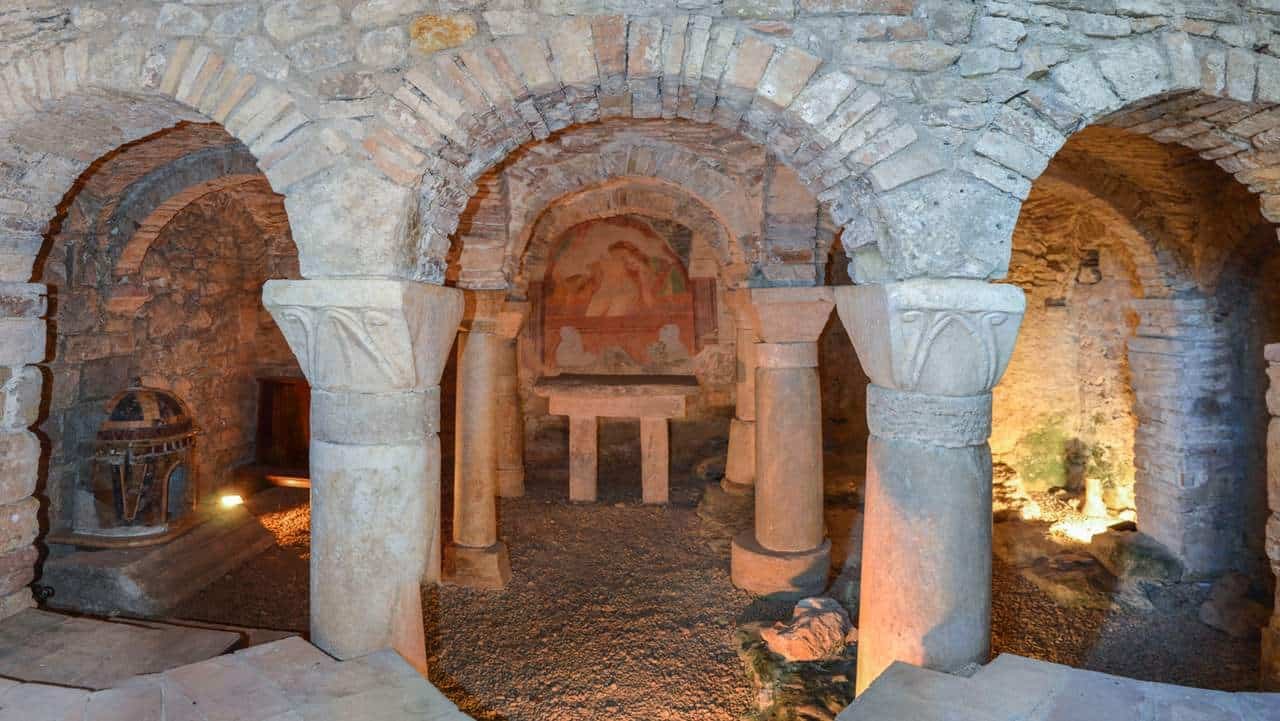
Some important events that happened here in history
A town of 800 inhabitants doesn't have a textbook chronology, but it has dates that carry weight, and lined up they tell a story longer than that of many cities. I separate them, as always, by degree of certainty.
Imperial era: the two villas
In the first century, between Augustus and the Flavians, the Sabine bank of the Tiber covers itself with villas. The one on the hill of San Pietro, with baths, exedra and cisterns, carries by tradition the name of Agrippa on the strength of an epigraphic fragment. The one at Fianello, of the Flavian era, was decorated with a collection of Greek and Roman sculptures. These are archaeological facts documented by excavations. Agrippa's ownership remains a learned hypothesis.
1105: San Pietro enters the registers of Farfa
On July 1, 1105, in a deed of the register of the abbey of Farfa, the church of San Pietro ad Muricentum is cited for the first time. It's the documentary birth certificate of Montebuono. The church, built around that date on the Roman mosaics, already existed: the document records it, it doesn't found it. The date of 1103 that some local sources attribute to a church of San Benedetto in the territory of Montebuono, in an era of dependence on the abbey, should be taken with caution because it finds no confirmation in the major sources.
Late 13th to early 14th century: the castle and Luca Savelli
Between the end of the 1200s and the first years of the 1300s the castle of Montebuono is founded, and the town takes on the fortified form you can still see. During the 14th century the castle is occupied by Luca Savelli, a member of one of the baronial families who shared the Sabina with the Orsini, and the Holy See forces him to return it. It's the episode that fixes Montebuono as land of the Church, a condition that will last until 1860.
1399-1400: the Bianchi and the Madonna dell'Oliva
On July 2, 1399, in Assisi, a child sees a white figure come out of an olive tree. From that vision the movement of the Bianchi is born, which in the autumn of 1399 crosses central Italy in procession toward Rome and the Jubilee of 1400. Montebuono keeps its painted memory on the inside of the front wall at San Pietro. It's not something that happened here in the strict sense, but it's here that you can see one of the rare depictions of it, and the Sabina was a land the processions passed through.
1451: the women of Montebuono have the apse frescoed
The inscription says it without ambiguity: in 1451 "le bone donne de Monte Bonu" pay Iacopo da Roccantica to paint the Last Judgment, the Saint Peter enthroned, the Nativity and the Annunciation in the apse of San Pietro. It's the most solid date in the whole history of the town and a rare case of documented collective female patronage in a rural center.
1571: the Orsini build the parish church of Fianello
In 1571 the Orsini, lords of Fianello, have the church of San Giovanni Battista built, after having enlarged the baronial palace over the course of the century with the arcaded loggia and the Renaissance portal. It's the moment of greatest weight for the hamlet, which from then on will only shrink.
1923 and 1927: from Perugia to Rome, from Rome to Rieti
In 1923 Montebuono passes from the province of Perugia to that of Rome. In 1927, with the creation of the province of Rieti, it enters the new district. Two bureaucratic dates that close centuries of Umbrian belonging.
April 13, 1944: the massacre at the hermitage of San Benedetto
Between April 12 and 14, 1944, German units carry out, in the mountainous area between the provinces of Terni and Rieti, Operation Osterei, "Easter eggs": a roundup against partisan formations, conducted also through terror on the civilian population. At dawn on April 13, at the hermitage of San Benedetto above Montebuono, a patrol of the 20th SS-Polizei Regiment surprises in their sleep eight American prisoners of war, one officer and seven noncommissioned officers, escaped from a train mistakenly hit by Allied aircraft and on their way to join the partisans. They are shot on the spot, accused of ties with the bands. Their names, as reported by the research of the Atlas of Nazi-Fascist Massacres, are Charles Dyda, Paul Valdes, Clarence Moody, Thomas Wodax, Robert Carnathan, Ben Espinosa, George Kerr and Robert Kavka, with spellings that vary slightly between sources. In the same roundup partisans fall on Monte San Pancrazio and civilians in Calvi dell'Umbria, on the other side of the regional border. It's the gravest event in Montebuono's history and the one the town remembers every year.
1950: the statues of Fianello
While opening the road to the Fianello cemetery, in 1950, the sculptures of the imperial era from the Flavian villa come to light: the Dancer, the Maenad, the Athena, the Attis-Eros, the Silenus, the athlete, the portraits of Aeschylus and Demosthenes. They head to the Museo Nazionale Romano.
1992-2000: the restoration of San Pietro
Between 1992 and 1998 the Soprintendenza ai beni monumentali del Lazio restores the architecture of San Pietro, removing the additions and bringing back to light, under the floor, the Roman mosaics and plasters, then protected by glass panels. Between 1998 and 2000 the frescoes of the apse and of the front wall are restored. It's the date on which Montebuono, silently, enters the map of Lazio's medieval art.
Who has passed through Montebuono (RI)
When writing about a small municipality you have to resist two opposite temptations, both dishonest. The first is inventing passing celebrities, attributing to the town illustrious visits never documented: it's a widespread vice and produces signs no historian would take seriously. The second is dismissing the place by saying nobody ever passed through, which is false by definition, because from a territory crossed for 3,000 years by roads, armies, monks and merchants, everything has passed. The truth is in the middle, and it's much more interesting than either simplification: through Montebuono have passed a few precise names and, around them, whole categories of people, and each has left a legible mark.
Marcus Vipsanius Agrippa and the Roman landowners
The first name is the one carved on the marble fragment of San Pietro: Marcus Vipsanius Agrippa. That he passed in person through this hill is tradition, not document. That his circle owned a bath villa here is a well-founded hypothesis. Around him, and after him, passed the Romans as landowners: the Sabina, once pacified, became one of the reference countrysides of the urban aristocracy, with rustic villas, farm estates, production facilities. The owner of the villa at Fianello, the one who collected portraits of Demosthenes and Aeschylus, was one of them. Olive growing here was encouraged precisely in that era, and the pressing and storage techniques described by the Latin agronomists, Cato, Varro, Columella, correspond in substance to what has continued to be done for 20 centuries. When you see a squared reused block in a wall of the town, that's the Romans' greeting to whoever passes today.
The Sabines and Horace
Even earlier, the Sabines. Before Rome existed as a power, this land was occupied by an Italic people speaking Oscan-Umbrian whom the Romans met, fought and finally absorbed. The legend of the rape of the Sabine women, which everyone remembers from school desks, is the mythical version of a real historical process of fusion between two neighboring communities. On Monte Cosce, above Fianello, Neolithic finds and remains of prehistoric stone industry have been collected: human presence is older than any name. Horace, who owned a villa in the Sabina given to him by Maecenas, left famous pages on country life in this region, and although his farm was elsewhere in the area, in the Licenza valley, the tone of those pages, the pleasure of measure, the flight from urban racket, the defense of a reduced scale of life, describes with surprising accuracy what people coming up here still look for today. Even Monte Soratte, "white with deep snow" in his ode, is the same one you see from San Pietro.
The Lombards and the monks of Farfa
The Lombards passed through, and their passage is not at all abstract. The duchy of Spoleto came to control a large part of this territory, and the Sabina became a zone of friction between the Lombard world and the Byzantine first, papal later. The pentagonal tower of Fianello, by tradition, is their sign. Then the group that left the deepest mark on the present face of the territory: the Benedictine monks. With the growth of the abbey of Farfa, the Sabina became one of the epicenters of monasticism in central Italy. The monks weren't only men of prayer: they were administrators, agronomists, jurists, archivists. They reclaimed land, brought it under cultivation, regulated relations with the peasants, and above all they wrote: without their register we wouldn't have the date of 1105. Among the figures linked to Farfa stands out the abbot Hugh, protagonist of the abbey's reforming season around the year 1000, the man who relaunched its patrimony and consolidated its power after a period of crisis. It's not a name from a school textbook, but his work conditioned for centuries the geography of the holdings and therefore the concrete life of small centers like this one.
The Bianchi of 1399 and Iacopo da Roccantica
The pilgrims passed through, in enormous numbers and for centuries, and among them, with name and date, the Bianchi of autumn 1399, on their way to the Jubilee. Those coming down toward Rome from the north had more options, and the routes crossing this part of Lazio along the Tiber were among the most traveled. The dense network of churches, hospitals and shelters found in the villages of the area is born of that flow, and Fianello, on the river, was a natural stop. Half a century later, with his brushes, passed Iacopo da Roccantica, a Sabine painter of the mid-15th century, called by the women of the town to paint the apse of San Pietro in 1451: the only artist whose signature is preserved in Montebuono, and it's a signature that also says who paid him.
The salt merchants, the shepherds and the barons
The salt merchants passed through and all the commercial traffic that gave meaning to Via Salaria. Salt from the Adriatic went inland and down toward Rome, and with the salt traveled wool, livestock, timber, foodstuffs. The Sabina was never a closed land: it was a land of transit crossed by long-range economies, and this explains why in such small towns you find buildings of a dignity higher than local agriculture alone could have sustained. The transhumance shepherds passed through: the grassy routes connecting the mountains of the central Apennines to the coastal plains crossed this sector of Lazio, and for centuries the calendar of these territories was marked by the seasonal passages of the flocks. Transhumance left a legacy still felt in the cuisine, the sheep cheeses, the ricotta, the pairings with new oil, and in the structure of certain tracks used today as trails without knowing they were originally highways for animals. The baronial families of the Papal States passed through, and here by name: the Savelli, with Luca occupying the castle in the 14th century, and the Orsini, lords of Fianello, who in the 16th century built the parish church there and enlarged the palace. Their presence didn't produce lavish residences as in the Castelli Romani, but it affected the structure of land ownership in a deep and lasting way.
The armies, the eight Americans and the emigrants
The armies passed through, more than once: from the Gothic wars to the medieval raids, from the Napoleonic campaigns to the Risorgimento movements. And there passed, to stop here forever, the eight American prisoners shot at the hermitage of San Benedetto on April 13, 1944: Carnathan, Dyda, Espinosa, Kavka, Kerr, Moody, Valdes, Wodax. They had escaped from a train hit by their own planes and were looking for the partisans. A patrol of the SS-Polizei found them. Local memories of that period, handed down orally more than in writing, tell of evacuations, requisitions, improvised refuges in the countryside, and are a heritage at risk of being lost with the last generations who lived it. Finally the emigrants passed through, and this is the most recent and most painful passage. From the end of the 19th century and for much of the 20th, the inland Sabina exported labor: to Rome, to the industrial north, to the Americas and Europe. Every family in these towns has a branch elsewhere. The closed houses you meet in the historic centers aren't ruins: they belong to people who live far away and who come back for a week in summer or for a relative's funeral.
The newcomers to Montebuono
And in recent decades, to stay, the newcomers have passed through: Romans who bought a farmhouse, foreigners, English, German, northern Europeans, who chose the Sabina for the combination of affordable prices, closeness to Rome and scenic quality, young farmers who recovered abandoned olive groves betting on organic certification and direct sales. It's a flow running against depopulation, quantitatively still modest but culturally significant, slowly changing the social fabric of towns like this one. If you hear English in a Sabine café, you're not watching a tourist phenomenon: you're watching a residential one. Anyone who wants to follow this story of passages across the whole area can build an itinerary touching the key places: Farfa for the monastic world, Fara in Sabina for the panoramic reading of the territory, Torri in Sabina and Poggio Catino for the system of castles, and Montebuono to understand what remains when big history withdraws and leaves the stage to the people. For a corporate group or a day outside Rome organized with a guide, the team building service of TourLeaderPro also works on itineraries in the Sabina.
Montebuono with kids, accessibility and costs
With kids Montebuono works better than you'd think, as long as you pick the right pieces. The village can be walked in half an hour and has small stairways, arches and underpasses that little ones like. San Pietro, with the glass floor over the Roman mosaics and Iacopo da Roccantica's Hell full of devils and greedy people swallowing gold, is among the churches best suited to children, because it tells stories with pictures. Fianello with its tower and ruined palace is an adventure, but it requires care: no going into buildings at risk of collapse. The hermitage of San Benedetto is for kids already used to walking. Strollers: in the village they work badly because of the steps, a baby carrier is better.
Accessibility: the historic center, with slopes and uneven paving, is tiring in a wheelchair, although Via Garibaldi can be done with a companion. San Pietro is flagged by the FAI as an accessible place and the restored floor is flat. The cost of the day is almost zero: there are no tickets either for the village or for the church, where it's good manners to leave an offering for the committee that looks after it. The only real expense, and a well-spent one, is the oil.
What to eat in Montebuono and what's around
The cuisine is that of the lower Sabina: Sabina DOP oil on everything, unsalted bread, legumes, pecorino and sheep ricotta inherited from transhumance, local meats and, a curiosity of the area, buffalo cheeses produced by farms in the zone. In autumn the bruschetta with new oil, bitter and peppery as it should be, is worth the trip on its own. Places to eat in town are few: if you want to sit down at a table, call ahead or move 10 minutes toward the nearby centers.
Within half an hour's radius are Torri in Sabina with its Roman forum of Forum Novum, Casperia, Roccantica, Poggio Mirteto, and on the other side of the Tiber Monte Soratte with the Nazzano Tevere-Farfa reserve. The Abbey of Farfa is less than an hour away. To the north, beyond the border, Otricoli with its Roman city and Narni: the old Umbria of Montebuono. If you read English, you'll find a good picture of the abbey and Sabine oil in the ItalyPlanner guide to Farfa.
Quick questions about Montebuono (RI)
Where is Montebuono (RI)?
In the lower Sabina, in the province of Rieti, at 325 meters on the slopes of Monte San Benedetto, a few kilometers from the border with Umbria and from the Tiber valley.
How far is Montebuono from Rome?
Between 65 and 70 kilometers depending on the route. A little over an hour by car on the A1 with the exit at Ponzano Romano-Soratte or Magliano Sabina. From Rieti it's about 48 kilometers.
How do you get to Montebuono without a car?
By regional train Rome-Orte to Stimigliano or Poggio Mirteto and then on the provincial Cotral line that goes up to Montebuono. Runs are few and should be checked on the Cotral site. The comfortable solution remains a car or a private tour with a guide.
How much does it cost to visit Montebuono?
Nothing: the village, Fianello and the church of San Pietro have no ticket. At San Pietro an offering for the committee that looks after it is appreciated.
How much time do you need for Montebuono?
Half a day for the village, San Pietro and Fianello. A full day if you add the hermitage of San Benedetto or a stop at an olive mill and a second Sabine village.
When is the church of San Pietro ad Muricentum open?
There's no fixed published schedule: it opens for services, concerts and exhibitions and by appointment. It's best to contact the Comune (0765 607631) or the parish before leaving.
What's special about the church of San Pietro in Montebuono?
It's built over a Roman villa attributed by tradition to Agrippa, with the mosaics visible under a glass floor, and it keeps the apse frescoed in 1451 by Iacopo da Roccantica with a Last Judgment, as well as the Madonna dell'Oliva recalling the Bianchi of 1399.
Who was Iacopo da Roccantica?
A 15th-century Sabine painter, originally from Roccantica, who signed and dated to 1451 the frescoes of the apse of San Pietro, commissioned by the women of Montebuono.
What is Fianello?
The medieval hamlet of Montebuono, at 193 meters on a terrace of the Tiber, with the Orsini baronial palace in a state of decay, a pentagonal tower attributed to the Lombards, the parish church of 1571 and the remains of a Roman villa from which statues now in the Museo Nazionale Romano came out in 1950.
What happened at the hermitage of San Benedetto in Montebuono?
On April 13, 1944, during the German roundup called Operation Osterei, eight American prisoners of war who had escaped from a train were surprised in their sleep and shot by the SS-Polizei.
Is Montebuono suitable for kids?
Yes: the village is small and safe, and the frescoes of San Pietro with Hell and the devils are among the most "tellable" in Lazio. The steps make a stroller awkward. Fianello should be visited without going into buildings at risk of collapse.
Can Montebuono be visited in a wheelchair?
With difficulty in the historic center, because of slopes and paving. The church of San Pietro is flagged by the FAI as an accessible place.
Can you take photos inside San Pietro ad Muricentum?
As a rule yes, without flash and with respect for services. For professional shooting you need to ask permission from the committee that manages the church.
Where do you park in Montebuono?
In the free spaces at the entrance to the town and along the main road. The center is walked on foot. In Fianello there are no equipped parking lots: leave the car at the edge without blocking anything.
What is the best time to visit Montebuono?
Between late October and early December, during the olive harvest. Otherwise April and May. In summer, only early morning and sunset.
What oil is produced in Montebuono?
Sabina DOP extra virgin olive oil: Montebuono is in the production zone of the production code, with cultivars such as Carboncella, Leccino, Raja, Frantoio, Moraiolo and Rosciola, maximum acidity 0.6 and a medium-light fruitiness.
Where do you buy oil in Montebuono?
Directly from the producers and olive mills of the area, asking for vintage and cultivar. The price is higher than in large-scale retail because the harvest is largely manual on terraced land.
Who is the patron saint of Montebuono?
San Vincenzo Ferreri, celebrated on April 3.
How many inhabitants does Montebuono have?
A little over 800: 811 residents as of January 1, 2024 according to the data reported for the municipality.
Is Montebuono in Lazio or Umbria?
Today in Lazio, province of Rieti. Until 1923 it belonged to the province of Perugia and passed to Rieti in 1927.
What's the difference between Montebuono and Casperia or Roccantica?
Casperia is the perfectly preserved, pedestrian spiral village, Roccantica the fortress town leaning on the mountain. Montebuono is the country town with the frescoed church outside the walls and the medieval hamlet on the Tiber. Together they make a full day.
What is there to see near Montebuono?
Torri in Sabina and Forum Novum, Casperia, Roccantica, Poggio Mirteto, the Abbey of Farfa, Monte Soratte and the Nazzano Tevere-Farfa reserve, and beyond the border Otricoli and Narni.
One last thing: if you have just one phone call to make before leaving, make it for San Pietro. The village can be seen anyway, the olive trees are always there, Fianello waits. But finding that church open, with the afternoon light coming in on the apse of Iacopo da Roccantica and the Roman mosaics under your feet, turns a nice outing into a day you tell about for years. Montebuono makes no noise: it works on a delay, and when the memory comes back, two weeks later in the city, the only sensible answer is to look at the calendar and decide when to return.
Article written by the editorial team of TourLeaderPro, contact them for Private/Corporate/V.I.P. Tours and Experiences.
Planning a trip to Rome? The English guides to visiting the city are on ItalyPlanner.com.