Monte Soratte (RM)
In short. Monte Soratte rises isolated in the middle Tiber valley, in the territory of the municipality of Sant'Oreste (RM), about 45 kilometers north of Rome.
Monte Soratte rises isolated in the middle Tiber valley, in the territory of the municipality of Sant'Oreste (RM), about 45 kilometers north of Rome. Reference address for the Nature Reserve: 00060 Sant'Oreste (RM), with access to the trails from the center of the village, in particular from the information office in Piazza Italia. You get there mostly by car: from the capital take Via Flaminia (SS3) and exit at Sant'Oreste, for a trip of a little under an hour. Public transport is provided by the Cotral buses that run along the Flaminia from Rome. Updated schedules and stops should be checked on the carrier's official website before leaving, because weekday and holiday runs change over the course of the year. The mountain and its reserve are free and open to all: you don't pay a ticket to go up to the trails or to the hermitage of San Silvestro. The tunnels and the bunker on the south slope, on the other hand, can only be visited by reservation, with openings scheduled by the volunteer association that manages the site together with the municipality. If you want to walk all the way to the top, wear hiking shoes: the elevation gain is modest but the ground is stony.
This guide is part of the collection of nature reserves of Lazio of estateromana.com, and it is for those who want to really understand what Monte Soratte is before going there: a limestone massif that the Romans called sacred, a village with 12 centuries of history at its feet, a labyrinth of tunnels that hosted a German field marshal and, later, the survival plan of the Italian State.
Where Monte Soratte (RM) is and how to get there
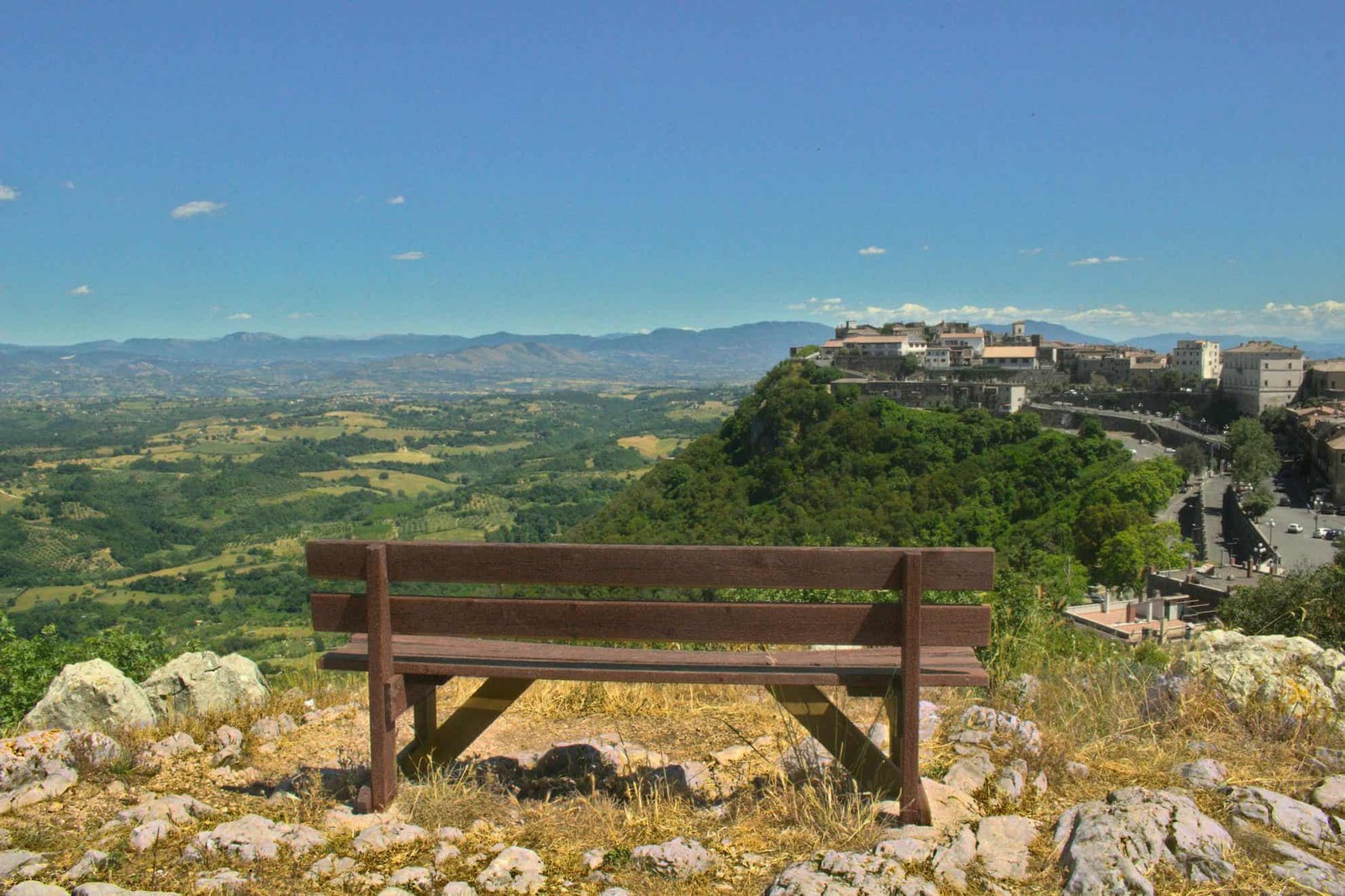
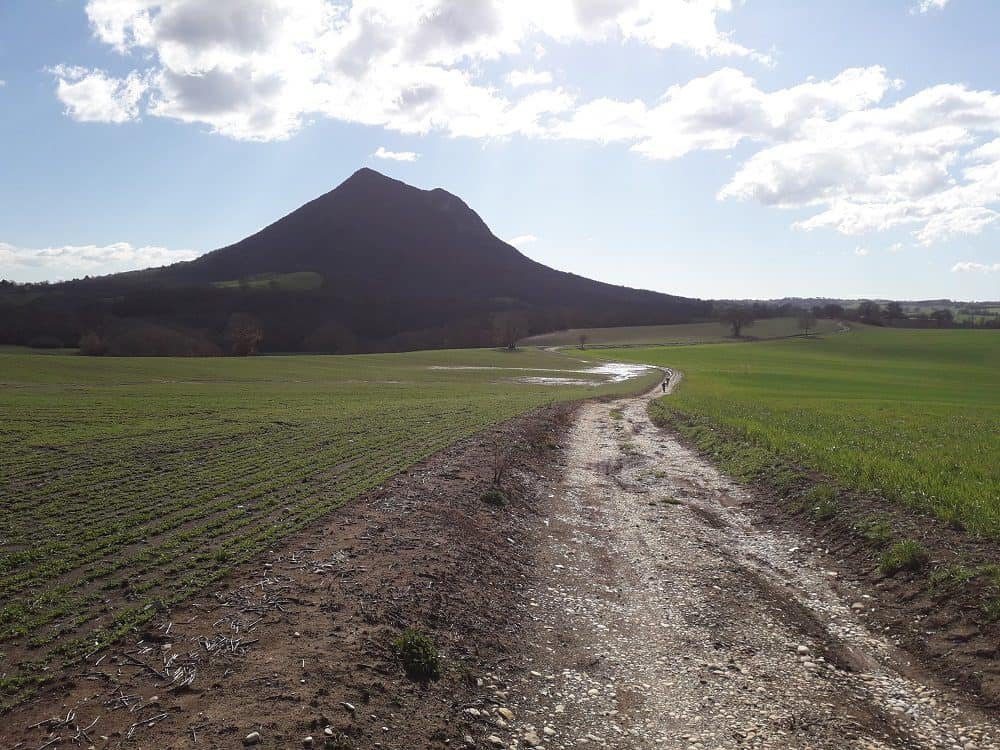
Monte Soratte rises in northern Lazio, on the right side of the Tiber, in a countryside of olive groves and small ditches that slopes gently toward the river. Administratively it belongs to the municipality of Sant'Oreste, in the province of Rome, but its elongated outline can be seen from very far away. Anyone traveling on the Flaminia or on the Autostrada del Sole recognizes it at once, a back of pale rock that breaks the flat horizon of the valley. It is this geographic solitude that explains almost everything else in its story, from the ancient cult to the military bunker.
How to reach Monte Soratte (RM) by car
The most convenient route remains Via Flaminia (SS3) heading north, with the exit toward Sant'Oreste. From the Grande Raccordo Anulare count about 45 kilometers and, traffic permitting, a little under an hour. The village of Sant'Oreste is perched at about 400 meters above sea level on one of the six peaks of the massif, so the last stretch is all hairpin bends. In the village you park near Piazza Italia, where the information office is located, from which almost all the trails of the reserve start.
Monte Soratte (RM) by public transport
By public transport it is less straightforward. Cotral buses connect Sant'Oreste to Rome along the Flaminia, with a terminus at the Saxa Rubra hub on the suburban transport line. It's best to check runs and connections on the official Cotral website, because weekday schedules are more frequent than holiday ones and not all runs go up to the historic center. The nearest railway station is that of the Roma Nord line toward Civita Castellana, but it remains far from the village and is poorly suited to those who arrive to walk. For Soratte, in short, the car is by far the most practical solution.
What Monte Soratte (RM) is: geography of an isolated massif
Monte Soratte is an isolated limestone massif, a relief that is not part of any chain and stands out precisely because it remains alone in the middle of the plain. With its 691 meters of maximum height it is more an important hill than a true mountain, and yet from the summit the gaze runs very far. On clear days you can make out Terminillo to the northeast, the bulk of Amiata toward Tuscany, the mirror of Lake Bracciano to the west and, beyond, the line of the Tyrrhenian Sea. This 360-degree view is the reason the mountain has been for millennia a point of reference, a natural altar and, in the 20th century, a military objective.
The six peaks and the shape of Monte Soratte (RM)
Seen from above, the massif has an ellipsoid plan: the major axis extends for about 5.5 kilometers in a north-northwest to south-southeast direction, along an arched profile made up of six aligned peaks. On one of these, at about 400 meters of altitude, the village of Sant'Oreste clings. The walls are steep and bare near the ridge, while lower down the slopes soften and are covered with dense woods. The practical consequence for walkers is clear: from the village several trails climb to the ridge and let you cross the mountain lengthwise, on both flanks. Given the steepness of the rock walls, however, there are no routes that cut across it from one slope to the other.
The Meri: the karst chasms of Monte Soratte (RM)
The strongest geological curiosity of Soratte is the Meri, three large chasms of karst origin that open at the eastern base of the mountain. They are natural shafts communicating with each other, about 115 meters deep altogether, and they have always attracted cavers. The most imposing, the Mero Grande, is a vertical shaft about 20 meters wide at the mouth that plunges for tens of meters into the dark. Inside one of these sinkholes, in the Neolithic age, a small four-handled vase was placed, in all likelihood to collect the water that dripped from a stalactite: a ritual gesture that says how ancient the sacred fame of this place is. The Meri are not to be approached lightly: they are dangerous cavities, and the Santa Romana Trail that brings you close to them should be done with caution.
The rock, the slopes and the farming landscape
The body of the mountain is compact limestone, which explains both the vertical walls of the ridge and the karst of the Meri: water, meeting the limestone, carves and bores it over millennia. At the foot of the relief the countryside is cultivated mostly with olive groves, interspersed with many ditches that descend toward the Tiber. This contrast, the pale rock above and the silvery green of the olive trees below, is the visual signature of Soratte and one of the reasons the mountain has been painted, sung and photographed so many times.
The trails of Monte Soratte (RM): all the routes of the Reserve
The Nature Reserve has a network of numbered trails that almost all start from the center of Sant'Oreste. They are short routes, suitable for half a day, with contained elevation gains but a stony surface. The official indications of the reserve describe them this way. If you have little time, choose a single loop. If you have a whole day, you can link two or three.
Percorso Vita and Percorso delle Carbonaie
The Percorso Vita is the easiest: about 45 minutes, negligible elevation gain, it starts from the municipal information office in Piazza Italia and is designed as a walk within reach of everyone. From it, after about 20 minutes of walking, the Percorso delle Carbonaie branches off, of medium difficulty, which in about an hour climbs from 430 to 641 meters. The name recalls the old clearings where charcoal was made, a trade that marked the economy of the woods for centuries.
Percorso Casaccia dei Ladri and Percorso delle Grotte
The Percorso Casaccia dei Ladri, of medium difficulty, lasts about 45 minutes and climbs from 430 to 660 meters following the signs you meet along the Percorso Vita. From here, for the fitter hikers, you continue with the Percorso delle Grotte, the most demanding of the reserve: about 60 minutes, high difficulty, between 660 and 690 meters, with exposed parts that call for a sure step and no hurry.
The Percorso degli Eremi of Monte Soratte (RM)
If I had to point to a single itinerary, it would be this one. The Percorso degli Eremi starts from the information office in Piazza Italia and in about 90 minutes climbs from 400 meters up to the 692 meters of the summit, with medium difficulty. Along the climb you touch the places of worship that made the sacred fame of the mountain and arrive at the hermitage of San Silvestro at the top, from where you enjoy the widest view. It is the best way to understand Soratte in one morning: history, nature and view all at once.
Percorso di Santa Romana and the Meri
The Percorso di Santa Romana connects the hermitage of the same name to the Meri area: about 45 minutes, medium difficulty, with a particular profile because it descends from 416 meters toward the 200 meters of the eastern base. It leads right up to the karst chasms and to the rock hermitage of Santa Romana, one of the most solitary corners of the mountain. Given the proximity to the sinkholes, it is a route where you don't improvise: you stay on the marked paths.
Flora and fauna of Monte Soratte (RM)
The vegetation of Soratte changes with the slope and the exposure, and this makes it surprisingly varied for such a small relief. Woodland and scrub formations prevail, but the type of wood changes when passing from the cool side to the warm one.
The woods of Monte Soratte (RM)
On the northeast slope, cooler and damper, the broadleaf trees that lose their leaves in winter dominate: the hop hornbeam (Ostrya carpinifolia), the manna ash (Fraxinus ornus) and the Montpellier maple (Acer monspessulanus), mixed with evergreens like the holm oak (Quercus ilex). On the slope exposed to the southeast, warm and sunny, a thermophilous scrub close to the Mediterranean maquis takes over instead, with holm oak, Montpellier maple, terebinth (Pistacia terebinthus) and mock privet (Phillyrea latifolia). On Soratte itself a rare plant community of this type was described for the first time: a small botanical record that specialists know well and visitors almost never.
The animals of Monte Soratte (RM)
The woods of Soratte still host a rich fauna. Among the mammals you meet the fox, the squirrel and the hazel dormouse, the small rodent of the hazel groves. Among the insectivores live the hedgehog, the mole and several species of shrews. The birdlife is the most conspicuous chapter: the forest areas give shelter to resident, passing and migratory birds, and among the birds of prey you can see the buzzard, the kestrel, the tawny owl, the little owl, the green woodpecker and the great spotted woodpecker, as well as many species of passerines. If you go up at dawn, with binoculars, you have a good chance of seeing a raptor hunting above the ridge.
The hermitages and places of worship of Monte Soratte (RM)
The religious vocation of Soratte is very ancient and it is not a folkloric detail: it is the key to the mountain. Since before Rome the relief was a place of worship for the peoples of the area, the Sabines, the Capenates, the Faliscans, the Etruscans. The Romans worshipped Soranus there, soon identified with Apollo. With the arrival of Christianity the mountain became a destination for hermits in search of silence, and still today it keeps the remains of six settlements of a religious character, some used during the feasts of Santa Lucia, Santa Romana and the Madonna of May.
The hermitage of San Silvestro at the top of Monte Soratte (RM)
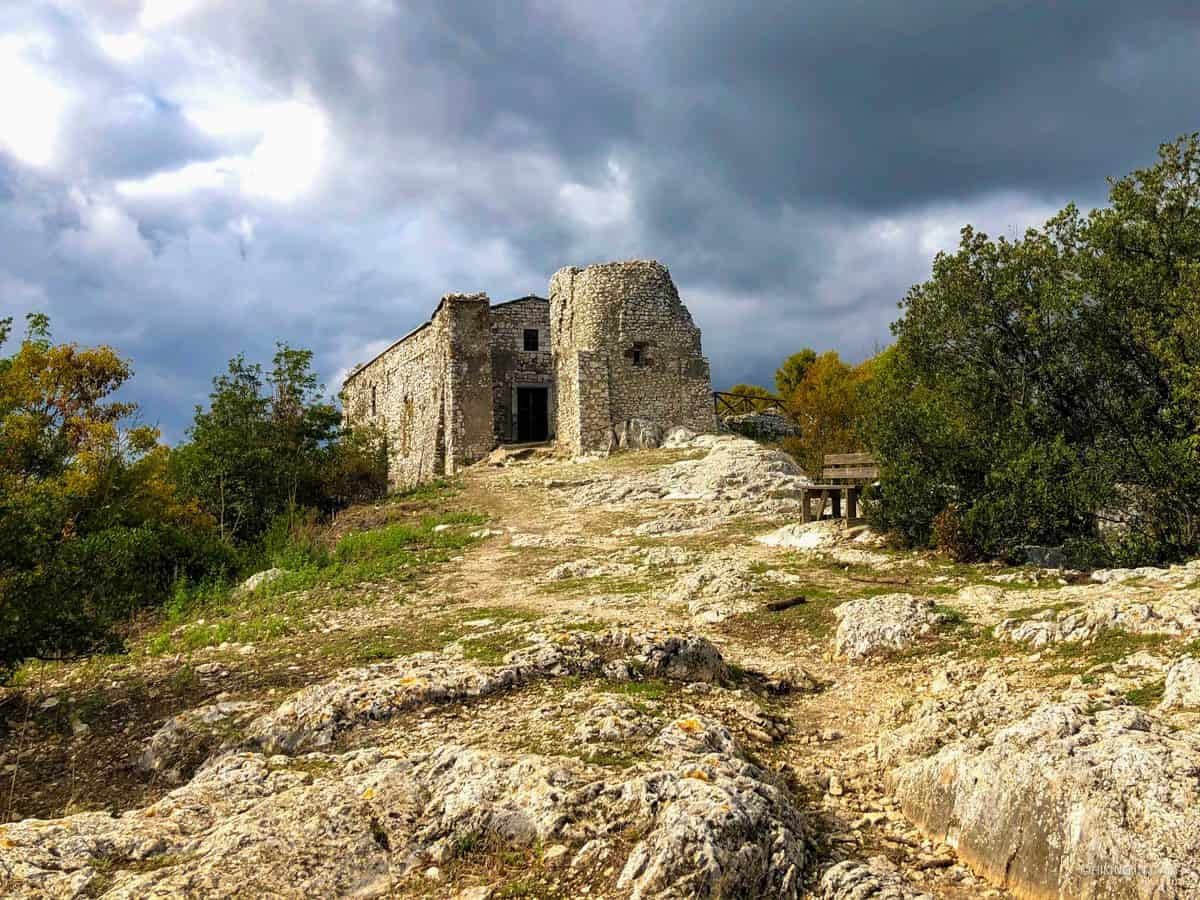
On the summit stands the hermitage of San Silvestro, the most famous place on the mountain. The construction goes back in all likelihood to the 6th century and is set on the remains of an ancient temple of Apollo, according to a typical mechanism: the new cult occupies the sacred place of the old one. A tradition moves the foundation back by three centuries and attributes it to Pope Sylvester I, who took refuge on Soratte to escape persecution. Right here he is said to have had the well-known vision of the dragon, which some link to the cult of the archangel Michael venerated on the nearby Monte Tancia. Inside, frescoes of the 14th and 15th centuries are kept, the subject over the years of studies and restoration work. You get there on foot with the Percorso degli Eremi: the effort is repaid by the widest view of the whole Tiber valley.
The church of Santa Maria delle Grazie and the monastery
Just below the summit are the church of Santa Maria delle Grazie and the adjoining monastery, built in 1835 over an earlier 16th-century building. The rooms have been extensively restored and offer board and lodging to those looking for a stay in silence. The church holds a fresco of the Blessed Virgin that in the 16th century was the object of great veneration.
The other rock hermitages of Monte Soratte (RM)
Besides San Silvestro, four other hermitages are counted on the mountain: Sant'Antonio, Santa Lucia, San Sebastiano and Santa Romana. They are in a state of abandonment, but they keep the typical features of rock hermit architecture, with spaces dug out of or built against the rock. The one of Santa Romana, in particular, is a small isolated rock church that strikes those who reach it with its secluded position. They are fragile testimonies: look at them with respect, without forcing collapses or passages.
The ancient cult: Soranus, Apollo and the Hirpi Sorani
Before the hermits, Soratte was the mountain of the god Soranus, a chthonic deity later assimilated to Apollo and sometimes to Dis Pater, the lord of the underworld. Pliny the Elder tells that the cult was celebrated by the families of the Hirpi Sorani, the wolves of Soranus, who in honor of the god walked barefoot over burning coals. For this rite, according to Pliny, a decree of the Senate had exempted them from military service and other obligations. Virgil too, in the Aeneid, puts into the mouth of the warrior Arruns an invocation to Apollo, guardian of holy Soracte, and recalls the practice of walking on fire. These are reports handed down by ancient sources: we relay them as they relay them, between history and tradition.
The tunnels and the bunker of Monte Soratte (RM)
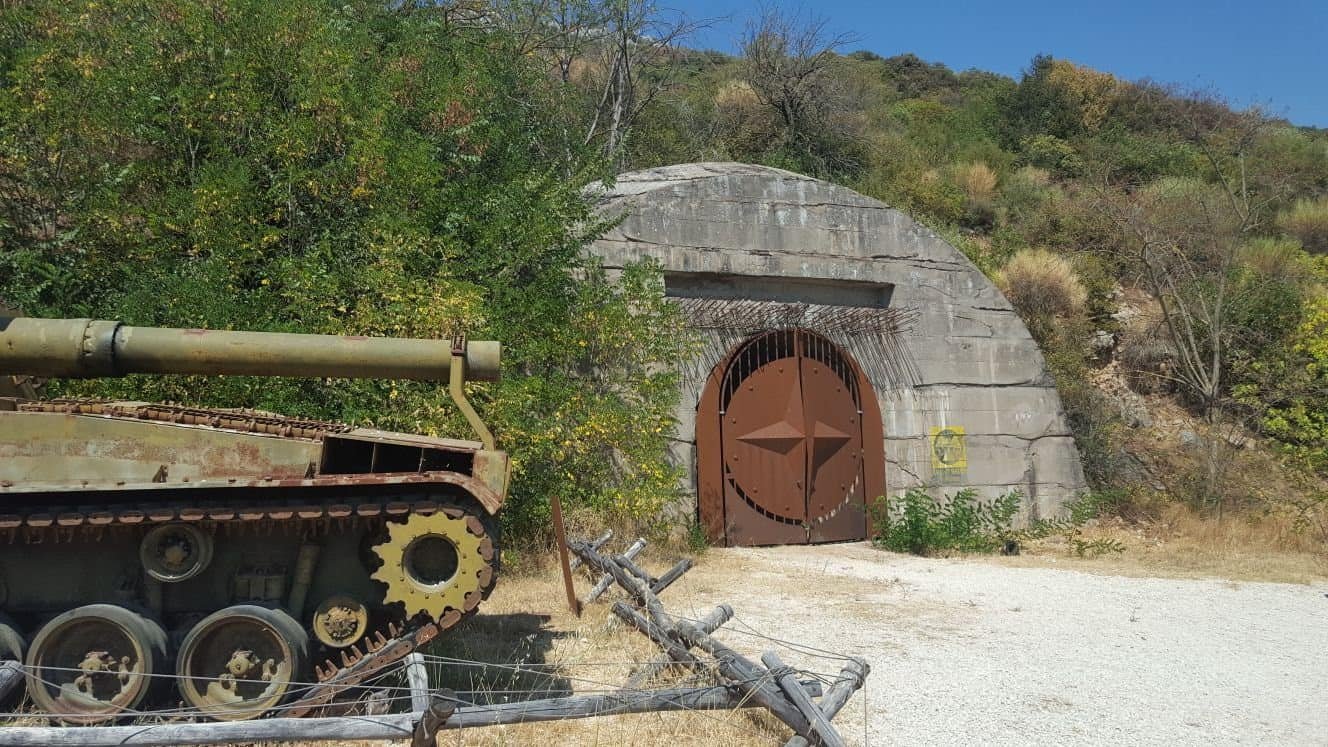
The south slope of the mountain hides one of the most impressive 20th-century stories in Lazio: a maze of tunnels dug into the limestone rock, over four kilometers long, born as a military shelter and in sequence becoming a German headquarters, a powder magazine, a nuclear bunker and finally a museum. Today it is the heart of the Percorso della Memoria.
The construction of the tunnels of Monte Soratte (RM)
Toward the end of the 1930s, under the direction of the military engineers, work began on digging a complex of tunnels intended to house the supreme command of the army in case of war, taking advantage of Soratte's closeness to the capital and the natural protection of the rock. The lot actually built exceeded four kilometers in length. It was a very hard construction site, with a large workforce and at least one worker killed in an accident during the excavations. The precise dates of the start vary in the different reconstructions, and whoever wants the detail will find it in the site's official documentation.
Kesselring's headquarters (1943-1944)
After the armistice of September 1943 the tunnels were occupied by the Wehrmacht. Field Marshal Albert Kesselring installed there the supreme command of the German occupation forces in Italy, the Oberbefehlshaber Südwest, making it his operational residence. The bunker remained the hub of the German command for decisive months. On May 12, 1944 it was heavily bombed by formations of B-17 flying fortresses departing from southern Italy. The deepest part of the underground complex held perfectly, and the structure ensured the continuity of command at least until June 4, 1944, when the fleeing Germans mined it and set it on fire.
The Cold War nuclear bunker
In the postwar period the story continues. Between 1952 and 1962 the tunnels were used as an Army powder magazine. Then, in the 1960s, the deepest part was turned into a nuclear shelter designed to receive the top of the State, the Presidency of the Council and the President of the Republic in case of a thermonuclear attack on Rome. The structure was tested and hosted important exercises within NATO, but it never entered operational service. Between 1993 and 2003 further projects were started by the Presidency of the Council, never completed. The exact dates of the works on the nuclear bunker differ across sources: here we stay with the frame of the decade, and for the detail we refer to the documentation of the body.
The Percorso della Memoria and the guided visits
The entire former military zone, about 44 hectares on the south slope, has been reacquired by the Municipality of Sant'Oreste and turned into a diffuse museum of a historical character called Percorso della Memoria. The tunnels, closed for years, can now be partially visited thanks to the work of a volunteer association that looks after their conservation and organizes the openings. Visits are by reservation, with a calendar that changes from season to season. If you want to go in, check the dates with the Municipality of Sant'Oreste and with the association that manages the site, through their official channels. In recent years internal accessibility has been expanded, making reachable stretches of tunnel previously excluded. Bring a jacket even in summer: under the rock the temperature stays low all year.
The legend of the gold of Monte Soratte (RM)
Around the bunker a tenacious legend has circulated for decades: that Kesselring had had tens of tons of Italian gold hidden in the tunnels, taken away at the time of the retreat. No trace of it has ever been found, and the story remains precisely a legend, one of those that feed the imagination of a place already mysterious in itself. We tell it for what it is, not as an established fact.
Sant'Oreste: the village at the foot of Monte Soratte (RM)
You can't understand Soratte without going up to Sant'Oreste, the village clinging to the side of the mountain at about 400 meters above sea level. It is a village of medieval origin, with a fortified layout, ancient churches, noble palaces and squares with curious names. You get there by the same road as the mountain and it is worth walking it before or after the hike.
The collegiate church of San Lorenzo martire
The parish church, the collegiate church of San Lorenzo martire, was built starting in 1568 from an original design by Vignola, at the wish of Cardinal Alessandro Farnese, replacing a smaller Romanesque church of the 12th-13th century, of which the bell tower with travertine mullioned windows is preserved. In 1745 it was enlarged by eliminating the 16th-century apse. The facade is articulated in two orders by means of pilasters with Doric capitals. The entablature of the first order supports a central pediment above the portal, while higher up there are connecting elements with lateral volutes. The interior has a single nave, covered by a lunetted barrel vault, with side chapels. Notable works are kept there: the 18th-century altarpiece of the high altar with the Martyrdom of Saint Lawrence, by the painter Ceccherini. A canvas with the Madonna of the Rosary made on the occasion of the battle of Lepanto. A 16th-century gilded wooden pulpit. And an organ of 1638 on the inner facade, the work of the organ builders of the Bonifazi family.
The other churches of Sant'Oreste
The historic center keeps other churches: San Biagio, San Nicola, Santa Croce and the oratory of the Madonnella. Outside the center, near the cemetery, stands the church of Sant'Edisto, linked to the saint who gave the village its name. A short distance away is Santa Maria Hospitalis. On the mountain, finally, remains the abbey of San Silvestro, which ideally closes the link between the village and the sacred summit.
Palaces, gates and historic squares
Among the civic architecture, the Palazzo Caccia, the former abbey palace that was the administrative center of the fief, and the Palazzo Rosati stand out. Of the fortified enclosure three gates remain, each with a double name: Porta Valle or Porta San Silvestro, Porta Costa or Porta Santa Maria, Porta la Dentro or Porta Sant'Edisto. The squares tell the story of the village better than a plaque: Piazza Principe di Piemonte, Piazza Orazio Moroni, Piazza Vittorio Emanuele, which the old documents called platea Communis, and Piazza Carlo Alberto, known to the people of Sant'Oreste as the square of the Goats or the square of the Palisade. Walking among these squares is the best way to read the overlapping centuries of the village.
The history of Monte Soratte (RM) and Sant'Oreste
The story of Soratte is as long as few others, and it intertwines with that of Rome from prehistory to today. It is worth retracing it by major eras, because every stone of the mountain and the village bears the mark of a passage.
Ancient age: Capenates, Faliscans and the sacred mountain
The territory has yielded prehistoric finds, including the small Neolithic four-handled vase placed in the Meri. Before the Roman conquest Sant'Oreste belonged to the territory of the Capenates (the ager Capenas), an Italic people that prospered in Lazio before the rise of Rome. They had a language of their own, similar to Latin and related to Etruscan, with Sabine influences, and their territory included the present municipalities of Capena, Civitella San Paolo, Morlupo, Fiano, Nazzano, Ponzano, Filacciano, Torrita, Rignano, Sant'Oreste, Castelnuovo di Porto and Riano. On the mountain these peoples worshipped the god Soranus, later identified with Apollo or with Dis Pater. The Faliscans and Capenates, allies of Etruscan Veii, were overwhelmed by the fall of the city in 396 BC. In 387 BC the Capenate territory was assigned to the Stellatina tribe and the capital Capena, not destroyed, became an important federated Roman municipality. In 241 BC the Faliscan capital of Falerii Veteres was razed to the ground after the revolt during the First Punic War. Afterwards the countryside filled with Roman villas: the remains of one of these, with a bath complex, frescoes and mosaic floors, were found in the Giardino area in Sant'Oreste.
Soratte is the sacred mountain sung by the Latin poets. Horace immortalizes it in the ninth ode of the first book, the one that begins: "Vides ut alta stet nive candidum / Soracte, nec iam sustineant onus / silvae laborantes, geluque / flumina constiterint acuto?". The summit white with snow, the woods bent by frost, the rivers hardened: it is one of the most famous winter images in ancient poetry, and its protagonist is this very mountain. Dante too cites it, in the 27th canto of the Inferno, evoking the legend of Sylvester and Constantine: "But as Constantine asked Sylvester / within Siratti to cure him of leprosy, / so this man asked me as a master".
Medieval age: hermits, Carloman and the castrum
According to a legend reported in the 5th century by the Actus Silvestri, Pope Sylvester I took refuge on Soratte to escape persecution. In memory of the episode, the monastery dedicated to the holy pontiff was founded on the summit, probably in the 6th century. In the first half of the 6th century Saint Nonnosus is said to have been a monk there, of whom Gregory the Great tells three miracles. The most striking moment comes in 746, when Carloman, brother of Pepin the Short, after abdicating the office of mayor of the palace withdrew right here, obtaining the monastery as a gift from Pope Zachary. The following year he moved to Montecassino and the monastery returned to the pope. Tradition also attributes to Carloman the foundation of the monastery of Santo Stefano at Mariano, at the foot of the mountain, and of Sant'Andrea in flumine near Ponzano. Among the possessions given to the monastery of San Silvestro, the Chronicon of the monk Benedict mentions a curtem Sancti Heristi, from the name of Saint Edistus, or Aristus, martyr under Nero on Via Laurentina. From that name, changing over the centuries, the present Sant'Oreste derives.
The village was born as Castrum Sancti Edsti around 747 and was fortified between the 10th and 11th centuries. Monte Soratte cum oppidis suis, with its fortified centers, appears in the 964 concession to the emperor Otto I by Pope Leo VIII. In 1074, under Gregory VII, the castles of Sant'Edistio, San Silvestro and Sant'Andrea in flumine passed to the abbey of San Paolo fuori le mura. In 1286 Pope Honorius IV made them a commendam and entrusted them to the bishop of Ancona, Pietro Capocci. In 1290 Sant'Edistio is cited as a castrum, a castle with walls, part of a defensive system with the castles of Versano and Ramiano. In the middle of the 14th century the fief belonged to the Savelli. In 1443 the castles of Sant'Oreste and Ponzano, with the monasteries of San Silvestro and Sant'Andrea, were assigned as a fief to the abbot of San Paolo fuori le mura by Pope Eugene IV.
Modern age: the Farnese, the commendam and the 19th century
In 1523 local tradition remembers a border dispute with Civita Castellana, whose inhabitants are said to have laid siege to the village without managing to take it. In 1528 the blessed Paolo Giustiniani died in the monastery of San Silvestro, a Camaldolese and founder of the congregation of the Camaldolese Hermits of Monte Corona. The turning point comes in 1546, when Pope Paul III united the fiefs of Sant'Oreste and Ponzano, with the monasteries of San Silvestro and Sant'Andrea, to the abbey of Tre Fontane, forming a single commendam and entrusting it to his namesake nephew, Cardinal Alessandro Farnese, abbot of Tre Fontane. Under the Farnese the village saw strong urban development: churches and palaces were built or restored, including the abbey Palace, and the walls were renovated in 1554. In 1576 Alessandro Farnese had a Statute of the community drawn up, a probable revision of older customs. The commendatory cardinal exercised the feudal rights and appointed a podestà, a vice-count, three priors, a chamberlain and a chancellor, while a general council and an ordinary one of 40 members represented the community.
In 1661 some relics of Saint Nonnosus were donated by the bishop of Freising, in Bavaria, where the saint's body had been translated in the 11th century. In 1676 Nonnosus was proclaimed patron of the village. In 1798 the citizens of Sant'Oreste joined the Roman Republic. The abolition of feudal rights, decreed with the Napoleonic occupation of 1809-1814, was confirmed by the restored papal government: from 1817 the municipality was subject to the government of Nazzano, replaced in 1828 by Castelnuovo di Porto as the seat, both in the district and comarca of Rome. In 1827 Sant'Oreste became the seat of a podesteria. After the annexation to the Kingdom of Italy in 1870, the 1871 census assigned it 1,747 inhabitants. Important public works were carried out: the new cemetery near the old church of Sant'Edisto (1874), the water cistern called Cisternone (1880), the municipal kindergarten (1891). In 1913, on the death of the last abbot, the old feudal commendam was claimed by the pope, and in 1927 definitively abolished. Also in 1927 the municipality entered the newly formed province of Viterbo, but in 1941 it passed to that of Rome. From then on the history of the mountain is tied to the military tunnels, the war and the bunker, as told above. The Monte Soratte Nature Reserve was finally established by Regional Law of October 6, 1997, no. 29. With Regional Law of October 22, 2018, no. 7, its management was entrusted to the direction of the Nazzano, Tevere-Farfa Reserve.
The festivals and traditions of Monte Soratte (RM) and Sant'Oreste
The Pro Loco of Sant'Oreste organizes many events on the mountain and in the village during the year. They are real community festivals, not reconstructions for tourists: if you happen to be there on the right dates you see a village that still lives to the rhythm of its sacred and agricultural calendar.
The Festa della Montagna
Two weeks after Easter the Festa della Montagna is held. The inhabitants of Sant'Oreste go up the mountain to take part in the Holy Mass and spend the day outdoors, enjoying the view and watching, when it happens, the launch of the paragliders. It is the informal opening of the hiking season.
The Madonna di Maggio and the Torchlight Procession of Monte Soratte (RM)
The most spectacular festival is the Festa della Madonna di Maggio, which is repeated every year on the last Sunday of May since 1814, when it was established thanks to Don Giuseppe Peligni. It culminates in the traditional Fiaccolata del Monte Soratte: in the preceding days hundreds of bundles of canes are laid out along a stretch of the mountain and, in the evening, when the procession reaches Piazza Mola a Vento, all the canes are lit at the same instant. The flank of the mountain lights up all at once, amid smoke and fireworks. It is a show worth the trip, if you happen to be in Rome in those days.
The Festa dei vicoli, San Nonnoso and Sant'Edisto
In August the Festa dei vicoli takes place, when the little streets of the historic center fill with the works of local artists and craftsmen. From September 1 to 3 San Nonnoso, co-patron of the village, is celebrated. It is one of the big events of late summer, with folkloric events and, on September 3, the historic fair of goods and livestock. From October 9 to 12 it is the turn of Sant'Edisto, the patron, with a historical procession and musical and theatrical shows. On October 10, on the saint's name day, the tasting of the Giant Cake is shared, a collective sweet that closes the season with a party.
What to see around Monte Soratte (RM)
Soratte is at the center of a rich territory, between the Flaminia and the Tiber, and lends itself to being combined with other destinations in a day. Here is what is worth putting on the program in the surroundings.
The villages near Monte Soratte (RM)
If you are in the area it is worth seeing the rock village of Calcata, perched above the Treja valley, and nearby Civita Castellana, with the cathedral with its Cosmatesque portico and the Sangallo fortress. Going back toward Rome along the Flaminia you come to Castelnuovo di Porto, dominated by the Colonna fortress. A little farther north Filacciano, overlooking the Tiber, and the towns of the Tuscia like Nepi and Sutri with its amphitheater dug into the tuff deserve a stop.
Nature and abbeys in the surroundings
On the other side of the Tiber the Sabina opens up, with the Farfa abbey and its monastic village, the Farfa gorges and the towns of Fara in Sabina and Castelnuovo di Farfa. For those who like walking, the same direction leads to the Monti Lucretili. Staying on the river side, the twin Reserve of Nazzano, Tevere-Farfa, which today also manages Soratte, is ideal for birdwatching, while farther south is Monterotondo.
Monte Soratte (RM) with children and the family
Soratte lends itself well to a trip with children, as long as you choose the right route. The Percorso Vita, which starts from Piazza Italia and lasts about 40 minutes with negligible elevation gain, is within reach even of the youngest and lets you be in the woods without tackling exposed stretches. To be avoided, instead, are the steep routes like the one of the Grotte and the whole Meri area: the karst chasms are deep and dangerous, and you don't go near them with children. The visit to the bunker tunnels is a strong and instructive experience for older kids, who study the Second World War at school, but it should be judged case by case: the spaces are dark, cold and at times cramped, and the more sensitive may be impressed by them. An idea that always works is to bring a packed lunch and stop at a viewpoint along the Percorso Vita: the view of the Tiber valley pleases everyone, adults and children. If you happen to be at the Festa della Montagna, two weeks after Easter, you often also see the launch of the paragliders, a show that stays with the little ones.
When to go to Monte Soratte (RM)
The ideal season for Soratte is the in-between one: spring and autumn give the right temperatures for walking and woods in full color. In spring the slopes bloom and the village festivals, from the Montagna to the Madonna di Maggio, enliven the calendar. In autumn the wood of hornbeams, manna ashes and maples turns yellow and red, and the crisp air stretches the view out to Amiata. Summer is not the best season for the climb: the south slope is sunny and hot, so it's best to start at dawn and bring enough water, because along several routes there are no fountains. Winter has a special and literary charm: when snow whitens the summit, Soratte becomes exactly the white mountain sung by Horace, and for a photographer it is the time of year to wait for. In every season, the only day truly to avoid is a rainy one: on wet limestone the steep stretches become slippery and the high trails treacherous.
The little train and the expansion of the Percorso della Memoria
In recent years the Percorso della Memoria has gained stretches previously inaccessible thanks to the work of the volunteers, who have put back into operation inside the tunnels a small train on narrow-gauge tracks, of the type used in construction sites and mines. This has made it possible to reach deep sectors of the underground complex that for decades had remained closed, noticeably expanding the visit route. It is a detail that changes the experience: you go deeper into the mountain, where the silence and the cold become absolute. The arrangements and the stretches actually open change over time, so whoever wants to see the deepest sections should refer to the official information of the Municipality and the association at the time of booking.
Where to eat and sleep near Monte Soratte (RM)
In Sant'Oreste and the surroundings you eat the cooking of the Roman and Sabine countryside, with the local olive oil as protagonist: the olive groves at the foot of the mountain are not a detail of the landscape, but the base of the agricultural economy of the area. To sleep in an unusual setting, the church of Santa Maria delle Grazie with its monastery, just below the summit, has long offered board and lodging to those looking for a stay of recollection. Availability and conditions must be agreed directly with the facility. Those who prefer better-equipped bases find lodging in the nearby towns along the Flaminia and in the Sabina. One piece of advice: if you have booked the bunker for the afternoon, have a light lunch, because the visit to the tunnels is long and on a full stomach, in the cold, it is harder to take.
A curiosity about Monte Soratte (RM)
The strongest curiosity is that Monte Soratte is, in all likelihood, the mountain most cited by Latin literature in relation to its modest height. With barely 691 meters it does not reach the stature of a true mountain, and yet Horace, Virgil and Pliny all speak of it, and for different reasons. Horace chooses it as the emblem of winter in the ninth ode of the first book, with the summit white with snow. Virgil evokes it in the Aeneid as the sacred seat of Apollo. Pliny cites it for the rite of the Hirpi Sorani who walked on coals. No other Lazio relief of such low altitude has such a density of ancient citations. The reason is geographic before poetic: isolated in the middle of the valley, visible from kilometers away and whitened in winter before any nearby height, Soratte was for the Romans a clock of the weather and a fixed point of the landscape, and as such it ended up in verse. Its fame, in short, does not come from height but from solitude.
Something nobody tells you about Monte Soratte (RM)
What almost no guide explains is that under the mountain sung by Horace runs one of the largest underground military complexes in Italy, and that the same rock that made Soratte sacred made it, 26 centuries later, a strategic objective. The tunnels of the south slope extend for over four kilometers and, in the deepest part, reach tens of meters below the surface: it was precisely this natural protection that made it, in sequence, the shelter of the Italian command, the headquarters of Kesselring, a powder magazine and a nuclear bunker for the top of the State. The least known detail is practical: inside the tunnels the temperature stays low and constant all year, around a few degrees above that of the subsoil, so even in midsummer a visit calls for a jacket. Many arrive in short sleeves convinced they are on a summer outing and find themselves in the cold. And there is a second point that slips by: the sacred mountain of the hermits and the mountain of the bunker are the same mountain, simply on two different slopes. Climbing to the hermitages you walk in the silence of the hermit cells. Going down to the Percorso della Memoria you enter the war of the 20th century. Few mountains tell two stories so far apart a few hundred meters from each other.
The advice I give you for visiting Monte Soratte (RM)
It is worth dedicating a whole day to Soratte and dividing it in two. In the morning walk up with the Percorso degli Eremi from Piazza Italia: 90 minutes of walking up to the 692 meters of the summit, with the hermitage of San Silvestro and the view over the Tiber valley as the reward. Start early, both for the best light and to avoid the heat on the sunny slope. In the afternoon, if you have booked in time, go down to the Percorso della Memoria for the visit to the tunnels. It is the right order, because you pass from the light and silence of the summit to the dark and the history of the bunker. Booking is the thing most people get wrong: the tunnels are not visited at will, but only during the openings scheduled by the volunteer association, so the calendar must be checked before setting out. Bring hiking shoes for the stony trails, enough water because at altitude there are no fountains along all the routes, and a jacket for the bunker. If you travel with children, the 45-minute Percorso Vita is within their reach, while the Percorso delle Grotte is too exposed: leave it to fit hikers. Avoid rainy days: on wet limestone the steep stretches become slippery.
Another well-known fact, yet rarely mentioned
It is known that Sant'Oreste takes its name from a saint, but few remember that the name is the fruit of a long linguistic deformation, and that the saint in question was not called Orestes at all. The medieval sources speak of a curtem Sancti Heristi, the court of Saint Edistus, or Aristus, martyr under Nero on Via Laurentina. From Sancti Heristi the place name slid over the centuries, from mouth to mouth and from document to document, until it became Sant'Oreste, by assonance with the name of the Greek hero son of Agamemnon, with whom however it has no connection. It is a textbook case of how place names transform over time through pure oral habit. It is worth keeping in mind when you visit the church of Sant'Edisto near the cemetery: that forgotten saint is the true godfather of the village, and he is still the patron, celebrated in October. The supposed Orestes, instead, never existed here. He was born from a phonetic misunderstanding that lasted centuries.
The right photo to take at Monte Soratte (RM)
The photograph that brings Soratte home is not taken on the mountain, but from far away, with the mountain as the subject. The isolated outline that stands out from the plain is its true image: look for a spot on Via Flaminia or on the hills of the Sabina, toward late afternoon, when the low light sculpts the six peaks and lengthens the shadows over the olive groves. In winter, with the summit white with snow, you get exactly Horace's scene, the white snow on Soratte: it is the most literary photo you can take in this part of Lazio. If instead you are at the top, turn the lens toward the Tiber valley: on clear days Lake Bracciano enters the frame and, in the background, the profiles of Terminillo and Amiata. A third shot, for those who visit the tunnels, is the entrance portal of the bunker on the south slope, with the rock swallowing the military road. Practical tip: for the outline of the mountain from afar use a telephoto lens, which compresses the planes and makes Soratte look even more imposing against the countryside.
Some important events that happened here in history
Soratte has been the stage of episodes that weigh in the history of Italy and Europe. In 746 Carloman withdrew here, brother of Pepin the Short and uncle of the future Charlemagne: having abdicated power to become a monk on this very mountain ties Soratte to the events of the Carolingian dynasty. In 964 the mountain appears, with its fortified centers, in the concession of Pope Leo VIII to the emperor Otto I, a sign of its strategic value already in the Ottonian era. The most dramatic chapter, however, is from the 20th century. After September 8, 1943 the tunnels of the south slope became the headquarters of Field Marshal Albert Kesselring, supreme commander of the German forces in Italy: from here decisive operations of the Italian campaign were directed. On May 12, 1944 the complex was bombed by formations of B-17s departing from the south of the peninsula, but the deep part held. The Germans kept the command until June 4, 1944, on the eve of the liberation of Rome, and before fleeing they mined and set fire to the structure. In the postwar period the mountain returned as a silent protagonist of national history: in the years of the Cold War the tunnels were fitted out as a nuclear shelter for the top of the State, tested and used for NATO exercises, without ever entering into operation. Few mountains of this height have seen pass, in order, a Carolingian prince, an emperor, a German field marshal and the survival plan of the Italian Republic.
Who has passed through Monte Soratte (RM)
The list of those who have had to do with Soratte spans 2,000 years. Among the poets, Horace made it immortal in the ninth ode of the first book. Virgil named it in the Aeneid as the sacred seat of Apollo. Pliny the Elder recorded its cult of the Hirpi Sorani. And Dante Alighieri evoked it in the 27th canto of the Inferno with the legend of Sylvester and Constantine. Among the religious, tradition has Pope Sylvester I take refuge there fleeing persecution, and places there the presence of Saint Nonnosus, whose miracles are told by Gregory the Great. In 746 Carloman, son of Charles Martel and brother of Pepin the Short, withdrew there, obtaining the monastery from Pope Zachary. In the modern age the mountain and the village entered the orbit of Cardinal Alessandro Farnese, who refounded the collegiate church on a design by Vignola and gave Sant'Oreste a statute and a new urban face. Here in 1528 died the blessed Paolo Giustiniani, founder of the Camaldolese of Monte Corona. In the 20th century the heaviest name is that of Field Marshal Albert Kesselring, who made the tunnels his command. Few places in Lazio can line up, on the same mountain, Latin poets, popes, a Carolingian prince, an emperor and a field marshal of the Third Reich.

Soratte the sacred mountain: from the Hirpi Sorani to the bunkers
Monte Soratte is a mountain that rises alone in the middle of the Tiber plain, and this geographic anomaly has decided 3,000 years of its history: a limestone ridge that stands out from a flat valley floor is seen from very far away, and what is seen from far away almost always becomes a place of worship. On Soratte it happened three times: the Faliscans and the Romans put a god there, the medieval monks hermitages and cells, and the Italian army in the 20th century dug a shelter inside it. Three opposite uses of the same rock, always for a single reason: Soratte stands isolated and is seen from the whole valley.
The Hirpi Sorani: what the ancient sources say
The oldest part concerns a god called Soranus, a deity of the Faliscans later likened by the Romans to Apollo, worshipped on the summit of the mountain. Around this cult the Latin sources tell a singular thing: a family of priests, the Hirpi Sorani ("the wolves of Soranus"), who during the rite walked barefoot over a bed of embers without burning themselves. Virgil speaks of it in the Aeneid, with a prayer to Apollo, guardian of Soratte, that names the passage over the coals. Pliny the Elder in the Naturalis Historia adds a concrete detail, namely that the Roman Senate had granted these families exemption from military service in exchange for the rite.
It must be said precisely what is documented and what is not. It is documented that Roman authors, including Virgil, Pliny and the later commentators, report this rite and link it to this mountain: the account exists, it is ancient, it is written. What actually happened during the ceremony remains, however, an account reported by the sources, not a verified fact. Scholars have proposed different explanations, from the preparation of the feet to the type of ember used, and the question is open. What can be said without hesitation is that Soratte was a sacred mountain long before Rome, and that at its foot stood the sanctuary of Feronia, another great Faliscan and Sabine place of worship.
From Apollo to San Silvestro: the summit changes owner
On the top today stands the hermitage of San Silvestro, a small church with annexes that over the centuries has been reworked quite a few times. Local tradition holds that it was built over the remains of the temple of Apollo and that the place is tied to Pope Sylvester I, the pontiff of the age of Constantine, who is said to have hidden there during the persecutions. This part is hagiographic tradition, not established history: Sylvester's refuge on the mountain belongs to the legendary cycle of the Actus Silvestri, a devotional text that was already circulating in the early Middle Ages. The same goes for the version you hear in the village, that of the church raised in a single night with supernatural help: it is folklore, and should be taken for what it is.
That on the summit there was a pagan cult later replaced by Christianity is plausible and consistent with what happened on dozens of Italian heights, but the physical overlap between temple and church here is asserted by tradition more than proven by an excavation. The ridge keeps other hermitages dedicated to Sant'Antonio, Santa Lucia, San Sebastiano and Santa Romana. They are reached on foot, and are concrete proof that the mountain was for centuries a small hermit district.
Carloman: the medieval chapter that is history, not legend
Here the ground becomes solid. In 747 Carloman, son of Charles Martel and brother of Pepin the Short, left power and withdrew to monastic life right on Soratte, in a monastery dedicated to San Silvestro that the sources attribute to him. He stayed only a short time: the flow of Frankish visitors made a secluded life impossible and he moved to Montecassino, to die at Vienne in 754. It is an episode documented by the Carolingian chronicles, and it says how much this mountain counted: a Frankish prince who renounces the throne does not choose a place at random.
Also tied to the monasticism of Soratte is Benedict, a monk of Sant'Andrea on the slopes of the mountain, author in the 10th century of a Chronicon that remains one of the most cited sources for the history of Rome and Lazio in those decades, despite the laborious Latin that for a long time led it to be treated with condescension. If the Middle Ages of the area interest you, the day goes well together with the Farfa Abbey, which is the other great monastic hub of the valley, and with the Nazzano Tevere Farfa Nature Reserve, which occupies the bend of the river a little farther north.
The 20th century: kilometers of tunnels inside the mountain
In 1937 the Royal Army began digging inside Soratte tunnels conceived as a shelter for the government and the Supreme Command in case of a siege of Rome. The work went on until the early 1940s and produced kilometers of tunnels, with hundreds of meters of rock overhead. After September 8, 1943 the structure passed to the Germans: Field Marshal Albert Kesselring installed there the command for the Italian front and from there coordinated operations until the summer of 1944, under Allied bombing. Later, in the middle of the Cold War, a portion of the tunnels was readapted as a nuclear shelter for the authorities of the State, a project never completed in the form planned.
Kesselring's gold: why it remains a legend
For 80 years the story has circulated of a treasure walled up inside the mountain: chests of gold and plundered goods that the Germans are said to have hidden before withdrawing. The rumor has been revived in waves by newspapers and treasure hunters, with search attempts even recently. It must be said without ambiguity: no find has ever been documented. No record of a discovery, no material recovered, no verified location. It is a legend, however tenacious, and it belongs to the same family of tales that for centuries has assigned to Soratte treasures buried in the "meri", the large karst chasms that open on the slope and which are instead verifiable geology.
The interesting thing is not the treasure, it is the mechanism: the same mountain that millennia ago guarded a god of fire continues to be imagined as a container of something hidden. The content changes, not the shape of the tale.
How to visit today
The tunnels can only be visited with a guide and by reservation. They are run by a local association, Bunker Soratte, which looks after the museum route inside the mountain and opens on scheduled dates. The visit lasts about two hours on a route of a little over one kilometer, almost all flat. Dates and booking arrangements change from season to season, so it's best to check the association's official calendar before leaving: showing up hoping for free entry does not work. The temperature inside stays low all year, even in August: a sweatshirt is really needed.
Quick questions about Monte Soratte (RM)
Where exactly is Monte Soratte (RM)?
In the municipality of Sant'Oreste, in the province of Rome, on the right side of the Tiber, about 45 kilometers north of the capital, along the line of Via Flaminia.
How high is Monte Soratte (RM)?
The maximum height is 691 meters above sea level. It is an isolated relief: more an important hill than a mountain, but it stands out because it remains alone in the middle of the valley.
How do you get to Monte Soratte (RM)?
The most convenient way is by car, Via Flaminia (SS3) with the exit toward Sant'Oreste. By public transport there are Cotral buses from Rome. Schedules and stops should be checked on the carrier's official website.
Do you pay a ticket to go up Monte Soratte (RM)?
No. The Nature Reserve and its trails are free and open to all. You only pay, if at all, for the guided visits to the tunnels and the bunker, run by volunteers.
How long does the climb to the hermitage of San Silvestro take?
The Percorso degli Eremi takes about 90 minutes from the information office in Piazza Italia to the 692 meters of the summit, with medium difficulty.
What are the trails of Monte Soratte (RM)?
The main ones are the Percorso Vita, the Percorso delle Carbonaie, the Percorso Casaccia dei Ladri, the Percorso delle Grotte, the Percorso degli Eremi and the Percorso di Santa Romana toward the Meri.
What is the easiest trail on Monte Soratte (RM)?
The Percorso Vita: about 45 minutes, negligible elevation gain, it starts from Piazza Italia and is also suitable for families with children.
What is the hardest trail?
The Percorso delle Grotte, of high difficulty, with exposed stretches between 660 and 690 meters. It should be tackled only by fit hikers with a sure step.
What are the Meri of Monte Soratte (RM)?
They are three large karst chasms at the eastern base of the mountain, communicating with each other and about 115 meters deep altogether. The Mero Grande is a vertical shaft about 20 meters wide. They are of great interest to cavers.
Can you visit the tunnels and the bunker of Monte Soratte (RM)?
Yes, but only by reservation, during the openings scheduled by the volunteer association that looks after the site with the municipality. The calendar changes with the season: check it before leaving.
Why is the bunker of Monte Soratte (RM) famous?
Because after September 8, 1943 its tunnels were the headquarters of Field Marshal Kesselring, and in the years of the Cold War the deepest part was fitted out as a nuclear shelter for the top of the State.
Is it cold inside the tunnels of Monte Soratte (RM)?
Yes. The temperature under the rock stays low and constant all year, even in summer. For the visit it's best to bring a jacket.
Is Monte Soratte (RM) suitable for children?
For easy trails like the Percorso Vita, yes. For the steep routes and for the Meri, no: they are exposed and dangerous places. The visit to the bunker is demanding but makes a big impression on older kids.
When is the best time to go to Monte Soratte (RM)?
Spring and autumn are the best seasons for walking. In winter, with snow on the summit, you get the image sung by Horace. In summer it's better to climb at dawn, avoiding the heat on the south slope.
What is there to see at the top of Monte Soratte (RM)?
The hermitage of San Silvestro, built on the remains of a temple of Apollo and decorated with frescoes between the 14th and 15th centuries, and a view that on clear days reaches Lake Bracciano, Terminillo and Amiata.
Why was Monte Soratte (RM) considered sacred?
Since before Rome the god Soranus was worshipped there, later identified with Apollo. The rite of the Hirpi Sorani, who walked on burning coals, is recalled by Pliny and Virgil. With Christianity the mountain became a destination for hermits.
What festivals are there in Sant'Oreste on Monte Soratte (RM)?
The Festa della Montagna two weeks after Easter, the Festa della Madonna di Maggio with the Torchlight Procession on the last Sunday of May, the Festa dei vicoli in August, San Nonnoso at the beginning of September and Sant'Edisto in October.
What is the Fiaccolata of Monte Soratte (RM)?
It is the culminating moment of the Festa della Madonna di Maggio: hundreds of bundles of canes laid out along the mountain are all lit together in the evening, when the procession reaches Piazza Mola a Vento, lighting up the flank of the mountain all at once.
How much time do you need to visit Monte Soratte (RM)?
For a single trail half a day is enough. To combine a climb to the hermitages and the visit to the bunker, count on the whole day, booking the tunnels in advance.
What can you see around Monte Soratte (RM)?
The villages of Calcata, Civita Castellana, Castelnuovo di Porto and Filacciano, the Farfa abbey with its gorges in the Sabina, and the Nazzano, Tevere-Farfa Reserve, which today also manages Soratte.
Does Monte Soratte (RM) appear in literature?
Yes, and it is one of the mountains most cited by the ancients: Horace in the ninth ode of the first book, Virgil in the Aeneid, Pliny the Elder for the cult of the Hirpi Sorani, and Dante in the 27th canto of the Inferno.
If I had to sum up Soratte in one sentence, I'd say it is the mountain of two faces: sacred on one side, military on the other, and surprising on both. The reaction of those who climb is always the same: you go up thinking of an ordinary hill and come down having crossed 2,000 years. Go with calm, book the bunker in time and leave yourself a full day. Soratte does not deserve a hit and run.
Article written by the editorial team of TourLeaderPro, contact them for Private/Corporate/V.I.P. Tours and Experiences.
Planning a trip to Rome? The English guides to visiting the city are on ItalyPlanner.com.