Monterotondo (RM)
In short. Monterotondo is a city of about 41,000 inhabitants in the Metropolitan City of Rome, at 165 meters above sea level, on a hill overlooking the Tiber valley and the Sabina, about 30 kilometers northeast of the center of Rome.

Monterotondo is a city of about 41,000 inhabitants in the Metropolitan City of Rome, at 165 meters above sea level, on a hill overlooking the Tiber valley and the Sabina, about 30 kilometers northeast of the center of Rome. By car you get there on Via Salaria (SS4) or Via Nomentana, or by the Roma Nord branch of the A1 exiting at Castelnuovo di Porto or Fiano Romano and crossing the Tiber on the Ponte del Grillo: from the Grande Raccordo Anulare it takes 25 or 30 minutes without traffic, almost double at rush hour. By train the solution is the FL1 regional line (Orte-Fiumicino Aeroporto): from Roma Tiburtina station to Monterotondo-Mentana station it takes about 35-40 minutes, with runs every 15-30 minutes on weekdays. The station is at Monterotondo Scalo, in the lower part of the city, and the historic center on the hill is reached by the urban lines that stop in front of the station or by an uphill walk of a couple of kilometers. The historic center, the squares, the Pincetto, Porta Garibaldi and the churches can be visited for free. For the Archaeological and Multimedia Museum (entrance from the Centro Culturale Paolo Angelani on Via Giuseppe Serrecchia and a second site in the frescoed rooms of Palazzo Orsini, Piazza Angelo Frammartino 4) and for the History Museum in the Torre Civica dello Scalo the hours change with the seasons: before leaving they should be checked on the site of the civic museums (mucim.it) or by calling 06 9061490 and 06 90964221, where you can also book guided visits and access to the archaeological area of the Nomentum-Eretum road at Tor Mancina. For parking it's best to leave the car in the lots next to the Passeggiata on Viale Bruno Buozzi or near the Cigno garden and continue on foot, because the streets of the old village are narrow and mostly restricted-traffic.
All the other destinations of the area north of Rome are gathered on the EstateRomana page of tourist attractions. For the countryside surrounding the city the obligatory reference is the Macchia di Gattaceca and Macchia del Barco Nature Reserve.
Monterotondo (RM), the gateway to the Sabina
Monterotondo is, by tradition, the gateway between Rome and the Sabina, both the Roman and the Rieti one. The city arose along the route of the two oldest consular roads of northern Lazio, the Salaria and the Nomentana, and a short distance from a third, the Tiberina, which runs on the other bank of the river. Its history has always been tied to the capital, which is a few kilometers away and which from here could be reached in a day's walk or by cart. Today it is reached in half an hour by train, and that explains why Monterotondo is one of the few centers in Lazio whose population has grown without interruption since the postwar period. With its closeness to the Raccordo the city has become a convenient place for stopping and staying, with a network of hotels, farm stays and services that you don't expect from a provincial center.
The history of Monterotondo is ancient and can be read in the Archaeological Museum, where finds from the pre-Roman, Etruscan and Roman eras are displayed. It is also a city that appears in many pages of national history: Giuseppe Garibaldi stormed it in October 1867 before the defeat at Mentana. In September 1943 it hosted the General Staff of the Royal Army and for this reason was attacked by German paratroopers. For the population's resistance in those days the Municipality received the Silver Medal of Military Valor, awarded on June 19, 1979.
Around the town extends the Eretum countryside, a green belt that wraps the city: the Macchia di Gattaceca and Macchia del Barco Nature Reserve, the Tor Mancina estate and the Valle Ricca countryside, which for centuries was the means of subsistence of a farming population. The name of the adjective, eretino, comes from Eretum, the Sabine city that ancient historians placed at the 18th mile of the Salaria: Monterotondo considers itself its heir, even though the actual site is in the territory of Montelibretti.
The historic center, with its central axis and its Pincetto, reminds visitors of the capital on a small scale, and the inhabitants have always felt they live in a little Rome of which they are an active part. The hill is called Monte Rotondo for its shape, and as happens in other Sabine centers (Poggio Mirteto, Collelungo, Collalto Sabino, Montelibretti, Montopoli) the height gave its name to the settlement that arose on it in the Middle Ages.
The old village of Monterotondo (RM): how it was born and how to read it
The first inhabitants settled on the height before the 11th century, probably in connection with an already existing agricultural and defensive complex: the villa of Campo Rotondo, near Grotta Marozza, cited in medieval documents as a possession of the monks of San Paolo fuori le mura. The phases of incastellamento followed, with the involvement of the great baronial families of Rome: the Capocci, first lords in emphyteusis around 1100, and then the Orsini, who gave shape to the Castrum Montis Rotundi cited in the act of division of the goods of Matteo Rosso Orsini of 1286. The place name passed from Campum Rotundum to Monte Ereto and Mons Teres, vulgarized into Monte Ritondo, a form in common use from the 14th century.
The houses of the medieval core are largely in rural Romanesque style: originally two-story, with an external staircase and the projecting profferlo on the facade, following the model found throughout the Sabina and the Viterbo area. On Via Arcangelo Federici and Via Rossini you can still see a few examples of 13th-century construction of this type, and they are the stretches of the village I recommend walking calmly, because there the building fabric has preserved the original plan.
The 17th-century part of the quarter, called simply Borgo, is made up of the axis Piazza Duomo-Via Cavour-Piazza del Popolo: it is the busiest area, where the shops are concentrated and where the commercial and cultural events take place, starting with the antiques market. In this quarter once stood the church of Sant'Ilario, destroyed by the Marsica earthquake of January 13, 1915, whose ruins resurfaced in 2006 during works. On January 5, 1959, because of a subsoil failure, a building on Via Oberdan collapsed ruinously and in the middle of the old village a wide open space opened up that the inhabitants renamed Lo Sbracato: a name that says everything about the ironic relationship of the people of Monterotondo with their own history.

Palazzo Orsini-Barberini, the seat of power in Monterotondo (RM)
The baronial palace of Piazza Angelo Frammartino is today the seat of the Municipality, of several municipal offices and of the municipal police command, and also houses the second site of the Archaeological Museum in the frescoed rooms. In the council rooms are preserved frescoes by the Palermo-born Giacinto Calandrucci (1655-1707), a pupil of Carlo Maratta, by the Flemish Paul Bril (1554-1626), the landscape painter who also frescoed Vatican rooms for Paul V, and by Girolamo Siciolante da Sermoneta (1521-1575), who also worked in the Caetani castle of his native town. The sequence says a lot about the history of the palace: Siciolante works for the Orsini in the 16th century, Bril and the Baroque decorators for the Barberini after 1626, Calandrucci at the end of the 17th century, on the eve of the passage to the Grillo.
The palace in fact belonged to the Orsini, then to the Barberini, the Grillo of Genoa (the family made famous by the Alberto Sordi film, Il marchese del Grillo, even though the marquis in the film is a fictional character) and finally the Boncompagni-Ludovisi princes of Piombino. The tower that dominates the Tiber valley is not the original one: it was rebuilt after the 1915 earthquake, which destroyed the previous one. The tricolor flies on the tower, as on Porta Garibaldi.
On November 1, 1867 the palace hosted Giuseppe Garibaldi and his general staff, transferred from Casa Frosi, guests of Ignazio Boncompagni. The prince of Venosa and senator of the Kingdom, according to local tradition, was still wearing the red shirt worn in those days of 1867. In the inner courtyard is a Roman-school marble wellhead of the 16th century with the coat of arms of Pope Leo X, the Medici son of Lorenzo the Magnificent and Clarice Orsini: a heraldic detail that is no accident, because Clarice was of this branch of the family. In the outer courtyard open the Giardino del Cigno and several monuments, including the one to the fallen of the Navy and the ossuary altar for the fallen of the Great War, with the recently rearranged Parco della Rimembranza.
The courtyard of the palace is the most architecturally successful thing in Monterotondo, and it can be seen for free during office hours. The frescoed rooms are visited instead with the museum route, and it's for those that it's worth booking.
Porta Garibaldi and the walls of Monterotondo (RM)
Near the church of San Rocco opens Porta Garibaldi, restored in recent years. Designed by the Roman architect Frontoni in 1722, it was completed in 1751 and was part of the circuit of walls that enclosed much of the city. It is the last of the four access gates to the historic center left standing and replaces the Porta Romana Vecchia, which was near today's Piazza del Popolo. The gate, a National Monument, was called Porta Romana before 1870 and takes its present name from Garibaldi's conquest of the city on October 26, 1867: to enter the city from the Tiber valley the Garibaldians had to burn the great door that closed the access, and the one who prepared the cart with the sulfur and the other incendiary materials was Pasquale Baiocchi, a native of Città Sant'Angelo and, with his father, owner of a fireworks factory. The gate's bolt, authenticated in every part by the lead seal of the Municipality, is now displayed in the Garibaldi Museum of Mentana.
In rural Romanesque style, the gate consists of a pedestrian access with a round arch. Passage is allowed on the left side, looking at the gate from the square in front. At the top fly the tricolor and the European flag. A little further on, two marble plaques recall the presence of Garibaldi and his general staff in an inn next to the Fontana dei Leoni. Garibaldi also stayed a few days in the Orsini castle before setting out toward Tivoli, where he disbanded the legion after Mentana. A plaque put up in the Fascist era, partly chiseled away in the 1940s, recalled the Campaign of the Agro Romano for the liberation of Rome and the battle of Mentana-Monterotondo of 1867 with hints of the march on Rome: a palimpsest of overlapping memories that alone tells a century of Italian history.
The 17th-century walls of the Barberini had three gates: the Romana, still standing in the San Rocco district, the Canonica beside the Duomo and the Ducale near the Giardino del Cigno. Porta Ducale and Porta Canonica have disappeared. It should be noted that already in 1503 Pope Alexander VI Borgia had ordered the destruction of the town's walls to punish the Orsini: those we see today are therefore the result of a later reconstruction.

The Francesco Ramarini theater
The municipal theater, named after Francesco Ramarini, was erected in 1920 and has an unlucky history behind it: at the end of the 1980s a fire, set by clumsy thieves, destroyed its attic floor, and it took years for the complete restoration. Today it hosts the drama season and the events of the Festival delle Cerase, the small film festival the city organizes every year.
The squares of Monterotondo (RM): Leoni, Duomo, Orologio
Piazza dei Leoni and the Fontana dei Leoni
The square, today Piazza del Popolo, is part of the urban arrangement wanted by the Barberini in the 17th century. At the center stands the Fontana dei Leoni, which originates from an earlier placement, in 1845, of an Ionic-order column on terracotta lions. In 1927 the terracotta lions were replaced by four travertine lions sculpted by Romeo Liberati, an Eretum sculptor. The square and the fountain are the favorite subject of local painters and photographers: among the paintings the watercolor portraying a Garibaldian in a red shirt on the square is interesting, a work by Erika Garibaldi, widow of Ezio, granddaughter of the General. A copy of the watercolor is in the Museum of Mentana. The plaque on the inn next to the fountain recalls that Garibaldi stopped right here.
The Pincetto of Monterotondo (RM)
The Pincetto is on Piazza Duomo, to the right of the basilica, and is a true panoramic terrace: it links the lower level of the square with the higher one of the old part of the town. It is a work of 1903 by the engineer Luca Betti and is an architectural element that takes up the motif of the ancient circuit of walls, with at the center a fountain that has at its base a statue depicting the three hills on which the city is built, the same emblem as in the municipal coat of arms. On the wall are two marble tablets: the first, dedicated to the fallen of Libya, was dictated by Raffaello Giovagnoli on September 20, 1913. The second, inaugurated on September 20, 1909, is dedicated to the memory of his brother Fabio Giovagnoli, who fell at Monterotondo in the campaign of 1867. Fabio's relics (the saber, the blue officer's sash and more) are kept in the National Museum of the Campaign of the Agro Romano for the liberation of Rome, at Mentana. The name Pincetto is a declared homage to the Roman Pincio: the little Rome I was talking about can be seen here quite literally.

Piazza dell'Orologio and the Palazzo del Priore
Piazza dell'Orologio, today Piazza della Repubblica, preserves the ancient Palazzo dell'Orologio, with the large dial on the outer wall: it is the city's old town hall, also called Palazzo del Priore, because the four Priors, elected every six months according to the Orsini statute of 1579, sat there. The palace is in Romanesque-Baroque style. The paving of the square draws a kind of sundial and the other buildings that face it are in rural style. It's a square that visitors cross without stopping: they are wrong, because it is here that for three centuries the community was administered.
The Passeggiata and Viale Mazzini
The Passeggiata is a long pedestrian avenue, a stretch of Via Bruno Buozzi, the daily meeting place of the young people of Monterotondo and nearby towns. In the Passeggiata park is the Garibaldian cippus-ossuary with the remains of those fallen in the battle of October 1867, transferred in 1937 to the Ara-Ossario of Mentana. Next to it, a marble column recalls the soldiers who fell in the battle against the Germans of September 1943, and a cippus dedicated to the military fallen was erected 60 years after those events. There is also the bust of the patriot Raffaello Giovagnoli, brother of Fabio, remembered with a plaque in Piazza Giordano Bruno, today Piazza Giovanni Paolo II, in front of the Duomo. In the city several plaques recall the presence of Garibaldi and his volunteers from October 27 to November 3, 1867. Garibaldi and Anita, fleeing Rome after the fall of the Roman Republic, had already passed through Monterotondo on July 4, 1849: a fragment of the pine under which they sheltered in Piazza Santa Maria is kept in the National Museum of Mentana. At the end of the Passeggiata stands the triumphal arch erected in memory of Fausto Cecconi, the pilot from Monterotondo of the Atlantic crossing, after whom a school and the municipal stadium are also named. Viale Mazzini, with its trees, is the other city promenade, the one for afternoon and evening.

The civic museums of Monterotondo (RM)
The Archaeological and Multimedia Museum of Monterotondo
The Territorial Archaeological Museum was founded in May 2003 and includes material recovered by the carabinieri, police and financial guard from clandestine digs in the surrounding territory, as well as finds that emerged during the works of the Società Autostrade for the Fiano-San Cesareo link road, following reports documented by the local press association. The original route was divided into four rooms and included ceramics from Crustumerium, Etruscan-style bucchero from different origins, marble and travertine heads from Eretum and from Nomentum, three reconstructions of tombs with skeletons or fragments of skeletons found at Nomentum and a model of a pre-Roman hut from Fidenae.
Today the museum is called the Archaeological and Multimedia Museum, is part of the system of the Civic Museums of Monterotondo and has two sites: the main entrance is in the Centro Culturale Paolo Angelani, on Via Giuseppe Serrecchia, in the former hospital complex. The second site is the frescoed rooms of Palazzo Orsini, at Piazza Frammartino 4. The route tells the history of the territory and the city from the pre-Roman age to the 17th century, with more than 4,000 finds on display and a multimedia apparatus of holograms, virtual reality, models and reconstructions of environments. From the museum you book guided visits and access to the archaeological area of the Nomentum-Eretum road at Tor Mancina. For an adult visitor it's a one-hour visit, an hour and a half with the Palazzo Orsini part. With children the multimedia section is the one that works best.
The History Museum of Monterotondo in the Torre Civica
The second museum, inaugurated on July 5, 2016, is housed on the upper floors of the Torre Civica dello Scalo, at Piedicosta, and is the continuation of the archaeological one: it picks up the story of the city from the Unification of Italy to the last decades of the 20th century. The section Abitare la Memoria retraces the stages of more than a century of Italian history seen from Monterotondo: the taking of Rome, the Great War, Fascism, the Resistance, the urbanization of the Scalo. The section Un mondo di argilla is dedicated to the history of the brick kilns, the activity that made the station quarter grow. The spaces are modern and interactive, with multimedia installations, holograms, models, relics, documents and photographs. The museum also holds the city's historical archive (1862-1960), the archive of Raffaello Giovagnoli and that of the Istituto Disarmo italiano. It is the right museum to understand why the Scalo, for a century, was a working-class city distinct from the village on the hill.
What to see in Monterotondo (RM): the religious architecture
If you spend a day in Monterotondo, go into a bakery and buy a bag of ciambelle a zampa, the salted anise ciambelle found only here and in nearby Mentana. Then set off on the tour of the churches, which is the richest part of the visit and deserves at least two hours.
The Duomo of Monterotondo, basilica of Santa Maria Maddalena
In 1621 the Council of 40 approved the decision to build a new parish church in place of the small one consecrated about five centuries earlier, by then insufficient for the grown population. Soon after, with the purchase of the fief in 1626, the Barberini found themselves having to honor the decision of the 40. After symbolically planting a cross in 1629 on the spot where the new church would rise, work officially began in 1630. Economic difficulties followed because, besides the church, the Barberini had to extend the circuit of walls to include the Duomo under construction and the recently built Borgo within a defensible space. As a result the church was born with a plain facade and a bare interior, and this sobriety can still be read today from the square.
In 1641 Pope Urban VIII Barberini visited the Duomo, to which he donated precious sacred vestments and a large bell of 11 quintals. In 1699 the Grillo of Genoa became lords of Monterotondo and adorned the church with new stuccoes and frescoes, leaving to the Boncompagni the task of completing the decorations. Through the interest of Cardinal Luigi Lambruschini, bishop of Sabina, the church, restored and embellished by don Antonio Boncompagni Ludovisi, was solemnly consecrated in 1845 and welcomed on October 6 of the same year Pope Gregory XVI, who raised it to minor basilica.
The Duomo is conceived according to the floor plan scheme of Vignola, that of the church of the Gesù in Rome: there are no side aisles but a single rectangular nave, a wide transept and the apse. To support the breadth of the covering, the two long sides were fitted with well-articulated chapels, each with its own altar. Above the cornices that surmount the chapels open the splays of six large windows. The great fresco of the vault is a hymn to Mary Magdalene taken up into heaven, to whom the church is dedicated: a balanced work despite the Baroque abundance of the pictorial conception even in the minor details, which local tradition attributes to Domenico Pistrini. The attribution remains one, without a document confirming it.
In the Duomo there are other frescoes, canvases, statues, sarcophagi and tablets. The canvas that occupies the chapel called the Souls in Purgatory is attributed to Zampa, a painter of the school of Domenichino. Several relics of martyrs and saints are preserved in the basilica: inside the 2nd-century AD sarcophagus that serves as the high altar rest the bodies of the martyrs Sixtus and Boniface. In the Chapel of the Relics, in the urn under the altar, those of the martyrs Balbina, Theodora, Emilia and Placidus. In the chapel of the Madonna stands a wooden statue of the Virgin with Child, of ancient make, which some consider a copy of a model by Sansovino. It was called Maria Vergine della Purità. Under the statue, in a wooden tabernacle, is the simulacrum of the virgin and martyr Saint Silvana with her relics. The Roman sarcophagus reused as an altar is the piece to look at first: it is the physical proof that the territory was inhabited and wealthy well before the medieval castle.
Very beautiful and unusual is the arrangement of the choir loft, which occupies the whole inner facade wall right after the main entrance: a play of frescoed lunettes, discreet stuccoes and animated spaces frames the pipes of the organ, restored thanks to the generosity of the people of Monterotondo by the restorer Maria Pia Rubolino. If you find the church open on a weekday, the best light for the vault is that of late afternoon.
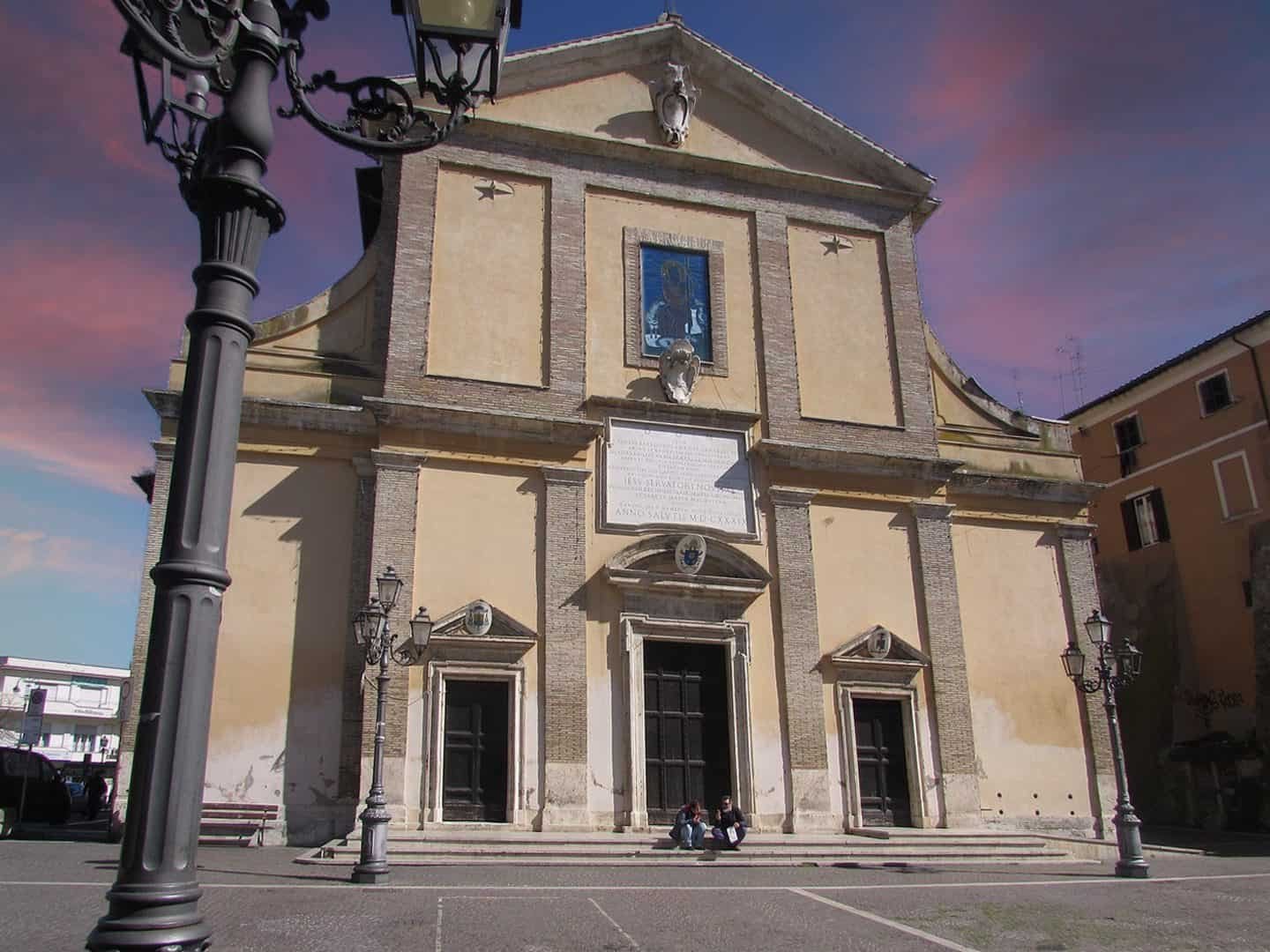
The convent of the Friars Minor Capuchin of Monterotondo
The Capuchin church, dedicated to Saint Francis of Assisi, is in the square of the same name, in the Cappuccini district. The facade is in Romanesque-Baroque style. The interior has a single nave with side chapels on the right side, which contain statues of saints, and the altar is in polychrome marbles. Attached to the church are the convent and the garden of the Capuchins, one of the few green lungs inside the city, if you exclude the garden in front of the town hall and that of the Passeggiata, dedicated to the Garibaldian fallen and to the soldiers who died in the battle of September 9 and 10, 1943. The great lung, in the countryside, remains the Macchia del Barco with the Gattaceca.
The Capuchin friars had been approved by Pope Clement VII Medici in 1528 and appear in the documents of Monterotondo on November 27, 1542, when a certain Evangelista sells the Orsini a vineyard in the San Salvatore district for the use of the Capuchins. The original convent was a small dwelling, almost opposite the old hospital, near the San Matteo farmhouse. In 1605 the construction of the new convent in the San Restituto district was approved. In 1609 the Community bought the land and started construction, entrusted to the Milanese master Antonio Del Grande. The Municipality and the population have always followed the events of this place with involvement: they completed its construction, looked after the restorations, and favored the friars' staying on even during the suppressions of religious orders decreed first by Napoleon and then by the Italian State.
Here lived and, according to tradition, worked miracles Saint Crispin of Viterbo from 1703 to 1709. The spring-water well that served the friar to water the vegetable garden still exists, north of the convent. Garibaldi made the convent his point of reference both in 1849 and in 1867: from that date comes the chipping of the church portal, caused by a cannon shot fired from Palazzo Piombino by the papal troops against the Garibaldians camped in the convent. In the old refectory is preserved the tablet placed on the occasion of the passage of Pius IX on October 6, 1853: the pope stopped for lunch with the Capuchins, who on that occasion planted the large pine felled in recent years by lightning and replaced with a new one.
Here the Capuchins of Lazio opened in 1884 the first Seraphic Seminary, brought back to the convent in 1946. In 1934 the philosophy course was established there and in 1938 the theology one. On September 4, 1940 Benito Mussolini came to inspect the general staff and the soldiers camped in the wood. In 1943 and 1944 the paratroopers arrived and then the retreating German troops, and with them many political refugees of both sides, mixed in with the friars. In those months the Capuchins set themselves to saving lives, procuring food and clothing, and improvised as carpenters to build coffins and bury the dead gathered from the rubble of Monterotondo and Mentana. One of them, Brother Bernardino of Castel di Tora, was killed by German paratroopers while cultivating the convent's vegetable garden, which was plundered and devastated. In the reconstruction the friars set up work sites, heliotherapy camps, lunches for the poor and recreation centers, and still today they provide spiritual assistance to the sick in the city hospital and in families. The Secular Franciscan Order and the Franciscan Youth are flourishing.
The small church is very much frequented. It preserves canvases of the 17th century (the high altar altarpiece and the one in the choir) and of the 16th (Saint Lucy and Saint Agatha in the choir). The altar frontal is in mosaic with a sgraffito back, and in the central chapel on the left is the logo of the fourth centenary with Saint Francis. Behind the church, in the garden near the arbor, a sculpture of Saint Francis in statuary marble is the work of the Capuchin friar sculptor Remo Rapone. The small cloister has at its center the cistern which, with the rainwater collected from the roofs and filtered, quenched the thirst of the friars and the town in difficult times. The vineyard is a tradition of the convent, handed down by generations of winegrowing friars, who produce a white and a red wine with techniques kept by the community. The wood has been carefully preserved through the centuries, and the population too has always been a jealous guardian of this rare green oasis. Among all the churches of Monterotondo it's the one where I recommend stopping longest, for the cloister and for the history its walls have seen.
The church of the Madonna delle Grazie and the monument of Giordano Orsini
The church of the Madonna delle Grazie is in the square of the same name in the Santa Maria district. Among the churches existing in Monterotondo it is certainly the oldest, though the precise year of construction is not known. In 1448, on commission from Giacomo Orsini, the neighboring monastery was annexed to it, demolished in 1932 to make way for the Monterotondo seat of the ONMI, the Opera nazionale maternità e infanzia. The plan is a single nave, vaulted, with four chapels per side, communicating with each other and well decorated. On the Romanesque arch of the last chapel on the left is an Orsini coat of arms that, it seems, replaces for the first time the six-pointed star with the better-known dog rose. The church preserves some well-made canvases: a Holy Family by Savonanzi, an altarpiece in the Caravaggesque taste and a painting of the Madonna and Child to which the same age as the church is attributed. The facade is Romanesque with later alterations.
The most important piece is one of the most interesting funerary monuments of the 15th century in Lazio: in a wall aedicula, above a sarcophagus, is placed the equestrian relief of Giordano Orsini, and in the lunette above it a Madonna with Child and praying angels that vaguely recalls the manner of Verrocchio. A knight carved in relief inside a village church is an absolute rarity in this part of Lazio, and alone justifies the detour into the Santa Maria district. In the early 2000s the church was restored for the damage of the Umbria-Marche earthquake of 1997. On July 4, 1849 Garibaldi and Anita sheltered under a pine in this square. The fragment of the pine is at Mentana.
The church of San Rocco and the Madonna del Diluvio
It was originally a simple chapel. Already from the 16th century a sacred image of the Virgin was kept there which, according to the old inhabitants, placed outside the walls a short distance from the main gate, seemed set as guardian and bulwark of the town against every public and private misfortune. Invoked by the inhabitants of the Borgo, it soon began to rain on them such a flood of graces that everyone agreed to call it Maria Santissima del Diluvio delle Grazie. The place was cramped and could not host the pilgrims who came from all over Lazio to visit the image. The chapel was therefore enlarged with the voluntary work of the workers of the La Fonte quarry, and the church of San Rocco was born.
The building in itself presents nothing remarkable: on entering you notice a certain coldness, softened until it disappears by the sight of the canvas above the altar, where the image of the Madonna del Diluvio is enthroned. It isn't a work of great value, but it is well executed and the author is unknown. The gold crowns on the heads of the Madonna and the Child were stolen by thieves never identified during the Garibaldian campaign of 1867, and it was the people of Monterotondo themselves, with personal donations, who gave the image new crowns.
Monsignor Giovannetti recounts an episode of 1656, during the great plague epidemic that in Rome caused more than 22,000 deaths and in the Papal State over 160,000. Only Monterotondo, among all the neighboring towns, escaped the scourge, which raged especially in nearby Mentana. The story goes that Father Giuseppe Gessi of Borghetto, of the Conventual Friars Minor, in the convent of the Santissima Concezione had a vision: a shadow on horseback was coming at full gallop toward the town from the Mentana side with a scourge in hand, and the Virgin with the Son, assisted by Saint Roch, forbade it entry to the town, making it turn back. The inhabitants of the Borgo were thus saved through the intercession of the Madonna. Historically, the salvation is better explained by the sanitary cordon and the walls, but the legend is the one the town still tells.
The other churches of Monterotondo (RM)
The church of the Madonna di Loreto was built in the 19th century, belongs to the Confraternita del Gonfalone and was restored in 2008. The church of Gesù Operaio, in the Spineti district, preserves inside a stone from the Gran Sasso and was restored and enlarged in 2010. Its parish organizes the feast of San Gabriele in mid-September. The church of Santa Maria del Carmine at the Scalo celebrates San Michele around September 29. The church of San Nicola, now deconsecrated, is part of the complex of the former hospital of Piazza Don Minzoni, wanted and built by Arcangelo Federici, a wealthy landowner and benefactor of Eretum to whom the adjacent street is dedicated. The building was the seat of the hospital until the 1930s and now houses the municipal library, the Paolo Angelani cultural center and the entrance of the Archaeological Museum. A marble plaque recalls the role of the complex in the 19th century. In the church of San Nicola were found the mortal remains of the founder Arcangelo Federici, who today rest, forgotten, in a nameless niche of the old cemetery: one of the few injustices of the city's memory that a Municipality so attentive to its patriots should set right.
Sant'Antonio Abate and the Torciata nel Borgo
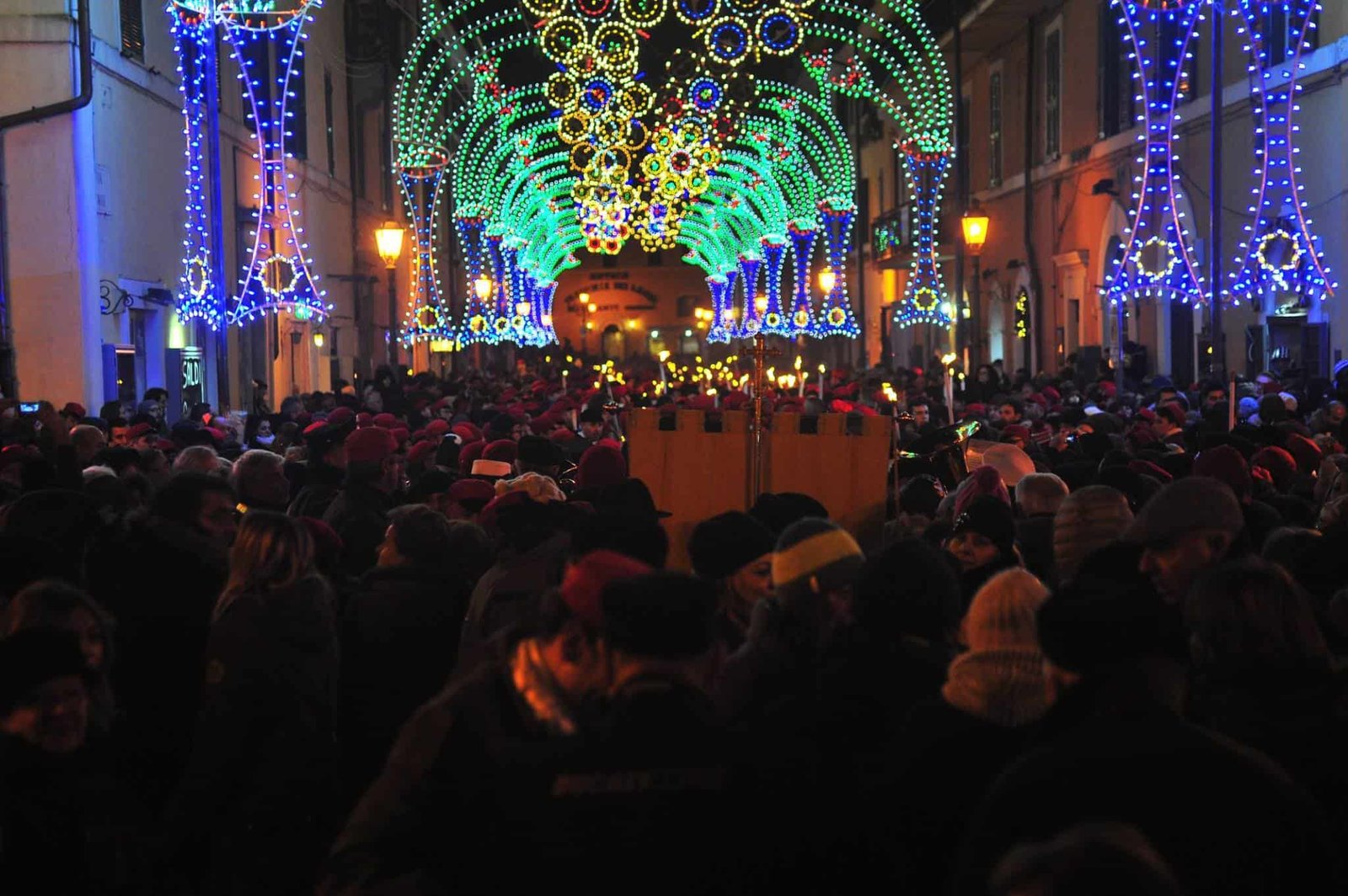
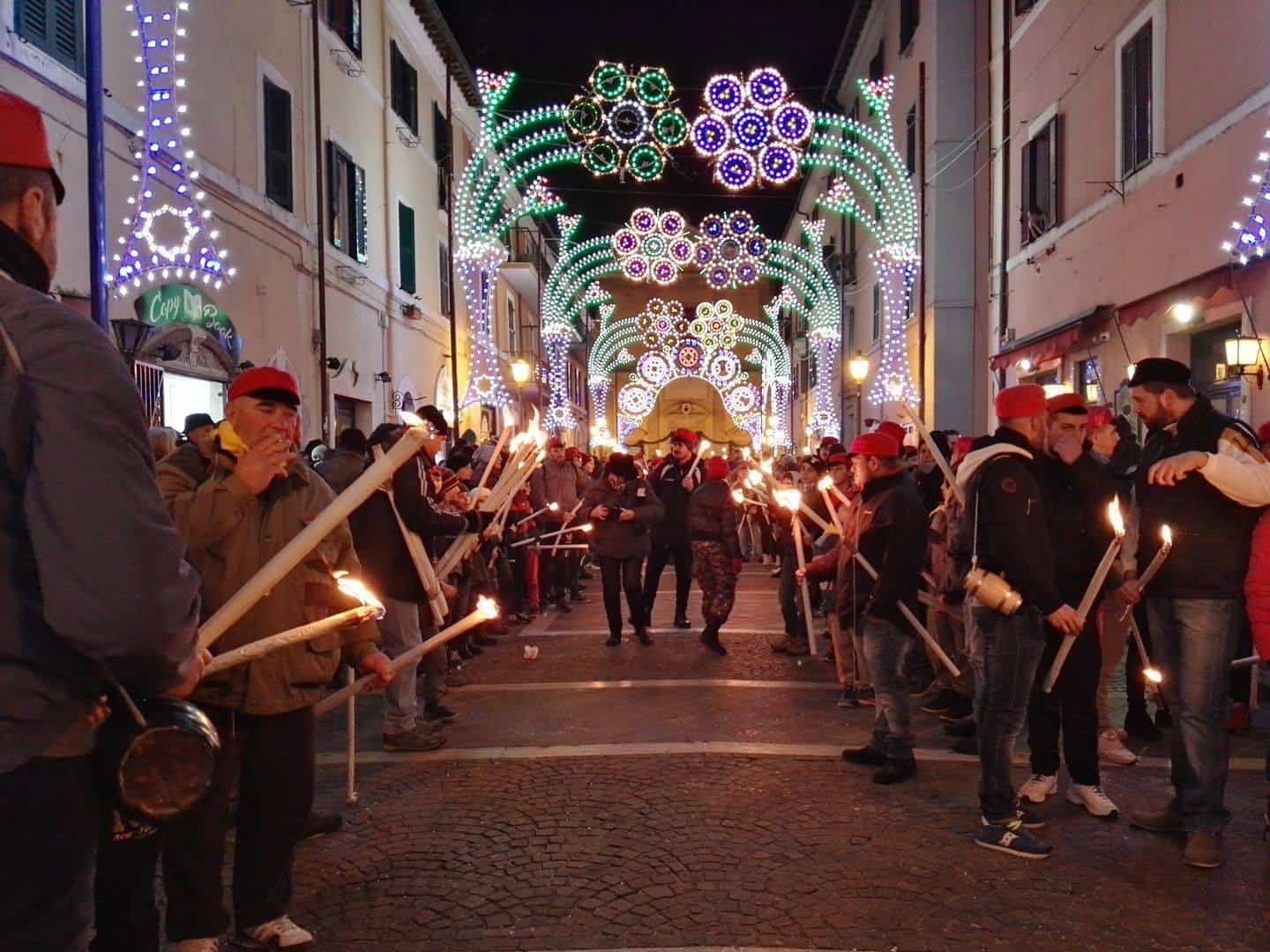
The feast of Sant'Antonio Abate, organized by the Pia Unione on the Sunday closest to January 17, is the most traditional festivity of Eretum, with the religious celebrations and, in the evening, the Torciata nel Borgo, the torchlight procession that crosses the old center. It's the only moment of the year when the historic center is seen at night as its inhabitants saw it before public lighting, and for a photographer it's the date to mark.

The natural areas around Monterotondo (RM)
The Macchia del Barco and the Macchia della Gattaceca
The Macchia di Gattaceca and Macchia del Barco Nature Reserve is a large protected area, established by the Lazio Region and managed by the Metropolitan City of Rome, among the municipalities of Monterotondo, Mentana and Sant'Angelo Romano. It is the remnant of the woods that covered the Roman countryside north of the Tiber: the flora includes several broadleaf trees, with elms, alders and many species of oak, and the fauna counts many species of birds, squirrels, dormice, foxes and porcupines. In summer it's the place of the nature events organized by the municipalities. In the other seasons it's a walk of two or three hours for those who want to understand what the landscape was like before the reclamations and the land subdivisions. The Gattaceca is the wildest part, the Barco the one that owes its name to the hunting preserve of the lords of the castle.

The Cave di Monterotondo Scalo and the other reserves
The Cave di Monterotondo Scalo Natural Monument consists of a few small lakes born from the flooding of the old clay quarries abandoned by the brick factories closed in the early 1970s: it is the industrial landscape of the Scalo returned to nature, and it ties directly to the section Un mondo di argilla of the History Museum. The Marcigliana Nature Reserve, on the Roman side, is traveled along trails that reach the Grande Raccordo Anulare and from there, on foot, the Montesacro district: it is the route that tradition assigns to Saint Francis on his journeys from Assisi to Rome along the Salaria. The Nomentum Nature Reserve, toward Mentana, protects what remains of the Latin city of Nomentum and the woods around it.
The archaeological area of the Nomentum-Eretum road at Tor Mancina
It is the city's archaeological area, where you can distinctly see the route of the ancient Via Nomentana between Eretum and Nomentum, with the paving stones and the cart tracks. It is visited during the year on the visits organized by the Civic Museums and by the Monterotondo-Mentana branch of the Archeoclub d'Italia. At Tor Mancina, an experimental livestock estate, a page of the unarmed Resistance also took place: Paolo Sabetta, manager of the estate, saved in 1943 and 1944 dozens of young people from deportation to Germany, and for this in 2008 the Municipality conferred honorary citizenship on him. The press called him the Perlasca of Monterotondo and the Perlasca of Foggia, and in the last years of his life he had set up a small museum in his own home in Foggia.
The public parks of Monterotondo (RM)
The Parco Cento Passi, dedicated to Peppino Impastato, is on Viale Bruno Buozzi. The Parco Arcobaleno, called ex ONMI, is on Via Kennedy. The Giardino del Cigno in front of the town hall is on Piazza Angelo Frammartino. The Parco ZeroSei, on Via Adige, is an inclusive park for children from zero to six years old, designed without architectural barriers so that every child with a disability can play with the others. The Passeggiata on Viale Mazzini closes the list. For a family arriving by train, the Parco ZeroSei and the Passeggiata are the two stops that work.
The history of Monterotondo (RM), century by century
Origins and the Roman age: Eretum
According to a current of studies developed above all in past centuries, and of which a certain echo is still heard today, the city would have inherited the legacy of the ancient Sabine city of Eretum, whose remains are in the municipality of Montelibretti, in the Tiber valley a little further north, and whose history goes back as far as that of Rome. Of Eretum no ruin remains that can be identified with certainty. The ancient historians, from Strabo to Pliny to Livy, agree in placing it at the 18th mile of Via Salaria, where the ancient route of the consular road crossed that of the Nomentana. Cited in Virgil's Aeneid among the cities that took up arms against Aeneas, Eretum is remembered above all as the theater of the struggles between Romans and Sabines in the monarchic age: battles near Eretum were fought, according to Dionysius of Halicarnassus, under Tullus Hostilius and Tarquin the Proud and then in the early Republican age. Livy tells that Hannibal also passed through it on his march on Rome, but after the submission of the Sabine cities to Rome (290 BC) the importance of the center waned. The distinction must be held firm: Eretum is documented by the sources, its identification with Monterotondo is a scholarly tradition, not an archaeological fact.
Middle Ages and Renaissance: the Capocci, the Orsini and Clarice
The area of the present city, which does not sit on the site of Eretum, was inhabited more massively starting from the 10th and 11th centuries, when the medieval settlement was born. Because of its position near the Salaria, Monterotondo was for a long time a strategic point and a bulwark for the defense of Rome, even though the inhabited center arose rather late compared to the neighboring towns: it is cited for the first time in a bull of the 11th century, which mentions a possession of the monks of San Paolo, the Campum Rotundum near Grotta Marozza. Around 1100 the hill was leased to the Capocci and in the 12th century passed to the Orsini, who kept power until the 17th century. During their lordship the name of Monterotondo recurred often in the affairs of Rome and Italy, and it paid the price: in 1432 it was briefly conquered by Niccolò Fortebraccio with the help of the Colonna, and was the scene of serious destruction during the war between Pope Innocent VIII and the king of Naples, with whom the Orsini had sided (1484-1492). When Alexander VI Borgia came to the throne, he, to annihilate the power of the Orsini, had Cardinal Giovanni Battista Orsini, of the Monterotondo branch, imprisoned and poisoned, and in 1503 ordered the destruction of the walls.
The most glorious moment for the Eretum branch of the family was the marriage of Clarice Orsini to Lorenzo the Magnificent, celebrated in Florence in 1469 after the contract drawn up in 1468. From that marriage were born Piero, Giuliano and Giovanni, the future Pope Leo X, whose coat of arms appears on the cistern in the courtyard of Palazzo Orsini. Important is the municipal statute drawn up by Francesco and Raimondo Orsini in 1579, which provided for notable autonomy: the community was headed by four Priors elected for six months, whose conduct was checked at the end of the term by two auditors. For the most important decisions a Public Council was consulted with one representative per family, which in turn produced a restricted body of 40 members, the Council of 40, the same that in 1621 decided on the construction of the Duomo.

The 17th century of the Barberini and the 18th century of the Grillo
For financial reasons, in 1626 the Orsini ceded the fief to the Barberini, who tried to make it more active and prosperous. The purchase was solemnized by a grand visit of Urban VIII, welcomed by the citizens in celebration, and by the elevation of Monterotondo to a duchy, granted by the pope in 1627. Under the new lordship the palace was restructured and enriched with frescoes and stuccoes. In 1639 the Duomo was under construction and the settlement was ringed with walls with three gates. In 1699, with the formal passage in 1701, the Grillo of Genoa became lords of Monterotondo, carried out new restorations on the palace, enriched the Duomo and built the bridge over the Tiber that is still called Ponte del Grillo today. The city enjoyed a long period of tranquility until the arrival of the French troops of General Pierre Dominique Garnier, who in 1799 laid siege to it. After a few days they had to give up Monterotondo and Rome, driven back by the Neapolitan army (September 30, 1799). In 1815 the fief passed from the Grillo to the Boncompagni Ludovisi princes of Piombino.
The 19th century: Gregory XVI and the title of city
In 1815 the city was occupied several times by the armies of Joachim Murat, who for the first time raised the banner of Italian independence. In March 1821 it suffered the passage of the Austrian troops come to drive the Neapolitan army back into the Kingdom. In 1845 Cardinal Luigi Lambruschini, bishop of the suburbicarian diocese of Sabina, having come to consecrate the collegiate basilica of Santa Maria Maddalena, announced the visit of Gregory XVI for October 6. The visit was celebrated with great pomp: the prior Nicola Fanucci, in front of the town hall door, handed the pope the golden keys of the Municipality, the festivities lasted until late evening and Gregory XVI was so struck by the affection of the people of Monterotondo and by the beauties of the territory that on November 22 of the same year he conferred on the municipality the title of City. Before him Urban VIII had also been welcomed by the Barberini, his blood relatives, but there is no record that he granted anything special. At that time Monterotondo was considered one of the major cities of the Sabina, and a book of the period called it the Paris of the Sabina.
1867: Garibaldi at Monterotondo
In 1867 the city was the theater of the Campaign of the Agro Romano for the liberation of Rome. In the night between October 25 and 26 about 5,000 volunteers attacked the papal garrison, a little over 300 strong, holed up in the castle. The initial assaults were led by Eugenio Valzania, Caldesi and Antonio Mosto, with the later intervention of Menotti Garibaldi, and on the morning of the 26th Garibaldi entered the city burning Porta Romana, today Porta Garibaldi. The Garibaldians lost about 40 men and had 140 wounded, the papal side 2 dead and 20 wounded. Among the young people in the retinue of the Hero of Two Worlds were the Cairoli brothers, Jessie White Mario, Countess Blavatsky (according to a tradition taken up by Helena Blavatsky herself, who told of having been wounded at Mentana), Giuseppe Pollini, a 16-year-old from Rovereto, and the brothers Fabio, Mario, Ettore, Alessandro and Raffaello Giovagnoli, called by Garibaldi the Cairoli of Lazio, natives of Monterotondo itself. Objects and documents that belonged to them are in the National Museum of the Campaign of the Agro Romano at Mentana, where the Ara-Ossario of the volunteers fallen in 1867 is also found. The victory at Monterotondo was the last of the campaign: on November 3 at Mentana the French with their Chassepot rifles closed the game.
The 20th century: Matteotti, 1943, the Resistance
On August 20, 1924, four days after the finding of the body in the Quartarella wood near Riano, the wagon that was to take the coffin of Giacomo Matteotti back to Fratta Polesine left from the Monterotondo station. He had been murdered by the squadristi on June 10. Thousands of workers, laborers and farmers of the Scalo, crowded at the edge of the railway, paid silent homage to the Socialist deputy: it was one of the last public demonstrations of opposition before the fascistissime laws.
In 1943 Palazzo Orsini-Barberini was for a few months the field seat of the General Staff of the Royal Army, the so-called Centro Marte. On September 9, 1943, the day after the announcement of the armistice, the Germans tried to capture it with a drop of paratroopers of the 2nd Battalion of the 6th Regiment, taking off from Puglia under the command of Major Walter Gericke: the sources vary between 650 and 800 men. The command had been evacuated the previous evening by General Roatta, but the palace and the town were stoutly defended by army units (including units of the Piave and Re divisions), by the carabinieri, by the Polizia dell'Africa Italiana and by armed citizens. Local tradition counts for the Germans the loss of about 300 paratroopers, of whom 48 dead, and for the Italians 125 dead and 145 wounded, among them 14 carabinieri. A truce was agreed on the evening of the 9th with the Germans holed up in the castle, and on the 10th the resistance ceased. Decorated were Vittorio Premoli of the 57th Piave Infantry Regiment (Gold Medal of Military Valor), the carabiniere Giuseppe Cannata, killed after the stout defense of a checkpoint (Silver Medal), Dario Ortenzi, called Garibaldi, who fought at 16 (Silver Medal), Lieutenant Raffaele Vessichelli of the carabinieri, commander of the group mobilized for the security of the palace (Bronze Medal), and the carabiniere Cesare Tassetto (badge of honor for the war wounded). Episodes of partisan struggle followed in 1944 with the sacrifice of Edmondo Riva, Gold Medal of Military Valor. The Municipality has been decorated with the Silver Medal of Military Valor since 1979.
Events and folklore in Monterotondo (RM)
The calendar of feasts is packed and follows the agricultural year. Sant'Antonio Abate, the Sunday closest to January 17, with the Torciata nel Borgo. The Saints Philip and James, the first Sunday of May, with the celebrations of the parish of Santa Maria Maddalena and the square events organized with the Pro Loco. The fava bean and pecorino food festival, on the weekend around May 10, in the Borgonovo district, with music and dancing. The Festival delle Cerase, born in the 1980s, which calls itself the smallest film festival in Italy and rewards actors and films with golden cherries, a tribute to the crop that made the Eretum countryside famous. Saint Anthony of Padua, the third Sunday of June, with the procession of the statue on a canopy from the parish of Santa Maria delle Grazie. The Ciummacata di San Giovanni, the Saturday closest to June 24: communal outdoor long-table meals with snails cooked in white and in tomato sauce, the oldest and most heartfelt food festival. The panzanella food festival in the first half of July in Piazza Togliatti, with free tasting. The Estate Eretina, the program of dance, film, music and theater born in the 1980s, fills the month of July with shows and concerts in the square and has been from the first year a fixed appointment for Monterotondo and the nearby towns. In autumn, San Gabriele in mid-September from the parish of Gesù Operaio, San Michele around September 29 at Santa Maria del Carmine at the Scalo, San Francesco around October 4 from the Capuchins with the Franciscan Youth.
What to eat in Monterotondo (RM)
The cooking is that of the Roman Sabina, poor and precise. The ciambelle a zampa, salted anise ciambelle whose shape recalls a paw: you buy them in the bakeries of the center and they are the right souvenir, much more than any object. The fava beans with pecorino in May, the panzanella in July, the San Giovanni snails cooked in white or in tomato sauce with mentuccia. The cherries of the Eretum countryside, which gave their name to the film festival. The olive oil of the Sabina, which here is a step from the PDO zone. The wine of the Capuchins, white and red, which the friars produce from the convent's vineyard and which is found only on the occasion of the Franciscan feasts. On restaurants I name no names: the rule in a center of 40,000 inhabitants is to choose the trattorias of the upper village, where the clientele is local, and leave the places of the Scalo to those in a hurry.
A curiosity about Monterotondo (RM)
The curiosity concerns a coat of arms on a cistern. In the courtyard of Palazzo Orsini the 16th-century wellhead bears the coat of arms of Pope Leo X, Giovanni de' Medici, and whoever passes takes it for a generic tribute to the papacy. It is instead a family tree in stone. Leo X was the son of Lorenzo the Magnificent and Clarice Orsini, the girl of this branch of the family who in 1468 was promised in Florence and married the following year with a celebration that cost the Medici a fortune. Clarice was not a happy princess: the Florentine court considered her a Roman provincial, and her clash with Poliziano, tutor of the children, is one of the best-known episodes of life in the Medici household. Yet it was she who brought the Orsini blood into the most powerful family in Italy, and it was her son who became pope in 1513, the first Medici on the throne of Peter. When the people of Monterotondo carved the Medici balls and the papal keys on the cistern of the castle, they were telling visitors that the pope was, by half, one of them. A century later the Barberini bought the fief and had the rooms frescoed with the bees of their coat of arms, and the city found itself for the second time tied to a reigning pope, Urban VIII, who came in person to visit it in 1641. Few towns of 40,000 inhabitants can claim two popes in the family, and Monterotondo writes it nowhere: you discover it only by looking at the stones of the courtyard.
Something nobody tells you about Monterotondo (RM)
Nobody tells that the most famous freight car in Italian history left from here. On August 16, 1924 the body of Giacomo Matteotti was found by chance in the Quartarella wood, in the municipality of Riano, about 15 kilometers from Monterotondo. The regime had a problem: bringing the body back to Fratta Polesine without the journey turning into an anti-Fascist demonstration along the whole peninsula. The solution was to choose the Monterotondo station, and not Rome, for loading the coffin onto a freight car, on August 20, in the hope that it would pass unnoticed. It did not: the workers of the kilns of the Scalo, the farmers and the railway men gathered along the tracks and saluted in silence, and that silence has remained in the memory of the quarter as the beginning of its political identity. The History Museum in the Torre Civica tells it in the section Abitare la Memoria, and tells it together with the kilns: the same brick factories that had made the Scalo arise as a working-class city, distinct from and at times rival to the village of the landowners on the hill. Whoever arrives by train gets off exactly at the point of that story and usually doesn't know it. It is one of the cases in which the least photogenic place in a city is the one with the most to say.
My advice for visiting Monterotondo (RM)
The advice is not to treat Monterotondo as a stand-alone outing but as the first stop of a Sabine day, and to do it by train. You leave Roma Tiburtina with the mid-morning FL1, get off at Monterotondo-Mentana and go up to the village with the city bus. The historic center is visited in two and a half hours in this order: Porta Garibaldi and the church of San Rocco, the climb along Via Cavour to Piazza del Popolo and the Fontana dei Leoni, the Duomo and the Pincetto, Palazzo Orsini with the courtyard and, if booked, the frescoed rooms of the museum, then the descent toward the Santa Maria district for the Madonna delle Grazie and the relief of Giordano Orsini, and finally the Capuchins for the cloister. Lunch is in the upper village with the ciambelle a zampa bought at the bakery as an appetizer. In the afternoon you return to the train and in 20 minutes you are at Fara Sabina-Montelibretti, from where you go up by bus to Fara in Sabina and the abbey of Farfa: in a single day you see the gateway of the Sabina and its most important monastery. The right day is Saturday, when the village is alive and the civic museums are normally open. On Sunday morning the center is silent and the churches are open for Mass, which helps those who want to see the interiors. Avoid Monday, when museums and many shops are closed, and the early afternoon hours in summer, when the Pincetto is an oven. Anyone who wants a guide for the whole day, with the car and the extension to Mentana and Farfa, can turn to the services of TourLeaderPro's tour escort services. For foreign visitors the English guide is on ItalyPlanner.
Another well-known fact, yet rarely cited
Everyone knows that the fighting at Monterotondo took place on September 9, 1943. Few remember that the operation was, strictly speaking, a failure foretold. The German plan aimed to capture in a single stroke the General Staff of the Royal Army, which had its field seat at Palazzo Orsini, and with it the generals who had signed the armistice. The paratroopers of Major Gericke, taking off from Puglia on about 50 Junkers Ju 52, jumped at dawn on the town. But on the evening of September 8 General Roatta had already had the command evacuated toward Rome, and in the palace there remained a few dozen officers and soldiers. The Germans conquered an empty castle, at the price of a day of house-to-house fighting against the infantrymen of the Piave, the carabinieri, the agents of the Polizia dell'Africa Italiana with their armored cars and the civilians who had taken up arms. In the evening a truce was agreed. The next day, with Rome by then in negotiations, the resistance ceased and thousands of Italian soldiers in the area were captured. In the History Museum and on the tablets of the Passeggiata the battle is told as the founding act of the Republican Monterotondo, and rightly so: it was one of the few times, in those days, that an Italian town defended itself instead of waiting. The well-known fact that no one cites is the other one: the target of that operation, the General Staff, had already left, and those who died at Monterotondo died to defend a symbol.
The right photo to take in Monterotondo (RM)
The right photo is taken from the Pincetto, but not from the central parapet where everyone stands: from the right corner of the terrace, looking toward the Tiber valley, with the fountain of the three hills in the foreground on the left and the Eretum countryside opening up to the Monti Lucretili and, on clear days, to the Terminillo. The light is that of the last hour of the afternoon, when the sun comes from behind you and lights up the roofs of the village and the palace tower. The second photo is the Fontana dei Leoni with the Duomo in the background, from the lower part of Piazza del Popolo, with a moderate wide-angle lens to keep in the four lions of Liberati and the facade. It is taken early in the morning, before the square fills with little tables. The third is Porta Garibaldi from the outer square, with the flags on top and the tricolor on the palace tower visible behind in line: it's the photo that tells 1867 without a caption. For those who want the rare photo, the Torciata di Sant'Antonio, on the Sunday closest to January 17: the torches in the streets of the village and the faces of the inhabitants are the only image of Monterotondo not found on postcards. A tip: the courtyard of Palazzo Orsini with the Medici cistern is almost always in shadow, and the photo works only at midday in summer. In the other months give up and look at it with your eyes.
Some important events that happened here in history
1286 is the year the Castrum Montis Rotundi enters the documents, with the division of the goods of Matteo Rosso Orsini: from then for three and a half centuries the history of the city coincides with that of the family. In 1432 Niccolò Fortebraccio takes it with the help of the Colonna. In 1503 Alexander VI Borgia has its walls torn down after having Cardinal Orsini poisoned. In 1469 the marriage of Clarice Orsini to Lorenzo de' Medici ties Monterotondo to Florence. In 1579 the Orsini grant the statute with the four Priors and the Council of 40. In 1626 the Barberini buy the fief, in 1627 Urban VIII raises it to a duchy, in 1630 the first stone of the Duomo is laid and in 1641 the pope comes to visit it. In 1656 the plague spares the city and the cult of the Madonna del Diluvio is born. In 1799 the French of Garnier besiege the city and are driven back by the Neapolitans. On October 6, 1845 Gregory XVI receives the golden keys from the prior Fanucci and on November 22 grants the title of City. On July 4, 1849 Garibaldi and Anita in flight shelter under the pine of Piazza Santa Maria. On October 26, 1867 Garibaldi burns Porta Romana and takes the town, only to lose at Mentana eight days later. On January 13, 1915 the Marsica earthquake brings down the palace tower and the church of Sant'Ilario. On August 20, 1924 Matteotti's coffin leaves from the station of the Scalo. On September 4, 1940 Mussolini inspects the troops camped in the Capuchins' wood. On September 9, 1943 the German paratroopers attack the palace that housed the General Staff. On January 5, 1959 the building on Via Oberdan collapses and Lo Sbracato is born. On June 19, 1979 the Municipality receives the Silver Medal of Military Valor. On July 5, 2016 the History Museum opens in the Torre Civica. These are 20 dates in seven centuries, and almost all have to do with Rome: this is the fate of a city that lies on the road of anyone who wants to enter or leave the capital from the north.
Who passed through Monterotondo (RM)
The list of documented visits is long for a center of this size. Clarice Orsini belonged to the Monterotondo branch of the family and is tied to it by birth and by fief before leaving for Florence in 1469, and her son Leo X is remembered by the coat of arms in the courtyard of the castle. Girolamo Siciolante da Sermoneta, Paul Bril and Giacinto Calandrucci worked here as painters in the rooms of the palace, between the 16th century and the end of the 17th. Urban VIII Barberini came here in 1641, 15 years after his family bought the fief, and left the Duomo the large bell of 11 quintals. Saint Crispin of Viterbo, the Capuchin canonized by John Paul II in 1982, lived in the convent from 1703 to 1709 and left the vegetable garden well. Gregory XVI entered on October 6, 1845 and Pius IX had lunch with the Capuchins on October 6, 1853, exactly eight years later. Giuseppe Garibaldi passed through twice, on July 4, 1849 in flight with Anita and from October 26 to November 3, 1867 as a victor, and with him the Cairoli brothers, Jessie White Mario and the five Giovagnoli brothers, one of whom, Raffaello, would become the writer of Spartacus, the most-read historical novel of Umbertine Italy, which Garibaldi himself praised in a letter to the author. Fausto Cecconi was born here on September 13, 1904. With Umberto Maddalena he set on June 2, 1930 the world record for duration and distance in a closed circuit, 67 hours and 13 minutes for 8,188 kilometers on a Savoia-Marchetti S.64, and in December of the same year took part in the Italy-Brazil Atlantic cruise led by Italo Balbo. He died at Tirrenia on March 19, 1931 in the in-flight explosion of the S.64 bis, and the city dedicated to him the arch of the Passeggiata, the stadium and a school. Benito Mussolini inspected the units camped in the Capuchins' wood on September 4, 1940. Major Walter Gericke, future general of the Bundeswehr, led the attack of September 9, 1943. Paolo Sabetta, the Perlasca of Monterotondo, saved dozens of young people at Tor Mancina. Among those who passed without stopping, the body of Giacomo Matteotti, on August 20, 1924. Anyone who wants to follow these traces outside the city finds at Mentana the Garibaldi museum and, further north, Nazzano and the Tevere-Farfa reserve, where the river valley has remained as it was.
Monterotondo (RM) with children and in a wheelchair
With children Monterotondo works better than you'd expect: the Archaeological and Multimedia Museum, with the holograms and reconstructions, holds the attention of an elementary-school child for a good hour. The Fontana dei Leoni and the ciambelle a zampa do the rest. The Parco ZeroSei on Via Adige is designed for the youngest and for children with disabilities. In a wheelchair the upper village is demanding: the streets are uphill and partly cobbled, the Pincetto is reached from the square by a ramp and the churches have steps at the entrance. The Duomo and Palazzo Orsini are accessible from the level of the square, and the Passeggiata on Viale Buozzi and Viale Mazzini are flat and comfortable. For the museum rooms and the Torre Civica it's best to ask in advance at the Civic Museums' numbers which sections are served by an elevator.
What's around Monterotondo (RM)
10 minutes by car away is Mentana, with the Garibaldi museum and the Ara-Ossario, and the Nomentum Reserve. 20 minutes away, beyond the Tiber, Fara in Sabina and the abbey of Farfa, with the Farfa Gorges for those who walk. Half an hour away Poggio Mirteto and the villages of the Sabina, or, toward the southeast, the Monti Lucretili and Tivoli with its villas. Anyone with a second day can go as far as Rieti. A program for small groups, with car and guide, is built with the TourLeaderPro customized experiences. For companies there are the team building formats outside Rome. The English guides to the surroundings are on ItalyPlanner: Mentana and Farfa Abbey.
Quick questions about Monterotondo (RM)
How far is Monterotondo from Rome?
About 30 kilometers from the center of Rome and about 10 from the Grande Raccordo Anulare, along the Salaria or the Nomentana. By train, with the FL1 from Roma Tiburtina, 35-40 minutes.
How do you get to Monterotondo by train?
With the FL1 regional line (Orte-Fiumicino Aeroporto) to Monterotondo-Mentana station, also served by some FL3 trains, with runs every 15-30 minutes on weekdays. From the station to the historic center you go up on the city lines or on foot in 20-30 minutes.
How much does it cost to visit Monterotondo?
The historic center, the squares, the Pincetto, Porta Garibaldi and the churches are free. For the Civic Museums (archaeological and history) the entry conditions and hours should be checked on the site mucim.it or at the numbers 06 9061490 and 06 90964221.
How long does a visit to Monterotondo take?
Two and a half hours for the historic center and the churches, an hour more for the Archaeological and Multimedia Museum, half a day if you add the History Museum at the Scalo or the Macchia di Gattaceca.
Do you need to book to visit Monterotondo?
For the village and the churches no. For the guided visits of the Civic Museums, for the frescoed rooms of Palazzo Orsini and for the archaeological area of Tor Mancina yes, through the museums' contacts.
What can you see in Monterotondo in a few hours?
Porta Garibaldi, the Fontana dei Leoni, the Duomo with the Pincetto, the courtyard of Palazzo Orsini and the cloister of the Capuchins. If there's time left, the Madonna delle Grazie for the relief of Giordano Orsini.
What are the ciambelle a zampa of Monterotondo?
Salted anise ciambelle typical of Monterotondo and Mentana. They are bought in the bakeries of the center.
Can you visit Palazzo Orsini-Barberini?
The courtyard with the Medici cistern is accessible during the hours of the municipal offices. The frescoed rooms are visited with the route of the Archaeological and Multimedia Museum.
Why is Porta Garibaldi called that?
It was the Porta Romana. On October 26, 1867 Garibaldi had it burned to enter the city, and after 1870 the gate took his name. It is a National Monument.
What happened in Monterotondo on September 9, 1943?
The German paratroopers of Major Gericke attacked Palazzo Orsini, field seat of the General Staff of the Royal Army. Soldiers and civilians resisted for two days. The Municipality holds the Silver Medal of Military Valor.
Is Monterotondo suitable for children?
Yes: multimedia museum, Fontana dei Leoni, Parco ZeroSei and the ciambelle. The upper village has slopes and stairs, the stroller is fine on the Passeggiata and in the square.
Can you visit Monterotondo in a wheelchair?
The main squares, the Duomo, the palace courtyard and the promenades are reachable. The streets of the medieval village and some churches have steps and cobblestones. For the museums it's best to ask about the elevator beforehand.
Where do you park in Monterotondo?
In the lots along Viale Bruno Buozzi and near the Giardino del Cigno, then on foot. The old village is mostly restricted-traffic.
Can you take photos in the churches of Monterotondo?
As a rule yes without flash and outside services. In the Duomo and at the Capuchins the rule of common sense applies, and asking the sacristan.
What is the difference between Monterotondo and Mentana?
They are neighbors and share 1867: Monterotondo is the city Garibaldi took, Mentana the one where he was defeated a week later. Monterotondo has the village, the Duomo and the palace. Mentana has the Garibaldi museum and the Ara-Ossario.
When is the best time to visit Monterotondo?
In spring and autumn, on Saturday. In January for the Torciata di Sant'Antonio, in June for the Ciummacata, in July for the Estate Eretina. Avoid Monday and the early afternoon hours in August.
Can Monterotondo and the Sabina be combined?
Yes, with the same FL1 line: from Monterotondo-Mentana to Fara Sabina-Montelibretti it's 20 minutes, and from there you go up to Fara in Sabina and the abbey of Farfa.
What can you see from the Pincetto of Monterotondo?
The Tiber valley, the Eretum countryside, the Monti Lucretili and, on clear days, the Terminillo.
Is there a Monterotondo museum on the 20th century?
Yes, the History Museum in the Torre Civica of Piedicosta, at the Scalo, opened in 2016: sections Abitare la Memoria and Un mondo di argilla, with the municipal historical archive.
Is Monterotondo connected to Via Francigena or the Way of Francis?
The city is a stage of the Way of Francis in Lazio, which follows the tradition of the saint's journeys along the Salaria. The trails of the Marcigliana link it on foot to Rome.
Whoever comes to Monterotondo on a Roman vacation often ends up remembering the courtyard with the cistern of Leo X more than many rooms of the Capitoline museums. It isn't a city that asks to be admired: it asks to be read, stone by stone, and it gives back exactly the time you devote to it. Go by train, with a free afternoon and with the idea that the Sabina begins here.
Article written by the TourLeaderPro editorial team, contact them for Private/Corporate/V.I.P. Tours and Experiences.
Planning a trip to Rome? The English guides to visiting the city are on ItalyPlanner.com.