Viterbo
In short. Viterbo is the capital of Tuscia, at an elevation of 326 meters and about 80 kilometers north of Rome.
Viterbo is the capital of Tuscia, at an elevation of 326 meters and about 80 kilometers north of Rome. By car, take Via Cassia bis (SS 2 bis, the so-called Cassia Veientana) from the Grande Raccordo Anulare, Cassia bis exit, and continue to Monterosi, where the expressway joins the actual Cassia that leads to Vetralla and then to the gates of the city. It takes an hour and a quarter from the Raccordo in normal traffic, an hour and a half on Saturday mornings. The train is the regional line FL3. It leaves from Roma Ostiense, stops at Trastevere, San Pietro and Valle Aurelia (transfer to Metro Line A) and arrives at Viterbo Porta Romana and Viterbo Porta Fiorentina. The Roma Ostiense-Viterbo ticket costs €5, direct trains run roughly once an hour on weekdays, and the trip takes between an hour and 40 minutes and an hour and 50 minutes. Porta Fiorentina is the convenient station for the center: you step out and you're already in front of the walls, five minutes on foot from Piazza della Rocca. If you come by car, leave it in the parking lots along the walls (Piazza Martiri d'Ungheria below the Sacrario, the Carmine, Porta Faul, the Rocca), because the historic center is almost entirely a limited traffic zone. The Polo Monumentale del Colle del Duomo, at Piazza San Lorenzo 8, combines the Palace of the Popes, the Cathedral sacristy and the Museo del Colle del Duomo in a single ticket: full €10, reduced €8, family €25, free under 12 and for residents. From April to October it opens every day from 10:00 to 19:00. From November to March it closes on Tuesdays and on weekdays has a split schedule, 10:00-13:00 and 15:00-18:00, with last entry one hour before closing. The Palazzo dei Priori at Piazza del Plebiscito 14, with the Museo dei Portici where the two panels by Sebastiano del Piombo are on display, costs €8 (reduced €6) and in the winter season it too closes on Tuesdays. The Museo Nazionale Etrusco di Rocca Albornoz, at Piazza della Rocca 21b, is open from 8:30 to 19:30 with last entry at 18:30, closed Mondays, full €7, reduced €2 for European citizens between 18 and 25, combined ticket with Villa Lante €12. For the evening of September 3, when 100 porters carry the Macchina di Santa Rosa on their shoulders, no ticket is needed. You need to arrive early. For a tour leader to guide you through popes, Etruscans and baths in a single day, you can contact TourLeaderPro.
Viterbo is one of the stops on Via Francigena in Lazio: those who arrive on foot from Montefiascone enter the city through Porta Fiorentina, like the medieval pilgrims. The other destinations of Tuscia are in the index of tourist attractions on EstateRomana.

Why Viterbo Is Called the City of the Popes
The name almost certainly comes from the Latin Vetus Urbs, the old city, and that alone says a lot about a place that has always looked back with pride. The historic center of Viterbo is the largest medieval nucleus in Europe among those that have remained intact: an entire fabric of gray peperino houses, towers, external staircases and squares with fountains, enclosed by 13th-century walls almost 5 kilometers long and surrounded by modern neighborhoods. The title of City of the Popes is not a tourist gimmick. Between 1257 and 1281 the papal curia resided permanently on the hill of San Lorenzo, in the palace built expressly for the pontiff, and in that quarter century Viterbo saw five conclaves, four elections and an invention destined to last to this day: the conclave itself, born from the exhausted patience of the people of Viterbo in 1271. The Università degli Studi della Tuscia has been based in the municipality since 1979, keeps about 10,000 students in the city and keeps alive a cultural vocation that the Baroque centuries had almost extinguished.
Our opinion: Viterbo is the most underrated medieval city in central Italy. Whoever visits it in a day from Rome comes back with the feeling of having discovered a little Siena without Siena's crowds. The comparison holds for the stone, for the squares and for the civic fanaticism around a September festival.
Traditions and Folklore in Viterbo: The Macchina di Santa Rosa
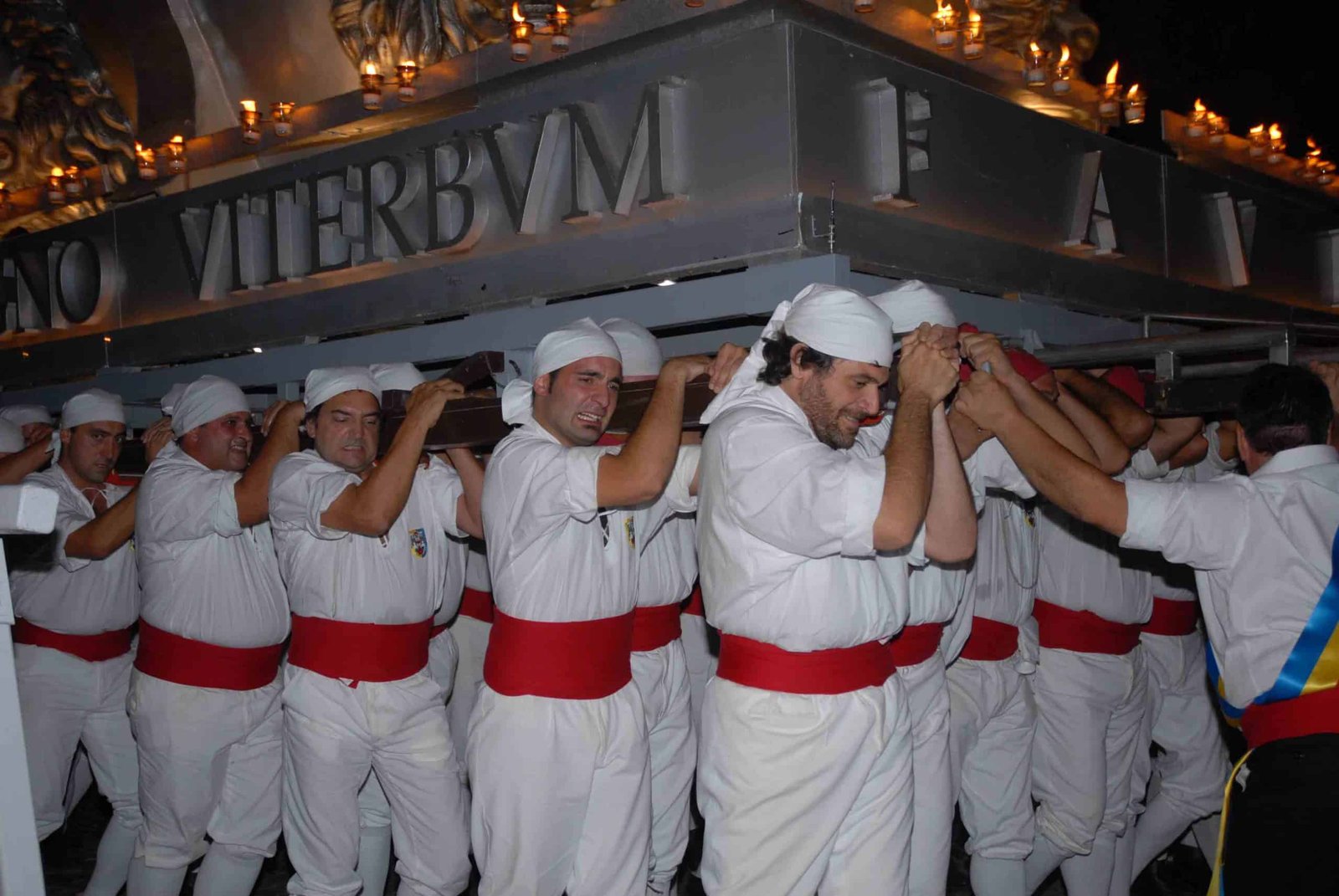
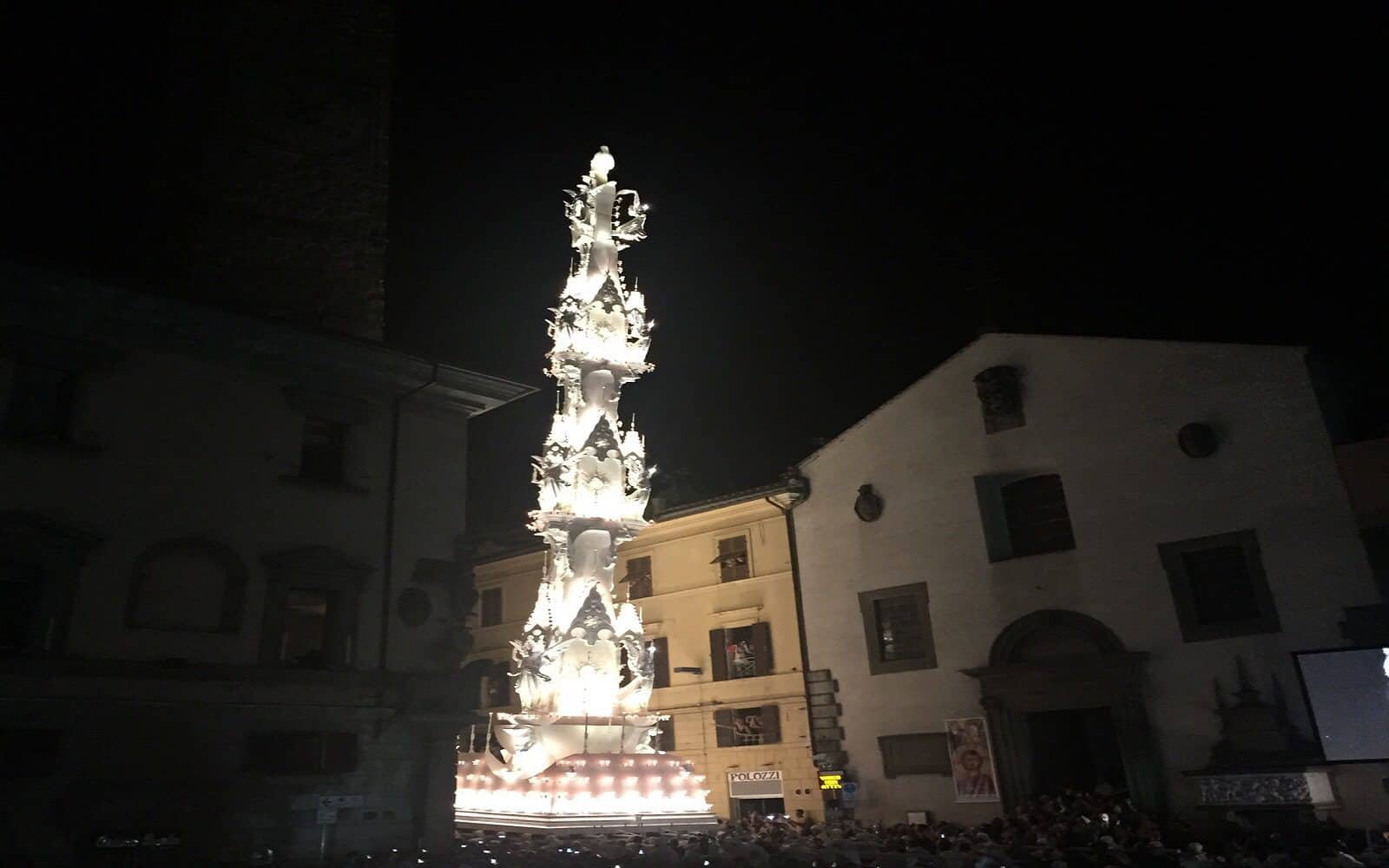
The Macchina di Santa Rosa is the reason Viterbo's name reached UNESCO. Every year, on the evening of September 3, an illuminated tower 30 meters tall and weighing 52 quintals is lifted and carried on the shoulders of 100 men, the Facchini di Santa Rosa, for about 1,200 meters of uphill streets, from Porta Romana to the Saint's sanctuary on the opposite side of the center. The city turns off the lights along the route and the Macchina advances in the dark like a column of fire. In 2013 the transport was inscribed by UNESCO on the List of the Intangible Cultural Heritage of Humanity together with the other great Italian shoulder-borne machines, the Gigli di Nola, the Varia di Palmi and the Candelieri di Sassari.
The tradition dates back to September 4, 1258, when Pope Alexander IV, who was living in the city, personally led the translation of Rosa's body from the church of Santa Maria in Poggio to the Poor Clares monastery that bears her name. That torch procession gave birth to the rite, which over the centuries has changed from a canopy to a baroque machine, and from a nineteenth-century tower to a contemporary structure. Since 2024 the Macchina in use has been called Dies Natalis, designed by Raffaele Ascenzi. It marks a return to the nineteenth-century stage sets, with a cross at the top instead of the statue of the Saint. It replaced Gloria, the machine by Ascenzi and Luigi Vetrani that had moved through the streets of Viterbo from 2015 to 2023. The most coveted spot under the structure belongs to the ciuffi, the facchini who carry the weight directly on the nape with a leather cushion. They are 63 out of the 100. The historic call that opens every lift, "Facchini di Santa Rosa, sotto col ciuffo e fermi," is the phrase every Viterbo native knows by heart.
A tip from someone who has seen it from every angle: the final climb up via Santa Rosa, where the facchini take a run-up and carry the Macchina to the top at a sprint, is the most theatrical moment and also the most crowded. Those who arrive at 18 find a spot, and those who arrive at 20 see other people's shoulders. The Museo della Macchina di Santa Rosa, in the headquarters of the Sodalizio dei Facchini in via San Pellegrino, holds models of earlier machines and lets you understand the structure in iron and fiberglass, which in person, on the night of September 3, looks made of light.

The Territory of Viterbo: Cimini, Palanzana and the Hidden Ditch
Viterbo stretches 326 meters above sea level on a wide false plateau that slopes down from the first northern slopes of Mount Palanzana, which Viterbo locals simply call the Palanzana, a 802-meter ridge in the Cimini Mountains group. The Cimini are extinct volcanoes. The main caldera holds Lake Vico, and their magma produced the gray peperino stone that all of Viterbo is built from, as well as the red tuffs of the gorges. The municipality covers 406.23 square kilometers, the second largest in Lazio by area, and to the west the false plateau gradually opens onto the Maremma plain and the sea at Tarquinia. The city is crossed along its entire length, from east to west, by the Fosso Urcionio. Until the early decades of the twentieth century it flowed in the open air, and today it runs almost entirely beneath the streets of the center. When it rains hard you can still hear it under Piazza delle Erbe.
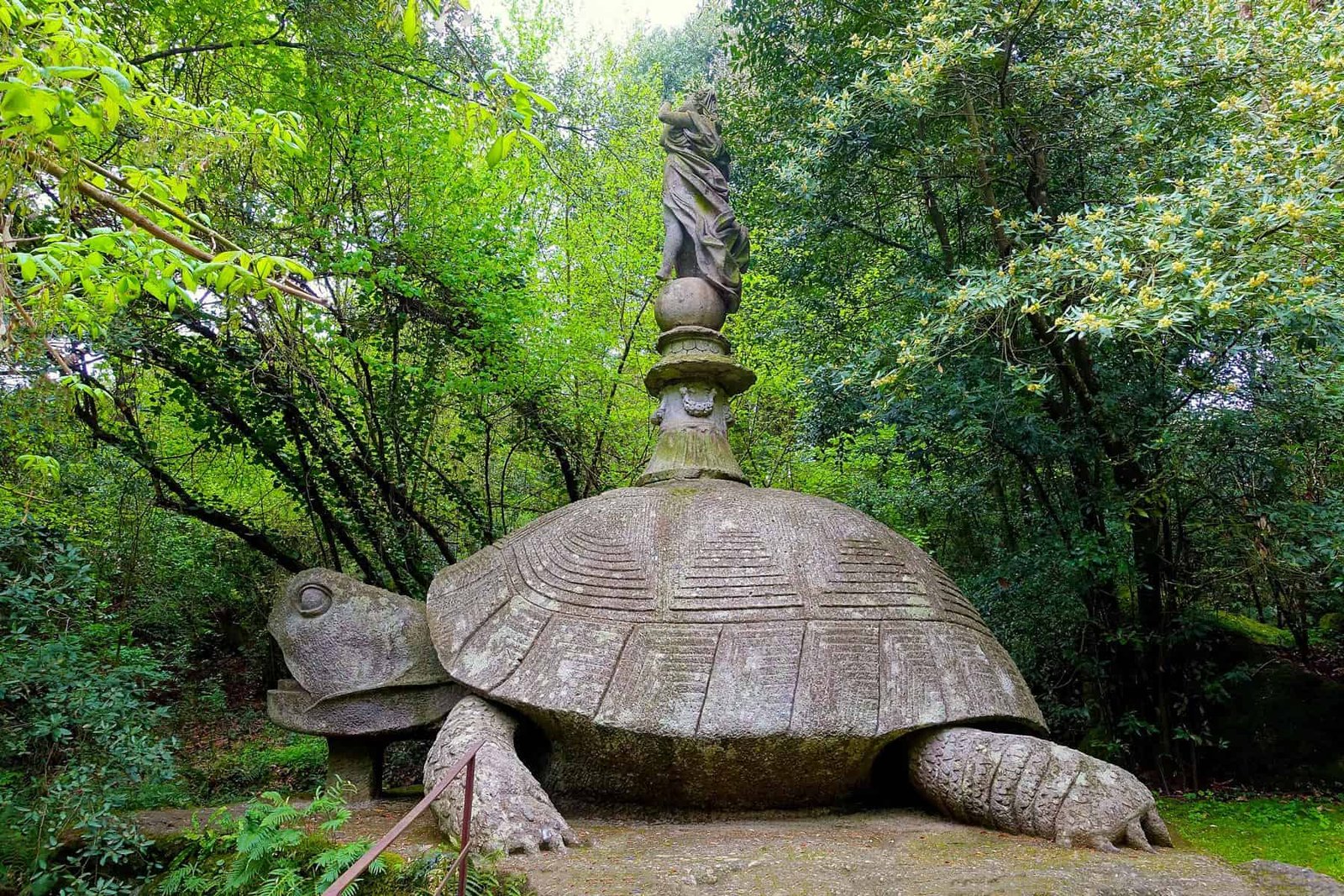
Viterbo Province is one of the richest in Lazio for those who love off-the-beaten-path places, and anyone who has already visited Soriano nel Cimino or the Parco dei Mostri in Bomarzo knows it: the village of Chia with Pasolini's tower, Civita di Bagnoregio on its clay spur, Calcata with the Opera Bosco, the gardens of Villa Lante in Bagnaia, the Ruspoli castle in Vignanello, the Palazzo Farnese in Caprarola. In Civitella d'Agliano, Swiss sculptor Paul Wiedmer bought an entire valley in 1997 and turned it into the Serpara, a garden-studio with more than 40 installations and sculptures that blend into the vegetation. It is open to the public only on some days of the year, announced by the artist.

Things to See in Viterbo: the Duomo Hill
The Palazzo dei Papi in Viterbo and the Loggia
Everything starts in Piazza San Lorenzo, on the hill where the Lombard castrum stood and where the curia moved in the mid-13th century. The Palazzo dei Papi was built between 1255 and 1266 at the wish of the capitano del popolo Raniero Gatti, to give the pope a defensible residence beside the cathedral. The façade is a severe block of peperino with a staircase leading up to the great hall. On the right side opens the famous Loggia, dating from 1267, formed on one side only by seven pointed arches supported by slender paired columns that intertwine at the top in a pierced entablature, light as lace. The other side of the loggia collapsed in the 14th century and was never rebuilt, and this is why the wind blows through it today. Behind it, the view over the Faul valley and the Pianoscarano quarter is the first view I recommend to anyone arriving in the city. In the center of the loggia is a 15th-century fountain with lions and the palm, the coat of arms of Viterbo.
From the loggia you enter the Sala del Conclave, the largest room in the palace, with two-light windows facing the city. Here, between 1268 and 1271, the cardinals were locked in, rationed to bread and water, and finally stripped of their roof until they elected Gregory X. I'll tell the story later, but standing before those bare walls, the event is easier to understand than in any book. The Polo Monumentale visit also includes the interior rooms with 16th-century frescoes and, on certain special days, the palace stables.
The Cathedral of San Lorenzo in Viterbo
Next to the palace stands the Duomo, dedicated to Saint Lawrence. It was erected in Romanesque forms during the 12th century on the site of a small 8th-century church dedicated to the same saint. According to tradition, that church had itself been built on the ruins of a pagan temple to Hercules. The façade, however, is Renaissance. It was redone in 1570 at the wish of Cardinal Giovanni Francesco Gambara, the bishop of Viterbo who in those same years was having Villa Lante built in Bagnaia. The 14th-century bell tower is the most beautiful part of the exterior. In its upper section it is marked by tiers of paired two-light windows and horizontal bands of light and dark stone, a Tuscan taste that has no equal in Viterbo.
The Cathedral of Viterbo suffered extremely serious damage in the Allied bombing of 1944, which struck the very hill of the Duomo. The postwar restoration chose to remove much of the Baroque remodeling and restore the Romanesque layout: three naves separated by two rows of columns with elegant capitals, each one different from the others, and the Cosmatesque floor with inlays of porphyry and serpentine. In the apse area of the left nave is the tomb of Pope John XXI, the Portuguese Pietro Ispano, physician and philosopher, who died in Viterbo in 1277 under the collapse of the ceiling of the study he had built in the palace. Dante places him in Paradise, the only pope of his time to have earned it. Nearby is the Madonna della Carbonara, a 12th-century panel in Byzantine style, which is the oldest painting in the city. Pope Alexander IV, who died in 1261, was also buried in the church. His tomb was moved to a secret place, perhaps to shield it from enemies, but more probably during the 16th-century works, and it has never been found. The Museo del Colle del Duomo, opened in 2000 next to the Cathedral, houses the treasury with reliquaries, goldsmiths' work, and the archaeological section on the excavations of the hill.

The Churches of Viterbo, One by One
Santa Maria Nuova and the Pulpit of Saint Thomas
Santa Maria Nuova is one of the oldest churches in Viterbo. A donation document attests to it already before 1080. It stands on the site where tradition places a temple of Jupiter, and above the portal juts a bearded marble head that for centuries the people of Viterbo believed was Christ, and that scholars consider a Roman Jupiter. In an outer corner of the building, on the left-hand corner, remains a small hexagonal stone pulpit that was reached by a wooden staircase. Tradition says that from there Saint Thomas Aquinas preached in 1266, called to Viterbo by Pope Clement IV. The very small size of the pulpit hardly fits with the bulk of the Dominican saint, and the series of sermons most likely took place inside. But the pulpit is authentic, and the plaque commemorating it is one of the few in Viterbo that names a philosopher.
Inside, the church holds a collection of Viterbo painting from the 14th to the 16th century: frescoes by Balletta, from the 15th century, and a Crucifixion attributed to Matteo Giovannetti, the painter who worked for the popes of Avignon around 1340. At the far end of the left aisle is the triptych of the Savior, painted on leather, with Christ blessing between the Virgin and Saint John. It is a work of the Roman school from the 13th century, found according to tradition in 1283. The side aisles have a wooden trussed ceiling decorated with ceramic tiles, a detail you only notice by looking up. In the Baptistery, the fresco with Saints John the Baptist, Jerome and Lawrence is by Antonio del Massaro from Viterbo, known as il Pastura, the Viterbo painter of the early 16th century who looks to Antoniazzo Romano and Perugino. On one side of the high altar, you go down into the early Christian crypt. A staircase outside the apse finally leads to the so-called Lombard cloister, from the early medieval period, rediscovered in 1954 after the collapse of one wing of the refectory and restored into the 1980s. Until then, no document suggested it existed, and for me it remains the quietest corner of all of Viterbo.
San Silvestro, the Church of the Viterbo Murder
The church of San Silvestro, today called del Gesù, in Piazza del Gesù, is a small and very ancient Romanesque building. On March 13, 1271, while the funeral procession of Louis IX of France was stopping in the city and the curia was still gathered for the conclave, the English prince Edmund's son Henry of Cornwall, nephew of King Henry III, was attacked during Mass by his cousins Guido and Simon de Montfort, who were avenging their father and brother killed at Evesham. Henry clung to the altar and was slaughtered right there. All of Europe was shaken by it. Dante recalls the event in Canto XII of the Inferno, where Guido di Montfort, immersed in boiling blood, is the one who «fesse in grembo a Dio lo cor che 'n su Tamisi ancor si cola», because the prince's heart, according to Giovanni Villani, was taken to London and placed in a gilded urn on a column of the bridge.
The Abbey of San Martino al Cimino
The abbey of San Martino al Cimino, in the hamlet of the same name south of the city, is the first example of Cistercian Gothic in Lazio after Fossanova and Casamari: a very tall nave, clustered piers, a rose window, and two façade towers that look French. I write about it in the chapter on Viterbo's hamlets.

The Basilica of the Madonna della Quercia
Two kilometers from the walls, in the hamlet of La Quercia along the road to Bagnaia, the Basilica of the Madonna della Quercia is one of the most remarkable Renaissance buildings in central Italy, and it was the first national monument in the province. It began around a painted roof tile of the Madonna, hung on an oak tree by a Viterbo potter in the 15th century and believed to be miraculous. From there, starting in 1470, the Dominicans built the church and convent. On the façade, faced with peperino stone, are three lunettes in glazed terracotta by Andrea della Robbia. Inside, there is the gilded coffered ceiling of the central nave, designed by Antonio da Sangallo the Younger, the marble tempietto by Andrea Bregno that encloses the sacred image, and, in the convent refectory, the Last Supper by Fra Bartolomeo della Porta. It holds the rank of minor basilica. The cloister with the well and the cypresses is free and almost always empty: if you have to choose just one church outside the walls, this is the one.
Other Churches in Viterbo Worth a Stop
The center of Viterbo has dozens of medieval churches, and each of them is worth at least 10 minutes. The Gothic Basilica of San Francesco alla Rocca, next to Piazza della Rocca, holds the tombs of two popes who died in Viterbo, Clement IV and Adrian V, the latter with a monument attributed to Arnolfo di Cambio. The church was gutted by the bombs of 1944 and rebuilt. Sant'Angelo in Spatha, in Piazza del Plebiscito, keeps on its façade the copy of the Roman sarcophagus called that of the Bella Galliana, the Viterbo girl of the legend. The sanctuary of Santa Rosa, at the top of Via Santa Rosa, rebuilt in the nineteenth century, holds the incorrupt body of the patron saint in the chapel on the left, with the House of Santa Rosa alongside. Sant'Egidio and Santa Maria del Suffragio are on Via Cavour. San Sisto, inside Porta Romana, is the oldest church in Viterbo together with Santa Maria Nuova, with the presbytery raised on a staircase and the bell tower that was a tower of the walls. Santa Maria della Verità, outside Porta della Verità, has the Mazzatosta chapel frescoed in 1469 by Lorenzo da Viterbo, a masterpiece of the fifteenth century in Lazio put back together piece by piece after the bombing of 1944. Next to it, the former convent is the Civic Museum. Sant'Andrea, in Pianoscarano, Romanesque with three apses. The Santissima Trinità, of the Augustinians, with the cloister and the library of Cardinal Egidio da Viterbo. San Giovanni in Zoccoli, from 1037, with the Balletta polyptych and the façade from which tradition has the people of Viterbo looking out during the siege of Frederick II.

Medieval Viterbo: San Pellegrino, the Squares and the Fountains
The San Pellegrino District
A short distance from Piazza del Duomo extends the San Pellegrino district, the most intact thirteenth-century core of the city and the reason Viterbo appears in so many costume films. The houses are in dark peperino, with the profferlo, the external stone staircase typical of Viterbo architecture that rises to a covered landing. The streets pass under arches and vaults, the so-called richiastri, small closed courtyards onto which several homes face. Piazza San Pellegrino, with the thirteenth-century Palazzo degli Alessandri and the small church of the same name, is the right spot to grasp the difference between a tower and a tower-house: the Alessandri tower was a family fortress, like those of San Gimignano. On the same street is the seat of the Sodalizio dei Facchini di Santa Rosa with its museum.
Piazza del Plebiscito and the Palazzo dei Priori of Viterbo
Piazza del Plebiscito, which the people of Viterbo call Piazza del Comune, has been the civic center since the fifteenth century: here are the City Hall and the Prefecture. The Palazzo dei Priori, begun in 1460 as the residence of the papal governor and seat of the Priori from 1510, has a courtyard with a loggia open onto the Faul valley and, on the noble floors, the frescoed rooms that can be visited with the ticket: the palatine chapel with frescoes by Filippo Cavarozzi and Marzio Ganassini, the Madonna room, the Sala Regia with the castles of the Viterbo territory painted at the end of the sixteenth century by Baldassarre Croce, the Council room still in use, the Landscape room and the Aurora room. In front, the Palazzo del Podestà with the clock tower, and the church of Sant'Angelo in Spatha.
The Corso, Santa Rosa and the Saint's House
Corso Italia, for everyone simply the Corso, is the street of the evening stroll. It starts from Piazza delle Erbe and ends in Piazza Verdi in front of the Teatro dell'Unione. From there, at the top of the climb of Via Santa Rosa, stands the sanctuary of the patron saint, built on a small rise next to the so-called House of Santa Rosa, the modest dwelling where the girl lived her 18 years and which you can still enter. In the sanctuary the body of the Saint is venerated, and it is here that the transport of the Machine ends, on the night of September 3.
The Squares and Fountains of Viterbo
Viterbo is the city of spindle fountains, with the multi-tiered basin that narrows toward the top: there are more than 20. Piazza Fontana Grande has the largest and oldest, begun in 1206 and completed in 1279, in the shape of a Greek cross. Piazza della Rocca has the sixteenth-century fountain attributed to Vignola, in front of the Rocca Albornoz. Piazza delle Erbe has the Lion fountain, rebuilt in the nineteenth century. Piazza della Morte, named for the confraternity that buried the poor, has a thirteenth-century fountain in the shade of a plane tree and the loggia that descends toward the Duomo bridge. On the Faul valley, near Porta Faul, rises the Branca tower called that of the Bella Galliana, and all around run the medieval walls, begun at the end of the eleventh century and completed in the thirteenth, with the two main gates, Porta Romana to the south and Porta Fiorentina to the north, and seven other minor gates.
The Frazioni of Viterbo: Bagnaia and San Martino al Cimino
Villa Lante a Bagnaia
In the frazione of Bagnaia, five kilometers to the east, Villa Lante is the most perfect Mannerist garden in Italy, and this is not an isolated judgment: the English critic Sacheverell Sitwell called it one of the most beautiful places in the world. It was begun in 1568 by Cardinal Giovanni Francesco Gambara, the bishop of the Duomo facade, to a design attributed to Vignola, and completed by Cardinal Alessandro Peretti Montalto. The trick is that the villa almost doesn't exist: two small twin buildings, and between them an Italian-style garden that descends in terraces with the water chain, the Fountain of the Giants, the cardinal's table with water running through the central channel to cool the wine, and the Fountain of the Moors by Giambologna. The combined ticket with the Museo Nazionale Etrusco costs €12.

San Martino al Cimino and Donna Olimpia
The frazione of San Martino al Cimino, on the slopes of the Cimini hills seven kilometers to the south, is a unique case of seventeenth-century urban planning. The village was redesigned in the first half of the seventeenth century at the wish of Donna Olimpia Maidalchini, a Viterbo native, sister-in-law of Pope Innocent X Pamphilj and for 10 years the most powerful woman in Rome, who obtained the fief with the title of princess and called in first-rank architects to work there: among the names that recur in studies is Francesco Borromini, whose presence is attested at least for the palazzo. The result is a spindle-shaped layout, with two rows of uniform row houses that widen from the abbey toward the gate, an experiment in planned public housing two centuries before the idea had a name. The Cistercian abbey, consecrated in 1225 and linked to Pontigny, has a facade with two bell towers added by Donna Olimpia herself, and inside, the Gothic nave in gray stone with the princess's tombstone, who died of plague in San Martino in 1657. The Palazzo Doria Pamphilj, a former convent, is the other part of the complex. The frazioni of the municipality of Viterbo are also La Quercia, Tobia, Fastello, Grotte Santo Stefano, Montecalvello, Monterazzano, Ponte di Cetti, Roccalvecce, Sant'Angelo di Roccalvecce, the village of the fairy-tale murals, and Vallebona.

Underground Viterbo
Beneath the historic center runs a network of tunnels carved into tuff and peperino that connects a large part of the buildings: passageways, cisterns, walkways, partly flooded, where it is not uncommon to find Etruscan and medieval finds. Born as quarries and water conduits, the tunnels served for centuries as cellars and, during World War II, as air-raid shelters for the population during the 1943-44 bombings that devastated the city. One section can be visited with the Viterbo Sotterranea tour, departing from Piazza della Morte, by reservation: the constant cold and humidity are the best introduction to the volcanic geology on which Viterbo is built.
The Museums of Viterbo
The Museo Civico Luigi Rossi Danielli and the Museo dei Portici
The Museo Civico of Viterbo, opened in 1912 and housed since 1955 in the former convent of Santa Maria della Verità in Piazza Crispi, reopened after long renovation work in 1994 and in 2014, is named after Luigi Rossi Danielli, the Viterbo archaeologist who excavated Ferento. On the ground floor, about a thousand Etruscan and Roman finds from Ferento, Musarna and Acquarossa, with sarcophagi, on the first floor, the picture gallery from the 12th to the 19th century, with glazed terracottas from the workshop of Andrea della Robbia, Cesare Nebbia, Salvator Rosa and copies of the lost frescoes by Benozzo Gozzoli in Santa Rosa, on the second floor, historical objects, including 56 sketches for the Macchine di Santa Rosa and the pharmacy jars of the 17th and 18th centuries. The large altarpiece of the Presepe by Pastura, the favorite pupil of Pinturicchio, is the most important Viterbo piece in the picture gallery.
The two panels by Sebastiano del Piombo, which for decades were the pride of the Santa Maria della Verità venue, are now displayed in the Museo dei Portici, the section of the Museo Civico set up in the Palazzo dei Priori: the Pietà, painted for the Botonti chapel in San Francesco alla Rocca in the second decade of the 16th century based on a design by Michelangelo, with the Madonna raising her eyes to the night sky and the dead Christ lying at her feet, and the Flagellation, from around 1525, a replica of the Borgherini chapel at San Pietro in Montorio. The Pietà is by far the most important work of art in Viterbo. The nighttime landscape behind the figures is one of the first nocturnes in Italian painting, and the Virgin's face has a severity that Michelangelo would have wanted for himself. Check the dates of the Museo Civico and the Museo dei Portici on the operator's website before your visit. The Santa Maria della Verità venue has closed repeatedly for work in recent years, and the layout of the rooms changes.
The Museo Nazionale Etrusco at Rocca Albornoz in Viterbo
Rocca Albornoz, at the top of Piazza della Rocca, was built from 1354 by the Spanish cardinal Egidio Albornoz, the vicar who won back the Papal States during the Avignon exile. Julius II entrusted its conversion from fortress to palace to Bramante, who created the Renaissance courtyard, and Paul III completed the work. Since 1986 it has housed the Museo Nazionale Etrusco, heir to the Museo Archeologico. The piece no other museum can offer is the full-scale reconstruction of the Etruscan houses of Acquarossa, with painted terracotta roofs reassembled using the original slabs from the 6th century BC, which makes clear in 10 minutes how people lived in an Etruscan city. There is also the mosaic with an Etruscan inscription from Musarna, the bronze biga from Ischia di Castro, and the grave goods from the necropolises of the inner Tuscia. Seven euros, closed on Mondays, and the Acquarossa room alone justifies the ticket.
The Other Museums of Viterbo
The Museo della Ceramica della Tuscia, on Via Cavour in the Palazzo Brugiotti, open since 1996, displays medieval and Renaissance majolica from Viterbo's production, including pieces recovered from the butti, the household drainage pits. The Museo del Colle del Duomo, from 2000, is included in the Polo Monumentale ticket. The Museo della Macchina di Santa Rosa, on Via San Pellegrino, is housed in the headquarters of the Sodalizio dei Facchini. The Museo Rosa Venerini, at the convent of the Maestre Pie in Piazza San Carluccio, is dedicated to the 17th-century saint from Viterbo who founded the first free schools for girls in Italy.
The Archeological Sites of Viterbo
Ferento
Six kilometers from the center along the Strada Teverina, Ferento is the Roman and medieval city heir to the Etruscan Acquarossa. The Augustan theater, in peperino stone, with its stage front still standing in arches, is among the best preserved in Lazio, and every summer it hosts a season of drama and music. Around it remain the paved decumanus, the baths, and the remains of the medieval city that Viterbo razed to the ground in 1172. Ferento was the homeland of Emperor Otto, and the Museo Civico of the city holds the statues of the Muses found in the theater. The Swedish excavations in nearby Acquarossa, starting in 1966, saw the archaeologist king Gustavo VI Adolfo of Sweden take part in person, digging with a trowel every spring in the Tuscia. Without those campaigns, the museum in the Rocca would not have its Etruscan houses.

The Necropolis of Castel d'Asso
Outside the center but within the municipal territory, to the west, the rock-cut necropolis of Castel d'Asso was the first of the Tuscia necropolises to be discovered and studied, at the start of the 19th century, and it is assumed to have been the largest. The dado tombs from the 4th-3rd century BC are carved into the tufa wall along the ditch, with false doors and inscriptions bearing the names of the families. Above them stand the ruins of the medieval castle. You can visit freely, wearing suitable shoes, and it's the right place to understand what a rock-cut necropolis is before going on to Norchia.
Norchia, Musarna and Acquarossa
The Norchia necropolis, monumental, with temple-style facades carved into the rock, is in the municipality of Vetralla. It is reached from the Aurelia bis state road in the direction of Tarquinia, and it remains the most spectacular in rock-cut Etruria. Musarna, an Etruscan and Roman city excavated since the 20th century by the École française de Rome, and Acquarossa, destroyed around 550-500 BC and never rebuilt, are the two sites that have filled the display cases of Viterbo's museums. On the ground little more than traces remain, so it's better to see them through the finds.
Natural Areas and Thermal Baths of Viterbo
The Bullicame and the Terme dei Papi
West of the city, toward Tuscania, the Bullicame is a sulfurous spring that gushes at about 58 degrees from a bubbling pool. For centuries it has fed the Terme dei Papi spa and several free pools along the road, although the flow has decreased in recent decades. Dante cites it in Canto XIV of the Inferno to describe the Phlegethon: «Quale del Bulicame esce ruscello che parton poi tra lor le peccatrici», with a reference to the prostitutes who had their houses along the stream in Viterbo. Pope Nicholas V had a thermal palace built in the area in 1454 by Rossellino, so he could cure himself. It is almost entirely lost. That is where the name Terme dei Papi comes from. The spa has a monumental pool of over 2,000 square meters, open every day except Tuesday, and on Saturday until late at night. Prices are listed on the spa's official website. The best-known free pools are the Piscine Carletti, on the Tuscanese road: white limestone basins in the meadow, steaming water in winter, a spartan setting and visitors from all over the province.

The Valle dell'Arcionello Nature Reserve
The Valle dell'Arcionello Regional Nature Reserve covers 438 hectares. It begins almost at the walls and climbs to the summit of Palanzana, at 802 meters, following the gorge of the Fosso Urcionio. It is interesting for geologists and botanists because of the phenomenon of vegetational inversion. At the bottom of the ravine, which is cold and damp, beech trees grow. They normally grow above 1,000 meters. Meanwhile, the holm oak, a plant of warm climates, occupies the ridges exposed to the sun. There are Etruscan and medieval remains along the trails and, at the top, a view over all of the Tuscia as far as Lake Bolsena.
Prato Giardino
Prato Giardino is Viterbo's main park, just outside Porta Fiorentina between via della Palazzina and via del Pilastro. It covers about four hectares, with plane tree avenues and a pond with geese and ducks at the main entrance. Along the avenues are busts of Vittorio Emanuele II, Giuseppe Garibaldi, Amedeo di Savoia duca d'Aosta, Giuseppe Mazzini and the Viterbo musician Cesare Dobici. It's the place to let the kids run around after the Museo Etrusco, which is 200 meters away.
The History of Viterbo
The Origins of Viterbo: Etruscans, Hercules and the Lombards
There are traces of Neolithic and Eneolithic settlements of the Rinaldone culture in the Viterbo area. Etruscan presence in the city is scant, almost all of it underground. The settlement on the Duomo hill, which some identify with the Surina or Surna of the sources, probably did not reach the status of vicus. It was an outpost of the lucumony of Tarquinia. The real Etruscan centers of the area were Musarna and Acquarossa, which was later reborn a short distance away as Ferento. The theories of Friar Annio da Viterbo, the fifteenth-century scholar and author of the monumental historical forgery known as Antiquitatum Variarum, imagined here an Etruscan tetrapolis named FAVL, an acronym of four cities (Fanum, Arbanum, Vetulonia, Longula). It was pure invention, but so lucky that the name stuck to the valley and to the Porta di Faul. After the Roman conquest, a military settlement most likely arose, the Castrum Herculis, named after the temple that was thought to be dedicated to the hero. The lion, symbol of Viterbo, comes from Hercules. Via Cassia ran nearby, with a station at Aquae Passeris in the thermal area to the west. Only in the Middle Ages, with the city's political rise, did the road enter the walls.
Reliable records begin with the Lombards: a border castrum between their holdings in the Tuscia and the Byzantine Duchy of Rome. The Colle di San Lorenzo appears in the donation of Sutri among the lands that Liutprand promised to the Church in 729. It was fortified in 773 by Desiderius, in the last phase of his conflict with Charlemagne. A papal document of 852 recognizes the Castrum Viterbii among the Lands of Saint Peter, and Otto I counts it among the possessions of the Church.
Viterbo as a Free Commune and the Struggle with Frederick II
In the 11th century, population growth gave rise to villages outside the castrum and, around 1090, a first stretch of walls. In 1099 the choice of the first consuls marks the transition to communal institutions. In the 12th century Viterbo, a free commune, secured many castles, and the protection of Frederick Barbarossa, present in the city in 1162, gave legitimacy to its expansion. In 1172 the people of Viterbo destroyed Ferento and added its symbol, the palm, to the lion. The current coat of arms, a lion joined to a palm, recalls that victory. Around 1190 they besieged Corneto, present-day Tarquinia, and the Viterbo army followed the emperor in the attack on Rome. The districtus grew, and in 1192 the city obtained the episcopal seat at the expense of Tuscania, which until then had been the religious center of Roman Tuscia.
At the beginning of the 1200s Viterbo came into the papal orbit and in 1207 hosted the parliament of the States of the Church called by Innocent III. But the great families, impatient with papal rule, called on Frederick II, and until 1250 the city was split between the Guelph Gatti and the Ghibelline Tignosi. In that climate lived Rosa, the most illustrious daughter of Viterbo, born in 1233 and dead in 1251 at 18: a girl of the people, a Franciscan tertiary, she preached in the streets against heretics and against the Ghibellines, was exiled to Soriano and came back after the emperor's death. Tradition attributes to her the courage that animated the people of Viterbo during the siege of 1243, when Frederick II in person pitched camp before the walls and was repelled after weeks of fighting, with the defense organized by the Viterbo cardinal Raniero Capocci, historian and sworn enemy of the emperor. That victory fixed forever the pro-papal politics: the Gatti monopolized the offices and the pontiffs, looking for a safe seat outside the Rome of the barons, chose Viterbo.
The Conclave of Viterbo and the Birth of the Conclave
The episode that brought Viterbo onto the world stage was the election of 1268-1271. At the death of Clement IV, the cardinals gathered in the palace had been unable to find a name for almost three years, divided between the French party of Charles of Anjou and the Italian one. In 1270 the captain of the people Raniero Gatti, tired of the cost of the curia in the city, made a drastic decision: he locked the cardinals in the hall, clausi cum clave, put them on bread and water and finally had the roof removed, leaving them at the mercy of the weather until they decided. Tradition adds the rebukes of Saint Bonaventure of Bagnoregio, who scolded them from the pulpit. In September 1271 the cardinals chose Tedaldo Visconti, archdeacon of Liège, a man from Piacenza who was not even a priest and at that moment was in Acre, in the Holy Land, with the crusade of Edward of England. The new pope, Gregory X, judged that the method had worked and with the constitution Ubi periculum, approved at the Second Council of Lyon in 1274, established that all future elections take place in a locked place: the conclave was born, and the word itself comes from that hall.
From 1261 to 1281 Viterbo hosted five conclaves. In the last, the people, stirred up by Charles of Anjou, burst into the hall and threw Cardinal Matteo Rosso Orsini, protodeacon, into prison to force the Orsini to yield. The French Simon de Brion came out elected, as Charles wanted, with the name Martin IV. And the new pope, instead of giving thanks, laid an interdict on the city, left it in a hurry with the whole court and went to Orvieto. With that discourtesy the golden age of Viterbo ended. The popes never again returned to reside in the city, but they stayed there for long periods: Urban V for a few months between 1367 and 1370, during the failed attempt to bring the seat back from Avignon to Rome. Nicholas V, who in 1454 had the thermal palace at the Bullicame built by Rossellino to treat his ailments. Julius II, often a guest of the Augustinians in the first decade of the 1500s because of his friendship with Egidio da Viterbo. Leo X, who came to hunt in the woods of the Cimini.
During the stable presence of the curia the city had reached its peak of splendor, economic, because it lay on the Cassia and on the Francigena, and architectural, with the public palaces, the towers and the churches in which the Romanesque gave way to the Gothic that the Cistercians had introduced in Tuscia with the abbey of San Martino al Cimino. The Avignon exile brought decline and new internal struggles. The reconstitution of the Patrimony of Saint Peter by Cardinal Albornoz, who built the Rocca in Viterbo, did not prevent the Gatti and the prefects of Vico from imposing themselves with institutions that were by now signorial.
Viterbo in the 1500s: Egidio, Pole and Vittoria Colonna
In the first decades of the 1500s Viterbo once again often hosted the popes, from Julius II to Leo X, thanks to the Augustinian cardinal Egidio da Viterbo, humanist, Hebraist and preacher, one of the most learned men of his time. In the middle of the century the city lived through a brief season of spiritual fervor around the English cardinal Reginald Pole, governor of the Patrimony from 1541, who gathered in Viterbo a circle of Catholic reformers, the so-called Ecclesia Viterbiensis, which included the marchioness Vittoria Colonna, withdrawn into the convent of Santa Caterina. Tradition has it that Michelangelo, bound to Colonna by a very deep friendship, came to visit her here. From the 1200s to the 1500s the city had a Jewish community, until the expulsion decree of Pius V of 1569.
Viterbo in the Modern Age: French, Garibaldians, Province
From the end of the 1500s Viterbo followed the fortunes of the Papal States and lost entirely the international vocation of the late Middle Ages: two centuries of little vitality, with a few Baroque building sites and a lot of quiet. In 1798 it was occupied by the French troops of General Championnet, who had intervened in defense of the Roman Republic. In November, when the Austrian Mack and Ferdinand IV of Bourbon entered Rome, the city rebelled and imprisoned the French garrison. With the Neapolitans driven out shortly afterward, Viterbo was attacked by General Kellermann and had to surrender, after he had defeated in the surrounding area the 6,000 men of the émigré Roger de Damas. In 1867 the Garibaldian column Acerbi passed through here in the unlucky campaign of the Agro romano, which ended at Mentana on November 3 with the defeat of Garibaldi at the hands of the papal and French forces. On September 12, 1870, eight days before Porta Pia, the Italian troops marching on Rome entered Viterbo.
With unification, almost all of Lazio was joined to the province of Rome and Viterbo lost its rank as provincial capital, which was restored to it only in 1927 with the reorganization of the districts ordered by Mussolini. Civitavecchia also aspired to the province. Viterbo won out and, to make up the numbers, absorbed as hamlets the municipalities until then autonomous of Bagnaia, San Martino al Cimino, Grotte Santo Stefano and other small centers. After September 8, 1943 the city was occupied by the 3rd Panzergrenadier Division moving toward Rome and became the seat of the German command. For this reason the Allied air force bombed it repeatedly, and the raid of January 17, 1944 killed hundreds of civilians and destroyed large areas of the historic center, including the hill of the Duomo. In 1962 Viterbo was awarded the Silver Medal of Civil Valor for those dead and for those ruins.
The Coat of Arms and Symbols of Viterbo
The civic coat of arms, recognized by decree of July 19, 1929, is blazoned as follows: "azure, a lion leopardé crowned or over a plain vert, collared to a palm tree fructed gules, proper, holding with the right forepaw a red bifid banner, with a silver cross, cantoned by four silver keys, placed in pale, with the bit upward and staffed vert". The lion is Hercules, the palm is Ferento, the flag with the keys is loyalty to the Church: three centuries of history in one design.
Viterbo Today: University, Culture, Theaters
Viterbo, University City
Viterbo is the center of education for the province: all the historic high schools and institutes are in the city, from the Liceo classico Mariano Buratti to the Scientifico Paolo Ruffini, from the Liceo delle scienze umane Santa Rosa da Viterbo to the technical institutes Paolo Savi and Leonardo da Vinci and the vocational Francesco Orioli. The Università degli Studi della Tuscia, established in 1979 as heir of the Libera Università active since 1969, is organized into seven departments and has its rectorate in the monumental complex of Santa Maria in Gradi, the former Dominican convent that was a penitentiary and today also hosts the auditorium. Other sites are San Carlo in Pianoscarano, the former convent of Santa Maria del Paradiso, the former Faculty of Agriculture and the Riello campus. Enrolled students number about 10,000, many from out of town, and they are the ones who keep the venues of Piazza delle Erbe and San Pellegrino open in the evening. Since 1975 there has been the Accademia di Belle Arti Lorenzo da Viterbo, networked with the European academies. The Sapienza's branch for the health professions is based at the AUSL. Since 2001 the city has hosted American students of the School Year Abroad and USAC programs.
Festivals and Music in Viterbo
In the 1970s Viterbo was a capital of Italian music. In 1973 it hosted the Festival Pop, with Alan Sorrenti and the Garybaldi, and from 1974 to 1977 the Festival dei Cantautori, through which passed Mauro Pelosi, Riccardo Cocciante, Renato Zero, Rino Gaetano, Angelo Branduardi, Lando Fiorini, Gianni Davoli and Ivan Graziani. In 2005 the city hosted a stop of the Festivalbar with Vanessa Incontrada and Fabio De Luigi. Today the calendar is packed with events that have sprung up over the last 20 years: Caffeina, in July, which fills the historic center with talks and shows, the Tuscia Film Fest, Tuscia in Jazz and JazzUp, the Tuscia Operafestival, the Festival Barocco, Quartieri dell'Arte, Medioera, Ludika 1243, the reenactment of Frederick II's siege, and Ombre Festival. The heritage is presented through five museums and places open to the public, such as Viterbo Sotterranea, the Palazzo dei Priori and the Polo Monumentale.
Theaters, cinemas and media in Viterbo
The Teatro dell'Unione, in Piazza Verdi, opened in 1855 to a design by Virginio Vespignani, the architect of Pius IX. It is an Italian-style theater with four tiers of boxes, among the most beautiful in Lazio. In August and September 1896, Antonino Palminteri, one of the best-known conductors of the 19th century, conducted Puccini's Manon Lescaut there, and in 1899 he returned for La Traviata, to very appreciative reviews from local critics. The Cinema Teatro Genio, in Piazza delle Erbe, was rebuilt in 1948 on the site of an 18th-century theater. It is municipally owned and has been closed for years. The Teatro Caffeina on Via Cavour took the place of the Teatro San Leonardo, built on the site of the church of the same name, which has since disappeared. The Sala Gatti, in Piazza delle Erbe, is a former cinema now used as a multipurpose space. The auditorium of Santa Maria in Gradi is in the former convent and serves the university. The Roman theater of Ferento hosts the summer season. Movie theaters have suffered from the crisis of the 2000s. The city still has the Cinema Lux on Viale Trento and the Cinema Trento in La Quercia, while Azzurro, Genio, Metropolitan and Trieste have closed. The largest multiplex in the province, the CineTuscia Village, opened in 2010 in the nearby town of Vitorchiano.
The local press is lively for a city of 66,000 residents. There are two daily newspapers with local news pages: Il Messaggero, with its newsroom on Via Marconi, and the Corriere di Viterbo, on Piazza dei Caduti, part of the Corriere dell'Umbria group. The newsrooms of Il Tempo, closed in 2010, and the dailies Nuovo Corriere Viterbese and Nuovo Oggi Viterbo from the first decade of the century have disappeared. The free magazines are Move Magazine, Decarta and Viterbonews24 Magazine, and in the past there were Melting Pot, Etrurialand, Totem Informacittà, La Città and Sottovoce. Radio Verde, founded in 1976, broadcast until 2018. Before it there were Radio Gluc, Radio Sole, Radiondazzurra and Radio Mediterraneo. The only television station is Tele Tuscia Sabina 2000, founded in Rieti in 1989 and in Viterbo since 1999. From 1977 to 1998 TeleViterbo broadcast, remembered for its live coverage of the Macchina di Santa Rosa and for sports, soccer and basketball. From 2008 to 2011 there was a newsroom of the Rome-based IesTv.
The neighborhoods of Viterbo
Inside the walls, the historic neighborhoods of Pianoscarano, San Pellegrino, San Faustino and Cunicchio stand out. Everything else inside the walls is simply the Centro storico. Pianoscarano, across the bridge over the Urcionio, is the neighborhood of craftspeople and taverns. Its fountain is where, in 1367, a revolt broke out against Urban V's court over a dog washed in the basin. Outside the walls are the modern neighborhoods. To the south are Carmine, Pietrare, Grotticella and Ponte dell'Elce. To the east, Cappuccini, Murialdo, Pila and Barco. To the north, Paradiso, Ellera, Santa Lucia, Santa Barbara, Villanova, Palazzina, Riello and the industrial zone of Poggino. To the west, Pilastro and the Terme.
How to really visit Viterbo
A full day, from 10 to 18, is enough for the center: Piazza della Rocca and the Museo Etrusco, then down Via Cavour to Piazza del Plebiscito and the Palazzo dei Priori, the Ponte del Duomo, Piazza San Lorenzo with the Palazzo dei Papi and the Cathedral, San Pellegrino, Piazza della Morte, Santa Maria Nuova, and the Corso as far as Santa Rosa. It is about 4 kilometers on foot, with short but steep climbs. Those with two days can add Villa Lante and San Martino al Cimino in the morning and the baths in the evening. Those with three days go to Ferento, Castel d'Asso and Norchia. Licensed guides for the Tuscia can be found through the tourist office on Piazza Martiri d'Ungheria. For a private or corporate tour with a guide from Rome, you can write to TourLeaderPro, which organizes day trips from the capital. The English guide to Italian regional trains from ItalyPlanner explains how FL3 tickets work for foreign travelers.
Viterbo with children
For kids, the stops that work are the room with the Etruscan houses at the Rocca, the Loggia dei Papi with the story of the roof that was taken off, the galleries of Viterbo Sotterranea (from age six and up), Prato Giardino with the geese and, if they're older, the Parco dei Mostri in Bomarzo, a half hour by car. On September 3 the crowd is so thick that strollers don't fit through. Carry them on your shoulders or, better, pick the morning of September 4 to see the Macchina standing still in front of the sanctuary.
Accessibility in Viterbo
The historic center of Viterbo is uphill and mostly paved with sampietrini and peperino. Piazza San Lorenzo, Piazza del Plebiscito and Piazza della Rocca can be reached by wheelchair, but the Palazzo dei Papi is visited by climbing the staircase, and the Loggia and the Conclave Hall are on the upper floor. The Museo Nazionale Etrusco has an elevator. San Pellegrino has steps and low vaults in many stretches. Before you leave, it's best to ask the operator of the Polo Monumentale, which has a toll-free number, which routes are passable.
How Much Viterbo Costs and How to Save
The historic center, the churches, the fountains and San Pellegrino are free. The paid museums cost €10 for the Colle del Duomo, €8 for the Palazzo dei Priori and €7 for the Rocca if you visit them in one day. The manager of the civic museums offers a Viterbo Pass valid for six months that brings them together. The Etruscan Museum is state-run and joins the ministry's free-admission days on the first Sunday of the month, while the Colle del Duomo complex, run by a private company on behalf of the diocese, doesn't take part. The combined ticket for the Rocca plus Villa Lante at €12 is the real bargain in the city.
When to Visit Viterbo and When to Avoid It
May and the second half of September are the perfect months: cool air, side light on the peperino, festivals without crowds. September 3 is a world apart, worth doing at least once in your life, knowing you'll walk, wait and eat standing up. July with Caffeina is lively but hot. August is hot and that's it, and some civic museums concentrate their continuous hours in August precisely. Winter brings steaming thermal baths and empty museums, but on Tuesdays many venues are closed.
What to Eat in Viterbo
Viterbo's cooking is that of the shepherds and farmers of the Cimini. It starts with acquacotta, a soup of wild greens, stale bread and egg. Then come lombrichelli, pasta made from water and flour and rolled by hand, served with tomato sauce or with sausage. Next is pignattaccio, a meat stew cooked in a clay pot. Then there are Cimini chestnuts, which at Vallerano and Canepina have a whole autumn market, marroni and hazelnuts, liver mortadella, and frittata with mentuccia. For dessert: sfogliatelle viterbesi, thin, with dried fruit, and tozzetti alle nocciole to dip in wine. The wines are those of the Tuscia: the Est! Est!! Est!!! from Montefiascone, the Aleatico from Gradoli, and the reds of the Colli Etruschi Viterbesi. The historic taverns are in Pianoscarano and around Piazza delle Erbe. For the rest, the rules of any university town apply, and the place full of students at 13 is the good one.
What's Around Viterbo in 10 Minutes and in an Hour
10 minutes by car you'll find Bagnaia with Villa Lante, San Martino al Cimino, La Quercia, the Terme dei Papi and the free pools. Half an hour away are Bomarzo with the Monte Casoli, Vitorchiano suspended over the tufa, Soriano nel Cimino with the Orsini castle, Caprarola with the Palazzo Farnese, Lake Vico, and Tuscania with its Romanesque basilicas. An hour away are Tarquinia, Lake Bolsena with Bolsena, Civita di Bagnoregio, Blera with the Parco Marturanum in Barbarano Romano, the Corchiano Gorges, and Orvieto beyond the Umbrian border. Those heading toward the sea will find the UNESCO necropolises along the way, which ItalyPlanner covers in English in its guide to Cerveteri and Tarquinia.
A Curiosity About Viterbo
The word conclave, which the whole world now uses for the election of the pope, was born in Viterbo and for a time it was an insult. When Raniero Gatti had the cardinals locked in with a key in 1270, the cardinals protested in writing against the violence suffered, and the expression clausi cum clave, locked with a key, was their complaint, not an institution. It was Gregory X, the one elected out of that imprisonment, who reversed the meaning of the thing: with the Ubi periculum of 1274 he made mandatory the seclusion, the progressive rationing of food after three days and absolute isolation, and that discipline, with many relaxations, is the same one that governs the Sistine Chapel today. The hall in Viterbo where it all happened is still there, with its roof put back. Few visitors know that the Viterbo conclave was also the longest in the history of the Church, 1,006 days, and that during the wait, according to the chronicles, some cardinal electors died. The second curiosity I keep for groups that listen: Gregory X, when he was elected, was not even a priest, and received holy orders and consecration only months later, after returning from Acre. In Viterbo, a layman became pope through other people's exhaustion.
Something Nobody Tells You About Viterbo
Guides tell about the popes and the Macchina, and almost nobody explains why the city is that color. Viterbo is gray because it's built of peperino, the lava of the Cimini, a dark volcanic stone, soft to cut and very hard afterward, which the people of Viterbo quarried for centuries under their own feet: the tunnels of Viterbo Sotterranea are in large part quarries. Peperino isn't plastered, isn't carved finely like marble and doesn't take color in the sun like travertine: it stays iron gray, and for this reason the historic center has never had the color vividness of Orvieto or Siena. It's a city to be looked at in the raking light of morning or evening, when the stone takes on bronze tones, and which under rain becomes almost black. The other thing nobody says is that the Urcionio ditch, covered in the twentieth century, passes right under the Corso and under Piazza delle Erbe. For centuries it was the sewer, the laundry and the motive power of the city's mills, and the women of Pianoscarano used it to wash clothes. When in 1367 a servant of the court of Urban V washed his dog in it, the district rose up, the curia was besieged in the palace and the pope, who had chosen Viterbo as the base for the return from Avignon, had the rebels' houses razed to the ground. A dirty dog, a fountain and a pope on the run: the history of Viterbo is made of such things too, not only of conclaves.
The Advice I Give You for Visiting Viterbo
Arrive by train at Porta Fiorentina, not Porta Romana, and do the circuit counterclockwise: Rocca and the Etruscan Museum first, at 9:00, when you're fresh and the museum is empty, because the Acquarossa room will give you the key to everything else, including the cube tombs of Castel d'Asso if you go there. Then come down Via Cavour, which is the backbone of the center, and keep the Duomo hill for early afternoon, when the light enters the Loggia of the seven arches. Book a visit slot if you care about the Conclave Hall with the explanation: the Polo Monumentale includes it but with groups the hall fills up. Do San Pellegrino at 17:00, when the shops reopen and the shadows of the profferli lengthen. Avoid coming on a winter Tuesday, because the Colle del Duomo, the Palazzo dei Priori and the baths are all closed: it's Viterbo's wrong day. If you have a car, go to the baths in the evening: an hour in 40-degree Celsius water after four kilometers of climbs is the real close of a Viterbo day, and the free pools of the Carletti, with the moon, are worth the luxury of the spa. One last thing: buy the tozzetti and the hazelnuts in the center, not on the highway.
Another Well-Known Fact, Yet Rarely Cited
Everyone knows Viterbo is the city of the Popes. Few remember that it is also the city that manufactured, literally, the Etruscans everyone thinks they know. Annio da Viterbo, born Giovanni Nanni, a Dominican friar born here in 1432 and dead in 1502, was the greatest forger of ancient documents of the Renaissance. In 1498 he published in Rome the Antiquitatum Variarum, 17 books of texts attributed to Berosus, Manetho, Cato, Fabius Pictor and other lost authors, entirely invented by him, with which he demonstrated that Viterbo had been founded by Noah in person and that the Etruscans descended from the biblical patriarchs. To support it he carved and buried false marble inscriptions, which he then had found in front of witnesses, and invented the tetrapolis FAVL. The operation was believed for a century, influenced European historians down to Guillaume Postel, and made Viterbo, for the scholars of the sixteenth century, the oldest city in Italy. Annio was also Master of the Sacred Palace, that is theologian of Pope Alexander VI Borgia, and legend has it that he died poisoned by Cesare Borgia. His forgery left real traces: the Faul valley is named that because of him, and the true Etruscan archaeology of Tuscia, that of Musarna, Acquarossa and Norchia, began precisely to dismantle his inventions.

The Right Photo to Take in Viterbo
The photo of Viterbo is the Loggia dei Papi seen from Piazza San Lorenzo, from below, with its seven openwork arches against the sky and the palace staircase rising on a diagonal. The right moment is late morning, when the sun lights the facade from the south and the intertwined little columns cast their shadows on the back wall. With a wide-angle lens you can also get the Cathedral with its two-tone bell tower, and it's the shot that appears on all the postcards. The second photo, the one few people take, is from inside the loggia, through the arches, toward the Faul valley and the rooftops of Pianoscarano: at sunset, with light coming in through the arches and the fountain in the foreground. The third is in San Pellegrino, in the square, with the Alessandri tower and the profferlo in the foreground. It works best in the hours when the square is in shade and the stones don't glare, because the grey peperino needs a longer exposure than you'd think. For the Macchina di Santa Rosa, the classic spot is Piazza del Plebiscito, where the illuminated tower turns around the fountain and the Palazzo dei Priori acts as a backdrop. The insider's spot is the final climb of Via Santa Rosa, from the raised sidewalk, but you have to be there two hours early. One last shot, if you have a telephoto lens: from the Palanzana or the San Martino lookout, all of Viterbo in its basin with the walls and bell towers, and behind it, on clear days, the line of the sea.
Some Important Events That Happened Here in History
In 1162, Frederick Barbarossa is in Viterbo, where he recognizes the commune and supports its ambitions. In 1172 the people of Viterbo destroy Ferento, and in 1192 they obtain the bishopric at the expense of Tuscania. In 1243 Frederick II lays siege to the city and is repulsed: one of the emperor's few military setbacks in Italy. In 1258 Alexander IV transfers the body of Rosa and, without knowing it, starts the Macchina di Santa Rosa. From 1261 to 1281, five conclaves are held in the Palazzo dei Papi. The one of 1268-1271, the longest in history, produces Gregory X and the word conclave. On March 13, 1271, Henry of Cornwall is killed in San Silvestro by the Montforts. In 1277 Pope John XXI dies under the collapse of the ceiling of his study in the palace. In 1281 Martin IV, elected under Angevin pressure, leaves Viterbo under interdict. In 1367 the revolt of the dog of Pianoscarano forces Urban V to abandon his plans for the city. In 1354 Cardinal Albornoz builds the Rocca. In 1469 Lorenzo da Viterbo paints frescoes in the Mazzatosta chapel. In 1498 Annius publishes his forgeries. In 1541 Cardinal Pole opens the circle of the spirituali in Viterbo with Vittoria Colonna. In 1569 the Jewish community is expelled. In 1798 the city rises up against the French and is retaken by Kellermann. On September 12, 1870, Italian troops enter. In 1927 Viterbo returns as the capital of the province. On January 17, 1944, Allied bombs destroy the Duomo hill, San Francesco alla Rocca, the Mazzatosta chapel and hundreds of lives. In 2013 the Macchina di Santa Rosa enters the UNESCO heritage list. These are nearly nine centuries of documented events, and most of them took place within 300 meters of Piazza San Lorenzo.
Who Passed Through Viterbo
The list is long and has to be taken in periods. Among the emperors: Frederick Barbarossa in 1162, and Frederick II, who in 1243 saw his siege engines burn beneath the walls and his own tent attacked by the people of Viterbo. Among the popes: those who lived, died or were elected here. Alexander IV died in Viterbo in 1261. Urban IV and Clement IV, the latter died and was buried here in 1268. Gregory X was elected in 1271. John XXI died in the palace in 1277. Nicholas III, and Martin IV, elected in 1281. Adrian V died here after a few weeks as pope, in 1276. Then Urban V in 1367, Nicholas V at the Bullicame in 1454, and Julius II and Leo X in the early 16th century. Among the saints: Saint Thomas Aquinas, who preached here in 1266, Saint Bonaventure, who scolded the cardinals, and of course Rosa, who was born here. Among the kings: Louis IX of France, who passed through dead in 1271 with his funeral procession, Philip III the Bold, who accompanied him, and Gustav VI Adolf of Sweden, who in the 20th century dug at Acquarossa in shirtsleeves. Among the artists: Andrea della Robbia for the lunettes of the Quercia, Antonio da Sangallo the Younger, Andrea Bregno, Sebastiano del Piombo, who painted the Pietà for the Botonti chapel, Vignola for Villa Lante and possibly for the fountain of the Rocca, Bramante for the courtyard of the Rocca, Borromini at San Martino al Cimino, Vittoria Colonna and, for love of her, Michelangelo. Among the writers: Dante was never here but put three memorable lines in, and Charles Dickens, in Pictures from Italy, crossed Viterbo in 1845 along the road from Rome to Florence. In the 20th century the city hosted dozens of film crews drawn by San Pellegrino, which passes for a Florence or Siena of the 14th century without needing sets. Pier Paolo Pasolini, who had bought the tower of Chia a few kilometers away, was a frequent visitor to this Tuscia. The list of films shot in Viterbo is longer than the list of popes.
Quick questions about Viterbo
How far is Viterbo from Rome?
About 80 kilometers. By car via the Cassia bis and the Cassia it takes an hour and a quarter from the Raccordo. By train on the FL3 from Roma Ostiense, it takes between 1 hour and 40 minutes and 1 hour and 50 minutes.
How much does the train from Rome to Viterbo cost?
The regional ticket from Roma Ostiense to Viterbo costs €5 per trip and is valid for both Viterbo stations, Porta Romana and Porta Fiorentina.
Which station is best for Viterbo?
Porta Fiorentina, the terminus, is a short walk from Piazza della Rocca and the Museo Etrusco. Porta Romana is convenient only for those who want to start from San Sisto and the south of the city.
How much does the Palazzo dei Papi in Viterbo cost?
The ticket for the Polo Monumentale del Colle del Duomo costs €10 full price and €8 reduced, €25 for families, and is free for children under 12. It includes the Palazzo dei Papi, the Cathedral sacristy and the Museo del Colle del Duomo, with an audio guide.
When is the Palazzo dei Papi closed?
From November to March it is closed on Tuesdays. From April to October it is open every day from 10 to 19.
How long does a visit to Viterbo take?
The center can be seen in one full day. With Villa Lante, San Martino al Cimino and the baths you need two days. With Ferento, Castel d'Asso and Norchia, three.
Do I need to book in Viterbo?
Individual visitors do not, except for Viterbo Sotterranea, which can only be visited with a guide by reservation. For groups, the Polo Monumentale asks for at least 24 hours' notice.
Are the museums in Viterbo free on the first Sunday of the month?
The Museo Nazionale Etrusco at Rocca Albornoz is state-run and falls under the ministry's free Sundays. The Polo del Colle del Duomo explicitly states that it does not take part. For the civic museums, check the operator's website.
Where can I see the Pietà by Sebastiano del Piombo in Viterbo?
In the Museo dei Portici, inside the Palazzo dei Priori on Piazza del Plebiscito, a section of the Civic Museum, together with the Flagellation.
When is the Macchina di Santa Rosa held in Viterbo?
On the evening of September 3 every year, after sunset, from Porta Romana to the sanctuary of Santa Rosa, for about 1,200 meters.
How tall is the Macchina di Santa Rosa?
About 30 meters, weighing 52 quintals, carried by 100 porters. The current machine is called Dies Natalis and has been in use since 2024.
Can you visit Viterbo in a wheelchair?
The main squares, yes. The Palazzo dei Papi has a staircase, and San Pellegrino has steps and vaults. The Etruscan Museum is accessible. Ask the operator about accessible routes.
Where to park in Viterbo?
In the parking areas along the walls: Piazza Martiri d'Ungheria, the Carmine, Porta Faul and the Rocca. The center is a limited traffic zone monitored by cameras.
Are the thermal baths in Viterbo free?
The free pools of the Bullicame and the Piscine Carletti are. The Terme dei Papi, with its monumental pool, charges admission and closes on Tuesdays.
Viterbo with kids: what to do?
The Etruscan houses rebuilt at the Rocca, the Loggia dei Papi with the story of its roof, Viterbo Sotterranea from age six, Prato Giardino and, half an hour away, the Parco dei Mostri at Bomarzo.
Can you take photos in the Palazzo dei Papi?
Without flash, yes, in the areas open to the public. In the Cathedral the rules for churches apply, with no photos during services.
What is the difference between Viterbo and Orvieto?
Orvieto is a city on a cliff with a polychrome Gothic Duomo. Viterbo is a city in a basin, gray with peperino, with an entire medieval quarter intact and the memory of the popes. They are an hour from each other and are visited together in two days.
What do people eat in Viterbo?
Acquacotta, lombrichelli, pignattaccio, chestnuts and hazelnuts from the Cimini, tozzetti, with Tuscia wines such as Est! Est!! Est!!! di Montefiascone.
What is the best time to visit Viterbo?
May and the second half of September. September 3 for the Macchina, and winter for the thermal baths. Avoid Tuesdays in winter because of closures.
Why is Viterbo called the City of the Popes?
Because from 1257 to 1281 the papal curia resided there permanently, in the Palazzo dei Papi built specifically for it, and five conclaves were held there, including the one that invented the word.
In Viterbo the reaction is always the same: silence in the Loggia, amazement in San Pellegrino, and the question "why didn't anyone tell us?" I don't know why. I do know that if you have to choose one day outside Rome among all the cities of Lazio, this is the day I recommend: gray stone, an uncovered roof, an 18-year-old girl carried up to heaven by 100 men. In Viterbo history is not behind glass.
Article written by the editorial team of TourLeaderPro, contact them for Tours and Private/Corporate/V.I.P. Experiences.
Are you planning a trip to Rome? English-language guides to visiting the city are on ItalyPlanner.com.