Villa Lante at Bagnaia (VT)
In short. Villa Lante at Bagnaia is located at Via Jacopo Barozzi, 71, in Bagnaia, a hamlet of Viterbo (VT), about 100 kilometers from Rome.

Villa Lante at Bagnaia is located at Via Jacopo Barozzi, 71, in Bagnaia, a hamlet of Viterbo (VT), about 100 kilometers from Rome. The full ticket costs €8, the reduced one €2, and the closing day is Monday. The hours follow the seasons: you enter from 8:30 and leave with the light, at 16:30 in the winter months up to 19:30 in the height of summer, with the last entry about an hour before closing. The complex is run by the Ministry of Culture, through the institute Ville monumentali della Tuscia, which manages it together with Palazzo Farnese, Palazzo Altieri and Villa Giustiniani. By car you get there from the Cassia or from the Autosole with the Orte exit and then the expressway to Viterbo. By train you get off at Viterbo and from there a city bus reaches Bagnaia in about 10 minutes, leaving you a few steps from the gate. Booking is not mandatory for the individual visitor, but for groups and guided visits it is a good idea to call ahead at 0761 288008. Anyone who wants the full picture of updated hours and rates can find it on the page of the Ministry of Culture devoted to the site.

If you are planning a day outside Rome devoted to the gardens and historic villas of Lazio, the page of tourist attractions collects the other places you can visit on the same trip, from Viterbo to the villages of Tuscia. Villa Lante is the right place to understand what Italians of the 16th century meant when they talked about a garden: not a lawn with a few flower beds, but an architecture made of water, levels, and perspectives calculated to the centimeter. Whoever arrives thinking of a park leaves with the idea of having seen a stage machine.
Why Villa Lante at Bagnaia (VT) Is the Masterpiece of the Italian Garden
Villa Lante is not the largest of the Renaissance villas of Lazio, and that is exactly its strength. At Tivoli, Villa d'Este overwhelms with quantity: hundreds of jets, immense terraces, an expense meant to impress. Here the designer worked by subtraction. The garden occupies a contained slope, laid out on a handful of terraces that climb toward the woods, and each terrace does one thing only, and does it well. The water is born at the top, from a grotto, and descends level by level, changing shape at each stage: first a rustic cascade, then a carved channel, then a table, then an ornamental basin, finally the geometric mirror of the lower garden. It is a narrative, with a beginning and an end, and you read it by walking.
In 2011 the public and a jury of experts voted it the most beautiful park in Italy in a national contest, and in 2014 the villa even ended up on the silver of a €5 commemorative coin devoted to Italian villas and gardens. Awards that weigh little against the real thing: when you stop on the terrace of the two small palaces and look down at the design of the hedges around the central fountain, you understand why generations of landscape architects, French and English included, have come all the way here to study. The French architect Georges Gromort, in a 1934 treatise on the art of gardens, pointed to it as one of the absolute peaks of the formal Italian garden, admiring its use of water and the measured relationship with the surrounding landscape.
How to Get to Villa Lante at Bagnaia (VT) and How Much the Ticket Costs
By Car and Public Transport to Villa Lante at Bagnaia (VT)
From the capital you take Via Cassia or the A1 motorway with the exit at Orte, then the Orte-Viterbo expressway until the signs for Bagnaia. The town is small and the villa's gate is at the top of the main street, Via Jacopo Barozzi, named after the very architect to whom the design is owed. Parking is available near the center, then you continue on foot uphill for a few minutes. If you don't drive, you can take the train to Viterbo, served by the regional lines from Rome, and from there get on a city bus that connects the city to Bagnaia in about 10 minutes. The stop is close to the entrance. The trip from Rome takes between an hour and a half and two hours, depending on the means, and works as a trip of a good full day if you combine Viterbo or Bomarzo.
Tickets, Hours and Closures of Villa Lante at Bagnaia (VT)
The full ticket is €8, the reduced one €2, with the usual exemptions by law for under-18s and the reductions for the 18 to 25 age group. Villa Lante is among the state sites that take part in the free admission days promoted by the Ministry, including the first Sundays of the month on many occasions during the year. Anyone who wants to take advantage should check the official calendar before leaving, because the dates change from year to year. The hours are seasonal. In winter the garden closes in the early afternoon, between 16:30 and 13:45 on holidays in the darkest months. In spring and summer it stays open until late afternoon, with closing in the hottest months at 19:30. The last entry is set about an hour earlier. The day of rest is Monday. Since the seasonal variations are many, the prudent thing is to check the hours of the chosen day before setting out.
The History of Villa Lante at Bagnaia (VT): From the Hunting Barco to the Cardinal's Garden
The Barco: The Hunting Preserve of the Bishops of Viterbo
Before the garden, there was the woods at Bagnaia. From the first decades of the 16th century the cardinals who held the episcopal see of Viterbo had fenced off a vast barco on the hill above the town, that is, a hunting preserve, stocked with game and crossed by avenues for hunts on horseback. Hunting was the pastime par excellence of the nobility and the cardinals' courts, and a well-kept barco required a small administration: wardens, keepers of the hound packs, dog trainers, falconers. The prey was introduced and looked after, and an important hunt was organized weeks in advance. This detail explains the logic of the place: the garden we admire today was born inside an already existing park, as its ornamental heart, not as a plant isolated in open countryside.
Cardinal Gambara and Jacopo Barozzi da Vignola
The turning point comes with Gianfrancesco Gambara, a cardinal from a Brescian family, who from the late 1560s, when he obtained responsibility for the see of Viterbo, decided to transform the barco into a villa of delights. The design of the garden and of the first small palace is traditionally attributed to Jacopo Barozzi da Vignola, the architect who in those same years was working not far away on the colossal Palazzo Farnese at Caprarola. It is good to say this precisely: the attribution to Vignola is strong by tradition and by affinity of language, but it is not confirmed by contemporary documents naming him for Bagnaia. What is certain is the result, a layout of rare coherence that bears the stylistic signature of Roman Mannerism of the mid-century. Gambara poured money and ambition into the construction site until his death, and his name, together with the family's heraldic crayfish, recurs in the garden's decorations like a repeated signature.
Cardinal Montalto and the Second Small Palace
At Gambara's death the work was not finished: the twin of the first small palace was missing. It was completed by Alessandro Peretti di Montalto, a very young cardinal and nephew of Pope Sixtus V, who between the end of the 16th century and the early 17th had the second building raised, a mirror of the first, and brought the decorative apparatus to completion. To this phase is tied the most famous fountain of the garden, with the coat of arms of the Montalto, the mount topped by the star, held aloft by the famous Moors. The villa thus became the fruit of two distinct cardinalate wills, welded into a single design without the join showing.
The Lante and the Name of the Villa
The name by which we know it arrives later, in the 17th century, when the property passed to Ippolito Lante Montefeltro della Rovere, first Duke of Bomarzo. From then on the villa bears the surname of the Lante, who held it for a long time, enlarged it with new plant species and preserved its layout. Only in the 20th century did the complex pass to the State: since 2014 it has been entrusted to the Ministry of Culture through the museum hub of Lazio, and since 2019 to the Regional Directorate of National Museums of Lazio. Today it answers to the institute Ville monumentali della Tuscia, which takes care of its opening, restoration and maintenance together with the other historic residences of the Viterbo area.

The Twin Small Palaces of Villa Lante at Bagnaia (VT)
The first surprise, for anyone who arrives convinced of finding one big villa, is that there is no villa in the strict sense: there are two small, identical palaces, placed on either side of the upper garden and separated by an open space. It is a revolutionary choice. At a time when the noble palace had to dominate the landscape, here the architect gave up an imposing main building and left the leading role to the garden. The two small palaces act as wings, not as protagonists. Each has a rusticated ground floor with arcades, a main floor with three windows alternating curved and triangular pediments, a mezzanine and a small belvedere turret on the roof. Seen from below they look like two pavilions, not two residences.
The Palazzina Gambara and Its Frescoes
The first building, that of Cardinal Gambara, holds inside a cycle of landscape frescoes in the barrel-vaulted loggia, with views that portray the great villas and gardens of Italy, including Bagnaia itself. It is a precious document: by painting the garden while it was being built, the frescoes give us back the initial idea of the project, even before it was finished. One room preserves hunting scenes tied to the old function of the barco. Color is used generously, to enhance the architectural details painted on the walls.
The Palazzina Montalto and the Reception Hall
The second building, commissioned by Cardinal Montalto, repeats outside the forms of its twin but changes register inside: the frescoes are of more classical taste and the reception hall plays with stucco decorations and false architectural openings, following the late 16th-century fashion for perspective illusion. Passing from one small palace to the other you feel firsthand the change of style between two generations of patrons, both however disciplined by the same layout. Access to the interiors may be regulated or limited depending on the day and on conservation needs: anyone who cares a lot about seeing the frescoes should ask at the ticket office on arrival.
The Garden of Villa Lante at Bagnaia (VT), Fountain by Fountain
The formal garden of Villa Lante is told as a descent of water. Visitors generally enter from below, from the large ornamental square, and then climb back up the terraces to the grotto from which everything is born. But the sense of the design is better grasped by imagining the water coming down, because that is how the architect conceived it. Let's walk it from top to bottom, as the current flows, stage by stage.
The Grotto of the Flood and the Loggia of the Muses
At the top, where the garden meets the woods, the water gushes from a rustic grotto flanked by two loggias. It is the point of origin, deliberately wild: the stone is left rough, the greenery invades, and the contrast with the geometry that will come further down is the whole program of the garden. From here nature, tamed little by little, begins its journey toward order. The two side loggias offered shelter and shade and closed off the upper part of the slope scenically.
The Fountain of the Giants and the Rivers
Going down, the water reaches a basin dominated by two large reclining figures that represent the rivers, following a convention of Renaissance iconography that personified watercourses as bearded colossi leaning on their urns. From this fountain the water is collected and channeled for the next descent. It is the moment when the flow, still abundant and theatrical, prepares to become design.
The Water Chain of Villa Lante at Bagnaia (VT)
Here is the most photographed invention of the garden: the water chain. In the middle of a sloping staircase runs a long channel carved in the shape of a chain, or according to some of an elongated crayfish, an allusion to Cardinal Gambara's coat of arms. The water slides into it rippling, with a continuous, soft sound that accompanies the climb. Vignola had used the same motif in other 16th-century gardens, and at Bagnaia it reaches one of its most elegant realizations, set between hedges and cypresses. It is here that you grasp the difference between a water trick and an idea of architecture: the chain is not there to astonish, it is there to lead the gaze and the step from one level to the next.
The Cardinal's Table
At the end of the chain opens one of the most curious places of the whole villa: a long stone table with a hollowed basin in the middle in which water flowed. Here Cardinal Gambara laid out his outdoor banquets, and the running water kept wine and fruit cool while the guests ate. It was at once a piece of furniture, a refrigerator and a game: the water table combined the pleasure of the country retreat with the show of a hydraulic technique that few could afford. Sitting mentally at that table helps you understand what a garden like this was really for: not to be looked at from a distance, but to be lived in, with the court, on summer days.
The Fountain of the Lumini
Further down the water feeds a circular stepped fountain, scattered with small jets in the shape of oil lamps, the lumini that give it its name. On festive evenings, with the little flames lit among the spurts, the effect must have been one of rare delicacy. Around it, among the intermediate terraces, the vegetation has grown richer over the centuries: already in the 19th century camellias and flowering acid-soil shrubs were introduced, which today light up the right months of the year with color.

The Square and the Fountain of the Moors of Villa Lante at Bagnaia (VT)
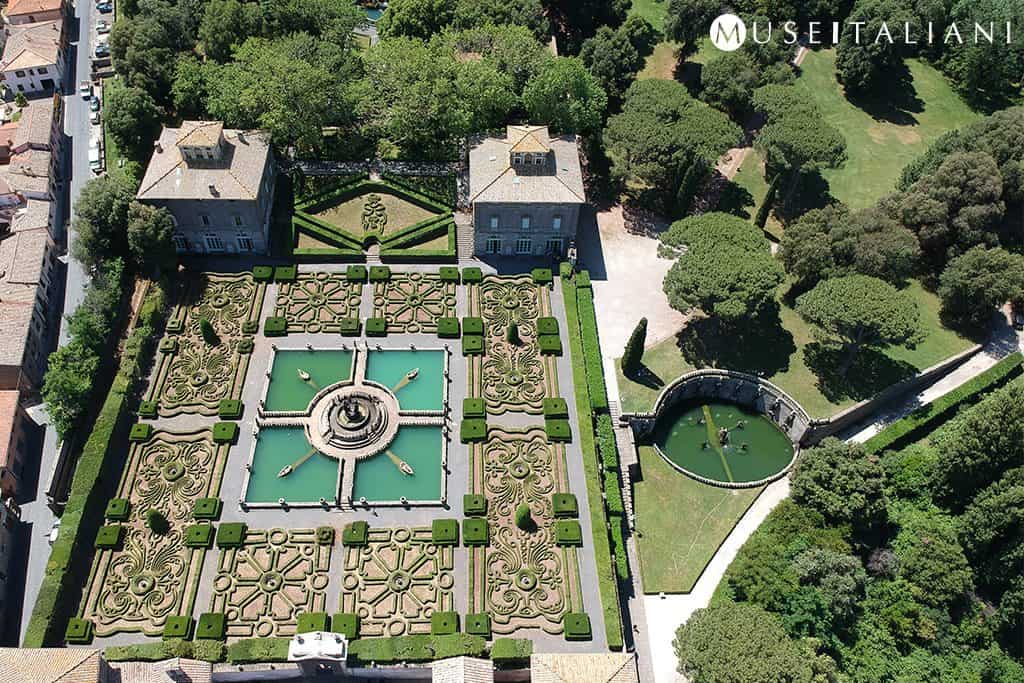
At the bottom of the descent the masterpiece opens up: the Square, the lower formal garden, a perfectly regular parterre closed on three sides by tall boxwood hedges and on the fourth by the two small palaces. The boxwood is clipped and shaped to form geometric designs around small fountains and statues, in a symmetry that precedes by a generation the great French parterres of Saint-Germain-en-Laye and Fontainebleau. At the center, in a pool of water divided into quadrants, stands the Fountain of the Moors, attributed to the circle of Giambologna: four life-size figures of Moors, arranged in a square around two lions, hold aloft the mount with the star, the coat of arms of the Montalto, from which a radiating spout rises. It is the point where the water, after all its journey, settles into absolute geometry. Whoever climbs the turret or leans out from the terrace of the small palaces takes in the whole design from up there, and it is the view that made Villa Lante a model studied throughout Europe.

The Barco: The Wooded Park of Villa Lante at Bagnaia (VT)
Beyond the formal garden extends the barco, the English-style park grown on the old hunting preserve. It is a different world: no more symmetries, but shady avenues, clearings, tall trees and paths that invite you to walk without a destination. A 17th-century map of the complex shows how already then the barco was crossed by scenic routes, dotted with obelisks and even a labyrinth. At the edge between the town and the park you meet a monumental fountain linked to the myth of Pegasus, the winged horse surrounded by the Muses, which marked the entrance to the wooded part. The contrast between the two worlds, the measured garden and the free woods, is intended: the 16th-century villa staged the passage from wild nature to art, and the barco is the wild half of that story. Today it is the place where families stop for a packed lunch and children run, while the formal garden is for contemplating.
The Hydraulic Ingenuity Behind Villa Lante at Bagnaia (VT)
All this theater of water would not exist without someone who knew how to bring it and distribute it. The hydraulic direction of the garden is assigned by tradition to Tommaso Ghinucci, an engineer and architect from Siena, who tapped the springs of the mountain above Bagnaia and led the water by gravity from level to level, measuring it out so that each fountain had its own pressure and its own effect. The name of Pirro Ligorio, a great connoisseur of antiquities and maker of similar displays elsewhere in Lazio, was also associated with the design of the garden. What still amazes is that the system works centuries later without pumps: the water that slides today in the chain and fills the basin of the Moors is moved by the same law of gravity that the 16th-century engineers knew how to follow. A garden like this is, first of all, a hydraulic problem solved with elegance.

A Curious Fact About Villa Lante at Bagnaia (VT)
The curiosity that almost nobody tells is about the crayfish. Cardinal Gianfrancesco Gambara had a crayfish in his coat of arms, and his vanity as a patron led him to sow it throughout the garden like a hidden signature. The carved channel we call the water chain, according to a very widespread reading, is not a chain at all, but a long stylized crayfish, with its claws at the top and its segmented tail running down the staircase: the water literally flows inside the cardinal's heraldic animal. And it is not the only one. Anyone who walks attentively finds the crayfish and the name Gambara carved on cornices, friezes and inscriptions, in a sort of treasure hunt that the cardinal had scattered to remind every guest whose villa it was. This habit of signing the garden with one's own heraldic emblem, typical of 16th-century patronage, reaches at Bagnaia an almost obsessive density, and it is one of the most entertaining keys to reading the place: look at the stones, and they will tell you a surname. It is worth arriving in front of the chain knowing this, because without this information you see an abstract decoration, and with it you see a portrait.
Something Nobody Tells You About Villa Lante at Bagnaia (VT)
The practical secret that guides often skip is that Villa Lante has two souls that don't always open together: the formal garden with the fountains, and the interiors of the palazzine with the frescoes. The garden is the reason almost everyone comes, and it stays accessible according to the seasonal schedule. The interiors, instead, for reasons of conservation and staffing, can have limited admissions, their own hours or days when they aren't visited. Anyone who arrives convinced they'll walk comfortably into Cardinal Gambara's painted loggia may find the door closed, and head home without having seen the frescoes that tell of the villas of Italy. The right move is to ask explicitly at the ticket office as soon as you arrive, and if needed plan the visit so as to catch the possible opening of the interiors. Then there's a second little-known point: the wooded barco, open and free, is the part of the complex where you can spread a blanket and have lunch, while in the formal garden, as is only right, the rules are stricter. Knowing in advance where you can stop to eat changes the day, especially with children.
The Advice I Give You for Visiting Villa Lante in Bagnaia (VT)
The advice is one: visit the garden going up, but come back going down. Almost everyone enters from the lower Quadrato, admires the Fountain of the Moors and climbs back up the terraces to the grotto, and that's right, because the surprise grows at every level. But the design is conceived for water that descends, and the deep sense of the garden is revealed only when, having reached the top, you turn around and walk back down following the current: then the chain, the table, the little lamps and finally the geometric mirror of the parterre fall into the order the architect wanted, and the story is complete. The second piece of advice concerns timing: arrive early, in the first hour after opening, when the light is raking and the garden is empty, or in the late afternoon in summer. At noon in August, with the sun straight overhead, the uncovered terraces bake and the photographs come out flat. Bring water and a hat, because the only real shade is in the barco, and allow two hours to do things calmly, more if you add the interiors and the woods. One last thing: don't run to the water chain and leave. Stop at the cardinal's table, close your eyes and listen. It's a garden you visit with your ears as well as your eyes.
Another Well-Known Fact, Yet Rarely Cited
People often say that Villa Lante is the work of Vignola, and indeed tradition attributes it to him with good stylistic reasons. The fact that almost no one adds is that the document is missing. To date there is no contemporary record naming Jacopo Barozzi da Vignola as the designer of Bagnaia: the attribution rests on the evident affinity with the nearby Palazzo Farnese in Caprarola, a site where Vignola was working in the same years, and on the logic of the patronage. It's a sturdy tradition, not a documented fact, and it's correct to keep the two things distinct. There's more: the dating too must be handled with caution. Some sources place the start of the works at the beginning of the 16th century, but that date most probably refers to the barco, that is, the fencing of the hunting preserve, while the garden with the fountains that we admire today comes from the design wanted by Cardinal Gambara in the second half of the century. Confusing one with the other makes the villa look older than its garden is. Distinguishing the old barco from Gambara's garden is the only reading that holds up before the stones.
The Right Photo to Take at Villa Lante in Bagnaia (VT)
The photograph you take home from Villa Lante is not the close-up of a fountain, but the overall view of the Quadrato from above. Climb toward the two palazzine and look for the raised spot from which you dominate the lower parterre: from there the eye takes in the complete design of the boxwood hedges, the water quadrants and, at the center, the Fountain of the Moors with its jet. It's the image that set the standard in all the manuals of garden history, and it can't be repeated at ground level, where the geometry is lost. The best light is that of early morning or late afternoon, when the long shadows of the hedges draw the parterre and the water takes on warm reflections. The second shot not to be missed is the water chain seen from below, on axis, with the staircase rising and the cypresses narrowing the perspective: kneel and hold the camera low, so the carved channel fills the center of the image and the water seems to descend toward you. Avoid the summer noon, which kills the contrasts and burns the pale stones. If you're looking for a detail, aim at Giambologna's moors against the light, with the radiating jet lighting up against the sky.
Some Important Events That Took Place Here in History
The story of Villa Lante is made more of changes of hands than of battles, but a few moments marked the place. The first is the transformation wanted by Cardinal Gambara: within a few years a hunting woods becomes one of the most admired gardens in Europe, and the banquets the cardinal laid out on the water table enter the society chronicles of his time. It is told, and here we are in the field of handed-down anecdote more than of documents, that a high-ranking visitor found the cardinal guilty of having spent too much on his own pleasure instead of on the poor, and that to make amends he was forced to fund charitable works in the city: a story that expresses well the climate of suspicion toward cardinalate luxury in the season of the Counter-Reformation.
The second moment is the 17th-century completion by Cardinal Montalto, who welds the two souls of the villa together and installs the Fountain of the Moors with the family coat of arms. The third is the long ownership of the Lante, which gives the villa its definitive name and runs through it for centuries, enriching it with new botanical species without upsetting its layout. In the 20th century comes the passage to the State and the season of restorations and openings to the public, with the villa becoming part of the national museum heritage. The recent recognitions, the title of most beautiful park in Italy in 2011 and the commemorative coin of 2014, are the last chapter: the official consecration of a place that specialists had always known and that the general public has finally learned to love.
Who Passed Through Villa Lante at Bagnaia (VT)
Through Villa Lante passed first of all its two great patrons, Cardinal Gianfrancesco Gambara and Cardinal Alessandro Peretti di Montalto, the latter a nephew of Pope Sixtus V, who with their courts filled the garden with banquets and receptions. Around them gravitated the world of the arts of the late 16th century: tradition ties to the place the name of Jacopo Barozzi da Vignola for the design, that of the Sienese engineer Tommaso Ghinucci for the hydraulics, that of the scholar Pirro Ligorio as consultant and that of the circle of Giambologna for the sculpture of the central fountain. With the arrival of the Lante, and then in the centuries of the Grand Tour, the villa became a destination for travelers, draftsmen and garden enthusiasts, who carried its fame across the Alps. In the 20th century the French architect Georges Gromort consecrated its critical primacy in a treatise that generations of landscape designers have studied. It is not the place of the great imperial or papal presences that crowd Rome: it is rather the place where those who wanted to understand how a garden is made have passed, and still pass. Scholars, landscape architects and photographers keep coming to Bagnaia for the same reason as four centuries ago, to measure the perfection of a model.
What to See Near Villa Lante at Bagnaia (VT)
Villa Lante can be visited in a morning, and the Tuscia area around it deserves the rest of the day. A few minutes away is Viterbo, with its medieval San Pellegrino quarter and the Palace of the Popes, one of the most intact art cities of Lazio. In the days of September the city celebrates the carrying of the Macchina di Santa Rosa, a luminous tower carried on shoulders that is a World Heritage item. Not far away, the Park of the Monsters of Bomarzo, the famous 16th-century Sacred Grove with its colossal sculptures, offers the exact opposite of Villa Lante: if here everything is order, there everything is wonder and caprice, and the two places read very well as a pair. To complete the picture of Viterbo Mannerism there is Palazzo Farnese at Caprarola, the pentagonal palace of Vignola, that is, the same architect to whom Bagnaia is attributed, with its upper gardens. For those who love water and gardens, the ideal trip continues toward Tivoli, where Villa d'Este stages the monumental version of the same theme and Hadrian's Villa shows its ancient ancestor. And if you are looking for a corner of absolute peace, Lake Vico is a short step away, while farther south the Garden of Ninfa ideally closes the great atlas of Lazio's gardens. In Rome, those who want to stay on theme can continue with Villa Doria Pamphilj and with Villa Farnesina.
Villa Lante at Bagnaia (VT) with Children
Villa Lante is a place children get right away, because water is everywhere and it moves. The chain that slides down, the jets of the Moors, the fountain of the little lamps, the small basin of the cardinal's table: these are attractions that need no explaining. The wooded barco, then, is the right space to run around, look for the obelisks among the trees and have a snack on a blanket. A little game that always works is the crayfish hunt: tell the older kids the story of the cardinal's coat of arms and let them look for the crayfish carved into the stones of the garden, starting from the water chain. In the formal garden the usual rules apply, no hands in the basins and a calm pace among the hedges, but no barrier makes the visit tiring for a family. The stroller handles the main paths well, with a few steps to expect between one terrace and the next. Allow a couple of hours and a water refill, and it will be one of the day trips outside Rome that children remember.
When to go to Villa Lante in Bagnaia (VT)
The season makes a big difference. Spring, between April and June, is when the garden is at its best: the camellias and flowering shrubs are in full push, the green is fresh and the long days allow wide opening hours. Autumn, between late September and October, offers warm light and few crowds, ideal for photography. Summer is splendid early in the morning and in the late afternoon, but avoid the central hours, when the uncovered terraces become scorching and the overhead light flattens every contrast. Winter has its austere charm, with the layout of the garden readable in the bareness of the hedges, but the hours are reduced and on holidays in the dark months closing comes as early as lunchtime. If you can choose, aim for a morning in May or an afternoon in October, and keep Monday out of your plans, because it is the closing day.
The frescoes of Villa Lante in Bagnaia (VT): a painted garden
Anyone who manages to enter the loggia of the Palazzina Gambara finds a surprise worth the trip: the garden is painted on the walls before it was even finished in reality. The cycle of landscape frescoes decorating the barrel vault shows the great villas and gardens of Italy, and among them Bagnaia itself, portrayed according to the original design. It is like leafing through the patron's wish album: next to Villa Lante appear other famous places of the cardinals' country retreats, and the visitor understands that the cardinal was not building just any garden, but one piece of a broader discourse on the way ecclesiastical power represented itself through the art of country living. The hunting scenes painted in one of the rooms recall the origin of the place as a barco, and hold together the two souls of the villa, the wildness of the woods and the order of the garden. In the Palazzina Montalto, instead, the decoration turns toward a more solemn and classical taste, with stuccoes and fake architectural openings that create illusory views on the walls, following the lesson of the great Roman decoration of the late sixteenth century. The comparison between the two interiors is a lesson in the history of taste: the same architectural box, two generations of patronage, two distinct decorative sensibilities.
The iconographic program of Villa Lante in Bagnaia (VT): from nature to art
A sixteenth-century garden is never just beautiful: it is a discourse in stone and water. At Villa Lante the discourse is very clear, and knowing it changes the visit. At the top, where the water gushes from the grotto among rough stone and untidy green, we are in nature in its wild state, the golden age of primitive humanity. As the water descends, nature lets itself be tamed: the forms become more regular, the fountains more architectural, until at the bottom we reach the Quadrato, where the clipped boxwood and absolute symmetry represent the triumph of art and reason over the formless. The path from top to bottom is therefore a parable about civilization: from water erupting free to the geometry that harnesses it. It is the same program found, with different results, in the other great villas of the century, but at Bagnaia it reaches an exemplary clarity, because the contained slope allows you to read the whole sequence at a single glance. When you reach the top and turn around, you are not just looking at fountains: you are looking at the way the Renaissance thought about the relationship between man and the natural world.
The boxwood, the camellias and the botany of Villa Lante in Bagnaia (VT)
The green structure of the garden rests mostly on boxwood, the evergreen shrub that, clipped and shaped, draws the geometric patterns of the Quadrato and the borders. It is a slow, patient plant that requires continuous pruning and constant maintenance: the sharp forms we see today are the result of centuries of uninterrupted work, and every oversized hedge would immediately tell of a year of neglect. To the evergreens that draw the original layout, other species were added over time: already in the nineteenth century, with the romantic sensibility for the flowering garden, camellias and acid-loving flowering shrubs were introduced, and in the right months they light up the middle terraces with color. The barco, with its tall trees, adds the register of the true woods, with the shade and coolness that the formal garden does not grant. Anyone who loves plants finds here a small living treatise on the Italian garden: the geometry of the evergreen below, the blooms added over the centuries on the terraces, the natural woods above. Three ways of understanding green, one on top of the other.
Villa Lante in Bagnaia (VT) and the other villas of the Lazio Renaissance
Villa Lante cannot be fully understood without its sisters and rivals. The most obvious is Villa d'Este in Tivoli, born from the same cultural environment and the same cardinals' passion for water: there, however, everything is quantity, challenge, expense, with hundreds of jets and a scale that wants to overwhelm the visitor. Bagnaia chooses the opposite road, restraint, and for this very reason many critics consider it more successful, more livable, more intelligent. Not far away is the exact reverse of Villa Lante: the Sacred Grove of Bomarzo, with its stone monsters and its deliberately crooked perspectives, where the sixteenth century plays with unease and wonder instead of order. Seeing the two places on the same day is one of the most instructive experiences Lazio can offer, because it shows the two faces of Mannerism, rule and caprice. Then there is the close link with Palazzo Farnese in Caprarola, the pentagonal palace also attributed to Vignola, which shares with Bagnaia the architectural language and perhaps the hand. Together, these places draw an itinerary of Viterbo Mannerism that few corners of Italy can equal, and Villa Lante is its most refined point.
Why Villa Lante in Bagnaia (VT) set the standard in Europe
There is a reason generations of landscape architects took the train to Bagnaia with a notebook in their pocket. Villa Lante solved, in a small space, all the problems of the formal garden: the relationship between the house and the green, the handling of the slope with terraces, the role of water as a common thread, the geometry of the parterre. When in France they began to design the great regular gardens that would later lead to Versailles, the perfectly ordered parterre of the Quadrato at Bagnaia had already been there for a generation, showing how it is done. The French architect Georges Gromort, in a 1934 treatise that trained crowds of landscape designers, pointed to it as one of the peaks of the Italian garden, admiring in particular the naturalness with which water governs the composition and the skill with which the terraces dialogue with the landscape. The secret, he said in essence, is that reducing the size does not impoverish the garden but makes it more intimate, more livable. It is exactly the feeling of anyone who arrives there today: not the cold admiration for a great machine, but the pleasure of a space on a human scale, where everything is in its place for a reason. That is why Villa Lante is not only beautiful, it is didactic: it teaches what a garden is.
The water theater of Villa Lante in Bagnaia (VT)
Scholars call the scenographic ensemble that closes the garden at the top the water theater, where grotto, fountains and loggias compose a unified backdrop. It is the stage set of the water story: from here the current starts, and from here the gaze, once you have climbed to the top, takes in the whole descent down to the Quadrato. The term theater is no accident. A garden like this was truly a stage: receptions, music and surprise water games that soaked unsuspecting guests were held here, in keeping with a taste for the hydraulic prank much loved in the sixteenth century. The loggias offered the sheltered box from which the court watched the spectacle of the garden, and the cardinal's stone table itself, with water running down the middle to cool the food, was part of the staging. Visiting Villa Lante thinking of this theater, and not of a silent museum, gives the place back its original function: a garden was not made to be looked at on tiptoe, but to be lived loudly, with the court, the water and the music.
Services and practical tips for visiting Villa Lante in Bagnaia (VT)
Some practical information to organize the day without surprises. The visiting route of the garden develops over terraces connected by staircases, so comfortable shoes are a must and heels should be left at home. There is no shade in the formal garden, all of it uncovered, while the barco offers shelter among the trees: in summer plan accordingly, with a hat and water. For eating, the wooded barco is the place for a packed lunch. In the town of Bagnaia you can find bars and trattorias a few steps from the gate. The stroller handles the main paths but meets steps between one level and another. Visiting the garden alone takes an hour and a half or two. Adding the woods and any interiors makes it half a day. Anyone who wants to truly understand the place can consider a guided visit, bookable in advance, because many of the meanings of the garden, from the cardinal's crayfish to the iconographic program of the water, are lost without someone to tell them. Finally, remember the golden rule of this villa: it is closed on Monday, and the hours change with the seasons, so a check before leaving avoids the disappointment of the locked gate.
Quick questions about Villa Lante in Bagnaia (VT)
How much does a ticket to Villa Lante in Bagnaia (VT) cost?
The full ticket costs €8, the reduced ticket €2. Free admission by law applies to those under 18, and the reduction applies to the 18 to 25 age group. It's best to check the updated rates before the visit.
What is the closing day of Villa Lante in Bagnaia (VT)?
The weekly closing day is Monday. On the other days the villa is open according to the seasonal schedule, with last entry about an hour before closing.
What are the opening hours of Villa Lante in Bagnaia (VT)?
The hours change with the seasons: you can enter from 8:30 and it closes in the early afternoon in winter, up to 19:30 in the height of summer. On holidays in the winter months closing is moved up to early afternoon. Better to check the hours for the day you choose before leaving.
How do you get to Villa Lante in Bagnaia (VT) from Rome?
By car from the Cassia or from the A1 with the Orte exit and the expressway to Viterbo, then follow the signs for Bagnaia. By train to Viterbo and from there a city bus that reaches Bagnaia in about 10 minutes. The trip takes between an hour and a half and two hours.
Do I need to book to visit Villa Lante in Bagnaia (VT)?
For the individual visitor, booking is not required. For groups and guided visits, it's best to call ahead at 0761 288008.
How long does the visit to Villa Lante in Bagnaia (VT) take?
For the formal garden an hour and a half or two hours is enough. Adding the wooded barco and any interiors of the palazzine, it comfortably becomes half a day.
Can you see the interiors of the palazzine?
The interiors with the frescoes may have limited access or days of their own, for conservation reasons. The best thing is to ask at the ticket office on arrival, because the garden is always open to visit while the interiors are not always.
Is Villa Lante in Bagnaia (VT) wheelchair accessible?
The garden develops over terraces connected by staircases, so the route is not entirely flat. Some paths can be walked, but the differences in level between the terraces involve steps. For a precise picture of the accessibility conditions, it's best to contact the ticket office before the visit.
Can you have a picnic at Villa Lante in Bagnaia (VT)?
Not in the formal garden, but the wooded barco is the right place to stop with a blanket and a packed lunch. It is the part of the complex where families most willingly linger.
Is Villa Lante in Bagnaia (VT) suitable for children?
Very: the water flowing everywhere captivates the little ones, and the barco offers room to run. The rules of the formal garden must be respected, but the visit is not tiring for a family.
Why is it called Villa Lante?
The name comes from the Lante family, and in particular from Ippolito Lante Montefeltro della Rovere, Duke of Bomarzo, to whom the property passed in the seventeenth century. Originally the villa was linked to the cardinals Gambara and Montalto, who built it.
Who designed Villa Lante in Bagnaia (VT)?
The design is traditionally attributed to Jacopo Barozzi da Vignola, the architect of the nearby Palazzo Farnese in Caprarola. The attribution is strong because of similarity of style but is not confirmed by contemporary documents.
What is the water chain of Villa Lante in Bagnaia (VT)?
It is a long channel carved in the center of a staircase, in which the water slides, rippling. Many read in it the shape of a crayfish, an allusion to the coat of arms of Cardinal Gambara, and it is one of the most famous elements of the garden.
What is the Fountain of the Moors?
It is the fountain in the center of the lower garden, attributed to the circle of Giambologna: four life-size Moors around two lions hold up the mountain with the star, the coat of arms of the Montalto, from which a radiating jet rises.
Why are there two identical palazzine?
Because they were built at two different times by two different cardinals, Gambara first and Montalto later, following a design that gave up a single large palace to leave the foreground to the garden. The two palazzine act as wings of the green scene.
Does Villa Lante in Bagnaia (VT) have working fountains?
Yes, the sixteenth-century hydraulic system works by gravity and still feeds fountains, cascades and the water chain, without pumps. It is one of the reasons for its value.
Is entry free on the first Sunday of the month?
Villa Lante is among the state sites that take part in the free admission days promoted by the Ministry, including many first Sundays of the month. The dates vary from year to year, so it's best to check the official calendar.
What is there to see near Villa Lante in Bagnaia (VT)?
Within a few kilometers there are Viterbo with its medieval center, the Park of the Monsters in Bomarzo, Palazzo Farnese in Caprarola and Lake Vico. Farther away, in Tivoli, Villa d'Este offers the monumental version of the same water theme.
How long does it take to do the water chain and the terraces?
Climbing slowly from the Quadrato to the grotto and coming back, the fountain route takes about an hour. Adding stops, photographs and the barco, it easily becomes two hours or more.
What is the best time to visit Villa Lante in Bagnaia (VT)?
Spring, between April and June, for the blooms, and autumn, between late September and October, for the warm light. Summer is fine early in the morning or in the late afternoon, avoiding the central hours.
Is there parking at Villa Lante in Bagnaia (VT)?
Yes, you park near the center of Bagnaia and then continue on foot uphill for a few minutes to the gate on Via Jacopo Barozzi. The town is small and the signs are easy.
How far is Villa Lante in Bagnaia (VT) from Viterbo?
Bagnaia is a district of Viterbo, a few kilometers from the city center. By city bus the connection takes about 10 minutes, which makes it convenient to combine the villa with a visit to Viterbo on the same day.
Who runs Villa Lante in Bagnaia (VT) today?
The villa belongs to the State, run by the Ministry of Culture through the institute Ville monumentali della Tuscia, which administers it together with Palazzo Farnese, Palazzo Altieri and Villa Giustiniani.
Why is the water chain shaped like a crayfish?
Because Cardinal Gianfrancesco Gambara had a crayfish in his coat of arms, and had it reproduced in the garden as a heraldic signature. The carved chain is one of its appearances, along with the name Gambara engraved on frames and friezes.
One thing above all stands out about Villa Lante: restraint. In a century that loved splendor, someone here understood that a garden is not judged by its square meters but by the intelligence with which the water descends from one level to another. If you have to choose only one villa-garden to see in Lazio, and you have already done Tivoli, come to Bagnaia: you will leave convinced that perfection, sometimes, lies in a small thing made without a single mistake. Give yourself time to walk back down following the water, and you will understand why four centuries of architects came all the way here to take notes.
Article written by the editorial team of TourLeaderPro, contact them for Private/Corporate/V.I.P. Tours and Experiences.
Planning a trip to Rome? The English guides to visiting the city are on ItalyPlanner.com.