Palazzo Farnese in Caprarola (VT)
In short. Palazzo Farnese in Caprarola is visited in Piazza Farnese, at the top of Via Dritta, which cuts the village in two, in Viterbo Province, about 60 kilometers from Rome.
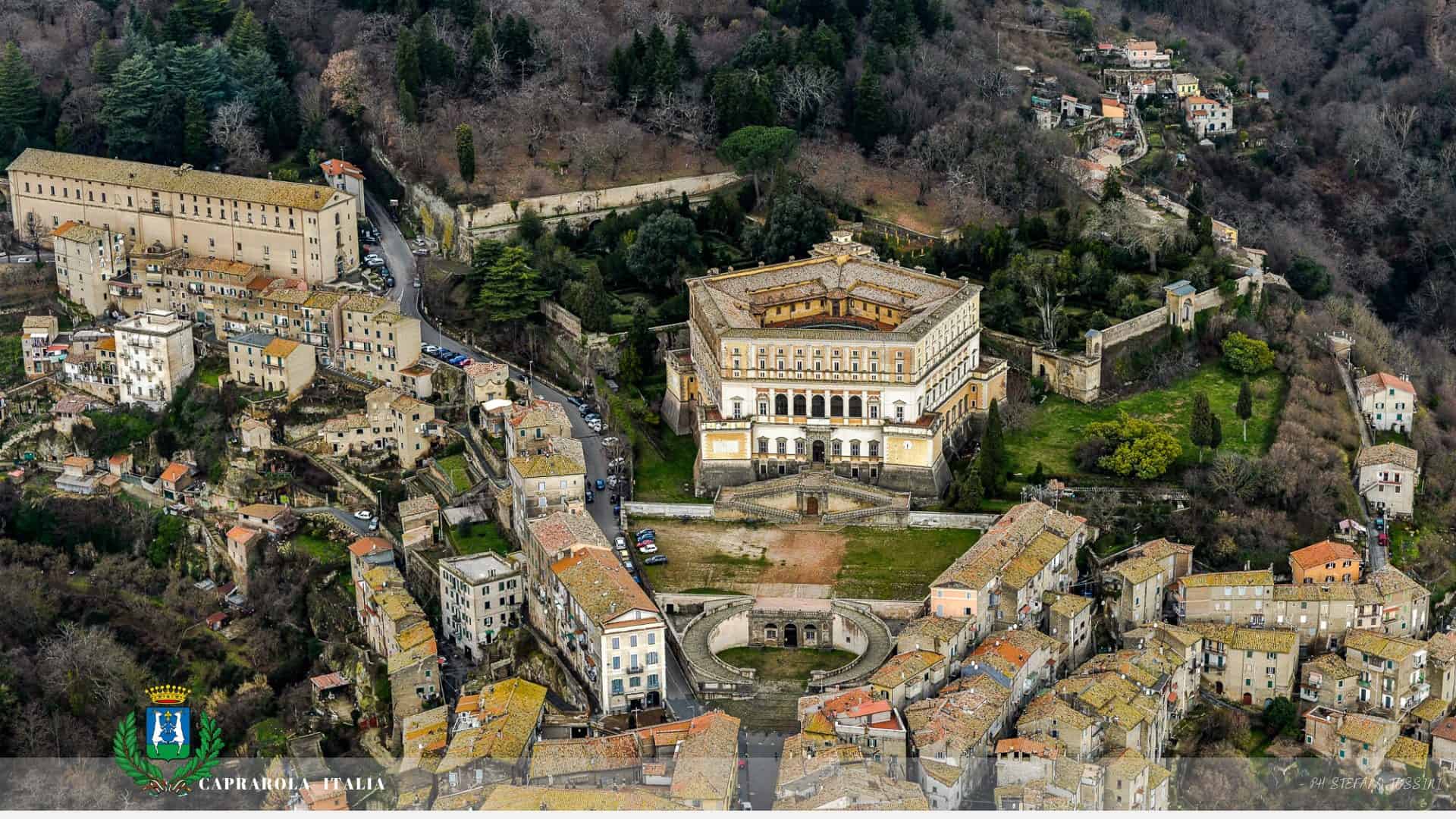
Palazzo Farnese in Caprarola is visited in Piazza Farnese, at the top of Via Dritta, which cuts the village in two, in Viterbo Province, about 60 kilometers from Rome. It's open Tuesday through Sunday and stays closed on Mondays. The ticket office is on the ground floor, just past the monumental staircase, and sells both the ticket for the apartments and the one that includes the guided visit to the gardens, which you can't walk through freely. Updated prices, last entry and the calendar of special openings are published by Istituto Ville monumentali della Tuscia, which manages the palace on behalf of the Ministry of Culture: it's worth checking them the day before you get in the car, because the park's hours change with the season, since it closes one hour before sunset, and garden tours leave at fixed times. By car, you can arrive via the Cassia or the A1 motorway, exiting at Orte, by public transport, you leave from Rome on Cotral regional buses, while the nearest useful train station is Capranica Sutri, on the Rome-Viterbo line. For the full visit, apartments and gardens, allow two and a half hours.
Anyone planning a day in the Tuscia finds here one of the few sixteenth-century Italian buildings still substantially intact in its structure, decoration and relationship with the landscape: a pentagon of golden stone set on top of a village of 5,000 residents, with a round courtyard carved inside, a spiral staircase rising on double columns and 11 frescoed rooms by some of the best painters active in Rome between 1560 and 1580. If your itinerary also includes Viterbo and the villages of the Cimini Mountains, the page dedicated to the village of Caprarola completes the picture.

How to Get to Palazzo Farnese in Caprarola
By Car from Rome to Palazzo Farnese in Caprarola
The most convenient route isn't the shortest on paper. From north Rome, take the A1 motorway toward Florence, exit at Orte and head for Viterbo on the ring road, then head south on the provincial road that serves the Cimini Mountains: the road is wide, the surface is good, and the actual travel time, in normal traffic, is around an hour and a quarter. The alternative is the Cassia as far as Monterosi and then the Cassia Cimina, a beautiful road that climbs through the hazel groves and overlooks the lake: driving is harder, you arrive later, and you see a lot more. It's worth driving it on the way there, when there's time and daylight, and taking the motorway back.
Parking is the weak point of the day. The square in front of the palace is small and largely taken up by the monumental perspective. Leave the car along Via Dritta or in the open areas of the lower part of the village and walk up. It's a five-minute climb, a real uphill, not a gentle slope: anyone with mobility problems should drop passengers off at the top and then go back to park. Coaches have a dedicated bay: the drivers know it, the satnavs don't.
By Public Transport to Palazzo Farnese in Caprarola
Cotral regional buses leave Rome from the Saxa Rubra terminal, on the Roma Nord line: the trip is direct but long, just under an hour and a half, and the bus stops at Caprarola village, a few minutes' walk from the palace. Buses run more often on weekdays than on holidays, and this is the detail that ruins more day trips than any other: anyone arriving on a Sunday on the late-morning bus may have only one useful bus back. Check timetables on the operator's website before setting out.
Frequently Asked Questions about Palazzo Farnese in Caprarola
How do I get to Palazzo Farnese in Caprarola from Rome?
Palazzo Farnese in Caprarola is reached from north Rome by taking the A1 motorway toward Florence, exiting at Orte, and heading for Viterbo on the Viterbo link road, then turning south on the provincial road that serves the Cimini Mountains. The actual travel time, with regular traffic, is around an hour and a quarter. The palace is a little over 60 kilometers from the capital.
What are the opening hours and tickets for Palazzo Farnese in Caprarola?
Palazzo Farnese in Caprarola belongs to the State, and it is run by Istituto Ville monumentali della Tuscia, part of the Ministry of Culture. It is open Tuesday through Sunday, from 8.30 to 19.30, with a weekly closing day on Monday. The ticket office closes at 18.45, and the park closes one hour before sunset. Tickets are bought at the ticket office inside, while for groups and school classes, booking is required.
Why does Palazzo Farnese in Caprarola have a pentagon shape?
Palazzo Farnese in Caprarola has five sides because it originated as a military fortress. The five-pointed plan with bastions at the corners was, in the first half of the 16th century, the technical answer to artillery fire, able to make cannon shots glance off rather than offering a straight wall to hit. The original design was by Antonio da Sangallo the Younger and Baldassarre Peruzzi, later taken up by Vignola for Cardinal Alessandro Farnese.
Is Palazzo Farnese in Caprarola accessible by wheelchair?
Palazzo Farnese in Caprarola works at two speeds: the main building has an elevator, and a large part of the interior route is passable by wheelchair, but the access from outside goes up monumental staircases and a sloping square. Anyone with mobility needs should call the museum before the visit to be shown the entrance and the most suitable assistance, if any.
Is Palazzo Farnese in Caprarola suitable for a visit with children?
Yes, Palazzo Farnese in Caprarola works better than expected with children, as long as you choose the right keys: the fortress shape with moat and bridges, the Scala Regia spiral staircase that turns on itself, and the room where the whole world is painted on the walls are three concrete elements that can hold the attention of an eight-year-old child.
What is the best time to visit Palazzo Farnese in Caprarola?
The best time to visit Palazzo Farnese in Caprarola is autumn, from late September to early November, when the hazelnut groves change color, the beech woods of the Cimini Mountains light up, and the low light is perfect for Via Dritta, with fewer groups around. Spring is just as beautiful but more crowded, with peaks on weekends in April and May.
Can you visit the gardens of Palazzo Farnese in Caprarola?
Yes, behind the building stretches a system of late Renaissance gardens, called Farnese Gardens in the old inventories, considered among the most complete examples surviving in Italy. The garden visit follows a fixed schedule separate from the rooms' open schedule, so it's worth asking right when you buy your ticket for the times of the guided visit and planning your day around them.
You can't reach Caprarola by train. The village has a station on the old Rome Civita Castellana Viterbo railway, but service on that stretch is not running. The useful stop is Capranica Sutri, on the line to Viterbo, though you'd still need a bus or taxi from there. For a single day trip from Rome, driving is still the most sensible choice. Anyone traveling in a group who doesn't want to drive can rely on a professional tour guide: the network of tour leaders from TourLeaderPro usually works in this part of the Tuscia.
From Viterbo, Ronciglione and Lake Vico
From Viterbo it's a little over 20 kilometers, just under half an hour via San Martino al Cimino. This is the route I recommend to anyone staying in town who wants to combine the morning in Caprarola with the afternoon in the gardens of Villa Lante in Bagnaia, another work by Vignola, less than 20 minutes away. From Ronciglione, the drive up takes a quarter of an hour, skirting the Lake Vico nature reserve, and this is the best way to understand where you are: the palace looks south toward the countryside, but behind it is a volcanic crater with a lake inside at an elevation of 510 meters.
Opening hours, tickets and bookings for Palazzo Farnese in Caprarola
The palace belongs to the State, and it is managed by Istituto Ville monumentali della Tuscia, part of the Ministry of Culture. It is open Tuesday to Sunday, from 8.30 to 19.30, with the weekly closure on Monday. The ticket office closes at 18.45, and the park closes one hour before sunset. You buy tickets at the internal ticket office. For groups and school classes, booking is required. For individual visitors, it is usually not needed. Exact prices, reductions and free admission are published on the museum's official website. It is the only source worth checking, because state discounts change and the lists circulating online age badly.
One tip that saves time: the apartments and the gardens are not visited in the same way. The rooms of the piano nobile are toured on your own, following the marked route. The gardens can only be reached with a staff guide, in groups that leave at set times. You should ask for them at the ticket office as soon as you enter. If you arrive in the middle of the afternoon and find the last departure has already left, you have missed the most beautiful half of the visit.
How Long the Visit to Palazzo Farnese in Caprarola Lasts
Just over an hour for the piano nobile if you walk slowly and look at the ceilings, which here matter as much as the walls. 40 minutes for the gardens, including the uphill stretch between the two levels. Add half an hour if you want to stop in the circular courtyard to understand how it's built, and another half hour for the village. A full day, including breaks, takes three hours. It's the kind of place that punishes hurrying: the rooms only look alike to someone who crosses them in five minutes.
The Gardens of Palazzo Farnese in Caprarola Are Visited Separately
The gardens behind the building are on terraces, connected to the palace by bridges that span the moat. The guided route goes through the Summer Garden or the Winter Garden, climbs to the Giardini Alti, and reaches the palazzina in the greenery. The total change in elevation is not trivial, and the ground is gravel and stone. Wear closed shoes, not beach sandals. On days of heavy rain, the garden visit may be suspended for safety reasons.
A Curiosity About Palazzo Farnese in Caprarola (VT)
The curiosity that surprises visitors most has nothing to do with a fresco. It's a shape: the pentagon. Palazzo Farnese in Caprarola has five sides because it was born as a military fortress. In the first half of the sixteenth century, a five-pointed plan with bastions at the corners was the technical answer to gunpowder artillery. A straight, high wall invited the cannonball. An angled bastioned front deflected it and let the defenders fire along the flank at anyone who approached the curtain wall. The pentagonal foundations were laid between 1515 and 1530 to a design by Antonio da Sangallo the Younger and Baldassarre Peruzzi. Those two names weigh in the history of Italian architecture as much as the painters who came later. Then the patron died, politics changed, and the nephew found himself with a fortress base and a desire for a villa.
Here comes the part nobody expects. Jacopo Barozzi da Vignola didn't demolish anything. He took the defensive pentagon, accepted it as a constraint, and built a residence for display on top of it. He replaced the bastions with panoramic terraces and carved a perfectly circular courtyard into the block. The result is a building that reasons in pure geometric forms, a circle inside a pentagon, and it has almost no parallel in Europe. The moat remained, with its drawbridges, but it no longer defended anything. It served to isolate the palace from the ground and to give it the distance that, in the language of the time, meant rank.
The detail that closes the circle is twentieth-century and American. When the United States planned the new headquarters of the Department of Defense, the chosen plan was a pentagon. A large part of the pentagon's fortune in architecture comes from the sixteenth-century treatises and engravings that spread models like this one. Telling this in the courtyard, to a group that has just toured the rooms, always works. It's the moment when people stop looking at the paintings and start looking at the building.
The Construction History of Palazzo Farnese in Caprarola
The Pentagonal Fortress by Antonio da Sangallo the Younger and Baldassarre Peruzzi
Alessandro Farnese the Elder, the cardinal who would become pope in 1534 under the name Paul III, acquired the fief of Caprarola in 1504. He commissioned Antonio da Sangallo the Younger and Baldassarre Peruzzi to design a fortress. Peruzzi's surviving drawings show a five-pointed fortress with sloping walls and projecting bastions, designed to allow enfilade fire against anyone who approached. Construction proceeded in phases between 1515 and 1530, then slowed. Sangallo's death in 1546 stopped it completely. What remains from that period is what you can't see: the base, the level, the perimeter. Every later decision had to deal with those foundations.
It's worth pausing for a moment to consider who these two were. Antonio da Sangallo the Younger was the head of the Fabbrica di San Pietro, the man who ran the largest papal building sites in Europe. Baldassarre Peruzzi, from Siena, was the architect of the Farnesina and one of the most refined perspective draftsmen of the Renaissance. Entrusting a provincial fortress to them shows how much the Farnese family considered that stretch of Tuscia strategic, on the route linking Rome to the Lake Bolsena domains.
Cardinal Alessandro Farnese the Younger and the Choice of Vignola
Alessandro Farnese the Younger was born on October 7, 1520, in Valentano, and was made a cardinal at 14, in 1534, by his grandfather, who had just been elected pope. From 1535 until his death he held the office of vice chancellor of the Holy Roman Church, one of the most lucrative positions in the Curia. He was archbishop of Monreale and, from 1580, cardinal bishop of Ostia and dean of the College of Cardinals. With that income he built and collected like few others of his century. His collection of ancient sculpture was the largest ever assembled by a private individual since antiquity, and today a large part of it is in Naples. He financed the church of the Gesù in Rome, where he wanted to be buried, and he died on March 2, 1589.
It was he, once settled in Caprarola, who decided that his grandfather's fortress would become a villa. In 1556 he hired Jacopo Barozzi da Vignola. The real work restarted in 1559 and continued until the architect's death in 1573, when the building was essentially finished. The choice was no accident. Vignola had just built Villa Giulia for Pope Julius III, and he knew how to make a building work with a slope, which was the main problem at Caprarola.
The Construction Site from 1559 to 1573
Vignola personally directed the work at least until 1564, then with more interruptions, because in the meantime he had taken over from Michelangelo at the Fabbrica di San Pietro and was overseeing the church of the Gesù. The operations were enormous. The hill was cut with staircases and ramps to isolate the main building, the circular courtyard was dug inside the pentagonal block, and the five spiral staircases arranged around the courtyard were built. Painted decoration ran parallel to the masonry work, and this explains why the rooms have such rare coherence: they are not layers of different tastes, but a single project completed in just over 20 years.
If you like numbers, keep in mind that the piano nobile was frescoed for the most part between 1560 and 1575, that Sala del Mappamondo was completed in 1574, and that the gardens behind the palace were begun in 1565 and finished only in 1630. In short, the palace was livable and full of paintings while the greenery was still a construction site. This was a completely normal situation in 16th-century villas, and it is still visible today in the shift in style between the Mannerist interior and the garden, which is already almost Baroque.
Who Was Jacopo Barozzi da Vignola
Born in Vignola, near Modena, on October 1, 1507, and died in Rome in 1573, Barozzi began in Bologna with painting and perspective drawing. He came to Rome in 1536 to survey ancient buildings and spent the years 1541 and 1543 at Fontainebleau, at the court of Francis I, where he most likely met Sebastiano Serlio. Back in Italy he worked alongside Michelangelo, who left a mark on his language. His major works are Villa Giulia, this palace, the church of the Gesù, Sant'Andrea in via Flaminia with the first oval dome in the history of architecture, and the gardens of Villa Lante in Bagnaia from 1566. In 1562 he published the Regola delli cinque ordini d'architettura, the most reprinted manual that Western architecture has ever produced. His remains were moved to the Pantheon in 1973.
In our view, Caprarola is his most intelligent work and Villa Lante his happiest. Here Vignola solves an almost unsolvable problem, there he has fun. Seeing both in the same day, 20 minutes apart, is the best itinerary the Tuscia has to offer anyone who loves architecture.

One Thing Nobody Tells You About Palazzo Farnese in Caprarola (VT)
No guide puts it on the front page, yet it changes the way you look at the place: Palazzo Farnese in Caprarola is not a country villa, it is a machine of government. The two terms historians use, suburban villa and summer residence, suggest idleness and coolness. Here, instead, a principality was administered. Cardinal Alessandro was vice chancellor of the Church, the second man in the Curia in terms of real power, and in Caprarola he received ambassadors, nephews of popes, generals and artists. The monumental staircase that rises to the piano nobile is not there to climb. It is there to make others climb under the gaze of the Farnese painted on the vaults.
The second fact rarely mentioned is organizational, and you only see it if you look for it. The building is divided into two twin, mirror-image apartments, one facing northeast and one facing southwest: the summer apartment, where the sun does not strike, and the winter one, which is exposed. Each is an orderly sequence of five rooms, from the large reception hall to the bedroom, the wardrobe room and the studiolo. This is the layout that in the seventeenth century would become the baroque state apartment, in all the European courts. Here we see it being born, 60 years earlier, and working. The visitor who walks through the rooms single file is, without knowing it, walking through a hierarchy: the further you went, the more important you were, and very few reached the studiolo.
Third detail, the most concrete one. The servants' quarters are not in a separate wing. They are carved into the thickness of the walls, with corridors, small stairs and very narrow rooms that run hidden between the reception rooms. The staff moved about without ever crossing paths with the guests. Right in the middle of this system is the cartoccio staircase, a spiral service ramp with a groove carved into the handrail. Inside it, a paper cartouche weighted with sand or pebbles was slid down, and the message reached the lower floors in a few seconds. A sixteenth-century pneumatic post, made of stone and gravity. Ask to see it if your visit allows it: it is the most modern thing in the building.
The Exterior of Palazzo Farnese in Caprarola
The Façade, the Staircases and the Moat
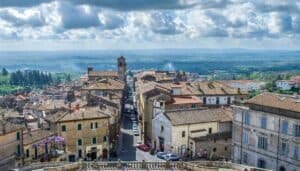
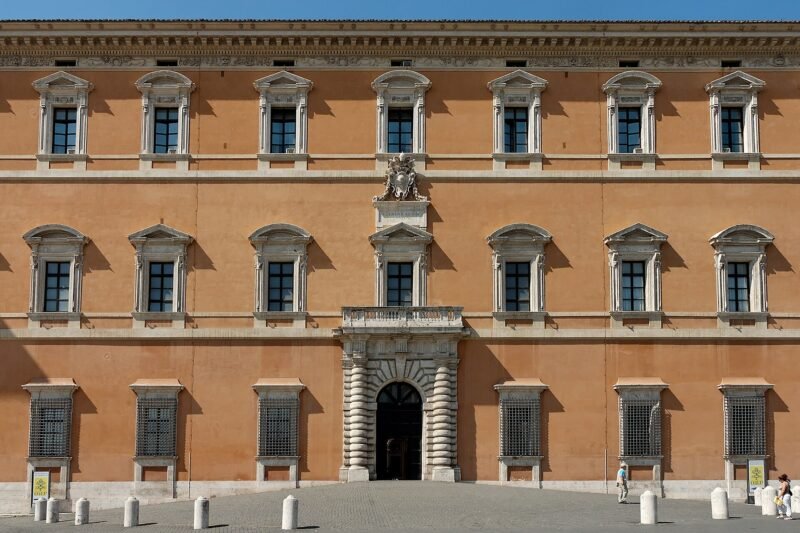
The palace presents a stone front in a warm color, between gold and reddish, supported at the base by a battered base that is still the one of the fortress. In front, two symmetrical ramps and a monumental staircase build the ascent: whoever climbs never sees the building all at once, but discovers it in successive stages. It is pure stage direction, and Vignola controls it with the same precision he uses to draw a cornice. The moat that surrounds the perimeter, crossed by bridges, no longer has a defensive function, but it keeps the palace separated from the rock and lets light into the lower floors.
Look at the windows. The first level has small, deep openings, almost like a fortress. Going up, the frames become richer and the proportions widen, until the piano nobile, where the openings become large and regular. It is the sixteenth-century way of writing the hierarchy of the interiors onto the façade: from the outside you can already read where the cardinal lives.
The Terraces in Place of the Bastions
In the five corners, where the military design called for bastions, Vignola built wide terraces open to the countryside. It is the move that turns a war machine into a landscape machine: from there the gaze runs over the hazelnut groves of the Cimini Mountains, the fields toward Ronciglione and, on clear days, all the way to the ridges that close the horizon to the south. This shift from closed to open is what makes Palazzo Farnese in Caprarola different from any urban palace: the fortress keeps its shape and loses its purpose.
Via Dritta: How Vignola Rewrote Caprarola
The most audacious move of the construction site did not concern the palace, but the town. To give the building a worthy perspective, a straight uphill street, Via Dritta, was cut through the medieval fabric, demolishing existing houses and alleys and aligning the surviving façades like the wings of a theater. Anyone who arrives from below today walks along that street and sees the palace grow ahead until it fills the entire field of view: the effect is calculated to the millimeter and still works after four and a half centuries.
From an urban planning standpoint, it is a textbook case of a lordly foundation grafted onto an existing village, with the terminal square widening in front of the entrance. From a human standpoint, it is an act of high-handedness, and it's worth saying so: the town was rewritten to serve as a pedestal. The two readings coexist, and the second makes the first much more interesting.
The Circular Courtyard of Palazzo Farnese in Caprarola
The Double Order, the Niches and the Busts of the Emperors
Inside the pentagon, the heart of the building is a perfectly circular courtyard on two levels. The lower register is an arched rustication, sturdy and austere, above runs a loggia with paired Ionic columns framing niches with busts of Roman emperors. The entablature steps forward over each pair of columns, while the columns rest on separate bases: a textbook detail, the kind Vignola would later codify in his Regola. The declared model is Bramante, the result is leaner and tauter.
The vaults of the loggia are frescoed by Antonio Tempesta, and in the inner loggia run grotesques in the Raphaelesque taste, related to those of the Vatican Loggias. Look up: this is where you understand how much money and how many painters this palace swallowed, in a space that is not even a reception hall but a passageway.
The Cistern at the Center of the Courtyard
The courtyard floor sloped toward the center, where a carved drain mouth opened, known locally as the Roman Mouth of Truth because of the resemblance of its mask. It is not an ancient piece: it is a collection system. Rainwater channeled from the courtyard ended up in cisterns and served the court's daily needs. In a building perched on top of a hill, far from major springs, water was the number one problem, and Vignola solved it by turning the courtyard into a funnel. The pentagon that gathers, the circle that channels: even the hydraulics here are geometry.
The Scala Regia of Palazzo Farnese in Caprarola
The Double Columns and the Helical Geometry
The Scala Regia is the piece nobody forgets. It is a wide, continuous spiral that climbs through three levels, supported by pairs of Ionic columns arranged along the spiral: 30 shafts of peperino, the grey volcanic stone of the Cimini Mountains, which carry the upward movement without ever breaking it. Unlike well staircases, where the central void is a hole, here the void is rhythmed by the columns and becomes architectural space in itself. You climb looking up and get the physical sense of being inside a mechanism.
The palace has five spiral staircases around the courtyard, but the others are service and passage stairs. This is the grand staircase, the one up which an important guest was led. The difference is measured in worked stone and light: the Scala Regia receives light from above and from the side openings, and its effect changes radically depending on the hour. Around mid-morning, with the sun still low, it is at its best.
The Frescoes by Antonio Tempesta on the Scala Regia
The decoration of the staircase is the work of Antonio Tempesta, Florentine by training and Roman by career, a fast painter of great craft, famous above all as an engraver of battles and hunting scenes. On the curved surfaces of the spiral he laid out grotesques, painted architecture, landscapes and allegorical figures, adapting them to a geometry that is unforgiving: painting in perspective on a helical vault is an exercise for specialists. Tempesta also worked on the vaults of the courtyard porticoes, and his hand is recognizable by its narrative vivacity and its clear skies.
The Legend of the Cardinal on Horseback
In Caprarola it has been said for centuries that the cardinal rode his horse up the Scala Regia to reach the piano nobile without dismounting. It is a tradition, not a documented fact, and it should be presented that way: the slopes and width of the ramps make the story technically plausible, but no contemporary source confirms it. I'll add one observation. The story is so appealing that many people repeat it as certain. Calling it a legend doesn't ruin it. It makes it more interesting, because it opens the real question: why a ceremonial staircase would have been generous enough to make someone think such a thing.
The Cartoccio Staircase and the Servants' Quarters in Palazzo Farnese in Caprarola
The service system of Palazzo Farnese in Caprarola deserves a chapter of its own. Kitchens, pantries and storerooms occupied the lower levels. Staff quarters were carved out of the thickness of the walls, in narrow rooms with no windows, connected by small stairways that never cross the noble route. A sixteenth-century palace housed a court of dozens of people, and the design challenge was to make them disappear.
Within this network runs the cartoccio staircase, a spiral service ramp with a continuous groove carved into the handrail. A paper cartoccio filled with sand or pebbles was sent sliding along it, so that its weight carried it quickly downward. Confidential messages reached the kitchens or the porter's lodge without anyone crossing the halls. It is a solution we would today call internal logistics, and it shows how much, in a house like this, the circulation of information mattered as much as the movement of people.
The fourth and fifth levels were assigned to the footmen and the horsemen, that is, the armed escort of the cardinal's court. Keeping this vertical layering in mind helps you read the building: service and water at the bottom, administration on the Prelates' floor, the prince on the piano nobile, and the escort at the top.
The Prelates' Floor of Palazzo Farnese in Caprarola
The Rooms of the Seasons
The raised ground floor is called the Prelates' Floor because it housed the cardinal's ecclesiastical entourage. You can reach it both from the external staircase and from inside, and the decoration, though less celebrated than that of the upper floor, is far from minor. Here are the rooms known as the Rooms of the Seasons, with decorative schemes tied to the cycle of the year, and rooms frescoed by Taddeo Zuccari's workshop. The seasonal theme is not just ornament. In a house organized into summer and winter apartments, the calendar is the principle that governs the entire building.
The Guards' Room
The Guards' Room is the filtering space: whoever arrived stopped here, and from here was either let through or not. It is a room you cross today in 30 seconds, but in its day it could mean waiting for days. Look at it while picturing the people standing against the walls, armed, and the sequence of the palace starts to make sense.

The Piano Nobile of Palazzo Farnese in Caprarola, Room by Room
The piano nobile is the reason people come all this way. Two symmetrical apartments, a summer one to the northeast and a winter one to the southwest, open on either side of the great central loggia and lead, in sequence, from the reception hall to the bedchamber, the wardrobe room, and the studiolo. The iconographic program was worked out by the man of letters Annibal Caro, with input from the antiquarian Onofrio Panvinio and the librarian Fulvio Orsini. These were three first-rate intellectuals in service of a single idea: to celebrate the Farnese family by placing it within universal history and within the cosmos.
The Hall of Hercules and the Fountain of Palazzo Farnese in Caprarola
The Hall of Hercules is the great central loggia of the piano nobile, now closed by glass panes but born as an open space: here people dined in summer, with the breeze rising from the valley. At the back opens a grotto fountain with a sculptural apparatus, a damp, dark rustication that contrasts with the clarity of the rest. The painted cycle tells the labors and deeds of Hercules, and not by chance: the hero who toils and wins was the emblem of the prince who builds.
The detail to look for is the relationship between the hall and the landscape. From here the gaze descends over Via Dritta, the town and the countryside: the loggia is the point where the palace looks at itself in the mirror and sees the town it redesigned for itself. If I had to name a single room in which to stop for 10 minutes in silence, I would name this one.
The Antechamber of the Council
The Antechamber of the Council takes its name from the fresco depicting the Council of Trent, the assembly that between 1545 and 1563 redefined the Catholic Church and that Paul III, grandfather of the patron, had convened. In the same room appears a scene of extraordinary political harshness: Pope Paul III excommunicating, candle in hand, the king of England Henry VIII. The rite of excommunication required that the candle be put out and thrown to the ground, to signify exclusion from the light of the Church.
It is worth pausing on what it means to paint such a thing in a reception room. It is not chronicle, it is dynastic propaganda: the Farnese who welcomes the guest reminds him, on the walls, that his family convened a council and excommunicated a king. This is the room that explains the palace better than any other.
The Hall of the Farnese Glories
The Hall of the Farnese Glories is the family gallery, frescoed by Taddeo and Federico Zuccari: from the floor to the coffered ceiling, the wall tells the most glorious moments of the house, with military and diplomatic episodes and learned comparisons with Alexander the Great. The rhetorical mechanism is the classic one of the century, putting one's own ancestors next to the ancient heroes until the distinction blurs.
Technically they are quadro riportato frescoes, that is, scenes framed by false frames as if they were hanging paintings: a solution the Zuccari brothers handled with confidence and which gives the narrative the rhythm of an illustrated book. Look at the quality of the painted architecture and the drapery, and then look at the faces: the difference in hand between Taddeo, who died in 1566, and his brother Federico, who completed the work, can be felt.
The Hall of the World Map of Palazzo Farnese at Caprarola
It is the most famous room and the most extraordinary in Italy of its kind. On the walls are painted the maps of the world known in the mid-16th century: the continents, the coasts, the place names, with America still uncertain in its outlines and Asia told more by reputation than by survey. The cycle is due to Giovanni Antonio da Varese, also called Giovanni Antonio Vanosino, and was completed in 1574. At the sides of the maps appear portraits of navigators and discoverers: geography becomes the history of men.
Then you raise your head, and the room changes scale. The vault does not continue the earthly discourse, it overturns it: painted there are the celestial spheres and the constellations of the zodiac, with the mythological figures arranged as on a globe seen from the inside. The message of Annibal Caro's program is explicit: beneath, the whole earth, above, the whole sky, and in the middle the Farnese family. I know of no other 16th-century room that declares so clearly the encyclopedic ambition of its patron.
Practical advice: people crowd in here, because it is the room everyone looks for. Go in, make a complete loop along the walls to read the maps, then stand in the center and look only at the vault for a couple of minutes. The painted sky has to be read all at once, not in pieces.
The Hall of the Angels
The Hall of the Angels belongs to the sequence of the apartment and takes its name from the angelic hosts painted in the vault. It is a room in which the decoration abandons the historical and political register and moves to the religious and celestial one, with a remarkable lightening effect after the halls of the glories. In a cardinal's house the presence of the sacred is not a decorative detail: it is the legitimation of the entire apparatus.
Observe the relationship between the lower zone of the walls, treated with false architecture and more sober schemes, and the surge of the vault. Roman Mannerism works precisely on this gap, and at Caprarola you see it with a clarity that in the city is often lost.
The Aurora Chamber, the Cardinal's Bedroom
The cardinal's bedroom is called the Aurora Chamber from the subject of the vault: Aurora preceding the chariot of the Sun, a mythological theme perfect for a room in which one wakes up. The decoration is attributed to Taddeo Zuccari and his circle. It is a relatively intimate room, and this in itself says something: in the houses of power, the size of the rooms shrinks as you get closer to the person of the prince.
Next to the bedchamber were the wardrobe and the studiolo, the most private rooms, where the cardinal kept books, antique coins, and collected objects. Fulvio Orsini, who looked after his library, was one of the greatest scholars of the century. What is today a small room was then the nerve center of one of the most important collections in Europe.
The Winter Apartment: Bertoja, Raffaellino da Reggio and Giovanni de Vecchi
While the summer apartment bears mainly the signature of Taddeo Zuccari, the winter apartment was decorated by a different and later team: Jacopo Zanguidi, known as Bertoja, a native of Parma, shaped by the lessons of Parmigianino and Correggio, Raffaellino da Reggio and Giovanni de Vecchi. The most dreamlike and restless rooms in the palace are due to Bertoja, with elongated figures, acid colors and spatial inventions that have nothing academic about them. Two Flemish artists working in Rome, Joos van Winghe and Bartholomaeus Spranger, were also called in to assist him, which gives a sense of how international the worksite was.
This is the part of the piano nobile that visitors walk through fastest, and that is a mistake. The Bertoja rooms are less spectacular and much more modern. Anyone who loves painting will find here the freest phase of Roman Mannerism. Slow down.
The Chapel of Palazzo Farnese in Caprarola
Next to Sala di Ercole is the chapel, with a central plan, which symmetrically closes the front of the piano nobile. Its placement is not accidental. The sacred and the secular stand side by side. The banquet loggia and the space for liturgy share the same level and the same view. In a cardinal's residence the chapel is not a devotional afterthought. It is part of daily ceremony, and the fact that it is round ties it to the geometry of the entire building.
The Artists of Palazzo Farnese in Caprarola
Taddeo and Federico Zuccari
Taddeo Zuccari was born on September 1, 1529, in Sant'Angelo in Vado, in the Duchy of Urbino. He arrived in Rome at 14, training mainly by copying the masters and studying the painted facades of Polidoro da Caravaggio. At 17 he was already working on chapel worksites. In Rome he left the Stories of the Passion in the Mattei chapel at Santa Maria della Consolazione, dating from 1556, and the Martyrdom of Saint Paul in the Frangipani chapel at San Marcello al Corso, around 1558. He was also active at Villa Giulia and in the Orsini castle at Bracciano. He died in Rome in 1566 and was buried in the Pantheon, not far from Raphael. That resting place tells you how famous he was.
His brother Federico, born around 1540, a painter and architect, took over the worksite and completed the cycles left unfinished. At Caprarola the two hands coexist, and telling them apart is one of the most instructive exercises you can do in a sixteenth-century Italian palace.
Antonio Tempesta and Giovanni Antonio da Varese
Antonio Tempesta worked on the courtyard vaults and the Scala Regia. His later fame came mainly from his engravings, which circulated throughout Europe and served as a source book for generations of painters. Giovanni Antonio da Varese, by contrast, signed Sala del Mappamondo, completed in 1574: large-scale painted cartography, a genre that in those same years would give the Vatican its famous gallery of geographical maps.
Annibal Caro, Onofrio Panvinio and Fulvio Orsini: Who Wrote the Program
The frescoes of Palazzo Farnese in Caprarola do not come from the painters' imagination. They come from a written program. Annibal Caro, a poet and translator of the Aeneid, was secretary to Cardinal Alessandro from 1548 and worked out the subjects. Onofrio Panvinio, an Augustinian and antiquarian, supplied the scholarly apparatus. Fulvio Orsini, librarian and curator of the collections, held everything together. Caro's letters describing the inventions for the rooms are fundamental documents for understanding how cultured patronage worked in the sixteenth century. The concept came first, and then they looked for the painter who could render it.
This is an aspect worth explaining to the young visitors. Here the painter is an executor of the highest level, not the author of the idea. Our way of thinking about art, with the artist at the center, came later. In front of these walls you can see a different system firsthand.

The Gardens of Palazzo Farnese at Caprarola
Behind the building, on the flank of the hill, extends the system of gardens that is worth the trip by itself. The old inventories call them Orti Farnesiani, with the same name as the gardens the family owned in Rome on the Palatine Hill, and they constitute one of the most complete examples of a late Renaissance garden left in Italy. Work began in 1565 under the direction of Giacomo Del Duca, a pupil of Michelangelo, and was closed only in 1630 with Girolamo Rainaldi. For the terracing they also used spoil earth coming from the foundations of the church of the Gesù in Rome, the building site the same cardinal was financing: a reuse of materials that today we would call circular and that at the time was simple economic common sense.
The Summer Garden and the Winter Garden
The two lower gardens are cut into the hill and are reached from the piano nobile by crossing the moat on drawbridges, one for each apartment: you go out to the summer garden from the summer apartment, to the winter one from the winter apartment. They are boxwood parterres with fountains, designed to be looked at also from above, from the windows of the rooms, like geometric carpets. The logic is the same as the interior: to each season its space, to each space its exposure.
The old sources recall that in the upper gardens there was a grotto theater, no longer legible today in its original form. It is the kind of loss that makes what remains precious: most 16th-century Italian gardens were remade in the 19th century, here the layout is still the original.
The Upper Gardens and the Water Chain
From the level of the parterres you climb to the Upper Gardens along a staircase sunk between walls of rustic ashlar, with the water chain in the center: a stepped little channel carved in stone, along which the water comes down roaring to a basin. It is the hydraulic invention that 16th-century Lazio brought to the highest degree and that is found, with sister solutions, in the gardens of Villa Lante at Bagnaia. Walking beside the water coming down as you climb is a physical experience before an aesthetic one: the sound changes with every step.
On the highest terrace two large statues of river deities lie at the sides of a central basin with a fountain. The river figures, taken from ancient statuary, declare the theme of the whole apparatus: dominion over water, which on top of a hill of the Cimini was the real technical feat.
Palazzina del Piacere
At the end of the route you meet the palazzina, a small habitable building with two loggias for eating outdoors, designed in all likelihood by Giacomo Del Duca and modified later by Girolamo Rainaldi. It is the refuge within the refuge: the cardinal who wanted to escape the court of the palace came up here, where the number of possible guests shrank to very few. To the north of the palazzina opens a private garden, slightly raised, with a rose garden.
The building had a second life in the 20th century, when it was used as a summer residence by the President of the Republic Luigi Einaudi during his seven-year term, between 1948 and 1955. This explains why the area was for a long time less accessible than the rest: anyone who visits it today enters a place that for decades had an institutional use.
The Canefori and the Herms of the Upper Gardens
The upper terrace is bordered by stone herms, half-bust figures on tapered pillars, with cypresses planted behind them. In local tradition they are called Canefori, that is, basket bearers, and their regular row turns the parterre into an open-air room delimited by statues. They are the most photographed thing in the gardens, and rightly so: the late afternoon light, filtered through the cypresses, makes them wonderful.
The advice I give you for visiting Palazzo Farnese in Caprarola (VT)
There is only one piece of advice, and it matters more than all the others put together: ask for the times of the guided tour of the gardens at the exact moment you buy your ticket, and plan the day around them. Palazzo Farnese in Caprarola is only worth visiting well if you fit together two different timings, the free one of the rooms and the fixed one of the garden. Whoever enters at 11:00 without checking, wanders the rooms calmly, leaves at 12:30 and discovers that the last morning group left at 11:30, has wasted half of the visit. The opposite works perfectly: take the first available slot for the gardens and use the time before or after for the piano nobile.
Second tip, less obvious: come in the early morning, on a weekday, outside of bridge holiday weekends. This palace doesn't have the queues of the Colosseum, but it has narrow rooms and school groups that arrive in waves. With 40 kids inside Sala del Mappamondo, you can't see anything and you can't hear anything. A Tuesday morning in October is the perfect window. In August, with 40 degrees on Via Dritta, the walk up from the parking lot becomes an ordeal, and you find yourselves visiting the palace already tired.
Third, and then I'll stop: don't treat it as a stopover between two villages. Many itineraries squeeze Caprarola in between Bomarzo and Civita di Bagnoregio and give the palace 40 minutes. That's a mistake. This place asks for three hours and gives back twice that. If time is short, it's better to give up another village and take all of Caprarola, maybe pairing it only with Villa Lante, which is 20 minutes away and is the same hand. A licensed guide makes an enormous difference here: without the thread of the iconographic program, the rooms become a list of painted vaults. Those who organize groups can look for a professional through the search service for tour leaders and guides of TourLeaderPro.
Another well-known fact, yet rarely mentioned
Everyone knows the palace is pentagonal and that inside there is a round courtyard. Almost no one dwells on the practical consequence of that choice, which is the real puzzle of the building: how to fill with rectangular rooms the space between a pentagon and a circle. Do it on a sheet of paper and you'll understand the problem. Each wing turns out to be an irregular trapezoid, with angles that are never right angles and walls that narrow toward the inside. A mediocre architect would have left the distortions visible. Vignola hides them, absorbing the leftover space into the wall thicknesses, the service corridors, and the spiral staircases placed precisely in the dead corners.
This is why the servants' rooms are inside the walls: it's not just social hierarchy, it's geometry. The thickness was needed anyway, so it might as well be lived in. And the same reason explains the presence of five spiral staircases distributed along the courtyard, one for each sector of the pentagon: the spiral is the only shape that fits without tension into a leftover space of any shape.
The second known and little-told fact concerns the use of peperino. The columns of the Scala Regia, the cornices, and the rustication of the gardens are made of local volcanic stone, quarried in the Cimini Mountains. It's the same material as the hill the palace rests on. A building like this seems like an imported object, dropped from above onto a village of farmers. In reality it is built with the stone of the place, by the local workers. This is the thing that people in Caprarola know and visitors ignore, and it's worth saying.
The right photo to take at Palazzo Farnese in Caprarola (VT)
The photo that captures the feel of the place is not the facade, and it's not the one of Sala del Mappamondo, where the light is poor and flash is forbidden. It's the shot from below on Via Dritta, taken from the far end of the street, with the palace closing the view at the top. You need a lens that doesn't distort too much, and you need to stand exactly on the central axis of the roadway, where Vignola built the point of view. The street acts as a funnel, the side facades act as stage wings, and the pentagon appears like a theatrical backdrop. In the morning the light comes in from the side and separates the floors. In the early afternoon it flattens everything.
Inside, the best shot is in the circular courtyard: stand against the wall, aim upward and capture the double order with the round sky in the center. It's a composition that always works, because the geometry does the work for you. Vertical, not horizontal.
In the gardens, the photo is the water chain seen from below, with the terraced steps rising and the rusticated walls on the sides. Alternatively, take the row of Canefori against the light in the late afternoon, with the cypresses behind. General rule: indoors, tripods are generally not allowed and neither is flash, so raise the sensitivity and lean on the door frames. Ask at the ticket office about the conditions for photos and video every time, because they vary and professional use requires permits.
Some important events that happened here in history
The first event is the purchase of the fief in 1504 by Cardinal Alessandro Farnese the Elder. It is not a bureaucratic detail: it is the moment when a family from the minor aristocracy of the Tuscia decides to turn a rural holding into a territorial base. 30 years later that cardinal will become Pope Paul III, and Caprarola will be one of the places where the Church reorganizes after the Sack of Rome.
The second is the start of construction on the fortress, between 1515 and 1530, with Antonio da Sangallo the Younger and Baldassarre Peruzzi. These were the years of permanent war in central Italy, and a pentagonal fortress atop the Cimini Mountains is a military statement as well as a political one. The halt in work in 1546, at Sangallo's death, leaves the base standing for more than a decade.
The third event is the restart in 1559, when Cardinal Alessandro the Younger, after hiring Vignola three years earlier, reopens the site with a completely different program. Within 14 years, until 1573, everything you can visit today rises up. It was an impressive speed for the time, and it can only be explained by the money available to a vice chancellor of the Church.
The fourth is the Council of Trent, which closes in 1563 and enters the palace in the form of a fresco. Paul III had convened it in 1545. Painting it at Caprarola, in the years right after it ended, means claiming for the family the credit for the Catholic Reform. In the same hall, the excommunication of Henry VIII fixes on the wall one of the gravest acts of the century.
The fifth is the completion of Sala del Mappamondo in 1574: in that year, on the walls of a palace in the Tuscia, the state of European geographic knowledge is put in writing. Less than a century after Columbus's first voyage, the whole world enters a room.
The sixth is the death of Cardinal Alessandro on March 2, 1589, and the passage of the properties to the Farnese dukes of Parma. From that moment the villa stops being the center of a court and becomes one dynastic property among others. The extraordinary collection of antiquities will over time make its way to Naples, following the family's inheritance matters.
The seventh concerns the gardens, completed in 1630 under the direction of Girolamo Rainaldi, 65 years after they were begun. Few garden projects in Italy have had such a long gestation or such a persistent design continuity.
The eighth belongs to the twentieth century: between 1948 and 1955 the palazzina in the gardens is the summer residence of the President of the Republic, Luigi Einaudi. A building created for a prince of the Church houses the head of state of the republic, and the situation is not without historical irony.
The ninth is the transfer of management to the State and, from December 2014, the inclusion in the ministry's museum network of Lazio, later reorganized as the Direzione regionale Musei. This is the setup that has made the palace permanently open to visitors and that has launched the maintenance campaigns of recent years.
Who Passed Through Palazzo Farnese in Caprarola (VT)
The first name is that of the master of the house, Cardinal Alessandro Farnese the Younger, who lived here for whole seasons between 1560 and 1589 and who made this palace his self-portrait in stone. Around him moved a court of intellectuals: Annibal Caro, poet and translator of the Aeneid, his secretary from 1548, who wrote the programs for the frescoes, Onofrio Panvinio, the antiquarian who supplied him with sources, Fulvio Orsini, the librarian who ran the collection of books, coins and ancient sculptures. These are three of the finest minds in Rome in the mid-16th century, and they passed through here not as guests but as steady collaborators.
Then there are the architects and painters, who did not just pass through Caprarola: they lived there for years. Jacopo Barozzi da Vignola directed the construction from 1559 until his death. Giacomo Del Duca, a pupil of Michelangelo, started the gardens in 1565. Girolamo Rainaldi closed them. Taddeo Zuccari worked here until 1566, the year of his death, and his brother Federico took over for him. Antonio Tempesta painted the courtyard and the staircase. Giovanni Antonio da Varese did the geographic maps. Jacopo Zanguidi, called il Bertoja, Raffaellino da Reggio and Giovanni de Vecchi did the winter apartment. With Il Bertoja also came the Flemish artists Joos van Winghe and Bartholomaeus Spranger, two names that show how much the site was a European stage.
On the political side, the palace was built to receive guests. The Council Hall and the Hall of the Fasti would make no sense without an audience of ambassadors, prelates and princes: for 30 years the Farnese court at Caprarola was one of the must-stop destinations for anyone who mattered in the Papal States. In the 19th century, during the events of Italian unification, the building hosted for a time the heir to the throne of Italy, in a symbolic handover between the old regime and the new state.
In the twentieth century the most important name is Luigi Einaudi, President of the Republic from 1948 to 1955, who chose the palazzina in the gardens as his summer residence. In the same century, the garden at Caprarola had a deep influence on a generation of landscape architects, especially American ones: Beatrix Farrand, A. E. Hanson and Florence Yoch looked at these terraces when they designed gardens on the California coast. The palace also fueled the architectural imagination of the pentagonal floor plan, of which the Pentagon complex in Washington is the most famous outcome.

The Village of Caprarola around Palazzo Farnese
The town has about 5,000 inhabitants and sits on the southern slope of the Cimini Mountains, east of Lake Vico. The settlement arose around the 11th century, in an area with Etruscan roots, and in the Middle Ages it changed hands among the Orsini, the Prefects of Vico and the Anguillara, before coming under the papal sphere of influence in 1435. The decisive period is the 16th-century Farnese era, when the family extends its rule and fills the area with villas and castles.
Via Dritta and the Fontana delle Tre Cannelle
Via Dritta is the backbone of the town, the straight road built to serve the palace's perspective. Walk it uphill, not downhill: that's how it was conceived. Along the route and in the side alleys, fragments of the medieval village survive: stone portals, shops. In the lower part you come to the Fontana delle Tre Cannelle, a 15th-century fountain that predates the 16th-century urban rewriting and therefore shows what the town looked like before the Farnese.
Cimini Hazelnuts and the Cooking of Caprarola
Hazelnuts are grown here, and not for folklore: Viterbo Province is Italy's first producing area. The hazelnut groves you see from the palace terraces are the real economy of the area. In pastry shops, hazelnuts end up in tozzetti, amaretti and pampepato, in the town's bakeries you can find them all year round. A tip from someone who has eaten in the area many times: have lunch after your visit, not before, and order something with porcini mushrooms if you're visiting in autumn, because the Cimini beech woods produce them in abundance.

What to See Around Palazzo Farnese in Caprarola
The Tuscia area of Viterbo, within half an hour, packs in an unusual amount of things, even by Italian standards. Behind the town, the Lake Vico nature reserve opens up. It is a caldera lake formed about 138,000 years ago by the collapse of the Vicano volcanic cone: 510 meters in elevation, nearly 13 square kilometers of surface area, 48.5 meters of maximum depth, surrounded by Monte Fogliano, 965 meters, and Monte Venere, 851. The reserve protects one of the southernmost beech forests in Europe and has the great crested grebe as its symbol. In Roman times, a tunnel dug through the tuff artificially lowered the lake's level, and in the sixteenth century the Farnese put it back into operation. As a result, a large part of the cultivated northern plain was, at one time, water.
20 minutes away are the gardens of Villa Lante in Bagnaia, the other masterpiece by Vignola in the Tuscia, with its water cascade and the Fontana dei Mori. Half an hour away is the Parco dei Mostri of Bomarzo, the woods of carved colossi commissioned by Vicino Orsini in the same decade. Visiting Caprarola and Bomarzo on the same day means seeing the two opposite faces of sixteenth-century Lazio, absolute order and absolute bizarreness.
Farther north are Civita di Bagnoregio, the village on its finger of tuff, and Montefiascone with Rocca dei Papi above Lake Bolsena. Toward the inner Cimini Mountains, there is Soriano nel Cimino with its Orsini castle and the nearby hamlet of Chia, where Pier Paolo Pasolini bought his tower. To the south, there is Sutri with its amphitheater carved into the tuff and Ronciglione on the other shore of the lake. If you have an extra day, add Calcata with its Opera Bosco Museum of Art in Nature, or Civitella d'Agliano, where a private valley has been home since the late 1990s to a park of contemporary sculptures that can be visited only on certain days of the year. For the Etruscans, head to Tarquinia, with its painted tombs, while Tuscania preserves two Romanesque churches among the most beautiful in Lazio. A well-reasoned selection of these villages, in English, can be found in the best small towns in Lazio di ItalyPlanner guide.
Palazzo Farnese in Caprarola with Children
It works better than you'd expect, as long as you pick the right keys. A child doesn't get excited about the iconographic program of Annibal Caro, but a child absolutely does get excited about three concrete things: the fortress-like shape with its moat and bridges, the spiral staircase that winds around itself, and the room where the whole world is painted on the walls. Three stories are enough to hold the attention of an eight-year-old for an hour, which is the right length.
In Sala del Mappamondo, have them look for Italy, then America, then the places that aren't on the map or are wrong. Realizing that in 1574 the world was only half known is a lesson in geography and history at once, and it's not something anyone forgets. On the Scala Regia, tell the legend of the cardinal on horseback, make clear that it's a legend, and ask whether they think a horse could really pass through: the debate lasts until the piano nobile.
The gardens are the part the little ones prefer, because of the water running down the chain and the open spaces. Be careful, though, of the changes in level and the uneven surface: a lightweight stroller can be brought along, but in some stretches it has to be lifted. On rainy days, with children, consider sticking to the indoor areas.
Accessibility of Palazzo Farnese in Caprarola
The situation is two-speed, and it's right to say so before you go. The main building has an elevator and a substantial part of the interior route is accessible by wheelchair, but the access from outside goes through monumental staircases and a sloping square, so arrival needs to be arranged: anyone with mobility needs should call the museum before the visit to be told where the entrance is and whether staff can assist. The gardens, on the other hand, remain largely problematic because of the terraces, the staircases, and the gravel surface.
For people with mild mobility difficulties, one practical suggestion: the climb from the parking lot along Via Dritta is the most tiring stretch of the whole day, more than the interior stairs. Having yourself dropped off in the square and retrieving the car afterward changes the experience completely.
When to visit Palazzo Farnese in Caprarola
The best season is autumn, from late September to early November: the hazel groves change color, the beech woods of the Cimini Mountains become an explosion, the low light is perfect for Via Dritta, and the tour groups are less dense. Spring is just as beautiful and more crowded, with the peak on the weekends of April and May. Summer has the advantage of extended hours and the drawback of heat, which at midday on the square is serious. If you come in July or August, go in right at opening time.
Winter is underrated. The palace is only partly heated, so dress as if you were going to be outdoors, but on a cold, clear January morning the view from the terraces reaches very far, and in the rooms you can be alone for entire minutes at a time. It's the condition in which this place is at its best: silence, low raking light, nobody in front of you.
For those planning a wider trip around the region, the English-language overview of Lazio on ItalyPlanner helps you fit the distances together. The page dedicated to Caprarola on ItalyPlanner repeats the same content for foreign visitors.
Quick Questions About Palazzo Farnese in Caprarola
Where exactly is Palazzo Farnese in Caprarola
At the top of Via Dritta, on the square that bears the family's name, in the town of Caprarola in Viterbo Province, on the southern side of the Cimini Mountains east of Lake Vico.
How far is Palazzo Farnese in Caprarola from Rome
Just over 60 kilometers, which by car comes to about an hour and a quarter via the A1 motorway with exit at Orte, or on a slower and more beautiful route along the Cassia and the Cassia Cimina.
What day is Palazzo Farnese in Caprarola closed
Mondays. It's open from Tuesday to Sunday, from 8.30 to 19.30 with the ticket office open until 18.45, while the park closes one hour before sunset. Check park hours and any special closures on the museum's official website before you go.
How much is the ticket for Palazzo Farnese in Caprarola
Tickets are bought on site at the ticket office. Full price, reduced rates and free admissions provided by national regulations are published on the official website of Istituto Ville monumentali della Tuscia, which manages the palace: it's the only reliable list, because conditions change over time.
Do you need a reservation to visit Palazzo Farnese in Caprarola
For an individual visitor, usually not. For groups and school groups, booking is required, and in any case it's worth contacting the museum in advance to arrange times and the availability of an escort to the gardens.
The gardens of Palazzo Farnese in Caprarola can be visited freely
No. The rooms on the piano nobile are entered on your own, but the gardens are only visited with staff, in groups that leave at set times. Ask about times at the ticket office as soon as you get in. Anyone who needs to organize a visit for a group can write to the TourLeaderPro contacts.
How long does the visit to Palazzo Farnese in Caprarola take
A good hour for the apartments, about 40 minutes for the gardens. With stops and a walk around the village, a full day is three hours.
You can take photos inside Palazzo Farnese in Caprarola
Amateur photography without flash or tripod is generally allowed in state museum spaces, but the specific conditions and any restrictions are asked at the ticket office. Professional filming and commercial use require an authorization.
Palazzo Farnese in Caprarola is wheelchair accessible
The main building is served by an elevator and a large part of the interior route is passable, but access from outside and the gardens have barriers linked to staircases and terraces. Calling the museum before the visit is the most useful thing to do.
Palazzo Farnese in Caprarola is suitable for children
Yes, if you focus on the moat, the spiral staircase and the room of the geographic maps. One hour inside and one in the gardens is the proportion that works.
Why Palazzo Farnese in Caprarola has a pentagonal plan
Because it was born as a military fortress: the pentagonal foundations with corner bastions were laid between 1515 and 1530 to a design by Antonio da Sangallo the Younger and Baldassarre Peruzzi, and Vignola reused them instead of demolishing them.
Who built Palazzo Farnese in Caprarola
Jacopo Barozzi da Vignola, commissioned in 1556 by Cardinal Alessandro Farnese the Younger, with construction begun in 1559 and continued until the architect's death in 1573, on the 16th-century foundations of Sangallo and Peruzzi.
How many columns does the Scala Regia of Palazzo Farnese in Caprarola have
30 shafts of peperino stone arranged in pairs along the spiral, which accompany the climb through three levels.
Is it true that the cardinal rode up the staircase on horseback
It's a local tradition, not a fact documented by sources of the period. The dimensions of the ramp make it plausible, but it should be told for what it is, a legend.
What is the cartoccio staircase
A service spiral ramp with a groove carved into the handrail: a weighted paper cartoccio, filled with sand or pebbles, was slid along it to get messages to the lower floors in a few seconds.
What is the most important room in Palazzo Farnese in Caprarola
Sala del Mappamondo, completed in 1574, with maps of the known world on the walls and the constellations of the zodiac on the vault. To understand the family, however, the decisive room is the Anticamera del Concilio.
Who painted the frescoes of Palazzo Farnese in Caprarola
Taddeo Zuccari until 1566 and then his brother Federico, Antonio Tempesta in the courtyard and on the Scala Regia, Giovanni Antonio da Varese in Sala del Mappamondo, Jacopo Zanguidi called il Bertoja with Raffaellino da Reggio and Giovanni de Vecchi in the winter apartment.
Who devised the subjects of the frescoes
The man of letters Annibal Caro, the cardinal's secretary from 1548, with the scholarly advice of Onofrio Panvinio and Fulvio Orsini.
What is the difference between Palazzo Farnese in Caprarola and Villa Lante in Bagnaia
Both are works by Vignola and are 20 minutes apart, but in Caprarola the protagonist is the building and the garden is the completion, in Bagnaia it's the opposite: the garden is the masterpiece and the palazzine serve as a supporting element. Seeing them on the same day is the best pairing in the Tuscia.
Can you visit the garden palazzina
It's part of the guided tour of the Giardini Alti, when that is open. It was the summer residence of President Luigi Einaudi between 1948 and 1955, and its accessibility depends on the visiting calendar: it should be checked with the museum.
Where to park in Caprarola
Along Via Dritta and in the spaces in the lower part of the town, spots in the piazza are very few. From the lower parking lot to the portal, it's five minutes of real uphill walking.
Can you get to Palazzo Farnese in Caprarola by public transport
Yes, with the regional Cotral buses from Rome Saxa Rubra, in a little under an hour and a half. The town's railway station is not served. The useful stop is Capranica Sutri, from which a bus connection is still needed.
Is there a cloakroom at Palazzo Farnese in Caprarola
Backpacks and large luggage must be left at the entrance, according to the rules in force in state museums. For bulky luggage, it's best to ask at the ticket office before going up.
How long does it take to also see Lake Vico
From Caprarola you go down to the lake in a quarter of an hour. For a tour of the viewpoints and a stop in the reserve, allow two hours, much more if you want to walk in the beech forest of Monte Venere.
What is the best time to visit Palazzo Farnese in Caprarola
Autumn, between late September and early November, for the light and the colors of the woods. A clear winter is the choice of those who want the rooms empty.
The verdict on Palazzo Farnese in Caprarola
There are very few places like this in Italy: a sixteenth-century building that has come down to us with its structure, its decoration and its landscape still legible together. If I had to choose just one day trip out of Rome for someone who loves architecture and doesn't want to queue, I'd choose this one, and I'd pair it with Villa Lante. Go in the morning, on a weekday, ask right away for the gardens' hours and don't rush through the Bertoja rooms, which everyone crosses at a run and which are the freest part of the palace. The rest is down to the Cimini stone.
Article written by the editorial team of TourLeaderPro, contact them for Private/Corporate/V.I.P. Tours and Experiences.
Are you planning a trip to Rome? English-language guides to visiting the city are on ItalyPlanner.com.