Monster Park of Bomarzo
In short. The Parco dei Mostri di Bomarzo is at Località Giardino, 01020 Bomarzo (VT), at the foot of the village, in the Viterbo area of the Tuscia, about 15 kilometers from Viterbo and just under 90 kilometers from Rome.

The Parco dei Mostri di Bomarzo is at Località Giardino, 01020 Bomarzo (VT), at the foot of the village, in the Viterbo area of the Tuscia, about 15 kilometers from Viterbo and just under 90 kilometers from Rome. You get there mostly by car. Take the A1 Autostrada del Sole and exit at Attigliano-Bomarzo, and in a few minutes you'll be at the parking area in front of the entrance. If you travel by train, get off at Orte or at Attigliano-Bomarzo station on the Rome-Florence line, then continue with a local connection or a taxi. Check routes and timetables before you leave, because road service in the area is irregular. The full ticket costs €15, and the reduced ticket for children aged 4 to 13 costs €9. Admission is free for people with a 100 percent certified disability and for their companion. Groups, schools and universities have their own rates. The Sacred Grove is open every day of the year with continuous hours, with the only closure on December 25. It's open from 9 to 19 from March to September, and from 9 to 17 from November to February, with October serving as the transition month. The last entry is one hour before closing. Tickets can be bought at the ticket office or online on the official website sacrobosco.eu, where the museum also manages bookings for schools and groups.
If you're planning a longer itinerary in the province, you'll find more ideas on the page dedicated to Viterbo and in the surrounding Tuscia, which is full of sculptures, gardens and rock-cut villages.

What Is the Parco dei Mostri di Bomarzo
The Parco dei Mostri, which ancient documents call the Sacred Grove and which some people rename Villa delle Meraviglie, is a 16th-century Mannerist garden filled with colossal sculptures carved directly into blocks of peperino, the gray volcanic stone that surfaces everywhere in the Tuscia. It isn't a nature park with a few statues in between. It's a route designed as a machine for wonder, where every bend in the path puts a different apparition before your eyes: a gaping ogre, a war elephant, a leaning house, a dragon that bites. The complex sits in the valley floor below the village of Bomarzo, within an area that the Monte Casoli provincial nature reserve still protects today.
The place needs some context. This is an area inhabited since the Bronze Age and then deeply Etruscan, as shown by the underground houses, the cave tombs and the wells dug into the tuff all around, particularly toward Santa Cecilia. From the woods of Bomarzo to Chia and Soriano nel Cimino, you'll come across inscriptions on stones, funerary cippi, anthropomorphic tombs and altars. There's the so-called Finestraccia, a large tomb possibly Etruscan that was later turned into a dwelling, and the Piramide Etrusca, a terraced altar carved into the tuff with 28 steps and a small well, whose dating oscillates between the Etruscan world and the older Rinaldonian civilization of the Bronze Age. The Sacred Grove grew out of this landscape full of memory, and it's no accident that it absorbs its taste for carved stone and for mystery.
The starting advice is simple: take it for what it is, a masterpiece of European art disguised as a sixteenth-century amusement park. Those who go expecting only photogenic monsters get through it in half an hour and don't understand a thing. Those who go knowing they're walking inside a stone poem come out changed.
How to Get to the Parco dei Mostri di Bomarzo
The natural way to go is by car. From Rome, take the A1 toward Florence and exit at Attigliano-Bomarzo. From there it's a few kilometers on a well-signed provincial road to the park, and there's a large parking area in front of the entrance. From Viterbo, head southeast along the Tuscia roads for about 20 minutes. The added value of driving is that the Parco dei Mostri di Bomarzo becomes the highlight of a tour that can include other gems of the province in a single day.
Public transportation requires more patience. The train arrives at Attigliano-Bomarzo station or at Orte, both on the Rome-Florence line. From there, the connection to the village is by local buses or taxi, with infrequent runs. It's worth arranging your return trip in advance, because being stuck on foot in the valley floor late in the afternoon isn't convenient. If you don't drive and are coming from Rome, an organized day tour often makes more sense. It takes care of transportation and combines Bomarzo with Civita di Bagnoregio or with the gardens of Villa Lante in Bagnaia.
Tickets and Opening Hours of the Parco dei Mostri di Bomarzo
The full ticket costs 15 euros. Children aged 4 to 13 pay 9 euros, and children under 4 enter for free. People with a certified 100 percent disability and the person accompanying them do not pay. For groups of 30 participants or more, the fee drops to 13 euros per person with one free escort. Schools and universities have dedicated reduced prices, and for these categories the museum asks for a reservation a few days in advance through its official channels.
The Sacro Bosco is generous with its hours. It is open every day of the year, with continuous hours and no usual weekly closing day, and it closes only on December 25. The visiting hours change with the seasons. From March to September, you can visit from 9 to 19. From November to February, the hours are 9 to 17. October is a transition month, with closing times that follow the change of time. In every period, the last entry is one hour before the gate closes, so keep this in mind, because the full route, taken at a relaxed pace, takes more than two hours. Prices and hours should always be double-checked on the official website before your visit, as they can change with the seasons and with special openings.
The History of the Sacro Bosco: Vicino Orsini and His Little Wood
The Parco dei Mostri di Bomarzo is the creation of a single man, Pier Francesco Orsini, whom everyone called Vicino. Prince of Bomarzo, military leader, and man of letters tied to the intellectual circles of his time, he began shaping his garden in the second half of the sixteenth century, after years of war and imprisonment and after the death of his much-loved wife. The dates proposed by scholars range between 1547 and the early 1550s, and the work continued for decades, until the 1580s. Orsini never called it the Parco dei Mostri. For him it was the boschetto, a private place to unburden his own heart, as one of the inscriptions says.
Who Really Designed the Parco dei Mostri di Bomarzo
The name that comes up most often is that of Pirro Ligorio, the Neapolitan architect and antiquarian, a great expert on antiquity and the mind behind the fantasies of Villa d'Este in Tivoli. Tradition attributes the design of the Sacro Bosco to him, but this is a hypothesis, not a documented fact backed by a contract. In the past, someone even dragged in Michelangelo Buonarroti, and for the small temple the name Jacopo Barozzi, known as Vignola, has been put forward. These attributions are now scaled back. The actual carving of the sculptures is cautiously attributed to the sculptor Simone Moschino. The truth is that the real mastermind was Vicino Orsini himself, who chose the themes, dictated the inscriptions, and turned a princely whim into a manifesto of Mannerist culture.
The Peperino and the Confusing Inscriptions
The figures were not brought to the park already finished. They were carved on site, cut from the large blocks of peperino outcropping in the wood, the local volcanic stone. This explains their gigantic scale and the fact that they seem to rise out of the ground. Adding to the sense of puzzle are the inscriptions carved almost everywhere, in sixteenth-century vernacular, which amaze and disorient the visitor. One, the most famous, warns those who arrive: «You who wander the world with eager eyes to see lofty and astounding marvels, come here, where there are horrid faces, elephants, lions, ogres and dragons». Another, with a moral tone, warns that the soul becomes wiser by resting. On a pillar appears what many consider the key to everything: «Only to unburden the heart».
Generations of historians and philologists have tried to decipher this labyrinth of symbols, finding echoes of Petrarch's Canzoniere, Ludovico Ariosto's Orlando furioso, and the poems of Bernardo Tasso, where, for example, there is a steel dragon with a room inside its body. Art historian John Shearman, in his study of Mannerism, described the grove as a series of pleasant and openly artificial fictions, products of an escape as much artistic as literary. The shared feeling is that a single, definitive key perhaps does not exist. The garden was built so that it cannot be solved.
Abandonment and Rediscovery of the Parco dei Mostri di Bomarzo
After Vicino Orsini's death, the grove lost its only interpreter and sank into a long oblivion. For nearly four centuries the wood closed in over the statues, brambles covered them, and the memory of the place was reduced to village legend. The revival came in the second half of the twentieth century thanks to Giancarlo Bettini and his wife Tina Severi, who bought the land, freed the sculptures from the vegetation, and financed the restoration. They are buried in the small temple inside the park. In the meantime, the Sacro Bosco had become a magnet for artists and intellectuals, who recognized in it an unexpected ancestor of the Surrealist taste.
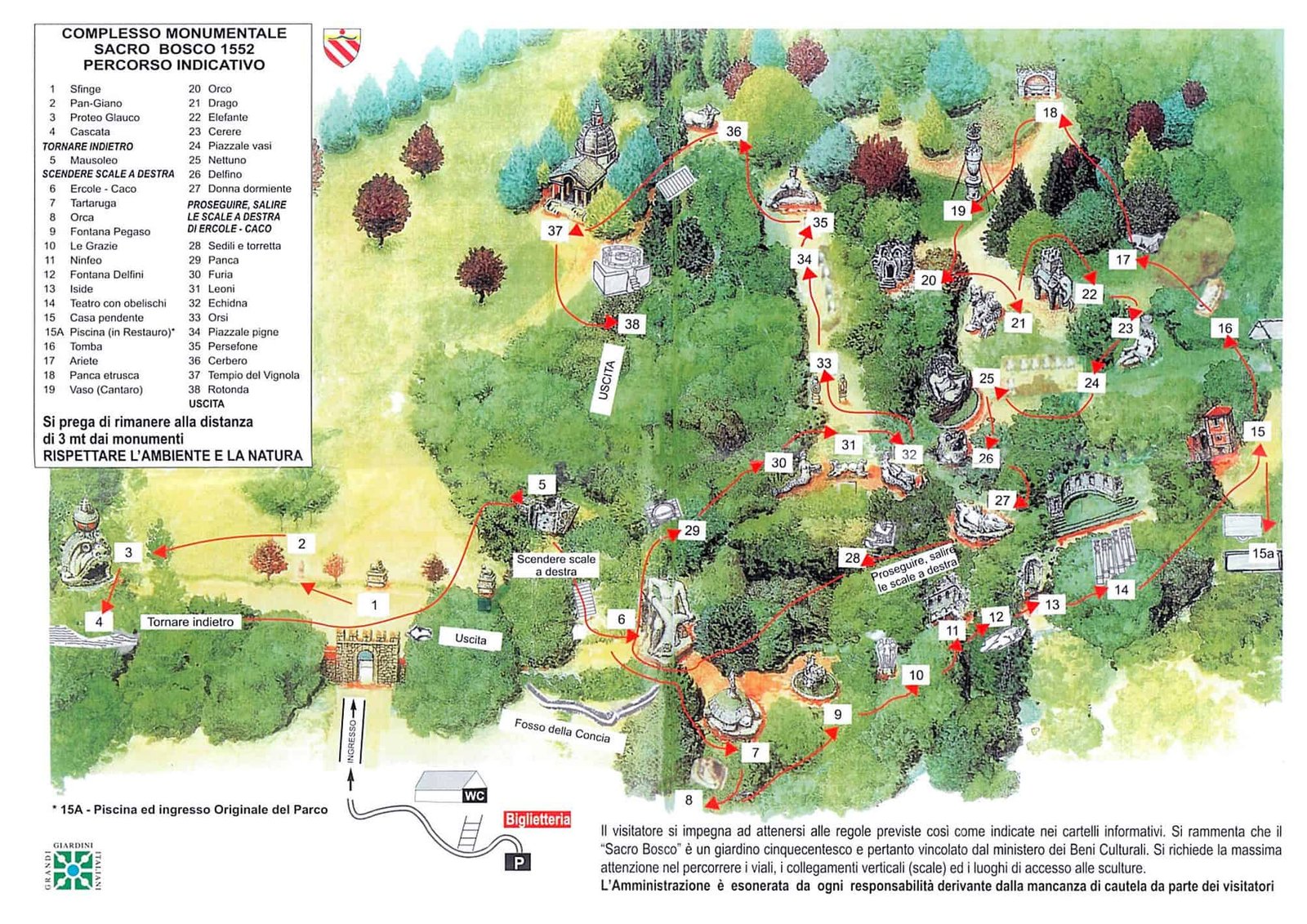
Visiting the Parco dei Mostri di Bomarzo, Statue by Statue
The route has no fixed reading order, and that was part of Orsini's game. I describe it following the path most visitors take, from the threshold up to the little temple. Take your time walking around each figure, because many of them change completely depending on the point from which you look at them.
The Sphinxes at the Entrance to the Parco dei Mostri di Bomarzo
Once you cross the monumental threshold of the wood, you meet two Sphinxes, placed as guardians. Their appearance combines the classical model of the woman with a lion's body and the Egyptian one, because both are wingless. Each one bears an inscription in hendecasyllables that welcomes and challenges the visitor. The one on the left warns that anyone who crosses the place distracted, with arched eyebrows and tight lips, does not even deserve the seven wonders of the world. The one on the right invites you to observe part by part and then say whether so many wonders were born by enchantment or by art. This is already a statement of poetics: here you enter to think, not to stroll.
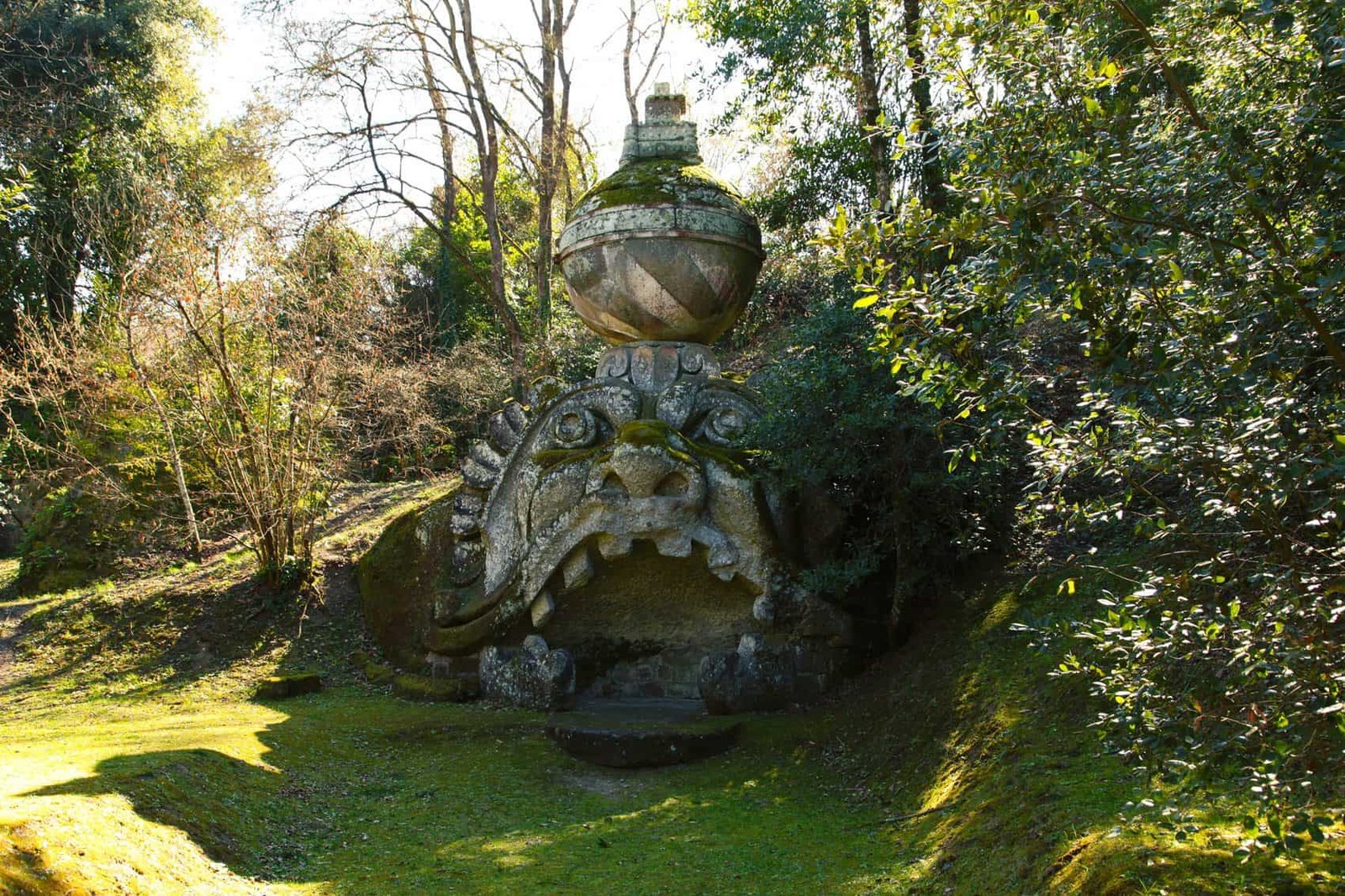
Proteus or Glaucus, the First Monster
Just beyond the Sphinxes, set aside from the main path, appears the first true monster: an immense anthropomorphic mask with its mouth open, seeming to emerge from the bowels of the earth. It is identified with Proteus or Glaucus, sea deities linked to metamorphosis. On its head it carries a large stone globe topped by a small tower, an image of the whole world dominated by the Orsini heraldic emblem. It is a way of signing the garden: the family even dominates the cosmos.
The Etruscan Mausoleum
A large boulder that looks shapeless at first reveals itself, on closer look, to be the facade of an Etruscan tomb, shaped by the chisel in imitation of the rock-cut burials of the area. Its decorations copy those of a tomb found at Sovana. It is a deliberate tribute to the Etruscan past of the Tuscia, the same world you can touch firsthand in the necropolises around Bomarzo and that is also well told at the Museo Etrusco di Villa Giulia in Rome.
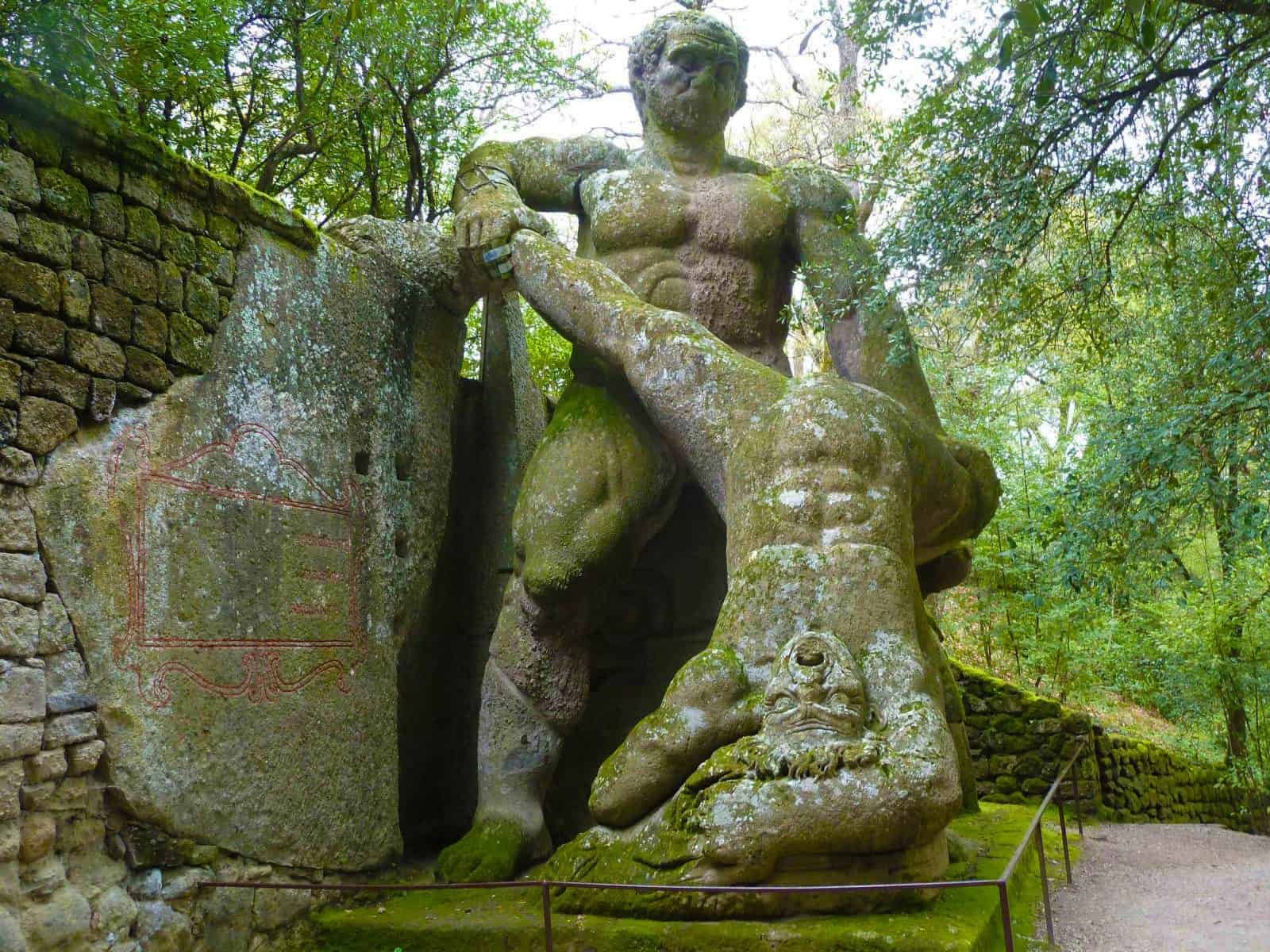
Hercules and Cacus, the Colossus of the Parco dei Mostri di Bomarzo
Also called the Colossus, it is the largest sculpture in the park: two giants locked in a furious struggle, identified as Hercules and Cacus, the thief the hero punishes. One holds the other upside down by the legs, in a gesture of violence frozen in stone. Around them, warrior figures now worn away by time completed the scene. Standing before this group, you understand the scale of Orsini's project: not garden miniatures, but bodies several meters tall that crush anyone who looks at them.
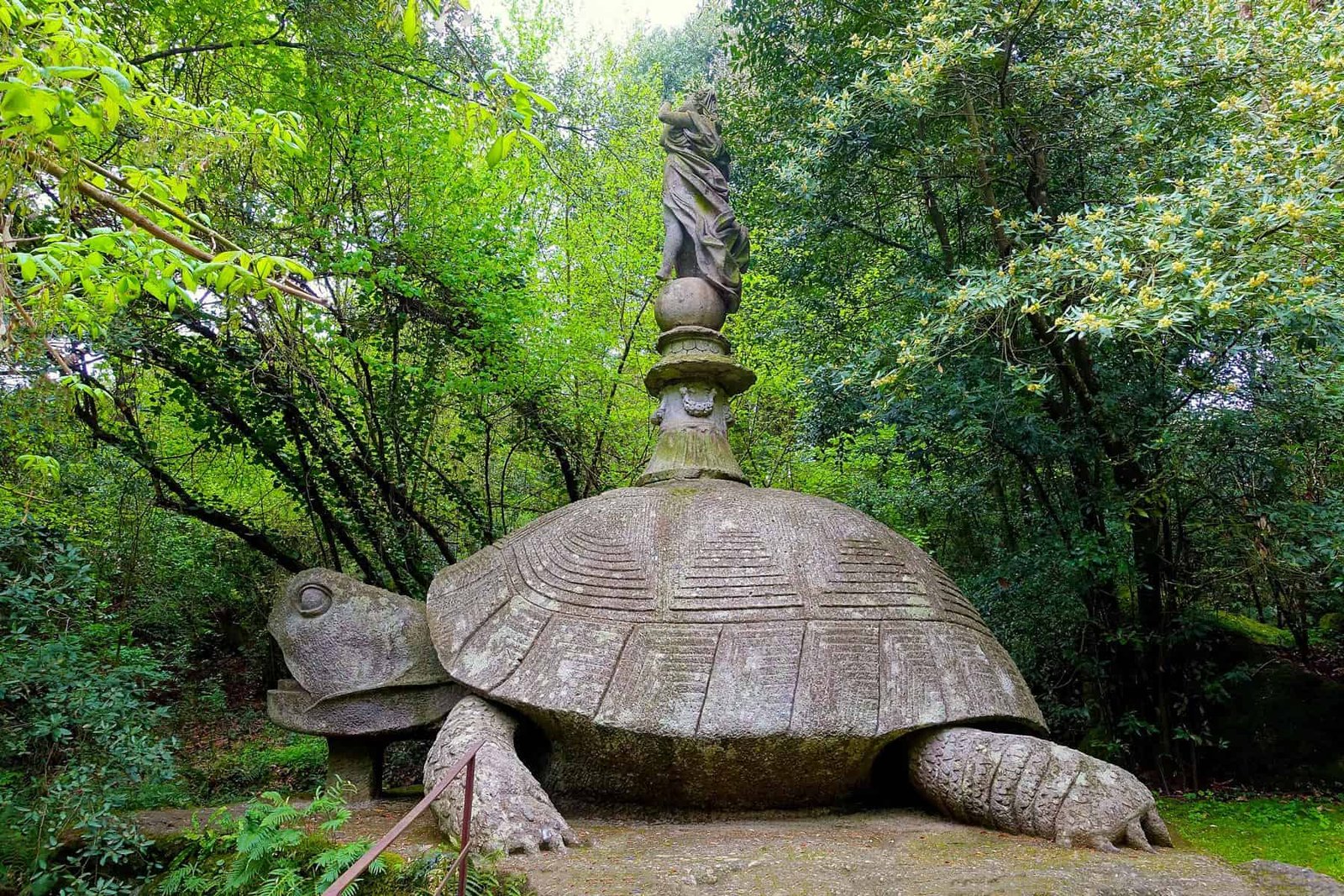
The Turtle and the Whale
Near the giants opens one of the most poetic groups in the wood. A large turtle carries on its domed shell the statue of a Nike, the winged victory, while a short distance away a whale emerges from the earth as if from an invisible sea: the two animals seem to stare at each other. The turtle stands as a symbol of stability and longevity, a union of earth and sky. The winged woman on its shell represents the peak of a transformation, the passage toward purification. It is one of the stops where the alchemical reading of the garden finds the most points of support.
The Pegasus Fountain and the Tree-Statue
Pegasus rises from a basin, the winged horse that in the park's symbolic reading stands for instinctive impulse tamed by spiritual will, those wings that rein in the brute force of the body. A short distance away is the so-called Tree-Statue, a sculpted larch trunk carved from a boulder, which reminds us that even vegetation could turn to stone here. These are minor episodes compared with the colossi, but they tell of the care with which every corner of the wood was conceived: in Vicino Orsini's garden nothing is filler, and even a secluded fountain or a petrified trunk takes part in the symbolic discourse of the whole. It is worth slowing down in front of these secondary figures too, which visitors' haste tends to skip on the way to the Orco.
The Nymphaeum and the Venus on the Shell
A large basin-style room recreates the Greek and Roman nymphaea, decorated with the three Graces and three nymphs. On the eastern wall stands a colossal Venus reclining on a shell, while a fountain around her is decorated with dolphins. This is the most classical and serene area of the park, a breath of harmony between one monster and the next, and it shows how Orsini mastered the high register of antiquarian culture too, not only the grotesque one.
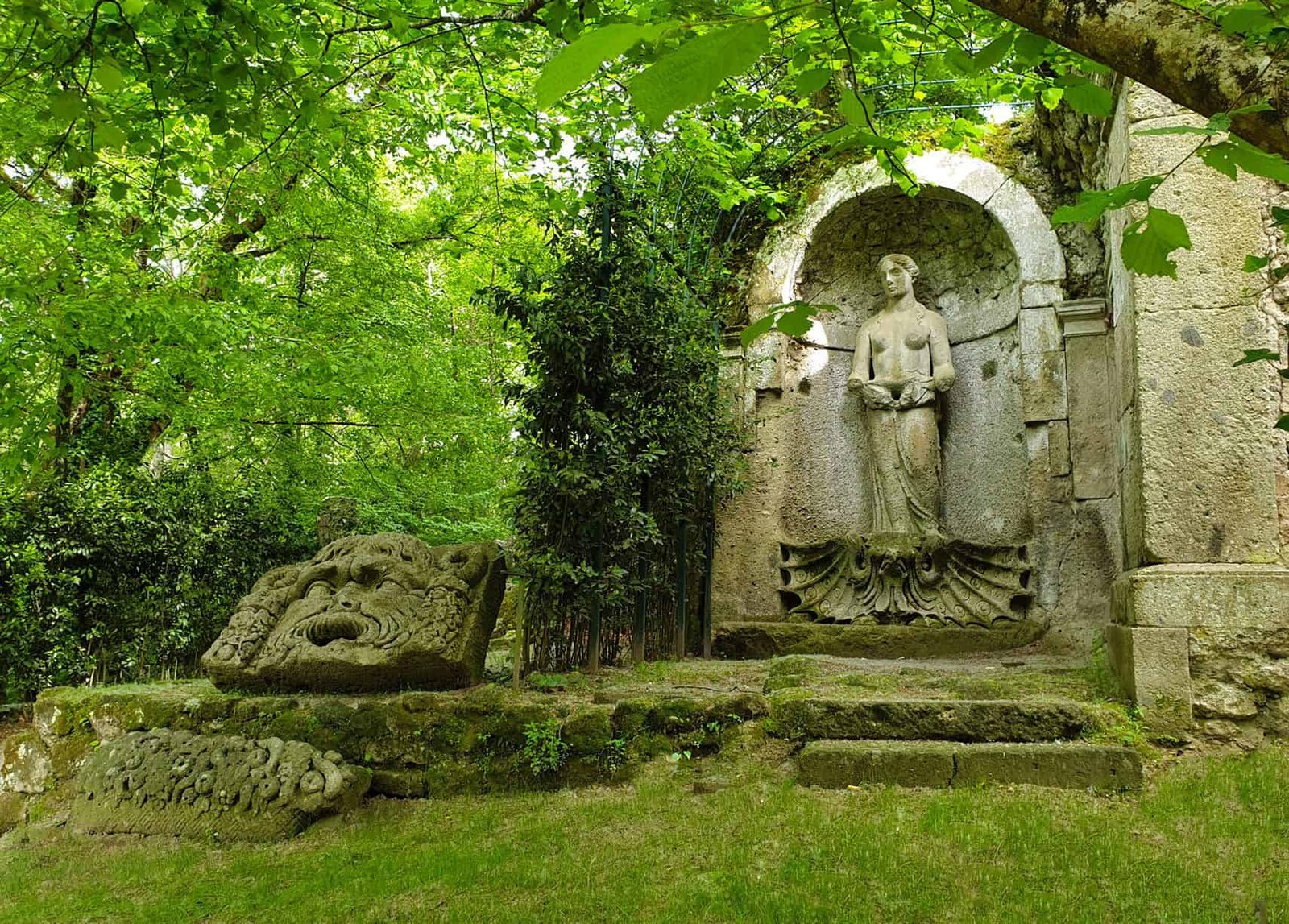
The Theater
Not far from the Nymphaeum stands a small room in classical taste that everyone calls the theater: in reality it is a very small reproduction of an exedra, the curved backdrop of an ancient stage. It is yet another learned quotation from a garden that keeps shrinking and disguising the architecture of the Roman world. In an age when great lords had theaters, nymphaea and temples in the antique style rebuilt in their parks to show off their culture, Orsini reverses the game: here classical architecture does not celebrate the power of the patron but becomes one fragment among many of a fragmentary dream, a piece of abandoned stage scenery in the woods.
The Leaning House of the Parco dei Mostri di Bomarzo
And perhaps the attraction that entertains the most. A small building was built on an inclined boulder and for this reason it leans noticeably: inside, the slope is irregular, the floor does not form a right angle with the walls, and anyone who goes in immediately loses their balance and sense of vertical. The stomach protests, photographs lie, children go wild with joy. It is believed that originally the entrance to the wood was right in front of the leaning house, so that the disorientation started from the first step. Anyone who suffers from vertigo or nausea should approach it with caution.
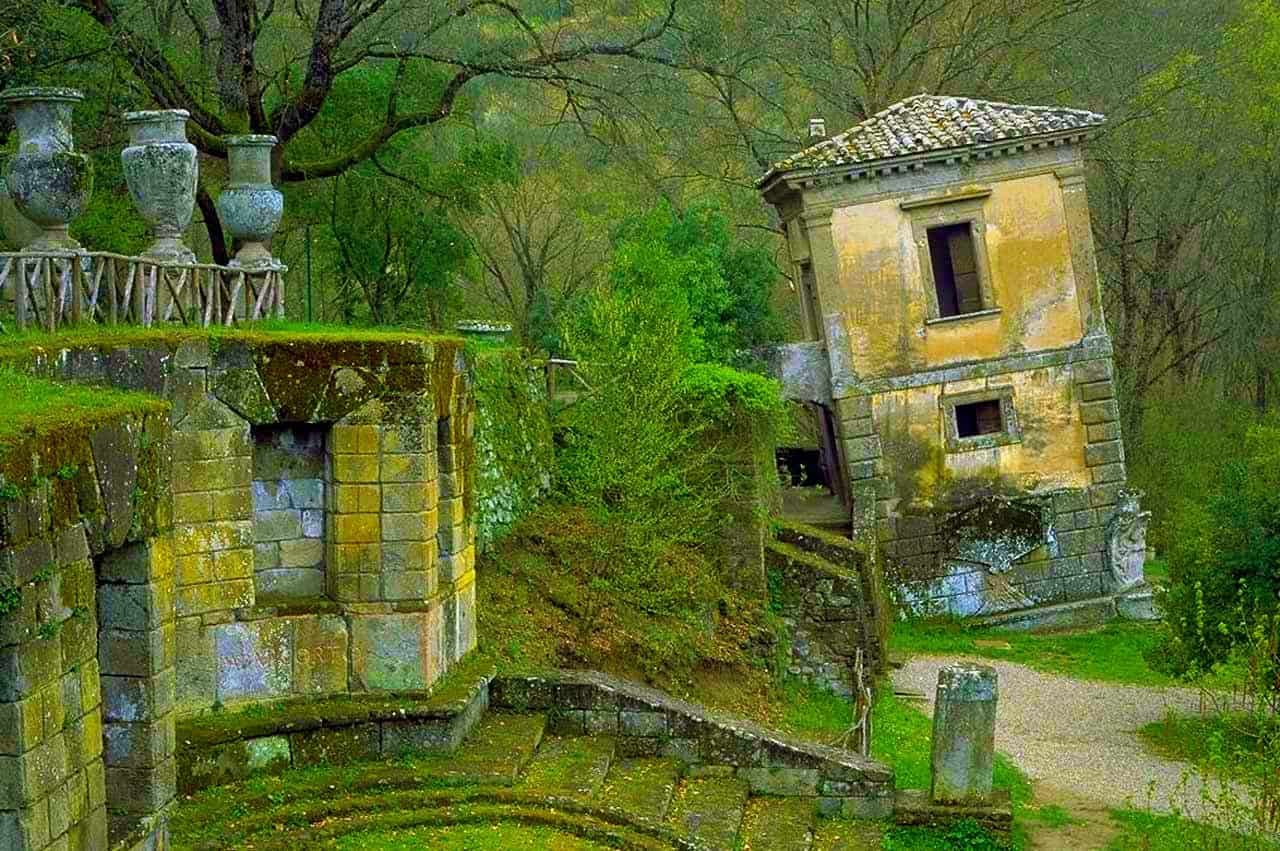
The Piazzale dei Vasi, Neptune and the Sleeping Nymph
A wide piazzale marked by enormous stone vases, once covered by inscriptions now illegible, leads to the majestic statue of Neptune. The god of the seas lies on a bed of water in the manner of Roman river gods, with a dolphin in his arms. Just beyond, a gigantic nymph sleeps stretched out, resting carelessly on one arm: it is one of the most sensual and quiet images in the park, the female counterpart to the fury of the giants.
Ceres, Goddess of the Harvests
Ceres, goddess of grain and mother of Proserpina, is sculpted as an enormous woman who wears on her head a basket of ears of wheat and holds a torch and a cornucopia. Around her, creatures of the woods can be glimpsed. Her presence ties the garden to the agricultural rhythm of the Viterbo territory and sets up, with her daughter Proserpina whom we will meet further on, the theme of abduction and return, that is, of the seasons.
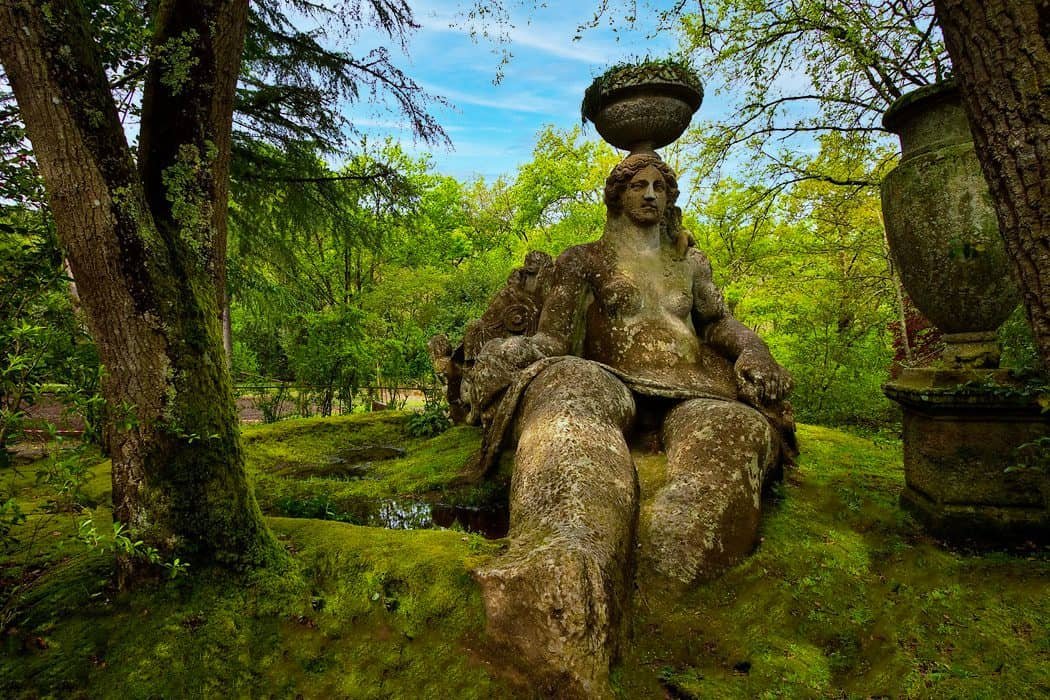
The War Elephant
A majestic elephant carries a tower on its back and with its trunk grips a Roman legionary, almost crushing him. The reference is to Hannibal's feat, who during the Punic Wars crossed the Alps with his elephants to bring war into Italy. It is one of the few figures in the woods with such a direct historical link, and it sums up the sixteenth-century obsession with the ancient world and its legendary battles.
The Dragon of the Parco dei Mostri di Bomarzo
More than a dragon in the strict sense, it is a wyvern, the reptile-like two-legged monster of heraldic tradition. The sculpture captures it in the act of fighting three animals, now hard to recognize because of erosion: probably a lion, a wolf and a dog, according to the most widespread readings. It is a scene of perpetual struggle, consistent with the climate of conflict that runs through the whole garden, where heroes, beasts and deities never stop facing one another. The dragon of Bomarzo is one of the most photographed subjects on the route, and its image, with open jaws and clawed feet, has become almost a second emblem of the park after the Orco.
The Giant Vase, the Etruscan Bench and the Ram
Three figures very close to one another make up a small group: a gigantic amphora decorated with a Gorgon's head, a crouching ram badly worn, and a bench that accurately reproduces the shape of an Etruscan or Roman triclinium, set inside a niche. The bench is not just decoration: it is an invitation to sit, to stop, to take part physically in the garden. Orsini wanted a wood you pass through with your body, not one you look at from a distance.
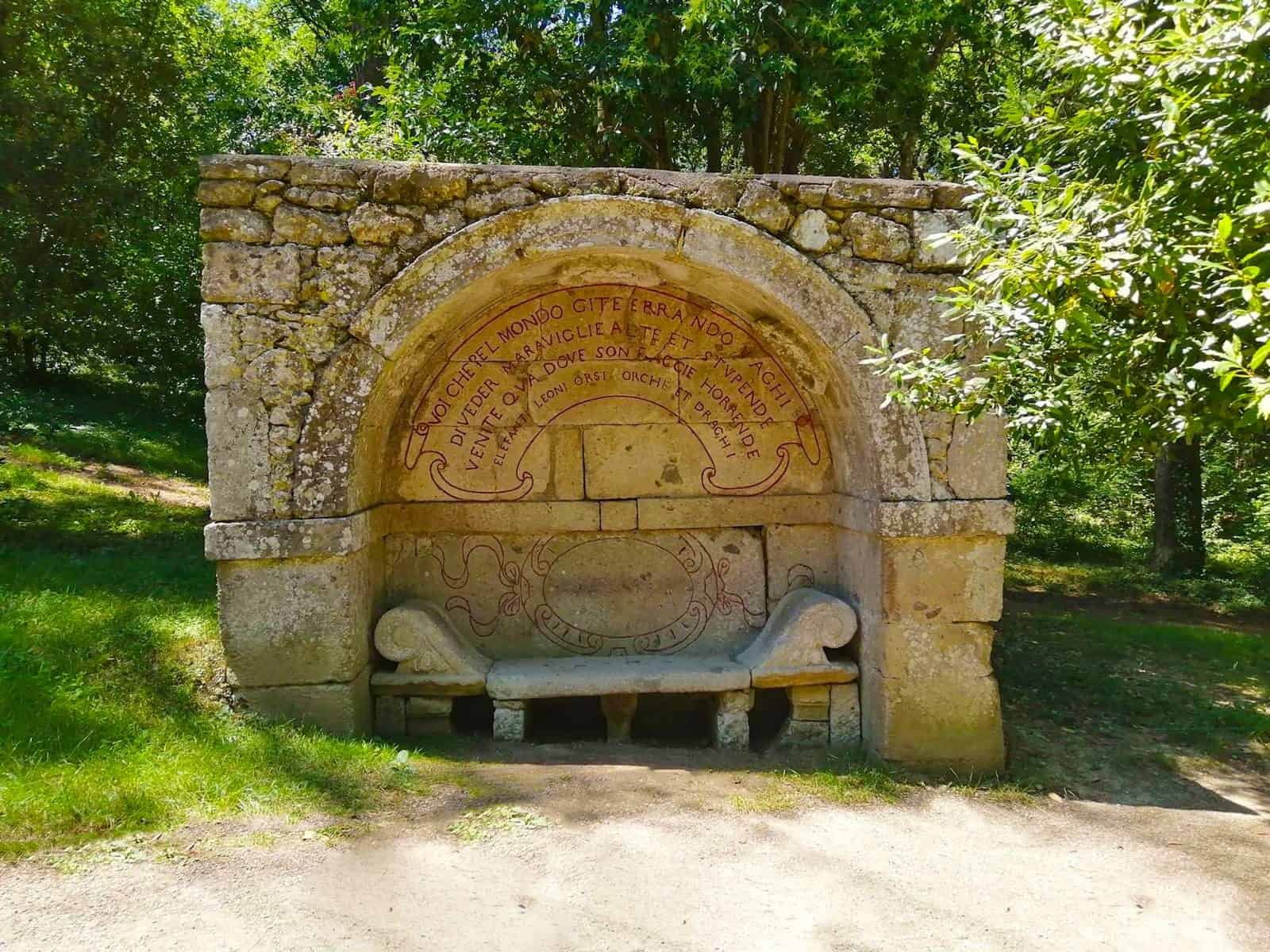
The Orco, the Symbol of the Parco dei Mostri di Bomarzo
It's the face everyone knows, the image that ends up on covers and T-shirts: an enormous stone face with its mouth wide open, around which runs the inscription OGNI PENSIERO VOLA. The mouth is actually the entrance to a chamber carved into the rock, reached by a few steps. Inside, a bench and a table turned the cave into a cool room to sit in. The shape of the space bounces voices and sounds off the walls, so that anyone speaking from inside produces a cavernous echo. A word whispered from the Orco's mouth comes out strangely amplified. Many read the inscription as a refined joke: every thought, once spoken in that throat, literally flies out. And the photographic heart of the park is the spot where small lines form for the shot.
Proserpina, Cerbero and the Piazzale delle Pigne
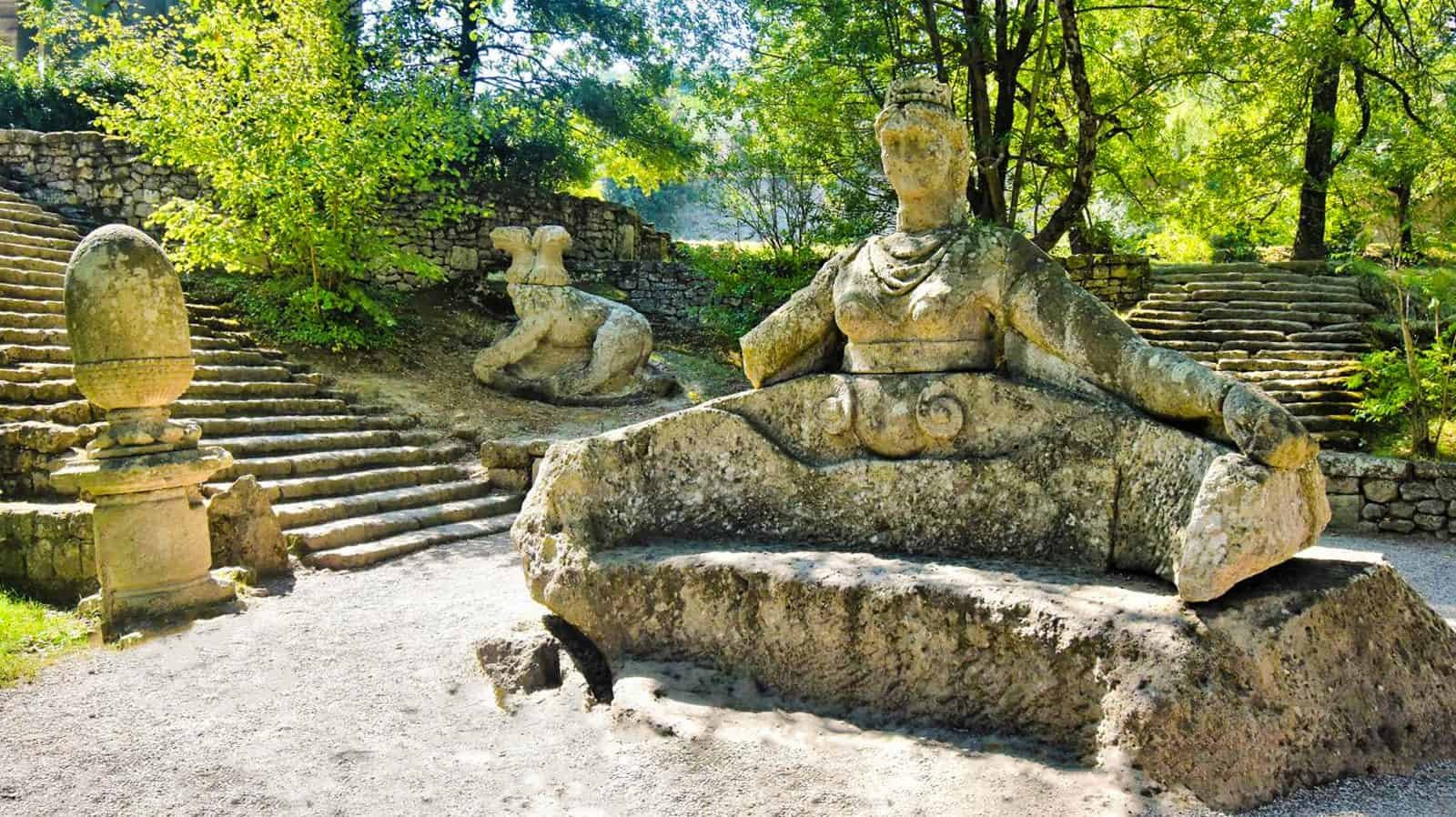
The queen of the Underworld, a heavily eroded figure, is shown as a woman with open arms whose dress spreads into a comfortable bench where visitors can sit. She is the one who abducts, but we too let ourselves be welcomed. A few steps away is Cerbero, the three-headed dog guarding the underworld. Behind the two figures opens the Piazzale delle Pigne, bordered by sculptures shaped like pine cones and acorns, with the Pignone returning as a decorative motif. This is the most openly infernal area of the park, the kingdom of the dead turned into a stone living room.
Echidna, the Fury and the Lions
Facing the Piazzale delle Pigne, two monstrous female sculptures face each other. Echidna is a colossal woman with two snake tails in place of legs, close to the medieval iconography of the two-tailed mermaid. The Fury, on the other hand, is a woman with a dragon's tail and wings. Between them crouch two lions, which tradition makes the offspring of Echidna and which appear in the coat of arms of Viterbo. This is a detail that once again roots the garden in its territory, as you can see walking around the historic center of Viterbo.
The Temple, the Last Farewell of the Parco dei Mostri di Bomarzo
A bit apart from the route, you come across a small temple that was built about 20 years after the rest of the wood, in honor of Vicino Orsini's wife, Giulia Farnese (not to be confused with the more famous namesake, the mistress of Pope Alexander VI). The building mixes forms from different eras: the pediment, the colonnade and the vestibule in classical taste, and the dome of Renaissance origin, modeled on the one in Santa Maria del Fiore in Florence. The interior is a very small circular hall, where the Bettini family, who restored the complex, placed a plaque in memory of Tina Severi. She also died as a result of an injury sustained during the park's recovery work. This is the sweet, melancholy note on which the visit closes: behind all the roar of the monsters, the wood remains a monument to love and loss.

Palazzo Orsini and the Village Above the Parco dei Mostri di Bomarzo
Before or after the wood, it's worth going up into the town. Bomarzo sits on a spur of tufa and is dominated by Palazzo Orsini, the residence of the same family who commissioned the Sacred Grove. It's a building born as a medieval fortress and turned into a noble residence during the Renaissance, with courtyards, loggias and halls that were once frescoed. From up there you understand the geography of the place: the family's power, perched high up, and the secret garden carved into the valley floor, almost a hidden double, stripped of the palazzo's public magnificence.
The village keeps its medieval layout of narrow alleys, arches and staircases, and its cozy atmosphere is a good counterpoint to the exuberance of the statues. Among other things, this is where it's worth stopping to eat. The cooking of the Tuscia, made of legumes, mushrooms, chestnuts, good oil and humble dishes full of flavor, holds up very well in the trattorias of the town and surroundings. Anyone who turns a visit to the Parco dei Mostri di Bomarzo into a half day, combining the wood, the village and a leisurely lunch, takes home an experience much richer than the rush to the sculptures alone.
Bomarzo and Surroundings: What to See Near the Parco dei Mostri
The village of Bomarzo, perched above the park and dominated by Palazzo Orsini, is worth the climb: it has earned the Touring Club Italiano Orange Flag, the mark of tourist and environmental quality reserved for small inland centers that combine heritage and hospitality. In the woods around it are hidden the aforementioned Piramide Etrusca and the remains of ancient Ferento, while a short distance away the Tuscia offers some of its absolute masterpieces.
Within a comfortable range for a one- or two-day trip are the Italian-style gardens of Villa Lante in Bagnaia, the grandiose Palazzo Farnese di Caprarola with its scala regia, the village of Caprarola, the volcanic lake and beech woods of Lake Vico, and the city of the popes, Viterbo, with its medieval San Pellegrino quarter. Those who love artist gardens can pair the Sacred Grove with the very colorful Tarot Garden by Niki de Saint Phalle in Maremma and the romantic Ninfa Garden. To stay on the Orsini theme, Rome has the Cappella Orsini, and for stone monsters in the city, the Casa dei Mostri di Palazzetto Zuccari is also worth a thought, a grotesque portal that speaks from a distance with Bomarzo. Anyone who wants to explore the area will find more ideas on the pages about Monte Casoli di Bomarzo and the Santa Rosa Machine in Viterbo.
The Sacred Grove and the Alchemical Reading of the Garden
Alongside the literary reading, built on references to Petrarch, Ariosto and Tasso, another interpretation has been around for a long time: the alchemical and hermetic one. According to this key, the path among the sculptures would not be random but an initiatory journey, the stone representation of the stages of the Great Work, the inner transformation that the adept undergoes by descending into matter to rise again purified. From this perspective, every figure becomes a symbolic station: the dragon and the Fury are the trials and monsters to overcome, the descent toward Proserpina and Cerberus and the entrance into the kingdom of the dead, the turtle with the winged Nike on its back represents the ascent and fulfillment, the union of opposites. The enigmatic inscriptions, starting with the famous invitation to "reflect part by part," would seem to be the coded instructions for this journey of the soul.
To be honest, this is one of many possible interpretations, fascinating but not proven: no document by Vicino Orsini explains the garden's program, and it is precisely this reticence that has left room for readings of every kind, from alchemy to psychoanalysis. The most cautious, and perhaps truer, approach is to take the Parco dei Mostri di Bomarzo for what those who studied it carefully wrote about it: a theater of erudite and openly artificial fictions, built by a melancholy prince to amaze a few friends and, as the key inscription says, to vent his heart. The charm of the woods lives exactly in this unresolved ambiguity: the more you search for the solution, the more the garden denies it.
Bomarzo in Literature and Music
The twentieth-century rediscovery did not concern only figurative art and cinema: the Sacred Grove also inspired a small literary masterpiece and an opera. In 1962 the Argentine writer Manuel Mujica Lainez published the novel Bomarzo, a long and sumptuous imaginary autobiography of Vicino Orsini, in which the prince, portrayed as a deformed and tormented man, builds the garden of monsters as a mirror of his wounded soul. The book enjoyed great success and helped spread the myth of the place around the world.
That novel gave rise, in 1967, to the opera Bomarzo by Argentine composer Alberto Ginastera, with a libretto by Mujica Lainez himself: a modern and bold score that caused a scandal at its debut for its raw themes and was even banned for a time in Argentina before establishing itself on international stages. That a garden in the Lazio countryside, forgotten for centuries among the brambles, inspired a famous novel and an avant-garde opera across the ocean says a lot about its power. The Parco dei Mostri di Bomarzo is not just a nice place to visit: it is an idea that keeps working on the imagination of those who encounter it, and keeps transforming into other works.
The Parco dei Mostri di Bomarzo with kids
Few visits in all of Lazio work with kids as well as the Sacred Grove. Here you don't need to ask for silence in front of a display case: the park is made for running from one monster to the next, going into the mouth of the Orco, losing your balance in the crooked house, looking for the dragon and the elephant along the paths. The tip is to turn the visit into a game: give the youngest the map at the entrance and assign them the job of finding the figures one by one, so the walk becomes a treasure hunt and nobody gets tired. Watch out, though, for the steps carved into the tufa, the edges of the basins and the uneven stretches, especially after rain. Kids need to be watched closely here, because the ground is natural and not protected like in a playground.
A practical tip: closed shoes for them too, a water bottle and, in summer, a cap, because some parts of the route are in the sun. The right length with the youngest is about an hour and a half, without pushing: when tiredness sets in, the Orco's cave and Proserpina's bench are great spots for a rest in the shade. The Parco dei Mostri di Bomarzo leaves kids with a memory that a traditional museum rarely manages to give.
When to visit the Parco dei Mostri di Bomarzo: the seasons
Each season reveals a different wood. Spring is perhaps the most beautiful time, with fresh green, dry paths and a still gentle light, but it's also the busiest period: on weekends and long weekends the groups multiply and the silence, which here is half the experience, is lost. Summer offers long days and hours extended until 19, but during the central hours the heat of the valley floor makes itself felt. Better the early morning or late afternoon, when the shade of the trees cools things down and the statues regain their depth.
Autumn is the secret season of the Sacred Grove: the wood changes color, mist often rises from the valley floor, and the stone faces re-emerge from the damp with exactly the unsettling look they must have had in the sixteenth century. Winter, with early closing at 17, offers the emptiest and quietest days, ideal for those who want the park all to themselves, as long as they dress warmly and pick a day without rain, because mud on the paths is not a minor detail. In every season the golden rule stays the same: go early or late, never at noon on a holiday.
The Parco dei Mostri di Bomarzo and the other Mannerist gardens
The Sacred Grove wasn't born in a vacuum. It belongs to the great era of Mannerist gardens that flourished between the sixteenth and seventeenth centuries in Lazio and Tuscany, in the villas of lords and cardinals. A few kilometers away, the gardens of Villa Lante in Bagnaia are the exact opposite of Bomarzo: perfect geometry, symmetrical fountains, hedges drawn to the millimeter, the order that celebrates man's dominion over nature. In Tivoli, Villa d'Este, tied to the very Pirro Ligorio whom tradition also names for Bomarzo, pushes the spectacle of water to an unmatched virtuosity.
The Parco dei Mostri di Bomarzo does the opposite of all of them: it gives up symmetry, embraces disorder, and chooses the grotesque and the enigma over reassuring magnificence. That's its revolution, and the reason historians consider it an almost unique case among European gardens. Anyone with time for a multi-day itinerary in the Tuscia can line up the three models, Villa Lante for order, Villa d'Este for water, Bomarzo for dream, and read in them three opposing ways of understanding the relationship between man and nature in the Renaissance. Add the Palazzo Farnese di Caprarola, and the picture of the great sixteenth-century patronage in the Viterbo area is complete.
A curiosity about Parco dei Mostri di Bomarzo
The curiosity that almost nobody knows concerns the name. For the whole sixteenth century, and in the mind of its creator, this place was never a park of monsters. Vicino Orsini affectionately called it the boschetto, the little grove, and contemporaries spoke of the Sacro Bosco: a literary, cultured garden, designed for a few friends able to catch the quotations from Petrarch, Ariosto and Tasso carved into the stone. The label Parco dei Mostri is much later, popular, twentieth-century, and comes from the amazement of the locals and then the tourists facing the open-mouthed faces that re-emerged from the brambles. There's more: many figures we now call monsters were, in the language of the time, deities, allegories and mythological characters perfectly recognizable to a man of Renaissance culture. Neptune, Ceres, Proserpina, Pegasus and the three Graces were not monstrous at all. They were the classical repertoire every educated gentleman mastered. Calling the garden Parco dei Mostri, in short, is a fascinating misunderstanding, a sign of how much the original key to reading it has been lost. Knowing this changes the way you walk through it: not a catalog of frights, but a library in stone whose index has been lost.
One thing nobody tells you about the Parco dei Mostri di Bomarzo
The practical detail that brochures leave out is the physical toll of the terrain. The Sacred Grove is not a flat museum with smooth corridors. It is a wooded valley floor, with a real change in elevation, dirt paths, steps carved into tufa, roots, and, after rain, slippery and muddy stretches. Sneakers are not a luxury, they are a necessity: anyone who arrives in fancy sandals or heels regrets it at the first up and down. This has an important consequence for accessibility: for anyone who uses a wheelchair or has difficulty walking, the route is largely problematic, and it's worth checking the official website beforehand about which stretches are passable. There is also a second thing few people anticipate: many statues need to be seen from several sides to be truly understood, because they were designed to appear and transform as you walk around them. Stopping in front of a figure, looking at it head-on, and then moving to the side is part of the original design: that is where the ogre becomes a cave, the house really starts to lean, and the giant shows its grip. Anyone who rushes through, camera around the neck and a brisk stride, misses exactly what the garden was built for.
The advice I give you for visiting the Parco dei Mostri di Bomarzo
There is only one piece of advice, and it's worth its weight in gold: go early, right when it opens, or late in the afternoon out of season. The charm of the Parco dei Mostri di Bomarzo changes dramatically with the light and the crowds. At nine in the morning, with the mist that sometimes rises from the valley floor and the first shafts of sun through the holm oaks, the ogre and the giants have a power that vanishes completely at noon, when the tour buses have unloaded and the loud groups have arrived. Avoid Saturdays and Sundays in peak spring and the holiday weekends: these are the days when the silence, which is this place's secret ingredient, doesn't exist. Plan on at least two hours, better two and a half, and don't plan a rigid schedule: the fun is letting yourself be surprised at every bend. Bring water, a hat in summer, and a light jacket even in warm season, because under the trees and inside the ogre's cave the temperature drops. If you're visiting with kids, turn the visit into a monster hunt: give them the map and let them find the dragon, the elephant, the crooked house. And finally, obvious but decisive: step away from your phone screen for at least a stretch and listen to the grove. Vicino Orsini built it for exactly this.
Another well-known fact, yet rarely mentioned
It is often repeated that the Sacred Grove inspired the Surrealists, and that is true, but the point is dismissed in a single line without saying how deep it goes. Salvador Dalí visited in 1948 and was dazzled by it: he had himself photographed in theatrical poses among the sculptures and spoke of it as an unrivaled historical invention, a sixteenth-century precedent for his own imagination. The elephant with the tower and the gaping masks echo in Dalí's paintings too precisely to be a coincidence. But the less mentioned chapter is a different one: film. In 1950, Michelangelo Antonioni, not yet the master of the famous films to come, shot a short documentary about the garden right here, one of the first modern looks able to read Bomarzo not as a local oddity but as a total work of art. Since then the Sacred Grove has become a recurring set and refuge for filmmakers, fashion photographers and writers looking for somewhere else. This shift from contempt to reverence tells a bigger story: the taste of the twentieth century, shaped by Surrealism and psychoanalysis, was finally able to understand a garden that the rationalism of earlier centuries had pushed aside as an incomprehensible eccentricity. Bomarzo hasn't changed: the eyes we look at it with have.
The right photo to take at the Parco dei Mostri di Bomarzo
The photo everyone takes is the mouth of the Orco with someone standing inside the jaws, and it's perfectly fine to take it: it's iconic, it's the park's symbol, and the line for the shot clears quickly if you go early. But the right photo, the one few people bother to look for, is a different one. Get down low, lower yourselves to the statues' eye level and shoot them from below upward, with the sky or the tree canopy behind them: that way the giants recover the overwhelming scale Orsini wanted, and stop looking like garden ornaments. For the Ogre, try shooting from inside the cave toward the outside, framing the bright wood through the open mouth: it's a striking image that flips the usual point of view. The leaning house fools the camera: to show the lean, look for a true vertical reference, a straight tree in the background, otherwise the eye straightens everything and the effect is lost. And if you want the truest photo of the place, wait for a hazy day or the low raking light of early morning, when the stone faces emerge from the damp shadow: that is where the Parco dei Mostri di Bomarzo becomes again the unsettling, sacred wood it was in the sixteenth century, not the colorful postcard of noon.
Some important events that happened here in history
The story of the Sacred Grove is measured in centuries and sharp turns. The first is its founding itself, in the mid-sixteenth century, when Vicino Orsini, back from the wars and marked by losses, decided to devote the last decades of his life to this garden of stone, a private and almost therapeutic gesture that has few parallels in the history of European art. The second crucial date is the end. When Orsini died in the 1580s, the grove lost its only interpreter and a very long abandonment began, during which vegetation reclaimed the sculptures and the place slipped into peasant legend.
The third great event is the twentieth-century rediscovery. After remaining a forgotten ruin for almost 400 years, the garden came back to light thanks to the purchase and restoration carried out by Giancarlo Bettini and Tina Severi, who freed the statues from the brambles and gave the grove back to the world. In parallel came the cultural endorsements: Salvador Dalí's visit in 1948, Michelangelo Antonioni's short film in 1950, and then the uninterrupted flow of artists, writers and filmmakers who made Bomarzo a place close to their hearts. Every era has left its mark: the Etruscans with the tombs carved all around, the Renaissance with Orsini's invention, the twentieth century with its rediscovery and its mythologizing. Walking today through the Parco dei Mostri di Bomarzo means crossing all these eras at once.
Who Has Passed Through Parco dei Mostri di Bomarzo
The first name is obviously that of the master of the house, Pier Francesco Vicino Orsini, prince, military leader and man of letters, who spent his final years here and turned his grief into stone. Around him revolves the question of the artists. Tradition points to the architect Pirro Ligorio, the man behind Villa d'Este, as the possible designer of the plan, and to the sculptor Simone Moschino as the probable executor of the statues, while names such as Michelangelo and Vignola appear in old attributions that are today scaled back.
But the most famous moments are those of the rediscovery. Salvador Dalí arrived in 1948 and turned his visit into a small event, having himself photographed among the monsters and proclaiming to the world the absolute originality of the place. Michelangelo Antonioni shot a documentary here in 1950. Giancarlo Bettini and Tina Severi, the restorers, are bound to the grove forever, buried in the little temple they had brought back to life. And behind them came a procession of writers, poets, photographers and travelers. In the twentieth century, the Sacred Grove became a secular pilgrimage for anyone looking for the point where cultivated art and dream meet. Literature too has drawn on it, with works that made Bomarzo and its prince the center of novels and stories. For an artist, passing through here has for decades been almost a rite of initiation.
The Meaning of the Sacred Grove Remains an Open Question
The Parco dei Mostri di Bomarzo is one of the very few Italian art sites of which it can be said, without exaggeration, that nobody knows how to explain what it means. This is not a catchy line: it is the real state of the studies. We know who wanted it, we know in which years it was carved and sculpted, and we read the inscriptions the patron had cut into the stone. What we don't have is a key that holds together the ogre with its mouth wide open, the elephant crushing a soldier, the house built crooked, the sphinxes, the dragon, the theater, the little temple at the top. Scholars have proposed readings that differ and are incompatible with one another, and none has prevailed so far. Here I try to lay out what is documented and what remains a hypothesis, because on the Sacred Grove the two are often confused.
What We Know for Certain About Vicino Orsini
The commission is documented and is not in question. The grove was wanted by Pier Francesco Orsini, known as Vicino, lord of Bomarzo: an ancient baronial family, a military career, imprisonment after a campaign in Germany, and ties to the cultured circle of the Farnese court. Work in the valley below the town began around the middle of the century and went on for decades, until the death of the patron in 1585. His devotion to his wife, Giulia Farnese di Latera (not to be confused with the namesake linked to Alexander VI), is also documented, as is the fact that the octagonal temple at the top of the route is recorded by the sources as a memorial dedicated to her.
The attribution of the design should also be treated with caution. The name that comes up most often is Pirro Ligorio, and for the sculptures, Simone Moschino. These are traditional attributions, repeated by much of the literature, not signed contracts. On who physically drew the route, scholars do not agree.
The Mourning for Giulia Farnese: A Partial Explanation
The most common reading, the one you'll hear in almost every guidebook, is that Vicino Orsini built the grove to work through the grief of his wife's death. It has some basis: the memorial at the top of the path exists, the dedication to his wife is recorded in the sources, and some inscriptions speak the language of grief and consolation. But as an overall explanation it holds up poorly, and it's fair to say so. Work in the valley is documented as started before Giulia died, the small temple belongs to a later phase, and most of the sculptures have nothing funereal about them: monsters, animals, jokes, mythological figures carved into the peperino boulders already on the site. Grief explains part of the grove. It doesn't explain the orc, the elephant, or the leaning house.
The competing hypotheses, without choosing one
The main readings proposed by scholars are at least four, and it's best to present them for what they are: modern hypotheses, none of which is confirmed by a sixteenth-century document that states the meaning of the path.
The first is the alchemical and hermetic key: the grove as a sequence of stations that would correspond to the phases of the Great Work, with the monstrous figures as passages to cross. The second is the initiatory reading in a broad sense: a path of trial, descent and return, which ends precisely at the temple as a place of quiet. The third is literary, and for some it is the strongest on philological grounds: in the statues, scholars have recognized episodes from Ariosto's Orlando furioso, echoes of Petrarch, and above all the fantastic apparitions of the Hypnerotomachia Poliphili, the illustrated book published in Venice in 1499 that in the sixteenth century was a storehouse of images for anyone designing gardens. The fourth reading is the least romantic and for this reason often overlooked: the grove as a Mannerist court game, a collection of marvels and jokes built to amaze guests, without a unified program, in the same taste that in those years produced grottoes, automata and trick perspectives in villas across half of Italy.
These readings are not all compatible with each other. Those who try to hold them together usually do so by adding to the text something that isn't in the text. The honest point, as far as I know, is that every overall symbolic interpretation of the Sacred Grove belongs to twentieth-century criticism and later, not to the sixteenth-century documentation. It's a hypothesis of reading, not a fact.
The inscriptions: an explicit invitation not to understand right away
The most curious thing is that the grove seems to defend itself against interpretation. The inscriptions carved along the path, which are documentary material in every sense because they are still there, explain nothing: they warn. One, on the sphinxes at the entrance, says that whoever does not walk this place with arched eyebrows and tight lips does not even admire the seven wonders of the world, and it invites those who enter to consider things one by one. Another, on the leaning house, states in Latin that the soul becomes wiser by resting. A third, the most quoted, declares that the grove was made only to relieve the heart.
These phrases shift attention from meaning to experience: look, suspend judgment, proceed piece by piece. They don't tell the visitor what to think, they tell them how to look. It's possible that the absence of a key is not a loss caused by time, but a choice by the patron: a grove that asks for wonder instead of understanding. This too, however, is an interpretation, and it should be taken as one.
Three centuries of neglect and a recent rediscovery
The later history explains why we know so little. After Vicino Orsini's death the grove was largely abandoned: vegetation covered the statues, and for about three centuries the place remained a local oddity. No text has come down to us that describes the program of the work.
The rediscovery is a twentieth-century affair, and it is documented. In 1948 Salvador Dalí visited the grove and had himself photographed among the sculptures, calling it a unique historical invention: those images did a lot to bring Bomarzo back into the sphere of international attention. In 1950 Michelangelo Antonioni, still a documentary filmmaker at the time, shot a short film there titled La villa dei mostri. The physical restoration came later, through private initiative: the Bettini family bought the area and began a restoration that continued for years, giving back the path visitors walk today. The paradox is that interpretations have multiplied precisely since then, without any one of them managing to settle the matter.
For context, it's worth also seeing the other face of the sixteenth-century gardens of the Viterbo area, the regular and geometric one of Villa Lante a Bagnaia: comparing the two places says more than many theories. Nearby, the Monte Casoli reserve and Viterbo round out the day.
Quick Questions About Parco dei Mostri di Bomarzo
How much does a ticket to Parco dei Mostri di Bomarzo cost
A full ticket costs €15, and the reduced ticket for children aged 4 to 13 is €9. Children under 4 enter for free. Always check prices again on the official website before your visit.
What Are the Opening Hours of the Parco dei Mostri di Bomarzo
The park is open every day of the year with continuous hours from 9, closing at 19 from March to September and at 17 from November to February. October follows the clock change.
What Time Is the Last Entry
The last entry is always one hour before the gate closes. Since the full visit takes just over two hours, it's best to arrive well ahead of time.
How Long Does the Visit to the Parco dei Mostri di Bomarzo Take
To see all the sculptures at a relaxed pace, you need at least two hours, better yet two and a half. If you only have one hour, you'll see the highlights, but you'll miss the best part, which is walking around the figures without rushing.
Is the Parco dei Mostri di Bomarzo Suitable for Kids
Very much so. The monsters, the crooked house, and the Orc's mouth drive the little ones wild. My advice is to give them the map and turn the visit into a monster hunt, keeping an eye on them on the steps and in the slippery stretches.
Is the Route Wheelchair Accessible
The Sacred Grove is a wooded valley floor with uneven ground, dirt paths, and steps carved into tufa, so a large part of the route is difficult for people with mobility problems. It's best to check in advance on the official website which stretches are passable.
Do You Need to Book to Visit the Parco dei Mostri di Bomarzo
For individual visitors, buying a ticket at the box office or online is usually enough. Advance booking is mainly required for schools, universities, and organized groups.
Can You Take Photos at the Parco dei Mostri di Bomarzo
Yes, photos for personal use are allowed, and the park is one of the most photogenic places in Lazio. The signature photo is the Orc's mouth with the inscription OGNI PENSIERO VOLA.
Why Is It Called the Parco dei Mostri
It's a popular name from the 20th century. Originally, Vicino Orsini called it a grove, and his contemporaries spoke of the Sacred Grove. Many of the figures are actually deities and mythological characters, not monsters.
Who Built the Parco dei Mostri di Bomarzo
It was commissioned by Prince Pier Francesco Vicino Orsini in the mid-16th century. Tradition attributes the design to architect Pirro Ligorio, as a hypothesis, and the sculptures to the chisel of Simone Moschino.
What Material Are the Statues Made Of
The sculptures were carved directly into the large blocks of peperino, the local volcanic stone, that emerged in the woods. That's why they are so large and seem to rise out of the ground.
What Does OGNI PENSIERO VOLA Mean
It's the inscription carved around the Orc's mouth. Many read it as a clever joke: inside the cave, the echo amplifies voices, so every thought spoken there literally flies out.
How Big Is the Parco dei Mostri di Bomarzo
It's a garden of several hectares in the valley floor, and you can walk the entire site along a loop of paths. The distances aren't huge, but the elevation changes and the natural terrain make the walk more demanding than it looks.
How to Get to the Parco dei Mostri di Bomarzo from Rome
By car, take the A1 toward Florence and exit at Attigliano-Bomarzo, for a total of about an hour and a half. By train, get off at Orte or Attigliano-Bomarzo and continue with local connections or a taxi, to be checked in advance.
Is There Parking at the Parco dei Mostri di Bomarzo
Yes, there is a large parking area in front of the entrance, which is convenient because the most practical way to get there is by car.
When Is the Best Time to Visit the Parco dei Mostri di Bomarzo
Early in the morning, right after opening, or in the late afternoon in the off-season, to avoid groups and enjoy the silence. Weekends in full spring and long holiday weekends are the busiest days.
What to See Near the Parco dei Mostri di Bomarzo
Nearby you'll find Villa Lante in Bagnaia, the Palazzo Farnese in Caprarola, Lake Vico, and Viterbo with the medieval San Pellegrino quarter. A little further on are Civita di Bagnoregio and the Giardino dei Tarocchi.
Can You Visit the Parco dei Mostri di Bomarzo in the Rain
You can, but the dirt paths become muddy and slippery, and the wet tufa steps need to be approached with care. With fog, however, the atmosphere of the woods is even more intense. Just wear suitable shoes.
Is There a Bar or Snack Stand Inside the Park
Services for visitors are available at the entrance area. For a proper meal, it's best to head up to the village of Bomarzo or stop in one of the nearby towns in the Tuscia, where Viterbo cooking holds its own very well.
Is Entry Free on the First Sunday of the Month at the Parco dei Mostri di Bomarzo
No. The Sacred Grove is a private park and is not part of the free Sunday initiative for state museums. Tickets must be paid every day of the year at the official rates.
Where Exactly Is the Parco dei Mostri di Bomarzo
The entrance is in Località Giardino, in the valley floor below the village of Bomarzo, in Viterbo Province, in the Tuscia area of Lazio. It is about 15 kilometers from Viterbo and just under 90 kilometers from Rome.
Is the Parco dei Mostri di Bomarzo Outdoor or Indoor?
It's entirely outdoor, a wooded garden to explore on foot along a loop of paths. Dress accordingly, with suitable shoes and protection from rain or sun depending on the season.
Is the Parco dei Mostri di Bomarzo Worth Visiting?
Yes, without a doubt. It's one of the most original places in Lazio and a masterpiece of European Mannerist garden design. Those who take it slowly, outside peak hours, come away surprised.
My Verdict on the Parco dei Mostri di Bomarzo
I remain convinced that the Parco dei Mostri di Bomarzo is one of the most underrated and at the same time greatest places in Lazio. It's not a day trip for kids with a few funny statues, even though kids love it. It's a masterpiece of the sixteenth century, the invention of a learned and wounded man who turned a wood into a poem. Go with the respect it deserves and with the right shoes, choose the empty hour, walk around every figure, sit on Proserpina's bench and in the Orco's lair, and leave without expecting to have understood everything. Bomarzo is not explained, it is walked through. And that is exactly why, four and a half centuries later, it keeps astonishing anyone patient enough to listen. Go back in a different season and you'll find the wood still has something to say to you, every time.
Article written by the editorial team at TourLeaderPro, contact them for Private/Corporate/V.I.P. Tours and Experiences.
Planning a trip to Rome? English-language guides to visiting the city are on ItalyPlanner.com.