Santa Rosa Machine in Viterbo
In short. The Santa Rosa Machine in Viterbo is carried through the historic center on the evening of September 3 every year.
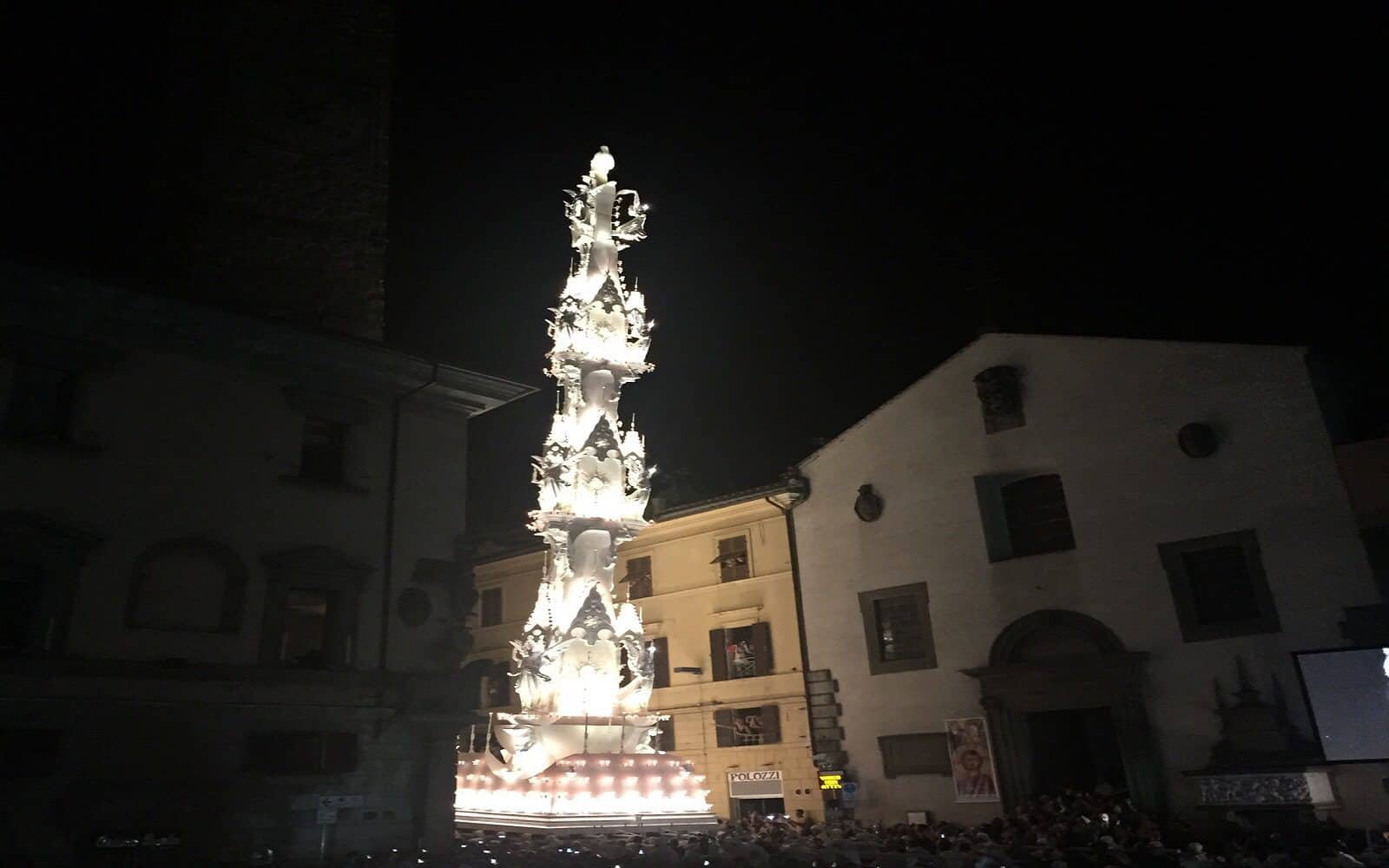
The Santa Rosa Machine in Viterbo is carried through the historic center on the evening of September 3 every year. It starts from the open space inside Porta Romana, next to the church of San Sisto, and ends in Largo Facchini di Santa Rosa, in front of the Sanctuary of Santa Rosa on Via Santa Rosa. The route is about 1,200 meters long, the start (the "mossa") normally happens around 21:00, and the whole maneuver lasts just under an hour. Watching along the streets and in the squares of the route costs nothing: you enter the center on foot, since it is closed to traffic and gradually limited in numbers from the afternoon. If you want a seat, you have to book one of the numbered seats in advance on the stands set up in some squares. In recent editions they were sold for 10 euros through a booking portal indicated by the Municipality of Viterbo. The number of seats, the price and the date sales open change from year to year and need to be checked on the Municipality's official website before you set out. The Machine currently in service is called Dies Natalis, it is signed by the Viterbo architect Raffaele Ascenzi and it is meant for the five-year period 2024-2028. After the transport the Machine stays assembled in Largo Facchini di Santa Rosa and can be seen up close, lit up, for a few days. If you are coming from Rome, Viterbo is an hour and a quarter away by car on the Cassia bis, or by train on the regional lines to Viterbo Porta Romana and Viterbo Porta Fiorentina.
Viterbo deserves more than one evening: the page on Viterbo covers the rest of the city, from the medieval San Pellegrino quarter to the Palace of the Popes.

What the Santa Rosa Machine in Viterbo Really Is
Calling it a procession is understating it and calling it a show is offensive. The Santa Rosa Machine in Viterbo is a luminous tower almost 30 meters tall from the ground, which about 100 men lift onto their shoulders and carry by hand, with no wheels, no motors, no cables, through medieval streets that in some places are barely wider than the base of the structure. There are no tricks. The center of gravity has to be calculated to the centimeter, the step has to be kept in unison, and the slightest misalignment by one man out of a hundred is transmitted upward, amplified 20 times.
The structure is a triumphal canopy, a direct descendant of the Baroque apparatuses that accompanied the city's processions in the 1600s. The building logic has stayed the same: a load-bearing metal frame, a light scenic covering, a lighting apparatus, and at the top, or in any case in a dominant position, the figure of Santa Rosa. What has changed over the last 60 years is everything else. Iron, wood and papier-mâché have given way to light alloys, glass fibers, composites and fiberglass. Candles and torches now coexist with low-consumption electric sources, but the live flame has never been eliminated entirely, and it is what gives the Santa Rosa Machine in Viterbo the flicker that no LED can imitate.
The municipal specifications set the limits within which the designer has to work, and they are strict limits. The maximum height allowed is 28 meters measured from the shoulders of the porters, which brings the top to about 29.50 meters from the ground, and the weight cannot exceed 50 quintals, apart from the tolerances verified by the official weighing that comes before the transport. Each call for entries then adds its own requirements on the center of gravity, the safety of the materials and compatibility with the width of the street along the route. These are numbers that seem abstract until you stand under a balcony on Via Cavour and see the Machine pass a hand's breadth from the gutter.
In our opinion, anyone who arrives expecting to see a stage set is thrown off, because the part that stays with you is not the tower but the noise. The shouted commands, the breath of 100 men, the unreal silence of the crowd in the seconds before the "sollevate" ("lift"). If you can choose, choose a spot where you can hear, not one where you can see best.
Dies Natalis, the Santa Rosa Machine in Viterbo Currently in Service
The Machine the porters are carrying in these years is called Dies Natalis. It is the third winning project signed by Raffaele Ascenzi, a Viterbo architect and former porter, after Ali di Luce (in service from 2003 to 2008) and Gloria (from 2015). The public competition that selected it set precise conditions: a maximum weight of 50 quintals, a center of gravity within a safe height, and an explicit reference to both the 2025 Jubilee and the 2013 UNESCO recognition. The judging committee, facing a shortlist of nine projects deemed feasible, particularly rewarded the placement of the figure of the Saint and the choice to tell episodes of her life along the structure, as well as the concrete technical feasibility of the whole. The five-year period assigned is 2024-2028.
The Name: Why "Dies Natalis" Does Not Mean Birthday
The title is the key to reading the work and it needs explaining, because almost everyone misunderstands it. In the vocabulary of the early Church, the dies natalis is not the day of biological birth but the day of death, understood as birth into eternal life. That is why saints are celebrated on the day they die and not the day they come into the world. Applied to a girl who died at 18 and became the patron of her city, the concept is anything but abstract. The Santa Rosa Machine in Viterbo that bears this name is built around the idea of passage: your eyes climb from the base upward and cross a human story that was short, intense and ended early.
The Shape, the Materials and the Position of the Statue
Compared with the earlier Machines, Dies Natalis introduces a choice that sparked quite a debate in Viterbo: the figure of Santa Rosa is not placed at the top, as recent tradition had accustomed everyone to, but in a lower position, inserted into the story told by the structure instead of resting on top like a finial. The body of the Machine is hollow, built on a metal frame covered with light composite materials, and along its sides it holds the episodes of the Saint's life. The declared height is 28 meters above the porters' shoulders, within the limit of the specifications.
Anyone who has in mind the pointed silhouette of the "walking bell tower" has to readjust in front of Dies Natalis. This is a Machine that works on empty spaces more than on full ones, and on the evening of the transport you can see the difference: the light does not cover a surface, it passes through it. It is an effect that works better in wide squares, where you can stand back, and that is lost in the alleys, where it passes so close that you only see one piece at a time.
Weight, Weighing and Testing of the Santa Rosa Machine in Viterbo
Before every transport the Machine is officially weighed. The figure matters, because the specifications set the ceiling and because the number of men under the structure is calibrated on that value. The weighings of recent editions have returned values around 50 quintals, that is, around 5 tons, and the ratio that comes out is the one that strikes anyone who does the math: a little under 50 kilograms per person of average load, but distributed in a completely uneven way, because whoever carries under the central beam bears much more than whoever accompanies on the side poles.
To the weight itself you have to add everything the public does not see: the ropes, the levers, the resting stands of 100 kilograms each that are carried by hand and positioned before every stop, the equipment of cushions and headgear. The assembly of the Santa Rosa Machine in Viterbo takes up the months of July and August in a work site set up at Porta Romana, next to San Sisto, and the structure stays hidden until the last moment inside a scaffold covered with sheets. The first time the people of Viterbo see it in full is that very evening, when the lights come on.
The Transport of the Santa Rosa Machine in Viterbo, Hour by Hour
The evening of September 3 has a fixed liturgy, and knowing it in advance completely changes the experience for those who come from out of town. Here is how it really unfolds.
Morning and Afternoon: The City Claims Its Spots
From the early hours of the morning the streets along the route begin to fill. Not with tourists: with people from Viterbo, who leave home with folding chairs, stools, sheets and ribbons and occupy their own meter of sidewalk with a territorial precision handed down in families for generations. Anyone who arrives at noon thinking they will find room in the front row in Piazza del Plebiscito has already lost. The paid stands in the main squares are put up in the preceding days and are there exactly for those who cannot guard a sidewalk for 12 hours.
The Porters at City Hall, at the Seven Churches and on Retreat
While the city gets into position, the porters follow their protocol. Dressed in the traditional uniform, they first go to City Hall to receive the greeting of the city authorities, then they make the visit to seven churches in the center, and finally they withdraw to the Capuchin convent, where the head porter gives the last technical instructions on the transport. It is a closed moment, which the public does not see, and it serves for spiritual preparation as much as for operational review: who goes where, who replaces whom, what the critical points are that year. The rite of the seven churches has a much more famous Roman parallel in the seven churches pilgrimage, but here it is a matter of team before it is a matter of individual devotion.
The Dark: The City Switches Everything Off
About an hour before the start the sun goes down and Viterbo begins to go dark. The public lights are turned off along the whole route, and by iron-clad tradition the private ones go off too: windows, signs, shop windows. Anyone who leans out with a lit cell phone is called out by the street. The result is a completely black historic center, in which the only light source that moves is the Santa Rosa Machine in Viterbo. It is not a modern scenic gimmick: it is the reason the structure was born lit, in an era when night lighting was in itself an extraordinary event.
The Blessing in Articulo Mortis at San Sisto
Around 20:00 the porters, preceded by the band playing their hymn, set off from the Sanctuary of Santa Rosa and walk the Machine's entire route backward, welcomed by the crowd along every street. They arrive at the church of San Sisto, near Porta Romana, where the "mossa" takes place. Here the bishop gives them the blessing known as in articulo mortis, the one given to those facing danger of death. It is not a rhetorical formula. The transport is an operation in which 100 men slip under five tons in balance, and the history of the festival includes serious accidents, among them the tragedy of 1801 that cost the lives of more than 20 people and led to separating the religious procession from the transport of the Machine.
The Mossa: The Moment the Santa Rosa Machine in Viterbo Rises
The sequence of the head porter's commands is the part the people of Viterbo know by heart and visitors hear for the first time. It begins with the call under the structure, "Ciuffi di Santa Rosa, accapezzate il ciuffo", continues with the question that is both a technical check and a collective oath, "Semo tutti d'un sentimento?", and with "Facchini di Santa Rosa, sotto col ciuffo e fermi". Then comes the "Sollevate e fermi": five tons leave the stands and stay motionless in the air, supported only by shoulders and napes. Finally "Per Santa Rosa, avanti!" and the Machine moves.
The practical advice: if you only have one shot, spend it here. The mossa is the point where you understand what you are looking at, because it is the only moment when the structure goes from standing to lifted before everyone's eyes, and the roar that follows is the most impressive thing of the whole evening.
The Five Stops and the Final Setting Down
Along the route the Santa Rosa Machine in Viterbo is set down on special stands, weighing about 100 kilograms each, which a dedicated team carries by hand and positions ahead of time. The stops let the carriers catch their breath, re-form the ranks, check the structure and replace anyone who cannot hold. They are the moments when the public can get closer with the eye and see the faces: from there on the festival stops being an image and becomes a matter of people.
- Piazza Fontana Grande
- Piazza del Plebiscito, in front of City Hall, where the girata takes place
- Piazza delle Erbe
- Corso Italia, in front of the church of Santa Maria del Suffragio
- Corso Italia, near the church of Sant'Egidio, a technical stop introduced in 2013
- Piazza Verdi, also called Piazza del Teatro
The last stretch is the one that decides the evening: a steep climb, taken almost at a run, with the addition of the front ropes pulled by a large team and the beams called levers that push the structure from behind. It is the passage where the rhythm changes abruptly and where the Machine, for the first time, seems to fly instead of walk. Once it reaches Largo Facchini di Santa Rosa, in front of the Sanctuary, it is set down with the command "posate piano, adagio" and stays on display to the public for a few days.

The Route of the Santa Rosa Machine in Viterbo, Point by Point
1,200 meters seems short. It is in fact a route of increasing difficulty, alternating open spaces where the structure breathes and tight squeezes where the carriers have to pull their heads in. It is worth walking it by day, before the transport, to understand where to stand in the evening.
Porta Romana and the Church of San Sisto
The starting point is the open space inside Porta Romana, dominated by the bulk of the church of San Sisto, one of the most important Romanesque buildings in the city, with its bell tower and the apse built into the walls. This is where the Machine is assembled during the summer and hidden behind the scaffolding. The area is the most crowded of all and the access gates are closed well in advance: anyone who wants to see the mossa has to plan on arriving in the early afternoon and not moving again.
Piazza Fontana Grande, the First Stop
The first stop takes place in the square of the most beautiful medieval fountain in Viterbo, the Fontana Grande, already documented in the 1200s and made of the typical local stone, gray peperino. The contrast between the Greek-cross basin, dark and low, and the luminous tower that stops beside it is one of the reasons this stop is so photographed. The square, however, slopes and the public arranges itself on several levels: whoever stays at the back sees little.
Piazza del Plebiscito and the Girata in Front of City Hall
Piazza del Plebiscito, with the Palazzo dei Priori and the Palazzo del Podestà, is the institutional center of the city and the point where the Santa Rosa Machine in Viterbo performs the girata, that is, the rotation on itself in front of the authorities. It is the technically most delicate maneuver of the whole transport, because it requires the inner rows to slow down and the outer ones to speed up while keeping the structure level. It is also the square with the largest stand capacity, and it is the place I recommend to anyone bringing elderly people or small children.
Piazza delle Erbe and Corso Italia
From Piazza delle Erbe the route turns onto Corso Italia, the commercial axis of the city, where two stops are planned: the first in front of the church of Santa Maria del Suffragio, the second near the church of Sant'Egidio, added in 2013 as a technical stop to ease the longest stretch without support. The Corso is wide and straight, which means good visibility and an extremely packed crowd. Anyone who wants to follow the Machine on foot from one stop to the next can't do it here: lateral movement is in practice impossible.
Piazza Verdi and the Final Climb of Via Santa Rosa
Piazza Verdi, in front of the Teatro dell'Unione, hosts the last stop and it is the moment when the porters prepare for the final effort. From there begins the climb to the Sanctuary, the stretch where the ropes and levers come into action and where the pace turns into a run. Anyone watching at the top, in Largo Facchini di Santa Rosa, sees the Santa Rosa Machine in Viterbo emerge from the darkness of the uphill street: it is the scene that appears in almost all the famous photographs of the festival, and the reason that square is the most restricted area of all.
The Facchini di Santa Rosa: Who Carries the Santa Rosa Machine in Viterbo
They are not extras. They are an organized body, selected with standardized physical tests and structured in precise hierarchical roles, and their collective existence has a formal birth date: 1978, the year the Sodalizio dei Facchini di Santa Rosa took shape, today the guarantor of the festival's entire organizational machinery. The push to set it up had come from the difficult years of the Volo d'Angeli, when it became clear that the safety of the transport could no longer depend on improvisation.
The Carrying Test: 90 Meters with 150 Kilograms
To join the carriers you have to pass a test that allows no interpretation: walk about 90 meters with 150 kilograms on your shoulders. The result serves not only to say yes or no, it serves to classify, because the head porter assigns each man's position under the structure based on the technical assessments of carrying capacity. Whoever can bear more goes where the load is greater. It is a brutal and transparent merit system, and it explains why in Viterbo being a porter is a social title before it is an assignment.
The Roles Under the Santa Rosa Machine in Viterbo
The formation numbers over 100 men, distributed as follows:
- Ciuffi: 63 porters arranged in seven rows of nine, placed under the base of the structure. They carry the so-called ciuffo on the nape, protected by a padded red leather headpiece. It is the most prestigious role and the hardest.
- Fixed spallette: 16 porters in two rows, under the side beams, with the shoulder protected by red cushions. In the narrow stretches they receive the command "dentro le teste".
- Additional spallette: 22 men in two rows of 11, placed alongside the fixed spallette to absorb the load in the most demanding stretches.
- Stanghette: 12 porters, six in front and six behind, whose job is to dampen the longitudinal swaying. They are the ones who keep the tower from gathering momentum.
- Leve: about 20 men who push on the rear beams in the final climb.
- Corde: about 30 porters who pull from the front of the base in the last sloping stretch.
- Cavalletti: the team that carries and positions the supports for the stops, a role that seems secondary and is in fact decisive for the balance of the standing structure.
- Guide: four former porters at the corners of the Machine, assisted by six helpers, who steer the passage through the narrow stretches and check the stands before every setting down.
The Head Porter and His Commands
The head porter directs the entire operation and is chosen from among porters with at least 20 years of experience under the structure. It is not an honorary role: he is the one who assigns the carrying assessments, decides the formation, calls the commands and stops everything if something is off. He stands out in the uniform because he wears black trousers and a sash across the chest in the colors of the city, yellow and blue.
The Uniform of the Facchini di Santa Rosa
The outfit is codified: white long-sleeved shirt rolled above the elbow, white trousers fastened below the knee in the knickerbocker style, red sash at the waist, white kerchief knotted in the corsair style, white socks and high black boots. The traditional symbolic reading ties white to the purity of the patron saint and red to the cardinals who took part in the translation of the body in 1258. Before the Second World War the sash had colored bands with red, pink and blue fringes.
The Hymn and the Collective Formula
The band that precedes the porters plays their hymn, whose words and music are by Lorenzo Celestini. But the formula that really works as a hymn is the one the head porter shouts before the mossa: "Semo tutti d'un sentimento?". The answer is a unanimous yes, and it is the only contract that holds together 100 men who are about to slip under five tons. Many definitions of the festival are in circulation. None explains it better than that question.

Santa Rosa, the Girl the Santa Rosa Machine in Viterbo Is Dedicated To
Behind five tons of structure there is a biography of 18 years. Rosa was born in Viterbo in 1233, to Giovanni and Caterina, and died in the same city in 1251. She did not found orders, she did not write treatises, she held no offices. She did one thing only, and she did it in the middle of a war: she preached publicly for reconciliation between families and factions in a city split by the conflict between Emperor Frederick II and the papacy, openly taking the side of the Church. The hagiographic sources say she was turned away by the Poor Clares because of her health and then entered the Franciscan third order.
The Exile in Soriano and Vitorchiano
Her political preaching had concrete consequences: the podestà had her sent away from Viterbo with her family. Rosa found refuge in Soriano nel Cimino and in Vitorchiano, two villages of the Tuscia that still preserve the memory of her passing. It is a detail that is told little in Viterbo and that actually says a lot: the patron of the city was, for a stretch of her very brief life, an exile.
The Translation of 1258, the Birth Certificate of the Festival
Rosa was buried without honors. After her death the flow of pilgrims to the tomb and the fame of the miracles attributed to her body convinced Pope Alexander IV to order its translation: on September 4, 1258 the body was moved from the church of Santa Maria in Poggio, known as the Crocetta, to the church of the women's monastery that would become the present Sanctuary. Tradition says that on that occasion the body was found incorrupt. That night procession is the birth certificate of everything: the transport of the Santa Rosa Machine in Viterbo, every September 3, is its symbolic reenactment.
The Canonization Process That Was Never Concluded
Here is a fact that surprises everyone: the canonization process of Rosa, begun in 1251 and resumed in 1457, was never formally brought to completion. The cult is very ancient, recognized and universally practiced, but the canonical procedure technically remains open and in recent years steps have been taken to complete it. Anyone who loves the anomalies of church history finds a notable one here: a patron saint celebrated for almost eight centuries with one of the grandest festivals in Italy, and a file that was never closed.
The Incorrupt Body and the Scientific Examinations
Rosa's body is kept in the Sanctuary inside a gilded bronze urn from 1699. The examinations carried out over time have documented the preservation of the heart, the muscle masses and the skeleton in anatomical connection: in 1921 the heart was removed intact. The scientific investigation of 1996 gave back the most precise portrait we have of the girl: age at death between 18 and 20, height of around one meter 55, dark hair, blue eyes, and a rare congenital malformation, Cantrell's pentalogy, which explains the ancient sources on her fragile health. It is the kind of information that makes a medieval devotion suddenly concrete.
The Sanctuary of Santa Rosa
The Sanctuary stands on Via Santa Rosa, where the church of the Poor Clares' monastery used to be, and it is the arrival point of the Machine. The present building dates from 1850 and replaces a 1600s structure, with a neoclassical layout and a dome added in 1913. Besides the urn with the body of the Saint, it holds a wooden crucifix from the 1600s with a gilded halo, a polyptych by Francesco d'Antonio with the Madonna and saints, and the tomb of Mario Fani, one of the founders of the Italian Catholic youth movement. Next door the community of Poor Clares still lives, which guards the body. Entry to the Sanctuary is free. Opening hours and Mass times should be checked on the website of the Diocese of Viterbo, because they vary between ordinary periods and festival days.
The Historic Machines: Six Centuries of Walking Towers
The Machine is not an object but a series. Every five years the Municipality of Viterbo issues a public competition for the design and construction of the new Machine, with a term that can be extended, and the winner delivers to the city a structure completely different from the previous one. It is a rare mechanism among Italian traditional festivals, where as a rule things are preserved. Here they are renewed by specification.
From 1600s Canopies to the Walking Bell Tower
The first documented evidence of a processional apparatus carried on the shoulders dates to the 1600s, with records around 1664. They were relatively simple machines, which over the 1700s and 1800s grew in height and complexity until they took the form of a Gothic bell tower lit by torches and candles. From that silhouette comes the definition "campanile che cammina" ("walking bell tower"), a phrase coined by the writer Orio Vergani and now the way all of Italy has learned to refer to the Santa Rosa Machine in Viterbo. Among the Machines of the 1900s from that season, worth recalling are Rose Fiorite by Rodolfo Salcini and Romano Giusti, in service from 1952 to 1958, and the Campanile che cammina itself by Angelo Paccosi, from 1959 to 1966.
Volo d'Angeli, the Revolution of 1967
In 1967 the competition was won by Giuseppe Zucchi, and the result split the city. The Volo d'Angeli, dedicated to the Folgore paratroopers who fell at El Alamein, abandoned the bell tower and introduced sculpture as the language of the Machine, with a uniform palette of white and peperino gray. For the first time a height of 30 meters was reached and exceeded.
The debut was a disaster. The first transport did not make it to the end: the Machine stopped on Via Cavour, where in 2007 a plaque was placed in memory of that evening. The causes were debated for decades. The very tight design schedule weighed, since the call had been held only the previous May. Zucchi's choice to add a row of ciuffi at the expense of the front and rear stanghette weighed. And, according to a reconstruction that has always circulated in Viterbo, weeks of rumors about a predicted failure weighed, fueled by some Cavalieri di Santa Rosa, as the porters tied to the previous builder were called. It must be said honestly: the conspiracy thesis belongs to the city's oral tradition, not to a documented finding.
Despite that debut, the Volo d'Angeli was carried for 12 years. The contribution of Giuseppe Zucchi, his son Luigi and the porters in those years was decisive for the safety of the transport and for the organization of the festival, and in 1978 it led to the foundations of what would become the Sodalizio.
Spirale di Fede, Armonia Celeste, Sinfonia d'Archi
From 1979 to 1985 it was the turn of Spirale di Fede, conceived and built by Maria Antonietta Palazzetti and Rosario Valeri, the Machine at the center of the two extraordinary transports of the 1980s. Armonia Celeste by Roberto Joppolo and Alfiero Antonini followed, from 1986 to 1990, and Sinfonia d'Archi by Angelo Russo, from 1991 to 1997. These are the Machines that middle-aged people in Viterbo remember from childhood and that mark the definitive passage from the language of the bell tower to that of abstract sculpture.
Ali di Luce, the Machine of 2003
From 2003 to 2008 Ali di Luce paraded, designed by Raffaele Ascenzi, at the time a porter in service, and built by Contaldo Cesarini. It marked the technological leap: fibers, light alloys, differentiated light sources to bring out the modeled coverings. Along the four sides of the base ran the motto non metuens verbum leo sum qui signo viterbum, first used in 1225 in the city seal, which means "I fear no threat, I am the lion who represents Viterbo", accompanied by the acronym FAVL, that is Fanum, Arbanum, Vetulonia, Longula: the four Etruscan cities from whose union the city was born, according to the hypothesis put forward in the 1400s by the Dominican Annio da Viterbo. The hypothesis is considered by historians today a learned construction with no foundation, but the motto has remained part of the city's identity. A part of this Machine is kept in Rome, at the National Museum of Arts and Popular Traditions.
Ali di Luce is also the Machine of the biggest scare of recent decades. On August 23, 2007 a tornado hit Viterbo and struck the San Sisto work site: the scaffolding bent and the structure under construction leaned against the bell tower of the church. There were 11 days left before the transport. The nonstop work of the crews made it possible to secure it and the transport went ahead as planned.
Fiore del Cielo, from 2009 to the Expo
From 2009 to 2014 Fiore del Cielo was in service, designed by the architects Arturo Vittori and Andreas Vogler of the studio Architecture and Vision and built by G. Engineering of Loris Granziera, of Udine. On September 6, 2009 Pope Benedict XVI, visiting Viterbo, saw it standing in front of the Sanctuary. In 2015 Fiore del Cielo was shown at the Milan Expo: the very first time a Santa Rosa Machine left Viterbo. That year something never seen before happened, namely two Machines on display at the same time, one in Milan and the other in the city.
Gloria, from 2015
On January 26, 2015 the call for the following five-year period was won again by Raffaele Ascenzi who, together with Luigi Vetrani, built Gloria. The name refers to the phrase with which the people of Viterbo have said for centuries that they carry their patron "in gloria". It debuted on September 3 of the same year and stayed in service until the middle of the following decade, before giving way to Dies Natalis.
The Work Site and the Builders
Since 2011 the Porta Romana work site where the Santa Rosa Machine in Viterbo is assembled has been set up by the local construction firms Fiorillo and Cesarini. The assembly takes July and August, and the fact that it happens under sheets, at the exact spot where the structure will be lifted on the evening of September 3, is as much a part of the rite as the transport itself.

The Santa Rosa Machine in Viterbo and the 2013 UNESCO Recognition
In December 2013 the Santa Rosa Machine entered the UNESCO Representative List of the Intangible Cultural Heritage of Humanity. The recognition does not concern the individual Viterbo festival but a collective element, the celebrations of the great Italian shoulder-borne machines, which brings together four sister festivals: the Festa dei Gigli of Nola, the Varia of Palmi, the Discesa dei Candelieri of Sassari and, of course, the transport of the Santa Rosa Machine in Viterbo. The four communities are organized in the Network of the Great Italian Shoulder-Borne Machines.
What changes in concrete terms? Little and a lot. Little, because the recognition brings no automatic funding and no constraints on the form of the Machine. A lot, because it shifts the center of gravity of protection from the object to the community: what UNESCO protects is not the tower, which is replaced every five years, but the collective know-how of the carriers, the builders and the city that turns off its lights. It is a distinction that has to be explained to those who arrive, because it is exactly the opposite of how the protection of a monument works.
In 2014, to celebrate the inscription, the Machine made an extraordinary passage along Via Marconi, something that had happened before only in 1952. In 2016, the year of the extraordinary Jubilee, the route was extended by about 700 meters with the stretch of Via Marconi up to the Sacrario, and an additional "sollevate" was added that recalled the near tragedy on the churchyard of the Sanctuary in 1986 and was also dedicated to the populations hit by the earthquake in central Italy.
How to Watch the Transport of the Santa Rosa Machine in Viterbo
This is the part that decides whether the evening will be memorable or frustrating. A transport seen badly, from behind three rows of heads, on a street where you can't hear the head porter, is a letdown. A transport seen well stays with you for years.
When to Arrive in the City
If you want a decent free spot along the route, arrive by early afternoon: from four o'clock on the good positions are taken and the gates start to close. If you have a numbered seat in the stands, the access time is printed on the ticket and must be respected, because once the gates close you can't get in. In any case, plan on not moving once you have taken your place: bring water, a light jacket because in September the evening gets cool, and nothing else bulky.
Stands, Seating and Booking
In the main squares the Municipality sets up stands with paid numbered seats, in limited numbers: in recent editions it has been a few dozen seats per square, at 10 euros per person and sold through an online portal, preceded by a window reserved for people with disabilities, the elderly, pregnant women and residents. Numbers, prices and dates change every year and should be checked on the official website of the Municipality of Viterbo as soon as presale opens, which normally falls in the second half of August. The seats sell out in a few hours.
Accessibility and People with Mobility Difficulties
The historic center of Viterbo has stone paving, level changes and sloping stretches, and on the evening of the transport the crowd makes any maneuver difficult. Reserved spots exist and are assigned as a priority, but they are limited: anyone with specific needs has to act well in advance by contacting the Municipality. I advise flatly against improvising an arrival in a wheelchair without an assigned spot.
The Santa Rosa Machine in Viterbo with Children
The transport is one of the most powerful experiences you can offer a child, and also one of the riskiest to handle badly. The waiting hours are long, the crowd is packed, the total darkness is disorienting and the roar of the mossa frightens the youngest. My advice: under six years old, seriously consider skipping the transport and instead taking them to see the Machine standing in front of the Sanctuary on the following days, lit up and approachable. Over six, take a seat in the stands in Piazza del Plebiscito and explain beforehand what will happen.
Safety and Rules of Conduct
The safety plan provides for controlled gates, limits on numbers in the areas, a ban on bringing in glass bottles and dangerous objects, and early closure to traffic of the entire center. The instructions of the staff are not negotiable: when they ask you to move back from a facade or clear an intersection, they do it because the Machine passes within a few centimeters at that point. Lights must be kept off, phones included, during the passage. And it is worth saying plainly: anyone who climbs onto ledges, dumpsters or outdoor seating areas to see better is made to come down.
How to Get to Viterbo and Where to Leave the Car
From Rome you arrive in a little over an hour driving the Cassia bis to Viterbo, or by train: the regional lines serve the stations of Viterbo Porta Romana and Viterbo Porta Fiorentina, both a few minutes on foot from the historic center, and on the evening of the transport the train is by far the most sensible solution. Anyone arriving by car has to park in the areas outside the walls and reach the route on foot, because the center is closed. In recent editions shuttle services have been activated from the outlying parking lots, with schedules published by the Municipality in the preceding days. If you are thinking of leaving right afterward, know that the outflow takes time: getting out of the city is not immediate.
Watching the Santa Rosa Machine in Viterbo Without Being There
The transport is filmed and broadcast live on television and streaming. In recent years the full coverage has aired on national channels and on the Municipality's institutional channels. It is not the same thing, of course: the direction shows everything and the city shows almost nothing, and it is precisely the not seeing that makes the transport what it is. But for those who can't be there it remains an excellent fallback, and for those who were there it is the way to see again what they missed by standing in a single spot.
A Curiosity About the Santa Rosa Machine in Viterbo
The curiosity concerns a Latin phrase that almost nobody translates correctly, and which is the very name of the Machine now in service: dies natalis. Anyone who reads it thinks of the day of birth. In the vocabulary of the Church of the first centuries it means exactly the opposite: it is the day of death, understood as birth into eternal life. That is why the liturgical calendar remembers saints on the date they die and not on the one they are born. Applied to Rosa, who died at 18 in 1251, the choice of the title is a precise theological statement, and whoever knows it looks at the structure differently: it is not a tower that celebrates a life, it is a tower that tells of a passage.
The curiosity doesn't end there, though, because the word crosses paths with another date. Rosa dies in March, but the festival falls on September 3 and 4, that is, on the anniversary of the translation of 1258 and not of her death. Viterbo, in short, built the grandest shoulder-borne festival in Italy not around the day its patron saint died, but around the day she was moved. It is a detail that says a great deal about how medieval cities worked: physical possession of the holy body was worth as much as devotion, and more, because it made the church that guarded it a pilgrimage center, and the city that hosted it a destination.
I'll add the tail that makes it all even more curious. The canonization process, opened in 1251 and resumed in 1457, was never formally concluded. Rosa is a saint by popular acclamation and by recognition of the cult, with a festival inscribed in the UNESCO lists and 100,000 people in the street every year, but her canonical file has stayed open for eight centuries. In how many other cities in Italy does the patron saint have a pending case?
Something Nobody Tells You About the Santa Rosa Machine in Viterbo
Nobody tells you that the best place to watch is not the one where you see best. The guides, the websites and word of mouth all send people to the same three spots: the mossa at San Sisto, the girata in Piazza del Plebiscito, the arrival in Largo Facchini di Santa Rosa. They are the right three spots, of course, and they are also the three spots where you have to hold your piece of pavement from early afternoon, where you watch with your head tilted back among thousands of people and where, paradoxically, you lose the thing that makes the difference: the sound of the porters.
The transport is heard before it is seen. In total darkness, on a narrow street, the sound arrives first: the measured step, the collective breath, the wood working, the voice of the head porter correcting a row. Then the light arrives, and the Santa Rosa Machine in Viterbo passes an arm's length from the walls. In a narrow stretch you can't take it in with a glance, you see one piece at a time, and that is where you understand the weight. Anyone who has already watched a transport from the big squares should try, at least once, a side alley of the route, perhaps in the early part, where the crowd is less packed.
The second thing nobody says concerns the days after. When the transport is over, the Machine stays assembled in front of the Sanctuary and is kept lit for a few evenings. You walk under it, you look at the structure from a meter away, you see the joints, the coverings, the light sources, the traces of the strain. For anyone with a technical interest, or simply for anyone traveling with small children, that is the right moment, with no crowd and no wait. It is the most useful piece of information of all, and curiously it is the one you find least.
Third thing: the seats in the stands are very few, a few dozen per square, and they sell out within a few hours of the opening of presale. Anyone who plans the trip in late August usually finds them already gone.
Frequently Asked Questions About the Santa Rosa Machine in Viterbo
When does the transport of the Santa Rosa Machine in Viterbo take place?
The transport of the Santa Rosa Machine in Viterbo takes place on the evening of September 3 every year, normally starting around 21:00. The following day, September 4, is the liturgical feast of the patron saint, Santa Rosa.
How much does it cost to watch the transport of the Santa Rosa Machine?
Watching the transport of the Santa Rosa Machine along the streets and in the squares of the route is free. You only pay for the numbered seat on the stands set up in some squares of the route, which in recent years have been organized as paid seating for those who want a guaranteed view.
What Is the Santa Rosa Machine, Really?
The Santa Rosa Machine in Viterbo is a luminous tower almost 30 meters tall that about 100 men, the Facchini di Santa Rosa, lift onto their shoulders and carry by hand, with no wheels, motors or cables, through medieval streets that in some places are barely wider than the base of the structure. The Machine currently in service is called Dies Natalis.
Where Is the Best Place to Watch the Transport of the Santa Rosa Machine?
The three best points for watching the transport of the Santa Rosa Machine in Viterbo are the mossa at San Sisto, the girata in Piazza del Plebiscito and the arrival in Largo Facchini di Santa Rosa, but they are also the most crowded: to hold one of these spots it pays to arrive in the center by early afternoon, because from four o'clock the best positions are already taken.
Is It Worth Seeing the Santa Rosa Machine as a Day Trip from Rome?
No, to watch the Santa Rosa Machine in Viterbo it is not worth organizing a day trip from Rome: you risk arriving late, finding the center already closed, watching from a mediocre position and facing the trip back in the outflow. It is better to sleep in Viterbo or the surrounding area and build two full days.
What Can You See in Viterbo Besides the Santa Rosa Machine?
Viterbo preserves the largest medieval historic center in Europe among those that have remained substantially intact, and it can be visited on the morning of September 3 before the gates for the transport start to close. The symbol monument is the Palace of the Popes, with its loggia of mullioned windows and the hall where the longest conclave in history was held between 1268 and 1271.
Is the Santa Rosa Machine the Same Every Year?
No, the Santa Rosa Machine is not always the same structure: every five years the Municipality of Viterbo issues a public competition for a new Machine, and the winner delivers to the city a project completely different from the previous one. The current Machine, Dies Natalis, signed by Raffaele Ascenzi, is the third won by the same architect.
My Advice for Visiting the Santa Rosa Machine in Viterbo
There is one piece of advice and it goes against everyone's instinct: don't organize a day trip. The temptation, for those who live in Rome, is to leave in the afternoon, see the transport and come back overnight. Not recommended. You arrive late, you find the center already closed, you watch from a mediocre position and you spend the trip back in the outflow. If you can, sleep in Viterbo or the surrounding area and build two full days.
The recommended plan is this. Arrive on the morning of September 3, have breakfast inside the walls, and spend the first part of the morning on the Palace of the Popes and the medieval San Pellegrino quarter, which at nine is still passable and at five in the afternoon will no longer be. Walk the entire route of the transport, from the mossa to the Sanctuary: half an hour of walking that is worth an hour of explanations, because it shows you where the streets narrow and where the public piles up. Eat lunch early and light. Take your spot by three in the afternoon. Then you wait, and the waiting is part of the experience: it is the moment when you talk with the people from Viterbo next to you, who tell the stories of past transports better than any guide.
The next day, September 4, is the liturgical feast of the patron saint: the city is still in festival mood, the streets are passable, the Machine is standing in front of the Sanctuary and can be seen up close at leisure. It is the right morning to go into the Sanctuary, see the urn, and then branch out toward the Tuscia. Anyone who organizes group trips on these dates knows the game is played on transfers and gates: for professional handling of the logistics you can rely on a professional tour guide service that knows the city's closures.
One last recommendation: closed, comfortable shoes, no bulky backpacks, phone battery charged but screen off during the passage. And take five minutes, when the Machine has passed, to do nothing. The center stays dark for a moment longer, and that silence after the roar is what you will remember.
Another Well-Known Fact, Yet Rarely Mentioned
Everyone knows the Machine is carried on the shoulders by about a hundred men. Almost nobody mentions the fact that the Machine, quite simply, is not the same. Every five years the Municipality of Viterbo issues a public competition and the structure is replaced entirely: new project, new author, new materials, new shape. In a little over 70 years the city has carried in procession Rose Fiorite, the Campanile che cammina, the Volo d'Angeli, Spirale di Fede, Armonia Celeste, Sinfonia d'Archi, Ali di Luce, Fiore del Cielo, Gloria and today Dies Natalis.
It is a well-known fact in Viterbo and wildly underrated outside. Among the great Italian traditional festivals the norm is preservation: you restore, you hand down, you repeat the identical object. Here they demolish and start over, by specification, with a call that sets maximum height, maximum weight, position of the center of gravity and even the themes to be represented. The heritage is not the tower: it is the ability to rebuild it and to carry it.
The cultural consequence is enormous and needs to be said: the Santa Rosa Machine in Viterbo is one of the very few European folk traditions that has embraced formal innovation as a rule instead of a threat. An 80-year-old from Viterbo has seen eight or nine different structures parade past his house, and he doesn't consider them betrayals of the tradition: he considers them the tradition. The less noble corollary is that every new Machine is discussed, criticized and defended with a passion that seems disproportionate to an outsider. The debate over the lower placement of the statue in the current Dies Natalis is the recent example.
I'll add the detail that strikes me most: parts of the retired Machines survive. A fragment of Ali di Luce is kept in Rome at the National Museum of Arts and Popular Traditions, and in 2015 Fiore del Cielo left Viterbo for the first time in the history of the festival to be shown at the Milan Expo.
The Right Photo to Take at the Santa Rosa Machine in Viterbo
I'll start with what doesn't work, because it is 90 percent of what you see online on September 4. The frontal photo taken with a phone from 20 meters doesn't work, in which the Machine is a vertical luminous smear on a black background and the scale is lost completely. The flash doesn't work, which lights up the nape of the person in front of you and nothing else. The 10-minute handheld video doesn't work.
The right photo is the one that puts the tower and the city together. The best framing comes from the final climb of Via Santa Rosa seen from above, from the open space in front of the Sanctuary: the Machine emerges from the darkness of the sloping street with the facades squeezed on either side, and the geometry tells the narrowness of the passage by itself. The second good framing is the stop in Piazza Fontana Grande, where the dark peperino of the medieval fountain in the foreground gives depth and scale. The third, less beaten, is a side alley that crosses the route: you lose the structure as a whole and gain the detail of the porters under the beams, which is the most honest photograph of the whole evening.
On the technical side, three practical points. First: forget automatic mode, which in a scene made of a light source inside total darkness systematically overexposes the Machine and turns it into a white blotch. Meter on the lights and accept that the rest stays dark. Second: the structure moves and sways, so exposure times that are too long give you a blurred tower even with a tripod. It's better to raise the sensitivity and accept the noise. Third: the stops are the only moment when the subject is still, and so they are the moment when it is worth shooting seriously.
Better to be blunt: photograph the mossa and then put the camera away. Watch the rest. The best images of the Santa Rosa Machine in Viterbo already exist, they are made by professionals from agreed positions, and none of us will beat them from the sidewalk. What doesn't exist is the memory of having really seen it.
Some Important Events That Happened Here in History
The history of the festival is not a succession of successful evenings. It is a sequence of crises, near tragedies and relaunches, and telling it in full is the best way to understand why the transport is a serious matter in Viterbo.
1258, the translation. On September 4 the body of Rosa is moved, at the wish of Pope Alexander IV, from the church of Santa Maria in Poggio, known as the Crocetta, to the church of the monastery that will become the Sanctuary. It is the event from which everything else descends.
1801, the tragedy. It is the black year of the festival: an accident during the procession causes more than 20 deaths. The organizational consequence is structural, because from then on the religious procession is separated from the transport of the Machine, which becomes a distinct event with its own safety rules.
1815, the first pope as spectator. Pius VII attends the transport: he is the first pontiff to see it in person, and the papal presence confirms the festival's importance as no longer only local.
1952, the passage along Via Marconi. An extraordinary route that will be repeated only once, over 60 years later.
1967, the night of the Volo d'Angeli. Giuseppe Zucchi's new Machine stops on Via Cavour and the transport is not completed. In 2007 a plaque recalls that evening at the exact spot where the structure came to a halt. It is the most debated episode in the modern history of the festival and the one that, in reaction, leads to the progressive professionalization of the carriers.
1978, the Sodalizio. The foundations of the Sodalizio dei Facchini di Santa Rosa are born, the body that since then has guaranteed selection, training and safety.
July 9, 1983, extraordinary transport. The 750th anniversary of Rosa's birth is celebrated with an off-calendar transport.
May 27, 1984, John Paul II. Second extraordinary transport, for the pope's visit. In Piazza del Plebiscito John Paul II goes down among the porters in the rain to thank them for the effort, overriding the security protocols. The same visit is remembered in Viterbo for a slip of the pontiff's tongue, who confused Santa Rosa with Santa Rita.
1986, the near tragedy on the churchyard. An episode the city has not forgotten and to which, 30 years later, an additional lift will be dedicated.
August 23, 2007, the tornado. A tornado hits Viterbo and the San Sisto work site: the scaffolding gives way and Ali di Luce, under construction, leans against the bell tower of the church. 11 days before the transport the city fears cancellation. The uninterrupted work of the crews secures the structure and the scaffolding, and on September 3 the Machine sets off as planned.
September 6, 2009, Benedict XVI. The pope, visiting Viterbo, sees Fiore del Cielo standing in front of the Sanctuary.
December 2013, UNESCO. The festival enters the Representative List of the Intangible Cultural Heritage of Humanity together with the other three great Italian shoulder-borne machines. The same year the technical stop at Sant'Egidio is introduced.
2014, the celebratory passage. To celebrate the recognition the Machine retraces Via Marconi, as in 1952.
2015, two Machines together. Fiore del Cielo is shown at the Milan Expo while Gloria debuts in Viterbo: for the first time two Santa Rosa Machines are visible at the same time, and for the first time one of them leaves the city.
2016, the Jubilee. The route is extended by about 700 meters up to the Sacrario along Via Marconi, with an additional lift dedicated to the memory of 1986 and to the earthquake-stricken populations of central Italy.
2020, the year without a transport. The health emergency stops everything. The idea of assembling the Machine in front of the Sanctuary anyway from August 29 to September 13 is considered, then set aside because of the risk of crowding. It is the only recent interruption of a sequence centuries old.
Who Has Passed Through the Santa Rosa Machine in Viterbo
The list of names that have crossed paths with this festival is longer than the city's fame would suggest, and it begins with a pope who really did reside in Viterbo.
Alexander IV. He is the pontiff who in 1258 orders the translation of Rosa's body, the founding act of the festival. Viterbo, in that century, is not a provincial town: it is a papal seat, and a few years later the Palace of the Popes will host the longest conclave in the history of the Church.
Pius VII. In 1815 he is the first pope to attend the transport in person. He is a pontiff just back from Napoleonic imprisonment, and his presence at a popular festival has at that moment a political value as well as a devotional one.
John Paul II. On May 27, 1984, visiting the city, he attends an extraordinary transport. In Piazza del Plebiscito he leaves his place and goes among the porters, in the rain, to thank them. In Viterbo they still tell it, and with affection they also tell of his mix-up of names between Santa Rosa and Santa Rita.
Benedict XVI. On September 6, 2009 he sees Fiore del Cielo set down in front of the Sanctuary, three days after the transport.
Orio Vergani. The writer and journalist is the author of the definition that went around Italy: the "campanile che cammina". A six-word phrase that did more for the fame of the Santa Rosa Machine in Viterbo than any promotional campaign.
Giuseppe and Luigi Zucchi. Father and son, designers and builders of the Volo d'Angeli. They went through the humiliation of 1967 and turned that defeat into the engine of the technical reorganization of the transport.
Raffaele Ascenzi. Viterbo architect, a Santa Rosa porter from 1988 to 2008, he has signed three Machines: Ali di Luce, Gloria and the current Dies Natalis. It is the rarest case you can imagine, that of someone who first carried the structure on his shoulders and then designed it knowing exactly what it means to be underneath.
Arturo Vittori and Andreas Vogler. The architects of Fiore del Cielo, authors of the project that took the Machine out of Viterbo for the first time.
Maria Antonietta Palazzetti and Rosario Valeri, Angelo Paccosi, Roberto Joppolo, Alfiero Antonini, Angelo Russo, Rodolfo Salcini, Romano Giusti, Luigi Vetrani, Contaldo Cesarini. These are the names of the designers and builders of the Machines of the 1900s and the early 2000s. Outside Viterbo almost nobody knows them. In the city they are the names used to date the eras, the way elsewhere it is done with mayors.
And then there are the 100,000 who have no name. Every September 3 the crowd that fills the route is made up in very large part of people from Viterbo who have never missed a transport in their lives, and who live elsewhere the rest of the year.
What to See in Viterbo Besides the Santa Rosa Machine
It would be a waste to come all this way and see only an hour of transport. Viterbo preserves the largest medieval historic center in Europe among those that have remained substantially intact, and on the morning of September 3, before the gates start to close, it can be visited perfectly well.
The Palace of the Popes with its loggia of mullioned windows and the conclave hall is the symbol monument: it was there that, between 1268 and 1271, the longest conclave in history was held, the one that legend says was resolved by taking the roof off and rationing the cardinals' food. Next to it, the cathedral of San Lorenzo. The San Pellegrino quarter is a tangle of arches, external staircases and peperino alleys that is worth half a morning. Outside the walls are the sulfurous thermal waters that made Viterbo famous as early as the Middle Ages. The whole picture is on the page dedicated to Viterbo.
The Tuscia Around the Santa Rosa Machine in Viterbo
If you stay two days, the province around is worth the trip as much as the festival. A few kilometers away is Villa Lante in Bagnaia, with its Mannerist garden and the water chain that is among the most beautiful things of the Italian 1500s. In Caprarola there is the Palazzo Farnese, a monumental pentagon with its helical grand staircase, and the village of Caprarola that grew up around it.
Not far from Viterbo you can visit the ruins of Ferento, with the Roman theater still standing, and the famous Park of the Monsters at Bomarzo, the 1500s woodland of Vicino Orsini populated with colossi in peperino. For Etruscan archaeology there are the painted necropolises of Tarquinia and the area of Vulci. For the Romanesque, the churches of Tuscania.
On the landscape side, Lake Vico is the most intact crater in Lazio and can be walked around in a day, while Lake Bolsena offers swimmable water until late September and the fortress of Montefiascone dominates its southern edge. For villages, besides Soriano and Vitorchiano, Civita di Bagnoregio, perched on its tuff spur, and Calcata, suspended above the Treja valley, are worth the detour. Anyone planning a wider itinerary in Lazio and Italy will find the English versions of these routes on ItalyPlanner, and for the technical construction of a custom tour you can turn to the group trip organization run by licensed professionals.

Quick Questions About the Santa Rosa Machine in Viterbo
When does the transport of the Santa Rosa Machine in Viterbo take place?
On the evening of September 3 every year, normally starting around 21:00. The following day, September 4, is the liturgical feast of the patron saint.
How much does it cost to watch the transport?
Watching along the streets and in the squares of the route is free. You only pay for the numbered seat on the stands set up in some squares: in recent editions the fee has been 10 euros per person, with online booking. Price and procedures should be checked on the official website of the Municipality of Viterbo.
How long does the transport last?
A little under an hour from the mossa to the final setting down in front of the Sanctuary. The overall commitment of the evening, though, is many hours, because you have to take your spot well in advance.
How Tall Is the Santa Rosa Machine in Viterbo and How Much Does It Weigh?
The specifications set 28 meters above the porters' shoulders, that is about 29.50 meters from the ground, and a maximum weight of around 50 quintals, verified by an official weighing before the transport. That is about five tons carried on the shoulders.
What is the Machine currently in service called?
Dies Natalis, designed by the architect Raffaele Ascenzi for the five-year period 2024-2028. The name, in the language of the early Church, indicates the day of death as birth into eternal life.
How Many Porters Carry the Santa Rosa Machine in Viterbo?
Over 100 men in formation, distributed among ciuffi, fixed and additional spallette, stanghette, leve, corde, cavalletti and guide. The ciuffi, the hardest role, number 63.
How do you become a Santa Rosa porter?
By passing a carrying test that consists of walking about 90 meters with 150 kilograms on your shoulders. The result of the test also determines the position assigned under the structure.
Where Does the Santa Rosa Machine in Viterbo Start and Where Does It End?
It starts from the open space inside Porta Romana, next to the church of San Sisto, and ends in Largo Facchini di Santa Rosa, in front of the Sanctuary, after about 1,200 meters.
How many stops are there along the route?
The stops are at Piazza Fontana Grande, Piazza del Plebiscito with the girata, Piazza delle Erbe, Corso Italia in front of the Suffragio, Corso Italia near Sant'Egidio as the technical stop introduced in 2013, and Piazza Verdi.
What Is the Best Place to Watch the Santa Rosa Machine in Viterbo?
For the emotion, the mossa at San Sisto. For the technical maneuver, the girata in Piazza del Plebiscito. For the image, the arrival at the top of the climb of Via Santa Rosa. For the sound and the detail of the porters, a narrow stretch of the route.
Can you take photographs during the transport?
Yes, without flash and without lit screens pointed at the Machine. The city turns off every light, and the lights of the public ruin the effect and disturb the carriers.
Is the Santa Rosa Machine in Viterbo Accessible to People in Wheelchairs?
There are reserved spots assigned as a priority, but they are limited and have to be requested from the Municipality well in advance. The historic center has stone paving and steep level changes, and the crowd makes any movement difficult.
Is it suitable for children?
Over six, yes, better from a seat in the stands and after explaining what will happen. Under six it is better to skip the transport and take them to see the Machine standing in front of the Sanctuary on the following days.
Can you see the Machine after September 3 too?
Yes. After the transport the Machine stays assembled and lit in Largo Facchini di Santa Rosa for a few days, and it can be seen up close without crowds.
What does the blessing in articulo mortis mean?
It is the blessing given to those facing danger of death. The bishop gives it to the porters in the church of San Sisto shortly before the mossa, and it recalls that the transport remains a dangerous operation.
Why does the city turn off all the lights?
Because the Machine was born as a luminous apparatus in an era when night lighting was exceptional. In total darkness the only source that moves in the historic center is the structure, and the effect is the one it was designed for.
Has the transport ever stopped or been canceled?
Yes. In 1967 the first transport of the Volo d'Angeli stopped on Via Cavour without reaching its destination. In 2020 the transport was not held because of the health emergency.
Why does the Machine change every five years?
Because the Municipality of Viterbo assigns the design and construction through a five-year public competition, which can be extended. Each winner delivers a completely new structure.
What does UNESCO have to do with the Santa Rosa Machine in Viterbo?
Since 2013 the festival has been inscribed in the Representative List of the Intangible Cultural Heritage of Humanity, within the collective element that brings together the great Italian shoulder-borne machines along with Nola, Palmi and Sassari.
Can you go into the Sanctuary of Santa Rosa?
Yes, entry is free. Inside you see the gilded bronze urn of 1699 with the body of the Saint. Opening hours and Mass times should be checked on the website of the Diocese of Viterbo, because they change on festival days.
How do you get to Viterbo on the evening of the transport?
By train with the regional lines to Viterbo Porta Romana or Viterbo Porta Fiorentina, which is the best solution, or by car, leaving the vehicle in the parking areas outside the walls and continuing on foot or with the shuttles activated for the occasion.
Is it worth staying overnight in the area?
Yes. A day trip from Rome means arriving late, seeing poorly and leaving in the outflow. Two days let you visit the city in the morning, watch the transport in the evening and see the Machine up close the next day.
Who was Santa Rosa?
A woman from Viterbo born in 1233 and died in 1251, a Franciscan tertiary, a preacher of reconciliation during the conflict between Frederick II and the papacy, exiled from the city and later becoming its patron saint. Her body, kept in the Sanctuary, has been an object of devotion for almost eight centuries.
The Last Piece of Advice
Few Italian festivals stand up to the comparison with this one. The reason is not the 30-meter tower: it is that in Viterbo, for an hour, an entire city stops being an audience and becomes part of the mechanism. It turns off the lights, goes quiet, holds its breath and then shouts together. There is nothing reconstructed and nothing staged for visitors.
If you have to choose just one thing to take home, take this: watch the porters when the Machine is set down. They are 50-year-old men and 20-year-old kids, drenched in sweat, with the mark of the ciuffo on the nape, who embrace without saying anything. That is the Santa Rosa Machine in Viterbo. The rest, however grand, is the frame.
Article written by the editorial team of TourLeaderPro, contact them for Private/Corporate/V.I.P. Tours and Experiences.
Planning a trip to Rome? The English guides for visiting the city are on ItalyPlanner.com.