Tuscania (VT)
In short. Tuscania can be reached from the Rome-Civitavecchia road by taking the Tarquinia exit and heading inland, or from Viterbo along the road that, in just over 20 kilometers, leads right up to the walls.
Tuscania can be reached from the Rome-Civitavecchia road by taking the Tarquinia exit and heading inland, or from Viterbo along the road that, in just over 20 kilometers, leads right up to the walls. The village sits at about 165 meters above sea level, on a series of tuff hills overlooking the Marta River, in the Viterbo part of Tuscia. The useful address for getting your bearings is the town hall, on Via Roma, while the real starting point for the visit is the San Pietro hill, just outside the medieval walls, where you'll find the two Romanesque basilicas that are worth the trip on their own. Those arriving by car should leave the car in the parking areas along the walls, since the historic center is largely pedestrian and uphill. The Museo Archeologico Nazionale, at Largo Mario Moretti 1, is open from 8:30 to 19:30 with last entry at 19:00, and it's closed on Mondays, as well as on January 1 and December 25. For tourist information, the reference is the Pro Loco, reachable at 327 247 2217 and at prolocotuscania@gmail.com. The two basilicas keep seasonal hours, so it's worth checking the Comune di Tuscania website before you go, since they change between summer and winter.
Tuscania is one of the villages in Tuscia recognized with the Touring Club Italiano Orange Flag, the mark that rewards smaller inland towns for the quality of the visit, heritage protection, and hospitality. If you want to extend the day, within a half-hour's drive you'll find nearby Tarquinia with its painted tombs, Viterbo with the medieval San Pellegrino quarter, and the large archaeological park of Vulci.

Things to See in Tuscania: The Map in Brief
Tuscania can be read on two levels. Outside the walls, on the hill the Etruscans used as an acropolis, you'll find the two Romanesque basilicas of San Pietro and Santa Maria Maggiore, the churches that made the village famous and that represent its highest chapter. Inside the walls, the historic center keeps a medieval fabric of towers, palaces, gates and fountains, with the eighteenth-century Duomo and a handful of smaller churches worth a stop. All around, in the valleys carved out by the streams, stretches one of the most extensive Etruscan necropolis areas in Lazio, whose best finds are collected in the Museo Archeologico Nazionale, inside the former convent of Santa Maria del Riposo. If you have only one day, spend the morning on the San Pietro hill and the afternoon in the center and at the museum. If you have two days, add a walk through the necropolises and a trip to the Marta River.
The Romanesque Basilicas on the San Pietro Hill
The San Pietro hill is where Tuscania was born. Here, where the Etruscan acropolis and later a temple once stood, are concentrated the two monuments that make the village a case study of central Italian Romanesque. The two churches face each other a short distance apart, on the same grassy, wind-swept plateau, with an open view over the valleys and the necropolises. It's no coincidence that directors have set dozens of films here: the set is already ready, with nothing to add.
The Basilica of San Pietro in Tuscania
San Pietro is Tuscania's largest monument and one of the peaks of Lazio Romanesque. According to the most widely accepted reconstruction, the church was founded around the eighth century on the remains of an earlier temple, but the building you see today is the result of two major successive building campaigns. In the 11th century the side aisles, the apses and the crypt were rebuilt, shortly after, the central nave was lengthened. The facade grew in two phases: the side sections date to the 12th century, while the central body, which projects about one meter beyond the flanks, belongs to the early years of the thirteenth century. It is in this offset, in this projection, that the history of the construction site can be read.
The facade is the most famous piece. At the center opens a large white rose window, surrounded by a very dense tangle of sculptures in which Christian symbols mix with figures that still have an archaic flavor: monsters, animals, the symbols of the evangelists, a repertoire that visitors arriving in front of it happily stop to decipher. On either side of the rose window the marble becomes darker and more severe, with blind arcades and inlays that recall the Cosmatesque taste. It's a facade worth looking at slowly, because every panel tells something.
Inside, the church has three naves divided by reused columns, with capitals from different periods. The Cosmatesque floor, made of inlaid colored marble, is one of the elements that impresses most: geometric bands, discs of porphyry and serpentine, the design that Roman stonemasons repeated in the great churches of the capital. The crypt, supported by a small forest of little columns with capitals that are all different, is the most intimate spot in the building and preserves fragments of medieval frescoes. In front of the façade, the traces of some towers line up: two tall guard towers flank the church, and a third, truncated, stands alone in front of the churchyard, a reminder of the fortified enclosure that once protected the hill. The whole fits fully within the Romanesque-Lombard art tradition, with that tone of strength and simplicity that has few parallels in Lazio.
The Basilica of Santa Maria Maggiore in Tuscania
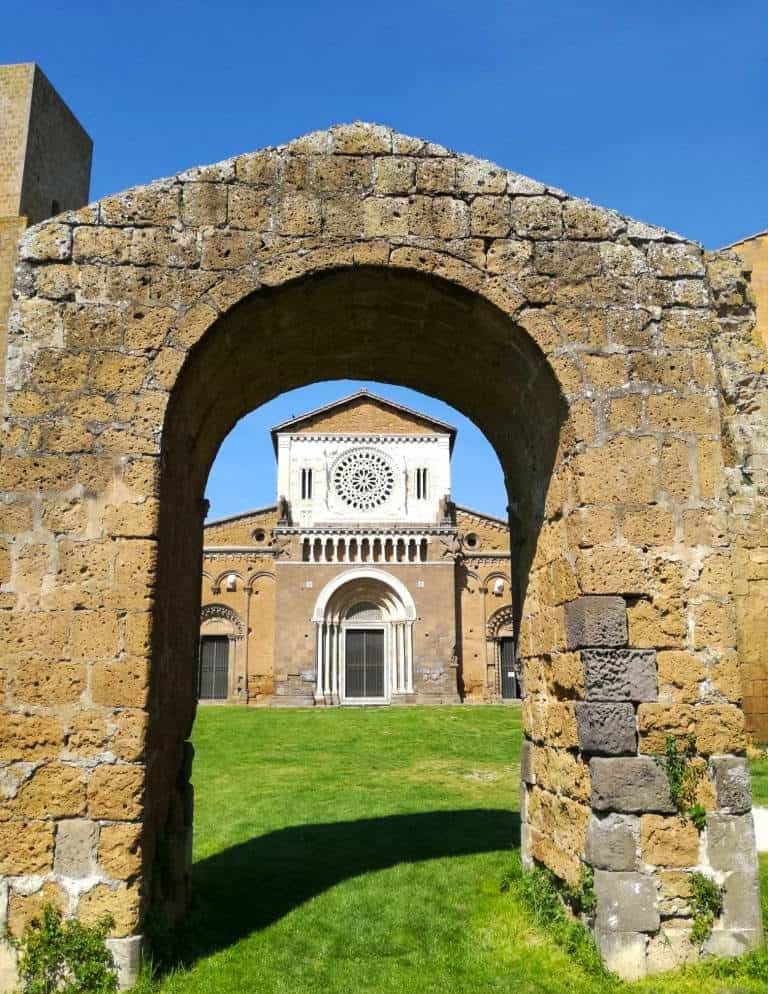
A short distance from San Pietro, lower down the slope, stands Santa Maria Maggiore, the second great Romanesque church on the hill. It is already mentioned in 852 in a papal bull and was consecrated on October 6, 1206. Scholars do not fully agree on the building's dating: some place it in the late 12th century in two phases, others move it back to between the late 11th and early 12th century, and others consider it even earlier than the nearby San Pietro. Caution suggests speaking of a building campaign between the 11th and 13th centuries, with later interventions.
The façade has three finely decorated portals. The central one, in white marble, is deeply splayed and rests on two stylophorous lions. In the lunette, the Madonna with the blessing Child is flanked by biblical scenes, including the episode of Balaam and the donkey and the sacrifice of Isaac. On either side of the entrance, the sculptures of the apostles Peter and Paul, partly restored after an act of vandalism, stand guard. Higher up, a large rose window on two rings of small columns, 12 and 12, is watched over at the four corners by the symbols of the evangelists: the eagle, the angel, the lion and the calf.
The interior has three naves over six bays, with alternating columns and piers. In the right nave is the octagonal marble baptismal font, dating from the 13th century, one of the most notable liturgical furnishings in the church. Over the altar, the ciborium, in still early Gothic forms, preserves its frescoed vaults. Not far away, a marble choir screen dating between the 8th and 9th centuries is a testimony to the oldest building. In the apse basin, a fresco from a Roman school of the 13th century depicts the 12 apostles. But the piece that stops everyone in their tracks is the counterfacade: a large Last Judgment from the 14th century, attributed to Gregorio and Donato d'Arezzo, where the patron Secundianus also appears. It is an imposing figurative machine, with Christ the Judge at the center, the ranks of the blessed and the geography of hell, which rewards the effort of looking up just after walking in.
The Historic Center of Tuscania Inside the Walls
Past the San Pietro hill, the visit enters the village proper, enclosed by medieval walls. Here the rhythm changes: uphill alleys, staircases, courtyards, and at every turn a palazzo, a tower, a fountain. The center of Tuscania is compact and can be toured on foot in a couple of hours, with your head tipped back.
Religious Architecture in the Center of Tuscania
Inside and around the historic center there are more than a dozen churches, from very different periods. The Duomo of Tuscania, that is the Co-cathedral of San Giacomo Maggiore, has an 18th-century appearance with a 16th-century façade and is the main church of the community. Santa Maria della Rosa, built between the 13th and 14th centuries, is a good example of the transition from Romanesque to Gothic, with the central portal on twisted columns and a worked rose window. Santa Maria del Riposo, linked to the former Franciscan convent that today houses the museum, closes off the western side of the village. To these are added the church of San Marco, that of San Silvestro, the church of San Francesco with the Sparapane chapel, San Giuseppe, San Giovanni Decollato, the church of the Santi Martiri dedicated to San Lorenzo, the Sacro Cuore di Gesù and Nostra Signora di Lourdes. Outside the built-up area, toward the countryside, stands the abbey of San Giusto, a medieval monastic complex immersed in greenery. Not all of these churches are always open: the two basilicas on the hill and the Duomo are the sure destinations, while the others are visited when the community opens them for services or special occasions.
Santa Maria della Rosa and the Duomo of Tuscania
Among the churches of the center, Santa Maria della Rosa deserves a stop of its own. Built between the 13th and 14th centuries, it marks the passage from Romanesque to Gothic: the facade has a central portal on twisted little columns and a worked rose window, while the interior preserves the simple layout of the churches of that period. The Duomo of Tuscania, that is, the Co-Cathedral of San Giacomo Maggiore, has instead a mainly 18th-century look, with a 16th-century facade, and represents the center of the town's religious life after the bishop's seat lost its rank: it was an episcopal seat until 1653. Inside it keeps altars and works of the modern age. It's the church where the people of Tuscania recognize themselves in festivals and anniversaries, less spectacular than the basilicas on the hill but a living part of the village.
The abbey of San Giusto and the countryside of Tuscania
Outside the town, immersed in the countryside toward the river, stands the abbey of San Giusto, a monastic complex of medieval origin that testifies to the dense network of religious settlements that dotted the territory. The countryside around Tuscania, made of gentle undulations cultivated with olive trees and wheat, is an integral part of the landscape: the ancient Etruscan burial grounds open right along the gullies that cut through these hills, and walking among the fields you come across traces of ancient roads, remains of tombs and the signs of an uninterrupted presence of almost 3,000 years. Anyone who loves landscape photography finds here, in the raking light of late afternoon, some of the most beautiful views of the Alta Tuscia.
The civil architecture and towers of Tuscania
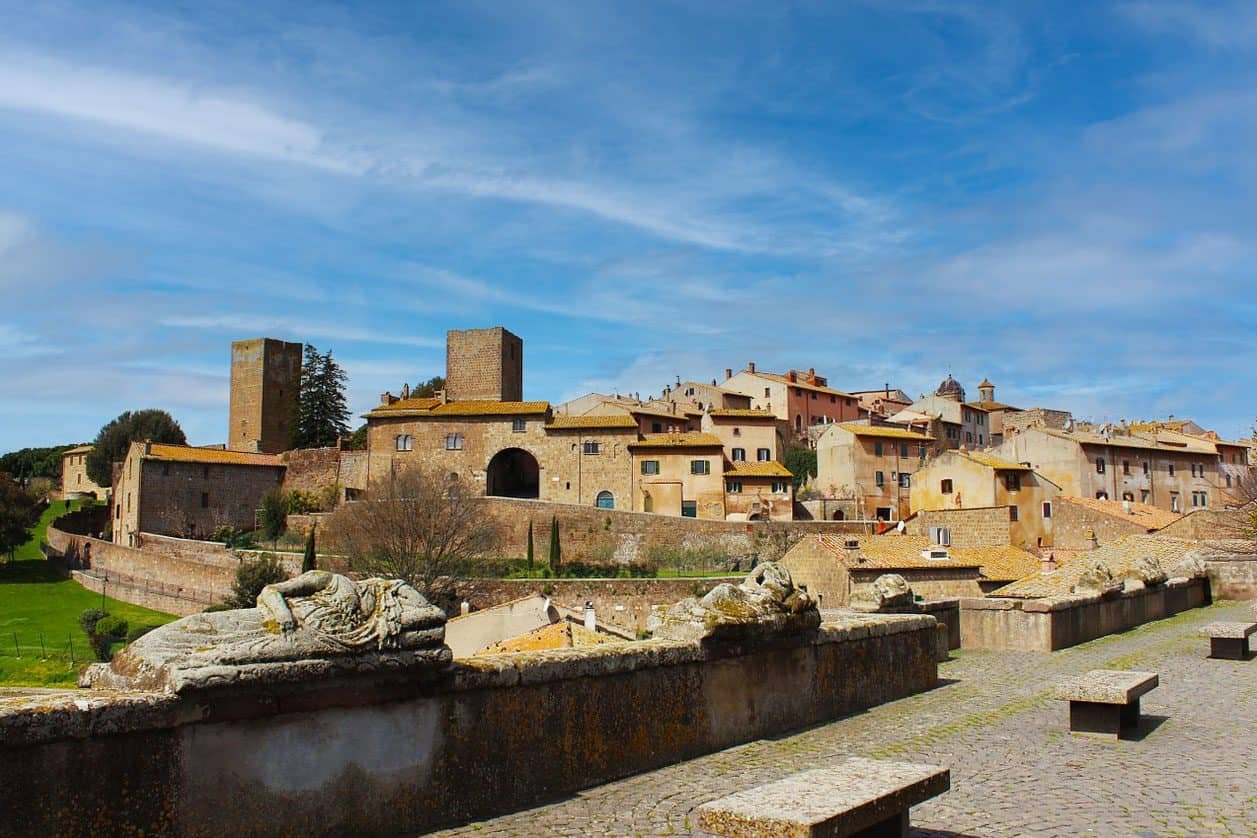
The medieval face of Tuscania is read in its palaces and its towers. The most photographed civil monument is the Torre di Lavello, which dominates the park of the same name overlooking the valleys: it takes its name from Angelo Broglio da Lavello, called Il Tartaglia, the condottiere who held the lordship of the city in the 15th century. Around it are lined up the palaces of the families that counted: Palazzo Tozzi-Spagnoli, the Palazzo Baronale, Palazzo Donnini also called the Vescovado, Palazzo Pocci, Palazzo Consalvi-Brunacci, Palazzo Giannotti and Palazzo Quaglia, the latter formerly Tartaglia and then Bruschi-Falgari. They are buildings that tell the Renaissance and Baroque Tuscania, that of the local houses, and today some host offices and some remain private residences, enjoyable from the outside along the promenade.
The walls, gates and fountains of Tuscania
The city wall of Tuscania was built and reinforced mainly around 1240, when the arrival of Frederick II pushed the citizens to defend themselves. Important stretches and some monumental gates survive: the Porta di San Marco, also called Montascide, and the Porta di Poggio Fiorentino, which mark the ancient entrances to the village. Inside and under the walls, water tells a chapter of its own: the Fontana delle sette cannelle, also called del Butinale, is the most famous, with its long basin fed by seven spouts. To this are added the Fontana di Poggio or di San Giacomo, the Fontana di Montascide and the Fontana del Belvedere or del Cardinale. They were the places where water was drawn and laundry washed, and they remain excellent spots to stop in the shade. Part of the ancient defensive system is also the Castello del Rivellino, of which the ruins remain, the only properly military architecture still readable.

The Etruscan necropolises of Tuscania
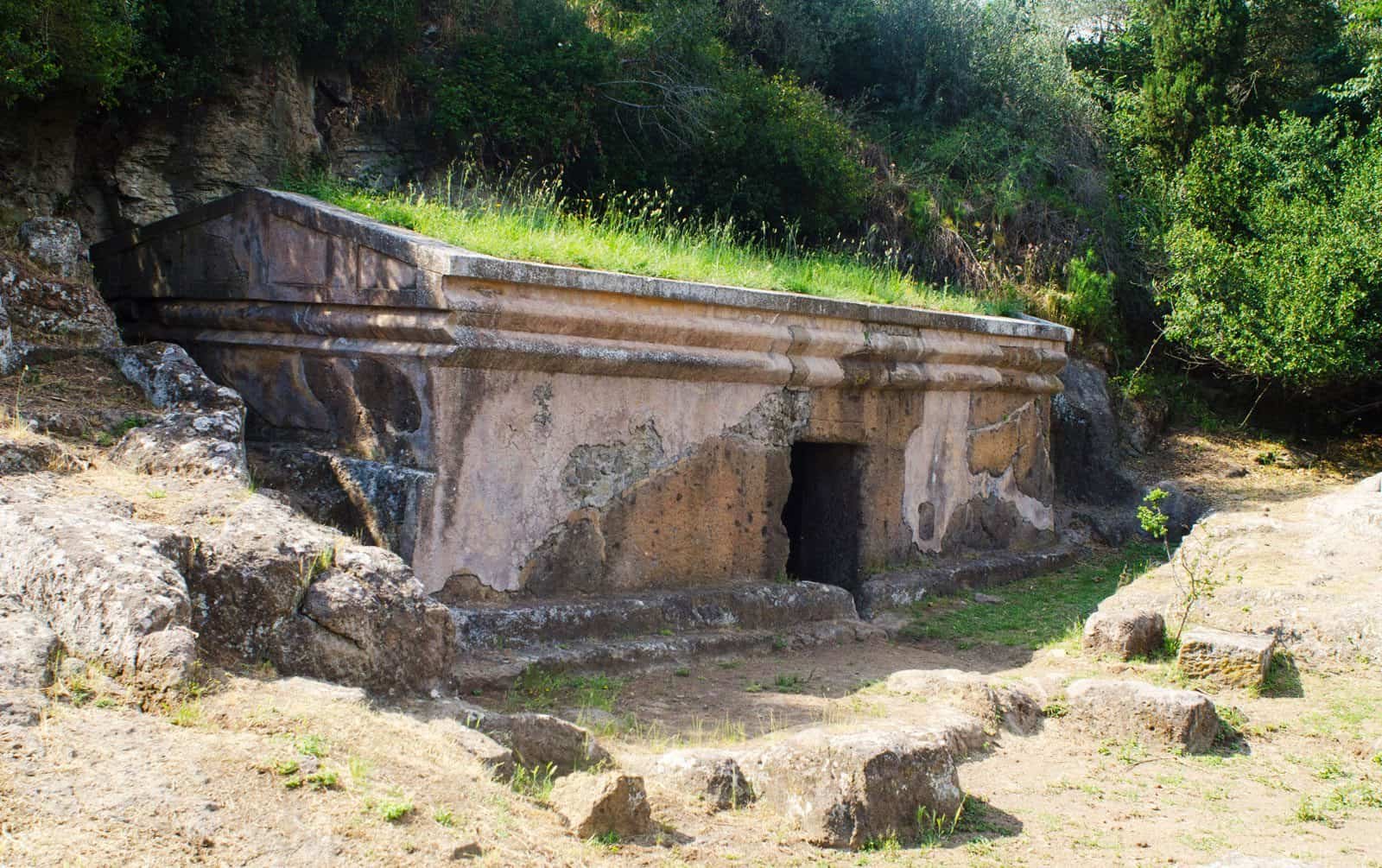
Before being a medieval village, Tuscania was an important Etruscan city, and Etruscan memory lives above all in its necropolises, dug into the rock along the gullies that surround the town. More than a dozen burial grounds have been recorded, spread through the valleys of the watercourses: Ara del Tufo, dated between the 7th and 6th centuries BC and known for its architectural terracottas, Guado Cinto, Sasso Pinzuto, Sughereto, Scalette, Casale Galeotti, San Giusto, Solfatare, Peschiera, Pian di Mola, Carcarello, Madonna dell'Olivo, Castelluzza and Montebello. They are rock-cut tombs, dug into the tuff, with chambers, benches and sometimes architectural facades imitated from the houses of the living.
The richest chapter is that of the family tombs of the Hellenistic period. The Curunas Tombs, datable between the 4th and 2nd centuries BC and excavated between 1967 and 1970 in the Madonna dell'Olivo necropolis, yielded a remarkable quantity of sarcophagi and grave goods. In the Carcarello necropolis, the tomb of the Etruscan Vipinana family, used between the end of the 4th and the first half of the 2nd century BC, contained 27 sarcophagi: a stone archive of an entire house. Among the most cited tombs of the territory are also the Tomb of the Amazon Sarcophagus, from the second half of the 4th century BC, and the Grotta della Regina, a long hypogeum dug between the 4th and 2nd centuries BC. Many of these materials are now kept and displayed in the National Archaeological Museum, where the sarcophagi can be seen up close.
The National Archaeological Museum of Tuscania
The museum occupies the former Franciscan convent of Santa Maria del Riposo, founded in 1247 and remodeled between the 15th and 16th centuries, at Largo Mario Moretti 1. It is the place where all the material from the necropolises takes on meaning: the sarcophagi of the Curunas Tombs, the grave goods of the Vipinana family, the reconstruction of excavation contexts, and the story of the Campanari family, the 19th-century antiquarians whose excavation campaigns in Tuscania became famous across Europe. The route lets you look closely at the lids with figures of the dead lying on their sides, the inscriptions in the Etruscan alphabet, the urns and the terracottas. Opening hours run from 8:30 to 19:30, with last entry at 19:00, and the museum is closed on Mondays. Entry was free for years, but since 2025 it has in some cases required a ticket. It is worth checking the rate and opening days on the website of the Regional Directorate of the National Museums of Lazio before your visit, because conditions have changed recently.
The Campanari family and the birth of Etruscheria
Part of Tuscania's archaeological appeal is owed to a family of 19th-century antiquarians, the Campanari. In the first half of the 19th century they carried out excavation campaigns in the territory's necropolises and drew from them sarcophagi, urns and grave goods. They sold these and displayed them across half of Europe, contributing to the fashion for Etruscan taste that captivated collectors and museums. It was an era of spectacular discoveries and, by today's standards, of dispersal: many Tuscania finds ended up far away, in the great museums of the continent. The National Archaeological Museum, housed in the former convent of Santa Maria del Riposo, also traces this story, recounting the history of the Campanari family alongside the materials that remained in the territory. It is a story that helps explain how the romantic 19th-century image of the Etruscans, which still populates the imagination today, was born precisely in towns like this one.
The history of Tuscania, from the Etruscans to today
The history of Tuscania is long and layered, and it's best told in phases, because each era has left something that can still be seen.
Tuscania from prehistory to the Etruscan period
The first human presence at the site dates from between the Copper Age and the start of the Bronze Age, that is, between the 3rd and the early 2nd millennium BC, as shown by the materials from the Scalette and Pantacciano necropolises. Real urbanization begins in the 8th century BC, when the acropolis arises on the hill of San Pietro. In the 4th century BC the city, which the Etruscans called Tusena, transformed from a cluster of farming villages into a leading trading center, among the most important in the territory controlled by Tarquinia. The large family tombs and the craft flourishing documented by the grave goods belong to this phase.
Roman rule
Tuscania passed under Rome, probably peacefully, around 280 BC. After the Social War, fought between 90 and 88 BC, it became a Roman municipium under the name Tuscana, enrolled in the Stellatina tribe. The construction of Via Clodia, around 225 BC, strengthened its role as a road junction between Rome and inland Etruria. The Latin name, Tuscana, derives from tuscum with the possessive suffix -anus, and means territory of the Tusci, that is, of the Etruscans. The city carries in its own name the people who founded it.
Tuscania in the Middle Ages
In the 5th century Tuscania became an episcopal see, and it remained one until 1653. In 569, or according to other sources in 574, it fell to Alboin's Lombards. In 774 it entered the domains of Charlemagne, and in 781, with the Carolingian donation to Pope Adrian I, it passed to the patrimony of the Church. Between 967 and 1066 it was controlled by the Anguillara family, and it then became a fief of the Aldobrandeschi. In 1081 Henry IV's troops besieged it. In the 12th century Tuscania became a free commune and came to control many castles in the territory. In 1222 the visit of Saint Francis of Assisi fueled a religious fervor that left its mark on the sacred buildings. In 1240 Frederick II entered the city on March 2, and it was then that the citizens reinforced the walls.
Tuscania from the communal period to today
In 1421 Pope Martin V granted the title of count to the condottiero Angelo Broglio da Lavello, known as Tartaglia, who gave his name to the tower. In 1495 the army of Charles VIII of France sacked the city during his march through Italy. For centuries the town was called Toscanella. Only in 1911, with a royal decree, did it take back its ancient name of Tuscania. The 20th century brought its greatest wound, the earthquake of 1971, and at the same time the long period of reconstruction and of film productions, which made the town a natural film set. Today Tuscania has just over 8,000 residents and lives off agriculture, olive oil, crafts and a growing cultural tourism, supported by its recognition with the Touring Club Italiano Orange Flag.
The Romanesque of Tuscania in the context of Lazio
It's worth explaining why San Pietro and Santa Maria Maggiore matter so much in art history. Lazio, unlike Tuscany or Emilia, did not leave many great intact Romanesque churches: many were rebuilt in the Baroque age, others demolished. Tuscania instead preserves two buildings that let you read almost in full the Romanesque language of central Italy between the 11th and 13th centuries, with its mix of elements. There is the solidity of Romanesque-Lombard art, brought by the workmen who worked all along the peninsula, there is the Roman Cosmatesque taste, that is, the art of the marble workers of the capital who inlaid floors and furnishings with tesserae of porphyry and serpentine, and there are sculptures of a still archaic, almost barbaric flavor in the friezes of the facades. This layering makes the two basilicas an open-air manual, and explains why generations of scholars have measured, drawn and discussed them. Anyone who stops in front of the facade of San Pietro is not looking at a simple beautiful monument: they are looking at one of the most complete documents that Lazio Romanesque has left us.
Why Tuscania has the Orange Flag
The Orange Flag is the tourism and environmental quality mark that the Touring Club Italiano awards to small inland villages, and Tuscania wears it deservedly. The recognition doesn't reward beauty alone, but a set of requirements: the preservation of historical and artistic heritage, care of the landscape, the quality of hospitality, the presence of services for the visitor and the vitality of the community. Tuscania lines up an intact historic center, two top-level monuments, a national museum, a solid food and wine tradition and a fabric of workshops and trattorias that is still alive. It's not a village turned into a postcard for tourists: it's an inhabited town, of a little over 8,000 people, which keeps living off agriculture and crafts while guarding its own stones. It's this combination, authenticity and care, that the orange mark recognizes, and that the visitor senses after the first walk.
A curiosity about Tuscania (VT)
The curiosity that few people know concerns the name. For much of its recent history the village was not called Tuscania but Toscanella, a diminutive that the people of Tuscania considered unfair, almost belittling compared with the city's ancient Etruscan and Roman dignity. Only in 1911 did a royal decree give the town back the Latin name Tuscana, Italianized as Tuscania. The detail is not purely bureaucratic: behind it lies a community's wish to reconnect with its deep origin, that Etruscan Tusena which in the 4th century BC was among the most flourishing centers of the territory of Tarquinia. Anyone who reads Tuscania on a sign today is reading, in the end, the word the Romans used to say land of the Etruscans. The same root, tuscum, gave its name to the whole historic region of the Tuscia of Viterbo, which takes one of its definitions from the village. It's rare for a town's name to contain, with such precision, the whole stratigraphy of its history: Etruscans, Rome, the Middle Ages and the 20th-century redemption all sit inside four syllables.
Something nobody tells you about Tuscania (VT)
What guides rarely say is that the two Romanesque basilicas, San Pietro and Santa Maria Maggiore, are not inside the village but outside the walls, on a separate hill, isolated and swept by wind. Anyone who arrives thinking they'll find the churches in the center risks searching for them a long time among the alleys and not understanding. The reason is ancient: that hill was the Etruscan acropolis and then the city's first settlement, which in the Middle Ages moved farther down, into the area now enclosed by the walls. The churches stayed where the original religious heart was, and the village grew elsewhere. The practical consequence is that to see the two masterpieces you have to allow for an uphill walk, or a short stretch by car, and that the hill has its own hours, different from those of the center. The poetic consequence is that the basilicas are visited in a condition of solitude and silence that wouldn't exist inside a town: grass, sky, the valleys of the necropolises below, and two stone churches that seem grown out of the tuff. Anyone who knows this in advance organizes the day better and doesn't end up empty-handed in front of a historic center that, though beautiful, doesn't contain its most famous monuments.
The advice I give you for visiting Tuscania (VT)
The advice is to reverse the instinctive order of your visit. The temptation is to start in the center, which is convenient and close to the parking lot, and leave the basilicas for later. That is a mistake. Go first to the hill of San Pietro, early, when the morning light slants across the facade and lights up the rose window and the sculptures. This is when the Romanesque style looks its best and when the hill is almost empty. Give San Pietro and Santa Maria Maggiore all the time they deserve, going inside both and looking up at the Last Judgment on the inner facade of the second. Only after that should you head down into the village for lunch and a walk among towers and fountains, when the sun is high and the shaded alleys are cooler. Save the afternoon for the Archaeological Museum, which closes relatively late and makes sense of everything you saw in the necropolises. A mistake to avoid is arriving at midday thinking you can do everything in two hours. Tuscania is not a village you can see in a quick stop, and rushing through it loses exactly the things that make it different from the other towns of the Tuscia. If you can, pair it with Tarquinia over a weekend, not in the same half day.
How to Get to Tuscania and How to Get Around
Tuscania is not served by rail. The nearest useful station is Tarquinia, on the Tyrrhenian Rome-Grosseto line, from which you continue by bus or taxi for about 20 kilometers inland. By car from Rome, take the Rome-Civitavecchia road and then the expressway toward Tarquinia, exiting toward Tuscania. From Viterbo you arrive in just over 20 kilometers along the provincial road. Buses to Viterbo and Tarquinia are run by the Lazio regional lines, with more frequent service on weekdays and fewer runs on Sundays. If you rely on public transport, check the return times carefully, since they thin out in the early afternoon. Once you arrive, the village is best explored entirely on foot. The hill of San Pietro is a little under one kilometer from the center and takes about a quarter of an hour to climb on foot, or a few minutes by car if you leave the car in the open area below the basilicas. I recommend comfortable shoes. Between the cobblestones, the staircases and the grass of the hill, heels are not a good idea.
Another Well-Known Fact That Is Rarely Mentioned
Most people know this fact secondhand, but few can place it precisely: the earthquake of 1971. On February 6 of that year, at 19:09, a quake of magnitude around 5.2, with an estimated intensity between the eighth and ninth degrees of the Mercalli scale, struck the area between Arlena di Castro and Tuscania, about 20 kilometers west of Viterbo. The toll was heavy. Sources cite about 22 deaths and around 100 injured, while more than 4,000 people lost their homes and were housed in tent camps. In Tuscania nearly 60 percent of the buildings were declared unsafe. The medieval quarter, built on tuff and lava, suffered many collapses, and the bridge over the Marta River was cracked. The two Romanesque basilicas, San Pietro and Santa Maria Maggiore, suffered very serious damage. What stands out, and deserves to be remembered, is the reconstruction. A state law from December 1971 went as far as exempting young men from Tuscania and Arlena who took part in the work from military service, and the patient restoration effort put the two monuments back together stone by stone, often reassembling fallen pieces like an enormous mosaic. The basilicas you see today are also the result of that restoration period, one of the most demanding in postwar Italy.
The Right Photo to Take in Tuscania (VT)
The photo that captures Tuscania is the facade of San Pietro taken early in the morning, when low light catches the rose window and brings out the tangle of sculptures around it. Stand in the middle of the lawn, about 10 meters from the facade, and include the side towers in the frame. It is the composition that shows both the strength and the strangeness of the monument. If you want the postcard view instead, head down to the Torre di Lavello park in the late afternoon. From there the village spreads across its tuff spurs, with the necropolis valleys below and warm light sliding over the stones. A third shot that few people take, and that is worth a lot, is inside Santa Maria Maggiore, from the back of the nave toward the inner facade, to capture the 14th-century Last Judgment. Ask if photos are allowed, and do not use flash, which is banned on the frescoed walls and flattens everything anyway. Avoid backlit shots at midday on the facade of San Pietro, when the sun is behind the church. The stone turns into a dark mass and the rose window disappears. The right moment is early morning, I repeat, or the very early evening in summer.
Some Important Events That Happened Here in History
Tuscania has gone through more than one turn in Italian history. In 1240 Frederick II of Swabia entered the town on March 2, at the height of his clash with the papacy, and pushed the citizens to fortify the walls that still surround the village today. In 1421 Pope Martin V granted the title of count to the mercenary captain Angelo Broglio da Lavello, known as Tartaglia, one of the most feared mercenaries of his time, and the tower that dominates the town takes its name from him. In 1495 the troops of Charles VIII of France, returning from the expedition toward Naples, sacked the town. In 1222 the passage of Saint Francis of Assisi opened a period of religious fervor that led to new buildings and monastic settlements. And then there is the date every Tuscanian knows by heart, February 6, 1971, the evening of the earthquake, the dividing line between the Tuscania that was and the one rebuilt. But not all the events are dramas. Since the Second World War the village has become a huge film set, and its hills have hosted scenes from film history that made these places familiar to millions of viewers, though almost no one knew where they had been shot.
Tuscania on Screen: A Natural Set
Few villages can claim a film history like Tuscania's. Its isolated churches on the hill, the necropolises, the walls and the alleyways have given directors ready-made sets that can evoke the ancient world, the Middle Ages and even other eras without building anything. Orson Welles shot scenes for his Othello here in 1952. Pier Paolo Pasolini chose Tuscania for The Gospel According to Matthew in 1964 and for Hawks and Sparrows in 1966. Mario Monicelli set the medieval adventures of The Brancaleone Army here in 1966, and its sequel Brancaleone at the Crusades in 1970, taking advantage of the archaic look of the basilicas. Franco Zeffirelli shot part of his 1968 Romeo and Juliet here, and Andrei Tarkovsky returned for some images for Nostalghia in 1983. More recently the village has kept working for television, with the series Leonardo and The Borgias. So when you walk across the lawn of San Pietro, you are walking through a place that millions of people have already seen without knowing it.
Who Passed Through Tuscania (VT)
Saints, emperors, mercenary captains and filmmakers have all passed through Tuscania. Saint Francis of Assisi arrived in 1222, and his visit left a lasting mark on the village's religious life. Frederick II of Swabia came in 1240, an emperor at war with the pope, and his presence can still be read in the walls the citizens raised to defend themselves. The mercenary captain Angelo Broglio da Lavello, Tartaglia, ruled the town in the early 15th century and left behind the tower that bears his name. In the 19th century the Campanari family, antiquarians and excavators, made Tuscania a center of European Etruscan archaeology, opening tombs whose finds ended up in the great museums of the continent and fed the fashion for Etruscan taste. In the 20th century the village became a destination for filmmakers and actors: Orson Welles, Pier Paolo Pasolini, Mario Monicelli, Franco Zeffirelli and Andrei Tarkovsky all worked here, and with them came the crews that filled the hill and the streets for weeks. History with a capital H also passed through, the history of sieges and earthquakes. Walking through Tuscania gives you the feeling, and not in a rhetorical way, of crossing a place that has hosted many different lives and has kept all of them, layered, in its stone.
Tuscania with Children
Tuscania works well with children, as long as you pace the visit. Kids tire of too many architectural details, but they enjoy the grass on the San Pietro hill, where they can run safely while the adults look at the facades. The necropolises, with their tombs carved into the rock, have an air of exploration that captures even the most reluctant kids. The idea of entering a 2,500-year-old Etruscan tomb is worth 1,000 explanations. The Archaeological Museum, with its sarcophagi and the reclining figures of the dead, lends itself to an adventure story more than a lesson. The Torre di Lavello park offers space, a view and a few benches for a snack. The one thing to watch is the central staircases and the uphill stretches, which are hard going with strollers, so a baby carrier works better for the little ones. Bring water, a hat in summer and closed shoes for the grass and the necropolises.
Things to See Around Tuscania
Tuscania is an excellent starting point for the Viterbo part of the Tuscia. About 20 minutes away is Tarquinia, with its Monterozzi necropolis, a World Heritage Site, and its painted tombs, the perfect complement to the Etruscan story that in Tuscania stops at the sarcophagi. A little farther on, toward the sea, stretches the large archaeological and nature park of Vulci, with the Abbadia castle and the bridge over the river. Inland, Viterbo offers the largest medieval quarter in Lazio, San Pellegrino, and the Palazzo dei Papi. On Lake Bolsena, Montefiascone stands high above with its fortress and the basilica of San Flaviano. For those who love the bizarre, the Monster Park of Bomarzo with its 16th-century sculptures is half an hour away, as is the Palazzo Farnese di Caprarola, one of the most extraordinary Renaissance palaces in Italy. For nature lovers, close by are the Tuscania Nature Reserve along the Marta river and the Lake Vico. Suspended over the void, the famous Civita di Bagnoregio completes the circuit of the most photographed hill towns in the area.
When to Visit Tuscania
The best season for Tuscania is the shoulder season: spring and early autumn, when the grass on the hill is green, the light is soft and the heat doesn't beat down on the stones. In summer the days are long and let you enjoy the evening, but at midday the hill of San Pietro, with no shade, becomes scorching: it's better to plan your visit there for early morning or sunset. Winter has a stern charm, with the basilicas standing out against the gray sky and the quiet village, but the churches may have reduced hours and the wind on the hill is biting. Those who happen to be there on February 6 find the community gathered in memory of the earthquake. On spring weekends the center comes alive with food festivals and markets tied to olive oil and local products, a good chance to combine culture and food. If you can, avoid the midday hours of a Saturday in August: it's the only time Tuscania risks a crowding that takes away its best quality, the silence.
Where to Eat and What to Buy in Tuscania
Tuscania's cooking is that of the Alta Tuscia: hearty, rustic, tied to the season. On the tables return legume soups, homemade pasta dressed with meat sauces or with mushrooms and local truffles, lamb and grilled meats. The star product is extra virgin olive oil, which here has an ancient tradition and recognized quality: many mills sell directly, and it's worth bringing a bottle home. Sheep's cheeses and local cured meats are not lacking. To drink, there are the wines of the Colli Etruschi and of the Montefiascone area, starting with the famous white from the shore of Lake Bolsena. The trattorias in the historic center serve simple menus at reasonable prices, often in spaces set inside old palazzi. For shopping, in addition to oil and wine, look for the ceramics and small crafts that some village workshops still offer.
A One-Day Itinerary in Tuscania
For those arriving from Rome or Viterbo with just one day, here is the order that works best. In the early morning go up to the hill of San Pietro and spend at least an hour on the two basilicas: first San Pietro, with its facade, Cosmatesque floor and crypt, then, going down a few steps, Santa Maria Maggiore with its three portals, baptismal font and the Last Judgment. Take the time to sit on the grass and look at the view over the valleys. Around noon go down into the village, enter through the medieval gates and take a first stroll among towers and palaces as far as the Torre di Lavello, with a lunch stop at a trattoria in the center. In the early afternoon visit the Museo Archeologico Nazionale in Largo Mario Moretti, where the sarcophagi of the Tombe Curunas and Tombe dei Vipinana give a face to the Etruscans of the necropolises. End the day with the Fontana delle sette cannelle and a second climb, if you have the energy, to the park of the Torre di Lavello for the sunset light. Those with a second day should spend it among the necropolises and the Tuscania Nature Reserve along the Marta river, or use it for a quick trip to Tarquinia or Viterbo.
Tuscania, Via Clodia and Its Strategic Position
Tuscania's ancient fortune is explained by its position. The village stands at a crossing point between the Tyrrhenian coast and inland Etruria, along the routes that linked Tarquinia and the sea with the volcanic hinterland of the lakes. In Roman times this role was consolidated by Via Clodia, opened around 225 BC, which crossed the territory and made the city a communications hub. The valleys carved out by the watercourses, besides hosting the necropolises, offered natural defense, and the tufa spurs on which the village climbs were easy to fortify. It is the same logic that, centuries later, led to choosing the hill of San Pietro as the acropolis and then as the site of the great churches: a high point, defended and visible from afar. Walking through Tuscania means reading, without needing books, the geography that determined its history.
Accessibility and practical tips for Tuscania
Tuscania requires trained legs. The historic center is all ups and downs of cobblestones, staircases and sloping alleys, and the hill of the basilicas, although reachable by car, has grass and a few steps at the entrance to the churches. Visitors with mobility difficulties can still enjoy a lot: the hill of San Pietro can be reached by car up to the flat square in front of the basilicas, the Archaeological Museum is largely accessible, and several panoramic views can be taken without effort from the park of the Torre di Lavello. For the rest, the advice for every tufa village applies: closed shoes with a sole that grips, water with you, a hat in summer because there is no shade on the hill, and a sweatshirt even in the shoulder seasons, because the wind on the heights is constant. Those traveling with a dog will find suitable open spaces, keeping in mind that access inside the churches and the museum is limited. For up-to-date information on basilica hours, special openings and guided tours, the reference is the Pro Loco di Tuscania.
Quick questions about Tuscania (VT)
Where is Tuscania?
Tuscania is in the Tuscia of Viterbo, in northern Lazio, about 20 kilometers from Viterbo and Tarquinia, on tufa heights overlooking the Marta River. From Rome it is about an hour and a half by car.
Why is Tuscania famous?
Mainly for its two Romanesque basilicas, San Pietro and Santa Maria Maggiore, among the masterpieces of Lazio Romanesque art, and for its extensive Etruscan necropolises. It is also a village with the Touring Club Italiano Orange Flag.
Are the basilicas of San Pietro and Santa Maria Maggiore in the center?
No. They stand outside the walls, on the hill of San Pietro, the ancient Etruscan acropolis, about one kilometer from the center. They can be reached on foot in 15 minutes of uphill walking or in a few minutes by car.
How much does it cost to visit Tuscania?
Walking through the village and looking at the church facades is free. The basilicas may ask for a contribution or offering and have their own opening hours. The Archaeological Museum, free for years, may charge an admission fee since 2025: it is worth checking the current conditions on the official website before setting out.
How much time does it take to visit Tuscania?
To see both basilicas, the historic center and the museum properly, at least one full day is needed. Those who want to add a walk through the necropolises should plan on two days.
How do you get to Tuscania without a car?
The nearest train station is Tarquinia, on the Rome-Grosseto line, and from there you continue by bus. There are also bus connections from Viterbo. Services are less frequent on Sundays and in the afternoon, so check the return times.
Is Tuscania suitable for children?
Yes. The grass of the hill of San Pietro, the tombs carved into the rock and the sarcophagi in the museum appeal to the youngest visitors. Only watch out for the staircases in the center, which are difficult with strollers.
Can you visit the Etruscan necropolises of Tuscania?
Several necropolises are in the territory, some accessible via trails in the Riserva naturale along the Marta. The best materials, sarcophagi and grave goods, are displayed in the Museo Archeologico Nazionale in the center.
What is the Last Judgment of Santa Maria Maggiore?
It is a large 14th-century fresco on the inner facade of the basilica, attributed to Gregorio and Donato d'Arezzo, with Christ as judge, the ranks of the blessed and the punishments of hell. You look up as soon as you walk in.
Where is the Archaeological Museum of Tuscania and when does it open?
It is at Largo Mario Moretti 1, in the former convent of Santa Maria del Riposo. It is open from 8:30 to 19:30, last entry at 19:00, closed on Mondays as well as January 1 and December 25.
What happened in Tuscania in 1971?
On February 6, 1971, at 19:09, an earthquake of magnitude around 5.2 struck the area, killing about 22 people, injuring around 100 and leaving thousands homeless. The basilicas and the medieval center were heavily damaged and later rebuilt.
Why was Tuscania called Toscanella before?
Toscanella was the name of the village for centuries. Only in 1911 did a royal decree restore the ancient name Tuscania, from the Latin Tuscana, meaning territory of the Tusci, that is, of the Etruscans.
What films were shot in Tuscania?
Among the many: Orson Welles's Othello, Pasolini's The Gospel According to Matthew and Hawks and Sparrows, Monicelli's The Brancaleone Army, Zeffirelli's Romeo and Juliet, Tarkovsky's Nostalghia, and more recently the series Leonardo and The Borgias.
Can you take photos inside Tuscania's churches?
Generally yes, but without flash, which is banned on the frescoes. Still, check at the entrance, since the rules can change, and visits are suspended during religious services.
Is Tuscania accessible for people with mobility difficulties?
The historic center has staircases and steep stretches that are not easy. The hill with the basilicas can be reached by car, and the open area is flat. The museum is largely accessible. Anyone with difficulties should check the routes by car and ask the Pro Loco for assistance.
What is there to eat in Tuscania?
Food from the Alta Tuscia: legume soups, homemade pasta, lamb and grilled meats, mushrooms and truffles. Signature products are extra virgin olive oil and the wines of the Montefiascone area and the Colli Etruschi.
When is the best time to go to Tuscania?
Spring and early autumn are the best seasons. In summer it is better to visit the hill in the morning or at sunset, to avoid the heat with no shade. Winter is fascinating but has reduced hours and wind on the hill.
What is there to see near Tuscania in a day?
Tarquinia and its painted tombs, Vulci, Viterbo, Montefiascone on Lake Bolsena, the Parco dei Mostri in Bomarzo, the Palazzo Farnese in Caprarola and the Civita di Bagnoregio are all within half a day's reach.
How many churches are there in Tuscania?
More than 12 churches, including the two basilicas on the hill, the 18th-century Duomo of San Giacomo, Santa Maria della Rosa and many smaller churches in the center and the countryside, such as the Abbey of San Giusto.
Is Tuscania worth a day trip from Rome?
Yes, especially for people who love Romanesque architecture and the Etruscan world. It deserves a full day, though, not a quick stop. Pairing it with Tarquinia makes the trip even richer.
What is the difference between San Pietro and Santa Maria Maggiore?
San Pietro is the taller and more monumental church, at the top of the hill, famous for its sculpted facade and its Cosmatesque pavement. Santa Maria Maggiore, a little lower down, stands out for its three portals, its baptismal font and the large 14th-century Last Judgment on the inner facade. You visit them together, a few steps from each other.
Why was Tuscania chosen for so many films?
Because it offers ready-made sets: isolated churches on a bare hill, walls, necropolises and medieval alleys that evoke different eras without the need for set design. Directors such as Welles, Pasolini, Monicelli, Zeffirelli and Tarkovsky shot famous scenes here.
Is there a tourist information office in Tuscania?
The main contact for visitors is the Pro Loco di Tuscania, reachable at 327 247 2217 and at prolocotuscania@gmail.com. It is the best place to find up-to-date hours for the basilicas and any guided tours.
Can you combine Tuscania with a trip to the sea?
Yes. The Tyrrhenian coast at Tarquinia and along the Viterbo shoreline is about 20 minutes away, and it lets you combine the village's culture with an afternoon at the beach in the warm season.
If I had to sum up Tuscania in one sentence, I would say it is the village where Romanesque architecture and the Etruscans live together, just a short walk apart, and where the two most beautiful churches are not in the center but on a hill of their own, suspended between the sky and the necropolises. Take your time. Go up to San Pietro in the morning light, enter Santa Maria Maggiore and look up at the Last Judgment, then head down into the village and end at the museum. It is not a destination to tick off in an hour. It is an Etruscan hill that became a Christian town, wounded by an earthquake and patiently put back together, and it rewards anyone who gives it a day and a little attention.
Article written by the editorial team at TourLeaderPro, contact them for Private, Corporate and V.I.P. Tours and Experiences.
Planning a trip to Rome? English-language guides to visiting the city are on ItalyPlanner.com.