Montefiascone (VT)
In short. Montefiascone is in the province of Viterbo, in the Upper Tuscia of Lazio, perched on the cone of an ancient volcano that closes off the southeast of the Lake Bolsena basin.
Montefiascone is in the province of Viterbo, in the Upper Tuscia of Lazio, perched on the cone of an ancient volcano that closes off the southeast of the Lake Bolsena basin. The historic center sits between 590 and 600 meters above sea level, while the summit occupied by the Rocca dei Papi reaches 633 meters: it is the highest town in the whole province, and from its top the eye takes in the largest volcanic lake in Europe. You get there from Via Cassia, State Road 2, which the ancient Romans laid out between 170 and 150 BC and which still carries traffic from Rome toward Tuscany: the capital is about a hundred kilometers away, Viterbo a little over 15 to the south, Bolsena a handful of kilometers down the slope toward the shore. Those without a car can use the regional Cotral buses that connect the town to Viterbo and the lake towns, or the train: the Montefiascone station is on the Viterbo Attigliano Orte line and is in the hamlet of Zepponami, a couple of kilometers below the center, so it's worth allowing for a last stretch by city bus or a climb on foot. Pilgrims and walkers, instead, arrive from the height of their effort, because Montefiascone is one of the stage destinations of Via Francigena and whoever descends from Bolsena sees it appear at the top of the hill long before reaching it. The main paid monument is the Rocca dei Papi, in Piazza Urbano V: the full ticket costs €5.00 and the reduced one €3.50, and in the good season, generally from April to September, access is on Saturdays, Sundays and holidays with hours 10:00 - 13:00 and 15:00 - 19:00, last entry half an hour before closing. Hours change from season to season, so it's best to check them on the operator's website before going up. The churches, on the other hand, the San Flaviano Basilica and the Santa Margherita Cathedral, can be visited free of charge during their opening hours for worship.
If your trip revolves around the body of water you can see from up here, the page dedicated to Lake Bolsena gathers the other villages that stand guard over its shores. If instead you are walking the great pilgrims' route, you'll find the full picture in the guide to Via Francigena.
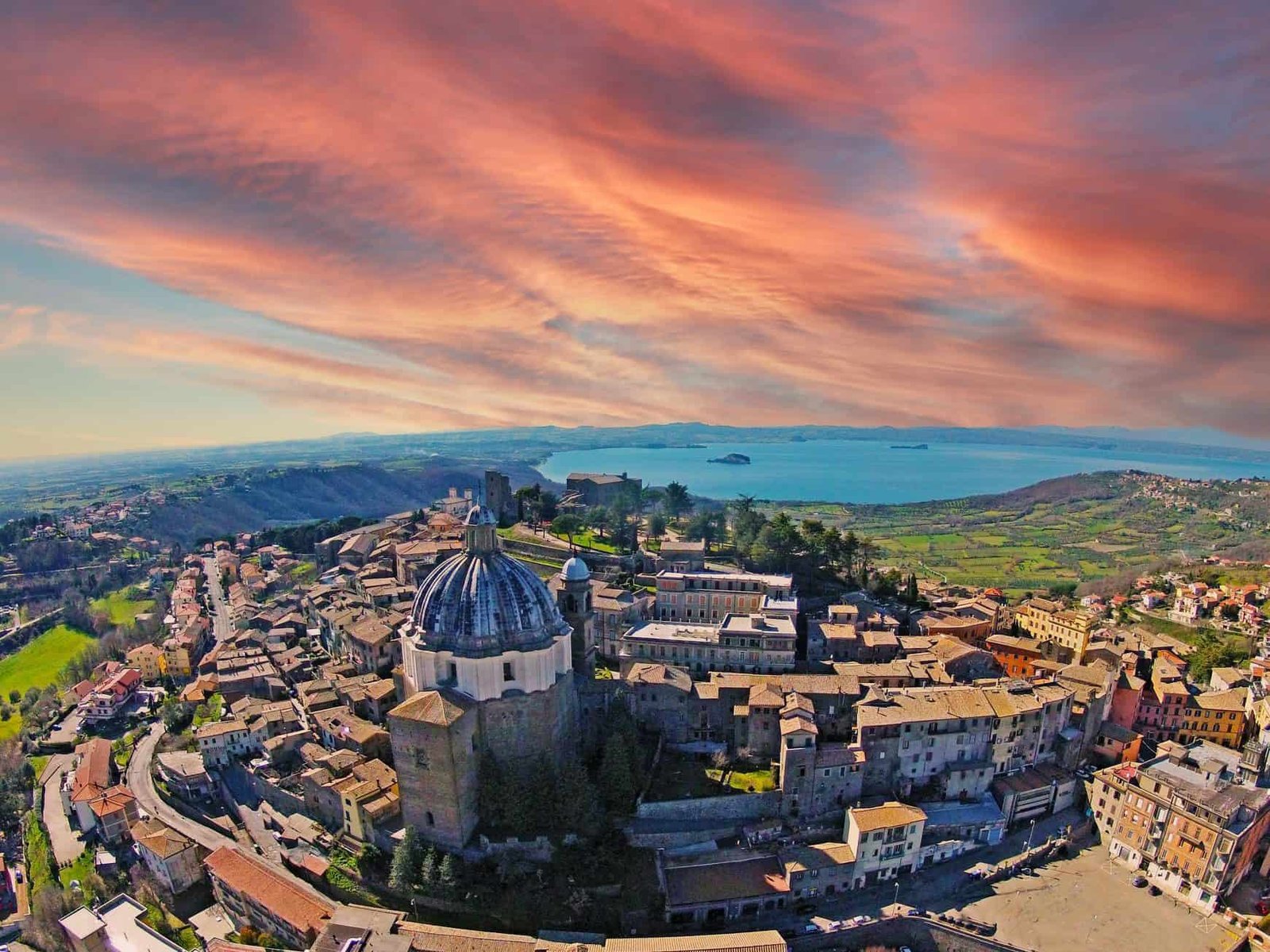
Where Montefiascone (VT) is and how to get there
Geography explains almost everything about this town. Montefiascone occupies the highest relief of the Vulsini volcanic complex, the same structure that, by sinking, generated the basin later filled by the waters of Lake Bolsena. From this come the dominant position, the defensive vocation of the summit and, at the base, the dark, mineral soils that make the wine famous. The municipal territory, one of the largest in the Viterbo area, descends from the 633 meters of the Rocca to the shores, and includes hamlets such as Zepponami, Le Grazie, Le Coste, Le Mosse and the Lungolago strip. The patron saint is Santa Margherita, to whom the cathedral is dedicated.
By car, the most direct way from Rome is Via Cassia, which climbs north touching Monterosi, Sutri and Viterbo before reaching Montefiascone. Those traveling by highway usually exit at Orte on the A1 and continue toward the lake. Parking in the historic center is limited and fills up early on holidays, so it's best to leave the car in the spaces just outside the walls and walk up toward the Rocca. By train, the Montefiascone station, on the line that links Viterbo to Orte via Attigliano, is a couple of kilometers from the town and mainly serves commuters. Tourists find the Cotral buses arriving from Viterbo more convenient. The Francigena walkers, on the other hand, enter from the lake side: the stage coming from Bolsena is short but all uphill, and rewards the effort with the panorama that opens at the top.
The Rocca dei Papi of Montefiascone (VT)
The Rocca dei Papi is the landmark you see from afar, the crown of the hill and the reason Montefiascone counts in history much more than its size would lead you to suppose. It stands on the highest point, at 633 meters, where a settlement already existed in protohistoric times: right here archaeologists have brought to light the remains of a Proto-Villanovan village datable between the 9th and 8th centuries BC, a sign that people chose this summit long before the popes.
The medieval fortress we see today was born as a defensive structure and grew over the centuries in which the pontiffs looked for a safe, cool refuge far from Rome. It was Innocent III, at the end of the 12th century, who reinforced it and encircled it with walls during the constitution of the Patrimony of St. Peter. After him, generations of popes and cardinals worked on it, up to the 16th-century interventions attributed to Antonio da Sangallo the Younger, who redesigned parts of the structure under Julius II. It is no coincidence that the Rocca today hosts a museum dedicated precisely to Sangallo's architecture.
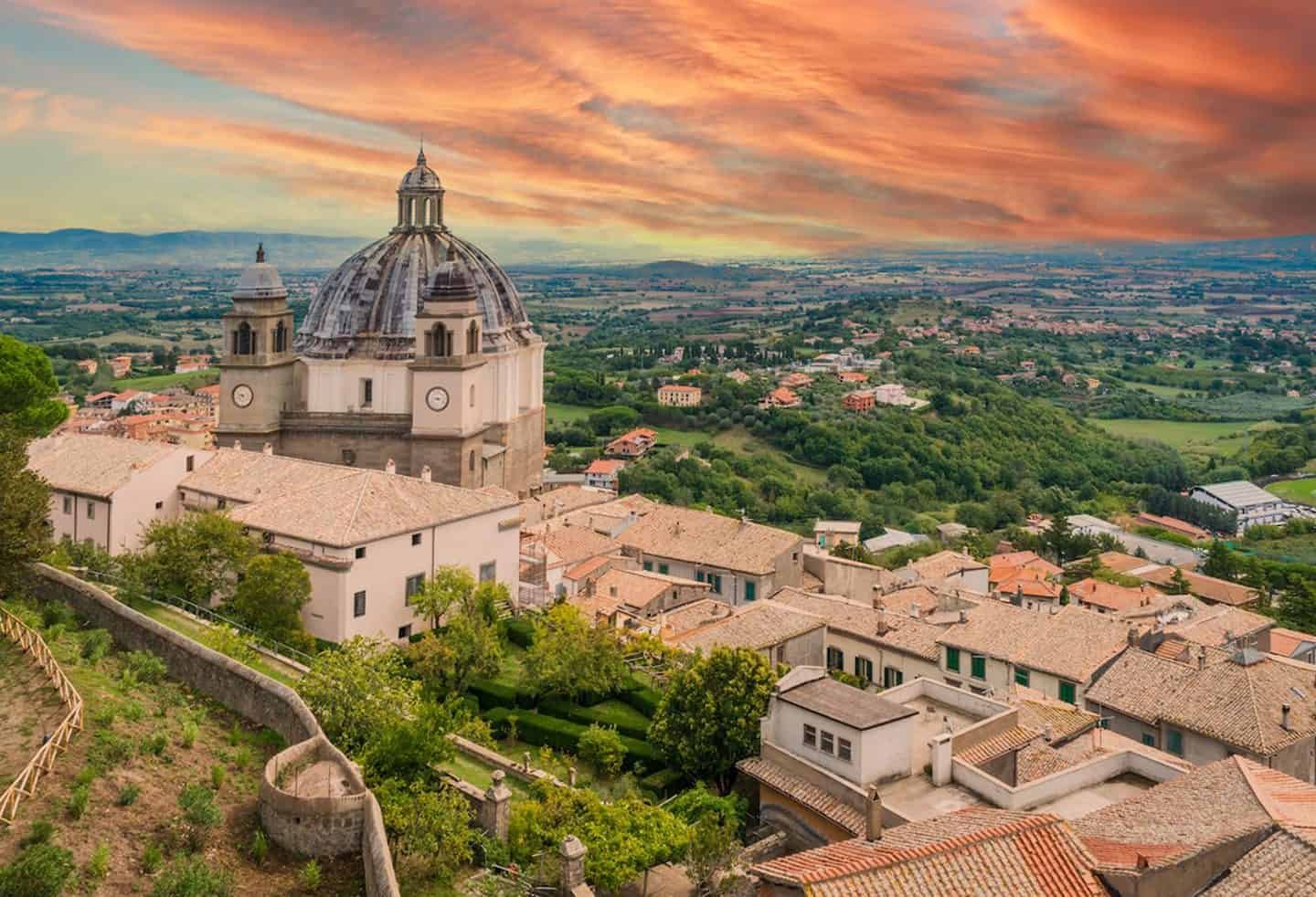
The Torre del Pellegrino and the panorama over the lake
The moment that makes the climb worth it is when you step out onto the panoramic terrace next to the Torre del Pellegrino. From there the eye runs over the whole Lake Bolsena basin, over the two islands that break its surface, the Bisentina and the smaller Martana, and over the ring of towns standing guard on the shores. The Martana carries a dark memory: tradition has it that Amalasuntha, queen of the Goths, daughter of Theodoric, was killed there. On clear days the view reaches well beyond the lake, toward the hills of the Upper Tuscia and, on the opposite side, toward the Cimino. It's the kind of view that explains by itself why the popes wanted this hill.
Tickets, hours and visiting the Rocca dei Papi
The entrance to the Rocca dei Papi is in Piazza Urbano V, the square named for the pontiff who resided here in the summers between 1368 and 1370. The full ticket costs €5.00, the reduced one €3.50 for young people between 12 and 18 and for large groups. School groups pay a lower rate and children under 12 enter free, as do residents of Montefiascone. The visit includes the climb up the tower and the antiquarium with materials from the area. Hours follow the tourist season, with opening on weekends and holidays from April to September and a wider winter closure. It's wise to check them on the operator's website, because they are updated from year to year. Allow for a climb on foot, because the Rocca is at the top and cars stay down below.
The San Flaviano Basilica, the Romanesque heart of Montefiascone (VT)
Before going up to the Rocca it's worth stopping at the edge of the town, along the old Via Cassia toward Orvieto, in front of a building that many visitors overlook and that is instead the most precious thing in Montefiascone. The San Flaviano Basilica is a double church, that is, two buildings stacked on top of each other and oriented in opposite directions: you enter the lower church and go up, on a route that very few other Italian churches offer. The oldest part, the lower one, dates to 1032. The whole grew between the 11th and 15th centuries, with a mainly Romanesque look enriched in the 14th century by Gothic elements.
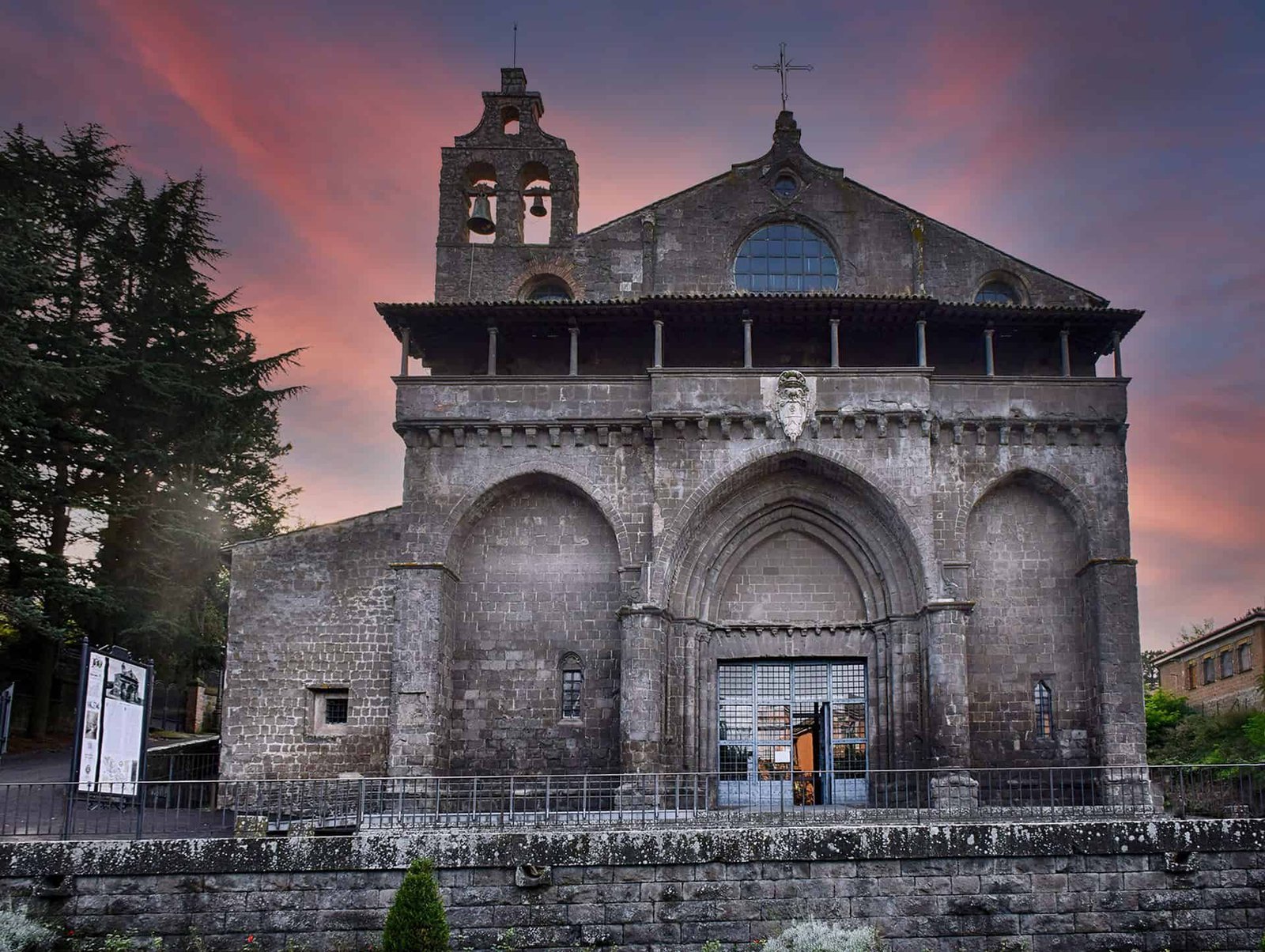
The lower church and the frescoes of San Flaviano
The lower church has three naves ending in three apses arranged in an arc, with columns topped by capitals decorated with acanthus leaves, many of them reused. This is where the most remarkable painted decoration is concentrated: in the apse stands an imposing image of Christ Pantocrator enthroned, flanked by saints, while lower down a scene shows the titular saint as an armed knight with the banner. The frescoes belong to different schools, from the Roman and Tuscan tradition of the 14th century to the Umbrian presences of the 15th, and should be looked at calmly, because the natural light is scarce and the colors emerge only after the eye has adjusted to the half-light. The upper church, also with three naves, has arches supported by low columns and a rectangular opening that looks onto the lower space, so as to put the two floors in visual communication.
The tomb of Johannes Defuk in San Flaviano
San Flaviano is also the place where the protagonist of the town's most famous legend rests. In 1113 Johannes Defuk was buried here, the German-speaking prelate who, according to tradition, died in Montefiascone out of love for the local wine. His tombstone bears an inscription that has entered folklore: in the form handed down it reads, for too much Est, here lies dead my lord Johannes Defuk. For centuries a libation of wine was poured on the tomb every year, a custom no longer practiced today but one that tells well of the bond between this figure and the town. The church also preserves, by tradition, the chair linked to Pope Urban IV. San Flaviano stands right on the ancient Via Francigena, and that is no detail: the pilgrims climbing toward Rome passed through here, and this was the first church they met on entering the town.
The Santa Margherita Cathedral and the great dome of Montefiascone (VT)
If San Flaviano is the hidden treasure, the Cathedral of Santa Margherita is the landmark that, together with the Rocca, draws Montefiascone's profile against the sky. Its dome can be recognized from almost all of the Tuscia and dominates the town with a mass that is surprising in a center of this size. The church is dedicated to Saint Margaret of Antioch, a young martyr whose relics arrived here from the East, and its construction engaged leading architects.
From the Renaissance plan to Carlo Fontana's dome
Work began between the 15th and 16th centuries. The lower part, from the crypt to the drum, is owed to Michele Sanmicheli of Verona, with the probable collaboration of Antonio da Sangallo the Younger. The turning point came from a disaster: on the night of Good Friday in 1670 a terrible fire destroyed the roof and a large part of the interiors. It was then that it was decided to crown the building with a great dome, and the commission went to Carlo Fontana, one of the most authoritative architects of the late Roman Baroque. Fontana modified the original design and drew a ribbed dome, with evident grooves, which was inaugurated on December 16, 1674. With a diameter of about 27 meters, it is among the widest masonry domes in Italy, and its silhouette has become the symbol of the town. The reconstruction was financed by Cardinal Altieri, which allowed the cathedral to be restored to its splendor in a few years. The facade and the bell towers, with the statues of the patron saints, are owed to a later intervention by Paolo Gazola.
The crypt of Santa Lucia Filippini in the Cathedral of Montefiascone
Beneath the main church rests a figure much loved in the area: Santa Lucia Filippini, founder of the order of the Maestre Pie and great benefactor of the local schools, canonized in 1930. Her remains are kept in the crypt underlying the basilica. The cathedral is also the burial place of Cardinal Marco Antonio Barbarigo, the prelate who at the end of the 17th century readapted the Montefiascone seminary until it became one of the most important in central Italy. The church was raised to the dignity of minor basilica in 1943, under the pontificate of Pius XII.
The other churches and monuments of Montefiascone (VT)
The religious heritage of Montefiascone does not end with its two major churches. The documentary sources, as early as the 9th century, record a dense fabric of sacred buildings, some vanished and others still standing. The official documents mention the convent of San Pietro in Vico Pergulata, the now lost churches of Santa Maria and Sant'Agnese, of which foundation traces remain, the church of San Pancrazio in Nocerina and that of Sant'Andrea, once located inside the city walls.
Sant'Andrea, Santa Maria di Montedoro and Santa Maria delle Grazie
Among the churches that can still be visited are Sant'Andrea, of ancient origins and altered several times, the sanctuary of Santa Maria di Montedoro, which stands just outside the town in a panoramic position, and the church of Santa Maria delle Grazie, dear to local devotion. These are buildings that rarely make it into the guides of those in a hurry, and precisely for this reason they give a truer portrait of the town's religiosity, made of suburban sanctuaries, convents and small neighborhood churches. Those with time can look for them one by one, following the alleys that run down from the central square toward the ancient gates.
A curiosity about Montefiascone (VT)
The curiosity that almost no visitor knows concerns a gluttonous pontiff and a lake full of eels. In the 13th century Pope Martin IV stayed at length at the Rocca of Montefiascone, which he embellished to the point of turning it into a royal palace. The pope, tradition says, was extremely fond of the eels caught in Lake Bolsena, which they say he had drowned in vernaccia before cooking them. That passion cost him eternal fame: Dante Alighieri placed him in Purgatory, in the cornice of the gluttons, alluding precisely to the eels of the lake and the wine he paired with them. That's why, going up to the Rocca, you are not only looking at a panorama: you are looking at the landscape that entered the Divine Comedy through the mouth of a pope condemned for gluttony. It is one of those coincidences in which a gastronomic detail, a lake and a masterpiece of literature are knotted together in a single point of Italian geography, and that point is this hill.
Something nobody tells you about Montefiascone (VT)
What the brochures don't explain is that San Flaviano is not simply an old church, but one of the very rare double churches in Italy, and that the meaning of that structure has to do with the road. The Francigena passed exactly there, at the foot of the town, and whoever arrived on foot from the north entered a church conceived on two superimposed levels oriented in opposite ways. It is not an architectural oddity: it reflects a liturgy and a function of welcoming pilgrims that built up over the centuries. A second detail that escapes most people concerns the inscription on Defuk's tomb: the formula with the triple Est is not a modern joke invented for tourists, but a text handed down for centuries, which Grand Tour travelers were already copying into their notebooks. Whoever enters San Flaviano looking only for the drinker's gravestone misses the frescoes. Whoever enters looking only for the frescoes misses the pilgrims' road that the church tells of. The right way to visit it is to keep the two things together.
The advice I give you for visiting Montefiascone (VT)
My advice is to reverse the instinctive order of the visit. Almost everyone heads straight for the Rocca and dismisses San Flaviano with a quick stop, if they even find it. Do the opposite: start down low, at San Flaviano, when the morning light still enters the lower church at a low angle and the frescoes of the Pantocrator read best. Then climb slowly toward the center, stop at the Cathedral to look at the dome from the inside, and save the Rocca for last, ideally in the late afternoon. The reason is simple: the panorama from the panoramic terrace is at its best when the sun sinks toward the lake and the water lights up. In a single day you see everything without rushing, but if you can split the visit over two half days, devoting one to the churches and one to the lake you see from up there, the town will stay with you much more. And forget the idea of visiting Montefiascone without drinking its wine: it would be like going to Bolsena and not looking at the water.
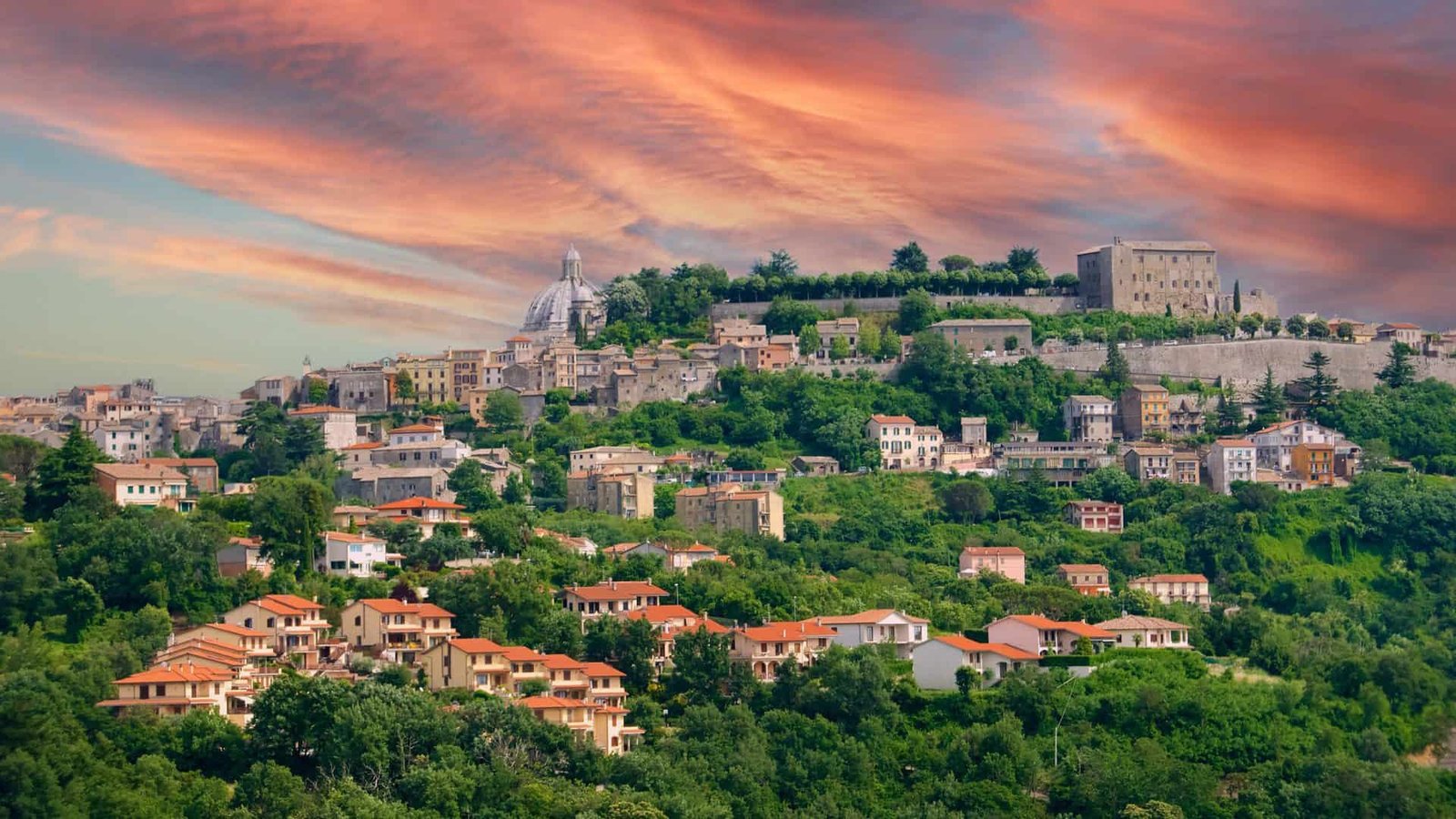
The Est! Est!! Est!!! wine of Montefiascone (VT)
No account of Montefiascone holds up without its wine, because the very name of this town is tied to one of the most famous and most curious labels in Italy. Montefiascone's Est! Est!! Est!!! is a white wine recognized as a controlled designation of origin (DOC) in 1966. Besides Montefiascone, it is produced in other towns of the Upper Tuscia overlooking the lake, and it comes from white-berried grapes: the base is Trebbiano toscano, called Procanico here, together with Malvasia bianca and Trebbiano giallo, known locally as Rossetto or Roscetto. The result is a wine with a brilliant straw-yellow color, a vinous aroma and a taste that the production regulations describe as savory, full-bodied, harmonious, in versions from dry to semi-sweet. There is also a sweet version and a sparkling one.
The legend of Johannes Defuk and the triple Est
The story that made this wine famous is set in 1111. The prelate Johannes Defuk was traveling to Rome in the retinue of Emperor Henry V, bound for the sovereign's coronation. A man of refined taste, Defuk had the habit of sending his cupbearer, named Martino, ahead with a precise task: to taste the wine in the inns along the road and mark with the Latin word Est, that is, there is good wine, the doors of the places worth stopping at. Having arrived in Montefiascone and tasted the local moscatello, Martino was so struck that on the door he did not write a single word but tripled it with emphasis: Est! Est!! Est!!! The bishop caught up with him, tried that wine and never left again. He stayed there, the legend says, until his death, which came, according to tradition, precisely from the excess of that pleasure. He was buried in San Flaviano, where his gravestone still recalls, with lapidary irony, that too much Est was his ruin.

Where to drink Est! Est!! Est!!! in Montefiascone
The wine you drink today is no longer the sweet moscatello of the medieval bishop: the 1966 regulations set a modern, drier profile, suited to lake fish and to the dishes of the local tradition. If you want to understand Est! Est!! Est!!!, taste it here, in the cellars and osterie of the center, perhaps with a plate of whitefish or eel from Lake Bolsena, and not elsewhere: a wine so tied to its place loses a lot when drunk far from the hill that produces it. An opinion: be wary of the too-cheap bottles sold at the roadside as souvenirs and look instead for the serious producers of the area, because the difference between a well-made Est! Est!! Est!!! and an industrial one is enormous, and risks ruining your memory of a wine that deserves respect.
Another well-known fact, yet rarely mentioned
Everyone knows that the popes stayed in Montefiascone, but few remember how long and how seriously this hill was, for a stretch of the 14th century, a de facto capital of the Papal States. During the Avignon captivity, when the pontiffs resided in France, it was the legates who governed central Italy in their name, and the most famous of them, the Spanish cardinal Egidio Albornoz, chose Montefiascone as the base for his military campaigns. In his two Italian missions, between 1353 and 1357 and then between 1358 and 1367, Albornoz resided mainly here, and spent his first Italian winter inside the Rocca preparing battle plans and gathering allies. In those years it was said that the fortress was impregnable. It was thanks to Albornoz's patient work that the Papal State was almost entirely rebuilt, so that when Urban V decided to bring the papal seat back from Avignon to Rome, on April 30, 1367, he found a pacified territory. And it was again in Montefiascone that Urban V spent the summers of 1368, 1369 and 1370, before returning to Rome to crown Emperor Charles IV. Not a simple papal holiday spot, then, but for a few decades the nerve center from which the State of the Church was reconquered.
The right photo to take in Montefiascone (VT)
The photograph you'll take home from Montefiascone is not the close-up of a monument, but the relationship between the town and its lake. Go up to the panoramic terrace of the Rocca dei Papi in the late afternoon and wait for the sun to start sinking toward the west: from there Lake Bolsena stretches out beneath you with the two islands breaking its surface, and the low light draws the hills. That's where to point the lens, keeping a strip of the Rocca's walls in the foreground to give depth to the image. Whoever prefers to frame the town, and not the panorama, should instead find a spot along the climb from which the dome of the Cathedral of Santa Margherita and the tower of the Rocca line up on the same axis: it is the silhouette that identifies Montefiascone from kilometers away, and it is the most recognizable postcard of the village. The best light for this second shot is the morning one, when the sun comes from the east and lights the cathedral facade from the side.

The history of Montefiascone (VT), from the Etruscans to today
The history of Montefiascone is long and layered, and it's worth retracing it in phases, because every era has left a mark that you can still read today walking through the town.
The first inhabitants and the Etruscans
Two sacred temple areas date to the Etruscan period, one in the locality of Cornos, on the lakeshore and also called Cornosse by the locals, and the other at the Rocca. Traces of more ancient civilizations have been found between Montefiascone and Viterbo, in the Rinaldone area, home of the Eneolithic civilization that took its name from this very site. Where the Rocca stands, the remains of a Proto-Villanovan settlement have been brought to light, datable to around the 9th and 8th centuries BC: the summit, therefore, was inhabited long before it became a refuge of the popes.
The Romans and Via Cassia
Montefiascone knew better fortunes in the Roman era, thanks to an efficient road system of which Via Cassia, built between 170 and 150 BC, is the most evident example. Its development was favored, paradoxically, by the scant urbanization the Etruscans had left in this part of the territory. Some finds in the area of the San Flaviano Basilica suggest that the initial Roman nucleus was located right in that area: traces of mausoleums, necropolises and many gravestones have emerged, which tell of a stable presence along the great consular road.
The first written records
With the Latin name of Mons Flasconis, Montefiascone begins to appear in official documents from the year 853, when Pope Leo IV confirms to the bishop of Tuscania, Virobono, the possessions of the diocese to which the territory belonged. From those documents we learn of the existence of the convent of San Pietro in Vico Pergulata, of the now vanished churches of Santa Maria and Sant'Agnese, of which foundation traces remain, of the church of San Pancrazio in Nocerina and of that of Sant'Andrea, then located inside the city walls.
The Early Middle Ages, the popes and Countess Matilda
In the Middle Ages the town, with its small fortress, took on considerable strategic importance because of its dominant position over the valley. In 1058 Pope Stephen IX went there, and in 1065 the army of Countess Matilda of Canossa. On June 15, 1074, Pope Gregory VII met Countess Matilda and her mother Beatrice, his precious allies in the struggle over investitures, right at San Flaviano. The fortress was besieged in 1093 by Emperor Henry IV, but the Farnese counts, the Ildibrandini and the lords of Bisenzio defended it with energy. In 1111 Henry V and his court passed through Montefiascone on their way to Rome for the imperial consecration, and it is to this passage that the legend ties the figure of Johannes Defuk and the wine. In 1185 Frederick Barbarossa also came here, aware of the fortress's value.
The Period of Splendor
In the following years Montefiascone became one of the most important centers of the Church. Pope Innocent III, in the 13th century, established the patrimony of Saint Peter, relying on the unfulfilled promises of Pepin and Charlemagne, and visited Montefiascone for the first time in 1207, reinforcing the Rocca and giving it a surrounding wall. Three years later, Otto IV occupied the town and set up his headquarters there. In 1222 Saint Francis passed through and left one of his followers there, Brother Morico of Viterbo, to introduce the townspeople to the Gospel according to his teaching. In 1267 the town was briefly invaded by the Ghibellines. Pope Martin IV stayed at the Rocca for a long time, embellishing it until he made it a royal palace, and the story of the lake eels is tied to him, which earned him a place among the gluttons of Dante's Purgatory. In 1315 the fortress was besieged over a dispute with a vicar rector of Saint Peter, and the Ghibellines, having won the contest, mocked the defeated and on Christmas Eve staged a trial against the prisoners that ended in heavy sentences. In 1321 Pope John XXII, from Avignon, ordered a new coin, the papalina, to be minted in the Rocca. During the Avignon captivity, as has been said, the legates governed from here, and among them Cardinal Albornoz was the most important. By 1463 the Rocca had lost its prestige, because the seat of papal government had been moved first to Viterbo and then permanently to Rome: Pope Pius II, visiting it, described it as a palace built to resemble a fortress, with halls, dining rooms and rooms worthy of a pope, but by then partly falling apart from age and neglect.
The Renaissance, the Plague and the Decline
In 1534 Cardinal Alessandro Farnese, tied to these lands, rose to the papal throne as Paul III: a skilled diplomat, he pursued a policy of pacification among the ecclesiastical authorities. In 1590 the Rocca was falling to pieces and was never restored again, because the popes had by then stopped frequenting what had been their summer residence, and for decades Montefiascone remained in obscurity. In 1657 the town was struck by the plague, which cost it about 1,200 inhabitants, almost a third of the population at the time. In 1695 a violent earthquake almost completely destroyed nearby Civita, and in Montefiascone too the damage was considerable, though without casualties. In 1687 the arrival of Cardinal Marco Antonio Barbarigo was providential: he refitted the local seminary until it became one of the most important in central Italy, before it too slowly lost importance. The cardinal died on May 26, 1706. On September 1, 1719, Bishop Cardinal Pompilio Bonaventura celebrated in Montefiascone the wedding between the Polish princess Maria Clementina Sobieska and James Stuart, pretender to the throne of England, who nevertheless would never become sovereigns.
From the French Occupation to Italian Unification
In 1797 Pope Pius VI passed through Montefiascone as an exile. The following year the French republicans invaded the Papal States and, entering the town, plundered the garden of the bishop's palace, destroying the 100 marble statues that adorned it. In 1860 the town was attacked by the Tiber Hunters, but the papal troops immediately regained control of it. In 1870 Nino Bixio occupied Montefiascone without meeting resistance, and the vote for annexation to the Kingdom of Italy was almost a plebiscite: out of 1,473 eligible voters, 1,469 voted in favor, four against and 491 abstained. After eight centuries the patrimony of Saint Peter in Tuscia ceased to exist. Under the new administration a large part of the buildings were rebuilt, sewers, roads and the Cimino aqueduct were built, and Montefiascone, described by many as the pearl of Upper Lazio, became a sought-after vacation destination in the first decades of the 20th century.
The 20th Century and World War II
Like many other towns, Montefiascone too paid its tribute to World War I, with 20 dead, among them the mayor Oreste Borghesi. In 1930 Lucia Filippini was canonized, and her remains rest in the crypt of the cathedral. In the 1930s the town received a visit from Mussolini, accompanied by Italo Balbo. In May 1944 Montefiascone suffered two air raids by Allied troops, with many casualties and heavy damage. In 1958, in regained peacetime, the Wine Fair was established, which is still today one of the main events of the Montefiascone summer and celebrates the town's historic agricultural and wine-growing vocation.
Some Important Events That Happened Here in History
Among the many events that marked Montefiascone, some deserve to be remembered for their force. The first is the meeting of June 15, 1074 between Pope Gregory VII and Countess Matilda of Canossa at San Flaviano: a summit between the protagonists of the struggle over investitures, at a decisive phase in the relations between papacy and empire. The second is the siege of 1093, when Emperor Henry IV surrounded the fortress and the local lords defended it with such determination that they drove him back. The third, and perhaps the most fascinating for anyone who loves history, is the winter that Cardinal Albornoz spent inside the Rocca between 1353 and 1354, turning this hill into the command post from which the State of the Church was reconquered. Then there is the night of Good Friday 1670, when the fire at the Duomo, disaster though it was, gave rise to the marvel of Carlo Fontana's dome, inaugurated four years later. And there is the most painful page, the plague of 1657 that took away a third of the population, and the two bombings of May 1944 that struck the town in the last months of the war. A happier event, but no less significant, was the 1719 marriage between Maria Clementina Sobieska and James Stuart, celebrated in this small town amid the never-fulfilled hopes of a Stuart restoration to the English throne. Each of these episodes has left a trace that can still be found today among the stones.
Who Passed Through Montefiascone (VT)
Few provincial towns can claim a coming and going of figures like the one that crossed Montefiascone over the centuries, and the reason is always the same: its position on the road to Rome. Emperors on their way to their consecration passed through, from Henry V in 1111 to Frederick Barbarossa in 1185, and with Henry V, according to the legend, came Johannes Defuk, the German prelate whom the local wine held here until his death. Many popes stayed here: Stephen IX in 1058, Gregory VII who met Countess Matilda of Canossa here, Innocent III who reinforced the Rocca, Martin IV who made it a royal palace and cultivated here the passion for eels that earned him a place in Dante's Divine Comedy, and Urban V who spent his summers here just back from Avignon. Saint Francis of Assisi stopped here in 1222, leaving a companion to preach the Gospel. Cardinal Egidio Albornoz, architect of the reconquest of the Papal States, resided here for a long time. Pius VI passed through, as an exile, in 1797, and Nino Bixio entered in 1870 on the eve of Unification. Even music left a mark: it is said that Gioachino Rossini set his Cenerentola in these lands. In the 1930s Mussolini arrived on a visit, accompanied by Italo Balbo. Walking through Montefiascone means retracing, without knowing it, the same alleys trodden by all of them.
Via Francigena in Montefiascone (VT)
Montefiascone is one of the most recognizable stops on Via Francigena, the great route that brought pilgrims from northern Europe to Rome. Those who walk this route today generally arrive from Bolsena, with a short but demanding climb that ends right at the top of the town, and set out again the next day toward Viterbo, often along a stretch of ancient stone paving that is among the best preserved of the entire route. San Flaviano, at the foot of the town, was the church that pilgrims met as they entered, and its two-level structure is also explained by this function of welcome. The town keeps, in short, not only the monuments of the powerful who stopped here, but also the humble and continuous memory of those who crossed it on foot out of faith. For those who arrive by car, walking even just a short stretch of the Francigena in the surroundings, perhaps toward the lake, helps to understand why this hill was so important along the road to Rome.
Events in Montefiascone (VT)
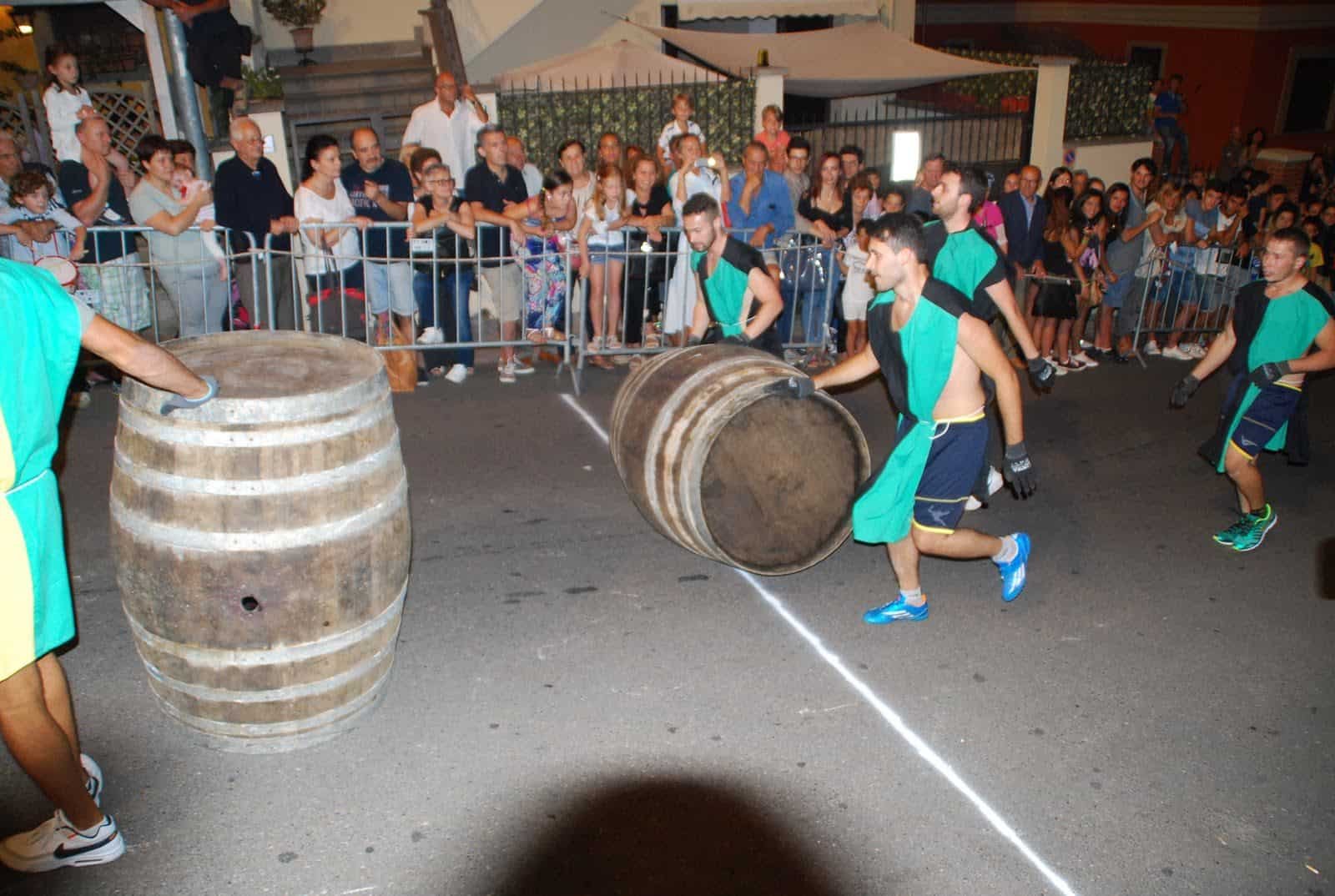
Montefiascone's calendar revolves around wine. The main event is the Wine Fair, established in 1958 and still the heart of the Montefiascone summer today: it is held every year in August and celebrates the agricultural and winemaking vocation of the territory with historical reenactments, among them the procession that recalls the legend of Defuk, and with the spectacular barrel race, in which the big wooden barrels are pushed rolling through the streets of the center. In July the town also hosts the Est Film Festival, a film series that brings screenings and meetings to the historic center. The rest of the calendar is arranged around these two major events, made up of food festivals, religious celebrations and events tied to the grape harvest. Whoever plans the visit for the second half of August finds the town at its liveliest moment, but also its most crowded: those looking for quiet should reckon with the calendar.
Eating in Montefiascone (VT): lake fish and wine
The cuisine of Montefiascone looks in two directions: toward the water of Lake Bolsena and toward the volcanic soils of the countryside. From the lake comes freshwater fish, which here is cooked with simple preparations, designed to bring out the flavor without covering it. The most prized fish is the whitefish, introduced at the end of the 19th century and become one of the economically most important species of the basin: it lives in deep, clear waters, feeds on plankton and has delicate flesh, so much so that the classic way of serving it is roasted, dressed with extra virgin olive oil, lemon, garlic and rosemary. Alongside the whitefish the lake offers perch, pike, tench and carp, grilled, fried or stewed. And then there is the eel, that same Lake Bolsena eel Pope Martin IV was fond of and which earned him his Dante fame: it is a fatty, flavorful fish, which local tradition prepares roasted or stewed.
Accompanying these dishes is, naturally, Est! Est!! Est!!!, whose dry profile pairs well with lake fish and with the flavors of the countryside. A pairing worth trying on the spot, in one of the osterie of the center, is precisely whitefish or eel with a glass of the local wine: it is the most direct way to understand why this town and its wine entered the history of Italian taste together. Whoever wants to take home a tasty souvenir finds, besides the bottles of the serious producers, the olive oil of the Tuscia and the products of the volcanic countryside, from lentils to the cheeses of the pastures around the lake.
The Barbarigo seminary and the Maestre Pie of Montefiascone (VT)
Among the less touristy but most significant chapters in the history of Montefiascone is that of education. At the end of the 17th century, in 1687, Cardinal Marco Antonio Barbarigo, a Venetian, arrived in the town, and would profoundly mark the life of the place. Barbarigo readapted and strengthened the Montefiascone seminary until it became one of the most important in central Italy, a center for training the clergy that for a long period attracted students from a vast territory. The cardinal died on May 26, 1706, and over time the seminary too lost part of its importance, but the educational imprint he had left on the town did not die out.
To that season also belongs the figure of Lucia Filippini, founder of the order of the Maestre Pie, who, right alongside Barbarigo's work, devoted her life to the education of girls and to popular schooling, in an age when women's education was largely neglected. A great benefactor of the local schools, she was canonized in 1930, and her remains still rest today in the crypt of the Cathedral of Santa Margherita, together with those of Cardinal Barbarigo. Whoever goes down into the crypt of the Cathedral, then, is not only visiting an architectural space, but meeting two protagonists of a story of school and education that has run through the town for centuries.
What to see around Montefiascone (VT)
Montefiascone is an excellent base for exploring the Alta Tuscia, one of the least-traveled and richest areas of Lazio. Going down toward the lake, you reach Bolsena in a few minutes, with its Santa Cristina Basilica and the Eucharistic miracle that gave rise to the feast of Corpus Christi, and the whole ring of lakeside villages is described on the page about Lake Bolsena. To the south, a quarter of an hour away by road, is Viterbo, the city of the popes with its medieval San Pellegrino quarter and the Palace of the Popes. A little farther on is the complex of San Martino al Cimino with its Cistercian abbey. Toward the Tiber, the spectacular Civita di Bagnoregio, the dying city, reachable only on foot, is worth the detour. Lovers of Etruscan art are spoiled for choice among the necropolises of Tarquinia, with its frescoes, the archaeological park of Vulci and the Tuscania of the Romanesque churches. Those who love Renaissance residences should head for Caprarola with Palazzo Farnese and the gardens of Villa Lante. In every case Montefiascone, with its height and its panorama, remains the balcony from which the whole area can be seen.
When to go, with children, accessibility
The best time to visit Montefiascone runs from spring to early autumn, when the Rocca is open on weekends and the weather lets you enjoy the views and the walks. Summer is lively but hot, and in August the Wine Fair brings a lot of people. Those looking for quiet will prefer May, June or September. The town is suitable for children, who have fun climbing toward the tower and taking in the view of the lake, but keep in mind that the old town is sloped and cobbled, and that the double church of San Flaviano, with its stairs, requires a little care with strollers. On accessibility, the hilly layout poses some difficulty for people with mobility problems: some climbs are steep and the old paving is not always easy. For up-to-date information on accessible routes and services, it's best to contact the municipal tourist office.
Quick questions about Montefiascone (VT)
Where is Montefiascone (VT)?
Montefiascone is in the province of Viterbo, in the Lazio part of the Alta Tuscia, on the southeastern shore of Lake Bolsena. The old town spreads between 590 and 600 meters above sea level and the Rocca reaches 633 meters, which makes it the highest municipality in the province.
How do you get to Montefiascone from Rome?
By car you follow Via Cassia north, for about a hundred kilometers. Alternatively, you exit at Orte on the A1 motorway and continue toward the lake. By public transport you reach Viterbo and from there take a Cotral bus. There is also a railway station, in the hamlet of Zepponami, on the Viterbo-Attigliano-Orte line.
How much is the ticket for the Rocca dei Papi in Montefiascone?
The full ticket costs €5.00 and the reduced ticket €3.50. School groups pay less, and children under 12, as well as residents, get in free. Hours vary with the season, so it's best to check them before your visit.
Are the churches of Montefiascone free to visit?
Yes, San Flaviano Basilica and Santa Margherita Cathedral can be visited free of charge during opening hours for worship. All that's asked is respect for silence and dress suited to a sacred place.
What is the Est! Est!! Est!!! wine of Montefiascone?
It's a white wine with a controlled designation of origin since 1966, made from Trebbiano Toscano, Malvasia Bianca and Trebbiano Giallo grapes. It owes its curious name to a medieval legend tied to the prelate Johannes Defuk and his cupbearer Martino.
Why is the wine called Est! Est!! Est!!!?
According to the legend, in 1111 the cupbearer Martino marked the best inns along the road to Rome with the Latin word Est, meaning there's good wine. In Montefiascone the wine seemed so excellent to him that he wrote the word three times, with growing emphasis: Est! Est!! Est!!!
Where is the tomb of Johannes Defuk?
The tomb of Johannes Defuk is in San Flaviano Basilica, at the foot of the town. The gravestone, buried there since 1113, wryly recalls that too much Est was what caused his death.
How big is the dome of the Cathedral of Montefiascone?
The dome of Santa Margherita Cathedral has a diameter of about 27 meters and is among the widest masonry domes in Italy. It was designed by Carlo Fontana and inaugurated on December 16, 1674, after the fire that had devastated the church in 1670.
What is the double church of San Flaviano?
San Flaviano is a church made up of two superimposed buildings oriented in opposite directions: you enter the lower church, dating from 1032, and climb to the upper one. It's one of the very rare double churches in Italy and preserves frescoes of great value.
How much time do you need to visit Montefiascone?
To see San Flaviano, the Duomo and the Rocca dei Papi without rushing you need at least half a day. Those who want to add a wine tasting or a walk on the Francigena will do better to dedicate a whole day to the town.
When Is the Montefiascone Wine Fair Held?
The Wine Fair is held every year in August. Established in 1958, it includes historical reenactments, the procession that recalls the legend of Defuk and the characteristic barrel race through the streets of the center.
Can You See Lake Bolsena from Montefiascone?
Yes, and this is one of the main reasons to climb up here. From the panoramic terrace of the Rocca dei Papi you look out over the entire Lake Bolsena with its two islands, the Bisentina and the Martana.
Is Montefiascone on Via Francigena?
Yes, Montefiascone is one of the stops on Via Francigena. Walkers usually arrive from Bolsena and set out again toward Viterbo, partly along a well-preserved stretch of ancient stone paving.
Is Montefiascone Suitable for Children?
Yes, children enjoy the climb up the tower and the view of the lake. You should consider, though, that the historic center is sloped and cobbled, and that the stairs of San Flaviano require a little care with strollers.
Where Can You Taste Montefiascone Wine?
Est! Est!! Est!!! is tasted in the cellars and taverns of the historic center, better if accompanied by Lake Bolsena fish. It pays to look for serious producers in the area and avoid the very cheap bottles sold as souvenirs.
Who Was Cardinal Albornoz and What Does He Have to Do with Montefiascone?
Egidio Albornoz was the Spanish cardinal who, during the Avignon captivity, reconquered the State of the Church in the name of the pope. Between 1353 and 1367 he resided mostly in Montefiascone, making the Rocca the base of his military campaigns.
What Is There to See near Montefiascone?
Within a few kilometers there are Bolsena, Viterbo, Civita di Bagnoregio, the Etruscan necropolises of Tarquinia and Vulci, Romanesque Tuscania and the Renaissance residences of Caprarola and Villa Lante. Montefiascone is a good base for the whole of Upper Tuscia.
Why Does Dante Mention Montefiascone in the Divine Comedy?
Dante places Pope Martin IV among the gluttons of Purgatory, alluding to the eels of Lake Bolsena, of which the pontiff was extremely fond during his stays at the Rocca of Montefiascone. It is not a direct mention of the town, but a gastronomic reference that concerns it closely.
What Is the Best Time to Go to Montefiascone?
Spring and early autumn offer mild weather, the Rocca open on weekends and fewer crowds. Summer is lively but hot, and in August the Wine Fair brings a lot of people to the town.
To Sum Up
Montefiascone is one of those towns that you barely notice from the windows of a car speeding along the Cassia, and that, if you choose to stop, gives back far more than it promises. On a single hill live side by side a fortress from which the State of the Church was governed, a double Romanesque church among the rarest in Italy, a Baroque dome born from a fire, a wine with the friendliest legend in the Italian wine scene and a natural balcony over the largest volcanic lake in Europe. My suggestion is not to treat it as a stop on the way to more prestigious destinations, but to give it the time it deserves: a slow climb from San Flaviano to the Rocca, a glass of Est! Est!! Est!!! drunk while watching the sunset over the lake, and the feeling, in the end, of having understood why so many popes and emperors chose to stop right here.
Article written by the editorial team of TourLeaderPro, contact them for Private/Corporate/V.I.P. Tours and Experiences.
Planning a trip to Rome? The English guides to visiting the city are on ItalyPlanner.com.