Lake Bolsena (VT)
In short. Lake Bolsena occupies the caldera of the Monti Volsini, in northern upper Lazio, in the province of Viterbo: 113.5 square kilometers of surface, 305 meters above sea level, 151 meters of maximum depth and 81 of average depth, a single…
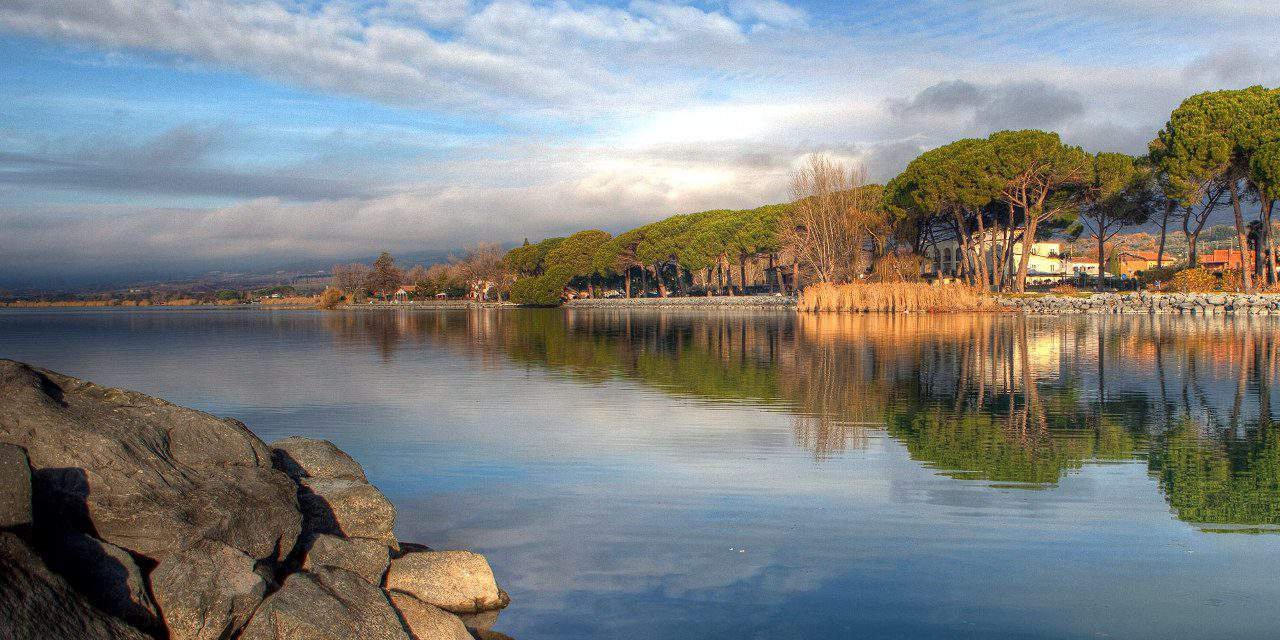
Lake Bolsena occupies the caldera of the Monti Volsini, in northern upper Lazio, in the province of Viterbo: 113.5 square kilometers of surface, 305 meters above sea level, 151 meters of maximum depth and 81 of average depth, a single outflow (the Marta River) and two islands. You get there from Rome by Via Cassia, the SS2: about 112 kilometers to Bolsena, between an hour and 40 minutes and two hours depending on the traffic at Monterosi and on the Cassia bis. Alternatively the A1 highway: exit Orte, then the expressway to Viterbo and the Cassia northward, about 60 kilometers, or exit Orvieto and 24 kilometers of Umbro Casentinese. By train the useful stations are Orvieto (24 km from the lake), Montefiascone Zepponami (16 km) and Viterbo (30 km). From the stations you continue with the Cotral runs, which connect Viterbo to Acquapendente passing through Montefiascone, Bolsena and San Lorenzo Nuovo (information at 0761 251262). You don't pay any ticket on the lake: the beaches of the lakeside towns are free, with stretches under concession to bathing establishments and campgrounds. You do pay to go to Isola Bisentina, the only one of the two that can be visited: the island's official site lists for the boat 20 euros for adults, 15 euros for kids from 6 to 15 years and for visitors with disabilities, free under 6, with group rates from 20 people up. The guided visit lasts about two and a half or three hours and must be booked in advance on the island's site, while the boat is paid at the boarding pier in Capodimonte or in Bolsena. The official calendar provides for openings every day except Monday and Wednesday, with some afternoon runs in English. The full rates for the guided visit change by season, so the total should be checked on the official site before leaving. Isola Martana is private property and cannot be visited: you go around it by boat.
If the lake is a stop on a wider trip in upper Lazio, it's best to cross it with the other pages for the area: Viterbo and its medieval quarter, Civita di Bagnoregio, Tuscania, and for those building an itinerary on the volcanic basins of Lazio Lake Vico and Lake Bracciano. For those who want to be accompanied by a professional, the licensed guides and tour leaders for Rome and for the Tuscia can be found on TourLeaderPro.

What Lake Bolsena really is: a caldera full of water
The almost circular shape is not a whim of the landscape: it is the signature of the event that created the basin. Over 300,000 years ago the volcanic complex of the Monti Volsini emptied its magma chambers and the roof collapsed in on itself, in a caldera collapse accompanied by a volcano-tectonic subsidence of the entire area. Water filled the basin, and the basin can still be seen: the rim of the caldera runs high above the eastern shore, and whoever arrives from the Cassia coming down from Montefiascone crosses it without realizing. The traces of the minor craters have remained along the flank of Isola Bisentina, in the Latera caldera, on the side of Montefiascone, which stands exactly on the rim of its own caldera.
What strikes you about this lake is its slowness. A basin of 113 square kilometers with a single outflow and a modest catchment area renews its waters over very long times: we are talking about over a century and a half for a complete turnover. It is the most important fact for understanding Lake Bolsena and nobody writes it on the brochures. A lake that takes 100 50 years to renew itself forgives nothing: every discharge, every fertilizer, every purification error stays inside for generations. Anyone who swims in it should know this, not to be frightened, but to understand why around here the word treatment plant sparks furious arguments in town councils.
The seiches, the oscillation nobody can predict
Lake Bolsena has a hydrological peculiarity that fascinates limnologists: the seiches. They are oscillations of the water level that depend neither on rain nor on the outflow, but on the fact that a closed mass of water, stirred by wind or atmospheric pressure, sloshes like water in a basin being carried around. In 2000 a seiche reached a difference in level of about 50 centimeters. People who live on the shore recognize them: the water withdraws a few meters from the waterline and comes back after a few hours, for no visible reason. It is not a tide, the lake has no tides. It is the basin breathing.
The level of Lake Bolsena and its historical fluctuations
In recent years the level has seen noticeable swings. In 2006 the water came close to the dirt roads along the shore, then went back to its usual values. In winter, heavy rains can flood the fields and the low-lying streets of the lakeside towns. The fact that there is only one outlet is an advantage here: the flow of the Marta River is regulated by the bocchette, openings cut into a dam that control how much water leaves the lake. The level, in short, can be managed. To see how much it has changed over the decades, just look at the historic structures along the shores: in June 2008 the wash house near the fishermen's beach at Marta stood at the same water level it was built for decades earlier. The lake rises and falls, and the walls record it better than any chart.
The lagheggiate, the winter spectacle
December and January bring winds from the north that exceed 80 or 90 kilometers per hour. When a strong tramontana meets the cold, the lake produces the lagheggiate: the waves slam against the seawalls of the lakefront and the pulverized water freezes on the parapets, the trees and the fountains, forming stalactites and crusts of ice that turn the waterfront into an Arctic stage set. The phenomenon is almost exclusive to the southern shore, in the towns of Marta and Capodimonte, and along the stretch at Montefiascone. My personal opinion: the lagheggiate are worth a winter trip more than a midsummer day at the lake. If you chase them, follow the wind forecasts, leave early and count on two or three failed attempts. It's worth it.
The Shores of Lake Bolsena, Side by Side
The shores are mostly low and sandy, with that dark, almost black sand that comes from the breakdown of volcanic rock. If you come from the clear Tyrrhenian sea, it throws you off. In some stretches the shore is marshy. The coast is not monotonous, though: small low peninsulas keep interrupting it, and the true headlands are few and easy to recognize, Monte Bisenzio, which closes off the Monti Volsini to the west, Punta San Bernardino, the peninsula of Capodimonte and the point of Sant'Antonio. Between one headland and the next, calm shores alternate, good for swimming and fishing, with cultivated fields that run down to the water, with olive trees, vineyards and vegetable gardens. Where people have stepped aside, isolated woods of oak, chestnut and willow grow, with extensive reed beds that shelter the nests of lake birds. On the trees the fishermen still hang their nets to dry, next to boats of an old design, with asymmetrical oars and a rear section that works as a rudder and is handled standing up.
The Eastern Shore of Lake Bolsena
It is the most populated and the best served, because the Cassia runs alongside it. Here you find Bolsena with its port, the equipped lakefront, the Monaldeschi della Cervara fortress and the basilica of Santa Cristina. The lake bed slopes down gently, which makes it the most convenient shore with children. It is also the one with the most bars, pedal boat rentals and beach clubs: if you want silence, this is not the right shore.
The Southern Shore: Marta and Capodimonte
The southern shore has the mildest climate and the two most characteristic towns from the point of view of lake culture: Marta, a fishermen's village with the Clock Tower and the sanctuary of the Madonna del Monte, and Capodimonte, perched on its own peninsula around the Farnese fortress. Boats leave from both. The Marta River also flows out of Marta, giving the town its name and carrying the lake's water toward the Tyrrhenian Sea.
The Western Shore, the Wildest
If you want to understand what this lake was like before tourism, go west. The western coast is the most solitary: dirt roads, reed beds, woods that reach the water, very few houses. Here Monte Bisenzio closes off the horizon, and beneath it, toward the water, stood the Etruscan city of Visentum. It is the shore where the phone gets a weak signal and where, on an October morning, you can stay alone for a whole hour. The verdict is clear: it is the most beautiful part of the lake, and it is the one that almost no day visitor sees.
The Northern Shore and the Upper Towns
To the north the shore is the lowest and the landscape opens into a cultivated plain, with the potatoes of San Lorenzo Nuovo and the vineyards of Grotte di Castro. The towns, though, are not on the water. They sit on the rim of the caldera, three or four kilometers away and about a hundred meters higher up, with lookouts over the whole basin. Gradoli and its Farnese palace, San Lorenzo Nuovo with its eighteenth-century octagonal square, Grotte di Castro with its rock-cut necropolises. The reason for this distance from the water is health-related, and it's a story that deserves a chapter of its own.

Gradoli - beach on Lake Bolsena
The Isola Bisentina on Lake Bolsena
17 hectares in the central western area of the basin, in the municipal territory of Capodimonte, province of Viterbo. The Isola Bisentina takes its name from the ancient Etruscan-Roman city of Bisenzio, which stood opposite it on the southwestern shore. Dense holm oak woods, centuries-old trees, and within that wood a quantity of architecture you don't expect on such a small island: the church of Santi Giacomo e Cristoforo, the chapels scattered through the scrub, the oratories, the paths that climb to the two hills, Monte Tabor and Monte Calvario.
The Church of Santi Giacomo e Cristoforo
It is the island's greatest monument, built between the mid-1400s and the 1500s. Critical tradition assigns the design to Antonio Garzoni, a pupil of Vignola, and attributes to Vignola himself the lead-covered dome that you see emerging from the woods as you approach by boat. Inside, for centuries, there were works that are no longer there today: some canvases attributed to Annibale Carracci were transferred to the Vatican at the wish of Pope Clement XI. The church also housed the burials of members of the Farnese family: the island was the dynastic mausoleum of one of the most powerful families in Europe, and this explains the disproportion between the size of the island and the quality of what is found there.
The Seven Chapels and the Malta dei Papi
Seven chapels are scattered through the woods, built according to tradition by the Franciscans on the model of the seven main churches of Rome. Each one faces a different town on the shore, so that every community on the lake could recognize its own. It is a solution of remarkable political intelligence, and it still works today: from a boat, if you know where to look, you can reconstruct the devotional geography of the lake.
Beneath Monte Tabor opens the Malta dei Papi, a cavity dug into the rock, perhaps of Etruscan origin, with a circular chamber about six meters wide and a vertical shaft about 30 meters deep. It was used as a prison. The name recurs in Dante's Paradiso, canto IX, in a passage that commentators refer precisely to an ecclesiastical prison of this kind. The shaft is not open to visitors, and whoever entered it as a sentence almost never came out.
The Legend of the Kingdom of Agarthi
There is a reason the Isola Bisentina attracts, besides art historians, a completely different audience. A twentieth-century esoteric tradition names it as one of the gateways to the Kingdom of Agarthi, the underground kingdom tied to the Hollow Earth theory, seat of the so-called King of the World, popularized in Theosophical writings starting from the studies of Helena Blavatsky in the late 1800s. Agarthi, in Sanskrit "the inaccessible," is said to be inhabited by a peaceful population able to use the psychic energy called vril, and the only gateway on Italian territory is supposed to be here. Let's be clear: this is modern esoteric literature, not a documented Etruscan tradition. That the Etruscans considered the lake sacred is instead plausible, because the federal sanctuary of the Fanum Voltumnae has long been hypothesized in the area. The two things have no documentary relationship to each other, and whoever tells you about them together is building a story, not reporting a source.
How to Really Visit the Isola Bisentina
You arrive only by boat, from the piers of Capodimonte and Bolsena. The visit is guided, lasts between two and a half and three hours, and involves a walk on uneven ground, with steps and climbs: the official site notes that some points, including the Rocchina, Monte Calvario, Monte Tabor, the Malta dei Papi and Santa Concordia, are not wheelchair accessible. Booking online is required, and the boat is paid for at the pier. Closed-toe shoes, water, a hat: there are no shops on the island. The practical advice: take the first morning slot, because the light on the lake is better and because the holm oak wood, in the early afternoon in August, turns into a sauna.

Who Has Owned the Isola Bisentina
The chain of owners tells five centuries of Italian history. From the late 1300s the island belonged to the Farnese, who made it the place of their burials. After Unification it passed to private owners: in 1871 to the Piedmontese entrepreneur Alarico Patti, in 1912 to Princess Beatrice Spada, then by inheritance to the Del Drago family. In 2017 it was bought by the Rovati family, pharmaceutical entrepreneurs from Lombardy, who began its restoration and opening to the public: a first extraordinary reopening took place on March 25, 2018, during the FAI days, after about 15 years of closure. The calendar of regular visits you find today is the result of that work.
The Isola Martana on Lake Bolsena
Opposite the town of Marta, to which it belongs territorially and from which it takes its name, the Isola Martana is the smaller of the two, at 10.3 hectares. You can't visit it: it is private property, uninhabited, and was once the site of an Augustinian convent. You can sail around it on the boats that leave from the ports of Capodimonte and Bolsena. From a distance it is a dark rock covered in green. Up close it is one of the gloomiest and most fascinating places in Lazio.
The Tunnel Dug into the Tuff
On the island there is an ancient tunnel dug into the tuff, which runs from the highest point down to the water level on the opposite side. Local tradition attributes it to Amalasuntha, who supposedly used it to reach the lake and bathe. Its real origin is uncertain and in all likelihood much older than the queen's imprisonment: tunnels of this kind, in the Tuscia, often belong to the Etruscan hydraulic repertoire. Whoever promises you a certain date is improvising.

Amalasuntha, the Queen Killed on the Island
One of the most dramatic episodes of late antique Italian history played out here. Amalasuntha, the only daughter of Theodoric, king of the Ostrogoths, a cultured, Latin-minded regent, was taken to the Isola Martana by deception and was killed there by her cousin Theodahad on April 30, 535. The murder gave Justinian the pretext to open the Greek-Gothic War, the conflict that devastated Italy for 20 years and definitively closed the ancient world on the peninsula. A little island of 10 hectares in Lake Bolsena is therefore one of the places where the end of ancient Italy was decided: it is talked about very little, and that's unfair.
The Legends of Amalasuntha Among the Fishermen
The queen's death has fed, for centuries, a repertoire of dark tales among the people of the lake. The old-timers say that the body was laid in a golden carriage and buried on the mainland, on one of the seven hills facing the island, and that on full moon nights her ghost still hovers around the rocks. Many fishermen of Marta claim that on days of strong tramontana, near the island, you can still hear the screams of the queen of the Goths. There is also talk of a road that anciently connected the island to the mainland, traveled by the sovereign: recent underwater surveys have identified traces consistent with a submerged passage, and the name given to it is the road of Amalasuntha. In Marta a street in the village is named after the queen, and in the eastern part of the island a plaque commemorates her.
The House of Tomao and the Memory of Marta
At number 106 on Via Amalasunta, in the historic center of Marta, local tradition identifies the house of Tomao, the legendary fisherman who supposedly ferried the queen to the island and kept contact between her and the people. A small square that the locals call Laco Tomao is dedicated to the same figure. It is the kind of place naming worth a walk: a legend that not only survives, but has an address.
The Remains of Santa Cristina on the Isola Martana
The island also served as a sacred refuge. When Lombard and Saracen raids put the towns of the lake to fire and sword, some of the faithful of Bolsena brought the remains of Saint Cristina here, to save them from plunder. Water, in those centuries, was the best fortification available.

The Towns of Lake Bolsena, One by One
Eight municipalities face the basin or its rim: Bolsena, Marta, Capodimonte, Montefiascone, Gradoli, Grotte di Castro, San Lorenzo Nuovo and Valentano. Tourism and settlements are concentrated on the eastern and southern coast, where the three true lakeside towns stand.
Bolsena
Bolsena is the historic capital of the lake. Above the town stretches the archaeological area of Volsinii Novi, the city the Romans founded after destroying Etruscan Volsinii. In the medieval center the Monaldeschi della Cervara fortress dominates, housing the territorial museum of Lake Bolsena, and in the lower part stands the basilica of Santa Cristina with its grotto and catacombs. The visit to the catacombs must be booked, and groups of more than 15 people have to announce themselves in advance. In the 1200s the event that made this name familiar to half the Catholic world happened here.
Marta
Marta is the fishermen's village, and you can tell: the nets, the boats, the vocabulary. The Clock Tower dominates the town, and above the town the sanctuary of the Madonna del Monte. On May 14, Marta celebrates the feast of the Madonna del Monte, which everyone calls Barabbata or festa delle Passate: the first documentary record goes back to a council resolution of May 9, 1557, in which the feast already appears as an established custom of previous years. The town's classes parade, the bifolchi with their animals and tools, the casenghi, and the fishermen, formally admitted in 1608. The three passate, the three ritual circuits around the church, originate from a dispute in 1704 between the bishop of Montefiascone and the Minim friars. If I had to choose a single day of the year to be on Lake Bolsena, I would choose this one.

Capodimonte
Capodimonte occupies a peninsula that enters the lake like a prow, and at the top has the Farnese fortress, an octagonal sixteenth-century palace. The boats for the Isola Bisentina leave from here. The lakefront is shaded by plane trees, and the walk around the peninsula, in the evening, is one of the most civilized things you can do in the province of Viterbo.
Montefiascone
Montefiascone is not on the water but on the rim of its own volcano's caldera, and looks down on the lake from above with the Rocca dei Papi and the dome of the cathedral of Santa Margherita. It was a refuge for many pontiffs and a bishop's seat, and in the 1600s it saw the rule of Cardinal Marcantonio Barbarigo. The view from the fortress is the best over the basin, and you get there by car: if you have two hours and don't know how to use them, come up here.
Gradoli, Grotte di Castro, San Lorenzo Nuovo, Valentano
Gradoli preserves the Farnese palace and a specific culinary tradition, the Purgatory lunch on Ash Wednesday. Grotte di Castro looks at the lake from a tuff plateau hollowed out by necropolises and cellars. San Lorenzo Nuovo is an eighteenth-century foundation ordered by Pope Clement XIV to move the inhabitants of San Lorenzo alle Grotte away from the malarial shores: the regular octagonal plan is the sign of that health project. Valentano, above the Latera caldera, preserves the Farnese fortress and the museum of the prehistory of the Tuscia. Near the locality of Montesenano, in the territory of Gradoli, a very rare plant has been observed, Baldellia ranunculoides: a detail for botanists, but it says how intact some corners of the shore still are.
Flora and Fauna of Lake Bolsena
The native fish population includes pike, tench, the small sand smelt, rudd, mullet, roach, the freshwater crayfish, the freshwater crab, the whitefish or lavarello, which is the most fished species, and eels, which have a particular fame in Italian literary tradition. The abundance of fish and the relative integrity of the shores attract a considerable number of waterfowl, which stop at the lake during migrations: tufted ducks, pochards, red-crested pochards, coots, great crested grebes, little grebes, black-necked grebes, little egrets and gray herons have been observed, species that the Lazio birdwatcher usually associates with more northern latitudes. Among the resident birds are pigeons, gulls and about 10 swans.
In the reed beds, small herons nest, along with the great reed warbler and the reed warbler, two passerines that weave the reeds to build cup-shaped nests, and the great crested grebe, which builds true floating platforms. On the shores live the common toad, the frog, the grass snake, the newt and the European pond turtle. The shore vegetation alternates reed beds, sand and small meadows where black nightshade with its red berries and white bindweed grow. A short distance from the shore appear buttercup, water knotweed, horned pondweed and the fennel pondweed, while in deeper water pondweed and the greater frogbit develop.
Alien Species, the Real Problem of the Lake
The native fauna is under pressure from the introduction of foreign species: pumpkinseed, catfish, largemouth bass, European perch, carp, agone, and then coypu, the American pond turtle, Canada goose, the Louisiana red crayfish. It is not a harmless list. These animals compete for resources, prey on local species and alter the habitat, and in a basin that renews its waters in a century and a half, balances, once broken, don't mend quickly. Anyone who fishes here should keep this in mind, and anyone who releases a fish bought elsewhere is doing damage that will outlast their lifetime.
Lake Bolsena: The History, from the Neolithic to Today
The shores were settled starting from the end of the Neolithic, with pile-dwelling villages set in the shallow water. Occupation continued in the Bronze Age and the Iron Age, always conditioned by changes in level: when the lake rose, the villages moved, and this is the reason underwater archaeology here still has much to say.
Lake Bolsena in the Etruscan Age
In Etruscan times the basin played a leading role. At least four centers arose on its shores: Visentum, today's Bisenzio, to the west, the Civita di Grotte di Castro to the north, and Cornossa, between Marta and Capodimonte, to the south, while present-day Bolsena became the port of powerful Volsinii, which scholars identify with Orvieto, in a relationship of dependence comparable to that between Rome and Ostia. In this area the Fanum Voltumnae has long been sought, the federal sanctuary where the leaders of the main Etruscan cities met every year: some hypotheses have placed it on the shores of the lake or on the Isola Bisentina, while the most recent excavations point to the Orvieto area. It remains a hypothesis, and as such it should be presented.
Lake Bolsena in the Roman Age
Once Volsinii was destroyed, the Romans moved the population to the site that would become Volsinii Novi, present-day Bolsena. The lake appears in Pliny's Naturalis Historia, under the Latin name of Lacus Volsiniensis. In the late imperial age the basin enters Christian history with the story of Saint Cristina, a third-century martyr, who would later be venerated as patron saint of the lake.
The Middle Ages: Plunder, Lombards and Saracens
The Middle Ages were, for the lake, a time of decline. Lombards and Saracens brought their armies here and plundered the main centers: Bolsena was devastated, and a group of inhabitants carried the remains of Saint Cristina to safety on the Isola Martana. Bisenzio was destroyed and its bishop's seat moved to Castro. On the Isola Martana the Gothic king Theodahad had his cousin Amalasuntha imprisoned and killed. From the twelfth century the lake became an object of contention between the municipalities of Orvieto and Viterbo, the Church, and the feudal lords of Bisenzio, and the shore towns suffered recurring plunder. Francesco Petrarca, struck by the situation, appealed to Pope Clement VI to intervene. The pontiff sent Cardinal Egidio Albornoz, who brought the area back under the control of the Church, followed by a train of riots and rebellions.
The Duchy of Castro and the Farnese
The return of the papacy to Rome consolidated papal rule over the area. In 1537 Pope Paul III established the duchy of Castro and entrusted it to his son Pier Luigi Farnese: the southern, western and northern shores of the lake belonged to the duchy, and the lake became its natural border. The Farnese settled in Marta, Capodimonte, Bisenzio, on the islands Bisentina, where they built the family mausoleum, and Martana, then in Gradoli, Grotte, San Lorenzo and Borghetto. They built fortresses, palaces and residences, and hosted writers and artists there. In 1649, with the fall of Castro, the lake came back under the direct rule of the Church: the city of Castro was razed to the ground and never rebuilt.
The 1600s and 1700s: Malaria and Relocated Towns
In the 1600s Cardinal Marcantonio Barbarigo was active in Montefiascone, supporting the work of Saint Lucia Filippini, founder of the Maestre Pie, an order born for the education of children in the lake area and later spread all over the world. In the 1700s the water level rose significantly and turned the lowest shores into marsh, with a violent spread of malaria. Inhabited centers disappeared: Bisenzio was merged with Capodimonte in 1816, Borghetto was merged with Grotte di Castro in 1745, and Pope Clement XIV had the inhabitants of San Lorenzo moved to Le Grotte, to a healthier site, founding San Lorenzo Nuovo. Malaria, not war, drew the present map of the lake towns.
The 1800s: Risorgimento and Brigandage
In 1848 the Associazione Castrense was born, a movement inspired by Mazzini that many inhabitants of the lake joined. In 1860 a detachment of Garibaldini who had landed at Talamone reached the area and tried to rouse the population, occupying the fortress of Valentano. The attempt failed because of the hostility of the inhabitants and the prompt intervention of the papal forces, who drove the patriots back into Tuscany. The area nevertheless entered the Kingdom of Italy after the capture of Rome. Brigandage followed, which struck Upper Lazio and lower Tuscany: the refuge of the brigands became the Selva di San Magno, between Gradoli, Latera, Valentano and Capodimonte. Here, on June 3, 1891, in an operation against the brigands, the carabinieri brigadier Sebastiano Preta, silver medal for military valor, was killed. King Umberto I personally paid for a bust in his memory in a square in Latera.
From the 1900s to Today
The economy continued to rest on farming and fishing, often under sharecropping, and poverty pushed many lake people to emigrate to North America and Canada, with Montreal as the favorite destination. Brigandage was defeated in the early 1900s. The improvement of Via Cassia followed, along with the arrival of running water and electricity. In 1927 the lake entered the newly created province of Viterbo. Then Fascism, the war, the devastation of 1943 and 1944, with the arrival of the Allies in the summer of 1944. After the war emigration resumed, this time toward Italian cities and above all toward Rome. From the 1950s and 1960s a slow tourist development began, which peaked in the 1970s and 1980s when the lake became popular among Germans, Austrians, Dutch, Belgians and Swedes. Even today the accommodation favors contact with nature: campgrounds, farm stays, bed and breakfasts, more than big hotels.
The Miracle of 1263 and the Birth of Corpus Domini
In 1263, or according to some reconstructions in 1264, a priest from the Germanic area named Peter, whom tradition says was from Prague, was celebrating Mass in the sanctuary of Santa Cristina in Bolsena. At the moment of consecration, according to the account, the host was stained with blood that dripped abundantly onto the corporal, the linen cloth spread on the altar. The priest gathered everything and headed to Orvieto, where Pope Urban IV resided. The bishop of Orvieto went to recover the relics, and tradition has Thomas Aquinas and Bonaventure of Bagnoregio present at the examination as well. The pope went to meet the procession, received the host and the linens and showed them publicly.
The consequence is enormous and can still be seen all over Europe: on August 11, 1264, with the bull Transiturus de hoc mundo, Urban IV extended the feast of Corpus Domini to the universal Church, entrusting Thomas Aquinas with the composition of the liturgical office. The corporal is kept in Orvieto, in the reliquary made by Ugolino di Vieri in 1337, and the Orvieto cathedral came into being, in substance, to house it. In Bolsena the original altar and the stained marble slabs remain, today in the chapel of the Miracle. It is worth saying plainly: one of the most widespread feasts of the world Catholic calendar was born in a village church on the shore of this lake, and the cathedral that is its monument stands 24 kilometers away by road.
A Curiosity About Lake Bolsena (VT)
The curiosity I like best concerns a fish and a pope. The eels of Lake Bolsena are mentioned in the Divine Comedy: in canto 24 of the Purgatorio Dante places Pope Martin IV, who died in 1285, among the gluttons, recalling that he atones for the sin of having eaten the eels of Lake Bolsena drowned in vernaccia wine. It is the kind of fame no promotional campaign can buy: a local product that ended up in Dante's afterlife through excess of success. The curious thing is that the detail is precise, not generic: the lake's eels were a specialty known to the papal court of the 1200s, and the technique of cooking them in wine was a way to bring out their fat.
There is a second, lesser-known layer of curiosity. Dante names this lake elsewhere too, and the Malta dei Papi on the Isola Bisentina appears in canto 9 of the Paradiso as a model of ecclesiastical prison. Two Dante citations for a single body of water in northern Lazio is a record that no other Italian lake can claim, and nobody talks about it. The right question to start with is why a thirteenth-century French pope ended up in Purgatory because of a fish from this lake.
Something Nobody Tells You About Lake Bolsena (VT)
Almost all the towns that should be on the lake are not on the lake. Look at a map: Gradoli, Grotte di Castro, San Lorenzo Nuovo, Valentano, Montefiascone itself are all a few kilometers from the water and about a hundred meters higher up, on the rim of the caldera. It is not a case of picturesque urban planning, it is a health decision taken over the course of centuries. When in the 1700s the level of the lake rose and the low shores turned to marsh, malaria became endemic: whoever lived on the shore died or fell ill. The answer was to move the people. San Lorenzo Nuovo is literally this: a new town, founded at the will of Pope Clement XIV, built on a regular octagonal plan, to which the inhabitants of old San Lorenzo alle Grotte were transferred. Bisenzio was merged with Capodimonte in 1816, Borghetto with Grotte di Castro in 1745.
The practical consequence for the visitor is that Lake Bolsena, unlike Lake Como or Trasimeno, does not have a continuous ring of villages facing the water. It has three centers on the shore, Bolsena, Marta and Capodimonte, and five towns that look down on it from above. Whoever arrives hoping for a walk from one town to another along the shore ends up disappointed. Whoever understands the logic of this distribution discovers instead that the high lookouts offer the best view, and that the shores in between, precisely because they are uninhabited, have remained the most natural in Lazio. The emptiness on the map is not a flaw: it is a historical scar that produced a landscape.
My Advice for Visiting Lake Bolsena (VT)
Don't do it as a day trip from Rome, and above all don't do it in August at noon. Lake Bolsena handles the hit-and-run visit badly: the full loop around requires about 50 kilometers of roads that are often narrow and scenic, and if you add the boat to the Bisentina, which takes a full half day, you have already used up your time. The right format is two days with one overnight, preferably in a high town like Gradoli or Grotte di Castro, where prices are reasonable and in the evening you eat well without standing in line.
The second piece of advice is about the season. May, June and September are the best months: water already warm in June, long light, no lines at the ferries. July and August bring a considerable German and Dutch density in the campgrounds of the eastern shore, and the parking lots of Bolsena and Capodimonte fill up by 10 in the morning. October is the month I recommend to those who come for the landscape and not for swimming: the colors of the woods on the western shore are worth the trip.
Third, a contrarian piece of advice. Most visitors concentrate on the eastern shore because the Cassia runs through it. Do the opposite: take the low road from Capodimonte toward Valentano and Gradoli, stop where you find a pull-off, and walk down to the reed beds. You will see a different lake, without pedal boats and without loudspeakers. If you then want someone to organize the logistics, you can find a tour leader or a licensed guide through TourLeaderPro. For those traveling with foreign friends, the English guides on Lazio are collected in the Lazio section of ItalyPlanner.
Another Well-Known Fact, Yet Rarely Cited
Everyone knows that Lake Bolsena is the largest volcanic lake in Europe. Almost no one connects that record to its most serious consequence: the slowness of the water exchange. A basin this large, fed almost only by rain and underwater springs, with a single outlet of modest flow, takes over a century and a half to completely renew its volume of water. It is a figure found in the limnological literature and in protection documents, and it changes the way you look at the shore.
Why it matters. It means that every input of nutrients stays in the system for decades, and that eutrophication, once it starts, does not stop because you change your mind. It means that the sewage collection and treatment works of the lakeside towns are not an administrative detail but the condition for the survival of the asset on which the local tourist economy lives. It also means that the lake's catch depends on fragile balances, already under attack today from non-native species. When you hear people discussing treatment plants on Lake Bolsena and it seems like a matter for the town council, remember the number: 100 50 years. No other Italian lake of this size has such a narrow margin for error, and it is the reason why it's worth leaving nothing on the shore, not even a cigarette butt.

The Right Photo to Take at Lake Bolsena (VT)
The photograph that brings the lake home isn't taken from the shore. It is taken from above, from the rim of the caldera, with the two islands lined up. The best spot is the climb from Marta toward the sanctuary of the Madonna del Monte, or the scenic road that goes down from Montefiascone toward Bolsena: from up there the Isola Martana enters the frame in the foreground, the Bisentina farther away, and the profile of the Monti Volsini closes the circle. With a moderate telephoto lens the two islands stack onto each other and the result is that flattened plane that renders the shape of the caldera well.
On the timing I am categorical: early morning. Lake Bolsena faces northwest, and the late afternoon light comes against the sun on the islands, with summer haze almost guaranteed. At dawn, instead, the water is often still as a slab, the fishermen still go out rowing, and the low fog lets only the tops of the islands emerge: it is the photograph you see in books and that almost no tourist takes, because it requires being up at five 30 in July.
Two variations I recommend. The first is the detail, not the panorama: the boats pulled up on the black beach at Marta, with the nets hung on the trees. The second is in winter, with strong tramontana: the ice stalactites of the lagheggiate on the parapets of the lakefront are a subject you can't find anywhere else in Lazio. Bring a cloth for the lens, because the spray travels far.
Some Important Events That Happened Here in History
On April 30, 535, the Isola Martana was the scene of the murder of Amalasuntha, daughter of Theodoric and regent of the Ostrogothic kingdom, killed on the order of her cousin Theodahad after being brought there by deception. Constantinople's reaction opened the Greek-Gothic War: a crime committed on 10 hectares of rock in the middle of this lake is one of the triggers of the end of ancient Italy.
In 1263, or according to other reconstructions in 1264, in the sanctuary of Santa Cristina in Bolsena the Eucharistic event took place that led Pope Urban IV, on August 11, 1264, to extend the feast of Corpus Domini to the whole Church with the bull Transiturus. From that event came the reliquary of Ugolino di Vieri, made in 1337, and to a large extent the cathedral of Orvieto.
In 1537 Pope Paul III established the duchy of Castro for his son Pier Luigi Farnese, and for a little more than a century the lake was the border of a family state with its own laws and its own building sites. The duchy ended in 1649 with the destruction of Castro, one of the rare cases in Italy of a city wiped out by papal order and never rebuilt.
In 1745 Borghetto was merged with Grotte di Castro, and in the 1700s Pope Clement XIV founded San Lorenzo Nuovo to take the inhabitants away from malaria. In 1816 Bisenzio too was merged with Capodimonte. In 1860 the Garibaldini who landed at Talamone tried to rouse the area by occupying the fortress of Valentano, and failed. On June 3, 1891, in the Selva di San Magno, the carabinieri brigadier Sebastiano Preta fell, silver medal for military valor, remembered by a bust personally paid for by Umberto I. In the summer of 1944 the Allies moved up through the lake area, which had suffered bombing and occupation. In 2017 the Isola Bisentina passed to the Rovati family and on March 25, 2018, during the FAI days, it reopened to the public after about 15 years of closure.
Who Has Passed Through Lake Bolsena (VT)
Pliny the Elder cites the lake in the Naturalis Historia, and with him Latin geography knows it as Lacus Volsiniensis. Amalasuntha, queen of the Goths, arrived there a prisoner and did not leave. Pope Urban IV sent the bishop of Orvieto there in 1263 and with that decision changed the liturgical calendar of Europe. Tradition places Thomas Aquinas and Bonaventure of Bagnoregio at that examination too, the latter born a few kilometers away.
Dante Alighieri knew the lake well enough to cite its eels in the Purgatorio, condemning Pope Martin IV, and to use the Malta as a point of comparison in the Paradiso. Francesco Petrarca concerned himself with the misery of the lakeside towns and wrote to Pope Clement VI so that he would send someone to restore order. Cardinal Egidio Albornoz was sent, and left a lasting mark here. In the 1500s the Farnese family made the lake its domestic stage: Paul III, Pier Luigi, and with them architects and artists called to work on the islands and in the fortresses.
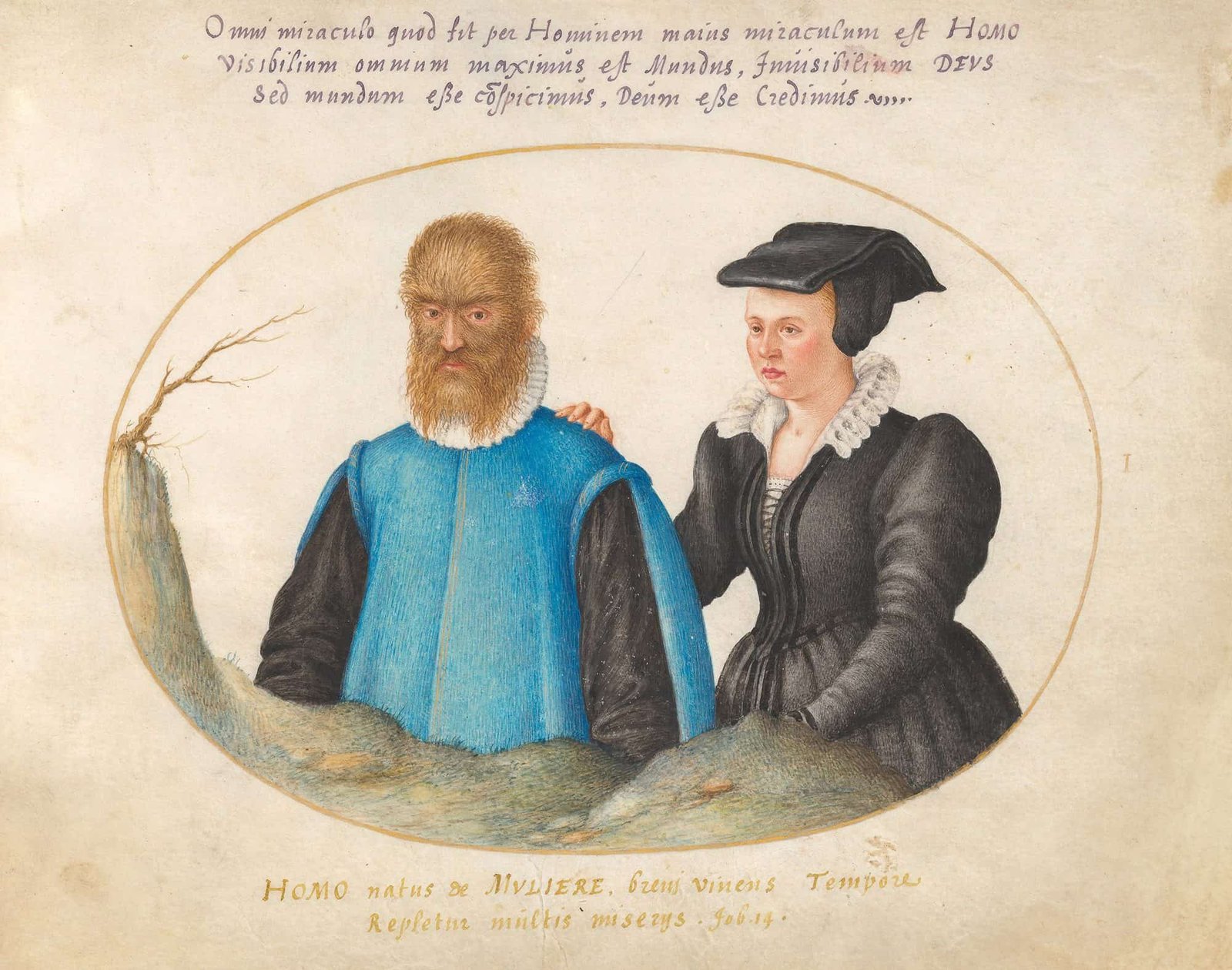
One presence that deserves to be told is that of Petrus Gonsalvus, the man with congenital hypertrichosis born in the Canary Islands in the 1500s, raised at the French court of Henry II, married to Catherine, a lady-in-waiting of Catherine de' Medici. The Farnese family welcomed him at Capodimonte, where he lived with his wife and children, some of whom had inherited his condition, and where he died at a very advanced age. His story is considered one of the historical roots of the tale of Beauty and the Beast. On the biographical details the sources diverge and it is wise to be cautious, but the family's presence in Capodimonte is part of local memory.
In the 1600s Cardinal Marcantonio Barbarigo, bishop of Montefiascone, passed through here and backed the work of Saint Lucia Filippini. In the 1800s King Umberto I took a personal interest in the memory of brigadier Preta. And then, from the 1970s, came the travelers from Northern Europe who made Lake Bolsena a familiar destination in Germany, Austria, the Netherlands, Belgium and Sweden long before it became fashionable among Romans.
Lake Bolsena with Children
It is one of the few bodies of water in Lazio where you can bring small children without anxiety. The eastern and southern shores slope gently, the water stays shallow for many meters and there are no currents. The dark sand gets very hot in the sun, so you need flip-flops, but it's good for playing. In Bolsena and Capodimonte you find pedal boat and canoe rentals, and in the warm months the equipped beaches have showers and bars. The boat to the Isola Bisentina is free under age six according to the official fare schedule, but the guided visit lasts almost three hours on uneven ground: under seven or eight years old the ratio of effort to attention is unfavorable, and many families regret it halfway through.
Child-friendly alternatives are plentiful: the Monaldeschi fortress in Bolsena with the lake museum, the rock-cut necropolises around Grotte di Castro, the prehistory museum in Valentano. And birdwatching in the reed beds: with inexpensive binoculars and half an hour of patience you see grebes and coots a few meters away.
Accessibility at Lake Bolsena
The lakefronts of Bolsena, Marta and Capodimonte are largely flat and passable by wheelchair, and some equipped municipal beaches have walkways in the swimming season. What's provided changes from year to year, and it's best to ask the town hall before leaving. The Isola Bisentina, instead, is partially accessible: the official site indicates that some points on the route, including the Rocchina, Monte Calvario, Monte Tabor, the Malta dei Papi and Santa Concordia, are not wheelchair accessible, and it offers a reduced fare for blind, deaf and severely disabled visitors. The high historic centers, Gradoli, Grotte di Castro, Valentano, Montefiascone, have slopes and paving that make the walk tiring: better to drive to the lookouts.
How Much a Day at Lake Bolsena Costs and How to Save
Free beaches cost nothing, and that is the most important line in the budget. The real costs are three: fuel or the Cotral ticket, parking in the summer months at Bolsena and Capodimonte, and the optional boat to the Isola Bisentina, which starts at 20 euros per person for transport alone according to the official fare schedule, with discounts for young people and disabilities and free under age six. The guided visit of the island has an additional cost that varies by season and format, so the total should be checked on the island's official site at the time of booking.
How to really save. First: sleep in the high towns rather than on the shore, where summer rates rise sharply. Second: eat at lunch and not at dinner, because midday menus in the villages are often half the price. Third: if you are more than 20, ask for the group fare for the boat, which the official fare schedule provides. Fourth, and the most effective: come out of season. In May and September the lake costs a third less and is worth twice as much.
What to Eat at Lake Bolsena
Lake cooking is freshwater fish, and whoever arrives expecting the seafood repertoire is thrown off. Whitefish, or lavarello, is the most fished species and ends up grilled or in carpione. Perch and tench appear in fried dishes. Eels have the fame we know from Dante's Purgatorio, and are cooked stewed or over embers. The signature dish is the sbroscia, the fishermen's soup: mixed lake fish, potatoes, onion, tomato, lake water in the archaic version, stale bread. It is a dish of poverty that became a dish of pride, and the versions of Marta, Capodimonte and Bolsena have been arguing with each other for generations.
Away from the water, the Tuscia offers its products: the oil of the Colli Etruschi, the purgatorio beans of Gradoli, the potatoes of the Alto Viterbese from San Lorenzo Nuovo, the Est Est Est wine of Montefiascone, the Aleatico of Gradoli, sweet, for the end of a meal. A blunt opinion, at the risk of displeasing someone: Est Est Est has a fame greater than its average quality, and the Aleatico of Gradoli is the wine that is really worth the stop. I don't name restaurants because they change management quickly, and a guide that recommends a restaurant closed for two years has failed at its job.
When to Go to Lake Bolsena and When to Avoid It
From mid-June to mid-September the water is good for swimming and the days are long. The peak of crowding falls in the first three weeks of August, when the campgrounds on the eastern shore are full and the parking lots fill up early. May and June have the best light and the countryside in bloom, with May 14 devoted to the Barabbata of Marta. September and October remain the best months: water still warm, woods changing color, quiet restaurants. The period to avoid, if you want to swim, runs from November to March, but it is exactly the right period for the lagheggiate and for empty villages. Watch out for the wind: days of strong tramontana make the lake choppy and not advisable for canoes and pedal boats, and on Lake Bolsena the waves can get serious fast.
What to See Around Lake Bolsena
Within half an hour's drive the program fills itself: Orvieto with the cathedral and the corporal reliquary, 24 kilometers from Bolsena. Civita di Bagnoregio on its tuff spur. Viterbo with the San Pellegrino quarter and the Palace of the Popes. Tuscania with San Pietro and Santa Maria Maggiore, two of the most austere Romanesque churches in Lazio. And farther south Tarquinia with its painted tombs. Whoever follows the water can continue toward Lake Vico, the other large volcanic basin of the province, or go down toward Lake Bracciano. The Marta River, the only outlet, leaves from Marta and crosses Tuscania and Tarquinia before reaching the Tyrrhenian Sea, where between its mouth and that of the Mignone the Salina di Tarquinia Nature Reserve for animal populations was established. For those organizing the trip from abroad or wanting to share it with English-speaking guests, Italian day excursions are collected on the ItalyPlanner day trips page.

Quick Questions About Lake Bolsena (VT)
How far is Lake Bolsena from Rome?
About 112 kilometers to Bolsena along Via Cassia, the SS2. By car it takes between an hour and 40 minutes and two hours, depending on traffic at Monterosi and on the Cassia bis. Alternatively, take the A1 and exit at Orte or Orvieto.
How do you get to Lake Bolsena without a car?
By train to Orvieto, Montefiascone Zepponami or Viterbo, then with the Cotral runs that connect Viterbo to Acquapendente via Montefiascone, Bolsena and San Lorenzo Nuovo. Schedules should be checked on the company's site before leaving, because weekday and holiday runs differ a lot.
How deep is Lake Bolsena?
The maximum depth is 151 meters, the average 81 meters. The surface area is 113.5 square kilometers and the elevation is 305 meters above sea level.
Why does Lake Bolsena have black sand?
Because it comes from the breakdown of the volcanic rocks of the caldera of the Monti Volsini. It is not pollution and it doesn't stain: it is simply the composition of the substrate.
Can you swim in Lake Bolsena?
Yes, the beaches of the lakeside towns are swimmable and mostly free. The results of the bathing water quality checks are published every season by the competent agencies and by the towns: whoever wants the updated data finds it there.
How much does it cost to go to the Isola Bisentina?
The official boat fare schedule lists 20 euros for adults, 15 euros for young people from 6 to 15 and for visitors with disabilities, free under 6, with discounts for groups of 20 people. The guided visit costs extra and varies by season: the total is checked on the island's official site.
Do I need to book to visit the Isola Bisentina?
Yes. Booking the guided visit is mandatory and guarantees your place on the boat. The boat ticket is paid at the boarding pier, in Capodimonte or Bolsena.
Can you visit the Isola Martana on Lake Bolsena?
No. The Isola Martana is private property and is not open to the public. You can sail around it on the boats that leave from the ports of Capodimonte and Bolsena.
How many islands are there in Lake Bolsena?
Two: the Bisentina, of about 17 hectares, and the Martana, of 10.3 hectares. The first can be visited with a guided tour, the second cannot.
Is Lake Bolsena suitable for children?
Very. The eastern and southern shores slope gently and the water stays shallow for a long way. For the guided tour of the Isola Bisentina, which lasts almost three hours on rough ground, it is better to wait until the children are older.
Can you go in a wheelchair at Lake Bolsena?
The lakefronts of the three lakeside towns are largely flat and some municipal beaches have seasonal walkways. On the Isola Bisentina the route is only partially accessible: the official site lists the points that are not wheelchair accessible.
Where do you park at Lake Bolsena?
In Bolsena and Capodimonte there are parking lots near the lakefront, paid in the summer months and full by late morning in August. In the high towns like Gradoli, Grotte di Castro and Valentano you can usually park without trouble just outside the historic center.
What fish do you eat at Lake Bolsena?
Whitefish or lavarello, perch, tench, sand smelt, eel. The traditional dish is the sbroscia, the fishermen's soup with lake fish, potatoes, onion, tomato and stale bread.
Why is Lake Bolsena famous in the history of the Church?
For the Eucharistic event of 1263 in the church of Santa Cristina in Bolsena, which led to the bull Transiturus with which Pope Urban IV, on August 11, 1264, extended the feast of Corpus Domini to the whole Church. The corporal is kept in the cathedral of Orvieto.
Who was Amalasuntha and what does she have to do with Lake Bolsena?
She was the daughter of Theodoric, regent of the Ostrogothic kingdom. She was taken by deception to the Isola Martana and killed there on April 30, 535, on the order of her cousin Theodahad. Her death was one of the pretexts for the Greek-Gothic War.
Is Lake Bolsena the largest volcanic lake in Europe?
Yes, it is the largest lake of volcanic origin on the continent by surface area, at 113.5 square kilometers, and the fifth largest Italian lake by size.
How long does it take to drive around Lake Bolsena?
The full loop is over 50 kilometers of shore roads and high roads. Without stops an hour and a half is enough, but with stops at the lookouts and in two or three towns you comfortably fill a day.
What is the difference between Lake Bolsena and Lake Vico?
Both are volcanic, but Lake Vico is much smaller, enclosed among the Monti Cimini and protected by a nature reserve with strict limits on swimming. Lake Bolsena is larger, more populated and equipped for beach tourism.
When is the Barabbata of Marta held?
On May 14 every year, for the feast of the Madonna del Monte. The first documentary record of the feast goes back to a town council resolution of May 9, 1557, which describes it as an already established custom.
What are the lagheggiate of Lake Bolsena?
They are the winter storm surges caused by strong tramontana: the waves beat against the seawalls and, in the cold, the pulverized water freezes, forming ice stalactites on parapets, trees and fountains. They are seen mostly on the southern shore, at Marta and Capodimonte.
Are there mosquitoes at Lake Bolsena?
In the reed bed areas and on late summer evenings, yes, as on every freshwater basin. Repellent and long sleeves after sunset solve the problem: the malaria that scourged these shores in the 1700s has been a closed chapter for over a century.
Can you fish in Lake Bolsena?
Sport fishing is practiced and regulated by regional and provincial rules, with a license and closed seasons for some species. Up-to-date conditions should be requested from the competent offices or from the fishermen's associations of the lakeside towns.
The Last Word on Lake Bolsena
A firm conviction: Lake Bolsena should not be treated as a convenient beach near Rome. It is a caldera holding a century and a half of water that renews itself slowly, two islands loaded with history, eight towns that moved their homes so as not to die of malaria, and a thirteenth-century event that changed the calendar for half the world. Whoever arrives at 11, lies down on the black sand and leaves at six has seen a tenth of what's there. Take two days, climb to the rim of the caldera, step into a village church, book the boat to the Bisentina and eat a sbroscia made the way it should be.
Article written by the editorial team of TourLeaderPro, contact them for Private/Corporate/V.I.P. Tours and Experiences.
Planning a trip to Rome? The English guides to visiting the city are on ItalyPlanner.com.