Bolsena (VT)
In short. Bolsena is a town of about 3,000 600 people in the province of Viterbo, on the northeastern shore of the lake that bears its name, in the upper Tuscia, a short distance from the border with Umbria.
Bolsena is a town of about 3,000 600 people in the province of Viterbo, on the northeastern shore of the lake that bears its name, in the upper Tuscia, a short distance from the border with Umbria. The historic center stretches between the 305 meters of the water's surface and the little more than 300 50 meters of the first slopes of the Volsini mountains. From Rome you arrive in a little under two hours: by car you take Via Cassia, the SS2, which runs along the lake from the south, or the A1 highway to the Orvieto exit and then the road that goes down toward the shore. Those traveling without a car reach Orvieto or Viterbo by train and continue with the Cotral buses, which connect Bolsena to both cities. The town has received the Bandiera Arancione (Orange Flag) of the Touring Club Italiano, the recognition reserved for inland towns that take good care of their heritage and hospitality. Strolling through the center costs nothing and the Basilica di Santa Cristina can be visited free of charge, while for the Rocca Monaldeschi della Cervara, which houses the Territorial Museum of Lake Bolsena, and for the Grotta di Santa Cristina below with the catacombs, a ticket is required: it's best to check rates and hours, which change with the season, on the museum's website or at the tourist office in the square.
This guide is part of the pages dedicated to the towns and villages around the capital and reads well alongside those on Lake Bolsena, Marta and Capodimonte, the other towns that share the shores of the same body of water. To plan the whole day, the list of the area's tourist attractions is handy.

Where Bolsena is and why the town is worth the trip
Bolsena occupies a low, broad stretch of shore, where the lake widens and the coast turns into a beach. Behind the town rise the Volsini mountains, the rim of an enormous extinct volcanic complex. In front, the water reaches to the horizon, with two islands in the middle. The town has belonged to the province of Viterbo since 1927, when it was detached from the province of Rome together with a good part of upper Lazio. It borders a ring of municipalities that all face the same basin or the hills surrounding it, and this makes it a good starting point for touring the inland Tuscia.
The reason Bolsena deserves more than a quick stop is the density of stories it holds together in a few hectares. Here is the largest volcanic lake in Europe. Here a Christian martyr of the third century left her name to a basilica and an underground necropolis. Here, in 1263, an episode told for centuries as a miracle gave the decisive push to the birth of one of the most important feasts of the Catholic calendar, Corpus Domini. And beneath the modern town sleeps an Etruscan and Roman city, Volsinii, with its forum, its baths and its frescoed domus. Whoever arrives thinking of a postcard on the lake soon realizes that every corner has a stratification that has to be dug into slowly.
Bolsena and the largest volcanic lake in Europe
Lake Bolsena is the largest lake of volcanic origin on the continent and the fifth largest among the Italian lakes. It covers an area of about 100 13 and a half square kilometers, reaches 100 51 meters at the deepest point and averages a little over 80. Its basin is not a single crater but a caldera: the void left by the collapse of the ground above an emptied magma chamber, a process that began over 300 thousand years ago as part of the Vulsini volcanic complex. The water level stays at a little over 300 meters above sea level. The lake has no large inflowing rivers and is fed mostly by springs and rain, which makes it clear but also sensitive: a closed basin reacts slowly and for a long time to every stress. On the shores of Bolsena the bottom slopes gently, the water is clean and in summer the beaches fill up. The lakefront, with its landing stages, is the point from which the boat trips to the islands depart.
How to get to Bolsena from Rome and from Viterbo
By car from Rome the simplest route is the Cassia north to Montefiascone and then down to the lake, or the Autostrada del Sole to the Orvieto exit, from which in about 20 minutes you descend to the shore. From Viterbo the town is about 30 kilometers along the Cassia. Those who don't drive have two rail bases: the Orvieto station on the Rome-Florence line, also served by high-speed trains, and the network that leads to Viterbo. From both cities the Cotral buses reach Bolsena. Keep in mind that suburban runs thin out on holidays, so it's best to look at the schedules before leaving. Once in town everything is walked: the historic center is compact and the distances between the Rocca up high and the Basilica along the main street are covered in a few minutes of walking, with some climbs.
The beaches of Bolsena and swimming
Bolsena is one of the best places to swim in the lake, because the town's shore is low and sandy and the bottom descends gently. The lakefront, at the foot of the historic center, alternates stretches of free beach with equipped beach clubs, with the possibility of renting pedal boats, canoes and small boats. The water is among the clearest of the big Italian lakes, an effect of its being a closed basin fed by springs, and in summer swimming lasts from May to well into September. Compared with the sea, the lake has the advantage of having no waves and no salt, which makes it convenient with small children. Those looking for quieter corners find them by moving away from the center along the shore, toward the less built-up stretches.
Lake fish and the cooking of Bolsena
The cooking of Bolsena is lake cooking, and it should be tasted for exactly that reason. The protagonist is freshwater fish: the whitefish, introduced into the lake and become a classic, the perch, the eel, the pike and the small fried latterini. They are found grilled, stewed or in guazzetto in the trattorie of the center and the lakefront. Around them, the Tuscia offers the rest of the pantry: the olive oil of upper Lazio, legumes, the chestnuts of the Cimini mountains a little to the south, and the wines of the area, starting with the famous Est! Est!! Est!!! of Montefiascone, which is drunk chilled looking at this very lake. Stopping for lunch with a plate of fish and a glass of local white, after the climb to the Rocca, is an integral part of the visit and not a side dish.
The four rioni of Bolsena
The historic center of Bolsena is divided by tradition into four rioni, and knowing their names helps you get oriented and understand the shape of the town. The Castello rione is the highest medieval core, gathered around the Rocca: narrow alleys, houses of dark volcanic stone, stairways. The Santa Cristina rione is the largest and most populous, spread around the basilica and the square of the same name, the heart of religious and civil life. The Borgo is the central rione, the smallest, a hinge between the upper and the lower parts. The San Giovanni rione is the most modern portion, toward the lake and the arrival roads. Walking from one rione to another means going up and down in time: you start from the fortified Middle Ages of the Castello, cross the religious fabric of Santa Cristina and come out on the shore, where the town looks at the water.
The history of Bolsena in brief
The story of Bolsena reads as a series of forced moves and rebirths. First there was Velzna, the Etruscan city on the Volsini mountains, powerful enough to host the federal sanctuary of the Fanum Voltumnae. When it fell in 264 BC, its inhabitants were deported down to the valley, where the Roman Volsinii arose, a city of forum, baths and domus along the consular road. With the collapse of the empire and the Gothic devastations of the fifth century the population retreated up again, this time onto the hill where the medieval town would grow. In the Middle Ages Bolsena came into the orbit of Orvieto and of the powerful Monaldeschi della Cervara family, who erected the Rocca and made it a stronghold. Religious fame arrived with the Eucharistic miracle of 1263 and the birth of Corpus Domini. The Renaissance and Baroque ages left palaces and chapels, while on the lake the weight of the Farnese, lords of the Isola Bisentina, was asserting itself. In 1927 the town passed from the province of Rome to that of Viterbo. Today Bolsena lives on farming, lake fishing and tourism, with a historic center that holds all these layers together, one on top of the other.
Bolsena in the Middle Ages and the Monaldeschi
The Middle Ages are the moment when the town takes the form it still keeps. Around the fortress on the hill the Castello rione tightens, with its houses of volcanic stone and steep alleys. Lower down the religious settlement grows around the tomb of Santa Cristina. The Monaldeschi della Cervara, a branch of one of the great families of Orvieto, control the territory and make it an outpost on the lake and on the roads that cross it. It's an era of struggles between families and changes of hands, common to the whole Tuscia, but in Bolsena it left a whole monument, the Rocca, and an urban fabric that has been preserved better than elsewhere. Whoever walks through the Castello rione today follows, without realizing it, the plan of a medieval fortified town that has remained almost intact.
The Rocca Monaldeschi della Cervara in Bolsena
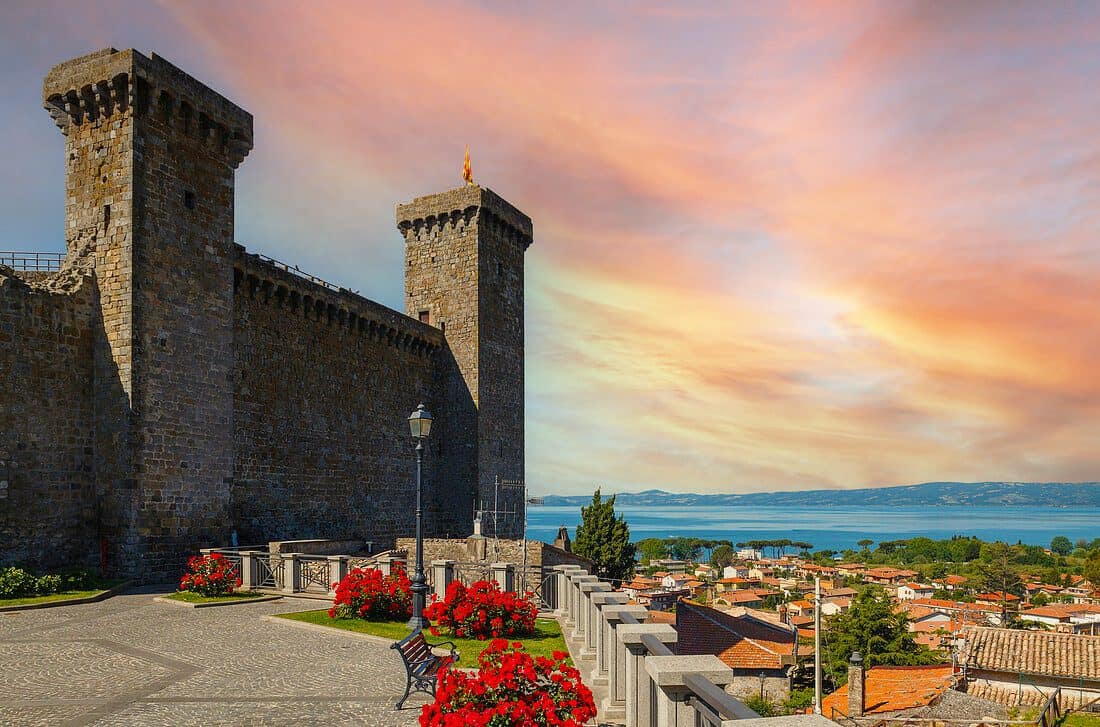
The Rocca is the monument that dominates Bolsena from above and the first image that imprints itself on the mind on arrival. The fortification of the hill is old: a first defense dates to the middle of the twelfth century, under Pope Hadrian IV, but the Rocca as we see it, with its four towers and its crenellated wall, is mostly the work of the thirteenth and fourteenth centuries, tied to the Monaldeschi della Cervara family, the house of Orvieto that controlled the town and the territory for a long time. It is a defensive machine designed for the lake and for the roads that converged on it, and even today the walkway on the walls gives back the long view the sentinels had: the shore, the islands, the towns across the water. After a long restoration the Rocca is fully visitable again and houses the territorial museum.

The Territorial Museum of Lake Bolsena
Inside the Rocca is the Territorial Museum of Lake Bolsena, a museum that tells the nature and the history of the basin together. The route runs over several levels and first addresses geology: how a caldera is born, what volcanic soil is made of, why the water is so clean. Next comes the section dedicated to prehistory and the Etruscan world, with the finds the territory has yielded, and then the Roman and medieval one, which leads up to the fortified town of the Monaldeschi. It's a museum of synthesis, designed for those who want to read the landscape even before the individual objects: you leave knowing how to look at the lake and its towns with different eyes. Management belongs to the territory's museum network. Hours and tickets should be checked before the visit because they follow the season.
The freshwater aquarium in the Rocca of Bolsena
The surprise that few expect inside a medieval fortress is an aquarium. In the Territorial Museum there is a freshwater aquarium dedicated to the species of the lake, inaugurated in 2011 and for a long time the only one of its kind in this part of central Italy. It gathers about 20 tanks with about 30 species of fish and other animals of the basin, from whitefish to pike, and it serves to explain what really lives beneath that smooth surface. For those traveling with children it's the Rocca's highlight: the story of the walls and towers wins over little ones very little, the fish very much. In the outer courtyard there is a small lapidary with Roman-era altars and funerary cippi, another thread tying the fortress to the ancient city buried under the town.
The collection: the Gran Carro and the Casa delle Pitture
Among the most important pieces kept or described in the museum are the materials of the Gran Carro, a submerged protohistoric settlement identified in 1959 on the bed of the lake's eastern shore: one of the rare Iron Age settlements that the lake has given back almost intact, with wooden posts preserved by the water. To the Roman world belongs instead the so-called Casa delle Pitture, a domus of Volsinii whose frescoes, datable between the first century BC and the fourth century AD, include an underground room tied to the Dionysian cult. There is then the Casa ad Atrio, with opus sectile floors, the refined inlay of colored marble, and a monumental nymphaeum. They are the fragments of a city worth imagining whole while you walk among the ruins of Poggio Moscini.
The Basilica di Santa Cristina in Bolsena
If the Rocca is the monument seen from afar, the Basilica di Santa Cristina is the spiritual heart of the town and the reason Bolsena appears in the books of Church history. The present church has a Romanesque layout from the eleventh century, with a Renaissance facade added during the 1400s, and was raised to the dignity of minor basilica in August 1976 by Pope Paul VI. It's a layered complex, which puts together several buildings and several eras: the upper church, the chapel dedicated to the Eucharistic miracle, the grotto with the saint's tomb and, below, the early Christian necropolis. It is visited in silence, passing from one space to another, and each passage tells a different piece of the story.
Santa Cristina of Bolsena, the martyr and the legend
Cristina is the young martyr to whom the town owes the name of its main rione and of the basilica. According to tradition she lived in Bolsena at the time of the persecutions of Diocletian, at the turn of the third and fourth centuries, and was put to death for not renouncing her faith. The hagiographic account, which should be taken for what it is, a devotional tradition and not a chronicle, has her subjected to repeated tortures from which she emerged unharmed: thrown into the lake with a millstone tied to her neck, the stone instead of dragging her to the bottom is said to have held her afloat, and on that stone tradition recognizes the prints of her feet, preserved as a relic in the grotto. Beyond the legend, the solid fact is the cult: already in late antiquity Cristina's tomb was a place of veneration, and around that sepulcher the whole monumental complex we see today grew.
The Grotta di Santa Cristina and the catacombs of Bolsena
Beneath the basilica opens the Grotta di Santa Cristina, a small underground basilica that rose around the tomb of the martyr, and from here you enter the early Christian necropolis, the catacomb that remained in use between the third and fifth century. It is one of the best-preserved Christian underground cemeteries in central Italy outside Rome, with galleries dug in tuff and burial niches arranged on several levels. In the grotto are kept a late antique sarcophagus linked to the burial of the saint and a glazed terracotta by Benedetto Buglioni, made at the end of the 15th century, depicting Cristina lying down: one of those Robbian sculptures with enameled colors that carry the Florentine school right into the rock of the Tuscia. The visit to the grotto and the catacombs is guided and has its own ticket. It is the most moving part of the whole complex, because you descend literally into the roots of the cult.
The Eucharistic Miracle of Bolsena of 1263
The event that made Bolsena famous throughout the Catholic world happened here, above the tomb of Santa Cristina, in 1263. Tradition tells it this way: a priest, remembered as Peter of Prague, tormented by doubt about the real presence of Christ in the Eucharist, was celebrating mass when, at the moment of consecration, the host is said to have begun to bleed, staining the corporal, the linen on which the consecrated bread rests, and falling on the stones of the altar. Pope Urban IV, who at that time resided in Orvieto, not far away, sent the bishop to verify and had the relics brought to Orvieto, welcomed in procession. The following year, 1264, with the bull Transiturus de hoc mundo, Urban IV instituted for the universal Church the feast of Corpus Christi, entrusting Thomas Aquinas with the composition of the liturgical texts. The bloodied corporal has been kept for centuries in the Duomo of Orvieto, inside a famous reliquary. In Bolsena remain the blood-stained stones of the altar, venerated in the chapel dedicated to the miracle, and the altar itself on which, according to the story, it all happened. Believe in the event or not, its historical weight is enormous: from an event that took place in this church comes one of the central feasts of the Catholic calendar.
The artworks of the basilica: Buglioni and Sano di Pietro
The Basilica di Santa Cristina is not only the stage of the miracle, it is also a small museum of works that deserve attention on their own. The Buglioni workshop, Florentine heirs of the Robbian tradition of glazed terracotta, left more than one example here, from the sculpture of the saint in the grotto to the enameled altars that dot the rooms. The church also holds a polyptych attributed to Sano di Pietro, a Sienese painter of the 15th century, and late Gothic frescoes, among them a decoration dated 1498 attributed to Giovanni de' Ferraris da Mondovì. They are works that tell of a cultured and up-to-date provincial patronage, able to call Sienese and Florentine workers to a lake in northern Lazio. It is worth entering slowly and looking for them one by one, instead of rushing toward the miracle chapel.
The other churches of Bolsena
The Basilica di Santa Cristina draws all the attention, but Bolsena is rich in other religious buildings that tell of different eras. The Cappella del Miracolo, built in the 17th century and then completed in the 19th century, is the Baroque space erected expressly to receive and venerate the bloodied stones of the altar of 1263: here the memory of the miracle became architecture. In the fabric of the town you find the old churches of San Francesco, of medieval layout between the 12th and 13th century, and San Salvatore, also of medieval origins, as well as a later church of San Salvatore, from the 15th century, marked by a fire in 1914. Outside the town are the convent of Santa Maria del Giglio and the oratory of the Madonna dei Cacciatori, from the 15th century. They are minor places, often not always open, but they convey the image of a town that for centuries was above all a town of devotion, grown in the shadow of its martyr.
Volsinii: Etruscan and Roman Bolsena
Before the medieval town there was an ancient city, and its history is as dramatic as the rest. On the mountains above the lake stood Velzna, in Latin Volsinii, one of the most powerful cities of the Etruscan dodecapolis, seat of the federal sanctuary of the Fanum Voltumnae, the meeting place of the Etruscan peoples. Rome destroyed it in 264 BC, at the end of a very hard war, and deported its inhabitants. The survivors were forced to refound the city lower down, near the lake, and this new Volsinii, the Volsinii Novi of the Romans, is the direct ancestor of Bolsena. The Roman city prospered along the consular road, acquired a forum, baths, an amphitheater, temples and luxury homes, and remained inhabited until the late antique decline, when the Gothic devastations of the fifth century pushed the population to take refuge on the fortified hill, where the medieval village would be born.

From Velzna to Volsinii Novi
The passage from an Etruscan city on the mountains to a Roman city on the lake is one of the most instructive stories of the ancient world, because it shows how Rome treated defeated enemies: not only with weapons, but with the physical relocation of a community. The Etruscan Velzna was dismantled and its inhabitants resettled on a more exposed and controllable site, at the foot of the hill, where they could no longer count on natural defenses. Within a few generations the new Volsinii was a Roman city in every respect, with its network of roads and its public buildings. The name, distorted over the centuries, has come down to us as Bolsena, and the lake itself took its name from the city.
The excavations of Poggio Moscini in Bolsena
The Roman city is visited in the archaeological area of Poggio Moscini, on the slope above the town, investigated for a long time by the French School in Rome. Here emerge the forum with the civil basilica, later turned into a church in the Constantinian age, a covered street, several domus with floors and decorations, the remains of the baths and the urban layout of a well-off provincial city. Walking among these remains helps give body to the finds you see in the museum of the Rocca: the Casa delle Pitture and the Casa ad Atrio are not display-case abstractions, but houses of this city, with their rooms and their courtyards. It's a less frequented area than the great archaeological destinations of Lazio, and this is an advantage: you often walk it in peace, without crowds.
The palaces and fountains of Bolsena
Between the Rocca and the basilica, the center of Bolsena preserves some fine civil buildings, which tell of the town's Renaissance and Baroque season. The Palazzo del Drago, from the mid-1500s, is tied to the names of Simone Mosca and Raffaello da Montelupo, artists of the Mannerist school also active in Orvieto, and keeps frescoed decorations inside. The Palazzo Cozza Caposavi, of sixteenth-century origin and reworked in the 1700s, is another of the noble palaces that give breathing room to the streets of the center. Near the Rocca stands then the palace of the Monaldeschi, the house that governed the town. Among the fountains the Fontana di San Rocco deserves a note, whose erection local tradition ties to Cardinal Giovanni de' Medici and around which, every year in mid-August, a blessing revolves. They are details that escape those who rush toward the major monuments, but that are worth a glance while passing from one end of the town to the other.
The islands of Lake Bolsena: Bisentina and Martana
In the middle of the lake two islands float, and each has its own story. The Bisentina is the larger, a little under 17 hectares, and keeps important artistic testimonies. It was long the property of the Farnese family, who turned it into a small monumental park with churches and chapels, also a destination of papal visits. The Martana is smaller, a little over 10 hectares, and more austere. The two islands can be seen well from the shore of Bolsena and are reached with the boat trips that leave from the lakefront in the good season. Landing and visits depend on seasonal openings, which should be checked each time.
The Isola Bisentina
The Bisentina is the island of the Farnese. The great family that gave the Church Pope Paul III chose it as a place of representation and leisure, dotting it with religious buildings and devotional paths among the greenery. For centuries it remained closed and visitable only at times. In its history chapels, a main church, grottoes and legends intertwine. Seen from the water, with its dense vegetation and the outlines of buildings poking out among the trees, it is one of the images that stay most impressed from the whole lake.
The Isola Martana and the end of Amalasuntha
The Martana is tied to one of the most famous crimes of the late antique world. Here, in 535, Amalasuntha was killed, daughter of Theodoric the Great and queen of the Ostrogoths, relegated to the island and murdered by order of her cousin Theodahad, who had taken power from her. Tradition fixes the date at April 30 of that year. It was a dynastic crime that had enormous consequences: it gave the emperor Justinian the pretext to unleash the Gothic War, the long conflict that would devastate Italy. A tiny island in a lake in upper Lazio thus turns out to be one of the keys to European history of the sixth century. A plaque on the island recalls the episode.
The festivals of Bolsena
The calendar of Bolsena revolves around Santa Cristina and the miracle, and its festivals are among the most intense in the Tuscia. The most spectacular is the festival of the Misteri di Santa Cristina, celebrated every year around July 23 and 24. Through the streets of the town, in some main squares, living tableaux are staged, the Misteri, which re-enact in motionless scenes the episodes of the saint's martyrdom. Over a hundred costumed participants take part, the statue of the martyr is carried in procession from one tableau to the next, and the evening closes with fireworks on the lake. It's a popular devotion of great scenic force, which fills the town.
The Infiorata of Corpus Domini in Bolsena
Directly tied to the miracle of 1263 is the Infiorata of Corpus Domini. On the day of the feast that originates precisely from Bolsena, the streets and squares of the center are covered with carpets of flowers that form sacred images, over which the procession passes. It's a tradition the town traces back to the centuries after the miracle and which continues today, with the neighborhoods busy for days gathering petals and composing the designs. Seeing a carpet of flowers undone under the feet of the procession is a small spectacle about the very idea of ephemeral beauty.
The other festivals of the year
Besides the two main appointments, Bolsena spreads other occasions throughout the year: the festival dedicated to hydrangeas, which colors the town in the second half of June, the medieval reenactments in summer, which bring the town back to the era of the Rocca, and the music and dance festivals tied to the good season. Those who want to see the town at its liveliest should make the visit coincide with one of these dates. Those who instead seek calm and silence should avoid them, because the center fills up and finding a place becomes a small feat.
For a day in Bolsena: the itinerary
A full day is enough to see the best of Bolsena without rushing. In the morning it's best to start from above, from the Castello rione and the Rocca Monaldeschi della Cervara, when the light on the lake is better and the air cooler: you visit the Territorial Museum with the aquarium, climb onto the walkways for the view, and then go down toward the archaeological area of Poggio Moscini for the Roman city. From there you return to the fabric of the town along the streets of the center, cross the Borgo and reach the lower squares, where you can stop to eat lake fish: whitefish and perch are the dishes to look for.
The afternoon: the basilica, the grotto and the lake
The afternoon is for Santa Cristina. You devote the right amount of time to the basilica, to the chapel of the miracle with the bloodstained stones and, above all, to the descent into the grotto and the catacombs, which is the part not to dispose of quickly. After the dark of the rock, the finale is on the water: the lakefront, a walk on the shore, a swim if the season allows it, or boarding for the tour of the islands. Those with energy left can close with the sunset, watching the Bisentina and the Martana darken on the water. It's the kind of day that alternates stone and light, underground spaces and horizons, and for exactly that reason it stays with you.

Bolsena on Via Francigena
Bolsena is a historic stage of Via Francigena, the ancient route that carried pilgrims from northern Europe to Rome and that is still walked and cycled today. Those arriving on foot along the Francigena enter the town from the north side and descend toward the lake through the center, with the basilica as the natural resting point: for centuries pilgrims bound for Rome stopped here to venerate Santa Cristina and, after 1263, the site of the miracle. This vocation of passage explains a lot about the character of Bolsena, a town used to welcoming those on the road. Today the stretch of the Francigena around the lake is among the best loved of the whole Italian route, for the gentle landscape and for the sequence of towns facing the water. The tourist office makes available directions for the walking and cycling itineraries in the surroundings. Walking even just the last stretch toward the town, with the lake appearing suddenly beyond the countryside, is a different and slower way of arriving in Bolsena, and perhaps the most faithful to its history.
The Turona park and the green areas
Those who want a break outdoors, perhaps with children, find just outside the center the municipal park of Turona, toward the Cassia south, an equipped green area with picnic spaces where the town blends into the countryside. Around it, the municipal territory offers sports facilities and the possibility of practicing water sports of every kind on the lake, from sailing to windsurfing, from kayaking to water skiing, while on land there is no shortage of tennis courts and facilities for five-a-side soccer. It's the less monumental and more everyday side of Bolsena, the one lived by those who live there and those who spend the summer there, but which is worth knowing to understand that the town is not only an open-air museum: it's also a place where people dive in, ride bikes and stop in the shade.
What to see around Bolsena
Bolsena is a good base for the whole upper Tuscia, and within half an hour by car you reach top destinations. On the lake, to the south, are Montefiascone with its rocca and the Est! Est!! Est!!! wine, Marta with its tower on the water and Capodimonte on the promontory. A little farther is Orvieto, with the duomo that keeps precisely the corporal of the Bolsena miracle, and the fragile Civita di Bagnoregio, the city that is dying on its spur of tuff. Inland open the Caprarola of Palazzo Farnese and the gardens of Villa Lante in Bagnaia, while not far away are Etruscan Tuscania, the provincial capital Viterbo with its medieval quarter and the famous Parco dei Mostri of Bomarzo. Enthusiasts of the Etruscan world will find plenty to sink their teeth into at Vulci and at Tarquinia with its painted tombs.
Bolsena with children and accessibility
Bolsena works well also as a family outing. The museum in the Rocca has a trump card with the little ones, the freshwater aquarium, which makes all the rest of the visit digestible. The beach on the lake, with its waveless water, is the perfect complement for the afternoon. The grotto and the catacombs, on the other hand, require some care: they remain fascinating but also dark and with a few steps, so for very small children or for those who suffer in closed spaces they should be considered calmly. On the accessibility front, the historic center is uphill and paved, with alleys and stairways especially in the Castello rione, and this makes it tiring for those with mobility difficulties or pushing a stroller. The lakefront, by contrast, is flat and comfortable. For the Rocca and for the underground route it's best to find out in advance about the access conditions, because the medieval structure and the dug rock were not made for wheelchairs. In compensation, much of the charm of the town, the lower squares, the shore, the upper basilica, can be enjoyed without facing the hardest climbs.
When to go to Bolsena and how long to stay
The ideal period for Bolsena depends on what you are looking for. For those who want to experience the town at the height of its identity, the two dates to mark are July, with the Misteri di Santa Cristina around the 23rd and 24th, and Corpus Domini with the Infiorata, movable between the end of May and June: on those days the town is at the peak of its scenic force, but also full of people and hard to get around calmly. For those who instead put tranquility and the quality of the visit to the monuments first, the best months are May, early June and September, when the climate is mild, the lake at the end of summer is still warm enough for swimming and the catacombs are visited without crowds. Winter is the quietest and most melancholy season, with the lake often wrapped in haze and many services reduced, suited to those who love towns out of season. As for time, a full day is enough for the core of the visit. Two days allow you to add the islands, the surroundings and a more human pace.
A curiosity about Bolsena (VT)
The curiosity that throws off those arriving in Bolsena is that the name of the town, of the lake and of an ancient Etruscan power are the same word, distorted by time. The Etruscan city was called Velzna. The Romans latinized it to Volsinii. From Volsinii, through the centuries, we arrived at Bolsena. The lake itself has no ancient proper name: it's called after the city that dominates it. It means that when we pronounce Bolsena we are repeating, without knowing it, the name of one of the capitals of Etruscan civilization, the one that hosted the federal sanctuary of the Fanum Voltumnae, the place where the Etruscan peoples gathered. There's more: the destruction of Velzna in 264 BC conventionally marks the end of Etruscan independence, the last of the great cities to fall to Rome. Walking in Bolsena means having under your feet not just any town but the last chapter of an entire civilization, and carrying its name in your mouth every time you say it. Few places in Lazio have such a heavy label hidden inside a name that sounds so light today.
Something nobody tells you about Bolsena (VT)
What almost nobody tells you is that the Catholic feast of Corpus Christi, celebrated every year all over the world, comes from something that happened in this provincial church, and that its most precious trophy did not stay in Bolsena. The bloodied corporal, the relic of the miracle of 1263, was taken to Orvieto and has been kept there for centuries, inside the Duomo, in a goldsmith's reliquary among the most famous in Italy. Bolsena, the place where it all supposedly happened, keeps the altar stones stained with blood and the tomb of Saint Cristina over which Mass was celebrated, but the main relic lives elsewhere. It's a small geographical injustice that says a lot about the balance of power at the time. Orvieto was a papal city and the seat of Urban IV, Bolsena a village of the surrounding countryside. For this reason, anyone who really wants to understand the miracle has to make two stops, not one: the grotto of Bolsena, where it supposedly happened, and the corporal chapel in Orvieto, where the proof ended up. The two pages are read together, and the lake in between becomes the hinge of a single story.
The advice I give you for visiting Bolsena (VT)
My advice is not to treat the grotto and the catacombs as an appendix to the basilica, but as the real heart of the visit, and to take the guided tour instead of peeking from above. The upper church, with its works, can be done on your own in half an hour. The descent underground, among the martyr's tomb, Buglioni's sculpture and the galleries of the early Christian necropolis, is something else entirely and calls for a guide who knows how to read those walls. In our judgment it's the strongest experience on the whole lake, much more than the view from the Rocca, which is beautiful too. Second piece of advice, about the season: if you can, come outside the two big events of July and June. During the Mysteries of Santa Cristina and the Infiorata the town is magnificent but packed, and the visit becomes a fight with the crowd. On any morning in May or September, on the other hand, Poggio Moscini and the catacombs can be visited almost alone, with the right light and the silence these places deserve. The lake, then, in September is still warm and the beaches have emptied out. It's the best window of the year.
Another well-known fact, yet rarely mentioned
It's known that Bolsena is the largest volcanic lake in Europe, but the detail that makes it an almost unique case is almost never added: it's an almost closed lake, which lives on springs and rain and not on large rivers flowing in. A single outflow, the Marta River, drains it to the south toward the sea. This delicate balance has two practical consequences that you can see with the naked eye. The first is clarity: the water is among the cleanest of the large Italian lakes, and in summer you can see the bottom for a long way going down from the shore. The second is fragility: a basin that renews itself slowly takes a very long time to react to any stress, and for this reason the health of Lake Bolsena is a serious issue for those who live on it. There's also a curious historical angle: the basin is a caldera, that is, the void left by the collapse of the ground after a series of eruptions, and the two islands, Bisentina and Martana, are the remains of more recent volcanic activity inside the caldera itself. Looking at the lake from the Rocca you don't just see a nice view, you read the scar of a volcano.
The right photo to take in Bolsena (VT)
The photograph that sums up Bolsena is taken from the walkways of the Rocca Monaldeschi della Cervara, at the right time. From up there you keep everything in the frame: the dark roofs of the Castello district in the foreground, the stretch of the lake opening up behind, and the two islands, Bisentina and Martana, suspended on the water. The best light is in the late afternoon, when the sun goes down toward the west, behind the islands, and the water lights up. Anyone looking instead for a more intimate image, less postcard, finds it down below, in the Grotta di Santa Cristina, where Buglioni's glazed terracotta, with its blue and white enamels, emerges from the darkness of the rock. It's a contrast that works very well in photography, as long as you avoid the flash, which flattens everything and bothers those who are praying. A third photo, for those who love details, is the one of the stones of the miracle altar: not spectacular at first sight, but loaded with all the weight of the history this town carries. The suggestion is not to settle for the panorama and to go down and look for the small images too, the ones that tell more than the lake from above.
Some important events that happened here in history
Bolsena and its lake appear several times at turning points in history. The first is the destruction of Etruscan Volsinii by Rome in 264 BC, the year historians use as the hinge between the independent Etruscan world and Roman rule: the city was razed to the ground and its inhabitants deported to the valley below, where Roman Volsinii would arise. The second event is the murder of Queen Amalasuntha, daughter of Theodoric, killed on Martana island in 535 on the orders of her cousin Theodahad. It was a dynastic crime that gave Emperor Justinian the pretext for the Gothic War, the conflict that would bloody Italy for 20 years. The third, the most famous, is the Eucharistic miracle of 1263, which took place on the altar above the tomb of Saint Cristina: from there, with the bull of Urban IV of 1264, the feast of Corpus Christi was born for the universal Church, with liturgical texts composed by Thomas Aquinas. Three events centuries and millennia apart from each other, the end of a civilization, a court crime and a religious event destined to last to this day, all tied to this stretch of shore. Few towns of their size can line up three pages of history of this magnitude.
Who passed through Bolsena (VT)
Real protagonists of history have passed through this corner of the lake. The Roman army passed through, which in 264 BC put an end to Etruscan independence by destroying Volsinii. Amalasuntha, queen of the Ostrogoths and daughter of Theodoric the Great, was confined here and killed in 535, on Martana island. Around the miracle of 1263 revolve the figure of Pope Urban IV, who lived in Orvieto and from there instituted Corpus Christi, and that of Thomas Aquinas, the great Dominican theologian charged with composing the liturgical office of the new feast: his hymn, the Pange lingua, was thus born in direct connection with what happened in Bolsena. On the lake worked the Monaldeschi della Cervara, the powerful Orvieto family that built the Rocca, and later the Farnese, the family of Pope Paul III, who made the Bisentina island their monumental garden. On the artistic side, in the basilica worked the Florentine workshop of the Buglioni, heirs of the Robbian tradition of glazed terracotta, and the Sienese Sano di Pietro. It's not a list of those who looked in by chance, but of those who left a mark in Bolsena that can still be seen, in the stones and in the stories.
The Eucharistic miracle of 1263 and what came of it
In Bolsena, in the basilica of Santa Cristina, tradition places in 1263 one of the best-known episodes of Catholic devotion: a host that bleeds during Mass. It's a religious story, and as such it should be taken. There's no way to verify it, and this chapter doesn't try. What can be done is to look at what happened afterward, because there the consequences are documented and enormous: a feast celebrated across the whole Catholic world, a cathedral built a few kilometers from here, a fresco by Raphael in the Vatican. The original event remains unprovable, the wave it generated does not.
The story: a priest in doubt and a stained corporal
Tradition says this. A Bohemian priest on pilgrimage to Rome stops in Bolsena. He carries a doubt about the real presence of Christ in the Eucharist: transubstantiation, the point 13th-century theology was working on quite a bit. He celebrates Mass at Santa Cristina and, at the consecration, blood begins to come out of the broken host, staining the corporal (the linen cloth spread on the altar) and falling on the floor. The priest gets frightened and tries to hide the linen. The news reaches Orvieto, where the pope is at that moment.
It must be said clearly: this part is religious tradition, not an established historical fact. The name by which the priest entered devotion, Peter of Prague, appears in later accounts, not in documents of 1263. No source contemporary with the episode describes it. Those who believe hold it true as an act of faith, and there's nothing to object to. On the historical level one can only say that no proof of that day remains, but a memory that consolidates in the following decades.
Urban IV in Orvieto and the bull of 1264: here we're in history
From here on the ground changes. Pope Urban IV, born Jacques Pantaléon, really was in Orvieto in those years: the papal curia had left Rome, and Orvieto was one of the seats where the popes of the 13th century resided for long periods. This is documented. On August 11, 1264, from Orvieto itself, Urban IV issued the bull Transiturus de hoc mundo, which extends the feast of Corpus Christi to the whole Church. This too is documented, act by act.
Here, though, the popular version skips a step. The direct causal link between the miracle and the institution of the feast is debated by historians, and many consider it a later construction. The main reason: the bull doesn't name Bolsena. There isn't a line, in Urban IV's text, that recalls the episode of the bleeding host. Moreover, the feast had earlier, well-traceable roots: in Liège it had already been celebrated in 1246, on the initiative of the local bishop and under the push of the nun Juliana of Cornillon, who for decades had argued for the need for a solemnity dedicated to the Eucharist. And Jacques Pantaléon, before becoming pope, had been archdeacon in Liège itself: he knew that devotion well.
The more cautious reading, the one you find in most studies, is that the miracle did not create the feast but gave it a decisive push and a powerful image, arriving at the right moment. What remains is the most interesting historical point of the whole affair: an unverifiable story produced a very verifiable institutional effect, which has lasted for over 750 years.
The Duomo of Orvieto, built for a piece of linen
The most visible consequence is found a handful of kilometers from here. The stained corporal was taken to Orvieto, and there it has stayed. The cathedral of Orvieto was begun at the end of the 13th century and went on for centuries: the mosaic facade and, inside, the Corporal Chapel are the endpoint of this story. The reliquary that holds the linen is 14th-century Sienese goldsmith work and reproduces in its form the facade of the duomo itself, with enamels that tell the miracle and the Eucharistic stories in scenes. The walls of the chapel repeat the same cycle in fresco.
That the duomo was built for the corporal is the traditional explanation, and some scholars remind us that Orvieto also had reasons of its own, civic and political, for wanting an imposing cathedral. But that the relic is the devotional and iconographic heart of that building no one disputes: just go in and look at what the walls tell. To see the other end of the thread that starts here, the trip is to Orvieto, a bit under half a day.
Raphael in the Vatican: when legend becomes state art
The second leap is made by painting. In the Room of Heliodorus, in the Vatican Palaces, Raphael paints around 1512 the Mass of Bolsena: the priest at the consecration, the bleeding host and, kneeling on the other side of the altar, Pope Julius II, who commissioned the work, portrayed as a witness to an event that took place two and a half centuries earlier. The choice says a lot. Putting a 16th-century pope inside a 13th-century episode means using the miracle as an argument, in an age when the real presence in the Eucharist was about to become one of the battlegrounds of the Reformation: unprovable as much as you like, but by then front-line material.
What you see today at Santa Cristina: objects of worship, not proof
In the basilica of Santa Cristina the part tied to the miracle is identifiable and can be visited. Some floor stones are kept that are indicated as those stained by the blood, displayed for veneration, along with the altar traditionally connected to the episode. In the complex, which also includes the saint's grotto and the area of the catacombs, the so-called cut stone is also shown, which local devotion ties not to 1263 but to Cristina's martyrdom: according to the hagiography the girl was thrown into the lake with a stone around her neck, and the stone supposedly floated.
On these objects it's best to be clear, without taking anything away from them. They're real, you can see them, and they're authentic documents of a devotion lasting centuries: they tell what people believed and how they celebrated it, and that's already historical value. They are not, however, proof of the episode they recall, and that's not the yardstick by which they should be looked at. This also holds for the prints attributed to the saint: hagiography, not chronicle.
Quick questions about Bolsena (VT)
Where is Bolsena?
Bolsena is in the province of Viterbo, in northern Lazio, on the northeastern shore of Lake Bolsena, about 30 kilometers from Viterbo and a little under two hours from Rome.
How do you get to Bolsena from Rome?
By car you take Via Cassia north or the A1 highway to the Orvieto exit and then go down to the lake. Without a car you take the train to Orvieto or Viterbo and continue with Cotral buses. On holidays the runs are reduced.
Why is Lake Bolsena famous?
Because it's the largest volcanic lake in Europe: about 113.5 square kilometers of surface, 151 meters of maximum depth, formed by the collapse of a caldera over 300,000 years ago.
What is the Eucharistic miracle of Bolsena?
It's the 1263 episode in which, during a Mass celebrated above the tomb of Saint Cristina, according to tradition the consecrated host bled, staining the corporal. From that event Pope Urban IV, in 1264, instituted the feast of Corpus Christi.
Where is the relic of the miracle today?
The bloodied corporal is kept in the Duomo of Orvieto, inside a famous reliquary. In Bolsena what remain are the altar stones stained with blood, venerated in the miracle chapel inside the Basilica of Santa Cristina.
Can you visit the catacombs of Bolsena?
Yes. Under the Basilica of Santa Cristina you go down into the grotto with the saint's tomb and into the early Christian necropolis in use between the third and fifth centuries. The visit is guided and has its own ticket.
How much does it cost to get into Bolsena?
Walking around the town and the upper basilica costs nothing. The Rocca with the Territorial Museum and the aquarium, and the grotto with the catacombs, have a ticket. Prices and hours change with the season and it's best to check them beforehand.
What is inside the Rocca of Bolsena?
The Rocca Monaldeschi della Cervara houses the Territorial Museum of Lake Bolsena, with sections on geology, Etruscan and Roman archaeology and medieval history, and a freshwater aquarium dedicated to the species of the lake.
Is the Bolsena aquarium good for kids?
Very much so. The freshwater aquarium in the Rocca, with about 20 tanks and about 30 species from the lake, is the part kids like most of the whole visit.
When are the Mysteries of Santa Cristina celebrated?
The feast of the Mysteries of Santa Cristina is held every year around July 23 and 24, with living tableaux set up in the town's squares, the procession of the martyr's statue and the final fireworks over the lake.
What is the Infiorata of Bolsena?
It's the carpet of flowers that covers streets and squares on the day of Corpus Christi, the feast that was born precisely from the miracle of Bolsena, and over which the procession passes. It's a tradition the town has carried on for centuries.
Who was Saint Cristina of Bolsena?
According to tradition she was a young martyr killed in Bolsena during the persecutions of Diocletian, between the third and fourth centuries. Around her tomb grew the grotto, the basilica and the necropolis.
Can you swim in Lake Bolsena?
Yes. The shores of Bolsena have beaches and the bottom slopes gently. The water is among the cleanest of the large Italian lakes. The swimming season runs from late spring to early autumn.
How do you reach the islands of Bisentina and Martana?
With boat trips that leave from the lakefront in the good season. Landing and visits depend on seasonal openings, which need to be checked each time.
What do you eat in Bolsena?
Lake fish, above all whitefish, perch and eel, often cooked on the grill or stewed. It's the dish to look for in the trattorias of the center and the lakefront.
How much time do you need to visit Bolsena?
A full day is enough for the best of it: in the morning the Rocca, museum and archaeological area of Poggio Moscini, in the afternoon the basilica, grotto and lake. Anyone who wants to add the islands or the surroundings should plan a second day.
Is Bolsena suitable for a day trip from Rome?
Yes, provided you leave early: with a little under two hours of travel on the way out, a full day works well. By car it's more convenient, because it also allows a stop in Orvieto or Montefiascone.
What is the best time to visit Bolsena?
May, June before the Infiorata, and September: mild weather, the lake still warm at the end of summer, and fewer crowds than at the big July festivals. In those months the catacombs and Poggio Moscini can be visited in peace.
What is there to see near Bolsena?
Orvieto with the corporal duomo, Civita di Bagnoregio, Montefiascone, Marta and Capodimonte on the lake, Tuscania, Viterbo, Caprarola with Palazzo Farnese, Villa Lante in Bagnaia and the Monster Park of Bomarzo, all within a short radius.
Why does Bolsena have the Orange Flag?
It's the tourism and environmental quality mark of the Touring Club Italiano for well-preserved, welcoming inland villages. Bolsena earned it for its well-kept historic center, its heritage and its visitor services.
My advice is not to reduce Bolsena to a scenic stop. The lake from above is beautiful, of course, but the town gives its best when you go down: under the basilica, in the martyr's grotto and in the galleries of the necropolis, where history can be touched by hand. Give it a whole day, avoid the Sundays of the big festivals if you're after calm, and bring a pair of comfortable shoes for the climb to the Rocca and for the damp rock of the catacombs. Lake fish at lunchtime is the right reward in the middle.
Article written by the editorial team of TourLeaderPro, contact them for Private/Corporate/V.I.P. Tours and Experiences.
Planning a trip to Rome? The English guides for visiting the city are on ItalyPlanner.com.