Caprarola (VT)
In short. Palazzo Farnese in Caprarola is located at Via Filippo Nicolai 561, 01032 Caprarola (VT), at the top of the climb that cuts the town in two.
Palazzo Farnese in Caprarola is located at Via Filippo Nicolai 561, 01032 Caprarola (VT), at the top of the climb that cuts the town in two. From Rome you get there in a little over an hour by car: take Via Cassia as far as Monterosi, then head up toward Ronciglione and from there to Caprarola, on the southern slope of the Cimini Mountains, east of Lake Vico. If you don't have a car, you can use the Cotral regional buses, which connect the town with Rome. The schedules change often, so check them on the carrier's website before leaving. The palace is run by the Lazio National Museums Directorate, a branch of the Ministry of Culture, and is open according to the ministerial calendar: the official website lists hours from Tuesday to Sunday, from 8:30 to 19:30 with last entry at 18:45, closed on Monday. The full ticket is 10 euros. It drops to 8 euros when the monumental park is closed, costs 2 euros for European Union citizens between 18 and 25 years old, and is free under 18. Prices and hours should be checked on the ministry's website before the visit, because they vary with the seasons and with the first Sundays of the month. The visit to the piano nobile alone takes a full hour or a bit more. With the upper gardens, plan on half a day.
If you're looking for other destinations within day-trip reach from Rome, the page on tourist attractions collects palaces, villas and villages in Lazio like this one.

Palazzo Farnese in Caprarola (VT): Vignola's pentagonal villa
Palazzo Farnese is one of the few Italian buildings of the 1500s that you can recognize at a glance from the plan: a regular pentagon with corner bastions, a circular courtyard carved out of the center, five sides that look out over the town like a crown. The shape doesn't come from a geometric whim. Underneath there is a fortress, and the fortress explains everything else. Whoever arrives today from Via Dritta sees the facade rise at the end of the climb, above a setting of ramps and terraces that Vignola calculated so it would appear a piece at a time, as you go up.
The patron is Cardinal Alessandro Farnese the Younger, nephew of Pope Paul III, one of the richest and most cultured men of the Rome of his time, collector, patron of the arts, cardinal at 14. The palace that bears his name is the family monument of the Farnese outside Rome, the place where the house staged its own history with painting, heraldry and architecture. Not a country retreat: a political manifesto built in stone.
From Antonio da Sangallo's fortress to the palace of Caprarola (VT)
The first stone is not Vignola's. Around 1530 Cardinal Alessandro Farnese the Elder, the future Paul III, entrusts Antonio da Sangallo the Younger with the design of a pentagonal fortress with bastions, meant to control the territory and defend the fief. Sangallo lays out the foundations and the great walls, then the work stops around 1546, when the family concentrates its resources elsewhere. For almost 15 years the pentagon remains a fortified base with no palace on top.
In 1559 Alessandro the Younger resumes the building site and calls Jacopo Barozzi da Vignola, the architect who had already worked for the family and who shortly after would sign the Church of the Gesù in Rome. The challenge was a thankless one: build a noble residence on top of the rigid foundations of a military fortress, without being able to change the perimeter. Vignola turns the constraint into an idea. He keeps the pentagon, but carves a perfectly circular courtyard inside it, and across the five floors he distributes apartments, loggias and stairs as if the irregular plan had always been conceived for living in. At Vignola's death, in 1573, the building is largely complete. Those who know the architecture of the century put it next to the great Roman villas as one of its peaks. To me it seems, more simply, the building that best tells how you go from war to display in a single generation.
The pentagon and the two courtyards of Caprarola (VT)
The geometry of Caprarola (VT) deserves a moment's pause before you go up. The outer pentagon, inherited from Sangallo, holds at its center a circular courtyard with two orders of loggias, with paired columns on the upper floor. It's a graft of forms that few in the 1500s would have dared: the circle inside the pentagon, the perfect round inside the defensive polygon. The noble rooms are organized around the courtyard, and from here starts the staircase that climbs to the floor of representation. Below, toward the town, open the lower floors carved into the tuff, with the cellars, the kitchens and the service rooms that made the palace a self-sufficient machine. The moat and the bastions, once military, become terraces and panoramic walkways. Looking at the mass from the bottom of Via Dritta you understand the intention: the palace dominates Caprarola as a theater dominates the audience.

The Scala Regia of Caprarola (VT): 30 peperino columns
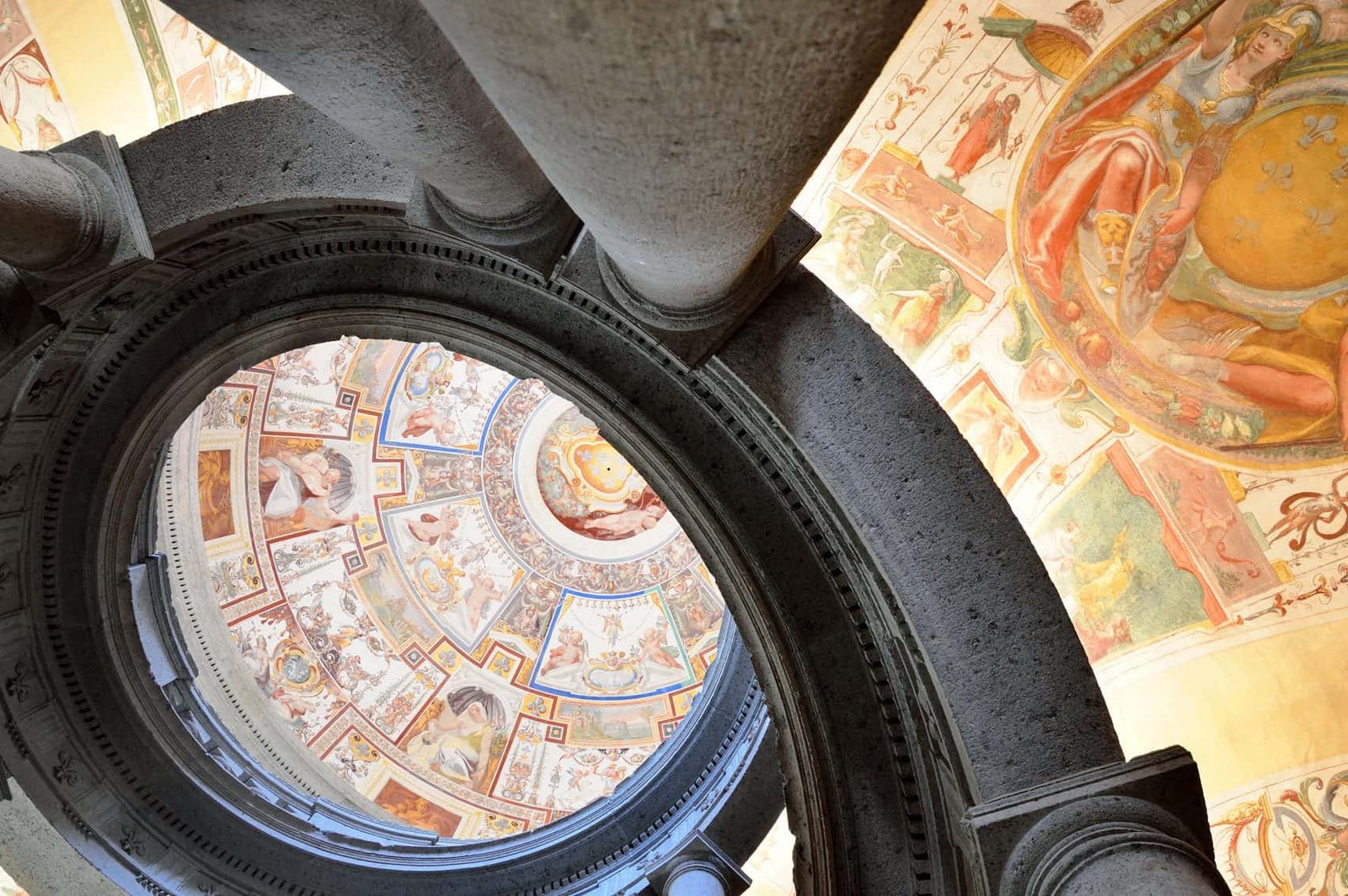
If I had to name a single reason to come all the way up here, I'd name the Scala Regia. It's a wide, monumental spiral staircase that winds around 30 columns of peperino, the gray volcanic stone of the Cimini. Vignola designed it as a continuous spiral, with low steps and deep treads, and tradition has it that the cardinal rode it on horseback up to the piano nobile without getting out of the saddle. It's one of those stories that have been repeated for centuries and that no document really confirms. I report it as tradition, not as fact, but in front of the width of those steps the legend becomes almost believable.
The fresco decoration of the staircase is by Antonio Tempesta, a Florentine painter who specialized in lively scenes, hunts, landscapes and grotesques. The light comes in from above and accompanies the climb, so that whoever goes up sees the spiral light up little by little. It's a piece of architecture worth the ticket even on its own: few rooms of the Italian 1500s combine with such naturalness the mechanics of a staircase and the staging of an entrance. My advice is to walk it slowly, looking up toward the center of the vortex, and then to do it again going down at the end of the visit: it changes completely.
The piano nobile of Palazzo Farnese, room by room
The piano nobile is the heart of the visit. The apartments are ideally divided into a summer part, facing north and cooler, and a winter part, exposed to the sun. The rooms were frescoed between the 1560s and 1570s by a team of painters led by the Zuccari brothers, with the contribution of other masters in the winter part. Each room has a theme, and the themes are not merely decorative. They tell of the family, the faith, geography, power. I give them one by one, in the order in which you more or less meet them.

Council Antechamber
The room takes its name from the frescoes dedicated to the Council of Trent, the great enterprise of the Counter-Reformation that the Farnese had sponsored: it was Paul III himself who convened it in 1545. Along the walls run episodes that interweave the history of the Church with that of the house, including the scene in which the Farnese pope excommunicates King Henry VIII of England. It is not neutral painting. It is dynastic propaganda of the highest level, where every panel reminds the visitor that the Farnese were at the center of the events that refounded the Catholic Church.
Hall of the Farnese Deeds in Caprarola (VT)
Here the family tells its own story openly. The walls hold the deeds, that is the feats, of the most illustrious Farnese: alliances, military commands, receptions, solemn moments of their rise. The decoration is the work of the Zuccari brothers, and the room works as a gallery of honor in which the visitor understands, without needing captions, who was in command in this territory and why. It's the room in which the palace declares its reason for being: to show the greatness of the Farnese house to anyone who is received.
Hall of the World Map in Caprarola (VT)
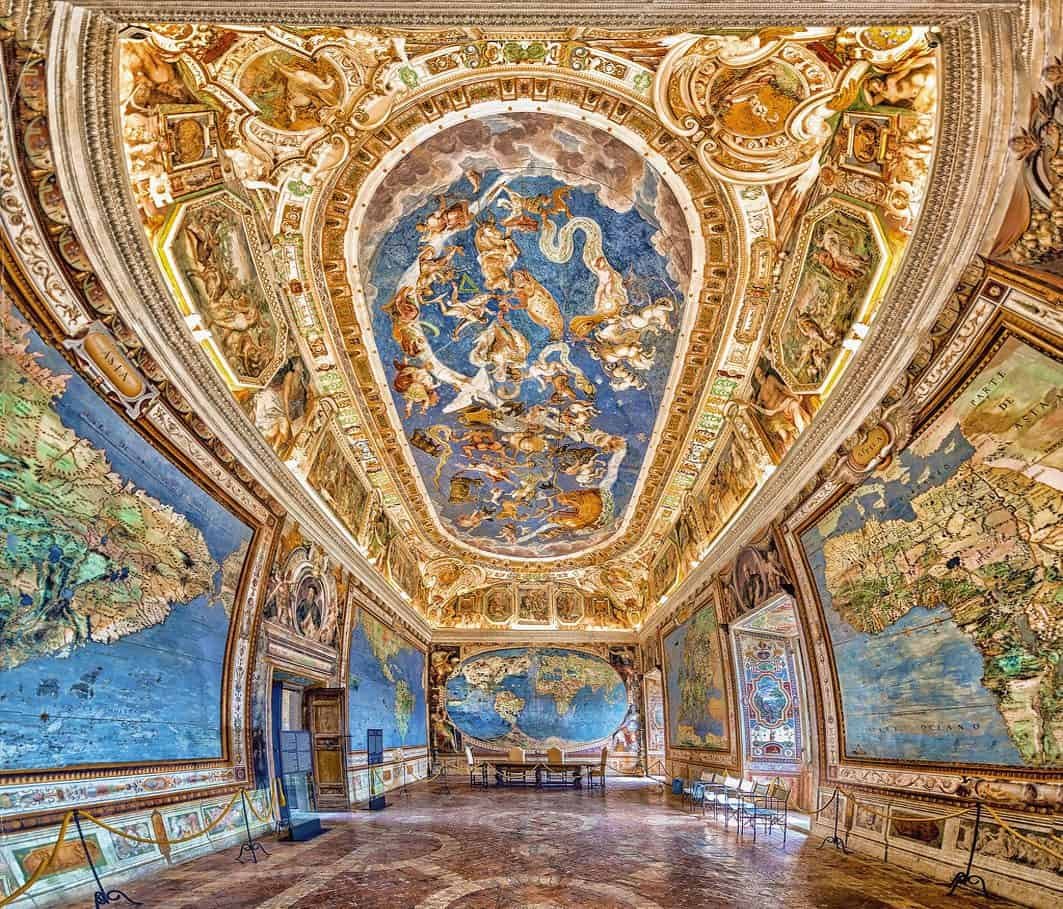
The Sala del Mappamondo is, together with the staircase, the room that visitors remember most. On the walls are painted large maps of the continents known at the time, Europe, Asia, Africa, the recently explored Americas, drawn according to the knowledge of the day and entrusted to Giovanni Antonio da Varese, known as the Vanosino, a cartographer who also worked in the Vatican. But the marvel is up above: the vault is painted as a night sky, with the constellations and the figures of the zodiac spread over the blue. Under that ceiling earth and sky look at each other, and the visitor finds himself at the center of a 16th-century planetarium. I find it's the room where Caprarola (VT) gives its best: you enter for the maps and you leave talking about the stars.
Hall of the Angels
Named for the hosts of angels painted on the vault, this room shows a more properly religious and celebratory register. The decoration belongs to the late phase of the building site, when other hands took over from the direction of the first Zuccari. It's a large, bright room, designed for receptions and conversation rather than private life, and serves as a hinge between the apartments of representation and the more intimate rooms.
Room of the Dawn
The Camera dell'Aurora was the cardinal's bedroom. The name comes from the fresco that on the vault shows Dawn preceding the chariot of the Sun, an image of waking and of the new day fitting for someone who woke up here. It's a more intimate room, where the decoration leaves behind the official tone of the state rooms for a more private grace. It's worth stopping to see how the temperature of the palace changes when you pass from the rooms of power to the bedroom of a man who, although a prince cardinal, slept here.
Hall of Hercules and Lake Vico
The Sala di Ercole owes its name to the hero's feats painted on the walls, but its loveliest curiosity concerns the territory. According to a version of the myth taken up here, it was Hercules who created Lake Vico: he planted his club in the ground, challenging the inhabitants to pull it out, and when he tore it from the soil the water gushed out and filled the basin. The room thus ties the palace to the landscape that surrounds it, and turns a volcanic lake into a piece of the Farnese's domestic mythology. It's a grand room, with an interior fountain that brought water and coolness inside the room during the summers of the Cimini.
The chapel and the winter apartment of Palazzo Farnese
The palace has its own chapel, a centrally planned room consistent with the ecclesiastical vocation of the patron, decorated in harmony with the rest of the piano nobile. The winter apartment, exposed to the sun and warmer, was entrusted to painters such as Jacopo Zanguidi known as Bertoja, Raffaellino da Reggio and Giovanni de Vecchi, who left landscapes, grotesques and scenes that complete the decorative program. The comparison between the summer and winter parts is one of the best ways to read Caprarola (VT): two climates, two lights, two seasons of painting under the same roof.
The Zuccari in Caprarola (VT): Taddeo and Federico
The name you hear repeated from room to room is that of the Zuccari. Taddeo Zuccari, from Sant'Angelo in Vado in the Marche, led the decorative enterprise from the start of the painting site until his early death in 1566. His younger brother Federico took up the legacy, destined to become one of the most famous and most widely traveled painters of his century, active later in Florence, in Rome, in Spain and in England, and founder of the Accademia di San Luca. Their hand holds the piano nobile together and makes it a unified cycle, where Farnese heraldry, sacred history and mythology chase each other from one room to the next. Anyone who loves the painting of the late 1500s finds in Caprarola one of the best preserved and most ambitious undertakings of the whole period.
The circular courtyard and the loggias of Caprarola (VT)
The geometric heart of the palace is the circular courtyard, and it's worth stopping to look at it before and after you visit the rooms. Fitting a perfect circle inside a defensive pentagon was, in the 1500s, a very bold choice: it forced the architect to join curves and angles, to make the rigidity of the fortress match the fluidity of the loggia. Vignola solved the problem with two orders of superimposed arcades, the lower floor more severe and the upper one lightened by paired columns, according to the proportions that the same architect codified in his treatise. The result is a space that seems to rotate on itself, where the light falls from above and runs along the curved walls over the course of the day.
From this courtyard the entrances to the apartments and to the Scala Regia were distributed, so that the central round worked as the junction of the whole palace. Whoever crosses it today walks through one of the most studied architectural spaces of the Italian Renaissance, a model that generations of architects have drawn and redrawn to understand its mechanism. It's also the point where you can best measure the distance between Sangallo's military project and Vignola's residential invention: the same plan, two worlds. I find it's the right place to stop for a few minutes and look up toward the loggias, before letting yourself be taken by the colors of the rooms.
The Council of Trent and faith in the rooms of Caprarola (VT)
One of the threads running through the decoration of the piano nobile is the defense of the Catholic Church in the age of the Counter-Reformation. It's no accident: it was the patron's own grandfather, Paul III, who convened the Council of Trent in 1545, the great assembly that would redefine Catholic doctrine and discipline in the face of the Protestant Reformation. In the Council Antechamber the frescoes stage these events, and in one of the most discussed scenes the Farnese pope excommunicates King Henry VIII of England, who had broken with Rome. It's painting that interweaves the religious chronicle of the century with the dynastic pride of the Farnese, protagonists of that season.
This theme ties in with the vocation of the patron, a cardinal and prince of the Church, and with the presence of the chapel inside the palace. The rooms celebrate the worldly magnificence of the family and at the same time its role in the history of the faith. For the attentive visitor, reading the frescoes with this key changes the experience: behind the beauty of the colors runs a precise discourse, almost a political and religious declaration entrusted to the walls. In Caprarola (VT) painting doesn't just decorate: it argues. And it is this density of meanings, beyond the quality of the hands, that makes the piano nobile one of the most fascinating cycles of the late 1500s.
The upper gardens and the Palazzina del Piacere of Caprarola (VT)
Leaving the palace toward the top you reach the gardens, laid out on terraces and organized with the same geometric direction that governs the building. The garden project was started by Vignola and continued by Giacomo Del Duca. The completion of the monumental layout dragged on for a long time, into the 1600s, with the contribution of Girolamo Rainaldi. Designed flowerbeds, hedges trimmed to rule, fountains and water features accompany the climb toward the most secret point of the estate.
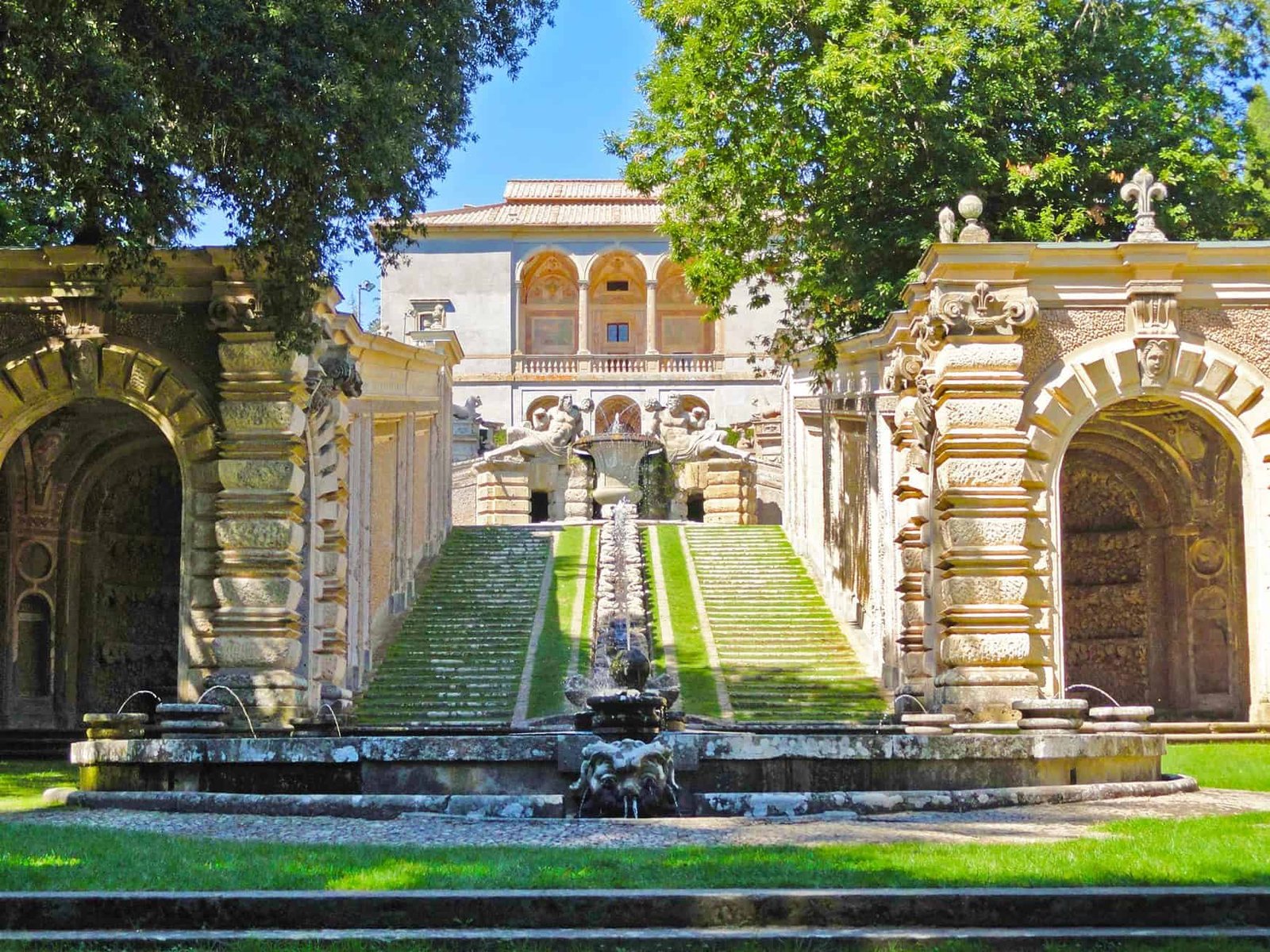
At the top is the Palazzina del Piacere, also called Casino or Casina, a small leisure residence built starting around 1584 by Giacomo Del Duca with the collaboration of other masters. It is preceded by a water chain, a sculpted cascade that runs down the staircase, and flanked by statues of caryatids and canephoras that symbolically hold up the garden. Here the cardinal withdrew far from the representation of the great palace, in a setting designed for cultured leisure, conversation and coolness. Access to the gardens and to the palazzina often follows its own hours and arrangements, with guided visits. It's best to ask at the ticket office as soon as you arrive, because the entrance is not always free like that of the piano nobile.
The village of Caprarola (VT): Via Dritta and Santa Teresa
The town is not just any frame for the palace: it was redesigned together with it. To give Palazzo Farnese the monumental entrance it deserved, Vignola cut a straight street through the medieval fabric that climbs straight from below to the square in front of the residence. The people of Caprarola have always called it Via Dritta, today Via Filippo Nicolai, and the urban gesture that opened it is considered one of the clearest examples of 16th-century planning in Italy. Walking uphill you have in front of you, as on a theatrical axis, the facade of the palace growing with every step.
The old medieval village divides on either side of the street, with alleys, arches and houses that descend toward the ravines. Along Via Dritta and in the nearby streets you come across churches and small palaces. The main one is the church dedicated to Santa Teresa d'Avila Church, a Baroque building tied to Farnese patronage, which closes one of the town's vistas. For individual attributions and dates of the minor buildings, it's best to rely on the on-site information and the town's guides, because local historiography does not always agree. Beyond the palace, Caprarola (VT) keeps the look of a town of volcanic stone grown up around a grandiose project, and it's worth the half hour's stroll that leads from the bottom of the climb to the upper square.

Lake Vico and the Cimini Mountains around Caprarola (VT)
West of the town opens Lake Vico, a body of water of volcanic origin enclosed in an ancient crater, among the best preserved of the great Italian volcanic lakes. It is protected as a nature reserve, with reed beds, woods and valuable vegetation that make it a different setting from the more frequented lakes of Lazio. Tradition ties it, as we have seen, to the club of Hercules. Geology, more prosaically, explains it with the collapse of a volcanic structure. In Etruscan and Roman times the surface of the lake was partly lowered through an underground channel, to gain fertile land for cultivation.
Around it stretch the Cimini Mountains, with the beech forest of Monte Fogliano and the chestnut woods that clothe the slopes. It's a landscape for walks, with trails, rest areas and panoramic points over the lake. If you have a full day, you can combine the visit to the palace in the morning with a tour of the lake or a walk in the woods in the afternoon: two faces of the same territory, the Farnese court and the volcanic nature that surrounds it. The suggestion is not to rush: Caprarola (VT) is best enjoyed with time to look up, at the ceiling of the Sala del Mappamondo as at the beeches of Fogliano.
How to get to Caprarola (VT) and how to organize the visit
The most convenient way to reach Caprarola (VT) is by car. From Rome you follow Via Cassia north as far as Monterosi, then continue toward Ronciglione and Caprarola. The travel time is slightly over an hour, traffic permitting. In town there are parking areas in the lower part, and it's best to leave the car there and walk up Via Dritta, which is also the right way to see the palace appear at the end of the street. If you travel without a car, you can use the Cotral buses that serve northern Lazio. The schedules are limited and should be checked in advance on the carrier's website.
To organize the day well: arrive early, buy your ticket and ask right away at the ticket office if and when it's possible to visit the upper gardens, which follow their own hours. Devote at least an hour and a half to the piano nobile and the staircase, then go up to the gardens if entry is available. Booking is not always mandatory, but on weekends and long weekends it's best to book on the official website of the Lazio National Museums Directorate, because entries may be limited. On the first Sunday of the month, entry to state sites is often free. Handy for the wallet, less so for the line, so plan for a bit of a wait.
Caprarola (VT) with children
The palace works well with children too, as long as you tell it the right way. The Scala Regia wide as a street, the room with maps of the whole world and the ceiling full of stars, the myth of Hercules planting his club and making a lake appear: these are images that capture the attention of the little ones better than any stylistic explanation. The gardens with the fountains and the water chain are a space to stretch your legs after the visit to the rooms. Watch out for the steps and the changes in level, and wear comfortable shoes for the climb up Via Dritta. For a day outdoors, Lake Vico, not far away, offers green spaces and rest areas suited to families.
A curiosity about Caprarola (VT)
The least obvious curiosity is not about a room, but about the very shape of the palace. Palazzo Farnese was born as a military fortress and has never entirely stopped being one: the pentagon plan with corner bastions, designed by Antonio da Sangallo the Younger around 1530, is that of a defense machine, meant to withstand artillery. When Vignola arrived, almost 30 years later, he couldn't erase that shell: he had to build a prince's residence on top of it while respecting the defensive perimeter. Hence the idea, bold for the time, of carving a perfect circular courtyard inside the irregular pentagon. The result is that today you visit a palace of pleasures and paintings that beneath the surface is still a fortress. Few Italian buildings carry written in their own plan this double nature, war and festivity, with the sharpness of Caprarola (VT). Whoever goes in looking only at the frescoes misses half the story: the geometry that contains them is the first work of art of the place, and it was born to shoot, not to amaze.
Something nobody tells you about Caprarola (VT)
Almost nobody tells visitors, but the palace you admire from the square is only the tip of a much larger building, because beneath the piano nobile there are other floors carved into the tuff toward the side of the town. The slope on which the villa stands allowed the Farnese to create lower floors with cellars, kitchens, pantries and service rooms, so that the residence was a self-sufficient machine, able to host and feed an entire court. Whoever looks at the facade from the top of Via Dritta sees few floors. Whoever looks at it from below, from the flank that descends toward the ravines, sees it much taller. Then there is a practical detail that escapes many: the upper gardens, perhaps the most refined part of the estate, are not always included in the free entrance and follow their own hours and dedicated visits. More than one visitor goes home convinced of having seen everything and has missed the water chain and the Palazzina del Piacere. If you come all the way here, ask expressly about the gardens at the ticket office. It's the least obvious advice I can give you.
My advice for visiting Caprarola (VT)
It's best to reverse the order in which most people visit the palace. Almost everyone goes in, hurries up the staircase, runs to the Mappamondo for the photograph and leaves. Do the opposite: climb the Scala Regia slowly, looking up toward the center of the spiral. Then cross the rooms following the story, from the Farnese Deeds to the Council, and leave the Mappamondo for near the end, when you'll have understood who the Farnese were and why they wanted the world painted in their house. At that point that starry ceiling says much more. Go up to the upper gardens if the schedule allows: the water chain and the Palazzina del Piacere are the reward that few take. Go on a weekday if you can, avoiding the first Sunday of the month if you don't like lines, and wear shoes suited to the climb up Via Dritta. One last thing: don't try to see Caprarola (VT) in a rush between two stops. It deserves the full half day, palace in the morning and lake or woods in the afternoon.
Another well-known fact, yet rarely mentioned
That the palace is the work of Vignola many people know. That Vignola also designed the town few say. Via Dritta, the straight street that climbs from below to the square of the palace, is not a medieval street that survived by chance: it was opened on purpose, cutting through the existing village, to create the perspective axis on which the Farnese facade could appear in all its height. It's an intervention of scenographic urban planning that anticipates by a long way the great Baroque vistas, and it's the reason why Caprarola (VT) is studied in architecture schools as an example of a town and a palace conceived together. The fact is known to specialists, but almost no guide explains it to the ordinary visitor, who climbs the hill without knowing they are walking inside a project. When it's told, the walk changes meaning: every step upward is a frame calculated four and a half centuries ago.
The right photo to take at Caprarola (VT)
The photograph everyone takes is the ceiling of the Sala del Mappamondo, with the zodiac and the constellations. It's beautiful and should be taken, best without flash and resting the camera or phone to hold the frame steady in the dim light. But the photo that truly gives the sense of the place is another one, and it's taken outside. Go down to the bottom of Via Dritta, toward the lower part of the town, and frame the climb with Palazzo Farnese closing it at the top: the straight street that points like an arrow at the facade is the image that sums up Vignola's whole project, the town and the palace conceived as one thing. The best light is that of the morning or late afternoon, when the raking sun draws the shadows along the climb. If you have access to the upper gardens, the second photo to take home is the water chain that runs down in front of the Palazzina del Piacere: look for the frontal framing, with the water climbing the steps toward you.
Some important events that took place here in history
The first event is the birth of the palace itself, in two stages far apart: the pentagonal fortress by Antonio da Sangallo the Younger begun around 1530 and halted in 1546, then the transformation into a residence entrusted to Vignola from 1559 and brought almost to completion by 1573. In between, the Farnese house rises to the summit of the Church with Paul III and makes Caprarola its own monument outside Rome. Over the centuries the palace changes hands along the fortunes of the Farnese inheritance, until it enters the public heritage: since December 2014 it has been run by the Ministry of Culture through the regional museum branch, today the Lazio National Museums Directorate.
Then there is a chapter from the 20th century that deserves to be told. During the German occupation, between 1943 and 1945, some inhabitants of Caprarola hid and saved the members of a Roman Jewish family fleeing persecution. For that act, decades later, the State of Israel through Yad Vashem recognized people from Caprarola with the title of Righteous Among the Nations. It's a story less known than the palace, but it belongs to the same town, and it reminds us that beneath the great architecture there always runs the small and courageous life of people. For the exact names and dates of the recognition it's best to rely on the documentary sources of Yad Vashem, which keeps the official register of the Righteous.
Who passed through Caprarola (VT)
Through these rooms passed first of all those who wanted and built them: Cardinal Alessandro Farnese the Younger, the patron, and before him his grandfather, Alessandro the Elder who rose to the throne as Paul III, the pope who started the fortress. The architects who made it a masterpiece passed through, Antonio da Sangallo the Younger with the military plan and Jacopo Barozzi da Vignola with the residence. And the painters who filled it with stories: the brothers Taddeo and Federico Zuccari, Antonio Tempesta on the staircase, Giovanni Antonio da Varese known as the Vanosino in the Sala del Mappamondo, Giacomo Del Duca at the gardens, and later Girolamo Rainaldi.
Over the centuries the palace, like the great villas of Lazio, was a destination for the curious and the learned who traveled through Italy. One episode from the twentieth century is worth recalling: in the 1990s the school of architecture promoted by Prince Charles of the United Kingdom chose Caprarola as an object of study, proof that the palace is still a training ground for those who design. As for individual illustrious visits and anecdotes, it is best to separate documented facts from oral traditions: here I report only what can be verified, because the place is already extraordinary enough without inflating its history.
Who Was Cardinal Alessandro Farnese, the Patron of Caprarola (VT)
To understand why a building of such ambition rises at Caprarola, you need to know the man who wanted it. Alessandro Farnese the Younger, born in 1520, was the nephew of Pope Paul III and was made a cardinal at 14, in 1534, as soon as his grandfather ascended the papal throne. He became one of the most powerful men of the Curia, vice chancellor of the Church, a diplomat, and above all the most munificent patron of his age. In Rome he was behind the decision to build the Gesù Church, the mother church of the Jesuits, and a collection of antiquities and paintings among the most celebrated of the sixteenth century. Alessandro had no children, but he had a precise idea of what should remain of his name: works. The palace of Caprarola (VT) is the place where this idea takes its most complete form outside the walls of Rome.
The cardinal followed the building site closely, discussing the iconographic programs with the humanists of his circle. The rooms were not decorated at random: each painted cycle answers a precise design, which weaves together the history of the family, the defense of the Catholic faith in the time of the Council, and the geographic and astronomical knowledge of the century. Whoever visits the piano nobile today reads, without knowing it, the ideal portrait of a prince of the Church of the mature Renaissance: cultured, ambitious, aware that art is also an instrument of power. Alessandro died in 1589, after seeing the main part of his villa completed. The Farnese house remembers him above all for this palace and for the Gesù: two monuments that tell, one of faith and the other of magnificence, of the same man.
Vignola, the Architect of Caprarola (VT), and His Treatise
Jacopo Barozzi, known as Vignola from the town in Emilia where he was born in 1507, is one of the architects who made the history of the classical language in Italy. Before Caprarola he had worked in France, had studied Roman antiquities and had collaborated on the great building sites of the capital. His fame, beyond his works, comes from a book: the Regola delli cinque ordini d'architettura, published in 1562, a manual that taught how to draw the Doric, Ionic, Corinthian, Tuscan and Composite columns according to fixed proportions. It was one of the most widely read and reprinted architecture texts in Europe for three centuries, and it trained generations of builders. He is also the author of a treatise on perspective, published after his death.
At Caprarola (VT) Vignola puts into practice everything he preaches. The circular courtyard on two levels is a lesson in superimposed orders, the Scala Regia is a feat of geometric virtuosity, and the multi-story facade, with its loggias and aligned windows, is a demonstration of measure and rhythm. Whoever knows his Roman work, from Villa Giulia to the Gesù Church, finds here the same hand that knows how to move from the theory of the book to the stone of the building site. Vignola died in 1573, with the palace almost finished and the gardens under way. His legacy at Caprarola is not only a building: it is the built proof that the rules of his treatise really could bear the weight of an entire palace. For those who love architecture, this is perhaps the deepest reason to climb up here.
The Stone of the Cimini and the Landscape Around Caprarola (VT)
The palace and the town are made of the earth they stand on. The Cimini Mountains are an ancient volcanic complex, and their characteristic stone is peperino, a compact gray tuff, dotted with small dark inclusions that give it its name, easy to work and yet durable. The 30 columns of the Scala Regia are peperino, as are many architectural details of the palace and of the houses of the village. It is a stone that was quarried locally and that gives the whole area a uniform, severe color, very different from the light travertine of Rome. Walking through Caprarola (VT) you touch this volcanic material everywhere: in the doorposts, the thresholds, the portals.
Around it, the Cimini territory has lived for centuries on another volcanic wealth: the fertility of the soil. The slopes are covered with hazelnut groves, and the hazelnut of this part of the Tuscia is a leading agricultural product, protected and known well beyond the borders of the province. In autumn the hazelnut harvest sets the rhythm of life in the town. Add to this the chestnut woods and the great beech forest of Monte Fogliano, one of the most remarkable low-altitude beech woods in Italy. The landscape surrounding the palace, in short, is no ordinary backdrop: it is the very reason the Farnese chose this place, where the cool climate of the woods and the abundance of water made summer bearable and hunting profitable.
When to Go to Caprarola (VT)
Every season has its reason. Spring and early autumn are the best periods: the light is soft, the gardens are at their best, and the temperature in the Cimini is more pleasant than in Rome. Summer up here is cooler than in the capital, and it is the reason the Farnese came in exactly these months. The rooms of the palace, with their thick walls and interior fountains, stay cool even on hot days. Late autumn brings the colors of the beech forest and the hazelnut harvest in the surrounding area. Winter is the quietest season, with fewer visitors: you can enjoy the rooms in peace, though the gardens offer less.
As for times of day, my advice is to arrive at opening, around 8:30, or in the early afternoon, avoiding the mid-morning rush on weekends. On the first Sunday of the month, with free admission, the palace fills up: if you want calm, pick another day. The best light for Via Dritta and for the facade is the low light of early morning or late afternoon, when the shadows draw the climb. In summer, if you want to combine it with Lake Vico, keep the palace for the morning and the lake for the afternoon, when the coolness of the water is more welcome.
Accessibility and Services at Palazzo Farnese in Caprarola (VT)
It has to be said frankly: a sixteenth-century palace built on top of a fortress, with the Scala Regia, the changes in level and the terraced gardens, has barriers that cannot be entirely removed. Some rooms of the piano nobile are harder to reach for people with walking difficulties, and the upper gardens involve climbs. To find out which routes are practicable, if there are elevators or alternative access, and which services are active at the time of your visit, it is best to contact the site directly or consult the website of the Direzione musei nazionali del Lazio: conditions change over time, and a phone call before you leave avoids unpleasant surprises. In town, the climb up Via Dritta is demanding and has a stone surface: if you have mobility difficulties, consider driving closer to the upper part, where the access rules for the historic center allow it.
What to See Around Caprarola (VT)
The area around Caprarola (VT) is very rich, and the palace pairs easily with other destinations in the Tuscia on a trip of one or two days. Not far away, in Bagnaia, is another masterpiece by Vignola for another cardinal, Villa Lante, famous for its Italian gardens and water features. On the Cimini side, the village of San Martino al Cimino preserves a Baroque-era urban layout also tied to the great Roman families. Toward the lake you reach Ronciglione, with its historic center and its historic carnival, among the oldest in Lazio.
A little farther north lies Viterbo, the city of the popes, with the medieval San Pellegrino quarter and the Palazzo dei Papi. In the surrounding area is the Etruscan Tuscania with its Romanesque basilicas. If you love perched landscapes, you can't skip Civita di Bagnoregio, the town suspended on its cliff, and the village of Calcata, clinging to the tuff above the Treja valley. On the coast, ancient Tarquinia guards the painted Etruscan necropolises, a World Heritage site. And to stay on the thread of the Farnese and Vignola, in Rome Villa Farnesina with Raphael's frescoes is worth a visit. If you are looking for other historic gardens in Lazio, I recall Villa d'Este in Tivoli and the Garden of Ninfa.
Quick Questions About Caprarola (VT)
How much is a ticket to Palazzo Farnese in Caprarola (VT)?
The official site lists a full ticket of 10 euros, reduced to 8 euros when the monumental park is closed, 2 euros for European Union citizens between 18 and 25, and free admission under 18. Prices and discounts can change: check the website of the Direzione musei nazionali del Lazio before your visit.
What are the opening hours of Caprarola (VT)?
According to the ministry calendar the palace is open Tuesday through Sunday, from 8:30 to 19:30, with last entry at 18:45, and is closed on Monday. Hours may vary with the seasons and on holidays, so it is best to check them on the official site.
What day is Palazzo Farnese closed?
The weekly closing day is Monday. Closures may be added on some holidays: check the official calendar before you set out.
Do I need to book to visit Caprarola (VT)?
Booking is not always required, but on weekends, long holiday weekends and free-admission days, entries may be limited. On the busiest days it's best to book on the official site.
Is admission free on the first Sunday of the month?
As at other state-run sites, admission is often free on the first Sunday of the month. On those days, though, the line grows: plan for a bit of a wait and arrive early.
How long does a visit to Palazzo Farnese in Caprarola (VT) take?
The piano nobile and the Scala Regia take about an hour and a half. Adding the upper gardens and the Palazzina del Piacere, it easily becomes half a day.
Can you visit the gardens of Caprarola (VT)?
Yes, but the upper gardens often follow their own hours and visiting arrangements, sometimes with a guide and not always included in free admission. Ask at the ticket office as soon as you arrive whether and when you can go up.
How do you get to Caprarola (VT) from Rome?
By car, follow Via Cassia to Monterosi and then continue toward Ronciglione and Caprarola, in a little over an hour. Without a car you can use the Cotral buses, with limited schedules to check on the carrier's website.
Where do you park in Caprarola (VT)?
It's best to leave the car in the parking areas in the lower part of town and walk up Via Dritta: it's also the best way to see the palace appear at the end of the street.
Can you take photos inside the palace?
In general, photos without flash and without a tripod are allowed in the rooms. Conditions may change and the instructions of the staff on site must be followed, especially during temporary exhibitions.
Is Palazzo Farnese in Caprarola (VT) accessible to people with disabilities?
The sixteenth-century structure, with stairs and changes in level, has barriers. For up-to-date information on access, elevators and services, it's best to contact the site directly before your visit.
Who built Palazzo Farnese in Caprarola (VT)?
The original pentagonal fortress is by Antonio da Sangallo the Younger, around 1530. The transformation into a residence is due to Jacopo Barozzi da Vignola, from 1559, for Cardinal Alessandro Farnese the Younger.
Why does the palace have a pentagon plan?
Because it began as a military fortress: the pentagon with corner bastions served for defense. Vignola kept that perimeter and inserted a circular courtyard in it, creating the unique form you see today.
What is the Scala Regia of Caprarola (VT)?
It is the monumental spiral staircase that winds around 30 peperino columns, designed by Vignola and frescoed by Antonio Tempesta. Tradition says the cardinal climbed it on horseback.
What is the Sala del Mappamondo?
It is the room with the large maps of the continents known in the sixteenth century, the work of Giovanni Antonio da Varese, known as il Vanosino, topped by a vault painted with the zodiac and the constellations.
Who painted the frescoes of Palazzo Farnese?
The cycle of the piano nobile is led by the brothers Taddeo and Federico Zuccari, with the contribution of Antonio Tempesta on the staircase, of Giovanni Antonio da Varese in the Mappamondo and, in the winter apartment, of painters such as Bertoja, Raffaellino da Reggio and Giovanni de Vecchi.
What is the Palazzina del Piacere of Caprarola (VT)?
It is the small leisure residence at the top of the upper gardens, built starting around 1584 by Giacomo Del Duca, preceded by a water chain and flanked by statues of caryatids and canephorae.
What is Via Dritta of Caprarola (VT)?
It is the straight road, now Via Filippo Nicolai, opened by Vignola by cutting through the village to create the perspective axis toward the palace. It climbs straight up from the bottom to the square of the residence.
Can you combine Caprarola (VT) with Lake Vico?
Yes, and it's the best combination: palace in the morning, Lake Vico or the Cimini woods in the afternoon. The lake, a nature reserve of volcanic origin, is a few minutes from town.
Is Caprarola (VT) good for kids?
Yes. The spiral staircase, the maps, the starry ceiling and the myth of Hercules creating the lake capture the attention of the little ones, and the gardens and nearby Lake Vico offer outdoor space. Watch out for steps and changes in level.
How far is Caprarola (VT) from Viterbo?
Viterbo is a short distance away, reachable by car in about 20 minutes through the Cimini: you can easily combine the visit to the palace with the city of the popes on the same day.
Who runs Palazzo Farnese in Caprarola (VT) today?
The palace belongs to the state heritage and is run by the Ministry of Culture through the Direzione musei nazionali del Lazio. It is the same body that sets its hours, tickets and opening calendar.
Why is the palace so tied to the Farnese family?
Because it was built as a monument of the Farnese house outside Rome. The patron, Cardinal Alessandro Farnese the Younger, was the nephew of Pope Paul III, and he wanted rooms entirely devoted to the history and deeds of his own family.
What stone was used to build Caprarola (VT)?
Mainly peperino, a compact gray tuff typical of the Cimini Mountains, quarried locally. The 30 columns of the Scala Regia and many details of the palace and the village are made of this volcanic stone.
What do you eat in the Caprarola (VT) area?
The Cimini territory is famous for hazelnuts, a protected product of the Tuscia, found in many local sweets, along with chestnuts and the dishes of Viterbo cooking. For places to eat, it's best to ask in town or consult the municipality's guides.
How much time do you need to see Caprarola (VT) and the surroundings?
Half a day is enough for the palace and the village. If you want to add Lake Vico, the Cimini woods or a second destination like Villa Lante in Bagnaia, you comfortably fill a whole day or a weekend in the Tuscia.
What's the difference between Palazzo Farnese in Caprarola (VT) and the one in Rome?
They are two distinct buildings of the same family. The one in Rome is the great city palace in the historic center, now a diplomatic seat. The one in Caprarola is the showpiece villa outside the city, with a pentagonal plan, the work of Vignola. Both bear the Farnese name, but they were born for different functions: the urban residence in one case, the country monument in the other.
Can you swim in Lake Vico near Caprarola (VT)?
The lake is protected as a nature reserve, and swimming follows precise rules that can change from season to season. Before planning a swim, it's best to check the guidelines of the reserve and the local authorities, who set the permitted areas and periods.
Is Caprarola (VT) worth visiting in a single day from Rome?
Yes. With a little over an hour of travel you reach the palace in the morning, visit the piano nobile and the Scala Regia, go up to the gardens if they are open, and in the afternoon you can take a spin around Lake Vico or a nearby village, returning to Rome in the evening.
If I had to leave you with one single recommendation, it is this: don't treat Caprarola as a quick stop between two more famous destinations. Climb Via Dritta on foot, take the time for the staircase and the starry ceiling, ask about the gardens and end the day at Lake Vico. Few places in Lazio reward slowness like this palace that was born a fortress and became a theater. The visitors who go home happy are always the same ones: not those who ticked off the photo of the ceiling, but those who understood the design, the road that climbs, the staircase that turns, the world painted on the walls and the stars on the vault. Caprarola (VT) is not a monument to be consumed in a hurry: it is an argument in stone, and like all serious arguments it asks for attention. Give it that, and it will give you back one of the finest days Lazio can offer outside Rome.
Article written by the editorial team of TourLeaderPro, contact them for Private/Corporate/V.I.P. Tours and Experiences.
Planning a trip to Rome? The English guides to visiting the city are on ItalyPlanner.com.