Villa Farnesina – Accademia Nazionale dei Lincei
In short. Villa Farnesina is at Via della Lungara 230, in Trastevere, on the side of the river facing the Janiculum, and you reach it with buses 23 and 280, stop Via della Lungara.
Villa Farnesina is at Via della Lungara 230, in Trastevere, on the side of the river facing the Janiculum, and you reach it with buses 23 and 280, stop Via della Lungara. The full ticket costs €12, the reduced ticket €10 (over 65, teachers, holders of ICOM, FAI and Touring Club cards), the reduced single-student ticket for ages 10 to 18 costs €7, the school group rate is €5 per student up to a maximum of 30 students with the accompanying teacher free. Admitted free are children up to 10 years old accompanied by their parents, visitors with disabilities with their companion, journalists with a press card and licensed tour guides with their badge. The mobile app for the visit costs €3 extra. The hours in force from February 16, 2026 are Monday to Saturday from 9:00 to 14:00 with last entry at 13:15, closed Sunday, with a special opening every second Sunday of the month from 9:00 to 17:00 and last entry at 16:15. Tickets are bought online on the official portal of the Accademia Nazionale dei Lincei. For groups and schools, booking is always required: write to villafarnesina@lincei.it or call 06 68027268. Holders of the Colosseum Archaeological Park Membership Card pay €10 instead of €12, and a discount is also offered to those arriving with a Vatican Museums ticket within seven days of the visit.
This guide is part of the collection dedicated to the Museums of Rome, where you will find the other venues in the city and the comparisons useful for building a sensible day.
Why you visit Villa Farnesina in the morning and almost never in the afternoon
First of all, the thing that ruins more visits than any other: here you go in the morning. The villa is the representative seat of a scientific academy, not a state museum with afternoon shifts, and the time slot reserved for the public is short. Whoever arrives at 15:00 on a Wednesday finds the door closed and nobody to complain to. The only regular exception is the second Sunday of the month, when the villa stays open until 17:00: it's the only window in which you can afford an afternoon.
Where to buy tickets. Villa Farnesina belongs to the Accademia Nazionale dei Lincei: reduced hours and tickets on the official site villafarnesina.it, open in the morning except the second Saturday of the month. The ticket is also available on GetYourGuide. Verified on September 28, 2026.
The practical consequence is that Villa Farnesina goes at the start of the day, not the end. It is not a fallback to fill a gap between lunch and dinner: it's the first thing you do, unhurried, before the high sun makes it hard to look at the vault of the Loggia of Cupid and Psyche against the light through the glass panels.
How to get to Villa Farnesina on foot
The official site indicates buses 23 and 280, with a stop on Via della Lungara, and it is the most direct route if you arrive from the lungotevere. On foot, though, the best way is another one. From Campo de' Fiori you cross Ponte Sisto, take Via della Lungara heading north and in about 10 minutes you are in front of the gate. From Piazza Trilussa the walk is even shorter. If you get off in Trastevere and walk up toward Porta Settimiana, you pass under the arch and find the villa on your left and Palazzo Corsini on your right: two doors facing each other, a sixteenth-century banker and an eighteenth-century papal family looking at each other across the street.
How long it takes to visit Villa Farnesina
An hour is the honest measure for the ground floor and first floor without hurrying. An hour and a half if you really stop in front of the vault of the Loggia of Cupid and Psyche, if you look for the graffiti in the Hall of Perspectives and if you go out into the garden. Two hours if you take a guided tour. It's a small museum by number of rooms and enormous by density: there are nine rooms on the route, at least a dozen frescoes worth looking at closely, and the risk is not getting bored, it's going through too fast.
Agostino Chigi, the man who had Villa Farnesina built
To understand this house you have to understand who wanted it. Agostino Chigi was born in Siena in 1466 and died in Rome in 1520, and in between he was probably the richest man in Europe. His fortune did not come from land or a title: it came from the monopoly on the exploitation rights of the alum mines of Tolfa, just north of Rome. Alum was used to fix colors in the dyeing of fabrics, and in the sixteenth century whoever controlled alum controlled the textile industry of half a continent. Chigi controlled it. He was the banker of Pope Julius II and then of Leo X, and in Rome they called him the Magnificent.
A man like that could have bought himself a palace inside the walls, among the baronial families, and spent his time squabbling over rank. He did the opposite: he bought a plot across the Tiber, away from the political traffic of the city, and built a suburban villa there. The gesture was new. Until then the villa outside the gates was an agricultural matter or a whim of cardinals. Here it becomes the representative residence of a private man who receives popes and ambassadors in a building surrounded by greenery, with the river in front and the hill behind.
Agostino Chigi's banquets and the plates in the Tiber
The chapter of the banquets is the one everyone tells, often badly. The correct version is this: the banquet that became famous for the gold and silver tableware thrown into the Tiber was the one in 1518 for the baptism of his firstborn Lorenzo Leone, not the wedding lunch. The wedding banquet, equally memorable, was held the following year, on August 28, 1519, in the Hall of Perspectives on the first floor.
About the gesture of the dishes thrown in the water, it's worth saying how things stand without romanticism. It was calculated ostentation, and reversible at that: tradition has it that nets were stretched just below the surface of the water and that the service was recovered once the party was over. It's a handed-down anecdote, not a notarial record, and should be told for what it is. But the political message worked all the same: in front of his guests, a banker without noble blood declared that silverware meant nothing to him. In the Rome of Leo X, where credit was everything, this was an advertising investment, not a waste.
Francesca Ordeaschi, from courtesan to lady of the house
The woman who presided over that 1519 wedding was called Francesca Ordeaschi, Venetian, for years Chigi's lover and the mother of his children, finally married in a solemn ceremony in the presence of Leo X. Her story is not a detail of Renaissance gossip: it is the key to reading the villa's most famous pictorial cycle. The adventures of Psyche, a mortal loved by a god, persecuted by Venus, subjected to impossible trials and finally admitted among the gods with a wedding banquet, are the mythological transposition of a real social rise. Whoever looks at the vault of the loggia is looking, in code, at the wedding of the owners of the house.
Baldassarre Peruzzi and the architecture of Villa Farnesina
The architect was from Siena like the client, and young. Baldassarre Peruzzi received the commission in May 1505. The first stone was laid on April 22, 1506. The masonry work was completed around 1512, but the decorative building site and adjustments continued until 1520, that is, until the client's death.
The plan is horseshoe-shaped: a central body and two wings projecting toward the garden, with a five-arched loggia set between the wings on the ground floor. The scheme holds house and greenery together in a way not yet seen in Rome, and refers to Vitruvian models and to the research of Francesco di Giorgio Martini, with a Sienese precedent in the villa delle Volte Alte. From here on the Roman suburban villa will almost always have this form: Peruzzi invented a type, not a single building.
The facades of Villa Farnesina, or the art of not overdoing it
Look at the elevations before going in, because that is where the distance from Bramante is measured. No rustication on the ground floor, no rusticated arches over the windows, no columns, no marble cladding. Only two orders of Tuscan pilasters barely raised from the plastered wall, a drawn design more than a sculpted one. At the top, under the cornice, runs a service attic with a relief frieze of putti and garlands and a row of small windows.
This sobriety seems elegant to us today, but originally it was something else: the exterior walls were frescoed in chiaroscuro, and the villa was meant to look like a painted box in the middle of the greenery. Of those exterior frescoes only minimal and illegible traces remain. Our opinion: it is the gravest loss of the whole complex, graver than the gardens, because it took away the chance to understand how Peruzzi conceived the relationship between architecture and outdoor painting.
The stables designed by Raphael
Outside the perimeter wall, toward Via della Lungara, survives the base of a separate building with projecting wings and paired pilasters. These were the stables, and the design is attributed to Raphael: three aisles, a staircase at the back, and what remains today is the podium, the pedestals, the bases of the pilasters and stretches of wall. Passing by, nobody notices. It's worth stopping for 30 seconds: it's the only piece of Raphaelesque architecture you can touch without paying the ticket.

The visit to Villa Farnesina, room by room
The official route includes on the ground floor the Loggia of Cupid and Psyche, the Hall of the Frieze, the Loggia of Galatea and the Atrium with the Farnesiana Room. On the first floor the Hall of Perspectives, the Hall of the Wedding, the Pompeian Room and the Gallery of the Grotesques. And finally the gardens. I describe them in the order in which you meet them.
The atrium and the Farnesiana Room
The first space is not sixteenth-century and it's best to know that right away. The atrium as you see it today comes from the nineteenth-century works carried out between 1861 and 1863 and from further twentieth-century changes: originally this area was part of a single large Renaissance entrance hall, later divided, and in the 1930s the installation of an elevator carved off another piece. The room next to it, used for years as a ticket office, preserves frescoes from the Farnese period that came out with the restorations: a sky with putti flying around the Farnese coat of arms, other putti on a blue ground, and an autumn landscape in a lunette.
It's a space that nine visitors out of 10 cross looking at their phones. Stop: those putti are the only visible trace of the house's Farnese season, that is, of the two centuries when the villa stopped being a banker's party and became the secondary property of a dynasty.
The Loggia of Cupid and Psyche at Villa Farnesina
Five arches, today closed by protective glass panels that save the frescoes and alter the relationship between voids and solids that Peruzzi had calculated. Raise your head: the vault is the reason the lines exist in front of this door.
The frescoes were executed in 1518 by Raphael's workshop from the master's designs. The documented hands are those of Giovan Francesco Penni and Giulio Romano, with Giovanni da Udine responsible for the festoons. Scholarship has also proposed the name of Raffaellino del Colle, but the precise division of the sections remains a matter of discussion among scholars, not an established fact. Raphael designed everything and painted little: it is a fact, and it takes nothing away from the strength of the whole.
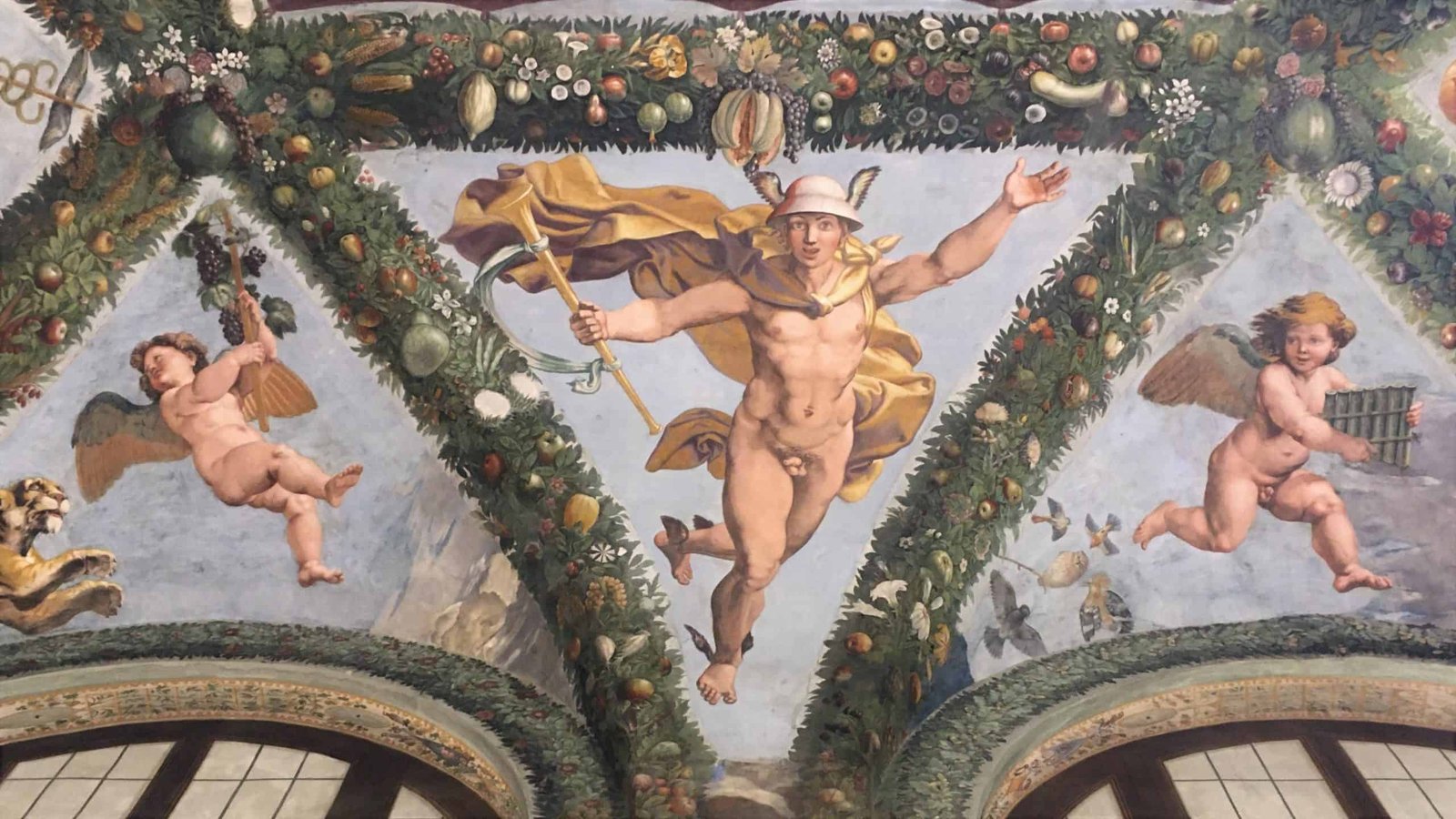
The theme comes from Apuleius's The Golden Ass, and the choice is not decorative. Raphael turned the vault into a pergola: at the center two large fake tapestries stretched between the festoons, the Council of the Gods and the Wedding Banquet of Cupid and Psyche. In the spandrels run the episodes of the fable, in the webs above the lunettes fly putti carrying the attributes of the deities, Jupiter's thunderbolt, Mars's helmets, Vulcan's hammers, Hercules's club, Mercury's caduceus, Pan's syrinx. The effect is of standing under an open-air arbor, with the sky opening above and the stories hanging like fabrics.
Giovanni da Udine's festoons and the American plants
Here is the thing that makes this loggia unique in the world, and it doesn't concern figure painting. In the festoons framing the scenes, 170 different botanical species have been identified. Not generic foliage: identifiable species, painted by a painter from Friuli who knew how to look at plants like a naturalist.
And among those 170 appear maize, squash and the American bean. These are plants native to the American continent, arrived in Europe a few decades earlier. In 1518, while in Rome they were still debating what exactly the lands found beyond the ocean were, in a loggia in Trastevere someone was already painting an ear of corn. At the 2017 exhibition titled The Colors of Prosperity: Fruits of the Old and New World, curated by Antonio Sgamellotti and Giulia Caneva, that ceiling was studied with in situ X-ray fluorescence analysis and infrared reflectography, and the loggia was read as a document of the transition from visual observation to scientific investigation of natural phenomena.
The practical tip: step into the loggia, find the festoon above the central arch and look for the ears of corn. With opera glasses you find them in two minutes. Without, it takes patience and good morning light.
The Hall of the Frieze
To the left of the loggia opens a room that almost everyone rushes through. The frieze painted high on the walls is by Baldassarre Peruzzi, around 1508: these are his first Roman works, and the style still carries Siena on it. On the north side and partly on the east side run the 12 labors of Hercules. In the rest of the circuit follow other mythological episodes, the rape of Europa, Apollo and Marsyas, Orpheus and Eurydice, in a continuous monochrome sequence that recalls an unrolled ancient relief.
The overall meaning is generally read as the contrast between reason and passion, between the Apollonian and the Dionysian spheres. The function of the room, though, is even more interesting than its iconography: here guests were made to wait, and important ceremonies were held here, including the reading of the banker's will. The walls beneath the frieze were probably covered with tapestries. Imagine the room lined with fabrics, with only the painted band running along the top: it was an antechamber designed to make whoever waited understand where they were.
The Loggia of Galatea at Villa Farnesina
The most famous room of the house after the loggia of Psyche, and the most layered. Here too there were arches open onto the garden, closed in the 1600s. Three different artists worked in this room over two years, and you can tell.
The first was Peruzzi, who in 1511 frescoed Agostino Chigi's horoscope on the vault. Then, in the winter of 1511-1512, came Sebastiano del Piombo, a Venetian just landed in Rome in Chigi's retinue, who painted the mythological scenes of the nine lunettes and the gigantic head of a young man. Finally Raphael, with the Triumph of Galatea, the fresco that gave the room its name.
Raphael's Triumph of Galatea
The nymph advances over the water on a shell-shaped chariot drawn by dolphins, surrounded by tritons, nereids and cupids drawing their bows. The composition is built on a spiral: all the bodies revolve around the central figure, who turns her head upward against the movement of the chariot. It is a perfect compositional machine, and it should be looked at knowing that Raphael had no live model. The source is literary, the impulse is the antique, the result is an ideal figure.
An unpopular opinion: the Galatea is smaller than you remember it from books. Whoever arrives here expecting a whole wall finds a panel. The greatness lies in its internal strength, not in its size, and that is why it should be looked at close up and not photographed from afar.
Sebastiano del Piombo's Polyphemus and the lunettes
Next to the Galatea sits the Polyphemus, monumental, seen from behind, with the bagpipe in his hand: it is Sebastiano del Piombo's first Roman work, and you understand right away that the painter comes from Venice, because the color is of a different stuff from Raphael's. The two frescoes are in dialogue: the Cyclops sings, the nymph turns her back on him. The client placed two different ways of painting side by side and let them look at each other.
In the lunettes above run mythological scenes drawn largely from the Metamorphoses: Tereus pursuing Philomela and Procne, Aglauros and Herse, Daedalus and Icarus, Juno, Scylla cutting Nisus's hair, the fall of Perdix, Boreas abducting Orithyia, Zephyrus and Flora. The tones are airy, almost watercolored, typical of Venetian colorism transplanted to Rome.
The big head in the lunette: Michelangelo or Sebastiano
On one of the lunettes stands an enormous monochrome head of a young man, drawn with an assurance that has been debated for centuries. Tradition attributed it to Michelangelo, who came to visit his friend Sebastiano del Piombo and wished to leave a demonstration of anatomy under the nose of his rival Raphael. It's a beautiful story and should be told as tradition. The Accademia Nazionale dei Lincei, which owns the house and studies it, assigns the head to Sebastiano del Piombo together with the lunettes.
How does a serious visitor behave in front of something like this? He looks at the line. Then decides for himself whether that way of turning the neck and loading the shadow under the cheekbone resembles the Venetian or the Florentine more. It's not a game: it is exactly the work art historians do, and in this room you can try it too.
Peruzzi's astrological vault and Agostino Chigi's horoscope
Now look up, because this vault is the most singular thing in all of Villa Farnesina and nobody looks at it enough. Peruzzi painted on it, in 1511, the sky of one precise night: the night of the birth of the master of the house, November 29, 1466, at 21:30.
The painted architecture joins the real architecture of the wall. At the center, in a regular octagon, is the client's coat of arms. At the sides, two scenes in elongated octagons: Fame announcing the banker's earthly glory next to Perseus killing Medusa, and on the other side Helice, the nymph of the celestial pole, to remind us that earthly honors depend on the favor of the stars. Next come the pendentives, doubled at the corners for a total of 14, with mythological and symbolic figures, and 10 hexagons with the planetary deities.
In the hexagons you read, one by one, the data of the natal chart: the Rape of Ganymede, Venus in Capricorn, Apollo and the Sun in Sagittarius, which is Chigi's sign, Mercury in Scorpio, Mars in Libra, Diana and the Moon in Virgo, Hercules with the Nemean lion, Hercules with the Lernaean Hydra, Leda and the swan, Jupiter in Taurus, Saturn in Pisces. Put together, these panels make up Agostino Chigi's personal horoscope translated into mythology.
That is why this vault is worth the ticket by itself. In 1511 astrology was a respected science, taught in universities, consulted by popes. A man who has his own birth chart painted on the ceiling of his house is not doing folklore: he is showing his guests the proof that his success is written in the sky, therefore legitimate, therefore beyond dispute. It is the most refined operation of private propaganda of the Roman Renaissance.

Baldassarre Peruzzi's Hall of Perspectives
You go up to the first floor and enter what is, in our judgment, the smartest room in Rome. Peruzzi decorated it in 1519, painting the walls as if the hall were an open loggia: two rows of fake columns and arches, and between the columns, instead of the wall, the landscape.
It is one of the first complete examples of illusionistic perspective applied to an entire room, and it still works. Whoever stands in the right spot in the room sees the colonnade straighten and the views open up as if the walls weren't there. Among the hilltop villages and glimpses of countryside you recognize pieces of real Rome: the church of Santo Spirito, a Romanesque basilica, Porta Settimiana, that is, the arch you passed under on the way here.
Under the coffered ceiling runs a frieze with mythological scenes by Peruzzi and his workshop, interspersed with fake bas-reliefs with female herms. On the north wall stands a large fireplace with the Forge of Vulcan. And in this room, on August 28, 1519, Agostino Chigi held the banquet for his wedding to Francesca Ordeaschi, in the presence of the pope.
The Landsknechts' graffiti in the Hall of Perspectives
Now go up to the walls and look at the fake columns at the height of a man. They are incised. Names, dates, phrases, scratched with the point of a weapon into the painted plaster.
In May 1527 the imperial troops of Charles V took Rome and sacked it for months. The Landsknechts who occupied this villa understood nothing of Albertian perspective and were cold, hungry and had time to kill: they carved the walls the way you carve school desks. The restorations brought to light, among others, an inscription in German Gothic script dated 1528, which translated reads: the Landsknechts made the Pope run.
A single sentence, carved by a soldier illiterate in art inside an architect's masterpiece, tells the collapse of a world better than any treatise. Clement VII had indeed fled, through the passetto, toward Castel Sant'Angelo. The Roman Renaissance ends there, and the receipt remains, written with a sword point on this wall. If you're looking for a reason to bring a bored teenager here, this is it. Then you tell them the story.
The Hall of the Wedding and Sodoma's Wedding of Alexander and Roxana
Next to the large hall is the bedroom of Agostino Chigi and Francesca Ordeaschi, and its decoration is from 1519, entrusted to Giovanni Antonio Bazzi known as Sodoma, who worked from an initial idea by Raphael.
The north wall is occupied by the Wedding of Alexander the Great and Roxana: the Macedonian leader hands the crown to the bride seated on the edge of a canopy bed, and around them a crowd of cupids busy themselves with veils, sandals, and the lit torch held by the god Hymenaeus. The half-naked figure seen from behind is Hephaestion, Alexander's companion. The subject is no accident: by identifying the client with Alexander, the room celebrates his wedding as an epic event.
There is an archaeological detail that makes this scene different from all the others. Sodoma was not inventing: he was reconstructing. The description of a lost painting by the Greek painter Aetion, handed down by Lucian of Samosata, is the literary source of this composition. A sixteenth-century painter repainting an ancient picture he never saw by following the written account of a second-century author: it is philology applied to the brush.
On the other walls the cycle continues with the Family of Darius before Alexander on the east side, the taming of the horse Bucephalus and a battle scene. The taming of Bucephalus is a later addition, because originally that stretch of wall was occupied by the bed, and in the right-hand part the hand of a collaborator can be recognized. Also by Sodoma is the Vulcan at the forge with the cupids handing him the darts.
The ceiling is coffered with grotesques and mythological subjects. The design is attributed to Peruzzi and the 12 panels with scenes from Ovid's Metamorphoses are traditionally assigned to Maturino, with the possible intervention of a very young Polidoro da Caravaggio. The name of Polidoro Caldara da Caravaggio comes up again, as a hypothesis, also for some grotesques in this room.
Finally there is a hermetic reading of the cycle, which I report for completeness and not because I endorse it: according to this interpretation, beneath the manifest narrative runs an alchemical meaning, with the four phases of the Great Work, nigredo, rubedo, citrinitas and albedo, described through symbols. It is a modern proposed reading, not a documented certainty, and should be kept in its place. The frescoes were retouched by Carlo Maratta and restored in the 1970s.
The Pompeian Room
A small room with a surprising biography. In the sixteenth century it was the landing from which one descended to the underground kitchens. In the nineteenth century the Duke of Ripalta, Salvador Bermúdez de Castro, had the staircase removed, a new wall built and the room decorated between 1861 and 1863 with motifs inspired directly by ancient examples, in the full climate of the rediscovery of Herculaneum and Pompeii. In the 1930s this room housed the toilets reserved for the president of the Royal Academy of Italy, who at the time was Guglielmo Marconi.
From Chigi's stoves to Marconi's private bathroom, in a single room. No museum in Rome compresses four centuries of domestic functions into so little space, and I assure you that telling it in front of the door always works.
The Gallery of the Grotesques
The corridor connecting the Hall of Perspectives to Francesca Ordeaschi's apartments is decorated with grotesques from 1517-1518. The name comes from the grottoes, that is, the underground rooms of Nero's Domus Aurea, rediscovered in the last quarter of the 1400s and visited by Pinturicchio, Michelangelo and Raphael, who lowered themselves in with torches to copy the ancient decorations.
After Raphael's work in the Vatican between 1517 and 1519 the grotesque became a fashion. Here the version is sober: candelabra motifs prevail, slender and symmetrical, framing the Triumph of Galatea. The closest kinship is with the Loggetta of Cardinal Bibbiena, decorated by Raphael in 1516. The gallery had a major restoration between 1861 and 1863, work on the lunettes in the 1930s and a recent teaching site run by the school of the Istituto centrale per il restauro, funded by a Swiss foundation.
The gardens of Villa Farnesina
The sixteenth-century garden was a viridarium connected to the architecture by the two projecting wings and the painted festoons of the loggia: inside and outside were meant to seem the same thing. What you see today is an affectionate and reduced reconstruction.
The wound is documented and has a starting date: from 1876 stretches of walls were demolished, including portions of the Aurelian wall that closed the garden to the south, to build the Lungotevere della Farnesina. The villa lost the strip toward the river, that is, the part that gave meaning to the whole layout, and along with it was lost the loggia overlooking the water that an old hypothesis assigns to Raphael. Since then the house has looked at an embankment wall.
In today's flower beds you find pines, cypresses, laurels, roses, medlars, quinces, the Acacia farnesiana that carries the villa's name, the Constantinople acacia, a collection of citrus, cherry trees, holm oaks and old camellias. And also myrtle, dogwood, barberry, sweet violets in old varieties, lilies, hyacinths and irises. Whoever has just looked at the festoons of the loggia finds here, alive, some of the plants they saw painted a few steps away. Do it in this order: first the vault, then the garden. It works much better than the reverse.

The other Villa Farnesina, the ancient Roman one beneath the garden
There is a second Villa Farnesina, and it is more than 1,500 years older. During the work on the Tiber embankment wall, around 1880, excavations intercepted beneath part of the garden the remains of a luxurious Roman house of the Augustan age, decorated at a level that has very few parallels in Rome.
The property has been linked to Marcus Vipsanius Agrippa and Julia the Elder, daughter of Augustus, on the basis of chronology and location: it is a reasonable and widespread hypothesis, not a documented fact, and whoever tells it to you as certainty is running ahead. What is certain is the quality. The wall paintings combine the second and third styles: small mythological panels on a white ground framed by red bands, very fine painted architecture, candelabra, miniature friezes. It is the same family of solutions seen in the frescoes of the Villa of Livia at Prima Porta.
The detached frescoes and stuccoes are part of the Museo Nazionale Romano and are displayed at Palazzo Massimo alle Terme. The advice is to treat the two things as a diptych: the morning here, the afternoon at Palazzo Massimo, and you will take home the most coherent day Rome can offer on how a rich house was decorated, 1,500 years apart, on the same piece of land.
From the Chigi to the Farnese: how Villa Farnesina changed its name
Agostino Chigi died in 1520, a few days after Raphael. With him the party ended. The villa lost furnishings and works of art, the heirs had neither the means nor the interest to maintain it, and the hereditary entail that the banker had imposed did not hold.
At the end of the 1570s the property passed to Cardinal Alessandro Farnese the Younger: the official website of the Accademia Nazionale dei Lincei gives 1579. From that transfer comes the name by which we know it, which is a diminutive: the Farnesina, that is, the little house of the Farnese, to distinguish it from the family's big palace on the other bank. From that season also dates a never-realized project to connect the two buildings with a covered passage over the river, a private bridge between the two banks. It would have been one of the most spectacular urban planning gestures in Rome. Nothing came of it, and luckily: a bridge like that would have crushed the villa.
In the eighteenth century the house entered the orbit of the Bourbons of Naples, and the official website places the transfer in 1735. Then Neapolitan diplomats. In 1861 Francis II of Bourbon commissioned the architect Antonio Sarti and the painter Tommaso Minardi to report on the condition of the building, and that is when Salvador Bermúdez de Castro, Duke of Ripalta, Spanish ambassador, enters the scene, who between 1863 and 1866 promoted a heavy campaign of works directed by the architects Antonio Cipolla and Antonio Sarti. An intrusive nineteenth century, as always: the Venetian-style floors, the Pompeian Room, the new atrium.
In 1927 the villa became the seat of the Royal Academy of Italy. Since 1944 the Italian State has assigned it to the Accademia Nazionale dei Lincei, the oldest scientific academy in the world, which made it its representative seat. Since 2009 it has also been a museum open to the public. This explains everything that will seem strange to you during the visit: the short hours, the silent atmosphere, the absence of endless lines. It is not a museum that lives on tourism. It is the house of an institution that has decided to open it.
When to go to Villa Farnesina
The general rule is: first entry at 9:00, a weekday, preferably Tuesday or Wednesday. The morning light comes in through the loggia and lights the festoons without flattening them, and the villa is almost empty.
The second Sunday of the month at Villa Farnesina
On the second Sunday of the month the villa opens until 17:00. It is the only chance for an afternoon visit and therefore also the most crowded day of the calendar: whoever wants the villa empty should choose another day, whoever works all week and has no alternative should come early, around 9:30, not at 15:00.
The right seasons
The garden gives its best in April and May, with the citrus and the roses, and in October. In the middle of August the villa can be visited comfortably because Rome empties, but the garden suffers. In winter the day is short and at 14:00, when it closes, the afternoon is still all to be spent: fit it in with something in the same area.
The guided tours of Villa Farnesina
The Academy organizes its own guided tours, and they are the best way to see this house if it's your first time. The ordinary calendar includes Saturday at 10:00 in English and at 12:30 in Italian. On the second Sunday of the month there are three tours in Italian, at 12:30, at 15:00 and at 16:00.
Between December 12 and February 15 a special calendar applies: Saturday and Sunday at 11:00 in Italian, at 12:00 in English and at 16:00 in Italian for the villa. And Saturday and Sunday at 12:30 and at 15:00, in Italian, for the Biblioteca Corsiniana, which is the rare chance to enter a historic library across from the villa.
For groups, booking is always required, the maximum is 25 people and for groups over 10 people the use of earpieces is mandatory. It is advised to show up at least 15 minutes early. The fees for guided tours are not published unambiguously on the site: ask for them when booking by writing to villafarnesina@lincei.it or calling 06 68027268.
Villa Farnesina with children
It works better than it seems, on two conditions. The first: limited length, 40 minutes, no more. The second: give them something to look for. The ears of corn in the festoons, the soldiers' graffiti in the Hall of Perspectives, the animals in the vault of the Galatea, the putti carrying the gods' tools. Turning the visit into a hunt works on all children between six and 12, and in this house the targets are within eyesight.
Children up to 10 years old accompanied by their parents get in free, and between 10 and 18 the ticket costs €7. The garden lets them burn off the energy built up inside. The stroller can be managed in the ground floor rooms. For the first floor, ask about access arrangements when booking.
Photography, accessibility and house rules
Photographs without flash are allowed. Video recording is not, except with formal authorization requested from the Academy for personal study purposes. Visitors with disabilities enter free together with their companion. The villa has an elevator installed in the 1930s, but for the specific accessibility conditions of individual rooms it's best to ask when booking, because a building from 1506 poses problems that no generic information sheet can solve. For groups over 10 people the earpieces are mandatory: it is a conservation rule, not a whim, because the loggia sends back the echo like a drum.
What's around Villa Farnesina
This is the part where the villa stops being an isolated visit and becomes the head of a whole day. Exactly across from the gate is Palazzo Corsini with the Galleria Nazionale d'Arte Antica, which is the other half of Via della Lungara: the 1500s on one side, the 1700s on the other, 10 meters of asphalt in between. Behind Palazzo Corsini rises the Rome Botanical Garden, which occupies the old Corsini garden on the flank of the Janiculum and naturally closes a morning spent looking at painted plants.
Going down into the rione you find the Basilica of Santa Maria in Trastevere with its apse mosaics, the Basilica of Santa Cecilia in Trastevere with Cavallini's Last Judgment, the Church of San Francesco a Ripa with Bernini's Blessed Ludovica Albertoni, the Museo di Roma in Trastevere to understand what the neighborhood was like before the demolitions, and the Antica Spezieria di Santa Maria alla Scala, a historic pharmacy that almost no Roman has ever seen.
Going up, instead, you reach San Pietro in Montorio with Bramante's Tempietto, the Acqua Paola Fountain and the Janiculum for the panorama and the noon cannon. And on the same flank of the hill is the Bosco Parrasio of the Accademia dell'Arcadia, another place Romans know by hearsay. Toward the river, in 10 minutes, you are at the Tiber Island.
Three days that really work
First day, the full Renaissance. At 9:00 Villa Farnesina, an hour and a half. At 11:00 Palazzo Corsini across the way. Lunch in Trastevere. Afternoon at the Orto Botanico, which closes late in the good season.
Second day, ancient and modern on the same land. Morning here, with attention to the festoons and the astrological vault. Afternoon at Palazzo Massimo alle Terme, in front of the frescoes of the Roman villa found beneath this garden and those of the Villa of Livia. It is the comparison no guide proposes and it's worth a whole day.
Third day, the long one on foot. At 9:00 Villa Farnesina, at 10:30 the climb toward San Pietro in Montorio and the Tempietto, noon at the Janiculum for the cannon, descent to Trastevere for lunch, afternoon between Santa Maria in Trastevere and Santa Cecilia. 12,000 steps and five centuries.

A curiosity about Villa Farnesina - Accademia Nazionale dei Lincei
The real curiosity of this house is not a fresco: it's an ear of corn painted in 1518. In the festoons of the Loggia of Cupid and Psyche, studies have identified 170 botanical species, and among them are maize, squash and the American bean, that is, three plants that arrived from the American continent a few decades earlier. Giovanni da Udine painted them with the precision of someone who had seen them alive, in a Roman vegetable garden or in a private collection, not copied from a herbal.
What makes the matter extraordinary is the context. In 1518 the New World was still a contested piece of news: people debated what it was, how big it was, what grew there. In a private loggia in Trastevere, inside a mythological cycle that tells a Greek fable of the second century, someone was already recording the botanical globalization under way. In the 2017 exhibition curated by Antonio Sgamellotti and Giulia Caneva this vault was analyzed with X-ray fluorescence and infrared reflectography and read as a hinge between visual observation and the scientific investigation of nature.
The Farnesina festoon is, in short, an agronomic document as well as a decorative one, and it has a date. If I had to point to a single thing to look at in this house for someone who has 20 minutes and will never come back, I would point to that, not the Galatea. The Galatea you already know from books. The ear of corn you don't, and it will change the way you look at any still life painted after 1500.
Something nobody tells you about Villa Farnesina - Accademia Nazionale dei Lincei
That this is not, technically, a house museum open every day with tourist criteria, and that is why so many people bump into it. The villa is the representative seat of the Accademia Nazionale dei Lincei, a scientific institution that holds conferences, lectures and ceremonies here. The public has entered on a stable basis only since 2009. The practical consequences are three, and no travel site highlights them.
The first: the opening window is morning-only and narrow, from 9:00 to 14:00, because in the afternoon the house goes back to doing its job. The second: rooms can be temporarily closed when they host Academy activities, so a phone call before setting out from afar is not pedantry, it's common sense. The third, the most interesting: some rooms can be opened outside hours for private groups, with separately published rates that start from several hundred euros for 30 people and include the guide as an optional paid service. It is how the Academy funds part of the conservation.
Put plainly: if you have a corporate group or a structured party and want the villa to yourselves at a civilized hour, that route exists and is official. If you are two people on vacation, forget it and get up early. In both cases, knowing the house has a double life explains everything that seems inconvenient in this museum's behavior.
My advice for visiting Villa Farnesina - Accademia Nazionale dei Lincei
Bring opera glasses. Small ones, the opera kind, eight-power. It is not a specialist's affectation: it is the tool that transforms this visit.
The reason is geometric. The frescoes that matter are on vaults several meters high, and the details that make the difference are tiny: the botanical species of the festoons, the astrological symbols in the hexagons of Peruzzi's vault, the attributes of the gods in the putti's hands, the Landsknechts' carvings that to the naked eye look like cracks. With your neck twisted, from the floor, you see a patch of color. With the binoculars you read the work. The difference between those who had them and those who didn't shows on their faces.
The second piece of advice concerns order. Go in, and before looking at anything, do a complete round of the rooms at a brisk pace, without stopping. Five minutes. Then go back and start looking for real, beginning with the loggia of Psyche. This double pass serves to shed the hurry and decide where to spend your time. It's a method that works in all small museums and here particularly well, because the house is compact and is taken in quickly.
Third thing, and I say it as someone who has seen many visits go wrong: don't book anything right afterward. Villa Farnesina closes at 14:00 and you will find yourself outside with the adrenaline and half a day ahead. Leave room for Palazzo Corsini, which is across the way, or for a slow lunch in Trastevere. The worst visit to this villa is the one squeezed between two appointments.
Another well-known fact, yet rarely cited
That the Loggia of Cupid and Psyche, the room people come here for, Raphael practically did not paint. He designed all of it, cartoon by cartoon, and then let the workshop execute it: Giulio Romano, Giovan Francesco Penni, Giovanni da Udine for the festoons. It is a fact known to anyone who studies art and systematically removed by those who visit, because it ruins the fantasy of the solitary genius with a brush in his hand.
Add what Vasari tells, who is the ancient source of this whole story: Raphael could not get on with the work because of the love he bore a woman, and Agostino Chigi, exasperated by the delays, managed to have the woman come to live in the house with the painter, in the part where Raphael worked, and only that way was the work completed. It is the anecdote from which the whole legend of the Fornarina arises, and should be taken for what it is, that is, a biography written 30 years after the events by an author who loved well-constructed stories.
The interesting fact, though, is not the gossip. It is the production model. In Rome in the second decade of the 1500s a great master worked like an architecture firm today: he designed, supervised, signed, and had it executed. The workshop was not a fallback, it was the system. And if you look at the loggia with this awareness you see better: you recognize the harder hand of Giulio Romano in the foreshortened figures, the more uniform grace of Penni in the complexions, and you understand that Raphael's value lies in the direction. Which, if you think about it, is a form of genius that is harder to explain, not smaller.
The right photo to take at Villa Farnesina - Accademia Nazionale dei Lincei
Photographs without flash: allowed. Video: no. That said, the right photo here is not the one everyone takes.
The shot everyone takes is the Galatea framed straight on, which always comes out badly, because it's a panel on a pale wall in a room with arches closed in by glass, and the result is a washed-out rectangle with no context. The right photo is a different one, and actually there are two.
The first: inside the Loggia of Cupid and Psyche, stand under a side arch, put your back against the wall, aim upward and frame the festoon together with a piece of the fake wall hanging. Take in the green and the scene in one shot. With the morning light coming in through the glass, the colors of the fruit hold up very well and the vault doesn't rush away in an unpleasant perspective. If you have a recent phone, the mode that keeps the lights low without brightening everything is the right one.
The second, the best: in the Hall of Perspectives, look for the spot where the painted colonnade straightens out and the views of Rome line up, and photograph the wall as if it were a real window. Do it with the phone at eye level and not raised above your head. The result is a photo where you can't tell what is painted and what isn't: which is exactly what Peruzzi wanted to achieve in 1519, and the only way to honor him with a camera.
Outside, for the postcard, the spot is from the garden toward the loggia, with the five arches in a row and the two wings closing the scene. In spring, with potted citrus trees in the foreground, it's the photo that sums up Peruzzi's entire project in a single frame.
Some important events that took place here in history
The first event is April 22, 1506: the laying of the first stone. A banker from Siena opens a building site outside the walls and, without knowing it, invents an architectural genre that Europe will copy for two centuries.
The second is from 1518, the banquet for the baptism of his firstborn, Lorenzo Leone, the one that went down in history for the gold and silver tableware thrown into the Tiber in front of the guests. It was the high point of the house's social life.
The third is August 28, 1519, the wedding banquet of Agostino Chigi and Francesca Ordeaschi in the Hall of Perspectives, with the pope present. A Venetian courtesan became, in that room, the lawful wife of the richest man in Europe, and on the ceiling of the loggia on the floor below the same story had already been told in the form of myth.
The fourth is 1520: Agostino Chigi dies, and the villa begins to fade. In the same year Raphael dies. The golden decade ends in a few months.
The fifth is May 1527, the Sack of Rome. Charles V's Landsknechts occupy this villa too, bivouac in it, and carve into the painted walls. An inscription in German Gothic lettering dated 1528, which came back to light with the restorations, says that the Landsknechts made the Pope run. Clement VII had taken refuge in Castel Sant'Angelo. There is no graffito in all of Rome that weighs as much.
The sixth is 1579, the year the official website gives for the villa's passage to Cardinal Alessandro Farnese the Younger, hence the name the house still bears.
The seventh is 1876 and the following years: the demolitions for the Lungotevere della Farnesina, which took away the garden toward the river and the loggia facing the water. That is the moment when the villa stops being a house on the Tiber and becomes a house behind a wall.
The eighth is 1927, with the installation of the Reale Accademia d'Italia, followed by 1944, when the State assigned the villa to the Accademia Nazionale dei Lincei. The ninth, for us visitors the most important, is 2009: the house opens permanently to the public.
Who passed through Villa Farnesina - Accademia Nazionale dei Lincei
Raphael Sanzio, before anyone else. He arrived in Rome in 1508 called by Julius II, and in the years of the Vatican Stanze he found time to work for the pope's banker: here he painted the Triumph of Galatea and designed the decoration of the Loggia of Cupid and Psyche. Vasari tells that the work site stalled because of a woman and that Chigi solved the matter by having her moved into the villa. From that account comes all the literature on the Fornarina, which is established tradition and not documentation.
Agostino Chigi, obviously, who lived here, received guests, got married, celebrated the birth of his son and had his will read in the Hall of the Frieze. With him Francesca Ordeaschi, the Venetian who went from mistress to lady of the house in 1519.
Pope Leo X, Giovanni de' Medici, who was Chigi's client and guest and who attended that wedding. Before him Julius II, the pope who had been Chigi's first great political and financial counterpart. Two pontiffs in a private house, in 10 years: no other non-ecclesiastical building in the Rome of that time can say the same.
Baldassarre Peruzzi, who here was not only the architect but also the painter of the astrological vault of the Loggia of Galatea, of the frieze in the waiting room, and of the whole Hall of Perspectives: his signature on this house is more extensive than anyone else's. Sebastiano del Piombo, a Venetian just arrived in Rome in the banker's retinue, who in the winter of 1511-1512 painted the Polyphemus and the lunettes. Giovanni Antonio Bazzi, known as Il Sodoma, who frescoed the bridal chamber in 1519. Giovanni da Udine, Giulio Romano, Giovan Francesco Penni. And, according to a tenacious tradition that the institution that owns the house does not confirm, Michelangelo Buonarroti, visiting his friend Sebastiano, author for one day of a large monochrome head.
Then the Landsknechts of 1527, who passed through here too, and left their signature. Then Cardinal Alessandro Farnese the Younger. Then the Bourbons of Naples. Then Salvador Bermúdez de Castro, Duke of Ripalta, Spanish ambassador, who remade half the house in the 19th century. And finally Guglielmo Marconi, president of the Royal Academy of Italy in the 1930s, whose offices were on the first floor, in the area where today you visit the Saletta Pompeiana. From a Sienese banker to a Nobel Prize winner in physics: rarely has a house changed tenants while staying so consistent with itself.

Quick questions about Villa Farnesina - Accademia Nazionale dei Lincei
How much is the ticket for Villa Farnesina
Full price is 12 euros, reduced is 10 euros for people over 65, teachers, and holders of ICOM, FAI, and Touring Club cards. The reduced single student ticket for ages 10 to 18 costs 7 euros, the school group ticket 5 euros per student up to 30 students. The mobile app for the visit costs 3 euros.
What are the opening hours of Villa Farnesina
Monday to Saturday from 9:00 to 14:00, with last entry at 13:15. Closed on Sunday, with the exception of the second Sunday of the month, when the hours run from 9:00 to 17:00 and last entry is at 16:15. These are the hours in effect since February 16, 2026.
Is Villa Farnesina open on Sunday
Usually no. The only Sunday it's open is the second of the month, with extended hours until 17:00. If Sunday is your only free day, you have to plan around that date.
Do you need to book for Villa Farnesina
For individuals, you buy the ticket online on the official portal, and it's the calmest way, especially on weekends and on the second Sunday of the month. For groups, booking is always mandatory.
How do you get to Villa Farnesina
Via della Lungara 230, buses 23 and 280 with a stop on Via della Lungara. On foot from Ponte Sisto it's about 10 minutes, heading up toward Porta Settimiana.
How long does the visit to Villa Farnesina take
One hour without rushing for the rooms on the ground floor and first floor. An hour and a half if you look closely at the vaults and go out into the garden. Two hours with a guided tour.
Can you take photos at Villa Farnesina
Yes, without flash. Video recording is not allowed, except with formal authorization issued by the Academy for personal study purposes.
Who built Villa Farnesina
The architect is Baldassarre Peruzzi, commissioned in May 1505. The first stone was laid on April 22, 1506. The client was the Sienese banker Agostino Chigi.
Why is it called Villa Farnesina if Chigi built it
Because at the end of the 16th century it passed to the Farnese family, who already owned the big palace on the other bank of the Tiber. Farnesina is the diminutive that distinguished the small house from the big palace. In Chigi's time it was simply called Villa Chigi.
Which works by Raphael are in Villa Farnesina
The Triumph of Galatea, painted by him, and the Loggia of Cupid and Psyche, designed by him and executed largely by his workshop. The design of the stables is also attributed to Raphael, and the base of them remains outside the boundary wall.
Who painted the Wedding of Alexander and Roxana
Giovanni Antonio Bazzi, known as Il Sodoma, in 1519, working from an initial idea by Raphael. The scene occupies the north wall of the bridal chamber.
What is the astrological vault of Villa Farnesina
It's the vault of the Loggia of Galatea, frescoed by Peruzzi in 1511 with the personal horoscope of Agostino Chigi, born on November 29, 1466 at 21:30. The deities in the hexagons correspond to the planetary positions of that night.
Where are the Landsknechts' graffiti in Villa Farnesina
In the Hall of Perspectives, on the first floor, carved on the fake columns at the height of a man. Among them is an inscription in German Gothic script dated 1528 that says the Landsknechts made the Pope run.
How many plant species are painted in the Loggia of Cupid and Psyche
170 botanical species, according to the studies presented in the 2017 exhibition curated by Antonio Sgamellotti and Giulia Caneva. Among them are corn, squash, and the American bean.
Is Villa Farnesina wheelchair accessible
The villa has an elevator installed in the 1930s, but the conditions of access to the individual rooms of a building from 1506 need to be checked case by case: it's best to ask when booking, by phone or email.
Is Villa Farnesina suitable for children
Yes, if the visit stays under 40 minutes and turns into a hunt for details. Children up to age 10 accompanied by their parents get in free. Between 10 and 18 the ticket costs 7 euros.
Are there guided tours of Villa Farnesina
Yes. On Saturday at 10:00 in English and at 12:30 in Italian. On the second Sunday of the month in Italian at 12:30, 15:00, and 16:00. Between December 12 and February 15 a special calendar applies, with tours in English too at 12:00.
How much is the guided tour of Villa Farnesina
The fee is not published clearly on the official website: you have to ask when booking by writing to villafarnesina@lincei.it or calling 06 68027268.
What is the difference between Villa Farnesina and Palazzo Farnese
They are two different buildings on opposite banks of the Tiber. Palazzo Farnese is the big family palace in the center, today the seat of the French embassy. This one is Agostino Chigi's suburban villa that passed to the Farnese in the 16th century. A project that was never built planned to connect them with a covered passage.
What is the Villa della Farnesina displayed at Palazzo Massimo
It's a different villa, Roman and from the Augustan age, excavated under part of this garden around 1880 during the work on the Tiber embankment wall. Its frescoes and stuccoes are in the Museo Nazionale Romano at Palazzo Massimo alle Terme.
Does Villa Farnesina have a garden you can visit
Yes, the garden is part of the visit route. It's much reduced compared to the original, because since 1876 the demolitions for the Lungotevere della Farnesina have taken away the strip toward the river.
Can you visit Villa Farnesina outside opening hours
The Academy offers special paid openings for private groups, with fees published separately and the guide as an optional service. They have to be booked well in advance by writing to the address dedicated to events.
Can Villa Farnesina be combined with Palazzo Corsini
Yes, and it's the most natural pairing: the Galleria Nazionale d'Arte Antica in Palazzo Corsini is right across the street, on the other side of Via della Lungara, and it's open in the afternoon too.
Is there a coat check at Villa Farnesina
It's not published on the official website. Given the villa's small size and the short length of the visit, it's best to show up without backpacks and bulky luggage and ask at the entrance.
Is Villa Farnesina free on the first Sunday of the month
No. The villa doesn't belong to the circuit of state museums that apply that measure: its Sunday opening is the second of the month and it's paid at the regular rates.
One last thing. Villa Farnesina is the house I recommend to people who have already seen Rome and think they've understood the Renaissance. It has no lines, no monumental ticket office, no gift shop waiting for you at the exit. It has a vault with a horoscope, an ear of corn painted five years after nobody in Europe knew yet what it was, and the signature of a German soldier carved inside a masterpiece. Get there at nine, stay an hour and a half, and be out before noon with the feeling of having seen something almost nobody sees. Then cross the street.
Article written by the editorial team of TourLeaderPro, contact them for Private/Corporate/V.I.P. Tours and Experiences.
Planning a trip to Rome? The guides in English to visit the city are on ItalyPlanner.com.