Basilica of Santa Cecilia in Trastevere
In short. The Basilica of Santa Cecilia in Trastevere is at Piazza di Santa Cecilia 22, 00153 Rome, in the Trastevere district, inside the silent quadrilateral that opens behind Viale di Trastevere toward the Tiber.
The Basilica of Santa Cecilia in Trastevere is at Piazza di Santa Cecilia 22, 00153 Rome, in the Trastevere district, inside the silent quadrilateral that opens behind Viale di Trastevere toward the Tiber. You get there by tram 8 along Viale di Trastevere, or by buses 23 and 280, which run on Lungotevere Ripa, or by bus H, also on Viale di Trastevere. Trastevere railway station is farther south, and from there it is about 15 minutes on foot. The monastery's phone number is 06 45492739, the email for visits is visite@benedettinesantacecilia.it, and the official site of the Benedictine nuns is benedettinesantacecilia.it. Entering the basilica costs nothing. Two things do cost money, and they are the two that are worth the trip: the visit to the underground excavations and the climb to the nuns' choir to see the Last Judgment by Pietro Cavallini. Two sources, romartguide.it and rome-roma.net, give €2.50 each for both, to be paid at the porter's lodge. The monastery's official site does not publish any price, so the figure is worth what it is worth: two independent sources in agreement and no written official confirmation. You will find the hours explained below in a chapter of their own, because there is a real mess among the sources here. You do not need to book for the basilica. For groups and guided visits the monastery asks you to write to the visits address. If you are building a tour of Roman churches, the natural complement is the Basilica of Santa Maria in Trastevere, an eight-minute walk away, and before coming here Cecilia's body was in the Catacombs of San Callisto, within the great chapter on the Catacombs of Rome.

Where Exactly the Basilica of Santa Cecilia in Trastevere Is
Everybody knows Trastevere for the alleys around Piazza Santa Maria and the line in front of the trattorias. The Basilica of Santa Cecilia in Trastevere is on the other side, in the half of the district that nobody crosses. You cross Viale di Trastevere, enter Via dei Genovesi or Via di Santa Cecilia, and within 300 meters the noise disappears. The square is small, closed, with a high wall and a big door. From outside it does not look like a basilica. It looks like the entrance to a convent, and in fact it is one.
Why the Basilica of Santa Cecilia in Trastevere Can't Be Seen from the Street
Because they put a courtyard in front of the church. In the 18th century the titular cardinal Francesco Acquaviva d'Aragona had the entrance arranged in a scenic way, and the result is that today you see the real facade only after passing through the door and crossing a garden with a large Roman vase in the middle, a cantharus, which the official tourist sources point out as a reused ancient piece. Whoever hurries along Via di Santa Cecilia sees a wall and keeps going. That is why, in an overcrowded city, this basilica stays relatively empty even in August.
What Transport Gets You to the Basilica of Santa Cecilia in Trastevere
Tram 8 is the most convenient line if you are coming from Largo Argentina. Get off on Viale di Trastevere at the first stops after the bridge and you are barely five minutes away. Buses 23 and 280 leave you on Lungotevere Ripa, that is, on the river side, and it is the best entrance because it brings you into the district from the back. Bus H also runs along Viale di Trastevere. Careful: the sources do not name the same stop. romartguide.it lists trams 3 and 8 and buses 23 and H. audiala.com gives tram 8 with the stop Piazza di San Cosimato and mentions buses 23 and 280 plus Trastevere station. The line numbers match, the stop names do not. Check the Atac app on the day itself, since stops in the center change every time they open a construction site.
Can You Walk to the Basilica of Santa Cecilia in Trastevere from the Center
Yes, and it is the best thing to do. From Tiber Island it is 10 minutes: cross Ponte Cestio, take Via della Lungaretta or the lungotevere and turn left. From Piazza Venezia it is a good 25 minutes. From Santa Maria in Cosmedin and the Mouth of Truth you cross Ponte Palatino and it takes a quarter of an hour.
Hours and Prices of the Basilica of Santa Cecilia in Trastevere
This is the point where most pages on this church tell you about a convenience that does not exist. Five sources give five different hours. Here they are in a row, with an indication of the most reliable one.
What the Benedictine Nuns' Official Site Says
The monastery's site, benedettinesantacecilia.it, on its hours page gives for the basilica, excavations and crypt: weekdays from 10:00 to 12:30 and from 16:30 to 18:30, holidays from 11:30 to 12:30 and from 16:30 to 18:30. For the fresco by Pietro Cavallini: weekdays from 10:00 to 12:30, holidays 11:30 to 12:30. The porter's lodge, which is the place where you pay and ask to go up, is given as weekdays 10:00-12:30 and 16:30-18:00, holidays 11:30-12:30 and 16:30-18:00. This is the manager of the place and it is the source that rules.
What the Other Sources Say
The official page of the tourist portal turismoroma.it says basilica and crypt Monday-Saturday 10:00-12:30 and 16:00-18:00, Sunday and holidays 11:30-12:30 and 16:00-18:00, and for the Cavallini weekdays 10:30-12:30. Rome-roma.net says exactly the same thing, Cavallini included starting from 10:30. Romartguide.it says something quite different: basilica 9:30-13:00 and 16:00-19:00, excavations 10:00-13:00 and 16:00-19:00 every day, Cavallini 10:00-12:30 on weekdays. Audiala.com says yet another thing: 9:00-12:30 and 16:00-18:00 Monday to Saturday, Sunday 9:00-13:00.
How to Handle These Hours
Go by the narrowest window, the one all the sources have in common: from 10:30 to 12:30 in the morning and from 16:30 to 18:00 in the afternoon. Within that band the Basilica of Santa Cecilia in Trastevere is open according to all five sources. If you go at 9:15 hoping for romartguide or at 18:45 hoping for the monastery, you risk a closed door. And above all: the Cavallini closes at half past noon and does not reopen in the afternoon. Whoever arrives at 17:00 sees the church, the excavations and the crypt, but does not see the fresco.
How Much It Costs to Enter the Basilica of Santa Cecilia in Trastevere
The church is free. The underground archaeological excavations and the choir with the Cavallini frescoes cost €2.50 each according to romartguide.it and rome-roma.net. The monastery does not publish rates on its site and there is no electronic ticket office: you pay in cash at the porter's lodge. Bring coins, because this is the classic situation where a 50-euro bill is useless.
A Curiosity About the Basilica of Santa Cecilia in Trastevere
Inside this monastery they weave the palliums. The pallium is that strip of white wool with black crosses that metropolitan archbishops wear on their shoulders over their vestments, and it is not made by a company: it is made by hand by the Benedictine nuns of Santa Cecilia in Trastevere, on wooden looms built in the last century, one of which is cut specially to the size of the pallium. The wool comes from two lambs blessed every January 21, the feast of Sant'Agnese, in the basilica of Sant'Agnese fuori le Mura, during the mass celebrated by the abbot general of the Canons Regular of the Lateran. After the blessing the lambs are brought here, to the monastery in Trastevere, and welcomed with the chant Isti sunt agni novelli. The finished palliums are then delivered to the archbishops on June 24, the solemnity of Saint John the Baptist, through the apostolic nuncios in their respective sees. Vatican News tells it, in the words of the abbess.
Behind that wall, in a room the public will never see, someone is still weaving by hand an object that will end up on the shoulders of an archbishop on the other side of the world.
Can You See the Looms or the Lambs
No, they are not part of the visit. Enclosure is enclosure. The part of the monastery open to the public is the basilica, the porter's lodge, the excavations and the path that leads to the choir. The rest is not visited. Better to know before, so you do not arrive with the wrong idea.
Who Cecilia Was and Why She Is the Patron Saint of Music
Cecilia is a Roman martyr of the 3rd century. Tradition, taken up in the Legenda Aurea, says she was a virgin of a noble Roman family, that her husband Valerian was converted by Pope Urban I, that Urban witnessed the martyrdom, that he buried Cecilia among the bishops and consecrated her house, turning it into a church. On when, the sources are divided: Italian Wikipedia says "around 220," the official page of turismoroma.it says "around 230," English Wikipedia says under Marcus Aurelius Severus Alexander, that is, between 222 and 235. These are three different claims about a fact that no contemporary document records. Take all three as tradition, not as chronicle.
Why Musicians Chose Her in Particular
Because in the acts of her martyrdom it is written that, while the instruments played at her wedding, she sang to God in the secret of her own silence. From that phrase, read and reread over the centuries, comes the iconography of the saint with the portable organ and everything that followed: the patronage of music, the name of the Accademia Nazionale di Santa Cecilia, the name of the Conservatorio di Santa Cecilia. If in Rome you hear "Santa Cecilia" in connection with a concert, at the end of the chain there is this church in Trastevere.
When the Feast of Santa Cecilia Is Celebrated
On November 22. It is the day when the basilica fills with musicians, choirs and instruments, and when it is worth being there if you are interested in the living side of the place and not only the archaeological one. The exact times of the celebrations change every year. Ask the monastery, they know those.

Something Nobody Tells You About the Basilica of Santa Cecilia in Trastevere
The absolute masterpiece of this church is not something you see when you enter the church. The Last Judgment by Pietro Cavallini is on the counter-facade, that is, on the wall above the entrance door, but in the 18th century they built in front of it those little nuns' galleries that cut the space in two. Today the fresco can only be seen from above, from the Benedictine nuns' choir, and you reach the choir through the monastery, not from the nave. So: you leave the church, go back to the courtyard, ring at the porter's lodge, pay the ticket and are accompanied up a staircase. Whoever does not know this enters the basilica, walks around, leaves and goes away convinced of having seen everything. They have seen maybe 60 percent.
And the time window is narrow. The Cavallini opens in the morning and closes at 12:30, every day. In the afternoon the basilica reopens but the choir does not. If you have only one afternoon in Rome and you want Cavallini, this place is not for you that day. Come back in the morning.
How Long the Climb to the Choir Takes
Not long, a quarter of an hour at an easy pace. But it is a quarter of an hour worth more than whole mornings spent in line elsewhere, because you find yourself five meters from a wall painted before 1300 that nobody is contesting with you.
The Last Judgment by Pietro Cavallini, Properly Explained
On the dating the sources give close but not identical numbers: English Wikipedia gives 1289-1293, Cathopedia gives 1291-1293, the turismoroma.it portal limits itself to "end of the 13th century." You often read, generically, "second half of the 13th century." It is not wrong, it is just too vague to be of any use. The fact that matters is another one, which is that we are before Giotto or at most in parallel with him, and that here modern painting is already being made: volumes, real light on the faces, glances that cross.
What You See in the Fresco
The upper register has Christ enthroned among the angels. At the sides the row of seated apostles, wrapped in robes that have a physical weight that earlier Roman painting did not have. Below, the division between the saved and the damned. The angelic hosts have iridescent wings, and they are the part that strikes most whoever climbs up for the first time, because the colors have been preserved in an anomalous way.
Why the Colors Are So Vivid
Because the fresco was under the plaster for almost two centuries. The sources agree on this: it was covered during the 18th-century works, around 1724, and rediscovered only in 1900. 200 years in the dark, without candle smoke, without hands, without wrong restorations. The misfortune of the 18th century is the good fortune of whoever looks today.
Are There Other Works by Cavallini in Rome
Yes, and the best known is a few hundred meters away: the mosaics of the life of the Virgin in the apse of the Basilica of Santa Maria in Trastevere. Doing the two things in the same morning is the best way to understand how much this painter was worth. It is a good half day on a theme, without hurry.
The Tip I Give You for Visiting the Basilica of Santa Cecilia in Trastevere
Go early in the morning, within the safe window between 10:30 and 12:30, and do things in this order: first the Cavallini choir, then the church, then the excavations. The reason is trivial and nobody says it: the choir closes first and does not reopen. If you start with the excavations you eat up 40 minutes underground, and when you come back up you find the porter's lodge closing the staircase.
Second tip, less technical. Do not come here right after St. Peter's or the Vatican Museums. This is a church that works on silence and emptiness, and if you arrive with eyes full of colossal marbles it tells you nothing. Give it a morning of its own, maybe combined with a walk toward the Rome Botanical Garden or up to the Janiculum. The district does the rest.
How Much Time You Need to Visit Everything
An hour and a half to do the three things at an easy pace: 15 minutes for the choir, 30 for the church, 40 for the underground, plus the time to ring, pay and wait. If you have only half an hour, do the church and the choir and skip the excavations.
How to Dress
It is a cloistered monastery with a community living inside. Shoulders and knees covered, as in all Roman churches, and here they point it out more than elsewhere. The practical sources confirm it. In August bring a scarf or a light shirt in your backpack.
Can You Take Photos Inside
In the church yes, without flash, according to the practical sources. In the choir with the Cavallini fresco and in the areas run directly by the monastery there may be restrictions, and the final word belongs to whoever accompanies you. Ask at the porter's lodge before taking out the camera, it costs a second and saves you an embarrassing moment.

The Apse Mosaic, the Piece from the 9th Century
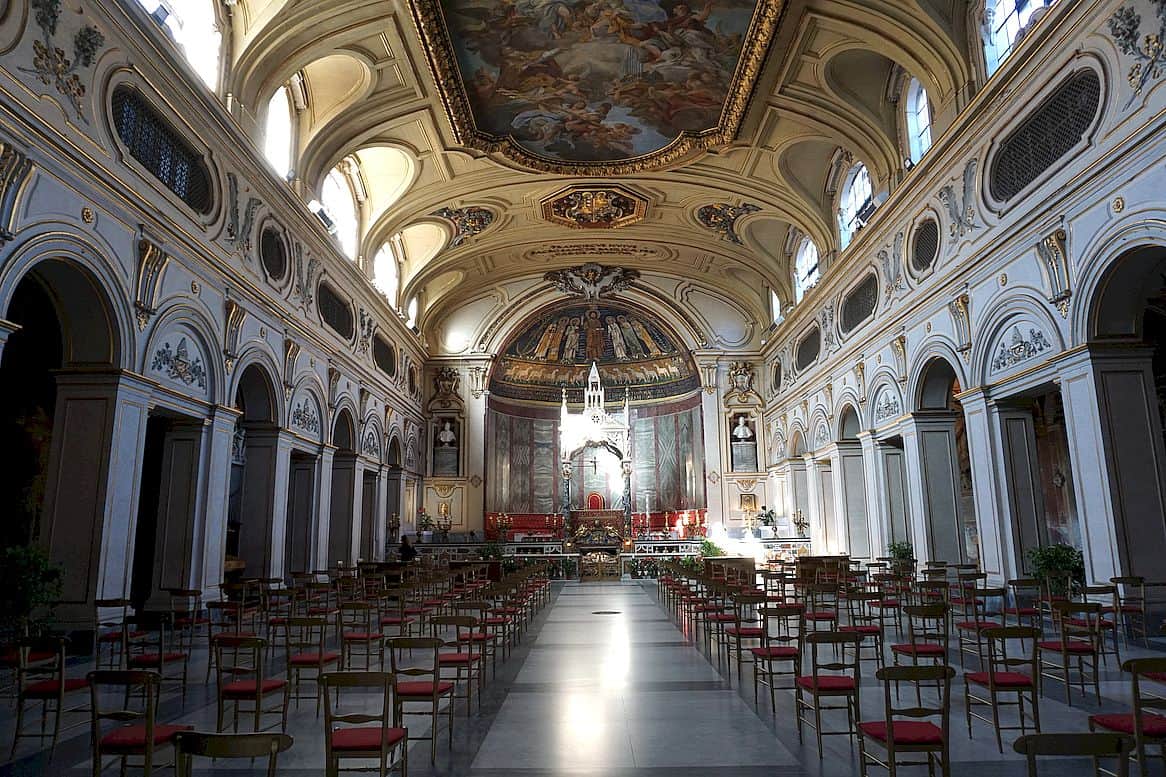
When you come in, look straight up toward the back. The apse vault is covered by a mosaic from the age of Pope Paschal I, so around 820, and it is the only part of the ancient basilica left practically intact through all the later remakes. In the center is the Redeemer, blessing. The sources list the figures at the sides with some differences in the order: English Wikipedia and archeoroma.org give Saint Paul, Saint Cecilia, Pope Paschal I, Saint Peter, Valerian and Saint Agatha. rome-roma.net puts Paul, Agatha and Valerian on one side and Peter and Cecilia on the other. Cathopedia describes Christ blessing, flanked by Paul and Cecilia presenting Paschal I, with Peter, Valerian and Agatha on the other side. On the names they all agree, on the arrangement they don't. Go look at them yourself, they're right there anyway.
How to Recognize Pope Paschal I in the Mosaic
By the square nimbus instead of a round one. In medieval iconography the square halo indicates a person still alive when the work was made. It's a detail that, once you know it, changes the way you look at all the Roman mosaics of the period.
The Mosaic Decoration Was Larger
Yes. The sources confirm it: originally the mosaic covered not only the vault but also the sides of the apse. What you see is a fragment of a much larger scheme.
Arnolfo di Cambio's Ciborium Above the Altar
It dates from 1293 and on this date all the sources agree. Four columns of white and black marble support a Gothic structure with pinnacles populated with statuettes: angels, saints, prophets, evangelists, and in the corner niches, figures on horseback. Cathopedia speaks of eight sculpted figures and corner niches with saints on horseback. turismoroma.it defines it as a Gothic ciborium in white and black marble. It is one of the two ciboria signed by Arnolfo left in Rome, together with the one in Saint Paul Outside the Walls, and seeing both on the same day is a recommended exercise for those who have already done the classic tour of the city.
Why the Ciborium Seems Suspended
Because it stands on a raised presbytery that wasn't part of the original design. The raising came with the remakes between the 1600s and the 1700s, and it changed the perception of the whole space: Paschal I's basilica had the nave and the crypt on the same level, with no difference in height. Today you climb three steps and the ciborium comes at you.
Stefano Maderno's Statue Under the Altar
It's the thing people remember about this church even years later. A figure of a woman lying on her side, her face turned toward the floor, the neck with the marks of the wounds, the veil, the hands with the fingers arranged to indicate the Trinity. The date is 1600, right after the opening of the tomb in 1599. English Wikipedia reports that a marble slab in the floor in front of the case reproduces Maderno's sworn statement, in which he says he reproduced the body exactly as he saw it when the tomb was opened. True, or a masterful Counter-Reformation construction, the effect on the viewer has been the same for 400 years.
What Really Happened in 1599
The titular cardinal Paolo Emilio Sfondrati, nephew of Pope Gregory XIV, was having work done in the basilica and had the marble tomb opened. Inside was a second cypress chest, and in the chest the body, according to the accounts of the time almost intact, dressed in white, with the mark of the wounds on the neck. Pope Clement VIII came in person to verify. Sfondrati's own funerary monument is in the porch, on the right: when you come in, before slipping into the church, take a look at it.
Cecilia's Body Is Still Here
The relics are in the crypt under the main altar. The statue is not a sarcophagus: it is a sculptural reproduction. Anyone who goes down into the crypt finds a completely 19th-century setting, described further on, not the early Christian tomb they expect.
Another Well-Known Fact, Yet Rarely Cited
The 12 columns of Paschal I's basilica are still there, but you can't see them. In 1830, for reasons of structural reinforcement, they were enclosed inside the brick pillars that now separate the aisles, and the arches were lowered. So every time you rest your hand on one of those square, anonymous pillars, under the plaster there is an ancient column shaft reused 1,000 years ago. The church you are looking at is a 19th-century box built around a Carolingian church built around a Roman house. Three buildings one inside the other.
The same logic applies to the ceiling: the original trusses were replaced by a wooden false ceiling full of stuccoes, with Sebastiano Conca's painting in the center. On the date of that painting the sources disagree: you often read 1725, the turismoroma.it entry dates it 1727 and titles it Apotheosis of Saint Cecilia. Two years of difference on a painting doesn't change your life.
The Leaning Bell Tower
The bell tower is Romanesque, with five tiers, with two-light and three-light windows, and it leans slightly: you notice it better from Via dei Genovesi than from the square. On the date there's a sharp disagreement: Italian Wikipedia attributes it to Pope Paschal II, so to the first quarter of the 12th century. Cathopedia instead places it in the middle of the 12th century and notes that it holds a bell from the 13th century plus two others donated in 1344. The two claims don't fit together, because Paschal II died in 1118. The certain fact is the 12th century, the rest needs checking against specialist literature.
Under the Basilica of Santa Cecilia in Trastevere: the domus, the insula, the eight vats
You go down about five meters below the level of the basilica and walk inside a piece of Roman Trastevere.
What was there before the church
A domus from the 2nd century BC, with walls in opus quadratum and opus reticulatum, tufa columns from the atrium, and cocciopesto and geometric mosaic floors still preserved. Romanoimpero.com specifies that it stood along Via Campana-Portuense, that is, on a traffic route toward the river port. Then, in the 2nd century AD, the building was turned into an insula, the Roman working-class apartment block: the old walls were reused, the courtyard took the place of the atrium, and a street, an access stairway, a hall and a small bath complex, probably private, appeared.
Why the house becomes an apartment block
The explanation holds up: in the Republican age Trastevere was countryside, with scattered houses and vegetable gardens, and in the imperial age it filled up with people as the city's population grew. The stately domus is no longer useful: what's needed is height, what's needed is rents. It's exactly what happens today in any neighborhood that becomes central.
The eight cylindrical vats
In a storage room there are eight large cylindrical vats set into the floor, with an inner lining in opus latericium and a base in opus spicatum. The detail that settles everything is that they aren't waterproofed: so they didn't hold liquids but solid goods, most likely grain. They were found filled with earth under a clearly later floor, and this helps date the transformation from domus to insula to the 2nd century AD. Cathopedia explicitly speaks of horrea, that is, warehouses, in the Republican age.
The lararium with Minerva
In the courtyard of the insula there was a lararium, that is, the household altar, with a bas-relief of the goddess Minerva. It's still there. It's the best detail of the whole underground: under the church of the Christian martyr there's the family altar dedicated to a pagan deity, a few meters from the place that tradition names as the site of her martyrdom. Rome's religious stratigraphy doesn't need to be explained, you just have to go down the stairs. Anyone who likes this kind of overlap has the textbook case at the Basilica of San Clemente, where there are even three levels.
The martyrdom bath really exists
There is a bath room, that much is true. Romanoimpero.com places the construction of the baths on the north side between the 3rd and 4th century AD and says that there is a calidarium there, that is, the hot room, which legend identifies with the place of Cecilia's attempted suffocation. Watch the dates, though: if the baths are from the 3rd-4th century and the martyrdom is placed between 220 and 235, the chronological coincidence is problematic. The "Bath" is often presented as an established fact. In reality the room exists and is ancient, but the identification with the place of the martyrdom is devotional tradition, not a result of excavation.
The hexagonal baptistery
When the complex passes to Christian use, in the 5th century, a room with a circular basin is turned into a hexagonal baptistery faced with marble. You see it along the excavation route. It's one of the few early Christian baptisteries preserved inside a Roman residential setting, and it's worth the €2.50 by itself.
The neo-Byzantine crypt that looks ancient and isn't
Here is the most common misunderstanding of the whole visit. The crypt under the altar, with the little columns, the gilded mosaics, the air of an Eastern church, is not early Christian: it's from the 20th century. Cathopedia indicates work between 1899 and 1901 to a design by the architect Giovanni Battista Giovenale, commissioned by the titular cardinal Mariano Rampolla del Tindaro, with mosaic decoration by Giuseppe Bravi. Romartguide.it dates it to 1901. You often read that Rampolla "decided to restore and enlarge the crypt": true, but incomplete, because what you see is a space designed entirely from scratch in the neo-Byzantine style. It's the difference between looking at a restoration and looking at a reconstruction.
Who Rampolla del Tindaro was
The titular cardinal of Santa Cecilia between 1887 and 1913, and one of the most important figures of the curia in the late 19th century. It was his decision to take the crypt in hand again that started the test digs in the floor of the church and the convent, and so the whole archaeological complex you visit today you owe indirectly to him.
The right photo to take at the Basilica of Santa Cecilia in Trastevere
Everyone takes the postcard shot: the courtyard with the big Roman vase in the center, the Romanesque bell tower in the background and Fuga's facade behind. It's perfectly fine, and it comes out well in mid-morning when the sun comes in over the boundary wall and the vase casts a long shadow on the paving. Go ahead and take it. But that's not the photo.
The right photo is another one: Maderno's statue framed low, at the level of the saint's eye, with the side light coming from the candles and the presbytery. You crouch on the step, rest the camera on the parapet so it doesn't move, and you don't use the flash, which washes out all the chiaroscuro of the marble. What you get is not a photo of a sculpture: it's the portrait of a body. It's exactly the effect Maderno was after in 1600 and it still works.
What light is best for photographing the interior
Mid-morning, from 11:00 on, when the light from the south comes in through the high windows and brightens the apse semidome without burning it out. In the early afternoon the church is closed, so the choice makes itself.
Can you photograph the Cavallini
There's no certified answer here: the general sources say photos are allowed without flash in the main church and restrictions apply in some areas, without specifying which rule holds in the choir. Ask at the porter's desk when you pay. If they tell you no, enjoy it with your eyes, you come out ahead.
Some important events that happened here in history
In order, what the sources allow us to state, with the warning that for the oldest dates there are different versions.
The titulus Caeciliae, between the 4th and 5th century
The titulus is attested already from the 5th century. English Wikipedia specifies the document: at the synod of Pope Symmachus in 499 the church appears as Titulus Ceciliae. Cathopedia moves the foundation even further back, attributing it to Pope Gregory the Great at the end of the 6th century, which however comes after the synod of 499 and so doesn't add up. The disagreement remains: the existence of the title in the late 5th century is documented, its foundation is not.
821 or 822: Paschal I rebuilds the basilica
Pope Paschal I, who was a great collector of relics and builder of churches (Santa Maria in Domnica and Santa Prassede are also his), according to tradition had a vision in a dream of Cecilia showing him where she was buried. He had the church built in basilica form on the site of the earlier one and moved the body there from the Catacombs of San Callisto. On the year: English Wikipedia says 822 for the reconstruction and for the translation of the relics, Cathopedia says 821. One year of difference.
1293: Arnolfo di Cambio signs the ciborium
A solid date, all the sources agree.
Late 13th century: Cavallini paints the Last Judgment
1289-1293 according to English Wikipedia, 1291-1293 according to Cathopedia.
1599: the opening of the tomb
The event that made the basilica's modern fame. Sfondrati opens it, Clement VIII sees for himself, Maderno sculpts the following year.
1724: the Cavallini ends up under the plaster
English Wikipedia gives 1724 as the year the fresco was plastered over. It disappears from view for 176 years.
Fuga's 18th century: 1725 or 1741-1742
The titular cardinal Francesco Acquaviva d'Aragona entrusts Ferdinando Fuga with the arrangement of the entrance, with the monumental facade, the cardinal's name in plain view, the new rooms and the wide courtyard. English Wikipedia dates the facade to 1725. Cathopedia speaks of work in 1724 and then in 1741-1742, attributing the outer facade to Fuga in the latter phase. The two datings are 16 years apart and can't be reconciled.
1830: the columns inside the piers
Structural reinforcement, lowered arches, the present look of the aisles.
1899-1901: Giovenale's crypt
And the test digs that lead to the discovery of the Roman underground.
1900: the Cavallini resurfaces
One of the most important finds in the history of medieval Italian art, and it happens inside a cloistered monastery in Trastevere.
1903: the Vegezzi Bossi organ
An instrument with pneumatic action, modest in size, built in 1903. In a church dedicated to the patron saint of music it's a detail that deserves at least a line.

Who has passed through the Basilica of Santa Cecilia in Trastevere
More than the famous visitors, what counts are the ones who left something here, and they're names that hold up anywhere.
Pope Paschal I
He built the basilica you're looking at underneath all the later layers and had himself portrayed in the apse mosaic with the square halo of the living. In the 9th century it was an author's signature.
Pietro Cavallini
The greatest Roman painter before Giotto. His most important surviving work is here, and it's in a place you visit in 15 minutes by paying two and a half euros.
Arnolfo di Cambio
The architect and sculptor who would later work on Florence Cathedral. The ciborium of 1293 is one of his Roman masterpieces.
Stefano Maderno
He was a little over 20 when he sculpted Saint Cecilia. In his whole career he never again made anything as great.
Sebastiano Conca
The Neapolitan painter who painted the Apotheosis of Saint Cecilia on the false ceiling, in the 1720s.
Ferdinando Fuga
One of the architects who gave shape to 18th-century Rome. Here he made the entrance and the courtyard.
Giovanni Battista Giovenale
The architect of the neo-Byzantine crypt, straddling the 19th and 20th centuries. If the crypt seems Byzantine to you, the credit or the blame is his.
The titular cardinals
The title of Santa Cecilia is ancient and prestigious. Among the titular cardinals of the last century the sources mention Albert Gregory Meyer, John Cody and above all Carlo Maria Martini, who held it from 1983 to 2012. The current titular cardinal given by both English Wikipedia and Cathopedia is Gualtiero Bassetti, appointed in 2014. As of August 2026 there is no more recent official source that confirms or denies the situation: if you need the information for serious reasons, check it in the Annuario Pontificio.
Guido Reni and Paul Bril
Romartguide.it reports works by Guido Reni and by the Flemish painter Paul Bril in the basilica. The official sources don't say precisely which paintings they are and in which chapel they stand: it's something to ask about on site.

What to see around the Basilica of Santa Cecilia in Trastevere
The nice thing about this area is that you do everything on foot and never have to take a vehicle.
Five minutes away
San Francesco a Ripa Church, with Bernini's Blessed Ludovica Albertoni, and Sant'Agata in Trastevere Church. They are two short stops that complete the picture of the district without lengthening the day.
10 minutes away
The Basilica of Santa Maria in Trastevere with its apse mosaics, and the Museo di Roma in Trastevere in Piazza Sant'Egidio for anyone who wants to understand what the city was like before the demolitions. On Sunday morning, if you like that kind of thing, there's Porta Portese barely 15 minutes away.
20 minutes away
Up above on the Janiculum for the view, or inside the Botanical Garden of Rome for real shade in summer. A little further on is Villa Farnesina with Raphael's Galatea, and anyone who wants old pharmacies can look for the Antica Spezieria di Santa Maria alla Scala.
If you have the whole day
Cross the river toward Santa Maria in Cosmedin, the Mouth of Truth and the Circus Maximus, or head down toward the Pyramid of Cestius and from there continue to Saint Paul Outside the Walls for Arnolfo's second ciborium. Anyone who wants big green space has Villa Doria Pamphilj behind the Janiculum.
Visiting the Basilica of Santa Cecilia in Trastevere with children, with little time, with mobility difficulties
The kids get bored
In the church, yes, after 10 minutes. Downstairs, no. The excavations with the vats, the stairs, the mosaic floors and Minerva's little altar work very well with kids from eight years old and up, because it's a real underground route and not a showcase. Turn it into a hunt: find the eight vats, find Minerva, find the herringbone floor.
If you only have 30 minutes
Cavallini's choir and Maderno's statue. That's it. You leave the rest for next time.
Is it wheelchair accessible
Partly. The practical sources say the courtyard and the main nave are accessible, with ramps at the entrance, while the underground areas may have limited access. The nuns' choir is reached by stairs. The official tourist portal points to its own accessibility section for details. If accessibility is a requirement and not a preference, call the monastery first at 06 45492739 and ask how things stand today: it's the only way to avoid getting a door in your face.
Is it cold down there
Down there it's between 15 and 20 degrees Celsius even in July, and it's damp. In summer it's a relief, in winter bring something to put on. Closed shoes, the ground is uneven.
Quick questions about the Basilica of Santa Cecilia in Trastevere
How much does a visit to the Basilica of Santa Cecilia in Trastevere cost
The basilica is free to enter. The excavations are €2.50 and the choir with Cavallini's frescoes €2.50, according to two sources. The monastery doesn't publish official rates.
Do you need to book
Not for the basilica. For groups and guided visits write to visite@benedettinesantacecilia.it or call 06 45492739.
What is the exact address
Piazza di Santa Cecilia 22, 00153 Rome. The monastery also gives street number 22/A for the porter's desk.
What are the safe opening hours
The window all the sources agree on is 10:30-12:30 in the morning and 16:30-18:00 in the afternoon. Outside that window it depends on which source is right.
Can you see the Cavallini in the afternoon too
No. It closes at 12:30 and doesn't reopen. It's the most common mistake people make about this place.
How long does it take to see all of it
An hour and a half for the church, choir and excavations at an easy pace. 40 minutes if you move fast.
Is the Basilica of Santa Cecilia in Trastevere open on Sunday
Yes, with reduced hours in the morning: the sources give holiday opening from 11:30 to 12:30, that is, after the 10:00 conventual Mass.
What time are the Masses
According to the sources: weekday Mass at 7:20, holiday conventual Eucharistic celebration at 10:00. Vaticano.com also reports the community's offices, Lauds at 6:45 on weekdays and Vespers at 19:15.
Can you take photos
In the church yes, without flash. In the monastery areas ask first at the porter's desk.
Is it accessible for people with disabilities
Courtyard and nave yes, underground areas and choir with limitations. Call first.
Are there bones or visible remains
No. The relics are in the crypt inside their container. What you see under the altar is a marble sculpture, not a body.
Does the statue contain the saint's body
No. It's a work by Stefano Maderno from 1600 that reproduces the position in which the body was found in 1599.
Where was Cecilia's body before
In the Catacombs of San Callisto, on the Appian Way, from where Pope Paschal I moved it here in 821 or 822 depending on the source.
What is the difference between the crypt and the excavations
The crypt is the neo-Byzantine space of 1899-1901 under the altar, with the relics. The excavations are the Roman archaeological route, domus and insula, which extends about five meters deep.
Is it worth paying for the excavations
Yes, if you're interested in domestic Rome and not only the monumental kind. The eight vats and the lararium of Minerva you find in very few other places you can visit in the city.
Is it worth paying for the Cavallini
It's the main reason to come all the way out here. Two and a half euros to stand five meters from the most important Roman fresco of the 13th century is a bargain with no equal in the city.
Is it cold in the excavations
Cool and damp all year round, 15 to 20 degrees Celsius. Pleasant in summer, biting in winter.
Are there restrooms
The practical sources indicate accessible restrooms, without official confirmation from the monastery: ask at the porter's desk.
Can you visit the Benedictine nuns' monastery
No, it's cloistered. You visit the basilica, excavations, crypt and choir.
Is there a guesthouse
The monastery runs a small guesthouse for visitors and gives a dedicated contact on its website. For conditions and availability, contact them directly.
How do you get there by subway
There's no subway stop nearby. The natural way is tram 8 on Viale di Trastevere, or buses 23 and 280 on Lungotevere Ripa.
Can you get there by car
Not recommended. Trastevere has a ZTL, narrow one-way streets and practically no parking around the square. Leave the car outside and do the last few minutes on foot.
What is the best day to go
A weekday morning. On Sunday the hours are reduced and the church is taken up by the liturgy. Saturday morning is fine but there are more passersby.
Is it crowded
Almost never. It's one of the few Roman churches of this caliber where you can stay 10 minutes in front of a 9th-century mosaic without anyone walking in front of you.
What is the difference from Santa Maria in Trastevere
Santa Maria in Trastevere is on the busiest square in the district and is always full. Santa Cecilia is 200 meters further on and is empty. The first has Cavallini's mosaics, the second has his fresco. Do both in the same morning.
What is the difference from San Clemente
The Basilica of San Clemente has three superimposed levels, a medieval church, an early Christian basilica and a Mithraeum, and it's the textbook case of Roman stratification. Santa Cecilia has two levels, the basilica and the Roman house, but in exchange it has the Cavallini and Maderno's statue. They complement each other.
When is Saint Cecilia celebrated
On November 22, the feast of the patron saint of music.
Is there a link with the Accademia di Santa Cecilia
The name comes from the same saint and the same patronage of music. The Accademia's concert activities today take place at the Auditorium Parco della Musica, which has no direct institutional relationship with this basilica: the link is the name and the saint.
Are weddings held here
Yes. The monastery has a wedding office with dedicated contacts given on its website and in the official tourist listings.
How old is the church I see today
There's no single answer. The mosaic is from the 9th century, the bell tower and the portico from the 12th, the ciborium from 1293, the fresco from the late 13th century, the statue from 1600, the ceiling and the entrance from the 18th century, the piers from 1830, the crypt from 1901. It's a church made in layers like a lasagna.
Why is it called a minor basilica
Because it's an honorary title granted by the pope to churches of particular historical and devotional importance. Santa Cecilia in Trastevere is also a cardinal's titular church, that is, assigned as a title to a cardinal.
What is the pallium that they weave here
A strip of white wool with black crosses that the pope gives to metropolitan archbishops. The wool comes from the lambs blessed on January 21 at Sant'Agnese fuori le Mura, the palliums are woven by hand in the monastery of Santa Cecilia in Trastevere and are delivered on June 24.
The point of the visit
You enter through the main door on Via di Santa Cecilia, cross the courtyard with the vase, and within 10 steps the traffic of Viale di Trastevere vanishes as if someone had flipped a switch. Then you go up to the choir, you pay €2.50, and you spend 15 minutes in front of a wall painted before 1300 that almost nobody in Rome knows they can see. Seen up close, Maderno's statue makes you think that the 20-year-old who sculpted it had understood something about the human body that nobody after him ever understood again. If you go, go in the morning and take your time. And if the door is closed because the hours you had read came from another source, don't take it personally: come back the next day at 11:00, because at that hour it's open according to all the sources.