Porta Portese
In short. Porta Portese is in Piazza di Porta Portese, Rome 00153, at the southern end of Trastevere, where the district slopes toward the Tiber and meets the embankment wall of Lungotevere Ripa.

Porta Portese is in Piazza di Porta Portese, Rome 00153, at the southern end of Trastevere, where the district slopes toward the Tiber and meets the embankment wall of Lungotevere Ripa. The flea market, which is the reason most visitors come all the way here, is held on only one morning a week: Sunday, from seven in the morning until about 14, with the first stalls opening around six 30 and the crowd thickening between nine and 11. You pay no ticket: the gate is an open-air monument and the market is free. You get here easily with tram 8, which leaves from Largo di Torre Argentina and in 10 minutes runs down Viale Trastevere to the Belli or Trastevere/Min. Istruzione stops. From there you continue on foot toward the river. Alternatively the area is served by buses 23 and 280 along the Lungotevere, the 75 from Termini and line H. From Metro line B you get off at Piramide and take tram 8 in the opposite direction. On Sunday morning forget the car: parking here is an ordeal, and the traffic around the market is dense. Bring cash in small bills, because almost no stall accepts cards, and comfortable shoes: the market stretches for almost a kilometer.
Anyone who wants to place Porta Portese within the wider panorama of the city will find a good starting point in the page on the tourist attractions of Rome, useful for linking this stop to Trastevere and the rest of the center.
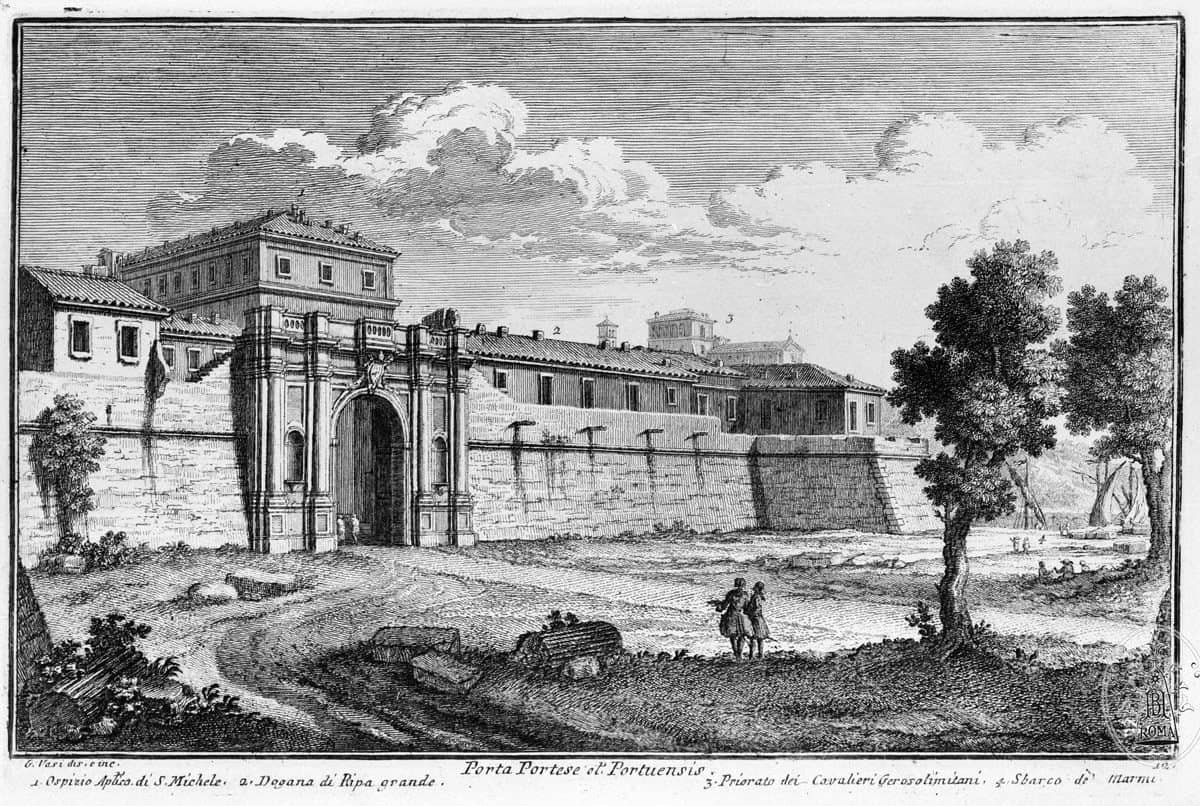
What Porta Portese Is, Beyond the Market
The name today evokes above all the Sunday market, but Porta Portese is first of all a seventeenth-century city gate, a monumental opening in the Janiculum Walls. It was built in 1644 to replace the older Porta Portuensis, and for centuries it has marked the point where those leaving Rome took Via Portuense, the road that led to Portus, the river and sea port at the mouth of the Tiber. The gate and the market share the same space: the first is the monument that gave its name to the second, and understanding one helps read the other. Before the stalls surrounded it, this was the threshold of a city that ended here, where the river brought goods and the walls fixed the customs boundary.
It's worth arriving a few minutes early, before plunging among the stalls, and looking up at the gate itself: the columns, the empty niches, the papal coat of arms. In the middle of the Sunday crush almost nobody looks at it, and that's a pity, because it tells three and a half centuries of Roman history in a few meters of travertine.
The Seventeenth-Century Gate of Porta Portese: What to Look At
The look of Porta Portese is that of a gate left half done, with a style that departs from the traditional canons of Roman city gates. The single arch, the opening you pass through, is flanked by two side niches left inexplicably empty: they were perhaps meant to hold statues never placed. Above the arch runs a balustrade supported by columns on a high stylobate, a sort of balcony in place of the usual crenellated walkway. The classic side towers that defended medieval gates are missing: here the logic is no longer that of tight defense, but that of a representative entrance in a stretch of wall conceived more for decorum and customs control than for withstanding a siege.
The detail to look for is the heraldic coat of arms above the arch. The gate was commissioned by Pope Urban VIII Barberini, but when the works ended the pontiff was already dead (Urban VIII died in July 1644), and the one who left his mark on the gate was his successor, Innocent X Pamphilj. Anyone who knows Roman heraldry thus recognizes the handover between two powerful families: the Barberini bees should have dominated the scene, and instead it's the Pamphilj dove with the olive branch that crowns the opening. A small joke of chronology carved in travertine.
One last observation: the gate you see was never finished as it was meant to be. Those empty niches and that slightly bare look are not modern neglect, but the sign of a seventeenth-century building site concluded in a hurry, with the patron gone and the priorities of Baroque Rome already shifted elsewhere. It's interrupted architecture, and it has its austere charm precisely for that reason.
The Janiculum Walls and the Old Porta Portuensis
To understand why the gate is here you have to look at the walls that contain it. The Janiculum Walls were commissioned by Urban VIII in 1643 as an extension of the older Leonine Walls, to protect the Janiculum Hill, a strategic point from which the whole city is dominated: whoever held the Janiculum held Rome. The circuit ran from the Tiber to San Pancrazio and came back down, enclosing within the defensive perimeter also the right bank of the river at the level of Trastevere. Porta Portese was built as an opening of this new circuit, completed the following year, in 1644. The design of the walls is documented as the work of several hands: sources indicate the military engineer Giulio Buratti and the architect Marcantonio De Rossi, father of the more famous Mattia De Rossi who would become a collaborator of Bernini. The design of the gate itself is also attributed to Marcantonio De Rossi.
The 17th-century gate was not born from nothing: it took the place of an older gate, the Porta Portuensis, which opened in the Aurelian Walls about 100 meters further south. The name, then as now, came from Via Portuensis, the road that connected Rome to the great imperial ports at the mouth of the Tiber, the Port of Claudius and the Port of Trajan. The ancient Portuensis had a notable peculiarity: when at the beginning of the fifth century, between 401 and 402, the emperor Honorius had the Aurelian Walls restored and raised, reducing many gates to a single arch for defensive reasons, the Portuensis was among the few to keep its two original arches, a sign of how intense the commercial traffic with Portus was. When in the 1600s the new Janiculum circuit was laid out, the old gate was demolished and its function transferred to the new gate, moved slightly further north. That is why today Porta Portese is 17th-century but bears a name many centuries old.

Via Portuense and the Imperial Ports of the Tiber
The road that starts at Porta Portese, Via Portuense, is no ordinary road: it is the ancient route that connected Rome to its ports on the sea. At the mouth of the Tiber, where Fiumicino now lies, the emperors built in the first and second centuries AD a grandiose port system, first the Port of Claudius and then the more rational Port of Trajan, with the celebrated hexagonal basin still visible today. From there, the grain that fed a million Romans, the oil from Baetica, the wine, the marbles from the four corners of the empire went up the river or were carried overland along the Portuense to the city's warehouses. The road, in short, was a vital artery of the annona, the food supply system of ancient Rome. When in the Middle Ages and then in the modern era the sea advanced and the ports silted up, the function of landing place gradually passed north, but the name of the road and the gate remained to recall that vocation, going back millennia, toward the river and the sea. Walking today among the market stalls means treading, without knowing it, the starting point of one of the most important commercial roads of antiquity.
The Janiculum, the Walls and the Siege of 1849
The walls that contain Porta Portese never had occasion to repel a siege in the 1600s, but two centuries later they were at the center of one of the most dramatic pages in the history of Rome. In 1849, with the Roman Republic proclaimed and Pope Pius IX fled, a French expeditionary corps was sent to restore papal power. The French aimed precisely at the Janiculum, the hill that the Janiculum walls defended, because whoever dominates that height dominates the city. For weeks, between April and June, the defenders of the Republic, with Giuseppe Garibaldi and his volunteers in the front line, resisted along the walls and villas of the Janiculum, in fierce fighting around Villa del Vascello, the Casino dei Quattro Venti and Porta San Pancrazio, just above Porta Portese. The Republic fell, but that desperate defense became a founding myth of the Italian Risorgimento, and in the following decades the Janiculum filled up with monuments, busts and Garibaldian memorials. Anyone who climbs on foot toward the hill after the market walks, almost without noticing, on one of the decisive battlefields of national unification.
Why Porta Portese Looks Unfinished
Anyone who knows Rome's great monumental gates, the scenographic Porta del Popolo or the severe Porta San Sebastiano, is a bit thrown in front of Porta Portese. It lacks the Baroque theatricality you would expect, it lacks statues, it lacks grandeur. The reason is historical and economic at once. The gate was built in a hurry, as part of a circuit of walls conceived for the military defense of the Janiculum more than for urban decor, and the patron, Urban VIII, died just as the work was ending. With the death of the pope who had wanted it, the project lost its main supporter and resources moved elsewhere: the niches meant for statues stayed empty, the decorative apparatus remained minimal, and the gate took on that bare and slightly austere air that still characterizes it today. It is therefore not a flaw of taste, but the readable sign of a commission interrupted halfway. The four columns on a high base, the architrave with the balustrade and the empty niches tell, to those who know how to look, the story of a 17th-century construction site closed before its time. It is an architecture honest in its incompleteness, and precisely for that reason different from all the other gates of Rome.
Ripa Grande, Rome's River Port
Before the railways and the 19th-century embankment walls, Rome was a river city, and its main landing was right here. At Porta Portese, inside the walls for customs reasons, stood the city's largest river port, called Ripa Grande for its size. Here docked the boats that came up the Tiber from Fiumicino and Ostia loaded with grain, wine, salt, marble, timber and every sort of goods bound for the Roman markets. It was a real port, with basins, flights of steps, warehouses and customs offices, the commercial heart of a Rome that received from the river what it did not produce. The duty was paid on entering the city, and the walls served this purpose too: to channel goods toward the tax checkpoints.
With the construction of the Tiber embankment walls, after Unification, to protect Rome from ruinous floods, the port was erased. Of Ripa Grande only the name remained, which still today indicates the stretch of Lungotevere between the San Michele complex and the ramp that goes down to the river. Anyone walking along that orderly, severe embankment wall struggles to imagine that down there was a port teeming with boats and porters. It is one of the many vanished Romes hiding behind a surviving place name.
The Papal Arsenal and San Michele a Ripa Grande
Outside the gate, again for customs reasons (the materials meant for the papal building sites did not have to pay duty, unlike goods bound for the city), in the mid-1700s the papal arsenal was built, where the vessels of the Papal States were fitted out and repaired. Of this too, after the embankment walls, little survived: the great masonry shed was converted into a storage depot for building materials, what Romans call a smorzo.
The real giant of this corner of Rome, however, is the monumental complex of San Michele a Ripa Grande, an immense 18th-century building overlooking the river, more than 300 meters long. Born as a charitable institution wanted by the popes, it hosted over the centuries a home for the elderly, craft workshops, a factory of wall hangings and, among its less glorious functions, a juvenile prison that remained active until 1938. After decades of abandonment and decay, in 1969 a long restoration began that gave the complex back to the city by turning it into a citadel of culture: today it houses offices and institutes of the Ministry of Culture, general directorates, the Central Institute for the Catalogue and Documentation, restoration laboratories, a laboratory of physics applied to cultural heritage and important libraries. Anyone with time after the market can take a short stroll along the embankment wall and admire its imposing facade on the Tiber.
The very name of San Michele tells a curious Italian story: that part of the Lungotevere is still called Ripa Grande precisely in memory of the vanished port, and the great 18th-century building overlooking it has gone, in the space of two centuries, from being a shelter for the poor and a prison to becoming a nerve center for the protection of the national artistic heritage. It is a parable that says a lot about this corner of the city: a place long considered marginal, a service area, almost run down, that in the 1900s found dignity and function again. The Porta Portese market, born in the same years among the shacks and depots, followed a parallel trajectory, turning an urban void into a piece of the city's identity.
How the Porta Portese Market Was Born
For much of the 20th century this area stayed on the margins of the growing Rome. Until the 1970s the capital's urban development looked elsewhere, and the area around the gate remained assigned to bulky and not very noble services: the outfalls of the sewer system, building material depots, the old municipal dog pound, an ATAC depot. The city seemed to end at Viale Trastevere. Beyond that line opened an amorphous belt, dotted with shacks and half abandoned, populated by junk dealers, car wreckers and secondhand dealers. It was in this urban void that, around 1945, in the disaster and scarcity of the postwar period, a flea market took shape that was destined to become the most famous and most frequented non-food market in Rome.
The origins go back to the survival economy of the war: according to a widespread reconstruction, the market was in part the continuation in broad daylight of the black market that during the conflict operated in the Tor di Nona area, on the other bank of the river. In the postwar period, with the city hungry for everything, buying and reselling used goods was not folklore but necessity. From there, decade after decade, the market took root, grew, became mythologized, until it entered the collective imagination as one of Rome's Sunday rites.
Over time some stall owners turned the old shacks along the street into permanent shops, and the look of the market changed. The historic operators, gathered in the Associazione Operatori di Porta Portese, have for years been carrying on a tug of war with the City of Rome so as not to be expelled or pushed to the margins. It is not only a question of pitches: it is a battle over the identity of the place. In 2008, together with the Occhio del Riciclone association, the operators circulated a Manifesto del Riuso whose first signatory was the French economist Serge Latouche, theorist of degrowth. In 2010 the association was among the promoters of the Rete Nazionale Operatori dell'Usato. Long before reuse and circular economy became fashionable words, Porta Portese practiced them every Sunday.
What You Can Buy at the Porta Portese Market
The good and the hard thing about Porta Portese is that you find everything, but scattered and mixed. Don't expect tidy sections as in a shopping mall: you have to walk, look, rummage. Here, though, is a rough map of what to expect.
Used Clothes and Vintage at Porta Portese
It is the queen of the merchandise. Mountains of used garments sold by weight or for a few euros, piles you have to dig through with patience, and next to them stalls of selected vintage for those looking for the military jacket, the 1970s coat, the Hawaiian shirt, the lived-in leather bag. Prices vary enormously depending on the stall and your ability to haggle: the same coat can cost five euros in the pile and 20 on the stall of the curated vintage. Anyone with an eye and patience takes home real bargains. Anyone in a hurry pays more.
Vinyl, Music and Prints at Porta Portese
Some historic stalls are devoted to vinyl records, sorted by genre in wooden crates: rock, jazz, Italian singer-songwriters, soundtracks, classical. Nearby you find old magazines, comics, postcards, posters, prints, period photographs. It is the kingdom of the collector and the nostalgic, and one of the few corners of the market where it pays to ask and chat: competent sellers know what they have in their hands, and often like to tell.
Furniture, Antiques and Modern Collectibles at Porta Portese
Toward some side streets are concentrated the stalls of furniture, furnishing objects, lamps, mirrors, frames, silverware, ceramics, small antiques and modern collectibles. Here the watchword is caution: next to the authentic piece lives the artfully aged fake, and telling real antiques from a reproduction takes expertise. If you are not an expert, buy because you like an object and at a price that seems right to you, not because they swear it is from the 1700s.
Used Books and Prints at Porta Portese
The book stalls are among the best loved: used volumes often sold for 50 cents or a few euros, out-of-print editions, yellowed paperbacks, manuals, novels, catalogs. For book lovers it is half an hour of happy hunting, with the real possibility of finding cheaply something that no longer exists in bookstores.
Collectibles, Curiosities and Street Food
Rounding out the picture are the stalls of small collectibles (coins, stamps, watches, medals, trinkets), tools, secondhand hardware, small appliances, and here and there a street food spot where you can stop for a porchetta or a supplì. The advice is not to arrive with too precise an idea of what you are looking for: at Porta Portese you find the right object when you are not looking for it.

How to Get Around Inside Porta Portese Without Getting Lost
The market unfolds along a main axis that follows Via Portuense and widens into the side streets, especially along Via Ippolito Nievo and Via Ettore Rolli, for an overall length that comes close to a kilometer from the Tiber inland. The most effective way to visit is simple: enter at one end and walk the whole axis once without buying, to get an idea of prices and availability, then go back to the stalls that struck you. Anyone who buys at the first stall almost always overpays.
Keep a fixed reference point: the monumental gate is the natural anchor, and always knowing which way it is keeps you from getting lost in the labyrinth of stalls. At peak hours, between nine and 11, the aisles become a slow river of people. If you want calm to look and haggle, arrive early, by eight, when the stalls are already set up but the crowd hasn't arrived yet. Around one o'clock many sellers begin to pack up, and it's the moment when you snatch the last discounts, because nobody feels like loading the goods back onto the van.
One thing that helps a lot is accepting the apparently random layout of the market instead of fighting it. At Porta Portese there are no clear, marked sections: books may pop up next to coats, vinyl beside pots, serious antiques a step from the pile of rags. Anyone who demands order gets irritated. Anyone who lets curiosity guide them has fun. The best method is to walk slowly keeping your eyes low on the stalls and high on the signs, stopping only when something truly catches your attention. And if you notice you're tired, leave the main aisle for a quieter side street or a bar at the edges: the market is long and tackling all of it in one go, in the crush, wears out even the fittest.
Safety at Porta Portese: Watch Out for Pickpockets
It needs to be said clearly, without alarmism and without reticence: Porta Portese, like every big crowded market in the world, is hunting ground for pickpockets, and the crush of the middle hours is their ideal condition. The rule is simple and is worth more than any trick: don't give them handholds. No wallet in the back pocket of your trousers, no phone sticking out of your jacket, no open backpack on your shoulders in the crowd. Carry the bare minimum, keep cash split among several inner pockets, the bag closed and in front, the phone in the front pocket. Avoid stopping dead in the middle of the aisle at peak hours, where the push of the crowd creates the confusion the pickpocket needs. If you have to check the map or answer a message, step to the side, with your back to a stall. It's not a dangerous place: it's a crowded place where a minimum of common sense is enough to enjoy the market in peace. It's also worth leaving at home valuables you don't really need: nobody comes to Porta Portese with a good watch and a bulging wallet, and whoever moves light moves serene.
When to Go to Porta Portese (and When to Avoid It)
The market exists only on Sunday morning, so the choice of day is forced. The real decision is the time. Our opinion is firm: the good window runs from seven to nine. At that hour the stalls are all set up, the light is better for photos, the sellers are fresh and eager to open the day with a sale, and above all you can walk. From nine 30 on the market fills until it becomes, on nice Sundays, almost impassable: great to live as a crowd experience, terrible for anyone who wants to look at the goods and haggle calmly. In summer add the heat factor: by 10 the sun beats down and the aisles become sultry. In winter, on the contrary, a sunny Sunday in January is perfect, with fewer people and the same goods.
A practical warning many forget: on rainy Sundays a good part of the stalls don't open. If the weather is uncertain and Porta Portese is the main reason for your outing, be ready with a plan B in nearby Trastevere.
Porta Portese With Kids
The market can be fun for little ones, with stalls of used toys, comics, records and oddities of every kind, but it has to be managed. The crowd of the middle hours is disorienting and a small child risks getting lost in an instant among people's legs: go early, when there's room to walk, hold the child by the hand or keep them in the stroller in the wider aisles, and set a recognizable meeting point right away (the monumental gate is the best) in case you get separated. A gelato or a supplì at the end of the round turns the morning into a happy memory. Avoid instead bringing bulky strollers into the narrower, crowded side streets: they become a trap.
Accessibility at Porta Portese
The market takes place on level city streets, without steps, which in theory makes it passable even for people with mobility difficulties or who use a wheelchair. The real problem is not the elevation but the crowd: at peak hours the aisles between the stalls narrow and fill to the point of making any movement tiring. Anyone with accessibility needs should absolutely aim for the opening, between seven and eight 30, when the spaces are still wide and free. The road surfaces are those of a normal Roman street, with some sampietrini and uneven stretches: caution, but nothing prohibitive if you avoid the crush.
What's Around Porta Portese
One of Porta Portese's merits is its position: you're a step from the most authentic Trastevere and from some of the most beautiful churches and museums on the right bank. A few minutes' walk away, climbing up through the district, you find the Basilica of Santa Maria in Trastevere, with its golden medieval mosaics, and the Basilica of Santa Cecilia in Trastevere, which keeps Stefano Maderno's famous statue of the saint. Right next to the market, toward the river, is the Church of San Francesco a Ripa, with the ecstasy of Blessed Ludovica Albertoni carved by Bernini, one of the peaks of Roman Baroque that almost no market visitor imagines having a step away.
If after the market you want to change register, climb toward the Janiculum for the most beautiful view over Rome, or cross toward the Tiber Island, the island in the middle of the river. A little farther up, on the same bank, await the Villa Farnesina with Raphael's frescoes, the Palazzo Corsini with the Galleria Nazionale d'Arte Antica, the Botanical Garden and the Museo di Roma in Trastevere. Anyone who loves markets and real neighborhoods can then cross the river toward Testaccio, where you find the Nuovo Mercato di Testaccio and, a little farther, the Pyramid of Cestius and the Centrale Montemartini. In a single day, starting from Porta Portese, you can build an itinerary that holds together the popular and the sublime.
Trastevere and Porta Portese, Two Faces of the Same Rome
Porta Portese is the southern threshold of Trastevere, the district that for centuries was the working-class neighborhood par excellence, across the river from the Rome of palaces and curias. Once inhabited by craftsmen, fishermen, millers and innkeepers, proud of its own speech and its own festivals, Trastevere kept longer than any other part of Rome the character of a city within the city. The market is a child of this identity: it was born where the working-class district met the river and its trades, where the junk dealer and the second-hand dealer were neighborhood figures and the trade in used goods was daily bread. In recent decades Trastevere has changed profoundly, through mass tourism, nightlife venues and short-term rentals that have pushed out many longtime residents, but on Sunday morning, among the stalls of Porta Portese, you still find something of the working-class Rome of the past: the voices, the haggling, the shouting, the art of getting by. It's worth reading the market this way too, as the last strip of a district changing its face, and as the place where that old soul re-emerges once a week.
Porta Portese in Song and in the Imagination
Few markets in the world can say they have a song that bears their name and that millions of people know by heart. Porta Portese has one: in the 1970s Claudio Baglioni dedicated to it a piece titled simply Porta Portese, which became an enormous hit and fixed the market in the imagination of whole generations of Italians. Since then, for very many, the name evokes the melody first and then the place, in a curious intertwining of geography and musical memory. It's not the market's only cultural reflection: a famous free classified-ad newspaper distributed in Rome and Lazio also took its name from it, so that for decades saying Porta Portese in Rome could mean three different things, the market, the gate and the newspaper, all born from the same place. This ability to generate language, songs, newspapers and sayings is the clearest sign of how deeply Porta Portese has entered the fabric of the city: not just a market, but a piece of Rome's sentimental vocabulary.
The Art of Haggling at Porta Portese
At Porta Portese the displayed price, when there is one, is a starting point, not a finish line. Haggling is practice, almost a ritual, and refusing to bargain means giving up half the fun and a slice of savings. A few rules learned in the field: never show too much enthusiasm for the object you really want, ask the price and then counter calmly lower, be ready to walk away (often it's the gesture that brings the figure down), and buy several pieces from the same stall to get an overall discount. Haggle with grace and a smile, not with arrogance: the seller is working, and friendliness pays more than toughness. And remember the golden rule of the second-hand market: when you're undecided about a piece you really like and the price is honest, take it, because the next Sunday it won't be there.
A Curiosity About Porta Portese
The best curiosity concerns the coat of arms above the arch. Porta Portese bears the name of an ancient function, that of the road to Portus, but on its front the coat of arms of the one who wanted it does not stand out. It was Pope Urban VIII Barberini who ordered its construction as part of the new Janiculum circuit, but the pontiff died in July 1644, just as the works were concluding, and didn't make it in time to inaugurate it. So it fell to his successor, Innocent X Pamphilj, to affix his own coat of arms to the gate. The result is that the monument wanted by one pope bears the imprint of another: anyone who knows heraldry reads on the arch the Pamphilj dove with the olive branch where you would expect the Barberini bees. It's a detail that escapes all the market's regulars, but that tells in one stroke the rivalry between two of the great families who contended for Rome in the seventeenth century, and the speed with which, at the death of a pope, the successor erased the traces of the predecessor to leave his own.
Something Nobody Tells You About Porta Portese
Almost nobody knows that here, where vinyl and used coats are sold today, stood the most important port of Rome. Ripa Grande, the river landing that rose right up against the gate, for centuries was the main entry point for goods into the city: grain, wine, salt, marble and timber arrived going up the Tiber and were unloaded right here, before paying duty and entering Rome. The city lived off its river, and this was its quay. When, after Unification, the great embankment walls were built to defend Rome from floods, the port was swept away and only the name remained, which still today indicates that stretch of Lungotevere. Walking along the orderly embankment wall that skirts the market, nobody imagines that a few meters below, for centuries, there was a real port, with its boats, its porters and its warehouses. The second-hand market, after all, is the last heir of that commercial vocation: a place where, as then, everything arrives, changes hands and sets off again.
My Advice for Visiting Porta Portese
The advice is just one, but it changes the day: arrive early. Not at 10, not at 11, but at seven 30 or eight, when the stalls are all set up and the crowd hasn't come down yet. At that hour Porta Portese is another market: you walk, you see the goods, the sellers want to haggle to open the day with a sale, and the morning light is perfect for photographs. Make a first complete round of the main axis without buying anything, just to understand prices and availability, then go back to the stalls that struck you and haggle. Bring cash in small bills (cards are hardly used), a bag closed and held in front, and no valuables you don't need. If the market then tires you, you have the most beautiful Trastevere within reach: the real advice is to consider Porta Portese not a destination in itself, but the start of a morning on the right bank of the Tiber.
Another Well-Known Fact, Yet Rarely Cited
That Porta Portese is Rome's flea market everyone knows. That it was born from wartime scarcity, few say. The market took shape around 1945, in the desperate postwar years, as an outlet in broad daylight for a trade in used goods that during the conflict had been above all black market and subsistence economy. In a city hungry for everything, where nothing was thrown away and every object could have a second life, buying and reselling old things was not a collectors' whim but a daily necessity. From that root of poverty and ingenuity grew the market we know, and that is why Porta Portese practiced reuse and recycling decades before these words became ecological slogans. In 2008 the market's operators signed a Manifesto del Riuso with Serge Latouche: a market of poor people giving a lesson in circular economy to the world of conferences. The fact is known to those who frequent the market, yet it's rarely told for what it is, namely the long story of how Rome turned necessity into popular culture.
The Right Photo to Take at Porta Portese
The temptation is to photograph the goods, the piles of clothes, the colorful stalls, and it's right to do so. But the photo that takes the sense of the place home with you is another: stand with your back to the Tiber and frame the monumental gate with the river of people passing under and around it. In a single shot you have the seventeenth-century travertine, the Pamphilj coat of arms, the empty niches and the Sunday crowd that makes it a living place: history and present in the same image. The best light is that of early morning, raking and warm, before the sun climbs and flattens everything. A second shot not to miss is the one stolen at the stalls: the hands of an elderly seller among the vinyl, the color of a pile of fabrics, the detail of a strange object. Always ask permission before pointing the lens at a seller up close: a smile and a gesture are enough, and often the portrait that results is worth the whole morning. Avoid shooting on the sly in the hours of crush, when pulling out the phone and getting distracted is also the surest way to attract the attention of pickpockets.
Some Important Events That Happened Here in History
This corner of Rome has seen centuries of history pass. In the seventeenth century, with the construction of the Janiculum Walls ordered by Urban VIII in 1643, the entire hill and the right bank were fortified: it was Baroque Rome closing itself behind new defenses, and Porta Portese became one of its openings, completed in 1644 under the coat of arms of Innocent X. But the military history of the Janiculum truly exploded in 1849, when the decisive battles for the defense of the Roman Republic were fought here: the French troops sent to restore the pope's power besieged the city precisely from this side, and the Garibaldians, with Garibaldi on the front line, held out for weeks on the heights of the Janiculum and along the walls. They were very hard days, which left their mark on Risorgimento memory and which are still celebrated today in the monuments and busts that crown the Janiculum promenade just above the market.
In the twentieth century the events were of a different nature but no less significant: the birth of the market in the postwar period, the slow transformation of an area of shacks and depots into one of the city's identity places, the restoration of San Michele a Ripa begun in 1969 after decades of abandonment, the conversion of the ancient hospice and prison into a citadel of culture. And then the small but tenacious story of the market operators' battles not to be erased, culminating in the reuse manifestos of 2008 and 2010. Not the big dates of school books, but the long story of a place that has kept reinventing itself while always remaining, at bottom, a place where things and people meet.
Who Has Passed Through Porta Portese
Through this gate, over the centuries, everything and everyone has passed, because it was one of Rome's commercial thresholds. In terms of historical figures, the most visible mark was left by the two popes who contended for its paternity: Urban VIII Barberini, who ordered its construction, and Innocent X Pamphilj, who affixed his own coat of arms to it. Their families dominated the Baroque Rome of the seventeenth century. A little above, on the Janiculum that the walls of Porta Portese defended, Giuseppe Garibaldi fought in 1849 at the head of the defenders of the Roman Republic, in one of the most famous pages of the Italian Risorgimento.
In more recent cultural history, the name of Porta Portese is inseparably tied to Claudio Baglioni, who in the 1970s dedicated a song to it, Porta Portese precisely, which became hugely popular and managed to fix the market in the imagination of whole generations: since then, for very many Italians, the name evokes the song first and then the place. But the true protagonists of Porta Portese, those who make it alive every Sunday, have no famous names: they are the historic sellers, the second-hand dealers, the junk dealers, the collectors, the bargain hunters, and the eternally renewed crowd of Romans, immigrants and tourists who for almost 80 years have mingled among the stalls. In recent decades it has been precisely the new Romans, immigrants arrived from every part of the world, who have given lifeblood to the market, often running the stalls and continuing, in the most natural way, Porta Portese's vocation: being the place where Rome has always welcomed and remixed.
Quick Questions About Porta Portese
When is the Porta Portese market held?
Only on Sunday morning, all year round. The stalls open between six 30 and seven and close around 14. On the other days of the week there is no market: only some permanent shops along the street stay active.
How much does it cost to enter Porta Portese?
Nothing. The market is free and takes place on public open-air streets, and the monumental gate is a monument you can admire freely. You spend only what you decide to buy at the stalls.
How do you get to Porta Portese by public transport?
The most convenient way is tram 8 from Largo di Torre Argentina, getting off at the stops along Viale Trastevere and continuing on foot toward the river. The area is also served by buses along the Lungotevere and by line H. From Metro line B you get off at Piramide and take tram 8. On Sunday morning the car is strongly discouraged.
What time is best to go to Porta Portese?
Early, between seven and nine. At that hour the stalls are already set up, walking is easy, the sellers are willing to haggle and the light is excellent for photos. From nine 30 on the crowd makes everything slower and more tiring.
What do you buy at Porta Portese?
Mostly used clothes and vintage, vinyl, used books, furniture, small antiques and mid-century design, collectibles, ceramics, prints and trinkets of every kind. You find everything, scattered and mixed: you need patience and an eye.
Can you pay by card at Porta Portese?
Better not to count on it. The vast majority of stalls accept only cash. Bring small-denomination bills, also useful for haggling over the price.
Is Porta Portese dangerous for pickpockets?
Like every big crowded market, it requires attention to pickpockets, especially at peak hours. Common sense is enough: wallet and phone in front pockets, bag closed and in front, no open backpacks, and don't stop dead in the crush. With these precautions you enjoy the market without problems.
How long does the visit to Porta Portese take?
It depends on you. For a complete round and a few purchases allow an hour and a half to two hours. Collectors and bargain hunters can spend the whole morning there. Anyone who just wants a taste of the atmosphere gets by in an hour.
Can you haggle over the price at Porta Portese?
Absolutely yes, and it's almost obligatory. The displayed price is a starting point. Ask, counter lower with grace, buy several pieces from the same stall for the overall discount and be ready to walk away: often it's the gesture that brings the figure down.
Is Porta Portese suitable for children?
Yes, as long as you go early and avoid the crush of the middle hours. There are stalls of toys, comics and curiosities that amuse little ones. Hold children by the hand in the crowd and set a recognizable meeting point, such as the monumental gate.
Does the Porta Portese market take place if it rains?
In case of rain many stalls don't open. If the weather is uncertain and the market is the reason for your outing, prepare an alternative plan in nearby Trastevere.
Is Porta Portese wheelchair accessible?
The market is level, without steps, so in theory passable. The real obstacle is the crowd of the middle hours, which narrows the aisles. Anyone with accessibility needs should go at opening, between seven and eight 30, when the spaces are still free.
Why is the gate called Porta Portese?
The name comes from Via Portuense, the road that led from here to Portus, that is, to the river and sea landings at the mouth of the Tiber. The seventeenth-century gate inherits the name from the older Porta Portuensis that stood a little farther south in the Aurelian Walls.
Who built Porta Portese and when?
It was built in 1644 as part of the Janiculum Walls wanted by Pope Urban VIII, and the design is attributed to the architect Marcantonio De Rossi. At the death of Urban VIII, his successor Innocent X affixed his own coat of arms to it.
Is there a public restroom at Porta Portese?
Public facilities on site are scarce and not always reliable. It's best to use a bar's restroom before starting the round, perhaps pairing it with a coffee: there are several at the edges of the market and in nearby Trastevere.
What is there to see near Porta Portese?
A great deal: Trastevere with Santa Maria in Trastevere and Santa Cecilia, the Church of San Francesco a Ripa with the Bernini, the Janiculum, the Tiber Island, the Villa Farnesina, Palazzo Corsini and the Botanical Garden. Crossing the river you reach Testaccio, the Pyramid of Cestius and the Centrale Montemartini.
Does the Porta Portese market sell food?
It's not a food market, but among the stalls there are street food spots where you can stop for a porchetta, a supplì or a snack. For a real meal it's best to move to the trattorias of nearby Trastevere.
How big is the Porta Portese market?
Very: it stretches for almost a kilometer along Via Portuense and in the side streets, with hundreds of stalls. Wear comfortable shoes, because to see it all you walk quite a lot.
What is the difference between Porta Portese and the Testaccio market?
They are different things. Porta Portese is the big flea market of used goods and vintage, only on Sunday morning. The Nuovo Mercato di Testaccio, on the other bank, is mainly a covered food market and street food, open more days. Anyone who loves both can combine them in the same day by crossing the Tiber.
Do you find real bargains at Porta Portese or only junk?
Both, and that's the beauty. Alongside mountains of ordinary goods live valuable pieces, authentic vintage, out-of-print books, sought-after vinyl and small antiques. Finding the bargain depends on eye, patience and time of day: whoever arrives early and knows what they're looking for takes home good purchases at low prices.
Is Porta Portese a market only for tourists?
No, not at all. It is a deeply Roman market, frequented by Romans of every background, collectors, bargain hunters and, more and more, by the new citizens who have arrived from all over the world. Tourists are there, but they are not the protagonists: Porta Portese remains a popular rite of the city, not a showcase built for visitors.
How Old Is the Gate of Porta Portese?
The monumental gate you see today dates to 1644, so to the 1600s. But it inherits its name and function from the older Porta Portuensis, opened centuries earlier in the Aurelian Walls a little further south: the name therefore goes back to Roman antiquity, even if the present construction is Baroque.
Are There Other Days or Evening Markets at Porta Portese?
The big flea market is only on Sunday morning. Some permanent shops along the street stay open on other days, but the experience of the real market, with its hundreds of stalls, exists only on Sunday. Don't count on evening or midweek editions.
To Sum Up
If I had to give just one piece of advice to someone who has never been, it is this: go early, walk the whole axis once before buying, and don't treat Porta Portese as a box to check off, but as the start of a morning on the right bank of the Tiber. The market is chaotic, sweaty, imperfect, and precisely for this reason it is one of the last places in Rome where the city shows itself as it really is, without makeup: of the people, ingenious, noisy, able to turn scarcity into culture and yesterday's things into today's opportunities. Look at the gate before plunging in among the stalls, buy something you truly like even if you don't need it, and take home not so much an object as the rhythm of a Roman Sunday the way they used to be.
Article written by the editorial team of TourLeaderPro, contact them for Private/Corporate/V.I.P. Tours and Experiences.
Planning a trip to Rome? The English guides to visiting the city are on ItalyPlanner.com.