Centrale Montemartini
In short. Centrale Montemartini, Via Ostiense 106, 00154 Rome: Metro line B, Garbatella stop, and a five-minute walk toward the Tiber, or Piramide and a longer walk along Via Ostiense.
Centrale Montemartini, Via Ostiense 106, 00154 Rome: Metro line B, Garbatella stop, and a five-minute walk toward the Tiber, or Piramide and a longer walk along Via Ostiense. Open Tuesday to Sunday from 9.00 to 19.00, last entry one hour earlier. Closed Mondays, May 1 and December 25. On December 24 and 31 reduced hours, 9.00-14.00. Museum ticket without exhibitions 11.00 euros full price and 6.50 reduced. With the temporary exhibition under way 14.50 full price and 10.00 reduced. The Capitolini Card, valid for seven days, combines this museum and the Capitoline Museums for 15.50 euros full price and 11.50 reduced. Free admission for residents of Rome and the Metropolitan City with ID, for MIC card holders, for children under six, for people with disabilities and one companion, and for everyone on the first Sunday of the month. Booking is not required. Information and purchase at the single number 060608 or on the official website, with a 1 euro presale fee that you don't pay at the ticket office.
This guide is part of the Rome museums section of estateromana.com, and should be read alongside the one on the Capitoline Museums, of which the Centrale is for all intents and purposes the second venue.
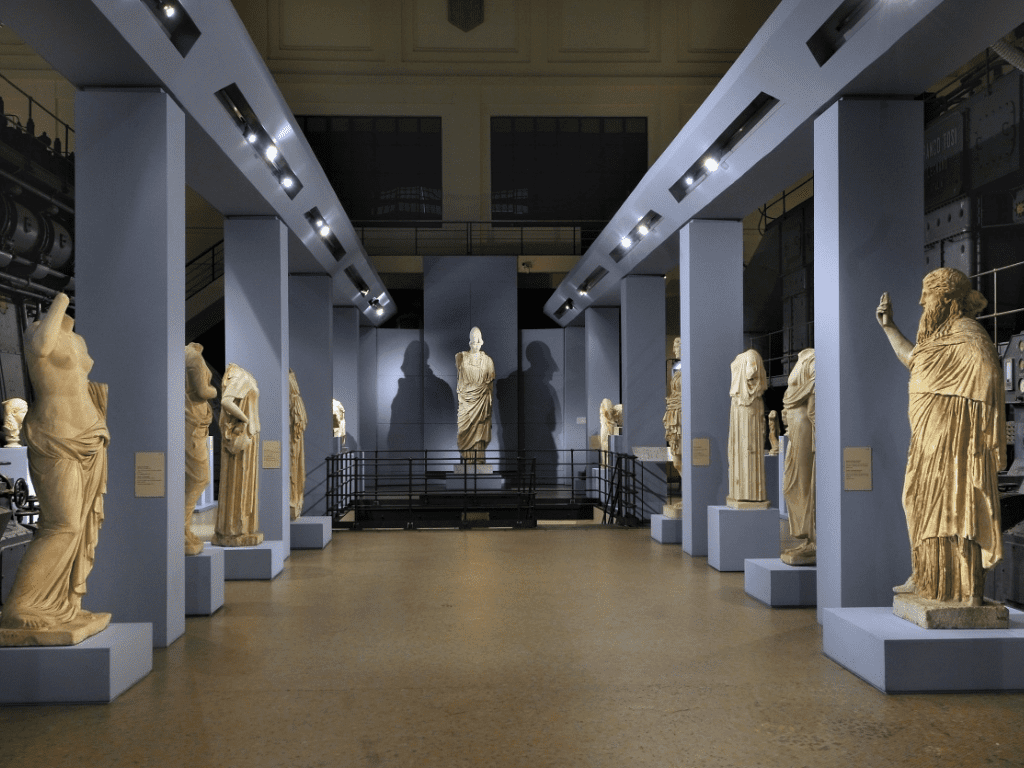
Why the Centrale Montemartini Is Unlike Any Other Museum in Rome
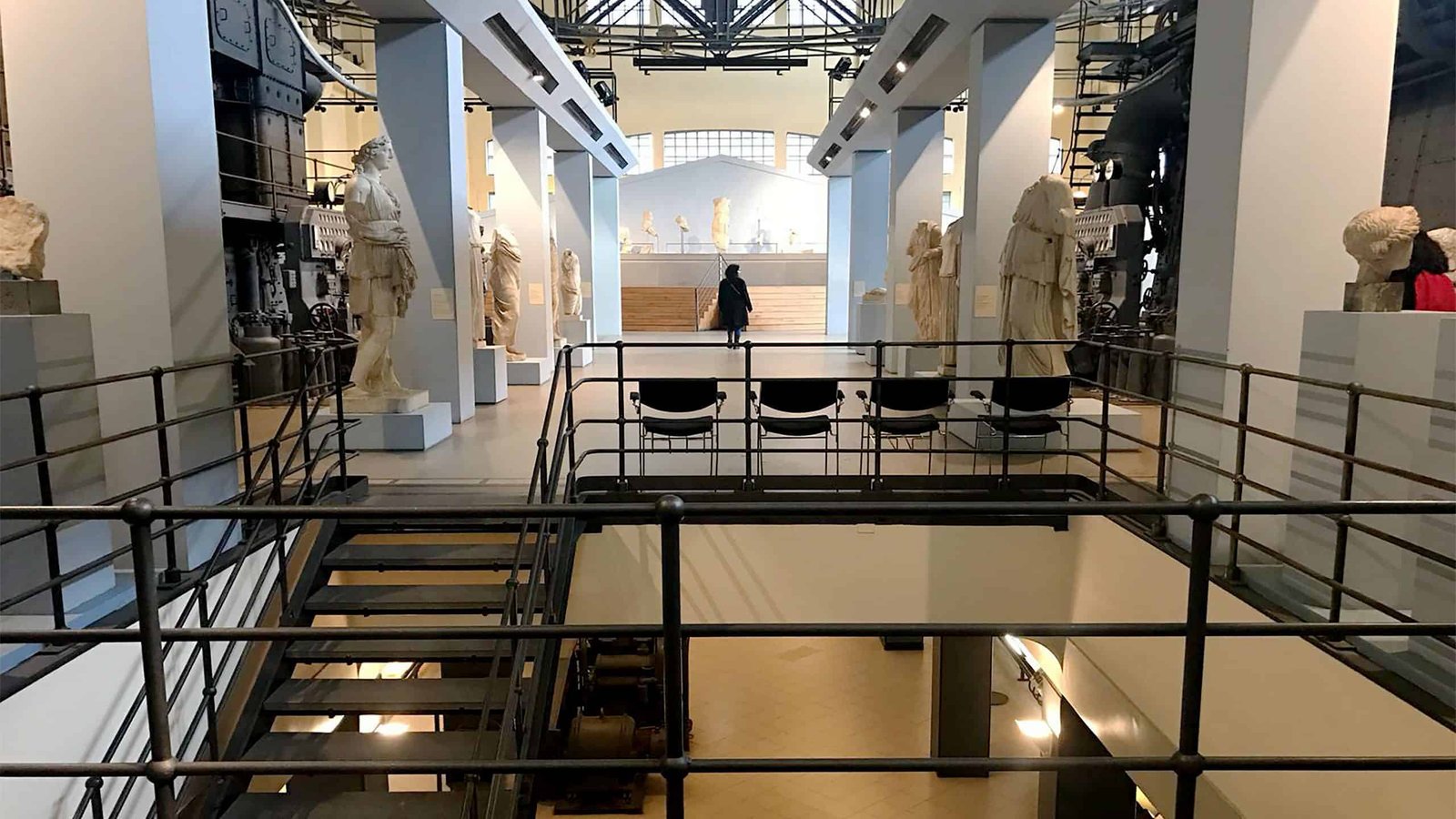
In Rome, archaeological museums as a rule ask the visitor for an effort of imagination: you have to mentally remove the display case, the panel, the white wall, and put the statue back inside the portico or garden it was sculpted for. At the Centrale Montemartini the opposite happens. Here the statue stands in front of a diesel engine as big as a house, and nobody pretends the two objects have anything in common. The effect comes precisely from that declared distance: white marble against black cast iron, fake flesh against real steel, the Olympian god against the machine that lit a city.
Where to buy tickets. The Centrale Montemartini is a venue of the Civic Museums: tickets and hours at centralemontemartini.org, information at 060608. You almost always get in without a line. The guided tour with ticket included is on GetYourGuide. Verified on September 28, 2026.
The museum holds about 400 Roman sculptures, along with inscriptions, mosaics and funerary goods: pieces that were already displayed at the Capitoline Museums or that slept in the city storerooms, invisible to the public for decades. They are in large part the materials that came to light in the demolitions and construction of Rome as capital, between the end of the nineteenth century and the first decades of the twentieth, when the Esquiline and the new neighborhoods were dug up with pickaxes to make room for the homes of the Kingdom's clerks.
The Centrale Montemartini is the museum that works best with people who say they hate museums. In here it's hard to get bored, even for teenagers grounded with their parents. It's also the right place to send someone who has already done the Colosseum, the Vatican and the Forums and thinks they've understood Rome.
How to Get to the Centrale Montemartini
By subway
The quickest solution is Metro line B, Garbatella stop: you come out, walk down toward the river and in a few minutes you're in front of number 106 of Via Ostiense. The previous stop, Piramide, works just as well if you want to arrive on foot taking in a piece of the neighborhood: it's about 20 minutes of walking straight along Via Ostiense, with no turns, with the Ostiense station and the Gasometer as a backdrop. The Piramide stop itself is the terminus of the railway to Ostia Lido, handy for those arriving from the coast.
By train and by car
Roma Ostiense station, served by regional trains and by the link with Fiumicino airport, is a short distance away: those arriving from outside Rome can get off there and reach the museum on foot. By car things get complicated, as always in this area: Via Ostiense is a busy artery and free parking spots are few. In the museum's inner courtyard there are spaces reserved for vehicles with a disability permit. For everyone else it's best to leave the idea of the car behind and take the metro.
The practical tip on the entrance
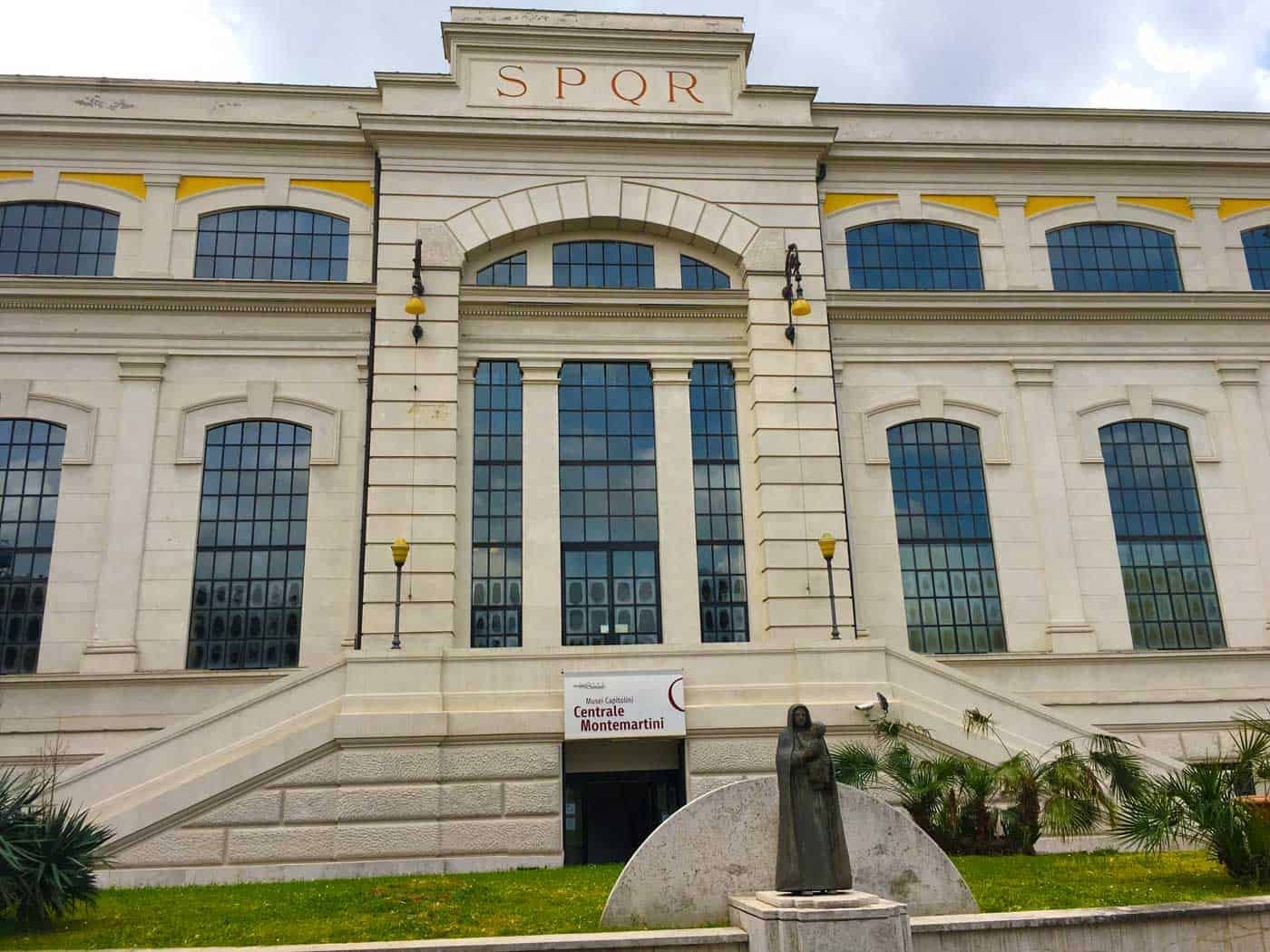
The entrance is at Via Ostiense 106 and goes through an inner courtyard: it's not a door that opens onto the sidewalk, and anyone looking for a monumental facade risks walking right past it. The front of the building, with its brickwork and large grid windows, is a piece of early twentieth-century industrial architecture worth a photograph even before going in.
Tickets, Hours and Free Admission at the Centrale Montemartini
How much the ticket costs
The official price list distinguishes two situations. When there is no temporary exhibition at the Centrale, the ticket is 11.00 euros full price and 6.50 euros reduced. When there is an exhibition, the price automatically includes that too: in summer 2026, with the show devoted to Italian fashion of the years 1955-1975, you pay 14.50 euros full price and 10.00 reduced. The reduction goes to non-resident citizens between six and 25 years old, to teachers of state and municipal schools, to Bibliocard holders, to annual Atac pass holders and to groups of at least 20 people.
The Capitolini Card, the single ticket with the Capitoline Museums
Anyone who wants to see the two venues of the same museum buys the Capitolini Card: 15.50 euros full price, 11.50 reduced, valid for seven days, it includes one entry to the Capitoline Museums on the Capitoline Hill and one to the Centrale Montemartini. If temporary exhibitions are open at the two venues, the supplement costs 5.50 euros. The math is quickly done: two separate tickets would cost more, and the seven days of validity are enough even for someone with a long weekend who doesn't want to squeeze two museums into the same morning. Better not to do it on the same day anyway: they are two visual experiences too different to be stuck together.
Who gets in free
The list of free admissions is long and it's worth reading before reaching for your wallet. Entering without paying are residents of Rome and the Metropolitan City showing ID, MIC card holders, children under six, people with disabilities with one companion, licensed European Union tourist guides with a valid license, ICOM and ICOMOS members, members of the Accademia dei Lincei, journalists with a professional ID, and everyone on the first Sunday of every month. Roma Pass holders get free entry at the first two sites with the 72-hour pass and at the first with the 48-hour one.
The MIC card and discounted Wednesday
The MIC card costs 5.00 euros, lasts 12 months from activation and opens the Roman civic museum system free of charge. It is valid for residents, for those with a temporary address in the city and for students of public and private universities of the Metropolitan City of Rome. Five euros for a year of civic museums: it's the best deal the Capitoline administration has put in its citizens' hands, and it keeps amazing me how many Romans know nothing about it. There is also a 50 percent reduction reserved for non-residents on Wednesdays, in the last two hours of opening.

Hours, booking and presale
The museum is open Tuesday to Sunday from 9.00 to 19.00, with last entry at 18.00. Monday is a closing day, as are May 1 and December 25. On December 24 and 31 you can only enter in the morning, between 9.00 and 14.00. You don't need to book for an individual visit: you show up and buy the ticket at the desk, with no presale fee, in cash or by card. Anyone who prefers to buy online or at 060608 pays one euro more in presale and should know that tickets bought online are neither refundable nor changeable. Groups of between five and 25 people book free of charge at 060608, with at least five pre-purchased tickets. School classes enter free with documentation on school letterhead.
The History of the Giovanni Montemartini Thermoelectric Plant
Rome wants its electricity
At the beginning of the twentieth century Rome bought electricity from private companies, on terms that the council led by Ernesto Nathan judged legalized robbery. Nathan, mayor from 1907 to 1913, is the mayor of schools, aqueducts and municipalized services: his administration decided that the City should produce for itself the power for public lighting and for the trams. From that political choice comes the plant on Via Ostiense, the city's first public plant for producing electricity. It was inaugurated on June 30, 1912 and began producing the following day.
Who Giovanni Montemartini was
Giovanni Montemartini was an economist, a theorist of the municipalization of public services in Italy, and the councilor for technological services in the Nathan administration. It was he, on the level of ideas even before the administrative one, who argued that water, electricity and transportation should belong to the community and not to a private concessionaire. He died in 1913 during a city council debate, while defending his positions: the city named after him the power plant he had wanted. Today it's a name that almost no one connects with a real person, and it's worth remembering before you go in, because it changes the way you look at those machines.
The expansions of the 1930s
The plant grew along with consumption. On April 21, 1933, two large diesel engines made by the Franco Tosi company of Legnano were put into operation, in the presence of Benito Mussolini: two machines of 7,500 horsepower each, 15,000 in total, with crankshafts made of three pieces for a total weight of 81 tons and a length of more than 20 meters. At the end of that decade a third steam turbine of 20,000 kilowatts arrived, fed by Tosi-Steinmuller boilers. These are the machines you see today on the first floor and in the boiler room: not replicas, not models, but the restored originals.
Decline and decommissioning
After half a century the plant was technologically old and Rome's power production had moved elsewhere. The plant was decommissioned in 1963. Decades of semi-abandonment followed, with the building used as a depot and a warehouse: the normal fate of Italian industrial archaeology, which generally ends up demolished before anyone realizes what it's worth. Here the realization came in time, and for a reason that has nothing to do with electricity.
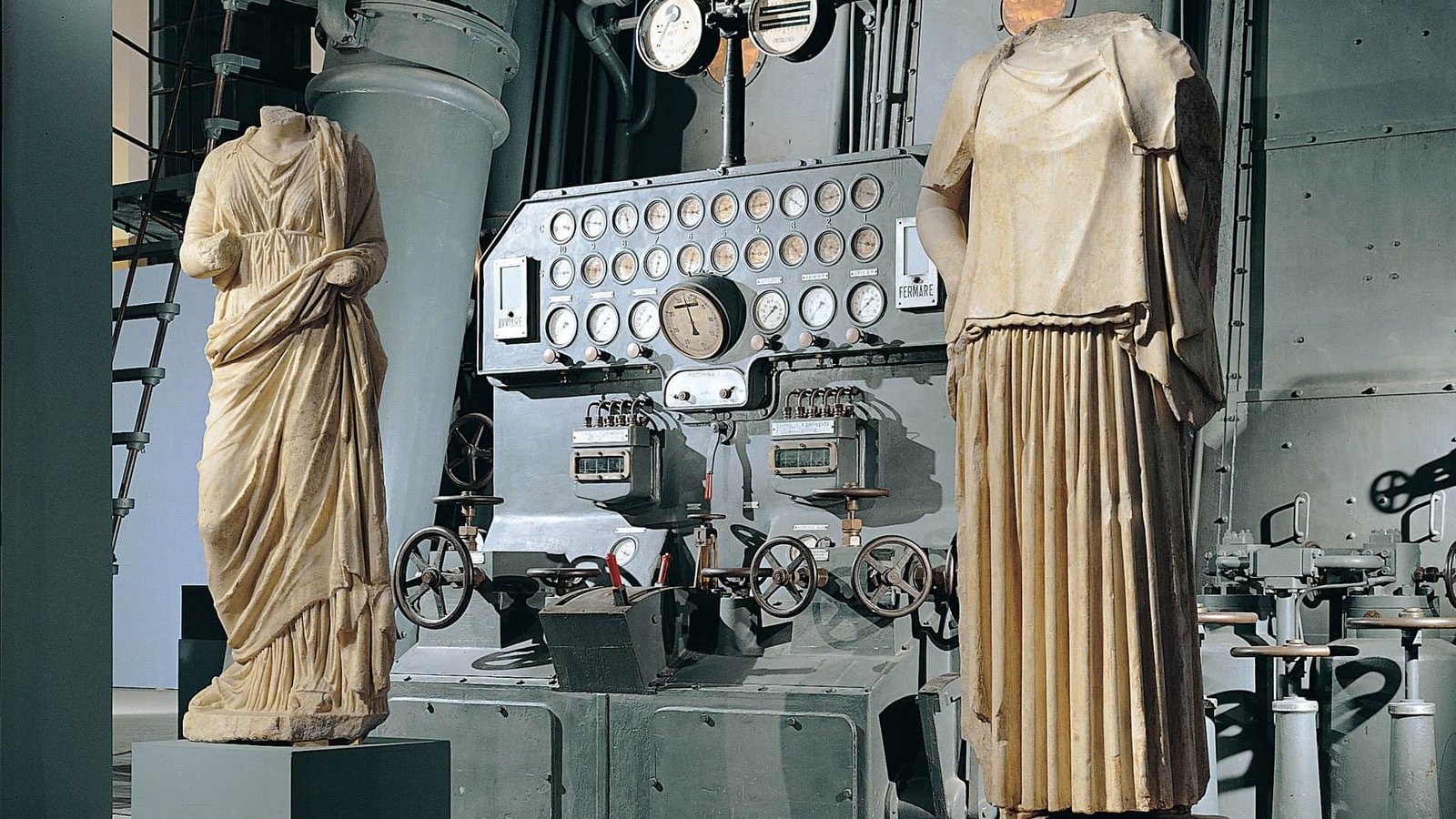
Machines and Gods: how an exhibition became a museum
The practical problem that started it all
In the 1990s the Capitoline Superintendency for Cultural Heritage had to renovate large sections of the Capitoline Museums. Closing the rooms meant taking hundreds of works away from the public for years. The solution was a large exhibition that would allow work on the Capitoline Hill while keeping the sculptures on view, and the empty spaces of the Centrale Montemartini, punctuated by the gigantic surviving machinery, seemed the right place to try out new museum display solutions. It's worth stressing: the most imitated museographic masterpiece in Italy was born from a construction site problem.
Acea and the Capitoline Museums, two parallel projects
Acea carried out the transformation of the building into an exhibition venue, adapting the spaces to their new use and restoring the machines, while the Capitoline Museums handled the archaeological side. The two interventions went ahead at the same time and in harmony, and that is exactly why the result still holds up today. The guiding idea was radical: two opposite worlds, classical archaeology and industrial archaeology, placed side by side without either of them being tamed. The objects that were already there and those brought in from elsewhere had to stay intact and not distort each other. From that play of contrasts came the title of the exhibition, Le Macchine e gli Dei (Machines and Gods), opened to the public in October 1997.
From temporary to permanent
The response of the public and of the experts was such that in 2001 the experiment became permanent: the Centrale Montemartini Museum was born, a branch of the Capitoline Museums. Since then the route has expanded, new spaces and new finds have arrived, and works that nobody had seen for generations have come out of storage. In November 2016, after a further intervention, the room housing the carriages of Pius IX's train opened.
The Centrale Montemartini room by room
The route is simple and runs over several levels: the atrium, the Columns Room, the Machines Room, the Boiler Room and, at the end, the Pius IX Train Room. There are no forks, you can't get lost. What you need is to slow down: the temptation, here, is to look at the machines and forget the marbles, or the other way around.
The atrium of the Centrale Montemartini
The entrance is also the ticket office and bookshop room, and it already houses ancient material: it's the moment when the eye gets used to the coexistence of an industrial floor and Roman statuary. A banal piece of advice that almost nobody follows: take the map and understand right away that the museum develops vertically, otherwise you risk leaving without having seen the upper rooms.
The Columns Room of the Centrale Montemartini
Why it's called that
The name comes from the many reinforced concrete pillars that held up the three boilers on the upper floor. If you look up you can still see the hoppers, truncated-pyramid funnels that collected the slag from the coal burned in the boilers, and a hatch allowed it to be recovered. That slag wasn't thrown away: it ended up in Roman villas and parks, used for drainage of the soil. It's a detail that explains better than any panel what an urban economy was before the throwaway age.
The faces of the Republic
The first section collects late Republican portraiture: heads and busts from the 1st century BC, with dry features, wrinkles, crooked ears, a thin neck. It's what is called Republican verism, a taste that rewarded age and authority instead of beauty. Anyone who arrives at the Centrale Montemartini after seeing the idealized heads of the emperors elsewhere understands in 10 minutes how much Roman sculpture changed in a century.
The Esquiline necropolis and the San Lorenzo complex
Here is concentrated the Republican Rome brought to light in the Esquiline necropolis, the large burial area excavated during the 19th-century urbanization of the hill. Next to it, the materials from the San Lorenzo complex. These are the finds that tell the story of the city of the living through that of the dead: urns, grave goods, inscriptions with the names of freedmen and craftsmen, the only trace left of people no historian would ever have named.
Crepereia Tryphaena and her doll
In the Columns Room is displayed the funerary assemblage of Crepereia Tryphaena, a young woman buried in the imperial age, famous for the articulated ivory doll found next to her along with her jewelry. It's the object that stops any group in its tracks, adults included: a doll with movable joints, the belongings of a girl who died too young, the comb, the rings. In the section of funerary and domestic furnishings there is also a funerary bed in bone decorated with Dionysian scenes, a rare and extremely fragile type of artifact.
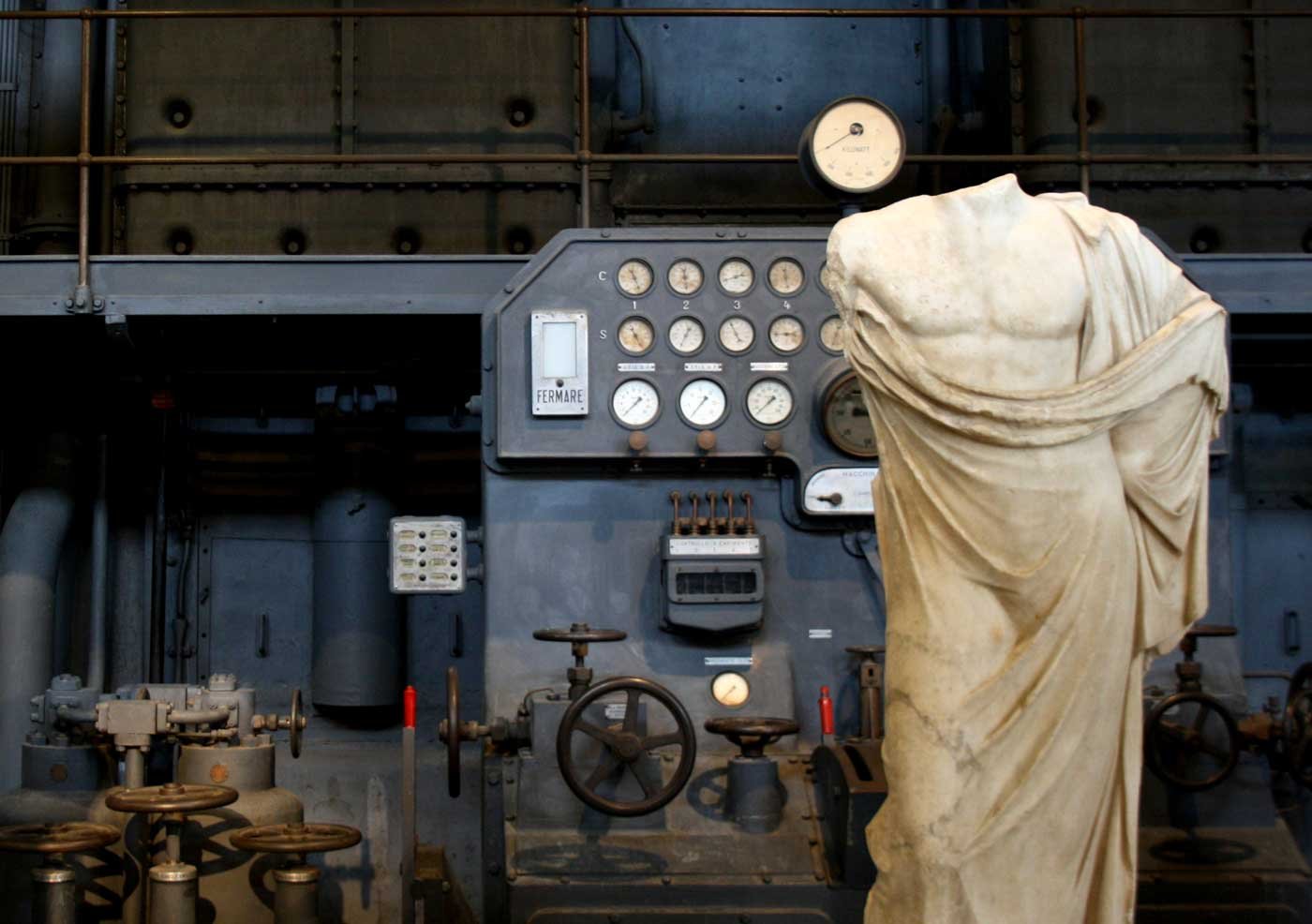
The Machines Room of the Centrale Montemartini
The two Franco Tosi diesel engines
This is the room everyone photographs and the one that made the museum famous around the world. Two enormous restored two-stroke diesel engines, the steam turbine, the Art Nouveau furnishings that went with the machinery: iron, brass, dials, railings. The engines are the ones installed in 1933, and the figures aren't a spec sheet detail: a three-piece crankshaft, 81 tons, more than 20 meters long. In front of this mass the ancient sculpture doesn't lose, it gains. If I had to name a single spot in the museum where you should stand for five minutes without saying anything, it would be this one.
The pediment of the Temple of Apollo Sosianus
In the Machines Room the group of pedimental sculptures from the Temple of Apollo Sosianus has been reassembled, the temple whose remains can still be seen next to the Theater of Marcellus. The subject is the battle between Greeks and Amazons, with Heracles and Theseus and the presence of Athena and Nike. What makes this ensemble extraordinary is its origin: they are Greek originals from 450-425 BC, brought to Rome in the Augustan age and reused to decorate the place of worship. Not Roman copies, not imperial-age replicas: marble carved in Greece at the height of classicism, moved 2,000 kilometers to make a good impression in a Roman temple. Alongside the pediment are displayed the friezes with the triumphal procession and combat scenes that decorated the inside of the cella, and a small circular monument from the adjacent area, perhaps a lustral basin.
The Capitoline Hill, Largo Argentina and the Caelian Hill
The room collects the finds from the monumental center of the ancient city: the materials from the Capitoline Hill, those from the sacred area of Largo di Torre Argentina, those from the Caelian Hill and the decoration of the domus of Villa Rivaldi. From Largo Argentina comes the colossal head of the goddess Fortuna, the remains of an acrolith, that is, a statue whose head, hands and feet were marble mounted on a body of a different material. A head as tall as a man, which belonged to a cult figure as tall as one floor of a building. Looking at it at floor level, without the podium and without the half-light of the cella, is a privilege that no ancient person ever had.
The copies of Greek originals and the portrait of Cleopatra
A section of the Engine Room is devoted to Roman replicas of famous Greek originals, the repertoire that furnished the homes, baths and gardens of the imperial ruling class. Among the masterpieces the museum points out in this room is a portrait identified as Cleopatra: an attribution debated by generations of scholars, which is worth looking at knowing that it is a proposed identification and not a documented certainty. The same area includes works from the Hadrianic age, among them the figure of Antinous portrayed as Apollo.
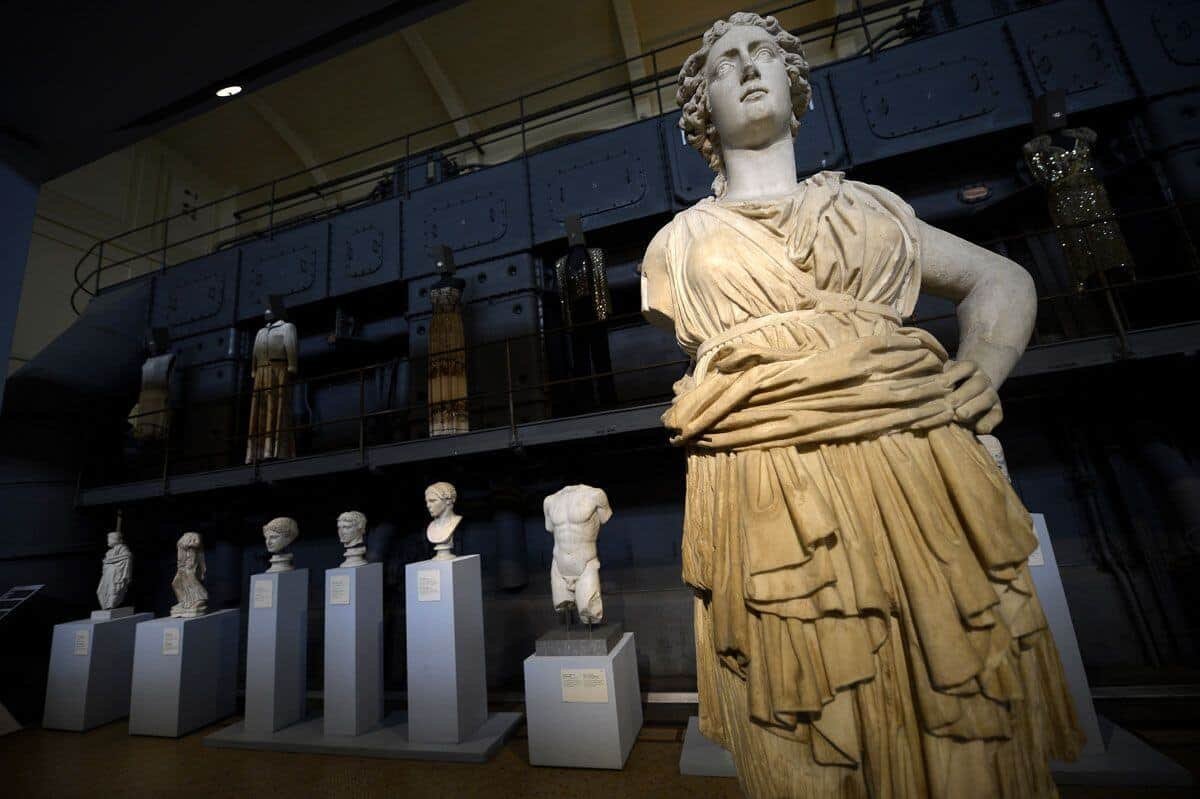
The Boiler Room of the Centrale Montemartini
A Thousand Square Meters and a Single Boiler
The Boiler Room is a rectangular hall of more than 1,000 square meters, dominated by a large steam boiler that rises from floor to ceiling in a tangle of pipes, bricks and metal walkways. It is the only survivor of the three the plant housed. The scale is that of an industrial cathedral, and the statues around it look like the faithful in a procession. If the Engine Room is the room for photography, this is the room of silence: here you have to walk softly and look up.
The Horti Sallustiani and the Gardens of Power
The works displayed in this room mostly come from the horti, the large residences with parks that surrounded Rome and that over the course of the imperial age almost all passed into the emperor's holdings. The Horti Sallustiani, born from the property of the historian Sallust in the valley between the Pincio and the Quirinal, are the best-known case: an urban park equipped with pavilions, fountains and sculpture collections, which the 1800s excavations returned in pieces. Alongside are the materials from Villa delle Vignacce on Via Latina, from the Horti of the Esquiline on Via Ariosto, from the domus of Fulvio Plauziano, from the domus on Via Cavour and from the one at Porta San Lorenzo.
The Horti Liciniani, the Seated Girl and the Hunting Mosaic
The Horti Liciniani on the Esquiline, which scholarly tradition links to the emperor Licinius Gallienus (253-268 AD), yielded two of the pieces that alone would be worth the ticket. The first is the Statue of a Seated Girl, inventory MC 1107, Pentelic marble, 108 centimeters high, datable to the 2nd century AD, found on the Esquiline near the so-called Temple of Minerva Medica. It portrays a girl seated on a stool, her torso bent forward, her legs crossed, her left arm resting on her leg, her hair gathered in a messy way, a heavy cloak over a thin dress. The face is still that of a child. The composition is meant to be walked around, and anyone who looks at it from one side only misses half the sculpture: the model goes back to Hellenistic art, the execution is Roman and extraordinary.
The second is the large mosaic with hunting scenes, inventory AntCom03636, dated to the early 4th century AD, 15 meters by 9: an entire floor, not a fragment, found in 1904 in the area of Santa Bibiana. It's the piece the general public doesn't expect and that, displayed vertically, reads like a wall hanging. 15 meters of late antique mosaic in a room of boilers: that's what bold museum design means.
Polyhymnia and the Horti Spei Veteris
The statue of the Muse Polyhymnia, inventory MC2135, 159 centimeters tall, is a Roman copy of a Hellenistic original: the muse leaning on a small pillar, her chin on her hand, her gaze going elsewhere. The museum's official entry assigns it to the section of the Horti Spei Veteris and gives its discovery on Via Terni in 1928, that is, in the area of the great imperial residence that stretched behind what is now Santa Croce in Gerusalemme Basilica. It's the museum's most published sculpture, the one that ends up on the cover: the pensive pose against the black cast iron is the image that went around the world.
Marsyas and Villa delle Vignacce
From Villa delle Vignacce, on Via Latina, comes the statue of Marsyas in rosso antico marble: the satyr who challenged Apollo to a musical contest, lost and was flayed alive. The red marble is a precise iconographic choice, not a decorative whim: the skin of the torture. The group belongs to a type common in the great residences, and seeing it here, hanging from its own pain in front of a steam pipe, produces an effect that no traditional display would achieve.
The Necropolises and Funerary Monuments of Via Ostiense
The final section collects funerary monuments and materials from the Ostiense necropolis, that is, the burials lined up along the road that passes in front of the museum. It's a circle that closes: the tombs you see in here once stood a few hundred meters further on, on either side of the same Via Ostiense that today you travel by bus. If you have time, you can continue the story at the Museum of Via Ostiense, inside Porta San Paolo.
The Pius IX Train Room
An 1858 train inside a power plant
The last room of the route, created in 2016 from the former Boiler Room number 2 and completely renovated, houses the carriages of Pius IX's train. The train was built in 1858 on commission from the railway companies Pio Centrale and Pio Latina, which had it made in France and gave it to the pontiff. The pope used it for the first time on July 3, 1859, on the line between Porta Maggiore and Cecchina, heading toward Albano.
The three carriages
The train is made up of three elements. The first carriage is the Loggia of Blessings, with the balcony from which the pontiff could appear and bless those along the tracks: a papal balcony mounted on a railway car, with curtains and small columns. The second is the Throne Room, the ceremonial space. The third is the chapel, with a highly refined exterior decoration. The museum attributes to Jean-Leon Gerome the painted roundels that adorn it. These are objects that tell of a precise moment in Italian history: the Papal States accepting the railway, after fearing it for years as an instrument of dangerous modernity, and immediately turning it into a mobile liturgy.
My verdict on this room
It's the part of the museum that divides people the most. Some find it a foreign body compared with classical archaeology and some, like me, consider it the logical completion of the story: three centuries of machines, from the papal train to the diesel engines, inside a building that lived on machines. The practical advice is not to leave it for last when you're already tired: it deserves more attention than it usually gets.
How long a visit to the Centrale Montemartini takes
A careful tour takes an hour and a half. If you want to read the captions and stop in front of the main pieces, you comfortably get to two hours. With a school group, or with a guide, it's a full two hours. If you only have an hour, you see the Machines Room and the Boiler Room and knowingly give up the Columns Room, a sacrifice I advise against but which at least leaves the spectacular part intact. The museum isn't big: it's the quality of attention, not the length of the route, that makes the difference.
The Centrale Montemartini with kids
Why it works so well
I've been saying for years that this is the right archaeological museum for kids in Rome, and the reason is simple: it doesn't ask them to imagine anything. A seven-year-old in front of a Corinthian capital gets bored, because the capital does nothing. In front of an 81-ton engine with a 20-meter shaft, on the other hand, the kid asks you the question. The machines catch their attention, and once the attention is caught the statues sneak in. Add the articulated doll of Crepereia Tryphaena, which no child ignores, and the pope's train with its balcony: three narrative hooks in one museum.
Practical tips for families
The spaces are fully navigable even with a stroller, and there is a family restroom with child-sized fixtures and a changing table. The museum's free app includes a route dedicated to the youngest, with video content designed for them, and it's worth downloading before you go in instead of fighting with the network at the entrance. A tip for parents: give the child a task, for example counting how many statues have a head that isn't their own. In archaeological museums it's a game that lasts the whole visit.
Accessibility at the Centrale Montemartini
People with mobility disabilities
Access is from Via Ostiense 106 through the inner courtyard, with a protected pedestrian path and no architectural barriers. In the courtyard there are spaces reserved for vehicles with a disability permit. The gate opens by ringing the intercom on the left side or by calling 06 67105431. The exhibition spaces run over several levels and are all reachable. Wheelchairs are available on request and seats for resting are spread along the route. Admission is free for people with disabilities and for one companion.
Blind and visually impaired people
A LOGES-type tactile path connects Via Ostiense 106 entrance to the museum. The elevators have voice announcements and buttons with Braille numbering. The museum's app contains dedicated audio descriptions, and there are tactile panels with Braille texts and orientation diagrams. On request, tactile visits with trained staff are organized: they have to be arranged in advance, they can't be improvised on the same day.
Deaf people
There is an introductory video of the museum in Italian Sign Language and a route of LIS videos inside the app, which can be called up with the QR codes distributed in the rooms. The museum also makes available its plan for the removal of architectural barriers, which can be viewed and downloaded.
When to go to the Centrale Montemartini
The museum has no lines, and it's one of the few things in Rome of which that can be said without qualification. The worst time is Sunday afternoon, and in particular the first Sunday of the month, when free admission brings in many more people than usual: the Machines Room with 40 people loses exactly what makes it memorable. The best time is Tuesday or Wednesday morning, right at opening, with the light coming in through the high windows and the halls still empty. If you can choose the month, choose winter: the building is an industrial shed, in summer you feel the heat and in mid-July the afternoon in the Boiler Room is an ordeal. Let me recall the basic rule, the one people get wrong most often: it's closed on Monday, and it's not the Monday of some state museums that open anyway.
What to see around the Centrale Montemartini
The Gasometer and industrial Ostiense
Coming out of the museum you're in the neighborhood that best tells the story of the productive Rome of the 20th century. The Gasometer, the metal structure of the former gas works, is the most recognizable silhouette on the skyline and can be seen from half the neighborhood: it's the building Romans call the Colosseum of industry, and from any point you look at it the comparison with the Centrale Montemartini holds up. Around it are the old General Markets, across from the museum on the other side of the street, and a number of sheds converted into university and cultural spaces.
The street art of Via Ostiense
Via Ostiense and the side streets host one of the densest concentrations of large murals in the city. It's not an organized open-air museum: these are works accumulated over some 15 years on blank walls, shutters and the ends of small apartment buildings. The right way to see them is to walk from Piramide toward the Gasometer keeping your eyes up: some of the best pieces are on side facades that you don't notice from the main street.
Piramide, the Non-Catholic Cemetery and Testaccio
A few stops away there is a group of places that go well together in the same day: the Pyramid of Cestius, the tomb of Gaius Cestius built into the Aurelian Walls, and next to it the Non-Catholic Cemetery, where Keats, Shelley and Gramsci rest. A little further on Testaccio begins, with Monte dei Cocci, the artificial hill made of broken amphorae that is the oldest industrial waste in Europe, the Nuovo Mercato di Testaccio for lunch and the Museo Diffuso del Rione Testaccio to understand the neighborhood from the inside.
Garbatella and San Paolo
On the opposite side, walking up from the metro stop, you enter Garbatella, the neighborhood of lots and courtyards born in the 1920s as a working-class garden city: it's the right place for an hour of aimless walking, among outdoor staircases, pergolas and little squares, and it also hosts the urban gardens that tell of its original vocation. Continuing along Via Ostiense you reach the Basilica of Saint Paul Outside the Walls, one of the four papal basilicas, with a Cosmatesque cloister that alone justifies the trip.
A curiosity about the Centrale Montemartini
The most instructive curiosity concerns the name of the building and the person it's named after. Giovanni Montemartini wasn't an engineer, wasn't an industrialist and had nothing to do with turbines: he was an economist, the leading Italian theorist of the municipalization of public services, and he sat in Ernesto Nathan's administration as councilor for technological services. His thesis was that a city's water, light and transportation could not be left to the profit of a private concessionaire, because their nature as natural monopolies would always have produced high rates and poor services. The power plant on Via Ostiense was born as a practical demonstration of that thesis: the city produces, the city distributes, the city sets the price.
Montemartini died in 1913, during a city council debate, a year after the plant's inauguration. The city decided to name the power plant after him, and so the name of a theorist of public economics ended up attached to an archaeological museum that millions of people around the world know today without the faintest idea who he was. I find it one of the most elegant ironies of Roman place names: a man who spent his life writing about rates and municipal budgets became immortal thanks to a Greek pediment from the fifth century BC and a diesel engine from Legnano.
There's a corollary worth adding. Nathan's era was short, from 1907 to 1913, and it's the only secular, reformist administration of the Rome of those years: elementary schools, aqueducts, municipalized services, school lunches. Many of those works were demolished or forgotten. The power plant, saved by chance by a Capitoline Museums construction project 80 years later, is today the most visited surviving monument of that administration. If you're looking for proof that the preservation of heritage often depends on luck, this is it.
Something nobody tells you about the Centrale Montemartini
No guide writes it, but the Centrale Montemartini was born as a stopgap solution to a construction logistics problem. In the 1990s the Capitoline Superintendency had to renovate large sections of the Capitoline Museums on the Capitoline Hill. The work meant emptying entire rooms, and nobody wanted to close hundreds of sculptures to the public for years. What was needed was a warehouse you could visit: a place to park the works while leaving them visible. From that utterly prosaic need came the display that international museography magazines cite today as an example.
The second part of what isn't said concerns the size of the gamble. Placing classical archaeology and industrial archaeology side by side, in 1997, wasn't a fashionable idea: it was a risk that could have ended in ridicule. The rule the curators gave themselves was that neither world should be tamed to make room for the other. The machines would not become a neutral backdrop painted white, and the statues would not be turned into industrial knickknacks. Acea restored the machinery for real, the way a cultural asset is restored, and the Capitoline Museums put the exhibition together the way a serious archaeological exhibition is put together, with topographical and chronological criteria.
The third thing nobody says is the most practical: many of the works displayed here were not visible anywhere else. They didn't come only from the Capitoline Hill, they came from the municipal storerooms, where for decades lay pieces that had entered after the excavations of the 19th-century urbanization and never come out again. The Centrale Montemartini didn't move a museum: it opened one that didn't exist. The number that circulates, about 400 sculptures, includes a considerable amount of material that no visitor had ever seen before 1997.
The advice I give you for visiting the Centrale Montemartini
The serious advice is only one: do the route twice, in two different directions of attention. The first time look only at the machines. Go up, follow the crankshaft for all its 20 meters, count the boiler's walkways, look for the coal hoppers in the ceiling of the Columns Room, read the Franco Tosi plates. Deliberately ignore the marble. The second time, go back and look only at the sculptures, pretending the machines aren't there. You'll realize that they are two museums on top of each other and that most visitors see neither of them well, because they spend their time marveling at the contrast without ever bringing the two terms into focus.
Second piece of advice, on timing. Arrive at opening, at 9:00, on a Tuesday or a Wednesday. The museum is almost empty and the natural light from the high windows does a job that artificial lighting can't do: the Pentelic marble of the Seated Girl changes depending on the hour. Avoid the first Sunday of the month if you can afford to pay for the ticket, because free admission brings in many more people and this is a museum to be enjoyed in silence.
Third piece of advice, on the ticket. If you also plan to visit the Capitoline Museums, buy the Capitolini Card and use it on two different days: it costs less than two separate admissions and saves you the classic mistake of cramming two museums into the same afternoon. If you're a resident of Rome or the Metropolitan City, admission is free, so bring an ID and don't let them sell you anything. If you're a student at a Roman university, €5 for the MIC card opens this museum and all the other civic ones for 12 months. Last: download the museum's app before you go in, not in front of the ticket desk.
Another well-known fact, yet rarely cited
Everyone knows that at the Centrale Montemartini you see Roman statues. Almost no one dwells on the fact that some of the museum's most important sculptures are not Roman at all: they are Greek, and they are originals. The pedimental group of the Temple of Apollo Sosianus is made of marbles carved in Greece between 450 and 425 BC, at the height of the classical age, and brought to Rome in the Augustan age to decorate the front of a temple that stood next to the Theater of Marcellus. They are not imperial-age copies like the vast majority of the so-called Greek sculptures you see in Italian museums: they are the real pieces, the ones that came out of an Attic workshop when Pericles was alive.
The subject is an Amazonomachy, the battle between Greeks and Amazons, with Heracles and Theseus as protagonists and Athena and Nike presiding over the fight. The fact that a Roman temple of the Augustan age displayed on its facade Greek sculptures four centuries old says a great deal about how Rome treated Greek art: as a capital of prestige to be acquired, transported and reassembled. The patron, Gaius Sosius, was a politician who had fought on Antony's side and had been pardoned by Octavian. The temple rebuilt with Greek marbles was also a declaration of rank.
Next to the pediment the museum displays the friezes with the triumphal procession and combat scenes that adorned the inside of the cella, and a small circular monument from the adjacent area, perhaps a lustral basin. In our view this ensemble is the most important thing in the museum from the art-historical point of view, and it's also the one in front of which the most people walk past without stopping, because everyone is photographing the engine.
The right photo to take at the Centrale Montemartini
The photograph everyone takes at the Centrale Montemartini is the Machines Room shot horizontally, with the statues in the foreground and the diesel engine behind. It always works and it isn't wrong. But the right photo, the one that truly conveys the sense of the place, is another one and it's vertical: you put the camera or the phone low, at knee height, frame a sculpture from below looking up, and let the industrial structure rise in the background up to the ceiling. In that format the statue regains the monumentality it had when it stood on a podium, and the machine becomes architecture instead of an object.
The second shot I recommend is in the Boiler Room: the Muse Polyhymnia, or the Seated Girl, with the steam boiler out of focus behind. You need a wide aperture or your phone's portrait mode: the light marble against the dark blurred mass is the contrast that made this museum famous in magazines around the world. Third shot, less obvious: the ceiling of the Columns Room with the truncated-pyramid hoppers. Nobody photographs it and it tells the story of the building better than any other framing.
Technical note, because it's a frequent question. The natural light from the high windows is excellent in the early morning hours and becomes harsh in the middle of the day. Flash is useless and flattens everything. Photographs for personal use are allowed in Rome's civic museums, while for tripods, professional equipment and filming intended for commercial use you have to ask for authorization: it's better to ask ahead at the single number 060608 instead of arguing with the staff in the room.
Some important events that happened here in history
The first event is the inauguration of June 30, 1912, with Mayor Ernesto Nathan cutting the ribbon on Rome's first public plant for the production of electric power. Production began the next day. In a city that then had little more than half a million inhabitants and was building its new neighborhoods, that date marks the moment when public lighting and trams stopped depending on a private supplier.
The second event is from April 21, 1933, the day of the Natale di Roma: the start-up of the two Franco Tosi diesel engines from Legnano, in the presence of Benito Mussolini. The regime had understood the propaganda value of the plant and made it a showcase of modernization. The figures of the machines installed that day remain impressive: 7,500 horsepower each, crankshafts in three pieces for a total of 81 tons and more than 20 meters in length. At the end of the decade a third steam turbine of 20,000 kilowatts arrived with Tosi-Steinmuller boilers.
The third event is a negative date: 1963, the year of decommissioning. The plant was obsolete and production had moved elsewhere. A long period of abandonment followed, with the building reduced to a depot. The history of Italian industrial archaeology is full of buildings like this one that ended up demolished in the 1970s and 1980s.
The fourth event is October 1997, with the opening to the public of the exhibition Le Macchine e gli Dei. The fifth is 2001, when the temporary experiment became a permanent museum venue: the Centrale Montemartini Museum, the second site of the Capitoline Museums. The sixth is November 2016, with the opening of the Pius IX train room, created from the former boiler room number two. Six dates, and none of them had been planned as part of a design: it's a museum built through an accumulation of opportunities.
Who has passed through the Centrale Montemartini
The first name is Ernesto Nathan, mayor of Rome from 1907 to 1913, who inaugurated the plant on June 30, 1912. Nathan is an anomalous figure in the history of the city: born in London, from a Jewish family, a Mazzinian, grand master of the Grande Oriente d'Italia, elected head of a secular coalition in a Rome still dominated by clerical notables. The power plant on Via Ostiense is the most visited surviving document of his administrative era.
The second name is Giovanni Montemartini, who is the political inspiration of this building even before being its namesake, and who tied his memory to it by dying in 1913 in the city council.
The third name is Benito Mussolini, present on April 21, 1933 at the start-up of the new diesel engines. It's a passage the museum documents and that is worth knowing: the power plant served the regime's propaganda as a symbol of industrial power, in the same way that 20 years earlier it had served the reformist propaganda of the Nathan administration. The same building, two opposite rhetorics.
The fourth passage is that of Pius IX, who never came here in life, but whose personal train occupies the museum's last room today. The pontiff boarded that train for the first time on July 3, 1859, on the stretch between Porta Maggiore and Cecchina.
The fifth name is Jean-Leon Gerome, a French painter among the most celebrated of the second half of the 19th century, to whom the museum attributes the painted roundels that decorate the chapel of the papal train: an attribution the visitor finds in the captions and that is worth verifying with your own eyes in front of the carriage.
Finally there is a category of passages that has no proper names and that I consider the most important: the plant's workers, the men who for 50 years shoveled coal into the boilers, watched the dials and walked on the metal walkways that the public now looks at from below. The hoppers in the ceiling of the Columns Room, with the slag that ended up in Roman parks, are their monument. Nobody writes the history of the stokers, but this museum preserves it better than any archive.
Quick questions about the Centrale Montemartini
How much does a ticket to the Centrale Montemartini cost
€11 full price and €6.50 reduced when there are no temporary exhibitions. With an exhibition running, the ticket goes up to €14.50 full price and €10 reduced, and includes the exhibition.
Is the Centrale Montemartini closed on Monday
Yes, Monday is a closing day, and unlike the Capitoline Museums on the Capitoline Hill, which are open every day, here you can't get in on Monday. Also closed on May 1 and December 25.
What are the opening hours of the Centrale Montemartini
Tuesday through Sunday from 9:00 to 19:00, with last entry one hour before closing. On December 24 and 31 the hours are reduced, from 9:00 to 14:00.
Is there a combined ticket with the Capitoline Museums
Yes, it's called the Capitolini Card, costs €15.50 full price and €11.50 reduced, lasts seven days and includes one admission to the Capitoline Museums and one to the Centrale Montemartini. With exhibitions the supplement is €5.50.
Do Rome residents get in free at the Centrale Montemartini
Yes. Residents of Rome and the Metropolitan City get in free by showing a valid ID. Free admission also applies to MIC card holders.
How much does the MIC card cost and who can get it
€5, valid for 12 months from activation. It is available to residents, to people with a temporary domicile in the city and to students at the public and private universities of the Metropolitan City of Rome.
Is admission free on the first Sunday of the month
Yes, on the first Sunday of every month admission is free for everyone. It's also the most crowded day: if you're looking for silence, pick another one.
Do I need to book to visit the Centrale Montemartini
No, individual visits don't require a reservation: you buy the ticket at the ticket desk. Booking is required for groups of between 5 and 25 people, free of charge, at 060608, with at least five tickets purchased in advance.
How long does it take to visit the Centrale Montemartini
An hour and a half for a careful visit, two hours if you stop to read the captions and in front of the main pieces. With a guide it's about two hours.
Can you take photographs inside the Centrale Montemartini
Photographs for personal use are allowed. For tripods, professional equipment and filming for commercial use you have to ask for authorization: ask at the single number 060608.
Is the Centrale Montemartini wheelchair accessible
Yes. The entrance at Via Ostiense 106 has no barriers, the exhibition spaces run over several levels and are all reachable, wheelchairs are available on request and there are reserved parking spaces in the inner courtyard.
Is the Centrale Montemartini suitable for children
It's one of the archaeological museums that works best with kids, because the machines catch their attention with no need for explanations. The spaces are navigable with a stroller and there is a family restroom with a changing table.
How do you get to the Centrale Montemartini by public transportation
Metro Line B, Garbatella stop, a few minutes on foot. Alternatively, the Piramide stop, with a longer walk along Via Ostiense, and Roma Ostiense railway station not far away.
What is the address of the Centrale Montemartini
Via Ostiense 106, 00154 Rome. The entrance is through the inner courtyard.
What is the difference between the Centrale Montemartini and the Capitoline Museums
They are the same museum in two locations. The Capitoline Museums on the Capitoline Hill hold the historic collection in the palaces of Piazza del Campidoglio. The Centrale Montemartini is the second site and mainly houses the sculptures from urban excavations between the 19th and 20th centuries, displayed inside the former power plant.
Can you still see Pius IX's train at the Centrale Montemartini
Yes. The carriages are on permanent display in the room opened in November 2016, created from the former boiler room number two.
How many works are on display at the Centrale Montemartini
About 400 sculptures, along with inscriptions, mosaics and funerary assemblages. Many come from the municipal storerooms and were not visible to the public before 1997.
What is the most important work at the Centrale Montemartini
In art-historical terms, the pedimental group of the Temple of Apollo Sosianus, Greek originals from 450-425 BC. In terms of image, the Muse Polyhymnia and the Statue of a Seated Girl.
Is there a coat check at the Centrale Montemartini
The reception services are at the entrance, together with the ticket office and the bookshop. For storing backpacks and bulky luggage it's best to ask for confirmation at 060608 before showing up with a suitcase.
Is there a bar or café inside the Centrale Montemartini
The museum doesn't have a café comparable to those of the big museums in the center. To eat, it's best to go out and choose among the places on Via Ostiense or go to the Testaccio market, a few minutes away.
Can you visit the Centrale Montemartini with a guide
Yes. There are guided tours and educational activities organized by the museum, and an audio guide and video guide service is available through the museum's free app for iOS and Android, with routes in several languages.
Is there a discount for non-residents on certain days
Yes, on Wednesday in the last two hours of opening there is a 50 percent reduction reserved for non-residents.
Is it worth buying the ticket online
Only if you want certainty about the time. Buying online and by phone carries a €1 advance sale fee that you don't pay at the ticket office, and tickets bought online are neither refundable nor changeable. Lines are rare here: it's quicker at the ticket desk.
What can you see near the Centrale Montemartini
The Gasometer and industrial Ostiense, the murals of Via Ostiense, the Pyramid of Cestius and the Non-Catholic Cemetery, Monte dei Cocci and the Testaccio market, Garbatella and the Basilica of Saint Paul Outside the Walls.
My final opinion on the Centrale Montemartini
Among Rome's museums it is one of the most underrated, and one of those to recommend with the least hesitation. €11, two hours, no lines, and an idea of a museum that in 1997 nobody had yet had and that since then has been copied in half of Europe. If you're coming to Rome for the second time, put it ahead of any replica of the Colosseum. If you live in Rome, get the €5 MIC card and come on a Tuesday morning in January: the marble, the iron and the silence deserve to be seen alone at least once.
Article written by the editorial team of TourLeaderPro, contact them for Private/Corporate/V.I.P. Tours and Experiences.
Planning a trip to Rome? The English-language guides to visiting the city are on ItalyPlanner.com.