Museo diffuso del rione Testaccio
In short. The Museo diffuso del rione Testaccio has three addresses and no main door: the archaeological area of the Nuovo Mercato Testaccio with the educational space Sottosopra is at Via Lorenzo Ghiberti 19, inside the covered market (the other…
The Museo diffuso del rione Testaccio has three addresses and no main door: the archaeological area of the Nuovo Mercato Testaccio with the educational space Sottosopra is at Via Lorenzo Ghiberti 19, inside the covered market (the other entrances face Via Beniamino Franklin, Via Alessandro Volta and Via Aldo Manuzio). The archaeological urban park of the Porticus Aemilia is at Via Rubattino 34, with the remains also visible from Via Giovanni Branca and Via Florio. The Emporium, the river port, is on Lungotevere Testaccio in front of number 11. Subway line B, Piramide stop, and from there you walk: seven minutes to the market, 10 to the riverside road. Surface lines 718, 719 and 775 serve the district as far as Largo Giovanni Battista Marzi, the former Slaughterhouse. The ministry's archaeological areas can be visited only with a guided or accompanied visit, by reservation, and the visit has no ticket: you leave a free contribution. The opening calendar runs from September to July, with the second Tuesday of the month reserved for groups that arrive with their own guide. In August the museum is closed. Reservations are made by email, at ss-abap-rm.museotestaccio@beniculturali.it for groups with their own guide and at sottosopra.testaccio@gmail.com for individuals, schools and groups without a guide. Visits to the archaeological area under the market are suspended for renovation work on the spaces: the resumption is announced on the page of the archaeological area of the Mercato Testaccio. The neighborhood route with the panels, instead, is always accessible and costs nothing, because it is made of streets.
If you are building a Roman itinerary off the obligatory circuits, the page of tourist attractions in Rome collects the rest of the proposals, but I warn you right away: this is the least museum-like place in the city, and that is exactly why it works.

What the Museo diffuso del rione Testaccio really is
Whoever arrives here expecting a building with a ticket office and a coat check is left disoriented for at least a quarter of an hour. The Museo diffuso del rione Testaccio has no building. It is a project born inside the Soprintendenza Speciale Archeologia Belle Arti e Paesaggio di Roma, that is, the peripheral office of the Ministry of Culture that protects the city's archaeology, and it consists in treating 60 hectares of neighborhood as if they were the rooms of a single museum. The display cases are the gates of a park, the floor of a neighborhood market, a retaining wall on the Tiber. The collection is the stratification: the Republican port, the imperial warehouses, the medieval gardens, the workers' houses of the 19th century, today's Faculty of Architecture.
The idea is not a whim. Testaccio has a characteristic that few Roman neighborhoods share: functional continuity. It has done the same job for 22 centuries. In the 2nd century BC it unloaded amphorae from barges, in the 20th century it slaughtered and sold meat, today it sells artichokes and fish in the same rectangle of land. An archaeologist calls it a laboratory, a Roman who has bought his groceries there for 40 years simply calls it the neighborhood. The museo diffuso puts the two readings together.
A museum without walls: how the Museo diffuso del rione Testaccio works
The project is organized into six declared components. The neighborhood route, with educational and informational panels placed along the streets. The multimedia route, designed to accompany the walk with digital content. The archaeological area of the Emporium, the river port on the riverside road. The archaeological urban park of the Porticus Aemilia, between Via Rubattino and Via Branca. The archaeological area of the Nuovo Mercato Testaccio, under the fruit stalls. The exhibition and educational area for children, from four to 11 years old, called Sottosopra, archaeology in small steps.
The operation is asymmetric and should be understood before leaving home. The neighborhood route is free, at no cost, available at any hour: you walk and read. The three archaeological areas, instead, are protected monuments and open only with an accompanied visit by reservation, on set days. It is not a commercial choice: they are underground spaces, narrow, with safety and conservation problems, and the ministerial supervision has a staff that everyone knows about. In our opinion this asymmetry is the real limit of the project: the most beautiful part is the one that opens the least.
Who runs the Museo diffuso del rione Testaccio
The direction is state-run. The museum belongs to the Soprintendenza Speciale di Roma, therefore to the Ministry of Culture, and this has a practical consequence worth knowing before lining up somewhere: the city cards of Roma Capitale have nothing to do with these areas, and are not even needed, since the accompanied visit has no ticket but a voluntary contribution. The MIC Card, which is the card of the Roman civic system, opens nothing here because there is nothing to open for a fee.
The picture changes 200 meters away. The Monte dei Cocci, which closes the district to the south, is an asset of Roma Capitale, run by the Sovrintendenza Capitolina: there a ticket exists, follows the municipal fare schedule in force, and the MIC Card gives the right to free admission. The Non-Catholic Cemetery, on the other side of Via Nicola Zabaglia, is a private body with its own autonomous administration and asks for a contribution of €5 per visitor: no public card is valid there. This distinction between state, civic and private is the thing that confuses visitors most often, and it is best to have it clear from the start.
What is part of the Museo diffuso del rione Testaccio and what is not
Here we must be precise, because all sorts of things are read around. Part of the museum, as stops of the exhibition system, are the Emporium, the Porticus Aemilia, the archaeological area of the Nuovo Mercato, the Sottosopra space, the neighborhood route with the panels and the multimedia route. The Monte Testaccio appears in the system as a monument of the district and is described by the panels, but its visit goes through another body and another reservation. The Pyramid of Cestius, the Non-Catholic Cemetery, the Commonwealth Cemetery, the Horrea Galbana, the former Slaughterhouse, the Aurelian Walls and the fire station appear in the district's cartography as monumental features of the territory, and some of them are cited in the project's brochure, but they are not areas that the museo diffuso opens or manages.
Put bluntly: the museo diffuso tells you about the whole neighborhood, but lets you in only to its own house. It is a clarification worth the price of a morning, because it avoids showing up at the wrong gate with the wrong email.
The Testaccio district before the museum: 60 hectares of history
The Museo diffuso del rione Testaccio can only be understood if you understand the plain it rests on. It is about 60 hectares on the left bank of the Tiber, a bend closed to the east by the Aventine and to the south by the line of the walls. Alluvial terrain, flat, served by water: the perfect combination for a port, the worst for living there without sewers. Both things happened, 1,900 years apart.
From the Foro Boario to the Emporium: why the port moved here
Rome's ancient landing was at the Foro Boario, under today's Mouth of Truth, in that river square that today we know for the two Republican little temples and for the line in front of the mascaron. Starting in the 2nd century BC that basin became insufficient. Rome had defeated Carthage, grain and oil arrived in quantities the city had never handled, and the barges coming up the Tiber from Ostia needed longer quays and bigger warehouses.
The solution was the plain of Testaccio. In 193 BC the aediles Marcus Aemilius Lepidus and Lucius Aemilius Paullus had the Emporium built, the great river port, and the Porticus Aemilia that carried their family name. In 174 BC the censors Quintus Fulvius Flaccus and Aulus Postumius Albinus had the quay paved in stone and equipped with warehouses. Between the 1st and 2nd centuries AD, with the empire at the height of its maritime traffic, the area filled with horrea: the Horrea Galbana, the Lolliana, the Seiana, names of senatorial families that had invested in storing goods the way today people invest in logistics.
From that movement came the phenomenon that gave the neighborhood its name. The oil amphorae that arrived from Baetica, that is, Andalusia, and in part from Tunisian Byzacena, were globular vessels of about 70 liters, with thick walls: once emptied they could not be recycled, because they broke into large curved fragments impossible to reduce to small shards. They were accumulated in a controlled dump not far from the quay. That dump today is a hill 35 meters high.
Ruralization and the meadows of the Roman people
Between the 5th and 7th centuries AD the port stopped functioning. The warehouses emptied, the level of the river and the floods did the rest, and the plain underwent a progressive phenomenon of ruralization. From the medieval period the area was given over to vegetable gardens and vineyards: the excavations under the market intercepted precisely these traces of agricultural activity, above the imperial structures. A part of the plateau instead remained for collective use and was known as the meadows of the Roman people, a place name that says everything about its legal status and its appearance.
These are the centuries in which the Monte dei Cocci enters the city's folklore: carnival games, tournaments, the ruzzica de li porci, and from the 15th century the Good Friday Via Crucis that climbed to the cross planted on the summit, reproducing Golgotha at the gates of Rome. The neighborhood, in the urban sense, did not yet exist. There was a meadow with a mountain of terracotta on top.
The 1871 Master Plan and the working-class district
The turning point comes with Rome as capital. The 1871 Master Plan assigned the area to industrial establishments and the attached workers' housing: the old productive vocation returned after 1,500 years, by other means. On a design by the architect Gioacchino Ersoch the municipal Slaughterhouse was built, constructed between 1888 and 1891, still considered today one of the most important buildings of industrial archaeology in the city for the modernity and originality of its structures: low pavilions, cast iron, courtyards, a rationalist layout 40 years ahead of rationalism.
The public housing, instead, went much worse. It was built without providing adequate infrastructure: no decent water network, no electricity, insufficient sewers. The result was precarious living conditions that marked the memory of the district for two generations. Whoever describes Testaccio as a picturesque neighborhood should spend half an hour on the health records of those years.
The Fascist 20 years and the social transformation of the district
The Fascist regime promoted a second building phase, with the gradual insertion into the neighborhood of the clerical middle classes and a progressive social transformation. This is the Testaccio of the closed-courtyard lots, of buildings with an inner courtyard and a drinking fountain, the one that still today gives the district its compact physiognomy and its strange evening silence. The coexistence of slaughterhouse workers and ministry clerks produced a particular social fabric, which the neighborhood still carries with it.
Testaccio today: university, design and contemporary art
The district has changed trade once again without changing skin. The Department of Architecture of Roma Tre University occupies the pavilions of the former Slaughterhouse at Largo Giovanni Battista Marzi 10, with classrooms, labs and library inside Ersoch's structures. The Istituto Europeo di Design has a campus at Via Giovanni Branca 122, a few dozen meters from the Porticus Aemilia. The exhibition spaces of the former Slaughterhouse, today gathered under the name of Mattatoio and entrusted to the Azienda Speciale Palaexpo, host exhibitions and programs, while the contemporary art museum of Roma Capitale now has only one site, the one on Via Nizza: whoever looks for the MACRO in Testaccio would make a wasted trip.

The stops of the Museo diffuso del rione Testaccio, one by one
Now we enter the rooms, which here are outdoors or underground. I describe them in the order in which I would have a group visit them, which is not the chronological order but the walking order.
The archaeological area of the Emporium
On Lungotevere Testaccio, in front of number 11, below the level of the modern street, a stretch of the quay of the Republican port survives. It is paved with large slabs of travertine, and this detail says more than a thousand pages about the Roman economy: travertine was an expensive material, and it was used for the unloading surface of a port because it had to bear the weight of the amphorae, the porters' cart and the daily passage of hundreds of people for centuries.
The port complex extended for about 500 meters of river front with a depth of about 90 meters. Toward the river the quay was closed by a long sloping wall, and in that wall were set the pierced mooring stones to which the barges' ropes were tied: the holes can still be seen, and it is the thing that strikes visitors most, because it is a technical gesture, recognizable, identical to that of a sailor today. Behind, two rows of warehouses faced a covered portico, with offices on the upper level. Amphorae of wine, grain, garum and oil passed through here, and blocks and slabs of marble destined for the city's construction sites.
The Emporium was abandoned by the 4th century, silted up, in the medieval period hosted burials and then was forgotten altogether. It re-emerged during the excavations of 1868-1870, those opened to build the Tiber retaining walls: the same work that saved Rome from floods beheaded the ancient port and at the same time brought it back to light. Other interventions re-exposed it in 1952 and then from 1974 onward. Today the area opens on the occasion of scheduled visits, and it is the most impressive of the three stops, as well as the one you see least.
The archaeological urban park of the Porticus Aemilia
Between Via Rubattino, Via Giovanni Branca and Via Florio, wedged between the Umbertine buildings, emerge the piers of what was the largest covered building of Republican Rome. The Porticus Aemilia was built in 193 BC by the aediles Marcus Aemilius Lepidus and Lucius Aemilius Paullus and rebuilt in 174 BC by the censors Quintus Fulvius Flaccus and Aulus Postumius Albinus. The measurements are dizzying even for those used to Rome: 487 meters long, 60 wide, 25,000 square meters covered, 50 barrel-vaulted aisles supported by 294 pillars arranged in seven rows, sloping toward the river.
The technique is the real news. It is opus incertum of tuff, that is, concrete with a facing of irregular chips: one of the first building sites where the Romans experiment on a colossal scale with concrete and the vault. Whoever looks at those broken piers among the apartment buildings of Via Branca is looking at the prototype of everything that will come after, from the Baths of Caracalla to the Pantheon. It is a sentence that, in front of those ruins, continues to seem true.
The park was inaugurated on May 9, 2015 after three years of excavations conducted by the Soprintendenza together with the Royal Netherlands Institute in Rome, which freed and restored about 1,200 square meters. The park project, designed by two architects then specializing at the Sapienza, provided gravel over the excavations, arches cleaned and highlighted, trees, benches, night lighting, educational panels and fencing. Access is free on the days set by the Soprintendenza, from 10 until an hour before sunset, and in any case the arches remain readable from the street through the gate at any hour of the day: if you pass in the evening with the light on, the effect is better than at noon.
The archaeological area of the Nuovo Mercato Testaccio
The Nuovo Mercato Testaccio was inaugurated on July 2, 2012, on a design by the architect Marco Rietti with a group of professionals that included the architects Guidi and Scalzo. 5,120 square meters, around 100 vendors, 23 entrances, a module of 10 by eight meters repeated like a chessboard, two levels above ground and two underground. But the part that interests the museo diffuso is under the feet of whoever buys puntarelle.
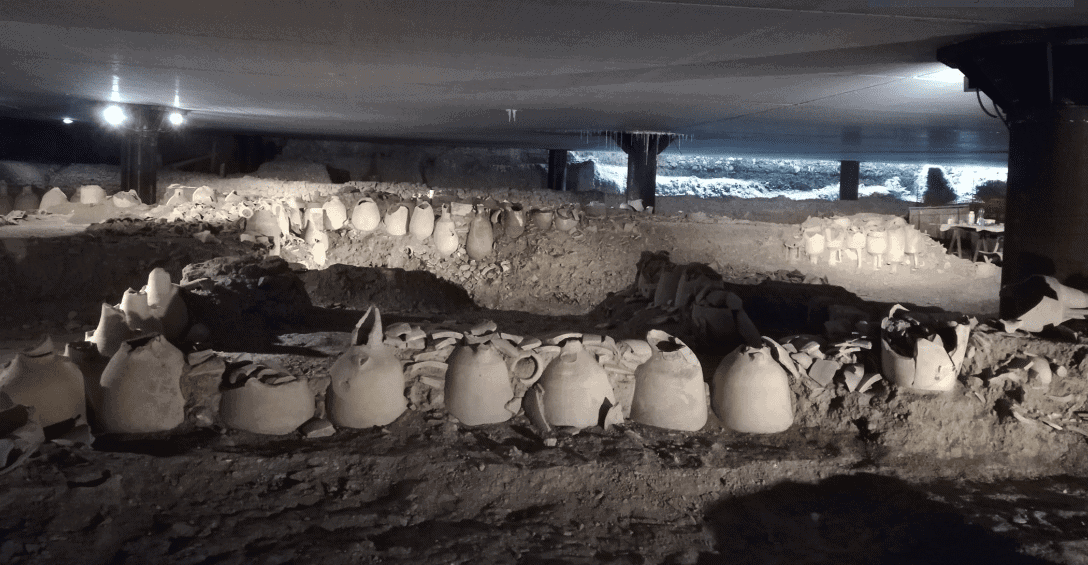
The preventive excavation, opened in 2005 and continued for years before construction, investigated about 7,000 square meters and returned a complete sequence. To the early imperial phase, between the end of the 1st century BC and the end of the 1st century AD, belongs a system of covered rooms and open courtyards in which the walls are built with emptied and reused amphorae, stacked on top of each other: a poor-site technique that here becomes the signature of the neighborhood, because nowhere else in Rome were there empty amphorae in quantities enough to raise a wall with them. Next to it, an area for dumping and reuse of building material.
To the middle imperial phase, between the age of Trajan and Hadrian and the 3rd century, belongs instead a horreum of trapezoidal plan in the western zone of the excavation: rectangular rooms arranged around a porticoed courtyard, that is, the Roman warehouse in its canonical form. Above, sporadic traces of medieval agricultural activity and then the contemporary neighborhood. The market project integrated the excavation as a musealized underground floor, with glass walkways, skylights and a central little square that looks directly onto the excavations: you buy fish and look at a warehouse from the Trajanic age seven meters below. When the visits are active they last about 45 minutes, are led by archaeologists, have a maximum of 20 people, are free with a voluntary offering, and the meeting point is in front of stall number 63, where it is best to show up a quarter of an hour early.
Sottosopra, archaeology in small steps
On the first floor of the market, at Via Lorenzo Ghiberti 19, there is the exhibition and educational space for children, designed for two age groups, four to six and seven to 11. Eight displays tell about Roman trade and the history of the district, and the visit ends with access to the archaeological area below. The method is learning by doing: the children touch, measure, reassemble, instead of listening in line. The duration is about an hour and a half, the minimum number of participants is eight children and the maximum 20, reservation is mandatory and the fee is paid per child, while the accompanying adult does not pay.
Operational management is entrusted to the company GEA with the association Contesti. Put plainly: among the archaeological activities for children found in Rome, this is one of the few that doesn't treat children as short tourists. The drawback is that the calendar is irregular and has to be chased, because it depends on the work on the underground.
The neighborhood route with the panels
It is the part of the Museo diffuso del rione Testaccio that nobody books and that everyone can do, for free, at any time: a series of educational and informational panels placed along the streets of the district, which explain what there was under or next to the point where you are standing. It works like an open-air museum without guards. It is also the most fragile part, because urban panels in Rome age badly among bad weather, stickers and spray paint.
The route I recommend starts from the riverside road at the height of the Emporium, goes up Via Marmorata to the market, cuts across Via Branca for the Porticus Aemilia, goes down toward Via Zabaglia and ends under the Monte dei Cocci. It is a little over two kilometers, an hour and a half at an easy pace, and you cross 1,800 years.
The multimedia route of the Museo diffuso del rione Testaccio
The project provided from the start for a multimedia route, with digital content and a dedicated application designed to accompany the walk with reconstructions and in-depth material. Digital platforms, however, have a shorter life than the ruins they describe, and the reactivation of the digital platform is one of the explicit points of the enhancement work financed with the National Recovery and Resilience Plan. The practical advice, before leaving, is to download or consult the available content while you are still at home with a decent connection: inside the archaeological area of the market the phone gets little and poor signal.
The construction site that is changing the Museo diffuso del rione Testaccio
On the system of Monte dei Cocci, river port, Porticus Aemilia and Nuovo Mercato a restoration and enhancement program of the Soprintendenza Speciale di Roma is under way, financed with €1.5 million of National Recovery and Resilience Plan funds for the Tourism and Culture chapter, with a works amount of €870,000, timeline from May 2025 to April 2026, responsible for the procedure Dr. Barbara Rossi and executing company the Consorzio Innova. The program provides for the protection and restoration of the structures of the Nuovo Mercato, the consolidation of the port structures and of the vaults of the Porticus Aemilia, new visit routes and updated signage, the reactivation of the digital platform and of the Sottosopra educational area, improved accessibility and better integration into the urban context.
This is the reason why the area under the market has closed gates and a fenced perimeter. It is also the reason why it is worth going back: when a construction site of this type delivers, an archaeological area changes face for 20 years. Whoever plans a trip to Rome well in advance should check before leaving, because the reopening dates of these works shift with a certain regularity.
The Monte dei Cocci, the bulky neighbor of the Museo diffuso del rione Testaccio
The Monte dei Cocci is the reason why everything else exists, and at the same time the stop that the museo diffuso tells about without managing. It is worth giving it space, because it is one of the most underrated monuments in Europe.
What it is, in numbers
It is an artificial accumulation about 35 meters high above street level, reaching 54 above sea level, with a surface of about 20,000 square meters and an estimated volume of around 580,000 cubic meters. The shape in plan is a scalene triangle with two distinct peaks. Inside are the fragments of over 53 million amphorae, the vast majority for oil. The accumulation forms from the Augustan age until the middle of the 3rd century: the oldest documented stamps lead to AD 144, the most recent to 251.
The provenance of the containers is almost entirely Iberian, from Baetica, with a North African share from Byzacena. The dominant type is the large globular vessel of about 70 liters that archaeologists call Dressel 20, from the name of the scholar who classified it right here.
The most orderly dump of antiquity
The thing that overturns expectations is that the Monte dei Cocci is not a random heap. The excavations of 1991 showed that the deposit was built as a series of leveled terraces, with retaining walls containing the sides, and that lime was spread over the fragments to neutralize the smell of rancid oil. Someone decided where to dump, how to stack, how to stabilize. It is public waste administration, 2,000 years ahead of time, and it is the reason it is called the first sorted landfill in history.
On the necks of the amphorae ran the tituli picti, inscriptions painted with a brush that recorded the contents, the weight of the oil, the name of the exporter, the names of those who weighed and certified, the shipping date and the district of origin. It is a goods delivery note. Whoever digs the Monte Testaccio is not digging a hill: they are digging the accounting archive of the imperial annona, and in fact from the hill has come a large part of what we know about the oil trade in the Roman Mediterranean.
The caves, the wine and the festivals
The potsherds have a property the Romans discovered long before archaeologists did: they hold a constant temperature of around 10 degrees. In the cavities dug into the sides of the hill, cellars, pantries and stables appeared, and from the Middle Ages onward taverns and restaurants, some of which still operate. The hill hosted the medieval Carnival games, with carts and pigs rolled down the slope, the Ottobrate romane of the grape harvest, and the Good Friday Via Crucis that from the 15th century climbed to the cross on the summit. In 1849 it was an artillery position during the defense of the Roman Republic, and it became one again in World War II.
How to visit
The entrance is at via Nicola Zabaglia 24. The hill belongs to Roma Capitale and is run by the Sovrintendenza Capitolina, so booking is mandatory at 060608, open every day from 9:00 to 19:00. The visit lasts about 60 minutes with a maximum of 20 participants. The fee follows the current municipal rate, and the MIC Card gives free entry. The route has architectural barriers and is not suitable for people with mobility difficulties: the ground is loose potsherds, uphill, and it gets slippery in the rain. The opening calendar is published on the website of the Sovrintendenza Capitolina. Closed shoes, always.

A curiosity about the Museo diffuso del rione Testaccio
The curiosity to keep for last, because it's the one that stays with you, concerns the walls made of amphorae that emerged under the Nuovo Mercato. In the early imperial phase of the dig, the one between the end of the 1st century BC and the end of the 1st century AD, the covered rooms and open courtyards were bounded by walls built with emptied, reused amphorae, stacked one on top of another like hollow bricks. It's not a decorative device and it's not an isolated case of building poverty: it's the direct consequence of the economic geography of the place.
Think about it for a moment. Every year, tens of thousands of terracotta containers full of oil arrived at that spot in the city. Once emptied they were worth nothing. They couldn't be reused for oil because the residue went rancid and contaminated the new cargo, and because of their shape they didn't even break down into small sherds to recycle as aggregate. The result is that in Testaccio the empty amphora was the most abundant and cheapest material around, more than stone and more than brick. Whoever needed to put up a dividing wall in a warehouse didn't go buy bricks: he took what he had at hand by the kilo.
The same reasoning, taken to an industrial scale, produced the Monte dei Cocci. The neighborhood invented two opposite solutions to the same problem, and built them 300 meters from each other: the hill is waste piled up, the walls are waste reused. Neither was planned by an architect. Both have lasted more than 2,000 years. The real curiosity, if you think about it, is that the discarded material is the only thing in this neighborhood that has been preserved intact, while the warehouses that produced that waste are reduced to chipped pillars among the apartment buildings.
Something nobody tells you about the Museo diffuso del rione Testaccio
That the biggest building of the museo diffuso, the Porticus Aemilia, may not be the Porticus Aemilia.
The traditional identification rests on a fragment of the Severan marble plan, the Forma Urbis, and on literary sources that record its construction in 193 BC and its rebuilding in 174. On this basis, for a century, those 50 vaulted aisles were described as the largest port warehouse of Republican Rome. In 2006, however, an alternative identification was put forward: those structures would not be a goods warehouse but the Navalia, that is, the shipyards and covered shelters for Roman warships. It's not a dispute over terminology: it completely changes the function of the building, changes its relationship with the riverbank, changes the way we imagine the scene that took place inside.
The excavations carried out since 2010 by the Soprintendenza have produced no decisive evidence in either direction. The aisles slope down toward the river, which suits both a launching ramp for a hull and the drainage of a warehouse. The dimensions of the intercolumniations are compatible with both hypotheses. The question, for now, remains open.
The reason it is worth knowing this before you go is that it changes how you look. If you think of a warehouse in front of those piers, you see crates and sacks. If you think of the Navalia, you see hulls on dry land and workers scraping them. Neither movie is certified, and it is rare for Roman archaeology to leave the visitor the freedom to choose between two such different scenarios in front of the same wall. In front of that fence on Via Branca it is best to keep both hypotheses open, and it is also more fun.
The advice I give you for visiting the Museo diffuso del rione Testaccio
There is only one piece of advice and it goes against the instinct of anyone planning a trip: don't try to see the closed areas first. Do the opposite. Start with the part that is always open, that is, the neighborhood, and treat the archaeological areas as a possible prize.
In practical terms: arrive at Piramide on line B around 9:30, go down onto Via Marmorata and take Lungotevere Testaccio as far as number 11. From there look at the river and look for the travertine floor below the modern level: it is the quay of the Emporium, and you can read it from the street. Go back up toward Via Ghiberti market around 10:30, when the stalls are full but the crush of tourists hasn't arrived yet, and look out from the inner small square over the excavations: even with the gates closed the archaeological void can be seen from above. Then cut across Via Giovanni Branca to the fence of the Porticus Aemilia, which is the place where I recommend you stay longer than you think. Finish on Via Zabaglia under Monte dei Cocci.
On reservations, two practical rules. The first: write well in advance and in Italian, stating the number of people, the age range and if you have your own guide, because the Soprintendenza's inbox sorts requests based on that information. The second: forget August, the calendar of the museo diffuso covers September to July and in August the district closes even the doors that are usually open, including the Non-Catholic Cemetery.
One last thing, the most important: you don't come here for the visual impact. There is no facade, no hall that takes your breath away, no masterpiece. You come to understand how a city of a million inhabitants worked before containers. Whoever arrives with the wrong expectation is disappointed in 20 minutes, and whoever arrives with the right one leaves with the feeling of having understood Rome better than at the Forum.

Another well-known fact, and yet seldom cited
That Monte dei Cocci gave its name to the neighborhood, everyone knows. That the name came about 1,800 years before the neighborhood, and that the neighborhood was born around a hill of Roman garbage the way a village is born around a church, is said far less.
The Latin place name is mons testaceus, hill of shards, from the term testa, which indicates the terracotta fragment. From there comes Testaccio, and from there come the names of half the local toponymy. But the historical sequence is the one that deserves attention: in the Middle Ages the area was not inhabited, it was countryside with vegetable gardens and vineyards, and the only recognizable element of the landscape was that artificial mountain. Processions, festivals, carnival games, taverns made in the caves: all the collective life of that piece of Rome organized itself around a heap of industrial waste, centuries before anyone built the first house. When the Master Plan of 1871 draws the working-class district, the name has already been there for 1,900 years and nobody dreams of changing it.
The second little-cited aspect is that that hill is a written document. Heinrich Dressel began to investigate it systematically in January 1872 and published the results in 1878. His readings of the inscriptions painted on the fragments made it possible to reconstruct the chronology and provenance of the dumps, and the classification of amphorae that came out of it still carries his name at every excavation in the Mediterranean. From 1980 research continued with the Spanish archaeologists Emilio Rodríguez Almeida and José Remesal Rodríguez, who built on the hill a school of studies on the imperial economy.
Put another way: the most working-class district of Rome rests on the largest commercial archive of antiquity, and its name is the inventory number. I don't know another district that can say the same.
The right photo to take at the Museo diffuso del rione Testaccio
The wrong photo is the one from the top of Monte dei Cocci toward the panorama. Everyone takes it, it always comes out the same and tells nothing, because the Roman panorama from there is mediocre and spoiled by the Ostiense sheds.
The right photo is from below, and it's the one of the fence of the Porticus Aemilia on via Giovanni Branca. Stand on the opposite sidewalk, wait for a car to pass so you have a clear street, and frame the shot so that three things fit in the same image: the concrete arches of the 2nd century BC, the contemporary railing, and above, without cutting them off, the balconies with laundry hanging out on the Umbertine buildings. That overlap is the museo diffuso in a single photograph: the layering that lives inside an inhabited neighborhood, without display cases and without guards. The best time is late afternoon, when the raking light enters the vaults and brings out their depth. In winter, if you pass after sunset, the night lighting installed with the park does a better job than the sun.
The second shot I recommend, for those lucky enough to get in, is inside the archaeological area of the market: position yourself so you have the walls built with reused amphorae in the foreground and, through the skylight or the glass walkway, the light of the stall level above your head. It's a hard photo, because the contrast between the darkness of the dig and the light of the market throws any automatic setting into crisis. Shoot in manual, expose for the shadows and accept that the skylight will blow out.
The third, the simplest, is on the lungotevere at the Emporium: a horizontal crop with the travertine of the ancient quay at the bottom, the 19th-century embankment wall in the middle and the river at the top. Three eras in three bands. If you have a long lens, try to isolate one of the perforated mooring stones: that hole is the most eloquent detail in the whole rione.
Some important events that took place here in history
The chronology of this piece of the city is a sequence of public decisions, and it's almost always the same decision: move here what no longer fits elsewhere.
193 BC. The aediles Marcus Aemilius Lepidus and Lucius Aemilius Paullus have the Emporium, the new river port, and the Porticus Aemilia built. Rome's commercial center of gravity shifts from the Forum Boarium to the Testaccio plain: it's the birth certificate of the neighborhood as infrastructure.
174 BC. The censors Quintus Fulvius Flaccus and Aulus Postumius Albinus have the quay paved in stone and equipped with warehouses. Rome goes from an improvised landing to an equipped port.
From the Augustan age to the mid-3rd century. The Monte dei Cocci forms. The documented stamps cover at least 144 to 251 AD. Under Trajan the Emporium reaches its peak traffic.
4th-7th century. The port is abandoned and silts up, and a burial area appears above its structures. The plain goes back to countryside.
15th century. The Good Friday Via Crucis is celebrated on the Monte dei Cocci, with the cross planted on the summit to reproduce Golgotha: an urban liturgy that will last for centuries and is documented by the city's sources.
1849. During the defense of the Roman Republic the hill becomes an artillery position. The hill of amphorae, which had been used to unload oil, is used to cover a battery.
January 1872. Heinrich Dressel begins the first systematic investigations on the hill and in 1878 publishes the results: the typology of Roman amphorae that archaeologists still use is born.
1868-1870. The works for the Tiber embankment walls bring the remains of the Emporium to light. The same work that defends the city from floods both damages and reveals the ancient port.
1871. The Piano Regolatore assigns the area to industrial plants and working-class housing. Testaccio stops being countryside and becomes a neighborhood.
1888-1891. The municipal Mattatoio is built to a design by Gioacchino Ersoch: one of the most important industrial archaeology complexes in the city.
2005. The preventive excavation for the new market opens about 7,000 square meters and yields the amphora walls, the trapezoidal horreum and the sequence up to the medieval age.
July 2, 2012. The Nuovo Mercato Testaccio is inaugurated, with the excavation integrated as a basement level turned into a museum.
May 9, 2015. The archaeological urban park of the Porticus Aemilia opens, after three years of work by the Soprintendenza with the Royal Netherlands Institute and the restoration of about 1,200 square meters.
May 2025. The restoration and enhancement site for the Monte dei Cocci system, river port, Porticus Aemilia and Nuovo Mercato gets under way, funded with money from the Piano Nazionale di Ripresa e Resilienza.
Who has passed through the Museo diffuso del rione Testaccio
Don't expect the parade of popes and cardinals you find elsewhere in Rome. People who worked passed through here, and that makes the list more interesting, not less.
Marcus Aemilius Lepidus and Lucius Aemilius Paullus, aediles in 193 BC, are the two magistrates who decided where the port of Rome would end up. The second is the father of that Lucius Aemilius Paullus who would win at Pydna: a family that in three generations built a port and took apart Macedonia. The name of the Porticus is theirs, and it's the reason a port warehouse still bears a family name.
Quintus Fulvius Flaccus and Aulus Postumius Albinus, censors in 174 BC, are the ones who put stone under the feet of the porters. In archaeology they are cited little because maintenance isn't news. In reality the paving of the quay is what allowed the port to work for five centuries.
The negotiatores olearii of Baetica. We don't know their faces, but we know their names, one by one, because they are written in brush on the necks of the Monte dei Cocci amphorae together with the weight of the oil and the date of shipment. They are Andalusian merchants who filled Rome with oil for two and a half centuries, and thanks to the tituli picti they are today among the best-documented people of the ancient world after the emperors.
Trajan. Under him the Emporium reaches its peak of activity, and the trapezoidal horreum found under the market dates to the age between Trajan and Hadrian. The emperor who built the hexagonal port at Fiumicino also left his mark upstream, at the urban terminal of that system.
The defenders of the Roman Republic of 1849. A battery was installed on the Monte dei Cocci during the French siege. It's the moment when the terracotta hill enters the Risorgimento history of the city.
Heinrich Dressel. A German archaeologist, he began digging the hill in January 1872 and published in 1878. His typology of amphorae is still today the common language of archaeologists across the Mediterranean: when a dig in Spain, Tunisia or Britain records a Dressel 20, it's speaking a language invented in Testaccio.
Emilio Rodríguez Almeida and José Remesal Rodríguez. Since 1980 they have brought Spanish research back to the hill, closing a historically perfect circle: the descendants of those who produced those amphorae came back to read them in the place where they had been thrown away.
Gioacchino Ersoch. The municipal architect who between 1888 and 1891 designed the Mattatoio, the building that gave the rione its modern look and that today houses the Department of Architecture of Roma Tre and the Mattatoio's exhibition spaces.
Marco Rietti. With the architects Guidi and Scalzo he designed the Nuovo Mercato Testaccio, inaugurated on July 2, 2012, and solved the problem nobody wanted: building a market over 7,000 square meters of excavation without burying it again. The piazzetta that looks out over the excavations is his answer, and it's perhaps the best idea of contemporary architecture to be found in this rione.

How to get to the Museo diffuso del rione Testaccio
The reference point is metro line B, Piramide stop, which is also the connection with the Roma Ostiense railway station and with the line to the Lido. From Piramide you exit onto piazzale Ostiense, take via Marmorata and you're inside the rione in five minutes. Surface lines 718, 719 and 775 serve the neighborhood as far as largo Giovanni Battista Marzi, the entrance of the former Mattatoio, and from there it's 300 meters to the market.
The distances within the museum are all short and on foot: from the via Ghiberti market to the Porticus Aemilia on via Rubattino it's a five-minute walk, from the market to lungotevere Testaccio 10, from the market to the entrance of the Monte dei Cocci on via Zabaglia seven. By car it's a terrible idea: the rione has a 19th-century grid with roadside parking that is always full, and the market's loading and unloading zones reduce space even further in the middle hours of the morning.
How much the Museo diffuso del rione Testaccio costs and how to book
The archaeological areas of the museo diffuso have no ticket. The guided visits are free, with the option of leaving a voluntary contribution, and booking is mandatory: these are monuments that open only with an educational or guided visit. The mailbox for individuals, schools and groups with their own guide is ss-abap-rm.museotestaccio@beniculturali.it. For individuals, schools and groups without their own guide, write to sottosopra.testaccio@gmail.com. The Sottosopra educational area, instead, charges a fee per child, while the accompanying adult doesn't pay, and this must be confirmed when booking together with the calendar.
The opening calendar covers the period from September to July, with the second Tuesday of the month dedicated to groups that arrive with their own guide and with morning and afternoon time slots. The museum observes closures for the main holidays and stays closed in August. The neighborhood route and the Porticus Aemilia park, being urban spaces, have no ticket in any case.
Outside the state perimeter the numbers change, and I summarize them because it's the question I get most often: the Monte dei Cocci follows the Roma Capitale rate with booking at 060608 and is free for MIC Card holders. The Non-Catholic Cemetery asks for a contribution of five euros. The Cestius Pyramid can be visited only by appointment on set days of the month and has a low-priced ticket, which is best checked when booking.
The Museo diffuso del rione Testaccio with kids
This is one of the few Roman archaeological sites really designed for children, and not just for show. The Sottosopra space is designed for two age groups, four to six and seven to 11, with eight exhibit installations that tell the story of ancient trade and the history of the rione, and with access to the archaeological area under the market. It lasts about an hour and a half, the group runs from eight to 20 children, and booking is mandatory.
The reason it works is that the subject is concrete. Children aren't asked to appreciate a capital: they're asked to understand what happens to a jar when you empty it, where 30,000 empty jars a year end up, and why at some point you build a wall with them. It's a line of thought about waste and reuse that any eight-year-old understands better than many adults. Before the workshop, I recommend a walk around the Monte dei Cocci from the outside, so they see the hill before hearing it described, and afterward the market, where you eat well and cheaply.
Accessibility of the Museo diffuso del rione Testaccio
The situation is uneven and it's good to know that. The neighborhood route, which runs along urban sidewalks, can be done in a wheelchair with the usual Roman difficulties, meaning ramps that don't always line up and sanpietrini in some stretches. The Nuovo Mercato Testaccio is a contemporary building and has elevators and accessible restrooms. The Porticus Aemilia park is flat and can be seen from the fence even by those who don't go in.
The underground archaeological areas are another matter: walkways, changes in level, irregular surfaces, and accessibility is itself one of the stated goals of the enhancement work now under way. Anyone with specific needs should state them in the booking email, because the route is organized accordingly. The visit to the Monte dei Cocci, run by Roma Capitale, has architectural barriers and is declared not suitable for people with mobility difficulties.
What to see around the Museo diffuso del rione Testaccio
Within a 10-minute walk there are more things than fit in a day, and I recommend choosing two, not five.
Cestius Pyramid and Non-Catholic Cemetery
South of the rione, wedged into the Aurelian Walls, the Cestius Pyramid is the tomb of Gaius Cestius Epulo, built between 18 and 12 BC: 36.40 meters high, with a square base about 30 meters on a side, concrete with a brick facing and a cladding of Carrara marble slabs. The inscription states that the work was completed according to his will in 330 days, because the heirs risked losing the inheritance if it was late. Inside there's a single burial chamber measuring 5.95 by 4.10 meters, 4.80 high, which takes up a little more than one percent of the monument's volume, painted white with figures of priestesses and amphorae on the walls and four Victories on the vault. In the 3rd century the pyramid was incorporated into the Aurelian Walls as a bastion, and that is probably why it escaped being stripped for materials.
Next to it, the Non-Catholic Cemetery at via Caio Cestio 6 is a private body, open Monday to Saturday from 9:00 to 17:00 with last entry at 16:30, Sundays and holidays from 9:00 to 13:00 with last entry at 12:30, with a suggested contribution of five euros. It closes for the whole month of August, and it's worth remembering that before planning the visit. Up-to-date information is on the cemetery's website.
Aventine, Ostiense and the riverbank
Going up the Aventine, in a quarter of an hour you reach the basilica of Santa Sabina, which is the best-preserved early Christian church in Rome. To the south, the Via Ostiense Museum occupies the walkways of Porta San Paolo and tells the story of the road that led to the sea. A little farther on, the Centrale Montemartini puts ancient sculptures inside a power plant, and it's the most successful display experiment of the last 30 years in Rome. Farther south still, the basilica of San Paolo fuori le Mura closes the Ostiense axis.
To the north, along the river, you reach the Forum Boarium, that is, the port the Emporium replaced, and from there the Circus Maximus. On the other bank, past ponte Sublicio, you enter Trastevere and can end the day at the Museo di Roma in Trastevere, or go back up to the Tiber Island. In summer the rione also comes alive on its own: the program of Testaccio Estate at the Città dell'Altra Economia takes over the spaces of the former Mattatoio.
When to go to the Museo diffuso del rione Testaccio and when to avoid it
The best months are October, November, March and April: the visit calendar is full, the light is low and good for the arches of the Porticus Aemilia, and the market works with the right products. September works, with the caveat that the first weeks are when the calendar restarts and availability runs out fast.
August is the month to avoid without hesitation: the museo diffuso is closed, the Non-Catholic Cemetery is closed for the whole month, the exhibition spaces of the former Mattatoio cut back activity and even the market stalls rotate around vacations. July is very hot and the rione, which is flat and has no trees on the main streets, becomes a griddle. If you go in summer, go at 9:00 in the morning or after 18:00.
During the week, Tuesday and Thursday are the days when the openings of the archaeological park have historically been concentrated, and the second Tuesday of the month is the one reserved for groups with their own guide. On Sunday the rione is beautiful and empty, but the market is closed and with it the access to the archaeological area below.
Quick questions about the Museo diffuso del rione Testaccio
What is the Museo diffuso del rione Testaccio
It's a territorial museum with no building, conceived by the Soprintendenza Speciale di Roma, that treats the 60 hectares of the rione as a single exhibition route made up of archaeological areas, street panels, multimedia content and an educational space for children.
What is the Museo diffuso del rione Testaccio made of
Six components: the neighborhood route with its panels, the multimedia route, the archaeological area of the Emporium, the archaeological urban park of the Porticus Aemilia, the archaeological area of the Nuovo Mercato Testaccio and the exhibition and educational area for children, Sottosopra.
How much does it cost to visit the Museo diffuso del rione Testaccio
The guided visits to the archaeological areas have no ticket and are supported by a voluntary contribution. The neighborhood route is open and free. The Sottosopra space charges a fee per child, with the accompanying adult not paying.
Do you need to book for the Museo diffuso del rione Testaccio
Yes, for all the archaeological areas: you get in only with an educational or guided visit. The neighborhood route, instead, requires no booking.
Who do you write to for booking
To ss-abap-rm.museotestaccio@beniculturali.it for individuals, schools and groups with their own guide, and to sottosopra.testaccio@gmail.com for individuals, schools and groups without their own guide.
Is the Museo diffuso del rione Testaccio open in August
No. The visit calendar covers September to July, and in August the museum stays closed, as many other doors in the rione do.
Why can't you visit the archaeological area under the market
Because visits are suspended for renovation work on the rooms, as part of a restoration and enhancement project funded with money from the Piano Nazionale di Ripresa e Resilienza that also concerns the Porticus Aemilia and the port structures.
What can you see in the archaeological area of the Nuovo Mercato Testaccio
Covered rooms and courtyards from the early imperial age with walls built by stacking emptied amphorae, an area for dumping and reusing building material, and a trapezoidal horreum from the Trajanic and Hadrianic age with rectangular rooms around a porticoed courtyard.
What is the Porticus Aemilia
A building from 193 BC, rebuilt in 174, 487 meters long and 60 wide, with 50 vaulted aisles on 294 pillars: the largest covered space of Republican Rome. Its function is debated between port warehouse and shipyards.
Can you go into the Porticus Aemilia park
Yes, access to the archaeological urban park is free on the days set by the Soprintendenza, from 10:00 until one hour before sunset. The arches remain visible from the street through the fence on via Rubattino, via Giovanni Branca and via Florio.
Where can you see the Emporium
On lungotevere Testaccio, opposite number 11: the quay paved in travertine, the inclined wall with the perforated mooring stones and the remains of the warehouses. The area opens for scheduled visits.
Is the Monte dei Cocci part of the Museo diffuso del rione Testaccio
It's the monument around which the whole story of the museum revolves and it appears in the neighborhood route, but its visit is run by Roma Capitale: booking mandatory at 060608, entrance from via Nicola Zabaglia 24.
Is the MIC Card valid for the Museo diffuso del rione Testaccio
No, and you wouldn't need it: the museum's areas are state-owned and the guided visit has no ticket. The MIC Card does give free entry to the Monte dei Cocci, which is a property of Roma Capitale.
How long does the visit last
The guided visit to the market's archaeological area lasts about 45 minutes, the Sottosopra workshop about an hour and a half, and the climb up the Monte dei Cocci about an hour. The complete neighborhood route takes about 90 minutes of walking.
How many people can take part
Groups are capped: 20 people at most for the visit to the market's archaeological area, 20 children at most and eight at minimum for Sottosopra, 20 participants at most for the Monte dei Cocci.
Is the Museo diffuso del rione Testaccio suitable for kids
Very much so, and it's one of the few Roman archaeological sites with a space designed just for them, divided into two age groups, four to six and seven to 11, with hands-on activities instead of lectures.
Can you take photos
In the museum's areas and on the neighborhood route, yes, with the limitations that staff indicate in the underground areas, where tripods are usually not allowed for reasons of space. In the nearby Non-Catholic Cemetery, instead, photographs are allowed only as personal keepsakes and can't be published on social media.
Is it wheelchair accessible
The neighborhood route and the Nuovo Mercato Testaccio are, the Porticus Aemilia park is flat, and the underground areas are problematic and must be arranged when booking. The Monte dei Cocci has architectural barriers and is not suitable for people with mobility difficulties.
How do you get to the Museo diffuso del rione Testaccio
Metro line B, Piramide stop, and then five to 10 minutes on foot toward via Marmorata. Surface lines 718, 719 and 775 go as far as largo Giovanni Battista Marzi, at the former Mattatoio.
What's the difference between the Museo diffuso del rione Testaccio and the Monte dei Cocci
The first is a state project of the Soprintendenza that includes the port, warehouses, the market excavation and educational activities. The second is a single municipal monument, visitable for a fee with booking at 060608. They are 300 meters apart and tell the same story from two opposite sides.
How much time do you need to see everything
With the archaeological areas open, a full morning: two and a half hours between the neighborhood route, the market and the Porticus Aemilia, plus the time of the booked visit. If you add the Monte dei Cocci and the Pyramid, you need the whole day.
Is a guide worth it for the Museo diffuso del rione Testaccio
For the neighborhood route, very much: without someone telling the story, a concrete pillar behind a fence stays a pillar behind a fence. For the archaeological areas the visit is already guided, but groups that arrive with their own guide have a dedicated day, the second Tuesday of the month.
Where do you eat after the visit
Inside the Nuovo Mercato Testaccio, at the food stalls, which is the fastest solution and the most honest in terms of price to quality. The historic taverns of the rione, some carved into the caves dug into the sides of the Monte dei Cocci, remain the alternative for a longer stop.
To wrap up
Rome has a difficulty nobody admits: almost all its monuments tell the story of power. Temples, arches, basilicas, palaces. Here, in these 60 hectares between the river and the walls, the story is instead about work, meaning porters, dockworkers, warehousemen, Andalusian merchants, 19th-century butchers and today's fishmongers. That's why the Museo diffuso del rione Testaccio, with all its limits of hours and closed gates, is one of the few Roman experiences that really change the way you look at the city.
The final advice: go back a second time with no plan. No booking, no list of things to see, with a free hour and the street. Look at the panels, count how many potsherds you can recognize in the retaining wall on via Zabaglia, stop for a drink in an inner piazzetta. Testaccio gives itself up on the second visit, never the first. And it's the only museum in Rome where you can buy artichokes on your way out.
Article written by the editorial team of TourLeaderPro, contact them for Private/Corporate/V.I.P. Tours and Experiences.
Planning a trip to Rome? The English guides for visiting the city are on ItalyPlanner.com.