Via Ostiense Museum
In short. Via Ostiense Museum occupies the interior spaces of Porta San Paolo, at Via Raffaele Persichetti 3, 00153 Rome, on the side of the square that faces the Pyramid of Cestius.
Via Ostiense Museum occupies the interior spaces of Porta San Paolo, at Via Raffaele Persichetti 3, 00153 Rome, on the side of the square that faces the Pyramid of Cestius. The phone number listed for the museum is 06 5743193. Admission is free, with no ticket and no reservation, but let's say it right away and without beating around the bush: the museum currently has no regular opening hours and is listed as temporarily closed among the state cultural sites, while the gate that houses it opens to the public for free special visits organized by the Capitoline Superintendency with Zetema, by phone reservation through the Roma Capitale contact center and with limited places (in recent openings, 15 people per turn, two one-hour turns). Before you head out, check the situation for the day on the museum's official website and on the Superintendency's calendar of visits. You get there by metro line B, Piramide stop, by the Roma-Lido railway that leaves from the Porta San Paolo station a few meters away, by the Roma Ostiense railway station and by a remarkable amount of surface transport: tram 3 and buses 23, 30, 60, 75, 83, 95, 175 and 280 all pass within 200 meters. For the visit to the interior of the gate, allow a full hour, an hour and a half if you stop to read the labels and look at the scale models the way they deserve. If you add the Pyramid, the Non-Catholic Cemetery and a walk along Via Marmorata, the whole morning is gone. This page is part of our collection dedicated to the museums of Rome.

There are places that Romans walk past every day without knowing they can be visited, and this is one of the first. Porta San Paolo comes first, and by a wide margin. Tens of thousands of people a day pass by it coming up from metro line B, skirt around it on their scooters cursing the traffic in the square, snap a photo of it in passing because behind it there's the Pyramid, which cuts a better figure. Almost nobody knows that inside those two semicircular towers, behind those little arched windows that look decorative, there are three museum rooms, a maneuvering gallery with 3rd-century Roman frescoes detached from a tomb, two scale models that explain Rome's port system better than any book, and a walkway from which you can look down on the Pyramid.
Via Ostiense Museum is a small museum, and anyone who judges it by the yardstick of the big Roman museums comes out disappointed. Anyone who takes it for what it is, that is, a site museum that explains a road and a territory from inside the monument that was that road's entrance gate, finds one of the smartest experiences Rome has to offer. Here the container is already the content: you study Via Ostiense while standing inside Porta Ostiense, you look at the model of Trajan's port from a window that frames the exact direction in which that port lay. It doesn't happen often.
What exactly is Via Ostiense Museum
The museum was set up in 1954 with a declared and narrow purpose: to illustrate the topography of the territory between Rome and Ostia. Not a museum of masterpieces, then, but a museum of a route, built around a simple and enormous question: how did the road that brought the world into Rome work.
The collection gathers the material that came out of excavations along the route: objects of daily life, marble and terracotta reliefs, sculptures tied to the Eastern cults that the port landed together with the goods, Roman copies of Greek and Hellenistic originals, a sizable group of imperial portraits, sarcophagi (among them one of a child with dancing putti), paintings and mosaics, including a 4th-century opus sectile floor. Then there are the three painted arcosolia detached from a 3rd-century tomb found near the Basilica of San Paolo, the casts of inscriptions and funerary cippi, and in the east tower a fragment of frescoes from the end of the 13th and the beginning of the 14th century, what remains of the chapel of a Byzantine community settled here.
The scientific direction was for a long time in the hands of Angelo Pellegrino, an archaeologist who also directed the excavations of ancient Ostia and who was a senior official of the Archaeological Superintendency of Ostia from 1981 to 2013. It's a detail that says a lot about the nature of the museum: whoever curated it came from Ostia, and the museum tells the story of Rome by looking at it from Ostia, that is, from the sea toward the city, which is exactly the direction in which the grain, the wine, the oil, the marble and the gods traveled.
Why Via Ostiense Museum is inside a gate, and not in a palace
The choice made in 1954 was not a makeshift solution. Porta San Paolo had just finished being a war front, it had been cut off from the rest of the walls 30 years earlier, and its interior was an empty container of great architectural quality: spaces on several levels, Roman wall thicknesses, a maneuvering gallery for the ancient portcullis, stairs in the towers, an open-air walkway. Putting inside it the museum of the road that started from that gate meant giving the monument a civic function again and, at the same time, giving it an audience.
The result has a flaw and a merit, and it's worth stating both. The flaw is that a museum inside a Roman gate is not accessible: you climb narrow, ancient flights of stairs, four of them on the guided visits that cover all the levels, and anyone with mobility difficulties stays outside. The merit is that the visit is an architectural experience even before it is an archaeological one: you touch the travertine of Honorius, you look at the square from the top of the maneuvering chamber, you step out onto the walkway and see the Pyramid from an angle that no tourist has.
A museum that opens on and off: how it really works
The practical question has to be dealt with right away, because it's the one that makes people lose time. Via Ostiense Museum is not a museum with fixed hours posted on the door, the kind you walk past and go into. The current arrangement is one of scheduled openings: the Capitoline Superintendency includes Porta San Paolo in its calendars of free guided visits, generally tied to themed days such as the European Archaeology Days, and the turns are booked through the contact center at 060608, open every day from 9:00 to 19:00. In recent openings the groups were of 15 people at most, with two turns in the morning, at 10:00 and 11:30, and a duration of 60 minutes per visit. The reservation is canceled by phone or by email at the contact center's dedicated address, and canceling when you can't come is a courtesy to those who remain on the list.
A tip for those who plan their days: don't build a trip to Rome around this museum, but if you live in the city or pass through often, put the Superintendency's calendar of visits among your bookmarks and book as soon as a date comes out. It's free, it lasts an hour, and it's worth three times as much as many paid visits in the center. Things that open rarely are taken when they open, not when it's convenient.
Porta San Paolo, the monument that houses Via Ostiense Museum
To understand the museum you have to understand the gate, because the gate is the first piece of the collection. Porta San Paolo is among the most majestic and best preserved of the entire circuit of the Aurelian Walls, and it has a layered building history that can still be read with the naked eye from the square, as long as you know where to look.
Porta Ostiensis: the ancient name and the reason it exists
The original name was Porta Ostiensis, and there's no mystery about why: from there began Via Ostiense, the road linking the Urbs with the ancient port of Ostia. The gates of the Aurelian Walls took their name from the road that passed through them, with a road-signage logic: whoever left from there was going to Ostia, whoever left from Porta Appia was going on the Appian Way, and so on. The medieval name, Porta San Paolo, comes later and from another logic, a devotional one: from here you left to reach the Basilica of San Paolo Outside the Walls, and the flow of pilgrims ended up rewriting the place names.
There's a topographical detail that almost nobody tells and that changes how you read the square. Near the Pyramid of Cestius there were two gates, not one: next to the eastern one, the one we see, there was a western one, which was closed and then demolished in 1888. A record of its measurements survives in the dismantling documents: an archway 3.60 meters wide, walls built of travertine blocks 67 centimeters thick, a monolithic travertine threshold more than four meters long. When you're in the square and the gate seems strangely off-center with respect to the Pyramid, that's the explanation: its twin is missing.
Aurelian, Maxentius, Honorius: the three phases of Porta San Paolo
The first phase is the Aurelian one, in the full 3rd century, when the walls were thrown up in a hurry around a city that for three centuries had not needed them. The gate was born with two archways, because the traffic toward Ostia was heavy and the carts had to be able to enter and exit without crossing paths: a choice made for a commercial artery, not for a ceremonial gate.
The second phase is that of Maxentius, at the beginning of the 4th century, and it gives Rome a unique case. On the inner side a second gate is built, a counter-gate, connected to the outer one by two walls closed like pincers so as to form a fortified courtyard: whoever came in found themselves shut in a square trap, watched from above, before being able to enter the city. It is the only counter-gate of the Aurelian Walls preserved in its entirety, and it is the famous Castelletto, that is, the very building in which the museum is set up. I'll add the oddity that the manuals point out and that visitors never notice: the closing of the counter-gate faced the city, not the outside. Which means that this device didn't serve only to stop those arriving from outside, but also to control those pressing from inside.
The third phase is that of Honorius, between 401 and 403, and it is the most visible. Rome is afraid, the Goths are on the move, and the passive defense is rewritten everywhere along the circuit: the two archways are reduced to one, the arch is raised by about a meter compared to the previous one, the two side towers are reinforced, raised and fitted with battlements and windows, and above the archway an attic is built with a row of little arched windows that served to light the portcullis maneuvering chamber. That explains the little windows that look like a whim from the square: they were service lighting for the men who operated the gate.
The towers, the portcullis and the toll collectors' station
The two towers have a semicircular, horseshoe-shaped base, following the Aurelian scheme. Inside, the museum occupies the upper levels: the first room is on the first floor of the west tower, the east tower preserves the medieval frescoes. The gallery that connects the two sides at the maneuvering level is the portcullis gallery, and it is the room that more than any other makes visitors understand how a late antique city entrance worked: above the archway, inside the thickness of the wall, the guards lowered and raised the gate with a system of counterweights.
The Castelletto was never just a military matter. Inside that closed courtyard there was room for the garrison and the toll collectors' station, that is, the office that collected the toll on incoming goods. Rome taxed goods at its gates for almost two millennia with impressive continuity, and at this spot the continuity is visible: in the inner courtyard the Casina del Dazio survives, an 18th-century structure later restored, which the museum displays as a piece of the route. Between the toll collector of Honorius and the customs officer of Pope Benedict XIV the language changes, not the trade.
Benedict XIV, 1920 and the wounds of war
In 1749 Pope Benedict XIV had the whole circuit of the walls restored, starting precisely from Porta San Paolo and going as far as Porta Flaminia, and he wanted people to know it: an inscription on the east tower commemorates him. It's a typical intervention of the 18th-century papacy, which no longer asked the walls for defense but for urban decorum and fiscal control.
The real blow comes in the 20th century. Around 1920 the gate is isolated from the walls on the eastern side to let traffic flow, and the monumental traffic island is born that today seems natural to us and that is instead a mutilation: the gate loses its grammatical reason, which was to be a hole in a continuous wall. Then, during the Second World War, a bombing destroys the western stretch of the walls too. What we see, then, is a monument amputated twice, left standing in the middle of the cars like a stranded ship. Whoever visits the museum should come out with this image in mind: the walls didn't end there, the gate wasn't alone, and the square we cross today was solid wall.
Via Ostiense: the road Via Ostiense Museum tells about
The museum exists for a road, and that road deserves a whole chapter, because it is the least celebrated and perhaps the most decisive of the Roman consular roads. The Appian Way has the literature, the Flaminian Way has the military history, the Aurelian Way has the sea. Via Ostiense had the grain. Without grain Rome didn't exist: a city of a million inhabitants, the first in European history to reach that threshold, is not fed by the agriculture of Lazio. It is fed by ships.
24 kilometers and 16 miles
The ancient itineraries agree on a measure of about 16 miles, a little less than 24 kilometers, between Rome and Ostia. Strabo gave a different one, 190 stadia, but he was calculating the route of the boats on the river, which is another journey and another logic: on the road you went on foot and by cart, on the Tiber you went upstream under tow. The two measures don't contradict each other, they measure two parallel infrastructures.
The original route started from the Porta Trigemina of the Servian Walls, that is, from a point much farther inside than Porta San Paolo, at the foot of the Aventine, where Rome's river port had its landings. It skirted Monte Testaccio, followed the western slopes of the Aventine from north to south and received branches from other Servian gates, the Lavernalis and the Raudusculana. When in the 3rd century the Aurelian Walls redraw the limit of the city, the route is diverted and the road takes as its head the gate that today houses the museum. This shift is the very reason the museum makes sense at that spot: before the 3rd century, Porta San Paolo didn't exist and Via Ostiense began elsewhere.
Grain, salt and the annona: why this road mattered
Via Ostiense was born as the salt road and grew as the supply road. The salt pans at the mouth of the Tiber are among the oldest economic infrastructures of Lazio, and tradition ties them to the very founding of Ostia. But the leap in scale comes with the annona, the public apparatus that guaranteed grain to the city. The cargo ships coming from Alexandria in Egypt and from proconsular Africa did not go up the Tiber: they were too big. They unloaded at the port, the cargo passed onto smaller river vessels, the naves caudicariae, and these went up the river towed from the bank to the warehouses of the Emporium, under the Aventine, a few hundred meters from the spot where Porta San Paolo stands today.
The road ran alongside all this and served what the river could not serve: people, animals, couriers, perishable goods, orders from the administration, and of course the traffic of the intermediate river ports. The museum displays the fruits of this system, and that is why a display case of everyday objects, in a museum about a road, is not minor material: it is the material proof that this corridor was not a ceremonial axis but a logistics machine running every day of the year.
Ostia, the port of Claudius, the hexagonal port of Trajan
Rome's port system is the thing that Via Ostiense Museum explains better than anyone else, and it does so with two scale models that are worth the trip on their own. The technical problem was serious: the mouth of the Tiber silts up, the Lazio coast offers no natural bays, and Ostia as a seaport was no longer enough already in the Augustan age.
The first solution is by Claudius, in the middle of the 1st century: a huge artificial basin dug north of the river mouth, protected by two curved moles and by an artificial island with a lighthouse, obtained by sinking the gigantic ship that had brought the Vatican obelisk to Rome. Grandiose and imperfect: the basin was too exposed to the winds, and the sources record mass shipwrecks inside the port itself.
The second solution is by Trajan, at the beginning of the 2nd century, and it is one of the most elegant engineering insights of antiquity: a second, inner basin, dug in the shape of a regular hexagon, connected to the first. The hexagon is not a geometric whim: it maximizes the length of the quays relative to the water surface, reduces the wave motion inside and allows the warehouses to be distributed rationally around six straight sides. Even today, from the plane on approach to Fiumicino, you can see that hexagon of water among the fields, and it always makes an impression.
The model displayed in the museum reconstructs the port of Claudius and that of Trajan together. Look at it calmly, because it is a piece of teaching of the highest level: in 30 seconds you grasp something that in a book takes 20 pages, namely that Rome had built, 25 kilometers from itself, an artificial port infrastructure on an industrial scale, and that Via Ostiense was the nerve that connected it to the city.
The tombs along the road and the necropolis of the Rupe di San Paolo
Like all the consular roads, Via Ostiense was lined with burials for kilometers, because Roman law forbade burying inside the pomerium and the roads leading out became linear cemeteries. The richest stretch is the one near the Basilica of San Paolo Outside the Walls, where one of the most important funerary complexes of the ancient city extends, in use from the 1st century BC to the 3rd century AD: columbaria with niches for cinerary urns arranged on several levels, then chamber tombs, arcosolia, formae, sarcophagi, pit burials, and temple-shaped tombs for those who could afford them.
This is the point where the museum's collection and the territory join hands. The painted arcosolia displayed in the portcullis gallery come precisely from there. And there is an important piece of news: on July 8, 2026 the Capitoline Superintendency opened to the public a new sector of Via Ostiense necropolis at the Rupe di San Paolo, in Parco Schuster next to the basilica, after an intervention of the PNRR Caput Mundi program that included consolidating the masonry, restoring the ancient plasters, removing the vegetation from the rock face, an educational path with panels, a scenic lighting system and security systems. In the new layout the frescoes are returned to their context through full-scale reproductions, because the originals are kept here, at the Porta San Paolo museum.
This is the reason why today the visit to the museum and the visit to the necropolis should be thought of together: in one place you see the wall the frescoes were detached from, in the other you see the frescoes. Whoever does only one of the two halves takes home half the story. The practical advice is to start from the museum and finish at the Rupe, because the meaning of the passage is better understood in the order in which the pieces were taken away.
The milestone of the 11th mile and the measure of Roman space
Among the pieces displayed in the portcullis gallery is the cast of the milestone of the 11th mile of Via Ostiense, dating to the 3rd century BC. A milestone is a small stone column that marks the distance from Rome, and the eleventh mile corresponds to about 16 kilometers from the city, that is, two thirds of the way to Ostia.
It's worth explaining why such a modest object is important. The milestone is the proof that this road was surveyed, measured and administered: not a path beaten by use, but a public work with a land register. The dating to the 3rd century BC places the construction of the road in the full Republican expansion, centuries before the empire and the great ports, when Rome was still building its relationship with the sea. In front of that cast it's worth remembering: Via Ostiense is older than the Colosseum by almost 300 years.
The visit to Via Ostiense Museum, room by room
The museum's route is distributed over the levels of the gate and its towers, and it follows a logic that becomes clear only as you go: you begin with the destination city, you pass through the dead, you arrive at the ports and you exit into the open air. Whoever rushes through it finds it disordered. Whoever goes through it with attention understands that it is built like a journey.
First room of Via Ostiense Museum: Italo Gismondi's model of Ostia
The first room is on the first floor of the west tower of Porta San Paolo, and it contains the piece that alone justifies the existence of the museum: a model of Ostia, built by Italo Gismondi in the 1930s.
Who Gismondi was should be taught in Roman schools. Born in Rome in 1887 and died in 1974, he joined the Administration of Antiquities and Fine Arts in 1910, directed the excavations of Ostia for 44 years and worked as superintendent of antiquities of Rome between 1919 and 1938. He is the man who understood Ostia as architecture, even before understanding it as a ruin: his reconstructions of the Ostian buildings, insulae, baths, horrea, are still today the basis on which people reason. And he is the author of the great model of imperial Rome at a scale of 1:250 kept at the Museo della Civiltà Romana, which he worked on from 1935 to 1971, 36 years of a single life.
The model of Ostia displayed here belongs to the same season and the same hand. Look at it searching for two things. The first is the urban fabric: Ostia is a grid city grown on a castrum, with a decumanus running through it that, in reality, by extending became the road to Rome. The second is the heights: Gismondi reconstructed Ostia as a city of multi-story houses, of brick apartment buildings with shared stairs and shops on the ground floor, and this is his strongest interpretive legacy. Ostia was not a town of little villas: it was a vertical city, dense, working-class, modern in a sense that still disturbs those who imagine antiquity as all columns and temples.
Marelli's painting and Via Ostiense seen as landscape
In the same room is displayed an oil painting by G. Marelli that depicts Via Ostiense and the territory that stretched from Rome to the sea. It is the pictorial complement of the model, and it serves a precise function in the route: to show the landscape, that is, what the scale model cannot give. Between Rome and Ostia there was no continuous suburb: there was countryside, salt pans, marshes, reed beds, the winding river, the mounds of the tombs along the roadway, the pines. The painting renders the distance as an experience, the day of travel, the solitude of the road.
It's not a masterpiece and nobody has ever passed it off as one. It is, however, a document of how, in the mid-20th century, people wanted to tell the ancient world to the public: with landscape painting, before photography and long before digital reconstruction. Anyone who works on the history of popular outreach looks at it with double interest.
The portcullis gallery: the most beautiful room of Via Ostiense Museum
The portcullis gallery, also called the maneuvering room, runs in the thickness of the wall above the archway and connects the two sides of the gate. It is the room that visitors remember, and for two opposite reasons: the architecture and the paintings.
The architecture is that of a late antique military service space left intact. Here Honorius's men operated the gate that closed the entrance to the city, and the little arched windows of the attic that look like decoration from the square lit their work. Walking in that corridor means physically occupying the viewpoint of whoever decided whether Rome was open or closed.
The paintings are the three arcosolia of the 3rd century, detached from a tomb of the necropolis near the Basilica of San Paolo Outside the Walls. The arcosolium is a precise funerary type: a rectangular niche dug into the wall and covered by an arch, with the pit for the body at the base and the surface of the arch reserved for painting. The type spreads between the 2nd and 3rd century and will become the dominant format in the Christian catacombs.
Prometheus shaping man: the most discussed scene in the museum
The main scene depicts Prometheus creating man, and in the current reading the Titan shapes the human figure while Athena breathes life into it, flanked by a peacock and a pheasant.
It's worth stopping, because this is a piece of the history of ideas. The myth of Prometheus the shaper, that is, of the Titan who makes man out of clay, is a late and learned version, much loved in the philosophical culture of the imperial age: it is the myth that explains man as a fabricated object, with a modeled body and a received breath. In a funerary context the meaning is transparent and consoling: if man was made once, the soul that animated him does not belong to the matter that comes apart. It is not yet Christian doctrine, but it is ready ground.
The peacock and the pheasant belong to the same reasoning in images. The peacock, in the symbolism that passes from classical to Christian culture, alludes to the afterlife, partly because of the ancient belief that its flesh was incorruptible, partly because of the wheel of eyes that opens like a starry sky. The pheasant keeps it company in the repertoire of birds of the garden of paradise.
In our judgment these three arcosolia are the most precious piece of Via Ostiense Museum and one of the most interesting documents in Rome on the gray zone between paganism and Christianity. Anyone who comes in here thinking they'll find minor objects is badly mistaken in their estimate. And since July 2026, with the necropolis at the Rupe di San Paolo reopened and set up with faithful reproductions, these paintings have finally regained a visitable context.
Grave goods, casts and Ferretti's paintings
In the same gallery you'll find the grave goods from the same burial area and the oil paintings by O. Ferretti dedicated to the San Paolo necropolis. Here too the function of the paintings is documentary: they fix the state of the places at the time of the excavation, with the structures still in the ground, before the restorations and the roofing. For those who study the funerary complex they are sources, not decorations.
The grave goods deserve attention even from those who usually pay none to grave goods. Oil lamps, balsam bottles, coins, unguent vessels, tiny objects that all seem the same: they are instead the social thermometer of the necropolis. A suburban necropolis along a commercial road is not an aristocratic cemetery, it is the cemetery of a mixed population, freedmen, artisans, warehouse workers, sailors, and the grave goods say so better than the inscriptions. The museum, by displaying them next to the arcosolia, holds together the great mythological painting and the daily life of those who were laid in that tomb.
Second room of Via Ostiense Museum: the models of the imperial ports
The second room houses the model that reconstructs the hexagonal port of Trajan and the port of Claudius, and for me it is the conceptual center of the museum.
Looking at the model you understand the architecture of the system: the Claudian basin, wide and open toward the sea, with the moles closing like pincers and the island with the lighthouse, and inland, connected by a canal, the Trajanic hexagon with the warehouses arranged around the six sides. Around it, the port city with its horrea, and the canal that reconnected the system to the Tiber.
In front of this model there are two things to know. The first is that this is the port that made Rome possible as a metropolis: without a safe and capacious landing, the grain supply for a million people doesn't hold, and an empire that doesn't feed its capital doesn't last. The second is that this hexagonal basin still exists, and not as an archaeological trace under the fields: it is full of water, it still has its shape, and it is a quarter of an hour by car from Fiumicino airport. Few public works from 2,000 years ago present themselves like this.
The Muronian cell and the outer walkway
From the second room, through the passage that the museum's itinerary calls the Muronian cell, you step out onto the outer walkway. It's the moment of the visit that makes people's expressions change, because until then you've been walking inside wall thicknesses and suddenly you're in the open air, up high, above the traffic, with the Pyramid of Cestius in front of you.
The view deserves an explanation, otherwise it comes down to a photograph. From up there you see that the Pyramid is not an isolated monument planted in the middle of a roundabout: it is wedged into the Aurelian Walls, of which it forms a bastion. You see the difference in height between the gate and the tomb. You see the cypresses of the Non-Catholic Cemetery sticking up behind. And you understand, better than from any printed map, that this corner of Rome is a compressed stratification: a tomb of the Augustan age, a wall of the Aurelian age, a gate rebuilt by Honorius, an 18th-century cemetery, a railway station from the 1920s and a metro stop, all within 200 meters.
Third room of Via Ostiense Museum: exhibitions, conferences and the toll house
The third room works as a space for temporary exhibitions and conferences, and it is the most flexible part of the museum. The 18th-century structure of the old toll house, later restored, is also preserved here: the little house in which the duty on incoming goods was collected.
I find it the most underrated object of the entire route, and I'll try to explain why. All visitors get excited in front of Prometheus and nobody stops in front of the toll booth. Yet that booth tells of a continuity of function that is incredible: the same gate that in the 4th century housed the toll collectors' station, in the 18th century housed the papal customs officers, and the consumption duty on goods entering Rome was abolished only well into the 20th century. 1,700 years of men sitting in the same spot asking how much the cart is worth. If you're looking for a way to make a kid understand what urban continuity means, take him in front of that little house.
The garden of Via Ostiense Museum and the marble ruins
In the garden in front of the entrance, marble funerary ruins of the imperial period found along Via Ostiense itself have been placed. Architectural fragments, elements of burial enclosures, cippi, worked blocks.
They are the natural tail end of the visit, and they should be looked at with the right mindset. An open-air lapidary is not a dump for discards: it is the part of the necropolis that couldn't fit in a display case. Run your fingers, where it's allowed, over the worked surfaces and look for the marks of the tools. Look at the letters of the fragmentary inscriptions and try to gauge by eye the height of the characters, which in Roman epigraphy is an indicator of date and of patron at least as much as the formula.
Imperial portraits, sarcophagi and the opus sectile floor
The museum holds a substantial repertoire of imperial portraits, and this is a specialty of the Ostian territory: a port city full of public offices, guilds, headquarters of colleges and monumental baths produces official portraits in quantity. The Roman portrait is a political document before an artistic one: the hairstyle changes with court fashion, the beard changes following the model of the reigning emperor, and it allows a context to be dated within a margin of a few years.
Among the sarcophagi the piece singled out is the one of a child with dancing putti. Children's sarcophagi are a category apart in Roman funerary sculpture and almost always use a deliberately light repertoire: erotes, garlands, games, miniature chariot races. It is not a distraction from grief, it is an iconographic strategy: early death is answered with images of play, and in many cases with the promise of a blessed condition. In front of a child's sarcophagus it's best to slow down, always.
Then there is the opus sectile floor of the 4th century. Opus sectile is a different technique from mosaic: not regular tesserae but thin marble slabs cut to size and fitted together to compose the design, with effects of color and luster that mosaic doesn't reach. In late antiquity it becomes the prestige technique par excellence, that of reception halls and the domus of the powerful, and its presence in a 4th-century Ostian context says two things: that at that date there was still wealth to spend along this road, and that the decorative fashions of the capital reached the port without delay.
The sculptures of the Eastern cults and the trades of the port
Among the materials on display are sculptures inspired by the Eastern cults, and they are the unmistakable signature of a port context. The port didn't import only goods: it imported people, and with the people their gods. Ostia is the Roman city with the greatest known density of Eastern places of worship, from the mithraea to the seats of the Egyptian cults, and the reason is economic before it is spiritual: sailors, merchants, porters, artisans who came from every province brought their own devotions with them and set them up next to the warehouses where they worked.
Next to these are the Roman copies of Greek and Hellenistic originals, which tell the other half of taste: the demand for classical statuary for houses, baths and public buildings, met by workshops that replicated famous models. And there are the marble and terracotta reliefs, where every so often there appears the thing that is always worth looking for in museums of this kind: the trade. Reliefs with scenes of work, tools, boats, measures. Via Ostiense was work, and its finds say so.
The medieval frescoes in the east tower
In the east tower survive remains of frescoes datable to the end of the 13th and the early 14th century, related to the decoration of a chapel of the Byzantine community.
It's the detail nobody expects, and it overturns the idea of a gate as a purely military place. After antiquity the city gates become micro-towns: families live in them, confraternities settle in them, chapels open in them, offices are held in them. A community of Byzantine rite frescoing a chapel inside the tower of Porta San Paolo, between the 13th and 14th centuries, tells of a many-sided medieval Rome, where the district outside the gate toward San Paolo was crossed by pilgrims and merchants of every language and where you heard Greek spoken in the street.
Don't expect complete cycles: they are fragments, and they should be looked at with an eye used to worn surfaces. But they are the proof that this monument has never stopped being inhabited, and that the stratification here doesn't end with Honorius.
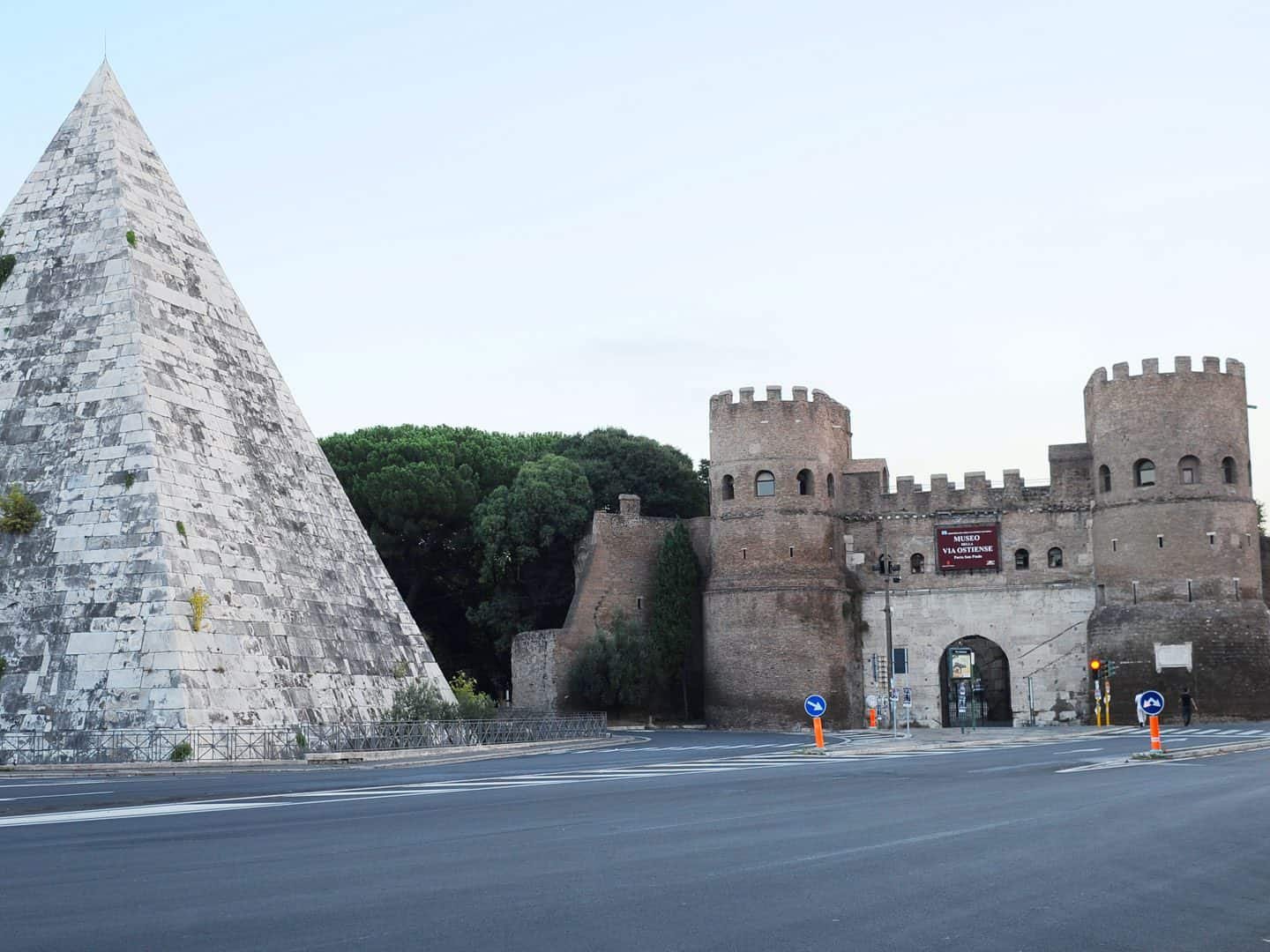
A curiosity about Via Ostiense Museum
The curiosity is hidden in the plan of the building, and it concerns a defensive detail that makes this monument unique in Rome. The museum, as has been said, is set up in the Castelletto, that is, in the counter-gate that Maxentius had built at the beginning of the 4th century on the inner side of the Aurelian gate. Two walls closed like pincers connect the two bodies and form a fortified courtyard: whoever entered the city didn't pass through an opening, they passed through a trap.
Up to here it's normal late antique military engineering, and other Roman gates had similar ones. The peculiarity, pointed out by scholars and never told to visitors, is that this counter-gate closed toward the city, not toward the outside as was the rule. Stop for a moment to think about what that means. A defensive device oriented inward doesn't protect against barbarians: it protects the garrison from the citizens. It serves to prevent a Roman crowd, or an armed faction, from taking control of the gate from the inside and opening it to those waiting outside.
This small inversion of direction is a political document. We are in the years of Maxentius, an emperor who rules Rome in a phase of permanent civil war, who has to defend the city from an external enemy and, at the same time, from a rival able to find accomplices inside the walls, and who knows very well how the city gates fared in earlier crises. Rome, after all, has a long history of gates opened from the inside: in 549 the Ostrogoths of Totila entered precisely from here thanks to the betrayal of the Isaurian garrison that was supposed to guard it. Maxentius's counter-gate is the architectural answer to that fear, built 200 years before the fear came true.
The second part of the curiosity is that this is the only counter-gate of the Aurelian Walls preserved in its entirety. Rome had 18 main gates and several posterns, and of that whole system of double defenses only one example remains intact: the one inside which Via Ostiense Museum was placed. Which produces a curious paradox: the museum occupies a piece of military architecture rarer than almost all the objects it displays.
The Pyramid of Cestius, the cumbersome neighbor of Via Ostiense Museum
You can't tell the story of this museum without telling the story of the pyramid that stands next to it, because the relationship between the two monuments is the key to reading this whole urban corner.
Who Gaius Cestius was and why he had a pyramid made
Gaius Cestius Epulo was a Roman magistrate, a member of the college of the septemviri epulones, the priests in charge of the sacred banquets. His tomb was built between 18 and 12 BC, in the Augustan age, and the inscriptions on the monument record an extraordinary testamentary clause: the work was completed in 330 days, opus absolutum ex testamento diebus CCCXXX, because the testator had imposed that deadline on his heirs on pain of losing the inheritance. 11 months for a 36-meter tomb: a building site run at a forced pace by a man who wanted to make sure he would be remembered.
The pyramidal form was not an isolated whim. After the conquest of Egypt in 30 BC Rome goes through a true Egyptomania: obelisks transported by sea, Isiac cults, Nilotic decorations in houses. Cestius builds himself an Egyptian tomb the way today one would build oneself a designer house: to say that he was up to date, cultured and rich. It should be added that his pyramid, tall and narrow, resembles the Nubian pyramids of Meroe more than those of Giza, and that in Rome there was at least one other, the so-called pyramid of Romulus near the Vatican, demolished in the 15th century.
The measurements, the materials, the burial chamber
The pyramid measures 36.40 meters in height on a square base about 30 meters on a side. It is built of concrete with a brick facing and a covering of Carrara marble slabs, on a platform of cementitious concrete: an entirely Roman technique under an entirely Egyptian form, which is, after all, the way Rome always treated the cultures it absorbed.
Inside, the burial chamber measures 5.95 by 4.10 meters, 4.80 high, with a barrel vault frescoed in the Pompeian third style: white walls with figures of priestesses and amphorae, and on the vault four figures of Nike. The frescoes are relatively well preserved, which, for a chamber that was sealed and then violated, is already a stroke of luck. The chamber was rediscovered thanks to the excavations ordered by Pope Alexander VII in 1663, who cleared the monument and had its inscriptions read again.
The pyramid as a bastion of the Aurelian Walls
The decisive fact, for whoever visits the museum, is what happens in the 3rd century: the pyramid is incorporated into the Aurelian Walls and becomes one of their bastions. It was not a tribute, it was construction-site economy. Aurelian's walls were built in a hurry and swallowed up everything that stood on the route and could serve as load-bearing structure: aqueducts, monumental tombs, private buildings, the Amphitheatrum Castrense. Cestius's tomb, massive and already tall, was a gift to the military engineers.
That is why the pyramid and the gate almost touch. They are not two monuments that happen to be close: they are two elements of the same wall, built three centuries apart and lined up by the same defensive need. When from the walkway of Via Ostiense Museum you look at the pyramid, you are not looking at a neighboring monument: you are looking at the next piece of the walls after yours.
The Japanese restoration and visits today
In 2015 the pyramid became white again after a restoration financed with about 2 million euros by the Japanese entrepreneur and patron Yuzo Yagi, one of the most visible episodes of private patronage of the Roman decade. Whoever remembers the monument black with smog and whoever sees it today has trouble believing it's the same one.
The interior, that is, the burial chamber with the frescoes, is visited with limited and scheduled access, not with free admission, and availability must be checked each time on the monument's official website. From the outside the pyramid is visible at any time, from the square and from the Non-Catholic Cemetery, which offers the best view of it. You'll find a dedicated in-depth article on our page about the Pyramid of Cestius.
Something nobody tells you about Via Ostiense Museum
The museum's address is Via Raffaele Persichetti 3. It's a short street, almost a connector, between the Pyramid of Cestius and Porta San Paolo, and no guide ever explains who the man it's named after was. The answer is that this man died there, a few meters from the gate inside which the museum is visited today, on September 10, 1943.
Raffaele Persichetti, born in Rome on May 12, 1915, taught art history at the Liceo Ginnasio Ennio Quirino Visconti. He was a lieutenant of the Granatieri di Sardegna and a war invalid. On the announcement of the armistice he had no obligation to report: he was dischargeable, he was a professor, he was wounded. He arrived at Porta San Paolo in civilian clothes and sketchily armed around 12:30, took command of a detachment and held it against superior German forces. Around 14:00 he was mortally hit while falling back on Viale Giotto. He was 28 years old. He was awarded the Gold Medal of Military Valor, and the citation contains the sentence that sums everything up: he rushed to the firing line in civilian clothes and sketchily armed, until, mortally struck, he sacrificed his young life.
His name is remembered by a plaque at the Collegio Romano, home of the Liceo Visconti, and by another on Corso Rinascimento. But his most eloquent dedication is this 150-meter street, which nobody walks because it leads nowhere, and which is exactly the stretch of asphalt on which the last defense of Rome was played out.
Here is the thing nobody tells you: when you type the address of Via Ostiense Museum into the navigator, you are typing the name of an art history professor who fell at that spot. An archaeology museum with an address that is already a monument to the Resistance. Knowing it before you go in changes the tone of the visit.
The Non-Catholic Cemetery Behind Via Ostiense Museum
100 meters from the door, at Via Caio Cestio 6, opens one of the most beautiful places in Rome and one of the least frequented by Romans: the Non-Catholic Cemetery, the one everybody calls the English cemetery or the Protestant cemetery. Anyone who visits the museum and does not walk those 100 meters makes a serious planning mistake.
Why the Cemetery Is Right Here
The reason for its location has to do with the same dynamics that explain the gate. In papal Rome non-Catholics could not be buried in consecrated ground, and the burial of non-Catholic foreigners was tolerated starting in the 18th century in a meadow outside the walls, near the Pyramid, at a point far enough from the city and close enough to a road out. The result is that next to a pagan tomb of the Augustan age a cemetery of Protestants, Orthodox, Jews of different origins, atheists, poets, diplomats and children of consuls has grown for two and a half centuries. Few concentrations of European cultural history are so dense in so little space.
Who Is Buried There, and How to Visit
In the old part, under the pyramid, rests John Keats, who died in Rome in 1821 at 25, with the nameless gravestone he asked for himself and the formula everyone knows about water and names. Not far away, the ashes of Percy Bysshe Shelley, drowned in 1822 off Viareggio. And in the new part the sober tomb of Antonio Gramsci, who died in 1937, which is the goal of a continuous political pilgrimage.
The practical information, as given by the cemetery itself: open Monday to Saturday from 9:00 to 17:00, with last entry at 16:30, and Sundays and holidays from 9:00 to 13:00, with last entry at 12:30. Closures are planned on January 1 and 6, for two weeks in mid-August, on December 8 and on the days between December 24 and 26 and on the 31st. Hours are reduced to the morning only at Easter and Easter Monday, on April 25, May 1, and June 2 and 29. Individual admission is free. For groups the cemetery asks for a voluntary contribution of €5 per visitor and advance booking through a form, with a maximum of 14 people plus one authorized guide. The telephone number given is +39 06 5741900.
Two warnings that matter here more than elsewhere. The first: it is a working cemetery, not an archaeological park, and funerals are still held. Appropriate dress and behavior, no food, no drinks, no cigarettes, no sitting on the gravestones, children must be accompanied and animals do not enter. The second: the cemetery asks that photographs taken inside not be shared on social media. It is a request for respect toward the families, and I find it absolutely right.
The View Nobody Considers
The last reason to go in is purely visual. From inside the cemetery, among the cypresses and the tombs of the old part, the Pyramid of Cestius appears as it does from no other point: without cars in front, without signs, without a roundabout, with greenery around it and the Aurelian Wall alongside. It is the closest way we have of seeing it as the travelers of the Grand Tour saw it, and it is the same image that produced an endless quantity of engravings and watercolors between the 18th and 19th centuries.
My Advice for Visiting Via Ostiense Museum
The advice is organizational, and it begins with an observation that saves disappointment: do not show up at the door hoping to find it open. The regime of this museum is that of scheduled opening, and most of the people who try find a closed gate and leave convinced that the museum no longer exists.
The method that works is this. First: keep an eye on the calendar of free guided visits of the Capitoline Superintendency, where Porta San Paolo appears periodically, often on the occasion of themed days such as the European Archaeology Days in June or the heritage days in autumn. Second: book the same day the date is published, because the groups are of 15 people and fill up in a few hours. Booking is done at the Roma Capitale contact center, open every day from 9:00 to 19:00, and there is also a dedicated mode for deaf people with an interpreting service. Third: if you can no longer come, cancel. Fourth: always check the opening status on the museum's official site before setting out, because the situation changes.
On what to wear and what to bring, three practical points. Closed shoes with good grip: you climb old flights of stairs, four on the visits that cover all levels, with uneven steps and little light. No bulky backpacks: the passages in the thickness of the wall are narrow and it's hard to turn around. A sweatshirt even in summer: inside the wall the temperature drops by quite a few degrees compared with the square, and the draft in the portcullis gallery really blows.
On when: the square is a node of very heavy traffic, and the difference between 9:00 in the morning and 18:00 on a weekday is the difference between hearing the guide and not hearing the guide. If you can choose the time slot, choose the earliest one. On who to bring: bring kids from 10 years old up, who enjoy the scale models and the idea of the portcullis, and leave the strollers at home, because they don't fit in here.
One last thing, and I consider it the most important. Give this visit half a day, not an hour. The museum lasts 60 minutes, and the rest is made up by the Pyramid seen from the square, the Non-Catholic Cemetery, and a walk along Via Marmorata or toward Testaccio. The Via Ostiense Museum taken on its own leaves the feeling of something small. Taken as a gateway to a quadrant of the city, it becomes one of the smartest mornings you can spend in Rome.
September 10, 1943: The Battle of Porta San Paolo
This chapter has to be written in full, because the monument that houses the museum is also the symbolic place of one of the decisive days in the history of twentieth-century Rome, and because the memory of that day is kept by plaques that passersby no longer read.
The Context: The Armistice and the Command Vacuum
The announcement of the armistice between Italy and the Allies arrives on the evening of September 8, 1943. In the following hours the top of the State leaves Rome, the armed forces are left without clear orders, and the German divisions around the capital receive precise instructions instead: occupy the city. Substantial Italian units are deployed around Rome, among them the 21st Infantry Division Granatieri di Sardegna, and the first fighting begins as early as the evening of September 9 along Via Laurentina and on the Magliana road.
It has to be said with historical honesty: it was not a defense organized from above. It was a sum of units that decided to fight, of officers who took initiative without cover, and of civilians who went down into the street. This is what makes September 10 a founding event for the Roman Resistance: not a battle won, but the first moment in which soldiers and the population find themselves on the same side of the barricade.
The Day, Hour by Hour
On the morning of September 10 the resistance concentrates on the southern arc of the city and finds its most famous point in the square of Porta San Paolo. The German columns press toward the center, the grenadiers and the units that are still holding try to block the access roads, and the fighting breaks up into a series of urban clashes among the Pyramid, Viale Giotto, Viale Baccelli and the streets of Testaccio.
Around 12:30 Raffaele Persichetti arrives, in civilian clothes. Around 14:00 he is fatally shot. At 16:00 General Giorgio Carlo Calvi di Bergolo signs the agreement for the surrender of the city. At 17:00 the Germans pass through Porta San Paolo. In a little over 24 hours, the toll of the defense of Rome counts 570 dead.
Who Was There: Names That Weigh
The list of the people present that day at that spot is impressive, and it's worth running through because it explains the Rome of the following 20 months. Sandro Pertini was there, future president of the Republic, who in those hours fights with whatever he finds. Bruno Buozzi was there, the trade unionist who will be killed by the Germans at La Storta on June 4, 1944, a few hours before the liberation. Mario Zagari was there, future minister. Adriano Ossicini and Romualdo Chiesa were there, Catholic communists. Chiesa will be shot at the Fosse Ardeatine on March 24, 1944. The students Mario Fiorentini and Marisa Musu were there, who will become two of the best-known GAP fighters of the Roman Resistance. Vincenzo Baldazzi was there, who at Via delle Conce put two German armored vehicles out of action. Lieutenant Maurizio Giglio was there. The pilot Eugenio Vicentini was there, gold medal winner. Maurizio Cecati was there, 17 years old, considered the first recognized partisan to fall. Second Lieutenant Enzo Fioritto was there, who fell on Viale Baccelli.
One thing is worth repeating. That square, today, is an intersection. But in those hours, in a rectangle of 300 by 200 meters, there were at the same time a future president of the Republic, a future minister, the future commanders of the Roman GAP, a trade unionist who would be murdered, a 17-year-old boy and an art history professor. Italian postwar history began to be written there.
The Plaques Nobody Reads
On the monument and around the square there are two plaques set into the walls in memory of the events of September 10, 1943, one in memory of the Anzio landing and the arrival of the Allies in June 1944, and a last one in memory of the fallen of the Resistance and of terrorism. They are modest slabs, in a noisy spot, and passersby walk past them without seeing them.
If you go to the Via Ostiense Museum, give five minutes to reading those plaques before going in. It's not rhetoric: it's the right way to visit a monument that served as a fortress three times, under Honorius, during the Gothic War and in 1943, and that lost each time.
Another Well-Known Fact, Yet Rarely Mentioned
The fact is this: Porta San Paolo is not where it was, and above all it is not as it was. Archaeologists know it, manuals write it, and nobody tells visitors, who in front of the monument convince themselves they are looking at a Roman gate that has stayed in its place.
The truth is more interesting and more melancholy. First element: near the Pyramid of Cestius there were two gates, side by side. The western one was closed in antiquity and demolished in 1888, in the full building fever of Rome as the capital, when everything that obstructed a street was taken down without much regret. Of that structure, the recorded measurements remain: an archway 3.60 meters wide, jambs in travertine blocks 67 centimeters thick, a monolithic threshold more than four meters long.
Second element: around 1920 the surviving gate is isolated from the walls on the eastern side to let traffic through. This is the operation that created the square we know, with the gate in the middle like an island. Third element: during the Second World War a bombing also destroys the stretch of wall on the western side. Final result, what we see: a monument amputated on both flanks, detached from the wall of which it was the opening, surrounded by cars.
Why does this change the visit to the Via Ostiense Museum? Because the gate can only be understood if you mentally rebuild the wall. An urban gate is not an isolated arch: it is the point where a continuous barrier accepts a controlled passage. If the wall isn't there, the gate becomes a decorative monument and loses its meaning, which was military, fiscal and legal all at once. Try this exercise before going in: stand on the sidewalk, look at the towers, and imagine extending the walls to the right and to the left until they close off the horizon. At that moment you understand where Rome ended.
I'll add the opinion, which is clear-cut. The isolation of 1920 is often told as an act of enhancement, almost a restoration. It was a traffic decision, and it was a loss. Rome gained a roundabout and lost the legibility of a piece of city wall among the best preserved in the city. Anyone who wants to see how the relationship between gate and wall really worked should go to the Museum of the Walls at Porta San Sebastiano, where the walkway can still be followed for hundreds of meters, or follow the preserved stretches of the Aurelian Walls elsewhere in the city.
The Ostiense Neighborhood Around the Museo della via Ostiense
The museum sits on the threshold of one of the most interesting neighborhoods in Rome, and anyone visiting would do well to think of the half day as a descent along Via Ostiense, not as an isolated stop.
From Grain Road to Industrial District
Via Ostiense has had two economic lives, and the second follows the first with impressive consistency. Between 1910 and 1927 the road becomes the axis of a brand-new industrial hub: the Magazzini generali, the Gazometro, the Montemartini thermoelectric power plant, the Mercati generali and the Roma-Lido railway are born. It's no accident: the route toward the sea was already the route of goods 2,000 years earlier, and logistics has a very long memory. The grain of the annona and the foodstuffs of the Mercati generali passed through the same corridor.
The Gazometro, with its 70 meters of metal framework visible from half the city, is the emblem of that season and is by now as much a monument of affection for Romans as an ancient arch. The Centrale Montemartini, instead, has become the smartest thing Rome has done with its own industrial archaeology: ancient sculptures from the Capitoline Museums displayed among diesel engines and boilers, a pairing that seemed a provocation when it was inaugurated and today is a model studied abroad. We talk about it on the dedicated page for the Centrale Montemartini.
Marcello Piacentini's Station
Next to the gate, and connected to the Piramide stop of metro line B by internal passages, is the Roma Porta San Paolo station, northern terminus of the Roma-Lido railway. Work began in 1919 and the station was inaugurated on August 10, 1924 to a design by Marcello Piacentini, in a neoclassical style that deliberately recalls the facade of a Roman temple.
It's a building that deserves two minutes of attention, because it tells of an explicit ideological choice: the railway that takes Romans to the sea had to look like a temple, and had to rise next to the ancient gate to establish a visual continuity between imperial Rome and modern Rome. Piacentini would later become the dominant architect of the Fascist period, and here, in 1924, that grammar is already fully readable. Inside the station there is also a museum center dedicated to transport, inaugurated in 2004: check that it's open before counting on it, because it has no guaranteed continuous schedule.
What's Within a 10-Minute Walk
The geography around the museum is generous and it's worth having it in your head before you arrive. 100 meters away, the Non-Catholic Cemetery and the Pyramid of Cestius. Five minutes away, going up Via Marmorata, the district of Testaccio with Monte dei Cocci, the Nuovo Mercato Testaccio and the best concentration of Roman home-style cooking in the city. 10 minutes away in the opposite direction, toward the river, the area of the Emporium and the remains of the grain warehouses under the Aventine. A little further up, the Aventine with the Basilica of Santa Sabina and the Orange Garden. To the south, by metro B or by bus, the Basilica of St. Paul Outside the Walls, which is the devotional terminus of this whole story, and the burial ground of the Rupe di San Paolo in Parco Schuster.
The recommended itinerary for anyone with only one day in this quadrant: museum visit slot at 10:00, Non-Catholic Cemetery right after, lunch in Testaccio, and in the afternoon metro B to San Paolo for the basilica and the burial ground. Anyone with more time adds Ostia Antica the next day, and at that point the scale model seen in the first room becomes a map you walk.
The Right Photo to Take at the Museo della via Ostiense
The photographs you see around of this corner of Rome are almost all wrong, and they're wrong for a precise reason: they're taken from the sidewalk of the square, in landscape format, and end up putting together the gate, the pyramid, four buses, a traffic light and a forest of poles. The result is a confused image in which nothing can be read.
The right photo, if you're lucky enough to be inside during a visit, is just one: the one from the outer walkway reached from the second room. From up there the Pyramid is framed from above, over the level of the traffic, with the Aurelian wall in the foreground as a leading line and the cypresses of the Non-Catholic Cemetery closing the background. Stand with the sun behind you, and if you can choose the time slot choose the morning one: the side light of the morning draws out the bricks of the gate and the marble of the pyramid, while at noon it flattens everything.
If instead you're outside, the square offers two spots that work. The first is the corner of Via Raffaele Persichetti, that is the little street between the gate and the pyramid: from there you get the alignment of the two monuments in depth, with the gate on the left and the pyramid closing on the right, and with a vertical crop you eliminate almost all the cars. The second, the best of all for the pyramid, is inside the Non-Catholic Cemetery, from the old part: lawn, cypresses, the Aurelian wall and the white tip above, without a single modern element in the frame. Remember, though, that the cemetery asks that those images not be shared on social media, and it's a request that must be respected.
One last technical note, from someone who has seen hundreds of people get the same shot wrong. The extreme wide angle, here, is the enemy: it makes the pyramid look like a distant little triangle and the gate like a toy. Use a normal or short telephoto focal length, get closer, and accept not fitting everything in. The subject is the relationship between the two monuments, not the list of things present.
How to Get to the Museo della via Ostiense and How Much Time You Need
Transport access is the absolute strong point of this place, and it should be used. The museum is in one of the best-served interchange hubs in Rome.
Metro, Train and Surface
The metro B, stop Piramide, lets you off practically under the monument: you come up the escalators and the gate is in front of you. The station is connected by internal passages to the Porta San Paolo station, terminus of the Roma-Lido railway, which goes to Ostia and the sea. Less than 200 meters away is the Roma Ostiense railway station, served by regional Lazio lines and by national connections. On the surface, tram 3 and buses 23, 30, 60, 75, 83, 95, 175 and 280 run through.
In practice: from Termini you get there in 15 minutes by metro B with no changes. From the Colosseum in six minutes, again metro B. From the Vatican, it's best to take metro A to Termini and change to B, or take the 23 along the Tiber, which is slower but passes in front of half of the Lungotevere and counts as a sightseeing ride.
By Car: My Advice Is Not to Come
Don't come by car. The square is a congested traffic node at all hours, parking is paid and scarce, and the area is subject to traffic restrictions that change over time. With a metro that stops 20 meters from the entrance, driving here is a self-defeating choice. If you really are coming from outside Rome by car, leave it at a park-and-ride on metro B and get off at Piramide.
How Much Time to Allow
For the interior rooms of the gate, that is for the museum proper, the guided visit lasts 60 minutes, and that's enough to see everything without rushing. Anyone visiting on their own, during an ordinary opening period, can get by in 45 minutes or stay an hour and a half depending on how much they love scale models and labels.
For the area, as said, allow half a day: museum, pyramid from the square, Non-Catholic Cemetery and a walk toward Testaccio fill a full morning. If you add the Basilica of St. Paul Outside the Walls and the burial ground of the Rupe, the day is complete and you still have time left for dinner in the area.
Some Important Events That Happened Here in History
Few points in Rome have such a dense and varied chronology: a tomb, a wall, a gate, a customs post, a battle, a museum. It's worth putting them in line, because the succession says more than any commentary.
Between 18 and 12 BC: The Pyramid Is Born
Gaius Cestius Epulo dies and his heirs, bound by the will, build the pyramid in 330 days. At that moment there are no walls at this spot: there is countryside outside the city, the road to Ostia, and the tombs that line it. The pyramid is simply the most conspicuous tomb on the stretch.
The 270s AD: The Walls Arrive
Aurelian has Rome encircled with walls for the first time in centuries, and the route passes right here. The pyramid is incorporated and turned into a bastion, and the Porta Ostiensis is opened with two archways to bear the traffic toward the port. In a few years a suburban funerary landscape becomes a defensive front.
Early 4th Century: Maxentius's Inner Gate
Maxentius builds on the inner side the inner gate with the fortified courtyard, the Castelletto, the only fully preserved example in Rome and the future home of the museum. The closure facing the city tells the political climate of those years better than many chronicles.
401-403: Honorius's Renovation
With the Goths on the move, Honorius reduces the two archways to one, raises the arch by about a meter, reinforces and heightens the towers, fits them with crenellations and windows, and builds the attic with the small windows that lit the room where the portcullis was operated. It's the appearance the monument still keeps today.
549: Totila Enters Here
During the Gothic War the Ostrogoths of Totila enter Rome through this very gate, thanks to the betrayal of the Isaurian garrison in charge of defending it. It's the episode that demonstrates, in the field, the clear-sightedness of Maxentius's design: the gates of Rome fell more often by internal agreement than by assault.
Between the 1200s and 1300s: The Byzantine Chapel in the Tower
The eastern tower houses a chapel decorated with frescoes for a community of Byzantine rite. It's the sign that in the Middle Ages the gate is inhabited, and that the village toward San Paolo is a crossroads of languages and rites.
1749: Benedict XIV's Restoration
Pope Benedict XIV has the city wall restored starting from Porta San Paolo as far as Porta Flaminia and has it carved on an inscription on the eastern tower. The papacy no longer defends the city with the walls, but maintains them as a fiscal boundary and as decoration.
1663 and Thereabouts: The Rediscovery of the Burial Chamber
The excavations ordered by Pope Alexander VII free the pyramid and bring back into view the frescoed funerary chamber, which had been violated in antiquity. In the following decades the monument enters permanently into the repertoire of Grand Tour travelers.
1888: The Demolition of the Western Gate
The second gate, the western one, already closed for centuries, is torn down. Rome has been the capital for 18 years and is building the new neighborhoods at a feverish pace. The monument gives way to the road network.
Circa 1920: The Isolation of the Gate
Porta San Paolo is detached from the walls on the eastern side to let traffic flow. The square is born, the continuity of the circuit dies.
August 10, 1924: Piacentini's Station
The Porta San Paolo station, terminus of the Roma-Lido, is inaugurated, designed by Marcello Piacentini in the forms of a neoclassical temple. The Ostiense neighborhood is by now the industrial and logistics district of the capital.
September 10, 1943: The Battle
The defense of Rome plays out in a few hours. At 16:00 the surrender, at 17:00 the Germans pass through the gate. 570 dead. Among them Raffaele Persichetti, after whom the museum's street is named.
1954: The Museo della via Ostiense Is Born
Inside the rooms of the gate the museum is set up, illustrating the topography of the territory between Rome and Ostia. A monument that had been a boundary tomb, a customs post, a fortress and a battlefield becomes an educational site.
2015: The Pyramid Turns White Again
The restoration financed by the Japanese patron Yuzo Yagi, for about 2 million euros, is completed. The monument loses the black patina of the twentieth century and regains its Carrara marble.
July 8, 2026: The Burial Ground of the Rupe di San Paolo Reopens
The Capitoline Superintendency opens to the public a new sector of Via Ostiense burial ground in Parco Schuster, with restorations, an educational route, lighting and full-scale reproductions of the frescoes preserved in the Porta San Paolo museum itself. After 70 years, the museum and its territory are connected again.
Who Has Passed Through the Museo della via Ostiense
The question, for a place like this, has to be asked in two ways: who passed through this gate, and who worked inside these rooms. The two lists together make a history of Italy.
Who Went Through the Gate
Through this gate, every day for centuries, passed the traffic that fed Rome: carters, muleteers, couriers of the annona, port officials, sailors from Alexandria and Carthage, Syrian and Egyptian merchants who brought their own cults with them. They are nameless people, but they are the reason the gate exists, and they are the people whose objects the museum displays.
Through this gate passed, according to devotional tradition, the pilgrims heading to the tomb of the apostle Paul, who according to tradition was beheaded at the Acque Salvie and buried along Via Ostiense, where Constantine had the first basilica built in 324, rebuilt and consecrated at the end of the 4th century. The flow of pilgrims was such that the road to the basilica was covered by a colonnaded portico, restored in 855 by Pope Benedict III, and that in the 9th century Pope John VIII had the village around the basilica fortified, creating the citadel of Giovannipoli against Saracen raids. The name of the gate comes from this traffic, not from the soldiers.
Through this gate Totila, king of the Ostrogoths, entered Rome in 549. Through this gate the papal processions headed to San Paolo went out and came back. Under this gate passed the carriages of the Grand Tour travelers who came down to see the pyramid and draw it: the pairing of the Egyptian tomb and the crenellated gate is one of the most replicated subjects of European engraving between the 1700s and 1800s.
Who Worked Here and Who Died Here
Italo Gismondi (1887-1974) passed through here in the fullest sense: the model of Ostia displayed in the first room is his work, and his interpretation of the port city is the backbone of the whole museum. Director of the excavations of Ostia for 44 years, superintendent of antiquities of Rome between 1919 and 1938, author of the model of imperial Rome at a scale of 1:250 on which he worked from 1935 to 1971, he received the Cultori di Roma prize in 1974. He is one of the decisive figures of twentieth-century Roman archaeology and one of the least known to the public.
Angelo Pellegrino, archaeologist, director of the museum and of the excavations of Ostia Antica, executive official of the Archaeological Superintendency of Ostia from 1981 to 2013, is the other name this place carries with it.
Marcello Piacentini signed, 20 meters from the gate, the Porta San Paolo station inaugurated on August 10, 1924. Pope Benedict XIV left his inscription on the eastern tower in 1749. Pope Alexander VII had the chamber of the pyramid reopened in 1663.
And then there is September 10, 1943, the list that weighs the most. Raffaele Persichetti, art history professor and lieutenant of the Granatieri, fallen at 28 a few meters from the gate. Sandro Pertini, future president of the Republic. Bruno Buozzi, trade unionist, killed at La Storta on June 4, 1944. Mario Zagari, future minister. Adriano Ossicini and Romualdo Chiesa, the latter shot at the Fosse Ardeatine on March 24, 1944. Mario Fiorentini and Marisa Musu, then students, later among the protagonists of the Roman Resistance. Vincenzo Baldazzi, Maurizio Giglio, Eugenio Vicentini, Enzo Fioritto, and Maurizio Cecati, 17 years old.
If I had to name a single reason why it's worth going into the Via Ostiense Museum, it would be this: few places in Italy hold together, inside the same stone perimeter, the grain of the annona, third-century funerary painting, a Byzantine chapel, a customs booth and the names of 1943.
The Museo della via Ostiense With Children and Teenagers
A frequent question, which deserves a detailed answer. The museum works very well with kids from 10 years old up and poorly with small children, for practical reasons before reasons of content.
The practical reasons: old stairs, uneven steps, narrow passages, no elevator, little light, and on guided visits four flights to climb. Strollers don't fit, and a child who has to be carried in your arms on those stairs turns the visit into a balancing exercise.
The reasons of content, on the other hand, work in its favor. There are two scale models, and scale models are the most immediate language a museum can offer a kid: a miniature city and a hexagonal port full of water beat any explanatory panel. There's a portcullis to imagine, and the question of how it was raised and who operated it fires up anyone. There's an open-air walkway with a view of a pyramid, and at that point the game is won. If you have kids of middle-school age, this is one of the Roman places where history explains itself.
My suggestion: prepare them with 10 minutes of storytelling before going in, explaining that this gate was a customs post and a fortress, and give them a small observation task, for example counting how many small windows the attic has or finding the traces of the walled-up second archway. A kid with a task looks. A kid without a task waits for the exit.
Accessibility of the Museo della via Ostiense
Here the answer has to be given without sugarcoating, because on accessibility half-statements do damage. The museum is set up inside a multi-level Roman monument, and the visits explicitly state that the activity is not suitable for people with mobility difficulties, because there are four flights of stairs to climb. There are no elevators, the passages are narrow, the steps are uneven and in some stretches the light is poor.
Anyone with walking problems, anyone who uses a wheelchair, anyone who has difficulty with stairs cannot visit the interior rooms. It's a structural limit of the monument, not a management choice, and overcoming it would take work that on a building like this is extremely complicated.
On the sensory side, instead, there is good news: the Superintendency's visits include a booking method dedicated to deaf people, through a global communication service active Monday to Friday from 8:30 to 18:30 and Saturday from 8:30 to 13:30, and on some openings an Italian Sign Language interpreter is provided. It's a serious service and it's worth using.
A concrete alternative for those who stay outside: the square, the Pyramid seen from the outside and the Non-Catholic Cemetery, which is level and walkable, still offer an excellent reading of the context. And the Centrale Montemartini, a little further along Via Ostiense, is a modern, accessible museum that tells the story of the same urban quadrant.
How Much It Costs to Visit the Museo della via Ostiense
The short answer is that it costs nothing. Admission to the museum is free, and the guided visits with which the Capitoline Superintendency periodically opens Porta San Paolo are also free of charge, activity and admission included, with the sole formality of mandatory booking and limited places. There is no full-price ticket, no reduced ticket, no surcharges.
It's worth clearing up a misunderstanding I often hear repeated, though, because it concerns Rome's museum passes. The MIC card costs five euros and gives free admission for 12 months to the Museums System of Roma Capitale, that is to the circuit of the civic museums. It can be bought by adults who are residents or domiciled in Rome and the Metropolitan City and by students of the public and private universities of the metropolitan territory, it's bought online, through an app, in the museums of the system and at the tourist information points, and it also gives discounts on exhibitions and agreements with cultural institutions of the city. Since February 2026 Rome residents have free access to the civic museums, and the card keeps other benefits.
The point is that the Via Ostiense Museum doesn't belong to that circuit: it's listed among the places of culture of the Ministry of Culture, and it's free on its own. The MIC card isn't needed here, simply because there's nothing to pay. It is very useful, instead, if after the museum you go down to the Centrale Montemartini or head back up toward the Trajan's Markets, which are in the civic circuit.
A professional's opinion, and I'll say it plainly: the fact that this museum is free is both its good fortune and its sentence. Good fortune because it removes every barrier. Sentence because a museum that doesn't take in money doesn't produce numbers, and a museum that doesn't produce numbers struggles to defend its staff, which is exactly the reason it has no ordinary schedule today. If you have the chance to go when it opens, go: attendance is the only thing that keeps small museums open.
When to Go to the Museo della via Ostiense and When to Avoid It
Seasonality matters less here than elsewhere, because the visit is short and largely indoor. What matters, instead, is the hour and the day.
Early morning is the right choice, and not only for the light. The square of Porta San Paolo is one of the noisiest traffic nodes in Rome, and from 8:00 to 9:30 and then again from 17:00 to 19:30 the racket makes it tiring to listen to whoever is speaking. On the special openings the slots are generally at 10:00 and 11:30: if you can choose, take the first.
Summer has a specific problem: the square has no shade and reflects heat from all sides, and the wait before entering, in July, makes itself felt. Bring water and a hat and show up with 10 minutes of margin, no more. Inside, on the contrary, the temperature drops sharply: the ancient masonry works as an air conditioner and the drafts in the portcullis gallery are real.
Winter is the best season for this quadrant: the low light draws out the bricks, the Non-Catholic Cemetery is almost empty and the cypresses against the clear sky are worth the trip. The period to avoid, if you're looking for quiet, is that of the big events in the neighborhood and of the heavily advertised special opening days, when the slots fill up in a few hours and the waiting lists are long.
One last practical warning that applies to the whole area: the square is an intense transit point, with lots of people running to catch metros and trains. Keep an eye on bags and phones as you would at Termini. It's not a dangerous neighborhood, it's a busy neighborhood, and it's always the visitors who pay for distraction.
The Museo della via Ostiense and the Other Museums in the Area: How Not to Get Confused
Within a few kilometers there are at least four institutions that tell related stories, and confusion is frequent. I'll clarify the differences, because choosing well saves half days.
Museo della via Ostiense and Museo delle Mura
The Museum of the Walls, set up inside Porta San Sebastiano on the Appian Way, is the conceptual sibling of this museum: it too occupies a gate of the Aurelian Walls, it too tells the story of the circuit. The difference is clear-cut. The Museo delle Mura tells the story of the walls, their building technique, the phases, the walkway, and lets you follow a stretch of the patrol path for hundreds of meters. The Via Ostiense Museum tells the story of the road and the territory toward the sea, and the gate serves it as a container and as the first exhibit. Anyone with time for only one of the two who loves military architecture should choose Porta San Sebastiano. Anyone who wants to understand Rome's supply and the port system should choose Porta San Paolo.
Museo della via Ostiense and Ostia Antica
The museum displays the model of Ostia, the materials of the road, the grave goods of the necropolises. The archaeological park of Ostia Antica is the real city, 25 kilometers further on, with its insulae, baths, theater, the mosaics of the guilds. They are not alternatives: they are two parts of the same discussion. The right order, if you have two days, is to start here and finish there, because arriving at Ostia having already seen Gismondi's model changes the way you read the decumanus.
Museo della via Ostiense and Centrale Montemartini
The Centrale Montemartini is a 20-minute walk along Via Ostiense and belongs to the circuit of the civic museums, with a ticket, continuous hours and full accessibility. It displays ancient sculptures from the Capitoline Museums inside a decommissioned thermoelectric power plant. It's an ancient art museum in an industrial container. The Porta San Paolo museum is a museum of territory in an ancient container. Together they tell the two economic lives of the same road, that of grain and that of electricity.
Museo della via Ostiense and Museo delle Civiltà
At EUR, the Museum of Civilizations holds among its collections the large model of imperial Rome made by Italo Gismondi, that is the major work of the same author as the model of Ostia displayed at Porta San Paolo. For anyone who becomes passionate about the figure of Gismondi, the route between the two models is the best outing Rome can offer a topographer.
What to Take Home From the Museo della via Ostiense
There's no bookshop, no catalogs for sale, no cafe, and in a museum of this size the opposite would be astonishing. What you take home is of another nature, and I'll try to say it in three points.
The first is a sense of scale. After looking at the model of the ports you understand that Roman antiquity wasn't a matter of isolated monuments but of systems: roads, canals, basins, warehouses, fleets, offices. The Colosseum is spectacle. The hexagonal port is infrastructure, and without infrastructure the spectacle doesn't pay for itself.
The second is a sense of continuity. In the same building you see a military device of the 4th century, a chapel of the 1200s, a customs booth of the 1700s and the plaques of 1943. There's no better way to understand that in Rome places don't change function: they accumulate them.
The third is a sense of proximity, and it's the most important. After this visit you will no longer look at the Piramide square as an intersection to cross in a hurry. You will look at a gate, a bastion, a cemetery of poets, a neoclassical station, a street named after a murdered professor. Rome works like this: the difference between an intersection and a chapter of history is only the amount of things you know.
Quick Questions About the Museo della via Ostiense
Where Is the Museo della via Ostiense
At Via Raffaele Persichetti 3, 00153 Rome, inside the rooms of Porta San Paolo, on the square that opens next to the Pyramid of Cestius, at the exit of the Piramide stop of metro B.
How Much Is a Ticket to the Museo della via Ostiense
Nothing: admission is free. The guided visits with which the Capitoline Superintendency periodically opens the gate are also free, activity and admission included.
Is the Museo della via Ostiense Open Every Day
No. Today the museum has no ordinary opening schedule and is listed as temporarily closed among the state cultural sites. Access is through scheduled special openings, generally tied to themed days. Always check the museum's official website and the Capitoline Superintendency's calendar of visits before heading out.
How Do You Book a Visit to Porta San Paolo
On recent openings booking was mandatory through the Roma Capitale contact center, number 060608, active every day from 9:00 to 19:00, with places limited to 15 participants per slot. Deaf people can book through a dedicated global communication service, active Monday to Friday from 8:30 to 18:30 and Saturday from 8:30 to 13:30.
How Long Does the Visit to the Museo della via Ostiense Last
The accompanied visits last 60 minutes. Taking it slowly, and under ordinary opening conditions, you can stay an hour and a half. For the whole quadrant, museum included, allow half a day.
Do You Need the MIC Card to Enter the Museo della via Ostiense
No. The MIC card, five euros for 12 months, concerns the Museums System of Roma Capitale and is reserved for adults who are residents or domiciled in Rome and the Metropolitan City and for students of the universities of the territory. The Porta San Paolo museum belongs to the state cultural sites and is free anyway, so the card isn't needed here.
Is the Museo della via Ostiense Wheelchair Accessible
No. The route unfolds on several levels with old flights of stairs, uneven steps, narrow passages and no elevator. The visits explicitly state that the activity is not suitable for people with mobility difficulties, with four flights to climb. It's a limit of the monument.
Can You Take Photos Inside the Museo della via Ostiense
On the visits no general bans on photography without flash are reported, but the golden rule in a museum of this size is to ask the person leading the group before shooting. In the nearby Non-Catholic Cemetery, instead, you are expressly asked not to share on social media the images taken inside.
How Do You Get to the Museo della via Ostiense by Public Transport
Metro B, Piramide stop, practically under the monument. Roma-Lido railway from the Porta San Paolo station, connected to the metro by internal passages. Roma Ostiense railway station 200 meters away. On the surface, tram 3 and buses 23, 30, 60, 75, 83, 95, 175 and 280.
Is It a Good Idea to Go by Car
No. The square is congested at all hours, parking is scarce and paid, and the area is subject to traffic restrictions. With the metro 20 meters from the entrance, the car is the worst choice.
What Exactly Can You See Inside the Museo della via Ostiense
The model of Ostia by Italo Gismondi and an oil painting with Via Ostiense in the first room. Three painted arcosolia of the 3rd century, the cast of the milestone of the 11th mile, paintings and grave goods in the portcullis gallery. The model of the port of Claudius and of the hexagonal port of Trajan in the second room. The outer walkway with a view of the Pyramid. The third room for exhibitions and conferences with the 18th-century customs structure. Imperial portraits, sarcophagi, mosaics and an opus sectile floor of the 4th century. Sculptures linked to the Eastern cults. Medieval frescoes in the eastern tower. Funerary marble ruins in the garden.
What Do the Arcosolia of the Museo della via Ostiense Represent
They come from a 3rd-century tomb in the burial ground near the Basilica of St. Paul Outside the Walls. The main scene depicts Prometheus shaping man, with Athena infusing life into him, flanked by a peacock and a pheasant, images linked to the afterlife.
Is the Museo della via Ostiense Good for Kids
From 10 years old up it works very well, thanks to the scale models and the idea of the portcullis. Below that age the stairs and narrow passages make it tiring, and strollers don't fit.
Is There a Coat Check or Luggage Storage
No. There's no coat check, storage, bookshop or cafe: it's a small museum set up inside a monument. Avoid bulky backpacks, which are a problem in the narrow passages.
How Long Is the Wait in Line at the Museo della via Ostiense
There are no lines, because there is no continuous free entry: you enter by booking, in limited slots. The line, if anything, is the one to book, and places run out within a few hours of the date being published.
Is Admission Free on the First Sunday of the Month
Here free admission doesn't depend on the first Sunday, because admission is always free. In the past accompanied visits were offered on the first Sunday of the month. Today the calendar to check is the one for the special openings.
What's the Difference Between Porta San Paolo and the Museo della via Ostiense
Porta San Paolo is the monument, that is the gate of the Aurelian Walls with its towers and Maxentius's inner gate. The Museo della via Ostiense is the museum installation of 1954 placed inside those rooms. You visit them together, because the container is part of the route.
Why Is the Gate Called San Paolo if the Road Is Via Ostiense
The ancient name was Porta Ostiensis, from the road that passed through it. The medieval name comes from the Basilica of St. Paul Outside the Walls, reachable from here along Via Ostiense: it was the pilgrim traffic that rewrote the place names.
Can You Visit the Pyramid of Cestius Together With the Museum
They are two separate places with two separate managements. The outside of the pyramid can always be seen from the square and, much better, from the Non-Catholic Cemetery. The inside, that is the frescoed burial chamber, is visited with limited and scheduled access that should be checked on the monument's official website.
How Far Is the Non-Catholic Cemetery From the Museo della via Ostiense
About 100 meters: the entrance is at Via Caio Cestio 6. It opens Monday to Saturday from 9:00 to 17:00, with last entry at 16:30, and Sundays and holidays from 9:00 to 13:00, with last entry at 12:30, with some closures and reduced hours in the year's calendar.
Does the Museo della via Ostiense Have Guided Visits in English
The special openings of the Capitoline Superintendency are in Italian. For a visit in another language you need to contact a licensed tour guide and check availability of the opening on the requested date.
Can You Visit the Outer Walkway of the Museo della via Ostiense
Yes, it's part of the route: you reach it from the second room through the passage that the museum's itinerary calls the cella muroniana, and it overlooks the Pyramid of Cestius. It's the best spot for a photograph.
What's the Relationship Between the Museum and the Burial Ground of the Rupe di San Paolo
Direct. The frescoes with Prometheus displayed in the portcullis gallery come from that funerary complex, and in the new sector opened on July 8, 2026 in Parco Schuster the paintings are returned to their context with full-scale reproductions. The two visits complement each other.
Is the Museo della via Ostiense Worth the Trip if You Have Few Days in Rome
On its own, no: anyone with three days spends them better elsewhere. But if you've already seen the center, if you come back to Rome often or if you live in the city, this is one of the most instructive mornings available, and it's free. Anyone who loves the archaeology of systems, ports and infrastructure should put it at the top of the list.
Where Do You Eat Near the Museo della via Ostiense
Going up Via Marmorata you enter the district of Testaccio, which is the most reliable concentration of Roman home-style cooking in the city, with the Nuovo Mercato Testaccio as a starting point and the neighborhood's museo diffuso as a guide to the area. 10 minutes on foot from the gate.
What Else Can You See on the Same Day
The Pyramid of Cestius, the Non-Catholic Cemetery, the Centrale Montemartini, the Basilica of St. Paul Outside the Walls, and going up toward the Aventine the Basilica of Santa Sabina, the Orange Garden and, a little further on, the Circus Maximus and the Baths of Caracalla.
The Last Recommendation
If I had to convince just one person to put Porta San Paolo on their list, I'd use one argument and that's it: it's the only place in Rome where you can look at a model of Trajan's port while standing inside the gate from which the road that led to that port began. Everything else, the paintings of Prometheus, the Byzantine chapel, the customs booth, the plaques of 1943, comes on top.
Book as soon as a date comes out, arrive for the morning slot, wear shoes with good grip on the stairs and bring half a day of time. And when you step out onto the walkway and see the Pyramid from above, stay a few minutes in silence before taking a photo: from there you understand the shape of this piece of the city better than from any book, and the understanding lasts longer than a shot.
Article written by the editorial team of TourLeaderPro, contact them for Private/Corporate/V.I.P. Tours and Experiences.
Planning a trip to Rome? The English guides for visiting the city are on ItalyPlanner.com.