Museum of Civilizations
In short. The Museum of Civilizations occupies two monumental buildings on either side of Piazza Guglielmo Marconi, in EUR: the Palazzo delle Scienze, at number 14, and the Palazzo delle Arti e Tradizioni Popolari, at number 8.

The Museum of Civilizations occupies two monumental buildings on either side of Piazza Guglielmo Marconi, in EUR: the Palazzo delle Scienze, at number 14, and the Palazzo delle Arti e Tradizioni Popolari, at number 8. You get there by Metro B, EUR Fermi stop, in about 10 minutes on foot. EUR Palasport is at a comparable distance too, and on the surface the buses 30, 170, 671, 714 and 791 pass. The full ticket costs €10, the reduced one €2 for citizens of the European Union between 18 and 25 years old. Admission is free under 18, for people with disabilities with a companion, every first Sunday of the month and on April 25. Hours: Tuesday to Sunday from 8:00 to 19:00, last admission at 18:30, closed Monday. For an individual visit you don't need to book: you buy the ticket at the desk. Some rooms open on rotation and the Grotta Guattari room is currently closed for maintenance: checking the official website before leaving avoids closed doors.
The Museum of Civilizations belongs to the network of Rome's state museums, and it is, in terms of the ratio between quality of collections and crowding, the most striking case in the whole network: collections worthy of a European capital, rooms where on a Tuesday morning you walk alone.

What the Museum of Civilizations is today
The Museum of Civilizations was born in 2016 from three decrees of the Ministry of Cultural Heritage, signed by Minister Dario Franceschini, which brought together under a single administration four national museums that had until then been autonomous: the Luigi Pigorini Prehistoric and Ethnographic Museum, the National Museum of Folk Arts and Traditions, the National Museum of the Early Middle Ages and the Giuseppe Tucci National Museum of Oriental Art. On paper an administrative reform. In practice, the birth of one of the richest museum complexes in Italy, which with a single ticket opens collections capable of filling four separate visits.
In the following years the family grew. In 2017 the oriental collections that were previously at Palazzo Brancaccio, on the Esquiline, arrived in EUR. The museum was then assigned the collections of the former Colonial Museum, now at the center of a critical rethinking, and the earth science collections of the former National Geological Museum, which came in thanks to an agreement with ISPRA. Since January 2022 the direction has been entrusted to Andrea Viliani, who abandoned the idea of the "museum of museums" with six separate identities to build a single anthropological museum, where the Paleolithic flint, the Sicilian cart, the Gandhara sculpture and the mineral are in dialogue along the same route.
A clarification a guide always makes, even before setting out: the Museum of Civilizations, plural, is something else from the Museum of Roman Civilization, the one with the models of ancient Rome, which is a civic museum and occupies another building in the neighborhood. Those who confuse the two names arrive at the wrong entrance, and it happens more often than you'd think.
From E42 to the Museum of Civilizations: the history of the two buildings
The two buildings of the Museum of Civilizations belong to the original E42 project, the Universal Exposition that Rome was supposed to host in 1942 and that the war canceled. The EUR district is the child of that interrupted project: avenues of imperial width, travertine everywhere, a monumental rationalism that 80 years later continues to divide architects and win over photographers. The buildings of Piazza Guglielmo Marconi were conceived for the Exposition's exhibitions. They remained empty shells for years, until the Republic decided to make them the home of the great national museums of anthropology.
The Palazzo delle Scienze of the Museum of Civilizations
The Palazzo delle Scienze, at number 14, is the main site: here are the prehistory and protohistory collections, the non-European ethnographic ones, the early Middle Ages collections, the oriental collections and the new installations dedicated to earth sciences and to the heritage of the former Colonial Museum. The Pigorini collections were moved here starting in 1967, after almost a century spent at the Collegio Romano, in the historic center. In that same year, 1967, the Museum of the Early Middle Ages was inaugurated in the same building. Monumental staircases, stained-glass windows, terraces: the building is a piece of the history of Italian architecture even before being a container.
The Palazzo delle Arti e Tradizioni Popolari of the Museum of Civilizations
On the other side of the square, at number 8, the Palazzo delle Arti e Tradizioni Popolari was the first of the two to become a museum: it opened to the public in 1956 to house the Italian folklore and ethnoanthropological collections. The two buildings face each other across a scenic colonnade that links them ideally, one of the most photogenic views in the whole neighborhood. Crossing the square from one building to the other is part of the visit: few museums in the world have an urban interlude of this level.
The prehistory and protohistory collections: the Pigorini inside the Museum of Civilizations
The collections that everyone in Rome still calls "the Pigorini" are the historic core of the Museum of Civilizations. Luigi Pigorini, a paletnologist from Parma, founded the museum in 1875 and opened it to the public the following year at the Collegio Romano, joining the Italian prehistoric collections to the 17th-century collection of the Jesuit Athanasius Kircher, one of the first ethnographic nuclei in Europe. At Pigorini's death, in 1925, the museum already counted over 170,000 pieces. It's a story that explains the double soul of the rooms: on one side Italian prehistory, on the other the cultures of the world.

On the prehistoric route you meet objects that appear in any textbook: the Paleolithic hand axes, the Venus of Savignano, an Upper Paleolithic statuette found in the Modena area, the Neolithic materials from the villages of Lake Bracciano. And then the Fibula Prenestina, a gold pin from the mid-7th century BC that bears engraved what is considered the oldest known inscription in the Latin language, written from right to left: a tiny object past which 90 percent of visitors walk distracted, and which alone justifies the ticket. The reinstallation opened in October 2022 under the title "Prehistory? Stories from the Anthropocene" reread these collections with a contemporary question: what the origins of man tell us in the age in which man alters the planet.
The Grotta Guattari room and the Neanderthal of Circeo
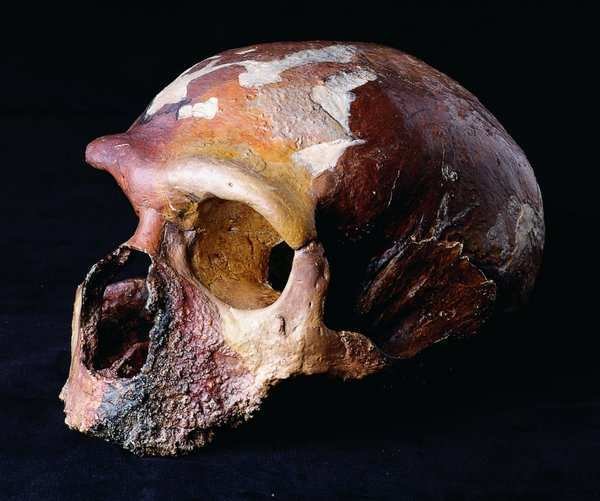
The most famous piece of the section is the Neanderthal skull from the Grotta Guattari, discovered on the Circeo promontory at the end of the 1930s: a find that marked the history of European paleoanthropology and that the museum has also told with three-dimensional models. The room dedicated to the cave is currently closed for maintenance: whoever comes specifically for the Neanderthal must check the openings page on the official website before setting out. It's worth saying frankly: it's the single object for which the most people cross the city, and its visibility depends on the opening rotations.
The African, Oceanian and American collections of the Museum of Civilizations
The other half of the Pigorini legacy is the trip around the world: the ethnographic collections dedicated to Africa, Oceania and the Americas, layered over a century and a half of expeditions, diplomatic gifts and acquisitions, starting from the Kircherian core of the 17th century. Among the African materials are masks of great quality, such as the 19th-century Kongo-Yombe ones. The Americas and Oceania rooms hold objects that have no equivalents in Italy. It's the section where the museum is working most on how to tell the story: where these objects come from, who brought them to Europe, in what circumstances. It's the part of the Museum of Civilizations that leaves the most lasting memory in visitors who enter skeptical.
Those who leave these rooms with an appetite whetted for Italian archaeology have a natural sequel within reach of the metro: the Etruscan Museum of Villa Giulia for the Etruscan world and Palazzo Massimo alle Terme for classical Rome. The entry dedicated to the Pigorini Prehistoric Museum goes deeper into the history of this section.
Folk arts and traditions: peasant Italy at the Museum of Civilizations
The building at number 8 holds the demo-ethno-anthropological collections gathered by Lamberto Loria, an ethnographer who after years of non-European expeditions decided to study Italy the way you study a distant land. Most of the material was put together for the Exhibition of Italian Ethnography of 1911, organized in Rome for the 50th anniversary of Unification: regional costumes, painted Sicilian carts, farm work tools, ex-votos, ceramics, objects of popular devotion. A visual census of preindustrial Italy carried out just before that Italy disappeared.

Anyone who thinks Italian ethnography is a dusty subject should stop in front of a painted Sicilian cart and read the stories of the paladins on its sides: it is folk painting of very high quality, with a precise social function. The rooms tell the cycle of the peasant year, the festivals, the trades, the home, birth and death. For children it is the most effective part of the whole complex: colors, recognizable objects, no abstract display cases. The page dedicated to the Museum of Popular Arts and Traditions Lamberto Loria tells this section at length. The building also houses the Central Institute for Intangible Heritage, the ministry body that studies festivals, rites and traditional knowledge.

The early Middle Ages at the Museum of Civilizations
Inside the Palazzo delle Scienze there is also the Museum of the Early Middle Ages, inaugurated in 1967 and since 2016 part of the Museum of Civilizations: the most important Italian collection dedicated to the centuries between the fall of the Western Roman Empire and the year 1000. It is the least known section of the complex and, in our judgment, the most underrated of all the museums in Rome.
The Lombard grave goods of Nocera Umbra and Castel Trosino
The heart of the collection is the Lombard grave goods from the necropolises of Nocera Umbra, in Umbria, and Castel Trosino, in the Marche, excavated at the end of the 19th century. From Nocera Umbra come the materials of 166 tombs: swords, shield bosses, gold crosses, fibulae, glass. From Castel Trosino come weapons, jewelry and the famous gilded saddle of the horseman, a masterpiece of Lombard goldsmithing from the early seventh century. These are the objects with which textbooks illustrate Lombard Italy, and they are found here, in often deserted rooms.
The opus sectile of Porta Marina, the room worth the trip
The piece I recommend looking for before any other is the opus sectile room from the domus outside Porta Marina in Ostia: an entire late antique reception room covered in inlaid marble, with figured panels of outstanding quality, datable precisely between 383 and 388 thanks to coins found in the excavations. The materials, brought to light in 1959 after excavations begun between 1938 and 1942, have been reassembled here panel by panel. The old misconception to dispel: the domus was not on the Palatine but in Ostia, just outside the gate toward the sea. The route is completed by the textiles of Coptic Egypt, from the late Roman age to the arrival of Islam, and by early medieval Roman ceramics. The page on the Museum of the Early Middle Ages goes into the details. The opening of these rooms runs in shifts: the updated picture is on the openings page of the official site.
The Giuseppe Tucci collections: Asia at the Museum of Civilizations
Since 2017 the Palazzo delle Scienze has also housed the collections of the National Museum of Oriental Art named after Giuseppe Tucci, transferred here after the closure of the historic seat at Palazzo Brancaccio. Tucci, one of the greatest orientalists of the 1900s, explored Tibet and Nepal in a long season of scientific expeditions, and the museum that bears his name carries on his legacy: Gandhara art, where Buddhist sculpture speaks a Greek dialect, Himalayan bronzes and paintings, ceramics and sculptures from Iran to China, including a wooden Guanyin of the Song-Jin period of absolute museum quality.
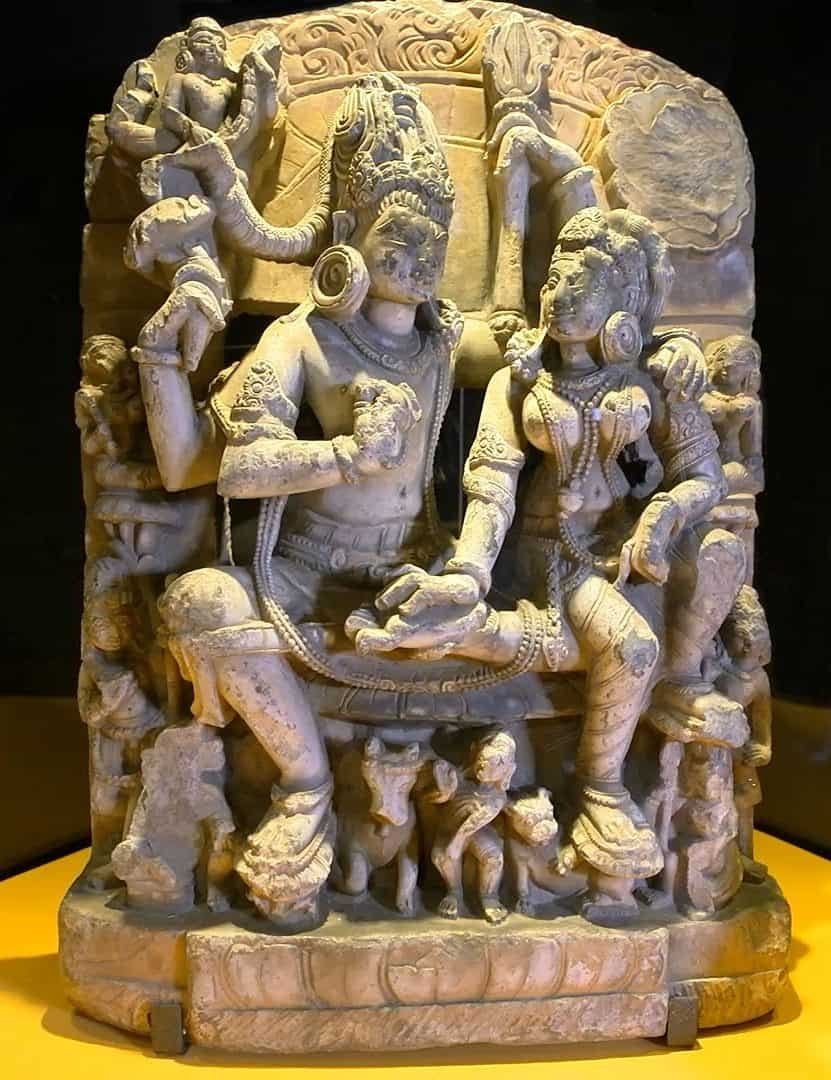
In October 2024 the museum opened the EUR_Asia reinstallation, which re-presents the Asian collections in the EUR spaces with a new project: for those who knew these works at Palazzo Brancaccio it's a different encounter, airier, inside the rationalist architecture. The full history of the collection is in the entry on the Giuseppe Tucci National Museum of Oriental Art. The practical advice: anyone with a specific interest in Asia should dedicate a separate visit to these rooms, because tacking them on after prehistory means walking through them with a head already full.
The former Colonial Museum and the Museum of Opacities
The most delicate chapter of the Museum of Civilizations concerns the collections of the former Colonial Museum of Rome: thousands of objects tied to the Italian occupation of Africa, which stayed for decades in storage after that museum closed. The Museum of Civilizations chose not to hide them and not to display them as if nothing had happened: in June 2023 it opened the Museum of Opacities, an installation that brings to light hundreds of works and documents and accompanies them with an explicit question about how and why they arrived in Italy. In May 2025 the second chapter arrived, dedicated to colonial agricultures and architectures.
The title states the method: opacity, not removal. The museum declares that the provenance of many objects is still a subject of research and that Italian colonial history must be documented, studied and shared, with the contribution of artists and scholars also from the countries of origin. It's one of the most discussed and most serious museum projects underway in Italy, and the reason the Museum of Civilizations is today watched by the ethnographic museums of half of Europe. Those who enter should be ready for an installation that poses questions more than it gives answers: it's a deliberate choice, and it works.
Rocks, minerals and animals: the ISPRA collections at the Museum of Civilizations
The latest big addition comes from the natural sciences: the geological, paleontological and mineralogical collections of the former National Geological Museum, once at Palazzo Canevari, which entered the Museum of Civilizations thanks to an agreement with ISPRA, the Istituto superiore per la protezione e la ricerca ambientale. In October 2025 the reinstallation "Animals, Plants, Rocks and Minerals: the ISPRA Collections" was inaugurated, presented as a "multispecies museum": geological and naturalistic samples displayed next to human cultures, to say that the history of civilizations begins with the history of the Earth. For an anthropological museum it's a coherent widening of horizon, and for the visitor it's a brand-new section, with display cases just installed: a good antidote to the idea that everything here is stuck in the 1970s.
Reinstallations and news 2025-2026 at the Museum of Civilizations
Since 2022 the Museum of Civilizations has been a declared cultural construction site: the direction chose to renew the rooms in successive stages, opening one reinstallation after another instead of closing everything for years. The recent sequence gives the measure of the pace: "Prehistory? Stories from the Anthropocene" in October 2022, the Museum of Opacities in June 2023, EUR_Asia in October 2024, the "Work in Progress" project in February 2025, the second chapter of the Opacities in May 2025, the ISPRA collections in October 2025.
The practical consequence, to keep in mind: some rooms may be closed or under transformation, and the layout you find today may differ from that described in even recent guides. The calendar of temporary exhibitions and openings can be checked on the museum's official website. This phase of works in plain sight is the most interesting time to visit, because you see a great museum thinking out loud.
How to visit the Museum of Civilizations: tickets, timing, route
The ticket is a single one and is valid for the collections of both sites: full €10, reduced €2 for young people of the European Union between 18 and 25, free under 18, for people with disabilities with a companion, the first Sunday of every month and on April 25. Those with the Roma Pass or who take part in affiliated events pay a "friend" ticket of €5. There is also an annual card at €22, which for those who live in Rome is the smartest purchase on the price list: two visits and you're already ahead. On weekends guided visits are available at €5 per person, by reservation, and for groups the fee is €100 for up to 20 participants. The museum is equipped for accessibility: wheelchairs on loan, accessible restrooms, dedicated parking spaces and tactile routes in Braille.
Realistic timing: two and a half hours for the Palazzo delle Scienze done at an easy pace, a good hour for the folk arts and traditions at number 8. With half a day you do both sites, with a break in between at the neighborhood's places. The recommended order: entrance at 8:00, prehistory and protohistory while your head is fresh, then early Middle Ages and Asia, and finally the crossing of the square for Italian ethnography. With kids it's better to reverse: carts and costumes hold attention much better than flint tools. By car you can park with an ease unknown to the rest of the city: it's one of the very few Roman museums for which the car is a sensible option.
A contrarian opinion that I confirm at every visit: anyone with a single afternoon in Rome who has to choose between this museum and the Capitoline Museums should choose the Capitoline. The Museum of Civilizations is the museum of the second or third trip, the one that pays off for those who are no longer chasing the list of monuments.
A curiosity about the Museum of Civilizations
The visiting rules contain a provision that has no equal among Rome's major museums: dogs are allowed in the rooms, every afternoon from 14:00 to 19:00, with a reduced ticket of €2. It isn't an informal tolerance, it's a rate on the price list: the dog pays its admission and accompanies its owner among the display cases. The measure tells well the spirit in which this museum is reinventing itself: a place that thinks about the relationship between humans, animals and the environment from the very title of its new naturalistic installation, the "multispecies museum", and that decided to take the question literally even at the ticket desk. There is then a second curiosity that few notice: the opening hour. The doors open at 8:00 in the morning, an hour when almost all Italian state museums are still closed. It's a functional legacy of the scientific vocation of the complex, which houses storage, labs and research institutes besides the exhibition rooms. For the visitor it means one thing only: the chance to find yourself at 8:15 in front of the Fibula Prenestina in a silence that doesn't exist in the historic center at any hour. Those who love empty museums have here their best chance in the city, and almost nobody takes advantage of it.
Something nobody tells you about the Museum of Civilizations
Inside the Palazzo delle Scienze there is an entire Roman room, taken apart and reassembled panel by panel, whose existence most Romans ignore: the opus sectile room from the domus outside Porta Marina in Ostia. Not a mosaic, not a fresco: a total covering in inlaid marbles, with figures, frames and geometric decorations, datable between 383 and 388 AD thanks to the coins found in the excavations. The materials were recovered in 1959, after excavations begun at the end of the 1930s, and the reassembly here in EUR restores the original effect: you walk in and you are surrounded by late antique luxury as the owner of the house saw it. If this room were in the Vatican Museums it would have a line. Here you sometimes have it to yourself. I add the practical corollary that no general guide reports: the sections of the building open on rotation, according to schedules published by the museum, and the Grotta Guattari room is currently closed for maintenance. Before crossing Rome for a specific object, be it the Circeo skull or the Castel Trosino saddle, the openings page of the official website should be read the same morning. It's the kind of detail that separates a successful visit from a wasted trip, and it costs 30 seconds.
My advice for visiting the Museum of Civilizations
Go on a Saturday, and go at 8:00. The reasoning is simple: the Museum of Civilizations is the only major Roman museum that opens at that hour, EUR first thing in the morning is deserted and the prehistory rooms tackled with a fresh mind are worth three times as much. Start from the Palazzo delle Scienze, number 14: first prehistory and protohistory, with a long stop in front of the Fibula Prenestina and the Venus of Savignano. Then the early Middle Ages, where the Porta Marina room and the Lombard grave goods are worth half an hour on their own. Then the Asian collections of the EUR_Asia reinstallation. Around 11 come out, cross Piazza Guglielmo Marconi enjoying the colonnade and give a good hour to the folk arts and traditions at number 8. By one o'clock you've seen, at a truly relaxed pace, what elsewhere would take a day of lines. Two professional warnings: check the openings page the evening before, because the sections rotate, and don't try to "do it all" if you travel with kids under 10, in which case it's better to start from the Sicilian carts and consider prehistory a supplement. Last thing: bring a light jacket even in summer, because the rationalist halls are large, high and cool, and the temperature difference with the plaza is noticeable.
Another well-known fact, yet rarely mentioned
That EUR is the neighborhood of the 1942 Universal Exposition everyone knows. That the exposition was never held is often repeated. What is rarely mentioned is the specific fate of the museum's two palaces: born for the exhibitions of an event canceled by the war, they remained unfinished and empty for years, and their museum life began only in the postwar period, by degrees. The Palazzo delle Arti e Tradizioni Popolari opened in 1956, the first museum of the neighborhood. The Palazzo delle Scienze received the Pigorini collections starting in 1967, the same year in which the Museum of the Early Middle Ages was inaugurated inside it. Put another way: the transfer of the great national museums to EUR was an operation of the Republic, not of the regime that had designed the neighborhood. There is a second fact that is known but little cited: the "Pigorini" lived for almost half a century at the Collegio Romano, a stone's throw from the Pantheon, where Athanasius Kircher had set up his famous encyclopedic museum in the 1600s. Whoever walks through the ethnographic rooms of EUR today is looking, in part, at the collection of a 17th-century Jesuit that passed through the Unification of Italy, two world wars and three moves. Continuity is the real news: few museums in the world can show off such a long genealogy.
The right photo to take at the Museum of Civilizations
The signature photo is taken at the center of Piazza Guglielmo Marconi, looking at the curved colonnade that links the museum's two palaces: first thing in the morning, with the low sun entering sideways between the columns and the square empty, the metaphysical effect is guaranteed without filters. For the more architectural version, climb the steps of the Palazzo delle Scienze and frame the run of columns on the diagonal, with the travertine turning to ivory. It also works at sunset, when the stone warms up. Inside, the subject that holds up best in a shot is the opus sectile room from Porta Marina, where the inlaid marbles fill the frame without need for extreme wide angles. Among the display cases, the Circeo skull and the gilded saddle of Castel Trosino are the two most photographed objects, when their respective rooms are open. For the use of flash and tripods, the rules posted in the museum apply. And for those who want to end the photo shoot with the most famous monument of the neighborhood, the Square Colosseum is a few minutes' walk away: the sequence of the museum colonnade plus the Palazzo della Civiltà Italiana is the perfect visual story of EUR in two images.
Some important events that happened here in history
The chronology of this corner of EUR is an Italian story in miniature. Late 1930s: the regime designs E42, the Universal Exposition that was to celebrate in 1942 the 20th anniversary of the March on Rome, and starts work on the monumental palaces. The war stops everything, and the exposition will never be held. 1956: the Palazzo delle Arti e Tradizioni Popolari opens to the public and brings to EUR the Italian ethnographic collections gathered by Lamberto Loria for the 1911 exhibition. 1967: double event in the Palazzo delle Scienze, with the arrival of the collections of the Luigi Pigorini Prehistoric Ethnographic Museum from the Collegio Romano and the inauguration of the Museum of the Early Middle Ages. 2016: three ministerial decrees merge four national museums into the new Museum of Civilizations. 2017: the Giuseppe Tucci oriental collections leave Palazzo Brancaccio and reach EUR. 2022: the new direction of Andrea Viliani unifies the institutes into a single anthropological museum and opens the season of reinstallations. 2023: with the Museo delle Opacità the collections of the former Colonial Museum become visible again, accompanied by a public reflection on Italy's colonial past that has no precedent in state museums. 2025: the ISPRA collections enter the stage with the "multispecies museum". Every date is a change of skin: few Roman places show with this clarity how an uncomfortable legacy can become a living cultural project.
Who passed through the Museum of Civilizations
The history of these collections is a gallery of larger-than-life figures. The forefather is Athanasius Kircher, the German Jesuit who in the 17th century gathered his encyclopedic museum at the Collegio Romano: part of those collections still lives today in the ethnographic rooms of EUR. Luigi Pigorini, a paletnologist from Parma, founded in 1875 the museum that bears his name and ran it for half a century, making it the center of Italian prehistory: at his death, in 1925, the pieces exceeded 170,000. Lamberto Loria, an ethnographer with years of non-European research behind him, devoted the last season of his life to surveying popular Italy for the 1911 exhibition: his collections are the heritage of the building at number 8. Giuseppe Tucci, an orientalist from the Marche and one of the greatest of the 20th century, explored Tibet and Nepal in legendary expeditions. The oriental art museum named after him merged here in 2017. And then the directors of the recent era: Filippo Maria Gambari, an archaeologist who led the unified museum from 2017 to 2020, and Andrea Viliani, who arrived in January 2022 from the world of contemporary art, the man of the Museum of Opacities and of the reinstallations underway. In short, learned Jesuits, pioneers of paletnology, explorers of the Himalayas and contemporary curators have passed through these rooms: the visitor who walks through the Museum of Civilizations walks inside their biographies.
The EUR district around the Museum of Civilizations
When the visit is over, the district deserves an hour's stroll, because EUR reads like an open-air museum: scenic road axes, travertine, perspectives studied to the millimeter. A few minutes on foot away is the Palazzo della Civiltà Italiana, the Square Colosseum, absolute icon of rationalism and today home to a fashion house. In the opposite direction, contemporary Rome: the congress center of Fuksas's Nuvola, which with its glass and the suspended case is the counterpoint to the Fascist-era district. To finish on a light note, the EUR little lake with its tree-lined promenade is the right place for a coffee or a gelato at a table. Those who instead want to stay on the theme of off-the-beaten-path museums can note down the Centrale Montemartini, ancient sculptures among the turbines of a power plant, on the way back toward the center along Metro B. It's a complete, coherent afternoon with no lines: an absolute rarity in Rome.
Quick questions about the Museum of Civilizations
How much is a ticket to the Museum of Civilizations?
The full ticket costs €10, the reduced one €2 for citizens of the European Union between 18 and 25. With the Roma Pass and for affiliated events there is a "friend" ticket at €5. Prices and conditions should be checked on the official website before the visit.
What are the opening hours of the Museum of Civilizations?
Tuesday to Sunday from 8:00 to 19:00, with last admission at 18:30. The opening at 8 in the morning is among the earliest of Italian museums and gives you half-empty rooms in the first hour.
When is the Museum of Civilizations closed?
The weekly closing day is Monday. Individual sections may also close on rotation for works or reinstallations: the picture of the open rooms is published on the official website.
Is the Museum of Civilizations free on the first Sunday of the month?
Yes, every first Sunday of the month admission is free for everyone, as in the other state museums. It is also free on April 25. But it's the most crowded day of the whole month: whoever can afford it should choose a paid Saturday morning, with €10 you enjoy the museum 10 times better.
Do you need to book the Museum of Civilizations?
No, for an individual visit the ticket is bought at the desk without reservation. Booking is needed for weekend guided visits and for groups.
How long does a visit to the Museum of Civilizations take?
Two and a half hours for the Palazzo delle Scienze at an easy pace, a good hour for the folk arts and traditions. Half a day covers both sites without rushing. A lean selection can also be done in two hours.
Are the Pigorini Museum and the Museum of Civilizations the same thing?
Today yes. The Luigi Pigorini Prehistoric and Ethnographic Museum merged in 2016 into the Museum of Civilizations and its collections are the prehistory, protohistory and ethnography collections of the Palazzo delle Scienze. The name Pigorini remains in the usage of Romans, but the ticket says Museum of Civilizations.
What is the difference between the Museum of Civilizations and the Museum of Roman Civilization?
They are two different museums. The Museum of Roman Civilization, the one with the big model of imperial Rome, is a civic museum in another building in EUR. The Museum of Civilizations is state-run and occupies the two buildings of Piazza Guglielmo Marconi. The confusion between the names is the most frequent mistake of those arriving in the district.
How do you get to the Museum of Civilizations by metro?
With line B, EUR Fermi stop, and a short walk along the district's avenues. EUR Palasport is at a similar distance too. On the surface the buses 30, 170, 671, 714 and 791 stop.
Is it easy to park at the Museum of Civilizations?
Yes, and it's a Roman exception: around the square free parking is found without effort. It's one of the very few museums in the city for which arriving by car is a reasonable choice.
Is the Museum of Civilizations suitable for kids?
Yes, with a clear preference for the folk arts and traditions rooms: painted carts, costumes and toys hold the little ones' attention much better than the lithic display cases. The spaces are wide, with no crush, and the stroller is never a problem.
Is the Museum of Civilizations wheelchair accessible?
Yes: the museum provides wheelchairs on loan, accessible restrooms, reserved parking spaces and tactile routes in Braille for blind visitors.
Can dogs enter the Museum of Civilizations?
Yes, in the afternoons from 14:00 to 19:00, with a dedicated reduced ticket. It is one of the very few Roman museum institutions to admit animals in the rooms with a rate on the price list.
Is the Roma Pass valid at the Museum of Civilizations?
Roma Pass holders get in with the "friend" discounted ticket of €5. The updated conditions of the agreements should be checked on the museum's official website.
Is there a membership for the Museum of Civilizations?
Yes, an annual card at €22 with unlimited admissions and dedicated initiatives. For those who live in Rome it's the most convenient option on the price list: it pays for itself in a little over two visits.
Are there guided visits at the Museum of Civilizations?
Yes, on weekends, at a cost of €5 per person on top of the ticket, by reservation. For groups the fee is €100 for up to 20 people. The contacts for booking are on the official website.
Is the Grotta Guattari room open?
The room dedicated to the Grotta Guattari of Circeo is currently closed for maintenance. Those who come specifically for the Neanderthal skull must check the reopening on the openings page of the official website.
Where are the oriental art collections of the Museum of Civilizations?
In the Palazzo delle Scienze, Piazza Guglielmo Marconi 14, where since 2017 the collections of the former Giuseppe Tucci National Museum of Oriental Art have merged, re-presented since October 2024 in the EUR_Asia reinstallation.
Is the Museum of Civilizations ticket valid for both buildings?
Yes, the ticket is a single one and covers the collections of the Palazzo delle Scienze and the Palazzo delle Arti e Tradizioni Popolari, at numbers 14 and 8 of the same square.
Can you take photographs at the Museum of Civilizations?
For personal use photography is generally allowed in state museums, with limitations on flash and tripods. The specific rules are posted in the museum and on the official website, which is worth consulting for special shoots.
Where do you eat near the Museum of Civilizations?
EUR is a living district, with bars and restaurants of ordinary level, frequented by those who work there rather than by tourists: between the streets around the square and the lake area the lunch break is settled at neighborhood prices, with no traps. Those who visit both sites of the museum do well to place the break between the one and the other: you start again with fresh eyes.
Are there temporary exhibitions at the Museum of Civilizations?
The museum alternates permanent reinstallations and temporary projects, with a calendar that changes during the year: the updated program of exhibitions can be checked on the museum's official website.
To close, a piece of advice that keeps surprising those who follow it: Saturday morning, entrance at 8:00, three hours among prehistory, Lombards and Asia, then the crossing of the colonnade toward the Sicilian carts. At one o'clock you come out having seen one of the great museums of Europe almost alone, with €10 spent better than on any other Roman line. The Museum of Civilizations doesn't need to be defended: it needs to be visited.
Article written by the editorial team of TourLeaderPro, contact them for Private/Corporate/V.I.P. Tours and Experiences.
Planning a trip to Rome? The English guides for visiting the city are on ItalyPlanner.com.