Square Colosseum – Palace of Italian Civilization
In short. The Square Colosseum, the name Romans have always used for the Palazzo della Civiltà Italiana, stands in the Quadrato della Concordia, in the EUR neighborhood, at the northwest end of the axis of Viale della Civiltà del Lavoro.
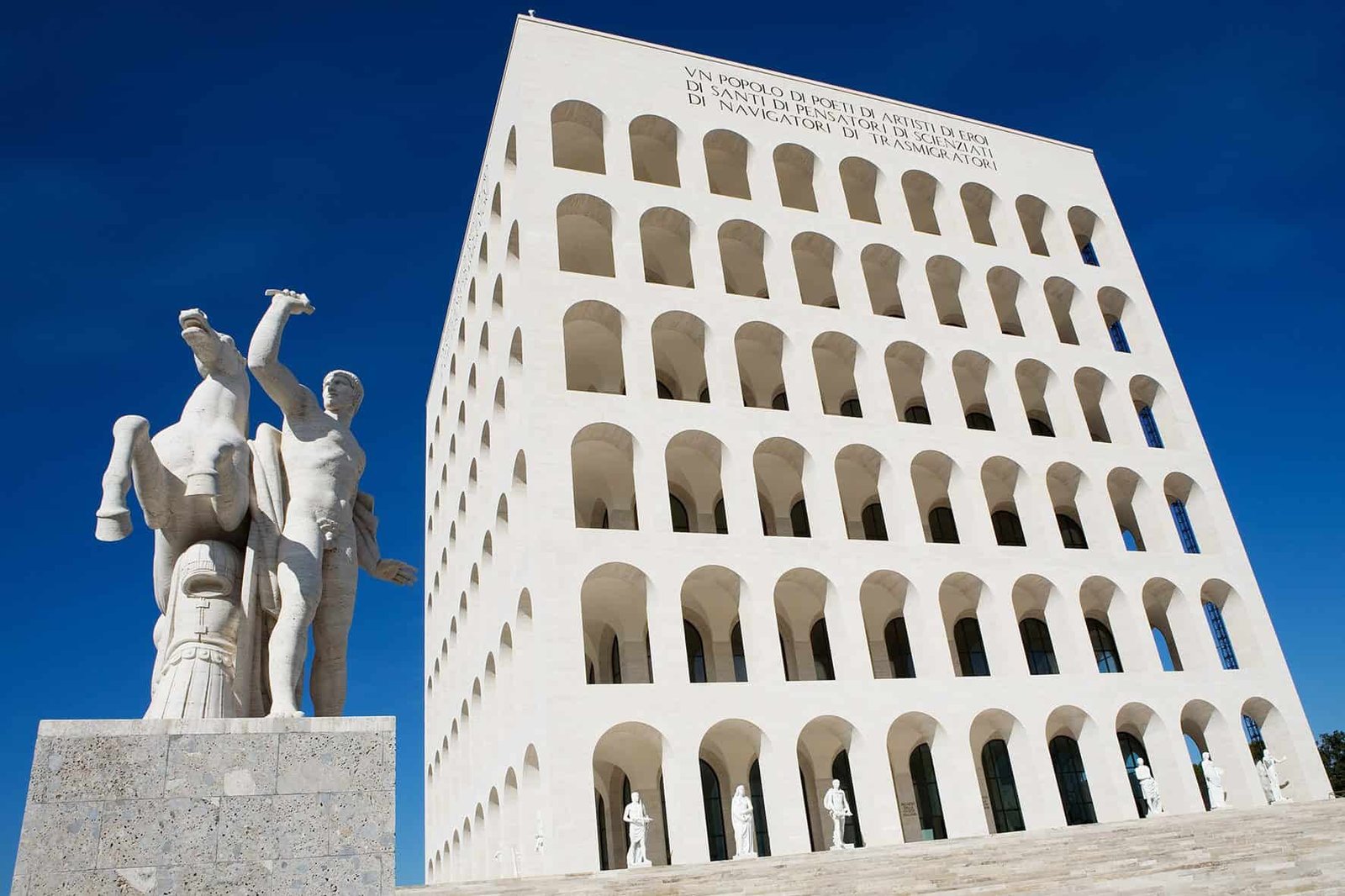
The Square Colosseum, the name Romans have always used for the Palazzo della Civiltà Italiana, stands in the Quadrato della Concordia, in the EUR neighborhood, at the northwest end of the axis of Viale della Civiltà del Lavoro. You can get there on Metro Line B: the EUR Magliana stop leaves you below the big staircase that climbs toward the palace, while the EUR Palasport stop leaves you on the opposite side, where the entrance is almost at street level. The ATAC time-based integrated ticket costs €1.50 and is valid for 100 minutes. The Roma 24 ore pass costs €8.50, the 48-hour pass €15.00, and the 72-hour pass €22.00. The building houses the headquarters and offices of the Fendi maison, and it is not a museum with a ticket office and continuous hours. It opens to the public for the exhibitions and events set up on the ground floor, and you should check the calendar on the maison's official website before setting out. The exterior, which is actually 90 percent of what people come to see, is visible at all times, free of charge, at any hour, and the square around it never closes.
First-time visitors usually have a photo in their heads and not much else. It's worth placing the palace in its context, because it doesn't make sense on its own. It is part of the urban design of the EUR, the neighborhood built for the World's Fair that was supposed to be held in Rome in 1942 and that the war canceled. Without that background, the Square Colosseum looks like an object dropped from the sky into an office district. With it, the building becomes the centerpiece of a political and urban project that no other European capital holds in such an intact form.

Where the Square Colosseum is and how to really get there
The address that appears on maps is the Quadrato della Concordia, a place name that doesn't correspond to a street but to an area: the quadrilateral on which the palace sits. Two sides are useful for orienting yourself. To the southeast runs Viale della Civiltà del Lavoro, the perspective axis chosen by the designers of the EUR. From there the palace presents its front, and the entrance is nearly at ground level, because the land rises. To the northwest the hill drops toward the railway to Ostia and the Tiber valley, and the stepped base reaches its maximum height of 18 meters, with the dramatic staircase descending toward the lower city.
By Metro to the Square Colosseum
Metro Line B serves the EUR with four stations: EUR Magliana, EUR Palasport, EUR Fermi and Laurentina. For the palace, the useful ones are the first two, and they are not equivalent. From EUR Magliana you come out at the bottom, on the valley side. You walk up, and the palace appears in stages: first the silhouette above the trees, then the base, then the arches. It's the most beautiful approach and the least used. From EUR Palasport you arrive from above, on the level of the neighborhood, and you find yourself in front of the facade on Viale della Civiltà del Lavoro with no visual preparation. It's convenient and quick, but much less striking. The advice is to enter from EUR Magliana and leave from EUR Palasport, so you see both faces of the building without backtracking.
On foot in the EUR, starting from the Square Colosseum
The EUR is one of the rare Roman neighborhoods designed to be explored on foot along straight avenues, and distances are deceiving because the sidewalks are very wide and the buildings are enormous. What looks like a short walk is a real hike. From the palace you go down Viale della Civiltà del Lavoro, cross Via Cristoforo Colombo, which is the old Via Imperiale, and reach the square where the Palazzo dei Congressi stands, now named after John Fitzgerald Kennedy. Continuing on, you come to the Museum of Civilizations and the large central park with the laghetto. If you have a full day, you can close the loop at the Palazzo dello Sport by Nervi and Piacentini, built for the 1960 Olympics.
Hours, access and tickets at the Square Colosseum
Here we need to be clear, because this is the source of most of the disappointment. The Palazzo della Civiltà Italiana is not a civic museum. It has no permanent ticket office, no opening hours printed to apply all year, and the upper floors are not open to visitors because they are offices. What opens to the public is the ground floor, when it hosts an exhibition. During those periods, access is through the entrance on viale della Civiltà del Lavoro, with hours announced each time on the official website of the fashion house that holds the building under concession. Outside exhibition periods, the building remains a workplace and you look at it from outside. That is not a minor limitation, and it's good to know it in advance: those who come expecting a two-hour visit of the interiors will go home disappointed, while those who come knowing the highlight is the architecture seen from the base will go home happy.
The 1937 Competition and the Birth of the Square Colosseum
The law that established the Universal Exposition of Rome dates from December 1936. The decree founding the district is dated December 26 of that year. In January 1937, the first invitations and the first calls for proposals for the design of the buildings of the new exhibition district went out. The district was named E42, after the acronym of the Exposition and the year planned for its opening. The government had two overlapping goals: to celebrate the regime's 20th anniversary before the world in 1942 and, with the same spending, to push the urban growth of Rome along the route leading to the sea.
The body in charge of vetting the projects had already approved the first plans in April 1937. Specific competitions for the major buildings were announced between June and October of the same year: the Palazzo dei Ricevimenti e dei Congressi, the exedra of piazza Imperiale, today piazza delle Nazioni Unite, the Museo delle Comunicazioni, today the seat of the Archivio Centrale dello Stato, the basilica of Santi Pietro e Paolo and, of course, the Palazzo della Civiltà Italiana. A further competition for the Palazzo dell'Acqua e della Luce was announced a year and a half later and was never built.
Guerrini, La Padula and Romano, the Authors of the Square Colosseum
The judging commission, chaired by Marcello Piacentini, who was the director of the entire E42, chose the project signed by Giovanni Guerrini, Ernesto Bruno La Padula and Mario Romano. The group leader was La Padula, whose legal name was Ernesto Angelo Lapadula, born in Pisticci on August 6, 1902, and died in Rome on January 24, 1968. He graduated from the School of Architecture in Rome in 1931, under Piacentini himself. He was a more complex figure than his most famous building suggests: a satirical cartoonist, an illustrator under the pseudonym Bruno di Lucania, a painter and a journalist. He designed the central Post Office Building in Potenza between 1938 and 1943, the church of San Rocco in Pisticci in 1934, pavilions for the Mostra d'Oltremare and for the Mostra autarchica del minerale italiano, and after the war he worked on urban planning projects in Argentina. Later, the artistic direction of the Mostra della civiltà italiana, the exhibition the building was meant to house and that the war cancelled, was also assigned to him.
Guerrini and Romano had less-told but no less important roles: the first brought to the group a long experience in decorative arts and graphic design, the second the Roman building experience. The recognizable character of the project, geometric abstraction applied to a classical theme, comes from the meeting of these three hands, and historians continue to debate which of the three had the greatest influence.
From 77 Arches to 54 in the Square Colosseum
The project that won the competition was not the one we see. The version presented to the commission called for four identical facades with 77 arches each, 11 in length and 7 in height. The palace would have been lower and wider, almost a carpet of voids. In the move to construction, the arches were reduced to 54, 9 in length and 6 in height, and the proportion changed radically: the building became more compact, more vertical, more like a cube. This is a change no guidebook mentions, and yet it explains everything. With 77 arches the palace would have been a monumental portico, with 54 it became a pure solid, and only then could Romans see a square Colosseum inside it.
The Square Colosseum Construction Site, 1938 to 1943
Work began in July 1938. The inauguration took place in 1940, with the building still unfinished, in a Rome that was entering the war and had already lost the Universal Exposition before even setting it up. In 1943, the construction site stopped completely. It was not a technical suspension: it was the end of the political project that had generated it. The palace remained there, finished in its structure and empty in its contents, in the middle of a district that was also interrupted halfway, with its streets laid out and its buildings without window frames.
It's worth taking a closer look at the construction choice, because it's more interesting than it seems. The load-bearing structure, invisible from the outside, is reinforced concrete: without it, volumes of that size could not have been supported. But the entire cladding is in travertine, the Roman stone par excellence, the one used for the Flavian Amphitheater and for half of the Baroque city. The choice served two different needs that, for once, coincided. The first was ideological: to evoke Roman identity, to stitch a visible thread between the ancient empire and what the regime believed it was building. The second was economic and autarkic: after the sanctions decided by the League of Nations following the Ethiopian war, iron and cement were scarce and expensive goods, while the travertine quarries of Tivoli were an hour's truck ride away. A building of that scale clad in Italian stone was also a message: we can manage on our own.
How to Read the Facade of the Square Colosseum, Palazzo della Civiltà Italiana
The building is 60 meters tall and has a square base 53 meters on each side. Four identical facades, no hierarchy between front and back, no monumental entrance that declares the front. It's this indifference to the four cardinal points that makes it so disorienting: you walk around the building and can't work out where the main door is, because strictly speaking there isn't one.
The 54 Arches per Side, 216 in Total
Each facade has 54 round arches, arranged across nine columns and six orders. Multiplied by four, that makes 216 openings, all the same size, all at the same distance. There's no arch larger than the others, no emphasized central bay, no varied rhythm of the kind any Renaissance architect would have introduced to keep the eye from getting bored. The repetition is total and intentional. The result is a building that looks small from a distance and becomes overwhelming at 20 meters, because the brain, finding no reference points for scale, gets the math wrong. It is the most effective optical effect in all of twentieth-century Roman architecture, and it still works today on everyone, including those who walk past it every morning.
Try an experiment: stop at a corner and look at the two converging facades. The arches of the two rows overlap in perspective and for a moment the building looks transparent, a suspended lattice. Then the brain rebuilds the volume and the sensation fades. Giorgio de Chirico never painted it, but anyone who knows his metaphysical squares immediately understands where the resemblance comes from.
The Inscription on the Four Ends
Below the upper band, in three lines carved into the travertine in Roman monumental capitals, runs the phrase: a people of poets, of artists, of heroes, of saints, of thinkers, of scientists, of navigators, of transmigrators. It appears identically on all four faces. The text is taken from a speech Mussolini delivered on October 2, 1935, the day the attack on Ethiopia was announced, in protest against the sanctions the League of Nations was preparing to impose on Italy.
This inscription has been debated for 80 years and the debate continues. Those who would like it removed argue that a democratic capital cannot keep the propaganda of a dictatorship in letters one meter tall. Those who defend it note that erasing it would make the building unreadable and turn it into a beautiful abstract object, stripped of the reason it was built. Our view is that the inscription should stay exactly where it is: without those three lines, no one would understand that this perfect cube was a rhetorical weapon, and a monument that no longer lets itself be questioned stops teaching anything. The problem is not the inscription: it's that almost no one explains it to people walking by.
One philological detail that almost always gets missed: the carved text has no punctuation. The three lines follow one another without commas, and the rhythm is left only to the line breaks. It's an ancient epigraphic choice, copied from imperial inscriptions, and it helps give the phrase that tone of a sentence carved in stone that the regime was after.

The 28 Statues of the Arts and Trades at the Base of the Square Colosseum
In the arches of the ground floor are placed 28 marble statues, more than three meters tall, one for each arch occupied. The distribution is not symmetrical: six for the facade facing Viale della Civiltà del Lavoro and six for the one facing the staircase, eight for each of the other two. Each one is an allegory of a virtue, an art, or a trade that the project attributed to the Italian people. They are the most neglected chapter of the entire monument: visitors photograph the arches and move on, while right there, at eye level, is the iconographic program the building was meant to illustrate.
The Complete List of the Square Colosseum's Allegories
Walking the perimeter clockwise, starting from the first statue on the left of the front on viale della Civiltà del Lavoro, the order is this: heroism, music, craftsmanship, political genius, social order, labor, agriculture, philosophy, commerce, industry, archaeology, astronomy, history, inventive genius, architecture, law, supremacy of navigation, sculpture, mathematics, theatrical genius, chemistry, printing, medicine, geography, physics, poetic genius, painting, military genius.
Read in sequence, the list is a remarkable cultural document. It starts with heroism and ends with military genius, and in between it puts chemistry and sculpture, commerce and philosophy, archaeology and industry on the same level. This is the portrait a nation wanted to give of itself in 1938: cultured and productive, ancient and modern, warlike and artisan. The religious dimension is entirely missing, even though it still counted in Italy in those years. The family is missing. Agriculture appears only as a single allegorical figure, next to 27 urban and intellectual virtues, with no rural world behind it. Anyone who wants to understand the regime's self-image has its synoptic table here, carved in marble.
How to Really Look at Them
The statues are hard to read from far away and very well from up close, because each one carries the attributes of its trade: the chisel, the compass, the book, the scroll, the rudder, the spear. The practical tip is to walk along the base with the building on your left and identify the attributes one by one, as you would before a cycle of saints in a church. The full circuit takes about 20 minutes of slow walking and is, in our judgment, the most instructive part of the visit. The best light is the low light of late afternoon, which separates the reliefs from the dark background of the arches. At noon the figures flatten out and become almost unreadable.
The Dioscuri at the Four Corners of the Base
At the four corners of the base stand four equestrian groups depicting the Dioscuri, Castor and Pollux, the work of Publio Morbiducci and Alberto Felci. The pair on the southeast side faces viale della Civiltà del Lavoro. The one on the northwest side looks out over the open side of the hill, toward the lower city.
Morbiducci deserves more than a line. Born in Rome on August 28, 1889, and died in the same city on March 31, 1963, he trained at the Istituto di belle arti under Duilio Cambellotti, whom he always considered his master. He had already made a name for himself at the Roman Secession of 1915 with a series of bronze masks. He is the author of the monument to the Bersagliere at Porta Pia, the Marinaio at the Verano, the layout of piazza del Viminale and, also at EUR, the large marble frieze on the Palazzo degli Uffici dedicated to the history of Rome. He was also a leading medalist: he won the 1923 competition for the two-lira coin. He was an academician of San Luca from 1937, and he had a major retrospective at the Accademia nazionale di San Luca in December 1999. The Dioscuri groups placed on the staircase belong to a long phase of his work at EUR, running from 1940 to 1956, during the years when the district was being reorganized ahead of the 1960 Olympics.
The iconographic choice is not accidental. The Dioscuri are the twin protectors of Rome, the ones who, according to legend, appeared in the Forum to announce the victory at Lake Regillus, and the ones of the colossal statues at the top of the Campidoglio ramp and of the Quirinale. Placing them to guard the corners of the building meant declaring, without writing one word more, that this new building belonged to the same monumental lineage.
The Square Colosseum after 1943: War, Displaced People, Rebirth
The history of the palazzo after construction stopped is the part that almost no visitor knows, yet it explains why the building reached the 1950s in pitiful condition.
September 9, 1943, on the Staircase
The day after the armistice was announced, on September 9, 1943, the area was the scene of an armed clash. On the staircase that descends toward the Tiber, German paratroopers, positioned near the old Magliana bridge, clashed with Italian units trying to slow the advance toward central Rome. In the fighting, an Italian artilleryman was killed and later decorated posthumously. Anyone climbing those steps today with a phone in hand is unlikely to imagine they were a defensive position, yet the layout of the place explains it on its own: from the top of the base you can control the whole valley, and that is why the fighting took place there.
Camp, Then Shelter
Once work on the site had ended and the war was over, the palazzo and the other buildings already completed, including the basilica of Santi Pietro e Paolo, the Palazzo dei Congressi and the exedra that today houses the INPS and INA offices, were first used as a camp for German troops, then for Allied troops, and finally, in the immediate postwar period, as shelter for displaced people. For a few years the Square Colosseum was an enormous building inhabited by families without homes, with laundry hung between the arches. It is the farthest image possible from the one its designers had in mind, and it is also the truest image of postwar Rome.
1951, Ente EUR and the Return to Life
It was only in 1951, with the founding of Ente EUR, that the district got going again. The acronym stayed the same, but the E became Europa instead of Esposizione. The idea was to turn the area into a new administrative hub for the capital, and the bet, it must be said, paid off. In 1953 the Palazzo della Civiltà Italiana hosted the International Agriculture Exhibition, then became the headquarters of the National Federation of the Knights of Labor and went through several ministry uses. In the mid-1980s, Ente EUR took back full management of it, but the building remained largely unused, open only for occasional events. For almost 30 years, the most photographed monument in the district was, in effect, an empty container.
Palazzo groviera
In those years Romans gave it a second nickname, less noble than the first: palazzo groviera, because of its perforated facades. The nickname says a lot about Roman irony, which takes apart monumental rhetoric with a neighborhood market joke, and it also says something about the city's relationship with EUR, long seen as a foreign, cold district, good for offices and advertising spots.
The Restoration of Square Colosseum and Its Protected Status
In 2006 a project by the Ministry for Cultural Heritage and Activities planned the restoration of the building. The work covered the facades, the ground floor, the window frames, and the terraces. The work, directed by architect Paolo Marconi, began in 2008 and was completed on December 15, 2010. It was the operation that gave the travertine its surface back and made everything that came after possible: a building with facades blackened by smog and rotten window frames would not have been rentable to anyone.
In 2009 the ministries of Economic Development and Cultural Heritage signed an agreement with EUR S.p.A. to make the building a home for Made in Italy, with a permanent exhibition of Italian design and an audiovisual museum. Completion was scheduled for 2011. That specific project was not carried out in the announced form, but it set a principle that has endured: the Palazzo della Civiltà Italiana is a cultural asset under Legislative Decree 42 of 2004 and is restricted to exhibition and museum uses. Whatever goes on inside, it must include a component open to the public. This restriction is why, even today with the building housing the offices of a private company, the ground floor must remain accessible for exhibitions.
Fendi at Square Colosseum, Palazzo della Civiltà Italiana
From July 2013 through the end of 2028, the building is leased to the Fendi maison, which moved its management and offices there. It celebrated the move in 2015, the 90th anniversary year of the house, with the opening to the public of an exhibition space on the ground floor.
Who Fendi is and why it ended up here
The story of the maison begins in 1918, when Adele Casagrande opened a shop for bags and furs in Rome, on via del Plebiscito. In 1925 the company took the name Fendi, after Adele married Edoardo Fendi. The first boutique on via Piave dates to 1932. In 1946 the founders passed the baton to their five daughters, Paola, Anna, Franca, Carla, and Alda, who divided up the areas of the business and modernized the brand. In 1965 the sisters hired a young German designer, Karl Lagerfeld. The collaboration lasted 54 years, and in 1966 the famous double-F logo was born. Bringing the offices into the Square Colosseum was therefore not an abstract gesture. It was a company born in Rome settling into the most Roman building of the 20th century.
Exhibitions on the ground floor of the Square Colosseum
The ground-floor space hosts temporary exhibitions, often dedicated to craftsmanship, fashion, design, and photography, and occasionally other events. To use the tourism boards' wording, the palazzo houses the maison's management and offices and is open to the public for events and exhibitions. So there is no fixed schedule, and you should check the official website before going. It is the only legitimate way to enter the building, and when it happens, it is worth the trip, because the ground-floor interior lets you look at the arches from the back, from the shaded side, and understand the real thickness of the stone cladding.
Pokras Lampas on the roof, 2017
In 2017 the Russian artist Pokras Lampas, whose legal name is Arsenij Pyzenkov, created a large yellow calligraphy on a black background across the building's roof, made of words starting with the letter F, as part of the Fendi F is For campaign. The work is listed as the largest calligraphy work created in Italy. You cannot see it from the street. It is designed to be seen from above, by planes approaching Fiumicino and in satellite images. It is a detail groups really enjoy hearing about, because it flips the usual relationship with a monument: here the decorated surface is the one no ground-level visitor will ever see.
A curiosity about the Square Colosseum, Palazzo della Civiltà Italiana
The real curiosity is not the nickname, which everyone knows, but the number. Nine arches in length by six in height, 54 per facade: why nine and six? The explanation that circulates on the most diligent guided tours, and which should be taken for what it is, a tradition of interpretation and not a fact documented in the project archives, is that the two figures correspond to the number of letters in the first and last name of Benito Mussolini: six letters in Benito, nine in Mussolini. Nine arches on the horizontal side, six on the vertical.
The interesting thing is that the competition design did not have those measurements. It had 11 arches in length and seven in height, 77 per facade. If the numerical correspondence had been planned from the start, you would expect to find it in the winning design, not in the executed variant. That leaves two possibilities open: either the change in the ratio between the bays was decided for compositional reasons and the coincidence was only noticed afterward, or it was introduced during construction precisely to achieve it. As things stand, there is no published document that settles the question, and anyone who tells you the second version as an established fact is going beyond the sources.
What remains is the point worth taking home: the building we know is not the building that won the competition. It is a second version, more compact and more abstract than the first, and that compaction is exactly what produced the cubic effect that made it a worldwide icon. If they had built the original design, nobody today would call it the Square Colosseum. It would be a long portico and nothing more.
Something nobody tells you about the Colosseo Quadrato, Palazzo della Civiltà Italiana
Nobody will tell you that the Palazzo della Civiltà Italiana has never performed the function for which it was built. Not for one day. It was meant to house the Mostra della civiltà italiana, the central section of the 1942 Universal Exposition, and for that exhibition even an artistic direction had been appointed, entrusted to La Padula himself. The war cancelled the Exposition and the exhibition was never set up. The building was inaugurated in 1940 unfinished and with no contents, and since then it has done every kind of job except the one it was born for: German military camp, then Allied, shelter for displaced people, venue of an agricultural exhibition in 1953, seat of an employers' federation, ministry office, empty container for 30 years, today headquarters of a fashion house.
There is a second thing that is rarely said, and it is a practical one: most of the photographs of the building that circulate are technically wrong. They are taken head-on, from the center of Viale della Civiltà del Lavoro, and they give you a rectangle of arches that looks as flat as a perforated wall. The building is not that. It is a solid, and you only understand it from the corner, when the two facades converge and the depth of the arcades becomes readable. Whoever arrives, stands in the middle, shoots and leaves takes home the least interesting photograph possible of one of the most photogenic buildings in Europe.
Third thing: EUR is a neighborhood where tourists get lost for a specific reason, namely that visual distances are compressed by the scale of the buildings. The Palazzo dei Congressi, which seems 200 meters away, is considerably farther. Anyone who plans to see the Colosseo Quadrato and then three other things in the same half hour gets the math wrong every time. Better to allow a whole morning and walk slowly.
Frequently asked questions about the Colosseo Quadrato, Palazzo della Civiltà Italiana
Why is it called the Colosseo Quadrato?
The building is called the Colosseo Quadrato (Square Colosseum) because of its resemblance to the Flavian amphitheater, due to the superimposed orders of round arches, combined with the perfectly square plan of the building. The official name is Palazzo della Civiltà Italiana, and in the past it has also been called Palazzo della Civiltà del Lavoro.
Where is the Colosseo Quadrato?
The Colosseo Quadrato is in the EUR neighborhood of Rome, on the Quadrato della Concordia, the quadrilateral on which the building stands. To the southeast runs Viale della Civiltà del Lavoro, the perspective axis wanted by the EUR planners, from which the building presents itself head-on with the entrance almost at street level.
How many arches does the Colosseo Quadrato have?
The Colosseo Quadrato has 54 arches on each of the four identical facades, arranged in nine bays in length and six in height. The building is 60 meters high and has a square base 53 meters on each side.
Who occupies the Colosseo Quadrato today?
From July 2013 and through the end of 2028 the Colosseo Quadrato is leased to the fashion house Fendi, which moved its headquarters and offices there. In 2015, the year of the fashion house's 90th anniversary, an exhibition space on the ground floor was also opened to the public.
Is the Colosseo Quadrato wheelchair accessible?
The front of the Square Colosseum on Viale della Civiltà del Lavoro is essentially at street level, so you can approach the base and the arches without any steps. This makes it possible to walk the outside loop even in a wheelchair. The opposite front, the one with the large staircase facing the valley, is impassable without stairs.
When was the Square Colosseum built?
Work on the Square Colosseum began in July 1938, after the 1937 competition won by the design of Guerrini, La Padula and Romano under the chairmanship of Marcello Piacentini. The building was inaugurated in 1940, still unfinished, and construction stopped completely in 1943. A restoration directed by architect Paolo Marconi later brought it back to optimal condition between 2008 and December 15, 2010.
Is the Square Colosseum suitable for children?
Yes, the Square Colosseum works well with children if you give them a task, such as counting the arches of a front and checking that there really are 54, or identifying the attributes of the 28 allegorical statues at the base, from the compass of architecture to the lance of the Military Genius.
When to go see the Square Colosseum?
The best season to see the Square Colosseum runs from mid-October to late November and from March to mid-May, with low light, reasonable temperatures and a lively but not crowded neighborhood. The Roman summer at EUR is harsh, because there is no shade and you have to cover the distances under the sun.
The advice I give you for visiting the Square Colosseum, Palazzo della Civiltà Italiana
My advice is one: arrive from below. Get off at EUR Magliana station, take the staircase and climb on foot. It takes a few extra minutes compared to arriving from EUR Palasport, and it completely changes the experience, because the building reveals itself in stages, above the line of the trees, and its monumental scale hits you only in the last 20 meters. This is exactly the effect the designers had calculated, with the 18-meter stepped base on that front. Arriving from above means throwing away the building's staging.
Second tip, about timing. The good light is in the late afternoon, when the low sun enters under the arches and creates the checkerboard of shadows that makes the travertine look three-dimensional. At noon the building flattens out and turns white and flat. At dawn, however, you get the rarest and most beautiful condition: the square empty, no cars parked on the front, and the facades still in cold shadow. If you have only an hour and want the photo of a lifetime, that is the hour.
Third tip, and it concerns how to be in this place. The Palazzo della Civiltà Italiana is a political monument, not a neutral building, and it should be looked at knowing what it celebrates. Bringing the kids here makes sense for exactly this reason: in front of that inscription you can give a lesson in contemporary history that no textbook can replace. Treating it as a simple backdrop for a travel photo means losing the only thing this building really has to say. Those who want to go deeper with a licensed guide can turn to the TourLeaderPro professional services in Rome, which also work on areas outside the historic center circuit.
Another well-known fact, yet one that is rarely mentioned
Everyone knows the neighborhood is called EUR. Few people know that the E in the acronym no longer means what it originally did. The acronym was born as Esposizione Universale Roma, referring to the 1942 exhibition that never took place. After the war the name was kept for continuity, but with the establishment of the Ente EUR in 1951 the letter changed meaning and the neighborhood was renamed Europa. The official name of the urban district is precisely Europa, sanctioned by a municipal measure of 1965. So today's EUR is, literally, Europa Universale Roma, which doesn't mean much, or simply the proper name of a place that has stopped being an acronym. It is a rare and instructive case of an acronym that survived its own reason.
The relationship between the Square Colosseum and the Flavian Amphitheater also falls into the category of well-known but rarely cited facts. The nickname suggests a direct kinship, and indeed the idea of the arch repeated across several orders comes from there. But the differences matter more than the similarities. The Colosseum is elliptical, the Palazzo della Civiltà Italiana is square. The Colosseum varies its architectural orders as it rises: Tuscan, Ionic, Corinthian. The EUR building repeats a single identical module six times. The Colosseum is a container, a shell around a central void meant for spectacles. The EUR building is a solid mass with offices inside. The quotation is therefore purely skin-deep. It concerns the skin, not the structure. And this is exactly what makes it a modern building disguised as an ancient one, that is, depending on your point of view, a masterpiece of synthesis or a manifesto of rhetoric.
The right photo to take at the Square Colosseum, Palazzo della Civiltà Italiana
The right photo is not the head-on one. Stand at a diagonal to one corner, step back until both facades fit in the frame, and raise the lens slightly: the two grids of arches converge, and the volume becomes readable immediately. If you have a wide-angle lens, stay low and close to the base and let the vertical lines fall: the distortion works in your favor in this case and reproduces the crushing sense of being pressed down that you really feel standing there.
The second shot I recommend is one that almost nobody tries: go under the arcades of the ground floor, on the side where the base is at street level, and photograph along the line of arches, with the allegorical statues in sequence setting the rhythm. You get a perspective corridor that looks like it came out of a metaphysical painting, and no head-on photo could ever produce it. In late-afternoon light, the sun cuts between one pillar and the next, drawing a ladder of bright blades across the floor.
A third option, for those who arrive early: the staircase on the northwest front, shot from below looking up, with the palazzo closing the view at the top. It is the framing that conveys the 18 meters of the base and that explains better than any caption why, on September 9, 1943, fighting took place there. In summer, avoid the middle of the day instead: the travertine reflects harsh light, the shadows vanish, and the photos come out blown out. If you want a route to follow for the rest of your day in Rome, the itinerary in the English-language guide Rome in 3 days sets the timing well between the historic center and the outer neighborhoods.
Some Important Events That Happened Here in History
The first event is the competition itself, between June and October 1937, when the commission chaired by Piacentini chose the Guerrini, La Padula and Romano design from among the proposals submitted. It was not a bureaucratic step. It was the moment the regime decided what image of itself to build in stone, and the choice fell on geometric abstraction rather than the archaeological classicism some had expected.
The second is the start of construction in July 1938, and the 1940 inauguration while the building was still unfinished. An unusual inauguration, celebrated while the World Exhibition that was the reason for it was being shelved and while Italy was entering the war.
The third is the final halt to construction in 1943 and the armed clash of September 9 that year on the staircase toward the Tiber, with German paratroopers positioned near the old Magliana bridge and Italian soldiers trying to slow their advance toward the center. An Italian artilleryman died there and was awarded a medal posthumously. The fourth event has no precise date but covers the years from 1943 to the postwar period: the building's occupation as a military camp, first German and then Allied, and finally as shelter for displaced Romans.
The fifth is 1951, with the founding of Ente EUR, and 1953, when the palazzo hosts the International Agriculture Exhibition: the first time the building actually served an exhibition function, 11 years after the date it was designed for. A long period followed as the headquarters of the National Federation of the Knights of Labor and as a container for public offices.
The sixth is the restoration: a ministry project in 2006, a construction site opened in 2008 under the direction of Paolo Marconi, and work completed on December 15, 2010. The seventh is July 2013, with the lease to the Fendi maison through the end of 2028, and 2015, when the move of the headquarters was celebrated with the opening to the public of the exhibition space on the ground floor. The eighth, minor but striking in its images, is 2017, with Pokras Lampas's monumental calligraphy on the roof, listed as the largest calligraphy work created in Italy.

Who Has Passed Through Square Colosseum, Palazzo della Civiltà Italiana
The first name is Marcello Piacentini, the architect who had overall control of E42 and chaired the 1937 competition commission. Without his direction, the district would not have this formal coherence, and without his approval, the project by the three would not have passed. The second is Ernesto Bruno La Padula, the group leader, who left Italy after the war to work in Argentina and died in Rome in 1968, having designed the most reproduced Italian building of the 20th century and never having seen the exhibition it was conceived for.
Then the sculptors appear: Publio Morbiducci and Alberto Felci for the equestrian groups of the Dioscuri, and the many authors of the 28 allegories on the ground floor, a collective sculpture project that involved many Roman workshops between 1938 and 1942.
But the most famous visitors to this building arrived with a movie camera. Michelangelo Antonioni brought his alienated Rome to L'eclisse, from 1962, one of the films that best understood the EUR, using it as a mental landscape before anything else and as a set second. Federico Fellini placed it in his visual geography in 8½, from 1963. The building appears as a backdrop already in Rome, Open City by Roberto Rossellini, from 1945, and it has kept crossing international cinema: Hudson Hawk in 1991, Equilibrium in 2002, Zoolander 2 in 2016, and a long list of productions up to recent years. In Italian music it left its mark on the cover of the album Andate tutti affanculo by Zen Circus, from 2009, while the video for Negramaro's Meraviglioso was shot on the roof of the neighboring INPS building, with the Square Colosseum in the background.
The reason for this film fortune is technical before it is aesthetic. The four identical facades, with no identifying marks, produce an abstract space, which lends itself to representing the future, imaginary totalitarianism, and faceless bureaucracy. Directors who had no interest at all in Italian history of the 1930s used this building to say things that have nothing to do with that history. It's the curious fate of a monument built to be highly meaningful that became, on screen, a universal backdrop. Not far away, after all, are the Cinecittà studios, which are the logistical reason for that fortune.
The Square Colosseum and the rest of the EUR: things to see nearby
No one should come all this way for just one building. The neighborhood has a density of twentieth-century architecture unmatched in Italy, and the building is its peak but not its only piece.
The Palazzo dei Congressi
At the opposite end of the perspective axis, across Via Cristoforo Colombo, stands the Palazzo dei Ricevimenti e dei Congressi, the work of Adalberto Libera, on the square today named after John Fitzgerald Kennedy. It is the counterpoint to the Square Colosseum: where the first is closed and repetitive, the second is open and luminous, with the large sail vault of the hall. Looking at them both on the same morning teaches you more than a course in architectural history.
The Basilica of Saints Peter and Paul
On the highest point of the neighborhood sits the Basilica of Saints Peter and Paul, also born from the competitions of 1937, with its dome visible from half of southern Rome. From the forecourt the view takes in the neighborhood and, on clear days, reaches all the way to the sea.
The Museo delle Civiltà and the EUR museums
The neighborhood's state museum complex is the Museum of Civilizations, which brings together different collections: the prehistoric and ethnographic section that carries on the heritage of the Museo Pigorini, and the section on folk arts and traditions named after Lamberto Loria. If you have a full day and want to stay indoors in the afternoon, this is the perfect complement to the architectural walk.
The park, the small lake and sports
Heading south you reach the central park with the small lake, the Japanese cherry trees and the waterfall, and a little further on the Palazzo dello Sport. For families with young children, the EUR Social Park is the simplest way to break up the day.
On the way back toward the center
Line B takes you back toward the center, passing through areas worth a stop: the Basilica of San Paolo fuori le Mura, the Museo della Via Ostiense at Porta San Paolo, the Pyramid of Cestius and, not far off, the Centrale Montemartini, where ancient statues live alongside diesel engines. It's an itinerary of industrial and classical archaeology that fits well with a morning at the EUR.
Visiting the Square Colosseum with children
It works better than you might think, under two conditions. The first is to give the children a task: count the arches of one facade, for example, and check that there really are 54, or identify the attributes of the allegorical statues, the compass of architecture, the book of philosophy, the spear of military genius. Turning the perimeter into a hunt for details keeps attention alive for the whole half hour of the tour.
The second condition is logistical: the area has no shade in the middle hours of the day, and the travertine reflects the heat. In summer you need water, a hat, and a late-afternoon visit. The staircase is long and steep for short legs. With a stroller, it's best to arrive from EUR Palasport, where access is level. The park with the little lake, a short distance away, is the natural reward at the end of the visit.
Accessibility of the Square Colosseum
The front on Viale della Civiltà del Lavoro is essentially level with the street and lets you get close to the base and the arches without climbing any steps, which makes the outside loop possible even for people in wheelchairs or with mobility difficulties. The opposite front, the one with the big staircase toward the valley, is instead impassable without stairs. If you have specific needs for access to the interior spaces during exhibition periods, ask the event organizers, because conditions change from one installation to the next.
When to Go to the Square Colosseum
The best season runs from mid-October to the end of November and from March to mid-May: low light, reasonable temperatures, a neighborhood that's lively but not crowded. The Roman summer in EUR is harsh, because there are no shaded alleys and you cover the distances under the sun. On the other hand, in summer the neighborhood hosts a program of outdoor events that is worth the evening.
As for timing, late afternoon on weekdays is the moment with the best balance between light and crowds. On weekends the area fills up with families and athletes, and the main front fills with parked cars that ruin low-angle shots. Early Sunday morning, on the other hand, is the quietest moment: you have the building almost to yourself. For those organizing group outings or company activities, the scale of the neighborhood lends itself very well to team building in Rome formats that make use of open spaces instead of the alleys of the center.
Quick Questions About the Square Colosseum, Palazzo della Civiltà Italiana
Why is it called the Square Colosseum?
For its resemblance to the Flavian Amphitheater, due to the superimposed orders of round arches, combined with the building's perfectly square plan. The official name is Palazzo della Civiltà Italiana, and in the past it was also called Palazzo della Civiltà del Lavoro.
How many arches does the Square Colosseum have?
54 on each facade, arranged in nine bays in length and six orders in height, for a total of 216 arches on the four sides.
How tall is the Palazzo della Civiltà Italiana?
60 meters, on a square base 53 meters on each side. The stepped base reaches a maximum height of 18 meters on the front facing the Ostia railway.
Who designed the Square Colosseum?
Giovanni Guerrini, Ernesto Bruno La Padula and Mario Romano, winners of the competition announced in 1937 and judged by the commission chaired by Marcello Piacentini.
When was the Square Colosseum built?
The construction site opened in July 1938. The inauguration, with the building incomplete, took place in 1940. Work stopped in 1943 and was completed after the war.
Can you go inside the Square Colosseum?
Not freely. The building houses the management and offices of the fashion house that has it under concession, and it opens to the public only for exhibitions and events on the ground floor. Check the calendar on the fashion house's official website.
How much does it cost to visit the Square Colosseum?
There is no permanent entrance ticket, because it is not a museum with a ticket office. The conditions for access to temporary exhibitions are indicated by the organizers each time. Looking at the building from the outside is free and possible at any hour.
How do you get to the Square Colosseum by metro?
Take Line B: the EUR Magliana stop if you arrive from below, along the staircase, or EUR Palasport for level access from Viale della Civiltà del Lavoro side.
How much is the metro ticket to get to the Square Colosseum?
The ATAC integrated timed ticket costs €1.50 and is valid for 100 minutes. If you're getting around all day, you can consider the 24-hour pass at €8.50, the 48-hour pass at €15.00, or the 72-hour pass at €22.00.
How much time do you need to visit the Square Colosseum?
For the full outside loop of the base, reading the allegorical statues and the inscriptions, allow 30 to 45 minutes. If there is an exhibition on the ground floor, add at least another hour.
What is written on the facades of the Palazzo della Civiltà Italiana?
On all four ends, in three lines of monumental capitals, runs the phrase “un popolo di poeti di artisti di eroi, di santi di pensatori di scienziati, di navigatori di trasmigratori”, taken from a speech by Mussolini on October 2, 1935.
How many statues are there at the base of the Square Colosseum?
28, placed in the arches of the ground floor: six on Viale della Civiltà del Lavoro front, six on the staircase front, and eight on each of the other two sides. They represent allegories of the arts, trades and virtues.
Who sculpted the equestrian groups at the corners?
The four Dioscuri groups are the work of Publio Morbiducci and Alberto Felci. Morbiducci worked at EUR over a long period, between 1940 and 1956.
Is the Square Colosseum the Fendi headquarters?
Yes. From July 2013 through the end of 2028, the building is leased to the Fendi maison, which moved its management and offices there and opened an exhibition space on the ground floor in 2015.
Can you take photos at the Square Colosseum?
Outside, yes, without restrictions, and the building is one of the most photographed subjects in Rome. For the indoor spaces during exhibitions, the rules set by the event organizers apply.
Is the Square Colosseum wheelchair accessible?
The outdoor path along the front of viale della Civiltà del Lavoro is essentially level and passable. The side with the large staircase is not. For the interiors during events, you need to check with the organizers.
Why is the Square Colosseum called palazzo groviera?
It is the ironic nickname Romans gave it because of its facades, which are entirely pierced by arches. It coexists with the more famous and nobler nickname of the Square Colosseum.
What is the difference between the Square Colosseum and the Colosseum?
They are nearly 2,000 years apart. The Flavian Amphitheatre is elliptical, with different architectural orders at each level, and it encloses an arena. The Palazzo della Civiltà Italiana is a solid with a square plan, with a single repeated module and offices inside. The resemblance lies only in the repetition of the arches.
Is the Square Colosseum protected?
Yes, it is declared a building of cultural interest under Legislative Decree 42 of 2004 and is restricted to exhibition and museum uses, which requires keeping a function open to the public.
What is there to see near the Square Colosseum?
Within a walk's reach: the Palazzo dei Congressi, the Basilica of Saints Peter and Paul, the Museum of Civilizations, the park with the small lake, and the Palazzo dello Sport. Heading back toward the center on Line B, you come across San Paolo fuori le Mura, the Pyramid of Cestius, and the Centrale Montemartini.
Is the Square Colosseum suitable for children?
Yes, as long as you give them an observation task, like counting the arches or identifying the attributes of the statues. However, you need to consider the lack of shade during midday hours and the length of the staircase.
What films were shot at the Square Colosseum?
Among the documented titles are Antonioni's L'eclisse from 1962, Fellini's 8½ from 1963, and later Hudson Hawk from 1991, Equilibrium from 2002, and Zoolander 2 from 2016. The palazzo can be glimpsed as a background as early as Rome, Open City from 1945.
What is the calligraphy on the roof of the Square Colosseum?
It is a work created in 2017 by the Russian artist Pokras Lampas, yellow on a black background, made of words beginning with F as part of a campaign by the maison. It cannot be seen from the ground, and it is listed as the largest calligraphy work ever created in Italy.
When is the best time to photograph the Square Colosseum?
Late afternoon, when low sun enters the arches, or early on Sunday morning, when the square is empty and there are no cars parked in front of the main facade.
Does the EUR district deserve a separate visit?
Yes, and it should be planned as a separate half-day. The EUR district holds the most coherent collection of existing Italian Rationalist architecture, with walking distances that mislead anyone who only looks at the map.
Do you need a guide to visit the Square Colosseum?
You do not need one to get in, since the visit is essentially outdoors, but you really do need one to understand it. A qualified guide can explain in half an hour the competition, the inscription, the statues, and the reason for those proportions. On your own, in front of a silent building with no panels, most of these things stay invisible. Those looking for a private, well-curated visit can look at personalized small-group experiences.
Where can I find an English guide to plan the rest of my trip to Rome?
For planning in English, with realistic timings and priorities, the best things to do in Rome collection is the most practical starting point.
The final opinion on the Square Colosseum
It is, in our view, the most difficult building in Rome to describe, because it asks for two things at once: to admire a form of rare perfection and not to forget the idea of the nation for which that form was built. Anyone who dismisses it as just fascist architecture misses the understanding of a compositional masterpiece. Anyone who photographs it as a nice white checkerboard without reading the inscription does a disservice to history. The right visit holds both together and takes much less time than you might think: one hour, arriving from below, walking the entire perimeter and stopping in front of the statues. If you have time for only one building from the Roman twentieth century, make it this one.
Article written by the editorial team at TourLeaderPro, contact them for Tours and Private/Corporate/V.I.P. Experiences.
Are you planning a trip to Rome? English guides for visiting the city are available at ItalyPlanner.com.