Basilica of Saint Paul Outside the Walls
In short. The Basilica of Saint Paul Outside the Walls is at Piazzale San Paolo 1, 00146 Rome, in the Ostiense neighborhood, just under two kilometers from Porta San Paolo and the Aurelian Walls.
The Basilica of Saint Paul Outside the Walls is at Piazzale San Paolo 1, 00146 Rome, in the Ostiense neighborhood, just under two kilometers from Porta San Paolo and the Aurelian Walls. You get there by metro line B, direction Laurentina, stop Basilica San Paolo. From the station exit to the quadriporticus it's a three-minute walk on level ground. At street level you need line 23, stop Ostiense/Lungotevere San Paolo. From Termini, metro B takes about 20 minutes and it's the most predictable way, because Via Ostiense at street level is almost always jammed. Entry to the basilica is free and doesn't require booking. The administration's hours page lists opening every day from 7:00 to 18:30, with no closing day. The museum route, which includes the 13th-century cloister, the picture gallery and the archaeological area, has a separate ticket instead, €4 full price and €3 reduced, open from 8:00 to 18:00 with last entry at 17:30. The hours for this part change over the course of the year, so it's worth rechecking them on the basilica's official website before you go. The bookshop and refreshment point keep the 8:00-18:30 schedule, the sacristy opens 8:00-12:00 and 16:00-18:30, the administration office Monday to Saturday 8:00-14:00. The phone numbers are 06 69880800 and 06 69880802, the email address is info@basilicasanpaolo.org. Weekday Masses are at 7:00, 10:00 and 17:00, vespers at 18:00. On Sundays and solemnities Mass is celebrated at 8:00, 10:00, 12:00 and 18:00, with vespers at 17:00. Confessions are held in the morning from 10:00 to 12:00 and in the afternoon from 16:00 to 18:30.
If you're putting together a broader Rome itinerary, the curated list of the city's monuments and museums is on the page for tourist attractions in Rome. Here, instead, we go into detail on a building that deserves an afternoon on its own, and that almost everyone dismisses in 20 minutes because they have the bus double-parked on the square.
I'll give you my opinion up front, so you know who you're dealing with: Saint Paul Outside the Walls is the most misunderstood basilica in Rome. It's taken for a 19th-century church, therefore a copy, therefore a waste of time compared with Saint Peter's. It's exactly the opposite. It's the only one of the four papal basilicas where you walk inside the form of a fourth-century basilica, with the right proportions, the right light and the right silence. That the marble dates from 1840 changes the material, not the experience of the space. Whoever skips it because it's "been rebuilt" makes the same mistake as someone who skips a classic text because the edition is recent.

Before the Basilica of Saint Paul Outside the Walls: the port, the villa, the great cemetery of the Ostiense
The first mistake to get out of the way is imagining empty countryside here, 2,000 years ago. The stretch of Via Ostiense between the Porta and the river was one of the city's logistical hubs. A little upstream, on the right bank, the Pietra Papa docks were in operation from the first century BC, quays active until at least the second century AD, where goods that had come up from Ostia were transferred onto smaller boats for the last stretch to the Emporium. The consular road ran parallel to the Tiber and brought grain, Spanish oil, marble and wine to Rome. It was a working road, noisy, traveled by carts and slaves, not a suburban stroll.
Under and around the basilica, excavations have identified the remains of a Roman villa of about 1100 square meters, in use between the first century BC and the third century AD, which part of the archaeological literature attributes, as a hypothesis, to the Calpurni Pisoni family. A hypothesis, precisely: no inscription proves it, and it's worth saying because stories far too sure of themselves are often built on this detail.
What really matters is something else. Along Via Ostiense, in the open air, an enormous cemetery extended, an open-air burial ground used from the first to the third century and then reused throughout late antiquity. Not catacombs: open-air burials, lined up along the road following the old Roman rule that forbade burying inside the pomerium. Estimates speak of more than 5,000 burials in the area later occupied by the basilica, and more than 1,700 inscribed slabs still preserved under the floor and in storage. When you enter the nave, you're walking over a cemetery: the basilica wasn't built next to the tombs, it was built inside the tombs.
This is the reason the Christians had no need to invent anything. The place of Paul's burial was already a legal cemetery, recognized, frequented. Not a clandestine refuge: an address.
Paul's tomb and Constantine's first basilica
Paul of Tarsus, a Roman citizen, was executed by beheading: it was the penalty reserved for citizens (cives), and tradition places it at the Aquae Salviae, the site now called Abbey of Tre Fontane. The two most common ancient dates are 64 and 67 AD, both linked to Nero's persecution. Anyone who tells you with certainty which of the two is correct is selling you a certainty the sources don't provide. According to tradition, the body was collected by the matron Lucina and buried on her property along Via Ostiense, the praedium Lucinae, not far from the place of execution.
The first solid documentary reference comes from Eusebius of Caesarea, who in his Ecclesiastical History of the fourth century cites a letter from the Roman presbyter Gaius, written during the time of Pope Zephyrinus, that is, between the late second and early third centuries. Gaius writes that he can show the "trophies" of the apostles: Peter's in the Vatican and Paul's on Via Ostiense. In the language of the time, "trophy" refers to the monumental marker erected above a venerated tomb. This means that around 200, the Pauline tomb was already a fixed point in the Christian topography of Rome, with a structure visible above it.
Constantine intervened at that tomb. The Liber Pontificalis records the construction of a basilica with three naves, oriented with its apse toward the river, and the placing of a gold cross over the tomb. The consecration is traditionally dated to November 18, 324, under Pope Sylvester I. It was the second Constantinian foundation in Rome after the Lateran. It was small by the standards that would come: a building of limited dimensions, squeezed between the road and the slope down to the Tiber, whose purpose was to cover and honor the tomb, not to hold crowds.
It's worth pausing for a second on this idea. The Constantinian basilica was not born as a parish church or a cathedral: it was born as a monumental cover for a burial. The entire later history of the building, including the nineteenth-century decisions that many consider absurd, is explained by this constraint. The fixed point is the tomb. Every rebuilding has had to return there.
The basilica of the three emperors: Theodosius, Gratian, Valentinian II
In 386, an imperial rescript in the name of Valentinian II, Theodosius I and Arcadius ordered the enlargement of the Constantinian building, which was by then considered unworthy of the memory of the Apostle. The direction of the works was entrusted to a technician named Ciriades, referred to in the sources as professor mechanicus, a title that could be rendered as chief engineer. The design choice was radical: reverse the orientation, move the apse from the river side to the west, occupy the course of the ancient Via Ostiense, and build a basilica with five naves, 80 columns and a quadriporticus in front.
The consecration took place in 390 under Pope Siricius, but the works continued for years, and the decoration was completed under Honorius, within the very first years of the fifth century. The result was, at that moment, the largest church in Christendom: larger than Constantine's Vatican basilica. For a couple of centuries, Rome had its major church not on the Vatican hill but here, among the tombs of the Ostiense.
Then came the layers. Leo I, pope from 440 to 461, had the transept raised, ordered frescoes along the naves and began the series of portraits of the popes, which over the centuries would become the frieze of medallions. Symmachus, at the beginning of the sixth century, restructured the apse and had the habitacula built, lodgings for pilgrims: the basilica already functioned as an international pilgrimage destination and needed infrastructure to receive visitors. Sergius I, at the end of the seventh century, renovated those same lodgings.
One detail says a lot: the pilgrims who came here were not coming for a Mass, they were coming for a tomb. They slept near the tomb, touched the marble, and left graffiti. The archaeology of the floors and the screens from Late Antiquity documents this well. The liturgy was built around this gesture, not the other way around.
From Gregory the Great to Giovannipoli: the Basilica of Saint Paul Outside the Walls in the early Middle Ages
Gregory the Great, pope from 590 to 604, made a decision that still today determines how the basilica is visited: he had the floor of the presbytery raised above the level of the tomb, creating the Confession, that is, the recessed space that lets the faithful approach the tomb without climbing onto the altar. It's the same solution adopted in the Vatican. From that moment on, the high altar stands exactly above the body of the Apostle, vertically, and not elsewhere.
Also from Gregory the Great comes the first certain mention of a monastic presence on the site: a women's monastery dedicated to Santo Stefano. The real organizer of Benedictine life here, however, was Gregory II, pope from 715 to 731, who ordered the restoration of the monastery of San Cesario and its union with that of Santo Stefano. From that merger the Pauline abbey was born, tasked with guarding the basilica, managing its property, and keeping the lamp lit over the tomb. Paul I, pope from 757 to 767, died right here at this monastery.
Then came 846. The Saracens sailed up the Tiber. The abbey's sources speak of 73 ships, 11,000 men and 500 knights. Saint Peter's in the Vatican was sacked. At Saint Paul's, according to monastic memory, the local farmers drove the attackers back. The lesson was clear enough, and the papal response came on two fronts. Leo IV fortified the Vatican with the Leonine City. Pope John VIII, pope from 872 to 882, surrounded the Ostian basilica with walls and towers, creating a true fortified citadel that was named Giovannipoli after him.
Try to keep this picture in mind as you walk across the square: there was no isolated building here. There was a walled village with houses, a mill, a church and a port on the river. A self-sufficient town built around a tomb. The Aurelian Walls, which you can still walk along at Porta San Paolo and which are told in the page dedicated to them, protected the city. Giovannipoli protected the Apostle.
In the 10th century, the Cluniac reform, begun in Rome by Saint Odo of Cluny around 936, restored order to monastic discipline. From then on the title Abbas Stephani et Caesarii disappears and Abbas Sancti Pauli takes its place. John XVIII, pope between 1003 and 1009, had been a professed monk of this abbey. In the 11th century, Leo IX entrusted the abbey to the monk Hildebrand as provisor apostolicus. That Hildebrand became Pope Gregory VII in 1073 and kept the title of abbot of Saint Paul's. His legacy includes the bull of 1081 establishing the nullius prelature, which removed the abbot from all episcopal authority except that of the pope. It also includes the famous illuminated Carolingian Bible kept in the abbey, and the Byzantine bronze door of 1070 that can still be seen in the narthex today.
The power of these abbots was not symbolic. Innocent III, with a bull dated June 13, 1203, granted them the use of episcopal insignia and the authority to administer confirmation in the abbey's possessions. The fief of Ardea belonged to Saint Paul's until 1421, when it was sold to the Colonna family. During the Avignon period, with the pope absent from 1309 to 1377, the abbot of Saint Paul's became the most important prelate physically present in Rome.
The Centuries of the Great Artists: Vassalletto, Cavallini, Arnolfo di Cambio
Between the 12th and 13th centuries, the Ostian basilica was a construction site of the first rank in Europe. This is the period that is easiest to read today, because it is also the one the fire of 1823 largely spared.
In 1170, Nicolò D'Angelo and Pietro Vassalletto signed the candelabrum for the Paschal candle, a marble column decorated with narrative scenes more than five meters tall, one of the absolute masterpieces of Roman Romanesque sculpture. The same Vassalletto workshop made the cloister in the 13th century, with its twisted columns and Cosmatesque inlay. Pietro Cavallini, the greatest Roman painter before Giotto, worked on the mosaics of the façade and the frescoes of the central nave. In 1285, Arnolfo di Cambio, called in by Abbot Bartolomeo, built the Gothic ciborium over the tomb that still dominates the presbytery today.
Then the rhythm changes. In the 15th century the abbey joined the reform circuit. Martin V entrusted Saint Paul's to Cardinal Gabriele Condulmer, future Eugene IV, and Condulmer brought in Ludovico Barbo, the man who had reformed Santa Giustina of Padua. The reformed monasteries came together in the Congregation de Unitate, later called Santa Giustina. When Montecassino also joined in 1504, the congregation took the name Cassinese. In 1687, Innocent XI approved a gymnasium of philosophical and theological studies at the abbey.
From that school came a Benedictine monk named Barnaba Chiaramonti, who taught philosophy for nine years. He would become bishop and cardinal under Pius VI, and at the conclave in Venice in 1800 he was elected pope with the name Pius VII. Keep this name in mind: it returns in a few lines, and the way it returns is one of the cruelest coincidences in Roman history.
Meanwhile, things kept being added. Adrian I redid the floor of the atrium in the 8th century. Leo III, in the 9th century, laid the first marble floor. The medieval bell tower rose beside the north nave in the 11th century. Clement VIII had the high altar built in 1600, and in 1724 Benedict XIII arranged the chapel of the Crucifix, today the chapel of the Blessed Sacrament. In December 1787, Johann Wolfgang von Goethe entered here during his stay in Rome and wrote about it in Italian Journey. He saw the Theodosian basilica, with its 80 ancient columns and its mosaics, 36 years before it disappeared.
The Night of July 15, 1823
A fire that lasts five hours can wipe out 1,400 years. It happened here.
In the night between July 15 and 16, 1823, a tinsmith working on the gutters of the roof left a brazier burning. The fire caught the original or slightly later wooden trusses of the roof and spread from there to the whole nave. The abbey's sources recall that the alarm was raised by a buttero, Giuseppe Perna, who was herding cattle nearby and saw the glow. The firefighters, led by the marchese Origo, arrived about two hours later: too late, and in any case without any equipment adequate for a building of that size. They saved the monastery, not the church.
What was lost is impressive to list: the roof, the entire central nave with the frescoes by Pietro Cavallini, most of the ancient columns, the floor, the furnishings. What was saved is just as significant: the transept, the apse with its thirteenth-century mosaic, the triumphal arch, the ciborium by Arnolfo, the Paschal candelabrum, the cloister, and the Chapel of the Blessed Sacrament. This was no accident. Those were the parts furthest back, protected by the solid mass of the transept and far from the burning roof of the nave.
Stendhal, who went to see the ruins, noted that the church was cluttered with black, smoking, half-burned beams. It is the description of a witness, not a rhetorical reconstruction.
And here Pius VII comes back. The pope who had studied in this abbey, who was a Benedictine of the Cassinese Congregation, who had lived here as a young monk, had fallen on July 6 and fractured his femur. On the night of the fire he was dying. He died on August 20, 1823, without anyone in the Vatican having had the courage to tell him that his basilica had burned. It is a detail that brings a different kind of silence.
How the Basilica of Saint Paul Outside the Walls Was Rebuilt
Leo XII made the most important political decision of the affair: to rebuild where it stood and as it was. On January 25, 1825, the feast of the Conversion of Saint Paul, he published the encyclical Ad plurimas, with which he opened a universal subscription for the reconstruction. On September 18 of that same year, a papal document explicitly forbade any architectural innovation: the new basilica had to repeat the forms, measurements and proportions of the one that had burned.
It must be said that this choice came at a cost. To bring the basilica back to its presumed early Christian purity, the Arch of Galla Placidia was demolished from its location, medieval and modern additions were dismantled, and the ancient quadriporticus was rebuilt ex novo. In the nineteenth-century debate some people protested, and they had their reasons. But the result, seen today, is the only place in Rome where you can enter a late antique basilica space at full scale. None of the other four papal basilicas allows this.
Donations came from half the world, and not only from Catholic countries. The King of Sardinia, France, the Kingdom of the Two Sicilies and the Netherlands all contributed. Tsar Nicholas I, Orthodox, sent the blocks of malachite and lapis lazuli used to build the two twin altars of the transept. The viceroy of Egypt sent the alabaster columns. Later, King Fuad I of Egypt would donate the alabaster slabs of the windows. A building site financed by an Orthodox tsar and a Muslim sovereign: this happened in 1825, and it is worth remembering.
On the technical side, the first design was by Giuseppe Valadier. The direction then passed to Pasquale Belli, with work beginning in 1826, and finally to Luigi Poletti, who is the man to whom the building's present appearance is owed: the coffered ceiling, the bell tower, the layout of the quadriporticus, the Chapel of Saint Benedict. Poletti worked with an idea that was both archaeological and scenographic: to rebuild the fourth-century basilica using the techniques and marbles of the nineteenth century.
There are two reopening dates. On October 5, 1840, Gregory XVI consecrated the altar of the Confession and the part already completed: mass was celebrated again over the tomb. On December 10, 1854, Pius IX consecrated the entire basilica, taking advantage of the presence in Rome of the world's bishops, gathered for the proclamation of the dogma of the Immaculate Conception, which had taken place two days earlier. It was one of the largest episcopal assemblies of the modern age before Vatican I.
The mosaics of the facade were completed in 1874. The outer quadriporticus, with its roughly 150 columns, was built between 1890 and 1928 to a design begun by Poletti and taken up by Guglielmo Calderini and Giuseppe Sacconi, the same Sacconi of the Vittoriano. On April 23, 1891, the explosion of the powder magazine of Forte Portuense shattered the stained-glass windows painted by Antonio Moroni around 1830. They were replaced with the thin alabaster slabs that filter the light today and that, in our opinion, are the most beautiful thing in the whole building. In December 2006, work in front of the papal altar led to the demolition of a recent altar and made the marble sarcophagus of the Apostle partially visible again.

The Quadriporticus and the Facade of the Basilica of San Paolo Fuori le Mura
The Quadriporticus and the Statue of Saint Paul
The quadriporticus measures 70 meters a side and is one of the least understood spaces in Rome. It serves two purposes: to separate the street from the church and to prepare the eye for the scale of the building. The portico has one row of columns on the fronts, a double row on the sides and a triple row in front of the entrance, where the columns are also taller and sturdier. In the medallions of the side walls the symbols of the apostles and disciples of Paul are depicted. On the entrance wall, the 12 apostles.
At the center of the garden, among the palms, stands the marble statue of Saint Paul by Giuseppe Obici, in Carrara marble: the Apostle holds the sword, which in Christian iconography is not a weapon but the instrument of his martyrdom, exactly as Peter's keys are not just any bunch of keys. It's a detail almost nobody explains, and one that completely changes how you read the figure.
The earthquake of October 30, 2016, with its epicenter between Norcia and Visso and a magnitude of 6.5, was felt here too: the news report of the day recorded cracks, fallen cornices and the detachment of one of the supports that hold up a large candelabrum. The basilica was closed immediately to allow safety checks and reopened after the inspections. The nineteenth-century structure, in massive masonry, behaved well.
The Mosaics of the Facade of San Paolo Fuori le Mura
The mosaics of the facade were made between 1854 and 1874 from cartoons by Filippo Agricola and Nicola Consoni, who drew inspiration from the medieval mosaic apparatus documented before the fire. They are read in three superimposed bands, from bottom to top.
At the bottom the four prophets of the Old Testament: Isaiah, Jeremiah, Ezekiel and Daniel, the major prophets, that is, the announcement. At the center the mystical Lamb on the mount of paradise, from which the four rivers descend, with 12 lambs advancing in two groups: the apostles. At the top, in the pediment, Christ blessing between Peter and Paul. It's a compact theological program: promise, sacrifice, Church.
The practical advice: those mosaics are viewed in the morning, between nine and 11, when the sun hits them full on. In the afternoon the facade goes into shadow and the gold goes dull. Whoever arrives at four in the afternoon and complains that the photos come out gray did not pick the wrong camera, they picked the wrong time.
The Five Doors of the Basilica of San Paolo Fuori le Mura
The narthex opens with five portals. The central door, in bronze, is the work of Antonio Maraini and was installed in 1931: it measures 7.48 meters in height by 3.35 in width, depicts episodes from the life of Peter and Paul and bears a large cross decorated with silver inlay and set with lapis lazuli. It is one of the few works of the Roman 1900s that stands up to the comparison with the setting it is in.
The door on the right is much older: it is the Byzantine door of the 11th century, which the abbey's sources date to 1070, cast in Constantinople and divided into 54 panels with scenes from the life of Jesus and the apostles, silver inlays on bronze. Until 1967 it was the main entrance of the basilica. Damaged by the fire, restored and finally repositioned inside. Look at it up close: the silver outlines, where they survive, have a finesse that bronze alone would not let you imagine.
The Holy Door
The current Holy Door, the work of Enrico Manfrini, measures 3.71 by 1.82 meters and bears a Latin distich: "Ad sacram Pauli cunctis venientibus aedem, sit pacis donum perpetuoque salus," that is, may the gift of peace and perpetual salvation be given to all who come to the sacred temple of Paul. The choice to assign that opening as the Holy Door dates to 1967, when the ancient Byzantine door was moved and replaced.
In the Jubilee of 2025 the Holy Door was opened and then closed again on December 28, 2025 by Cardinal James Michael Harvey, archpriest of the basilica: it was the third to close, after Santa Maria Maggiore on December 25 and San Giovanni in Laterano on the 27th. Since then the portal has been walled up and stays that way until the next Holy Year. Whoever arrives today therefore does not find the jubilee indulgence tied to the opening: they find the door closed, which is an image of its own and not without force.
The Bell Tower
The bell tower designed by Luigi Poletti was finished in 1860 and rises behind the apse, not on the facade. It is articulated in five orders: three lower ones on a square plan with a false Tuscan loggia, an octagonal one with Ionic columns and, at the top, a circular Corinthian cell covered by a dome. It is neoclassical to the marrow and not everyone likes it. To me it seems the weakest element of the complex: composed, correct, cold. It houses seven bells, almost all cast in 1959 by the Marinelli foundry of Agnone. The largest, called Pierpaola, weighs around 5,000 kilos and has a diameter of two meters. The highest-pitched bell instead dates from 1653 and comes from the previous basilica.

The facade's tympanum, with the mosaics of Christ among the prophets, and below it the statue of Saint Paul holding the sword of martyrdom
Inside the Basilica of Saint Paul Outside the Walls: the five naves
Proportions and columns
The floor plan is a Latin cross. The nave measures about 131 meters long, 65 wide and 29.70 high: the second-largest church in Rome after Saint Peter's. Five naves are separated by four rows of 20 monolithic columns in Montorfano granite, quarried on Lake Maggiore: 80 columns, as in the Theodosian basilica. There are no side chapels along the naves, and this is the choice that makes the interior so different from any other Roman church. No niches, no private altars, no noble family asking you to look at its chapel. Just columns and space.
The walls and floor are covered in polychrome marble with geometric patterns. The arched windows have no stained glass, only thin sheets of alabaster held in place by wrought iron frames. The light that comes through is warm, dense, almost material. Go in at eight in the morning in winter and you'll understand why I insist so much on the time.
The gilded coffered ceiling, designed by Poletti, closes off the space at the top. It is not ancient and doesn't pretend to be: it is a nineteenth-century backdrop, fully aware of itself. The late antique basilica had exposed roof trusses, much more modest. Here the nineteenth century allowed itself its luxury, and honestly, it did the right thing.
The medallions of the popes of the Basilica of Saint Paul Outside the Walls
Above the arches runs the band with mosaic portraits of all the popes, from Peter to the reigning pope, on a gold background. The series picks up an idea already present in the ancient basilica, where a similar gallery existed, begun in the time of Leo I and documented before the fire. The current work was begun in 1847 under Pius IX. Each medallion bears the pope's name and the years of his papacy.
It is the thing visitors look at longest, and rightly so: it is a timeline 2,000 years long laid out on a wall, and you read it as you walk. I suggest following it from the counter-facade, on the left side, where it begins with Peter, and continuing to the apse without stopping. The sense of speeding up you feel in the last few meters, where the papacies get shorter and the faces multiply, is worth the stiff neck.
The medallion of Leo XIV
The last portrait in the series is that of Leo XIV, elected in 2025. The mosaic was delivered by the Studio del Mosaico Vaticano della Fabbrica di San Pietro on January 14, 2026, and presented by Cardinal Mauro Gambetti, Cardinal Archpriest James Michael Harvey and Abbot Dom Donato Ogliari. It measures 137 centimeters in diameter and is made of over 15,000 tesserae in vitreous enamels and gold, mounted on a metal structure, using the traditional cutting technique and the characteristic oil stucco of the Vatican school. Some of the tesserae used date back to the nineteenth century. The full-size painted design is by the master Rodolfo Papa and remains kept at the Fabbrica di San Pietro together with the complete series of papal portraits. The Studio del Mosaico is directed by Paolo Di Buono.
The medallion is placed in the right nave, in the band above the arches, about 13 meters high, next to the portrait of Pope Francis. The light that illuminates it was switched on on January 25, 2026, during the vespers for the solemnity of the Conversion of Saint Paul, presided over by the Pontiff. If you come now, it is the last face in the row: look at it, then turn back toward Peter. 2,000 years in 50 meters of wall.
The frescoes with the stories of Paul
In the band above the medallions, along the central nave and in the transept, run 36 frescoed panels with episodes from the life of Saint Paul. They were commissioned by Pius IX, painted by a group of Roman painters of the nineteenth century, including Vincenzo Morani, and completed around 1860. In their narrative layout, they follow the lost cycle that decorated the ancient basilica.
They are academic painting of good quality, not masterpieces. But they serve a specific purpose: they tell the story of the conversion on the road to Damascus, the journeys, the shipwrecks, the imprisonment, the martyrdom. Anyone visiting with kids will find here the most effective way to explain who Paul was without opening a book.
The statues in the presbytery
On either side of the staircase leading up to the presbytery stand two nineteenth-century statues: Saint Peter by Salvatore Revelli and Saint Paul by Ignazio Jacometti. They are works of the Purist school, polished and composed. Jacometti's Saint Paul, with the sword lowered and his gaze fixed, is noticeably better than its counterpart. Look at the rendering of the drapery on the left arm.
The Arch of Galla Placidia
The triumphal arch separating the central nave from the transept bears the name of Galla Placidia, daughter of Theodosius I, sister of Honorius, mother of Valentinian III, and for years regent of the Western Empire. It was she who funded the mosaic decoration, carried out during the papacy of Leo I, in the first half of the 5th century. It is the oldest piece you can see in the basilica.
The two inscriptions are the key to reading it. The one at the top records that Theodosius began and Honorius completed the hall dedicated to the body of Paul, teacher of the world. The second says that the pious mind of Placidia rejoices in the decorum of her father's work. These are imperial texts, not devotional ones: they declare a dynastic commission. The Theodosian family presents itself as the builder of apostolic memory, and it writes this in letters of gold above the heads of the faithful.
The mosaic: at the center, inside a clipeus, is the bust of Christ Pantocrator giving a blessing, with golden rays. On the sides are the four symbols of the evangelists, the ox of Luke and the angel of Matthew on one side, the eagle of John and the lion of Mark on the other, among red and green clouds against a gold sky. Below are 24 elders of the Apocalypse, arranged in groups, with the pallium and the crown offered with outstretched arms. In the lower band, on a dark blue background, are the figures of Paul on the left and Peter on the right.
Clement XII had the whole restored between 1731 and 1740. After the fire the mosaic was detached, restored and put back in place, and the arch was rebuilt with the recovered ancient tesserae. It has to be said honestly: the proportion of original tesserae against the nineteenth-century replacements is a matter of debate among specialists, and anyone who tells you that you can see the fifth-century original exactly as it was oversimplifies. But the compositional layout, the proportions of the figures and the rhythm of the elders are late antique, and they are extraordinary.
Personal opinion: among all the early Christian mosaics in Rome, this is the one that suffers most from distance. From below, you lose it. Stop halfway down the nave, next to a column, and look at it from there. The composition comes back together, and the elders stop looking like a crowd and become what they are, an orderly procession.
The Ciborium of Arnolfo di Cambio and the Confession
The ciborium above the papal altar is signed and dated: Arnolfo di Cambio, 1285, with an assistant identified as socius named Petrus, whom part of the scholarship identifies, as a hypothesis, with Pietro di Oderisio. The commission came from Abbot Bartolomeo. Arnolfo was about 45 years old and came from the workshop of Nicola Pisano. 20 years later he would design Santa Maria del Fiore in Florence. Here he is at the peak of his Roman period.
The structure is a Gothic marble aedicule on four columns. Above the capitals, four cuspids open with pointed arches. At the corners, inside niches crowned by triangular cuspids, are the statues of Paul, Peter, Benedict and Timothy. Above runs a Gothic loggia, and finally a tall cuspid, topped by a gold cross. The Corinthian columns in red porphyry were replaced during the nineteenth-century restorations.
The thing almost nobody mentions is that this object was at risk twice. The first time was in 1823, when the fire licked it without bringing it down. The second came later, when the neoclassical rebuilding judged it unsuited to the new interior and hid it under a nineteenth-century canopy. It stayed covered for decades. It was the taste of the twentieth century that freed it, by demolishing the structure built over it. If you can see it today, it's because someone changed their mind in time.
A judgment: the ciborium of Saint Paul Outside the Walls is more beautiful than Arnolfo's in Santa Cecilia in Trastevere, and that is not a minority opinion. The difference lies in the proportions between the columns and the cuspid, which here are calibrated for the viewpoint of someone arriving from the far end of the nave. Arnolfo had calculated the distance.
The Confession and the Sarcophagus of Paul
Below the ciborium, at the lowest level of the central nave, opens the Confession, reached by two marble staircases. Until the early 2000s the space was occupied by an altar against the wall, where the weekday Mass was celebrated. During the 2002 works and then in December 2006, that altar was removed and a square chamber was opened, making visible the marble sarcophagus of the Apostle and a stretch of the apse of the Constantinian basilica.
The sarcophagus bears the inscription PAVLO APOSTOLO MART, in fourth-century letters. It is the reason all the rest exists. People go down, look through a grate, and usually don't understand that what they're facing is the object around which three buildings have been built and rebuilt in 1,600 years. Take 30 seconds more than you need.
The Paschal Candlestick
On the right side of the presbytery stands the candelabrum for the Paschal candle, signed by Nicolò D'Angelo and Pietro Vassalletto and dated around 1170. It is a marble column decorated with narrative scenes across several overlapping registers: at the base, monsters and wild beasts, then scenes of the Passion and Resurrection of Christ alternating with vine scrolls, and at the top a fluted shaft that holds the candle's dish.
Look at the band with the trial before Pilate and the deposition: the rendering of the faces, the use of the drill in the folds, the sense of storytelling. It is Roman Romanesque sculpture of the highest level, and it survived the fire because it was in the transept. If you have only one object to look at closely in this basilica, for me it's this one, not the mosaics.

The central nave seen toward the apse, under the nineteenth-century coffered gilded ceiling designed by Poletti
The Apse of Honorius III
The apse basin preserves the mosaic made under Honorius III, between 1216 and 1227, by workers whom the sources say came from the building site of San Marco in Venice. It is a Venetian 1200s transplanted to Rome, and you can see it: the stylization of the garments, the compact gold grounds, the fixity of the gazes belong to the Adriatic Byzantine language, not to the Roman tradition of Cavallini.
At the center the Redeemer enthroned, the book of the Gospels open in his left hand, the right in a gesture of blessing. At the sides, of the same size, Peter and Paul, Andrew the apostle and Luke the evangelist: the choice to give them the same scale as Christ is theologically significant, because it presents them as pillars of the Church and not as devotees. At the foot of the throne, tiny, Honorius III in pontifical robes kissing the Redeemer's foot. The disproportion between the pope and the saints is intended, and it is the medieval way of saying who is in charge.
In the lower band, between two geometric Greek-key borders, stands the jeweled Cross flanked by angels alternating with palms and by 10 of the 12 apostles. At the foot of the cross three minor figures appear: Pope Nicholas III, that is, Giovanni Gaetano Orsini, who had been abbot of this basilica before rising to the papal throne, the monk Ardinolfo and the Holy Innocents.
It's worth stopping on the latter, because it is a fact no guide tells. Until the pontificate of Sixtus V this basilica was the main Roman sanctuary of the Holy Innocents, the children killed by Herod: the relics were kept here. Sixtus V had them moved to Santa Maria Maggiore at the end of the 1500s, and the cult moved with them. The mosaic remains as a witness of a lost title.
One last technical note: this mosaic is authentically thirteenth-century, not a nineteenth-century remake. It was saved because the apse was set back from the roof of the nave that burned, and because the mass of the transept's walls acted as a shield. Restored several times, certainly, but in substance it is the work of Honorius III.
The Transept and the Four Chapels of the Basilica of San Paolo Fuori le Mura
The transept is the part where the basilica changes character. In the nave you walk inside the 4th century. Here you enter the most sumptuous papal 1800s. At the two ends are the twin neoclassical altars built with the malachite and lapis lazuli donated by Tsar Nicholas I: the one on the right side with the altarpiece of the Coronation of the Virgin, the one on the left side with the Conversion of Saint Paul. The green of Russian malachite against the white of Carrara marble is a pairing that in 1840 must have looked violent, and that today works very well.
Around the apse open four chapels, two per side.
The Chapel of Saint Stephen
It preserves the Martyrdom of Saint Stephen by Francesco Podesti, one of the most sought-after painters of the Rome of Gregory XVI and Pius IX, and the statue of the protomartyr sculpted by Rinaldo Rinaldi, a pupil of Canova. The dedication is not by chance: Saint Stephen was the title of the early medieval women's monastery that stood here, the one named by Gregory the Great and found again by the excavations.
The Chapel of the Most Holy Sacrament
It is the chapel that escaped the fire of 1823, and this alone justifies the visit. It was designed by Carlo Maderno, the architect of the facade of St. Peter's, who also sculpted its statue of Saint Bridget of Sweden. Here is kept the large wooden Crucifix of the 14th century before which, according to tradition, Saint Ignatius of Loyola and his first companions took their vows in 1541.
The attribution of the Crucifix is a small case in art history. Vasari assigned it to Pietro Cavallini. Modern criticism leans toward the Sienese school of the first decades of the 1300s and has put forward the name of Tino di Camaino. Let's put it this way: the century is documented, the hand is debated. It's exactly the kind of distinction a serious guide must make, instead of choosing the most high-sounding attribution.
The Chapel of Saint Lawrence
Also designed by Carlo Maderno, it preserves the inlaid wooden stalls of the monks' choir and paintings by Giuseppe Ghezzi, among them a Last Supper. The piece that counts, however, is another: the marble triptych by Andrea Bregno, dated 1494, which survived the fire and the restorations. Bregno is the Lombard sculptor who filled Rome with tabernacles and funerary monuments between Sixtus IV and Alexander VI: here he signs a work of great finesse that nobody looks at, because it is in a side chapel and because groups are in a hurry.
The Chapel of Saint Benedict
Designed by Luigi Poletti, it is the only space in which the architect allowed himself an explicit archaeological quotation: the idea is that of the cella of a pagan temple, with 12 ancient columns from Veii. At the center, the marble statue of Saint Benedict seated in a chair sculpted by Pietro Tenerani, the greatest Purist sculptor of the Rome of the 1800s and a pupil of Thorvaldsen. It is a cold and beautiful chapel. Go there calmly, it is almost always empty.
The Martyrology Hall and the Oratory of Saint Julian
On the side of the abbey, medieval rooms survive with frescoes from the 12th and 13th centuries, dedicated to the saints venerated by the monastery: among them Cesarius of Terracina and Stephen, the two ancient monastic titles that Gregory II unified in the 8th century. These spaces are not always part of the regular visiting route. When they are accessible, they are worth the time, because they document the Romanesque layer that the fire erased elsewhere.
The Organs of the Basilica of Saint Paul Outside the Walls
The main organ comes from the basilica of Saint John Lateran, from which it was moved in the second half of the 19th century. The instrument is tied to the material of the Bergamo workshop of the Serassi brothers, the most important Italian organ-building dynasty of the 19th century. It was originally placed in the left transept, with mechanical action.
Its later history is a textbook of Italian organ building. In 1895 the Veronese organ builder Domenico Farinati enlarged it and changed the action from mechanical to pneumatic, with a new console. In 1896 the instrument was temporarily moved to Santa Maria degli Angeli for the wedding of Vittorio Emanuele III and Elena del Montenegro, and Pacifico Inzoli handled both the move and the return. Other work is recorded in 1910 by Carlo Vegezzi Bossi, then in 1975, and finally between 1993 and 1995, when the Roman firm Buccolini converted the action from pneumatic to electric and installed the new console in the apse. Today the instrument has 36 stops and about 2,550 pipes. The neoclassical case was designed by Virginio Vespignani.
There is a second organ, in the Chapel of San Lorenzo, set into a niche to the left of the altar. It was built in 1891 by the English organ builder William George Trice, came from the church of Sant'Anselmo all'Aventino in 1911, and was installed here between 1925 and 1930. It has tubular-pneumatic action, two manuals of 58 notes and a pedalboard of 30, for a dozen stops.
Professional tip: if you happen to be here on the afternoon of vespers, stay. The acoustics of a 131-meter nave with no side chapels are something you don't forget, and no recording can convey them.
The Vassalletto Cloister, the Picture Gallery and the Archaeological Area
The cloister is the other reason to come here, and it needs to be said right away that it isn't included in the free entrance. You enter through the museum route with a ticket of €4, or €3 reduced.
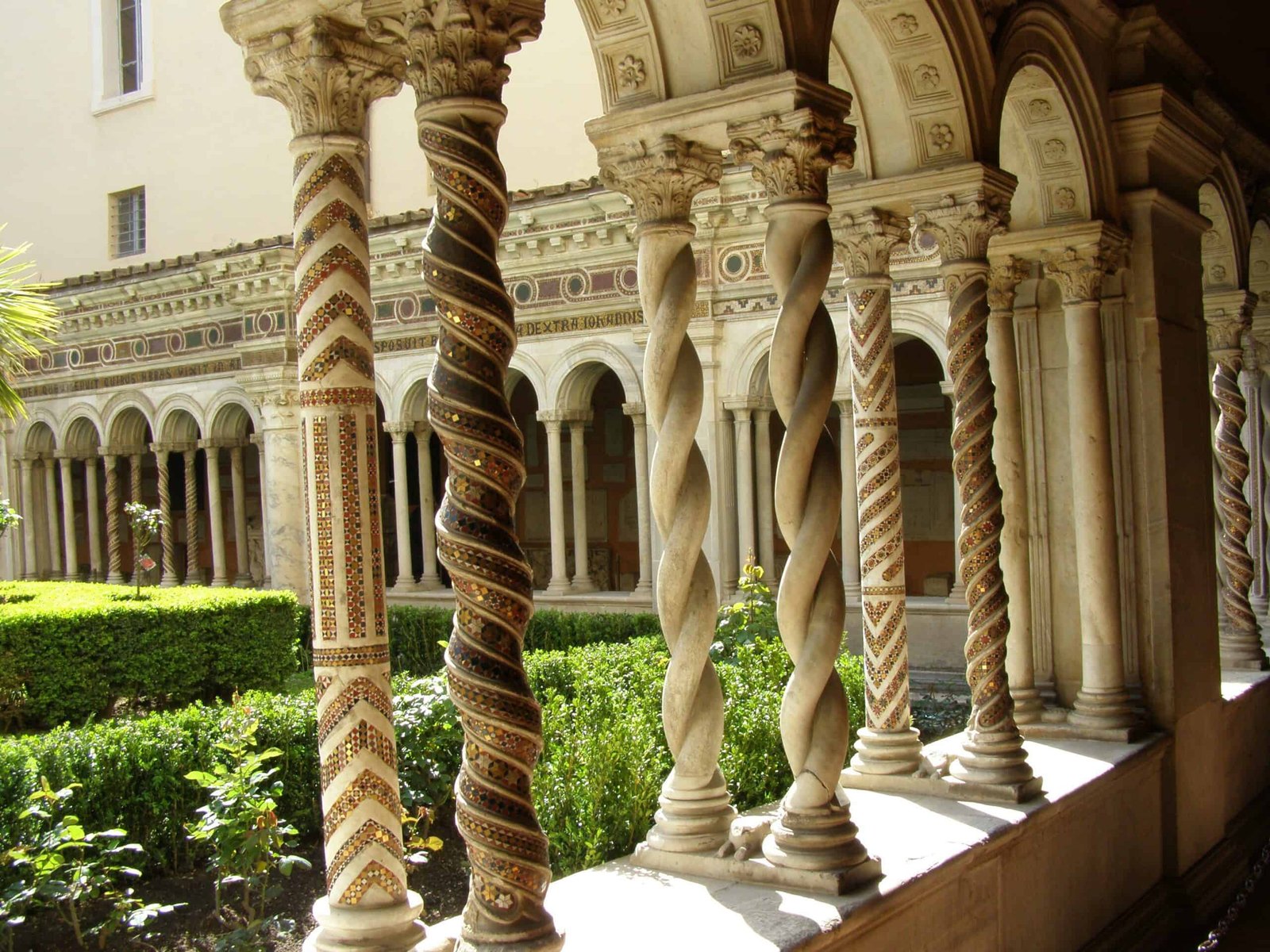
It was built in the 13th century by the Vassalletto workshop, the same family of Roman marble workers active at Saint John Lateran. The little columns come in different shapes: smooth, twinned, twisted, double-spiral, some covered with gold mosaic tesserae and glass paste in the Cosmatesque technique. No pair is identical to another, and that's the point: the Roman medieval cloister doesn't seek classical uniformity, it seeks variety as an exercise in ingenuity. Above the arches runs a frieze with inscriptions and figures. In the center, the garden.
The verdict is clear: the cloisters of Saint Paul and of the Lateran are the two best in Rome, and this one is the more intact of the two. €4 for 20 minutes of silence 200 meters from Via Ostiense is the best deal in the neighborhood.
The Picture Gallery and the Chapel of the Relics
The route includes a picture gallery, a Chapel of the Relics, an exhibition gallery and some annexed rooms, for about 1,000 square meters in total. It holds plaques, funerary inscriptions and sculptural fragments from the Constantinian basilica and the Theodosian one, as well as reused material and finds recovered in excavations between the 19th and 20th centuries. Along the route there are illustrative panels and multimedia videos.
The plaques are the part I'd recommend looking at most carefully, even though at first glance they seem the most boring. They are the names of the people buried here: men and women from the 3rd, 4th and 5th centuries, with their age in years, months and days, and sometimes the formula asking the reader not to disturb their rest. They are the people who lined up to be buried near Paul.
The Archaeological Area in the Monks' Garden
In 2007 the abbey started, in the southwest area, in the monks' garden, excavation for the construction of a multipurpose building for pilgrim services. The work lasted about two years and uncovered an early medieval complex of great interest, so much so that the underground volume was turned into an archaeological protection area and then made into a museum.
The investigations were carried out under the direction of the Vatican Museums, with the Pontifical Institute of Christian Archaeology, the Specialization School in Architectural and Landscape Heritage of Sapienza and the basilica's administration.
What you can see. The structures of the women's monastery from the 5th to 7th centuries, with the oratory dedicated to Saint Stephen, which before the excavation was known only from an inscription kept in the abbey and dating to the time of Gregory the Great: refectory hall, portico, columns, a well, a bell tower. Then there is the stretch of portico that connected the Porta di San Paolo to the ancient basilica, the porticus Sancti Pauli, a covered colonnade about 1.5 kilometers long that let pilgrims reach the tomb without coming out into the open. You can also see traces of the building sites active on the spot between the 8th and 15th centuries: mortar basins, marble set aside to be turned into lime.
This last detail is the most instructive of the whole visit. For centuries, inside the sacred area, ancient marble was burned to make lime. Preservation as we understand it today is a recent invention: the Middle Ages reused, and reused everything.

The Benedictine Abbey of the Basilica of Saint Paul Outside the Walls, Today
The Benedictine community has looked after the basilica since the 8th century and never left, not even when the State took everything from it. The suppressions of 1866 and the Roman one of 1870 confiscated the abbey's property. The monks stayed on as custodians, continuing the divine office over the tomb. That is 1,700 years of liturgical continuity over a tomb, and it's something you can count on one hand in Europe.
Between the 19th and 20th centuries, the abbey became a hub for the revival of European monasticism. From here, experiences either passed through or began in Germany with the Wolter brothers, in France with Dom Prosper Guéranger, who professed at Saint Paul's on July 26, 1837 before refounding Solesmes, in Portugal and in Brazil. They reopened the abbeys of Farfa and Pontida. Monsignor Rudesindo Salvado, founder of the New Norcia mission in Australia, died at Saint Paul's on December 29, 1900. Among the abbots are Blessed Placido Riccardi and Blessed Alfredo Ildefonso Schuster, who would later become a cardinal and archbishop of Milan.
The legal framework has changed in recent years. Since March 7, 2005, the monastery has taken the name Abbey of Saint Paul Outside the Walls, losing its territorial title. On May 31, 2005, with the motu proprio "L'antica e venerabile Basilica," Benedict XVI abolished the millennium-old prelature nullius established by Gregory VII and entrusted the basilica to an archpriest appointed by the Pope, with ordinary and immediate jurisdiction, as in the other papal basilicas of Rome. The abbot remains vicar for pastoral care. The archpriests who have succeeded one another are Cardinal Andrea Cordero Lanza di Montezemolo since 2005, Francesco Monterisi since 2009 and James Michael Harvey since 2012. The abbot in office is Dom Donato Ogliari.
The monks exercise the ministry of reconciliation as minor apostolic penitentiaries, and in this capacity they answer to the Tribunal of the Apostolic Penitentiary and not to the cardinal archpriest. Canonically, the abbey reports to the Abbot President of the Cassinese Sublacense Congregation, born from the merger of the two branches in 2016. Since that same year, the Abbey of San Pietro in Perugia has been a dependent house of the Ostiense one.
On the civil level, the complex enjoys the extraterritoriality recognized for the Holy See by the Lateran Pacts of 1929. The Holy See exercises full jurisdiction there, with no possibility of expropriation or taxation by the Italian side. This is not a bureaucratic abstraction. When you pass through the portal of the quadriportico, you are entering a different legal regime from that of the forecourt you just crossed. By decree of John Paul II dated July 11, 1981, the abbot retains ordinary pastoral care of the extraterritorial area. Since 1980, the basilica has been inscribed on the UNESCO World Heritage List, as part of the site that includes the historic center of Rome and the extraterritorial properties of the Holy See.
The Pilgrimage of the Seven Churches and the Holy Door
Visiting the seven churches is the oldest Roman devotional practice still alive. In its codified form, it dates back to the Jubilee of 1300 proclaimed by Boniface VIII, before being revived in the 16th century by Saint Philip Neri, who made it a full-day walk with stops, singing and a snack on the Aventine Hill. The seven churches are Saint Peter's, Saint Paul Outside the Walls, Saint John Lateran, Saint Mary Major, Saint Lawrence Outside the Walls, Holy Cross in Jerusalem and Saint Sebastian Outside the Walls.
Saint Paul Outside the Walls is the second stop on the classic route, the one you tackle leaving the city to the south. If you want to walk it all in one day, plan on about 25 kilometers and start at dawn. The stretch between Saint Paul and San Sebastiano, along the Ostiense and then toward the Appia, is the least walkable and needs to be studied in advance.
As for the Holy Door: it is one of the five portals on the facade, opened only in Jubilee years. The ordinary Jubilee of 2025 closed on December 28, 2025 with the ceremony presided over by Cardinal Harvey, and since that day the passage has been walled up. Until the next Holy Year, there is no Jubilee indulgence linked to passing through it. Anyone arriving today enters through the ordinary portals, and the visit keeps its meaning intact.
How to Get to the Basilica of Saint Paul Outside the Walls
Take metro line B toward Laurentina, stop Basilica San Paolo. The exit is on Viale San Paolo, and it's three minutes on foot, on flat ground, to the quadriportico. From Termini it's about 20 minutes with no transfers, and it's the best way.
On the surface, take line 23, stop Ostiense/Lungotevere San Paolo. It runs along the Tiber and connects Piazzale Clodio with Pincherle/Parravano and Valco San Paolo, passing through Trastevere, Testaccio and the Ostiense. It's a convenient line if you're coming from Trastevere or Saint Peter's, much less so if you're in a hurry.
From Fiumicino: Leonardo Express to Termini, then metro B. By car in normal traffic it's about 40 minutes, but normal traffic on the Roma-Fiumicino is a theoretical concept. From Ciampino: regular bus or shuttle to Termini, then metro B.
By car: not recommended. Parking around the square is paid and always full, Via Ostiense is congested, and there is no parking lot dedicated to visitors. If you really must come by car, leave it at Laurentina station or EUR Magliana and take a stretch of metro.
How to Really Visit the Basilica of Saint Paul Outside the Walls
Realistic timing: 40 minutes for the basilica if you walk through carefully, an hour and a half or two hours if you add the cloister, picture gallery and archaeological area. Anyone arriving on an organized tour usually has 22 minutes, looks at the apse, photographs the ciborium and moves on. It's a shame, because this is one of the few Roman monuments where you don't wait in line and you don't have to fight for your own square meter.
The best time is the first hour of the morning, between 7:00 and 9:00. There are no groups, light enters through the eastern windows via the alabaster, and the color it gives off is the kind worth getting up for. The second good window is the last hour, around 18:00, when the artificial lights come on over the roundels and the nave takes on a completely different tone.
The time of year matters less here than elsewhere, because the building doesn't suffer from crowding. If I had to choose, I'd say February or November, with the basilica almost empty. January 25, the solemnity of the Conversion of Saint Paul, is the titular feast, and the basilica is the center of the celebrations: beautiful to see, terrible if you're looking for quiet.
Dress code: it's a papal basilica, so shoulders and knees need to be covered. There's no security checkpoint at the entrance, but they will stop you, and carrying a shawl in your backpack avoids arguments.
The Basilica of Saint Paul Outside the Walls with Kids
It works better than you might expect, and the reason is space. Here you don't walk single file as you do in the Catacombs of San Callisto. There are no narrow corridors or lines: there are thousands of square meters where a child can walk around without anyone getting irritated.
The quadriportico is the right place to let off energy before or after: garden, palm trees, gravel, the large statue in the center. Inside, the game that always works is hunting for roundels. Giving a kid the job of finding one specific pope's portrait along 50 meters of wall keeps them busy for an entire visit and teaches them something. With older kids, the 36 frescoed panels telling the stories of Paul work well, recounting shipwrecks, imprisonments and journeys.
The archaeological area, with its panels and films, is of interest from age 10 up. Below that age, it's a long, dark route, so it's better to skip it. There are no marked changing tables on the museum route: plan on sorting it out yourselves.
Accessibility of the Basilica of Saint Paul Outside the Walls
The quadriportico and the basilica are on a single level, with no significant steps between the entrance and the central nave, and the spaces are very wide. For anyone using a wheelchair or pushing a stroller, it's one of the most accessible papal churches in Rome. The presbytery and the Confession, however, require climbing a few steps.
The museum route, cloister included, has uneven thresholds and surfaces, because it's a 13th-century structure with original flooring. The underground archaeological area has ramps and walkways, but it's worth checking by phone the day before whether it's accessible before you go. The numbers are 06 69880800 and 06 69880802.
For the museum route ticket, the administration offers free admission to people with disabilities and their companion. The garden of the quadriportico has shade and places to sit. Inside the enclosure there are no drinking fountains, so bring your own water, especially in summer.
How much it costs to visit the Basilica of Saint Paul Outside the Walls
The basilica is free. Always, every day, with no reservation, no ticket, no time slots. It's worth repeating because a surprising number of visitors arrive convinced they have to pay something.
You only pay for the route that includes the cloister, the picture gallery and the archaeology area: 4 euro full price, 3 euro reduced, with free admission for people with disabilities and their companion, for the companion of groups, and for the teacher accompanying a school class. Tickets are bought on site.
For guided tours organized by the basilica, rates and procedures are arranged by writing to info@basilicasanpaolo.org or by calling the administration's phone numbers. There is no service at fixed times with stable rates all year round.
Practical tip for saving money: Saint Paul, together with Santa Maria Maggiore, Saint John Lateran and Saint Peter's, forms an itinerary of four papal basilicas that are entirely free. They are the four most important churches in Catholicism, and they don't cost one euro. If you have one day and a tight budget, this is the Roman itinerary with the best ratio between what you see and what you spend.
The Ostiense around the Basilica of Saint Paul Outside the Walls
The neighborhood around the basilica is not a backdrop. It is one of the densest layerings in Rome, and understanding it changes the visit.
Between the late 1800s and the early 1900s, the city administration decided to concentrate the city's production facilities here. The Gazometro, Mercati Generali, Mattatoio di Testaccio and the Montemartini thermoelectric power plant were built, the latter switched on in 1912 as Rome's first public power plant. Workers' houses, railway workers' houses and warehouse workers' houses grew up around it. For half a century this was Rome's district of heavy labor, with the papal basilica in the middle, like a ship moored in an industrial port.
In the last 20 years the transformation has been radical. The Centrale Montemartini has become the satellite venue of the Capitoline Museums, where ancient statues live alongside diesel engines and boilers: one of the three or four smartest museum displays in Italy. The area around Via del Porto Fluviale has filled with large-format murals and evening venues. Roma Tre has brought thousands of students. Mattatoio hosts exhibitions and the Città dell'Altra Economia, and the neighboring Testaccio district has become one of the most crowded food destinations in the city.
To sum up the stratigraphy: a Roman cemetery from the 1st century, an early Christian basilica, a fortified village from the 9th century, an industrial plant from the early 1900s, and above all of this, contemporary urban art. Five layers in one square kilometer. I don't know many neighborhoods in Europe that can match that.
What to see near the Basilica of Saint Paul Outside the Walls
Within one metro stop or a short walk:
The Pyramid of Cestius, the tomb of Gaius Cestius built between 18 and 12 BC and later incorporated into the Aurelian Walls. It is two metro stops away, at the Piramide station, and visiting it after the basilica makes sense because it shows the other Roman way of handling death, the monumental and private one.
The Museo della Via Ostiense, set up inside the Porta San Paolo, with models and finds from the river port and the consular road: small, free, almost always empty, and essential for understanding the context we talked about at the beginning.
The Abbey of the Three Fountains, in the valley behind the EUR, where tradition places Paul's martyrdom and where legend says the severed head, bouncing three times, made three springs gush forth. It is the natural complement to this visit, and it is a place of great peace. You can get there on Metro line B, Laurentina stop.
The Catacombs of Commodilla and those of Santa Tecla, both on the Ostiense and linked precisely to the burial ground of which the basilica occupies a portion, plus the museum of the Generosa catacombs. These are underground burial sites with regulated access, so you can't just walk in by chance.
Farther away but in the same funerary logic, the Verano Cemetery grew up against a Constantinian basilica as well, Saint Lawrence: the same idea of burying near the martyr, applied from the 1800s onward.
A curiosity about the Basilica of Saint Paul Outside the Walls
The curiosity concerns the band of papal roundels, and it's not what you expect.
Among Romans, and in the oral repertoire of generations of guides and monks, a rumor has long been going around. When the available roundels run out and there is no more room for the portrait of a new pontiff, the end of the world will come. In some versions the prophecy is less apocalyptic and more practical: the basilica will have to be demolished and rebuilt to make room for more portraits. It's a popular legend, not an official document, and it should be taken for what it is: a piece of Roman folklore that has lasted two centuries.
What makes the story interesting is that nobody can stop counting. Try it yourselves: go in, find the roundel of the reigning pope, and then look at how many empty panels are left along the wall. I assure you everyone does the math, believers and non-believers alike, and everyone lowers their voice while doing it.
It's worth adding the technical detail that deflates the prophecy and makes it more fascinating at the same time. The series didn't begin in the nineteenth century. The ancient basilica already had one, begun in the time of Leo I, in the fifth century, and in that case the space was simply reorganized several times over the centuries. When the space ran out, a register was added, the band was redesigned, the sequence was moved. That is to say, the problem has come up before, and the solution has always been architectural, never apocalyptic.
Our opinion: it's one of the few Roman legends worth telling in full, because it isn't inert folklore. It forces whoever hears it to look at the wall as a timeline that keeps going, instead of as decoration. And in a basilica where everything has been redone twice, the real curiosity is exactly this: the only truly continuous element is not the stone but the list of names.
Something nobody tells you about the Basilica of Saint Paul Outside the Walls
Under the floor you're walking on there are more than 5,000 burials, and more than 1,700 inscribed slabs. That's not a rhetorical estimate. It's the result of the archaeological recoveries carried out from the nineteenth century onward, and part of that material is displayed in the gallery of the museum route.
The point no guide develops is why. From the end of the third century there was a regular market for burials ad sanctos, that is, near the body of a martyr. People bought proximity. The closer you were to the tomb of the Apostle, the more you paid, exactly as today you pay for a sea view. The theological assumption was that on the day of the resurrection the martyr would pull his neighbors along with him. The economic assumption was that there were few places nearby.
This led to documented and repeated abuses: burials sold twice, bones removed to make room for new buyers, unauthorized occupation of other people's burial niches. Councils and bishops legislated repeatedly against the trade in burials, which shows that the phenomenon was widespread and persistent. Around the great apostolic tombs of Rome, a real estate economy, with prices, middlemen and disputes, operated for centuries.
Walking in the nave you don't notice it, because the floor is the nineteenth-century one in polychrome marble and because everyone looks up. But near the side entrances, and in some stretches of the museum route, you can see traces of this layering: fragments of reused slabs, cut inscriptions, reworked marbles. The next time you go in, spend two minutes on the floor instead of the ceiling.
Let's add the detail that completes the picture. When Gregory the Great raised the level of the presbytery, at the end of the sixth century, he didn't do it for aesthetic reasons but to manage this very pressure. The tomb of the Apostle needed to be separated from the crowd of worshippers and from the private burials. The Confession was born as a public order device, even before it was a liturgical one.
My advice for visiting the Basilica of Saint Paul Outside the Walls
My advice is to divide the visit into three distinct stages and not mix them. It's a method that works because it respects the hierarchy according to which the building was designed.
First stage, the quadriporticus. Don't rush through it to get inside. Stop in the middle, look at the golden facade, walk around the colonnade, take in the depth of the triple row in front of the entrance. It takes five minutes and it helps calibrate your eye. When you then go in, the scale of the interior doesn't surprise you, it confirms what you saw.
Second stage, the central nave, in a straight line and with no detours. Don't look at the chapels, don't look at the roundels, don't stop at the statues. Walk from the portal to the balustrade of the presbytery looking straight ahead, toward the mosaic of the apse. It's about 90 meters, so go slowly. It's the only way to understand what a late antique basilica was, that is, a guided path toward a single point.
Third stage, the details. Only now go back and take in Arnolfo's ciborium, the arch of Galla Placidia from the right spot halfway down the nave, the Paschal candelabrum, the four chapels of the transept, the roundels. And if you have four euros and half an hour, the cloister.
The tip within the tip: come early. Between seven and nine in the morning the basilica is practically yours, the light through the alabaster is warm, and the groups haven't arrived yet. From 11 on, everything changes, and not for the better. If you have to choose between sleeping one hour more and seeing this basilica empty, choose the second. It's an experience you can still have for free in tourist Rome in 2026, and there are fewer and fewer places of which the same can be said.
Another well-known fact, yet rarely mentioned
Everyone knows that Saint Paul Outside the Walls is Rome's second-largest basilica after Saint Peter's. Almost no one draws the consequence.
The consequence is this: among the four papal basilicas, Saint Paul's is the only one that preserves, in its layout and proportions, the form of an early Christian basilica. Saint Peter's was demolished and reinvented in the sixteenth and seventeenth centuries, and today it is a Renaissance and Baroque building that preserves nothing visible of the Constantinian basilica. Saint John Lateran was transformed by Borromini. Santa Maria Maggiore keeps the ancient nave but has been covered and altered repeatedly. Saint Paul Outside the Walls, burned in 1823, was rebuilt with the explicit order not to innovate.
The paradox that follows deserves to be stated clearly: the most recent of the four is the one that looks most like the original. Leo XII, in the document of September 18, 1825, banned architectural innovations and required respect for the existing forms and proportions. It was a conservative decision that seemed backward to many architects in the nineteenth century, and that today has turned out to be a gift: no other place in Europe lets you walk, at full scale, through the space of a fourth-century basilica.
Anyone who visits Rome often sets up a mental ranking in which Saint Peter's comes first and the other three follow. On the level of architectural experience, for understanding how an ancient Christian church worked, the order is reversed. Saint Peter's tells the story of papal power in the seventeenth century. Saint Paul's tells the story of the liturgy of the fourth century. They are two different things, and it is a mistake to measure them with the same yardstick.
The right photo to take at the Basilica of Saint Paul Outside the Walls
There are two, and neither one is the one everyone takes.
Outside, the wrong photo is the frontal shot taken from the central path of the quadriportico: it compresses the facade, flattens the mosaics, and tells nothing about the space. The right photo is taken from a corner of the portico, standing between two columns and using them as a frame. This way the golden facade appears at the end, framed by the colonnade and the palms, and the perspective conveys the depth of the courtyard. Better time: between nine and 11 in the morning, when the sun hits the mosaics full on. In the afternoon the facade goes into shadow and the gold turns brown.
Inside, the right photo is taken from the far end of the central nave, on axis, with a wide-angle lens. The trick that changes everything is to lower the camera to hip height instead of holding it at eye level: the columns look more imposing, the gilded coffered ceiling closes the frame at the top, and the scale of the building reads at once. If you have a small tripod, set the camera on the ground and use the self-timer. With the alabaster in the windows the light is warm but weak, and exposure times get longer.
Third option, for those with patience: the cloister. Don't photograph the whole, which always looks confused. Photograph a single group of twisted columns against the light, with the garden blurred behind. The gold tesserae of the Cosmatesque inlays light up, and it is the only way to show in one image why that cloister matters.
Practical rules: photos are allowed, flash and bulky tripods are not, and during celebrations everything gets put away. Those who shoot with a phone get decent results if they lock the exposure on the lit part of the apse instead of letting the automatic mode decide, which overexposes the mosaics and blows out the gold.

Some important events that took place here in history
On November 18, 324, according to the tradition recorded in the Liber Pontificalis, Pope Sylvester I consecrated the first Constantinian basilica over the tomb of Paul. It was the second imperial foundation in Rome after the Lateran.
In 386 an imperial rescript ordered its enlargement. In 390 Pope Siricius consecrated the new basilica, with five naves, which was completed under Honorius within the first years of the fifth century. For a couple of centuries it was the largest church in the Christian world.
In 846 the Saracens sailed up the Tiber and sacked Saint Peter's. Here, according to the abbey's memory, the attackers were driven back by farmers from the area. The papal response was the construction, under John VIII, of the fortified citadel known as Giovannipoli: walls, towers, houses, a mill, a port on the river.
In 1081 Gregory VII, who had been abbot of this abbey, issued the bull establishing the prelature nullius, removing the abbot from all episcopal authority except that of the pope. The privilege lasted 924 years, until 2005.
In 1285 Arnolfo di Cambio delivered the Gothic ciborium over the tomb. It is the only signed and dated Roman monument by the artist who would later design the Duomo of Florence.
On April 22, 1541, in front of the wooden Crucifix in the chapel now called the Chapel of the Blessed Sacrament, Ignatius of Loyola and his first companions took their solemn vows. The Society of Jesus was legally founded elsewhere, but here it performed its first communal founding act.
In the night between July 15 and 16, 1823, a fire destroyed a large part of the basilica in five hours, erasing the frescoes by Cavallini and almost all the ancient columns. Pope Pius VII, who had been a Benedictine monk of the Cassinese Congregation, died on August 20 without being told.
On January 25, 1825, Leo XII published the encyclical Ad plurimas, opening an international subscription for the reconstruction. Catholic, Orthodox and Muslim sovereigns contributed.
On October 5, 1840, Gregory XVI reconsecrated the altar of the Confession. On December 10, 1854, Pius IX consecrated the entire basilica in front of the world episcopate gathered in Rome for the proclamation of the dogma of the Immaculate Conception.
On April 23, 1891, the explosion of the powder magazine of Forte Portuense destroyed the stained-glass windows painted by Antonio Moroni. They were replaced by alabaster slabs, which today give the interior its characteristic light.
On January 25, 1959, in the chapter hall of the abbey, at the end of the celebration for the Conversion of Saint Paul, Pope John XXIII announced to the gathered cardinals the convocation of the Second Vatican Ecumenical Council. It is the most important modern event to have taken place in this complex, and it is also the one visitors remember least. A plaque written by Cardinal Antonio Bacci commemorates it.
On October 30, 2016, the central Italy earthquake caused cracks and falling cornices. The basilica was closed for checks and reopened after inspections.
On May 20, 2025, Leo XIV, elected a few days earlier, came to pray at the tomb of the Apostle in front of about 2,000 faithful. He was welcomed by Abbot Dom Donato Ogliari and Cardinal Archpriest James Michael Harvey. He incensed the trophaeum and gave a homily on grace, faith and justice. On December 28, 2025, Cardinal Harvey closed the Holy Door of the Jubilee. On January 25, 2026, during the Vespers for the Conversion of Saint Paul, the light was turned on over the mosaic roundel of the new pontiff.
Who Passed Through the Basilica of Saint Paul Outside the Walls
Paul of Tarsus, first of all, but dead. His body arrives here, not his preaching.
The emperors. Constantine founded the first basilica. Theodosius I, Gratian and Valentinian II commissioned the second, and Honorius completed it. Galla Placidia, daughter of Theodosius and regent of the Western Empire, paid for the triumphal arch mosaic out of her own pocket and had it written in the inscription.
The popes, too many to sum up easily. Pope Silvester I consecrated the Constantinian basilica, and Siricius consecrated the Theodosian one. Leo I started the series of papal portraits. Gregory the Great created the Confession. Gregory II effectively founded the abbey. John VIII built Giovannipoli. John XVIII had been a monk here. Gregory VII was abbot of this monastery before becoming the pope of the Investiture Controversy. Nicholas III, that is, Giovanni Gaetano Orsini, was abbot and had himself portrayed in the apse mosaic. Only two popes rest in the basilica: Saint Felix III and John XIII.
The artists. Pietro Vassalletto and Nicolò D'Angelo signed the Paschal candelabrum around 1170. The Vassalletto workshop built the cloister in the thirteenth century. Pietro Cavallini frescoed the nave and worked on the façade mosaics. His work here was lost in the fire, and it is one of the most serious losses in Italian painting. Arnolfo di Cambio delivered the ciborium in 1285. In the nineteenth century, Giuseppe Valadier, Pasquale Belli, Luigi Poletti, Antonio Moroni, Filippo Agricola, Nicola Consoni, Giuseppe Obici, Pietro Tenerani, Salvatore Revelli, Ignazio Jacometti, Rinaldo Rinaldi, Francesco Podesti and Virginio Vespignani passed through. In the twentieth century, Guglielmo Calderini, Giuseppe Sacconi, Antonio Maraini and Enrico Manfrini did. In 1494 Andrea Bregno had left his marble triptych in the Chapel of Saint Lawrence, and Carlo Maderno designed two chapels in the transept.
The saints and reformers. Saint Odo of Cluny brought reform here in the 10th century. Ludovico Barbo, called in by Gabriele Condulmer, reformed the abbey in the fifteenth century. Ignatius of Loyola and the first Jesuits took their solemn vows here on April 22, 1541. Dom Prosper Guéranger professed at Saint Paul Outside the Walls on July 26, 1837, before refounding Solesmes and rewriting the history of Gregorian chant. Rudesindo Salvado, founder of the Benedictine mission of New Norcia in Australia, died here on December 29, 1900. Blessed Ildefonso Schuster was abbot before becoming cardinal and archbishop of Milan.
The travelers. Johann Wolfgang von Goethe came in December 1787 and wrote about it in Italian Journey: it is one of the few direct descriptions of the Theodosian basilica that survive from before the fire. Stendhal arrived after 1823 and noted the image of the black, smoking, half-burned beams.
The contemporaries. Pope John XXIII announced the Council here on January 25, 1959. Leo XIV came to pray at the tomb on May 20, 2025, and presided over the Vespers of the Conversion on January 25, 2026. Cardinal James Michael Harvey has been archpriest since 2012, and Dom Donato Ogliari is abbot of the Benedictine community.
One name that no one associates with this place, yet one that deserves to close the list: Barnaba Chiaramonti, a Benedictine monk trained in the school of this congregation, elected pope in 1800 as Pius VII. He was the pontiff who stood up to Napoleon and spent five years in captivity in France. He died a month after the fire, without knowing it.
Quick questions about the Basilica of Saint Paul Outside the Walls
How much does it cost to enter the Basilica of Saint Paul Outside the Walls?
Nothing. Entry to the basilica is free every day, with no ticket and no reservation. You only pay for the route that includes the cloister, the picture gallery and the archaeological area: 4 euros full price, 3 euros reduced.
What are the opening hours of the Basilica of Saint Paul Outside the Walls?
The administration's hours page lists opening every day from 7:00 to 18:30, with no weekly closing day. Evening hours may change with the season and with celebrations: it's best to check the basilica's official website the day before.
What are the hours and price for the cloister?
The museum route opens at 8:00 and closes at 18:00, with last entry at 17:30. The ticket costs 4 euros, reduced 3 euros. Here too, hours are subject to seasonal changes.
How do I get to the Basilica of Saint Paul Outside the Walls by metro?
Metro B, direction Laurentina, stop Basilica San Paolo. From the exit, it's a three-minute walk on flat ground. From Termini it's about 20 minutes with no changes.
Is there a bus that goes to the basilica?
Yes, line 23, stop Ostiense/Lungotevere San Paolo. It connects Piazzale Clodio to Pincherle/Parravano, passing through Trastevere, Testaccio and Ostiense: convenient if you're coming from those areas, slow if you're in a hurry.
What is the exact address?
Piazzale San Paolo 1, 00146 Rome. The official entrance is not on via Ostiense but on the inner piazzale, through the quadriportico.
Do I need to book to visit the Basilica of Saint Paul Outside the Walls?
No. For the basilica there is no reservation or ticket office. The ticket for the museum route is bought on site.
How long does the visit take?
40 minutes for the basilica alone, if you walk attentively. An hour and a half or two if you add the cloister, picture gallery and archaeological area. Organized groups get through it in 20 minutes, and they're wrong.
Where is the tomb of Saint Paul?
Under the papal altar, in the Confession, that is, the recessed space at the center of the presbytery, reached by two marble staircases. The sarcophagus is visible through the square opening made during the restorations of the early 2000s, and bears the inscription PAVLO APOSTOLO MART.
Who is the pope depicted in the last medallion of the nave?
Leo XIV, elected in 2025. His mosaic portrait, made by the Studio del Mosaico Vaticano from a design by Rodolfo Papa, was delivered on January 14, 2026, and placed in the right nave at a height of about 13 meters, next to that of Pope Francis.
Can you take photos inside the Basilica of Saint Paul Outside the Walls?
Yes, without flash and without bulky tripods. During celebrations everything is put away. For the interior you need a bright lens or a surface to rest the camera on, because the alabaster in the windows gives warm but dim light.
Is the Basilica of Saint Paul Outside the Walls suitable for children?
Very much so. The spaces are huge, and there are no narrow corridors or lines. The quadriportico works as a place to let off steam before or after, and hunting for the papal medallions along the wall keeps a young boy busy for the whole visit.
Is the basilica accessible to people with mobility difficulties?
The quadriportico and naves are on a single level with no significant steps, and the spaces are ample: it's among the most accessible of Rome's papal churches. The presbytery and the Confession require a few steps. The cloister route has uneven thresholds and surfaces, so it's best to call first at 06 69880800 or 06 69880802.
Why is it called Outside the Walls?
Because it stands outside the circuit of the Aurelian Walls, a little under two kilometers from the Porta San Paolo, along the route of via Ostiense. Roman law forbade burials inside the urban perimeter, so the tombs, and the basilicas built over the tombs, are all located outside the walls. The same goes for San Lorenzo and San Sebastiano.
Does the Basilica of Saint Paul Outside the Walls belong to Italy or the Holy See?
To the Holy See. The complex enjoys extraterritoriality recognized by the Lateran Pacts of 1929: full Vatican jurisdiction, with no possibility of expropriation or taxation by Italy. The outer piazzale, however, is Italian territory.
How many popes are buried in the basilica?
Only two: Saint Felix III and John XIII. It's a surprisingly low number for a papal basilica, and it's explained by the fact that there is only one tomb here, and it belongs to the Apostle.
What does it mean that it's a UNESCO World Heritage Site?
Since 1980 the basilica has been part of the UNESCO site that includes the historic center of Rome and the extraterritorial properties of the Holy See. In practical terms, it means protection constraints and conservation obligations, not tickets or restrictions for visitors.
What can you see in the archaeological area?
The remains of the women's monastery from the 5th to 7th centuries, with the oratory of Santo Stefano, a stretch of the porticus Sancti Pauli that connected the Porta San Paolo to the basilica, and the building sites active on the spot between the 8th and 15th centuries, with the mortar pits and the ancient marbles set aside to make lime. Excavations began in 2007 and lasted about two years.
What's the difference between the Basilica of Saint Paul Outside the Walls and the Catacombs of Via Appia?
The catacombs are underground cemeteries dug into tufa, and you can only visit them with a guide, at set times and on set routes. Here the cemetery was above ground, in the open air, and the basilica was built over it: you enter freely and walk over the burials without noticing.
What is the ciborium above the altar?
A Gothic marble aedicule made by Arnolfo di Cambio in 1285 at the request of Abbot Bartolomeo, with statues of Paul, Peter, Benedict and Timothy at the corners. It architecturally marks the exact spot of the tomb.
Where does the main organ come from?
From the Basilica of Saint John Lateran, from which it was moved in the second half of the 19th century. The instrument is tied to the work of the Serassi brothers' workshop, and it has been rebuilt several times, by Domenico Farinati in 1895 and up to the Buccolini firm between 1993 and 1995. Today it has 36 stops and about 2,550 pipes.
Can you attend Mass?
Of course, and it's free, like everything else. Weekdays at 7:00, 10:00 and 17:00, with vespers at 18:00. Sundays and solemnities at 8:00, 10:00, 12:00 and 18:00, with vespers at 17:00. The Sunday conventual Mass at 10:00 is the one sung by the monks.
Is there a bookshop or a snack bar?
Yes, both are open every day from 8:00 to 18:30. The sacristy is open 8:00-12:00 and 16:00-18:30, and the administration office is open Monday through Saturday 8:00-14:00.
What can you see around the Basilica of Saint Paul Outside the Walls?
The Pyramid of Cestius and Museo della Via Ostiense at Porta San Paolo, Centrale Montemartini with the Capitoline statues among the turbines, the Abbey of Tre Fontane where tradition places the martyrdom of Paul, and the Catacombs of Commodilla and Santa Tecla on the Ostiense.
Did the basilica suffer damage in the 2016 earthquake?
Yes. On October 30, 2016, the magnitude 6.5 quake with its epicenter between Norcia and Visso caused cracks, falling cornices and the detachment of a support for a large candelabrum. The basilica was closed for safety checks and reopened after the inspections: no structural damage.
Can you climb the bell tower?
The Poletti bell tower, five stories high and completed in 1860, is not part of the visiting route, and the basilica doesn't offer any viewpoints.
Is prayer still said at Paul's tomb today?
Every day. The Benedictine community has looked after the basilica since the 8th century and ensures that the liturgy at the tomb continues without interruption, including in the periods when the State had confiscated all its property.
What's the best time to visit the Basilica of Saint Paul Outside the Walls?
Any time, because there's no line. If you can choose, February or November early in the morning. On January 25, the feast of the Conversion of Saint Paul, the basilica is the center of the celebrations: spectacular to see, not suited to anyone looking for silence.
Can you enter with large backpacks or suitcases?
There are no formal bans and no luggage storage. Common sense matters more than the rules: a day backpack causes no problems, but a large checked-in suitcase in a church where Mass is celebrated every hour does.
How much does a guided tour organized by the basilica cost?
Rates and procedures are arranged by writing to info@basilicasanpaolo.org or by calling the administration office. There is no fixed, permanent price list.
Is the Basilica of Saint Paul Outside the Walls part of the Seven Churches pilgrimage?
Yes, and it's the second stop on the classic route established during the Jubilee of 1300 and revived in the 16th century by Saint Philip Neri. The others are Saint Peter's, Saint John Lateran, Saint Mary Major, Saint Lawrence Outside the Walls, Holy Cross in Jerusalem and Saint Sebastian Outside the Walls.
Is the Holy Door still open?
No. The ordinary Jubilee of 2025 has ended, and the basilica's Holy Door was closed on December 28, 2025 by Cardinal Archpriest James Michael Harvey. It remains walled up until the next Holy Year.
How big is the Basilica of Saint Paul Outside the Walls?
About 131 meters long, 65 wide and 29.70 high, with five naves divided by four rows of 20 columns of Montorfano granite. It is the second largest church in Rome after Saint Peter's.
What is the Confession and why is it called that?
It is the recessed space in front of the altar that lets you get close to the tomb without climbing onto the presbytery. The name comes from the Latin confessio, which refers to the testimony a martyr gave with his blood: the martyr's tomb is, literally, his confession of faith.
How much time do you need to see the archaeological area too?
Plan on 40 extra minutes beyond the basilica alone, and another half hour for the cloister. Taking your time, the full complex takes two full hours, which still feels short for everything there is to see.
One last thing, and then I'll let you go. If you have only one day in Rome, this basilica won't make your list, and that's fine. But if you have three, or if you're going back for a second time, take the metro B one morning early and come here before anything else. You'll find yourself in an immense, free, almost empty church, built over a tomb that someone has been visiting nonstop for 1,800 years. Then go stand in line at the Vatican Museums, if you want. But the right order, for me, is this one.
Article written by the editorial team at TourLeaderPro, contact them for Private/Corporate/V.I.P. Tours and Experiences.
Planning a trip to Rome? English-language guides to visiting the city are on ItalyPlanner.com.
Contact Information
Nearby
 Street Art in Rome: Neighborhoods and Walls to See200 m
- Street Art in Ostiense200 m
- Ostiense200 m
- Vinile500 m
- Catacombs of Commodilla600 m
- LOA Acrobax, social center in Marconi700 m
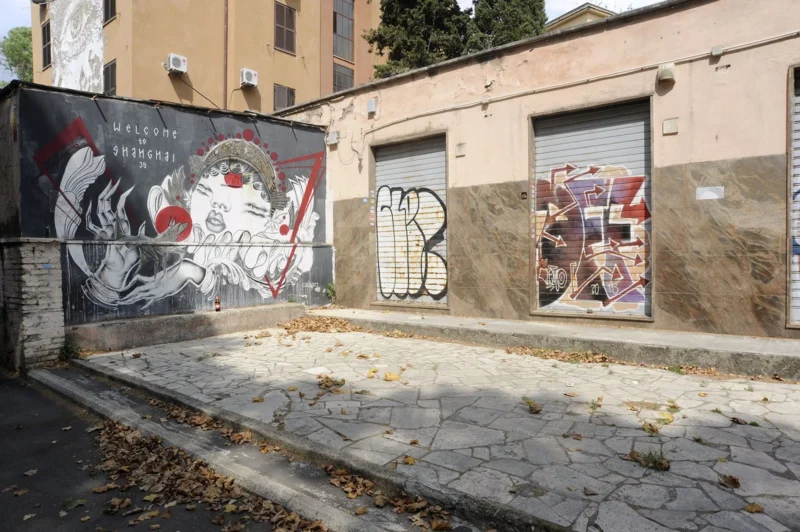
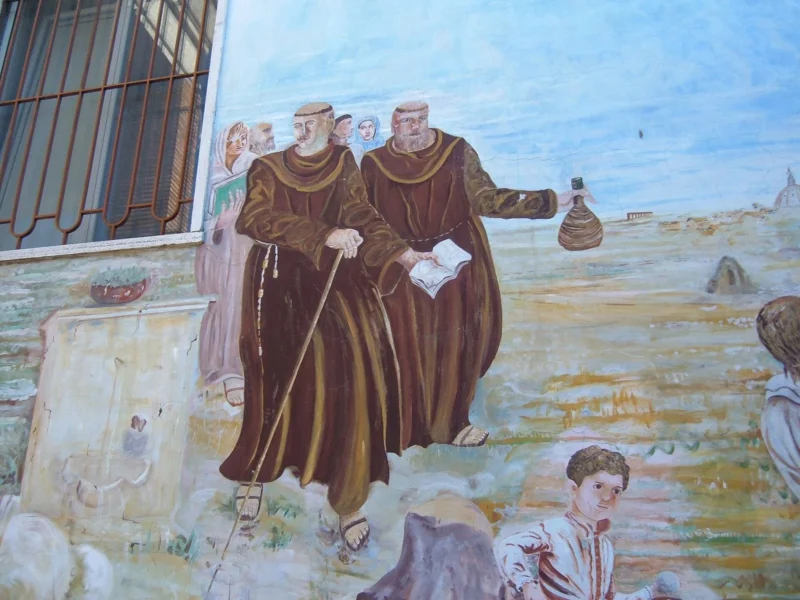
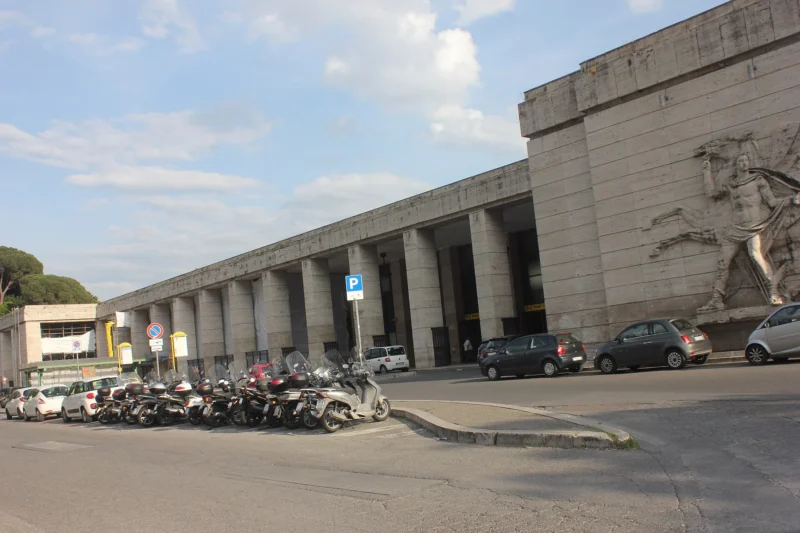
Upcoming events nearby
- «Friday Vinile» with Carosello Swing at Vinile, Friday, November 13, 2026600 m
- «Material» DJ set at Vinile, Saturday, November 14, 2026600 m
- Minû with Cristi Cons and Mennie: Saturday, November 14, 2026800 m
- UP NEO vs ORIGIN at NEO Club Roma: Friday, November 13, 2026800 m