Basilica of Santi Pietro e Paolo at EUR
In short. The Basilica of Santi Pietro e Paolo at EUR is open and active: a parish of the Diocese of Rome entrusted to the Conventual Friars Minor of the Alma Provincia Romana, it celebrates Mass every day and there is no sign of any closure for restoration.
The Basilica of Santi Pietro e Paolo at EUR is open and active: a parish of the Diocese of Rome entrusted to the Conventual Friars Minor of the Alma Provincia Romana, it celebrates Mass every day and there is no sign of any closure for restoration. No part of the building requires payment: there is no ticket office, no climb to the dome, no crypt with a separate entrance. You just walk in, with the decorum owed to a parish church in full activity.
Address: Piazzale dei Santi Pietro e Paolo 8, 00144 Rome, Europa neighborhood. Parish phone: 06 5926166. Parish office email: ufficioparrocchiale@santipietroepaoloroma.it. Parish website: santipietroepaoloroma.it. Weekday Masses are at 7:00, at 8:30, and in the evening. The evening time changes with the season, 18:00 in winter and 18:30 in the warm months. On Sundays and solemnities Mass is celebrated at 8:00, 9:00, 10:30, 12:00, 18:00, and 19:00. The parish office hours and the summer changes are best arranged by phone before showing up.
How to get there: metro line B, stops EUR Fermi or EUR Palasport, both on Viale America. From there you walk uphill toward the highest point of the neighborhood, where the dome appears from every corner and acts as a compass. By bus, the 30 Express line (Laurentina - Clodio) stops at Colombo/Europa, on Via Cristoforo Colombo at the intersection with Viale Europa. From that stop the basilica's square is at the end of the avenue, uphill. Those who arrive by car find the square in front of the church, which fills up quickly on wedding and funeral days. The monumental staircase that comes down to Viale Europa is the most beautiful way in, and also the most tiring. Anyone with walking difficulties should go directly to the upper square.
A clarification that is always needed in Rome: neither the MIC card nor the Roma Pass is valid here. They are tools designed for the civic museums and for museum circuits, and a church is not a museum. Admission to the Basilica of Santi Pietro e Paolo at EUR is free because it's a place of worship, not because someone decided on a promotion. It's worth learning this once and for all, because it avoids pointless arguments on the churchyard.
The surrounding neighborhood is that of the Esposizione Universale di Roma, the E42 that was never inaugurated. The basilica is its religious head, the Palazzo della Civiltà Italiana is its secular head, and between the two runs the axis on which the whole neighborhood was designed.

How to get to the Basilica of Santi Pietro e Paolo at EUR without wasting time
By metro to the Basilica of Santi Pietro e Paolo at EUR
Line B is the most convenient, and it has a tie to this neighborhood that few people know. The stations EUR Fermi and EUR Palasport were inaugurated on February 9, 1955, under the names Esposizione Est and Esposizione Ovest. They were the stops meant to bring the public to a world's fair that was never held. The first run was inaugurated by President of the Republic Luigi Einaudi and by Cardinal Vicar Clemente Micara. A few months later, Micara himself opened the basilica on the hill for worship. The metro and the church are children of the same year, and of the same attempt to turn an abandoned construction site into a city.
From EUR Fermi you exit onto Piazza della Stazione Enrico Fermi and take Viale America. From EUR Palasport you exit directly below the street level of Viale America, a short walk from the Parco Centrale del Lago. In both cases the direction is the same: you head west and go uphill. The dome is visible from almost every intersection, which makes it nearly impossible to take a wrong turn. If you prefer a reference on the ground, take Viale Europa and follow it to the end. The avenue starts right from the basilica's square and continues in the opposite direction as far as Piazzale degli Archivi, where the Archivio Centrale dello Stato is located.
By bus and on foot
The 30 Express line connects Laurentina to Clodio, crossing half the city, and stops on Via Cristoforo Colombo at the height of Viale Europa, at the Colombo/Europa stop. From there you walk up the avenue. It's an uphill walk, with the buildings of the 1930s and 1950s on both sides and the dome growing in front of you as you get closer. If you have time and legs, it's the right way to arrive, because the basilica was designed precisely to be seen like this, from below, at the end of a perspective.
The professional advice is never to arrive from above by car the first time. Parking on the square and getting out of the car 20 meters from the portal takes away from the building exactly what it was built for: distance. Foschini and his collaborators worked on a monumental flight of steps and a base. Looking at the church without climbing those steps is like reading the last page of a novel.
By car, by bicycle, with your own transport
The Europa neighborhood is one of the few corners of Rome where car traffic still works the way the designers imagined it: wide streets, regular blocks, right-angle intersections. Finding a spot around the square is possible outside peak hours and outside days of special celebrations. By bicycle the final climb makes itself felt, but the road surface is good and the traffic, on Sunday morning, is almost nil. Anyone arriving on foot from the Parco Centrale del Lago should count on a real change in elevation: the basilica occupies the highest point of the area, and that is not a figure of speech but the fact that determined the choice of the site.
Admission, hours, and rules at the Basilica of Santi Pietro e Paolo at EUR
How much it costs to enter the Basilica of Santi Pietro e Paolo at EUR
Nothing. Admission to the Basilica of Santi Pietro e Paolo at EUR is open and free, as in almost all the churches of Rome. There is no ticket, no reservation, no paid route. Anyone offering you a ticket to get in is telling you a fairy tale. Offerings are optional and go into the boxes for the maintenance and works of the parish. Nobody will stop you at the entrance.
MIC card, Roma Pass, and the other passes: you don't need them here
The MIC card is the card for the civic museums of the City of Rome. The Roma Pass is a tourist package that includes museums and transport. Neither has any effect on a church: churches don't belong to the museum circuit, have no turnstiles, and issue no tickets. The misunderstanding arises from the fact that in Rome some religious places have attached museum spaces that charge admission, and so the confusion is understandable. Here the case doesn't arise: the Basilica of Santi Pietro e Paolo at EUR has no crypt that can be visited for a fee, no treasury, no archaeological excavations, no climb to the dome, and no bell tower you can walk up. In fact it has no bell tower at all: the building lacks one, and this is one of its most conspicuous oddities.
The difference between free and paid spaces in the churches of Rome
Since the question always comes back, it's worth fixing the general principle. In Rome the liturgical hall, that is the church proper with its naves and chapels, is almost always free. What becomes paid, when it exists, are the spaces that require dedicated staff and extraordinary maintenance: domes with a panoramic climb, archaeological crypts, treasuries with gold work and reliquaries, excavations below the walking floor, bell towers, museum-ized cloisters. At the basilica of EUR none of these exists. If you want a practical comparison, St. Peter's Basilica in the Vatican is free in the nave and paid for the dome. It's the model that confuses everyone, and it doesn't apply here.
The respect owed: silence, dress, services
This is a living parish, not a container of works of art. In the course of a morning you may come across a funeral, a baptism, catechism for the kids, a group of elderly people at prayer. Simple, non-negotiable rules: shoulders and knees covered, hat off, phone on silent, voice low. During services you don't wander around the church taking photos. You sit at the back, or you go out and come back later. Avoid flash always, and not just out of politeness: in front of a modern mosaic it gives false colors. If you want to look at the chapels in peace, choose mid-morning between one Mass and the next, or early afternoon.
Let's add one thing: in front of a church built in the twentieth century the temptation to behave as in an architecture museum is strong. Resist it. The people kneeling in the chapel of the Immacolata are not extras.
Mass times at the Basilica of Santi Pietro e Paolo at EUR
On weekdays Masses are early in the morning, at 7:00 and 8:30, and then in the evening. The evening time follows the season: 18:00 in winter, 18:30 when the days get longer. On Sunday the rhythm picks up, with services at 8:00, 9:00, 10:30, 12:00, 18:00, and 19:00. The 10:30 and the 12:00 Masses are the best attended by neighborhood families. If you're looking for silence, aim for the early morning ones. In July and August the calendar thins out and the times may change: a phone call to the parish settles it in 30 seconds.
The solemnity of Santi Pietro e Paolo, on June 29, is the day of the year when this church is at its best, and it's also the day when it is most crowded. I talk about it at length further on, because it deserves a chapter of its own.
E42: where the Basilica of Santi Pietro e Paolo at EUR comes from
A world's fair that was never held
To understand this church you have to understand the construction site where it was born. The autonomous body in charge of organizing the 1942 World's Fair was established on December 26, 1936. On April 26, 1937, Mussolini planted a pine tree at the central point of the chosen area, south of the city, with the declared idea of pushing Rome toward the sea. The acronym E42 indicated the year planned for the inauguration, which would have coincided with the twentieth anniversary of the regime. The first project, on an area of about four square kilometers, was presented in 1938. The definitive plan came in 1939.
Vittorio Cini, general commissioner of the body, submitted a list of architects to Mussolini. The direction went to Marcello Piacentini, who represented the monumental and academic line. Alongside him was called Giuseppe Pagano, a representative of the rationalist front, together with Luigi Piccinato, Luigi Vietti, and Ettore Rossi. The coexistence of the two souls was not peaceful, and the neighborhood we see today bears the marks of that compromise: orthogonal axes of imperial Roman layout, stereometric volumes, travertine and tuff cladding, and at the same time reinforced concrete structures of great technical daring.
Why a church inside a world's fair
The question is legitimate: what is a basilica doing at a world's fair? The answer is political before it is liturgical. The Lateran Pacts had been signed in 1929, and the new city south of Rome was supposed to show the world that State and Church had found a stable arrangement. On one side the Palazzo della Civiltà Italiana, with its 54 arches per facade and the inscription on the attic dedicated to the people of poets, artists, heroes, saints, thinkers, scientists, navigators, and migrants. On the other, at the opposite end of the axis, a Christian dome. Two monuments, two messages, a single stage set.
This is the common reading, and it should be presented for what it is: a reading. The documents attest the dates, the projects, the funding, and the commissions. The political meaning of the pairing is historiographical interpretation, however widely shared. The historiography on E42 has debated for decades how much the will to representation weighed and how much, instead, the practical needs of a neighborhood destined to become residential after the fair. An inhabited neighborhood needs a parish, and that alone would be enough to explain the church.
The hill, the Tiber, and the site of the Basilica of Santi Pietro e Paolo at EUR
The chosen site is the highest point of the area. Local tradition has it that there was already an oratory of the Arciconfraternita dei Pellegrini dedicated to the two apostles there, and that this precedent guided the choice. It should be reported for what it is, a handed-down belief and not an archive document. What is certain is that the position overlooks the Tiber on one side and the future artificial lake on the other, and that a dome placed there is seen from kilometers away. The designers knew this very well.
Arnaldo Foschini and the team that designed the Basilica of Santi Pietro e Paolo at EUR
Who Arnaldo Foschini was
Arnaldo Foschini was born in Rome on September 26, 1884, and died there on March 24, 1968. The son of an engineer from Emilia, after classical high school he enrolled in 1902 at the institute of fine arts in Rome, where his teachers were Guglielmo Calderini and Pio Piacentini. He graduated in 1909. In 1914 he won the competition for associate professor of architectural composition, in 1926 he became full professor, and in 1927 he obtained the chair of architectural composition. He was dean of the faculty of architecture from 1945 to 1953, president of the Accademia nazionale di San Luca in 1951 and 1952, president of the Consiglio nazionale degli architetti from 1952 to 1954, and then president of the INA-Casa administration during the two seven-year terms of the Fanfani plan, as well as president of ISES until 1966.
The résumé explains a lot. Foschini was not a rebel: he was a man of institutions, who worked side by side with Marcello Piacentini at the Città Universitaria, where he signed the propylaea and some of the main buildings of the 1930s. The church of Santi Apostoli Pietro e Paolo was built, in its structural substance, between 1937 and 1941, and inaugurated only in 1955. In the postwar period Foschini also designed the church of the Immacolata on Via Laurentina, between 1955 and 1958. An architect who goes through the regime, the war, and the reconstruction without ever leaving the rooms where decisions are made.
The other designers and the engineers
Foschini held general responsibility until 1941, assisted by Alfredo Energici, Vittorio Grassi, Nello Ena, Tullio Rossi, and Costantino Vetriani. The text circulating about the parish also recalls the contribution of the engineers Alfredo Foschini and Aristide Giannelli for the structural calculations. Tullio Rossi is a name worth remembering: he is the architect who in the postwar period would design dozens of Roman churches for the Piano delle borgate wanted by the cardinal vicar, and who in effect gave shape to the sacred architecture of the capital's outskirts. Vittorio Grassi was a painter, decorator, and stamp designer as well as an architect. Not a group of specialists in sacred architecture, then, but a team of professionals used to large public commissions.
Why the Basilica of Santi Pietro e Paolo at EUR has a Greek cross plan
The approved project calls for a central Greek cross plan, with a central cube and four projecting bodies that form the arms. In Italian sacred architecture of those years the Latin cross, with its longitudinal nave, was the almost absolute norm. The Greek cross here represents an atypical choice, which brings the church closer to the great central-plan buildings of the past than to contemporary parish churches. The practical consequence is obvious as soon as you enter: there is no path to walk toward the altar, there is a single space under a dome. The worshipper does not advance, he places himself under the dome. It's a liturgically modern choice adopted 15 years before the Second Vatican Council, and this is one of the most interesting aspects of the building.
The construction site of the Basilica of Santi Pietro e Paolo at EUR, 1938-1955
The approved project and the first works
The project was approved in September 1938 and work began in April 1939. The structure rose with remarkable speed for a building of that size: the masonry shell was completed by September 1940 and the dome was erected by the first months of 1941. The two colossal statues of the apostles were placed in early 1942. Anyone who knows the timing of Roman construction sites understands without help that behind it there was an organizational machine with extraordinary means and a political deadline.
The war stops everything
Then the deadline fell through. The world's fair was not held, work slowed and was suspended after a bombing that hit some structures in 1943. The neighborhood remained a plateau of travertine skeletons, with the already closed dome sticking up above the plain like a lighthouse. It's the image that historic photographs convey better than any description: a church finished outside, empty inside, in the middle of nowhere.

September 10, 1943, at the Basilica of Santi Pietro e Paolo at EUR
The hardest chapter in the history of this building is not about art. After the announcement of the armistice, between September 8 and 10, 1943, the southern zone of Rome became the front of the city's defense. The first gunshot was fired at 22:10 on September 8 in the southern zone, from strongpoint number 5, by the battery of Captain Villoresi. That strongpoint was located at the height of the Exposition church, whose solitary dome stood out on the ridge of the plateau: a crucial position for the Germans, who from there controlled the access to the city from the south.
On the ground were the first and second Granatieri di Sardegna regiments, a reserve battalion commanded by Major Costa, the armored unit of the Montebello regiment of the Ariete division, carabinieri, bersaglieri, men of the Polizia Africa Italiana, and the 21st battalion of 81 mm mortars. Facing them were German paratroopers, SS units, tanks, and armored cars. On the morning of September 9 the Costa battalion intervened and at 10:30 strongpoint number 5 was fully retaken by the grenadiers of the second battalion and by the Montebello self-propelled guns. In the afternoon a truce was violated by the Germans, who attacked the regiment command at Montagnola with tanks.
The defenses of the E42 construction site had been weakened from the start: the High Commissioner of the fair had had their setup suspended, worried about the very serious damage the area would suffer. A detail that says everything about the climate of those days. After the fighting, on the slope of the church nine unrecognizable bodies of Italian soldiers were found and covered with earth. At the foot of the staircase fell four grenadiers who remained unknown, whose bodies, half stripped, had been deprived of their identification tags. The testimony of grenadier Frantellizzi recalls four lost officers, some decorated with the gold medal posthumously, and an unspecified number of grenadiers dead and wounded.
When you climb that staircase, know what you are walking on. There is no plaque that says so, and it's an omission that is hard to justify.
1953: the resumption and the thefts at the construction site
Work resumed in 1953. When the construction site reopened, it was discovered that large quantities of building material had been stolen: in 10 years of abandonment, in a hungry city, the site had been dismantled piece by piece. In December 1952 the Conventual Friars Minor had taken possession of the building, and they were the ones who oversaw the phase of completing the interiors.
1955-1967: opening, parish, consecration, basilica
The church was opened for worship on July 3, 1955, with Cardinal Vicar Clemente Micara. On December 8, 1958, it was erected as a parish. On February 5, 1965, Paul VI established the cardinal title of Santi Pietro e Paolo a Via Ostiense, and the first titleholder, from February 22, 1965, was the Croatian cardinal Franjo Šeper, archbishop of Zagreb and later prefect of the Congregation for the Doctrine of the Faith. It was Šeper himself, in June 1966, who solemnly dedicated the church. The following year, in 1967, the building received from Paul VI the dignity of minor basilica. After Šeper the title passed to the Filipino Ricardo Vidal, from May 25, 1985, to 2017, and from June 28, 2018, to the Peruvian Pedro Barreto.
In 2007 the building underwent major restoration and conservation work, made necessary also by structural problems.
What you see from outside the Basilica of Santi Pietro e Paolo at EUR
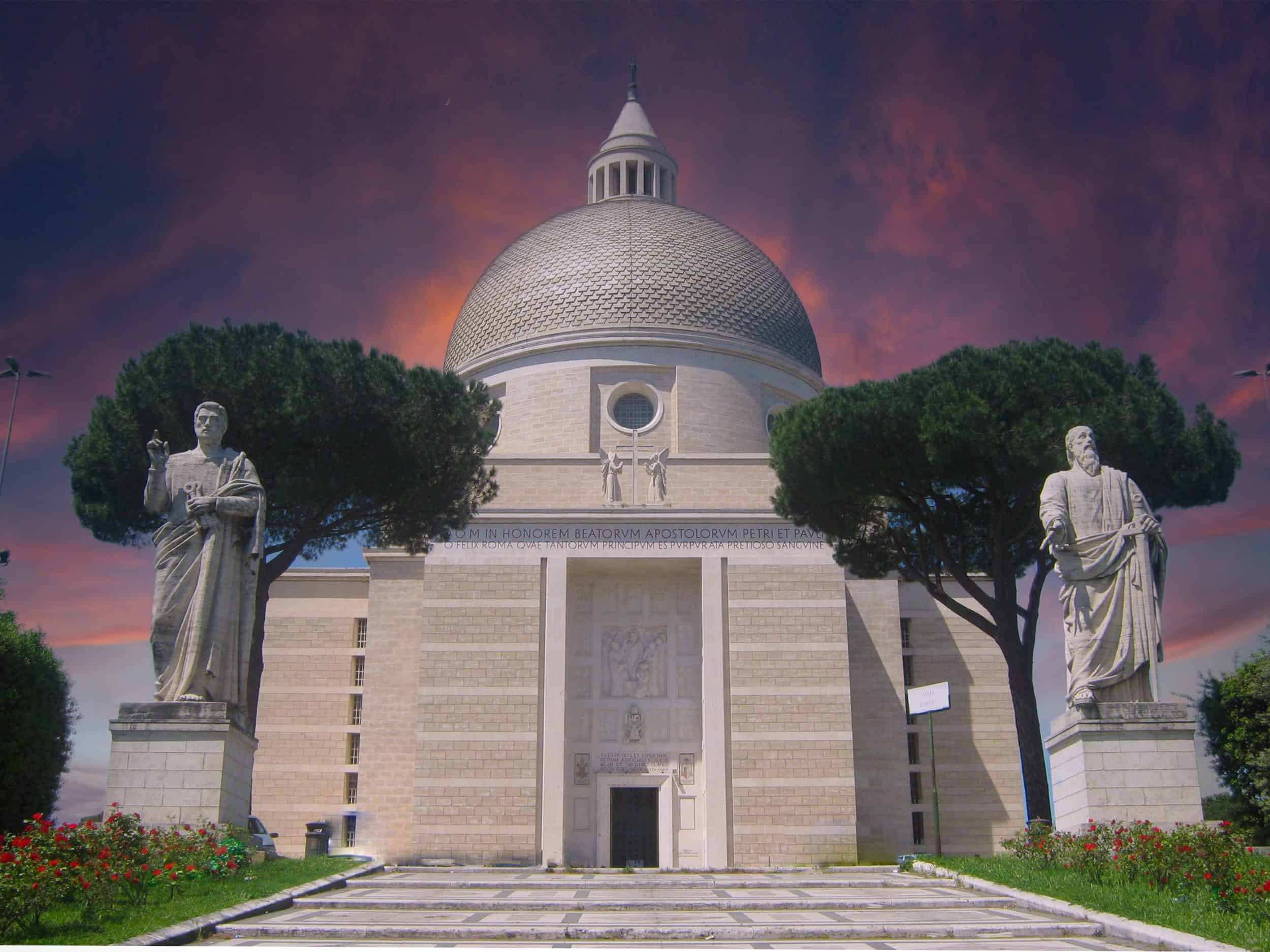
The monumental stair ramp and the square of the Basilica of Santi Pietro e Paolo at EUR
From the church square starts the cordonata that comes down to Viale Europa, a monumental flight of steps with marble ramps and umbrella pines on both sides. It is not a simple link between two levels: it's a scenographic device. As you climb, the steps regulate your pace and force you to look up. The building is revealed little by little, first the statues, then the portico, then the dome. When you reach the top, the square is vast and almost empty, and this vastness belongs to the design: no adjoining building, no street wings, only sky around the volume.
This is where the difference between historic Rome and the Rome of E42 can be measured. The Baroque churches of the center are wedged between buildings, reveal themselves suddenly when you turn a corner, and play on the surprise effect. The Basilica of Santi Pietro e Paolo at EUR has no surprises to offer. It announces itself from afar, grows as you walk toward it, and when you get there it is exactly what it seemed. Those who love the Baroque often find this frankness cold. In our judgment it is honest.
The cube, the four projecting bodies, and the cladding
The composition is elementary and therefore effective: a central cube, four large piers set against the faces that form the arms of the Greek cross, terraces above the projecting bodies, lateral porticoed wings. The exterior cladding is travertine, the Roman stone par excellence, alongside the straw-colored Chiampo from Vicenza. The load-bearing structure is reinforced concrete. The surface is in regular ashlar blocks, without moldings, without projecting cornices, without ornaments: the decoration is left entirely to sculpture, concentrated at the focal points.
Look at the joints of the stone. The quality of the cutting and laying is very high, and it's one of the reasons the building has gone through 80 years of weather without flaking. It's the kind of detail you appreciate only by getting close to the wall and walking slowly along it, and that almost nobody looks at.
The dome of the Basilica of Santi Pietro e Paolo at EUR
The hemispherical reinforced concrete dome rests on a cylindrical drum with eight rectangular recesses that hold circular windows. The diameter measures about 32 meters. To place it in the Roman hierarchy: it's the fourth largest dome in Rome after the Pantheon, St. Peter's in the Vatican, and San Giovanni Bosco, and the third by height after St. Peter's and Sant'Andrea della Valle. The absolute record remains with the Vatican. This dome plays in the category immediately after, which for a parish church is already a notable fact.
The covering is made of hexagonal elements of gray slate. The initial idea was different: the project called for a gold-yellow dome, which would have lit up the plateau like a lantern. The solution was abandoned because of execution difficulties during the work, and gray was chosen, which goes better with the travertine and the concrete. It's worth trying to imagine the alternative: a golden dome above EUR would have changed the character of the whole neighborhood, and probably would have made it a much more photographed and much less serious object.
The two colossal statues of the apostles in front of the Basilica of Santi Pietro e Paolo at EUR
At the top of the monumental staircase, on either side of the portico, stand watch the two colossal statues of the patron saints of Rome: Saint Peter on the right, by Domenico Ponzi, and Saint Paul on the left, by Francesco Nagni. The two sculptures belong to the initial season of the construction site, with placement begun in early 1942, and were finished in the postwar completion phase: the date 1943 refers to Nagni's Saint Paul, and 1957 to Ponzi's Saint Peter.
Go see them up close, and then step back 30 meters. They are calibrated for long distance: from below they look out of proportion, from halfway up the staircase they find their balance. It's the same principle that governs the statues on the Vatican colonnade, and it shows that the two sculptors had studied their craft.
The bronze portal by Giovanni Prini at the Basilica of Santi Pietro e Paolo at EUR
The entrance portal is the highlight of the facade. Made of bronze and divided into 10 panels with episodes from the lives of the two apostles, it is the work of Giovanni Prini, and it's one of the pieces that runs through the entire story of the construction site, from the models of the early 1940s to the postwar installation. Prini was born in Genoa on June 14, 1877, and died in Rome on September 9, 1958. He trained at the Accademia di Belle Arti in Genoa and established himself as an interpreter of the child figure, author of groups of children of great melancholy, before opening up to social themes. His usual language is a delicate lyricism, tinged with melancholic sweetness. These are qualities you wouldn't expect in a bronze portal meant for a monumental building, and yet they are recognizable in the measure of the figures and the calm of the scenes.
The panels are viewed standing, without hurry, starting from the top left. It's the point in the basilica where twentieth-century Italian art shows itself at its highest level, and almost everyone walks past it pushing the door without raising their eyes.
The high relief of the handing over of the keys
In the niche of the facade is placed a large high relief representing Christ handing the keys to Saint Peter, also by Giovanni Prini. The theme is the founding one of the Petrine primacy, and the choice to place it on the main axis needs no explanation. The rendering is flat, almost didactic, without emphasis: a way of sculpting that refuses pathos and aims at legibility from a distance.
The reliefs in the large niches: the martyrdom of the two apostles
In the right-hand large niche is the travertine high relief with the Crucifixion of Saint Peter, by Alessandro Monteleone. In the left one is the Beheading of Saint Paul by Carlo Pini. On the front is the Conversion of Saint Paul by Venanzo Crocetti. The three episodes tell the Roman destiny of the two apostles: Peter crucified, according to tradition upside down, in the Vatican area, and Paul beheaded, according to tradition, at Tre Fontane, where the Abbey of Tre Fontane stands, a short distance from here in the direction of Via Laurentina. The geography of the martyrdom encloses this neighborhood on two sides, and the basilica stands exactly in the middle.
Venanzo Crocetti deserves a parenthesis. Born in Giulianova on August 3, 1913, and died in Rome on February 3, 2003, he arrived in Rome in 1928 to work and study in the evenings, without a regular academic path. In 1965 he completed the Door of the Sacraments of St. Peter's Basilica in the Vatican, inaugurated by Paul VI on September 12 of that year. A sculptor who signed one of the doors of St. Peter's left here, at EUR, works from his youth: the marble relief of the Conversion of Saul on the side facade bears the date 1941, when the author was 28 years old.
The Conversion of Saul on the side of the Basilica of Santi Pietro e Paolo at EUR
On the side facade stands out the marble high relief of the Conversion of Saul, sculpted by Venanzo Crocetti in 1941. It's the moment of the fall from the horse on the road to Damascus, the reversal that turns the persecutor into an apostle. Few works tell the logic of this church better: on the front the primacy of Peter, on the side the conversion of Paul, that is institution and rupture, continuity and scandal. Those who walk around the building, and they are very few, find it in front of them almost by chance.
The angel on the lantern and the figures of the facade
On the outside, on the spire of the lantern, is a bronze angel by Carmelo Abate. At the center of the facade, on either side of the cross, are two other large angels, the work of Federico Papi, whose name also appears in the form Federigo. They are the pieces least accessible to close observation, and you need a telephoto lens or binoculars: from the square you can make out the silhouettes, not the details. The angel on the lantern, which nobody ever looks at, is to all effects the highest point of the church.
The walls of the large niches and the motifs of Francesco Coccia
The walls of the large niches and of the interior chapels were decorated by Francesco Coccia with geometric and symbolic motifs, dated to 1940. Coccia was born in Palestrina in 1902 and died in Crans-Montana in 1981. He studied at the Accademia di Belle Arti in Rome and frequented the Villa Strohl Fern group. In 1944 he was appointed extraordinary commissioner of the Quadriennale di Roma and in 1948 he organized the fifth edition, renamed Rassegna nazionale delle arti figurative. His best-known work remains the sculptural group of the Fosse Ardeatine Mausoleum: the same artist who decorates this basilica signed the monument to the massacre of March 24, 1944. Holding the two things together helps to understand how close, in twentieth-century Italy, was the thread that ties the commissions of the regime and the memory of its victims.
Inside the Basilica of Santi Pietro e Paolo at EUR: the visit room by room
The entrance and the first perception of the space
You push the portal and enter a circular space from which four arms open. There is no nave, no colonnade, no half-light. The light comes from above, from the circular windows of the drum, and falls on the floor of colored marbles. The first effect is disorientation: anyone entering expecting a Roman church instead finds a single compact volume, dominated by the emptiness of the dome. The second effect, which comes after a minute, is quiet. The space pushes nowhere, and this slows whoever walks in it.
Give yourself 30 seconds standing still just past the threshold, before moving. It's the only way to register the proportion between the diameter and the height, which is then lost as you walk around. Anyone who enters walking doesn't understand this church.
The dome of the Basilica of Santi Pietro e Paolo at EUR seen from inside
The dome is coffered with a cross motif and stucco panels that repeat concentrically up to the oculus. The white of the vault contrasts with the multicolored paintings of the chapels and with the colored marble floor: a deliberate chromatic play, which concentrates the light above and the colors below. From the cornice of the drum hangs an enormous crown of lights with 16 sides, a lighting fixture that holds its own against the space without crowding it.
The practical advice: stand exactly in the center, under the keystone, and look up. Then move 10 meters and look again. The design of the coffers changes meaning completely, because the concentric perspective works from a single point. It's the kind of check you also do at the Pantheon, and here, without a crowd around, it works better.

The Evangelists on the drum of the Basilica of Santi Pietro e Paolo at EUR
On the drum of the dome are four marble high reliefs of the Evangelists. Saint Luke and Saint Mark were created by Francesco Coccia, Saint John and Saint Matthew by Enrico Castelli. The placement at the four points of the drum takes up a very ancient tradition, that of the pendentives with the symbols of the evangelists in Byzantine and early Christian central-plan churches. Here the reference is translated into a twentieth-century sculptural language, with clean volumes and simplified drapery.
They are hard to look at without a stiff neck, and the light that illuminates them changes a lot with the hour. In the afternoon, with the low sun coming in from the western windows, the reliefs gain depth and become legible even to the naked eye. In the morning they stay flat.
The high altar and the Christ by Selva
Above the high altar, against the background of the apse, dominates the figure of Christ, known as Christ in the carpet of Grace and also as Christ the Triumphant, dated 1966 and made in marble by Attilio Selva. Attilio Selva was born in Trieste in 1888 and died in Rome in 1970. He studied at the Scuola Industriale in Trieste, worked as a stonecutter in Milan, was welcomed into the atelier of Leonardo Bistolfi in Turin, and won the Premio di Roma in 1907. A precursor of the return to order, oriented toward the Italian Novecento and a monumentality of Michelangelesque descent, he had already signed the Fountain of the Caryatids in Piazza dei Quiriti, the monument to Guido Baccelli, and some statues of the Stadio dei Marmi at the Foro Italico.
The figure is set in a mosaic representing the Martyrdom and glorification of the apostles Peter and Paul, the work of his son Sergio Selva. Father and son working together on the same apse backdrop is an old workshop custom applied to a postwar construction site, and it's a detail that makes this ensemble less cold than the photograph suggests. The mosaic is the surface that gathers and relaunches the light of the hall: without it the apse would be a blind wall.
The bronze Crucifix by Giuseppe Graziosi
The bronze Crucifix, dated 1942, is the work of Giuseppe Graziosi from Modena. Born in Savignano sul Panaro on January 25, 1879, and died in Florence on July 2, 1942, Graziosi was the son of sharecroppers. His studies were paid for by Arsenio Crespellani and his wife Emilia, and he trained between Modena, Florence, Rome, and Paris. A sculptor, painter, engraver, and photographer, he had won a bronze medal in Paris in 1900 with The Founder and a prize at the 1915 San Francisco Exposition with Susanna, and had been working on a Via Crucis since 1920.
If the dates are correct, this Crucifix belongs to the last year of the artist's life. Look at it thinking of a 63-year-old man who lived through the naturalism of the late nineteenth century, the twentieth century, and the monumental rhetoric of the 1930s, and who here returns to an essential sculpture. It is the most sober work in the whole church, and for me the most beautiful.
The bronze pulpits by Duilio Cambellotti in the Basilica of Santi Pietro e Paolo at EUR
The two cast bronze pulpits, with high reliefs narrating the main episodes of the preaching of Saint Peter and Saint Paul, are the work of Duilio Cambellotti, and they are the reason it's worth coming all the way up here even for just half an hour. Cambellotti was born in Rome on May 10, 1876, and died there on January 31, 1960. He described himself as an outsider and self-taught. In 1954 he declared that he had not attended schools or had teachers, although he had attended the Accademia di Belle Arti in Rome between 1893 and 1897, studying engraving and chiseling with Alessandro Morani and Raffaello Ojetti, without ever graduating.
His biography is that of a total artist: woodcut artist, engraver, ceramist, author of stained glass, set designer. In 1905, with Giovanni Cena, Giacomo Balla, and Sibilla Aleramo, he founded the schools for peasants on the edge of the Pontine marshes. From 1914 to 1939, and then from 1947, he signed the stagings of the classical performances at the Greek Theater in Syracuse for the Istituto Nazionale del Dramma Antico, beginning with the scenic apparatus of Aeschylus's Agamemnon. His stained glass can be admired at the Casina delle Civette in Villa Torlonia, which anyone who loves Roman Liberty style knows by heart.
In the pulpits at EUR you find that hand again: the graphic line that becomes relief, the elongated figures, the narration that runs in bands. They are late works, by a man by then in his seventies, and they keep the sharpness of the drawing intact. If I had to point to a single piece to look at in this church, I would point to these two.
The chapel of the Immaculate Conception and the mosaic by Bruno Saetti
In the left chapel, dedicated to the Immaculate Conception, is a mosaic by Bruno Saetti representing the Madonna and Child surrounded by a crown of angels. Saetti was born in Bologna on November 21, 1902, and died there on July 10, 1984. He completed his studies at the Accademia di Belle Arti in Bologna in 1924, was admitted to the 1928 Venice Biennale with the Judgment of Paris, and took part in 14 editions overall, with a solo show in 1938 and recognitions in the 1950s. He had won the Premio Baruzzi in 1929 with Bathers.
Saetti rejected the languages of the avant-garde and settled on an expressionist realism, painting female nudes, maternities, landscapes, and symbolic figures such as angels. From 1935, after a trip to Pompeii, he specialized in the fresco technique, and then moved on to mosaic. His best-known Roman work remains the frescoes in the basilica of Sant'Eugenio. In the chapel at EUR the color is warmer than in the rest of the church, and the contrast with the white of the dome is exactly what the designers had sought.
In the same chapel is a statue of the Immaculate Conception dated 1958 and attributed to the South Tyrolean workshop of Ferdinand Stuflesser, one of the great manufacturers of sacred sculpture in Val Gardena, which has supplied furnishings and statues to thousands of churches around the world.
The chapel of Saint Francis of Assisi and the mosaic by János Hajnal
In the right chapel, dedicated to Saint Francis of Assisi, you can admire a mosaic altarpiece depicting Saint Francis together with some saints of the Franciscan order. The author is János Hajnal, called Giovanni in Italy, born in Budapest on August 27, 1913, and died in Rome on October 9, 2010. A graduate of the Budapest Academy, he later attended the academies of Frankfurt, Stockholm, and Rome. At 18 he made the journey from Budapest to Florence on foot. He moved permanently to Italy in 1948 and obtained Italian citizenship for artistic merit in 1958.
Hajnal is one of the major Italian authors of historiated stained glass and mosaics of the second half of the twentieth century. His are the stained-glass windows of the Duomo of Milan made between 1953 and 1955 and then between 1988 and 1989, the windows of the Paul VI Hall in the Vatican from 1971, the rose window of the basilica of Santa Maria Maggiore from 1995, and the windows of the Roman churches of San Leone, Santa Maria Goretti, Sant'Angela Merici, and Santa Brigida. The Franciscan presence in the chapel is not accidental: the basilica is entrusted to the Conventual Friars Minor, and the iconographic choice declares who looks after the building.
The chapel of Saint Anthony and the terracotta works
To the right of the entrance is the chapel of Saint Anthony. Restored in 1978, it was enriched with terracotta works by the painter Franco Petruzzi. It is a minor space compared to the two major chapels, and precisely for that reason interesting: it shows the layering of a parish church that continues to be adapted by the community that uses it. Terracotta is a humble, warm, tactile material, the opposite of the marble and travertine of the rest of the building.
The baptismal font and the Baptism of Jesus
On the right side opens the baptismal font, enriched with mosaics and marbles, a work of the painter Sergio Selva. The bronze group resting on the basin, depicting the Baptism of Jesus, is by Andrea Spadini, dated 1940. Spadini was born in Rome on July 2, 1912 and died there on September 4, 1983. He was the son of the painter Armando Spadini, studied in Florence with Libero Andreotti, was an assistant to Arturo Martini at the Istituto d'Arte in Monza, and in Rome attended the Scuola d'Arte della Medaglia with Giuseppe Romagnoli and the Scuola Libera del Nudo, in an environment marked by Mario Mafai and Scipione.
Critics have underlined his playfulness, his humor and a dynamism of Berninian descent, as well as the recovery of the great tradition of 18th-century ceramics. In 1943 he took part in the defense of Porta San Paolo. More is said about his story in the chapter of curiosities, because it contains a detail that leaves you speechless.
The pipe organ of the Basilica of Saints Peter and Paul at EUR
In the left transept, on the floor to the left of the altar, is the pipe organ. It was built in 1960 by Libero Rino Pinchi and enlarged in 1990 by Carlo Soracco. The transmission is electric with a multiplex system. The instrument has 25 stops, six of them real, distributed over two manuals and pedal. The multiplex system, for those unfamiliar with organ building, means that a few rows of pipes are used at several pitches to generate many stops: an economical and compact solution, widely adopted in postwar Italian churches and debated by purist organ builders.
The acoustics of a centrally planned space with a hemispherical dome are generous and treacherous at the same time: the reverb is long, low sounds blur together, spoken voices lose definition. If you happen to attend a celebration with the organ playing, sit toward the back of one of the arms and not in the center: the dome concentrates the sound and in the center you hear worse.
The sacristy and the sketches
In the sacristy are gathered several works of some interest and some sketches of the works made in the basilica. It is not a space open to free visiting: ask at the parish, politely and outside the hours of celebrations. The sketches are precious material because they document the passage from idea to execution in a construction project that lasted 15 years and was interrupted by a war, and they allow a comparison between what was designed before 1943 and what was built after 1953.
The marbles, the floor and the color
The colored marble floor is one of the least commented and most effective elements of the interior. Together with the paintings of the chapels it builds the low chromatic band that holds up the white of the vault. Walk on it looking down for about 10 meters, following the design: the geometry of the floor repeats that of the plan and helps you understand where the circle ends and where the arms begin. It is an old device, used in Roman basilicas with Cosmatesque floors, here proposed again with 20th-century materials and designs.

Reading the architecture of the ventennio without taking sides
What the documents say and what the interpretations say
On this building something verifiable can be said and something debatable, and it is best to keep the two apart. Verifiable: the client is the autonomous body of the Universal Exposition of 1942, the design dates to 1938, work begins in 1939, is interrupted in 1943 and resumes in 1953, and the building opens for worship in 1955. Verifiable: the artists involved are leading figures of the Italian art system of those years, many of whom would go on working without a break in the Republic as well. Debatable: that the church and the Palazzo della Civiltà Italiana together constitute the staging of a pact between regime and Church after the Lateran Pacts of 1929. This reading is widely accepted by scholars and is reasonable, but it remains a reading.
On architectural merit, the building belongs to that line of simplified monumentalism that in Italy has been called by many names and that has produced uneven results. Here the result holds up, for three concrete reasons: the choice of the central plan, unusual and bold, the quality of the stone cladding, and the decision to entrust the ornament to real sculptors rather than decorators. Much less convincing is the idea that monumentality is enough to make sacred architecture: whoever enters looking for recollection finds a space that speaks of order more than of mystery.
A personal position, declared as such
In front of the architecture of the Fascist era two camps form immediately. The first wants to demolish everything for moral reasons, the second is moved for aesthetic reasons and forgets the context. Both are comfortable positions. The uncomfortable position, and in our judgment the only useful one, is to look at the building as a document: it says what a power wanted to show of itself, with what means and with what artists, and it also says that that rhetoric did not survive the war, so much so that the church was finished by another Italy, with other money and other clients. A building that straddles two eras is worth more than a thousand debates.
A curiosity about the Basilica of Santi Pietro e Paolo at EUR
The sculptor who modeled the bronze group of the Baptism of Jesus on the baptismal font of this basilica is the same one who signed one of the most beloved objects in New York. Andrea Spadini, a Roman born in 1912, made between 1964 and 1965 the musical clock with bronze sculptures at the Central Park Zoo in Manhattan: the one with the animals that go around in a circle playing instruments every half hour, in front of which hundreds of children stop every day. Between the baptismal font at EUR and 60-fourth Street runs the same chisel.
The thing becomes tastier if you take into account how critics have described Spadini: playfulness, humor, a dynamism that goes back to Bernini's Baroque sculpture, and a declared recovery of the great tradition of eighteenth-century ceramics. It's not the profile you expect from the author of a baptismal group in a monumental church. Yet it's precisely that lightness that makes the Baptism of Jesus in this basilica less solemn and more human than the architecture around it would lead you to expect. Look at it with the Central Park clock in mind: the hand is recognizable.
I'll add a second detail, less known than it deserves. The dome you see as gray was supposed to be gold-yellow. The original project called for a golden dome, and the idea was abandoned because of execution difficulties during the work. A more neutral gray was chosen then, able to go with the travertine and the concrete of the rest of the building. Try to redo the scene mentally: a plateau of white, squared buildings, and on top a gold dome visible from the Tiber and from Via Ostiense. The neighborhood would have had another identity, and this church would have become the postcard of southern Rome. The renunciation of gold-yellow is one of the least told and most decisive decisions of the whole story.
Third curiosity, for the pedantic: in 1953, when the construction site that had been stopped for 10 years reopened, it was discovered that large quantities of building material had been stolen. The basilica's construction site, abandoned in the middle of the countryside in a hungry city, had been slowly dismantled. To anyone who says EUR is a neighborhood without history, just tell this episode.
One thing nobody tells you about the Basilica of Santi Pietro e Paolo at EUR
This basilica has no bell tower. It's not hidden, it didn't collapse, it wasn't demolished: it never existed. For an Italian parish church it's a glaring anomaly, and no guide points it out. The project entrusts all the verticality to the dome and the lantern with the bronze angel, giving up the element that for a thousand years has signaled a church in the urban landscape. If you think about it, the choice has an iron logic: in a neighborhood designed to be seen from afar and in perspective, the hemispherical dome works better than a tower, and a tower would have broken the symmetry of the Greek cross. But the result is that this church doesn't ring its bells from a bell tower like all the others, and this changes the way the neighborhood perceives it.
Second thing that almost nobody says: the basilica was opened for worship in 1955 and solemnly dedicated only in June 1966, 11 years later. The two things do not coincide at all. A church can be open, have a parish, celebrate baptisms and funerals, and remain unconsecrated for years: the dedication is a solemn rite that requires the bishop and is celebrated when the building is considered complete. 11 years of gap mean that in 1955 the interior construction site was anything but finished, and indeed the Christ by Attilio Selva on the apse bears the date 1966, that is the very year of the dedication. The church was dedicated when the apse was ready.
Third thing. The cardinal title connected to it doesn't bear the name of EUR but that of Via Ostiense: it's called the title of Santi Pietro e Paolo a Via Ostiense, and it was established by Paul VI on February 5, 1965. Anyone searching for the title with the word EUR won't find it, and this generates confusion even among insiders. The first cardinal titleholder was the Croatian Franjo Šeper, who in 1968 would become prefect of the Congregation for the Doctrine of the Faith, succeeding Alfredo Ottaviani: one of the most influential men of the post-conciliar Church had as his titular church this dome at EUR.
Fourth and last. The distance between this church and the Basilica of San Paolo fuori le Mura is short, and the link is closer than people think: the cardinal title takes its name from the same road that leads to the tomb of Paul, and the reliefs of the facade tell the martyrdom of the two apostles which took place, according to tradition, a few kilometers from here in two opposite directions. This hill is halfway between the place where Peter was crucified and the place where Paul was beheaded. The geography of the basilica is a theological fact before it is an urban planning one.
The advice I give you for visiting the Basilica of Santi Pietro e Paolo at EUR
Go in the afternoon, around four in winter or six in summer, and arrive on foot from below, climbing the cordonata from Viale Europa. The reason is the light. The main facade catches the sun in the second half of the day, and the travertine reliefs of the large niches, which in the morning stay flat, gain depth with the raking sun and finally become legible. Inside, the circular windows of the drum work the same way: in the afternoon the dome lights up unevenly, and the stucco coffers cast shadows that don't exist in the morning.
Second piece of advice: check the calendar of services before leaving. An active parish church is occupied by Masses, weddings, funerals, catechism, and choir rehearsals far more often than a tourist imagines. The best window for a quiet visit is mid-morning between the 8:30 Mass and noon, or early afternoon before the evening Mass. On Saturday afternoon, in wedding season, this basilica is one of the most requested in southern Rome: the monumental staircase is a perfect backdrop for wedding photos, and if you happen to be there at that moment you'll find a square full of guests and no chance of looking at the interior in peace.
Third piece of advice, and it concerns method. Don't treat this building as a 10-minute stop. You need a good 40 minutes: 10 for the climb and the exterior, five for Prini's portal, 20 for the interior, five for the walk around the building that almost nobody does and that is the only way to see Crocetti's Conversion of Saul on the side. The full exterior walk is the part I recommend most strongly, because it shows the logic of the four projecting bodies and lets you understand the Greek cross plan by walking around it, which is much harder from the inside.
Fourth: combine it with something else in the same outing. On its own it doesn't fill a morning, and the surrounding neighborhood offers quite a lot. A combination that works well is the basilica, the EUR lake, and the Museum of Civilizations, with lunch in Viale Europa area. Another, for those with a car, is the basilica and the Abbey of Tre Fontane, that is the place of Paul's martyrdom according to tradition: the thematic link is strong and the distance minimal.
Fifth and last: bring light binoculars, or at least a telephoto lens. The angel by Carmelo Abate on the lantern, the angels by Federico Papi on either side of the cross on the facade, and the four Evangelists on the interior drum are all placed at distances the naked eye doesn't cover. Without an optical instrument you miss a considerable part of the sculptural apparatus, and you'll only notice when you look at the photographs at home.
Another well-known fact, yet rarely mentioned
Many people know that EUR was born for a world's fair that was never held. Few know that the plateau was a battlefield, and almost nobody connects the two things. Between September 8 and 10, 1943, after the announcement of the armistice, the defense of Rome was played out in the south, on the line that from the Ponte della Magliana and the consular roads pointed to the center. Strongpoint number 5 was located at the height of the Exposition church, whose solitary dome stood out on the ridge of the plateau: a crucial position, because whoever held that height controlled the access to the city.
The first gunshot in the southern zone was fired at 22:10 on September 8 by the battery of Captain Villoresi. In the night and the following morning attacks and counterattacks alternated: the reserve battalion of Major Costa intervened, and at 10:30 on September 9 strongpoint number 5 was fully retaken by the grenadiers of the second battalion and by the self-propelled guns of the Montebello regiment of the Ariete division. In the afternoon an agreed truce was violated, and German tanks attacked the regiment command at Montagnola. On the ground operated the first and second Granatieri di Sardegna regiments, carabinieri, bersaglieri, men of the Polizia Africa Italiana, and the 21st battalion of 81 mm mortars, against German paratroopers and SS units.
The defenses of the fair's construction site had been weakened in advance for a reason that sounds surreal today: the High Commissioner of E42 had had their setup suspended, worried about the very serious damage the area would suffer. They feared for the buildings while the city was being lost.
After the fighting, on the slope of the church nine unrecognizable bodies of Italian soldiers were found and covered with earth. At the foot of the staircase fell four grenadiers who remained unknown, whose bodies, half stripped, had been deprived of their identification tags. Grenadier Frantellizzi, a witness of those days, recalled the loss of four officers, some of whom were decorated with the gold medal posthumously, and an unspecified number of grenadiers dead and wounded.
The fact is documented, and this distinguishes it from the many legends that circulate about EUR. Yet it is rarely cited, because it doesn't fit the usual story of the neighborhood, which oscillates between the rhetoric of architecture and the cinema of the 1960s. It's worth stopping halfway up that staircase to think about it. The silence that follows is worth more than any comment on the order of the volumes.
The right photo to take at the Basilica of Santi Pietro e Paolo at EUR
The photograph this basilica asks for is only one, and it's not the frontal one from the square. Go down the cordonata to Viale Europa, turn around, and frame from down there with a moderately wide-angle lens, keeping the staircase as the central vanishing line and the dome at the top. It's the view the building was designed for: wide base, climb, culmination. If you shoot from the square you get nothing but a wall of travertine, because up close the volume crushes the perspective and the dome disappears behind the projecting body.
The right time is late afternoon, when the sun lights the front from the right and the travertine goes from white to honey. In summer it's best to wait for the last half hour before sunset. In winter half past three is enough. If you love dramatic skies, keep an eye on the late-summer thunderstorms: above a plateau without obstacles the clouds arrive from afar, and the gray dome against a dark front is an image of remarkable strength.
The second photograph to take home is interior and vertical. Stand at the exact center under the dome, rest your smartphone or camera on the floor pointing up, and shoot. The symmetry of the cross-and-panel coffers converges toward the oculus and produces a clean geometric image, which with the natural afternoon light gains depth. Pay attention to two things: don't lie down on the floor, because you're in a church and it's disrespectful, and don't use flash, which on mosaics and stucco gives false colors.
The third is a detail. The bronze portal by Giovanni Prini, with its 10 panels, should be photographed from the side, with raking light, not head-on: head-on, the bronze flattens, while side light sculpts the reliefs and makes them legible. Fill the frame with two or three panels, not the whole door leaf.
One last indication on the places from which the dome can be seen well, for those looking for the wide shot: the basilica occupies the highest point of the area and the dome emerges from many points of the neighborhood, in particular going up Viale Europa and from the edges of the Parco Centrale del Lago. These are views that tell the relationship between the church and the city that has grown up around it, and they are worth more than 10 close-ups. And please, avoid the drone: over an urban area you need authorizations, and the annoyance caused to those who are praying isn't worth a 15-second video.

Some important events that took place here in history
December 26, 1936: the autonomous body in charge of organizing the 1942 World's Fair is born. On April 26, 1937, Mussolini plants a pine tree at the central point of the area, with the declared aim of pushing Rome toward the sea. Everything else follows from that gesture, including the church.
September 1938: the basilica project is approved, signed by Arnaldo Foschini with Alfredo Energici, Vittorio Grassi, Nello Ena, Tullio Rossi, and Costantino Vetriani. April 1939: work begins. September 1940: the masonry shell is completed. First months of 1941: the dome is erected. Early 1942: the two colossal statues of the apostles are placed.
1943: a bombing hits some structures and work stops. Between September 8 and 10 of the same year the plateau becomes a battlefield in the defense of Rome, with strongpoint number 5 located at the height of the church. On the slope of the building nine unrecognizable bodies of Italian soldiers will later be found, and at the foot of the staircase four grenadiers who remained unknown will fall.
December 1952: the Conventual Friars Minor take possession of the building. 1953: work resumes, and it is discovered that large quantities of building material had been stolen from the site.
February 9, 1955: metro line B enters service, with the stations Esposizione Est and Esposizione Ovest, inaugurated by President Luigi Einaudi and Cardinal Vicar Clemente Micara. July 3, 1955: the church is opened for worship, again with Micara. The ghost neighborhood begins to become livable.
December 8, 1958: the church is erected as a parish. It's the date that turns a monument into a community.
1960: Rome hosts the Games of the XVII Olympiad and EUR is brought almost to completion, with the Palazzo dello Sport by Pier Luigi Nervi and Marcello Piacentini and the Velodrome. The church, finished five years earlier, finds itself for the first time inside a working city rather than a construction site.
February 5, 1965: Paul VI establishes the cardinal title of Santi Pietro e Paolo a Via Ostiense. On the following February 22, the first titleholder is Cardinal Franjo Šeper.
June 1966: the church is solemnly dedicated by the titular cardinal Šeper. 1967: Paul VI raises it to the dignity of minor basilica.
March 22, 1981: John Paul II makes the pastoral visit to the Roman parish of Santi Pietro e Paolo, as part of the program of visits to the parishes of his diocese that marked his entire pontificate.
2007: the basilica undergoes major restoration and conservation work, made necessary also by structural problems. It's the moment when the building, 70 years after the project, begins to be treated as heritage rather than as a recent construction.
October 2025: Father Luca Atzeni begins his ministry as pastor of the community. The basilica continues to be what it was erected as a parish for in 1958: a church where the people of the neighborhood get married, baptize their children, and say goodbye to their dead.
Who has passed through the Basilica of Santi Pietro e Paolo at EUR
The first name is Clemente Micara, cardinal vicar of Rome, who in July 1955 opened the church for worship and who a few months earlier, on February 9 of the same year, had inaugurated metro line B together with President Luigi Einaudi. Two inaugurations in the same year, the underground railway and the basilica on the hill, both conceived for a fair that had not been held and converted to serve a real city. Micara was one of the men who managed the passage of the Roman Church from the postwar period to the Council, and his name recurs in dozens of cornerstones of the Roman outskirts.
The second name is Franjo Šeper, archbishop of Zagreb, first titular cardinal of the church from February 22, 1965, and celebrant of the solemn dedication in June 1966. In 1968 he became prefect of the Congregation for the Doctrine of the Faith, a post he held until 1981: he is the figure who guided the former Holy Office in the most delicate season of the post-conciliar period. The fact that his titular church was an outskirts basilica built by a Fascist body is one of those ironies that history produces without meaning to.
Third name: Paul VI, who established the cardinal title on February 5, 1965, and raised the church to minor basilica in 1967. Pope Montini had an active and polemical relationship with the art of his own time, and the choice to give basilica dignity to a twentieth-century building is not neutral at all.
Fourth name, and the most significant for the community: John Paul II, who on March 22, 1981, made the pastoral visit to the Roman parish of Santi Pietro e Paolo. Pope Wojtyła visited in 27 years the vast majority of the parishes of Rome, and for a neighborhood community that day remains the most important event of its history. Less than two months later, on May 13, 1981, he would be shot in St. Peter's Square.
Then the later titular cardinals: the Filipino Ricardo Vidal, archbishop of Cebu, titleholder from May 25, 1985, to 2017, and the Peruvian Pedro Barreto, from June 28, 2018. Neither has ties to the neighborhood, but it's the way the Roman Church links its outskirts to the college of cardinals, and this basilica is to all effects a titular church of the whole world.
Finally the artists, who passed through here leaving works of their maturity or of their youth: Arnaldo Foschini, future dean of the faculty of architecture in Rome and president of the Accademia di San Luca. Giovanni Prini, who came from Genoa and became one of the most delicate sculptors of the early Italian twentieth century. Duilio Cambellotti, the self-taught artist of the stained glass and of the Syracuse stage designs. Venanzo Crocetti, who at 28 signed the Conversion of Saul here and at 52 would sign the Door of the Sacraments in the Vatican. Bruno Saetti, 14 times at the Venice Biennale. János Hajnal, Hungarian from Budapest naturalized Italian for artistic merit, author of the rose window of Santa Maria Maggiore. Francesco Coccia, who would sculpt the Fosse Ardeatine group. Andrea Spadini, the man of the Central Park Zoo clock. Giuseppe Graziosi, son of Modenese sharecroppers, in his last year of life.
It's not a list of gossip-magazine celebrities. It's the list of those who made sculpture and mosaic in Italy between the wars and in the postwar period, concentrated in a single outskirts building. Few Roman churches of the twentieth century can say as much.
June 29 at the Basilica of Santi Pietro e Paolo at EUR: the feast of the patron saints
What is celebrated
The solemnity of Santi Pietro e Paolo, on June 29, commemorates the martyrdom in Rome of the two apostles. It's a feast of very ancient Christian origin, and the date is traditionally linked to the anniversary of their death or to the translation of the relics. For a church named after both, it's the day of the year: the double dedication means that the parish feast coincides with the feast of the city's patron saints.
In the Roman liturgy the solemnity brings with it some customs worth knowing. On the evening of June 28 the pontiff blesses the palliums destined for the new metropolitan archbishops. On the morning of June 29, on the gate of the Vatican basilica, the fisherman's creel is displayed, symbol of Peter's humble trade. In the Lateran basilica the reliquaries that according to tradition contain the heads of the two apostles are displayed. The prison traditionally linked to Peter's detention is visited, at San Pietro in Carcere. At Vespers and Lauds the hymn Decora lux aeternitatis auream is sung.
Why June 29 is different in Rome
Until 1976 June 29 was a public holiday throughout the country. The holiday was abolished nationally starting in 1977, but it remains a local holiday in Rome as a patron saint celebration, as well as in other Italian towns. For those who live in the city it means closed shops, public offices at a standstill, and a Sunday rhythm in the middle of the week. For those visiting Rome it means museums with special hours and a tourist load different from usual. Find out beforehand, because it's the classic day when you arrive in front of a closed door.
How the feast is experienced at the Basilica of Santi Pietro e Paolo at EUR
In a parish named after the two apostles, on June 29 the services multiply and the church fills up. If your interest is artistic, that's the worst day for a careful visit: you'll find the community celebrating, and it would be out of place to wander among the pews with a camera. If instead your interest is to understand what a living church means, there is no better occasion. You choose, but know that the two things don't go together.
The Basilica of Santi Pietro e Paolo at EUR with kids
It works better than people think, and for a counterintuitive reason: the central-plan space is immediately understandable even to a six-year-old. There's no route to follow, no side chapels in a row to explain one by one, no names to learn by heart. There's a big circle with a dome on top, four arms, and two chapels. A child gets it in 30 seconds and then wants to look up, which is exactly what's needed.
The game I recommend to parents is the hunt for animals and symbols: the four Evangelists on the drum, with their traditional attributes, are a perfect trail. One finds Mark's lion, another Luke's ox, another John's eagle, another Matthew's angel. Then you go out and look for the bronze angel on the lantern, which from the square is a dot: you need binoculars, and this turns the search into a small adventure. The panels of Prini's portal, 10 scenes with two protagonists, lend themselves to being told like a comic-book story.
Watch out for two practical things. The monumental staircase with strollers is impracticable: go directly to the upper square. And remind the kids to talk quietly, not to run, and that someone around is really praying: the rules should be explained before going in, not after the first reprimand. After the visit, the EUR lake and the EUR Social Park offer the open space needed to burn off the energy stored up in church.
Accessibility of the Basilica of Santi Pietro e Paolo at EUR
The question should be faced honestly. The monumental staircase connecting Viale Europa to the square is a plain and simple architectural barrier: those who use a wheelchair, have mobility difficulties, or push a stroller must go directly to the upper square, which is level and allows access to the entrance without significant changes in height. The square, being wide and lightly trafficked, also allows you to get out of the car close to the portal.
Inside the situation is favorable: the central plan on a single level, with no steps between one space and another and no crypt to reach, makes getting around simple. A circular space without naves and colonnades is, from the accessibility point of view, much more convenient than a historic basilica. The side chapels can be reached without steps.
For specific details, from the presence of an alternative entrance to the availability of accessible restrooms, it's best to make a phone call ahead to the parish office at 06 5926166. In a parish the friars and volunteers know the building better than any information sheet, and they are usually helpful to those who call first.
When to go to the Basilica of Santi Pietro e Paolo at EUR and when to avoid it
The best seasons are spring and autumn, for a reason that concerns the neighborhood more than the church: EUR is a plateau without shade, with enormous squares and little vegetation along the routes, and in August at noon the climb from Viale Europa is an endurance test. In winter, instead, the neighborhood has a dry beauty that suits it: clear sky, low light, travertine turning gray.
The hours to avoid are those of the services, if you want a careful visit, and Saturday afternoons from April to October, when weddings follow one after another. June 29, as said, is an extraordinary day to understand the community and terrible for looking at the works. Sunday mornings between 10 and 13 are the busiest of the week.
The ideal window, if I have to name just one: a weekday, around 16 in winter or 17:30 in summer, with the light coming in from the drum and the church almost empty. Arrive on foot from below, take your time on the climb, and go in without hurry. In 40 minutes you will have seen everything there is to see, and calmly.
What's around the Basilica of Santi Pietro e Paolo at EUR
Within a 10-minute walk of the Basilica of Santi Pietro e Paolo at EUR
Going down Viale Europa you cross the commercial heart of the neighborhood, with the porticoes and shop windows that for decades made it the Sunday stroll of southern Rome. Along the avenue you come across the Torri Ligini and the Museo storico della comunicazione, and continuing you reach the New Congress Center designed by Massimiliano Fuksas and finally Piazzale degli Archivi, home of the Archivio Centrale dello Stato. In 10 minutes you cross half a century of Italian architecture, from the monumentalism of the 1930s to the glass and steel of the 2000s.
Within 20 minutes
The Palazzo della Civiltà Italiana, 60 meters high on a base of 53, with 54 arches per facade, 28 allegorical statues in the ground-level arcades, and four equestrian groups of the Dioscuri at the corners of the base, is the opposite end of the axis on which the basilica stands. It was designed in 1937 by Giovanni Guerrini, Ernesto Lapadula, and Mario Romano, construction began in July 1938, the partial inauguration took place in 1940, and work stopped in 1943, as with the church. Since 2013 the building has been leased to a fashion house, which keeps an exhibition space there open to the public.
A little further on are the Palazzo dei Congressi, the Palazzo dello Sport by Pier Luigi Nervi and Marcello Piacentini built for the 1960 Games, the EUR lake with its park, and the Museo delle Civiltà, which brings together the State's prehistoric, ethnographic, and folk arts and traditions collections.
A little farther, but close thematically
In the direction of Via Laurentina you reach the Abbey of Tre Fontane, the place that tradition indicates as the scene of the beheading of Saint Paul. In the opposite direction, along Via Ostiense, the Basilica of San Paolo fuori le Mura holds the tomb of the apostle, and further on the Pyramid of Cestius marks the ancient entrance to the city. Anyone who wants to complete the Petrine route has San Pietro in Vincoli with Michelangelo's Moses and the chains of tradition, and San Pietro in Montorio with Bramante's Tempietto on the Janiculum, which is in turn a central-plan building erected where tradition places the crucifixion of the apostle. The comparison between the Tempietto and this dome at EUR, four centuries apart, says a great deal about how the way of celebrating the same martyrdom changes.
Quick questions about the Basilica of Santi Pietro e Paolo at EUR
How much does it cost to enter the Basilica of Santi Pietro e Paolo at EUR?
Nothing. Admission is open and free, as in almost all the churches of Rome. There is no ticket office and no reservation. Offerings are optional.
Is the MIC card valid for the Basilica of Santi Pietro e Paolo at EUR?
No. The MIC card is the card for the civic museums of the City of Rome and has no effect on churches, which don't belong to the museum circuit. Besides, you don't need it here, because you get in for free.
Do you need the Roma Pass to visit the Basilica of Santi Pietro e Paolo at EUR?
No. The Roma Pass includes museums and public transport, and a church is not a museum. It will be useful for getting here by metro, not for getting in.
Are there paid spaces inside the Basilica of Santi Pietro e Paolo at EUR?
No. There is no climb to the dome, no crypt with a separate entrance, no treasury, no archaeological excavations, and no bell tower you can walk up. Everything you visit is free.
Can you climb the dome of the Basilica of Santi Pietro e Paolo at EUR?
No, no climb is planned for visitors. Anyone looking for a dome you can climb in Rome has to go to St. Peter's Basilica in the Vatican, where however the climb is paid.
What are the Mass times at the Basilica of Santi Pietro e Paolo at EUR?
On weekdays at 7:00, at 8:30, and in the evening, with the evening time going from 18:00 in winter to 18:30 in the warm months. On Sundays at 8:00, 9:00, 10:30, 12:00, 18:00, and 19:00. In July and August the schedule may vary.
What is the exact address of the Basilica of Santi Pietro e Paolo at EUR?
Piazzale dei Santi Pietro e Paolo 8, 00144 Rome, Europa neighborhood. The parish phone is 06 5926166 and the parish office email is ufficioparrocchiale@santipietroepaoloroma.it.
How do you get there by public transport?
Metro line B, stops EUR Fermi or EUR Palasport, both on Viale America, and then on foot toward the highest point of the neighborhood. By bus, the 30 Express line stops at Colombo/Europa, at the intersection of Via Cristoforo Colombo and Viale Europa.
How long does it take to visit the Basilica of Santi Pietro e Paolo at EUR?
40 minutes is the right measure: 10 for the climb and the exterior, five for the bronze portal, 20 for the interior, and five for the complete walk around the building, which almost nobody does and which is the most instructive part.
Do you need to book?
No, no reservation is needed. It's best, however, to avoid service times if you want to look at the works in peace, and to phone the parish if you are accompanying a large group.
Can you take photographs inside the basilica?
Yes, discreetly and without flash, and never during services. You behave as in any active place of worship: silence, respect for those who pray, no bulky tripods among the pews.
How do you dress to enter?
Shoulders and knees covered, hat off. It's the common rule for all the churches of Rome and it applies here as elsewhere, even in summer and even if tourism around is scarce.
Is the Basilica of Santi Pietro e Paolo at EUR wheelchair accessible?
The interior yes, because it's on a single level with no steps between the spaces. The monumental staircase that climbs from Viale Europa is not: you have to go directly to the upper square, which is level.
Who officiates at the Basilica of Santi Pietro e Paolo at EUR?
The basilica is a parish of the Diocese of Rome entrusted to the care of the Conventual Friars Minor of the Alma Provincia Romana. The pastor began his ministry in October 2025 and is Father Luca Atzeni.
Why is it called a basilica if it's a parish church?
Because in 1967 Paul VI conferred on it the title of minor basilica, an honorary recognition that the pope grants to churches of particular importance. The title does not change the parish nature of the building.
Who designed the Basilica of Santi Pietro e Paolo at EUR?
Arnaldo Foschini, with Alfredo Energici, Vittorio Grassi, Nello Ena, Tullio Rossi, and Costantino Vetriani. The project was approved in September 1938 and work began in April 1939.
How big is the dome of the Basilica of Santi Pietro e Paolo at EUR?
The diameter measures about 32 meters. It's the fourth largest dome in Rome, after the Pantheon, St. Peter's, and San Giovanni Bosco, and the third by height after St. Peter's and Sant'Andrea della Valle.
Why is the dome gray?
Because the original project, which called for it to be gold-yellow, was abandoned because of execution difficulties during the work. A more neutral gray was then chosen, made with hexagonal slate elements, which goes with the travertine of the cladding.
Does the Basilica of Santi Pietro e Paolo at EUR have a bell tower?
No, and this is one of its least-known features. All the verticality of the building is entrusted to the dome and the lantern topped by the bronze angel by Carmelo Abate.
Which works of art are best to look at first?
The two bronze pulpits by Duilio Cambellotti, the 10-panel portal by Giovanni Prini, the Crucifix by Giuseppe Graziosi, the apse mosaic by the Selvas, and the two mosaic altarpieces of the chapels, by Bruno Saetti and János Hajnal.
What is the relationship between the basilica and the Palazzo della Civiltà Italiana?
The two buildings occupy the opposite ends of the neighborhood's main axis and look at each other from a distance. The current historiographical reading sees in them the staging of the relationship between State and Church after the Lateran Pacts of 1929.
Is the Basilica of Santi Pietro e Paolo at EUR closed for restoration?
No. The last major restoration and conservation work dates to 2007 and the church is regularly open for worship, with daily Masses.
Are weddings held at the Basilica of Santi Pietro e Paolo at EUR?
Yes, and it's one of the most requested churches in southern Rome for weddings, especially for the scenography of the monumental staircase. For this reason Saturday afternoon, in the good season, is the worst time for a quiet visit.
Is the basilica suitable for kids?
Very. The central plan is immediately understandable, the four Evangelists on the drum lend themselves to a symbol hunt, and the 10 panels of the portal can be told like an illustrated story. Just avoid the staircase with a stroller.
What's the difference between this basilica and St. Peter's Basilica in the Vatican?
They are two worlds. St. Peter's is the papal basilica over the tomb of the apostle, with centuries of layering and a paid Michelangelo dome. This one is a twentieth-century central-plan parish, free in every part, built in 15 years between a regime and a republic. The link is not architectural but thematic: the martyrdom of the two apostles.
Is it worth going all the way to EUR just for this church?
On its own, honestly no. Combined with the Palazzo della Civiltà Italiana, the lake, and the Museo delle Civiltà, it becomes a half day of great interest, especially for those who want to understand the Rome of the twentieth century instead of repeating the tour of the forums.
When is the basilica's feast day?
June 29, the solemnity of Santi Pietro e Paolo, which in Rome is also the feast of the city's patron saints and remains a local holiday. It's the best day to see the community and the worst to look at the works in silence.
The verdict on the Basilica of Santi Pietro e Paolo at EUR
Those who expect an outskirts church often leave saying it was the most interesting thing of the day. The reason is not beauty, which is debatable and debated, but density: in a single building there are the history of E42, the defense of Rome in September 1943, the passage from regime to Republic, the best Italian sculpture between the wars, and a central plan that anticipates by 15 years the liturgical choices of the Council. Few Roman churches tell so many things at once.
The final advice is to come with a mind free of prepackaged judgments on the architecture of the Fascist era, and with 40 real minutes available. Climb from below, look at the portal before pushing it, stop at the center under the dome, look for Cambellotti's pulpits, and leave by making the complete walk around the building. And if you come across a Mass in progress, sit at the back and stay five minutes: you'll understand more that way than by reading 10 pages of architectural history.
Article written by the editorial team of TourLeaderPro, contact them for Private/Corporate/V.I.P. Tours and Experiences.
Planning a trip to Rome? The English-language guides to visiting the city are on ItalyPlanner.com.