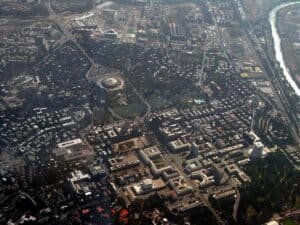
St. Peter’s Basilica in the Vatican
In short. The Basilica of St. Peter in the Vatican, formally the Papal Major Basilica of St.


The Basilica of St. Peter in the Vatican, formally the Papal Major Basilica of St. Peter, is the largest of Rome's four papal basilicas and the church that symbolizes Christianity: admission is free. The 2026 hours run from 7.00 in the morning until 20.00 from June 1 (the hours the official site basilicasanpietro.va lists for the whole year). You enter from Piazza San Pietro after security checks, with shoulders and knees covered. You pay only to climb to the dome, for the underground necropolis and for the special routes. It stands over the tomb of the apostle Peter, above the basilica that Constantine had built around 320 AD. The current building is the result of two centuries of construction, from 1506 to 1626, with Bramante, Raphael, Michelangelo, Maderno and Bernini in succession. No other building in the world has had a similar list of architects.
A clarification that always surprises people and needs to be said right away: St. Peter's is not the cathedral of Rome. The title of cathedral, with the inscription Mother and Head of All Churches, belongs to St. John Lateran. St. Peter's is the papal chapel next to the Apostolic Palace, the church of the great papal rites, the one of the Vatican I and II Councils, of canonizations and of papal funerals. It is also the heart of the Holy Years. Here, on December 24, 2024, Pope Francis opened the Holy Door of the Jubilee, and here Pope Leo XIV closed it on January 6, 2026, in front of President Mattarella, after a year with over 33 million pilgrims.

Here is the complete guide: the history of the longest construction site of the Renaissance, the facade, the five doors, the naves monument by monument, the dome and how to climb it in 2026, the recently restored Baldachin, the Grottoes with the tombs of the popes, the necropolis with Peter's tomb, the bells, the sacristy, and even the origin of a Roman saying that was born right here. It is long because the basilica demands it: 218 meters of church cannot be told in 10 lines. For the rest of the Vatican, I refer you to the related pages, Vatican City, Vatican Museums, Sistine Chapel and Vatican Gardens.
History: From Constantine's Basilica to Julius II's Construction Site
The first St. Peter's came into being around 320, when Constantine I had the flank of the Vatican hill leveled above the Circus of Nero and the necropolis where the first Christians venerated the apostle's tomb. It was a five-aisled basilica with timber roof trusses, similar to the first St. Paul Outside the Walls, which over 11 centuries accumulated relics, mosaics and altars, up to about 120, 27 of them dedicated to the Madonna. Here, on Christmas night in 800, Charlemagne was crowned emperor, and on this floor pilgrims from all over Europe knelt for the first Jubilee in 1300.
In the mid-15th century the building was unsafe, and Nicholas V, pope from 1447 to 1455, commissioned Bernardo Rossellino for a radical project: five groin-vaulted naves, an enlarged transept, a new apse choir and a dome at the crossing. Work started around 1450 and stopped with the pope's death. It resumed briefly in 1470-71 with Giuliano da Sangallo for Paul II, and in 1505 the walls of Rossellino's choir had risen barely 1.75 meters from the ground. The old and the new coexisted for decades. This detail explains everything about the century that followed.
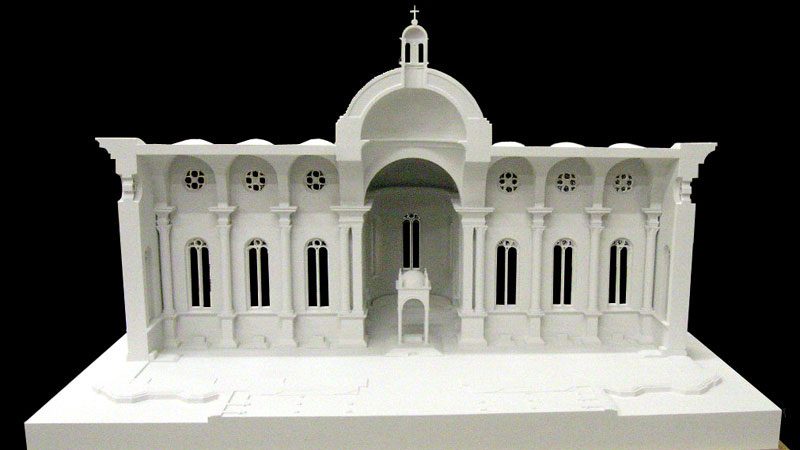
The Basilica of Constantine: The Church That Lived 1,000 Years
Before it was torn down, it took 150 years of hesitation, and it's worth remembering what the old St. Peter's was, because everything you see today is its reincarnation. Constantine laid it out with an imperial gesture: he cut into the flank of the Vatican hill, buried the necropolis while preserving the trophy above the apostle's tomb, and built on top of it a basilica with five naves, preceded by a vast quadriporticus, the Paradise, where pilgrims purified themselves at the fountain of the bronze pine cone, the one that now stands in the courtyard of the same name in the Vatican Museums. Inside, over 1,000 years, everything piled up: about 120 altars, 27 of them Marian, the mosaics, Giotto's Stefaneschi Polyptych for the high altar, now in the Pinacoteca, Giotto's Navicella on the quadriporticus, the papal monuments of which only the tomb of Innocent VIII and little else survive, and the golden rooster from the bell tower that now pecks away in the Treasury Museum.
Emperors were crowned here starting with Charlemagne, the first Jubilee in history opened here in 1300, and the popes of the 1400s returned here from Avignon to find a building that was leaning and crumbling. Demolition was gradual and painful: for a century the old church and the new construction site coexisted, separated by a dividing wall, with services held among the scaffolding, until in 1615 the wall fell and Constantine's St. Peter's came to an end for good. The Romans of the time mourned it. Today's Romans have the job of remembering, as they walk on the marble, that under their feet lies the exact plan of a church that lasted 1,000 years.
Bramante's Designs and the First Stone of 1506
The decision to demolish Constantine's basilica and rebuild it from scratch was made by Julius II in 1505, perhaps on the advice of Michelangelo himself, who was looking for a worthy frame for the pope's colossal tomb. Among the proposals submitted was one by Fra Giovanni Giocondo, a plan with five domes modeled on St. Mark's in Venice. The winner was Donato Bramante, already at work on the Belvedere Courtyard, who won the contest against Giuliano da Sangallo. The debate of 1505, animated also by the Neoplatonist theologian Egidio da Viterbo, revolved around the central plan: Bramante drew a Greek cross with a hemispherical dome, heir to early Christian martyria, with four large piers and barrel vaults with a Roman character, the dome inspired by the Pantheon to be built in concrete as the ancients did. Behind it lay half a century of research on the central plan, from Francesco di Giorgio Martini to Filarete to Leonardo da Vinci, and the memory of the octagonal tribune of the Florence Cathedral.
On April 18, 1506, Julius II lays the first stone, commemorated by the medal by Caradosso that shows the design. Of Bramante's drawing what remains is the so-called autograph parchment plan, curiously lacking the high altar. The end date of the overall construction gives the measure of the undertaking: the basilica would not be consecrated until 1626, 120 years later, and the square would arrive in 1667. For the record, the original drawings of the construction were rediscovered and studied only in 1866 by Heinrich von Geymüller.

The Construction Site from 1505 to 1514: the Ruinous Master
Bramante kept Rossellino's choir with its Doric pilasters and laid the four certainties that still hold everything up: the four piers and the four arches of the crossing. But to do so he demolished the presbytery area of Constantine's basilica, and the controversy was fierce. Michelangelo accused him of ruining the ancient columns, Erasmus of Rotterdam lamented it in writing, and the nickname ruinous master stuck to Bramante, cemented by the satirical dialogue Simia by Andrea Guarna, printed in Milan in 1517, where the architect, having arrived in heaven, proposes to Saint Peter that he demolish and rebuild the Paradise as well.
Then there is the chapter that changed the history of Europe. To finance the construction, indulgences were preached from 1507 on, and their sale was one of the sparks of Martin Luther's Reformation. Luther had been in Rome at the end of 1510 and had been scandalized. The building of St. Peter's, born to celebrate the unity of the Church, contributed against its will to splitting it. When Julius II died in 1513 and Bramante in 1514, the site was a forest of pillars open to the sky in the middle of the old, half-demolished basilica. The views by Maarten van Heemskerck, a few years later, show a romantic ruin before Romanticism. Still, the basilica remains a stop on the classic tour of the seven churches of Rome, the pilgrims' itinerary that Saint Philip Neri made famous.
The Construction Site from 1514 to 1546: Raphael, the Sangallos, Peruzzi
From 1514 the direction passes to Raphael, assisted by Giuliano da Sangallo and fra Giocondo. From 1515 they are replaced by the young Antonio da Sangallo. From 1520, after Raphael's death, Antonio da Sangallo the Younger leads, with Baldassarre Peruzzi alongside him until 1527. These 20 years are a tug of war between two ideas of the church. Raphael designs a basilica plan with three naves, while Peruzzi defends the central plan. Work really resumes from 1525, with the tribune finished and the south arm standing. Then the Sack of Rome in 1527 stops everything, and they have to wait for Paul III, around 1538, before Sangallo can restart.
Two enormous things remain from Sangallo. The first is the large wooden model built between 1539 and 1546 with Antonio Labacco, today kept in the octagonal halls of the basilica. It is a synthesis of Greek and Latin cross with a domed forepart, two bell towers and a double drum, so detailed that it is a monument in itself. The second is structural. Between 1538 and 1546 the eastern arm was vaulted, the north arm was founded, the pillars were reinforced, and the floor level was raised, creating the gap that would become the Vatican Grottoes. The so-called Farnesian wall also dates from 1538. When people say there's another church under St. Peter's, the credit, unintentionally, goes to Sangallo.

Michelangelo's Design
In 1546, after Sangallo's death, Paul III calls Michelangelo. He is over 70 and accepts without pay, for the glory of God and St. Peter. He leaves no definitive design. He proceeds piece by piece, and what we know largely comes from the posthumous engravings of Stefano Dupérac. He makes short work of the Sangallo model, with judgments that remain famous: too dark, artificial, with spires and projections like German architecture. He brings the church back to the central plan, a cross centered on a square ambulatory, with the idea of a porticoed pronaos with an attic on the façade. Criticism did not fail to come, with Nanni di Baccio Bigio at the head. His countermove was that of a strategist: open the worksite at several points at once, so that successors could no longer turn back. He demolished Sangallo's ambulatory, imposed the Corinthian giant order that unifies the whole exterior, and set up the dome with a double shell on the model of Brunelleschi at Santa Maria del Fiore.
It was not a triumphal march. In 1551 a mistake by the master builder caused a collapse. In 1562 Michelangelo went as far as resigning when they assigned his rival Nanni di Baccio as consultant. At his death, in 1564, the works had reached the drum. The gray granite columns you see in the transept and apse have a curious origin: they come from the Temple of Venus and Rome, the giant of the Forum. The dome was completed by Giacomo Della Porta, with Domenico Fontana, between 1588 and 1590. They raised its curvature by about seven meters compared with Michelangelo's drawing. Of the four minor domes planned, only two were built, the Gregorian and the Clementine. They are ornamental, based on designs linked to Vignola and Pirro Ligorio.

The Completion: Maderno, the Nave, the Consecration of 1626
In 1603 Clement VIII entrusts the construction to Carlo Maderno. In 1605 Paul V Borghese makes the decision that gives the basilica its current form: abandon the central plan and add a longitudinal body, the Latin cross wanted by the Counter-Reformation, which turned a church into a tool of mass worship. There is talk of a competition, without documentary proof, with the names of Flaminio Ponzio, Girolamo Rainaldi, Orazio Torriani, Giovanni Antonio Dosio, il Cigoli, Niccolò Branconio and Domenico Fontana, plus the proposals of Fausto Rughesi, Giovanni Paolo Maggi and Martino Ferrabosco. The wooden model was built between April and November 1607. The nave starts in 1608: three naves with side chapels, recessed oval domes with lanterns, and the façade with the giant order on a single level.
The milestones follow one another in quick succession: in 1611 the first blessing from the new Loggia, in 1614 the barrel vault of the nave, in 1615 the demolition of the dividing wall that still protected the ancient area, in 1616 the Confession completed. The interior mosaics had started as early as 1576 with the Gregorian Chapel, then moved on to the dome and the Clementine. The consecration came on November 18, 1626 with Urban VIII, exactly 1,200 years, according to tradition, after the consecration of the Constantinian basilica. What remained was the wound of the bell towers commissioned by Paul V. Construction stopped in 1622, leaving the facade wider than it is tall. Bernini tried again with a bell tower that caused structural problems and was torn down. Its columns ended up reused in the twin churches of Santa Maria dei Miracoli and Santa Maria in Montesanto in piazza del Popolo. The final touch came in the twentieth century: the marble cladding of the interior pilasters, begun under Pius IX, resumed under Pius X in 1913 and completed under Pius XII.
Piazza San Pietro, the embrace of Bernini
The square is by Gian Lorenzo Bernini, commissioned by Alexander VII Chigi, between 1657 and 1667: an inverted trapezoid set against the facade and the great oval of the architrave colonnade, four rows of Doric columns topped with statues of saints, the embrace of the Church to the world. The project called for a third arm, the noble interruption that would have closed the oval toward Borgo. It was never built, and to make room for the square, the clock tower by Ferrabosco was demolished. The bronze door aligned with Borgo Nuovo leads to the Scala Regia, the perspective masterpiece with which Bernini connected the square and the Apostolic Palace. For three centuries the square stayed hidden behind the Spina di Borgo, the block that separated it from the Tiber, with that asymmetrical cut on the north side. The demolition of the Spina and the opening of via della Conciliazione, between 1936 and 1950, gave it the stage set it has today, gaining the perspective and losing the surprise. I cover the square's numbers and the optical effect of the porphyry discs in the entry for Vatican City. Here, the list of those who thought it up will do.
The architects of St. Peter's Basilica, in order
From 1506, Bramante, with Giuliano da Sangallo. From 1514, Raphael, with Giuliano da Sangallo, replaced from 1515 by his nephew Antonio da Sangallo the Younger, and Fra Giocondo, who died in 1515. From 1520, Antonio da Sangallo the Younger, with Baldassarre Peruzzi until 1527. From 1546, Michelangelo Buonarroti. From 1564, Pirro Ligorio and Vignola. From 1573, Giacomo Della Porta, with Domenico Fontana. From 1603, Carlo Maderno. From 1629, Gian Lorenzo Bernini. Nine names over 120 years: the most impressive list in the history of architecture, and none of the protagonists saw the finished work.

The square's numbers, for those who want them all
Piazza San Pietro doesn't have its own entry, so here are the numbers for Bernini's masterpiece too: the colonnade has 284 Doric columns in four rows, topped by 140 statues of saints standing 3.10 meters tall, sculpted by Bernini's workshop, plus the six large coats of arms of Alexander VII Chigi. The oval measures 240 meters across its major diameter. At the center, the obelisk, more than 25 meters tall, stands with the two twin fountains, the one by Maderno and the replica by Fontana. And here's the game I recommend to everyone: look for the two porphyry discs between the obelisk and the fountains, the foci of the ellipse. Stand right on them, and the four rows of columns line up perfectly into one. It's Bernini's geometric signature, proof that the embrace is calculated down to the centimeter, and it remains Rome's best-displayed secret. It sits in the middle of the square, and almost nobody sees it.
The facade, the clocks and the Loggia delle Benedizioni
Maderno's facade, built between 1607 and 1614, measures 114.69 meters wide by 45.44 meters tall, 48 counting the statues: wider than a soccer field. In the center is the Loggia delle Benedizioni, the balcony of the Habemus Papam and of the Urbi et Orbi blessings, with the high relief of the Handing Over of the Keys by Ambrogio Buonvicino below it. The dedication of Paul V Borghese runs across the architrave: IN HONOREM PRINCIPIS APOST PAVLVS V BVRGHESIVS ROMANVS PONT MAX AN MDCXII PONT VII, meaning in honor of the prince of the apostles, Paul V Borghese, Roman pontiff and pontifex maximus, in the year 1612, the seventh year of his pontificate. At the top are 13 colossal
The detail not to miss: the two clocks by Giuseppe Valadier, from 1785, on either side of the facade. The one on the left, the Oltremontano, has two hands and shows the hour of the time zone. The one on the right, the Italiano, has a single hand and used to show the Italic hour, which counted the hours from sunset. Two time systems on the same facade: the eighteenth century passing the baton to modernity. Beneath the left clock sits the bell chamber with the six bells, from Valadier's Campanone to the medieval Rota bell. I'll tell you about them one by one later. The facade has returned to the colors wanted by Maderno with the restoration for the Jubilee of 2000.

The Portico: Charlemagne, Constantine and Giotto's Navicella
Maderno's portico, 71 meters long with five entrances, is already a museum. At the two ends face the equestrian statues of the two emperors of the Church: Charlemagne by Agostino Cornacchini, from 1725, and Constantine by Bernini, from 1670, placed toward the Scala Regia at the exact point where the palace meets the basilica. The stuccoes of the vault, designed by Ferrabosco and executed by Buonvicino, frame 32 statues of popes in the lunettes. And above the central entrance, looking back toward the square, is the oldest and most moving piece: the fragment of Giotto's Navicella degli Apostoli, the mosaic that welcomed pilgrims to the Constantinian basilica, relocated here in 1674. Having survived two demolitions and a thousand moves, it is the calling card of 700 years of pilgrimages. Look up before you go in, because on the way out you won't think about it anymore.

The Five Doors of St. Peter's Basilica
Five doors lead in from the portico, and each one is a chapter. The Door of Death, on the far left, is by Giacomo Manzù, 1964, wanted by John XXIII for funeral processions. In the panels: the Deposition of Christ and the Assumption of Mary, the Eucharistic symbols of vines and wheat ears, and deaths: the killing of Abel, the death of Joseph, the upside-down martyrdom of Peter, the death in exile of Gregory VII, six dying animals, and the death of John XXIII himself, with a reference to Pacem in Terris. Inside, Manzù left the imprint of his own hand and a portrait of Cardinal Rugambwa, the first African cardinal at the Council. The Door of Good and Evil is by Luciano Minguzzi, 1970-1977. The Central Door by Filarete is the only survivor of the old basilica. Commissioned by Eugene IV from Antonio Averulino, known as Filarete, and cast between 1439 and 1445, it shows Christ and the Madonna enthroned, Peter handing the keys to Eugene IV, Paul with his sword, the martyrdoms of the two apostles, the beheading and the upside-down crucifixion, among scrolls with emperors and chronicles of the papacy. On the back, Filarete signed himself with a little scene: him and his students riding mules on an outing. The Door of the Sacraments is by Venanzo Crocetti, inaugurated by Paul VI on September 12, 1965, with the angel announcing the seven sacraments.
And finally the Holy Door, the last one on the right: the 16 panels by Vico Consorti, cast by the Fonderia Marinelli in 1950 and donated to Pius XII, tell the story of salvation up to Boniface VIII and the first Jubilee of 1300. It opens only in Holy Years, and the plaques walled in beside it keep the record: the one by John Paul II for the Great Jubilee of 2000-2001, the one by Francis for the Jubilee of Mercy 2015-2016. The latest page was written by very recent history: opened by Francis on December 24, 2024, for the Jubilee of Hope, it was closed by Leo XIV on January 6, 2026. The new commemorative plaque, with two different popes at the two ends of the same Holy Year, is a document no other door in the world can display.

The Main Nave: Numbers, Floor and Founders
Inside, the numbers come first, because the eye alone can't perceive them: 186.36 meters of interior length (the inscription on the floor reads 837 P.R., Roman palms), central nave of 90 by 26, about 45 high, side arches 23 high and 13 wide, walkable surface of 15,160 square meters out of about 23,000 total, declared capacity of 60,000 worshippers according to tradition, 20,000 according to more cautious estimates, and in any case more than any other church. The perspective illusion is carefully designed: every element is out of human scale, and the putti holding the holy water basins, which look like children from a distance, are almost two meters tall. The holy water stoups of 1722-1725, designed by Cornacchini with basins in yellow Siena marble by Giuseppe Lironi and putti by Francesco Moderati and Giovanni Battista de Rossi, are the perfect thermometer: come closer and measure yourselves.
Just inside, on the floor, is the Rota Porphyretica: the disk of red Egyptian porphyry on which Charlemagne knelt on Christmas Eve of the 800s for his coronation, recovered from the ancient basilica. The current marble floor was designed by Bernini for the 1650 Jubilee, replacing the bricks. The decorations above, from the pendentives to the vaults, are 10,000 square meters of mosaics, based on cartoons by Pietro da Cortona, Giovanni De Vecchi, Cavalier d'Arpino and Francesco Trevisani. In St. Peter's, almost nothing that looks painted really is, and I'll come back to it in a moment because it's one of the least-told facts about the basilica.
In the niches of the nave piers stand statues of the saints who founded religious orders, an 18th- and 20th-century pantheon that I list for completists. On the right: St. Teresa of Jesus (1754), St. Madeleine Sophie Barat (1934), St. Vincent de Paul by Pietro Bracci (1754), St. John Eudes (1932), St. Philip Neri by Giovanni Battista Maino (1737), St. John Baptist de La Salle (1904), St. John Bosco (1936). On the left: St. Peter of Alcántara (1713), St. Lucy Filippini (1949), St. Camillus de Lellis (1753), St. Louis Marie Grignion de Montfort (1948), St. Ignatius of Loyola by Camillo Rusconi (1733), St. Anthony Mary Zaccaria (1909), St. Francis of Paola by Maino (1732), St. Peter Fourier (1899). And on the right pier, in front of the Confession, is the bronze statue of St. Peter attributed to Arnolfo di Cambio, its right foot worn down by seven centuries of pilgrims' caresses: the ritual of kissing the foot was stopped in the time of Pius XII, but the caress has survived everything.

The right nave: from the Pietà to the tomb of John Paul II
The first chapel on the right houses Michelangelo's Pietà, sculpted in 1498-1499 when the artist was 23, his only signed work, on the band that crosses the Virgin's chest. Since 1972 it has been behind a crystal case: that year a man attacked it with a hammer, and the restoration and the glass are the price we still pay. Next come the monument to Leo XII by De Fabris (1835-36) and the one to Christina of Sweden by Carlo Fontana, the converted queen mentioned in the State entry, one of the rare women celebrated in the basilica along with Matilda of Canossa, whose Berninian monument (1633-37) stands just beyond, and Maria Clementina Sobieska in the opposite nave.
The Chapel of St. Sebastian, with the mosaic of the martyrdom taken from Domenichino by Pier Paolo Cristofari and the vault by Pietro da Cortona, is today one of the most visited spots in the basilica: on the altar rests St. John Paul II, moved here from the Grottoes after his beatification in 2011, between the monuments to Pius XI and Pius XII. Past the monument to Innocent XII by Filippo della Valle (1746) and the one to Matilda, you come to the Chapel of the Blessed Sacrament, reserved for prayer: a grille designed by Borromini, a gilded bronze tabernacle by Bernini (1674) modeled on the small temple of San Pietro in Montorio, an altarpiece of the Trinity by Pietro da Cortona, one of the very few real paintings in the basilica. The nave is closed by the monuments to Gregory XIII by Camillo Rusconi (1723) and to Gregory XIV.
The left nave: the Baptism, the Stuarts, Pius X
From the far end: the Chapel of the Baptism, designed by Carlo Fontana, with the Baciccio mosaics completed by Trevisani and the baptismal font, a piece of recycled Roman history: the overturned lid of the red porphyry sarcophagus of the emperor Hadrian, adapted by Fontana in 1698. Next come the tomb of Maria Clementina Sobieska by Pietro Bracci (1742) and the Monument to the Stuarts by Antonio Canova (1829), the stele with two funerary genii with extinguished torches that commemorates the last Catholic pretenders to the English throne, buried in the Grottoes. Then the Chapel of the Presentation with the body of Saint Pius X and the twentieth-century monuments to John XXIII and Benedict XV, the monument to Pius X (1923), and the bronze tomb of Innocent VIII by Pollaiolo, 1498: the only papal monument moved from the old basilica to the new one, the oldest in the church. The Choir Chapel, mirroring the Sacrament Chapel with its Borromini grille, and the monuments to Leo XI by Algardi (1644) and to Innocent XI complete the side.
The Pietà up close: the signature, the French cardinal and 1972
It is worth lingering over the Pietà longer than the crowd allows, and here you can do so. The work came out of a purely diplomatic commission: the French cardinal Jean de Bilhères de Lagraulas, ambassador of the King of France to the pope, wanted it for his own funerary chapel in the rotunda of Santa Petronilla, built against the old basilica. The contract is dated 1498, delivery 1499, and the sculptor was a 25-year-old Tuscan, almost unknown. Vasari tells that Michelangelo, hearing the group attributed to a Lombard, locked himself into the chapel at night and carved his own name on the Virgin's sash, MICHAEL ANGELUS BONAROTUS FLORENTINUS FACIEBAT. It is a Vasari tradition, but the signature is there, the only one in his entire career, and the remorse the legend attributes to him, that he never signed anything again, fits the man. The Virgin's disconcerting youth, younger than the son she holds, was debated from the start. The answer tradition puts in the artist's mouth, purity does not age, is Neoplatonic theology in the form of a quip.
On May 21, 1972, Pentecost Sunday, a man climbed over the railing and struck the group with a hammer, 15 blows that wrecked the face, the nose and the left arm of the Virgin. The restoration by the Vatican laboratories, carried out by reintegrating the original fragments recovered, returned the work to the chapel the following year, behind the bulletproof glass that has separated it from the world ever since. The distance is the price. The compensation is that the Pietà, lit in its case, is seen today better than the pilgrims of the 16th century saw it in the dimness of Santa Petronilla.
Cappella Giulia: music at home
St. Peter's has a choir all its own, and it's not the one you're thinking of: the Cappella Giulia, founded and endowed by Julius II in 1513 so the basilica would have its own music every day, separate from Cappella Musicale Pontificia Sistina, which serves the pope. For four centuries the Giulia was one of Europe's music schools. Among those who led it was Giovanni Pierluigi da Palestrina, and the Roman polyphonic repertoire was largely born in these naves. Today the choir accompanies the chapter liturgies and the great celebrations. If a sung Mass happens to fall during your visit, stop, because the polyphony under the dome, with its 10 seconds of reverberation, is an experience no recording reproduces.
The 20th Century in the Basilica: the Councils, the Proclamations, the New Doors
The 20th century left more marks in the basilica than people realize. The two great Marian dogmatic proclamations came from the Loggia and the forecourt: the Immaculate Conception in 1854 and the Assumption on November 1, 1950, before an oceanic piazza. The nave was turned into a council hall twice, in 1869-70 for Vatican I and from 1962 to 1965 for the Second Vatican Council, with wooden tiers for more than 2,000 fathers built over Bernini's floor, the most imposing stage machine ever seen in a church. Pius XII's excavations gave the basilica its spiritual foundations rediscovered, and the postwar period equipped it with three modern doors: Consorti in 1950, Manzù in 1964, Crocetti in 1965, Minguzzi in 1977. An entire museum of 20th-century Italian sculpture hung on the hinges of the entrance. The interior marble cladding, completed under Pius XII, closed a decorative worksite that lasted a century. When people say St. Peter's is never finished, it's not a metaphor. It's the account book of the Fabbrica.
The Ambulatory and the Transept: the tour of the minor masterpieces
The ambulatory, the path that goes around the crossing, is the part that hurried visitors skip, and it's a deadly sin. In clockwise order from the right: the altar of St. Jerome, with the mosaic from Domenichino's altarpiece, where St. John XXIII, the good pope, rests, exposed for veneration. The Gregorian Chapel, the first decorated in mosaic from 1576, with the tomb of Gregory XVI by Luigi Amici and the altar of Our Lady of Help. The tomb of Benedict XIV. The altar of St. Basil with its 18th-century mosaic. The monument to Clement XIII by Antonio Canova (1787-1792), the neoclassical masterpiece of the basilica, with the lions that everyone photographs and the funerary genius leaning against it. The altars of the Navicella, of St. Michael the Archangel, of St. Petronilla, and of St. Peter Raising Tabitha. The monument to Clement X by Mattia de Rossi. The large mosaic of the Transfiguration by Raphael, translated from the original, which is in the Vatican Picture Gallery.
Then the Clementine Chapel with the remains of St. Gregory the Great and the monument to Pius VII by Bertel Thorvaldsen (1831), the Danish sculptor who is the only non-Catholic artist to have worked for the basilica. The altar of the Bugia. The monument to Pius VIII by Pietro Tenerani (1866), from which you go down to the corridor for the Sacristy. The monument to Alexander VII by Bernini, the last dramatic touch of the 80-year-old master: the pope at prayer above a real door, the door of the afterlife, from which a gilded skeleton lifts the drape while waving an hourglass. The 20th-century altar of the Sacred Heart. The Chapel of the Virgin of the Column with the altar of St. Leo the Great and the large marble altarpiece by Algardi (1645-53), the meeting of Leo and Attila. The altar of St. Peter Healing the Paralytic, and the monument to Alexander VIII.
In the transept, the altars are distributed between the north side, with St. Wenceslaus, St. Erasmus and, in the center, Saints Processus and Martinian, Peter's converted jailers, and the south side, with St. Joseph, the crucifixion of Peter, and St. Thomas. In the niches, eight more statues of founders, from St. Bruno (1744) to St. Angela Merici (1866), from St. Joseph Calasanz (1755) to St. Paul of the Cross (1876), from St. Bonfilius Monaldi (1906) to St. William of Vercelli (1878), St. Norbert (1767) and St. Juliana Falconieri (1740). The north transept is where Michelangelo removed Sangallo's ambulatory, opening the niches with the large windows. Stand in the center and turn around, this is the point where the basilica feels like a central-plan building.

The dome: the numbers, the climb and how to book in 2026
Michelangelo's dome is the roof of Rome: over 133 meters in height to the cross (sources vary between 133.30 and 136.57), interior diameter of 41.50 meters, just less than the Pantheon, maximum exterior diameter of 58.90, four pillars with a perimeter of 71 meters, and an estimated weight of 14,000 tons. Michelangelo laid it out as a double shell on the Brunelleschi model, leaving at his death the drum with its paired columns and the 16 windows. The wooden model of 1558-1561 perhaps showed it spherical, and Giacomo Della Porta built it between 1588 and 1590 with a raised profile, about seven meters taller, with iron chains in the masonry, 800 men at work, and the lantern completed in 1593. In the 18th century, Giovanni Poleni added more chains to halt the cracks. Inside, the mosaics by the Cavalier d'Arpino and De Vecchi for Clement VIII. Outside, the covering of lead sheets.
Climbing in 2026: you go up from the inside, with a separate ticket, by elevator to the terrace or entirely on foot. From the terrace, there remain the 320 steps of the helical corridor between the two shells, narrow and sloping, for a declared total of over 500 from the base (the basilica's sources have given 537 and 551 over the years: don't do the math, take the breaks). Official hours for 2026: from 7.30 to 17.00 in winter, from 7.00 to 18.00 in summer, from March 29 to October 25. Tickets can only be bought from the basilica's official ticket office, booking.basilicasanpietro.va, with an assigned climbing time and admission to the basilica included. The price differs between stairs and elevator, around 10 euros, and it should be checked there because the price list is set by the Fabbrica, not by guides. From the lantern, you take in everything: the Vatican Gardens, the square, Rome as far as the Castelli. Anyone who struggles with tight spaces should choose a clear day and go early in the morning: up there, you wait in single file.
The Baldachin, the papal altar and the Cathedra
Under the dome, directly above the tomb of Peter, stands the papal altar, known as Clement VIII's because it was consecrated in 1594, where only the Pontiff celebrates Mass. Towering over it is the Baldacchino by Bernini, 1624-1633, almost 30 meters of bronze, partly taken from the Pantheon, with twisted columns that imitate those of the Constantinian ciborium and, according to tradition, of the Temple of Solomon, and the Barberini bees buzzing everywhere, because the patron was Urban VIII. On the marble bases, look for the seven women's faces that change expression from coat of arms to coat of arms, down to a newborn's face: the traditional reading links them to a birth, the story of the Mater Ecclesia carved in stone, and tradition recognizes the hand of the young Borromini, then working for his rival. The Baldacchino has returned to its bronze and gold with the restoration completed in 2024, in time for the opening of the Jubilee: if you were here years ago, the difference is visible to the naked eye.
In front of the altar opens the Confession by Maderno, completed in 1616: the double staircase with the balustrade on which the 99 perpetual lamps burn, overlooking the niche of the palliums with the mosaic of Christ Pantocrator, where the golden casket holds the woolen palliums meant for newly appointed metropolitan archbishops. At the far end of the apse, the grand theatrical finale: the Cathedra of St. Peter by Bernini, the gilded bronze case seven meters high that encloses an ancient wooden cathedra from early Christian times, held up by the four Doctors of the Church, Greek and Latin, under the glory of stucco and the window with the dove of the Holy Spirit, the spot where the sun sets exactly on axis on winter afternoons. On the sides, the monument to Paul III by Guglielmo Della Porta and the tomb of Urban VIII by Bernini, with the blessing pope between Charity and Justice and the skeleton writing the epitaph, in the choir also the statues of St. Dominic (1706), St. Francis of Assisi (1727), St. Francis Caracciolo (1834) and St. Alphonsus Liguori (1839).

The Vatican Grottoes and Peter's tomb
Under the basilica there are four levels of history: the current floor, the Vatican Grottoes, the underground church with three aisles carved into the gap created when Sangallo raised the floor level, the floor of the Constantinian basilica, and deeper still the ancient ground level, with the necropolis. In the Grottoes, free admission from the marked route (during peak hours from the outside, on the right side), you walk among the burials of the popes: here rest, among others, Pius XII, Paul VI, John Paul I and, since January 2023, Benedict XVI, in the niche that belonged to John Paul II before his transfer to the basilica in 2011. A note that updates all the guides: Pope Francis is not here. By his wish he is buried outside the Vatican, at Santa Maria Maggiore, the first pope in more than a century to choose a different basilica.
Further down still, the pre-Constantinian necropolis: the pagan and Christian mausoleums of the II-IV centuries buried by Constantine, brought back to light by the excavations that Pius XII promoted right after his election, in 1939, and which lasted 10 years. In 1953, in a niche with an incomplete Greek inscription bearing Peter's name, bones wrapped in a purple cloth were found: Paul VI declared them in all likelihood the relics of the apostle, and today they are placed on the vertical line that runs through all three papal altars in history. The visit to the excavations, the famous Scavi della necropoli, is a route with very limited numbers that must be booked well in advance through the Ufficio Scavi of the Fabbrica di San Pietro: it's the most intense experience in all of the Vatican, and I say this having done them all.

The Treasury, the octagonal halls, the sacristy
The Museo del Tesoro, which according to the official website is temporarily closed for work on the new display and is normally visited from the left aisle with its own ticket, lines up in nine rooms works from the fourth to the 19th century: Donatello's ciborium, Pollaiolo's monument to Sixtus IV, the gilded silver cross and candelabra by Antonio Gentili (1582), the fourth-century Sarcophagus of Junius Bassus, an absolute masterpiece of early Christian sculpture, the sixth-century Crux Vaticana of Justin II, an early medieval dalmatic and even the ninth-century gilded metal rooster that turned on the bell tower of the Constantinian basilica. On the upper levels are the octagonal rooms, eight spaces above the chapels, built under Antonio da Sangallo the Younger. They hold the historical archive of the Fabbrica and the great wooden models: Sangallo's at 1:30 scale, the one of Michelangelo's dome, Filippo Juvarra's model of the sacristy and the 1:10-scale model of Aristide Cavaillé-Coll's monumental organ, which was never built. Next to them are the Stanza degli Architetti and the Stanza dei Vetri, used by Vanvitelli during the 18th-century restoration of the dome and recovered in the late 1980s.
The sacristy has a history of its own: it rose where the Rotunda of Sant'Andrea stood, a Roman imperial mausoleum that survived until the second half of the 18th century. Filippo Juvarra won the 1715 competition, but the project stayed on paper because of the costs, and it was Pius VI who entrusted the work to Carlo Marchionni. It was completed in 1784 and mercilessly criticized by the theorist Francesco Milizia, who had to leave Rome because of those criticisms. Connected to it are the sacristies of the Canonici and the Beneficiati, Sala del Capitolo and the rooms of the Treasury, where the Tabernacle of the Sacrament by Donatello and Michelozzo (1432-33) also ended up.
Inside the Grottoes: the niche of the palliums and the bronze hatch
The Grottoes deserve two more details for anyone who goes down with the right eyes. The first is the niche of the palliums, the small gilded recess under the papal altar, in front of the mosaic of Christ Pantocrator. In the bronze box rest the palliums, the lamb's wool stoles that the pope places on the world's new metropolitan archbishops, woven from the wool of the lambs blessed at Sant'Agnese. It's the point where apostolic continuity is touched, literally, with the apostle's tomb one meter away. The second is the bronze hatch, the cataracta or billicus confessionis, the ancient small shaft through which for centuries pilgrims lowered cloths and objects to brush the tomb. Medieval devotion worked through contact, and that hole was the direct line. Around it are the remains of the Constantinian monument and the underground chapels, with the lower church following the perimeter of the old basilica: four levels of faith stacked up, from the Roman ground level to Bernini's marble.
The smaller domes: the Gregoriana and the Clementina
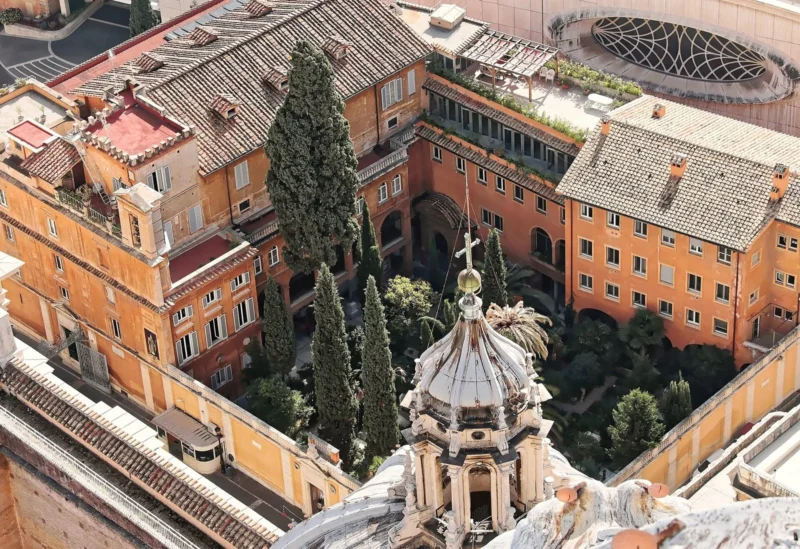
The two ornamental domes flanking the Cupolone on its sides cover the Gregoriana and Clementina chapels, the two twin masterpieces of the late 16th century. The Gregoriana, completed for Gregory XIII, was the first part of the new basilica to receive mosaic decoration, from 1576, with the Madonna del Soccorso brought from the old basilica. The Clementina, for Clement VIII, holds Saint Gregory the Great and today Thorvaldsen's monument to Pius VII. In Dupérac's design, four smaller domes were planned. The other two stayed on paper, and the two fake drums you see from the piazza serve only for the silhouette. It's the perfectly Roman compromise between what was promised and what was built: symmetry from outside, bookkeeping from inside.
The obelisk and the most famous move in history
The obelisk in the center of the square deserves its own chapter, because it's the oldest witness of the place. Brought from Egypt by Caligula for the spina of his circus, the same circus where according to tradition Peter was martyred, it stood for 15 centuries on the side of the basilica, the only obelisk in Rome that never fell. In 1586 Sixtus V decided to move it in front of the new basilica, and the undertaking of Domenico Fontana became the most famous construction site of the century: months of preparation, hundreds of men and dozens of winches and horses to move a granite monolith of hundreds of tons in one piece, with the city gathered to watch. Tied to that move is the most retold tradition of St. Peter's Square, the one of the Ligurian sailor Bresca who supposedly shouted "water" at the ropes, saving the operation and earning his family the privilege of supplying the palms for Palm Sunday. I report it for what it is, a tradition dear to guides and lacking documentary proof, but the privilege of the Bordighera palms really did exist. On top, where the ancients saw the ashes of Caesar, Sixtus V put the relic of the Cross. The pagan obelisk became the gigantic Christian gnomon that still serves as the square's sundial today, with the signs of the winds and the hours on the paving.
The relics of the four piers
The four piers of the dome aren't just structure: they are the basilica's monumental reliquaries, and the four colossal statues already mentioned, Longinus, Helena, Veronica and Andrew, declare the relics that the loggias above kept. The lance of Longinus, the soldier who pierced Christ's side, arrived in Rome in 1492 as a gift from the sultan to Innocent VIII. The largest fragment of the True Cross of Saint Helena. The veil of Veronica, the relic that in the 14th and 15th centuries was the supreme destination of Roman pilgrimages, the one for which Dante coins the image of the Croatian pilgrim in the Paradiso. And the head of Saint Andrew, Peter's brother, which stayed here until 1964, when Paul VI returned it to the church of Patras in one of the first great ecumenical gestures toward the East: Duquesnoy's statue stayed, the relic went back home. On Passion Sundays the Veronica is still displayed from the loggia of its pier. If you're there during Lent, find out more, because it is one of the oldest and least publicized rites of the basilica.
Liturgical life and visiting in 2026
St. Peter's is not a museum with Masses: it is a church with visitors, and the difference organizes everything. Masses are celebrated every day from early morning in the chapels and at the altars, and anyone can take part. The sacrament of Reconciliation has its official hours, Monday to Saturday 7.00-12.30 and 16.00-19.00, Sunday 7.00-13.00 and 16.00-19.00, with polyglot confessors in the right transept, a service traditionally entrusted to the Penitentiary friars. The official guided tours of the basilica run Monday to Saturday from 9.30 to 17.30 with last registration at 17.00, and on Sundays and Vatican holidays from 13.30 to 15.30. You book them at the counters and on the official website. The digital novelty is called Pétros ení, the immersive experience of the basilica, open with the same hours as the dome. The name comes from the Greek graffito found in the excavations, Peter is here, and it is the right way in for anyone who wants to understand the necropolis without having managed to book the Scavi.
A few more coordinates on the building you are visiting: there are 45 altars and 11 chapels, the whole interior perimeter can be walked, and the travertine exterior runs around with Michelangelo's giant order and attic. A raised corridor connects the basilica to the Vatican Palaces through the Scala Regia, and two corridors go down toward the sacristy. The staff who move around you have precise names: the canons of the Chapter, the sampietrini of the Fabbrica, the students of the Pre-Seminary in liturgical service, the Gendarmerie at the gates. And the bells mark the day with a code you learn quickly: the strokes of the Campanone for the midday Angelus, the full peal of the smaller ones on Sundays and feast days, the plenum of all six on the supreme solemnities, the Ave Maria and the Campanella striking the quarter hours while the Campanone counts the hours. Stop on the parvis at noon and listen: it is the original soundtrack of the place, and it has sounded the same for centuries.
The bells, the organs and the Fabbrica di San Pietro
The six bells sit in the bell chamber under the left clock, on a wooden frame from the late 1700s, with a fast swing. In order of size: the Campanone by Luigi Valadier, 1785, 2.32 meters in diameter and 8,950 kilograms, the Campanoncino by Innocenzo Casini, 1725, 3,640 kilograms, the Rota bell, cast by Guidotto Pisano around 1280, 1,735 kilograms, the medieval voice that survived everything, the Predica bell by Giovanni Battista Lucenti, 1909, 830 kilograms, the Ave Maria by Daciano Colbachini, 1932, 250 kilograms, and the Campanella by Angiolo Romagnoli, 1825, 235 kilograms. The Campanone strikes the hours and rings full peal at the supreme moments: the plenum accompanies the Easter Vigil, Christmas Night, the Urbi et Orbi, Saints Peter and Paul on June 29 and the election of the Pope. Since the 2005 conclave, to dispel doubts about the smoke, it is the sound of the bells that confirms the Habemus Papam, as happened on May 8, 2025 for Leo XIV. The recent historic plenums: the beatification of John Paul II on May 1, 2011, the farewell to the resigning Benedict XVI on February 28, 2013, the double canonization of April 27, 2014.
The organs: the largest is the Tamburini of 1962, arranged in two bodies in the choir transepts, heir to the early 20th-century instruments by Carlo Vegezzi Bossi and Walcker, with the main console by the left body and a second Mascioni console from 1999 that can be moved for celebrations in the square. For connoisseurs, a symphonic organ with a more precious sound than others of its size. Alongside it are the Morettini of the Choir chapel (1887), the Tamburini of the same chapel (1974) and the small Morettini of the Blessed Sacrament chapel (1914), with a case attributed to designs by Giacomo Della Porta. The names of the organists are deliberately left out: the last reliable public list dates from 2018, and here the data is either verified or it isn't there.
Behind all of this, the Reverenda Fabbrica di San Pietro has been at work since the 16th century. It is the body that manages and preserves the basilica, it is still operating, and its archives hold notes, contracts and even correspondence between Michelangelo and the Curia, open to scholars. The Fabbrica has also left traces in Roman dialect, as I'll tell you shortly in the curiosities section. Liturgical service has been handled since 1956 by the Preseminario San Pio X, an institute of the Opera Don Folci that depends on the diocese of Como, and its students serve the Masses in the basilica. The top official in charge of worship is the archpriest, a office reserved for cardinals, which since February 20, 2021 has been entrusted to the Franciscan cardinal Mauro Gambetti. He also inherits the duties of the abolished Vescovo Sacrista.
The Dimensions and the Basilica as a Model
The numbers from the official list, for those who love rankings: maximum external length 218 meters, internal 186.36, atrium 71 wide and 19 deep, vaults about 45 high, dome at 133.30 meters (136.57 according to some sources), canopy 28, facade 114.69 by 45.44 (48 with the statues), central nave 26 wide, internal drum 41.50, surface area 23,000 square meters of which 15,160 are walkable, and 537 steps to the top of the dome from the base (551 in other counts by the Fabbrica: it depends on where you start counting). On the floor of the nave, golden stars mark the lengths of the great churches of the world, all of them shorter: St. Peter's contains all of them except one. The Basilica of Yamoussoukro in Ivory Coast, consecrated in 1990, surpasses it in height with its 158 meters, and it was modeled on St. Peter's, as half the Christian world has been. From here descend the dome of Sant'Andrea della Valle, Saint Paul's in London (1675), the Pantheon in Paris and Les Invalides, and then the revival in the 19th and 20th centuries, from Chicago to Milwaukee, from Pittsburgh to Oudenbosch in the Netherlands, up to the cathedral of Montréal. In the second half of the 20th century there were Licheń in Poland, Yamoussoukro, and the Incoronata Madre del Buon Consiglio in Naples. When an architect has to design the largest church he can, he has been starting here for five centuries.
A Curiosity About St. Peter's Basilica in the Vatican
If you hear someone in Rome say that something is done a uffo, meaning for free, you are quoting the Fabbrica di San Pietro. Materials destined for the building site traveled exempt from duties with the mark A.U.F., Ad Usum Fabricae, for the use of the Fabbrica. Carts marked this way passed through customs without paying, and the people turned the acronym into a word, auffo, aufa, which after five centuries is still in the Roman dialect vocabulary. It is not the only linguistic legacy: for a job that never ends, people still say it's like the Fabbrica di San Pietro, and with 120 years of documented construction, plus the perpetual maintenance, the saying is technically flawless.
The next time someone offers you a coffee a uffo, you know whom to thank: Julius II, his customs duties, and a building site so long it entered the language. No other church in the world has produced an adverb.
Something Nobody Tells You About St. Peter's Basilica in the Vatican
There are no paintings in St. Peter's. What look like giant painted altarpieces, from the Transfiguration by Raphael to the Martyrdom of Saint Sebastian by Domenichino, are mosaics: 10,000 square meters of tesserae, translated from the originals by the Studio del Mosaico della Fabbrica di San Pietro starting in the 16th century, precisely because the basilica's humidity was devouring the canvases and panels. The originals moved elsewhere, many to the Pinacoteca of the Vatican Museums, and in their place came copies made of glass and enamels, with a range of over 20,000 shades developed by the Studio, which still works today.
Stop in front of any altar and move close enough to see the tesserae: this is the moment when the basilica changes its nature before your eyes. The real paintings can be counted on one hand, like the Trinity by Pietro da Cortona in the Chapel of the Sacrament. Everything else is a luminous deception designed to last forever. The most visited church in the world is also the largest gallery of mosaics of the modern age, and 90 percent of its visitors leave convinced they saw paintings. Now you won't.
The Advice I Give for Visiting St. Peter's Basilica in the Vatican
Go in at 7.00 sharp, at opening. It's the most valuable advice, and it's worth more than any skip-the-line ticket: very early in the morning the security line doesn't exist, the light comes in low through the eastern windows, the morning Masses fill the side chapels, and for an hour the basilica belongs to those who pray and to a few early-rising travelers. At 10.00 the same spaces are a station during rush hour.
The sequence I set up for clients: at 7.00, the basilica, calmly, nave by nave. At 8.00-8.30, the climb to the dome as soon as it opens, booked through the official ticket office with the matching time slot. Once back down, the Grottoes. Then mid-morning, outside, toward the café on Borgo Pio, while the crowds arrive. Anyone who wants to add the Necropolis excavations must book them weeks ahead through the Ufficio Scavi, and put them in the afternoon. Two practical warnings. The dress code really applies, with shoulders and knees covered even in August. And on Wednesday mornings the square is taken over by the papal audience, so the basilica opens to visitors later. If Wednesday is your day, give it to the Museums and save St. Peter's for another dawn.
Another well-known fact, yet rarely mentioned
St. Peter's is not the cathedral of Rome, and it is not even, canonically, the most important church in Christendom. Both titles belong to St. John Lateran, the cathedral of the bishop of Rome, which bears the inscription "Mother and Head of All the Churches" on its facade. Historians and canon lawyers know this very well. Hurried guidebooks forget it, and millions of visitors leave convinced they have seen the Pope's cathedral.
The distinction is not pedantry. It explains the function. St. Peter's is the shrine over the apostle's tomb and the papal chapel for the great rites, the stage for the conclaves held next door, for canonizations, for Jubilees. The Lateran is the episcopal seat, where every new pope must take possession of his cathedra. That is why papal funerals are held here, in the square, as the world saw in April 2025 for Francis. And that is why the Holy Door of St. Peter's is the first to open in Holy Years, but not the only one: the other three papal basilicas have their own too. Knowing this changes how you visit Christian Rome. St. Peter's is the heart, but the legal head lives on the Caelian Hill.
The right photo to take at St. Peter's Basilica in the Vatican
The photo worth the early wake-up is taken from the lantern of the dome, as soon as they open. Bernini's square seen from above, with the long shadow of the basilica stretched across the oval and the two arms of the colonnade closing in below you. It's the only shot that explains the whole design in one go, and at 7.30 in the morning the light is on your side and the balcony is almost empty.
The second: inside, from the Rota Porphyretica just after passing through Filarete's door, kneeling or crouching at floor level, with the nave running all the way to the illuminated Baldachin. It's the view Charlemagne had on the night of 800, and it's the way to photograph the 186 meters without them coming out soft in the wide angle. The third is outside: the facade with the dome seeming to rest on it, from Via della Conciliazione at the level of Castel Sant'Angelo, with a telephoto lens, as explained in the State's entry. Or, for romantics, the profile of the Cupolone at sunset from Ponte Umberto I, the postcard Romans simply call er Cuppolone. Inside the basilica, photos without flash are allowed. Respect for the place, with the prayer areas marked, is the only limit that matters.
Some important events that took place here in history
circa 64-67: Peter's martyrdom in Nero's circus and his burial in the necropolis. circa 320: Constantine founds the first basilica. Christmas 800: Charlemagne crowned emperor on the Rota Porphyretica. 1300: the first Jubilee of Boniface VIII fills the old basilica. April 18, 1506: Julius II lays the first stone of the new one. 1527: the Sack of Rome halts the construction. 1564: Michelangelo dies, and the drum remains half-finished. 1590-1593: Della Porta closes off the dome and lantern. November 18, 1626: Urban VIII consecrates the basilica. 1667: the colonnade completes the square. 1854: the proclamation of the Immaculate Conception. 1869-70: Vatican Council I. 1950: the current Holy Door and the proclamation of the Assumption. 1962-1965: Vatican Council II, with the council fathers filling the nave. 1939-1953: Pius XII's excavations find the necropolis and the bones attributed to Peter. 1964: Manzù's Door of Death. 1972: the attack on the Pietà and the case. 2000: the Great Jubilee.
And the present, which never stops here: April 2005 and April 2025, the funerals of John Paul II and Francis in the forecourt, in front of the world's leaders. February 28, 2013, the great bell marks the resignation of Benedict XVI. December 24, 2024, Francis opens the Holy Door of the Jubilee of Hope. May 8, 2025, the bells announce the election of Leo XIV. January 6, 2026, Leo XIV closes the Holy Door on a year that drew 33 million pilgrims. The news of St. Peter's is simply news, and anyone visiting in 2026 walks on pages that are still warm.
Who Has Passed Through St. Peter's Basilica in the Vatican
Starting with the involuntary founder: Peter of Bethsaida, who was buried here and upon whom everything is built. Constantine, who leveled a hill to build him a house. Charlemagne, crowned on the porphyry on Christmas night of 800, and with him the centuries of emperors, kings and pilgrims of the old basilica. Then the team of builders: Bramante, Raphael, the Sangallo, Peruzzi, Michelangelo, Della Porta, Maderno, Bernini, Borromini, a list that alone is a manual of art history. And their silent heirs, the sampietrini, the workers of the Fabbrica who have kept the machine running for five centuries, and the Studio del Mosaico, which continues to turn paintings into eternity.
Among the illustrious burials, besides the popes: Christina of Sweden, the queen who gave up a throne, Maria Clementina Sobieska and the Stuarts, the exiled court of England, Countess Matilda of Canossa, the first woman moved here by the will of a pope. Among the visitors, anyone who has mattered in two millennia, from the great figures of the earth who lined up for the funerals of April 2025 to the 33 million pilgrims of the last Holy Year. And one presence I prefer to all the others: the 99 lamps burning day and night around the Confession. They don't pass: they stay. They are the perpetual visitors, and for 2,000 years they have held the place for all the others.
How to Get to St. Peter's Basilica
The entrance is from Piazza San Pietro, with security checkpoints on the right side of the colonnade. Metro A to Ottaviano stop, then 10 minutes on foot along Via Ottaviano. Alternatively, buses 40 and 64 from Termini to Borgo, tram 19 to Piazza Risorgimento, or the walk from Castel Sant'Angelo along Via della Conciliazione, which remains the most spectacular approach to Rome. For the dome and the Grottoes, access is from inside the complex. For the Excavations, meet at the Ufficio Scavi under the left colonnade. Driving is out of the question: Borgo is tow-away territory.
How to Fit St. Peter's Basilica into Your Day
The winning plan is the one already outlined: basilica at 7.00, dome at 8.00, Grottoes afterward, coffee at Borgo Pio, and the rest of the day at the Vatican Museums with the Sistine Chapel booked for late morning. If you have two days, split the two visits and add the Vatican Gardens. If you want the big picture of the state, start with the Vatican City page. You can save your itinerary with Il mio viaggio, and the city's other wonders are in the Tourist Attractions section.
Quick Questions About St. Peter's Basilica
How much does it cost to enter St. Peter's Basilica?
Nothing: entry to the basilica is free, and always has been. You pay for the climb to the dome, Museo del Tesoro, the excavations of the necropolis and special guided tours, all of which can be booked through the basilica's official ticket office.
What are the opening hours of St. Peter's Basilica in 2026?
It opens at 7.00 in the morning. According to the official calendar, closing time is 20.00 from June 1, and the official website lists the same time all year round. The dome has its own hours: 7.30-17.00 in winter, 7.00-18.00 from March 29 to October 25. During papal celebrations, access changes, so check basilicasanpietro.va before you go.
Do I need a ticket or a reservation for the basilica?
No, you can enter freely after passing the security checks. Almost all of the line you see in the square is there for the metal detectors: at 7.00 there is none, while at 11.00 it can go over an hour. Reservations are needed, though, for the dome, the Excavations and guided tours.
How much does it cost to climb the dome and how many steps are there?
There are two options: entirely on foot, or by elevator up to the terrace, from where there are still 320 narrow steps between the two shells. The total count from the base is over 500 (537 or 551, depending on the Fabbrica's counts). The price is around 10 euros depending on the option. The exact price list is only on the official ticketing site booking.basilicasanpietro.va, which also assigns your time slot.
Is there a dress code to enter?
Yes, and it is enforced without exceptions: shoulders and knees covered, for men and women, no tank tops or hats. Carrying a scarf in your bag in summer solves the problem. The makeshift sarongs sold in the square are the worst souvenir you could bring home.
Where are the popes buried?
In the Vatican Grottoes under the basilica, with Pius XII, Paul VI, John Paul I and, since 2023, Benedict XVI. Saint John Paul II is instead up above, in the basilica, in the Chapel of San Sebastiano, and Saint John XXIII is at the altar of San Girolamo. Not Pope Francis: by his wish, he rests at Santa Maria Maggiore, outside the Vatican.
Can you visit the tomb of Saint Peter?
The Confession with the 99 lamps can be seen freely from the basilica, and the Grottoes are free admission. The real underground necropolis with the apostle's burial niche, the Excavations, can only be visited in tiny groups. You book weeks in advance through the Ufficio Scavi della Fabbrica: it's the most difficult and most rewarding booking in the Vatican.
Where is Michelangelo's Pietà, and why is it behind glass?
First chapel on the right aisle, right as you walk in. The bulletproof glass has been there since 1972, when a man struck it with a hammer, damaging the face and arm of the Virgin. The restoration was exemplary, and the case is the permanent price. It is the only work signed by Michelangelo: the signature runs across the band on the Madonna's chest.
How long does the basilica visit take?
One hour for the essential tour, two to read it as it deserves, half a day adding the dome and the Grottoes. The advice is still to go at dawn: the same visit at 7.00 is worth double compared with 11.00.
Can you take photos inside St. Peter's?
Yes, without flash and without tripods, respecting the marked prayer areas, where the guards ask that phones be put away. In the Chapel of the Blessed Sacrament, photography is not allowed: it's reserved for those who pray, and that's right.
What's the difference between the basilica, the dome, the Grottoes and the Excavations?
Four experiences stacked on top of each other: the basilica (free), the dome (paid, from above), the Grottoes with the papal tombs (free, under the floor), the Excavations of the necropolis with Peter's tomb (paid, by reservation, beneath the Grottoes). You can do them all on the same day only by planning: the right order is basilica, dome, Grottoes, and the Excavations at your assigned time.
When can you see the Pope at St. Peter's?
The Sunday Angelus at noon in the square, with no tickets needed, and the Wednesday morning general audience, with free tickets from the Prefecture of the Papal Household. Plus the major liturgies announced from time to time. On days of celebrations, the basilica limits or moves its visiting hours.
Is the basilica accessible to people with disabilities?
Yes: step-free routes from outside, interior ramps and assistance at the entrances. The Grottoes have easier access, while the upper part of the dome remains off-limits by nature, with narrow stairs and no elevator beyond the terrace. The basilica's assistance service helps those who report it in advance.
Why does the facade look too wide?
Because it was meant to have two bell towers. Construction stopped in 1622, Bernini's attempt was demolished due to subsidence, and Maderno's facade was left with the two side bays orphaned of their towers. The columns already ready ended up in the twin churches of Piazza del Popolo: even failures, in Rome, become monuments somewhere else.
What is the obelisk in St. Peter's Square, and why does it have no hieroglyphs?
It is an Egyptian monolith of red granite brought to Rome by Caligula for his circus, without hieroglyphs because it was probably never inscribed. It witnessed Peter's martyrdom, 15 centuries on the side of the basilica, and the famous 1586 move by Domenico Fontana. On top, in place of the supposed ashes of Caesar, there has been a relic of the Cross since the 1500s.
What is the Veronica and when can it be seen?
The veil with which, according to tradition, a woman wiped the face of Christ on the road to Calvary. It was the most venerated relic of medieval Rome and remains kept in the loggia of its pillar, with display on Passion Sundays. It is never shown to the public up close: the statue by Mochi, below, is its permanent monument.
Who are the sampietrini?
The specialized workers of the Fabbrica di San Pietro who have maintained the basilica for centuries, known for their acrobatic maintenance on the cupolone and for setting up the great celebrations. The name has also passed to the flint blocks of Rome's streets, but the original sampietrini are them: a trade handed down, often from father to son.
Why are there 99 lamps at the Confession?
They burn day and night around the Maderno balustrade above Peter's tomb. Tradition holds there are 99, and the number, never explained by any document, is part of the rite. They are the most photographed image of the heart of the basilica, and the spot where it's worth stopping for a minute in silence, even if you came in as a tourist.
Is St. Peter's the largest church in the world?
By area and tradition, yes, with an asterisk: the basilica of Yamoussoukro in Ivory Coast, modeled on St. Peter's and consecrated in 1990, surpasses it in height. The gold stars on the nave floor mark the lengths of the other great churches in the world: all of them end before the altar.
What happened to the Holy Door in the Jubilee 2025?
It was opened by Pope Francis on December 24, 2024, and closed by Pope Leo XIV on January 6, 2026: a Holy Year begun by one pope and concluded by his successor, the second case since the 18th century. Outside Holy Years, the door remains walled up from the inside. What you see in the portico is the outer face of the 16 panels by Vico Consorti from 1950.
Can you visit the basilica on Wednesdays?
Yes, but hours are affected by the papal audience in the square, which takes up the morning. Visitor access resumes normally after it ends. If you have only one Wednesday in Rome, the right move is to spend the morning at the Vatican Museums and save St. Peter's for the dawn of another day.
How much did the basilica cost and who paid for it?
The construction was funded by offerings from all of Christendom and, infamously, by the preaching of indulgences from 1507: a choice that helped trigger the Protestant Reformation. The total cost of 120 years of work cannot be calculated in modern money. The accounts of the Fabbrica, preserved in the archives, are a monument to double-entry bookkeeping in themselves.
Is the climb to the dome hard? And what about people with claustrophobia?
It's a real climb. Even with the elevator, there are still 320 steps. The last stretch runs at an incline between the two shells, so narrow you can touch the wall with your shoulder, and there's no way to turn back against the current. Anyone who suffers from tight spaces or vertigo should take the terrace elevator and stop there. The view of the façade mosaics and the giant saints is already worth the ticket. Water, sturdy shoes, and no big backpacks.
Are there restrooms, a cloakroom, or other services?
Yes: restrooms on either side of the colonnade and near the sacristy, no cloakroom or luggage storage according to the official website, the Fabbrica's visitor assistance service and, for those who need one, wheelchairs available through assistance. There's a Red Cross first aid station under the colonnade. In the square, in summer, it's needed more often than you'd think.
How early do you need to arrive?
Nobody at dawn: at 7.00 you get in within five minutes. Mid-morning, the line for the metal detectors wraps around the colonnade and can exceed an hour, in summer in full sun. The rule: either before 8.30, or after 17.00, when the basilica empties out and the light inside is the most beautiful of the day.
Are there skip-the-line tickets for the basilica?
For simple entry, no, because entry is free and the line is only for security. Anyone selling you a skip-the-line ticket for the basilica is selling you a guided tour, which is legitimate if declared and a sly trick if disguised. There are only two official channels: basilicasanpietro.va for information and visits, and booking.basilicasanpietro.va for the dome and routes. Everything else should be judged by what it really adds.
Can you attend Mass in St. Peter's?
Yes, freely: Masses are celebrated every day from early morning at the altars and in the chapels, and the sung Chapter Mass brings the choir to life on feast days. For papal liturgies, however, you need free tickets from the Prefecture, to be requested in advance. Attending a weekday 7.00 Mass is also the most authentic way to experience the basilica: as a church, not as a monument.
What does papal basilica mean? And why not archbasilica?
The papal basilicas are the four major churches of Rome with an altar reserved for the Pope: St. Peter's, St. John Lateran, St. Paul Outside the Walls, and Saint Mary Major. The title of archbasilica, the supreme rank, belongs only to the Lateran, however. St. Peter's, as immense as it is, comes after it in the hierarchy. Another confirmation that in Rome size and rank are two different sports.
Who was Giunio Basso, the one with the Treasury sarcophagus?
A prefect of Rome who died in 359, a neophyte baptized on his deathbed, as the inscription says. His sarcophagus, found near Peter's tomb, is the absolute masterpiece of early Christian sculpture, with biblical scenes carved when the empire had been Christian for barely a generation. It alone justifies the ticket to Museo del Tesoro, and almost no one knows it.
What time do the two clocks on the façade show?
The one on the left, the Oltremontano, shows the standard time of the time zone with two hands and is the one to set your watch by. The one on the right, the Italiano, has only one hand and was made for the Italic hours, which counted hours from sunset, the system used in the Papal States until the 19th century. Looking at them together is reading the transition between two ways of measuring time: on this façade, even the clocks make history.
To close: St. Peter's Basilica is the only 120-year construction site that became a synonym for eternity, the place where a customs acronym became a word and a fisherman's tomb became the center of a world. Go in at seven, climb up to the lantern, and descend to the lamps of the Confession. No other building will make you cross 2,000 years in 300 meters of elevation change. And remember the house rule: here, greatness is measured in silence.
Contact Information
Nearby
 Sistine Chapel100 m
- Vatican City100 m
- Camposanto Teutonico100 m
- Santo Stefano degli Abissini200 m
- Vatican Gardens300 m
- Piazza San Pietro300 m

Upcoming events nearby
- The Cranach-Triegel Altarpiece at the Campo Santo Teutonico, from November 2, 2025 to November 2, 2027100 m
- Catastrophe and Wonder. AQVA at the Vatican Apostolic Library, September 25, 2026 to May 14, 2027300 m
- Mozart’s Requiem with Orchestra Mavra and Piero Gallo at Teatro Ghione, November 22, 2026400 m
- IOSNO – Diventare Io400 m