Church of San Pietro in Carcere
In short. The Church of San Pietro in Carcere is at Clivo Argentario, at the foot of the Capitoline Hill, on the side of the Roman Forum that faces the Arch of Septimius Severus and the Curia.

The Church of San Pietro in Carcere is at Clivo Argentario, at the foot of the Capitoline Hill, on the side of the Roman Forum that faces the Arch of Septimius Severus and the Curia. The entrance is the one everyone knows as the Mamertine Prison: a narrow door under a travertine facade, set into the retaining wall of the hill, topped by the bulk of the church of San Giuseppe dei Falegnami. The complex belongs to the Vicariate of Rome through the Archconfraternity of San Giuseppe dei Falegnami, and its management is entrusted to the Opera Romana Pellegrinaggi, which looks after its opening to the public and the museum route. The official listing of the Ministry of Culture indicates daily opening in continuous daytime hours and a modestly priced admission ticket, with reductions. Since hours, prices and booking arrangements are updated fairly often, the sensible thing is to check them on the operator's official channels before showing up at the door. The reference phone number given by the Ministry is 06 69896379.
You get there on foot. The area is pedestrian or limited-traffic, there is no dedicated parking and it doesn't even make sense to look for it: the most convenient metro stop is Colosseo, on line B, from which you walk up Via dei Fori Imperiali in a good 10 minutes, or you get off at Piazza Venezia, where most of the surface lines crossing the center stop. Anyone coming from the Capitoline Hill can take the small stairway and the ramp that go down along the side of the Aracoeli toward the Forum: you come out exactly above the facade, and the view from above is the best way to understand what you're about to visit.
What the Church of San Pietro in Carcere really is
The starting point is the thing that generates 90 percent of the confusion, because without it the rest can't be understood and you end up telling yourself the wrong story while going down a real staircase. At this spot in Rome there are three distinct buildings, stacked one on top of the other like the floors of a house, built 1,500 years apart from one another, and each has its own name that isn't interchangeable with the others. At the lowest level is the Tullianum, the ancient chamber dug and built into the rock of the Capitoline Hill. Above the Tullianum is the Carcer, the trapezoidal hall with the barrel vault, which is the part you can see best and which the Romans called simply the prison, without adjectives. Higher still, wedged between the vault of the Carcer and the foundations of the modern church, is the Church of San Pietro in Carcere, that is the intermediate place of worship, the one that today presents itself as a small shrine of the Crucifix. And above everything, in the open air, with its 17th- and 18th-century facade and its bell tower, is the church of San Giuseppe dei Falegnami, which is an independent building, with a parish, a cardinal's title, a gilded wooden ceiling and a history of its own.
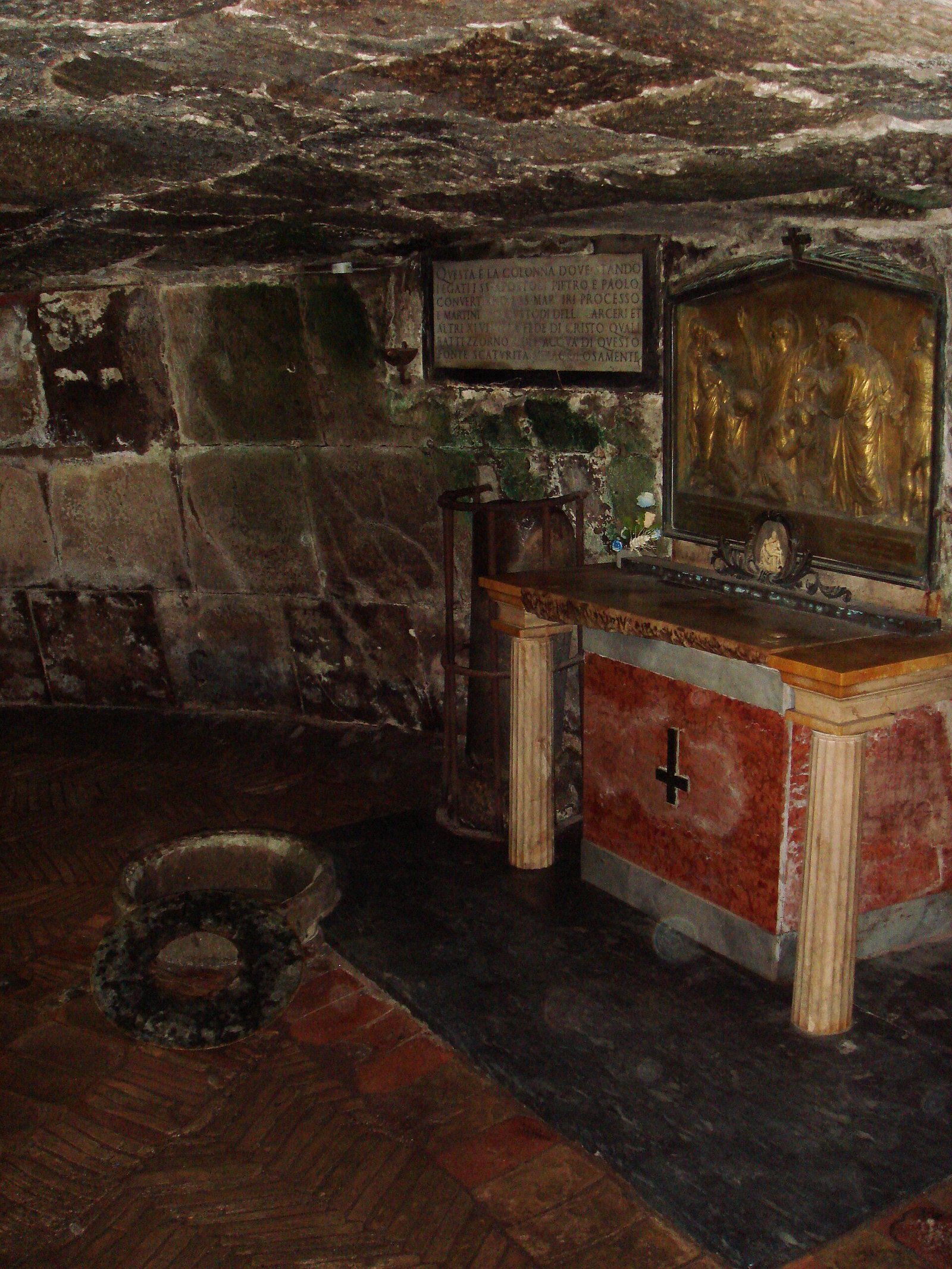
Put bluntly: the Mamertine Prison is antiquity, the Church of San Pietro in Carcere is the devotional level that formed inside and on top of that antiquity, San Giuseppe dei Falegnami is the church of the carpenters' guild built starting in 1597 on top of it all. When someone says to you "let's go see the church where they imprisoned Saint Peter," they are mixing up three things that sit together physically but not historically. And when on a map you find three different pins at exactly the same spot, it's not a navigation error: they really are three places, one on top of the other, with three names.
The Church of San Pietro in Carcere, in the strict sense, is the name by which the underground complex entered Christian devotion and ecclesiastical documents. It is a place of worship carved inside a Roman monument, with an altar, a consecrated floor, venerated images, and the memory of an imprisonment: there never were a nave and transept here. It is the reason why the Carcer was never destroyed, never dismantled to get building stone, never ended up under six meters of earth like half of the Roman Forum: because it had become a church, and churches in Rome keep being used. Christianization saved the most sinister pagan building in the city. It's a paradox that is worth the ticket by itself.
Where exactly the Church of San Pietro in Carcere is
The complex occupies the southern foot of the Capitoline Hill, on the slope facing the Forum, along the route of the ancient Clivus Argentarius, the road that climbed toward the citadel passing between the Carcer and the flank of the future Caesar's Forum. It's a position that today seems marginal, squeezed between the traffic of Piazza Venezia and the turnstiles of the Roman Forum, and that in antiquity was instead absolutely central: you were a few steps from the Comitium, from the Curia where the Senate met, from the Rostra from which people addressed the populace, from the Temple of Concord. Decisions were made 50 meters from the place where they were carried out. The distance between debate and strangulation, on December 5, 63 BC, was measured in minutes of walking.
Anyone arriving from below, from the Forum side, first sees the travertine facade of the Carcer, then raises their eyes and finds the Baroque facade of San Giuseppe dei Falegnami, which sits one floor above because the level of the city has risen. Anyone arriving from above, from the Capitoline Hill, sees only the modern church and can't imagine what lies beneath. This double reading, from below and from above, is the best way to understand the stratigraphy even before going in: do it, it costs five minutes and completely changes the visit.
The postal address is Clivo Argentario 1. The entrance door to the archaeological route is at the level of the lower street, while the upper church is reached from the side staircase. From the threshold you can see, without moving: the Arch of Septimius Severus, the flank of the Curia Julia, the church of Santi Luca e Martina, the Temple of Vespasian and Titus and, turning around, the wall of Caesar's Forum. Within a radius of 200 meters there is more documented Roman history than at any other point on the peninsula. It's worth getting there calmly and not in a rush between two turnstiles.
The three things stacked at the Church of San Pietro in Carcere
The question needs to be taken up again more carefully, because it's the heart of the misunderstanding and also the most interesting part of the place. Imagine a vertical section, like the ones drawn in archaeology textbooks. At the bottom, the Tullianum: circular in plan originally, today mutilated and closed by a straight wall, stone blocks laid dry, a floor, a small well from which spring water comes out. It is the oldest structure, the only one that truly belongs to the Rome of the origins and the early Republic. Above, the Carcer: a hall of about eight and a half meters by five and a half, trapezoidal in shape, covered by a barrel vault, built of large squared blocks of yellow and red tufa. In the middle of the vault, an opening: it was the only original access to the Tullianum, a hole in the ceiling through which the condemned were lowered. There was no staircase. The staircase you walk down is medieval.
Climbing further you enter the level that devotion called the Church of San Pietro in Carcere: a space carved out between the vault of the Carcer and the foundations of the upper church, arranged in its present form in the modern era, where the Crucifix known as "delle Carceri" is kept, once displayed outside, on the travertine facade, for the benefit of those passing in the street. This is the floor that hurried visitors cross without noticing, mistaking it for a passageway. It is instead the link that holds together the two ends of the story: below, the Roman judicial machine, above, the 17th-century carpenters' guild.
On the top floor, finally in the open air, San Giuseppe dei Falegnami. A single-nave church with two chapels on each side, begun in 1597 to a design by Giacomo Della Porta, continued after his death in 1602 by Giovan Battista Montano, who designed the facade and the famous gilded coffered ceiling made around 1611-1613, then by Giovanni Battista Soria and finally by Antonio Del Grande. It was consecrated on November 11, 1663. Inside is a Nativity by Carlo Maratta from 1651. Since 2012 it has been the seat of a cardinal deaconry. It is, to all intents and purposes, a 17th-century Roman church like many others, with the only difference that it has a prison from the Republican era in place of the crypt.
Why the confusion is so widespread
For three reasons, all understandable. The first is that the three levels are visited with a single ticket and a single staircase, so the experience is continuous and memory fuses them. The second is that the name Mamertine Prison, which is the most popular, is also the latest and the least precise: it doesn't appear in the ancient sources, it establishes itself in the Middle Ages and ends up designating the whole complex. The third is that tourist literature has always needed a single label, and when it has to choose it chooses the one that sells, namely Saint Peter's prison. The result is that you leave having seen three monuments and remembering one.
How to keep the three things separate during the visit
A trick that works: count the materials. If you see enormous tuff blocks, laid without mortar, with staggered joints, you're in Roman antiquity. If you see worked travertine, cornices, letters carved with a triangular section, you're still in antiquity but in an imperial phase of rebuilding the facade. If you see plaster, colored marble, stucco and a votive lamp, you're on the Christian level. If you see gilded wood and a painted vault, you're in the 17th century of the carpenters. Four materials, four eras. At the end of the stairs you'll know exactly where you've been.
The Tullianum Beneath the Church of San Pietro in Carcere
We go down to the lowest level, the one that gives its name to the whole complex in the scholarly literature: the Tullianum. It is a chamber that today looks like a semicircle closed by a straight wall, with a diameter on the order of six to seven meters, built of stone blocks laid dry, without mortar, in a technique that signals archaism. The original form was not what you see: studies carried out over the last 15 years converge in recognizing a circular plan, a kind of underground tholos, later cut by further interventions when the Carcer was built above and when, in the imperial age, the front was regularized. So what remains is half of a circle, and the other half was absorbed into the substructures of the hill.
The central point, literally, is water. In the floor of the Tullianum opens a small circular well, of surprisingly modest dimensions, a few dozen centimeters in diameter and just as many in depth, fed by a natural vein that still gives water today. It is the head of a spring, fed by a natural vein and not by a collecting basin. And here comes the first big surprise of the place, the one archaeologists have repeated for years and visitors struggle to register: the Tullianum was probably born as a place of water, not as a place of detention. The prison comes after, installed on a site that was already marked by a religious meaning tied to the spring. If you have in mind how much a pool of water gushing from rock on top of a sacred hill mattered to the Romans, you understand at once that we are talking about a place of worship before a place of punishment.
The block structure you see today is dated by the most recent studies to a moment of the middle Republic, roughly the 4th century BC, but the site was frequented far earlier. Stratigraphic investigations have yielded materials going down to the archaic age and votive deposits dated roughly between the 5th and 3rd century BC, consistent with a continuous cult practice. A ritual deposit, contained in a small box, with materials of archaic and Republican age has also been identified. The analysis of the associated plant and animal remains made it possible to place the ritual act in a specific season, autumn. This kind of detail, to someone outside the trade, looks like a specialists' curiosity: in reality it is the difference between knowing that someone did something and knowing when they did it, that is, between a hypothesis and a rite.
What the Blocks Say
The masonry of the Tullianum is squared-block masonry, with blocks arranged in regular courses and without binder. It is a technique used in Rome for a long time, but the proportions of the blocks, the type of stone and the way the exposed faces are worked are chronological clues. In the upper structures different tuffs appear, in particular the yellow tuff of the Monteverde area and the red tuff of the Aniene, materials that in Republican Rome have their own history of quarries and building fashions. Looking at the wall of the Tullianum and then the wall of the Carcer means seeing two distinct building sites, separated by at least a couple of centuries, that ended up coexisting.
The Absence of a Door
The detail that strikes most, and that almost nobody notices because we are used to stairs, is that the Tullianum originally had no door. The only access was the circular opening in the vault of the Carcer. Whoever had to go down was lowered with a rope, or was thrown in. Whoever had to come back up, by and large, didn't. The staircase that allows passage today is a much later addition, of medieval age, made when the place had become a pilgrimage destination and the faithful had to be circulated. When you're at the bottom, lift your head and look at the hole in the vault: that, not the staircase, is the real historical entrance of the space.
The Carcer Above the Tullianum, Beneath the Church of San Pietro in Carcere
The intermediate level of the ancient part is the hall the Romans simply called carcer. It measures roughly eight and a half meters by five and a half, has a trapezoidal plan and a barrel-vault roof, and is built of large squared tuff blocks. It is the space where the detention function materially took place: here the condemned were held awaiting the decision, the triumph, the execution. It was not a penitentiary, there were no cells, there was no penalty regime to be served. It was, to use a modern term, a holding room connected directly to the Comitium.
The chronology of the upper hall is debated and it's best to say so honestly instead of pretending to certainties. The scholarly tradition, following Livy, attributes the construction of the prison to Ancus Marcius, fourth king of Rome, therefore to the seventh century BC. Institutional listings often repeat this early chronology, placing the Tullianum in the regal age and the Carcer a century later. Recent archaeological studies, conducted on the structures and the stratigraphy, tend instead to lower the dates of the surviving masonry, which largely belongs to the middle and late Republic, while recognizing the very ancient use of the site. The two readings are not necessarily in contradiction: what is ancient is the place and its symbolic function, what is more recent is the wall you see.
The vaulted covering is the element that gives this room its gloomy and memorable character. The vault is low and compressed, built to bear earth and structures rather than for the soaring quality of public architecture, and when you stand under it you physically perceive the weight of the hill. Add the lack of windows, the only light coming in from above, the dampness rising from the spring and the characteristic smell of wet stones, and you will have a very concrete idea of what Sallust describes when he speaks of the filthy and terrible look of the place.
The link with the Cloaca Maxima
Under the floor of the Tullianum runs a conduit that carries water toward the ancient sewer system, that is toward the Cloaca Maxima and finally the Tiber. The stretch visible today is largely a medieval reconstruction, but the hydraulic logic is ancient: an active spring inside a buried room must be drained, otherwise the room floods. This technical detail fed for centuries a darker tradition, according to which the bodies of the executed were disposed of through that conduit. The ancient sources speak rather of bodies dragged with a hook, displayed on the Scalae Gemoniae and finally thrown into the Tiber: the route, that is, was in the open and public, because the point of capital punishment in Rome was precisely its visibility. But the conduit is there, the water flows, and I understand perfectly why the legend chose that path.
The travertine facade of the Church of San Pietro in Carcere
Before going down, stop outside. The front of the complex toward Clivo Argentario is covered with a travertine facing with a molded cornice and a monumental inscription in large letters. It is the only piece of Roman architecture properly speaking, that is designed to be seen, in the whole complex: the rest is service masonry, this is facade. The inscription records an intervention carried out by decree of the Senate under two consuls, Gaius Vibius Rufinus and Marcus Cocceius Nerva, and on this basis scholars place the reconstruction in the early Imperial age, in a span running from the last years of Tiberius to the first of Claudius, with the interval between AD 39 and 42 as the most current proposal. Some prefer a slightly earlier dating, within the 20s of the first century.
The interesting fact is not the date, it's the fact itself. Someone, in the Imperial age, judged that the State prison deserved a decorous facade, in noble material, with an official inscription declaring its public restoration. It wasn't a shame to hide: it was an institution of the Republic, and the Republic, even when it was by then a constitutional fiction, needed to show its furnishings. Restoring the prison and saying so in writing is a political gesture. It's worth keeping in mind while looking at those letters: they are the signature of the State on a machine of death.
Above the ancient inscription appears a modern one, which declares the place the prison of the holy apostles Peter and Paul and uses the name Mamertine. The two inscriptions, more than 1,500 years apart, say two different things about the same wall: the first qualifies it as a building of the Roman State, the second as a Christian shrine. There is no better way to understand the whole story of the place than to read them one after the other, vertically, standing on the sidewalk.
Why it's called Mamertine and why it's called Tullianum
The two names belong to two different worlds and are not synonyms, even though current usage treats them as such. Tullianum is the ancient name, the one you read in the Latin sources, and it designates specifically the lower chamber. On the origin of the term the ancients themselves argued. Varro and the lexicographic tradition connected it to King Servius Tullius, who would have been its builder. Livy instead attributes the foundation of the prison to King Ancus Marcius. Modern scholars mostly lean toward a different and more prosaic explanation: tullius, in archaic Latin, indicates a jet of water, a vein, a spring. Tullianum would thus be the place of the spring. If this etymology is correct, and there are good reasons to think so, the name of the most famous prison of antiquity speaks not of imprisonment but of spring water. It is an excellent reminder that names preserve memories older than functions.
Mamertine is another matter altogether. It doesn't appear in the classical sources, it establishes itself in the Middle Ages and from there passes into devotional literature, pilgrims' guidebooks and finally everyday language. The most widespread explanation connects it to Mamers, the Oscan name of Mars, and hypothesizes the existence in the area of a temple or small shrine dedicated to that deity, from which the complex would have taken its epithet. Other proposals trace it to medieval place names or people. In any case, when someone says "the Mamertine Prison" to you, they are using a medieval expression for an ancient building, exactly as when one says Colosseum instead of Flavian Amphitheater.
It's worth explaining right away, because it always produces the same effect: you realize that the names of Roman monuments are sediments, not labels. Under Mamertine there is the Middle Ages, under Tullianum there is perhaps water, under Church of San Pietro in Carcere there is a hagiographic tradition, under San Giuseppe dei Falegnami there is a guild of craftsmen. Four names, four layers, one address.
The name in devotion
In the Christian tradition the complex has also been known as San Pietro in Carcere, a formula found in ecclesiastical lists and in documents concerning the management of the place, and which has remained as the name of the underground place of worship. It is exactly the kind of topographic title that Rome has been producing for 1,500 years: San Nicola in Carcere, San Lorenzo in Miranda, Santa Maria in Cosmedin. The saint plus the place. In this case the place is the prison itself, which is at once the most literal and the most dramatic thing.
The spring of the Church of San Pietro in Carcere
Let's go back to the water, because it is the true common thread of the whole monument and because it joins, very rarely, the archaeological level and the devotional one. In the floor of the Tullianum there is a small circular basin fed by a natural vein. Its size is laughable: we're talking about a little well a little more than a hand's width across and as deep. Anyone expecting a dramatic well, the kind with a pulley and a bucket, is disappointed. Anyone who understands what they're looking at, instead, is impressed: it is an active spring inside a hill, at a point where the Romans built something important precisely because of that water.
The Christian tradition gave this pool a precise and very powerful meaning: it would have gushed miraculously so that Peter could baptize his jailers. It's a story that belongs to hagiographic literature and has an evident narrative function, namely explaining the presence of baptismal water in a place where nobody would expect a font. The archaeological fact and the hagiographic tale meet here in an almost perfect way: there really was a spring, and it really was anomalous for a room like this. The legend did not invent the water, it gave it an explanation.
From here also derives an aspect that touches the present: the place continues to be a pilgrimage destination, the water is visible but protected, and the management of the site has to hold together two needs that don't always get along, the protection of a fragile archaeological monument and the welcome of people who come to pray. Visitors would do well to remember it: it's not just any museum, it's a shrine inside a monument, and at certain times of the day you may find groups at prayer. It's not a disturbance to the visit, it's part of the visit.
Why a spring on top of a hill
The Capitoline Hill, like all the Roman hills, is a relief of volcanic and sedimentary materials in which permeable layers rest on impermeable layers. Where the two meet, outcropping on the flank of the hill, water comes out. It's a perfectly ordinary phenomenon from the geological point of view and extraordinary from the religious point of view: for an ancient culture, a pool that arises from rock in an elevated and sacred place is a sign, not an accident. There's no need to imagine mysteries to understand why that spot attracted cults from the Archaic age.
The ancient sources on the Church of San Pietro in Carcere and on the Tullianum
The most cited text is a passage from Sallust's Bellum Catilinae, chapter 55, written a little over 20 years after the events it recounts. Sallust explains that in the prison, going up a little to the left, there is a room called the Tullianum, sunk into the ground by about 12 feet, closed by walls and covered by a stone vault, and he describes its look with three words that no translator manages to render fully: neglect, darkness, stench. Then he recounts the execution of the conspirators, strangled by the executors of capital sentences. It is a dry, frightening page, and above all it is a topographical description: 12 feet correspond roughly to three and a half meters, which is exactly the order of magnitude of the height difference between the two rooms.
Livy, in the first book, attributes to Ancus Marcius the construction of the prison in the middle of the city, above the Forum, as a deterrent in the face of the increase in crime in a grown population. It is a passage that has conditioned the whole scholarly tradition and that still today is found repeated in many popular listings. It should be read for what it is: an annalistic report on an era for which Livy had no documents, which reflects the Roman conviction that the city's great institutions dated back to the kings. Varro and Festus, for their part, deal with the name and connect it to Servius Tullius. None of these sources, it must be said, is archaeology. They are cultural memories.
Then there are the accounts of individual episodes, which are worth more than any description: Plutarch for the end of Jugurtha, Cassius Dio for Sejanus, Josephus for Simon bar Giora, Cicero himself for 63 BC. Lined up, they give a coherent picture: the prison was not a place where people stayed, it was a place where they ended up. The average length of stay, for the figures we know something about, is measured in hours or days, except for the exceptional cases of prisoners kept for the triumph.
A clarification on the citations
The ancient sources never name a church, obviously, and never use the term Mamertine. When you read a sign or a guidebook that attributes to the Latin authors the expression Mamertine Prison, know that it is a later overlay. The ancients say carcer, and for the lower part Tullianum. It's a distinction that seems pedantry and is instead the key to not confusing what is documented with what is tradition.
How the prison beneath the Church of San Pietro in Carcere really worked
Here we have to dismantle a modern idea that we carry inside without realizing it. In Roman law detention was not a penalty. The prison served to keep someone at disposal, not to punish them by depriving them of liberty for a set time. The jurist Ulpian says so explicitly, in a passage that went into the Digest: the prison must serve to hold men, not to punish them. The penalties were others, and for serious crimes they were the fine, exile, loss of citizenship, condemnation to forced labor in the mines, death. No Roman was ever sentenced to five years in the Tullianum, because a sentence like that did not exist.
The carcer of the Forum therefore served three purposes. First: to hold those awaiting judgment or a political decision, often for a few hours. Second: to keep the illustrious prisoners destined to appear in the triumphal procession, and this is the only function that involves long detentions, even of years. Third, and above all: to carry out capital sentences by strangulation, which took place in the lower chamber, in a secluded and covered place, with a sober and quick ritual entrusted to specialized officials. It was not a spectacular execution like those of the amphitheater, it was an administrative act carried out in the dark, which became public only afterward, with the display of the body.
This distinction changes the way you look at the room. The Tullianum is the room where the executioner worked, not the cell of a condemned man waiting. The Carcer above functioned as an antechamber and not as a detention wing. And the fact that all this was 50 meters from the Curia, in the middle of the monumental center, was not an urban-planning distortion, it was a declaration: the State that deliberates and the State that kills live in the same block.
Who actually carried out the sentences
The sources speak of triumviri capitales, minor magistrates in charge of policing and prisons, and of carnifices, the actual executioners, socially infamous figures who could not live inside the pomerium, the sacred boundary of the city. The Roman executioner lived outside, came in to work and left. It's one of those details that say more than a thousand pages about the mentality of a society: capital execution is necessary, and whoever carries it out is impure.
The Scalae Gemoniae
Next to the prison the Scalae Gemoniae climbed toward the Capitoline Hill, the staircase on which the bodies of the executed were displayed before being dragged to the Tiber. The name has been linked since antiquity to groans, and the explanation is probably folk etymology, but the function is documented. The body of Sejanus remained displayed there and was abused by the crowd for days. Visitors today do not see the Gemoniae, because the route is not preserved in a recognizable way, but knowing that they were there, right next door, helps to mentally reconstruct the complete scene: the dark chamber, the climb, the square, the river.
Jugurtha and the Church of San Pietro in Carcere
The first of the great prisoners of whom we have an account is Jugurtha, king of Numidia, an adversary of Rome in a long and embarrassing war that Sallust made famous. Captured through the betrayal of his father-in-law Bocchus, handed over to Sulla, brought to Rome, he paraded in the triumph of Gaius Marius in January 104 BC and was then lowered into the Tullianum. Plutarch tells the scene of his end with a detail nobody forgets: the king, stripped and dragged, is said to have exclaimed with bitter irony how cold that room was, as one says of a bath. He died a few days later, of hunger according to some versions, strangled according to others.
Jugurtha's quip has gone down in history because it condenses everything: horror reduced to a remark about custom, the king who loses everything and keeps his sarcasm, the damp cold that anyone going down into that room even today feels on their skin in any season. It should be told at the exact point where you stand at the foot of the staircase, because that is where the temperature changes and the sentence becomes a physical experience instead of an anecdote.
There is also a political aspect. Jugurtha had been for years the symbol of the corruption of the Roman ruling class: he had bought senators, and had said, according to Sallust, that all of Rome was for sale and would find a buyer. His end in the Tullianum is therefore also the closing of an affair that had shaken the Republic from within. The prison of the Forum did not house common criminals: it housed unresolved political problems, and it resolved them.
Vercingetorix and the Church of San Pietro in Carcere
The most famous case of long detention is that of Vercingetorix, chief of the Arverni, the man who in 52 BC unified Gallic resistance and surrendered to Caesar under the walls of Alesia. He was not killed immediately. He was brought to Rome and kept, which is the right verb, for six years, waiting until Caesar could celebrate his triumph. The civil war, Pharsalus, Egypt, Africa: the triumph came only in 46 BC. Vercingetorix paraded in the procession, shown to the Roman people as visible proof of the conquest of Gaul, and right afterward he was strangled.
Six years of imprisonment are an eternity in a system that did not provide for detention as a penalty. They mean that someone had given precise orders for that man to stay alive and presentable until the useful day. It is one of the most chilling things that can be said about this place: it was not only a place where people died quickly, it was also a warehouse of living trophies. And the trophy had to reach the triumph in a condition to be recognizable.
It must be said, for fairness, that the sources do not always specify in which exact room illustrious prisoners were held for long periods, and that a multi-year detention in the Tullianum would simply have been impossible in practical terms. It is plausible that Vercingetorix spent those years in a different custody and that the Tullianum saw only the last act. The tradition that ties him to this place therefore concerns his death, not his imprisonment. It's a clarification I remove from the romantic tale reluctantly, but that's the job.
Why the triumph needed an execution
The Roman triumph was not a parade, it was a religious rite with an obligatory sequence that culminated on the Capitoline Hill, at the temple of Jupiter Optimus Maximus. The elimination of the defeated enemy, which took place while the general climbed to the temple, closed the circle: victory was complete only when the adversary ceased to exist. The prison at the foot of the hill was the point where the procession, having reached the end of Via Sacra, got rid of its prisoner before the final climb. The geography of the rite and the geography of the monument coincide. It is no accident that the prison stands right there.
The night of Catiline's conspirators at the Church of San Pietro in Carcere
On December 5, 63 BC the Senate, meeting in the temple of Concord a few tens of meters from here, discussed the fate of five conspirators arrested in Rome after the discovery of Catiline's conspiracy: Publius Cornelius Lentulus Sura, Gaius Cornelius Cethegus, Publius Gabinius Capito, Lucius Statilius and Marcus Caeparius. Caesar proposed a prudent solution, custody in the municipalities. Cato asked for death. The Senate followed Cato. Cicero, consul in office, had the condemned taken down into the Tullianum, where they were strangled. Coming out, he pronounced a single word to the people: they lived. In Latin, vixerunt. He did not say they are dead, he said they had finished living, with that linguistic modesty that the Romans reserved for irreversible things.
There are not many places in the world where you can stand exactly where an episode like this happened, with the topography intact and the source that tells it written a few years later. Sallust was alive, he was 20 years old, he knew the protagonists. His description of the Tullianum in that chapter stages a fact that all of Rome had commented on for weeks, and not a literary exercise. When you are at the bottom of the staircase and look at the stones, you are looking at the stage set of that evening.
The affair had an enormous backlash on Cicero's career. Having put Roman citizens to death without trial, by virtue of an emergency decree, cost him exile five years later. Besides documenting ancient cruelty, the prison of the Forum is the place where one of the most famous cases of conflict between state security and legal guarantees in all of Western history played out. The question they were asking themselves that evening, whether in an emergency the rules can be suspended, still has no shared answer.
Sejanus, Simon bar Giora and the others
In AD 31 it was the turn of Lucius Aelius Sejanus, prefect of the praetorian guard, for years the most powerful man in Rome after Tiberius, perhaps more than Tiberius. Summoned to the Senate believing he was to receive the tribunicia potestas, he found himself listening to a letter from the emperor ordering his arrest. He was taken to the prison and killed the same day. His body remained displayed on the Gemoniae and was torn apart by the crowd, and his fall dragged down his children and a long string of suspects. It is the swiftest case the sources record: in the morning he was the second man of the empire, in the evening he was a corpse on a staircase 200 meters from here.
In AD 71 it was the turn of Simon bar Giora, one of the leaders of the Jewish revolt, brought to Rome for the triumph of Vespasian and Titus over Judea. Josephus, who witnessed the triumph, tells that the prisoner was dragged with a noose to the place where those condemned for crimes against the State were usually killed, while the procession waited for the announcement of his death to continue toward the Capitoline Hill. It is the clearest description we have of the mechanism, and it comes from an eyewitness. That triumph is the same one commemorated by the reliefs of the Arch of Titus, at the end of Via Sacra: the seven-branched candelabrum sculpted up there and the end of Simon bar Giora belong to the same day.
Tradition adds other names, with varying degrees of reliability: the Samnite commander Gaius Pontius, victor of the Caudine Forks, executed after the triumph of Quintus Fabius Maximus. Aristobulus II, king and high priest of Judea, brought to Rome by Pompey. And of course dozens of minor figures we know nothing about. The list of famous names is short because the list of what the sources considered worthy of memory is short, not because the place worked little.
The prison as an archive of other people's defeats
Lining up the names gives a geography of Roman expansion: a Numidian, a Gaul, a Samnite, a Jew. The prison of the Forum is, in a sense, the table of contents of the chapters of conquest. Every time Rome won an important war, the victor brought the loser here. It is a macabre collection and at the same time a political document: proof that Roman power needed to make the end of its adversaries visible and final, and that it always did so in the same place.
The tradition of Peter and Paul at the Church of San Pietro in Carcere
We come to the point for which most visitors arrive here. Christian tradition holds that the apostles Peter and Paul were shut up in this prison before martyrdom, under Nero. That they converted their guards there, Processus and Martinian. That to baptize them they made a spring miraculously gush from the floor. And that on the wall of the descent the imprint of Peter's face remained, pushed against the stone by the guards. The mark is still pointed out to visitors today, protected by a grille installed in the 18th century.
What can we say historically? That it is a tradition, not a documented fact. The sources of the first century do not place Peter's imprisonment in this building. The story takes shape in later hagiographic literature, in particular in the passio of Saints Processus and Martinian, and consolidates in the Middle Ages, when the complex is already a place of worship and pilgrimage. The fact that a tradition is late does not automatically mean it is false, but it means it cannot be treated as a chronicle. The prudent formula is this: here is found the Christian memory of Peter's imprisonment, that memory is more than a thousand years old and has left imposing material traces, and the event itself is not verifiable.
There is however a point where the tradition has excellent internal logic. If a non-Roman citizen accused of crimes against public order had been taken in Rome under Nero, the State prison of the Forum was a plausible destination, at least for one phase of the procedure. There is no proof, but there is no absurdity either. And on the other hand the choice to identify this place, and not another, says something important about how Christians perceived Roman power: the right place to put the apostles' imprisonment was the judicial heart of the city, not a periphery.
Processus and Martinian
The two converted jailers had remarkable good fortune. They are venerated as martyrs, they have their own basilica on Via Aurelia and their remains were transferred to Saint Peter's in the Vatican, where Valentin de Boulogne painted for them a famous altarpiece now in the Vatican Pinacoteca. Their story served to answer a question early Christians often asked: what becomes of those who carry out orders? The answer of the passio is that even the jailer can convert, and that the water for baptism, if needed, comes out of the prison floor. As a narrative construction it is impeccable.
The mark on the wall
The imprint pointed out as the face of Saint Peter is a hollow in the stone on the wall of the descent. From the archaeological point of view it is, in all likelihood, an irregularity of the block or an ancient seating. From the devotional point of view it is a contact relic, that is an object that matters because the saint is said to have touched it. The two readings do not exclude each other: what you see is stone, what you venerate is memory. In the 18th century it was protected by a grille precisely because pilgrims touched it to the point of wearing it down. This too is a historical fact: it says how frequented the place was three centuries ago.
From prison to worship: the birth of the Church of San Pietro in Carcere
The passage from judicial use to religious use did not happen in a day and has no certifiable date, however much tradition likes to attribute it to Pope Sylvester I and the beginning of the fourth century. What studies show is a long process, recognizable in the stratigraphy: during the early Middle Ages the rooms lose their prison function, are modified, receive plasters, paintings, burials, and progressively become a space of worship. The moment when the dedication to Saints Peter and Paul appears consolidated is placed around the 12th century, but the traces of Christian use are earlier.
The archaeological investigations carried out in recent years have yielded, among other things, skeletal remains from the early medieval age, a sign of burials practiced in the area when the prison was no longer a prison, and fragments of wall painting of notable interest, including a Marian image that has been related to the type of the Madonna of Mercy, the one who welcomes the faithful under her mantle. If the reading is correct, it would be an early testimony of an iconographic theme destined for enormous success. It's not the discovery that makes the newspapers, but for those who study Roman devotion it is worth a great deal.
This is the passage that explains the preservation. Rome demolished, stripped and reused almost everything that was ancient. It turned temples into churches, baths into convents, mausoleums into fortresses. The carcer was saved because it became the Church of San Pietro in Carcere, that is because it changed trade while staying open. The monument visited today is, literally, the product of this conversion: without the cult, we would have at most a stretch of block wall under a building.
The continuity of pilgrimage
From the Middle Ages onward the place appears in the city's devotional routes, together with the great basilicas and the shrines tied to the memory of the apostles. In the Holy Year its attendance grows, and the need to make it passable grows accordingly: hence the interventions that over time opened staircases, widened passages, protected the relics with grilles and gates. Every modern modification that today bothers the archaeological purist is, in reality, a document of the devotional history of the place.
The oratory of the Crucifix, heart of the Church of San Pietro in Carcere
The intermediate level deserves more attention than it receives. Wedged between the vault of the Carcer and the foundations of the 17th-century church, it is the space where devotion took architectural form: a small shrine dedicated to the Crucifix, with the altar and the venerated image, arranged in its present form in the modern era and renovated in the 19th century. The Crucifix known as "delle Carceri" is kept here, which was previously placed outside, on the travertine facade, exposed to the view of those passing along Clivo Argentario.
The detail of the original outdoor placement is more significant than it seems. It means that for a long period the complex communicated with the street through a sacred image affixed to the facade of a Roman prison: anyone passing saw together the carved letters of the consuls and the crucifix. It is the perfect symbolic image of what this place represents, and the fact that it was later moved indoors for reasons of conservation takes nothing away from its force.
In the practice of the visit, the oratory is the point where it's worth stopping a few minutes longer, because it is the only room in which the two worlds physically touch. Under your feet is the vault of the Roman prison, above your head the floor of the carpenters' church. You stand in the middle of 1,700 years. It is also, for reasons of acoustics and lighting, the most recollected space of the whole route, and those who come for religious reasons recognize it at once as the devotional center of the complex.
San Giuseppe dei Falegnami above the Church of San Pietro in Carcere
The upper church has an independent history that begins with a guild. The congregation of the carpenters of Rome, which had Saint Joseph as its patron for obvious reasons, rented the church of San Pietro in Carcere starting in 1540 and, grown in means and ambitions, obtained at the end of the century authorization to build above it a new, larger building, worthy of the brotherhood. The building site opened in 1597 with Giacomo Della Porta, one of the busiest architects of late 16th-century Rome, the man of the dome of Saint Peter's completed with Domenico Fontana and of half the religious building of the city.
Della Porta dies in 1602 and the work passes to Giovan Battista Montano, a very interesting figure: a carver, a theorist of ancient architecture, author of collections of reconstruction drawings that influenced generations of architects. To him are owed the design of the facade and above all the carved and gilded wooden ceiling, made around 1611-1613, which for four centuries was the pride of the church. After Montano, Giovanni Battista Soria and Antonio Del Grande step in. The consecration comes on November 11, 1663. Inside, among other works, a Nativity by Carlo Maratta from 1651 is kept. In the 19th century the church underwent a restoration led by the architect Antonio Parisi. Since 2012 the title has been the seat of a cardinal deaconry.
That a guild of woodworking craftsmen built its church above the State prison of ancient Rome is one of those coincidences that Rome produces effortlessly and that no urban planner would ever plan. But there is a logic: the carpenters needed a seat in the center, the little church of San Pietro in Carcere was available for rent, and the ground above an ancient monument is solid ground on which to build. Devotion and building convenience, as often happens, traveled together.
Montano's ceiling
The gilded wooden coffered ceiling made between 1611 and 1613 was an extraordinary carving work, with figured panels devoted to the Nativity and to Saints Peter and Paul, mounted on a framework of trusses. It was also, from the technical point of view, a little-studied artifact: the literature had dealt above all with its artistic value and much less with how it was built, with the joints, the suspensions, the relationship with the roof. This gap, as we'll see, proved dramatically relevant.
The collapse of August 30, 2018
On August 30, 2018, at 14:59, the roof of San Giuseppe dei Falegnami gives way. Two of the four trusses collapse and drag down with them about two thirds of the wooden ceiling, which crashes onto the church floor. The noise is heard throughout the Forum, the cloud of dust comes out of the windows and the door. By a lucky circumstance the church was not frequented at that moment and there were no victims or injuries, and this, considering the mass of wood and iron that fell, remains the most important fact of the whole affair.
The damage to the heritage, instead, was enormous. A carved and gilded 17th-century ceiling is unique and cannot be replaced: reduced to fragments it becomes a puzzle of thousands of pieces, many of them pulverized. In the days immediately afterward the priority was securing the building and the archaeological structures below, because under that floor, let's remember, are the oratory and the Roman prison. The area was closed off, the Roman Forum stayed open but with limitations in the adjacent area, and the work of digging out the debris began.
The recovery operations began on November 5, 2018: sorting, cleaning, cataloguing and documenting every fragment extracted from the rubble. The recovery tally, communicated afterward, indicates that it was possible to save about half of the serial decorative elements and about 90 percent of the sculpted parts. The church partially reopened for worship on December 21, 2018: the faithful were able to return to pray before the wooden nativity scene, recovered almost intact from the rubble. This detail, the nativity scene unharmed under the collapsed ceiling, is by itself a description of the mood of that Christmas.
The restoration and the return of the ceiling
The actual reconstruction began on June 3, 2019 and dragged on for years, with the direction of works entrusted to specialized structural engineers and the joint involvement of the archaeological superintendency, the central institute for restoration and private firms. The building site was substantially concluded by the end of 2020, so much so that the first Mass in the restored church was celebrated on March 19, 2021, the feast of Saint Joseph, a date nobody could have chosen better. The formal conclusion of the works and the public presentation of the results came then in 2023, when the church hosted the presentation of the scholarly volume devoted to the archaeological complex below.
The method adopted deserves to be told, because it is a textbook case. On one side they proceeded with technology: three-dimensional laser scanner survey of the entire ceiling and of the debris, digital modeling to reconstruct the original position of each fragment, design of a support and monitoring system that would reduce future risks. On the other they had to go back to pure craftsmanship, recovering carving and gilding techniques to remake from scratch the elements irretrievably lost. The combination of digital scanning and carver's workshop is, in Italian conservation, one of the most promising directions.
There is also a legacy of knowledge that the collapse produced in spite of itself. Dismantling, studying and reassembling a 17th-century ceiling forced the specialists to truly understand how it was built: joints, suspension systems, the relationship between the load-bearing framework and the decorative apparatus, the behavior of materials over time. Before 2018 this knowledge was fragmentary, because nobody had ever had the chance, or the courage, to open up an artifact like this. Today the case of San Giuseppe dei Falegnami is a reference for the preventive maintenance of dozens of Roman wooden ceilings still in place. It's a meager consolation, but it's a real consolation.
What the collapse teaches visitors
One very simple thing: monuments are not eternal by definition, they are eternal through maintenance. A roof that nobody has inspected for long enough gives way, and in giving way it brings down four centuries of work. When you enter the upper church and see the ceiling that looks intact, know that a substantial part of what you're looking at was put back together piece by piece from a heap of rubble, and that another part was remade by hand. It is a documented, declared restoration, reversible in its logic and readable for those who know where to look, and as such it should be read.
The recent excavations beneath the Church of San Pietro in Carcere
The season of archaeological investigations conducted starting in 2009-2010, directed by Patrizia Fortini for the competent superintendency and merged into the project later coordinated by the Colosseum Archaeological Park with Alfonsina Russo, has deeply changed the understanding of the monument. Before then the Mamertine Prison was essentially a place of tradition, with a scholarly bibliography and very little stratigraphic data. Afterward, it became an excavated, documented and published site, with a dedicated scholarly volume, published by L'Erma di Bretschneider, which collects the results of the excavations and restorations.
The main results can be summed up in four points. First: the confirmation that the lower level has an originally circular plan and that the whole layout should be read as an autonomous structure, not as a mere cellar of the upper prison. Second: the identification of a long sequence of use going back to the Archaic age, with materials and votive deposits datable largely between the fifth and the third century BC, and the consequent reading of the site as a place of worship tied to the spring. Third: the recognition of ritual acts datable with seasonal precision thanks to archaeobotanical and archaeozoological analysis, with autumn indicated. Fourth: the documentation of the Christian phases, with early medieval burials and wall paintings.
The picture that emerges is not that of a prison built by a king and then reused by Christians, but that of a sacred place of water in the heart of Archaic Rome, which at a certain point in Republican history is incorporated into the judicial apparatus of the State, continues to be perceived as special, and at the end of antiquity becomes again a religious place with another religion. The continuity is not in the function, it is in the quality of the place. This is, in our judgment, the true scientific result of the last 15 years.
The relationship between excavation and legend
Something rare happened here: the excavation did not refute the tradition, it explained it. The spring really was there, and its presence fed for centuries both the pagan cult and the story of the apostolic baptism. The early medieval burials confirm that the place had become sacred very early. The legend dressed a preexisting sacredness in Christian names, and archaeology found the foundations of that sacredness again. It doesn't happen often, and when it does it's worth saying so.
The museum route of the Church of San Pietro in Carcere today
The complex is no longer visited as a simple descent into a dark room. At the end of the excavation and restoration campaign a museum route was set up that integrates multimedia apparatus: scenographic lighting calibrated to the different rooms, video projections, digital content accessible through devices that reconstruct the phases of the monument and give back its appearance in the different eras. It's a choice debated among purists, but here it has a strong justification: most of what makes this place understandable, that is the stratigraphic sequence and the finds, is not visible to the naked eye.
The route also includes an exhibition section with materials from the excavations, which lets you see in display cases the objects that document the long history of the site. It is the part that visitors in a hurry skip and that instead gives sense to the rest: without the ceramic fragments, the organic remains and the ritual elements, the argument about the cultic origin of the Tullianum remains an assertion. With those in front of you, it becomes a demonstration.
A practical warning, because disappointment always comes from wrong expectations. The complex is small. The complete visit, done calmly, reading everything and watching the videos, takes between 40 minutes and an hour. Anyone who goes in thinking they'll find kilometers of underground passages is thrown off. Anyone who goes in knowing they're going down into two rooms and will find 2,700 years of history there leaves, usually, with the idea of having been in one of the densest places in Rome.
The matter of crowding
The rooms are narrow and the number of people who can be there at the same time is limited for obvious reasons of safety and conservation. In the high season and in the middle hours of the day lines form, and above all jams form at the bottom of the staircase, which is the point where everyone wants to stop. The rule is: first opening or last hour. It's not an original tip, but here it makes an enormous difference, because silence is an integral part of the experience and with 40 people in two rooms silence doesn't exist.
What you see, room by room, at the Church of San Pietro in Carcere
Here the account follows the order in which you encounter things. You begin outside, on Clivo Argentario, in front of the travertine facade: look at the carved letters of the consular inscription, the cornice, the join between the noble facing and the tufa block masonry that sticks out at the sides. Then raise your eyes to the upper church, so you already have the vertical section in your head. Once inside, you walk a stretch of modern circulation and arrive at the exhibition area, where the excavation materials and the reconstruction of the phases are presented.
You then go down to the level of the Carcer. The thing to do here is to stand in the middle and turn slowly in place: the trapezoidal plan reads very well, the barrel vault looms, the tufa blocks show their weave of courses. Look for the circular opening in the floor, which is the mouth of the Tullianum and the only original access to the lower chamber. From there, look down: you are looking at exactly what the triumviri capitales saw when they lowered a condemned man.
Finally you go down into the Tullianum, by a staircase that is not ancient. Below, the room is low, damp, closed. On the right you recognize the devotional arrangement, the altar and the column that tradition indicates as the one to which the apostles were tied. In the floor is the basin of the spring, protected. You see the blocks laid dry, the residual curve of the circular layout, the cut of the later walls. Going back up, you pass through the oratory of the Crucifix and, if access is allowed and the church is open, you can go on into the upper church to see the reconstructed ceiling and Maratta's Nativity.
Details almost nobody looks at
Three, in order of importance. The first: the holes and recesses in the walls of the Carcer, which tell of wooden structures, closures and passages now gone. The second: the point where the ancient masonry is cut by the foundations of the modern church, which is the material proof of the overlapping we've been talking about from the start. The third: the drainage channel, which explains why the room is not flooded and which is a lesson in applied hydraulics 25 centuries long.
The temperature factor
In summer the temperature difference between Clivo Argentario at two in the afternoon and the bottom of the Tullianum is striking, and in winter the bottom is penetratingly damp. It's not a problem for a one-hour visit, but if you have small children or suffer from neck trouble, keep something to put over your shoulders at hand. It sounds like grandmother's advice: it's the advice I give most often and the one that gets thanked the most.
Practical information for visiting the Church of San Pietro in Carcere
The site is owned by the Vicariate of Rome, through the Archconfraternity of San Giuseppe dei Falegnami, and its management and enhancement are entrusted to the Opera Romana Pellegrinaggi. This means two practical things. The first is that the ticket is not part of the state circuit of the Roman Forum and the Palatine: it is a separate admission, purchased separately, and it is not included in the tickets of the Colosseum Archaeological Park. The second is that the concessions and free admissions of the state museums do not apply here automatically. The listing of the Ministry of Culture reports daily opening in continuous daytime hours and a modest admission fee with a reduction, plus the phone number 06 69896379, but before going it's always best to check updated hours and conditions with the operator.
On accessibility we have to be frank, because it is the information that is most often missing and that most often ruins a day. It is a hypogeal monument reached by stairs, with irregular steps in the ancient stretches, narrow passages and reduced heights in some points. The descent to the Tullianum is not compatible with a wheelchair and presents difficulties also for those with walking problems or who suffer from claustrophobia. Anyone with specific needs should make a phone call first: the staff know the route and can say how far it is reasonable to go.
On visit time: 40 minutes is the sensible minimum, an hour the right measure, an hour and a half if you want to read everything and also go up into the upper church. On the season: any, because it is covered, but the comparative advantage over the rest of the city is greatest on rainy days and in the hot months. On the time of day: opening or late afternoon. On clothing: it is a place of worship, so the usual rules apply, shoulders and knees covered, and shoes with a sole that grips, because wet stone is slippery.
Photographs and behavior
Photography without flash is normally allowed in sites of this type, but the rule is set by the operator and can change. Flash, in rooms with paintings and ancient surfaces, is to be avoided on principle anyway. Tripods and bulky equipment are impractical for a banal reason even before a regulatory one: there is no space. A low tone of voice is not a formal recommendation but an acoustic fact, because in a chamber of stone blocks with a barrel vault a normal conversation becomes a rumble for everyone.
What to see around the Church of San Pietro in Carcere
The density of the neighborhood is such that any itinerary works. Going down toward the Roman Forum you immediately encounter the Arch of Septimius Severus, the Curia Julia with its copy bronze doors, the Lapis Niger, the Rostra, the temple of Saturn and that of Vespasian and Titus. Above the prison, on the flank of the hill, is the temple of Concord, reduced to its podium, which is the place where the Senate deliberated the death of Catiline's conspirators: the distance between the temple and the prison is what you need to tell the episode without moving.
On the other side, Caesar's Forum with the remains of the temple of Venus Genetrix and the Imperial Forums. A little farther up, the church of Santi Luca e Martina by Pietro da Cortona, one of the masterpieces of Roman Baroque, and the prison complex is tied to it also by visual contiguity. Climbing the staircase toward the Capitoline Hill you arrive at Piazza del Campidoglio and the Capitoline Museums. Going down toward Piazza Venezia you meet the Insula dell'Ara Coeli, one of the very rare Roman apartment blocks for ordinary people preserved in elevation, and the Aracoeli staircase.
If I had to build a coherent half day, I'd build it like this: first opening at the prison, then the climb to Santa Maria in Aracoeli, then the Capitoline Museums with the terrace over the Forum, and finally the descent to the Roman Forum in the afternoon with the entrance from the Imperial Forums. You walk little, you go up and down a lot, and you cross 3,000 years without ever getting more than 400 meters from the starting point. It's the kind of day that can be done in Rome and nowhere else.
The most common mistakes about the Church of San Pietro in Carcere
The first mistake is the one we talked about at the beginning: believing that Mamertine Prison, Church of San Pietro in Carcere and San Giuseppe dei Falegnami are three names for the same thing. They are three different things in the same spot. The second mistake is thinking that the Roman Forum ticket entitles you to enter: it doesn't, the management is different and the ticket is separate. You sometimes see whole families show up at the door with the Colosseum ticket in hand and turn back annoyed. It's not a trap, it's simply another owner.
The third mistake is expecting a labyrinth of underground passages. They are two rooms, with a total surface comparable to that of an apartment. The fourth is going in knowing nothing and coming out having understood nothing, which is by far the most frequent outcome: without a minimum of context, the visitor sees wet stones and an altar and doesn't register that they are in the place of some of the most famous executions of Roman history. 10 minutes of reading beforehand are enough, and they are the best-spent 10 minutes of the whole day.
The fifth mistake, subtler, concerns attitude. The place is a place of torture and at the same time a shrine. Anyone who arrives in treasure-hunt mode, in a hurry to tick a box, not only loses everything but disturbs those who came to pray. You don't need to be a believer to behave properly: you just need to understand where you are. After all, what happened here was death inflicted by a State on unarmed people, and the Christian memory laid over it only reaffirms it. It is a room that deserves silence, whatever the reason for going down into it.
A mistake even among insiders
Even in serious popular writing you sometimes read that the Tullianum was built by Servius Tullius or by Ancus Marcius as a fact. These are traditional attributions, not excavation results, and they should be presented for what they are. The archaeological chronology of the surviving structures is lower, while the use of the site is older. Saying both things is not academic nitpicking, it is the correct way to tell a monument to those who trust us.
The Church of San Pietro in Carcere in the memory of the city
There is a reason why this place, small and uncomfortable, occupies so large a space in the imagination. It is the point where Roman history stops being architecture and becomes biography. At the Colosseum you admire a work of engineering. At the Pantheon you are left breathless by a dome. Here there is nothing to admire in an aesthetic sense, and precisely for this reason attention shifts entirely to people. Jugurtha complaining about the cold, Cicero saying a single word as he comes out, Vercingetorix waiting six years, Sejanus who in one afternoon goes from the summit of power to the staircase: these are individual destinies, not monuments.
The Middle Ages and the modern era added another layer of memory, that of pilgrimage. For centuries, those who arrived in Rome from far away did not come to see the Forum as an archaeological ruin, a category that did not exist, but traveled through the city as a map of sacred presences. The prison of the apostles was a stop, together with the basilicas and the places of martyrdom. The 18th-century grilles that protect the relics from excessive contact say how many people passed through: you don't put a grille where there is no pressure.
Then came the 19th century with its double gaze, romantic and archaeological. Grand Tour travelers sought the emotion of ruins and found it more easily here than elsewhere, because an underground prison with a tradition of martyrdom is a concentrate of everything the taste of the time loved. Archaeologists, for their part, began to ask the right questions about chronology. The two sensibilities coexisted for a century and a half. The season of excavations of the last 15 years has finally given documented answers, without taking anything away from the emotion: indeed, adding to it.
The place in popular culture
The Mamertine Prison appears regularly in historical novels, films and documentaries set in ancient Rome and in the first Christian centuries, almost always in the role of Peter's prison. The most widespread depiction is that of a squalid cell in which the apostle awaits martyrdom, with the spring gushing from the floor. It's an image that derives from the passio, not from the historical sources, but it has such narrative force that it has imposed itself everywhere. It is part of the life of this place exactly like the stones.
Frequently asked questions about the Church of San Pietro in Carcere
Are the Church of San Pietro in Carcere and the Mamertine Prison the same thing
No, even though they are visited together. The Mamertine Prison is the Roman archaeological complex, made up of the Carcer and the Tullianum. The Church of San Pietro in Carcere is the Christian place of worship formed inside and on top of that complex. Above both is the modern church of San Giuseppe dei Falegnami, which is a distinct building.
Is the Roman Forum ticket valid for the Church of San Pietro in Carcere
No. The complex belongs to the Vicariate of Rome through the Archconfraternity of San Giuseppe dei Falegnami and is managed by the Opera Romana Pellegrinaggi, with its own paid admission, distinct from the tickets of the Colosseum Archaeological Park.
Was Saint Peter really imprisoned here
It is a tradition, not a fact documented by the sources of the first century. The story consolidates in hagiographic literature and in the Middle Ages. That said, the tradition is very ancient, has generated an uninterrupted cult and has determined the very preservation of the monument.
How long does the visit to the Church of San Pietro in Carcere take
Between 40 minutes and an hour for the underground route with the exhibition part, an hour and a half if the upper church is added. The rooms are few and small, but there is quite a lot of content to read.
Is the visit suitable for children
From age seven or eight up it works very well, as long as you tell the story and don't just show the stones. The themes are harsh, so it's best to calibrate the telling. On the other hand, the staircase, the hole in the vault and the water coming out of the floor are elements that catch attention immediately. Under five, with a stroller, it is impractical.
Is it accessible to people with mobility difficulties
The hypogeal route is approached only by stairs, with irregular steps and narrow passages, and it cannot be done in a wheelchair. Anyone with limitations should contact the operator beforehand to understand which parts of the route are compatible with their conditions.
Can you visit in the rain
Yes, and it is in fact one of the best choices on bad days, because the route is entirely indoors and is a few steps from other places that can be visited under cover. The only precaution concerns the steps, which become slippery with wet soles.
Do you need to book
Conditions can vary over time and by type of visit, in particular for groups. In periods of heavier attendance it is reasonable to check the arrangements with the operator in advance, if only to avoid finding yourself in line on a narrow street without shade.
Clivo Argentario and the urban context of the Church of San Pietro in Carcere
The street the entrance opens onto is no ordinary street. Clivus Argentarius was the route that climbed from the Forum toward the Capitoline citadel, passing behind the Carcer, and the name most likely alludes to the bankers and money changers, the argentarii, who had their counters in the Forum area. So picture the real setting: an uphill street, busy, commercial, lined with exchange shops, and halfway along it the door of the state prison. No separation, no buffer zone. The ancient city put together things that we carefully keep apart.
With the construction of the Forum of Caesar, inaugurated in 46 BC and completed by Augustus, the whole sector was redesigned: the side of the hill was cut away, streets were moved, everything was made monumental. The prison stayed where it was, wedged between the new imperial complex and the old Republican square, and this persistence is news in itself. In an area reworked at enormous expense, nobody thought of moving the prison. Because it wasn't just a functional building: it was a place with an identity, and the Romans didn't joke about that kind of identity.
The ancient street level, it must be said, is lower than the current one. Rome has grown upward through an accumulation of rubble, floods and rebuilding, and the difference in level in the Forums sector is on the order of several meters. That's why the travertine facade seems to sink into the ground and the modern church seems to float on the upper level: the church wasn't built high up, the ground rose. Keep this in mind every time something in Rome looks out of proportion in height. Nine times out of 10 the explanation is the ground level.
The Relationship with the Comitium
The Comitium, the political space par excellence of Republican Rome, was a few dozen meters away, between the Curia and the Rostra. The physical closeness of assembly, senate and prison is the urban translation of a principle: the community that deliberates is the same one that punishes, and it doesn't delegate punishment to a distant, invisible place. In Imperial Rome this principle watered down, spectacular executions moved to the amphitheaters and the carcer of the Forum became a ceremonial leftover. But the leftover is so loaded with meaning that it kept being used for the prisoners of triumphs well into the first century AD.
The Modern Pilgrimage to the Church of San Pietro in Carcere
The religious dimension of the place is not an archaeological fact left in the past: it is alive. The complex is part of the devotional itineraries dedicated to the memory of Peter and Paul in Rome, which include the Vatican basilica, San Paolo fuori le Mura, San Pietro in Vincoli with the chains, Quo Vadis on the Appian Way, Tre Fontane. In these routes the prison has a precise place: it is the stop of the imprisonment, the one that comes before martyrdom. Those who visit it in this spirit aren't looking for the dating of the blocks, they're looking for a place to stop and think about what the end of a life means.
The fact that its promotion is entrusted to the Opera Romana Pellegrinaggi, the diocesan body that handles religious travel and itineraries, makes this vocation explicit. The practical consequence is a visit route that holds together the archaeological rigor of the content, developed from the excavations, and the devotional function of the spaces. The two don't always coexist easily. Here, all things considered, the compromise works: the captions don't turn legend into chronicle, and the space of worship isn't reduced to scenery.
In Jubilee years the flow increases considerably and access management becomes stricter. Anyone planning a visit in a period like that should find out well in advance and consider unusual time slots. It's also a chance for an observation: pilgrimage isn't a folkloric leftover, it's the reason cultural tourism exists in this city. The infrastructure of Roman hospitality, from medieval hospices to today's hotels, was born for pilgrims. The prison of the apostles is one of the original nodes of that network.
Masses and Worship Hours
The upper church of San Giuseppe dei Falegnami is in service and has a liturgical life of its own, with celebrations that take on particular importance on the feast days tied to Saint Joseph, since the building is the historic seat of the archconfraternity. The times of the services don't match those of the archaeological route and may mean the temporary closure of some rooms to visitors. It's a church, and churches in Italy work like this: services come before visits.
Why the Church of San Pietro in Carcere Is Worth a Visit
Let me lay my cards on the table: from an aesthetic point of view, this is not one of Rome's great monuments. There's no precious marble, no famous frescoes, no memorable view. If you're looking for pure beauty, go elsewhere, the city is generous. If instead you're interested in history as an experience, meaning the chance to stand physically where things you've read about in books took place, then this is one of the five or six places in the world worth reaching.
The reason is density. In two small rooms you find together: a cult of the waters from the archaic age, the judicial apparatus of the Roman Republic with its capital executions, the rite of the triumph, the memory of the end of Vercingetorix and of Catiline's conspirators, the tradition of the apostles' imprisonment, late antique Christianization, the medieval pilgrimage, a seventeenth-century guild of craftsmen, a collapse in 2018 and a restoration that has become an international case study. 27 centuries, 40 square meters.
Then there is a quality that is harder to put into words and more decisive. Rome is a city where history is almost always monumental, that is, built to impress. Not here. Here history is administrative and private, made of service rooms, procedures, men led into the dark and other men carrying out an order. It is the other side of the imperial coin, and for those willing to look at it, it is far more instructive than any triumphal arch. You leave in silence, and that's normal.
A Curiosity About the Church of San Pietro in Carcere
The curiosity I like best concerns the size of the well. Everyone, hearing about the miraculous spring, expects something spectacular: a basin, a fountain, at least a stone bowl. The reality is a small circular well measured in centimeters, a few dozen across and a little more than half a meter deep, cut into the floor and protected. It's so small that many visitors walk right past it without seeing it, and have to be shown where to look. Then someone explains that this tiny opening is probably the reason everything else exists, and the face changes.
Because the reasoning goes like this: if the most accepted etymology is correct and tullius means vein of water, then the name of the most famous prison of antiquity comes from that hole in the floor. Not from the walls, not from the condemned, not from the kings to whom tradition attributes the construction. From a spring that gushes from the rock and that someone, 27 centuries ago, thought important enough to build a circular chamber over. The entire monument grew around a hydraulic detail the size of a plate.
I'll add a second curiosity along the same lines: the water is still there. It's not an archaeological trace, not a memory, not a reconstruction: it's an active vein that keeps giving water in the 20-first century, in a hill swallowed up by a European capital, under a Baroque church, under a Republican prison. Of all the elements visible in that underground space, the oldest and the most continuous is not the stone. It's the water. And this, in a place dedicated to the memory of death, has an irony that doesn't need pointing out.
Something Nobody Tells You About the Church of San Pietro in Carcere
That the Roman prison wasn't a punishment. This is the thing nobody will tell you at the entrance, and it radically changes the meaning of what you're about to see. In Roman law there was no sentence of imprisonment: you were fined, exiled, stripped of citizenship, sent to forced labor or killed, but nobody was sentenced to spend years locked in a room. The jurist Ulpian writes it unambiguously in a passage collected in the Digest: prison is for holding men, not for punishing them. The carcer of the Forum was therefore a structure of custody and execution, not a penitentiary.
The consequence is that every mental image built from films and novels needs recalibrating. There were no inmates passing the time, no assigned cells, no yard shifts. There were people who stayed there for a few hours awaiting a decision, and people who arrived already condemned, for the last act. The only exception concerns the illustrious prisoners kept for the triumph, who could wait for years, and even for them it's likely that the long wait took place elsewhere and that this place saw only the end.
A second observation follows that almost never gets made. If the prison served to hold and to kill, and if the killing took place in the lower chamber, then the Tullianum is nobody's cell: it's the workplace of the carnifex. It wasn't a dormitory, it was an operating room. Looking at those walls knowing they were the setting in which a state official carried out a technical act, quick, provided for by procedure, is far more chilling than picturing a prisoner in chains. The administrative banality of death is not a twentieth-century invention: it has a room, and this is it.
My Advice for Visiting the Church of San Pietro in Carcere
Go first thing, as soon as it opens, and expect to be the only ones for 10 minutes. It's the most obvious advice and also the most effective, because in this place silence is not an added value but a requirement. There are two rooms, they're small, they have a barrel vault that amplifies every voice, and with 20 people around they turn into a subway station with ancient stones. Alone, instead, you hear the water. You feel the temperature change as you go down. You see the light coming in through the opening in the vault. These are the three elements that make the place memorable, and all three disappear in the presence of a large group.
The second piece of advice is to do five minutes of preparation before going in. You don't need to read a manual: three names and a date are enough. The names are Jugurtha, Vercingetorix and Cicero. The date is December 5, 63 BC. If you go down that staircase with it in mind that beneath your feet five Roman citizens were strangled by decision of the Senate, and that the word with which the consul announced the execution was just one, the visit changes register completely. Without context you see damp stones. With context you see the scene.
The third piece of advice, less obvious, is to set aside time for the level everyone rushes through, the intermediate oratory, and for the upper church if it's open. The value of the complex lies in the overlap, and the overlap can only be understood by walking through all of it, from top to bottom and back. Go up, look at the reconstructed ceiling of San Giuseppe dei Falegnami, then think back to the hole in the vault of the Carcer you saw 20 minutes earlier: they're the same vertical axis, four and a half centuries apart in the first case, 20 centuries in the second. On your way out, stop on the sidewalk and read the two inscriptions on the facade, the one of the consuls and the one of the saints. It's the summary of everything, and it's free.
Another Well-Known Fact, Yet Rarely Mentioned
That the original entrance wasn't a door, but a hole in the ceiling. It's a fact found in any technical sheet and that practically nobody tells visitors, perhaps because it seems like a technical detail. It is nothing of the kind: it's the key to reading the whole lower space. The Tullianum had no side access. You entered from above, lowered through a circular opening cut into the vault, and the staircase that allows passage today is a medieval addition, built when the place had become a pilgrimage destination and the faithful had to be able to go down and come back up.
Imagine what that means. There was no threshold, no doorpost, no lock. There was no moment when the condemned crossed a door: there was the moment when he was lowered or pushed into a pit. The geometry of the space expresses on its own the idea that whoever enters does not leave, and not out of decorative cruelty but by structure. It is the architectural translation of a legal concept. And when you stand at the bottom and look up, you see exactly what they saw: a circle of light far away, above your head.
This detail, told at the right moment, produces an effect that no anecdote about famous prisoners manages to achieve. Because illustrious names create distance, they're characters from a book. The hole in the ceiling instead is a physical thing, that you can see, and anyone understands in an instant what it implies. You don't need to know Latin, you don't need to know who Sejanus was. All you have to do is look up.
The Right Photo to Take at the Church of San Pietro in Carcere
The right photo isn't inside, it's outside, and it should be taken from the opposite sidewalk of Clivo Argentario, framing the whole stratigraphy vertically: at the bottom the ancient blocks and the travertine facade with the consular inscription, in the middle the band with the devotional inscription, at the top the seventeenth-century facade of San Giuseppe dei Falegnami with its pediment. A single image that contains 27 centuries, with no need for captions. It's also the only shot that visually explains what words struggle to make clear, namely that there are three buildings stacked here. Take it in morning light, when the travertine takes on a warm tone and the carved letters have the right shadow to be legible.
The second photo, the one nobody takes and which is nevertheless the best of the interior, is shot from the bottom of the Tullianum, pointing upward at the opening in the vault. You get a circle of light surrounded by dark stone: it is literally the prisoner's point of view. Technically it's a difficult situation, because the difference in brightness between the stone and the opening is huge and most cameras blow out the highlights. If your phone has a mode that handles dynamic range, this is the time to use it. But even an imperfect photo, in that case, says something true.
Third possibility, for those with patience: the spring. A close-up of the little well in the floor, with the wet stone around it, works as a symbolic image and it's the one that always has the most effect in presentations, because it defies expectations. Nobody imagines that the famous miraculous spring is a circle the size of a plate. Two recommendations that apply to all three photos: no flash, out of respect for the surfaces and for those who are there to pray, and no tripods, because there's no room and you'd be an obstacle for everyone. The best equipment, here, is arriving early.
Some Important Events That Happened Here in History
The first event that can be dated precisely is the execution of Catiline's conspirators, on December 5, 63 BC. Five men, all Roman citizens, all from families of the ruling class, were led into the Tullianum and strangled by decision of the Senate, without a trial, under an emergency resolution. It is the best-documented episode in the entire history of the monument, because Sallust tells it a few years afterward and because Cicero, who orchestrated it, talked about it for the rest of his life. That evening set the legal and political precedent that the West still argues about: how far the state can suspend its own rules to defend itself.
The second is the execution of Vercingetorix in 46 BC, at the end of Caesar's Gallic triumph. The Arvernian chief had been kept alive for six years for that day. He marched in the procession and was killed while the triumphant general climbed to the Capitoline. The third is the end of Jugurtha, in 104 BC, after the triumph of Marius, with the quip about the cold that Plutarch has preserved for us. The fourth is the fall of Sejanus, on October 18, AD 31: summoned to the Senate believing he was being promoted, arrested, killed within a few hours, his body displayed on the Gemonian Stairs and torn apart by the crowd. The fifth is the execution of Simon bar Giora in AD 71, during the triumph of Vespasian and Titus over Judea, recounted by an eyewitness like Josephus.
Then the other series of events begins, those that no longer concern death but memory. The gradual transformation of the rooms into a place of worship during the early Middle Ages, with burials and paintings, the consolidation of the dedication to Saints Peter and Paul around the twelfth century, the church's lease to the carpenters' congregation from 1540, the start of work on the upper church in 1597 and its consecration on November 11, 1663, the eighteenth-century arrangement of the protections for the relics, with the grate of 1720, the nineteenth-century restoration. And finally the contemporary series: the excavation campaign begun around 2009-2010 and the new museum display, the collapse of the roof of the upper church on August 30, 2018 at 14:59, the recovery of the fragments from November 5, 2018, the reopening for worship on December 21, 2018, the start of reconstruction on June 3, 2019, the first Mass in the restored church on March 19, 2021, the public presentation of the results and of the scholarly volume in 2023.
A Chronology That Never Breaks
The remarkable thing, when you line up these dates, is that there is no empty century. From the archaic age to today, this spot in Rome has always been used for something: cult of the waters, judicial custody, capital executions, burial, devotion, pilgrimage, seat of a guild, restoration site, museum. It's a place that has never closed, unlike the Colosseum and the Forum, abandoned and then rediscovered. Among Rome's thousands of ancient buildings, those that can say the same can be counted on one hand.
Who Passed Through the Church of San Pietro in Carcere
Let's start with the prisoners, because they're the reason the place is famous. Jugurtha, king of Numidia, brought here after the triumph of Gaius Marius in 104 BC. Vercingetorix, chief of the Arverni, killed after Caesar's triumph in 46. The five Catilinarian conspirators, Lentulus Sura, Cethegus, Gabinius Capito, Statilius and Caeparius, strangled in 63. Sejanus, prefect of the praetorian guard, in AD 31. Simon bar Giora, leader of the Jewish revolt, in 71. Tradition adds the Samnite commander Gaius Pontius and the Jewish high priest Aristobulus II, with varying degrees of reliability. These are names that span three centuries of Roman expansion, from three different continents.
Then there are those who passed through on the right side of the handle. Cicero, consul in office, who personally accompanied the condemned and left uttering that single word. Caesar, who had proposed in the Senate that they be spared and who 17 years later would send his most valuable prisoner here. Cato, who had called for their death. Marius, Sulla, Pompey, Vespasian, Titus: practically every great general of the late Republic and early empire had, one day or another, a professional relationship with this building. And of course the triumviri capitales and the carnifices, of whom we don't know a single name, who are the only people to have worked here every day.
The second category is that of witnesses and narrators. Sallust, who wrote 20 years after the events and left us the physical description of the space. Livy, who attributed its founding to Ancus Marcius. Varro and Festus, who discussed the name. Plutarch, who collected Jugurtha's quip. Cassius Dio, who told of Sejanus. Josephus, who attended the triumph of 71 and described its conclusion. Without them we would have two stone rooms and no story.
Then there is the long line of pilgrims, who have no names but left physical traces: the marks of touch on the venerated surfaces, the grate of 1720 placed there precisely because the stone was being worn away by hands, the adaptations of the rooms to let people circulate. In the history of this place, the anonymous crowd left a deeper mark than any emperor: the staircase was dug for them, and it's thanks to them that the monument has come down to us.
Finally, those who built it, decorated it and saved it in the modern age. Giacomo Della Porta, who opened the work on the upper church in 1597. Giovan Battista Montano, author of the facade and of the gilded wooden ceiling of 1611-1613. Giovanni Battista Soria and Antonio Del Grande, who carried the work forward to the consecration of 1663. Carlo Maratta, who in 1651 signed the Nativity kept inside. Antonio Parisi, who directed the nineteenth-century restoration. And in our own time Patrizia Fortini, who directed the excavations and edited, with Alfonsina Russo, director of the Colosseum Archaeological Park, the volume that finally gave this monument a scholarly publication worthy of it. Along with them the teams of restorers, engineers and carvers who after 2018 put back together a ceiling reduced to thousands of fragments. Among the names that have passed through here, the latter are the only ones who left the place better than they found it.
What's worth taking away from here is not a list of illustrious prisoners. It's the feeling, which you only get standing at the bottom of that staircase, that history isn't a succession of great works but a chain of rooms in which someone decided the life of someone else. Rome built extraordinary aqueducts and unrepeatable domes, and I admire them like anyone. But the way this city worked is better understood down here than under the Pantheon, looking at a circle of light above your head and a little well of water a hand wide.
Article written by the editorial team of TourLeaderPro, contact them for Private/Corporate/V.I.P. Tours and Experiences.
Planning a trip to Rome? The English guides to visiting the city are on ItalyPlanner.com.