Luigi Pigorini National Museum of Prehistory and Ethnography – Museum of Civilizations
In short. The address is Piazza Guglielmo Marconi 14, in the EUR neighborhood, inside the Palazzo delle Scienze.
The address is Piazza Guglielmo Marconi 14, in the EUR neighborhood, inside the Palazzo delle Scienze. This is where the collections that everyone in Rome still calls the Pigorini Museum are housed, and which have been part of the Museum of Civilizations since 2016. You get there by metro line B, EUR Fermi stop, a five-minute walk slightly uphill. You can also take ATAC buses 30, 170, 671, 791 and 714, or drive and find free parking on the nearby streets, which at EUR almost always works out, except on trade fair days at the Nuvola. Open Tuesday to Sunday, from 8:00 to 19:00, last entry at 18:30. Closed on Mondays. Full ticket €10.00. Reduced €2.00 for European Union citizens between 18 and 25. Free under 18 and for people with disabilities with their companion. There is an annual Museum of Civilizations card at €22.00 that gives you a year of unlimited entries, and the Roma Pass is accepted. Free admission for everyone on the first Sunday of every month and on April 25. For an ordinary visit you don't need to book: you pay at the ticket desk and walk in. Booking is required, however, for groups and school classes, with a booking fee of €10.00.
Two pieces of information weigh on your day more than any other, and you should have them in mind before you get on the metro. The first: the African, American and Oceanic Arts and Cultures collections, which occupy the first floor of the Palazzo delle Scienze, are affected by renovation works and remain closed until winter 2026, for the legally required checks on the new anti-seismic devices, for the new fire-safety and air-conditioning systems, and for the restoration of the historic window frames. In their place, at the entrance of the building, a rotating selection of masterpieces from those same collections is on display in the itinerary titled In corso d'opera. The second: the Sala Guattari, the one with the Neanderthal skull from Circeo, has its own hours, different from those of the museum, and it is open to the public freely on Saturday and Sunday from 8:30 to 13:00, while from Tuesday to Friday it can be visited by reservation with groups and school classes. It is a technical room, with delicate equipment and possible closures for maintenance: a phone call or a check on the official website the day before saves you a wasted trip.
If you want to place the institution as a whole, with all its sections and venues, you'll find the general picture on the Museum of Civilizations page. Here we talk about the prehistoric and ethnographic core, the one founded by Luigi Pigorini, which remains the scientific heart of the whole machine.

Where the Pigorini Museum is and how to get there
The museum occupies the Palazzo delle Scienze, on the long side of Piazza Guglielmo Marconi, opposite the Palazzo delle Arti e Tradizioni Popolari, which is at number 8 and houses the other big half of the Museum of Civilizations. Together the two buildings cover about 50,000 square meters between exhibition rooms and storerooms. That figure explains why nobody manages to see everything in one morning, and why the visible part is always a selection of what is there.
Getting to the Pigorini Museum by metro
Metro B, direction Laurentina, EUR Fermi stop. When you come out, take Viale Beethoven or Viale America and walk up toward the piazza: barely five minutes, all on a wide sidewalk, with a very slight slope that you only feel in July. The next stop, EUR Palasport, is just as close on foot and has the advantage of taking you past the Palazzo dello Sport by Nervi and the little lake. If you're traveling with a stroller or a wheelchair, EUR Fermi is the right choice: working elevators and a step-free route all the way to the piazza.
By bus
The ATAC lines that serve the area are 30, 170, 671, 791 and 714. The 30 is the most convenient if you're coming from Piramide or Ostiense, the 714 if you're coming from Termini and San Giovanni, the 170 if you're coming from Trastevere and Testaccio. None of these lines stops in front of the door: you get off on Viale Europa or on Viale della Civiltà del Lavoro and walk a few hundred meters. At EUR distances are deceptive because the sidewalks are monumental and the porticoes all look alike: if you pick the wrong building, you only find out in front of the ticket office.
By car and by bike
At EUR street parking is free on most of the streets around the piazza, and that is an absolute rarity in Rome. Two spaces reserved for people with disabilities are in front of number 14 and two more in front of number 8. Getting there by bike is easy: Viale della Civiltà del Lavoro and Viale Europa have wide roadways, and the neighborhood is almost flat compared with the rest of the city. A professional's tip: if you come by car, arrive before 9:30, because by mid-morning the offices in the area have already taken everything.
Hours and tickets for the Luigi Pigorini National Museum of Prehistory and Ethnography
The museum is open Tuesday to Sunday, from 8:00 to 19:00, with last entry at 18:30. It is closed on Mondays. Opening at 8:00 is a gentle anomaly in the Roman scene, where most museums raise the shutter at 9:00 or 9:30. It means you can do a good hour of visit in a practically empty building, with the morning light coming in through the high windows of the second floor. People who know the museum go at that hour, period.
How much a Pigorini Museum ticket costs
Full price €10.00. Reduced €2.00 for European Union citizens aged 18 to 25 (turned), which is the age group most penalized by Italian museums and here gets off with the price of a coffee and a croissant. Free for under 18s, for people with disabilities and those who accompany them, and for some categories of students and teachers in specific fields of study. There is also a Friend ticket at €5.00 reserved for holders of the Roma Arte in Nuvola fair pass on the days of the event and for those who take part in the meetings of the In Piazza series organized by the museum.
The Museum of Civilizations annual card and free admission
The Museum of Civilizations Card costs €22.00 and gives you a full year of unlimited access to all the venues. Do the math: it pays for itself on the third visit. For anyone who lives in Rome and wants to take the museum slowly, one floor at a time, it is the smartest spend you can make in here, all the more now that part of the collections is reopening in stages and it's worth coming back. Admission is free for everyone on the first Sunday of every month and on April 25. The first Sunday of the month at EUR has none of the crush of the Forums: you walk in, look around, walk out, and that is probably the best-spent free Sunday in Rome.
The Roma Pass and online tickets
The Roma Pass is accepted, in the 48-hour and 72-hour versions, and it is useful if you already plan to visit other museums on the circuit. The museum does not offer its own online sales channel: you buy the ticket at the desk, at the entrance of the Palazzo delle Scienze. Be wary of resellers who promise skip-the-line for this museum. Here there is almost never a line, and when there is one it lasts as long as it takes three people ahead of you.
Guided tours of the Pigorini Museum, groups and school classes
The educational service and the guided tours are run by the cooperative AbIntra. On weekends, guided itineraries are offered to individual visitors at a cost of €5.00 per person, with booking to be closed by Friday. For groups of up to 20 participants the guided tour costs €100.00, which becomes €120.00 if you want it in English. Participants beyond the 20th pay €5.00 each, €6.00 in English. The phone number for booking is +39 375 8323206, and the email address is didatticamuciv@abintra.it. For groups and school classes booking is required and carries a fixed fee of €10.00. An opinion: €5 for a guide in a museum of this complexity is a price out of line with the market, in the visitor's favor, and the guided tour here is not a luxury, it is almost a necessity, because the new layout of the second floor reasons by problems and not by display cases, and without someone to hold the thread you risk leaving with the feeling of having seen lots of beautiful objects without understanding what held them together.
Accessibility at the Museum of Civilizations
This is one of the most accessible museums in Rome, and it needs to be said clearly because in this city it is not common. There are elevators serving the first and second floors, equipped restrooms on every floor, wheelchairs and reclining chairs available free of charge at the reception desk, two reserved parking spaces in front of each of the two buildings, and tactile Braille paths along the collections. Admission is free for people with disabilities and for their companion. The floors are smooth and continuous, the rooms wide, the distances between one display case and the next generous: if you get around in a wheelchair, here you can really move through the museum, and not with the effort you have to put up with in many historic buildings in the center.
Dogs at the Pigorini Museum
Dogs are admitted in the afternoon, from 14:00 to 19:00, upon payment of the reduced ticket. Guide dogs for blind people and service dogs enter free of charge and with no time limits, as required by law. Small animals held in your arms or inside a carrier enter freely. It is a fairly rare open-door policy in Italian state museums, and anyone who arrives at EUR with a dog on a leash after a walk by the lake appreciates it a lot.
What you can see today at the Luigi Pigorini National Museum of Prehistory and Ethnography
The museum is read by floors, and the logic is simple once you get it. On the second floor are the Prehistory and Protohistory collections, re-installed since October 26, 2022 under the title Preistoria? Storie dall'Antropocene. It is the open, complete and most recent part, and it is the main reason it's worth the trip up to EUR. On the first floor you find the African, American, Asian and Oceanic Arts and Cultures collections, now affected by the works to upgrade the systems and the seismic protection, which keep them closed until winter 2026. On the ground floor, at the entrance, the museum displays on rotation a selection of masterpieces from those same collections in the itinerary In corso d'opera, which works as a preview and a partial compensation. The same building also houses the collections of the former Colonial Museum, the materials of the Museo dell'Alto Medioevo and those of the Giuseppe Tucci National Museum of Oriental Art, all merged into the Museum of Civilizations.
The practical advice: start from the top. Take the elevator, go up to the second floor, do the prehistory with a fresh head and then work your way down toward the ground floor. It sounds like a nitpicker's detail, but the second floor requires attention and reading, and doing it at the end, with tired legs, means skipping it. Prehistory doesn't forgive fatigue: it is a subject you only understand if you read, because the objects are small, often fragmentary, and they speak only to those who feel like listening.
The second floor of the Pigorini Museum: Preistoria? Storie dall'Antropocene
The question mark in the title is not a graphic whim. The installation inaugurated on October 26, 2022 questions the very notion of prehistory, and it does so with a precise thesis: the idea of a time before history was born in the nineteenth century together with a hierarchy of human cultures, and that hierarchy produced disasters for which the museum itself bears historical responsibility. The itinerary therefore does not celebrate a triumphal march from the caveman to modern man. It tells how the collections were formed, with what criteria, with what silences, and what we do with them today.
Scientific hominization
The first section retraces the process of hominization with the tools of current paleoanthropology: fossil finds, casts, reconstructions, apparatus explaining how a bone is read and what it can and cannot say. It is the part where the museum takes a stand against the most deeply rooted and most mistaken image we all have in our heads, the line of silhouettes that gradually straighten up until they become us. That figure is a twentieth-century graphic invention, and it is scientifically false: human evolution is a bush with parallel branches, extinctions, hybridizations and dead ends, not a ladder. The Neanderthal is not a step toward us. He is a contemporary cousin, who lived alongside Homo sapiens, interbred with him and left us a percentage of our genome.
From the Paleolithic to the Metal Age
The second section is the most traditional in form and the richest in substance: the civilizations of the Italian peninsula from the Paleolithic to the Metal Age, with the major excavation complexes that made the history of Italian paletnology. Here you meet the lithic industries, Neolithic pottery, Eneolithic grave goods, the bronzes of the later ages, the Sardinian materials. The approach is not that of a catalog: each group is presented as a research problem, with the history of the excavation, the names of the excavators, the interpretations that have followed one another and those that have fallen.
The materials of ongoing research
The third part shows the museum as a laboratory. It is not a figure of speech: the Museum of Civilizations keeps excavation archives, samples, materials under study, and for a few years now it has chosen to make them visible instead of keeping them in storage. The visitor sees crates, labels, record cards, sediment samples, and understands that an archaeological museum is not a warehouse of beautiful things but an infrastructure of knowledge that produces new results every year, often on materials excavated 70 years ago.
Contemporary art interventions in the itinerary
Within the prehistoric itinerary the museum has grafted contemporary artworks that work as a critical counterpoint. Ali Cherri, a Lebanese artist, is present with the film The Digger, which won him the Silver Lion at the Venice Biennale in 2022: a portrait of the guardian of a Neolithic necropolis in the desert, which questions the very meaning of preserving. Elizabeth A. Povinelli, anthropologist and theorist, contributes texts and images that rewrite the word prehistory as sedimentation: not a before, but a layer that keeps being deposited beneath our feet as we walk. The judgment on these grafts is positive, and that is not a given: too often contemporary art in archaeological museums is a fashionable dress put on a body that didn't ask for it. Here instead the operation holds, because the works pose the same question that the installation poses.
Imaginative hominization
The closing of the itinerary is the part that divides visitors the most. It is called Imaginative hominization and it asks you to imagine future scenarios: what will remain of us, what those who come after will dig up, what geological layer we will leave. Anyone who enters the museum looking for the display case with the flint arrowheads comes out disoriented. Anyone who enters willing to be moved comes out with something extra. In our judgment this section works very well with teenagers and poorly with children under 10: small children want the bone, the arrowhead and the dugout canoe, and that is what you should aim at.
The pieces you absolutely have to see at the Pigorini Museum
If you're short on time, this is the list you can't skip. There are 11 groups, and all together they take an hour and a half if you walk with method.
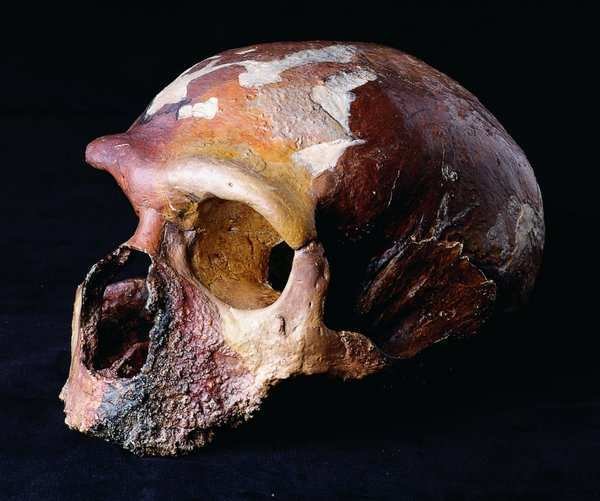
The Guattari 1 Neanderthal skull at the Pigorini Museum
It is the most famous piece in the museum and it is the original, not a cast. That is worth repeating, because many visitors arrive convinced of the opposite. The skull was found on February 24, 1939 at San Felice Circeo, when some workers hired by the owner of the land, Alessandro Guattari, were quarrying stones and by chance opened a cavity that a very ancient landslide had sealed. Inside, at the bottom of what came to be called the Antro dell'Uomo, lay a skull of Homo neanderthalensis in an exceptional state of preservation, missing a portion of the right orbit and with a damaged occipital margin. Two mandibles were collected on the surface, cataloged as Guattari 2 and Guattari 3.
Look at it carefully, in front of the display case. The continuous, thick brow ridges, the face projecting forward, the absence of a chin, the low, long vault: these are the traits of a human species different from ours, which lived in Europe and the Near East for over 200,000 years and went extinct about 40,000 years ago. The Circeo skull is one of the very few complete Neanderthals found in Italy, and for decades it was the most discussed human fossil in the country.
The Sala Guattari and the Laboratorio Neanderthal
Since December 18, 2025 the Sala Guattari has a completely new look and a new name: Laboratorio Neanderthal, le scoperte di Grotta Guattari. The multimedia installation is signed by Studio Azzurro, with artistic direction by Leonardo Sangiorgi and Giuseppe Carmosino. The curators are Maria Grazia Filetici and Andrea Viliani, with a technical-scientific committee that brings together the Directorate General for Museums, the Superintendency and researchers from the universities of Bologna, Sapienza, Tor Vergata and Florence. The room is dark, the architecture recalls the cavity, and the light is calibrated to make the objects emerge from the black as they emerged from the mud of the excavation.
Inside are the finds from 1939 and those from the campaigns opened in October 2019: 15 new human remains among cranial elements, postcranial bones and isolated teeth, which brought the minimum number of Neanderthal individuals documented at the site to 11 and make it the largest sample ever found in a single Italian deposit. Next to the human remains you see the lithic industries of the so-called Pontinian industry, made with the small flint pebbles of the Circeo beaches, and a fauna that tells of an unrecognizable landscape: deer, aurochs, horses, hyenas, elephants, rhinoceroses. There are interactive stations, a table that responds to gestures, a virtual visit of the cave and bilingual panels. The reminder to keep in mind before leaving home: the room follows its own hours, Saturday and Sunday from 8:30 to 13:00, and from Tuesday to Friday it opens by reservation for groups and schools. Anyone who shows up on a Wednesday afternoon without having booked won't see it, and this is the most frequent disappointment I note among visitors to the museum.
The three Paleolithic Venuses
The museum displays three female statuettes from the Upper Paleolithic that are called Venuses for convenience, with a nineteenth-century name that no scholar defends today: the one from Savignano, the one from Lake Trasimeno and the one from La Marmotta. The most famous is the Venus of Savignano, found in 1925 during the excavation of the foundations of a farm building in the Pra Martino farmstead, near Savignano sul Panaro in the province of Modena. It was purchased by the sculptor Giuseppe Graziosi, who then donated it to the museum in Rome. It is made of serpentine, a greenish-brown rock that comes from the ophiolite formations of the Modena Apennines, measures 22.1 centimeters in height by 5 in width and 5.5 in thickness, and weighs 585 grams. The dating, based on stylistic comparisons with the female figurines of the European Gravettian, ranges between 28,000 and 24,000 years ago.
In front of the original you notice what photographs do not convey: the head and the lower part are worked to a pyramidal point, while the breast, belly, buttocks and thighs have a full, confident plasticity, and the joined legs are run through by a longitudinal groove. The figure works from any side you look at it, which not all Paleolithic Venuses do. If I had to point to a single object in the museum for someone who has 10 minutes and wants to understand what sculpture is, I would point to this one, not the skull.
The dugout canoes of Lake Bracciano at the Museo Pigorini
The single-log dugout canoes from the Marmotta site are what strikes children most and, if I'm honest, adults too. They are hollowed out of a single trunk, several meters long, and they have an age that is hard to say out loud without sounding exaggerated: the village they come from was inhabited between 5700 and 5300 BC. They are among the oldest boats in the Mediterranean, and they have reached us because the anaerobic mud on the bed of Lake Bracciano protected them for 7,000 years from the oxygen that would have rotted the wood in a single season.
The Neolithic village of Marmotta
The Marmotta site, off Anguillara Sabazia, is considered the oldest lake village in Western Europe and lies submerged under several meters of water. Five dugout canoes and a quantity of objects that no dry Neolithic site could yield have come out of the excavations: wooden farming tools, architectural elements, whole and fragmentary sickles, textile remains, seeds. The most commonly used wood is oak. To understand the importance of this: in the vast majority of European Neolithic villages nothing remains of the wood, and archaeologists have to deduce the houses from post holes. At Marmotta the houses are still there, and with them the tools that built them. The site is an international reference for the study of Neolithic technology and of the expansion of the first farming communities across the Mediterranean basin. The fifth dugout, kept for 15 years in the visitor center in Anguillara Sabazia, is the subject of an agreement between the Museo delle Civiltà and the municipality for a restoration that will require about 18 months of impregnation alone, plus another six or 10 months of work.
The Widow's Tomb and the Eneolithic
The Eneolithic, in Italy, runs roughly from 3500 to 2200 BC and is the moment when metal tools sit alongside stone ones, changing the way communities organize themselves, trade and differentiate internally. In northern Lazio and southern Etruria this period has a precise name, the Rinaldone culture, and runs from about 3600 to 2500 BC. The burials are of the small-cave type, chambers artificially dug into the ground, or pit burials. The rite involves single, double or collective inhumations, with later reopenings of the tomb to lay other dead in it.
The Widow's Tomb, from Ponte San Pietro near Ischia di Castro in the province of Viterbo, is the showpiece of this section and has an instructive interpretive history. It contained an adult man and a young woman. The male grave goods were very rich, with a copper dagger and axe, a polished-stone hammer axe and 14 arrowheads. For decades the tomb was read as proof of a ritual female sacrifice: the widow killed and buried with her man, complete with a cranial fracture to confirm the violence. Modern radiometric analyses have taken the reconstruction apart piece by piece. The two deaths were not contemporaneous: the man falls between 3750 and 3537 BC, the woman between 3635 and 3376. And the fracture in the female skull, examined closely, turns out to have been produced by rodents, not by a blow. It is one of the most elegant cases I know of archaeology correcting itself, and the museum tells it without hiding the error. That name, Widow's Tomb, remains on the labels, though: the memory of museums is slower than science.
Gricignano d'Aversa
The excavation at Gricignano d'Aversa, in Campania, documented a village of the Laterza culture around 3000 BC, with many huts of elliptical plan and a necropolis of pit graves. The striking fact is the ritual differentiation between the sexes: male tombs contain vases and weapons, female ones have no grave goods. It is information that says a lot about how that society worked, and that no photograph of a vase could convey on its own. Materials of this kind are the reason why at the Museo Pigorini reading the panels matters as much as looking at the display cases.
Polada and the Bronze Age pile dwellings
The materials from the eponymous site of Polada, near Lonato del Garda, define one of the key cultures of the early Bronze Age of the Po plain, the one that precedes and prepares the terramare. Here too the mud preserved the wood, the rope, the textiles: axe handles, wheels, containers. The Polada culture is a subject for specialists, but the public that stops in front of a whole axe handle from 4,000 years ago immediately understands why archaeologists get excited about a piece of wood.
The Coste del Marano hoard
The Coste del Marano hoard, in the territory of Tolfa, is one of the most important bronze assemblages of the end of the Bronze Age in central Italy. A hoard is a deliberate deposit of metal objects, hidden underground. It can be a founder's storeroom, a store of value, or a ritual offering that was never recovered. In the case of Coste del Marano the repertoire includes ornaments in embossed sheet metal of very high quality. These are pieces you look at with a magnifying glass, and it is the moment when it pays to have the right glasses.
Nuragic bronzetti and votive swords
The Sardinian section is one of the most beautiful in the museum and one of the least visited. The Nuragic warrior bronzetto, with the shield, the horned helmet and the frontal posture, belongs to a production that looks like nothing made at the same time in the rest of Italy: an autonomous, geometrizing figurative language, developed in Sardinia between the Final Bronze Age and the early Iron Age. Next to the bronzetti you see the votive swords, specimens of oversized dimensions and manifestly non-practical function, laid in sanctuaries as offerings. Anyone who gets here after seeing the Etruscan bronzes at the Museo Etrusco di Villa Giulia grasps the difference in three seconds.
The Fibula Prenestina at the Pigorini Museum
Small, gold, and capable of having held Latin philology in check for 30 years. The Fibula Prenestina bears the engraved inscription MANIOS MED FHEFHAKED NUMASIOI, which in classical Latin would read Manius me fecit Numerio: Manio made me for Numerio. If the dating holds, and it is placed around the middle of the 7th century BC, we are looking at the oldest inscription in the Latin language known. The history of the object is worthy of a novel. The German archaeologist Wolfgang Helbig presented it in 1887, declaring that he had bought it in 1876 and later indicating as its provenance the Bernardini tomb at Palestrina, from which it was supposedly removed. In 1919 the fibula was taken off the inventories for lack of certainty about its archaeological provenance. In 1980 the epigraphist Margherita Guarducci publicly maintained that both the inscription and the fibula were a forgery, the result of an agreement between Helbig and the antiquarian Francesco Martinetti. The question was closed in 2011, when Daniela Ferro of the CNR Institute for the Study of Nanostructured Materials and Edilberto Formigli, with an electron microscope and microprobe, verified the match between the goldsmithing techniques visible on the object and those practiced in the Etruscan environment in the indicated period. The piece you see at the museum is the real one. A modern reproduction is on display at the Baths of Diocletian. A tip: read the inscription out loud, sounding it out syllable by syllable. Hearing that language turn into Latin is an experience no panel can replace.
The Arts and Cultures collections of the Museum of Civilizations
The first floor of the Palazzo delle Scienze houses the African, American, Asian and Oceanic Arts and Cultures collections, and it is the part now affected by the works that make it visitable only in stages until winter 2026. It is still worth knowing what is there, for two reasons: because the selection displayed on the ground floor in In corso d'opera rotates and draws precisely from there, and because anyone who returns to Rome in a few months will find one of the most important ethnographic collections in Europe.
The numbers, in order of magnitude, are these: about 20,000 American works, about 15,000 Oceanic, about 10,000 African, to which are added the Asian collections of the Pigorini, over 15,000 objects, and the roughly 40,000 pieces of the Giuseppe Tucci National Museum of Oriental Art, which has also merged into the Museum of Civilizations. It is a heritage that no room could display in full, and in fact it doesn't.
American Arts and Cultures at the Museum of Civilizations
The American collection is the oldest in the museum by date of formation and has a precise Roman root: the Museo Kircheriano of the Collegio Romano, formed between 1635 and 1680 with the materials that the missionaries of the Society of Jesus sent to Rome from Brazil, China and Canada. To that core were added over time Capuchin collections from the Congo and Angola, diplomatic gifts, and purchases of nineteenth-century private collections.
The Mesoamerican itinerary starts with the Olmecs, between 1700 and 300 BC, and runs through the Mixtecs, Zapotecs and Totonacs up to the Aztecs, from 1300 to the Spanish conquest of 1521. The turquoise mosaic-covered masks are the pieces everyone photographs and everyone remembers: surfaces made of thousands of tiny tesserae, worked with a patience that almost frightens us today. The Andean area is covered just as seriously, with Chavín, Paracas, Nasca, Moche, Recuay, Pukara, Tiwanaku, Chimú, Chincha, the Aymara kingdoms and finally the Inka. There are Paracas textiles, Moche portrait ceramics, goldwork. An unpopular opinion: this collection deserves more than the distracted stop that almost all visitors give it, and Andean textile, if you look closely at how it is built, is technically more complex than the gold object you look at first.
Oceanic Arts and Cultures
The Oceanic section gathers about 15,000 objects from Melanesia, Polynesia, Micronesia and Australia, with important nineteenth-century collections from New Guinea, which arrived in Rome in the season of the great scientific explorations. The itinerary is organized by major themes: the haus tambaran, the men's ceremonial house in the Sepik region, with its masks and carved posts. The kula exchange circuit of the Trobriand Islands, where shell necklaces and armbands traveled in opposite directions along a ring of islands creating alliances and prestige. The malagan sculptures of New Ireland, carved for a single funerary ceremony and then destined to be abandoned. The materials from the Solomon Islands and New Caledonia. The Polynesian concept of mana as a power that accumulates in objects and people. The ancestral beings of Australian cosmology.
The kula, in particular, is one of the most interesting things an ethnographic museum can explain, because it is an economic system that doesn't produce material wealth and serves instead to produce relationships. Bronislaw Malinowski described it in 1922 in Argonauts of the Western Pacific, and since then anthropology has not stopped debating it. In front of a mwali armband you understand, better than by reading a hundred pages, how the value of an object can have nothing to do with the material it is made of.
African Arts and Cultures
The roughly 10,000 African works have a layered provenance that the museum now declares openly instead of hiding it behind the neutral term collection. There are materials from the Royal House, there are the collections of cardinals Flavio Chigi senior and Stefano Borgia, there are the fruits of the expeditions promoted by the Italian Geographical Society with Romolo Gessi and Giacomo Bove, and there are pieces that came from the Venice Biennale of 1922. There are Nigerian ivories and power figures from the Congo basin.
The historical point the museum highlights is that this collection was formed within the political framework opened by the Berlin Conference of 1884, that is, at the moment when the European powers carved up Africa, and that it was ordered according to the nineteenth-century evolutionary scale, the one that placed African cultures at the bottom of an imaginary hierarchy. The current installation does not reproduce that hierarchy. It displays it as an object of study, showing the historical photographs of the rooms as anthropological documents in their own right. It is a choice I share without reservation. A museum that built its display cases on a wrong theory has two options: pretend it didn't happen, or tell it. Here they chose the second, and that is what makes this museum different from many of its European counterparts.

Asian Arts and Cultures
To the Asian collections of the Pigorini have been added the materials of the Giuseppe Tucci National Museum of Oriental Art, which bring as a dowry 7,000 years of art history across Iran, Afghanistan, India, China and Vietnam. The Iranian and Afghan core derives in large part from the excavations of the Italian Institute for the Middle and Far East, the body founded by Giuseppe Tucci, a Tibetologist and orientalist who was one of the most imposing and most debated figures of twentieth-century Italian culture. The Tibetan section, with paintings on cloth and ritual bronzes, is the one that strikes most those who don't expect it.
The former Colonial Museum and the Museo delle Opacità
This is the part of the Museum of Civilizations that is talked about most outside Italy and least in Roman conversations, and it deserves to be told in full because it is the story that, more than any other, explains what this institution is today.
What the Colonial Museum was
The Colonial Museum of Rome was inaugurated in 1923 at the wish of Benito Mussolini, with its initial seat in the Palazzo della Consulta. In 1935 it was moved to Via Aldrovandi, in the Parioli district. In 1940 it changed its name to Museum of Italian Africa, in keeping with the regime's imperial rhetoric. Reopened in 1947, it survived the fall of fascism and the end of the colonies until its closure, in 1971. The collections had been transferred in 1956 to the Italian Institute for Africa, and from there, after other transfers, they passed into the heritage of the Ministry of Culture in 2017, to be finally assigned to the Museum of Civilizations.
The total is about 12,000 objects: archaeological finds, works of art, handicrafts, seeds, scientific instruments, maps, and even the original display devices, that is, the display cases and panels with which Italian colonialism told its own story to itself. That material remained in storage for over 50 years. It documents almost a century of Italian presence in Africa, from 1882 to 1960.
The Museo delle Opacità
On June 6, 2023 the Museum of Civilizations opened the chapter titled Museo delle Opacità, which brings those materials back into the rooms by putting them in dialogue with contemporary artworks. The term opacity has a double root: on one side it refers to the collective removal of the Italian colonial past, on the other it takes up the theoretical notion of Édouard Glissant, for whom opacity is everyone's right to keep an identity of their own without being reduced, translated and classified by the gaze of others.
The installations are distributed on the mezzanines of the two buildings. One section is devoted to the Ethiopian collections, to the stories of appropriation and to restitutions, including the Ethiopian parliamentary paintings of 1936 and 1938 and their partial return in the 1950s, and the documentation of the return of the Aksum obelisk. Another section concerns Libya and the role of cartography in the erasure of territorial memory. There is a cinema space, where Inconscio italiano by Luca Guadagnino is screened. There is an installation turned toward the future, ph0n0museum rome, set in 2154 and imagined by Wissal Houbabi, Toi Giordani and Ismael Astri Lo.
Among the artists present: Sammy Baloji with Gnosis from 2022, a black fiberglass sphere that reflects and distorts what surrounds it, acquired through the 2022 Plan for Contemporary Art. DAAR, that is Sandi Hilal and Alessandro Petti, with Ente di Decolonizzazione, Borgo Rizza, the 2021 work that won them the Golden Lion at the Venice Biennale. And also Jermay Michael Gabriel, Francis Offman, Theo Eshetu, Adelita Husni Bey, Rossella Biscotti, Peter Friedl. The research is conducted with a participatory method, involving citizens, collectives, communities, artists, curators and scholars.
Provenance, restitutions and the museum that won't open
Since 2022 an international research group has been working on the provenance of the collections and on possible restitutions, and the matter is also regulated by the decree of October 18, 2021 that established the committee for the recovery and restitution of cultural property. On one point it is worth being clear, because the opposite information still circulates online: the project for a new Museo Italo-Africano Ilaria Alpi as an independent institution is not in the plans. The management chose the path of critical re-installation inside the Museum of Civilizations, which is a much harder and much more honest choice than opening a new museum and leaving the questions intact.
Where the Pigorini Museum comes from: four centuries in order
The Museo Kircheriano, the grandfather of the Pigorini Museum
It all begins at the Collegio Romano, in the building the Jesuits built at the end of the sixteenth century. There, between 1635 and 1680, Father Athanasius Kircher, a German Jesuit of boundless curiosity and questionable method, gathered a wunderkammer that held together antiquities, machines, minerals, miniature obelisks and ethnographic materials sent to Rome from missions all over the world. That museum of wonders is the direct grandfather of the collections you see today at EUR: the ethnographic part of the Kircheriano flowed into the Pigorini, and with it the first American core.
Luigi Pigorini
Luigi Pigorini was born in Fontanellato, in the Parma area, on January 10, 1842. At 16, in 1858, he was already a student at the Museum of Antiquities of Parma: a precocity that today seems like something out of a novel and that back then was the normal way provincial scholars were formed. He graduated in political and administrative sciences, traveled, taught, and in 1875 he founded, together with Gaetano Chierici and Pellegrino Strobel, the Bullettino di Paletnologia Italiana, the journal that gave birth to the discipline in Italy. The same year he joined the General Directorate of Museums and Excavations of Antiquities of the Kingdom, in Rome, and proposed to the minister to create a national prehistoric museum.
The proposal was accepted. The Regio Museo Preistorico ed Etnografico was inaugurated on March 14, 1876 in the Palazzo del Collegio Romano. In 1877 Pigorini obtained the first chair of Paletnology at the University of Rome and held it for about 40 years. He was appointed senator in 1912 and vice president of the Senate in 1919, a post he kept until his death, which occurred in Padua on April 1, 1925.
On Pigorini it is worth being precise about the uncomfortable side too. His idea of a museum was openly political: to build, through the prehistory of the peninsula, a story of national continuity for a country unified only a few years earlier and lacking a shared memory. His theories on the Po Valley terramare as the original core of Italian identity were dismantled by twentieth-century research. The fact remains, however, that this man invented a discipline, created a network of correspondents all over Italy and put together the heritage we visit today. You can debate his theses without dismantling his museum, and that is what the museum itself does today.
From the Collegio Romano to EUR
In 1911, on the occasion of the fiftieth anniversary of Unification, the Congress of Italian Ethnography and the exhibition that accompanied it produced the core of what would become the museum of folk arts and traditions, today housed in the Palazzo delle Arti e Tradizioni Popolari Lamberto Loria, at number 8 of the same piazza. The transfer of the prehistoric and ethnographic collections from the Collegio Romano to EUR took place in stages between 1962 and 1977, with the bulk of the work concentrated in the years between 1975 and 1977. The reason was as prosaic as it was decisive: the Collegio Romano was needed by the newly created Ministry for Cultural and Environmental Heritage, and the museum had to make room. The Museo dell'Alto Medioevo had already arrived at the Palazzo delle Scienze in 1967.
The 2016 reform
With the 2016 decrees signed by the then minister Dario Franceschini, the Museum of Civilizations was born, bringing together in a single institution the Luigi Pigorini Prehistoric and Ethnographic Museum, the Museo dell'Alto Medioevo, the Giuseppe Tucci National Museum of Oriental Art and the Lamberto Loria Museum of Folk Arts and Traditions. Since 2011 the collections of the former African museum had already flowed into the Pigorini. In 2022 the geological and mineralogical collections of ISPRA were added, heir to that Regio Ufficio Geologico established in 1873 on the initiative of Quintino Sella and Felice Giordano.
The name Pigorini, therefore, no longer indicates an independent institution today: it indicates a collection, a history, a tradition of studies. The plaque outside the door says Museo delle Civiltà. Romans keep saying the Pigorini, and they will do so for at least another 20 years.
The Palazzo delle Scienze, home of the Pigorini Museum
The building deserves a stop of its own. It was built between 1938 and 1943 to a design by Luigi Brusa, Gino Cancellotti, Eugenio Montuori and Alfredo Scalpelli, under the overall coordination of Marcello Piacentini, and it was intended for the Universal Science Exhibition of the 1942 Exposition, the event that gave the neighborhood its name and that was never inaugurated because the war overwhelmed it. Piazza Guglielmo Marconi, which was then called Piazza Imperiale, was conceived as one of the focal points of the entire exposition: on three sides were to rise the museums of ancient art, modern art and science, and on the fourth a cinema theater that was never built.
The language is that of Italian rationalism in its monumental version: porticoes with square pillars, travertine cladding, absolute symmetry, high regular windows. You like it or you don't, but it must be looked at for what it is, that is, a document of political architecture built to impress, and it must be read together with the rest of the neighborhood. Anyone who wants to really understand it should set aside half an hour for the EUR neighborhood before or after the visit, because the museum and the building that contains it tell two different stories that met by chance, in 1977, when the State had to find a home for the collections evicted from the Collegio Romano.
A curiosity about the Luigi Pigorini National Museum of Prehistory and Ethnography - Museum of Civilizations
For almost a century this museum was a one-way narrative machine, and the machine was built into the very architecture of the rooms. The Arts and Cultures collections were ordered according to the nineteenth-century evolutionary scale, an imaginary hierarchy of human civilizations that assigned Asia the highest place, and then, further and further down, the Americas, Oceania and, last of all, Africa. The visitor who walked through the rooms was not simply looking at objects: he was following, without knowing it, an ideological path that explained to him where to place the peoples of the world, and where to place himself in relation to them. Prehistory, upstairs, provided the zero step of that scale, that of primitive man, and the comparison between an Italian Neolithic vase and a contemporary African mask served to suggest that the two things belonged to the same stage of development. It was not a naive mistake. It was the official science of the time, and it served to justify a policy.
The real curiosity is that the museum has not erased that history: it has turned it into material to exhibit. The historical photographs of the installations are now treated as full anthropological documents, exactly like the objects they depict. They are studied, published, shown, because they make it possible to reconstruct the interpretive framework that produced them and to understand where the people who put those objects inside those display cases, in that order, were coming from. It is a rare reversal, and in the European museum landscape few institutions have had the courage to do it on themselves. It is the reason why, having to choose among the city's museums the one that today has the most to say to a thinking adult, we would point without hesitation to the Pigorini Museum and not to one of the big names in the center. You don't come here to look at beautiful things: you come to understand how we learned to look at them.
One thing nobody tells you about the Luigi Pigorini National Museum of Prehistory and Ethnography - Museum of Civilizations
The most important thing about this museum is the one you won't see. Between the two buildings on Piazza Guglielmo Marconi, the Museum of Civilizations occupies about 50,000 square meters of rooms and storerooms, and the percentage of the heritage actually on display is a modest fraction of the total. The Arts and Cultures collections alone number tens of thousands of pieces: about 20,000 American, about 15,000 Oceanic, about 10,000 African, over 15,000 Asian from the Pigorini holdings, and another roughly 40,000 from the Tucci Museum. No imaginable installation could handle those numbers. The museum you visit is therefore a selection, and every selection is a choice, and every choice can be debated.
The most striking case concerns the 12,000 objects of the former Colonial Museum. After that museum closed in 1971, its collections stayed in crates for over 50 years: archaeology, works of art, handicrafts, seeds, scientific instruments, maps, and even the original panels and display cases with which Italian colonialism represented itself. 50 years of silence are not a logistical accident, they are a cultural choice of an entire country. The fact that this material is now on display, within the Museo delle Opacità project opened on June 6, 2023, is the most relevant news concerning this address in the last 30 years, and it is the one least told by generalist tourist guides.
The second thing nobody says is practical and costs dearly to those who don't know it: the Sala Guattari, the one with the Neanderthal skull, has its own hours, independent of the rest of the museum. It opens to the public freely only on Saturday and Sunday from 8:30 to 13:00. From Tuesday to Friday it can be visited by reservation for groups and school classes. Anyone who plans the day around a Tuesday afternoon and comes here for the Circeo skull finds the door closed and the ticket already paid.
My advice for visiting the Luigi Pigorini National Museum of Prehistory and Ethnography - Museum of Civilizations
First: come on a Saturday morning, at 8:00 sharp. The museum opens at that hour, which almost nobody else in Rome does, and for the first hour the building is yours. At 8:30 the Sala Guattari opens, and you're already inside and already in the right place: do it first, with a clear head, because it is the room that asks for the most attention and the only one that closes at 13:00.
Second: go up to the second floor right away and work your way down. Prehistory requires reading and concentration, and tackling it after two hours of walking means going through it without seeing it. Those who start from the bottom, systematically, reach the second floor tired and look at the display cases from a distance. Those who start from the top leave knowing something.
Third: take the weekend guided tour. €5 per person, booking to be closed by Friday, and the service is run by AbIntra. It is not an expense, it is the difference between understanding and not understanding, because the new layout of the second floor reasons by problems and not by chronological sequences, and without someone to hold the thread the visitor collects scattered objects.
Fourth: if you live in Rome or come back often, buy the annual card at €22.00. It pays for itself on the third visit and lets you do what this museum really asks, which is to come back. As long as the first floor stays under construction until winter 2026, the card is also the only smart way not to miss the progressive reopenings of the rooms.
Fifth, and this is the advice nobody will give you: don't come here at the end of the day after the Forums and the Colosseum. It doesn't work. This museum needs to be tackled with morning energy and paired with EUR, not with the historic center. A morning here, lunch on Viale Europa, an afternoon between the Square Colosseum and the EUR lake: that is the right day, and it is a Roman day that almost no tourist does.
Another well-known fact, yet rarely cited
Everybody knows that the Pigorini Museum has the Neanderthal skull from Circeo. Almost everybody also knows the story that made it famous: the artificially enlarged foramen magnum, the skull laid in the center of a rough circle of stones, and the interpretation by Alberto Carlo Blanc, who conducted the first excavations and saw in those signs proof of ritual cannibalism, with the brain extracted through the opening to be eaten in a ceremony. That reading went around the world, entered the textbooks, fed for decades the image of the brutish, bloodthirsty Neanderthal, and generated an endless popular literature.
What is cited much less is that the theory has fallen. In 1989, exactly 50 years after the discovery, an international conference gathered at Circeo reexamined the evidence with the methods of modern taphonomy, that is, the study of what happens to a body after death. The result was clear: the only recognizable marks on the bones were produced by hyena teeth. The cave, around 50,000 years ago, had been a hyena den. It was the hyenas that carried the remains into the cavern and gnawed the skull while feeding. No rite, no banquet, no circle of stones arranged by human hands, but a perfectly ordinary accumulation by carnivores. The revision scaled down a legend and made the fossil more interesting, not less, because it moved the question from mythology to research.
It is worth adding the sequel, which belongs to these years. The excavation campaigns resumed in October 2019 yielded 15 new human remains, among cranial fragments, postcranial bones and isolated teeth, which bring to 11 the minimum number of Neanderthal individuals documented in the cave: the largest sample ever recovered from a single Italian deposit. Eight of those remains date between 50,000 and 68,000 years ago, one goes back to a range between 100,000 and 90,000. A fossil that seemed closed for 80 years has started speaking again, and the new Sala Guattari serves exactly to tell that reopened conversation.
The right photo to take at the Luigi Pigorini National Museum of Prehistory and Ethnography - Museum of Civilizations
The photo everybody tries is the one of the Circeo skull, and it is almost always a bad photo. The reason is technical: the display case is well lit for the eye but terrible for the sensor, the glass reflects the ceiling and your body, and the flash is forbidden as well as useless because it flattens the relief of the brow ridges, which is precisely the thing worth showing. If you care about getting it, this is the procedure: lens resting on the glass or a couple of centimeters away, your body acting as a screen against the light behind you, sensitivity raised without fear up to 1,600 or 3,200 ISO, exposure reduced by one stop so as not to burn the pale bone, and shoot at a slight three-quarter angle rather than in profile, so the shadow carves out the brow ridge and the skull stops looking like a rock.
The truly beautiful photo, however, is another one and it is not inside a display case: it is the La Marmotta dugout canoe shot along its whole length, with a person in the frame to give the scale. Without a human body next to it nobody understands how long it is, and the photograph becomes a piece of wood. With a figure beside it, it becomes a boat from 7,000 years ago, and the difference is all there. Stand at the far end of the room, with a moderate wide-angle lens around 28 millimeters equivalent, and shoot diagonally following the axis of the hull.
Outside the museum, the photograph to take home is the one of the portico of the Palazzo delle Scienze seen from the piazza in the last hour of light. At that hour the travertine turns amber, the square pillars cast sharp, regular shadows like a musical score, and the rationalist architecture is at its best exactly when it is most severe. Backlit, at dawn, it works even better, and since the museum opens at 8:00, anyone who arrives early in winter finds it already served up. A tip from someone who has seen hundreds of people get the framing wrong in this piazza: don't put the whole building in the frame. Take five pillars, or six, and let the eye complete the rest.
Some important events that happened here in history
The chronology of this museum is a chronology of the Italian State, and it is best followed by dates because each step corresponds to a different idea of what a museum is for.
On March 14, 1876 the Regio Museo Preistorico ed Etnografico was inaugurated in the Palazzo del Collegio Romano, wanted by Luigi Pigorini and approved by the ministry the year before. It was the first national museum of prehistory in the Kingdom, and it was born with an explicit political task: to give the newly unified country a shared temporal depth. The previous year, 1875, Pigorini had founded with Gaetano Chierici and Pellegrino Strobel the Bullettino di Paletnologia Italiana, and in 1877 he would obtain the first Italian chair of the discipline.
In 1911, for the fiftieth anniversary of Unification, the Congress of Italian Ethnography and the large exhibition that accompanied it brought together the core of the folk arts and traditions collections, those tied to the name of Lamberto Loria, which would later find a home in the building across the way.
Between 1938 and 1943 the Palazzo delle Scienze was built for the Universal Science Exhibition of the 1942 Exposition, which was never inaugurated: the war stopped everything, and for years the building remained a monumental shell in search of a function. In 1967 the Museo dell'Alto Medioevo arrived there. Between 1962 and 1977, with the decisive phase concentrated between 1975 and 1977, the prehistoric and ethnographic collections moved in, driven out of the Collegio Romano by the birth of the Ministry for Cultural and Environmental Heritage.
In 2011 the collections of the former African museum flowed into the Pigorini. In 2016, with the decrees signed by minister Dario Franceschini, the Museum of Civilizations was born, which merged four institutes into one. In 2022 the geological and mineralogical collections of ISPRA arrived, heir to the Regio Ufficio Geologico established in 1873 on the initiative of Quintino Sella and Felice Giordano. On October 26, 2022 the new installation of the second floor, Preistoria? Storie dall'Antropocene, opened. On June 6, 2023 the Museo delle Opacità opened, with the return to the rooms of the materials of the former Colonial Museum. On December 18, 2025 the new Sala Guattari was inaugurated with the installation Laboratorio Neanderthal, signed by Studio Azzurro.
Outside these walls but inside this story there is a date that counts more than all: February 24, 1939, when Alessandro Guattari's workers, quarrying stones at San Felice Circeo, by chance opened a cave sealed by a very ancient landslide and found the skull that would make the museum's fame.
Who has passed through the Luigi Pigorini National Museum of Prehistory and Ethnography - Museum of Civilizations
The first name is the founder's. Luigi Pigorini, born in Fontanellato on January 10, 1842 and died in Padua on April 1, 1925, directed this museum from its founding and made it the center of a national network of excavations, correspondents and publications. A senator from 1912, vice president of the Senate from 1919, he held for 40 years the first chair of Paletnology at the University of Rome. Before him, and behind him, stands the figure of Athanasius Kircher, the German Jesuit who between 1635 and 1680 gathered at the Collegio Romano the museum of wonders from which the first ethnographic and American core of these collections comes.
Alberto Carlo Blanc, a paletnologist of the Italo-French school, conducted the research at Grotta Guattari after the 1939 discovery and is the author of the ritual interpretation of the skull that set the standard for half a century before being refuted. Margherita Guarducci, the greatest Italian epigraphist of the twentieth century, entered the history of this museum from the opposite side: in 1980 she publicly maintained that the Fibula Prenestina was a nineteenth-century forgery, opening a controversy that would last 31 years and that closed only in 2011 with the analyses of Daniela Ferro and Edilberto Formigli. Even earlier, in 1887, Wolfgang Helbig had passed through here, the German archaeologist who presented the fibula to the scientific world and whose reputation the affair overwhelmed.
The sculptor Giuseppe Graziosi bought in 1925 the statuette of Savignano sul Panaro from the farmers who had found it while digging the foundations of a farm building, and donated it to this museum, where it still is. Romolo Gessi and Giacomo Bove, explorers of the Italian Geographical Society, left here the materials of their African expeditions. Giuseppe Tucci, orientalist and Tibetologist, founder of the Italian Institute for the Middle and Far East, gave his name to the museum of oriental art that merged into the Museum of Civilizations, bringing as a dowry excavations in Iran and Afghanistan. Quintino Sella and Felice Giordano, from 1873, started that Regio Ufficio Geologico whose collections arrived here in 2022.
Among contemporaries, the museum has hosted and hosts names that carry weight in international art. Ali Cherri, Silver Lion at the Venice Biennale in 2022, is present in the prehistoric itinerary with the film The Digger. Sammy Baloji, a Congolese artist, left Gnosis, a 2022 work that entered the collections. Sandi Hilal and Alessandro Petti, who work as DAAR, brought here Ente di Decolonizzazione, Borgo Rizza, awarded the Golden Lion. Luca Guadagnino is present with the film Inconscio italiano. Elizabeth A. Povinelli signs the texts that rewrite the notion of prehistory. And since December 2025 there is the hand of Studio Azzurro, with Leonardo Sangiorgi and Giuseppe Carmosino, in the skull room: a collective that since the 1980s has changed the way Italian museums use video.
How to fit the Pigorini Museum into a Roman day
This museum works poorly as an isolated stop and very well as the pivot of a well-built day. Here are three days I usually propose, in order of practicality.
An EUR day around the Pigorini Museum, without leaving the neighborhood
Entrance at 8:00 at the Palazzo delle Scienze, two full hours of visit, then you cross the piazza and enter number 8, the Museo delle Arti e Tradizioni Popolari Lamberto Loria, which is the other half of the Museum of Civilizations and tells the story of peasant, artisan and festive Italy with Sicilian carts, work tools, costumes and nativity scenes. Lunch on Viale Europa, where the places are more for office workers than for tourists and you eat decently at reasonable prices. Afternoon on foot: the Palazzo della Civiltà Italiana, the Palazzo dei Congressi by Adalberto Libera, the lake with the Japanese cherry trees and, if there are children on board, the EUR Social Park to burn off their energy. Anyone with energy left can close with the Museo della Via Ostiense, heading down toward Piramide, or with Cinecittà by taking metro A.
A Lazio prehistory day, with the dugout canoes as the common thread
You start from the museum, with the La Marmotta canoes and the materials from the Neolithic village, then you take the car and go see the place they come from: Anguillara Sabazia on Lake Bracciano, the visitor center, the town perched above the water. In the afternoon you go up to the Castello Odescalchi in Bracciano, which has nothing to do with prehistory but closes the day with a view that pays back the trip. Anyone who prefers to shift the axis toward the Iron Age and the Etruscans has three first-rate alternatives: the Parco di Veio, the Necropoli della Banditaccia in Cerveteri and Tarquinia. Toward the south, instead, the Prehistoric Museum of Pofi in Ciociaria and the Archaeological Museum of Palestrina complete the Lazio picture seriously.
A Guattari day, if the skull got to you
It happens often, and it happens above all to those who didn't expect it. If the Sala Guattari left you wanting to see the place, the Circeo National Park is a little over two hours from Rome and gives back the environmental context in which those Neanderthals lived: the dune, the lowland forest, the reclaimed marshes, the limestone promontory riddled with cavities. Afternoon on the beach at San Felice Circeo, dinner in Sperlonga. The reminder: the Sala Guattari opens to the public freely only on Saturday and Sunday from 8:30 to 13:00, so the day has to be built starting from that window and not the other way around.
The Pigorini Museum and Rome's other archaeological museums
The Pigorini fits well into a multi-day itinerary devoted to Roman archaeology. The Museo Etrusco di Villa Giulia is the natural complement for the Iron Age and for the Etruscans. Palazzo Massimo alle Terme and the Baths of Diocletian cover classical Rome, the Crypta Balbi the passage from antiquity to the Middle Ages, the Centrale Montemartini the pairing of ancient sculpture and industrial archaeology. For those looking for the Paleolithic inside the Grande Raccordo Anulare, the Museo di Casal de Pazzi preserves a river deposit from 200,000 years ago discovered during construction work, with tusks of an ancient elephant and a fragment of a human skull. It is the best possible follow-up to a morning at the Pigorini, and it is almost unknown even to Romans.
The Pigorini Museum with children
It works, and works well, as long as you know what to show. From age six up this is one of the most effective museums in Rome for the little ones, and the reason is simple: the objects are big, recognizable and tied to stories you can tell in 30 seconds. The canoe is a boat, and everyone understands a boat. The Nuragic swords are swords. The masks are masks. The skull is a real skull of a man who wasn't like us, and no child stays indifferent in front of that sentence.
The itinerary I recommend with children is short and selective: the canoe, the Venuses, the Sardinian bronzetti, the skull, and then outside. An hour and a quarter, no more. The museum offers educational workshops and also organizes birthday parties with a guided tour, which few state museums in Rome offer. The closing section of the second floor, the one on imaginative hominization and future scenarios, works with middle and high school kids and leaves the youngest cold: with them, better to skip it and leave while they are still happy. The EUR park 200 meters away takes care of the rest of the afternoon better than any room.
When to go and when to avoid the Museum of Civilizations
The absolute best time is Saturday morning between 8:00 and 10:00: museum open, Sala Guattari accessible from 8:30, empty rooms, good light. The second best time is a Tuesday or Wednesday morning off-season, when the museum is practically deserted and you can read every panel with nobody behind you.
There are three times to avoid. The first: late morning on weekdays during the school year, when school classes fill the second floor and the Sala Guattari is occupied by booked visits. The second: late afternoon, always, because arriving at 17:30 with last entry at 18:30 means doing half the museum on the run and feeling guilty. The third: the first Sunday of the month if you have even a single doubt about your tolerance for crowds, although here, to be honest, the first-Sunday crowd is a fraction of what you see in the center.
On the climate: the museum is air-conditioned and in summer it offers a serious refuge in the worst hours. In winter the rooms on the second floor, high and with big windows, can feel cool: an extra sweatshirt doesn't hurt. And since EUR is a neighborhood you cover on foot with long distances between one building and the next, comfortable shoes matter here more than in the center.
Quick questions about the Luigi Pigorini National Museum of Prehistory and Ethnography - Museum of Civilizations
Does the Pigorini Museum still exist?
Not as an independent institution. Since 2016 the prehistoric and ethnographic collections founded by Luigi Pigorini have been part of the Museum of Civilizations, together with the Museo dell'Alto Medioevo, the Giuseppe Tucci National Museum of Oriental Art and the Lamberto Loria Museum of Folk Arts and Traditions. The name Pigorini now indicates a collection and a tradition of studies, not a separate museum. The location has been the same since 1977.
Where exactly is the Pigorini Museum?
At the Palazzo delle Scienze, Piazza Guglielmo Marconi 14, EUR neighborhood, Rome. The reference stop is EUR Fermi on metro B, five minutes on foot. The twin building on the other side of the piazza, at number 8, houses the Museo delle Arti e Tradizioni Popolari.
How much is a Museum of Civilizations ticket?
Full price €10.00, reduced €2.00 for European Union citizens between 18 and 25, free for under 18s. There is also a Friend ticket at €5.00 reserved for certain categories tied to the museum's events. The Museum of Civilizations annual card costs €22.00. Free admission on the first Sunday of the month and on April 25.
Can you buy Pigorini Museum tickets online?
The museum does not run its own online sales channel: the ticket is bought at the desk, at the entrance of the Palazzo delle Scienze. Considering attendance, it's not a problem. If anyone offers you a skip-the-line for this address, you are paying for a service you don't need.
When is the Museum of Civilizations closed?
On Mondays. On the other days, Tuesday to Sunday, it opens at 8:00 and closes at 19:00, with last entry at 18:30. Closures on holidays should be checked on the official website before you leave.
Is the Neanderthal skull from Circeo the original or a cast?
It is the original. The Guattari 1 skull, found on February 24, 1939 at San Felice Circeo, is on display here as the original in the Sala Guattari, re-installed since December 18, 2025 with the Laboratorio Neanderthal project.
How do you visit the Sala Guattari?
The room follows its own hours: Saturday and Sunday from 8:30 to 13:00 for the general public, Tuesday to Friday by reservation for groups and school classes. Being a space with dedicated equipment, it may close for maintenance: a check on the official website the day before is time well spent.
Which floor is the prehistory on at the Pigorini Museum?
On the second floor of the Palazzo delle Scienze, with the installation Preistoria? Storie dall'Antropocene opened on October 26, 2022. The African, American and Oceanic Arts and Cultures collections occupy the first floor. The elevators serve both levels.
Can you see the African, American and Oceanic collections?
The first floor is affected by a seismic and systems upgrade project and remains closed until winter 2026. In the meantime a rotating selection of masterpieces from those collections is on display on the ground floor in the itinerary In corso d'opera.
How much time do you need to visit the Pigorini Museum?
Two hours for an honest visit of the Palazzo delle Scienze, three if you read everything, a good half day if you add the building across the way. With children, a well-chosen hour and a quarter works better than two full hours.
Is the Pigorini Museum suitable for children?
From age six up, very much. The canoe, Nuragic swords, masks and skull work on any child. The museum organizes educational workshops and birthday parties with a guided tour. The final section on future scenarios, on the other hand, is material for older kids.
Do you need to book a visit to the Museum of Civilizations?
For an individual visit, no. For groups and school classes, yes, with a booking fee of €10.00. The weekend guided tours for individual visitors must be booked by Friday.
How much do the guided tours cost?
€5 per person for the weekend guided itineraries. €100 for a group of up to 20 participants, €120 in English. Participants beyond the 20th pay €5 each, €6 in English. The service is run by AbIntra, with bookings at +39 375 8323206 or at didatticamuciv@abintra.it.
Is the Roma Pass valid at the Pigorini Museum?
Yes, the museum is part of the Roma Pass circuit, in the 48-hour and 72-hour versions.
Is the Museum of Civilizations wheelchair accessible?
Yes, and it is among the best equipped in Rome: elevators to the first and second floors, equipped restrooms on every floor, wheelchairs and reclining chairs on free loan, Braille paths along the collections, two reserved parking spaces in front of each building. Free admission for the person with a disability and for the companion.
Can you take photographs at the Pigorini Museum?
Photographs without flash and without a tripod are normally allowed in the permanent collection rooms. Different rules may apply to temporary exhibitions: ask the room staff, who are happy to answer.
Can you enter with a dog?
Yes, from 14:00 to 19:00, paying the reduced ticket. Guide dogs and service dogs enter free of charge with no time limits, and small animals carried in your arms or in a bag enter freely.
Is there a coat check?
At the entrance there is a storage service for bulky bags and backpacks, according to the security rules in force in state museums. Large backpacks and umbrellas must be left, small bags are carried into the rooms.
Is there a long wait in line?
Almost never. This museum has one of the most favorable ratios between quality of collections and attendance in all of Rome. Even on the best days the line at the ticket desk clears in a few minutes.
What is the difference between the Pigorini Museum and the Museo Etrusco di Villa Giulia?
They cover different and partly consecutive eras. The Pigorini tells the story from the Paleolithic to the Metal Age, with the addition of the non-European ethnographic collections. Villa Giulia starts from the Iron Age and focuses on Etruscan civilization and pre-Roman Italy. Anyone who wants to understand the complete sequence visits them in this order, the Pigorini first and then Villa Giulia.
What is the difference between the Pigorini Museum and the Museum of Civilizations?
They are not two different museums. The Museum of Civilizations is the institution born in 2016 that includes, among others, the prehistoric and ethnographic collections founded by Pigorini. Anyone looking for the Pigorini must go to the Museum of Civilizations, and finds other things there too.
Will a Museo Italo-Africano Ilaria Alpi open?
The project for a new independent museum is not in the plans. The path chosen is the critical re-installation of the collections of the former Colonial Museum inside the Museum of Civilizations, within the Museo delle Opacità project opened on June 6, 2023, together with the work on provenance and possible restitutions started in 2022.
What is the Fibula Prenestina and why is it famous?
It is a small gold fibula with the inscription MANIOS MED FHEFHAKED NUMASIOI, that is Manio made me for Numerio: if the dating to the middle of the 7th century BC holds, it is the oldest known Latin inscription. It was accused of being a forgery in 1980 by Margherita Guarducci and rehabilitated in 2011 by the analyses conducted by Daniela Ferro and Edilberto Formigli.
Can you eat inside the museum?
There is no internal restaurant comparable to those of the big museums in the center. The practical solution is Viale Europa, a few minutes on foot, with cafes and trattorias frequented mostly by people who work in the neighborhood and prices far from tourist ones.
Is the Pigorini Museum air-conditioned?
Yes, and it is one of the best refuges of the Roman summer: wide rooms, controlled temperature, few people. In the middle hours of July and August it counts as a survival choice as well as a cultural one.
Is it worth going if I have little time in Rome?
If you have two or three days and have never been to Rome, no: the Colosseum, the Forums, the Pantheon and the Vatican Museums come first. If you have five days or more, or if you are coming back to Rome for the second or third time, then yes, and with conviction: it is one of the museums that give back the most for the time you devote to it.
We close with our opinion. The Pigorini Museum is the Roman museum that best rewards the curiosity of those who walk in. It has no famous room to photograph, no statue that visitors seek out for years, no line that certifies its importance. It has instead a 7,000-year-old canoe, a skull that has changed meaning three times in 80 years, a gold fibula that held Latin philology in check for a generation, and an installation that does a rare and uncomfortable thing: it questions the museum itself while showing it to you. Go on an early Saturday morning, go straight up to the second floor, take the €5 guide and give yourself two full hours. You'll leave knowing more, which is the only thing you should ask of a museum.
Article written by the TourLeaderPro editorial team, contact them for Private/Corporate/V.I.P. Tours and Experiences.
Planning a trip to Rome? The English-language guides to visiting the city are on ItalyPlanner.com.