Baths of Diocletian – National Roman Museum
In short. The Baths of Diocletian are at Viale Enrico de Nicola 78, on the north side of Piazza dei Cinquecento, a two-minute walk from the exit of Termini station: Metro A and Metro B, Termini stop, or Metro A to Repubblica if you arrive from…

The Baths of Diocletian are at Viale Enrico de Nicola 78, on the north side of Piazza dei Cinquecento, a two-minute walk from the exit of Termini station: Metro A and Metro B, Termini stop, or Metro A to Repubblica if you arrive from the other side of the complex. The museum is open Tuesday through Sunday from 9.00 to 19.00, with the ticket office and last entry at 18.00. It is closed on Mondays. The full ticket costs €15.00, and the reduced ticket costs €2.00 under the conditions set for state cultural sites. It isn't a ticket for a single museum: it covers all the sites of the Museo Nazionale Romano, with one entry to each, for one week from the first validation. There is also a ticket for the Aula Ottagona alone at €5.00, valid from July 4, 2026, and the annual MNRCard at €30.00 full price and €20.00 reduced. Entry is free on the first Sunday of the month, as at all state museums. Tickets can be bought at the ticket office or on the Museiitaliani portal the museum lists, and they are non-refundable. Booking is not required. Phone 06 684851, email mn-rm@cultura.gov.it. One thing needs to be said right away, because it changes the visit: for now the natatio, Aula VIII and the Museum of Protohistory of the Latin Peoples are not accessible, and the Crypta Balbi site, which is part of the same circuit, is temporarily closed to the public.
This guide is part of the section on state museums in Rome, where you'll find the other state sites in the city with opening hours and prices.

What the Baths of Diocletian - Museo Nazionale Romano really are
Anyone who buys a ticket thinking they're entering a museum is actually entering four different things held together by the same outer wall. The first is an ancient building: the surviving halls of the largest baths Rome ever had, vaults as tall as six-story palaces, early twentieth-century bricks next to fourth-century bricks. The second is a sixteenth-century monastery, the charterhouse the popes carved out of the ruins, with the monumental cloister that tradition links to Michelangelo's name. The third is a museum of inscriptions, the Museo della Comunicazione Scritta dei Romani, which is the least touristy and most honest way to understand how Romans spoke when they wrote on stone. The fourth is a museum of prehistory of Lazio, dedicated to the peoples who lived on these hills before Rome existed.
Where to buy tickets. The Baths of Diocletian are part of the Museo Nazionale Romano: tickets and notices of closed halls are on museonazionaleromano.it. The ticket that also includes Palazzo Massimo and Palazzo Altemps is on GetYourGuide. Checked on September 28, 2026.
Add to that the fact that inside the perimeter of the same baths there are three working churches, a former planetarium turned museum, Italy's largest railway station and a square that follows the ancient exedra, and you'll understand why this is the most underrated spot in Rome. People walk past it by the millions every year, dragging rolling suitcases, and don't look up. Our opinion: if you have just one afternoon in Rome and want to understand how an ancient city worked instead of photographing it, the Baths of Diocletian are worth more than the Colosseum, and they cost a third as much.
How to get to the Baths of Diocletian
Metro and trains to the Baths of Diocletian
Termini is the shared terminus of Metro Lines A and B, and from the exit onto Piazza dei Cinquecento to the museum entrance you walk for three or four minutes, keeping the station at your back and the large brick wall on your right. The Repubblica stop on Line A is just as convenient if your goal is the Basilica of Santa Maria degli Angeli e dei Martiri, which opens onto the square. Termini is also a national railway station, with regional trains in Lazio, high-speed trains and the Leonardo Express from Fiumicino. If you arrive by plane in the morning and have time before check-in at your hotel, you have one of the best archaeology museums in Europe here, four minutes from the platform.
Buses, trams and shuttles to the Baths of Diocletian
Piazza dei Cinquecento is the most served surface transport hub in the city: dozens of city bus lines and regional coaches pass in front of the station, and the tram termini are on the other side of the square. You don't need to know the line number. You just need to know that any bus showing Termini on its sign will drop you within sight of the entrance. If you arrive from the Castelli or the coast on intercity buses, you get off on Via Giolitti or Via Marsala, and the walk takes the same time.
By car, by taxi and with luggage
Coming here by car is a mistake: you're inside the Limited Traffic Zone (ZTL) of the historic center during restricted hours, surface parking is almost nonexistent, and the garages in the area cost more than the ticket. Taxis have an official stand in Piazza dei Cinquecento. If you're traveling with suitcases, Termini station has the station's luggage storage, and that's one of the practical reasons the museum works very well as a first or last stop on a trip: you leave your bags, cross the square, visit, and head back to the train.
Tickets, hours and closing days at the Baths of Diocletian
How much the Baths of Diocletian ticket costs
15 euros for the full ticket, two euros for the reduced one. The point almost no one takes advantage of is that the ticket doesn't belong to the Baths of Diocletian: it belongs to the National Roman Museum, and with the same ticket you can enter each site in the circuit once within a week of the first validation. The sites are the Baths of Diocletian, Palazzo Massimo alle Terme, Palazzo Altemps and the Crypta Balbi, currently temporarily closed, plus the Aula Ottagona. Do the math: visit two sites and you're already under eight euros each, three sites and you're at five euros.
The Aula Ottagona ticket on its own
Since July 4, 2026, there is a standalone 5,00 euros ticket that gives access to the Aula Ottagona alone, the octagonal hall overlooking Via Romita that houses the Museum of Saved Art. It's for people who want to see just that, perhaps in half an hour between two appointments. Anyone who already has the combined ticket doesn't need to buy it: the Aula Ottagona is included in the weekly circuit.
The MNRCard and other discounts
30 euros a year for the full card, 20 for the reduced, with unlimited entry to all sites. For people who live in Rome or come back twice a year, it's simple math: it pays for itself on the second visit. There is also a ticket called "musei in rete" at 10,00 euros. Discount and free-entry conditions change over time and should be checked on the official site before you get in line at the ticket counter.
Baths of Diocletian hours, Monday closing and the first Sunday of the month
Tuesday through Sunday, 9.00-19.00, ticket office and last entry at 18.00. Closed Mondays, which is the weekly closing day for all sites of the National Roman Museum: if your only free day in Rome is a Monday, plan something else and check the civic museum calendar, for example the Capitoline Museums, which follow different rules from the state museums. Entry on the first Sunday of the month is free. A tip from a professional: avoid it. Here the crowds don't ruin the large halls, which can hold any crowd, but they make the epigraphic section hard going, where you have to get close and stop to read. For the Aula Ottagona, opening hours may differ from those of the main complex, so check the official site the day before.
Do you need to book for the Baths of Diocletian?
No. You buy at the ticket counter without an appointment, and on the vast majority of days of the year there's no line. Online purchasing is done on the Museiitaliani portal. Keep in mind that National Roman Museum tickets bought through official channels are non-refundable: buy online only if you're sure of the date.
The history of the Baths of Diocletian
Construction of the Baths of Diocletian: AD 298-306
The Thermae Diocletianae were built in eight years, between 298 and 306 AD. Eight years for a complex of nearly 14 hectares: a speed that still puzzles archaeologists today, and that can only be explained by the use of labor and resources on a military scale. The initiative was Maximian's, the Augustus of the West, who had it built after returning from the African campaign and dedicated it to the name of his colleague Diocletian. The neighborhood that stood there before was bought and demolished: insulae, private houses, streets. It wasn't a clearing of empty land, but a planned demolition in a densely built area between the Quirinal, Viminal and Esquiline, the three hills the baths were meant to serve.
The dedicatory inscription and the firm dates
We know the dates with unusual precision because the dedicatory inscription survived, broken into eight fragments and reassembled. It names the two senior Augusti, Diocletian and Maximian, their successors Constantius and Maximian, and the Caesars Severus and Maximinus, and it states that the building was commissioned by Maximian on his return from Africa, dedicated to the name of his brother Diocletian, and that the existing buildings were purchased to make way for it, coemptis aedificiis, in proportion to the size of the work. That participle, coemptis, is the documentary proof of a paid expropriation. The list of imperial titles gives the chronological window: after Maximian's return from Africa, in autumn 298, after the abdication of the two Augusti, on May 1, 305, before the death of Constantius Chlorus, on July 25, 306. The final dedication is the most Roman part of all: Romanis suis dedicaverunt, they dedicated it to their Romans.
Water: the branch of the Acqua Marcia and the Termini barrel
A system of this size doesn't hold up without a dedicated aqueduct. The water came from a branch of the Acqua Marcia that split off at the height of Porta Tiburtina and ran on arches to an enormous cistern, over 90 meters long, that modern Romans called the botte di Termini. That reservoir survived 1,500 years after the fall of the empire, but it did not survive the nineteenth century: it was demolished in 1876 to make room for the station. The station, in turn, took its name from the baths. Every time someone says Termini while thinking of a train, they are saying the name of this building.
How the baths worked until 537 and the cutting of the aqueducts
The baths remained in operation, at least in part, for more than two centuries after their inauguration, through sackings and changes of regime. The date that closes their life is 537, the year of the Gothic siege of Rome: Vitiges had the aqueducts cut, and without water a bath complex is a shell. Belisarius, on the other side, walled up the entrances that crossed the walls to prevent nighttime infiltration by the enemy. From that moment on, the history of the Baths of Diocletian is the story of a building too big to be demolished and too useful to be left alone.
1,000 years as a stone quarry
In the centuries that followed, the complex became what almost all Roman monuments were: an outdoor depot of building materials. Marble, columns, bricks, metals. The halls were taken over for private uses of all kinds, including the training of horses. The worst blow, however, came in modern times, and not from a barbarian: between 1586 and 1589, the construction site of the villa that Pope Sixtus V was building on the Esquiline Hill consumed the area of the calidarium, which was also torn down with explosives, for an estimated volume of material of around 100,000 cubic meters. The pope's sister, Camilla Peretti, had a part in the real estate operation. A tenth of what you see today survived by chance.
The 19th century, the urban demolitions, and the birth of the museum in 1889
The last assault came from the capital itself. The opening of Piazza dei Cinquecento, the construction of the station, the layout of Piazza della Repubblica and new streets cut through the ancient enclosure in several places. Only in the early twentieth century did serious restoration and consolidation work begin on what remained, and in 1908 a large part of the structures of the Charterhouse was demolished to clear the ruins for the Grande Mostra Archeologica of 1911, set up for the fiftieth anniversary of Italian Unification. Meanwhile, the most important thing had happened: in 1889 the young Kingdom of Italy chose this complex as the first home of the Museo Nazionale Romano, the institution created to collect the flood of material that the excavations of Rome as the capital had been bringing to light since 1870. The museum was born here. The other venues came later.
The true size of the Baths of Diocletian
The enclosure measured about 380 by 365 meters, a little under 14 hectares. The central block, that is, the bath building proper, measured 250 by 180 meters. Estimated capacity is 3,000 people at the same time. Still in the fifth century, the historian Olympiodorus claimed there were 2,400 basins: a figure to take as a contemporary's impression, not as a census. The architectural model is that of the Baths of Trajan, with the semicircular exedra and the rectangular calidarium with three niches. The Baths of Caracalla, which are the other major bath complexes you can visit in Rome, instead have a circular calidarium and occupy about half the surface area. If you've seen Caracalla and think you've seen the maximum, here there was twice as much.
How to measure the size of the building today
There's a simple way to get a sense of it. Go out onto the square and look at the semicircle of the porticoes of Piazza della Repubblica, the ones built by Gaetano Koch at the end of the nineteenth century: that curve is not an invention of Umbertine urban planning, it follows the line of the ancient exedra of the baths. The square was called Piazza dell'Esedra for exactly this reason, and many Romans still call it that. The building that housed the Facoltà di Magistero, on the north-eastern side, is wedged against the remains of one of the apses of the calidarium. Spend time in the square knowing this and the geometry explains itself.
How the Baths of Diocletian really worked
The part that no audio guide tells well is the most interesting: what a Roman actually did when he walked in here on an afternoon in March of 320. The imperial baths were not a public swimming pool. They were the civic center of the city: people washed, trained, closed deals, read, ate, did politics, looked for a wife, and gossiped. Entry cost a copper coin, the quadrans, and was free on days when a wealthy man paid for everyone. Those who came in had a precise route ahead of them, laid out by the architecture.
The changing room and the gyms of the Baths of Diocletian
First stop was the apodyterium, the changing room, which in the Baths of Diocletian corresponds to Room IX of the current museum route. People undressed and left their clothes with a slave or an attendant, and then came the most practical problem of antiquity: theft. The capsarii, the cloakroom attendants, had a terrible reputation, and ancient sources are full of complaints about vanished tunics. After the changing room you went to the gyms, two of them, symmetrical, along the main axis of the complex. People trained with a ball, with weights, with wrestling. They had themselves rubbed with oil and then scraped with the strigil, the curved iron that removed oil, sweat and dust. The sweat of famous athletes was sold as a cosmetic. This isn't a joke: it was a market.
The calidarium, the tepidarium and the frigidarium
The bathing route followed the minor axis and was a thermal sequence. You entered the calidarium, the hot room, with basins of boiling water and air saturated with steam, where you stayed long enough to open your pores and sweat. Then you moved to the tepidarium, a transition room at medium temperature, which served to keep you from catching a chill. You ended in the frigidarium, the great cold hall, with basins of ice-cold water, to close your pores and recover. Those who wanted to finish the job went out into the natatio, the open-air pool. The order could vary according to taste and doctors, but the hot-warm-cold sequence is what explains the layout of the rooms, and it still works today as a mental map while you walk through the museum.
The natatio of the Baths of Diocletian: 4,000 square meters of pool
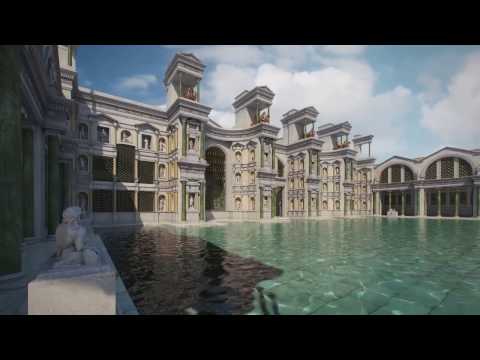
The natatio of the Baths of Diocletian measured about 4,000 square meters, three times a modern Olympic pool, and it was open to the sky. Its monumental facade, 90 meters long, was articulated with rectangular and semicircular niches, faced with colored marble and mosaics, and decorated with brackets that supported hanging small columns: a motif typical of the architecture of the Diocletianic age, which is also found in the emperor's palace at Split. Today the natatio is not accessible to visitors, but a stretch of the facade can still be read from the adjacent rooms and from the small cloister, which occupies about a third of the ancient basin.
The invisible work: furnaces, slaves, firewood
Here is the part that spoils the picture. Under the floors ran the hypocaust, the void where the hot air produced by the furnaces, the praefurnia, circulated, fed day and night. In the walls rose the tubuli, terracotta pipes that carried the heat up to the walls. All of this required a quantity of firewood measured in tons a day and a permanent crew of men who lived in the service corridors, in the dark, at temperatures no modern regulation would allow. They were slaves and freedmen, and their day began many hours before opening. When you look up at the vaults and are moved by the engineering, remember that the fuel for that engineering was the forced labor of people whose names we don't know, not even one. For me, this is the adult way to visit an imperial bath.
Solar orientation and the intelligence of the design
The central block is oriented to the southwest. It isn't a whim: it served to let the afternoon sun hit the calidarium, saving fuel, and to keep the frigidarium sheltered from the sun's radiation. Imperial architects designed energy saving 17 centuries before someone coined the term. At the center of the complex, where the two symmetry axes cross, stood the great basilica hall, that is, the frigidarium: the room that today is a church.

The visit route through the ancient rooms of the Baths of Diocletian
The museum occupies the northeast sector of the complex, between the great basilica hall and the gymnasium, and it houses a sequence of rooms that archaeology numbers with Roman numerals. Don't be put off by the numbering: it's a useful guide, because the rooms have lost their ancient names and have taken the names from the excavation.
Room X of the Baths of Diocletian and the Tomb of the Platorini
The Aula X was one of the monumental entrances to the central block. Today it houses the piece that alone justifies the visit for anyone who loves funerary archaeology: the tomb of the Platorini family, discovered in 1880 in the Lungara area of Trastevere during work on the Tiber embankment walls, dismantled stone by stone and reassembled here inside. It is an Augustan-age funerary monument, with its columbarium, the portraits of the deceased, and the inscriptions in their original places. Walking inside a Roman tomb rebuilt upright, instead of looking at its stones scattered in a courtyard, completely changes how you perceive what a family tomb was. In the same room, two chamber tombs found in 1951 along Via Portuense have been reinstalled, with their decorations.
The Aula IX, the Aula XI and the Aula VIII
The Aula IX is identified as one of the changing rooms. The Aula XI had an original purpose that remains uncertain, and it was later converted into a water supply tank for the pool. The Aula VIII preserves fragments of the architectural decoration of the baths and overlooks the natatio through a façade marked by pilasters and columns. Today it is not accessible, and this is a real loss for visitors, because it was the best place to understand the elevation of the pool. Still, ask at reception which rooms are open on the day of your visit, because the situation with the work sites changes.
The garden, the exedrae and the sarcophagi
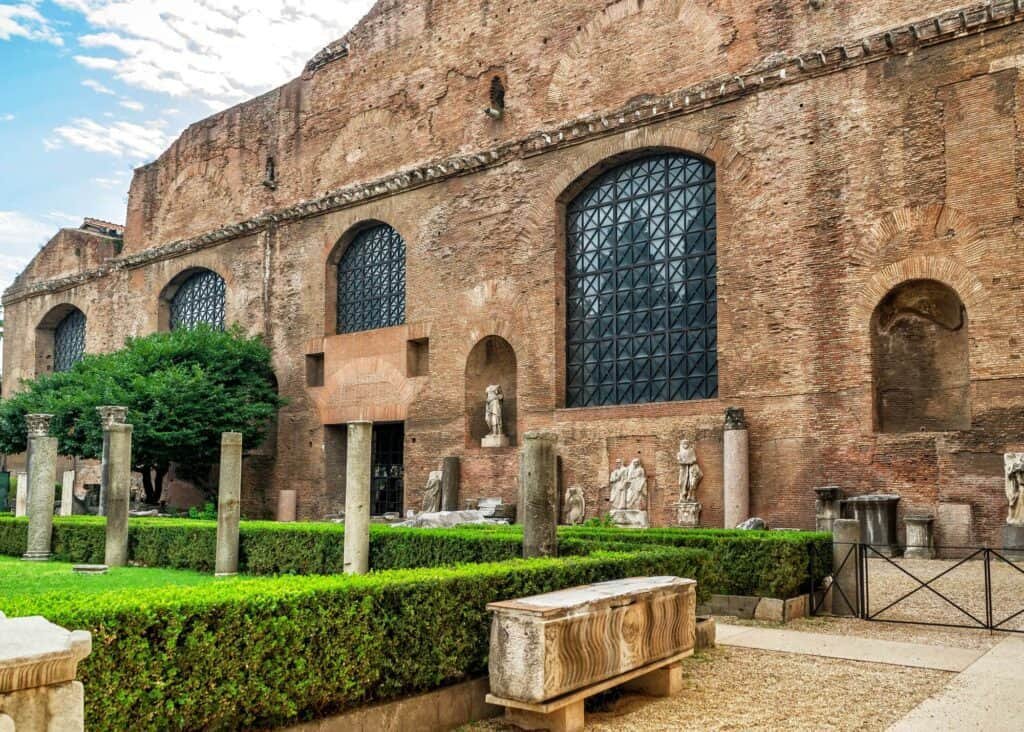
From the museum garden you can read a stretch of the ancient façade, which is the most honest way to measure the height of the building: no photograph conveys the difference between the modern walking level and the Roman one. On the opposite side, the two exedrae at the northeast corner of the enclosure are preserved, fairly intact apsed rooms that scholars interpret as auditoria, halls for lectures and public readings. One still retains its original mosaic floor. In the garden and under the porticoes, sarcophagi, altars, cippi and stelae are lined up, many of them coming from the nineteenth-century excavations. Don't treat them as mere furnishings: some are first-rank pieces, and displaying them outdoors is a historical choice by the museum that dates back to its first installations.
Michelangelo's great cloister at the Baths of Diocletian
You leave the ancient halls and enter the sixteenth century without passing through a monumental doorway. The passage is almost understated, and then the cloister opens up, covering 10,000 square meters. Four sides of 100 meters each, 100 monolithic travertine columns, one of the largest cloisters in Italy. Construction most likely began to a design by Michelangelo, but in 1565, a year after his death, and it dragged on with interruptions in funding until 1676. This is why art historians use the cautious formula: attributed design, execution by others, a worksite lasting a century. Still, the scale, the rhythm of the bays and the severity of the proportions speak a Michelangelesque language.
The seven colossal animal heads of the cloister at the Baths of Diocletian
At the center of the garden, lined up along the paths, are seven animal heads of out-of-scale size, and they are the thing visitors photograph most without knowing what they are. Four are ancient, Roman-period, dating to the second century AD and coming from sixteenth-century excavations in the area of Trajan's Column: a horse, two bulls and a dromedary. The other three were sculpted by artists of the late sixteenth century to complete the series: a ram, an elephant and a rhinoceros. The rhinoceros is the funniest piece in the whole complex, because it wasn't copied from life. It was modeled on Albrecht Dürer's famous 1515 woodcut, a rhinoceros Dürer had never seen and had drawn from someone else's description, armored like a knight. Look at the plates on its back: it's an imaginary animal from the European Renaissance, placed in line with the real ones from the empire of Trajan.
The eighth head
Since June 10, 2024, an eighth one stands among the seven. It is a work by the Roman artist Elisabetta Benassi, a giraffe skull in patinated bronze set on a stool in a modernist taste, conceived for this cloister and destined to remain as a gift to the museum. The artist has spoken of a skull that seems to laugh at us from beyond death. Anyone who hates contemporary art inside ancient settings will turn up their nose. To me, it is one of the best-executed insertions of recent years in Rome, because it doesn't compete with the proportions of the cloister and asks the visitor exactly the right question: why do we consider a fake sixteenth-century rhinoceros natural and suspect a 20-first-century giraffe?
The dolphin fountain and the cypress
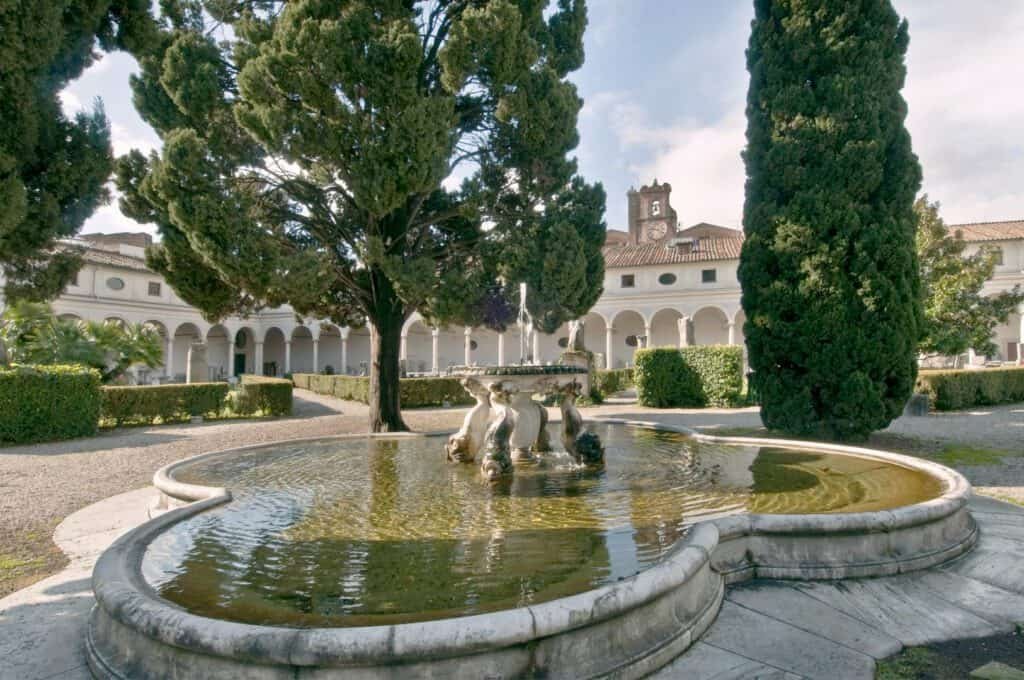
At the center of the paths there is a fountain from 1695 with dolphins, surrounded by cypresses. One of them, according to local tradition, is called Michelangelo's cypress. It is an affectionate attribution, not a documented fact, and like all oral traditions it should be told for what it is. The cloister also holds an outdoor collection of statues, stelae and sarcophagi that is worth a slow stroll: under the porticoes, sheltered from the rain, are portraits, funerary altars and reliefs that in any other museum in Europe would have a dedicated room.
The small cloister of the Baths of Diocletian and the Charterhouse of Santa Maria degli Angeli
The small cloister is built inside about a third of the ancient natatio, and this one sentence is enough to give you a sense of the size of the pool. It has a circular well with three steps and a portico that today displays Roman materials of religious context and sculptures. On the walls, frescoes showing the Pietà degli Angeli, Pope Pius IV and Saint Bruno, founder of the Carthusian order, have come back to light in recent times. They are the devotional signature of the monastery that occupied this sector.
The history of the charterhouse inside the Baths of Diocletian
The papal bull of Pope Pius IV Medici that launches the conversion of the baths into a church and charterhouse is dated July 27, 1561. Michelangelo was 86 years old and accepted the commission. He designed the church and in all likelihood laid out the large cloister and the general layout of the monastery. The Carthusians stayed here until 1884, when the charterhouse was suppressed. Part of the rooms became the Ospizio Margherita di Savoia for the blind. In 1908, most of the monastic structures were demolished to free the ancient ruins ahead of the Great Archaeological Exhibition of 1911. What you see today is therefore an amputated monastery: the two cloisters and little else.
The collections that passed through here
Under the portico of the small cloister, pieces of the Boncompagni Ludovisi collection were displayed until 1997, when they were moved to Palazzo Altemps, where they remain to this day. Knowing this helps you understand something important about the Museo Nazionale Romano: it is a museum that has kept rethinking itself, moving collections from one site to another according to criteria of coherence. Renaissance sculptures from the collection are at Altemps, the statuary and painting at Palazzo Massimo, the urban stratification at Crypta Balbi, and the inscriptions and protohistory here.
The Museum of Written Communication of the Romans at the Baths of Diocletian
This is the heart of the current museum, and it is also the section that 90 percent of visitors walk through at a quick march because the word epigraphy scares them. They're wrong. There are no stone tablets to decipher in Latin here. There is a route built to show how a society without newspapers, without regular mail and without civil registries used stone to communicate. Every inscription is a public message that someone paid to leave for passersby.
The collection displays about 900 selected pieces from a holding of about 20,000 kept by the museum. Its origins go back to the late nineteenth century and to materials that came out of the excavations of Rome as the capital, from 1870 on. The display is laid out on three levels, with a chronological route and then a thematic one.
The ground floor: from the origins to the figure of the emperor
You start with an introductory section on Roman written communication, then the Archaic age, the Middle Republican age and the Late Republican age, and it ends with the room dedicated to the figure of the emperor. The sequence shows something that is poorly read in textbooks: the Latin alphabet changes shape, the letters become more regular, the syntax of formulas becomes stiffer, and in 300 years writing goes from being a mark of prestige reserved for a few to being the everyday tool of a state that governs the Mediterranean. Stop at the archaic texts: the letters are irregular, cut by hands that did not yet have a canon.
The middle floor: society, institutions, economy
The second level is organized by theme: social structure, institutions and political-administrative structures, economic activity. This is where you see the museum's most brutal piece, a slave collar: a metal ring with an inscription inviting whoever found the wearer to return him to his master, like a dog tag. In the same area are the brick stamps, including the brick with the stamp of Trajan, which seem like nothing but are actually the industrial accounting of the empire: who produced, on behalf of whom, in which consular year. The Baths of Diocletian themselves are dated precisely thanks to the stamps on their bricks, all from the Diocletianic age.
The top floor: the religions of the Romans
The last sector holds the religious evidence, and it is the one with the two most famous documentary collections. The first are the records of the Fratres Arvales, the priestly brotherhood that celebrated the cult of the goddess Dia. Their tablets cover a span from the first century BC to the fourth century AD and are one of the most continuous documents we have on Roman religious life, with names, rites, sacrifices and even details of the banquets. The second are the pillars with the records of the Ludi Saeculares, the secular games, which preserve texts from 17 BC and from 204 AD. Those lines contain the hymn that Horace wrote on commission from Augustus for the chorus of boys and girls. The Carmen saeculare is not an invention of literature textbooks. It is engraved on a stone you can look at.
The practical advice for this section: don't try to read everything. Choose three panels, really read them, and leave having understood just one thing. An hour spent like that is worth 10 distracted passes.

The Museum of the Protohistory of the Latin Peoples at the Baths of Diocletian
On the first floor of the Michelangelo cloister is the section that tells the story of Latium before Rome, between the end of the Bronze Age, in the eleventh century BC, and the Orientalizing phase, between the tenth and the beginning of the sixth. It is the story of the Latin peoples: villages of huts on tufa plateaus, necropolises, grave goods, social hierarchies taking shape. It must be said right away that this section is temporarily closed for refitting, so check the situation before organizing your visit around it.
What you see in the protohistoric section
The first part offers the general picture of ancient Latium: social structure, economy, religion, ideology, organization of the territory. The second goes into the individual settlements of the territory of Rome, with the complexes of Osteria dell'Osa and Castiglione in the Gabii area, Fidene, La Rustica corresponding to ancient Collatia, San Palomba and Quadrato. The necropolis of Osteria dell'Osa is one of the best-excavated funerary contexts in Italy, with hundreds of tombs that make it possible to reconstruct an entire community: who buried whom, with which objects, in which family groups.
The hut urns and the prince's scepter
Two objects stay in the mind. The hut urns, that is the cinerary urns modeled in the shape of a dwelling, with the roof, the little door and the beams reproduced in miniature: they are the best document we have of how the houses of the Latins were made, because the real huts have disappeared and their funerary copies have not. And the high-status grave goods, with miniature chariots, inscribed vases and the scepter attributed to the so-called Prince of Collatia: objects that say that in Latium, centuries before the Rome of the kings, there were already chiefs with a recognized power and a symbolism of command. Anyone who arrives in Rome convinced that history begins with Romulus finds the refutation here, arranged in display cases.
If the section is closed and you still want to see prehistory and protohistory in Rome, the alternative venue is the Museum of Civilizations at EUR, which holds the national prehistoric and ethnographic collections.
Santa Maria degli Angeli e dei Martiri: the basilica inside the Baths of Diocletian
On Piazza della Repubblica a facade opens that is not a facade: it is the curved, rough apse of a bath hall, with the ancient wall left exposed and a portal opened inside. Whoever doesn't know it walks past. Whoever goes in finds themselves in one of the largest churches in Rome, carved out inside the central hall of the Baths of Diocletian, and not rebuilt: the cross vaults you see overhead are the Roman ones, supported by eight monolithic granite columns of oversized dimensions. They are among the very few examples left standing of the original splendor of an imperial interior. Entry is free.
Michelangelo and the 1561 project
The project is Michelangelo's last great architectural undertaking, begun with the bull of Pius IV of July 27, 1561 and carried forward when the artist was 86 years old. His choice was radical for the time: instead of building a new church with the materials of the ancient one, he preserved the Roman space and consecrated it. A minimal conversion, with a longitudinal orientation that exploited the existing axis. Not everything you see today is his, and anyone who tells you it is an intact church by Michelangelo is simplifying things for you.
Vanvitelli and the 1749 reversal
In 1749 Luigi Vanvitelli was commissioned to transform the building according to the taste of his century, and he rotated the church's orientation by 90 degrees, opening the present entrance in the room of the calidarium. He raised the floor, added columns of plastered masonry in imitation of granite, reorganized the altars. The result is a hybrid: you enter from a circular Roman vestibule, cross an immense transept that was the frigidarium, and arrive at an eighteenth-century presbytery built where the natatio was. The entrance vestibule, with its circular plan and niches, corresponds to the ancient tepidarium and houses the tombs of Salvator Rosa and Carlo Maratta.
The meridian line of Francesco Bianchini inside the Baths of Diocletian
On the floor of the transept runs a brass strip tens of meters long, set into the marble, with the zodiac signs and the day markings. It is the meridian commissioned by Pope Clement XI Albani and designed by the canon from Verona Francesco Bianchini, astronomer and scholar, inaugurated in 1702. It works like this: a gnomonic hole opened high in the wall lets in a disc of sunlight that falls on the line at local solar noon, and the position of the disc along the line indicates the day of the year. It was used to establish precisely the spring and autumn equinoxes, the solstices, true noon and other astronomical parameters, in an era when the date of Easter was a political problem as well as a scientific one. The meridian is still the subject of ongoing research: astronomer Costantino Sigismondi carries out measurements of the solar diameter there. Go there around noon and stand next to the line: you'll see the oval of light move slowly across the floor of a fourth-century thermal hall.
Why It Is Also Called dei Martiri
The dedication to the martyrs comes from a late medieval and Renaissance hagiographic belief, according to which the baths were built by the labor of Christians reduced to slavery under Diocletian, the emperor of the great persecution of 303. Historians today consider the account to lack documentary foundation, and it should be told as a devotional tradition, not as a fact. Still, this is the reason the church bears that name, and why the popes cared so much: consecrating the building of the persecutor was, in the eyes of the sixteenth century, a symbolic victory.
The Other Churches Within the Enclosure of the Baths of Diocletian
San Bernardo alle Terme, in the circular hall of the enclosure
At the western corner of the thermal enclosure there were two large circular halls. One of the two, in 1598, was turned into a church at the wish of Caterina Nobili Sforza, niece of Pope Julius III, and given to the Reformed Cistercians, the consecration to Saint Bernard of Clairvaux came in 1602. Go inside: the interior is a rotunda covered by a dome 22 meters in diameter, with octagonal coffers receding toward the central oculus, which openly quotes the Pantheon. Along the perimeter are eight large stucco statues of saints by Camillo Mariani around 1600, which sculpture manuals consider a key step toward the Baroque. The address is Via Torino 94, three minutes from the museum. Free admission, with hours tied to the life of the parish.
Sant'Isidoro alle Terme
In 1754 Benedict XIV had a church dedicated to Saint Isidore, the saint of farmers, built inside the rooms the popes used as granaries: a consistent choice, since the Annona grain was stored here. Only the entrance façade of that church remains today, incorporated into the complex. It is one of those details you only see if you know what to look for, and the detour is worth 30 seconds.
The papal Annona: grain and oil inside the baths
The story deserves a paragraph of its own, because it explains the survival of the monument better than any restoration. For the Jubilee of 1575, Gregory XIII assigned the octagonal hall and three large halls up to the basilica to be papal grain warehouses. In 1763, after a serious oil shortage, Clement XIII had 10 wells dug in the basements for oil storage, the so-called papal olearie, each capable of holding up to 44,000 liters. The Termini area, which in Giambattista Nolli's 1748 map appears peripheral and occupied by vegetable gardens, vineyards and a few villas, thus became the center of the grain and oil Annona of the Papal State. With the abolition of the Annona, wanted by Pius VII and Cardinal Consalvi, the rooms passed to other uses: prison, shelter, hospice, post office, seat of the Facoltà di Magistero. The Baths of Diocletian survived because they have always served some purpose.
The Aula Ottagona of the Baths of Diocletian and the Museo dell'Arte Salvata
At the western corner of the complex, on Via Romita, there is a room that looks like a square from the outside and is an octagon from the inside, covered by an umbrella-shaped dome of great elegance, originally decorated with stucco. Archaeologists interpret it as a secondary frigidarium. It has had a busy modern life: papal granary in the seventeenth century, planetarium from 1928, with the metal structure of the apparatus still visible overhead today, then cinema hall and exhibition space.
What you can see today in the Aula Ottagona
Today the Aula Ottagona houses the Museo dell'Arte Salvata, dedicated to works recovered from illegal trafficking and returned to Italy thanks to the work of the carabinieri of the Comando Tutela Patrimonio Culturale and of the cultural authorities. It is a rotating museum: the works stay on display for a period and then return to their territories of origin, replaced by new recoveries. The concept is wonderful and rare in Europe, and for those who lead groups it is a goldmine of true stories about clandestine digging, auctions, and international investigations. Under the floor, remains of buildings that predate the baths are visible. Since July 4, 2026, there is a dedicated ticket at €5,00, access is in any case included in the single ticket for the Museo Nazionale Romano. Hours may differ from those at the main site: check them on the official website before you visit.

How to Visit the Baths of Diocletian: Duration, Route and Recommended Order
The museum can be comfortably toured in an hour and a half. With two hours, you can also read the epigraphy at a relaxed pace. If you add the Basilica of Santa Maria degli Angeli and a stop at the Aula Ottagona, plan on three full hours. The route inside is fairly open: you enter from the garden, cross the ancient halls, exit into the large cloister, and go up to the museum sections.
Recommended Order
Start with the thermal halls, before tiredness takes away your ability to look up. Then the large cloister, taking your time, walking all the way around it and not just the entrance side, because the best pieces under the porticoes are on the long sides. Then go up to the epigraphic section, which requires attention and should be tackled with a fresh mind. Exit, cross the square, and enter Santa Maria degli Angeli, ideally around noon for the meridian line. End with the Aula Ottagona if you still have energy. If you bought the combined ticket, visit Palazzo Massimo another day: it's 200 meters away, but combining two museums this dense in the same afternoon means not remembering anything from either one.
Guided Tours, Audio Guides and Information Materials
The museum offers guided visits and tours and has an education room and exhibition halls. The schedule of activities is published on the official website and changes from month to month. If you go without a guide, the route map available at the entrance is essential, because the room numbering and the layout across three levels are not intuitive.
The Baths of Diocletian with Children
It works better than parents expect, on two conditions. The first: focus on spaces and objects you understand with your eyes, that is, the large halls, the cloister with the animal heads, the hut urns from protohistory when that section reopens, the tomb of the Platorini. The second: give up reading the inscriptions without any guilt. The game that always works with children aged six and up is the hunt for the seven heads: find them all, work out which are real and which are invented, and discuss the rhinoceros drawn by someone who had never seen one. The cloister is large, outdoor, and free of traffic, and for a family it means half an hour in which no one has to be told to stay still. A stroller can get around almost everywhere on the ground floor.
Accessibility at the Baths of Diocletian
The museum states it is accessible to visitors with mobility disabilities, with elevators and ramps, wheelchairs available on request, accessible restrooms and assistance. Tactile routes are provided for visitors with visual disabilities, on request. The museum also has a cloakroom and a bookshop. The practical tip: let the reception desk know your needs as soon as you enter, because some passages between the ancient halls and the upper levels require a dedicated route, and the staff know it. The cloister floor and the garden paths are partly gravel and packed earth: with a manual wheelchair it is doable, but it takes an extra push.
When to Visit the Baths of Diocletian
The truth is there is almost never a line here, and it is this museum's competitive advantage over any other Roman archaeological site. That said, the best time is early morning, just after the 9.00 opening, when the light comes in low through the halls and the cloister is empty. Late afternoon in winter, around 16.30, is just as beautiful but shorter. Avoid the first Sunday of the month if you want to read the inscriptions. In summer the cloister is one of the coolest spots in the Termini area, sheltered by the porticoes. In winter it is windy, so bring a jacket. On rainy days the museum is an excellent choice, because the route is almost entirely indoors.
What Is Around the Baths of Diocletian
This is the quadrant of Rome with the highest density of museums per square meter and the worst reputation in the city, because it's the station area and people walk through it quickly, watching their pockets. Those who stop find, within a 10-minute walk, material that elsewhere would be the center of an itinerary.
Palazzo Massimo alle Terme, 200 meters from the Baths of Diocletian
On the other side of Piazza dei Cinquecento is Palazzo Massimo alle Terme, the main seat of the Museo Nazionale Romano: the Boxer at Rest, the bronze Hellenistic Prince, the Lancellotti Discobolus, the Portonaccio Sarcophagus, the frescoes of the painted garden from the Villa of Livia, and the stuccoes of the Villa della Farnesina. It's included in the same ticket. If you have to choose just one of the two venues and you love ancient sculpture and painting, choose that one. If you want to understand Roman architecture and society, stay here.
Piazza della Repubblica and the Fountain of the Naiads
Coming out of the basilica, you're on Piazza della Repubblica, which Romans still call Piazza Esedra. The two curved porticoes are by Gaetano Koch, late 19th century, and follow the ancient exedra. In the center is the Fountain of the Naiads by Mario Rutelli, whose final layout dates to 1897 and which was inaugurated in 1901: four bronze groups of nymphs on water animals, each representing a form of water. It caused a scandal. The female figures were judged provocative, and the fountain was hidden for a long time behind a wooden fence. The central group you see today, Glaucus wrestling with a dolphin, dates from 1914. It replaced the original group, moved in 1913 to Piazza Vittorio, which Romans had nicknamed, with cruel affection, the frittura mista. Look at the square at sunset, when the travertine of the porticoes takes on the right color.
Santa Maria Maggiore and the Museo Nazionale degli Strumenti Musicali
Heading up toward the Esquiline, you reach Santa Maria Maggiore in about 10 minutes, with the mosaics of the 5th-century nave, which are the natural continuation of the discussion started here: same city, a century after Diocletian, another religion in power. Toward Porta Maggiore, instead, is the National Museum of Musical Instruments, little-visited and surprising, with one of the richest collections in Europe in its field.
The other venues on the circuit and the rest of Roman archaeology
With the same ticket, within seven days, you can get to Palazzo Altemps, near Piazza Navona, for its noble collections of ancient sculpture, and to the Crypta Balbi when it reopens. If the baths have fascinated you, the obvious comparison is the Baths of Caracalla, half the surface area but with more intact standing walls, and the Trajan's Markets, which tell the other side of imperial public architecture. Anyone who wants to close the circle on monumental Rome has the Colosseum four stops away on Metro B.

A curiosity about the Baths of Diocletian - Museo Nazionale Romano
The best curiosity concerns a word you say every time you take a train. Termini has nothing to do with the terminus, with the end of the route, with the idea of arrival. It comes from thermae, from the Baths of Diocletian. The place name existed centuries before the railway and indicated the area of the thermal ruins. When the site for the central station of the new kingdom was chosen in 1863, the name of the place passed to the building without anyone thinking too much about it, and from there it has entered the vocabulary of half the world.
It gets more interesting when you discover that the station physically devoured a piece of the baths to take its name. The cistern that fed the complex, a reservoir over 90 meters long that modern Romans called the botte di Termini, survived unscathed the fall of the empire, the cutting of the aqueducts, the sackings, the papal demolitions, and the agricultural use of the neighborhood. It survived for about 1,500 years. It was demolished in 1876 to make room for the tracks. 15 centuries of history wiped out in a single construction season, and in exchange, the name.
There's a second layer of irony. The Termini botte carried water from a branch of the Acqua Marcia, the finest aqueduct in ancient Rome, the one Romans considered the best to drink. The arches that carried that water were reused until 1879 for the Acqua Felice, the Renaissance aqueduct of Sixtus V, that is, of the same pope who had blown up the baths' calidarium with gunpowder. The same pontiff who demolished the monument reused its infrastructure. It's a perfect summary of Rome's relationship with its own past: no reverence, a lot of recycling, and a memory that survives in names far more than in stones. The next time someone tells you to meet them at Termini, know that they're arranging to meet you inside a fourth-century building.
One thing nobody tells you about the Baths of Diocletian - Museo Nazionale Romano
That this isn't one museum but four, and that the ticket knows it even if you don't. €15 buys a weekly pass valid for one entry to each site of the Museo Nazionale Romano, and the vast majority of visitors use it once and throw it away. Sometimes someone pays twice for the same circuit 24 hours apart because nobody at the ticket desk explained that the stub in their pocket was still valid. Keep it, photograph it, set an alarm: you have seven days.
The second thing nobody mentions concerns the spaces. The great halls that thrill visitors are a tiny fraction of what was there, and some of the most beautiful ones aren't part of the museum route: they've become churches, and entering them requires no ticket. The central hall, the frigidarium, is now Santa Maria degli Angeli e dei Martiri, free entry. A circular hall in the enclosure is the church of San Bernardo, free entry. A savvy visitor with an hour and zero euros could see two of the three most impressive thermal spaces in the complex without paying anything. I'm not saying this to suggest you save money, I'm saying it to show how large the part the museum can't contain really is.
Third thing, the most awkward: part of the complex isn't open to visitors, and you only find out in front of the sign. The natatio, Hall VIII and the prehistory section are closed for now, and the Crypta Balbi, which your ticket theoretically covers, is closed too. That's not a minor detail if you've built your day around those stops. Call or check the official website the evening before: two minutes can save an afternoon.
The advice I give you for visiting the Baths of Diocletian - Museo Nazionale Romano
Get there at nine sharp and go straight to the ancient halls, before anything else. Not to avoid the crowds, which are a minor problem here, but for the light: early in the morning the sun comes in low through the high windows and cuts the space into diagonals that make the height of the vaults readable. At two in the afternoon that same room is flat. Bring a fresh head, because the first quarter hour is when you grasp the scale of the building, and that understanding then carries through the whole visit.
Second piece of advice, on method: don't try to read every inscription. About 900 pieces are on display, selected from a collection of 20,000, which means each one you see has a reason to be there. Pick three. One from the archaic period, to see the letters still uncertain, the slave collar, to understand what this society really was, and a document from the Arvali or the Ludi Saeculares, to touch an official text of the Roman state. Read them with the panel, all the way through. You'll leave with three real things instead of 40 photos.
Third, and here I get categorical: don't combine the Baths of Diocletian and Palazzo Massimo on the same day. They're 200 meters apart and the ticket is the same, so the temptation is huge, and the result is always the same: by the third room of the second museum your head is full and you look without seeing. The ticket lasts a week for exactly this reason. Do the baths in the morning, finish with the basilica and the meridian around noon, eat something, and use the afternoon for an outdoor stroll. Palazzo Massimo tomorrow, rest up, and it will feel like a different trip.
Another well-known fact, yet rarely mentioned
That the Baths of Diocletian were built in eight years. The figure appears in every guide and nobody stops to think about it: nearly 14 hectares of enclosure, a central block of 250 by 180 meters, cross vaults with spans of 20 meters, a pool of 4,000 square meters, a dedicated aqueduct, all built between 298 and 306 AD. Eight seasons of construction. Gothic cathedrals much smaller than this took three centuries.
The how is the instructive part. Before laying a single brick, they had to buy and demolish an entire inhabited neighborhood, with private houses and insulae, and reorganize the roads: the dedicatory inscription states this openly with that coemptis aedificiis, "buildings purchased." Then they chose brick, a fast and standardized material, and revived a system that was falling out of use, that of stamps on bricks: all the bricks of the baths bear stamps from the Diocletianic age, and for exactly that reason the building can be dated with a precision that is extremely rare in archaeology. It meant a production chain reorganized on public contract, with kilns, transport and coordinated crews.
The third element is the discipline of the design. The southwest orientation to take advantage of the afternoon sun on the calidarium, the minor axis reserved for the sequence of baths, the major axis for the palaestrae, and the crossing point occupied by the central hall. Nothing was left to improvisation. The Tetrarchy needed to show that the state still worked, after 50 years of military and monetary crisis, and it chose to show this with a public building that was free or nearly so, open to 3,000 people at a time. The Baths of Diocletian are political propaganda built in masonry, and they are proof that the message could still afford it.
The right photo to take at the Baths of Diocletian - Museo Nazionale Romano
The photo everyone takes is the row of animal heads in the cloister, and it's a nice photo. But the one that really takes the monument home is a different one, and it's taken outside the museum: inside Santa Maria degli Angeli e dei Martiri, standing in the center of the transept with your back to the entrance and framing the granite columns with the groin vault above. They are eight monoliths, and the groin vaults they support are the Roman ones. In a single frame you have a section of an imperial bath hall still standing. The best light is midday light, which comes in through the high windows.
In the same church is the most difficult and most rewarding photo: the oval of sunlight that falls at true noon on the brass line of Bianchini's meridian. It takes patience, it takes being there at the right hour, and it takes a low framing, almost at floor level, that keeps together the bright patch and the graduated line. It's the only tourist photo in Rome that documents an astronomical phenomenon in progress.
Inside the museum, the best one is yet another: from the garden, frame the stretch of ancient façade from below, including in the corner a modern element, a bench, a sign, a person. You need a scale reference, otherwise no one can tell the height. The cloister, by contrast, should be photographed at an angle rather than head-on, to let the perspective run along two sides each 100 meters long: it's the way to convey in one image the size of 10,000 square meters. Photos without flash and without a tripod are generally allowed, in rooms with fragile materials, follow the staff's instructions.
Some important events that happened here in history
The first is the dedication itself, between 305 and 306, with the inscription that names the Augusti and the Caesars of the Tetrarchy and closes with the formula Romanis suis dedicaverunt. It was a state ceremony at an extremely delicate moment: Diocletian and Maximian had abdicated on May 1, 305, an unprecedented event in Roman history, and the inauguration of the baths served to show the people that the system held up even without them.
The second is 537, the year of the siege of Rome by the Goths of Vitiges during the Greco-Gothic War. Cutting the aqueducts was a deliberate act of war against the city's civilian life, and the baths, which lived on water, stopped. Belisarius had the passages that crossed the walls walled up to prevent night raids. Within a few months, the largest public building in Rome became an empty shell.
The third is July 27, 1561, the date of the papal bull with which Pius IV entrusted to 86-year-old Michelangelo the conversion of the central hall into a church and of the area into a charterhouse. It is one of the very first European cases of conscious conservative reuse of an ancient monument: you don't demolish to build, you consecrate what is already there.
The fourth is 1702, the year Francesco Bianchini's meridian, commissioned by Clement XI, went into operation, turning a basilica into an astronomical observatory. It was used to check the date of Easter and how well the Gregorian calendar held up: applied science inside a church, a century after the trial of Galileo.
The fifth is 1889, when the Kingdom of Italy chose this complex as the first home of the Museo Nazionale Romano. The sixth is 1908, with the demolition of most of the charterhouse structures to prepare for the Grande Mostra Archeologica of 1911, staged for the 50th anniversary of national unity: a questionable choice that sacrificed the Cinquecento to antiquity. The seventh, to end on something light, is 1928, when the Planetarium of Rome was installed in the Aula Ottagona: for decades Romans went to look at fake stars under a real Roman dome.
Who has passed through the Baths of Diocletian - Museo Nazionale Romano
First the architects, because they passed through here in droves. Andrea Palladio drew the baths in full during his stays in Rome, and his surveys remain among the most important graphic sources for reconstructing the layout. When you think of a Palladian church or an eighteenth-century English basilica, you're looking at the descendants of these vaults. After him came generations of draftsmen and view painters, from the 1400s onward, drawn by the grandeur of the ruins.
Then the popes, who did more than pass through here. Gregory XIII turned them into the granaries for the Jubilee of 1575. Sixtus V demolished an enormous section to build his villa on the Esquiline, with the help of his sister Camilla Peretti in the real estate deal. Pius IV called on Michelangelo. Benedict XIV built the church of Sant'Isidoro there in 1754. Clement XIII dug the olive oil storerooms there in 1763. Clement XI installed the meridian line there. Pius VII and Cardinal Consalvi suppressed its annona. Five centuries of papal policy can be read in the masonry of this block.
Michelangelo Buonarroti remains the greatest name, and the last chapter of his life as an architect was written here, at the age of 86. Luigi Vanvitelli, before Caserta, worked here in 1749. Camillo Mariani modeled the stuccoes of San Bernardo. Gaetano Koch, at the end of the 1800s, designed the porticoes that follow the exedra. Mario Rutelli placed the naiads that caused a scandal in the center of the square. Salvator Rosa and Carlo Maratta are buried in the circular vestibule of the basilica.
And then there are the nameless Romans, who are the true protagonists: 3,000 at a time, every afternoon, for two centuries. Slaves at the furnaces, capsarii in the changing room, athletes in the gyms, senators and water carriers in the same pool. The inscriptions displayed upstairs are their phone book.
Quick questions about the Terme di Diocleziano - Museo Nazionale Romano
Where exactly are the Terme di Diocleziano?
The museum entrance is at viale Enrico de Nicola 78, on the north side of piazza dei Cinquecento, opposite Termini station. The ancient complex, however, occupied a much larger area, between piazza della Repubblica, piazza dei Cinquecento, via Volturno and via XX Settembre.
How much is the ticket for the Terme di Diocleziano?
€15 for the full ticket and €2 for the reduced one, under the conditions set for state cultural sites. The ticket is valid for all venues of the Museo Nazionale Romano, with one entry each, within one week of the first validation.
What are the opening hours of the Terme di Diocleziano?
Tuesday to Sunday from 9.00 to 19.00, with the ticket office and last entry at 18.00.
What is the closing day of the Terme di Diocleziano?
Mondays, which is the weekly closing day of all venues of the Museo Nazionale Romano.
Is the ticket also valid for Palazzo Massimo, Palazzo Altemps and Crypta Balbi?
Yes, it's the same ticket: it allows one entry for each venue in the circuit within seven days of first access. Keep in mind that the Crypta Balbi is temporarily closed to the public.
Is entry free on the first Sunday of the month?
Yes, on the first Sunday of the month entry is free at all state cultural sites, so this one included. It's best to avoid it if you want to read the epigraphic section calmly.
Do I need to book to visit the Terme di Diocleziano?
No, booking is not mandatory and tickets are bought at the box office. Online purchases are made through the Museiitaliani portal indicated by the museum, and tickets bought through official channels are not refundable.
How long does a visit to the Terme di Diocleziano take?
An hour and a half for a standard visit, two hours if you also want to read the epigraphy calmly, and three full hours if you add Santa Maria degli Angeli and the Aula Ottagona.
How much is the ticket for the Aula Ottagona alone?
€5, with a dedicated ticket valid from July 4, 2026. Anyone holding the single ticket for the Museo Nazionale Romano enters without paying anything more.
What can you see in the Aula Ottagona today?
The Museo dell'Arte Salvata, dedicated to works recovered from illegal trafficking and returned to Italy. The exhibition rotates: the works stay for a period and then return to their places of origin.
Is the great cloister really by Michelangelo?
The design is attributed to him, and tradition links it to his name, but work began in 1565, one year after his death, and was completed in 1676. The correct formula is attributed design and execution by others.
What are the animal heads in the cloister of the Terme di Diocleziano?
Seven colossal heads. Four are Roman, from the second century AD, from the 16th-century excavations near the Trajan's Column: a horse, two bulls and a dromedary. The other three, a ram, an elephant and a rhinoceros, were carved at the end of the 16th century, the rhinoceros derives from Albrecht Dürer's woodcut of 1515.
What is the eighth head?
A contemporary work by Elisabetta Benassi, unveiled on June 10, 2024 in the cloister: a giraffe skull in patinated bronze placed on a modernist stool, intended to remain as a gift to the museum.
Is the prehistory section open to visitors?
Not at the moment: the Museo di Protostoria dei Popoli Latini is temporarily closed for re-exhibition. It's best to check the official website before your visit.
Can you see the natatio, the swimming pool of the baths?
The natatio is not currently accessible, and neither is Room VIII, which opened onto it. The small cloister covers about a third of the ancient basin, and from there you can get a sense of the scale of the complex.
What's the difference between the Baths of Diocletian and the Baths of Caracalla?
The Baths of Diocletian are much larger, about twice the size, and are built into the modern city, with churches and museums set inside the halls. Caracalla is an outdoor archaeological area, with better-preserved walls and a more isolated setting. If you want to understand the structure and daily life of the baths, come here. If you want to walk through a monumental ruin, go to Caracalla.
Is Santa Maria degli Angeli e dei Martiri free to enter?
Yes, entry to the basilica is free. It's a working church, with its liturgical schedule, and it occupies the central hall of the baths.
What is the meridian line in the basilica?
A bronze meridian line set into the floor of the transept, commissioned by Clement XI, designed by Francesco Bianchini, and inaugurated in 1702. A hole in the high wall projects a disk of sunlight that, at true noon, falls on the line, indicating the day of the year, the equinoxes and the solstices.
Are the Baths of Diocletian wheelchair accessible?
The museum declares accessibility for visitors with mobility disabilities, with elevators, ramps, wheelchairs on request, accessible restrooms and assistance. Tactile routes are available on request. The garden and cloister paths have stretches of gravel.
Can you take photographs at the Baths of Diocletian?
Photographs without flash and without a tripod are generally allowed. In rooms with fragile materials, it's best to ask and follow the staff's instructions.
Is there a cloakroom?
Yes, the museum has a cloakroom, along with a bookshop, a teaching room and exhibition halls. It's a handy detail if you arrive from the station with a backpack.
Are the Baths of Diocletian suitable for children?
Yes, as long as you focus on the spaces and the visual objects: the large halls, the cloister with the seven heads, the reconstructed tomb. The animal head hunt works with any child from 6 years old and up.
Do you have to wait in line to get into the Baths of Diocletian?
Almost never. It's one of the few first-tier museums in Rome where, on most days, you buy your ticket and go right in. The exceptions are the first Sunday of the month and days with major events in the city.
What is the best time to visit the Baths of Diocletian?
The morning right after opening, for the low light in the ancient halls and for the empty cloister. Alternatively, late afternoon, keeping in mind the last entry at 18.00.
What is the Museo della Comunicazione Scritta dei Romani?
The epigraphic section of the museum, spread over three levels, which displays about 900 selected pieces from a collection of about 20,000. It shows how the Romans used writing in political, religious, social, economic and private life, from the emperor to the slave.
What is the Tomba dei Platorini at the Baths of Diocletian?
A family tomb from the Augustan age, discovered in 1880 in the Lungara area and reassembled inside Room X of the museum, with the columbarium, the portraits and the inscriptions. In the same room, two chamber tombs found in 1951 along Via Portuense have been reconstructed.
Why is the station called Termini?
Because the place name comes from thermae, the baths of Diocletian, and it existed centuries before the railway. The ancient cistern that supplied the complex, the so-called botte di Termini, was demolished in 1876 to make room for the station.
How big were the Baths of Diocletian?
The enclosure measured about 380 by 365 meters, just under 14 hectares. The central block measured 250 by 180 meters. They could hold up to 3,000 people at the same time, and they were the largest baths ever built in Rome.
Can you visit the other churches built inside the baths?
Yes. Santa Maria degli Angeli e dei Martiri opens onto Piazza della Repubblica. San Bernardo alle Terme, created in 1598 in one of the two circular halls of the enclosure, is at Via Torino 94. Of the church of Sant'Isidoro, built in 1754 inside the papal granaries, only the entrance facade remains.
Is it worth visiting the Baths of Diocletian if I have little time in Rome?
If you have one hour and you're at Termini, yes, more than anything else you can reach in that hour. If you have three full days and have never seen Rome, put them after the Colosseum and the Pantheon, but do put them in: they're the place where you understand how an ancient city worked, not just what it looked like.
To wrap up, the one recommendation with no nuance. Go there looking like someone who has time, even if you don't. This complex does nothing to seduce the visitor: it has no façade, no signature masterpiece to put on posters, no line that confirms you're in the right place. It has vaults 20 meters high, 900 stones inscribed by people who died 18 centuries ago, a cloister you walk around in silence, and a church where at noon the sun writes the date on the floor. If you rush in, you won't understand why I talk about it this way. If you sit for 10 minutes on a bench in the large cloister, with the animal heads in front of you and the noise from Termini reaching you muffled by the arcades, you'll leave convinced it's the best museum in Rome.
Article written by the editorial team of TourLeaderPro, contact them for Tours and Private/Corporate/V.I.P. Experiences.
Planning a trip to Rome? English-language guides to visiting the city are on ItalyPlanner.com.