State Museums of Rome
In short. State museums in Rome means something specific: the museums, galleries, monuments and archaeological areas that belong to the Italian State and that the Ministry of Culture administers directly.
State museums in Rome means something specific: the museums, galleries, monuments and archaeological areas that belong to the Italian State and that the Ministry of Culture administers directly. They are not the city's museums, they are not the Vatican Museums, they are not the collections of the princely families that stayed in private hands. They are a group of about 30 addresses in the city of Rome alone, with about 50 more sites in the rest of Lazio, and they all follow the same admission rules: under 18 you get in free, between 18 and 25 the ticket costs €2.00 for citizens of the European Union, and on the first Sunday of the month admission is free for everyone. Tickets are bought on the ministry portal Musei Italiani, run by the General Directorate for Museums, or on the portals that individual autonomous institutes list on their official website.
The main numbers, the ones you need before leaving the house. The Colosseum with the Roman Forum and Palatine costs €18.00, the ticket is valid for 24 hours, and the time spent inside the amphitheater is limited to 75 minutes. The Borghese Gallery costs €16.00 plus €2.00 for the mandatory reservation, with hourly slots and a two-hour visit. The National Roman Museum has a single ticket at €15.00 valid for a week at all its sites. Palazzo Barberini and the Corsini Gallery share a ticket at €15.00 valid for 20 days. Castel Sant'Angelo costs €18.00. The Pantheon costs €7.00 and is free for residents of Rome. Villa Giulia costs €13.00, the Museum of Civilizations €10.00, the National Gallery of Modern Art €15.00, the Baths of Caracalla €8.00. Almost all of them close on Monday. The Pantheon and the Vittoriano complex don't.
This guide is the reasoned list of that system: who is in charge of what, which sites are worth the day and which half an hour, where booking is mandatory and where it's only recommended, which combined tickets really save money and which are traps. If you're looking instead for the full picture of Rome's museums of every ownership, the reference page is the one on the museums of Rome. If you're looking for free admission opportunities, there's the page on free museums in Rome. Here the angle is only one: the state organization, with its advantages and its oddities.
What the State Museums of Rome are
The legal definition is boring but it decides everything. A state museum is a cultural site owned by the State and entrusted to an institute of the Ministry of Culture. A chain of practical consequences follows from this: the fees follow ministerial decrees and not city resolutions, the free admissions are those set by law and the same from Bolzano to Syracuse, the free Sunday is the first of the month and not the second, and the ticket office is run under concession by an operator chosen through a public tender.

The Roman state heritage took shape in three waves. The first came right after Porta Pia. Between 1870 and 1890 the new State took over the property of the suppressed ecclesiastical bodies and began gathering in one place the materials surfacing from the demolitions in Prati di Castello and the Esquiline. That is how the National Roman Museum was born, set up in the Carthusian monastery of the Baths of Diocletian in 1889. The second wave was the purchase of the great princely collections: the Ludovisi collection passed to the State in 1901, the Corsini Gallery had already been donated in 1883 together with the palace, and the Borghese Gallery was bought along with the villa in 1902. The third is recent and concerns buildings: Palazzo Altemps was bought in 1982 and opened in 1997, Palazzo Massimo was bought in 1981 and opened in 1998.
The result is a system that is uneven by definition. Encyclopedic collections built over a century and a half of excavations coexist with house museums of a few rooms born from a bequest, and with archaeological parks as large as neighborhoods. Anyone arriving in Rome thinking there is a single ticket for the State's museums is disappointed. There isn't one, and the reason is that each autonomous institute has its own budget and its own fee. Our opinion is that autonomy has greatly improved the quality of the individual sites and worsened the readability of the whole. Palazzo Barberini today is a European museum. Understanding that its ticket also gets you into the Corsini, however, requires reading the notes at the bottom of the page.
State, civic, private, ecclesiastical: the four Romes of museums
In Rome the word museum covers four different kinds of ownership that don't communicate with each other. Confusing them costs money and pointless lines, because each family has its own rules on admission, free entry and passes that don't apply to the others.
The State Museums of Rome
These are the ones this guide covers: Ministry of Culture, fees set by decree, free first Sunday of the month, under 18 free, ages 18 to 25 at €2.00. They include the National Roman Museum with its sites, the National Galleries of Ancient Art, the Borghese Gallery, the National Gallery of Modern and Contemporary Art, the National Etruscan Museum of Villa Giulia, the Museum of Civilizations, Castel Sant'Angelo, the Pantheon, the Colosseum with its archaeological park, the Appia Antica Park, Ostia Antica and a handful of house museums.
The civic museums
They belong to Roma Capitale and are a parallel system, with their own ticket office and their own pass. The flagship is the Capitoline Museums on the Capitoline Hill, alongside which are the Museum of Rome at Palazzo Braschi, the Barracco Museum, the Napoleonic Museum, the museums of Villa Torlonia, the Pietro Canonica Museum and the Carlo Bilotti Museum in Villa Borghese, the Museum of Rome in Trastevere, the Museum of the Walls, the Museum of the Roman Republic. The civic free Sunday doesn't coincide with the state one, and the city's annual card doesn't open a single door of the State.
Private museums and foundations
These are the collections that stayed with the families or passed to foundations: the Doria Pamphilj Gallery on the Corso, the Colonna Gallery at Santi Apostoli, the Spada Gallery, which is a hybrid case because the collection is state-owned while the palace houses the Council of State, and the Roman Domus of Palazzo Valentini, which belong to the Metropolitan City. Here the owner sets the price and the first Sunday of the month doesn't exist.
Ecclesiastical museums
They range from the Vatican Museums, which belong to another State and so have nothing to do with the Italian system, to the treasuries of the basilicas and the small convent museums. The Jewish Museum too belongs to a religious community and follows its own calendar and holidays.
The practical rule: before buying any pass, check who owns the museum you're interested in. A mistake on this point is worth a wasted day of sightseeing.
How the system of the State Museums of Rome is organized
The Ministry of Culture doesn't run the museums from a single office. Above everything is the General Directorate for Museums, which sets policy, maintains the national portal and coordinates. Below it, three different kinds of bodies divide up the Roman sites. Understanding who is in charge of what matters, because the booking, the price and even the closing day depend on which administrative box you're facing.
The autonomous museums among the State Museums of Rome
These are the institutes with special autonomy: they have a director selected through an international competition, their own budget, a board of directors and a scientific committee. In Rome they are the backbone of the system. This category includes the Borghese Gallery, the National Galleries of Ancient Art of Palazzo Barberini and Corsini, the National Gallery of Modern and Contemporary Art, the National Roman Museum, the National Etruscan Museum of Villa Giulia, the Museum of Civilizations, the Colosseum Archaeological Park, the Appia Antica Archaeological Park, the Ostia Antica Archaeological Park, and the VIVE complex that holds together the Vittoriano and Palazzo Venezia. Each of these sells tickets on its own, with its own concessionaire and its own website. That is the reason there is not and cannot be a single ticket for the Roman state museums.
Pantheon and Castel Sant'Angelo, the directorate of the city's national museums
The institutes without autonomy are grouped in a territorial directorate that is now called Pantheon and Castel Sant'Angelo, Directorate of the National Museums of the City of Rome, with offices at Lungotevere Castello 50. It includes Castel Sant'Angelo, the Pantheon, the Boncompagni Ludovisi Museum, the Hendrik Christian Andersen House Museum, the Mario Praz House Museum, the National Museum of Musical Instruments, the Giacomo Manzù Museum in Ardea and Casa Pasolini. It's an apparently mixed collection that actually has an economic logic: the two monuments that draw enormous numbers support the house museums that draw very few.
The Special Superintendency of Rome
A third body, the Special Superintendency of Rome, protects the city's subsoil and directly manages some sites open to the public, among them the Baths of Caracalla and the Mausoleum of Augustus. It has oversight powers over everything that is excavated inside the Grande Raccordo Anulare, which explains why the Roman subway construction sites proceed at the pace we know.
Why the organization chart of the State Museums of Rome matters to you
Because it decides three things that weigh on your day. First: booking. The autonomous institutes with big numbers have adopted mandatory timed entry, the others haven't. Second: price. An autonomous museum can raise or lower its fee and invent passes. A museum of the territorial directorate applies the decree and that's it. Third: the purchase channel. The Colosseum, Borghese, Barberini and the National Roman Museum have separate ticket offices that aren't interchangeable, while Castel Sant'Angelo, the Pantheon and the house museums all go through the ministry portal. My advice: make a list of the museums you want to see, then write the purchase channel next to each. It takes five minutes and saves you the afternoon lost in front of a turnstile.
The National Roman Museum, the largest of the State Museums of Rome
If I had to name just one institute to understand what the state museums of Rome are, I'd name this one. The National Roman Museum is the repository of ancient Rome that resurfaced from the subsoil after 1870: four sites, a single ticket at €15.00 valid for a week with one entry to each site, reduced to €2.00 for EU citizens aged 18 to 25, open Tuesday to Sunday from 9:00 to 19:00 with last entry at 18:00, closed Monday. There is also an annual pass, the MNR Card, at €30.00 full price and €20.00 reduced, which allows unlimited entries to the sites. If you're staying in Rome more than four days and have a real passion for ancient sculpture, it pays for itself easily.
A necessary warning before you plan: the Crypta Balbi site is listed as temporarily closed to the public, and at the Baths of Diocletian some areas, including the Natatio, Aula VIII and the Museum of Protohistory, are not accessible because of works. Before leaving, it's best to check the opening status on the museum's official website.
Palazzo Massimo alle Terme
Largo di Villa Peretti 2, about 100 meters from the Termini exit, across from the side entrance of the station. It's the palace that the Jesuit father Massimiliano Massimo had built between 1883 and 1887 to a design by Camillo Pistrucci, in forms that imitate sixteenth-century palaces, to house the Jesuit College. The State bought it in 1981, the architect Costantino Dardi oversaw its radical transformation, and in 1998 it opened as a site of the National Roman Museum. Today's visitor doesn't imagine being in a late nineteenth-century building dressed up as Renaissance: the interior is a museum with a contemporary layout, clear routes and serious captions.
The ground floor and the first floor tell the story of Roman sculpture in chronological order and by genre: the Republican and imperial portrait, the reworkings and copies of Greek originals, the images of deities. Here are the Boxer and the so-called Hellenistic Prince, the two bronzes found on the Quirinal in the area of the Baths of Constantine. The Niobid from the Horti Sallustiani, one of the Greek sculptures of the classical age that reached Rome as booty or as a luxury purchase. The Lancellotti Discobolus and the Discobolus from Castel Porziano, two Roman replicas of Myron's lost bronze. The Sleeping Hermaphroditus and the Aphrodite Bathing. The great Portonaccio Sarcophagus with the battle between Romans and barbarians, a relief you have to look at up close to understand how well second-century sculpture can pile bodies together without losing legibility.
My advice at this site goes against the crowd: don't start with the bronzes. Start with the gallery of Republican portraits, those old men's faces with every wrinkle carved one by one. They are the most honest document of the Roman mindset before the empire imposed the smooth face of the prince, and after seeing them the Boxer will tell you a lot more.
The second floor of Palazzo Massimo and the frescoes of Livia
The second floor is the reason this site is worth the trip even for people bored by ancient sculpture. It is entirely devoted to wall painting, mosaics and stuccoes detached from the great Roman residences and reassembled in rooms that recreate the originals. The famous piece is the cycle from the underground triclinium of the Villa of Livia at Prima Porta: a painted garden that runs without interruption across all four walls, with pomegranates, quince trees, laurels, oleanders and about 30 recognizable species of birds. It's a painting from the first century BC that denies the wall and opens the room onto greenery, and to grasp how bold it was, it's enough to consider that there is no human figure in the painted garden.
Next to it, the frescoes and stuccoes of the Villa della Farnesina, the late Republican residence uncovered in 1879 during the work on the Tiber embankments, in an area that today corresponds to the gardens of the sixteenth-century villa on the Lungara. The black walls with small mythological pictures and very thin architectural frames are among the best examples of the second and third Pompeian style found in Rome. Then the polychrome mosaics, the opus sectile floors, the stuccoed coffered ceilings. If you have little time, make a clear choice: half an hour on the second floor is worth an hour and a half on the ground floor.
The Coin Cabinet in the basement
The basement houses a selection from the Medagliere, the museum's numismatic collection, which counts more than half a million pieces including coins, medals, jewels and objects tied to the Roman economy. It can be visited at limited hours and in controlled groups for security reasons. If you care about it, check the official website the day before. The sequence of coin issues from the cast Republican coin to the late empire is the clearest thing I know for explaining to a non-specialist what inflation was in the third century. Alongside the coins are displayed the gold pieces and jewels, and this is the part that keeps even distracted visitors glued: the links of the chains, the settings of the gems and the clasp systems of the earrings tell of a goldsmith's craft that has nothing to envy in the modern one.
Palazzo Altemps
Palazzo Altemps is at Piazza di Sant'Apollinare 46, a short walk from Piazza Navona on its north side. The first core of the building was built in the fifteenth century at the wish of Girolamo Riario, lord of Imola and nephew of Sixtus IV. In 1568 Cardinal Marco Sittico Altemps, nephew of Pope Pius IV, bought it and set up his residence there along with a first-rate collection of antiquities. The palace stayed with the Altemps until the nineteenth century, then passed to Giulio Hardouin, whose heir Maria married Gabriele D'Annunzio in 1883, and at the end of the century the Holy See assigned it to the Pontifical Spanish College. The State bought it in 1982 and opened it to the public in December 1997.
The theme of this site is collecting: not the sculptures for what they represent, but the sculptures for how they were gathered, restored, supplemented and staged by the Roman princes between the sixteenth and seventeenth centuries. It's a substantial difference. In the rooms you see the old restorations left visible, the arms redone in the seventeenth century, the heads remounted on bodies that weren't theirs. Anyone who has already visited Palazzo Massimo will find here the exact opposite of the archaeological criterion: sculpture as furnishing for a noble house.
The Ludovisi and Mattei collections at Palazzo Altemps
The main core is the Boncompagni Ludovisi collection, assembled by Cardinal Ludovico Ludovisi in the villa on the Pincio starting in 1621 and bought by the State at the beginning of the twentieth century. It includes the great sarcophagus known as the Ludovisi, with the battle between Romans and Goths, a third-century relief worked with the drill until it leaves the surface no room to breathe. The group of the Galata Suicide, a Roman replica of a Pergamene bronze original. The so-called Ludovisi Throne, a Greek relief of the fifth century BC whose interpretation remains debated among scholars. Alongside are the sculptures of the Mattei collection, of the Gorga collection, of the Altemps holdings, the Jandolo, Veneziani and Brancaccio marbles, the Pallavicini Rospigliosi frescoes and an Egyptian collection that documents the Roman passion for the cults of Isis.
A detail that groups always appreciate: the palace also preserves the family's private seventeenth-century theater and the church of Sant'Aniceto, a family chapel built to house the relics of a second-century pope. These are spaces that no general-purpose guidebook names and that tell of a way of living unthinkable today. If I had to choose a single site of the National Roman Museum for a second-time visitor to Rome, I'd choose this one. It's the least crowded of the four and the most refined.
Baths of Diocletian
Via Enrico de Nicola 78, on the side of Piazza dei Cinquecento opposite the station. The Baths of Diocletian are the largest bath complex ever built in the ancient world: 13 hectares, built between 298 and 306 AD under Maximian and dedicated to Diocletian, able to hold up to 3,000 people at the same time. They stayed in operation until the middle of the sixth century, when the Gothic War broke the aqueducts and Rome lost its running water.
What you visit today is a layering of three things. There is the ancient ruin, with brick walls that reach impressive heights. There is the sixteenth-century transformation: in 1561 Pius IV commissioned Michelangelo to carve out of the frigidarium and the tepidarium Santa Maria degli Angeli e dei Martiri Church and a Carthusian complex, and the artist, almost 90 years old, chose not to erase the ancient but to inhabit it, leaving the vaults and the granite columns standing. And finally there is the museum, with the epigraphic section that bears the name Museum of the Written Communication of the Romans and the protohistory section on the Latin peoples.
The epigraphic section is the most underrated part of all the state museums of Rome. There are thousands of inscriptions arranged by theme: dedications to the gods, public decrees, epitaphs of freed slaves, shopkeepers' signs, curses carved on lead sheets. There is no better way to hear the voice of the people who lived in Rome and appear in no history book. Ask the staff for the route starting from the funerary inscriptions of the first cloister: you come out changed.
The great cloister attributed to Michelangelo, with its 100 pillars and the cypresses in the middle, is one of the quietest spaces in the center of Rome and by itself justifies a stop. Remember, though, that some areas of the complex are not currently accessible because of restoration: it's best to check first on the museum's official website.
The Aula Ottagona and the Museo dell'Arte Salvata
The Aula Ottagona, at the corner of Via Giuseppe Romita and Via Parigi, is an octagonal hall covered by a dome, part of the baths complex, which in the twentieth century had all sorts of lives: granary, storage, planetarium from 1928 to 1980, exhibition hall. Since 2022 it has housed the Museo dell'Arte Salvata, which shows on rotation the finds recovered by the carabinieri of the cultural heritage protection command and returned to Italy after illicit exports. It has its own ticket at €5.00.
It is a museum conceptually different from all the others: the works stay a short time, then leave for the place they were stolen from. Whoever walks in sees an exhibition that changes and reads a story of investigations, international auctions and returns. For anyone with teenage kids bored by marbles, it's the winning argument: here the talk is of thieves, forgers and detectives.
Crypta Balbi
The Crypta Balbi, at Via delle Botteghe Oscure 31, is the site that explains better than any other how a city that builds on top of itself works. It comes from the excavation of the porticoed courtyard attached to the theater that Lucius Cornelius Balbus had built in 13 BC, and it follows the same block through 20 centuries: the crypta of the Augustan age, the late antique transformations, the early medieval monastery, the artisans' workshops, the medieval houses, the women's conservatory of the modern age. The museum route on the first floor is devoted to Rome between the fifth and the 10th century, the period of which the city preserves the least and of which least is said.
It must be said clearly: the site is at the moment temporarily closed to the public. Anyone planning an itinerary must consider it unavailable and check the official website of the Museo Nazionale Romano before counting on it. When it reopens, the advice stays the same: visit it last, after Palazzo Massimo and Altemps, because it is the site that gives meaning to all the others.
The Single Ticket of the Museo Nazionale Romano
The mechanism is simple and almost always worth it. With €15.00 you get one entry to each site, to be used within a week of the first access. The reduced ticket for 18-to-25-year-olds from the European Union is €2.00. There is also a combined ticket with other institutions, indicated as networked museums, at €10.00, whose conditions should be read on the official website because they vary with the agreements in force. The annual MNR Card costs €30.00 full price and €20.00 reduced.
The math is quick: if you plan to visit at least two sites, the single ticket is already the right choice. With Crypta Balbi closed and part of the Baths of Diocletian under construction, the realistic package today is Palazzo Massimo plus Palazzo Altemps plus the cloister and the epigraphic section of Diocletian: three half days, or two full days for anyone who reads the captions. Don't try to do them all in a single day. After the third site, even the most motivated visitors stop looking at anything.
The Gallerie Nazionali di Arte Antica: Palazzo Barberini and the Galleria Corsini
The official name of the institution is Gallerie Nazionali di Arte Antica, in the plural, and the reason for the plural is that they are two palaces a kilometer and a half apart as the crow flies but belonging to the same collection, split in 1895 when the Corsini collection, donated to the State along with the palace in 1883, was supplemented with purchases and deposits and began to overflow. Today the ticket is single and costs €15.00 full price, €2.00 reduced: it includes one entry to Palazzo Barberini and one to the Galleria Corsini, stays valid for 20 days and has a booked time slot at the site where you start and free entry at the other. Both are open Tuesday through Sunday from 10:00 to 19:00 and closed on Monday.
Palazzo Barberini, the Building
Via delle Quattro Fontane 13, at the foot of the climb that leads to Piazza Barberini. It's the most important architectural project of the Rome of Urban VIII: begun in 1627 to a design by Carlo Maderno, continued with Gian Lorenzo Bernini and Francesco Borromini, completed in 1633. The H-shaped plan with the wing open toward the garden is an invention that breaks with the closed-courtyard palace of the Florentine and Roman tradition. Climb both staircases, because they are the clearest lesson that exists on the difference between the two greatest architects of the century: Bernini's square staircase, solemn and regular, and Borromini's helical staircase, with paired columns that shrink as you go up to speed up the perspective. No textbook page is worth those two minutes.
The main hall is covered by the Triumph of Divine Providence frescoed by Pietro da Cortona between 1632 and 1639: an illusionistic machine in which the painted architectural frame opens onto the sky and the Barberini bees fly upward in a composition that celebrates the pontiff of the family. Look at it lying on one of the benches in the middle, without hurrying. It's the moment when Roman Baroque stops being a word and becomes a physical experience.
The rooms and paintings of Palazzo Barberini
The collection covers Italian and European art from the thirteenth to the eighteenth century. The route begins with gold grounds and late Gothic painting, continues with the Renaissance and arrives at the seventeenth and eighteenth centuries, with a display renewed in recent years that has given the rooms room to breathe.
The works visitors look for are well known: Raphael's Fornarina, a female portrait whose attribution is widely accepted by critics, with the bracelet bearing the artist's name. The Narcissus from the Caravaggesque circle, whose attribution to Caravaggio is debated and not unanimous. Caravaggio's Judith Beheading Holofernes, painted around 1599 for the Genoese banker Ottavio Costa, one of the most violent and most studied paintings in Italian art. Henry VIII by Hans Holbein the Younger. Piero di Cosimo's Magdalene. Works by Filippo Lippi, Bronzino, Tintoretto, El Greco, Guido Reni, Guercino, Nicolas Poussin, Canaletto.
My advice: in front of Judith, don't look at Judith. Look at the old servant on the right, with the cloth in her hands and her eyes wide open. Caravaggio gave her the face of someone who knows exactly what is happening and doesn't stop it, and it's that face that turns a biblical episode into a news item. The Fornarina, if I may say so, is the most overrated painting in the palace: beautiful, important, but surrounded by a crowd that takes away any chance of really looking at it.
The Corsini Gallery on the Lungara
Via della Lungara 10, in Trastevere, on the side of the Tiber opposite Palazzo Barberini. Something very rare in Italian museums happens here: the collection has stayed on display as it was in the late eighteenth century, with paintings crowded in several tiers up to the ceiling, following the taste of the eighteenth-century picture gallery. It's not museographic laziness, it's a conscious conservation choice, and it makes the Corsini the only Roman gallery where you understand how paintings were actually seen by their contemporaries.
There are works by Caravaggio, Guido Reni, Guercino, Fra Angelico, Rubens, Van Dyck, Murillo, as well as a notable section of northern landscape painters active in Rome. Christina of Sweden lived in the palace, the queen who abdicated and converted to Catholicism, and she died there in 1689. The room of her death is marked along the route. The palace, rebuilt by Ferdinando Fuga from 1736, today also houses the National Academy of the Lincei.
The Corsini is the least visited state museum in Rome in relation to its quality. On weekday afternoons you walk through the rooms almost alone. Anyone who bought the Palazzo Barberini ticket and doesn't go is throwing away half of what they paid for.
20 days of validity, a unique case among the State Museums of Rome
The 20-day formula is the most generous of those in force at the state museums of Rome and should be used intelligently. If you're staying in the city for a week, you can visit Palazzo Barberini on the first day and save the Corsini for a morning when the weather is bad and the parks are out. The Lungara is a five-minute walk from Villa Farnesina, which sits right across from it, and in 20 minutes you reach the Botanical Garden. It's the best-built half day in Trastevere I know.
The Borghese Gallery, the hardest state museum to book in Rome
Piazzale Scipione Borghese 5, inside the park of Villa Borghese, entrance from Via Pinciana side. Open Tuesday to Sunday from 9:00 to 19:00 with the last slot at 17:45, closed Monday, December 25 and January 1. The full ticket costs €16.00, the last slot costs €11.00, the reduced fee for ages 18 to 25 is €2.00, under 18 you get in free. For everyone, a mandatory booking fee of €2.00 is added, and booking is mandatory even for those entitled to free entry. It's the point where I see the most people get it wrong, by far.
The two-hour slots, the strictest rule of the State Museums of Rome
The visit is organized in hourly shifts, with 180 people per shift and a standard length of two hours, except for the last entry. At the end of the shift the room really does empty out: the staff walks you out. The practical consequence is that you have to arrive 20 minutes before the time indicated, leave backpacks and umbrellas in the cloakroom, which is mandatory, and go in with the countdown already running. Anyone who arrives late loses the shift and doesn't get it back.
Booking is done through the official channel indicated by the museum or at the dedicated phone number. The museum explicitly warns to buy tickets only through official channels: it's a warning that comes from years of inflated resales and it should be taken literally. In the high season the shifts sell out weeks in advance, and in April or October finding a spot with two days' notice is almost impossible.
What You See on the Ground Floor of the Galleria Borghese
The ground floor is the domain of sculpture and contains, in eight rooms, the most concentrated group of Bernini masterpieces in the world. The Rape of Proserpina, sculpted by Gian Lorenzo Bernini between 1621 and 1622, with Pluto's fingers sinking into the marble thigh: it is the most quoted detail of Baroque sculpture and it is still impressive even to someone who has seen it in photographs 1,000 times. The Apollo and Daphne, from 1622-1625, with the bark climbing up the nymph's body and the leaves sprouting from her fingers. The David of 1623-1624, caught in the instant before the throw, with the tense face that according to tradition reproduces the features of Bernini himself. And Aeneas, Anchises and Ascanius, a youthful work in which the collaboration of his father Pietro is admitted by critics.
In the same enfilade, the Pauline Borghese by Antonio Canova, finished in 1808, a portrait of Napoleon's sister as Venus Victrix. The marble is worked to be seen by candlelight and the original base rotated. Then the floor mosaics with gladiator scenes from the Torrenova estate and the collection of ancient sculptures completed according to seventeenth-century taste.
The Pinacoteca on the Upper Floor
The upper floor houses the picture gallery built by Cardinal Scipione Caffarelli Borghese, nephew of Paul V, one of the most unscrupulous collectors in the history of art: he bought, obtained by pressure and in one famous case had seized paintings he desired. There are six canvases by Caravaggio, among them the Boy with a Basket of Fruit, the Sick Bacchus, the Madonna of the Palafrenieri, the Saint Jerome and the David with the Head of Goliath, in which the severed head is a self-portrait. There are Raphael's Deposition, painted in 1507 for Atalanta Baglioni, Titian's Sacred and Profane Love, painted around 1514, Correggio's Danaë, works by Dosso Dossi, Lorenzo Lotto, Antonello da Messina, Rubens.
The practical advice: with only two hours, give 50 minutes to the ground floor, 10 to the climb and 50 to the upper floor, and don't try to read every label. The Galleria Borghese is not a museum to study, it is a museum to look at. And if you have to sacrifice something, sacrifice the rooms of ancient sculptures: you'll find those identical elsewhere, the Berninis you won't.
The Colosseum Archaeological Park
Since 2017 the Colosseum no longer belongs to the Superintendency but to an autonomous institute, the Colosseum Archaeological Park, which includes the Flavian Amphitheater, the Roman Forum, the Palatine, the Domus Aurea, the Arch of Constantine and the surrounding valley. It is the most visited place in Italy and the reference model for understanding where the management of state museums is heading: mandatory named booking, tickets by time slot, capped length of stay.
Colosseum Tickets and Hours
The ordinary ticket, called Colosseo, Foro Romano, Palatino, costs €18.00 full price and €2.00 reduced for European Union citizens between 18 and 25. It is valid for 24 hours: you book the entry to the Colosseum at a precise time and visit the Forum and Palatine area before or after, within the 24 hours that precede or follow that time. It includes the first and second ring of the amphitheater, the Colosseum museum, the Roman Forum with its museum and the area of the Palatine Hill. The maximum stay inside the Colosseum is 75 minutes. There is a reduced ticket at €14.00 for residents of the Metropolitan City under the conditions indicated by the park and a dedicated rate for holders of the city tourist card at €11.50.
Hours change with the season: from March 29 to September 30 the Colosseum opens at 8:30 and the Forum with the Palatine at 9:00, with last entry at 18:15 and closing at 19:15. From October 1 to 24 the last entry drops to 17:30. From October 25 to February 28 the last entry is at 15:30 with closing at 16:30. Fully closed on December 25 and January 1. Free admission on the first Sunday of the month and on April 25, June 2 and November 4.
The Ticket Is in Your Name, and That Changes Everything
All ticket types of the park are named: at the turnstile your ID is checked and the name has to match. A change of name is allowed only once and with seven days' notice, under the conditions set by the park. Sales open 30 days before the visit date on the official Colosseum ticketing portal. The consequence is that tickets bought from third parties in someone else's name don't work, and every summer I see tourists stuck at the entrance holding a ticket issued to a stranger. It's the most expensive mistake you can make in Rome.
Full Experience, Domus Aurea and evening openings
Besides the standard ticket the park sells special tickets: access to the arena with a controlled 20-minute visit, the Full Experience packages valid for two days that add the underground levels, the third ring or the Commodus passage, entry to the Domus Aurea available from Friday to Sunday with departures every 15 minutes and closed on the first Sunday of the month, and the evening openings of the Colosseum and the Roman Forum on certain evenings of the week. The prices of these options vary and should be checked on the park's official website at the time of purchase.
The verdict: the underground levels are worth the expense once in a lifetime, the arena isn't. 20 minutes on the arena floor give you a photograph and little else, while the hypogeum level with the elevator corridors and the cages tells you how the machine worked. As for the Domus Aurea, it's the most extraordinary place in the park and the least visited, because it requires booking well in advance and a helmet on your head. Go.
The Appia Antica Archaeological Park
The other autonomous Roman park has an enormous surface area and a very low density of visitors: it's the exact opposite of the Colosseum. It includes the monumental stretch of Via Appia Antica, the Mausoleum of Cecilia Metella with the Castrum Caetani and the church of San Nicola, the Villa of the Quintilii with Santa Maria Nova, the complexes of the Claudio, Marcio and Anio Novus aqueducts in the Aqueducts Park, the Antiquarium of Lucrezia Romana, the valley of the Caffarella, the Villa of Sette Bassi, Tor Marancia, the Torre del Fiscale and the Tombs of Via Latina.
Tickets for the Appia Antica Park
There is a combined ticket, the pass valid for seven days for all the sites, at €12.00 full price, €10.00 for those covered by agreements, €2.00 reduced, free for minors and for people with disabilities. Single tickets cost €8.00 for Cecilia Metella with Capo di Bove, €8.00 for the Villa of the Quintilii, €6.00 for the Antiquarium of Lucrezia Romana, €6.00 for the Villa of Sette Bassi and the Tombs of Via Latina, which can be visited only with a guided tour and booking. There is also an annual card, La Mia Appia Card, at €25.00 for unlimited access. Note: two sites, the Tombs of Via Latina and Capo di Bove, are listed as temporarily closed for restoration.
The hours follow the light: from April 1 to September 30 from 9:00 to 19:15, in October and March from 9:00 to 18:30, from November to the end of February from 9:00 to 16:30, always Tuesday to Sunday.
How you really visit the Appia
On foot or by bicycle, never by car. The stretch between the fork at Via Cecilia Metella and the fifth mile is closed to traffic on Sundays and is the only civilized way to cover it. The operating advice: start from the Villa of the Quintilii, which is the largest and least visited site, then go down toward Cecilia Metella and finally walk on the ancient paving stones toward the south. The opposite, that is starting from Porta San Sebastiano, condemns you to two kilometers of busy asphalt before you see anything.
The Villa of the Quintilii deserves a chapter of its own. It was the residence of the brothers Sextus Quintilius Condianus and Sextus Quintilius Valerius Maximus, consuls in 151 AD, whom Commodus had killed in order to take over the property. The fact is told by the ancient sources and is one of the best documented cases of imperial confiscation. The baths preserve high windows and brick apses that in the afternoon light are among the most beautiful things you can see in the Roman countryside.
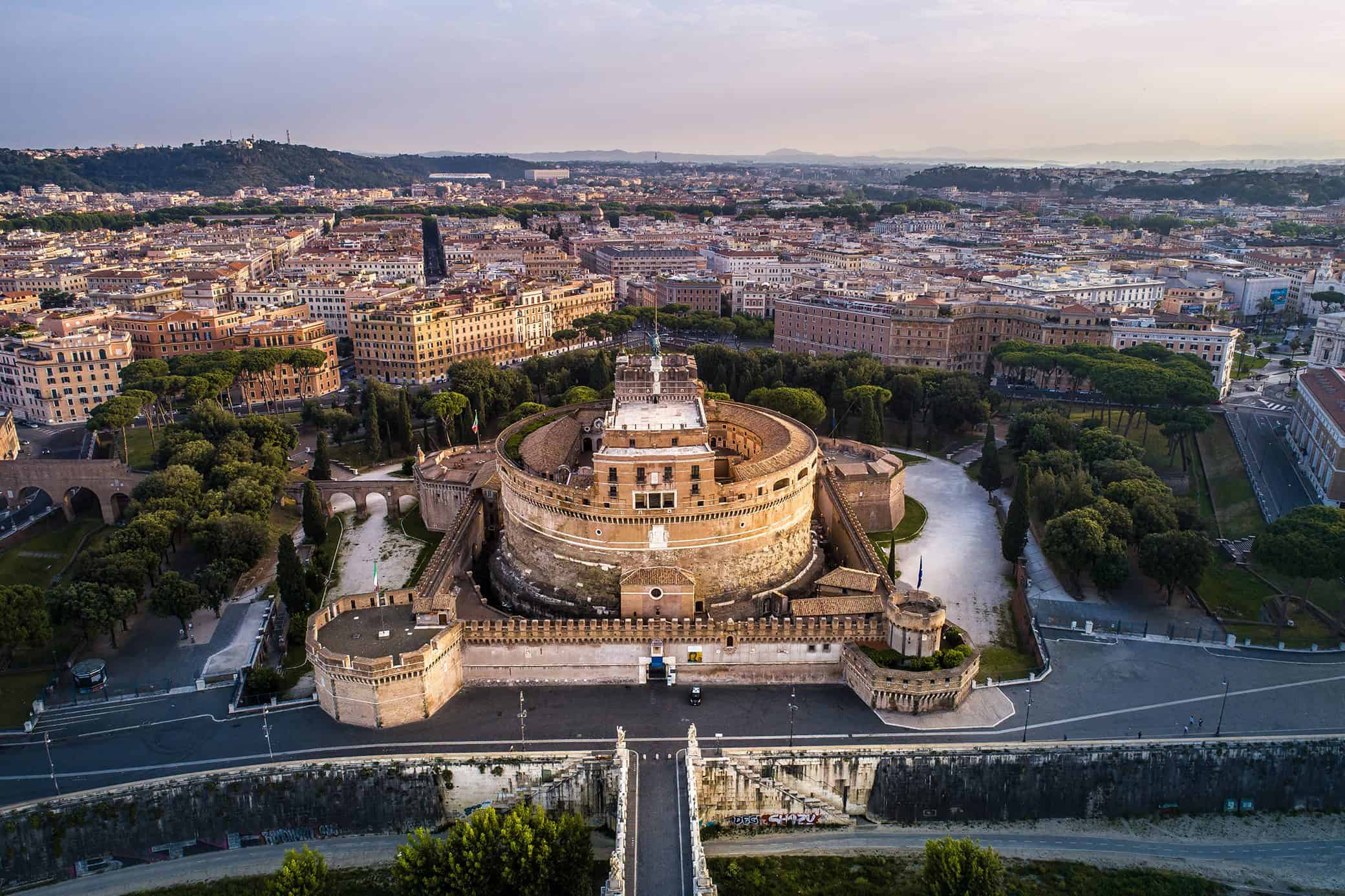
Castel Sant'Angelo, the most layered monument of the State Museums of Rome
Lungotevere Castello 50. Open Tuesday to Sunday from 9:00 to 19:30 with last entry at 18:30, closed Monday except for special events, closed December 25 and January 1. The full ticket costs €18.00, the reduced fee for EU citizens aged 18 to 25 is €2.00, free under 18 and on the first Sunday of the month. Booking is recommended every day and becomes almost essential on weekends and holidays. Tickets are named and a matching ID must be shown at the check. Groups of 10 to 25 people must book and get audio guides at €2.00 per person.
The museum's own definition of itself is unusual and accurate: monument, archaeological area and museum all in one. It began as the mausoleum of Hadrian, completed in 139 AD, became a late antique fortress, then a papal stronghold linked to the Vatican by the Passetto di Borgo, then a state prison, then barracks, and finally a museum in 1925. The helical ramp that climbs inside the body of the mausoleum is still the Hadrianic one, and walking through it is the most physical experience of imperial Rome you can have in Rome.
At the top are the Renaissance rooms frescoed for Paul III Farnese, with the Sala Paolina decorated by Perin del Vaga and collaborators around 1545, Clement VII's little bathroom, the papal apartments. And there's the terrace, the one where the heroine throws herself off in the last act of Tosca. The view from the terrace of the Angel is better than the one from the Janiculum and the one from the Pincio, because it's the only one that holds St. Peter's dome, the bend of the Tiber and the rooftops of the historic center in a single frame.
A warning nobody gives: the climb is long and almost all on ramps or stairs, and on hot days the ancient part has no ventilation. People with mobility difficulties or heart problems need to know this before buying the ticket.
The Pantheon Among the State Museums of Rome
Piazza della Rotonda. Open every day from 9:00 to 19:00, with the ticket office closing at 18:00 and last entry for individual visitors at 18:30. Closed December 25 and January 1. The ticket costs €7.00 full price and €2.00 reduced for European Union citizens between 18 and 25 years old. It's free for people under 18, for Rome residents and on the first Sunday of the month, and it stays free during religious services, because the Pantheon is in every respect the Santa Maria ad Martyres Basilica and has never stopped being one. The required dress is that of churches: shoulders covered, no shorts.
The visit calendar is set on a monthly basis and tickets go on sale around the middle of the previous month on the ministry portal or the dedicated app. Anyone who arrives without a ticket finds the line at the ticket windows in Piazza della Rotonda, which on spring mornings is the slowest in the center.
Free admission for Roman residents is the least publicized piece of news in the whole state system of the city. Anyone who lives in Rome can keep walking in as they always have, by showing an ID. My advice to Romans is to take advantage of it on a day of heavy rain: the oculus open in the dome lets the water fall on the sloped floor, the 22 drainage holes carry it away, and you watch a plumbing system designed 19 centuries ago keep working without extraordinary maintenance. There is no more effective demonstration of Roman engineering.
The House Museums of the State Museums of Rome
This is the part of the system that nobody knows and that is the real competitive advantage of Rome's state museums. There are five or six small addresses, well kept, with low ticket prices and no lines, where you walk in and find staff who want to tell you about the place. Anyone who has already seen the big museums and is coming back to Rome for the third time should build their day around these.
The Boncompagni Ludovisi Museum, the Surprise of Via Veneto
Via Boncompagni 18, in an early 1900s palazzina a short walk from Via Veneto. Open Tuesday to Sunday from 9:00 to 19:30 with last entry at 18:30, closed Monday except for some special Monday afternoon openings scheduled between spring and autumn. Full ticket €6.00, reduced €2.00, free under 18 and on the first Sunday of the month.
The theme is stated outright: decorative arts, fashion and costume understood as the evolution of social taste in the modern age. There is furniture, clothing, paintings and sculptures, but the highlight is the atmosphere of the house, donated to the State by Princess Blanceflor Boncompagni Ludovisi along with the collection. For anyone who works on the history of Italian costume it's a required stop. For everyone else it's the best surprise Via Veneto can still offer.
The Hendrik Christian Andersen House Museum
The house of the Norwegian sculptor naturalized American, at the foot of the Pincio toward Piazzale Flaminio, holds his studio with the monumental sculptures meant for an ideal city that was never built. Andersen was a friend and correspondent of Henry James, and the letters between the two are a literary document known to scholars. The Andersen house museum is one of the strangest places in Rome: dozens of colossal bodies in plaster and bronze, all conceived for a utopian project. Opening conditions should be checked on the official website of the directorate of national museums of the city of Rome.
The Mario Praz House Museum
The apartment of Mario Praz, Anglicist, critic and collector, preserved as he left it at his death in 1982, in a building in the center. The Praz museum is visited with an escort and in small groups, for reasons of space: it's a real apartment, with Empire furniture, waxes, watercolors of interiors. Praz wrote La casa della vita, which is both an autobiography and an annotated catalog of his own objects, and visiting the apartment after reading that book is an experience with no equivalent in Rome. Hours and access arrangements should be checked on the official website, because capacity is minimal.
The National Museum of Musical Instruments
Piazza Santa Croce in Gerusalemme, inside the Palazzina Samoggia, next to the basilica. The musical instruments museum holds more than 3,000 pieces, from the ancient world to the 19th century, with a notable section of keyboard instruments. The piece specialists come to see is a harpsichord attributed to the workshop of Bartolomeo Cristofori, the inventor of the piano. It's a quiet museum, almost always empty, in an area, Santa Croce, that tourists cross only to get to the Scala Santa.
The Giacomo Manzù Museum and the Casa Pasolini
The Giacomo Manzù Museum is in Ardea, south of Rome, and gathers the works that the sculptor from Bergamo donated to the State in 1979: bas-reliefs, portraits, the sketches for the doors of St. Peter's. You get there by car or on the public transport that serves the southern coast, and it's a trip that works well combined with an off-season day at the sea. The Casa Pasolini, under the same ministerial directorate, is the latest entry into the system and its visiting arrangements should be checked on the official website.
Better to be blunt about this chapter: if you have a free afternoon and the prospect of a line at the Forums depresses you, pick two of these addresses. You'll spend less than €15 for the two, you won't find anyone and you'll leave with a story to tell at dinner. It's the best way to use Rome's state museums.
VIVE: the Vittoriano and Palazzo Venezia
The autonomous institute called VIVE holds together the Vittoriano with the Altare della Patria, the Central Museum of the Risorgimento, the panoramic terrace, the Imperial Forums Wing, Palazzo Venezia and the Library of Archaeology and Art History. It's open every day from 9:30 to 19:30 with last entry at 18:45, and on Fridays it stays open until 23:30 with last entry at 22:45. The integrated ticket costs €18.00 full price, includes the temporary exhibition currently running, and drops to €5.00 for visitors between 18 and 24. It's free under 18 and for people with disabilities.
Palazzo Venezia is the first great palace of the Roman Renaissance, built starting in 1455 for the Venetian cardinal Pietro Barbo, later Pope Paul II. It has a courtyard with two orders of arches left unfinished, a walled hanging garden, the Viridarium, and a series of monumental rooms including the Sala del Mappamondo, from whose window Mussolini spoke to the crowd in Piazza Venezia. The collections include medieval wooden sculptures, ceramics, small bronzes, tapestries, weapons, silverware: a collection of applied arts that has no match in Rome.
The Vittoriano, designed by Giuseppe Sacconi and inaugurated in 1911, is the most debated monument in the city. The elevator to the terrace is worth it, since it offers the only view from above in which you see the Colosseum, the Forums and the Capitoline Hill in the same frame without climbing a dome. The verdict: the monument itself remains indigestible, the Risorgimento museum is serious and underrated, and the Friday evening opening is the smartest thing this institute has done in recent years.
The National Etruscan Museum of Villa Giulia
Piazzale di Villa Giulia 9, reachable by trams 2, 3 and 19 or from Flaminio station on metro line A with about a 14-minute walk. Open Tuesday to Sunday from 8:30 to 19:30, last entry at 18:30, rooms start closing at 19:00. Closed Monday, December 25 and January 1. Full ticket €13.00, reduced €2.00.
The villa was built for Julius III between 1551 and 1553 with the contribution of Jacopo Barozzi da Vignola, Bartolomeo Ammannati and Giorgio Vasari, and with advice from Michelangelo according to the tradition reported by 16th-century sources. The three-level nymphaeum with the Acqua Vergine fountain is one of the masterpieces of 16th-century villa architecture and by itself justifies the ticket. Since 1889 the villa has housed the museum dedicated to the pre-Roman civilizations of Tyrrhenian central Italy.
The works everyone looks for are the Sarcophagus of the Spouses from Cerveteri, in terracotta, from the second half of the sixth century BC, with the couple half-reclining on the banquet couch. The Apollo of Veii and the group of terracottas from the Portonaccio temple, attributed by tradition to Vulca, the only Etruscan artist whose name the ancient sources hand down. The Ficoroni Cista, a bronze container of Praenestine production with the signature of Novios Plautios. The gold sheets of Pyrgi with inscriptions in Etruscan and Phoenician, a fundamental document for the linguistic history of the Mediterranean. There is also a notable collection of Attic pottery that reached Etruria through trade.
The second site, Villa Poniatowski, on the other side of Via Flaminia, is undergoing works and reopening is announced for the fall of 2026. It's worth checking the museum's official website before planning it.
A piece of advice that almost nobody follows: go into Villa Giulia with the idea of understanding how people lived, not what was dug up. The Etruscans left their tombs because few of their cities remain, but the banquet table settings, the engraved mirrors, the bucchero ware and the jewelry tell of a society that the Romans described with a mixture of admiration and contempt. The Sarcophagus of the Spouses, with the woman reclining next to the man and not at his feet, is the best answer to anyone who believes antiquity was all the same.
The Museum of Civilizations at EUR
Piazza Guglielmo Marconi 14 and 8, at EUR, in the two buildings of the Palazzo delle Scienze and the Palazzo delle Arti e Tradizioni Popolari. Open Tuesday to Sunday from 8:00 to 19:00 with last entry at 18:30, closed Monday. The full ticket is €10.00, the reduced €2.00. You get there by metro line B to the EUR Fermi or EUR Palasport stop.
The Museum of Civilizations was created in 2016 by the merger of four existing national museums: the Luigi Pigorini Prehistoric and Ethnographic Museum, the Lamberto Loria Museum of Folk Arts and Traditions, the Museum of the Early Middle Ages and the Giuseppe Tucci National Museum of Oriental Art. It's the most ambitious museum project of recent years in Italy, and also the most difficult: putting European prehistory, colonial ethnographic collections, Italian folk arts and Asian art under the same roof means tackling head-on the question of how a museum born of a 19th-century mentality is displayed today.
What you see. The Italian prehistoric sequence from the Paleolithic to the Iron Age, with materials of the first rank. The ethnographic collections from Oceania, Africa and the Americas, including a famous turquoise mosaic mask of Mesoamerican origin. Objects of Italian material culture collected by Lamberto Loria for the 1911 Exposition: Sicilian carts, looms, nativity scenes, costumes. The Lombard grave goods and early medieval sculptures. The oriental collections built by the Italian Institute for the Middle and Far East, with the Iranian section and the Tibetan section collected by Giuseppe Tucci.
In our view it's the Roman state museum where you learn the most and the one Romans know the least. On the other hand the display is uneven, some sections are still in transition and the signage inside the two buildings doesn't help. Go with at least three hours ahead of you and the frame of mind of someone visiting an intellectual construction site, not a finished museum.
The National Gallery of Modern and Contemporary Art
Viale delle Belle Arti 131, on the northern edge of Villa Borghese, in the Palazzo delle Belle Arti built by Cesare Bazzani for the 1911 Exposition. Open Tuesday to Sunday from 9:00 to 19:00, last entry 45 minutes before closing, closed Monday. The full ticket costs €15.00, the reduced €2.00 for European Union citizens between 18 and 25. Free on the first Sunday of the month, under 18, for eligible teachers and students, for people with disabilities and one companion, and on April 25, June 2 and November 4.
The Galleria Nazionale holds the largest Italian collection of 19th- and 20th-century art: Antonio Canova, Francesco Hayez, the Macchiaioli, Giovanni Segantini, Giacomo Balla, Umberto Boccioni, Amedeo Modigliani, Giorgio de Chirico, Giorgio Morandi, Alberto Burri, Lucio Fontana, Piero Manzoni, Jackson Pollock, Claude Monet, Vincent van Gogh, Gustav Klimt. The large thematic installation introduced in the last decade broke the chronological sequence by placing works of distant eras side by side, with debated results.
The experiment worked only halfway: some pairings are illuminating, others gratuitous. It remains a museum with an enormous collection, a café with a view of the gardens and a small audience relative to the quality of what it shows. Anyone arriving in Rome for the second time who believes there is no contemporary art in Rome should start here, and continue with MAXXI on Via Guido Reni, which however is a foundation and not a state museum in the strict sense.
Baths of Caracalla and the Sites of the Special Superintendency
Via delle Terme di Caracalla. The full ticket costs €8.00, the reduced €2.00, with a supplement of €5.00 when an exhibition is on. The ministry website lists hours Tuesday to Sunday from 9:00 to 19:15 with last entry at 18:00 and the ticket office closed at 18:00. The Monday calendar and the seasonal hours change often, so it's best to check the official website before going. Since May 2024 ticketing runs through the ministry platform, with online purchase, app or an on-site kiosk with electronic payment.
The Baths of Caracalla are the best-preserved imperial bath complex in Rome: inaugurated in 216 AD, they covered about 11 hectares and could hold up to 1,600 people at the same time. What still stands are the walls of the central block, up to 30 meters high, stripped of the marble cladding that popes and princes took down over centuries. The two granite basins that decorate Piazza Farnese today come from here. The Farnese Bull group and the Farnese Hercules, today in Naples, were found in the palaestrae in the 16th century.
The visit to the underground mithraea, when available, is the most interesting part: the mithraeum of the Baths of Caracalla is the largest in Rome. In the summer months the complex hosts the open-air opera season, and it's the only Italian case of a major performance inside an ancient monument that works without damaging it, thanks to a self-supporting stage.
Other open sites fall under the same Superintendency, including the Mausoleum of Augustus, returned to visitors after a long restoration, with access and booking arrangements indicated on the official website.
Ostia Antica, the State Park Worth a Full Day
Viale dei Romagnoli 717, in Ostia Antica. The Archaeological Park of Ostia Antica is an autonomous institute that includes the excavations with the Ostia Museum, the Castle of Julius II and the village, the archaeological area of the imperial ports of Claudius and Trajan, the Museum of the Ships, the Porto necropolis at Isola Sacra and the complex of the Sant'Ippolito Basilica. Admission is free on the first Sunday of the month. Updated hours and rates are on the park's official website and on the ministry portal.
You get there by the urban train from Porta San Paolo, Ostia Antica stop, and the ticket is the ordinary public transport one: it's the cheapest archaeological site to reach in the whole Roman area. The walk from the station to the gate takes five minutes across an overpass.
Why it takes a full day. Because Ostia is not a monument but a city: the decumanus more than a kilometer long, the Baths of Neptune with the black-and-white mosaics, the theater with the Square of the Corporations where the mosaics mark the offices of the shipowners of Alexandria, Carthage, Narbonne. The multi-story insulae that explain Roman residential building better than any reconstruction. The thermopolia with marble counters. The Mithraeum of the Seven Spheres. The synagogue on the eastern outskirts, among the oldest in the western Mediterranean. The Ostia Museum holds the sculptures found in the excavations.
Ostia gives more than Pompeii to anyone who wants to understand how an ordinary Roman city worked, because it wasn't sealed by a catastrophe but slowly abandoned, and so it preserves the transformations of four centuries instead of a single instant. On the other hand it has less painting and fewer objects in place. If you have only one day and love objects, choose Palazzo Massimo. If you love streets, choose Ostia.
What Isn't State-Owned in Rome Even Though It Looks It
There are places everyone assumes are state-owned and aren't. The mix-up costs time and sometimes money, because someone who arrives on the first Sunday of the month convinced they're getting in free finds the ticket office selling tickets as usual.
Villa Farnesina Belongs to the Lincei
The Villa Farnesina, at Via della Lungara 230, is owned by the Accademia Nazionale dei Lincei and run by the Academy itself, not by the Ministry. It doesn't take part in the free state Sunday, it has its own calendar, it's open on all working days from 9:00 to 14:00 with last entry at 13:15 and opens specially on the second Sunday of the month from 9:00 to 17:00, with a guided tour at 12:30. The ticket is bought online through the channel indicated by the Academy or at the villa.
It's worth every euro. The villa was built between 1506 and 1511 by Baldassarre Peruzzi for the Sienese banker Agostino Chigi, and the decoration brings together Raphael with his workshop, Sebastiano del Piombo, Giovanni da Udine, Sodoma and Peruzzi himself. The Loggia of Galatea with Raphael's Triumph of Galatea and Peruzzi's astrological vault sails, the Loggia of Cupid and Psyche with Giovanni da Udine's plant festoons, Peruzzi's Hall of Perspectives with views of Rome painted between false columns, the wedding chamber with Sodoma's Wedding of Alexander and Roxana. It's the most coherent secular cycle of the Roman Renaissance after the Vatican Stanze, and the fact that it's outside the state circuit keeps it wonderfully empty.
The Vatican Museums Belong to Another State
The Vatican Museums belong to the Vatican City State. They don't apply the Italian decree on free admissions, they don't do the first Sunday of the month like the Italian state museums but have their own free-opening Sunday with its own rules, and their ticket office is completely separate. No Italian pass, state or municipal, gives access to them.
Family Galleries and Hybrid Cases
The Galleria Doria Pamphilj and the Galleria Colonna are private and remain the property of the families. The Galleria Spada, on the other hand, is state-owned, but occupies the piano nobile of a palace that houses the Council of State, which explains the checks at the entrance and the mandatory route. The Quirinal Palace is the seat of the Presidency of the Republic and is visited by reservation with its own security rules. Villa Medici belongs to the French Academy in Rome and has a French ticket office.
Municipal Museums Have Nothing to Do With It
It's worth repeating because it's the most frequent mistake: the Capitoline Museums, the Museum of the Imperial Forums at the Markets of Trajan, the Ara Pacis, the Porta San Paolo and the other museums of Roma Capitale have municipal rates, a municipal calendar and a municipal pass. Their free admissions depend on the Rome City Council resolutions and not on the ministerial decree, and the conditions in force should be checked on the City's official channel: the page on free museums in Rome reconstructs them in detail.
Mandatory Reservations in the State Museums of Rome
Not all of the State's museums require a reservation, and telling them apart helps avoid two opposite mistakes: showing up without a ticket where one is needed, or paying a presale fee where it wasn't necessary.
Where Reservations Are Mandatory in the State Museums of Rome
At the Galleria Borghese reservation is mandatory for everyone, including the categories entitled to free admission, and carries a fee of €2.00. At the Colosseum Archaeological Park online reservation is mandatory for the entry time slot to the amphitheater and the ticket is named, with an ID check. At the Domus Aurea the visit is only with an escort and a reservation, on opening days. At the Villa of Sette Bassi and the Tombs of Via Latina, in the Appia Antica Park, you enter only with a booked guided visit. At the Mario Praz House Museum access is by very small groups and has to be arranged. Groups of 10 to 25 people at Castel Sant'Angelo must reserve.
Where Reservations Are Only Recommended
At Castel Sant'Angelo for individuals, at the Pantheon, at the sites of the National Roman Museum, at the National Galleries of Ancient Art, at Villa Giulia, at the Museum of Civilizations, at the National Gallery of Modern Art, at the Baths of Caracalla and at Ostia Antica you can buy the ticket on site. Recommended does mean something, though: at the Pantheon on April and October mornings the line at the ticket windows exceeds an hour, and at Castel Sant'Angelo on Saturday afternoon you reach similar waits.
The Right Place to Buy for the State Museums of Rome
The museums that depend on the territorial directorate, so Castel Sant'Angelo, the Pantheon and the house museums, sell on the ministry portal Musei Italiani and its app. The autonomous institutes each have their own concessionaire, indicated on their official website. No state museum authorizes sales by intermediaries that are not listed on its own official page: if a site offers a ticket for the Colosseum at a price different from the list price, that ticket includes an additional service or is not valid. Always buy starting from the museum's website, never from a search engine.
The First Sunday of the Month in the State Museums of Rome
It's the best-known rule and the most misunderstood. On the first Sunday of every month the State's museums, monuments, galleries and archaeological areas are free for everyone, during the usual opening hours, with reservation recommended or mandatory where required. The free admission covers entry, not the reservation fee: at the Galleria Borghese you still pay the €2.00 fee and the spot still has to be reserved, and in high season the free slots sell out within a few hours of sales opening.
The exceptions matter. The Domus Aurea is closed on the first Sunday of the month. Some guided-visit sites keep the cost of the escort. Temporary exhibitions with a supplement remain paid even on the free Sunday.
The advice that almost nobody follows: the first Sunday of the month is not the right day for the famous museums. The Colosseum and the Galleria Borghese on that date have crowds that make the visit worse, not better. It is instead the perfect day for the Museum of Civilizations at EUR, for the epigraphic section of the Baths of Diocletian, for the National Gallery of Modern Art, for Ostia Antica: places that stay quiet even when free and that on that day give you a zero-cost visit with no penalty. Anyone who wants to save on the big names should do the opposite, that is, choose a paid Tuesday in November: you pay €15 and see double.
Free Admission and Reductions by Law in the State Museums of Rome
The ministerial decree that regulates admissions applies throughout Italy and is applied identically in every museum of the State. It's worth knowing, because many people pay for tickets they shouldn't pay for.
Admission is free, with no age limit, in state archives and libraries for anyone. In state museums, monuments, galleries and archaeological areas admission is free for those who haven't turned 18, regardless of citizenship. It's also free for licensed European Union tourist interpreters, for Ministry staff, for ICOM members, for teachers and university students of the degree programs in architecture, cultural heritage conservation, education sciences, archaeology and art history, for teachers and students of the fine arts academies, for school teachers with the required documentation, for people with disabilities and one companion, for volunteer association workers under agreement, for school groups with reservation, for researchers with verification by their institution, for citizens of Norway, Iceland, Liechtenstein and Switzerland by virtue of the agreements on the European economic area, and for journalists registered in the professional register with a valid press card.
The reduced ticket at €2.00 goes to European Union citizens who have turned 18 and haven't turned 25, and extends to citizens of third countries where reciprocity applies. Two euros for Palazzo Barberini or the National Roman Museum is, without exaggeration, the best cultural offer in Europe for a 20-year-old.
Carry the document that proves your entitlement. You don't need to print anything more, but without a document the ticket window applies the full price and allows no discussion.
Combined Tickets and Cards in the State Museums of Rome
The Roman state system has no single card, but it has a few combined formulas that, used well, save serious money. I list them in order of real value.
The National Roman Museum Ticket
€15 for one entry to each site within seven days. With two sites visited it already breaks even against the cost of single admissions, with three it's a bargain. The annual MNR Card at €30.00 suits anyone who lives in Rome or stays for a long time.
The National Galleries of Ancient Art Ticket
€15 for Palazzo Barberini and Galleria Corsini, valid 20 days. The duration is the real gift: it lets you split the visit across two different days and two different neighborhoods.
The Appia Antica Park Pass
€12 for seven days on all the sites of the park, against the €8 of a single entry to Cecilia Metella or the Villa dei Quintili. Anyone who sees two sites already breaks even. The annual card at €25.00 is the best cultural expense a Roman can make, because the park is also a place to walk.
The Colosseum Archaeological Park Formulas
The ordinary ticket at €18.00 already includes three areas for 24 hours, and the Full Experience packages extend to two days with the addition of special areas. Here the calculation is not about savings but about time: anyone with two free mornings spends better with the longer package, anyone with only one shouldn't even consider it.
City Cards and the State Museums of Rome
Rome's tourist cards, sold by the city's official tourism circuit, include entries to a selection of state and municipal museums and public transport. The Colosseum Archaeological Park applies a dedicated rate of €11.50 to holders. It pays off only for anyone who truly plans three or four major entries in a few days and will use the metro a lot. In all other cases the numbers don't add up, and I say so having redone the calculation every year for the clients who ask me.
The municipal annual card, the €5 one reserved for residents, opens only the museums of Roma Capitale and has no effect on the State's museums. Anyone who lives in Rome and loves museums needs two different cards, and it's one of the most enduring absurdities of Italian cultural administration.
State Museums of Lazio Outside Rome
The list of the State's museums doesn't stop at the Grande Raccordo Anulare. Lazio holds a network of state sites that is worth the trip and that almost no foreign visitor knows, with low ticket prices and the same free admissions by law. I order them by province.
State Museums of the Province of Rome
In Tivoli are the two largest complexes: Hadrian's Villa, the residence Hadrian had built between 118 and 138 AD over an area of more than 120 hectares, and Villa d'Este, the 16th-century villa of Cardinal Ippolito II d'Este with the system of fountains fed without pumps. They are run by a dedicated autonomous institute and both are World Heritage sites. Tivoli is reached by train from Tiburtina in just under an hour.
In Palestrina the National Archaeological Museum occupies the Palazzo Colonna Barberini built over the sanctuary of Fortuna Primigenia, and holds the great Nilotic mosaic of the late Republican period, one of the most extraordinary documents of Egyptianizing taste in Rome. In Nemi the Museum of the Roman Ships tells the story of the two ships of Caligula recovered from the lake in the 1930s and destroyed by a fire in 1944. At Prima Porta the Villa of Livia, the one with the garden frescoes. In the northern territory the Veio Park with the sanctuary of Portonaccio, from which the Apollo of Villa Giulia comes.
State Museums of the Province of Frosinone
The Archaeological Museum of Frosinone collects the materials of the Hernici and Volscian territory. At Cassino the archaeological area with the theater and amphitheater of Casinum, below the abbey of Montecassino. At Anagni the cathedral museum with the frescoed crypt, which is church property but completes the route. In the Liri valley and in the Ciociaria there is a network of municipal and state antiquaria that documents the pre-Roman occupation.
State Museums of the Province of Latina
At Priverno the museums of Priverno with the archaeological area of Privernum. At Sermoneta and in the Pontine plain the Museum of Satricum at Le Ferriere, where the sanctuary of Mater Matuta stood. At Sperlonga the national archaeological museum next to the villa of Tiberius, with the Hellenistic sculptural groups reassembled from the fragments found in the grotto: it is, in our view, the most beautiful state museum in Lazio after the Roman ones. At Anzio the Landing Museum tells the story of January 1944. The Museum of the Pontine Land in Latina documents the land reclamation.
State Museums of the Provinces of Viterbo and Rieti
In Upper Lazio the Etruscan concentration is the densest in Italy: Tarquinia with the national museum in Palazzo Vitelleschi and the painted necropolises, Cerveteri with the Banditaccia, Vulci, Tuscania. The Palazzo Farnese in Caprarola, built on a pentagonal plan by Vignola for Cardinal Alessandro Farnese, and the Villa Lante at Bagnaia are two of the manifestos of Italian Mannerism. Not far away the Sacro Bosco of Bomarzo, which however is private. In the province of Rieti the abbey of Farfa and the Sabine areas complete the picture.
If you've already seen Rome twice, spend the third time outside it. Sperlonga, Tarquinia and Caprarola in three days with a car are worth more than any fourth visit to the Forums, and the tickets cost as much as a coffee in the center.
Two Days Among the State Museums of Rome: the Itinerary I Propose
I build it the way I would build it for a group of curious adults, without small children, in an average season. It assumes it isn't Monday.
First Day Among the State Museums of Rome: the Ancient World
9:00, Palazzo Massimo alle Terme, single National Roman Museum ticket at €15.00. Two full hours, with priority to the second floor. 11:15, cross Piazza dei Cinquecento and visit the epigraphic section and Michelangelo's cloister of the Baths of Diocletian, one hour. Quick lunch in the Repubblica area. 14:30, bus 64 or a walk to Palazzo Altemps, an hour and a half. 16:30, coffee in Piazza Navona and close the day at the Pantheon, €7.00, with the reservation made the night before. Total cost of tickets: €22.00.
Second Day Among the State Museums of Rome: the Modern and the Baroque
9:00, Galleria Borghese with a booked slot, €16.00 plus €2.00 for the reservation. Out at 11:00, walk through Villa Borghese to Viale delle Belle Arti. 11:30, National Gallery of Modern Art, €15.00, an hour and a half. Lunch. 15:00, Palazzo Barberini with the €15.00 ticket valid 20 days, two hours. Anyone with energy left continues by bus to the Lungara and uses the second half of the ticket at the Galleria Corsini in the following days. Total cost: €48.00.
Two warnings from a professional. The first: don't put the Colosseum in a two-day all-museum itinerary, because it needs half a day of its own and changes the rhythm. The second: if the first Sunday of the month falls within your stay, move the modern day to that date and save €30 each, but book the Borghese the very day sales open.
The State Museums of Rome with Children
The state system is generous with families: under 18 you get in free everywhere, which means a family with two minor children pays for only two tickets. It's an advantage that in Rome is worth hundreds of euros in a week.
What really works, from direct experience. Castel Sant'Angelo, because it's a real castle with ramps, drawbridges, terraces and cannons. The Museum of Civilizations at EUR, for the prehistoric section and for the ethnographic objects, which say more to a child than any marble. Villa Giulia, for the nymphaeum, for the Sarcophagus of the Spouses and for the feeling of being in a garden. Ostia Antica, because it's a city where you run. The National Museum of Musical Instruments, for reasons obvious to anyone with children who play.
What doesn't work: the Galleria Borghese, because of the rigid two-hour slot and the ban on running. Palazzo Altemps, too quiet. The Colosseum in the middle hours of July, because the heat on the floor of the amphitheater is unbearable for a child. The practical advice: one museum a day, never two, and always with an ice cream announced in advance as the final prize. It has worked for 20 years.
Accessibility in the State Museums of Rome
People with disabilities and one companion enter all the State's museums free of charge, by decree. On physical accessibility the picture is uneven and has to be checked case by case on the official website of each institute.
The sites with good accessibility are Palazzo Massimo, which has elevators on all floors, the Museum of Civilizations, the National Gallery of Modern Art, and Palazzo Barberini along most of the route. Villa Giulia has easier routes and dedicated services, including tactile reproductions for visitors with visual disabilities and sign-language video guides. The Galleria Borghese is accessible but the rigid two-hour slot has to be taken into account.
The difficult sites are Castel Sant'Angelo, where the ancient helical ramp and the stairs to the terraces cannot be overcome in a wheelchair beyond a certain level. The Baths of Diocletian, where construction work changes the routes. The area of the Roman Forum and the Palatine, where the ground is largely uneven and uphill. Ostia Antica, where the ancient paving stones are impassable with small wheels. In the archaeological parks there are marked easier routes: ask the staff at the entrance, because they aren't always shown on the map.
When to Go and When to Avoid the State Museums of Rome
On Monday most of the State's museums are closed. The exceptions are the Pantheon and the Vittoriano complex with Palazzo Venezia, open every day, and some special initiatives that open Castel Sant'Angelo on Mondays in certain periods. A Monday in Rome has to be planned accordingly: parks, churches, basilicas and the municipal museums that are open.
The worst months are April, May and October, when the overlap of school tourism and international tourism saturates every reservation. The best months are January, February and the second half of November: half-empty museums, low and beautiful light in the rooms, staff willing to talk. July and August are acceptable in indoor museums and prohibitive at outdoor sites: at the Baths of Caracalla or the Palatine, between 11:00 and 16:00, the heat is a safety problem, not a comfort problem.
The best times of day are opening and the last two hours. The flow of organized groups concentrates between 10:00 and 13:00, and from 16:00 on the rooms empty out. An alternative, when you visit for pleasure, is to enter an hour and a half before last entry: you see less, but you see better.
A Curiosity About the State Museums of Rome
The first state museum of Rome was not built: it was requisitioned. When in 1889 the Ministry of Public Education decided to give a home to the antiquities that were emerging in an avalanche from the demolitions of the capital, it chose the Certosa di Santa Maria degli Angeli, that is, the Carthusian monastery that Michelangelo created inside the Baths of Diocletian. The friars had already been removed under the suppression laws of the 1860s. In the cells and cloisters they began to pile up marbles, inscriptions, sarcophagi. The National Roman Museum was born this way, inside a fourth-century bath building turned into a convent in the 16th century and into an archaeological warehouse in the 19th.
The consequence is still visible today. The great cloister attributed to Michelangelo, 100 pillars around a garden with four cypresses that tradition holds were planted by the artist himself, was not designed to hold sculptures: the colossal animal heads you meet along the sides are there because there was nowhere else to put them. Over a century the museum has spread to three other sites precisely because the first was born of a logistical emergency and not of a plan.
I'll add a curiosity within the curiosity. The number of finds kept in the storerooms of Rome's state museums exceeds, many times over, the number of those on display. It's a condition common to all the great archaeological museums in the world, but in Rome it reaches particular proportions, because every building site in the city produces material that by law becomes state property. Every time they dig for a new pipe, Rome's state museums become a little richer and a little more crowded in the basements.
Something Nobody Tells You About the State Museums of Rome
That the Palazzo Barberini ticket is valid for 20 days and includes the Galleria Corsini, and that the vast majority of the people who enter Barberini never set foot in the Corsini. It happens often: whoever bought the ticket has it stamped at Via delle Quattro Fontane, leaves happy and throws away half of their purchase. The Corsini is on the other side of the river, in Trastevere, and nobody associates it with Barberini because the name of the institute, Gallerie Nazionali di Arte Antica, doesn't say so.
The same goes for the National Roman Museum ticket: €15 for four sites within seven days, and the percentage of visitors who use more than two is very low. And for the Appia Antica Park pass, €12 for seven days on all the sites, which almost everyone buys in the single €8 version because they don't know it exists.
There is a second thing nobody says and it's even more useful. The Pantheon is free for residents of Rome. There is no sign shouting it, the news passed almost in silence when the monument became paid, and I know Romans convinced they can no longer enter the monument near their home. All it takes is an ID with a Roman residence and you go through the right line.
Third and last thing. The house museums of the territorial directorate, those of Andersen, Praz, Boncompagni Ludovisi, have tickets of €6 or less and minimal capacities. On January weekdays you walk in and there is no one else. In a city with lines everywhere in 2026, the existence of four state museums where you are alone is information worth more than any discount.
The Advice I Give You for Visiting the State Museums of Rome
Do the opposite of what everyone does: build the itinerary starting from the calendar, not from the names. The Roman state system has three rigid constraints that decide the day before your tastes do. On Monday almost everything is closed. The reservation at the Galleria Borghese and the Colosseum has to be made weeks in advance in high season. The first Sunday of the month completely changes attendance. If you put these three elements on the table before choosing the museums, the rest falls into place on its own.
Second piece of advice: buy the combined tickets even if you think you won't use them all. €15 for the National Roman Museum pays for itself with two sites, and you'll want to see the second site. €15 for Barberini plus Corsini pays for itself the same way, with 20 days of margin. It's elementary math that almost nobody does.
Third piece of advice: never go over two museums in a day. The average attention threshold of an adult in a museum is around 90 minutes, and after the second entry the yield collapses. Walking through Palazzo Altemps in 15 minutes after two other museums the same morning means, at the end of the day, remembering nothing. Better three museums done well in three days than six done badly in two.
Fourth: bring your ID. It seems trivial and yet it's the reason someone pays full price every week while entitled to free or reduced admission. State ticket offices don't accept verbal self-declarations.
Fifth and last: go into the museums in the wrong season. January and February in Rome are cold, bright and empty, and in those weeks a state museum is what it should always be, a place where you can stand still in front of a painting without someone pushing you.
Another Well-Known Fact, Yet Seldom Cited
Everyone knows that Rome's great museums come from the collections of the cardinal nephews. Almost no one remembers on what terms the Italian State bought them, and the story deserves telling because it explains why some things are in Rome and some others aren't.
The 1902 law on the protection of monuments arose in a large part from alarm at the dispersal of Rome's princely collections. The families were in debt, the international market paid enormous sums, and within a few years a substantial part of Rome's private artistic heritage took the road abroad. The Borghese collection was purchased by the State with the villa in 1902 precisely to stop its breakup, after the prince had already sold a notable part of the antiquities to Napoleon in 1807: those marbles are in the Louvre and will not return.
The Ludovisi collection followed a similar path. Formed by Cardinal Ludovico Ludovisi from 1621, it was considered the largest collection of ancient sculpture in private hands in Rome. At the end of the 19th century the villa on the Pincio was subdivided into lots to build the neighborhood that today bears the family's name, and the collection was purchased by the State in the early 20th century, saved at the last moment. The statues you see today at Palazzo Altemps are there by the skin of their teeth.
The little-cited fact, then, is this: Rome's state museums are not the fruit of a cultural policy, but of a series of emergency rescue operations carried out over 50 years by a young and poor country that understood it was losing something unrepeatable. It's a story of catching up, not of plans. And when today people complain about the unevenness of the system, it's worth remembering that the historical alternative was not a better system: it was the antiquarian market of London and New York.
The Right Photo to Take at the State Museums of Rome
First the rule, because without it the rest is useless. In the State's museums, photography without flash, tripod or pole is generally allowed for personal use, but each autonomous institute may set its own limits and some rooms with loaned works have specific bans posted on site. Flash is banned everywhere, always, and not on a whim: repeated radiation damages pigments and organic supports.
The photographs I recommend, in order. The first is Borromini's helical staircase at Palazzo Barberini, shot from below in the center of the stairwell: the paired columns that shrink as they rise produce a vortex that no wide-angle lens can ruin. It's the most beautiful photograph you can take in a Roman state museum and it costs zero effort.
The second is the room of Livia's painted garden on the second floor of Palazzo Massimo. Don't photograph the whole wall, which flattens in an image: choose a corner, where two walls meet, and include the floor. It's the only way to convey the feeling of being inside a room that pretends to have no walls.
The third is the great cloister of the Baths of Diocletian from the west side in the late afternoon, when the raking light crosses the portico and the cypresses cut the shadow. With the pillars in the foreground and the ancient animal heads lined up along the wall you get an image that tells the 16th century and antiquity together.
The fourth is the terrace of Castel Sant'Angelo toward St. Peter's an hour before sunset, with Peter Anton von Verschaffelt's bronze angel in blurred foreground and the dome in focus. It's an image seen a million times and it keeps working.
The fifth, the one nobody takes, is the best: the nymphaeum of Villa Giulia shot from the top of the loggia, with the three levels overlapping and the caryatids below. It tells the 16th-century idea of a villa better than any floor plan.
One last recommendation from someone who leads groups: don't photograph while the guide is speaking, and above all don't photograph every label with the idea of reading it at home. You will never read it. Look at the work for 30 seconds with no screen in front of your eyes, then shoot if you like. The memory that stays is that of the 30 seconds.
Some Important Events That Happened Here in History
The places that today make up Rome's state museums have been the stage of events that changed European history. I pick some of the best documented.
On May 6, 1527 the Landsknechts enter Rome. Clement VII flees the Vatican along the Passetto di Borgo and shuts himself in Castel Sant'Angelo, where he remains besieged for months together with about a thousand people. Benvenuto Cellini, who was inside, says in his autobiography that he fired from the bastions. His testimony is partisan and should be read as such, but the pope's confinement in the fortress is an established fact. The Sack of Rome closes the Roman Renaissance and scatters artists and workshops across Italy.
In 1561 Pius IV commissions Michelangelo to turn part of the Baths of Diocletian into a church. The artist is 86 years old and chooses a solution nobody had tried: preserve the ancient hall instead of demolishing it, adapting its spaces to the liturgy. It is the first conscious example of reusing an ancient monument as architecture, not as a quarry of materials, and it opens a path that Europe will follow for centuries.
In 1633 Pietro da Cortona begins the ceiling of the salon of Palazzo Barberini. In that same palace, in those same years, the family of the reigning pope builds its own image with a machine of visual propaganda that today we would call modern. The palace becomes the model of the European Baroque palace.
In 1689 Christina of Sweden dies in the palace on the Lungara, the queen who had abdicated the throne in 1654, had converted to Catholicism and had chosen Rome as her residence, gathering there a court of writers and musicians from which the Accademia dell'Arcadia will be born. Her library and her collections ended up scattered across Europe. The palace is today the Galleria Corsini.
In 1849, during the Roman Republic, the Janiculum and the area of Villa Corsini are the theater of fighting between Garibaldi's volunteers and the French expeditionary corps. The Villa Corsini at the Quattro Venti is destroyed in the clashes. The palace on the Lungara survives.
In 1870 the breach of Porta Pia hands Rome over to the Kingdom of Italy. In the following 20 years the construction of the new neighborhoods brings to light a quantity of ancient material without precedent: the Horti Sallustiani, the Horti Lamiani on the Esquiline, the Termini area. It is the moment when, out of necessity, the very idea of a national museum in Rome is born.
In 1938 Palazzo Venezia hosts the diplomatic meetings that precede and follow the Munich conference. From the balcony of the Sala del Mappamondo, on June 10, 1940, Italy's entry into the war is announced. The Renaissance palace of Cardinal Barbo becomes, for 20 years, the center of Italian power.
In 1944, during the German occupation, the works of many Roman museums are moved to places considered safe. The Roman ships of Nemi, kept in the museum on the lake, burn on the night between May 31 and June 1. What remains are the scale models and the recovered metal parts: it is the gravest archaeological loss of twentieth-century Italy.
In 2016 the Ministry brings together in a single institute four national museums at the EUR and creates the Museo delle Civiltà. In 2017 the Colosseum Archaeological Park is born as an autonomous institute. These are administrative decisions, not battles, but they change the way Rome shows itself more than people think.
Who Passed Through the State Museums of Rome
The buildings that today house the museums of the State have been homes, convents, fortresses and colleges, and have seen all kinds of people pass through. I list those who are documented, distinguishing where needed between established fact and tradition.
The emperor Hadrian, who had the mausoleum on the Tiber built, completed in 139 AD, today Castel Sant'Angelo, and the villa at Tivoli. Marcus Aurelius and the Severans, whose statues and portraits fill the rooms of Palazzo Massimo. Diocletian and Maximian, who between 298 and 306 had the largest baths of the ancient world built.
Michelangelo Buonarroti, who in 1561 designed the church of Santa Maria degli Angeli and the Carthusian complex inside the baths, and to whom tradition also attributes the great cloister. Baldassarre Peruzzi, Raphael, Sebastiano del Piombo, Il Sodoma and Giovanni da Udine, who between 1506 and 1519 decorated the villa of Agostino Chigi on the Lungara. Jacopo Barozzi da Vignola, Bartolomeo Ammannati and Giorgio Vasari, who built Villa Giulia for Julius III between 1551 and 1553.
Carlo Maderno, Gian Lorenzo Bernini and Francesco Borromini, who passed the construction site of Palazzo Barberini among themselves between 1627 and 1633. Pietro da Cortona, who frescoed the salon there. Cardinal Scipione Borghese, who between 1605 and 1633 built the collection of the villa outside Porta Pinciana with methods that today we would call predatory. Cardinal Ludovico Ludovisi, who from 1621 gathered on the Pincio the collection that is today in Palazzo Altemps.
Benvenuto Cellini, besieged in Castel Sant'Angelo in 1527 and then, years later, a prisoner in the same fortress, from which according to his account he attempted to escape. The Count of Cagliostro, arrested in Rome at the end of 1789 and locked up in Castel Sant'Angelo during the trial of the Holy Office. Christina of Sweden, who died in Palazzo Corsini in 1689. Gabriele D'Annunzio, who in 1883 married Maria Hardouin di Gallese, whose family owned Palazzo Altemps.
In the nineteenth and twentieth centuries the travelers of the Grand Tour and their heirs passed through these places: Johann Wolfgang Goethe, who stayed in Rome between 1786 and 1788 and visited the antiquarian collections that were then private. Stendhal, who wrote Walks in Rome. Henry James, friend and correspondent of the sculptor Hendrik Christian Andersen, whose house is today a state museum. William Wyler, who in 1953 brought to the screen a Rome of recognizable monuments, Castel Sant'Angelo among them, with Roman Holiday. And before him Giacomo Puccini, who in 1900 set the last act of Tosca on the terrace of the fortress, the opera having premiered in Rome that very year. That scene made the monument familiar to a worldwide audience that had never seen it.
Mario Praz, English-literature scholar and collector, lived until 1982 in the apartment that is today a state house museum. Giacomo Manzù donated to the nation in 1979 the works that can be seen at Ardea. Giuseppe Tucci, orientalist and traveler, gathered in Asia the collections that ended up in the Museum of Civilizations. These are names that do not appear in the quick guides, and they are the ones that explain why certain objects are in Rome and not elsewhere.
Quick questions about the State Museums of Rome
How many State Museums of Rome are there?
In the city of Rome the state institutions and cultural sites open to the public number about 30, counting separately the venues of the institutes that have more than one: the four of the National Roman Museum, the two of the National Galleries of Ancient Art, the two of the Museum of Civilizations, the monuments of the two archaeological parks, the house museums of the territorial directorate. Across Lazio the total comfortably exceeds 50 sites. The updated list can be consulted on the ministry portal.
Which is the biggest of the State Museums of Rome?
By extent of the area under its care, the Appia Antica Archaeological Park, which covers thousands of hectares of road, villas, aqueducts and valleys. By number of visitors, the Colosseum Archaeological Park. By number of items held, the National Roman Museum, whose Medagliere alone has more than half a million pieces.
Is there a single ticket for all the State Museums of Rome?
No, and the reason is administrative: each autonomous institute has its own budget and ticket office. There are combined tickets within individual institutes, such as the National Roman Museum's €15 ticket valid for a week across four venues, the €15 ticket for Palazzo Barberini and Galleria Corsini valid for 20 days, the €12 weekly pass of the Appia Antica.
When are the State Museums of Rome free?
The first Sunday of every month for everyone, during the usual opening hours. Always for anyone under 18, for people with disabilities and one companion, for teachers and students of the faculties listed in the decree, for journalists on the professional register, for ICOM members and for the other categories provided for. The Colosseum Archaeological Park adds April 25, June 2 and November 4.
Do I need to book the State Museums of Rome?
It is mandatory at the Galleria Borghese, the Colosseum, the Domus Aurea and for some guided visits of the Appia Antica Park. It is recommended but not mandatory at the other venues. At the Galleria Borghese booking is mandatory even for those who enter free, with a fee of €2.00.
How much does it cost to enter the Colosseum, the most visited of the State Museums of Rome?
The standard Colosseum, Roman Forum, Palatine ticket costs €18.00 full price and €2.00 reduced for European Union citizens between 18 and 25. It is valid for 24 hours and limits the stay inside the amphitheater to 75 minutes. There are Full Experience options valid for two days with access to the underground, the arena, the third tier or the Passage of Commodus.
How much does the Galleria Borghese cost?
€16 full price, €11 for the last slot, €2 reduced, plus a mandatory booking fee of €2 for everyone. The visit lasts two hours, the slots are hourly and the capacity is 180 people per slot.
What is the difference between state museums and civic museums in Rome?
Ownership, and therefore the rules. State museums belong to the Ministry of Culture, apply the national decree on free admission and have the first Sunday free for everyone. Civic museums belong to Roma Capitale, have fares and concessions decided by the city administration and an annual card that is valid only for them. No pass for one is valid for the other.
Is the MIC card valid at the State Museums of Rome?
No. It is the card of the museums of Roma Capitale, reserved for residents, and it opens no door of the State. Anyone who lives in Rome and wants to cover both systems must also get the passes of the individual state institutes, such as the MNR Card or La Mia Appia Card.
Is Villa Farnesina a state museum?
No. It belongs to and is run by the Accademia Nazionale dei Lincei. It has its own calendar, fares and sales channel, opens on weekdays from 9:00 to 14:00 with last entry at 13:15 and, on an extraordinary basis, on the second Sunday of the month, and it does not take part in the state free Sunday.
Are the Vatican Museums among the State Museums of Rome?
No. They belong to the State of Vatican City, which is another State. They have their own ticket office, calendar and free-admission policy and do not apply the Italian decree.
Are the State Museums of Rome closed on Monday?
The great majority, yes. The exceptions are the Pantheon and the VIVE complex with Palazzo Venezia and the Vittoriano, open every day. Castel Sant'Angelo has some extraordinary Monday openings in certain periods of the year.
Can you take photographs in the State Museums of Rome?
In general yes, for personal use, without flash, tripod or selfie stick. Some rooms with works on loan or temporary exhibitions apply specific bans, posted on site. Professional filming requires authorization.
Are the State Museums of Rome wheelchair accessible?
It depends on the venue. Palazzo Massimo, the Museum of Civilizations, the National Gallery of Modern Art and a large part of Palazzo Barberini are accessible. Castel Sant'Angelo beyond a certain level, the Forum and Palatine area, and Ostia Antica because of the basalt paving are difficult. Entry is in any case free for the person with a disability and for one companion.
How long does the visit to the National Roman Museum, the largest of the State Museums of Rome, take?
Palazzo Massimo needs at least two hours, Palazzo Altemps an hour and a half, the visitable part of the Baths of Diocletian with the cloister and the epigraphic section about an hour. The single ticket lasts seven days precisely to allow you to spread the venues over different days.
Where do you buy tickets for the State Museums of Rome?
On the ministry portal Musei Italiani and its app for the museums of the territorial directorate, and on the official website of each autonomous institute for the others. Every museum indicates on its own site the reseller it has authorized: always start from there and never from a search result.
Are there State Museums of Rome that are free all year?
Entry is free for everyone in the archives and libraries of the State. Among the museums, some minor venues and some areas of the archaeological parks are freely accessible, and the monumental stretch of Via Appia Antica can be walked without a ticket. The complete picture of free opportunities is on the page dedicated to free museums in Rome.
Which is the least crowded of the State Museums of Rome?
Among the big ones, the Museum of Civilizations at EUR and the Galleria Corsini. Among the small ones, the National Museum of Musical Instruments at Santa Croce in Gerusalemme and the Boncompagni Ludovisi Museum. On a weekday afternoon in January you walk through the rooms almost alone.
Does the National Roman Museum ticket include the Colosseum?
No. They are two separate autonomous institutes with separate ticket offices. The National Roman Museum ticket is valid only for its own venues.
What can you see in half a day among the State Museums of Rome?
Palazzo Massimo and the Baths of Diocletian, which are opposite each other in Piazza dei Cinquecento and are covered by the same ticket. It is the densest and cheapest state half day that Rome can offer.
Is the city tourist card worth it for the State Museums of Rome?
Only for those who plan three or four big entries in a few days and will use public transport a lot. The Colosseum Archaeological Park reserves a dedicated fare of €11.50 for holders. In all other cases the total for single or combined tickets is lower.
Is there a cloakroom in the State Museums of Rome?
In the major venues yes, and it is often mandatory for backpacks, umbrellas and bulky luggage. At the Galleria Borghese the deposit is mandatory and you should factor it into your timing. At outdoor sites, like the Palatine or Ostia Antica, the service is limited or absent.
Are the State Museums of Rome suitable for children?
Very much so, also because under 18 you enter free. Castel Sant'Angelo, the Museum of Civilizations, Villa Giulia, Ostia Antica and the Museum of Musical Instruments work best. The Galleria Borghese, because of its rigid slot, and the outdoor sites in the middle hours of summer work worse.
The verdict on the State Museums of Rome
In our view the Roman state system today offers the highest quality and the worst communication in Europe. The venues have been restored, the displays redone, the directors chosen by competition have raised the bar everywhere: today's Palazzo Barberini has nothing to do with the one of 15 years ago, the Museum of Civilizations is a serious intellectual work site, the Appia Antica Park has invented a new way of making people visit a landscape. At the same time an intelligent, informed visitor struggles to understand which ticket gets them in where, and this is a failure that no restoration makes up for.
If I had to name just three things for someone arriving in Rome with little time, I would say these. Buy the National Roman Museum combined ticket and really use it, because €15 for Palazzo Massimo and Palazzo Altemps is the best ratio of price to substance in the city. Book the Galleria Borghese as soon as you have your dates, no arguing, because it is the only place in the world where you see four early Berninis in eight rooms. And devote an afternoon to a small museum, any one of the State's house museums, because that is where you understand that Rome is not only a collection of masterpieces but a city where people lived, gathered objects and decided to leave them to everyone.
The rest follows. Bring ID, avoid Monday, don't do two museums back to back and look at fewer things for longer.
Article written by the editorial team of TourLeaderPro, contact them for Private/Corporate/V.I.P. Tours and Experiences.
Planning a trip to Rome? The English guides to visiting the city are on ItalyPlanner.com.