Cerveteri (RM)
In short. Cerveteri is a little over half an hour from Rome by car: 42 kilometers along the Aurelia or the Rome-Civitavecchia highway, exit Cerveteri-Ladispoli, and you're in the town that guards one of the largest necropolises of the ancient world.

Cerveteri is a little over half an hour from Rome by car: 42 kilometers along the Aurelia or the Rome-Civitavecchia highway, exit Cerveteri-Ladispoli, and you're in the town that guards one of the largest necropolises of the ancient world. The Banditaccia Necropolis is on Via della Necropoli, 00052 Cerveteri (RM). The Cerite National Archaeological Museum occupies Ruspoli Castle in Piazza Santa Maria, in the historic center. Both belong to the Archaeological Park of Cerveteri and Tarquinia and follow the same calendar: closed Monday, open Tuesday through Sunday. The museum keeps the hours 9:00-19:30 all year, with last entry at 18:30. The necropolis varies with the season: 9:00-19:30 in the middle months, 9:00-18:30 in the autumn transition period and 9:00-17:00 in the winter half of the year, always with last entry one hour before closing. The combined ticket for museum plus necropolis costs €13. The circuit that also includes the two Tarquinia sites costs €21. EU citizens between 18 and 25 pay €2, and minors get in free. There is an annual pass at €30, reduced to €20 for residents of Cerveteri and Tarquinia. Booking is not required. The phone numbers are 06 9940001 for the necropolis and 06 9941354 for the museum. If you come by public transport, take the regional train on the Rome-Civitavecchia line to Marina di Cerveteri and continue on the connecting bus toward the center. Check the bus schedules on the operator's website, because they change between weekdays and holidays.
That's the practical preamble. What follows is the reason it's worth going through it. Cerveteri is not an archaeological site with a town attached. It's a town of almost 38,000 inhabitants built on top of and beside the largest Etruscan city on the Tyrrhenian, with a medieval historic center still intact inside its walls, eight hamlets scattered between the Colli Ceriti and the sea, a shoreline of sand dark from the iron it contains, a protected marsh full of migratory birds and a network of wooded gorges where the Vaccina flows. In a single day you go from the 7th century BC to the trattoria on the main street, and the transition is less abrupt than it seems.

Frequently asked questions about Cerveteri (RM)
How much does a ticket to the Banditaccia Necropolis in Cerveteri cost?
The combined ticket that includes the museum and necropolis of Cerveteri costs €13. The circuit that adds the two Tarquinia sites as well goes up to €21. EU citizens between 18 and 25 pay €2, minors get in free and the annual pass costs €30, €20 for residents of Cerveteri and Tarquinia.
How do you get to Cerveteri from Rome by car?
From Rome the easiest way to reach Cerveteri is the A12 Rome-Civitavecchia highway, with the Cerveteri-Ladispoli exit followed by about three kilometers inland. Alternatively, to avoid the toll, you can take Via Aurelia to the turnoff for Cerveteri. From the Grande Raccordo Anulare, exiting at the Aurelia, you reach town in a little over half an hour, out of the Sunday return traffic.
How long does it take to visit Cerveteri?
A complete visit to Cerveteri takes a full day. The Banditaccia necropolis alone takes a good two hours if you go into all the open tombs, three if you walk to the upper part of the enclosure. The museum in Ruspoli Castle needs another hour, while the historic center takes about an hour to walk.
Why are the Cerveteri necropolises a UNESCO heritage site?
The Etruscan necropolises of Cerveteri and Tarquinia were inscribed on the UNESCO World Heritage List in 2004, under criteria one, three and four. The protected property covers 326.93 hectares with a buffer zone of 4,932.11 hectares, and the rationale recognizes in these complexes a unique testimony to Etruscan civilization, as well as recognizing that the tombs of the Banditaccia are organized according to a layout similar to that of a city.
Is Cerveteri suitable for a visit with children?
Yes, the Banditaccia Necropolis in Cerveteri is one of the few archaeological sites that works well with children, because you physically go inside the tombs: an eight-year-old who goes down the dromos of a tumulus ends up in a room carved into the rock, with no need for too many explanations. The path is flat in the central part, with plenty of greenery and shade, and it's best to avoid the hottest midday hours.
Is the Cerveteri necropolis wheelchair accessible?
Only partly: the main path of the Cerveteri necropolis is on packed dirt with moderate slopes in the first stretch, but the individual tombs are reached by going down steep, narrow stairs, often without handrails, which rules out access to the chambers for people with serious mobility difficulties. The museum occupies a historic building on several levels. Those with specific needs can contact the Archaeological Park in advance.
What is the best time of year to visit Cerveteri?
The best months to visit Cerveteri are April, May and October: in spring the grass among the tumuli is green, in October the low light enters the dromoi at an angle and helps with photographs. July and August are the worst choice, because the necropolis is largely exposed to the sun and the tuff gives off heat, making the chambers humid and muggy.
What do you eat and drink in Cerveteri?
Cerveteri gives its name to a controlled designation of origin, the Cerveteri DOC, whose production zone includes the entire territory of the municipalities of Cerveteri, Ladispoli, Santa Marinella and Civitavecchia, as well as part of Rome, Allumiere, Tolfa and a portion of Tarquinia. The production specification provides for eight types of wine, among dry, semisweet and sparkling whites and dry reds.
How to get to Cerveteri (RM) and how to get around
By car from Rome the easiest route is the A12 Rome-Civitavecchia highway, exit Cerveteri-Ladispoli, then three kilometers inland. If you don't want to pay the toll, take Via Aurelia and go up at the turnoff for Cerveteri. From the Grande Raccordo Anulare, exiting at the Aurelia, you're in town in a little over half an hour if you don't run into the Sunday return traffic, which on the Aurelia is a well-known punishment. The necropolis has its own parking lot right at the entrance, free and large. The historic center, on the other hand, can only be seen on foot, and it's best to leave the car in the spaces under the walls.
By train, get off at Marina di Cerveteri on the regional line FL5 Roma Termini-Civitavecchia. The station is on the sea, seven kilometers from the historic center. The connection is by local bus, and the service is not very frequent. If you arrive without a car, my advice is to work out the return before the outbound trip. The Banditaccia is two kilometers from town, uphill. You can do it on foot, but in summer at two in the afternoon it's a test of character that I advise against.
If the trip to Cerveteri is one piece of a wider itinerary, the professionals who design routes in Lazio can be found at TourLeaderPro Roma, which works with tour operators and private groups across the entire northern quadrant of the capital.
Cerveteri (RM): what to see and how long it takes
A complete visit to Cerveteri takes a full day. The necropolis alone eats up a good two hours if you go into all the open tombs, three if you walk to the upper part of the enclosure. The museum in Ruspoli Castle needs another one, and it's not a museum you get through in 20 minutes, because it holds two Greek vases that are worth the trip on their own. That leaves the historic center, which takes an hour to walk, and the hamlets, which take at least another hour each. If you have half a day, choose the necropolis and the museum and skip the rest. If you have a full day, add Ceri in the afternoon, when the light cuts across the tuff cliff sideways. The sequence I've recommended for years is museum first and necropolis after: the grave goods seen in the display cases make the empty chambers much less empty.
The Banditaccia Necropolis, the heart of Cerveteri (RM)
The Banditaccia Necropolis is the largest and most important of the necropolises of Caere. It covers about 20 hectares, around 10 of them open to the public, and preserves more than 20,000 chamber tombs carved into the tuff bed. It developed from the 9th century BC until the Hellenistic-Roman period: almost 900 years of burials in the same place, without interruption. The name comes from the lands the Comune rented out, the bandite, and has nothing funereal about it.
What strikes anyone entering for the first time is not the number of tombs but their order. The Banditaccia is not a cemetery: it's a city. It has streets, crossroads, small squares, blocks. The largest tumuli line up along the main funerary road like palaces along a main street, and the 6th-century cube tombs are arranged in regular rows like townhouses. UNESCO, when it inscribed the site in 2004, used exactly this formula: tombs organized according to an urban plan, with streets, small squares and neighborhoods. There is no other place in the world where Etruscan domestic architecture, which was made of wood and mud brick and has survived nowhere, can be read so well: because the living built for the dead the same houses they lived in, and they carved them into the rock.

How the Cerveteri (RM) necropolis is organized
The burial types follow one another in phases and can be recognized with the naked eye. The oldest, from the Villanovan period between the 9th and 8th centuries, are the small pits that hold ashes inside an urn and the rectangular trenches for inhumations: holes in the tuff, nothing more. From the 7th century, in the Orientalizing period and with the arrival of wealth that came from metal and from trade with the Levant, the great tumuli appear: a circular drum carved out of the bedrock, finished with moldings, and on top a cap of earth. Inside, one or more burial chambers reproduce the rooms of a house, with a gabled roof, a ridgepole, beams, even false doors.
In the 6th century the model changes. The cube tombs, tuff cubes lined up along orthogonal streets, replace the aristocratic tumulus: it's the sign of a society that expands and becomes regimented, where the monumental burial of the individual head of the family gives way to a more uniform fabric. Caditoia tombs, with access from above, also appear. From the 4th century on, the single-chamber hypogeum prevails, with benches against the walls on which the bodies were laid: less spectacular, roomier, suited to large families.
The Mengarelli Tumulus and the great tumuli of Cerveteri (RM)
The Mengarelli Tumulus bears the name of Raniero Mengarelli, the archaeologist who between 1909 and 1933 turned the excavation of the Banditaccia from a treasure hunt into systematic research. Before him, people dug in order to sell: the Marquis Giampietro Campana, in 1845-46, took out of it, among other things, the painted terracotta slabs that are now in the Louvre. Mengarelli, instead, dug in order to understand, and in 1927 he identified the great funerary road that all of us walk today. The tumulus named after him is one of the largest in the enclosure and shows the typical structure well: the rock drum, the molded cornice, the access with a dromos, the inner chambers arranged like rooms around a vestibule.
It's worth stopping on the architectural details, because they are the reason this place is unique. In the 7th-century chambers you can see the central pillars imitating wooden ones, the funerary beds carved out of the rock with the pillow already sculpted, the ceilings with the central beam in relief, the false windows. They are not decorations: they are the photograph of an Etruscan house of the 7th century BC, the only one we have.
The Tomb of the Reliefs, the masterpiece of Cerveteri (RM)
If I had to save a single tomb in all of Etruria, I would save this one. The Tomb of the Reliefs dates to the end of the 4th century BC, belonged to the Matuna family, who sign themselves in the inscriptions inside, and was discovered in 1847. You go down a dromos with steep steps and arrive in a rectangular chamber of 7.70 meters by 6.5, 2.60 meters high, with 12 bed-shaped niches carved into the walls and 32 places for the dead in all. The gabled roof is held up, apparently, by two Ionic-style capitals.
What's special is not the architecture. It's that the whole chamber is covered in painted stucco reliefs that reproduce the objects of daily life hung on the walls, as in a real house: folding chairs, helmets, shields, cuirasses, spits, ivory horns, the priest's lituus, kitchen utensils, domestic animals. No other Etruscan tomb does this. The tombs of Tarquinia tell of banquets and dances through painting. This one tells of possessions, the home, the trade, through relief. Under the central niche appear Cerberus and an infernal demon, and the two pilasters flanking it carry badly damaged busts in which one probably recognizes Aita and Phersipnai, the Etruscan Pluto and Persephone.
An honest warning: the Tomb of the Reliefs is not always accessible, and at certain times it can only be seen through glass or at special openings announced by the Archaeological Park. If it matters to you, check availability before you leave.
The Tomb of the Capitals and the stone houses
The Tomb of the Capitals, from the 6th century BC, takes its name from the two Aeolic capitals that crown the pillars of the main chamber. It is one of the best examples of that transfer between the architecture of the living and the architecture of the dead that I was talking about: the vestibule with the pitched ceiling, the two side cells, the back cell, all of it traces the plan of a three-room house with an atrium. Anyone who enters here after seeing a Roman domus understands in an instant where the Romans took the atrium from: from the Etruscans, and the atrium was called Tuscan for exactly that reason.
The Tomb of the Five Chairs, the most mysterious in Cerveteri (RM)
Discovered in 1865 inside a tumulus more than 20 meters in diameter, the Tomb of the Five Chairs dates to the 7th century BC. A short dromos leads to two small side rooms and a back chamber. In the left cell the wall preserves five chairs carved into the tuff, and in front of those chairs stood five small terracotta statuettes, three of which have survived: two are today in the British Museum in London, one in the Capitoline Museums in Rome.
What those statuettes were is the question that makes the tomb famous. The most widely held interpretation is that they represent the ancestors of the family, seated to receive the offerings of their descendants: in front of the chairs they also found an altar, a table and two other empty seats, probably intended for whoever performed the rite. It would be, in this case, the only material document of a domestic cult of ancestors in Etruria, much older than the Roman Lares it resembles. It remains a hypothesis, however solid.
The Tomb of the Hut and the other tombs of Cerveteri (RM)
The Tomb of the Hut is among the oldest in the enclosure and reproduces in the rock an oval-plan hut with a roof of brushwood: it's the Iron Age house, the same one seen in the Villanovan hut urns. Along the route you also come across the Tomb of the Alcove, the Tomb of the Sarcophagi, the Tomb of the Triclinium, the Tomb of the Tamsnie, the Tomb of the Cornice, the Tomb of the Funerary Beds, the Tomb of the Greek Vases. Each adds a piece: the alcove with the marriage bed under a covered niche, the nenfro sarcophagi still in their place, the molded cornice that runs along the wall as in a plastered room.
Not all of them are open at the same time. The openings rotate for conservation reasons, and the Archaeological Park periodically organizes guided visits to tombs that are normally closed. If you have a specific interest in a particular tomb, you'd do well to find out beforehand.
Via degli Inferi, the carved road of Cerveteri (RM)
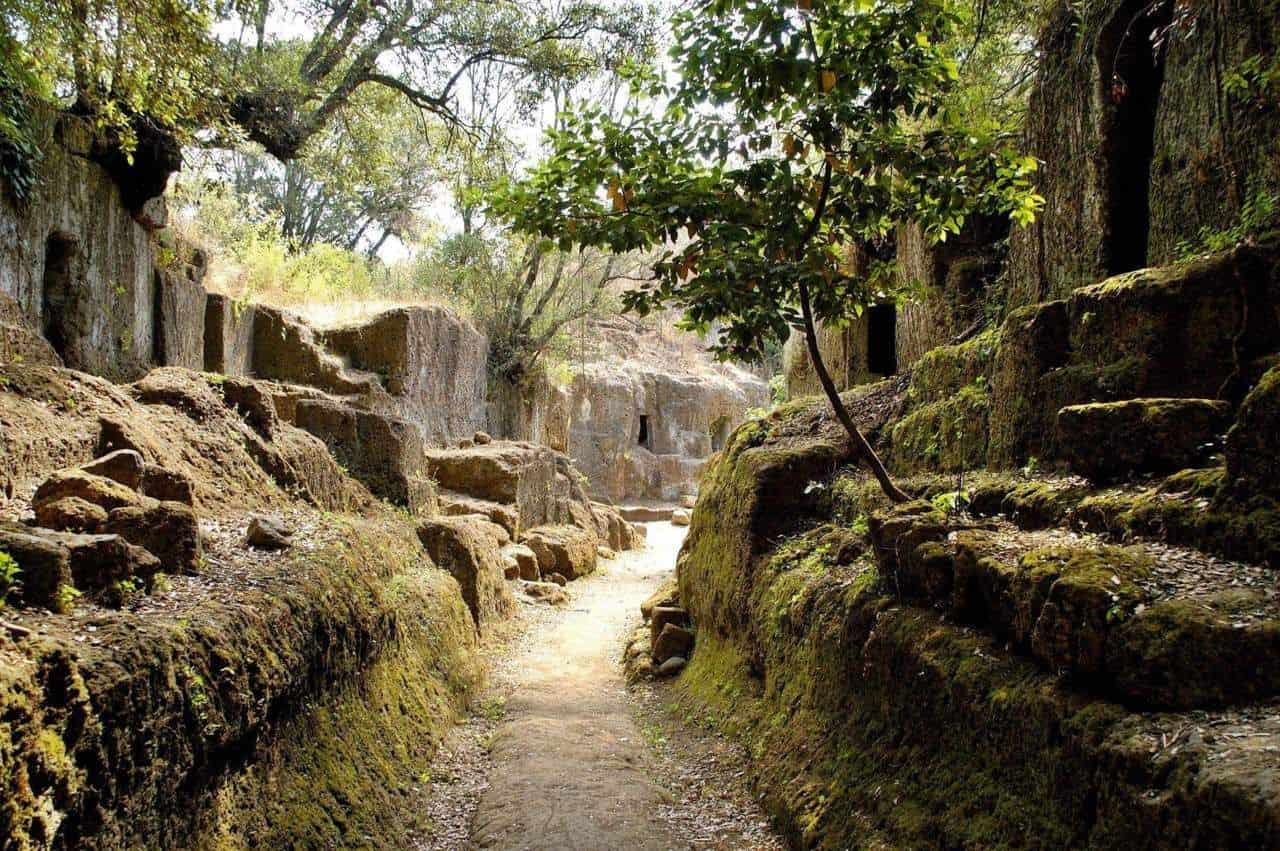
Via degli Inferi is an artery cut deep into the tuff that connected the city of the living, on the plateau where the town stands today, to the city of the dead of the Banditaccia. In places the vertical walls reach several meters in height and preserve the tool marks, the cart ruts, the votive niches. You walk in it as in a corridor open to the sky, with the woods closing over your head. It's the most moving stretch of the whole visit and, curiously, the one many people miss, because it lies outside the main enclosure and you have to look for it.
The Cerite National Archaeological Museum of Cerveteri (RM)
The museum occupies Ruspoli Castle, in Piazza Santa Maria, at the highest point of the historic center. The building is a 13th-century fortress built of tuff masonry, lava and brick, with towers and stretches of 4th-century BC Etruscan walls incorporated into the foundations: the palace that visitors know as Palazzo Ruspoli and the fortress are in fact a single organism, grown by additions from the Middle Ages to the 1700s. The complex was donated to the State by Princess Claudia Ruspoli, after whom the museum is named, and has housed ever since the materials from the necropolises of the area.
The ground floor of the Cerite Museum of Cerveteri (RM)
The ground floor follows chronological order and is built around grave goods. It starts with the Sorbo necropolis, with materials between the 9th and 7th centuries BC: hut urns, fibulae, impasto pottery, bronzes. It continues with the grave goods of the Banditaccia and Monte Abatone, where bucchero dominates the scene. Bucchero is the shiny black pottery that the Etruscans developed right in this area in the 7th century: black on the surface and in the body, obtained by firing in a reducing atmosphere, very thin in the best versions. At Cerveteri you see its complete arc, from thin bucchero to the heavy, decadent bucchero of the following century.
Then there are the imported ceramics, the amphorae, the funerary vases, the figured sarcophagus lids, the reconstruction of a curule chair. The route is punctuated by thematic display cases that keep the grave goods together tomb by tomb instead of breaking them up by type: it's a display choice that helps a lot, because it conveys the idea of what a Cerveteri family considered necessary to take along with them.
The Euphronios Krater, the centerpiece of Cerveteri (RM)
Upstairs is the reason archaeologists from half the world come to Cerveteri. The Euphronios Krater is an Attic red-figure krater made around 515 BC, shaped by the potter Euxitheos and painted by the vase painter Euphronios, who signs it. It measures about 46 centimeters in height by 55 in diameter and held 45 liters of diluted wine. The main side depicts the death of Sarpedon, the son of Zeus who fell at Troy: Hypnos and Thanatos, Sleep and Death, lift the blood-soaked body while Hermes, in the center, directs the operation. It is one of the most famous scenes of Greek pottery and one of the moments when vase painting stops being decoration and becomes drama.
The story of the vase is almost as well known. Dug up clandestinely from a tomb in the Cerveteri area around 1971, sold for a million dollars, the krater was displayed from 1972 at the Metropolitan Museum in New York. After years of Italian investigations, ownership was returned to Italy in 2006, the vase came back in January 2008 and since February 2015 it has been on display here, a few hundred meters from the tomb it was torn from. At the Cerite Museum the krater is joined by the kylix by the same Euphronios, returned from the Getty Museum in Malibu. The museum also houses a rare stone sculpture of the demon Charun.
Looking at the krater, it's worth remembering something that no caption says loudly enough: that vase is not Etruscan. It's Greek, Athenian, imported. That it ended up in a tomb at Caere says everything about the wealth and tastes of the Cerveteri aristocracy of the 6th century, which bought the best of the Mediterranean market and took it underground with them.
Why the necropolises of Cerveteri (RM) are a UNESCO heritage site
In 2004 UNESCO inscribed the Etruscan necropolises of Cerveteri and Tarquinia on the World Heritage List, under criteria one, three and four. The protected property covers 326.93 hectares, with a buffer zone of 4,932.11 hectares. The rationale recognizes in the two complexes a unique and exceptional testimony to Etruscan civilization, the only urban civilization of pre-Roman Italy, and distinguishes precisely the two contributions: the Banditaccia for funerary architecture organized on an urban layout, the Monterozzi of Tarquinia for the roughly 200 painted tombs, the oldest of which date to the 7th century BC, out of a total of 6,000 burials.
The pairing is no accident. Cerveteri preserves the form of the houses, Tarquinia the colors of life: put together, they give back a people. If you have time for only one site, choose according to what you're looking for, and know that they are two different experiences. With the circuit ticket, valid four months, you can visit all four places of the Park without hurry.

The other necropolises of Cerveteri (RM)
For two centuries the countryside around Cerveteri was the favorite hunting ground of tomb robbers, and not only theirs. The Banditaccia is the best known, but the area preserves others, some visitable only on special occasions.
The Sorbo necropolis and the Regolini-Galassi Tomb
In the Sorbo necropolis, in 1836, General Vincenzo Galassi and Alessandro Regolini, archpriest of Cerveteri, found intact a tomb of the 7th century BC hidden inside the tumulus of a cremation burial. The grave goods are among the richest in all of Etruria: gold jewelry worked in granulation, silverware, bronzes, pottery of the Phoenician-Cypriot sphere, an enormous gold fibula decorated with five lion cubs, and three vehicles, a biga, a passenger-carrying cart and a heavy freight one. The whole complex is today in the Gregorian Etruscan Museum, inside the Vatican Museums, where it fills an entire room. Seeing it changes your sense of what a princely family of Caere was in the 7th century.
Monte Abatone and the Greppe di Sant'Angelo
The Monte Abatone necropolis, on the plateau opposite the ancient settlement, preserves, among others, the Torlonia Tomb and the Campana Tumulus, the latter linked to the name of the marquis who dug here in the mid-1800s. The necropolis of the Greppe di Sant'Angelo completes the picture. These are areas that as a rule cannot be visited freely: they open for initiatives by the Archaeological Park or local associations, and anyone interested has to follow the official channels.
The Sarcophagus of the Spouses, the most famous son of Cerveteri (RM)
The Sarcophagus of the Spouses also comes from the Banditaccia, the absolute masterpiece of Etruscan coroplastic art. Polychrome terracotta, 140 centimeters high and 202 long, datable between 530 and 520 BC, it was found in 1881, acquired in 1893 and reassembled from about 400 fragments. It depicts a couple reclining on a banquet couch: the man puts his right arm around the woman's shoulders, the two faces with the archaic smile almost touching. The woman occupies the foreground, and for a 6th-century Greek this would have been inconceivable: in the Greek symposium wives did not enter. The Sarcophagus of the Spouses is in the Villa Giulia Etruscan Museum in Rome, and anyone visiting Cerveteri should plan that stop too, because the two places explain each other.

The historic center of Cerveteri (RM) and its districts
The old town is enclosed within a medieval wall that is still fairly intact and is organized into districts, which are not a folkloric curiosity but the real social structure of the place: they compete with each other every year at the Grape and Wine Festival of the Colli Ceriti, and the rivalry is serious.
The districts of Cerveteri (RM), one by one
La Boccetta is the oldest district and includes the entire historic center inside the walls. La Garbatella stretches out in front of the historic center and includes Piazza Aldo Moro, the Parco della Legnara and the Giardini della Rimembranza. San Pietro occupies the upper part of Cerveteri and takes its name from its own square. La Casaccia includes the area of the Old Cemetery and the Granarone. La Fornace borders the Giardini and recalls in its name a brick factory later demolished. Madonna dei Canneti develops around the street of the same name. Fontana Morella is the largest district: it starts from the fork with Via Settevene Palo, reaches the bridge over the Fosso del Marmo, includes a large part of the Colle dell'Asino and the stretch of Viale Manzoni between Largo Guido Rossa and the intersection with Via Bonaventura. Tyrsenia occupies the lower part of town, the real entrance to Cerveteri. Cerenova Costantica corresponds to the locality of the same name in the hamlet of Marina di Cerveteri.
The civic architecture of Cerveteri (RM)
Palazzo Ruspoli and the fortress form a single building, as already said, and house the Cerite National Museum. The Granarone is the princes' former grain warehouse, a building of large volume now used for public and cultural functions. The old town hall, the Case Grifoni and the alleys that connect them complete the fabric: local stone, segmental arches, external staircases, a built fabric that did not suffer the building devastation of the postwar period precisely because the growth of the town took place outside the walls.
The military architecture of Cerveteri (RM)
The medieval wall and the Ruspoli Fortress are the same structure seen from two sides: a towered structure in a good state of preservation that encloses the historic village. Walking the outer perimeter you can read the phases, from the base in blocks to the medieval facing.
A separate matter is the Furbara military airport, a historic airfield and former acrobatics school. Gabriele D'Annunzio, in 1918, wrote: "Go to the Cerveteri airfield. You will see a whirlwind of human flights...". Since 2003 the grounds have housed the 17th Raiders Wing of the Italian Air Force. It cannot be visited, but its history explains why during the Second World War the municipal territory was considered strategic.
The churches of Cerveteri (RM)
The list of the municipality's churches is surprisingly long, because it includes the center, the eight hamlets, the farmhouses and the rural chapels. It's worth running through it in full, because it tells the religious geography of an extensive agricultural territory.
Santa Maria Maggiore and the churches of the center of Cerveteri (RM)
Santa Maria Maggiore Church is the most important in the area and is the seat of an archpriesthood. It is made up of two interlocked structures: the old church, of Romanesque layout datable to around the year 1000, and the new one from 1950, which fits into the first instead of replacing it. The result is a building that reads like a stratigraphy.
The Madonna dei Canneti Church is a small country church that marks the boundary between the historic center and the new part of town: it's an 18th-century sanctuary in Roman-Baroque forms. The Pietà Church, called l'Ossara in dialect, is the chapel of the old cemetery. The Sant'Antonio Abate Church, with three naves, also dates to around the year 1000. The San Michele Arcangelo Church, dedicated to the patron saint, is from 1756. The San Rocco Church no longer exists: it stood on the street of the same name and an apartment building was built in its place. The Santissima Trinità Church is the town's second parish. Housed for a time in a garage, it received its new home on the same spot where the first one stood, consecrated on July 1, 2012.
The churches of the hamlets of Cerveteri (RM)
In the hamlet of Ceri you find the Sanctuary of the Immaculate Virgin, the Madonna di Ceri, the San Sebastiano Church, the Madonna di Carpineto Church and the Buon Consiglio Church, which stands on the Torlonia palace. Also in Ceri is the San Felice Church, also called Madonna della Cava, where tradition places the miracle of the oxen. In Cerenova there is the San Francesco d'Assisi Church, in Terzi the Sant'Eugenio Church, in Sasso the Santa Croce Church, in Borgo San Martino the San Martino Church, in Due Casette the Vergine Lauretana Church, in Valcanneto the Sacro Cuore Church. On Via Aurelia, in Furbara, the Sant'Antonino Church is incorporated into the Pallavicini farmhouse, inside the Monte Tosto estate. The picture is completed by the Sanctuary of Sant'Antonio Abate at Monte Santo, the chapel of Sant'Antonio Abate in the Mola valley, dedicated to the protection of animals, the Madonna del Piano Church at the Cerenova junction, built after the land reclamation and today the site of the Ruspoli family tombs, the Oratory of San Michele, the Santi Giovanni e Paolo Church in the Lutheran valley and the Monastery of the Maddalena.
The lost churches of Cerveteri (RM)
Some exist only in documents or in a few remains. The San Pietro Church has vanished, and it has been hypothesized that its remains lay under the San Michele Arcangelo Church, in the district of the same name. Of the San Paolo Church, three apses emerge from the ruins of Casal dei Guitti. Another San Martino Church stood in front of the Mascherone fountain and was demolished in 1881. The Santa Maria della Fonte Church was next to the wash house, with a chapel of the same name beside the Mascherone fountain. The San Michele Arcangelo Church now used as a hayloft is the one where, according to legend, the archangel rang the bells to warn the inhabitants of the arrival of the Saracens.

Ceri, the medieval village of Cerveteri (RM)
Ceri is the hamlet that Romans know least and that surprises them most. It stands on an isolated tuff cliff, a few kilometers from the main town, and is reached by a single uphill road: below is the parking lot, above a handful of houses, a square, a church, a castle. The cliff was already inhabited in the Bronze Age. The present village was born in 1236, when part of the population of Caere Vetus moved here, and from that moment the documents distinguish Cere Novum from Cere Vetere. The bull of Pope Gregory IX of 1236 is the document that sanctions the separation, and it is from that pair of names that modern Cerveteri derives.
The castle that guards the entrance belonged to several families, including the Torlonia, who later gave it up. In the main church, during a restoration in 1980, 12th-century frescoes of the Roman school emerged, with scenes from the Old Testament and stories from the life of Saint Sylvester: they are the main reason to come up here, and they are of remarkable quality. It's best to go in the late afternoon and stay until sunset: from the parking lot below, the cliff lights up orange and the photograph takes itself.
The sea of Cerveteri (RM) and the black sand beaches
The municipality reaches the sea with Marina di Cerveteri and Cerenova. The beaches are dark, almost black, because the sand is rich in iron: it's a geological feature of the entire coast between Ladispoli and Santa Marinella, and anyone who arrives expecting white sand is thrown. The coast is frequented in summer by Roman vacationers and by those who own a second home. The area's accommodation offer, made up mostly of agriturismi and bed and breakfasts, confirms that the prevailing economic vocation of Cerveteri is tourism.
A little farther north you come to the Santa Severa beach, with the castle on the water, and farther on still the port of Civitavecchia. An observation from someone who has been going for years: the stretch of Cerveteri coastline is not the most beautiful in Lazio and doesn't pretend to be, but on the libeccio days of September, with a heavy sea and the umbrellas already taken down, it has a melancholy that is worth the trip more than August.
Nature around Cerveteri (RM)
The municipal territory contains four recognized protected areas, among special protection zones and special areas of conservation: the Torre Flavia Marsh Natural Monument, the Tolfetano-Cerite-Manziate Complex, Monte Tosto and the Sughereta del Sasso. It's an unusual density for a municipality on the Roman coast.

The Torre Flavia Marsh Natural Monument
The Torre Flavia Marsh is a coastal wetland between Ladispoli and Cerenova, one of the last patches of marsh to survive the land reclamations of the coast. It is a stopover for migratory birds and hosts species that have disappeared elsewhere on the coast. The half-ruined coastal tower that gives it its name, now isolated by erosion, has become the symbol of the place. You visit from the paths and boardwalks, with binoculars, early in the morning. It is not a playground: it's a fragile environment and should be treated as such.
The little waterfalls of the Fosso del Norcino and the Vaccina
From Via degli Inferi starts a path of about four kilometers that goes up the Fosso Vaccina and reaches a series of small waterfalls: these are the little waterfalls of the Fosso del Norcino, and the trail continues to the Castelgiuliano falls. The Vaccina is the watercourse that cut into the plateau of Caere and determined its shape: without those gorges, the Etruscan city would not have had the natural defenses that kept it safe for centuries. Walking in them in spring, with high water and the woods closed overhead, is one of the most beautiful hikes in northern Lazio and one of the least visited. You need proper shoes and a minimum of caution: the ground is slippery and in case of rain the ditch swells quickly.

The Tolfetano-Cerite-Manziate Complex, Monte Tosto and the Sughereta del Sasso
The Tolfetano-Cerite-Manziate Complex is a vast special protection zone that holds together the Tolfa Mountains, the countryside of Cerveteri and the territory of Manziana: it is a nesting area for raptors of great interest and one of the few complexes in Lazio where the traditional agricultural landscape has held out. Monte Tosto and the Sughereta del Sasso are smaller special areas of conservation: the second protects a cork oak grove, a rare formation on the Lazio coast and tied to acidic soils of volcanic origin.
Pyrgi and the ports of Cerveteri (RM)
Caere would not have been Caere without its ports. The main one was Pyrgi, today in the territory of Santa Marinella, in the locality of Santa Severa, at the foot of Santa Severa Castle. The site is protected as a natural monument over 67.17 hectares and has been systematically excavated by La Sapienza University since 1957.
Here stood two temples, identified by archaeologists as Temple A and Temple B, dedicated to the goddess Uni and to Thesan-Leukothea, and a southern sanctuary linked to chthonic cults for Cavatha and Suri. From Temple B come the three famous gold tablets found in 1964, two inscribed in Etruscan and one in Phoenician: they are the dedication of the king of Caere Thefarie Velianas to the goddess Uni, called Astarte in the Phoenician text, and date to the end of the 6th century BC. The temple dates to around 510. The tablets are today in the Villa Giulia Etruscan Museum in Rome, together with the pediment with the myth of the Seven Against Thebes that decorated Temple A.
The value of those three gold sheets is hard to overstate: they are the document that proves the political and religious alliance between the Etruscan aristocracy and the Punic world at the moment when control of the Tyrrhenian was at stake, and they are one of the few bilingual texts that allow work on the Etruscan language. Anyone who visits Cerveteri and then goes to Villa Giulia closes the circle: the town, the port, the sanctuary, the treasure.
The history of Cerveteri (RM), from Agylla to Caere
The ancient origins of Cerveteri (RM)
Cerveteri stands where the ancient city stood that the Greeks called Agylla and the Etruscans called Caere. The modern name derives from Caere Vetus, the name used from the 13th century to distinguish it from Caere Novum, present-day Ceri. Another ancient place name is Cisra, the Etruscan form.
The archaeological evidence dates human presence on the plateau to the early Iron Age, which in the Mediterranean area falls in the 9th century BC. The circumstance goes together with the almost total disappearance of the nearby Bronze Age settlements, and this suggests that the city was born by concentration: groups leaving the scattered villages and gathering on a defensible plateau, for economic and security reasons. The surrounding settlements and necropolises are attested throughout the Iron Age and join seamlessly with those of the historical period. The ancient historiographic tradition, on the other hand, tells that the city was founded by the Pelasgians under the name of Agylla and then conquered by the Etruscans, who renamed it Caere: it is a tradition, not an archaeological fact, and should be kept distinct.
Caere, the sea and the Battle of the Sardinian Sea
The events of Caere are tied first to the conflict between Greek and Etruscan cities for commercial supremacy in the Tyrrhenian, then to the clash between Etruscans and Rome. Between 541 and 535 BC Caere-Agylla fought with the Etruscan forces allied with the Carthaginians against the Phocaeans in the naval clash known as the Battle of the Sardinian Sea. Formally the victory went to the Phocaeans, but the strategic result was the opposite: Etruscans and Carthaginians blocked Greek expansion in the western Tyrrhenian. These are the same years as the Pyrgi tablets, and the two facts explain each other.
Caere and Rome
Despite the centuries-old rivalry with Rome for supremacy in central Italy, in 387 BC, when the Gauls of Brennus sacked Rome, Caere supported the rival city. First it gave refuge to the Vestals and the Roman fugitives, then it attacked the Gauls in the Sabine country on their way back, managing to take from them the loot plundered from Rome. It's an episode worth telling in full, because it is at the origin of the anomalous bond between the two cities: after the submission of the Etruscan cities to Roman rule in the 4th century, Caere entered the Roman world as a municipium sine suffragio, that is, with citizenship but without the right to vote. The Latin formula "tabulae Caeritum", the registers of citizens without a vote, was born right from this.
Cerveteri (RM) from the Middle Ages to the modern age
Despite the general decline of Italian cities after the fall of Rome, Cere kept a certain importance: at least eight bishops are counted, the Episcopus Cerensis, the last of whom, Benedict, in 1029. Between the 8th and 11th centuries, according to the documents of the emperors Louis the Pious, Otto I and Henry II the Saint, Caere was governed directly by the papacy. Then it lost weight: in 1192, according to the Liber Censuum of the Roman Church, Caere now depended on the bishopric of Portus. Between the 12th and 13th centuries part of the population moved to Cere Novum, distinguished from old Cere Vetere in the bull of 1236 of Pope Gregory IX.
In the 13th century the fief belonged to the Norman Alberteschi, then to the Corsi, who held it between the end of the 1200s and the mid-1400s, then to the Venturini, who ceded it to the Anguillara. After the latter were excommunicated by Paul II, the fief passed to Bartolomeo Giuppo, nephew of Sixtus IV, who in 1487 ceded it to Franceschetto Cybo together with Monterano, Rota and Ischia. Shortly afterward everything passed to the Orsini, who held it, apart from a brief Farnese interlude in the mid-1500s, until 1674, when they were forced to sell to the Ruspoli. In 1709 the Ruspoli obtained the title of prince. In the following centuries Cerveteri shrank to an agricultural center, and only in the 20th century did it become a tourist and archaeological center.
Cerveteri (RM) in the 20th century
During the Second World War two airfields were operating in the municipal territory, the Cerveteri airport and the Furbara one, which as the Italian campaign evolved were considered by the Allies as possible bases for the offensive on Rome. At the Furbara site, which was also an aerial firing range, before the entry into the war Mussolini showed Hitler the efficiency of Italian aircraft, in the course of military demonstrations held in Naples for the Navy and precisely at Furbara for the Air Force.
In 1949 Cerveteri received from the municipality of Civitavecchia the hamlet of Ladispoli, which became an autonomous municipality in 1970. In 2004 came the UNESCO inscription. Today the municipality has about 38,000 inhabitants, with a share of foreign residents of around eight percent, and it continues to grow: many work locally, many others commute to Rome.
Traditions, events and folklore in Cerveteri (RM)
The calendar of Cerveteri's festivals is busy and still follows the agricultural and liturgical cycle. The main occasions are these.
- January 17, feast of Sant'Antonio Abate, with the blessing of the animals.
- Third week of April, Cerveteri Typical Products Festival.
- Good Friday, historical reenactment of the Passion and Death of Our Lord Jesus Christ.
- May 8, patron saint's feast in honor of Saint Michael the Archangel.
- Last Sunday of May, Infiorata in honor of the Madonna, feast of the parish of Santa Maria Maggiore.
- Solemnity of Corpus Domini, Infiorata.
- July and August, the events of Estate Cerite.
- August, Etruria Eco Festival.
- Last week of August, Grape and Wine Festival of the Colli Ceriti.
- First Sunday of December, Cerveteri New Olive Oil Festival.
The Grape and Wine Festival of the Colli Ceriti is the event the town cares about most. The central moment is the parade of allegorical floats, built by the districts in competition with each other, held at the end of August. If you want to see Cerveteri as it really lives, and not as it presents itself to tourists, come in those days. The exact dates change from year to year and should be checked on the official channels of the Comune and the organizing committee.

What to Drink and Eat in Cerveteri (RM)
Cerveteri gives its name to a controlled designation of origin. The production area of the DOC Cerveteri includes the entire territory of the municipalities of Cerveteri, Ladispoli, Santa Marinella and Civitavecchia, part of the territories of Rome, Allumiere and Tolfa in the province of Rome, and a portion of Tarquinia in the province of Viterbo. The production rules provide for eight types: dry, semi-sweet and sparkling whites, dry and semi-sweet reds, still and sparkling rosés, and a 100 percent Trebbiano. The whites are based on Trebbiano toscano, which is called Procanico here, for at least half of the blend, with Malvasia di Candia and other permitted white grape varieties. The reds are based on Sangiovese and Montepulciano for at least 60 percent, with Merlot permitted.
Alongside the wine there is the olive oil, celebrated by the New Olive Oil Festival in December, and there are the products of the Tolfa hinterland, where sheep farming has never ended. The cooking is that of the northern Roman countryside, with game and egg pasta appearing on the menus of the agriturismi of the Colli Ceriti. A clear opinion: eating in the center of Cerveteri is convenient, but the best level is found by going up toward the hills, where the agriturismi cook what they produce.
Cerveteri (RM) with Children
The Banditaccia is one of the few archaeological sites that really works with children, and the reason is simple: you go inside things. An eight-year-old who goes down the dromos of a tumulus and finds himself in a room carved into the rock with stone beds needs no explanations. The path is long but flat in the central part, there is plenty of greenery, and plenty of shade too. It's best to avoid the middle hours of July and August and to bring a flashlight: inside the chambers, little natural light gets in.
The museum in the Ruspoli castle holds up well with the little ones thanks to its multimedia displays, narrated touch screens and holographic projections. The practical advice is to split the day: museum in the morning, when attention is high, necropolis in the afternoon, when they need to move.
Accessibility of the Necropolis and the Museum of Cerveteri (RM)
The main path of the necropolis is on packed dirt and has moderate slopes in the first stretch, but the individual tombs are reached by going down steep, narrow stairs, often without handrails: access to the chambers is not possible for people with serious mobility difficulties. The museum occupies a historic building on several levels. Anyone with specific needs should contact the Archaeological Park in advance, using the contact details on the official website, to find out which tombs and which rooms can actually be reached at the time of the visit.
When to Go to Cerveteri (RM)
April, May, October. In spring the grass between the tumuli is green and the ditches have water. In October the low light enters the dromoi at an angle and the photos come out better. July and August are the worst choice: the necropolis is largely exposed, the tuff gives back heat and the chambers become damp and muggy. Winter works very well on clear days, with the warning that everything closes at 17:00. Don't go on Monday: both the museum and the necropolis are closed.
A Curiosity About Cerveteri (RM)
The best curiosity concerns a Latin phrase that nobody connects with this place anymore: the tabulae Caeritum. After 387 BC, when the people of Caere took in the Roman Vestal Virgins fleeing from the Gauls and then recovered the loot taken from the barbarians, Rome rewarded Caere with a new legal institution, the civitas sine suffragio: the people of Caere became Roman citizens in every respect, with military and tax obligations, but without the right to vote in the assemblies. The lists in which they were registered took the name tabulae Caeritum, the registers of the people of Caere. Over time the formula reversed its sign: in the mature republican age, being entered in the tabulae Caeritum became a sanction, the punishment imposed by the censors on citizens who had lost the right to vote for unworthy conduct. The name of an allied city had become a synonym for civic degradation.
There is a second curiosity, smaller but just as instructive, and it is the name of the necropolis itself. Banditaccia has nothing to do with brigands or bandits. It comes from the bandite, the lands the Comune leased to private individuals, and the pejorative suffix says how little those stony lands were worth before someone realized what they contained. For centuries the farmers of Cerveteri plowed over 20,000 tombs, considering them a nuisance. The same stones that we now defend with an international convention were, until two centuries ago, an obstacle to the plow.
Something Nobody Tells You About Cerveteri (RM)
That the most famous piece of Cerveteri is not Etruscan, and that the town's museum had to wait 40 years to get it back. The Euphronios Krater is an Attic vase painted in Athens around 515 BC by a Greek painter for a Greek clientele. It ended up in a tomb at Caere because the aristocracy of Caere bought the best of Mediterranean production. In 1971 it was dug up clandestinely, taken out of Italy and sold for a million dollars to the Metropolitan Museum of New York, where it was on display from 1972. The Italian investigations into the trafficking of artifacts led to the 2006 agreement, to the physical return in January 2008 and finally, in February 2015, to its placement here, in the Museo Cerite. The same happened to the Euphronios kylix, which came back from the Getty Museum.
What nobody says is the reason for the final choice. The vase could have stayed in Rome, where the public is 100 times larger. Instead it was brought to the town it had been stolen from, a few hundred meters from the violated tomb. It is a decision that counts as a statement of principle: an artifact without context is half an artifact, and the context of that krater is this hill. It's worth keeping in mind while you look at it, because it changes the way you look at the whole rest of the museum. I'll add a practical note that no guide writes: the krater is displayed in a room of a small museum, almost always half empty. You can stay in front of the Death of Sarpedon for 20 minutes alone. In New York that didn't happen.
My Advice for Visiting Cerveteri (RM)
There is only one piece of advice, and it goes against everyone's instinct: buy the combined ticket, visit the museum first and then the necropolis, and not the other way around. The reason is that the Banditaccia, however grand, is empty. The tombs were emptied centuries ago, the grave goods are elsewhere, and anyone who enters the chambers without knowing what they contained sees stone rooms. If instead you arrive at the necropolis after spending an hour in front of the bucchero ware, the fibulae, the sarcophagus lids and the krater, every bench carved into the tuff fills with people again.
Second piece of advice, on time: don't try to do Cerveteri and Tarquinia on the same day. The circuit ticket lasts four months for exactly that reason. They are 50 kilometers apart, they are two different experiences, and doing them back to back means arriving at the second with no attention left. Third: bring water and a real flashlight, not the one on your phone. Fourth: stop to look for Via degli Inferi, which is outside the main enclosure and which a great many visitors skip without knowing they skipped it. It is the most impressive stretch of the whole site. Fifth, and perhaps the most important: slow down. The Banditaccia is to be walked, not crossed. Anyone who gets there at 15:30 thinking they'll get through it in an hour is doing themselves a disservice.
Anyone who prefers to rely on a professional can turn to a certified guide: the tour guide service of TourLeaderPro also covers southern Etruria and organized groups.
Another Well-Known Fact, Yet Rarely Cited
That the Banditaccia is a World Heritage Site everyone knows. What almost nobody mentions is the technical reason for the listing, which is not the beauty of the tombs but their layout. In 2004 UNESCO recognized criteria i, iii and iv for the necropolises of Cerveteri and Tarquinia, and in the statement devoted to the Banditaccia it wrote that the tombs are organized according to a plan similar to that of a city, with streets, small squares and neighborhoods. The listed property covers 326.93 hectares, with a buffer zone of 4,932.11 hectares: numbers that show how large the protected territory is beyond the enclosure open to visitors.
The point is this. The houses of the Etruscans were made of wood, mud brick and terracotta, and they have disappeared everywhere: not a single one is left standing in all of Etruria. Of the Etruscan cities we know the walls, the foundations, the wells, little else. The Banditaccia is the only place where Etruscan domestic architecture survives, because it was carved into the rock instead of built. The gabled roof with the raised beam, the central pillar, the false doors, the beds with pillows, the molded cornice along the wall: all of this is the interior of a house of the 7th century BC, the negative of a building that no longer exists. That is why the necropolis is a document and not just a monument, and why the UNESCO listing cites urban planning before art.
The Right Photo to Take in Cerveteri (RM)
The photograph everyone takes at the Banditaccia is the tumulus seen from the front, with the tuff drum and the black entrance in the center. It always comes out flat, because at noon the light falls from above and the drum loses all relief. The right photograph is a different one: you stand inside the main burial street, with the low sun behind you or to the side, and you frame the receding line of aligned tumuli. That is how you read the thing that makes this place unique, namely the urban alignment. Best hour, the first or the last of the day. Best season, October or November, when the sun never climbs too high.
The second shot to take home is inside Via degli Inferi: vertical walls of tuff, vegetation closing over the top, a human figure at the far end to give scale. Without a person in the frame the depth is not understood. Third subject, in the town: Ceri seen from the parking lot below, with the tuff cliff rising sheer and the village on the edge. At sunset the wall turns orange and the photograph takes itself. One last recommendation, a serious one: no flash inside the tombs. The stuccoes of the Tomba dei Rilievi are 2,300 years old and repeated direct light is one of the things that wear them down. Shoot handheld with a high ISO, and if it doesn't turn out, too bad.
Some Important Events That Happened Here in History
The first is military and naval. Between 541 and 535 BC, in the waters between Sardinia and Corsica, the fleet of Caere-Agylla fought alongside the Carthaginians against the Phocaeans in the Battle of the Sardinian Sea. On the field the Phocaeans won, but they lost the war: after that clash Greek expansion in the western Tyrrhenian stopped. Caere came out of it as a recognized maritime power, and a few decades later its king Thefarie Velianas had the dedication of the temple of Pyrgi to the goddess Uni-Astarte engraved on three gold plates, in Etruscan and in Phoenician: the material proof of that alliance.
The second is from 387 BC. Rome is taken and burned by the Gauls of Brennus. Caere, which had been the rival for two centuries, takes in the Vestal Virgins fleeing with the sacred objects and the Roman citizens who escaped. Then it attacks the Gauls in the Sabine country on their way back and deprives them of the loot taken from Rome. From that gesture comes the anomalous status of municipium sine suffragio and the formula of the tabulae Caeritum.
The third is from 1836, and it is a stroke of archaeological luck. In the Sorbo necropolis General Vincenzo Galassi and Archpriest Alessandro Regolini open a 7th-century tomb that had remained intact: gold worked with granulation, silverware, bronzes, Phoenician-Cypriot ceramics, three chariots. The grave goods, now in the Museo Gregoriano Etrusco in the Vatican, redefine in one stroke the knowledge of the Etruscan Orientalizing period.
The fourth is from 1927. Raniero Mengarelli, who had been digging at the Banditaccia since 1909, identifies the great burial street: the necropolis stops being a collection of tombs and becomes a readable city. The fifth is from July 2004, with the UNESCO listing. The sixth is from February 2015, when the Euphronios Krater, stolen in 1971 and sold in New York, is displayed in the museum of the town it had been taken from.
A less noble chapter should be added, but a historic one too. In 1881 the Sarcophagus of the Spouses was found at the Banditaccia, later reassembled from about 400 fragments. And in 1845-46 the marquis Giampietro Campana dug up here the painted terracotta slabs that ended up in the Louvre. Cerveteri is also the story of how much of it has gone away.
Who Passed Through Cerveteri (RM)
The first name is that of an Etruscan king documented by a first-hand written source: Thefarie Velianas, who at the end of the 6th century BC ruled over Caere and had the gold plates of Pyrgi engraved. He is not a figure of tradition: he is a man who left his own name written in two languages on three gold sheets, which can be read today at Villa Giulia.
Through Cerveteri passed, in 387 BC, the Roman Vestal Virgins fleeing from the Gauls with the sacred furnishings of the city: an episode that the Latin sources remember because it founded the privileged relationship between the two communities.
In the 19th century the excavators arrived. Giampietro Campana, marquis and banker, dug here in 1845-46 before being tried for embezzlement and seeing his collection scattered among the Louvre, the Hermitage and other museums. General Vincenzo Galassi and Archpriest Alessandro Regolini opened in 1836 the tomb that bears their names. Raniero Mengarelli worked at the Banditaccia from 1909 to 1933 and was the first to dig with method. Mario Moretti resumed the research in the 1960s.
Among the famous visitors we should mention Gabriele D'Annunzio, who in 1918 wrote about the Furbara airfield: "Go to the Cervéteri airfield. You will see a whirlwind of human flights...". And in May 1938, at Furbara, the Fascist regime organized for Adolf Hitler a demonstration of the capabilities of the Italian Air Force, a twin of the naval one staged in Naples.
The longest-lived owner of this territory, finally, is a family: the Ruspoli, who bought the fief from the Orsini in 1674 and received the princely title for it in 1709. The castle that now houses the museum still bears their name, and the museum is named after Princess Claudia Ruspoli, who donated it to the State.
What to See Around Cerveteri (RM)
Cerveteri is an excellent base camp for southern Etruria. To the north, along the coast, you find the Santa Severa castle with the site of Pyrgi, then Civitavecchia and finally Tarquinia with the Monterozzi necropolis and the National Archaeological Museum in Palazzo Vitelleschi. Further north you reach Vulci, the third great Etruscan city of the area. Inland there are the Tolfa Mountains, the ghost village of Monterano and Lake Bracciano. To the south you go down to Ladispoli and, a little beyond, to the San Martino castle.
If you are planning a trip to Italy and read English, you will find the general picture of the regions on ItalyPlanner, day trips on day trips in Italy, and the complete guide to the capital on best things to do in Rome.
Quick Questions About Cerveteri (RM)
How much is the ticket for the Banditaccia Necropolis of Cerveteri (RM)?
The combined ticket that includes the museum and the necropolis costs 13 euros. The circuit that adds the two sites of Tarquinia costs 21 euros. European Union citizens between 18 and 25 pay 2 euros, and minors get in free. The annual pass costs 30 euros, 20 for residents of Cerveteri and Tarquinia.
What are the opening hours of the necropolis of Cerveteri (RM)?
The necropolis is open Tuesday to Sunday. The hours vary with the season: 9:00-19:30 in the central months, 9:00-18:30 in the short autumn transition period, 9:00-17:00 in the winter period, with last entry one hour before closing. The museum keeps 9:00-19:30 all year, with last entry at 18:30.
Is Cerveteri (RM) closed on Monday?
On Monday both the Banditaccia Necropolis and the Cerite National Archaeological Museum are closed. The town, of course, is not, but planning the visit for a Monday means giving up both main places.
Do you need to book to visit Cerveteri (RM)?
For the ordinary visit no reservation is needed. It is needed, however, for the guided visits to the tombs that are normally closed and for the special openings, which the Archaeological Park announces on its own channels.
How long does it take to visit the necropolis of Cerveteri (RM)?
Two hours for the main route, entering the open tombs, three if you also walk in the upper part of the enclosure and look for Via degli Inferi. The museum takes another full hour.
How do you get to Cerveteri (RM) from Rome without a car?
By regional train on the Rome-Civitavecchia line to the Marina di Cerveteri station, then by local bus toward the center. The station is about seven kilometers from the historic center and the necropolis is another two kilometers beyond the town, uphill. Bus schedules should be checked on the operator's channels.
How far is Cerveteri (RM) from Rome?
About 42 kilometers. By car, without traffic, you cover them in a little over half an hour from the ring of the Grande Raccordo Anulare.
Where is the Euphronios Krater?
On the upper floor of the Cerite National Archaeological Museum, inside the Ruspoli castle, in Piazza Santa Maria in Cerveteri. It has been on display there since February 2015.
Where is the Sarcophagus of the Spouses found at Cerveteri (RM)?
At the National Etruscan Museum of Villa Giulia in Rome. It comes from the Banditaccia Necropolis and can be dated between 530 and 520 BC.
Can you take photographs in the tombs of Cerveteri (RM)?
Photographs without flash are generally allowed. Flash should be avoided in any case inside the decorated chambers, because it damages stuccoes and painted surfaces. For professional use and for a tripod you need to ask the Archaeological Park for authorization.
Is the necropolis of Cerveteri (RM) wheelchair accessible?
The main avenue is on packed ground and partly passable, but the individual tombs are reached by steep, narrow stairs that are not accessible. It's best to contact the Archaeological Park in advance to find out which points can be reached at the time of the visit.
Is Cerveteri (RM) suitable for children?
Very. You walk outdoors, you go inside the tombs, and the route is largely flat and shaded. Bring a flashlight and avoid the middle hours of the hot months.
What is the most beautiful tomb in Cerveteri (RM)?
The Tomba dei Rilievi, no question: it is the only Etruscan tomb entirely covered with stucco reliefs reproducing the objects of daily life. It cannot always be visited from the inside, so check availability before you leave.
What is the difference between Cerveteri (RM) and Tarquinia?
Cerveteri preserves the architecture: tombs carved like houses, with roofs, pillars and stone beds. Tarquinia preserves the painting: about 200 painted tombs out of 6,000 burials. They complement each other and should be seen on two different days.
Why are the necropolises of Cerveteri (RM) a UNESCO site?
Because they document in a unique way Etruscan civilization, the only urban civilization of pre-Roman Italy. The listing dates from 2004, with criteria i, iii and iv, and the statement insists on the urban layout of the necropolis.
How many tombs are there in the Banditaccia Necropolis?
Over 20,000 chamber tombs, on an area of about 20 hectares, of which around 10 are open to visitors. The main burial street is over two kilometers long.
What is Via degli Inferi of Cerveteri (RM)?
A road cut deep into the tuff that connected the city of the living to the plateau of the necropolis. You walk it on foot and it is the most scenic stretch of the whole site, but it remains outside the main enclosure and many visitors don't see it.
Where are the finds from the Regolini-Galassi Tomb?
In the Museo Gregoriano Etrusco, inside the Vatican Museums. The tomb was opened intact in 1836 in the Sorbo necropolis.
Are the beaches of Cerveteri (RM) black sand?
Yes, the sand of the Cerveteri coast is dark because it is rich in iron. The feature is shared by the whole stretch of coast between Ladispoli and Santa Marinella.
What wine is produced in Cerveteri (RM)?
The DOC Cerveteri provides for whites, reds and rosés, as well as a 100 percent Trebbiano. The whites are based on Trebbiano toscano, here called Procanico, the reds on Sangiovese and Montepulciano. The production area also includes Ladispoli, Santa Marinella, Civitavecchia and parts of Rome, Allumiere, Tolfa and Tarquinia.
When is the Grape Festival of Cerveteri (RM) held?
In the last week of August, with the parade of allegorical floats built by the districts. The exact dates change every year and should be checked on the official channels.
What to see in Cerveteri (RM) in half a day?
The Museo Cerite and the Banditaccia Necropolis, in that order. Everything else, historic center and hamlets included, requires additional time.
Is it worth going to Ceri?
Yes. It is a tuff cliff with a tiny village on top, a castle and a church with frescoes of the Roman school from the 12th century that emerged in a 1980 restoration. It takes less than an hour and it changes the day.
When is the best time to go to Cerveteri (RM)?
April, May and October. In summer the necropolis is exposed to the sun and the chambers become muggy. In winter clear days are excellent, with early closing at 17:00.
One last word. Cerveteri doesn't impress at first sight: it has no standing temple, no amphitheater, no postcard. It has 20,000 rooms carved into the rock and a hill that, if you walk slowly enough, stops being a cemetery and becomes a neighborhood. The moment when it happens almost always comes at the same point, inside the second or third chamber, when you notice that the ceiling has its beam and the room has its false windows. From there on you no longer look at tombs: you look at houses. Take the time it takes for that moment to arrive, and don't go back to Rome before sunset.
Article written by the editorial team of TourLeaderPro, contact them for Private/Corporate/V.I.P. Tours and Experiences.
Planning a trip to Rome? The English guides to visiting the city are on ItalyPlanner.com.