Banditaccia Necropolis – Ancient Caere: Etruscan Necropolis of Cerveteri
In short. There are places you visit and places you enter. The Banditaccia belongs to the second category, and you realize it as soon as you pass the gate, in front of something no photograph manages to capture: a city.
There are places you visit and places you enter. The Banditaccia belongs to the second category, and you realize it as soon as you pass the gate, in front of something no photograph manages to capture: a city. Not the ruins of a city, not the archaeological memory of a city, but a real city, with its streets, its blocks, its residential neighborhoods and its working-class neighborhoods, its houses lined up along the main streets and its monumental structures arranged like the villas of the rich. Except that no living person has ever lived here. It is the city the Etruscans of Caere built for their dead, and they built it with a care, patience and urban precision that had no equal in the Mediterranean of the 7th century BC.
We are in Cerveteri, Rome Province, just under 40 kilometers northwest of the capital, on a tufa plateau that looks toward the sea and the Monti della Tolfa. The archaeological area covers about 20 hectares, roughly 10 of which are open to the public, and it contains something like 20,000 excavated chamber tombs, built, decorated and filled over almost 1,000 years. 20,000. The number is so large that it stops meaning anything, so I'll try to translate it: if you stopped for one minute in front of each tomb, without pauses, without eating and without sleeping, you would need nearly 14 consecutive days to finish the tour. Nobody does this, of course. But the fact that it could theoretically be done says everything about the scale of the place.
Not with the rush of someone listing monuments, but with the calm of someone who knows the streets and knows where it's worth stopping, where it's worth looking up, where the tufa tells a story that isn't written in books. The Banditaccia rewards those who slow down. It's the only serious recommendation, to keep in mind before you even begin.
Banditaccia Necropolis - Ancient Caere: Etruscan Necropolis of Cerveteri: why this place is unique in the world
First of all, the thing that surprises everyone, even those who arrive already prepared. Of the Etruscans, we have practically nothing in the way of domestic architecture. Their cities were built from perishable materials: wood, unfired brick, clay, straw roofs and later terracotta tiles. They have been systematically erased: by the Romans who built over them, by the Middle Ages that built over them again, by agriculture that flattened everything else. In practice, of Etruscan houses, what remains are foundations, postholes, and fragments of terracotta facing. A puzzle with 90 percent of the pieces missing.
Where to buy tickets. The Banditaccia Necropolis is state-run, part of the Parco archeologico di Cerveteri e Tarquinia: hours and fees are on the official page of the Ministry of Culture, tickets are sold at the ticket office at the entrance, and a combined ticket with the Cerveteri Museum is possible. No booking platform sells a product dedicated to the necropolis. Verified on September 28, 2026.
So how do we know what an Etruscan house from the 7th century BC looked like? We know because the Etruscans of Caere carved faithful reproductions of their own homes into the tufa for their dead. Not symbolic, not suggestive: faithful. With the double-pitched roof reproduced in the rock, with the ridgepole carved even though it holds up nothing, with the side rafters cut one by one, with the door lintels, with the beds with turned feet, with the cushions, with the chairs, with the fake windows. They copied in stone what they built in wood in life. The result is that the Banditaccia is, quite literally, the most complete document we have on Etruscan domestic architecture. To understand how they lived, you have to look at where they died.
This is the technical reason why UNESCO, in 2004, inscribed the necropolis on the World Heritage List together with the Necropolis of Monterozzi in Tarquinia, under the joint name Etruscan Necropolises of Cerveteri and Tarquinia. The two sites are complementary, and the commission stated this clearly: Tarquinia preserves the painting, with about 200 painted tombs that constitute the main surviving evidence of figurative painting in the pre-Roman Mediterranean, Cerveteri preserves the architecture, and in particular the urban layout of a necropolis conceived as a city. Together they cover nine centuries of civilization, from the 9th to the 1st century BC. Together they tell the story of a people that the Romans absorbed, replaced and, in large part, forgotten.
Where it is, how to get there and what to expect at the entrance
The necropolis is on Via della Necropoli, a little over two kilometers from the historic center of Cerveteri, in a rural area that has kept a certain quiet. Those coming from Rome by car take the Aurelia or the A12 motorway toward Civitavecchia, exit at Cerveteri-Ladispoli and head up toward the town. From the coast to the plateau it's about 10 kilometers of road passing through vegetable gardens, vineyards and a few graceless buildings, and then suddenly it opens onto the medieval hilltop village. The necropolis is signposted, the parking area is large and unpaved, and you can already sense something from the parking lot: those grass-covered mounds visible beyond the fence are not natural hills.
Getting there by public transport
If you don't have a car, you can take the regional train line that connects Rome to Civitavecchia and get off at Marina di Cerveteri or Ladispoli-Cerveteri, then continue by local bus up to the town. Alternatively, there are direct bus connections from Rome. An honest warning: the last stretch, from the center of Cerveteri to the necropolis, isn't served as often as it deserves, and it's not unusual to see visitors walking it. It's a 25-minute walk on a gentle uphill, pleasant in spring and autumn, and much less pleasant in July at two in the afternoon. Always check the current hours on the official website of the Parco Archeologico di Cerveteri e Tarquinia before you leave, since seasonal schedules and closing days change.
How much time you really need
It's the question everyone asks. The short answer: two hours for the main loop, three hours to do it at a relaxed pace, half a day if you want to add the Museo Nazionale Cerite in town, a full day if you also want the village and maybe a detour to Ceri or the sea at Santa Severa. The long answer is that the Banditaccia isn't a museum with a set route: you walk freely along the burial streets, go into the open tombs, backtrack, and get a bit lost. Time stretches. It often happens that you go in sure you'll be done in an hour and come out after three, looking like someone who isn't finished yet. Consider it an affectionate warning.
Caere before the necropolis: how an Etruscan metropolis came to be
To understand the Banditaccia, you have to understand who built it, and who built it was one of the richest and most powerful cities in the western Mediterranean. It was called Kaisra or Chaisrie in Etruscan, Agylla by the Greeks, and Caere by the Romans, and the current name Cerveteri derives by corruption from Caere Vetus, the old Caere, after the inhabitants moved elsewhere in the Middle Ages. The city stood on a tufa plateau of about 150 hectares, naturally protected by the ravines of the Manganello and Mola streams, in a position that combined two decisive advantages: control of a stretch of Tyrrhenian coast with several landing points, and proximity to the metal deposits of the Monti della Tolfa.
Metal is the key to everything. In the Mediterranean of the Iron Age, copper and iron were what oil was for the 20th century, and southern Etruria was full of it. Caere was exactly in the right place to mine it, work it and sell it, and to do that it needed ports. It had three: Pyrgi, today Santa Severa, the most important, Alsium, today Palo Laziale near Ladispoli, and Punicum, corresponding to Santa Marinella. Three ports along about 20 kilometers of coastline, linked to the city by roads cut through the tufa. I don't know many other ancient cities that allowed themselves a luxury like this.
From Villanovan village to city
The process begins in the 9th century BC, during the full Villanovan culture, when groups of scattered huts settle on the plateau and the surrounding heights. Burials from this phase are simple: small pits dug into the tufa, inside which a biconical impasto urn holding the ashes of the deceased is placed, sometimes covered by a helmet or an inverted bowl. Minimal grave goods: fibulae, razors, spindle whorls, a few glass paste beads. A society still horizontal, or at least one that doesn't feel the need to display its differences in death.
Then, between the late 8th and early 7th century BC, something enormous happens. The villages merge into a single urban organism, Greek and Phoenician ships arrive, writing arrives, gold and ivory arrive, along with granulation goldsmithing techniques, and above all an aristocracy arrives that wants to be seen. This is the period archaeologists call Orientalizing, and this is when the Banditaccia becomes what we see today, because that is when the tumuli appear.
Tufa, the raw material above all
One element explains the Banditaccia better than any historical consideration: it's geological. The Cerveteri plateau is formed of tufa, the volcanic rock produced by the eruptive centers of the Sabatini and Vicani, and tufa has a wonderful property for anyone who has to dig: freshly extracted, it's soft, it can be worked with iron tools the way one would work hard wood, and once exposed to the air it gradually hardens. In practice, the Etruscans had a material that could be carved like butter and then behaved like stone.
Try to keep this in mind as you walk. Every burial chamber you see was carved by hand, chip by chip, by men who had to haul the waste rock out bucket by bucket. A medium-sized chamber tomb meant removing several cubic meters of rock. A large 7th-century tumulus meant removing dozens. Multiply by 20,000 and you'll have a sense of the work accumulated across these 20 hectares. It's the kind of calculation archaeologists call an estimate of construction energy, and at the Banditaccia it produces impressive results.
Why the tuff also affects preservation
The flip side is that tuff is porous. It absorbs water, and when the water evaporates it leaves salts that crystallize and flake off the surface. This is why some tombs are closed off by gates or glass panels, why others are open to visitors only on special occasions, and why the Archaeological Park manages access with conservation criteria that sometimes disappoint visitors who want to go everywhere. It's not bureaucracy. It's that the breath of 30 people in a 20-square-meter chamber causes measurable damage. If you find a tomb closed, think of it as the price we pay so that there's still something to see in 50 years.
Tumuli: when the aristocracy invented the monument
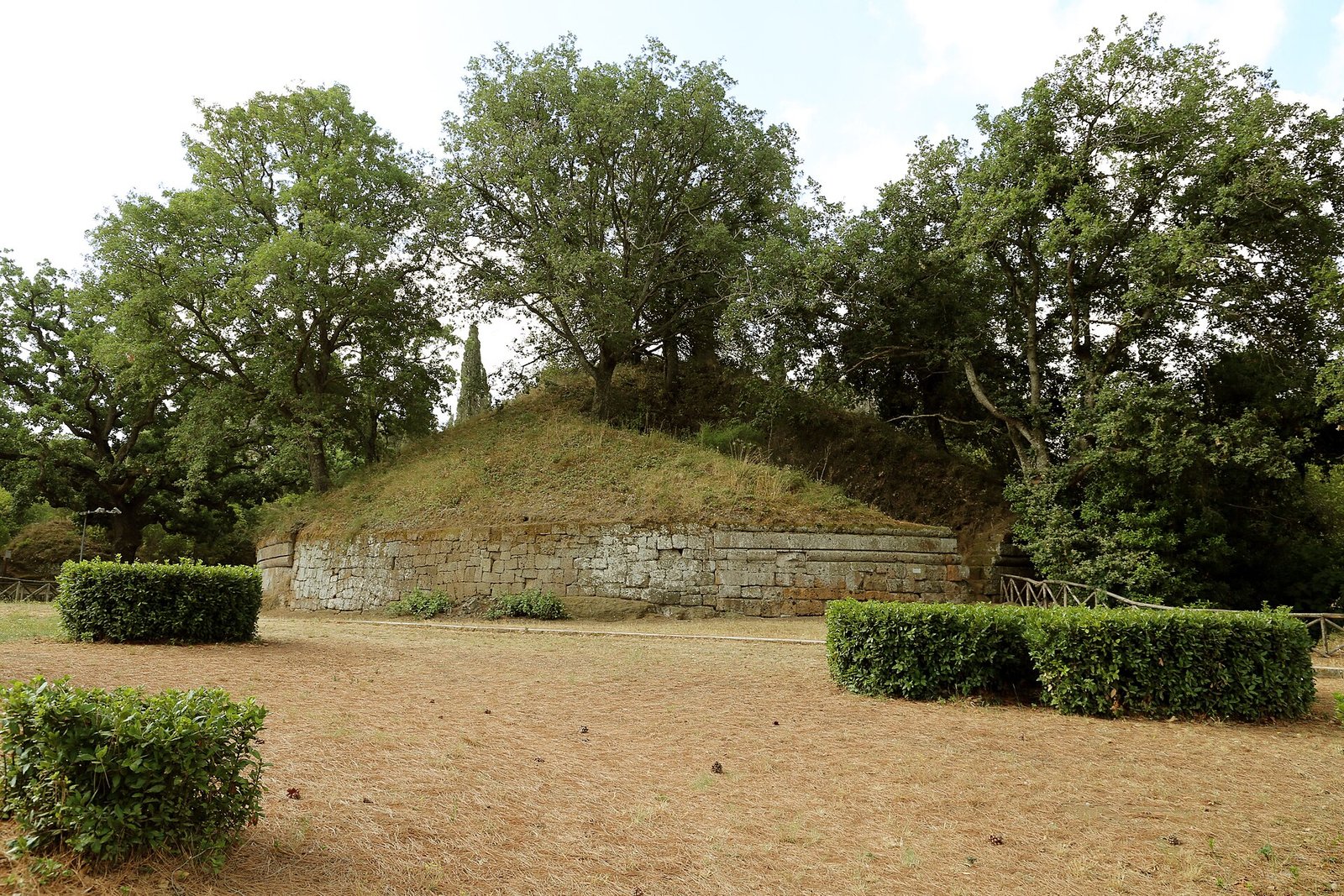
The tumulus is the shape that makes the Banditaccia recognizable at a glance: a huge circular drum of tuff, often faced with a molded base, topped by an earthen cap now covered in grass and trees. Inside, one or more chamber tombs with an access corridor. Outside, the clearest political statement a family could make in the 7th century BC: we are here, we matter, and we want to be seen from far away.
Diameters vary enormously. There are modest tumuli of seven or eight meters, and giants over 40 meters, with the Tumulo del Colonnello and the Tumulo Mengarelli among the most imposing in the visitable area. Some reach and exceed 50 meters in diameter in sectors not open to the public. Imagine this expanse without the grass and the trees, with freshly cut tuff that is a light ochre-yellow, almost luminous: a forest of very white discs that could be seen from the sea. That's the point: tumuli were signals. Anyone arriving at Caere from the coast saw the city of the dead first and then the city of the living.
What a tumulus looks like inside
The typical structure includes a circular drum partly carved out of the tuff bank and partly built with squared blocks, a dromos, that is, an access corridor open to the sky or covered, which slopes gently inward, and then one or more chambers. In the older versions there is a single chamber, with a double-pitched ceiling and side benches for the depositions. In the more developed versions you get real apartments: a vestibule, two side cells, and a rear chamber, exactly as in the houses with a median floor plan of the same period.
One detail I always point out, and that almost nobody notices on their own: many tumuli don't contain just one tomb, but several tombs dug at different times along the perimeter. The tumulus was a family real estate investment, and later generations added to it by digging their own entrance. When you look at the base of a large tumulus and see two, three, four separate doors facing different sides, you're looking at a Caeretan family tree written in the tuff, and you can almost date the branches from the shape of the lintels.
The molded base and the taste for detail
The more carefully made tumuli have a continuous molding at the base, a kind of shaped cornice running all the way around the circumference. It serves no structural purpose. It says that this tumulus was paid for well. It's exactly the same principle by which today a prestigious building has a travertine base and an anonymous one has plaster: the Etruscans got there 27 centuries early, and with better taste.
The Tomba della Capanna, or the fossilized Etruscan house
If I had to choose one tomb to explain to someone why the Banditaccia matters, I'd choose this one, even though it's neither the most beautiful nor the richest. The Tomba della Capanna is one of the oldest chamber tombs at the site, carved inside a tumulus, and it reproduces in the tuff the structure of an Iron Age hut: low walls slightly sloping inward, a double-pitched roof with the ridge carved, and on the rock surface the imitation of the roof framing, the posts, the rafters, even the look of the vegetal covering.
It's a document of inestimable value. We know Villanovan huts from hut urns, that is, small terracotta containers shaped like houses and used for ashes, and from traces in the ground: postholes, gutter trenches, clay floors. These are clues. Here, instead, there's the thing itself, reproduced at life size by someone who saw those huts every day. It's as if, of a 1950s car, only the tire tracks had survived, and then someone suddenly found a complete cast of the body.
It's worth stopping for a few extra minutes in this chamber, in silence, in front of a thought that's banal but hard to shake: the craftsman who carved this ceiling was reproducing the house he was born in. Not an idea of a house. His own. He would look up at the ceiling of his own hut and then lower his eyes to the tufa and copy it. 27 centuries later, his work still shows where his parents slept.
Dado tombs and the urban revolution of the 6th century
Toward the end of the 7th century, something changes. Monumental tumuli cost a great deal, take up an enormous amount of land, and at a certain point the necropolis simply has no room left to go on like this. But it's not just a matter of square meters: society is changing. The Orientalizing aristocracy, that of princes with chariots and ivory thrones, gives way to a broader class of well-off families, merchants, wealthy craftsmen, middle-level landowners. And this class builds a new type of tomb.
This is how the dado tomb is born: a tufa parallelepiped, with a flat facade facing the road, the door in the center, and a simple inner chamber with two or three benches. Dado tombs don't scatter across the landscape like tumuli: they line up, sit side by side, share walls like row houses, and form regular blocks along straight streets. The result, in the sectors of the 6th century, is an orthogonal urban fabric that anyone who has ever seen a plan of an ancient city will recognize immediately.
Via dei Monti Ceriti and Via dei Monti della Tolfa
These are the two main axes of this neighborhood, and their modern names come from the hills they face. Walking through them is the most disorienting part of the visit: you proceed along a road cut into the tufa, with the fronts of the tombs on the right and left, the entrances regularly spaced, the facades aligned, and at a certain point you realize you are walking down a city street of the 6th century BC. With house numbers, practically speaking. No other Etruscan site conveys this feeling with the same force.
Archaeologists have long debated whether this regularity in the necropolis reflects a corresponding regularity in the city of the living. The hypothesis is fascinating and is partly confirmed by the excavations on the urban plateau, which have identified organized road axes and blocks. If that's true, then Caere practiced a form of orthogonal urban planning before the Hippodamian model spread in the Greek world, which would shuffle the deck quite a bit in a story we're used to telling in one direction only, from Greece to Italy.
The paradox of funerary democratization
There is a social aspect that I find instructive. The shift from tumulus to dado tomb looks a lot like the shift from the detached villa to the apartment building. Less space per family, more families buried, standardized modules, lower costs. Some scholars have read into it a widening of the social class able to afford a dignified burial, that is, a phenomenon of social mobility. Others, more cautious, see above all a rationalization of resources. Probably both are right. What is certain is that in the 6th century BC at Caere, many more people than before could afford a stone chamber with their own name carved on the lintel.
Via degli Inferi, the road with the most beautiful name in Italian archaeology
Outside the main enclosure, in a ravine that runs down toward the Manganello stream, runs a road cut into the tufa that the archaeologist Raniero Mengarelli identified in 1927 and named Via degli Inferi. The name is evocative and partly modern, but it captures the function perfectly: it was the artery that connected the city of the living, on the plateau of Caere, to the city of the dead at the Banditaccia. It was the route funeral processions followed.
It is an extraordinary stretch of road, at points several meters wide, with tufa walls rising for many meters on both sides until they form a true trench, and with the ruts of carts still visible in the road surface in some places. Ruts from Etruscan and then Roman carts, because the road kept being used for centuries. In the walls there are niches, rock-cut tombs, drainage channels, and in many places you can see the regular cuts of the quarries: the tufa extracted to make the tombs came out from here, and the road and the quarry were the same thing.
Walking through it
Via degli Inferi has its own microclimate. Even in the middle of summer, inside that artificial canyon, the temperature drops by several degrees, the air is humid, maidenhair fern grows, the walls are green with moss, and in the shadiest spots ivy cascades down. You can hear the sound of water. It is the part of the visit where even the noisiest groups lower their voices, and I don't think that's a coincidence: the Etruscans who designed this passage knew very well what effect going down into a narrow gorge, with the sky reduced to a strip above your head, has on a human being.
Access to this sector can change over time and doesn't always coincide with the main entrance of the necropolis: it's best to ask the staff at the time of your visit or check the Archaeological Park's website, because how walkable it is also depends on the condition of the ground and on vegetation maintenance. When it is open, don't pass it up for any reason.
The Tomb of the Reliefs: The Absolute Masterpiece
And now we get to the highlight, the one worth crossing half of Lazio for. The Tomb of the Reliefs was discovered in 1847 and belonged to the Matunas family, one of the great Caeretan houses of the Hellenistic phase. The painted inscription records that it was Vel Matunas, son of Laris, who had it built. The dating ranges between the middle and the end of the fourth century BC, a moment when Caere had already lost its Mediterranean hegemony but kept remarkable wealth and refinement.
You go down a steep dromos and reach a rectangular chamber of about 7.7 meters by 6.5 meters, 2.6 meters high, with a double-pitched ceiling supported by two central pillars. Along the walls, 13 niches with funerary beds and 32 burial places in all. Up to here, a great family tomb like others. Then you raise your eyes, and the wonder begins.
A Household Inventory Sculpted in Stucco
Every available surface, the pillars, the architraves, the bands above the niches, the sides of the beds, is covered with painted stucco reliefs that reproduce real objects at life size, hung as they would have been hung on the walls of a house. Not abstract decorations: objects. I'll list some, because the list is the best way to make clear what we're talking about.
There are helmets, greaves, breastplates, round shields, swords in their scabbards, big knives. There are drinking horns and jugs and ladles and strainers for wine, that is, the complete equipment of the banquet. There are a walking stick, a bag, a small chest, coiled ropes, bowls. There is a gaming board with the pieces. There are folding chairs, stools, fans. There are kitchen utensils: the pan, the rolling pin, the butcher's hooks, the knife. There are domestic animals: a dog crouched under a bed, a goose, a cat. There are ropes and bolts and keys.
The result is that on entering the Tomb of the Reliefs you don't enter a sepulchre: you enter a furnished house. With the pantry, with the banquet hall, with the family armory hung on the wall, with the cat. No other Etruscan monument gives back to us with this precision the material inventory of an aristocratic house of the fourth century, and no other monument tells us as much about the Etruscan idea of the afterlife: a place where you keep living as you lived, surrounded by the same things.
Cerberus and the Demons
Then, under the central niche, the one reserved for the main couple, husband and wife side by side, the scene changes register. Two figures in relief appear: a three-headed monster, who is Cerberus, and an infernal demon with serpentine features, whose identification is debated. At the sides of the niche there are traces of heavily damaged busts, which scholars tend to refer to Aita and Phersipnai, that is, the Etruscan versions of Hades and Persephone, the rulers of the world of the dead.
It's a powerful contrast. Above, domestic life in its most concrete and affectionate details, down to the dog and the pan. Below, the guardian of the underworld and his lords. The Tomb of the Reliefs puts the two things together without trying to reconcile them, and in this I think it is more honest than many theologies: you keep living, and at the same time you go down to the underworld. The Etruscans held both ideas together without feeling the need to resolve the contradiction.
Why You Often See It Through Glass
The stuccoes still retain substantial traces of the original polychromy, and painted stucco is among the most fragile materials archaeology knows: it fears humidity, it fears temperature swings, it fears contact. For this reason the tomb is normally protected and viewed through a glass panel, with extraordinary openings on particular occasions organized by the Archaeological Park. I understand the disappointment of those who would like to go in. But I assure you that even through the glass the effect is still huge, and above all I guarantee you that it makes much more sense to see it behind glass today than not to see it at all in 20 years.
The Tomb That Entered Literature
There is also a curious detail. The Tomb of the Reliefs left its mark outside archaeology too, because the necropolis of Cerveteri appears at the beginning of Giorgio Bassani's novel The Garden of the Finzi-Continis, where an outing to the Etruscan tombs opens the book and sets the narrator's memory in motion. A girl, in front of the tombs, says that they make her less sad than modern cemeteries because there the dead have been dead for so long that it's as if they had never lived. It is one of the truest things ever written about this place, and it was written by a novelist, not by an archaeologist.
The Tomb of the Capitals and the Architecture of Wood
Dated to around 570 BC, the Tomb of the Capitals is cut entirely into the tufa inside a small tumulus. It takes its name from two central pillars topped with Aeolic capitals, their volutes opening sideways like two horns. These are the capitals that, in the Greek-Eastern world, come before and alongside the Ionic order. Finding them here, in sixth-century Etruria, is one of the most elegant proofs of how fully Caere was inside the artistic currents of the Mediterranean.
But the remarkable thing about the Tomb of the Capitals isn't the capitals. It's the ceiling. The chamber reproduces with stubborn precision the wooden structure of a real roof. There's the ridge beam, there are the rafters, there are the joists, and there's the way the joints between the elements are rendered. Everything is carved from a single block of rock that doesn't need any support, because it is rock. It's mimetic architecture in its purest form: the stone pretends to be wood, and it pretends so well that today scholars reconstruct Etruscan carpentry starting from here.
The vestibule with the cells
The layout deserves attention. You enter a wide vestibule, and from there you reach side cells and rear chambers. It's the scheme of the mid-plan house, with a central atrium and the rooms arranged around it, that is, the scheme the Romans will inherit and develop in the domus. Looking at this tomb makes it clear that the atrium of the Roman house didn't come from nowhere. It has an Etruscan prehistory, and you can read it better in the tombs of Cerveteri than in any urban excavation.
The Tomb of the Five Chairs and the cult of the ancestors
Discovered in 1865 inside a tumulus over 20 meters in diameter, the Tomb of the Five Chairs dates to the seventh century BC and has an apparently ordinary structure: a short dromos, two side rooms, a rear chamber. In the left-hand cell, however, five chairs are carved into the wall in a row, with a small table and two thrones in front of them. Not symbols of chairs: chairs, cut from the tufa.
Five small terracotta statuettes, made at reduced scale, once stood on those chairs, representing seated figures in a composed pose. They were the ancestors. The complex must have worked as a kind of household chapel dedicated to the cult of the forebears, in front of which the living left offerings. The presence of the table and thrones suggests a periodic, repeated ritual, almost a shared banquet between generations. Three of the statuettes have survived in good enough condition to be displayed: two are in the British Museum in London, and one is in the Capitoline Museums in Rome.
This dispersal, which makes us wince today, shows well how the nineteenth-century antiquities market worked. It also explains why a visit to the Banditaccia is necessarily an incomplete one. The container is here, while the contents are scattered between Rome, London, Paris, the Vatican and a dozen other museums around the world. I'll come back to this later, because it's a story that deserves space.
What those five figures really tell us
One point deserves attention, one that is usually dismissed quickly. The cult of the ancestors implies a view of the family as an entity that continues over time, in which the dead remain active members of the group and must be fed, honored and consulted. The Etruscans practiced it intensely, and the Banditaccia as a whole is the monumental translation of this idea: family tombs reopened for generations, roads walked by processions, banquets held on site. It wasn't a cemetery you visited once a year. It was a frequented neighborhood.
The Regolini-Galassi Tomb and the treasure that changed Etruscology
To tell this story, you have to leave the Banditaccia, because the tomb is in the Sorbo necropolis, on the opposite side of the Caere plateau. But it's impossible to talk about Cerveteri without it. In 1836 the archpriest of Cerveteri, Alessandro Regolini, and General Vincenzo Galassi opened a tumulus in the Sorbo and found something no one expected: an intact chamber tomb, unviolated, with its grave goods still in place.
Inside there was gold. Gold in such quantity and quality that it rewrote what was known about ancient goldworking: an enormous gold fibula, over 30 centimeters long, decorated with granulation and rows of raised lions and ducklings. There was also a gold pectoral embossed with hundreds of figurines, bracelets, pins, cups, a chariot, a throne, a bronze funeral bed, cauldrons with griffin protomes in an Eastern style, gilded silver vessels and ivories. All of it is datable to around the middle of the seventh century BC, in the full Orientalizing phase.
The grave goods entered the papal collections and still form the core of Room II of the Gregorian Etruscan Museum, in the Vatican Museums. If you go see it, and I strongly recommend you do, keep in mind that you're looking at the contents of a tomb a few kilometers from the ones you visited at the Banditaccia, belonging to the same city and the same aristocracy. The granulation on those fibulae, thousands of tiny gold spheres a fraction of a millimeter in diameter soldered one by one, is a technique that has taken modern goldsmiths decades to reproduce convincingly.
The tomb of the woman with the name
A woman was laid in the back cell, and on some objects of the grave goods there is an inscription with a name that reads as Larthia. It is one of the first personal names we read from Etruria, and it belongs to a woman buried with a treasure worth the budget of a small state. It's worth dwelling on this: in the seventh century BC, in Etruria, a woman could be buried with royal honors and with her own name inscribed on the objects. In contemporary Greece it would have been unthinkable. In Rome in the following centuries women would not even have had an individual praenomen.
The Sarcophagus of the Spouses: The Image Everyone Knows
There is an Etruscan object that everyone has seen at least once, maybe without knowing where it came from: two figures reclining on a banquet couch, a man and a woman, he with a pointed beard and his arm around her shoulders, she with a long braid and a soft cap, both with that oblique and faintly ironic archaic smile. That terracotta sarcophagus, about 1.4 meters high and about 2.2 meters long, dated to the last quarter of the sixth century BC, comes from here. From the Banditaccia. It was recovered in the 1881 excavations in hundreds of fragments (the sources speak of 400 pieces) and patiently put back together.
Today it is in the National Etruscan Museum of Villa Giulia in Rome, and it is rightly the most famous piece of that collection. A twin example, also from the area of Caere and passed through the collection of the Marquis Giampietro Campana, is in the Louvre in Paris. Two nearly identical sarcophagi, produced in the same Caeretan workshop, now separated by 1,000 kilometers.
Why It's a Revolutionary Image
The point isn't technical, it's anthropological. In the archaic and classical Greek banquet, women of rank did not take part: at the symposium there were the men and, with very different roles, the hetairai and the female musicians. In the Etruscan banquet, instead, the wife lies next to her husband, on the same couch, at the same level, and the two are shown as an equal couple sharing a convivial gesture. The Greek historians found this scandalous and wrote about it with a mix of fascination and contempt: Theopompus left pages on Etruscan women of such relentless malice that today they are the best proof that those women enjoyed a freedom that the Greeks found incomprehensible.
Looking at the Sarcophagus of the Spouses you understand that the Etruscans had a different society. Women took part in banquets, had a name of their own, appeared in funerary inscriptions with their maternal descent, owned property. It was not an egalitarian society in the modern sense, but it was clearly more open than those around it, and we see this openness sculpted in a terracotta that came out of the tuff of Cerveteri.
Pyrgi, the Port of Caere, and the Three Gold Sheets
About 15 kilometers from the necropolis, on the coast, lies Santa Severa, and under the village and the castle hides Pyrgi, the main port of Caere and one of the major trading ports of the Tyrrhenian between the sixth and fourth century BC. Here stood an international sanctuary, with two temples that archaeologists conventionally call Temple A and Temple B, frequented by Greek, Phoenician and Punic merchants, besides the Etruscans of course.
On July 8, 1964, during the excavation campaigns directed by Massimo Pallottino, three rolled-up gold sheets, very thin, engraved with texts, emerged from the ground at Pyrgi. Two were in Etruscan, one in Phoenician. The content documents the dedication of Temple B to the goddess Uni, identified in the Phoenician text with Astarte, by Thefarie Velianas, supreme magistrate of Caere. The Punic text and the Etruscan one are not a literal translation of each other, but they are substantially parallel, and this makes them one of the most precious tools we have for approaching the Etruscan language.
It's Not the Rosetta Stone, but It's the Closest Thing
We have to be honest: the Pyrgi sheets did not decipher Etruscan, and whoever writes that exaggerates. We know how to read the Etruscan language (the alphabet derives from the western Greek one and the pronunciation is no mystery) but we don't know how to translate it well, because it doesn't belong to the Indo-European family and has no surviving close relatives. What the sheets provided is a bilingual context that confirmed or corrected the meaning of a certain number of terms and formulas. A real step forward, not a revolution.
But the sheets say another thing, historically even denser. They say that in the sixth century BC the head of Caere dedicated a temple to a deity with a Phoenician name, in a Phoenician language, on gold sheets, in a sanctuary of his port. That is, they say that Caere and Carthage were allies, that the environment was truly multicultural, and that the Tyrrhenian was a contested sea in which Etruscans and Punics made common cause against Greek expansion. The three sheets are kept in the National Etruscan Museum of Villa Giulia in Rome.
Alalia, or How Caere Became a Naval Power
Around 540 BC, off the coast of Corsica, a naval battle took place that Herodotus describes and that has gone down in history as the Battle of the Sardinian Sea or the Battle of Alalia. On one side were the Phocaeans, Greek colonists settled at Alalia in Corsica, who raided Tyrrhenian trade. On the other was a fleet allied with the Etruscans, in which the Caeretani played the leading part, and with the Carthaginians.
In Herodotus's account, the outcome was a so-called Cadmean victory for the Greeks. The Phocaeans won on the field but lost a large part of their ships and were forced to abandon Corsica. The strategic result rewarded the Etruscan-Punic allies, who divided up the areas of influence. The Caeretani got the prisoners, who were stoned. Herodotus adds a detail that may be the most interesting part of the whole story: after the massacre, anyone who passed near the site of the execution was struck by paralysis and deformity, men, beasts and flocks alike. The frightened Caeretani sent to consult the oracle at Delphi, and Delphi instructed them to establish funeral games and sacrifices in honor of the victims.
Why that story matters to us
Because it shows Caere within the Greek religious and diplomatic system. An Etruscan city that sends to consult the oracle at Delphi, and that owns its own thesauros there, that is, a treasury building for offerings, is a city the Greeks regarded as a counterpart. Not barbarians on the fringes, but trading partners, military rivals and, in Caere's case, holders of pan-Hellenic religious credentials too. Among the Etruscan cities, Caere has the most pronounced international profile, and its necropolis reflects this in every detail, from the Greek imports in the grave goods to the Aeolic capitals in the chambers.
Caere and Rome: an alliance that ended badly
Relations between Caere and Rome began well. The tradition, reported by Livy, says that in 390 BC, when the Gallic Senones under Brennus took Rome, the Vestal Virgins and the sacred objects were saved and taken to Caere, which welcomed and protected them. From that episode, according to an ancient etymological explanation, the term caerimoniae, ceremonies, would derive: the rites kept at Caere. It's one of those etymologies that modern linguists view with suspicion, but the fact that the Romans believed it shows how strongly the bond was felt.
Caere was the first community to receive the hospitium publicum, public hospitality, a formal recognition of friendship between the two states. Then things went sour. In the 4th century BC, Caere was involved in hostilities against Rome, and in 353 BC, after its defeat, it obtained a truce that led to a particular legal status: the civitas sine suffragio, Roman citizenship without the right to vote. The Caeretani became half-Roman citizens, enrolled in the tabulae Caeritum, which in Roman usage became the register of demoted citizens.
From there on, the trajectory is downhill. Caere loses its ports, loses its autonomy, loses its trade. It becomes a Roman municipium of middling importance, then an agricultural center, then little more than a name. In the Middle Ages, the population, decimated by malaria and Saracen raids, abandoned the plateau and moved to Ceri, the fortified settlement on a cliff a few kilometers farther on. The old site became Caere Vetus, the old Caere, and from this phrase, through centuries of popular usage, the modern name Cerveteri came about.
The joke in the name Banditaccia
And here is the detail I love most. The name of the most remarkable archaeological site in southern Etruria has nothing lofty about it. Banditaccia comes from bandita, a term that in agricultural language meant land subject to a ban, that is, closed to common use and reserved for the owner. The pejorative ending -accia is the local farmers' comment: the ugly bandita, the awkward one, the one where the ground is full of holes and can't be plowed properly. The world's heritage, for those who worked the land there in the 1800s, was essentially a ruined field.
The excavations of the 1800s: between science, adventure and looting
The rediscovery of the Banditaccia belongs to that unrepeatable and ambiguous era that was 19th-century archaeology, when scientific curiosity, the passion for collecting and commercial interest were often the same person. Aristocrats, antiquarians, bankers and Grand Tour travelers arrived in Cerveteri, and all of them dug.
Marquis Campana and the painted plaques
Between 1845 and 1846, the Marquis Giampietro Campana, director of the Monte di Pietà in Rome and a collector of titanic proportions, excavated at Cerveteri and brought back, among other things, a group of painted terracotta plaques, known as the Campana plaques, which are among the most valuable documents of early Etruscan painting. Campana amassed a vast collection and financed all of it by drawing on the coffers of the institution he directed. When the matter came to light, he was tried and convicted, and the collection was sold at auction. The plaques and the sarcophagus twin to the Sarcophagus of the Spouses ended up in the Louvre, and other pieces scattered across Russia, England and half of Europe.
It's an exemplary story of the period, and I tell it without retroactive indignation. Campana was a thief, but he was also one of the few who understood the importance of what he was digging up, and some objects we admire today still exist because he collected them instead of letting the plow destroy them. The history of conservation is almost always like this: dirty, contradictory, and still preferable to the alternative.
The Fascination of the Opening
A recurring and extraordinary description survives in travelers' memoirs, that of the opening of an intact tomb. The blocking wall was broken through, a lantern was held in, and for a few seconds one saw the paintings with vivid colors, the objects in their places, the fabrics, the bodies laid out on the beds. Then the air came in, and within a few minutes the colors faded, the textiles turned to dust, the bodies collapsed into little heaps of bones. Those who watched told of having seen a whole world for an instant and of having seen it vanish as they looked at it. Today, with modern excavation techniques, that disaster is avoided. Back then it was the norm, and every opened tomb was a document destroyed in the very act of being read.
Raniero Mengarelli and the Birth of the Modern Banditaccia
The necropolis as we see it today, with its walkable roads and its tumuli freed from vegetation, is to a very large extent the work of one man: Raniero Mengarelli, who directed the excavations of Cerveteri from 1909 until the 1930s. Mengarelli was not the first to dig here, but he was the first to do it with an overall plan, which didn't consist of looking for objects but of understanding and making legible the structure of the site.
To him we owe the identification of the road layout of the necropolis, the recognition in 1927 of Via degli Inferi, the restoration and consolidation of dozens of tumuli, the arrangement of the paths, the very idea that the Banditaccia could be opened up and understood by the public. One of the great tumuli of the area bears his name, and rightly so. Mengarelli also worked in difficult conditions, with limited means and in a context in which clandestine digging was a widespread and partly tolerated activity.
The Interruption and the Damage
After the end of Mengarelli's directorship, around the mid-1930s, the site went through a period of neglect, with unauthorized digging starting up again. 1944 added further damage: the passage of the front, heavy military vehicles on the tumuli, trenches. Some structures were irreversibly compromised. It is a little-told chapter of the history of the necropolis, but it explains why in certain sectors the archaeological reading is harder than in others.
The Restart: Moretti, Cristofani and the Italian School
The systematic restart is due to Mario Moretti, who from 1957 resumed the excavation campaigns with an already fully modern approach, and in the 1980s to Mauro Cristofani, one of the greatest Etruscologists of the twentieth century, who brought updated stratigraphic methods to Cerveteri and a new attention to settlement contexts as well as funerary ones. The investigations have never stopped: in recent decades geophysical surveys, aerial photographs, laser surveys and three-dimensional modeling have identified thousands of buried structures without removing a gram of earth.
This step is worth underlining. The archaeology of the 21st century digs less and less, because it has learned that intact ground is a non-renewable resource and that every excavation is a controlled destruction. At the Banditaccia the portion investigated is estimated to be a fraction of the total, and this is not a failure: it is a choice. The unexcavated tombs are left to colleagues of the future, who will have tools we can't imagine.
The Cerite National Archaeological Museum, a Required Stop
In the historic center of Cerveteri, facing Piazza Santa Maria, stands Palazzo Ruspoli, the old Rocca, which houses the Cerite National Archaeological Museum. Visiting the necropolis and skipping the museum is a mistake: they are two halves of the same thing. At the Banditaccia you see the empty containers, here you see a part of the contents, and the overall meaning forms only by holding the two experiences together.
The display is spread over two levels and presents materials from the different necropolises of the Cerveteri territory, covering the span from the Villanovan phase to the Hellenistic age: impasto wares, bucchero, that jet-black glossy pottery that is the stylistic signature of archaic Etruria, amphorae, transport vessels, reassembled grave goods, sarcophagus lids with reclining figures of the deceased, votive materials. Management is ministerial and the museum is part of the system of the Archaeological Park of Cerveteri and Tarquinia together with the necropolis.
The Euphronios Krater, the Story of a Return
The piece that alone is worth the climb up to the town is an Attic red-figure krater signed by Euphronios as ceramicist, an absolute masterpiece of Greek ceramics straddling the 6th and 5th centuries BC. This vase has a biography worthy of a novel. It left the territory of Cerveteri illegally, ended up on the international market, and was bought by the Metropolitan Museum of New York, where for decades it was one of the most celebrated pieces. Investigations carried out in Italy into the antiquities trafficking proved its illicit provenance, and after long negotiations the vase returned to Italy. Since 2015, together with a kylix by the same Euphronios already at the Getty Museum in Malibu, it has been on display here, in Cerveteri, a few kilometers from the point where it was pulled out of the earth.
I find it one of the most instructive stories in contemporary archaeology. It reminds us that tomb robbers are not folkloric figures of a distant past: they operated intensely in this territory until just a few decades ago, fueled a global market, and tore thousands of objects out of their context. A vase without context loses a large part of its documentary value: we don't know which tomb it was in, what it was associated with, who its owner was. Euphronios's krater has come back beautiful and mutilated, because its context is lost forever.
Villa Giulia, the other half of the story
The Villa Giulia National Etruscan Museum, in Rome, occupies the sixteenth-century villa built for Pope Julius III on designs that involved Vignola, Ammannati and Vasari, and since 1889 has been the great repository of the Etruscan antiquities of southern Etruria. For those visiting Cerveteri, it is the third natural stop, after the necropolis and the local museum.
The Sarcophagus of the Spouses is here. The gold sheets of Pyrgi are here. Complete grave goods from the Ceretan necropolises are here, along with Attic ceramics imported to Caere in industrial quantities, buccheri, bronzes, and architectural terracottas. If I had to suggest an order, I'd say: first the Banditaccia, to understand the space, then the Cerite, for the territory, then Villa Giulia, for the synthesis. But any order works, as long as you don't stop at the first one.
A practical tip
Don't try to do Cerveteri and Villa Giulia in the same day. On paper it's possible, in practice it's torture: you'll arrive at the Roman museum tired, with heavy legs and a saturated head, and you'll walk past the Sarcophagus of the Spouses thinking about dinner. They're two days, and they're two days well spent. The Banditaccia requires comfortable shoes and walking, Villa Giulia requires rested eyes and slowness. They're different efforts and they don't add up well.
The 2004 UNESCO inscription and what it really entails
In 2004 the World Heritage Committee inscribed on the List the serial site called Etruscan Necropolises of Cerveteri and Tarquinia, comprising the Banditaccia and the Monterozzi necropolis. The inscription was based on three criteria: the first, which recognizes a masterpiece of human creative genius, the third, which recognizes a unique or exceptional testimony to a vanished civilization, and the fourth, which recognizes an eminent example of a type of architectural or landscape complex illustrating a significant phase of human history.
The inscribed property covers a little over 320 hectares in total, with a buffer zone of almost 5,000 hectares. These numbers explain something important: protection doesn't concern only the tombs, but also the landscape around them, the visual cones, the countryside. Because the Banditaccia without its pines, without its cypresses, without the view of the Tolfa Mountains would not be the same thing, and UNESCO has put this in black and white.
Cerveteri and Tarquinia: why together
The logic of the joint inscription is complementary, and I find it smart. Tarquinia has the painted tombs: about 200 frescoed chambers out of about 6,000 burials, with a painted sequence running from the 7th to the 2nd century BC, and it is the main surviving testimony to large-scale painting in the pre-Roman Mediterranean world. Cerveteri has the architecture and urban planning: the structure of a planned funerary city, with its streets and its blocks, and the faithful reproduction of domestic architecture.
Taken separately they would be two exceptional sites. Taken together they tell the story of the Etruscan civilization in two dimensions that no other context conveys: how they built and how they painted, how they organized space and how they imagined the afterlife. Anyone with time should see both, perhaps on two consecutive days with a night in the area. They are a little over 40 kilometers apart along the coast.
How to imagine a funeral in Caere
I'll try to reconstruct the scene, sticking to what archaeology and the sources allow us to state, because walking through the necropolis knowing what happened there radically changes the experience.
The procession leaves from the city, on the plateau. The deceased is carried on a bed, accompanied by relatives, flute and trumpet players, dancers, and prefiche, that is, women paid to perform the funeral lament. The procession descends along the road cut into the tufa, the one we today call Via degli Inferi, with tall walls on either side and sounds that bounce back. It arrives at the necropolis, enters the funerary road, and reaches the family tumulus.
The sealing of the door is removed, since the family tomb is reopened and is not sealed once and for all, and the body is laid on the stone bed or inside a sarcophagus, with the grave goods: vessels for the banquet, personal objects, weapons if the deceased is a man of rank, jewelry and spinning tools if it is a woman. Outside, in front of the tumulus, a funeral banquet is held, attended by the living. People eat, drink, and pour libations. Sometimes there are games: races, wrestling, performances that in the Etruscan world carried strong ritual meaning and that Rome would inherit, turning them into something very different and much bloodier.
The tomb as a home and the shared meal
Then the door is closed again, and the family returns to the city. But they will come back. They will come back for the next funeral, they will come back for the anniversaries, they will come back to bring offerings. The necropolis was a place that was visited, walked through, and cared for, and the funerary roads were real roads, with upkeep, drainage, and channels for rainwater. There is a continuity between the house of the living and the house of the dead that our cemeteries have lost and that can be seen here firsthand: the same architecture, the same furnishings, the same objects, the same idea of the family extended over time.
What to see on a two-hour route: the itinerary
I suggest an order that works, built on many visits and a few mistakes made along the way. Keep in mind that access to individual tombs changes over time for conservation and maintenance reasons, so check on site which ones are open on the day of your visit.
First half hour: getting your bearings
From the entrance, don't rush toward the first open tomb. Instead, climb to one of the viewpoints and look at the whole. Count the tumuli you can see. Try to imagine them without vegetation, with the bare tufa. This five-minute exercise is worth more than half an hour of captions, because it fixes in your mind the one thing photographs don't convey: the scale.
Second half hour: the great tumuli
Then head down toward the sector of the great Orientalizing tumuli and visit the accessible ones, paying attention to the Tomba della Capanna and to the chambers with ceilings that reproduce wooden structures. In each one, look for three elements: the ridge of the roof, the beds with carved feet, and any false window or door. Finding them becomes a game, and the game teaches you to read architecture much better than any explanation would.
Third half hour: the row quarter
Move to the sixth-century roads, Via dei Monti Ceriti and Via dei Monti della Tolfa, and walk along the façades of the cube-shaped tombs. Here the thing to do is simply walk the road from one end to the other without stopping, and then walk back stopping. On the first pass, get the urban rhythm, on the second, look at the details, the differences between one façade and the next, the traces of inscriptions on the architraves.
Last half hour: the Tomba dei Rilievi and the farewell
End with the Tomba dei Rilievi, because it is the high point and should be left for last: whatever you see afterward will seem less. Give it at least a quarter of an hour, and use it to identify as many stucco objects as you can. It's an exercise that children enjoy too, and they usually find the dog and the cat before the adults do. Then leave the sector and take five minutes on a bench in the shade, without talking. The Banditaccia needs a moment to settle, otherwise you leave with your head full and your memory confused.
The landscape of the necropolis: pines, cypresses, and a particular silence
One aspect that almost never appears in descriptions, yet is decisive in the experience: the Banditaccia is a beautiful place regardless of the archaeology. The tumuli are covered with grass and scrub, the avenues are shaded by stone pines and cypresses, and Mediterranean vegetation fills the valleys with holm oak, strawberry tree, mastic, and wild rosemary. In spring the ground between the tombs fills with daisies, poppies, and wild fennel, and the air smells intensely.
The animals are there and can be seen: jays and dormice, hoopoes with that improbable crest, buzzards circling high over the plateau, lizards and green lizards in industrial quantities on the warm stones. In some chambers live colonies of bats, protected and very useful. Next to the tumuli you may see porcupines digging, and at dusk you may hear scops owls. Anyone who arrives expecting a dusty archaeological site is surprised: it is more like a natural park that contains a city.
Best seasons and times
April, May, the first half of June, and then all of October: these are the periods when the Banditaccia is at its best, with low light shaping the tumuli and temperatures that let you walk for hours. July and August are demanding: there is shade, but it isn't continuous, and the reverberation of the tuff increases the perceived heat. In that case, aim for the first hour of opening or the late afternoon. Winter has a severe charm, with fog caught among the tumuli, but the ground can be muddy and slippery: consider your shoes.
The village of Cerveteri and the surroundings worth adding
After the necropolis, the historic center of Cerveteri deserves at least an hour. It is a compact medieval village, gathered around Piazza Santa Maria, with the Palazzo Ruspoli that houses the museum, the church of Santa Maria Maggiore built on ancient structures, the alleys, the walls. It is not a postcard village cleaned up for tourism: it is a living town, with its share of everyday normalcy, and this is a plus.
Ceri
A few kilometers away, on a spur of tuff surrounded by cliffs, is Ceri, the village where the inhabitants of Caere took refuge when they abandoned the ancient plateau. It is tiny, has only one access road, and preserves the church of the Immacolata Concezione with a cycle of medieval frescoes of remarkable interest. You can get there in 10 minutes from the necropolis and visit it in half an hour. It's worth the detour just to understand physically what the word arroccarsi means.
Santa Severa and the castle by the sea
Toward the coast, the castle of Santa Severa stands above and within the area of ancient Pyrgi, with the sea a few meters from the walls. It is one of the most photogenic spots on the Lazio coast and lets you close the loop of the day: the city of the dead in the morning, the port that made that wealth possible in the afternoon, with the beach available if the season allows. Of the sanctuaries of Pyrgi, the foundations of the temples remain, visible in the archaeological area.
The table
Cerveteri is wine country: the local designation produces white and red wines of traditional style, and the countryside around is dotted with farms. The cooking is that of the Lazio hinterland with some seafood influence, so artichokes in season, pecorino, abbacchio, fettuccine, and fish if you head toward Ladispoli, which has made a famous festival out of artichokes. Eating well here is not hard and not expensive, which can't be said of all the areas 40 kilometers from Rome.
Visiting with children: it works better than you think
The Banditaccia is one of the archaeological sites that works best with children, and the reason is that you go inside things. A ruined temple requires an effort of imagination that few eight-year-olds feel like making. Here instead you go down steps, pass through doorways, find yourself in a room with a roof and beds, and the idea of home arrives immediately.
A few practical tips. Bring a flashlight, because the rooms are dark and lighting them yourselves is half the fun. Play the object game at the Tomb of the Reliefs. Explain the tuff by letting them touch it. And above all, don't turn the visit into a lesson: the necropolis tells its own story if you give it time. Watch the steps, often uneven and slippery with humidity, and the strollers, which are impassable in many stretches: a child carrier backpack works much better.
Accessibility
The main route is partly on unpaved ground and has changes in elevation. Access to the individual chambers almost always involves steep steps and low passages. Visitors with mobility difficulties can still enjoy a large part of the site by moving along the main avenues and observing from outside the tumuli and facades, which are already half the experience in themselves. For specific information on accessible routes and services, it is best to contact the Parco Archeologico directly before your visit.
Bucchero, the black ceramic ware that made Caere's fortune
If there is one object that represents Caeretan craftsmanship, it is bucchero: a ceramic of uniform black color, with a glossy, almost metallic surface, obtained by firing in a reducing atmosphere that transforms the iron compounds present in the clay and blackens the body of the vessel through its whole thickness, not just on the surface. It is a sophisticated technique, which requires precise control of the firing chamber, and the Etruscans had already mastered it in the 7th century BC.
Thin bucchero, the kind from the best phases, has walls of just a few millimeters and a crystalline sound when struck. It imitated bronze vessels, that is, the tableware of the wealthy, and allowed a broader social class to set a table that resembled the aristocratic one. It was, in essence, an affordable luxury product, and as such it had enormous commercial success: Etruscan bucchero has been found in Provence, Spain, North Africa, Greece, and the Levant. It is the first Italian industrial product exported across the whole Mediterranean, about 2,600 years ahead of any modern manufacturing district.
The Caeretan hydriai
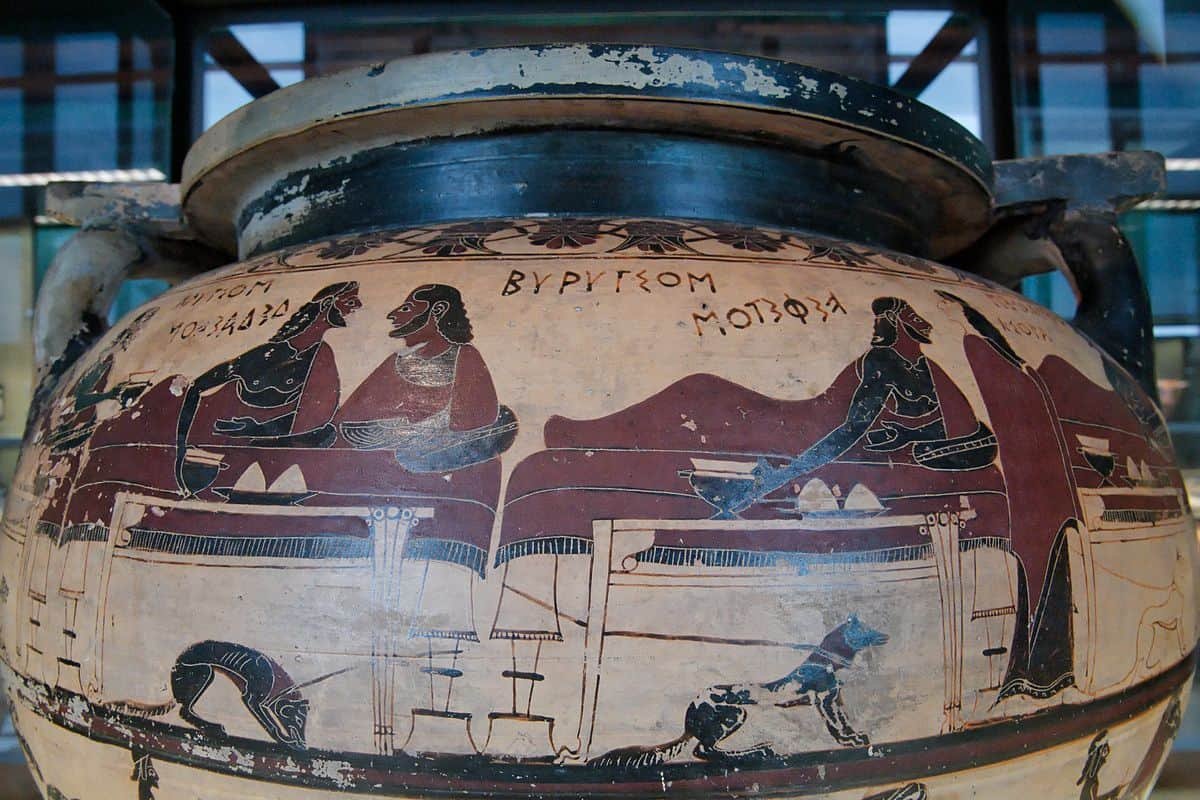
In the second half of the sixth century BC, a workshop in Caere produced a group of black-figure vases of such recognizable quality and style that scholars gave them a name of their own in the archaeological literature: the Caeretan hydriai. They are water amphorae with lively, colorful, often ironic decoration, with mythological scenes treated with a narrative freedom that Attic potters would not have allowed themselves. Scholars believe they were made by craftsmen of Greek-Eastern origin, probably emigrated Ionians, who worked in Caere for an Etruscan clientele.
This detail says a lot about the city. Not only goods arrived in Caere: craftsmen arrived too, settled, opened workshops, trained local apprentices, and produced objects that are Greek in technique and Etruscan in taste. The necropolis still preserves, in the grave goods recovered, the results of this hybridization, and the museums in the area display examples of it.
Greek Imports and the Paradox of the Attic Vases
There is a fact that always surprises people who hear it for the first time: most of the Attic black-figure and red-figure vases we admire in museums around the world were not found in Greece. They were found in Etruria, inside tombs. The Etruscans bought Athenian pottery in enormous quantities, used it at banquets, and then placed it in the tombs with the dead, where the tuff and the absence of plows preserved it for 25 centuries.
Caere was one of the main markets for this trade, and its necropolises have yielded pieces signed by the greatest Athenian potters and painters. The krater by Euphronios, now in the Museo Cerite, is the best-known example, but far from isolated. This means that in the history of Greek art there is an enormous and little-acknowledged debt to Etruria: without the Etruscan tombs, Attic pottery would be known to us only from fragments, and our idea of Greek painting would be infinitely poorer.
What a Wealthy Man of Caere Bought
I'll try to make the shopping list of a sixth-century aristocratic family from Caere, reconstructed from the grave goods. Attic tableware for wine, imported. Local bucchero for everyday use. Bronzes: candelabra, braziers, situlae, engraved mirrors. Gold worked in granulation and filigree. Ivory, which comes from Africa via the Phoenicians. Amber, which comes from the Baltic along very long overland routes. Decorated ostrich eggs, which come from North Africa. Perfumes in alabaster vessels and aryballoi. Dyed fabrics.
Look at that list and ask yourselves what kind of trade network it would take to fill it. From the Baltic to sub-Saharan Africa, from mainland Greece to the Phoenician Levant. In the sixth century BC, in a city on the Tyrrhenian coast. The Banditaccia is the funerary monument of a global merchant bourgeoisie, and its tumuli are, in a very literal sense, the financial statement of that trade.
The Etruscan Language and the Inscriptions of the Necropolis
Walking along the funerary streets, you may come across short inscriptions in the Etruscan alphabet, carved on lintels or facades. They are read from right to left, the alphabet derives from the Western Greek alphabet mediated through Cumae, and the signs are largely familiar to anyone who knows the Greek or Latin alphabet. Reading them aloud is possible and, the first time, exciting.
The problem isn't reading them: it's understanding them. Etruscan does not belong to the Indo-European family and has no close surviving relatives (the only recognized affinities concern the Stele of Lemnos and possibly Rhaetic), so we cannot deduce the meaning of words by comparing them with known languages. We know well the funerary vocabulary, the numerals, kinship terms, dedication formulas, and the names of deities and magistracies, that is, exactly what recurs in the texts we have. But the texts we have are overwhelmingly short epitaphs.
What They Usually Say
A typical Etruscan funerary inscription contains the given name, the family name, the patronymic, often the matronymic, sometimes the age at death and the office held. And it is precisely the systematic presence of the mother's name beside the father's that makes up one of the most interesting pieces of evidence the Etruscan necropolises hand down to us. In a Roman inscription the mother almost never appears. In an Etruscan one she regularly appears, and this has fueled a long historiographical debate about the role of women in Etruscan society.
The longest Etruscan text we have, incidentally, does not come from Italy: it is the so-called Liber Linteus, a ritual book written on cloth that was cut into strips and used to wrap a mummy, and which is today kept in Zagreb. About 1,200 words, a liturgical manual, and still only partly understandable today. Every new inscription, even one of three words, adds a piece to the puzzle.
Etruscan Religion and the World of the Dead
The ancients considered the Etruscans the most religious people of all, and Livy explicitly writes this. The so-called Etruscan discipline was a body of technical doctrines on interpreting divine will: haruspicy, that is, the reading of the entrails of sacrificed animals, with particular attention to the liver, the science of lightning, which classified bolts according to the region of the sky they came from and the god who sent them, and rituals on founding cities, marking out fields, and the duration of historical cycles.
The Romans took a great deal from them: the foundation rite with the plow, the templum as a delimited and oriented space, the figure of the haruspex who remained active in Rome for centuries, the ritual books. Even the idea of the saeculum, the unit of time that marks the life of a people, is of Etruscan origin. When the Romans did things in the most solemnly Roman way, they were often doing Etruscan things.
Who Rules the Afterlife
The Etruscan underworld pantheon includes Aita and Phersipnai, corresponding to Hades and Persephone, and a series of demonic figures that become prominent in funerary art mainly from the fourth century: Charun, with hammer, hooked nose, and livid complexion, who is not the Greek ferryman but rather a figure who oversees the passage, Vanth, female, winged, with torch and serpent, often present as a companion, Tuchulcha, with beak and donkey's ears. And of course Cerberus, which we can see carved in the Tomb of the Reliefs.
There is a change in tone that can be read chronologically. In the archaic tombs the image of the banquet, dance, and joy prevails: the afterlife as a festive continuation of life. From the fourth century on, demons, the journey, and unease make their way in. Many scholars have linked this change to the political crisis of Etruria in the face of Roman expansion: when a people loses control of its own future, its imagination of the otherworld becomes darker. It is not a provable explanation, but it is hard to look at the two phases side by side and not think about it.
What We Still Don't Know
It is worth remembering, to close, that the Banditaccia is an open worksite, not a closed chapter. Estimates agree that a substantial portion of the necropolis has never been investigated, and geophysical surveys continue to identify buried structures: chambers, dromoi, enclosures, stretches of road. There are, under that grass, tombs that have never been opened.
Technologies have changed the way we search for them. Ground-penetrating radar returns cross-sections of the subsoil without touching it, magnetometry picks up anomalies linked to voids and structures, ground-based and drone laser surveys produce millimeter-level three-dimensional models, and photogrammetry makes it possible to document fragile stucco without touching it. Virtual reconstruction projects have digitally reassembled scattered contexts, putting back together a tomb from Cerveteri with its grave goods kept in a distant museum.
Why Not Everything Is Excavated
Because excavating is destroying. Every layer removed does not come back, and every object removed from its context loses part of the information it carries with it. Contemporary archaeology digs to answer specific questions, or to save what would otherwise be destroyed by public works or erosion. Leaving the majority of the necropolis intact is not laziness: it is the most responsible choice that could be made, and it means that 50 years from now someone with better tools than ours will still find something to read.
Common Mistakes: What Not to Expect from the Banditaccia
I'll list the avoidable disappointments, because arriving with the right expectations is half the success of a visit.
Don't expect the paintings of Tarquinia. The tombs of Cerveteri are architecture, not painting: there are some traces of color, but anyone who comes here looking for frescoes has picked the wrong necropolis and would do well to add Monterozzi to the plan too. Don't expect to find objects in the tombs: they are empty, and their contents are in museums, when they aren't dispersed. Don't expect to enter all the chambers: many are closed for conservation reasons, and the list of open ones changes. Don't expect comprehensive captions in front of every monument: the Banditaccia rewards those who arrive prepared or accompanied.
And above all, don't expect a packaged attraction. This is a large, green, partly wild site where you walk a lot and where the relationship you build with the place depends to a large degree on you. Those who arrive with the mindset of a monument consumer leave puzzled. Those who arrive with an explorer's mindset leave with one of the strongest experiences Italian archaeology has to offer.
A Curiosity About the Banditaccia Necropolis - Ancient Caere: Etruscan Necropolis of Cerveteri
The best-known curiosity concerns the beds. In the funerary chambers of Cerveteri, the burials take place on benches carved into the tufa, and these benches are not simple shelves: they are beds, reproduced with turned feet, with raised headboards, with cushions rendered in relief, sometimes with folded blankets. So far, nothing surprising for anyone who knows the Etruscan idea of the tomb as a home. The point is something else: in many chambers the beds come in two different types, and the difference is systematic.
There are beds with a double-sloped headboard, which resembles a small roof or a pediment, and there are flat beds with a simple cushion. Scholars have compared this distinction with the available anthropological data and with the arrangement of the grave goods, and have drawn a convincing reading from it: the shaped headboard corresponds to female burials, the flat bed to male ones. In practice, in an Etruscan chamber at Caere you can determine the sex of the dead by looking at the shape of the furniture, even without bones or inscriptions.
I find this detail instructive for two reasons. The first is methodological: it shows how archaeology draws social information from elements that to a casual eye seem purely decorative, and how the shape of a stone pillow can say something about how a family was organized. The second is simpler and more human. Those people cared that their dead had a suitable, distinct, personal bed. Not a niche, not a shelf: a bed, with the right pillow. It is a gesture of domestic care made toward someone who would not come back, and 27 centuries later it is still legible in the tufa.
I'll add a note that completes the picture. In the larger chambers, the central niche is often designed for two side-by-side burials, husband and wife together. The Tomba dei Rilievi is the most famous example. Considering that the Sarcophagus of the Spouses, which came from this same necropolis, shows a couple reclining on the same banquet bed, a remarkable consistency emerges: in the funerary culture of Caere, the married couple is a unit that remains united even afterward, and it declares this in the space, in the furnishings and in the image.
One thing nobody tells you about the Banditaccia Necropolis - Ancient Caere: Etruscan Necropolis of Cerveteri
What nobody says, because it spoils the romantic atmosphere a bit, is that this necropolis was emptied methodically. I'm not only talking about the tomb robbers of the 20th century, who did enormous damage: I'm talking about the fact that the entire history of the site, from the 19th century on, is the history of a systematic separation between the containers and what they held. The containers stayed here, because they were carved into the rock and no one could carry them away. Everything else went away.
As you walk, do this exercise in your head. The statuettes from the Tomba delle Cinque Sedie: two at the British Museum in London, one at the Capitoline Museums. The grave goods from the Regolini-Galassi: Vatican Museums. The Sarcophagus of the Spouses: Villa Giulia in Rome. Its twin and the Campana painted slabs: Louvre, Paris. The Pyrgi lamellae: Villa Giulia. The krater of Euphronios: for decades in New York, today finally at the Museo Cerite in Cerveteri. And then thousands of vases, bronzes, and jewels scattered across dozens of European and American collections, many of them without precise indication of the tomb of origin.
This means that a visit to the Banditaccia is, structurally, a visit to a dismembered archive. We see the shelves and not the books. And that's why I push so hard for the site to be paired with the Museo Nazionale Archeologico Cerite in town and, when possible, Villa Giulia in Rome: they are not optional extras, they are the missing pieces of the same object. Anyone who sees only the necropolis has seen half of the thing and doesn't know it.
There is, however, some good news within this story, and it is the return of the Euphronios krater. A masterpiece vase leaves illegally, crosses the ocean, becomes the centerpiece of one of the most important museums in the world, and then, after patient investigations and very long negotiations, returns. Not to Rome, not to a capital: it returns to Cerveteri, a few kilometers from where it was found. It is a precedent that changed the way major international museums handle antiquities of uncertain provenance, and that returned to a local community a piece of its own history. It's worth keeping this in mind when you go up to the museum in Piazza Santa Maria: that vase has traveled more than almost all of us.
The advice I give you for visiting the Banditaccia Necropolis - Ancient Caere: Etruscan Necropolis of Cerveteri
There is only one piece of advice, and I'll put it plainly: go into the tombs and stay there. Not a glance from the threshold, not a quick photo from the entrance. Go down the steps, step all the way in, reach the back of the chamber, turn toward the doorway and look at the light coming in. Then stop in silence for a good full minute, which is much longer than it sounds.
The reason is technical before it is poetic. The difference between the Banditaccia and any other Etruscan site is that here you experience the architecture from the inside: the double-pitched ceiling with the carved ridge beam, the little rafters, the false doors, the blind windows, the beds with worked feet, the proportions of the room. None of these elements can be perceived from the outside. Photographed, they flatten out. You have to be inside, raise your eyes, and let your brain register that you are in a room made like the rooms we live in.
I always bring a small flashlight and I advise everyone to do the same, because raking light completely changes how readable the tuff is: the chisel marks, the moldings, the traces of color emerge with side light and disappear with frontal light. A phone is fine, but a real flashlight is much better, costs little and weighs nothing. Add closed shoes with a treaded sole, because the steps are often uneven and the dampness of the tuff makes them treacherous, and water, because there aren't many fountains along the route.
One last recommendation, the most important of all: go early, as soon as they open, or in the last hour. In the middle hours the light is vertical and flat, the heat builds up and the groups concentrate. In the first hour of the morning the Banditaccia is almost deserted, the light enters the chambers at an angle, the night dampness brings out the colors of the tuff and the birds are the only noise. It's a different place. If you have to choose between doing the whole route at an uncomfortable hour or doing half of it at the right hour, do half at the right hour.
Another Well-Known Fact, Yet Rarely Mentioned
The fact is this: the Banditaccia was colorful. All the specialists know it, it's written in any manual, and yet the mental image almost all of us have of this place is that of an expanse of grayish-yellow tuff covered in green. It wasn't like that. It was a showy place.
Start with freshly cut tuff, which has a light, warm, luminous color, very different from the dark patina that exposure to lichens and rain has given it in 25 centuries. Add that many surfaces were plastered and painted: the stuccoes of the Tomb of the Reliefs still preserve traces of polychromy, and we know from other Caeretan contexts that reds, whites, blacks and ochers were widely used in funerary decorations. Add the blocking walls of the doors, the wooden elements, the markers above the tombs, the stelae, the cippi that indicated the sex of the deceased. Add finally the grave goods, which at the moment of closing were inside: shiny bronzes, painted vases, textiles.
The result is that this necropolis, in the sixth century BC, must have looked more like an inhabited neighborhood on a festival day than the melancholy park we walk through today. It is the same misunderstanding we made for centuries with Greek temples and ancient statues, imagining them white when they were painted in full colors. The white and the gray of antiquity are a modern invention, produced by time and ratified by Neoclassical taste.
This changes the way of looking at the site, and I invite you to try it. Stand in front of a large tumulus and try to mentally remove the grass, the shrubs and the trees, giving the surface back its bare, light tuff. Then do it for all the tumuli you see. What will appear to you is an expanse of enormous luminous disks, lined up along roads, visible from the sea and the countryside for kilometers: the monumental identity card of a city that wanted to be seen. And then you will understand why the Etruscans invested so much in tombs: they didn't do it only for the dead, they did it for the living who were watching.
The Right Photo to Take at Banditaccia Necropolis - Ancient Caere: Etruscan Necropolis of Cerveteri
The photograph everyone takes is the three-quarter view of the tumulus, with the grass on top and the base in evidence. It's a nice image and it should be taken, but it isn't the right photograph, because it gives back nothing of what makes this place unrepeatable. The isolated tumulus looks like a little hill with a wall around it, and anyone looking at the photo without having been there will think of just any tumulus.
The right photo is another one and is taken along the burial roads of the sixth century, Via dei Monti Ceriti or Via dei Monti della Tolfa. You stand in the middle of the road, at its mouth, lower the shooting point to chest height or a little less, and frame in depth along the axis of the road, keeping the cube-shaped tomb facades lined up on the right and on the left. What you get is an urban perspective: a street with houses on both sides, receding toward the back. Anyone who looks at that photograph grasps in an instant the concept of a city of the dead, which 10 lines of explanation cannot convey.
The Light and the Hour
The best moment is the first hour after opening or the last before closing, when the low sun enters raking along the axis of the roads and draws the shadows of the doors and moldings on the facades. At noon the vertical light flattens everything and the facades become uniform surfaces with no relief. If you have an overcast day, take advantage of it: diffuse light is perfect for the interiors of the chambers and reduces the harsh contrast between the dark doors and the lit tuff.
The second photo, the one nobody thinks to take
There's one more, maybe the best. Go into a room, walk to the back, turn around and photograph the entrance door from inside, with the light coming in and cutting through the dark. If someone is standing in the doorway, even better: the figure backlit gives the scale and transforms the image. It's the photograph that shows the point of view of the deceased, and it has a power that no exterior shot reaches.
Two practical warnings. No direct flash on the stucco or the painted surfaces: besides often being prohibited, it produces very bad, flat images. And if you photograph inside the chambers, rest the camera or phone on a ledge instead of raising the ISO: long exposures with a stable support give incomparably better results than digital noise, and you don't need any tripod.
Some important events that happened here in history
I'll try to line up the moments that shaped what we see today, because the history of an archaeological site is not only the history of who built it: it is also the history of who rediscovered it, studied it, plundered it and saved it.
The building era
The first major event is the very birth of the monumental necropolis, between the end of the eighth century and the full seventh century BC, when the Villanovan communities of the plateau organized themselves into a city and the aristocracy began building tumuli. This is the moment when Etruria enters the Mediterranean of the great trade routes, and the Banditaccia records it with the appearance of gold, ivory, amber and Eastern imports in the grave goods. The second decisive moment is the urban reorganization of the sixth century, with the appearance of cube-shaped tombs and regular burial roads: society changes, the burial model changes, and the necropolis takes on the layout we still walk through today.
The dates of rediscovery
Then came the nineteenth century. In 1836 Alessandro Regolini and Vincenzo Galassi opened the intact tomb in the Sorbo necropolis that bears their names, and it revealed to Europe the wealth of Etruscan goldwork. Between 1845 and 1846 the Marquis Giampietro Campana carried out excavations at Cerveteri and recovered, among other things, the painted plaques that today bear his name. In 1847 the Tomb of the Reliefs was discovered. In 1865 the Tomb of the Five Chairs was opened. In 1881 the excavations at the Banditaccia returned the Sarcophagus of the Spouses, in hundreds of fragments.
The twentieth century
From 1909, Raniero Mengarelli took over direction of the excavations and turned the necropolis from a deposit of objects into a readable monument: he consolidated the tumuli, cleared the roads, and in 1927 he identified and recognized Via degli Inferi. Around the middle of the 1930s the direction was interrupted and the site went through a period of neglect, with clandestine digging resuming, in 1944 the passage of the front line added damage to the structures. From 1957, Mario Moretti restarted systematic campaigns, and in the 1980s Mauro Cristofani brought modern stratigraphic archaeology to Cerveteri.
Recent dates
On July 8, 1964, at Pyrgi, the excavations directed by Massimo Pallottino returned the three gold sheets with the Etruscan-Phoenician bilingual inscription: it is the document that definitively links Caere to the Punic world and gives Etruscology one of its most solid linguistic footholds. In July 2004, UNESCO inscribed the Etruscan Necropolises of Cerveteri and Tarquinia on the World Heritage List, under criteria i, iii and iv. Since 2015, the Euphronios krater, returned to Italy after the legal case that established its illegal provenance, has been displayed together with a kylix by the same painter at the Museo Nazionale Archeologico Cerite in Cerveteri. These are, in order, the scientific, the international and the moral recognition of this territory.
Who has passed through the Banditaccia Necropolis - Ancient Caere: Etruscan Necropolis of Cerveteri
First come those who passed through for work, because they are the names that left the deepest traces. Raniero Mengarelli, who from 1909 devoted a large part of his professional life to this necropolis and gave it the readable form we now take for granted: without him we would be walking through a field full of mounds. Mario Moretti, who from 1957 brought back method and continuity here after the difficult years. Mauro Cristofani, among the greatest Etruscologists of the twentieth century, who in the 1980s brought contemporary research standards to Cerveteri. Massimo Pallottino, the founder of modern Etruscology as an independent discipline, who at Pyrgi, the port of this same city, pulled the gold sheets out of the ground.
Then there were the ambiguous protagonists of the nineteenth century. Alessandro Regolini, archpriest of Cerveteri, and General Vincenzo Galassi, who in 1836 opened the intact Sorbo tomb and found a treasure that today is in the Musei Vaticani. Giampietro Campana, a marquis, formidable collector and unfaithful administrator, who excavated here between 1845 and 1846 and whose collection, sold at auction after his conviction, sent pieces from Cerveteri to the Louvre and across half of Europe. They are figures we would judge harshly today, and rightly so, but they rescued from oblivion materials that would otherwise have been lost in silence.
Travelers, writers, artists
Between the eighteenth and nineteenth centuries, Etruria became a regular stop on the Grand Tour. The southern Etruscan necropolises drew travelers, illustrators and antiquarians from all over Europe, fascinated by a civilization that seemed to contradict the dominant classicist account. In the nineteenth century, large illustrated works on Etruria spread images of these tumuli across England, France and Germany, and helped build the romantic idea of an enigmatic, joyful people: eaters, dancers and mysterious.
In the twentieth century, the torch passed to literature. D. H. Lawrence devoted a travel book to Etruria, Etruscan Places, which grew out of a 1927 journey among the Etruscan sites of Lazio and Tuscany. In it he sets the sensual vitality of the Etruscans against Roman rigidity and modern mechanization. It is a questionable reading from a historical point of view and magnificent as prose. Giorgio Bassani opened The Garden of the Finzi-Continis with an outing to the Etruscan tombs of Cerveteri, and from that visit he drew the whole meditation on memory and death that holds the novel together. These are two very different ways of looking at the same thing, and neither of them is archaeology. They prove that this place acts on the imagination of anyone who walks through it.
And then everyone else
But the most honest answer to the question of who has passed through here is a different one, and it concerns the 1,000 years during which the necropolis was in use. Tens of thousands of people from Caere passed through: the bearers of funeral beds, the flute players, the women who led the laments, the quarrymen who cut the tuff, the stonemasons who carved the ceilings, the stuccoworkers, the painters, the priests who read livers, and children carried in arms to their grandfather's funeral. Greek merchants and transplanted Ionian craftsmen passed through too. So did the Romans, who made it a municipium, and the medieval farmers who called that field full of holes "bandita," and the shepherds who sheltered from the rain inside the open chambers.
None of them left their name on a plaque, but they left something better: the marks of chisels on the walls, the wheel ruts in Via degli Inferi, the traces of work in the tuff. When you walk along Via dei Monti Ceriti, you are following a road worn down by thousands of feet over many centuries. This is not a figure of speech. It is exactly what happened, and the tuff records it. Of everything you can see at the Banditaccia, the thing that moves people most is the step worn down in the middle and still intact at the edges, because it is the collective signature of everyone who came before us.
Quick Questions
Where to find the Banditaccia Necropolis
You'll find it in Cerveteri, in Rome Province, on Via della Necropoli, just over 2 kilometers from the historic center of the town. It sits on a tuff plateau in open countryside, just under 40 kilometers northwest of the capital, with views toward the sea and the Monti della Tolfa. The archaeological area covers about 20 hectares, of which about 10 are open to the public.
How to get to the Banditaccia Necropolis from Rome
By car, take the Aurelia or the A12 motorway toward Civitavecchia, exit at Cerveteri-Ladispoli and drive up toward the town. The necropolis is signposted, and the parking area is large and unpaved. By public transport, take the regional train from Rome to Civitavecchia as far as Marina di Cerveteri or Ladispoli-Cerveteri, then the local bus. The last stretch from the town center to the necropolis is poorly served. On foot it takes 25 minutes on a gentle uphill slope.
Where to buy tickets for the Banditaccia Necropolis
You buy tickets at the ticket office at the entrance, and you can combine them with the Cerveteri museum. The necropolis is state-owned and part of the Archaeological Park of Cerveteri and Tarquinia. You'll find opening hours and fees on the official page of the Ministry of Culture. No booking platform sells a product dedicated to the necropolis. Always check opening hours and closing days before you leave, because they change with the season.
How long the Banditaccia visit takes
The main route takes two hours, or three if you want to take it slowly. Plan on half a day if you add the Museo Nazionale Cerite in town, and a full day if you also want to see the village, perhaps with a detour to Ceri or the beach at Santa Severa. There is no set route. You walk freely along the funerary streets and enter the open tombs, so the time adds up easily.
Can you enter the Tomb of the Reliefs
As a rule, no. The Tomb of the Reliefs is protected and you view it through a glass window, with special openings organized by the Archaeological Park on particular occasions. The reason is the painted stucco, which is vulnerable to humidity, temperature changes and contact. Even through the glass you can recognize the life-size objects hanging on the walls, from helmets to kitchen utensils, down to the dog and the cat. Give it at least a quarter of an hour and save it for last.
When is the best time to visit the Banditaccia
The best periods are April, May, the first half of June and all of October, when the light is low and you can walk for hours without suffering. In July and August the shade is not continuous and the tuff reflects the heat: aim for the first opening hour or the late afternoon. In winter the ground can be muddy and slippery. Bring a flashlight, closed shoes with a sculpted sole and water, because the drinking fountains are few.
Article written by the editorial team of TourLeaderPro, contact them for Private/Corporate/V.I.P. Tours and Experiences.
Are you planning a trip to Rome? English-language guides for visiting the city are on ItalyPlanner.com.