Palazzo Ruspoli
In short. There are buildings in Rome that assault you with columns and angels, and then there is Palazzo Ruspoli, which waits for you in silence.

Palazzo Ruspoli, a Stern Backdrop on the Corso
There are buildings in Rome that assault you with columns and angels, and then there is Palazzo Ruspoli, which waits for you in silence. You really notice the palace on a winter evening, walking along Via del Corso while the shop windows go dark one after another. That long, orderly wall, almost military in its composure, ends up seeming the most interesting thing on the whole street, precisely because it doesn't ask to be looked at. Behind that facade of travertine and plaster there is much more history than the palace is willing to tell the distracted passerby.
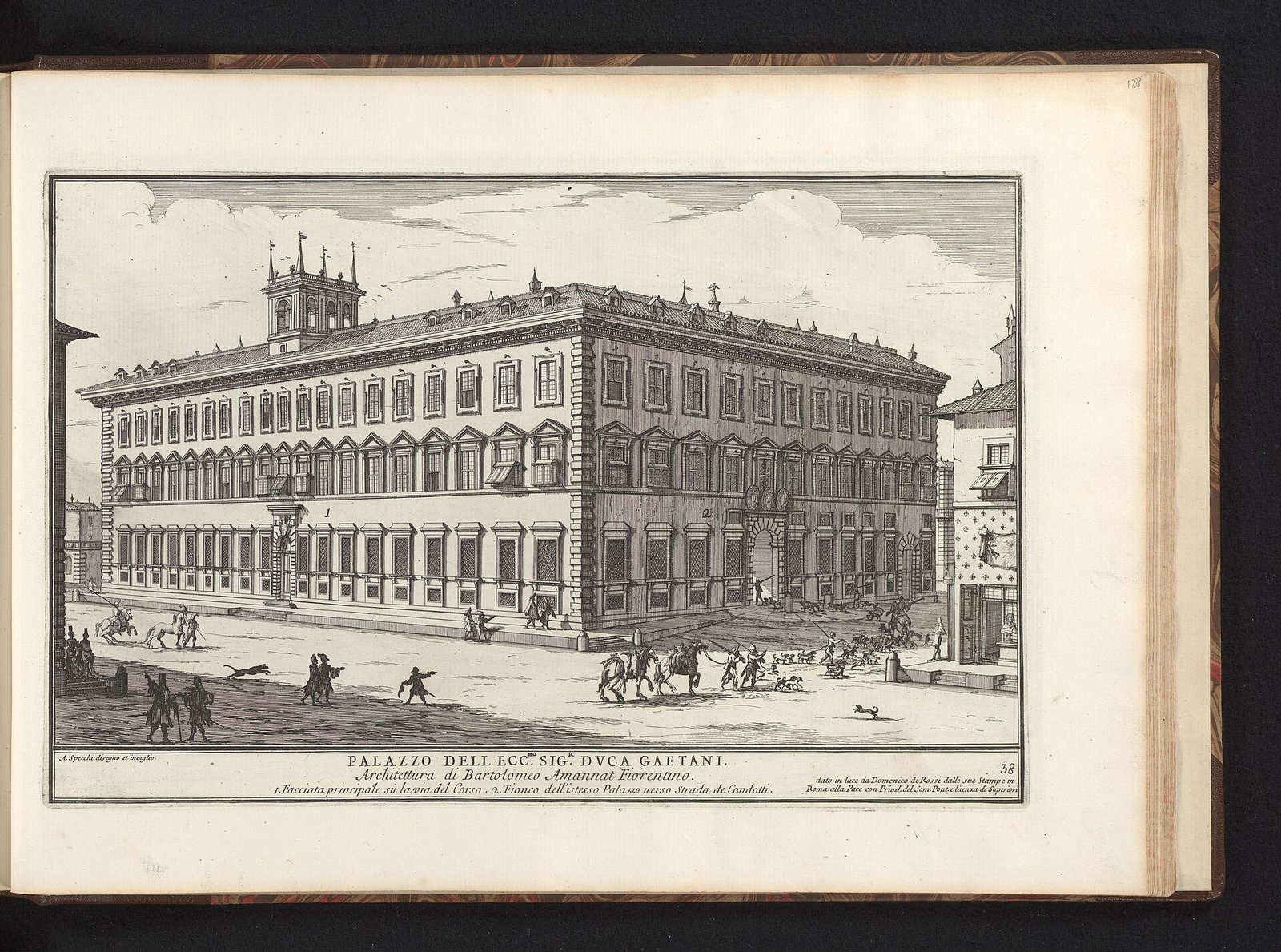
Palazzo Ruspoli stands where Via del Corso meets Largo Goldoni, a step from the crossing with Via dei Condotti and Via della Fontanella di Borghese, in that heart of the Tridente where the three straight streets wanted by the popes fan out from Piazza del Popolo. It is a position we take for granted today, because we associate it with boutiques and strolling, but for centuries it was one of the most coveted in Rome: whoever had a palace here had a view onto the street of triumph, the one that processions followed to enter the city. Building such a long front on this axis was not only a choice about housing, it was a declaration of rank.
This story deserves calm, because Palazzo Ruspoli can't be summed up in a sentence. It belonged to the Rucellai, the Caetani and finally the Ruspoli. It saw top-level architects at work. It hosted music, parties, minor plots and real patronage. And today, in a part of its ground-floor rooms, it has become a space where you look at contemporary art. Few things in Rome hold together so many centuries so naturally.
The reason this palace stays in the mind more than others, perhaps more sumptuous, is precisely its ability not to show off. In a city that in the Baroque pushed the art of astonishing to the extreme, Palazzo Ruspoli chooses a different path, made of restraint and order, and keeps its surprises for the interiors and for a chosen few. It is a building that asks for complicity, not simple admiration, and that reveals itself only to those who want to know its history. That is why I consider it one of the best places to explain what it really means to look at Rome with attention, going beyond the list of the loudest marvels to look for those that are won through knowledge.
Where Exactly Palazzo Ruspoli Is and How to Find Your Way
If you arrive from Piazza del Popolo and take Via del Corso, you walk for a few minutes leaving the two twin churches and the monumental gate behind you, and at a certain point, on the right side relative to your direction of travel, the rhythm of the facades changes. The bourgeois houses give way to a single front, much longer than the others, with an imposing portal and windows aligned with an almost obsessive regularity. You have arrived: that is Palazzo Ruspoli, and the main entrance faces Largo Goldoni, the small square dedicated to the Venetian playwright who spent years of his life in Rome.
It is worth doing a small orientation exercise, because it helps to understand the palace. From Largo Goldoni, if you turn around, you have Via dei Condotti pointing straight toward Trinità dei Monti and the staircase of Piazza di Spagna: it is the axis of luxury shopping, but it is also one of the most elegant urban perspectives in the city. On the other side, a little farther along the Corso, opens Piazza San Lorenzo in Lucina, with its very ancient church and Romanesque bell tower. Palazzo Ruspoli sits exactly between these two poles, and it is no accident: the family who lived in it had its parish right at San Lorenzo in Lucina, and left traces and memorials in that church.
One last practical tip, the kind given by someone who really frequents the area. The palace occupies an entire block, so don't stop at the portal on the Corso thinking you've seen everything: walk around it and you will notice that the side facades tell other things, with other doors, other windows, other levels. The overall mass is remarkable, and only by walking around it do you perceive how much precious land this family managed to secure in the heart of the city.
Why Palazzo Ruspoli Is Called That, and the Names That Came Before
The name it bears today is that of the last great owning family, the Ruspoli, but it would be a mistake to think the palace was born with them. On the contrary: when the Ruspoli acquired it, the building had already existed for over a century and had an important history behind it. Before being Ruspoli, this was the palace of the Rucellai and then of the Caetani, and each of these handovers left a mark on the stones and on the form.
At the origin are the Rucellai, a Florentine family of very great weight, rich merchants and bankers, the same house that in Florence had commissioned from Alberti the facade of Palazzo Rucellai and the completion of Santa Maria Novella. In Rome the Rucellai wanted a residence worthy of their name, and it was for them that the building was conceived in the second half of the 16th century. Then, through inheritance and marriage events that in Rome are the real underlying plot of the history of palaces, the property passed to the Caetani, a very ancient baronial family of Lazio, the one that had given the Church Pope Boniface VIII.
These changes of ownership were not simple real estate sales, but real dynastic affairs in which inheritances, marriages, extinctions of family branches and patrimonial strategies came into play. In Rome a great palace almost always changed hands through these mechanisms, and each new owner inherited not only the walls, but also a part of the history and prestige those walls had accumulated. Reconstructing the Rucellai-Caetani-Ruspoli chain therefore means following the thread of how power and wealth were passed on in the Rome of the ancien régime, with families handing each other the baton of the city's most prestigious places.
Only at a third moment, in the early 18th century, do the Ruspoli come on stage. It is then that the palace takes on the identity that still defines it today, and it is then that it lives its most brilliant season of parties and music. That is why, when I tell you this is the Rucellai-Caetani-Ruspoli palace, I am not showing off erudition: I am recalling that every stone here was thought up, inhabited and transformed by different people, with different tastes, over a very long span of time.
The 16th-Century Birth of the Palace and the Hand of Bartolomeo Ammannati
The oldest and most decisive phase of Palazzo Ruspoli belongs to the second half of the 16th century, and is tied to the name of Bartolomeo Ammannati, one of the protagonists of architecture and sculpture in full Mannerism. Ammannati was Florentine, trained in an environment that had breathed Michelangelo and Sansovino, and in Rome he worked on top-level building sites. That it was the Rucellai, a Florentine family, who called a Florentine architect is not a detail: it is the sign of a patronage that wanted to bring into the heart of Rome a certain Tuscan way of understanding measure and the severity of surfaces.
If you look at the facade on the Corso with an attentive eye, you understand at once that the scenographic splendor the Baroque would bring half a century later was not being sought here. The windows are framed with sobriety, the alignments are rigorous, the game is all proportion and rhythm rather than decoration. It is an architecture that speaks softly, and precisely for this reason, once you begin to read it, it never tires. The palace of the later 16th century is a building designed to last and to impose itself with its mass, not with its ornaments.
Historiography has long debated the attribution to Ammannati, as always happens with Roman buildings that so many generations have worked on. But the substance remains: the late 16th-century frame of the palace belongs to that high architectural culture, and whoever walks along the facade today is looking, beneath the later transformations, at a structure conceived in those years. It makes you think that the slightly surly composure of this front is exactly what its first designers wanted: a palace that has no need to raise its voice.
The 17th and 18th Centuries: How Palazzo Ruspoli Grew Over Time
A Roman palace is almost never built all at once. Palazzo Ruspoli is, like many of its neighbors, the result of additions, completions and embellishments that followed one another over generations. The 16th-century structure provided the layout, but it was the 17th and above all the 18th century that gave it the look and the fame we still know. It is in these two centuries that the palace is enriched with decorative interventions, ceremonial apparatus and that element that has become its emblem, the great staircase.
There are places where time stratifies and others where it overlaps chaotically. Here the feeling is of coherent growth. Each owner added something without entirely erasing what was there before, and this produced an architectural organism that holds together the Mannerist severity of the exteriors with the more theatrical taste of the 17th- and 18th-century interiors. When you enter the part that can be visited, the shift in register compared to the facade is sharp, and it is precisely in that contrast that the history of the building can be read.
The moment of greatest splendor coincides with the arrival of the Ruspoli and with their wish to make the palace a center of the cultural and social life of the city. It is not enough to own a great residence: you have to make it live, fill it with music, guests, paintings, conversation. It is in this 18th-century season that Palazzo Ruspoli becomes something more than a container of rooms: it becomes a place with a reputation, an address that counts.
The Monumental Staircase by Martino Longhi the Younger, the Real Hidden Masterpiece
If there is one thing for which it is worth knowing Palazzo Ruspoli, even just to have it in mind when you pass in front of it, it is its monumental staircase. It is the work of Martino Longhi the Younger, an architect active in Rome in the 17th century, belonging to a true dynasty of builders: his grandfather Martino the Elder and his father Onorio had worked in the city before him, and this family continuity of craft can be felt in the assurance with which the project is resolved. The staircase of Palazzo Ruspoli is considered among the most scenographic in all of Rome, and it is not a brochure claim: it is a judgment that scholars repeat.
The fact that strikes most, and that still impresses me every time I repeat it, is technical before it is aesthetic. It is a staircase of 115 steps, and its fame comes from the fact that each step was reportedly cut from a single block of stone. Not assembled steps, not pieces sewn together: monoliths. Now try to think what it meant, in the 17th century, to procure, transport and put in place 115 blocks of that size, with the means of the time, inside an already built palace. It is an undertaking that speaks of wealth, of ambition and of a precise will to astonish.
But the staircase is not just a record to cite. It is a spatial experience: it climbs guiding the eye, widens and narrows with a studied rhythm, plays with the light that comes down from above and with the perspectives that open at every landing. Longhi the Younger was a master precisely of this kind of scenic solution, able to turn a functional element like a staircase into a piece of architectural theater. Those who have had the luck to climb it on special occasions always say the same thing: that going up becomes a small show, and that you stop halfway just to look around.
There is a point to underline, because it helps to understand the mentality of those who designed and wanted this staircase. In the 17th and 18th centuries, the entrance and the climb toward the piano nobile were the moment when a palace communicated itself to the guest. Before even being received in the rooms, the visitor was prepared by the sequence of spaces, from the atrium to the staircase, in a studied crescendo of effects. Investing so much in a staircase was therefore not an extravagance but a precise choice: it meant entrusting to the first stretch of the route the task of declaring the family's rank. The staircase of Palazzo Ruspoli is proof that its owners knew this grammar of astonishment perfectly and were able to bring it to one of its highest results in the whole city.
The Ruspoli Family and Its Role in the Rome of the Popes
To understand the palace you have to understand the family that gave it its name. The Ruspoli were a house of ancient origins, with roots reaching into Tuscany, and over the 17th and 18th centuries they managed to build for themselves a leading position in Rome, entering the ranks of the aristocracy that counted, the one close to the papal court and able to influence, through marriages and alliances, the balance of the city. In Rome power did not pass only through ecclesiastical offices: it also passed through the ability to keep an open house, to host, to be a point of reference.
The figure who matters most for the history of the palace is Francesco Maria Ruspoli, the great protagonist of the golden season of the early 18th century. It was he who made the palace a center of Roman musical and cultural life, and it was he who tied his name to that of one of the greatest composers of all time. Under him the family obtained recognitions and titles that consecrated its rank, and the residence on the Corso became the visible stage of this rise.
There is something I find fascinating in the great Roman families, and it is their ability to last. While popes followed one another in Rome, balances changed, fortunes went out and lit up, houses like the Ruspoli crossed the centuries adapting, marrying into other families, repositioning themselves. The palace on the Corso is, at bottom, the stone document of this endurance: a building that accompanied the family through its transformations, always remaining recognizable as its address.
The Ruspoli Patronage and Palazzo Ruspoli as a Home of Music
In the Rome of the early 18th century, being a patron was not an accessory luxury: it was a way of exercising power, of signaling one's refinement, of competing with other families on the ground of cultural prestige. Francesco Maria Ruspoli understood this very well, and made his palace one of the places where the Roman music of the time found a home. In the reception rooms performances were held, musicians were welcomed, works were commissioned: the palace pulsed with that artistic life that today we imagine only through the surviving scores.
It should be remembered that in those years in Rome the public opera theater was often viewed with suspicion by the ecclesiastical authorities, and there were periods of bans and restrictions. For this very reason the palaces of the aristocracy became the real centers of musical life: it was in private residences, under the protection of a cardinal or a prince, that cantatas, oratorios and serenades were performed. Palazzo Ruspoli was one of these private sanctuaries of music, and Francesco Maria one of the most generous and active protectors.
Those evenings are easy to imagine: the candles, the instruments being tuned, the guests taking their seats, and the music filling rooms born to astonish. It was not entertainment in the sense we understand it. It was a social rite, a way of saying who you were and whom you kept company with. And the fact that today the palace hosts contemporary art instead of Baroque cantatas does not break this vocation: it only changes its language, keeping the substance of a place that calls to itself the creation of its own time.
Georg Friedrich Händel at Palazzo Ruspoli: The Most Famous Chapter
We come to the name that, when I pronounce it in front of the palace, makes even the distracted passerby look up: Georg Friedrich Händel. The great German composer, still young, stayed in Italy in the early years of the 18th century to complete his training, and in Rome he found in Francesco Maria Ruspoli a fundamental protector. He was a guest of the palace and tied to this residence an important part of his Roman output, the part that would mark the rest of his career.
In Rome, and under the protection of the Ruspoli, Händel composed sacred and secular music designed for the settings he frequented: cantatas and oratorios, the genre that replaced opera where opera could not be staged. These are the years of his Italian training, decisive ones, in which the young composer absorbed the lesson of melodrama and Italian vocality that he would then take with him to England, where he would become one of the greatest. That part of this path went right through the rooms of Palazzo Ruspoli gives these stones a value that goes well beyond architecture.
There is something dizzying, for me, in thinking that a young man destined to write some of the most famous pages of Western music worked and lived here, at this address on the Corso, centuries ago. There is no plaque shouting this link at passersby, and perhaps that is right: the most important things in Rome often don't announce themselves. But if you know this story, looking at the facade of Palazzo Ruspoli is no longer the same thing: you know that behind those windows passed also the youth of Händel.
The Italian stay was for the composer a decisive forge. In Italy he absorbed the sense of melody, the science of the voice, the taste for dramatic contrast that are the soul of melodrama, and made them his own with the rapacious intelligence of the great. When he later left the peninsula to head toward northern Europe and finally England, where he would build his immense fame, he carried this Italian baggage with him, and kept drawing on it all his life. That is why the link between Palazzo Ruspoli and Händel is not a simple local anecdote, but a piece in the formation of one of the geniuses of music of all time: here, under the protection of the Ruspoli, something was being prepared that would go far beyond the borders of Rome.
The Oratorios and Cantatas Composed in the Orbit of the Ruspoli
It is worth dwelling on what the Ruspoli protection really meant, on the musical level. It was not generic patronage: it involved concrete commissions, regular performances, the provision of singers and instrumentalists. In the orbit of Francesco Maria Ruspoli, the young guest composer was able to write a considerable quantity of chamber cantatas, designed to be performed at the evenings in the palace, and compositions of wider scope in the genre of the oratorio, which in Rome enjoyed great success precisely because it got around the bans that hit the theater.
The oratorio, in those years, was a kind of opera disguised as devotion: sacred subjects, but with all the dramatic power and vocal richness of melodrama. In the rooms of a palace like this, an oratorio could become the event of the season, with a select audience and a musical staging of great ambition. The generosity of the Ruspoli allowed a talented young foreigner to measure himself against these means, and the fruits of that Roman season would nourish his art for the rest of his life.
It is striking how closely the history of music and the history of architecture intertwine here. The rooms are not a simple backdrop: they are the instrument with which the patron made creation possible. Without the palace, without its rooms able to host performances and guests, that patronage would not have been the same. That is why talking about Palazzo Ruspoli without talking about music would be like describing a theater while forgetting that plays are performed on its stage.
Palazzo Ruspoli Today: The Fondazione Memmo and Contemporary Art
Let's jump across the centuries and arrive at the present, because this is the reason why today Palazzo Ruspoli can be spoken of as a place partly open to visits and not only as a facade to admire from outside. For some decades, the ground-floor spaces of the palace have been home to the Fondazione Memmo, a cultural institution devoted in particular to contemporary art, which has made these historic rooms a place for exhibitions and research. It is here that the patronage vocation of the building extends down to us, changing language but not function.
I find there is a nice coherence in all this. A palace born to welcome the music and art of its own time continues, three centuries later, to do the same thing with the art of ours. The exhibitions of the Fondazione Memmo bring into these ancient rooms the work of contemporary artists, often invited to engage with the space and the history of the place. It is a dialogue between eras that in Rome is not at all a given, and that here happens with particular naturalness precisely because the container is so loaded with memory.
For those visiting Rome, this means that Palazzo Ruspoli is not just a name on the map or a facade to slow down in front of. In the periods when an exhibition is on, it is possible to cross the threshold and experience the rooms from the inside, coming into contact with that part of the palace that has been opened to the public. It is an opportunity I recommend taking, because it combines two pleasures: that of looking at art of the present and that of being, even for just an hour, inside a piece of Roman history.
Over the years the Fondazione Memmo has built a recognizable profile, made of attention to research and a close dialogue between the invited artists and the space that receives them. It is not a matter of hanging pictures on any wall, but of measuring oneself against a place that has a strong history and a precise personality. Many projects are born precisely from the confrontation with these rooms, with their light, their memory, and this makes each exhibition an event tied in a particular way to the palace. It is an intelligent way to make past and present coexist, avoiding both sterile museumification and indifference to the history of the container.
The Difference Between the Private Palace and the Exhibition Space You Can Visit
Here I must make an honest distinction, the kind a good guide doesn't hide. Palazzo Ruspoli is not, as a whole, a museum open to free visits. It is a building largely private, with its own life, its properties, its spaces not accessible to the public. The famous monumental staircase, for example, is not a tourist route you can take whenever you want: it belongs to the parts not ordinarily open to visitors, and shows itself only on particular occasions.
What is accessible instead, and regularly when an exhibition is on, is the exhibition space of the Fondazione Memmo on the ground floor. That is where the possibility of entering is concentrated, and that is where you should direct your expectations if you are planning a visit. Confusing the two things leads to avoidable disappointments: don't expect to climb the 115 steps or to walk through the noble apartments as you would in a palace-museum, but do expect the real possibility of entering the rooms where the exhibitions are held.
The clarification is necessary because in Rome the line between public and private, between visitable and not visitable, is thinner and more fluid than one thinks. Many palaces we imagine closed open their doors on special days, for cultural initiatives or events. Others that seem accessible are so only in part. Palazzo Ruspoli belongs to this intermediate category, and it is precisely the awareness of this condition that lets you enjoy it at its best, without demanding what it doesn't offer and fully taking what it grants.
The Facade on the Corso and the Stern Language of the Palace
Let's go back outside, onto the street, because the facade of Palazzo Ruspoli deserves a long stop, not the passing glance most people give it. It is a front that lives on horizontality: long, stretched out, marked by rows of windows that repeat with discipline. There is nothing casual in this apparent monotony. It is a calculated monotony, the kind born from the Mannerist wish to impose order and to make the mass of the building be perceived as a compact and powerful block.
Observe the window frames, the string courses that divide the levels, the relationship between voids and solids. Everything contributes to an impression of solidity and control. Where the Roman Baroque, which would burst out soon after, would have bent the surfaces, projected the cornices and filled every corner with movement, here a slightly haughty calm reigns. It is the taste of a patronage that came from another tradition, the Tuscan one, and that in Rome wanted to assert a different idea of beauty, made of proportion rather than exuberance.
Anyone who knows architecture recognizes in this sobriety a conscious choice and by no means an obvious one. Giving up easy ornament, entrusting the effect to proportion alone, requires a sureness of taste that not all patrons possessed. Palazzo Ruspoli belongs to the group of buildings that have the courage of restraint, and this makes it, in our judgment, even more elegant than many facades loaded with decoration.
There is a lesson in this facade worth taking away. Beauty doesn't always need to shout. On a street like Via del Corso, which over the centuries has filled with signs, shop windows and noise, the severity of Palazzo Ruspoli stands as a reminder of another way of being in the world. As you pass in front of it, try to remove everything else mentally: the cars, the lights, the crowd. What remains is a noble wall crossing the centuries, still doing its part with a dignity that needs no explaining.
Palazzo Ruspoli, Via del Corso and the Meaning of the Tridente
You can't truly understand Palazzo Ruspoli without understanding the street it faces. Via del Corso is the central axis of the so-called Tridente, the system of three straight streets that start from Piazza del Popolo and open toward the center: Via del Corso in the middle, Via di Ripetta and Via del Babuino at the sides. It is an urban layout wanted by the popes between the 16th and 17th centuries to give order and monumentality to the northern entrance of Rome, the one through which pilgrims and Grand Tour travelers arrived.
The Corso takes its name from the horse races, the famous palios held there, and for centuries it was the street of the struscio, of carriages, of processions, of the aristocracy's evening promenade. Having a palace on this street meant having a view onto the city's main theater, a natural box from which to look out and be seen. The Rucellai first, the Ruspoli later, consciously chose this scene: their residence had to be on the Corso precisely because the Corso was the place where Rome watched itself go by.
Even today, if you stop in front of the palace and watch the continuous flow of people along the street, you understand that this function has never really changed. The Corso remains a human river, and Palazzo Ruspoli continues to serve as its noble embankment. Walking here thinking about the history of this axis turns a banal stroll among the shops into a path through papal urban planning, and Palazzo Ruspoli becomes one of the keys to reading it.
It is worth remembering that the straightness of the Corso, which seems obvious to us today, was the result of a precise will for order. In a city that had grown for centuries in a twisting way, with irregular alleys and open spaces, having a straight street linking the northern gate to the ancient heart was an urban and symbolic achievement. On that line of force faced the residences of the families that counted, and the position of Palazzo Ruspoli, near the crossing with the streets that climb toward Trinità dei Monti, placed it at one of the most strategic points of the entire axis. Not just any frontage, then, but one of the most coveted of the modern city.
Piazza San Lorenzo in Lucina, the Most Precious Neighbor
A few steps from Palazzo Ruspoli, leaving the Corso, opens one of the most intimate and beloved squares of the center: Piazza San Lorenzo in Lucina. You get there in a moment, and I warmly recommend including it in any itinerary that touches the palace, because the two things light each other up. The church that gives the square its name is one of the oldest in Rome, with origins going back to the first centuries of Christianity, and it keeps a fine Romanesque bell tower that rises above the roofs.
The link between Palazzo Ruspoli and this church is no accident. San Lorenzo in Lucina was the reference church for the area, and the great families of the district left chapels, memorials and burials there. Going in, you find yourself in one of those Roman interiors where the layers of the centuries overlap: the ancient traces, the Baroque interventions, the works of art kept in the chapels. It is the spiritual and communal counterpart of the palace: if the residence on the Corso represented the family's power and worldliness, the church represented its devotional dimension and its presence in the life of the neighborhood.
I love this square because it has kept a human scale that so many parts of the center have lost. The café tables, the fountain, the quiet rhythm of those who stop here: it is a place where Rome breathes more slowly. Stopping here after looking at Palazzo Ruspoli lets you complete the picture, moving from the monumental staircase and the stories of Händel to the everyday dimension of a neighborhood that, behind the windows of the Corso, still keeps its soul.
Largo Goldoni and the Shopping Tridente Around the Palace
The main entrance of Palazzo Ruspoli faces Largo Goldoni, and this small open space is in turn an interesting junction. Here Via del Corso crosses Via dei Condotti and Via della Fontanella di Borghese, at a point where some of the most elegant streets of the city converge. Largo Goldoni is dedicated to Carlo Goldoni, the great reformer of Italian comic theater, and the presence of his name right in front of a palace so tied to the performing arts is a happy coincidence.
From Largo Goldoni starts Via dei Condotti, the luxury shopping street par excellence, which points straight at the staircase of Trinità dei Monti with one of the most photographed perspectives in Rome. It is a street we associate with boutiques today, but it has an ancient history: here is the Caffè Greco, one of the most famous literary cafés in Europe, frequented over the centuries by artists, writers and musicians passing through the city. The whole surroundings of Palazzo Ruspoli, in short, are a concentrate of elegance and cultural memory.
I suggest you experience this area with a double gaze. On one side there is the glittering present of the shop windows, the strolling tourists, the displayed luxury. On the other there is the historical stratification that surfaces everywhere, in the names of the streets, in the facades, in the old cafés. Palazzo Ruspoli stands exactly on this threshold, with its severe mass facing a square named for a playwright, among streets that tell of commerce and culture together. It is a position that sums up, within a few dozen meters, many of the faces of Rome.
How to Visit the Exhibitions and What to Expect from the Interiors
Let's come to the more practical side, the one that interests those who really want to go in. When the Fondazione Memmo has an exhibition on, the exhibition spaces on the ground floor of the palace are open to the public, and the visit focuses on these rooms. You are not entering a museum route that takes you through the noble apartments with furnishings and portraits. You are entering historic rooms converted into a space for contemporary art, where the appeal comes precisely from the meeting between the ancient walls and the works of the present.
The scale of the exhibitions is intimate, never scattered, and for me that is a plus. They are curated shows, often monographic or thematic, designed for a close dialogue with the artists' work. You stay briefly if you look in a hurry, you can stay long if you feel like lingering. It is the kind of place that rewards those who come in with an open mind and without the hurry of the tourist ticking off stops: you come here for a concentrated experience, not to pile up square meters of visit.
My advice is to always check in advance, through the channels of the Fondazione Memmo, if an exhibition is open at that moment and with what hours, because an exhibition space lives on alternating installations, with periods of opening and periods of closure between one show and the next. Showing up without checking means risking closed doors during a change of installation. With a minimum of planning, instead, entry is within everyone's reach and is, in most cases, an experience that doesn't weigh on the travel budget.
Palazzo Ruspoli in the Ecosystem of the Great Palaces of the Corso
Palazzo Ruspoli is not an isolated case: it is part of a true constellation of great aristocratic palaces facing Via del Corso and the adjacent streets. A little farther on is Palazzo Chigi, today the seat of the government. Nearby are Palazzo Doria Pamphilj with its extraordinary gallery, Palazzo Sciarra and other buildings that tell of the power of the great Roman families. Walking along the Corso means, at bottom, leafing through a list of houses that made the history of the city.
Placing Palazzo Ruspoli in this context helps to understand its nature. It was not a one-off, but a luxury participant in a contest of prestige played out on this very street. Every family wanted its palace on the Corso, and every palace had to say something about the rank of whoever lived in it. In this competition, the Ruspoli chose the card of external architectural severity combined with the splendor of the interiors and cultural liveliness, and their monumental staircase was the showpiece with which they stood out.
For the visitor, this geography of palaces is an invitation. Palazzo Ruspoli can be the starting point or a stop on a route that touches the great residences of the center, some turned into fully accessible museums, others left private or semi-private like this one. Building an itinerary that links them lets you understand the Rome of the aristocracy much better than visiting a single building would. And in this itinerary, Palazzo Ruspoli holds a special place precisely because it holds together, at a single address, architecture, music and art.
The Neighborhood Around Palazzo Ruspoli Between Past and Present
Stopping at the palace alone would be a pity, because the urban fabric surrounding it is an integral part of its appeal. We are in the Campo Marzio district, one of the oldest and most layered in Rome, an area that in the classical age was occupied by the great public monuments and that over the centuries filled with churches, palaces and alleys. Every street around here has a history, and many still keep the layout and character of distant eras.
Walking around Palazzo Ruspoli you come across glimpses that deserve a photograph and a pause: small squares, historic workshops, buildings that tell of the daily life of a neighborhood that for centuries was inhabited by the aristocracy and the well-off bourgeoisie. It is a center that, despite the pressure of tourism and luxury commerce, still keeps an impressive density of memory. You only have to raise your eyes above the shop windows to notice how many stories are engraved in the facades.
It is better not to treat Palazzo Ruspoli as an isolated stop to tick off, but as a gateway to a wider walk. Give the neighborhood the time to reveal itself, walk without a precise destination in the surrounding streets, let yourself be surprised. This is how Rome really gets to be known: not by running from one monument to another, but by inhabiting a piece of the city for a few hours and letting its layers speak to you. Palazzo Ruspoli, with its history of families, music and art, is an excellent point from which to begin this slower and more attentive exploration.
Why Palazzo Ruspoli Tells the Story of the Rome of the Great Families
If I had to explain in a few words why Palazzo Ruspoli deserves attention, I would say it is one of the most eloquent documents of the Rome of the great families, that parallel city made of houses, alliances, patronage and power that for centuries coexisted with the Rome of the popes and that of the people. Through this palace runs the story of the Rucellai, the Caetani, the Ruspoli, and with them the story of how the Roman aristocracy built and asserted its identity.
Every element we have met tells a piece of this world. The severe facade speaks of the taste and origin of the first patrons. The monumental staircase speaks of the wish to astonish and of the wealth needed to achieve it. The stories of music and Händel speak of patronage as an instrument of prestige. Today's Fondazione Memmo speaks of how these places can go on living by transforming themselves. It is a story centuries long condensed in a single building.
That is why I tell you it is worth knowing Palazzo Ruspoli even if you can't get in, even if you only look at it from the street. Because once you know its history, that long, composed wall on the Corso stops being a simple building and becomes a key to reading the city. And reading Rome through its palaces, one after another, is perhaps the deepest and most rewarding way to know it.
The 18th-Century Musical Season and the Evenings at Palazzo Ruspoli
It is worth trying to reconstruct with the imagination what the evenings at Palazzo Ruspoli really were in their most brilliant season, that of the first decades of the 18th century. They were not simple concerts in the sense we give the word today, but appointments that interwove music, conversation, display and social strategy. The prince opened his rooms to a select audience, and in those rooms the voices of the singers and the sound of the instruments resounded, while the guests exchanged news, favors and alliances. Music was the center, but a whole world of relationships revolved around it.
The fact that in Rome the public opera theater was repeatedly opposed by the authorities made these private appointments even more precious. It was in the residences of the aristocracy that great music could live freely, under the protection of an important name. Palazzo Ruspoli, in this sense, was not only a place where music was made: it was one of the strongholds in which Roman musical culture found shelter and support, and Francesco Maria Ruspoli one of its most convinced and generous protectors.
Those admitted to these evenings were probably aware of taking part in something rare. Sitting in a room of the palace while a newly composed cantata was performed, perhaps by the young composer who was a guest of the house, meant witnessing the birth of music at the very moment it came to life. It is a dimension we struggle to imagine today, used as we are to infinite reproduction, but which was then the norm for those who frequented these privileged settings: music as an unrepeatable event, tied to a place and a moment.
The Longhi Dynasty and the Art of Building Staircases in Rome
Martino Longhi the Younger is the author of the monumental staircase, and it is worth dwelling on the family he came from, because it tells a lot about how building was done in Rome in the 17th century. The Longhi were a true dynasty of architects: his grandfather Martino the Elder and his father Onorio worked in the city before him, leaving works of note. This continuity of craft, handed down from generation to generation, gave those who had it an assurance and a repertoire of solutions that were refined over time.
Martino the Younger belongs to the season in which Roman architecture loved scenic solutions, perspective effects, the ability to turn functional spaces into occasions for spectacle. A staircase, for an architect of this culture, was not a simple link between floors: it was an opportunity to stage the ascent, to guide the eye, to create wonder. The staircase of Palazzo Ruspoli is one of the most successful examples of this conception, and its fame among the most scenographic in Rome is the recognition of that mastery.
I find it instructive to think that behind an element the visitor might dismiss as purely utilitarian there is a centuries-old tradition of building knowledge and an entire family of specialists. In Rome nothing is ever just what it seems: behind every great achievement there is a network of skills, workshops, craftsmen who handed down techniques and solutions. Longhi's staircase is, in this sense, not only an individual masterpiece, but the ripe fruit of a building culture that had Rome as its great permanent construction site.
The Campo Marzio District and the Ancient Roots of the Place
Palazzo Ruspoli stands in the Campo Marzio district, and this name carries with it a very long history worth recalling. In the Roman age, the Campo Marzio was the great plain outside the political heart of the city, originally devoted to military activities and then gradually filled with public monuments, temples, porticoes and theaters. It was an area of display and leisure, and in the following centuries it turned into one of the most densely inhabited and layered neighborhoods of Rome.
Walking here means moving over overlapping layers of history. Beneath the streets and palaces we see today, traces of antiquity are preserved, and the very layout of some streets follows alignments remote in time. When the Rucellai and then the Ruspoli built and inhabited their palace, they slotted into a fabric already rich with centuries of history, adding a new layer to a place that had already seen very many. It is this density that makes the center of Rome unique in the world.
For those visiting the palace, keeping this time depth in mind changes the gaze. You are not just looking at a building of the 16th and 18th centuries, but at a point in a continuum that starts from antiquity and reaches us. The Campo Marzio district is one of those places where history is not an episode but a permanent condition, and Palazzo Ruspoli is one of its most eloquent chapters. Strolling around the building with this awareness turns a visit into a journey through time 2000 years long.
How to Fit Palazzo Ruspoli into a Day in Rome
Those short on time who want to include Palazzo Ruspoli in a day in Rome can build a very natural itinerary, because the position of the palace places it at the center of one of the richest areas of the center. Starting from Piazza del Popolo, you can walk Via del Corso admiring the facades, stop in front of the palace, detour toward Piazza San Lorenzo in Lucina for a quieter pause, and then climb back toward Via dei Condotti and the staircase of Piazza di Spagna. It is a route of a few hundred meters that concentrates an extraordinary amount of beauty.
If at that moment the Fondazione Memmo has an exhibition open, the ideal is to plan the entry into the palace as the central moment of the walk, perhaps in the hours when the light on the Corso is most beautiful for photography. The visit to the exhibition is intimate and doesn't take much time, which makes it perfect as a cultural interlude in a day devoted to the Tridente. This way you combine the pleasure of an outdoor walk with that of an indoor artistic experience, without weighing down the rhythm of the day.
For those who love walking, it is better not to stop at the Corso and to let yourself be tempted by the side alleys, which hide churches, little squares and glimpses of great appeal. The area around Palazzo Ruspoli rewards those who get lost, who deviate from the main routes, who have the patience to raise their eyes and look beyond the shop windows. Building the day around this palace means having a solid anchor point from which to set out to explore one of the most authentic hearts of Rome, with the freedom to follow curiosity wherever it leads.
Palazzo Ruspoli and the Memory of Carlo Goldoni
The main entrance of the palace faces Largo Goldoni, named for Carlo Goldoni, the great Venetian playwright who reformed Italian comic theater by bringing to the stage the truth of characters and daily life. The coincidence between this name and a palace so tied to the performing arts, to music and to patronage, is more eloquent than it seems at first sight. It is as if the place kept, even in its place names, a vocation for theater in the widest sense.
Goldoni spent years of his life in Rome, and the city remembered him by dedicating to him this open space right in the heart of the center, at a point of heavy traffic. Those who cross Largo Goldoni today rarely pause on the meaning of that name, but for those who know the history of Italian theater it is a small homage worth picking up. And finding it right in front of Palazzo Ruspoli adds a piece to that network of cultural references that makes this portion of the city so dense.
I love these interweavings because they show how in Rome everything is connected, often in ways that escape a distracted glance. A palace that hosted music and patronage faces a square dedicated to a reformer of the theater, a step from a street that leads to a famous literary café and to one of the most famous staircases in the world. It is no accident, it is the very dense web of meanings that the city has accumulated over the centuries, and that those who know how to read can savor step by step. Largo Goldoni, in front of Palazzo Ruspoli, is one of the knots of this web.
A Curiosity About Palazzo Ruspoli
The curiosity I love to tell concerns the staircase, and specifically that number, 115 steps, each cut from a single block of stone. It is a detail that seems made on purpose to strike the imagination, and indeed it has always fed the fame of the palace. But the curious thing is that this technical record was not born of a gratuitous whim: it was a precise way of communicating power. Procuring 115 monoliths of that size, transporting them and putting them in place inside an already built palace meant demonstrating, with the stone itself, that you could afford what almost no one else could.
Then there is an aspect I find fascinating, and it is the relationship between this hidden luxury and the severity of the outer facade. Outside, the palace looks sober, almost austere. Inside, it conceals one of the most scenographic staircases in Rome. It is as if the family had wanted to keep for itself, for its guests and for those admitted to climb, the most beautiful spectacle, showing the outside world only a noble composure. This gap between public appearance and private wealth is, in its own way, very Roman.
Whoever climbed that staircase for the first time, perhaps invited to a musical evening in the 18th century, felt in all probability exactly the wonder that the Ruspoli wanted to arouse. Passing from a crowded street and a severe facade to that sweep of monolithic steps must have been a theatrical experience, a twist carefully designed. The curiosity of the number, in short, is not an encyclopedia fact: it is the trace of a precise strategy of effect.
Something Nobody Tells You About Palazzo Ruspoli
What is rarely said is that Palazzo Ruspoli, as the visitor meets it today, is a building deeply divided between what can be seen and what remains invisible. Almost everyone who hears about it thinks of a place to visit, and imagines being able to climb the famous staircase and walk through the noble apartments. In reality the accessible part is only that contained one, the exhibition space on the ground floor, while the great organism of the palace, with its staircase and its historic rooms, stays for the most part beyond the reach of the public.
This often creates a small misunderstanding, and it is exactly what no hurried guide explains to you. Those who arrive at the portal expecting a palace-museum can be thrown to discover that the entrance leads to a contemporary art exhibition and not to a route through frescoed halls. It is not a flaw of the palace: it is its real nature, that of a largely private building that opens only a portion of itself to cultural use.
Knowing this in advance completely changes the experience. Instead of looking for something that isn't there and being disappointed, you arrive with the right expectations: entering an intimate and precious space, enjoying the meeting between the ancient walls and the art of the present, and keeping for the street, for the look from outside, the contemplation of the historic architecture. It is good to know, because it turns a possible frustration into an aware and rewarding visit.
The Advice I Give You for Visiting Palazzo Ruspoli
The main advice is simple but makes the difference: before going, check if an exhibition of the Fondazione Memmo is open at that moment. The exhibition space is not always accessible, because between one installation and the next there are periods of closure, and showing up at random means risking finding the doors shut. A quick check ahead of time spares you a disappointment and lets you plan the visit at the right moment.
The second piece of advice concerns how to experience the area. Don't treat Palazzo Ruspoli as a stop on its own, but place it in a wider walk that touches Piazza San Lorenzo in Lucina, Largo Goldoni, Via dei Condotti and perhaps pushes on toward the rest of the Tridente. The palace gives its best when it is read within its urban context, as part of a fabric of streets and squares that multiply its meaning. Give yourself the time to walk slowly and to look up.
The third suggestion is of a mental order. Arrive informed. Knowing about Longhi's staircase, Händel's stay, the patronage of the Ruspoli completely transforms what you see, even when what you see is only a facade and an exhibition on the ground floor. In Rome knowledge is the lens that makes the invisible visible: in front of Palazzo Ruspoli, whoever knows its history looks at a much richer building than whoever passes without knowing anything. The most precious advice, then, is exactly this: prepare, because here knowledge is half of the experience.
Another Well-Known Fact, Yet Rarely Mentioned
A fact that all scholars know, but that curiously rarely enters the common account, is the Florentine consistency of the palace's origins. It was the Rucellai, a Florentine family, who promoted its construction, and it was a Florentine architect, Bartolomeo Ammannati, who left his imprint on the 16th-century layout. This Tuscan matrix explains many things about the severity of the facade and its language, so different from the exuberance that the Roman Baroque would bring soon after.
It is a well-known fact among those who study Roman architecture, and yet little valued in the tourist account, which tends to flatten everything onto the name of the Ruspoli and the staircase. But without this Florentine origin, without the architectural culture that the Rucellai brought with them, the palace would not look as it does. The Mannerist composure of the facade is not an accident: it is the sign of a precise provenance and a precise taste, that of a family who in Rome wanted to assert its identity also through the style of its building.
I find that remembering this gives depth to the reading of the palace. We are not looking only at the residence of a Roman family, but at the result of a meeting between traditions, between the Florence of banker-patrons and the Rome of the popes. This interweaving of cultures is one of the most fascinating traits of the building, and it is a pity that it is so often neglected in favor of the more spectacular anecdotes. The truth is that the spectacle of the staircase rests on Florentine foundations, and knowing them makes everything richer.
The Right Photo to Take at Palazzo Ruspoli
The photo I recommend to anyone who wants to take away a real memory is not the close-up of the portal, as many would instinctively do, but the shot that catches the length of the facade on the Corso in perspective. Stand at one side, at the end of the front, and let the row of windows run toward the vanishing point: this is how you render that severe and powerful horizontality that is the true hallmark of the building. A frontal photo flattens. A photo in perspective gives back the mass and the rhythm of the palace.
The best light is that of the early morning hours or late afternoon, when the raking sun strokes the facade from the side and brings out the relief of the frames and the string courses. In the middle hours, with full vertical light, the front tends to go dull and become flat. If you can choose the moment, aim for the golden hours: the same facade completely changes character, and from severe becomes almost warm.
Then there is a less obvious but very evocative photo, the one that frames the palace together with a fragment of its context: the corner of Largo Goldoni, the view that slides from there along Via dei Condotti toward Trinità dei Monti, or the pairing with the sign of one of the historic cafés. These are images that tell not only the building but its place in the city, and for me they are worth more than a thousand close-ups. The right photo, at bottom, is the one that gives back not a wall, but a story and a place.
Some Important Events That Happened Here in History
Among the events that have marked the history of this place, the most famous is without doubt the stay of Georg Friedrich Händel in the early years of the 18th century, under the protection of Francesco Maria Ruspoli. In that period the young composer worked and lived in close relationship with the palace, composing in the orbit of his patron cantatas and oratorios that would mark his Italian training. It is the most important cultural event tied to these walls, the one that projects them into the history of European music.
A second great event, more spread out in time but just as significant, is the construction of the monumental staircase by Martino Longhi the Younger over the course of the 17th century. Not a point-in-time episode, but an undertaking that gave the palace its most famous element and that inscribed it among the most scenographic architectures of the city. Every time this building is spoken of, that staircase comes back, and it is right to consider its construction one of the decisive events of its history.
The third event, the closest to us, is the transformation of a part of the palace into a space for contemporary art with the settling in of the Fondazione Memmo. It is an event of recent history, but no less important, because it has reopened the building to a public cultural function, extending to our days that vocation to patronage and art which had been the Ruspoli's. In this sense, the three great moments, Händel's stay, Longhi's staircase and the Fondazione Memmo, together draw the whole arc of the palace's history.
Who Passed Through Palazzo Ruspoli
The name that comes first, when you think of who passed through here, is that of Georg Friedrich Händel, guest of the palace in his Italian season and deeply tied to Francesco Maria Ruspoli, the patron who protected him and allowed him to compose. It is the most illustrious passage, the one that alone would be enough to give these walls a place in the history of European culture. Imagining the young composer moving through these rooms gives the palace an extraordinary human and artistic dimension.
But Händel was not the only one to pass through Palazzo Ruspoli. In the orbit of the Ruspoli patronage there gravitated musicians, singers, instrumentalists, poets and artists who animated the evenings and the cultural projects of the family. A palace conceived like this was a meeting place, a point where the creativity of the time found commissions and an audience. Around the patron prince a small court of talents was built, and the rooms of the palace were their stage.
Today, in a certain sense, protagonists of culture continue to pass through here, even if of another kind: the contemporary artists invited by the Fondazione Memmo to exhibit and to engage with the space, the curators, the visitors who come in to look at the art of the present inside a container loaded with history. It is a continuity that moves you. Those who have passed through Palazzo Ruspoli, from the young Händel to the artists of today, are united by a thin but tenacious thread: the vocation of this place to welcome the art of its own time, century after century, without ever stopping.
Quick Questions About Palazzo Ruspoli
Where is Palazzo Ruspoli
Palazzo Ruspoli is on Via del Corso, at the point where the street meets Largo Goldoni, a step from the crossing with Via dei Condotti and Via della Fontanella di Borghese. Coming from Piazza del Popolo you find it on the right side: it is the single front much longer than the others, with an imposing portal. The main entrance faces Largo Goldoni and the palace occupies an entire block in the Campo Marzio district.
Can you visit the inside of Palazzo Ruspoli
Only in part. Palazzo Ruspoli is a largely private building and is not a museum open to free visits. What you can see, when an exhibition is on, is the exhibition space of the Fondazione Memmo on the ground floor, devoted to contemporary art. The noble apartments are not part of the route. Arrive knowing this, so you don't expect a palace-museum with frescoed halls.
Can you climb the monumental staircase of Palazzo Ruspoli
No, not whenever you want. The staircase by Martino Longhi the Younger, with its 115 steps that tradition holds were each cut from a single block of stone, is in the parts of the palace not ordinarily open to visitors and shows itself only on particular occasions. It is considered among the most scenographic in Rome, but those who enter for a Fondazione Memmo exhibition stay on the ground floor and do not walk it.
When is the Fondazione Memmo space open
The space is open to the public when the Fondazione Memmo has an exhibition on. Between one installation and the next there are periods of closure, so showing up at random means risking finding the doors closed. Before going, check on the Fondazione Memmo channels if an exhibition is open and with what hours. With this minimum of planning, entry is within everyone's reach.
How much time do you need to visit Palazzo Ruspoli
Not much: the exhibitions on the ground floor are intimate in scale and don't take long, unless you want to linger over the works. That is why they work well as an indoor interlude in a day devoted to the Tridente. Add a few minutes to look from outside at the long facade on the Corso, best in the early morning or late afternoon, when the raking light brings out the frames and string courses.
What is there to see near Palazzo Ruspoli
A few steps away, leaving the Corso, is Piazza San Lorenzo in Lucina, with one of the oldest churches in Rome and its Romanesque bell tower. From Largo Goldoni starts Via dei Condotti, where the Caffè Greco is, and at the end you see the staircase of Trinità dei Monti. A simple route starts from Piazza del Popolo, goes down Via del Corso to the palace and climbs back toward Piazza di Spagna.
Article written by the editorial team of TourLeaderPro, contact them for Private/Corporate/V.I.P. Tours and Experiences.
Planning a trip to Rome? The English-language guides to visiting the city are on ItalyPlanner.com.