Santa Severa Beach
In short. Santa Severa Beach occupies the shoreline of the hamlet of Santa Severa, in the municipality of Santa Marinella, province of Rome, along State Road 1 Via Aurelia: the road reference for the Castle, which stands directly on the sand, is…
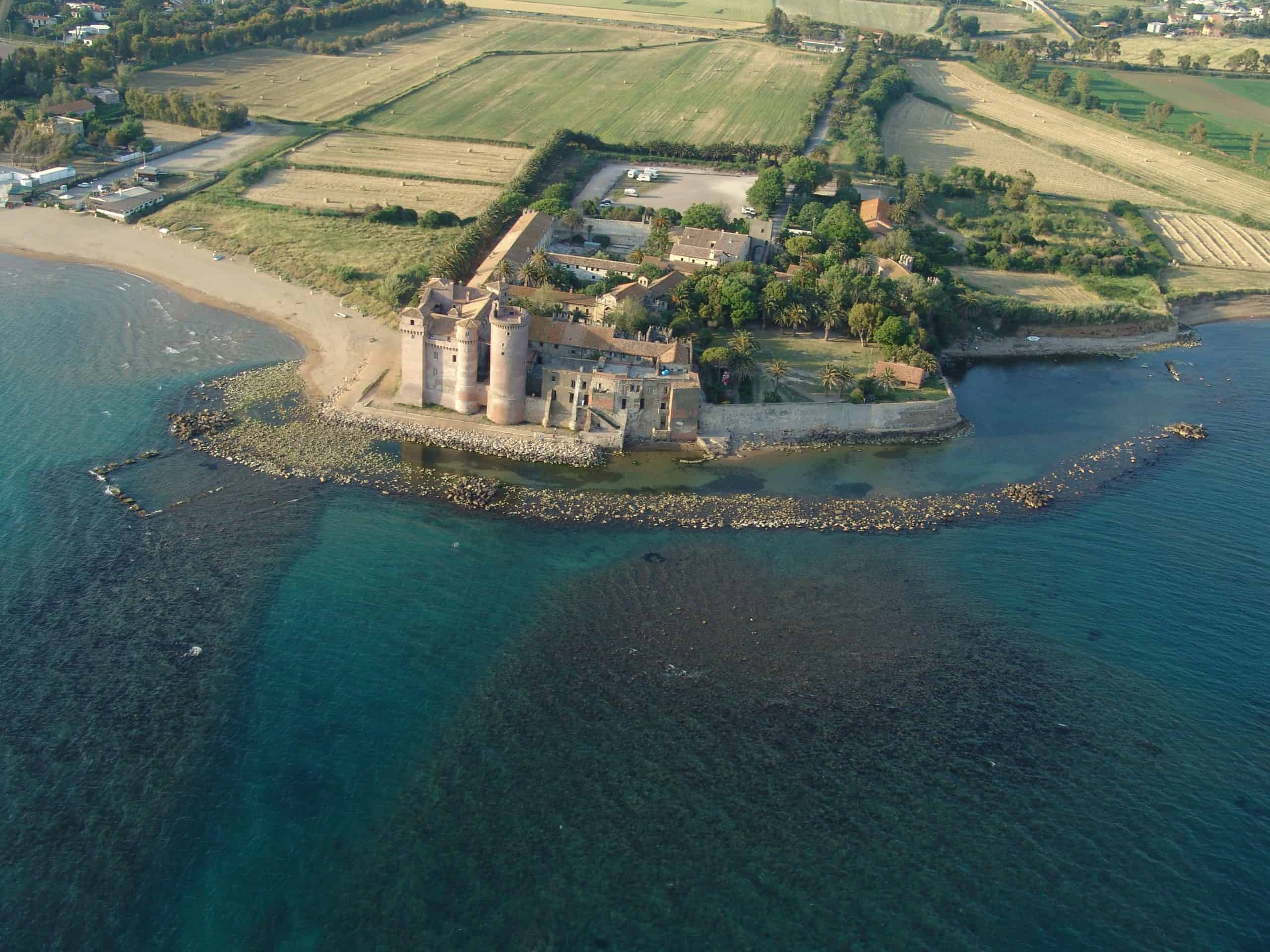
Santa Severa Beach occupies the shoreline of the hamlet of Santa Severa, in the municipality of Santa Marinella, province of Rome, along State Road 1 Via Aurelia: the road reference for the Castle, which stands directly on the sand, is SS1 Via Aurelia km 52,600, 00058 Santa Marinella (RM). By car from Rome you leave the A12 Roma Civitavecchia at the Santa Severa Santa Marinella exit, then follow the Aurelia. By train you get off at the Santa Severa station, on the Tyrrhenian line served by the regional trains of the Roma Termini Civitavecchia route, and from the station square you reach the sea on foot in a few minutes. The beach is free of charge along its whole length in the stretches not under concession. The ticket for the museum complex of Santa Severa Castle, according to the price list published on the official website, is 4,00 euros full price and 3,00 euros reduced, with the Saracen Tower at 2,00 euros extra. Minors under 18 accompanied by a paying adult get in free, and whoever shows the ticket gets three hours of free parking. The complex's hours change four times a year: from September 1 to October 31, Tuesday to Friday from 9:00 to 18:00, Saturdays, Sundays and holidays from 10:00 to 19:00. From November 1 to March 31, Tuesday to Friday from 9:00 to 16:00 and on weekends from 10:00 to 17:00. From April 1 to June 30 as in autumn. From July 1 to August 31, Tuesday to Sunday from 15:00 to midnight. Closed on Mondays. For the hostel inside, bookings go through the number 06 51681785 and the dedicated email address shown on the Castle's website. It's always a good idea to recheck fares and hours on the official website before leaving, because the seasonal calendar shifts.
Those who want to place this stretch of coast within a wider tour will find the context on the page of Santa Severa Castle and on the one for the nearby Santa Marinella Beach.

Where Santa Severa Beach is and how to get there
Santa Severa is the only hamlet of Santa Marinella and is also its most frequented seaside center. It stretches along Via Aurelia, the ancient consular road opened in the 3rd century BC toward coastal Etruria, about eight kilometers south of the municipal seat and about 50 kilometers north of Rome, at the southern end of the Lazio maremma and at the foot of the Tolfa Mountains. The name comes from the martyr Severa, venerated here and killed, according to tradition, in the 2nd century. She is not a saint for the tourist sign, she is the name the local community has carried for more than a thousand years.
The inhabited part of the hamlet measures roughly three kilometers. The southern boundary is the medieval castle, the northern one is the locality of Grottini, which takes its name from the rocky coast below. In between runs the sand, interrupted by a few groins and some concessions.
By car to Santa Severa Beach
The shoreline is skirted to the north by State Road 1 Via Aurelia and is a short distance from the Santa Severa Santa Marinella exit of the A12 Roma Civitavecchia motorway. From north Rome the motorway route is the fastest, but the road that gives you something is the old Aurelia, with the signs that name Pyrgi and the fields that run down toward the sea. The main parking lot is the one right by the castle, paid in the warm season: with the museum ticket you get three free hours back, and that changes the cost of a whole day more than it seems. On July and August weekends the spots run out early: whoever arrives after 10:00 in the morning settles for the inner streets.
By train to Santa Severa Beach
The hamlet has a station on the Tyrrhenian railway, in the stretch between Marina di Cerveteri and Santa Marinella. It is served by the regional trains of the Roma Civitavecchia route, which leave from Termini, Ostiense, Trastevere and San Pietro: times and stops are checked on the Trenitalia website, because not all runs stop at Santa Severa. From the station square you reach the sea on foot. It is the solution I recommend to anyone coming from Rome for the day, because it removes the parking problem and lets you have a drink in the evening without driving.
The streets of the hamlet
A detail that Romans miss and children enjoy: the streets of Santa Severa are organized in themed families. There is the group of plants (via delle Rose, via degli Oleandri), the one of civilizations and historical houses (via dei Normanni, via degli Orsini, via dei Pelasgi), the one of historical figures (via Giovanni Falcone) and the one of rivers (via Tevere, via Isonzo, via Tagliamento). It's not a whim: it is the sign of a development planned on paper, grown in successive blocks. When you get lost among the little villas, the name of the street tells you which decade the neighborhood you are crossing belongs to.
What kind of beach Santa Severa Beach really is
It has to be said right away, because it is the first thing that throws off anyone arriving from the pale beaches of Versilia or Circeo: the sand here is dark. Iron gray, almost black when wet, fine and heavy. It is not dirt and it is not ground-up algae: it is the mineral composition of the shoreline, fed by the volcanic materials that watercourses have carried for millennia from the inland hills toward the Tyrrhenian. The coastal strip between Ladispoli and Santa Marinella shares the same character, and Santa Severa is its most photogenic stretch because the dark sand serves as a backdrop to the pale travertine of the castle.
The dark sand of Santa Severa Beach
The sand heats up much more than pale siliceous sands. In August, at two in the afternoon, walking barefoot from the water's edge to the umbrella is a serious physical test: flip-flops are a must, especially with children. On the other hand, the same property makes the beach very pleasant in May and September, when the sun is low and the sand holds its heat until evening. Those who have read the old guides with the expression black sands think of a lava beach: it is not that phenomenon, it is a shoreline of iron-bearing sands. If you run a fridge magnet over it you see the dark grains stick to it, and it's a game that keeps your kids busy for a good half hour.
I Grottini, the northern boundary
The locality of Grottini closes the hamlet to the north and takes its name from the rocky coast that supports it. It is the least sandy and wildest stretch, with low rocks, pools and small coves: it is not convenient for families with strollers, it is excellent for anyone who brings a mask. The seabed is rougher and more interesting, with submerged rocks a few meters from shore. It is frequented mostly by residents, and you can tell.
The stretch in front of Santa Severa Castle
The heart of the shoreline is the half-moon of sand that opens in front of the fortress. Here the sea slopes gently, the bottom stays shallow for quite a few meters and the current is normally weak. It is the most crowded spot on the whole coast between Ladispoli and Civitavecchia on July weekends, and there is a precise reason: you swim looking at an eleventh-century castle resting on Roman polygonal walls. In Italy the places where that happens can be counted on the fingers of one hand.
Free beaches and beach clubs on Santa Severa Beach
Santa Severa Beach alternates free stretches and beach clubs under concession. The free stretches are wide and extend mostly toward the north. The beach clubs offer rental of umbrellas and loungers, showers, a bar and in some cases a lifeguard service. Prices change from year to year and by day of the week, so you ask the operator. A rule of thumb that applies everywhere on this shoreline: on the free beaches the lifeguard service is not guaranteed, and with a rough libeccio sea the backwash on the dark shoreline becomes annoying. The municipal bathing ordinances set each year the start and end of the season, the obligations of the concessions and the bans: the Municipality of Santa Marinella publishes them on its institutional website.
The sea and water quality
The bathing waters of the Santa Marinella shoreline are monitored by Arpa Lazio, which periodically samples the collection points along the coast and publishes the official classifications. The readings of recent years place the large part of the points in this stretch in the highest class. The Arpa Lazio portal and the Ministry of Health water portal report the updated figure point by point: it is the source to consult before a beach day, far more reliable than any newspaper ranking.
Santa Severa Castle, the highlight of Santa Severa Beach
No beach in Lazio has a monument like this resting on top of it. The Santa Severa Castle complex is a layered organism that starts in the Bronze Age and reaches today, and since April 2017 the Lazio Region has kept it permanently open to the public with a formula that combines museum, hostel, event spaces and dining. The museum ticket, according to the official price list, gives access to Piazza della Rocca, the early Christian church, the Sala del Nostromo and the Sala Pyrgi and the Castle Museum. The Baptistery and the Saracen Tower have a separate fare. Entry to the outer walls, the courtyards and the church on Sunday openings is free: you can stroll through the village without spending anything, and that is the way most people experience it.
The Museum of the Sea and Ancient Navigation
Founded in 1993 and completely renovated in 2016, it occupies seven rooms with more than 100 finds. The thread is the underwater archaeology of the shoreline between Alsium and Centumcellae, that is between today's Ladispoli and Civitavecchia, with a chapter dedicated to the port of Pyrgi. The display includes full-scale reconstructions of settings and shipboard instruments, developed by the Centro Studi marittimi together with Italian and European universities. In 2005 it received the regional quality mark, and over the years it has ended up in the educational programs of public television. For those coming from the beach it is the right museum: you step out of the water and go in to see how those who sailed that water 2,500 years ago navigated. Overrated, in our view, is the scenographic part. Hugely underrated is the section on amphorae, which tells the story of Mediterranean trade better than 10 text panels.
The Castle Museum
It occupies 800 square meters spread over three levels inside the fourteenth-century Rocca, surrounded by the moat and the towers. The route goes from the Etruscan age to today with panels, video projections and three-dimensional reconstructions. Among the pieces on display: the reconstruction of the medieval kitchen and dining hall with original remains, the seal of Pietro Romano Bonaventura, historical clothing reconstructed philologically, and the materials from the medieval cemetery studied by the University of Tor Vergata. You can visit the Rocca's inner chapel, a room with frescoes from the time of Urban VIII and the two cylindrical corner towers on the southern side. The digital part includes augmented reality, multitouch monitors, interactive carpets and virtual reality headsets that reconstruct the Etruscan port, the Phoenician ships and the Roman structures.
The Saracen Tower
It is the oldest part of the complex: the core dates to the 9th century, with remodelings between the sixteenth and seventeenth centuries. Built to control the shoreline and to spot Saracen vessels, a function it served mainly between the 16th and 18th centuries, it is a cylindrical tower with Renaissance decorative elements, connected to the castle by a drawbridge set at a height of 20 meters. Inside, three superimposed circular rooms lead to the top terrace, the parade ground, from which you overlook the whole shoreline. The current name is recent: until the restoration of the 1960s it was simply called Torre del Castello. The climb is not suited to anyone who suffers from vertigo, and the extra ticket of 2,00 euros is the best investment of the whole visit.
The early Christian church and the Baptistery
It is the oldest place of worship in the complex, datable to around the mid 5th century and in all likelihood dedicated to the martyr Severa. It was identified in 2007 by surveys of the archaeological superintendency of southern Etruria carried out together with the Museum of the Sea and the local archaeological groups: the walls of the apse surfaced just 10 centimeters below the modern floor level. The hall measured about 11 meters wide and was divided into three naves by masonry columns. The central apse, three and a half meters wide, preserves traces of fresco. The church was built over a Roman villa, of which fragments of floor remain, and the baptismal font carved out of a pre-existing bath room. The excavations yielded ceramics, glass, metals and food remains of the 13th and 14th centuries. The building was abandoned and partly demolished at the end of the 1300s, perhaps after a fire. The cult of Severa is attested from at least the 9th century and her feast falls on June 5.
The village, the church of Santa Maria Assunta and the hostel
Inside the walls you walk in a small village with the square, the parish church of Santa Maria Assunta, the houses and the spaces now used for services. The Castle hostel offers 42 beds in 14 rooms, nine of them with a sea view, with rooms of one to four beds. Each room has air conditioning, heating, linens, towels and a small fridge. There is a common area with a fully equipped kitchen and a relaxation room, and parking is free for guests. Check-in from 15:00 to 22:30, check-out by 10:30, non-smoking facility, animals not allowed. The reception answers from 7:00 to 23:00 at the number 06 51681785. Those who sleep in the hostel pay 6 euros for the castle ticket. Sleeping inside the walls and going down to the beach at dawn, before anyone arrives, is one of the best experiences the Lazio coast can offer.
Antiquarium, Territory Museum and Pyrgi excavations
The official website notes that the Pyrgi Antiquarium is closed for renovation work and that the Territory Museum and access to the excavations are also not currently visitable in the ordinary format. It's good to get information at the ticket office or on the website before setting out with that goal in mind, because the picture changes as the work site advances and with the calendars of special guided visits.

Pyrgi, the Etruscan port under Santa Severa Beach
Under the umbrellas lies one of the most important archaeological sites in Etruria. In the same place as the castle, at the southern edge of the hamlet, there was already in the Bronze Age a coastal village, documented by ceramic finds. On that settlement grew Pyrgi, the Etruscan town that became the main port of Caere, today's Cerveteri, 13 kilometers inland, and one of the largest seaports of all Etruria. The name is Greek and means towers. Environmental conditions were favorable: the site hosted at least two distinct harbor basins, the city's fleet and a large sacred complex. Greek and Phoenician merchants arrived there regularly, and Virgil mentions Pyrgi in the Aeneid among the Etruscan communities allied with Aeneas.
The monumental sanctuary and temples A and B
The excavations have brought to light the remains of a large sanctuary that rose a few steps from the shore, with two temples conventionally labeled A and B. Temple B is the older one, datable to the end of the 6th century BC. Temple A, larger and more imposing, belongs to the first half of the 5th century BC. The patron deity is the Etruscan goddess Uni, identified with the Phoenician Astarte, flanked by Thesan, the goddess of dawn whom the Greek world knew as Leukothea. A sanctuary dedicated to a Mediterranean female deity, built by an Etruscan city, with inscriptions in Phoenician: Pyrgi is the clearest proof that Etruria was never a closed world.
The southern area and the cults of Cavatha and Suri
The most recent campaigns have identified, south of the monumental sanctuary, a second sacred area of a completely different character, dedicated to chthonic cults linked to the deities Cavatha and Suri. It is not a detail for specialists: it means that in the same port an official and solemn cult, directed at the sea and at trade, lived alongside an underground, oracular cult tied to the world of the dead and to healing. The research is still open and the excavations continue.
The gold tablets of Pyrgi
On July 8, 1964, during an excavation campaign directed by Massimo Pallottino, three gold tablets about 20 centimeters high came out, datable between the end of the 6th and the beginning of the 5th century BC. They carry a sacred text in Phoenician and in Etruscan and document the consecration of temple B to the goddess Uni Astarte at the will of Thefarie Velianas, supreme magistrate of Caere. The Phoenician text insists on the recognition that the goddess would have granted him for his position at the top of the city. The Etruscan version privileges the ritual aspects of the cult. It is the most important bilingual document that Etruscan archaeology has ever produced, and for studies of the Etruscan language it has played the same role the Rosetta stone played for Egyptian, with the difference that Etruscan remains largely undeciphered to this day. The tablets are on display at the National Etruscan Museum of Villa Giulia in Rome.
The Seven against Thebes and Villa Giulia
The other find that made Pyrgi famous is the group of fragments of a high relief in painted terracotta with figures in relief of mythological subject, the myth of the Seven Against Thebes, which adorned the rear pediment of the more recent temple. The reassembly is at the Villa Giulia Museum. Anyone who has seen the beach and then enters that room understands something books tell badly: Etruscan terracotta sculpture was violent, theatrical, painted in full colors, conceived to be read from below by those arriving from the sea. If the plan includes a day at Santa Severa, a visit to Villa Giulia should be put in the same trip, even if days apart.
The Roman colony of 264 BC and the polygonal walls
On the site of the ancient Etruscan port a Roman maritime colony was established in 264 BC, fortified by imposing polygonal walls, the ones tradition calls Cyclopean, still partly preserved and partly incorporated into the structures of the castle. Walking along the southern side of the complex you can make out the enormous blocks of the Republican wall beneath the medieval masonry: three eras stacked in a few meters of elevation. In the first half of the third century the Etruscan settlement became the seat of a Roman castrum, and from then on the continuity of settlement has never been interrupted.
The natural monument of Pyrgi
The area is also protected on the environmental side: the Pyrgi natural monument extends over 67.17 hectares in the territory of Santa Marinella, is managed by the Lazio Region and was established by decree of the president of the Lazio Region of September 29, 2017, number 163. The double protection, archaeological and naturalistic, is the reason this piece of coast was not built on.
The history of the hamlet: from the Middle Ages to the seaside borgata
In the early Middle Ages, on the ruins of the Roman town, a small village developed, flanked by an 11th-century castle overlooking the sea. The territory was donated to the Abbey of Farfa in 1068 and then passed to the Benedictine monks. In the 1200s the great Roman families came into play. In 1482 Pope Sixtus IV granted the complex to the Hospital Order of Santo Spirito, which held it for five centuries, until 1980, and saw to important restorations. After Italian unification, in 1870, the property passed to the Kingdom. In 1950 the castle entered the territory of the municipality of Santa Marinella, and from 1961 the Lazio Region began the restoration programs that would lead to the current situation.
The restoration ordered by the Pio Istituto di Santo Spirito
In the second half of the 1960s the Pio Istituto di Santo Spirito, then owner of the castle, ordered its renovation. The works were directed by Riccardo Medici and were completed in 1970. It was on that occasion that the main tower took the name Torre Saracena by which everyone knows it today, and that the complex took on the appearance the visitor finds. Half a century later, the permanent reopening of 2017 completed the path.
The Cooperativa 28 Ottobre and the villas of the 1930s
The seaside center of Santa Severa was born in the 1930s as a summer vacation spot for many Fascist officials. The homes built then were part of the Cooperativa 28 Ottobre, whose name refers to the date of the March on Rome. At the beginning there were very few houses, all single-family villas immersed in the pinewood and scrub, with the railway on one side and the sea on the other. Anyone strolling today along the inner streets still recognizes that first nucleus by the low boundary walls, the concrete canopies and the gardens with stone pines planted 90 years ago.
The 1970s and the birth of the Grottini
During the 1970s the northernmost portion of the hamlet was also built, today called Grottini in reference to the rocky coast below. It is the second layer of the borgata: denser houses, smaller lots, the sign of the Roman second-home boom. The two souls still coexist, and anyone looking at the facades understands right away where one ends and the other begins.
Santa Severa, the martyr who gives the beach its name
Hagiographic tradition places the martyrdom of Severa in the second century, on this stretch of coast. The cult is documented since at least the ninth century and continued until the 1970s. The liturgical memorial falls on June 5. The early Christian church identified in 2007 inside the castle, in all likelihood dedicated to her, is the oldest material proof of that devotion. On the circumstances of the martyrdom the sources are late and legendary: what tradition hands down is told, kept distinct from what archaeology documents.
A curiosity about Santa Severa Beach
The real curiosity of Santa Severa Beach is not the castle: it is that this beach produced the most precious bilingual document of Etruscan archaeology. On July 8, 1964, a few meters from the water's edge, the team of Massimo Pallottino pulled out of the ground three gold sheets about 20 centimeters high, folded and kept together with the bronze nails that were meant to fix them to a door or a wall of the sanctuary. Two tablets carry an Etruscan text, the third a Phoenician text. They tell the same story with different accents: the dedication of temple B to the goddess Uni Astarte by Thefarie Velianas, the supreme magistrate of Caere, at the end of the 6th century BC. Why does an Etruscan have a text in Phoenician engraved on his own shoreline? Because in those years Caere and Carthage were allies against Greek expansion in the Tyrrhenian, and a port sanctuary with a Punic inscription was a political message aimed at whoever landed. The beach where people sunbathe today was a diplomatic frontier of the archaic Mediterranean. The tablets can be seen at Villa Giulia, the sand they came out of is walked on here. The leap between the two is the best reason to come to Santa Severa off season, when the beach is empty and the mind wanders.
Something nobody tells you about Santa Severa Beach
That the dark sand is a heat trap. No guide writes it, because it sounds unattractive, and yet it radically changes the day. The iron-bearing sands of this shoreline absorb and hold heat much more than pale siliceous sands: in the middle hours of July and August the surface becomes impassable barefoot, and the trip between umbrella and shore has to be done in flip-flops, children included. The second effect is the opposite and should be exploited: in May, in September and even on clear October days, that same sand stays warm until sunset, and you lie down comfortably when elsewhere the cold has already arrived. The third detail concerns towels and light-colored swimsuits, which after a day here take home a gray patina that is hard to get out: whoever cares about white brings a dark sheet. None of these three points makes it into the brochures, and they are exactly the three points that separate a successful day from a bad one on Santa Severa Beach. I'll add a fourth: with the libeccio wind the backwash on the dark seabed raises a suspension that clouds the water for hours. It is not pollution, it is sediment. But if the plan includes mask and snorkeling, that day it's better to move to the rocks of Grottini or postpone.
Frequently asked questions about Santa Severa Beach
Where exactly is Santa Severa Beach?
Santa Severa Beach is in the hamlet of Santa Severa, municipality of Santa Marinella, in the province of Rome, along the SS1 Via Aurelia, about eight kilometers south of the municipal seat and about 50 kilometers north of Rome. The reference point for the castle on the beach is kilometer 52,600.
Is Santa Severa Beach free or paid?
Santa Severa Beach is largely free, while the monumental complex of the Castle, which stands directly on the beach, has its own entrance ticket according to the museum's official price list, which gives access to Piazza a Mare and the museum spaces.
Why is the sand of Santa Severa Beach dark?
The sand of Santa Severa Beach is iron gray, almost black when wet, because of the mineral composition of the shoreline, fed by the volcanic materials that watercourses have carried for millennia from the inland hills toward the Tyrrhenian. It is not dirt or ground-up algae, but a natural characteristic of this whole coast.
How do you get to Santa Severa Beach?
The best way to reach Santa Severa Beach is the train, on a weekday, ideally in September: the train drops visitors a few minutes' walk from the sand and removes the parking problem, which on August weekends becomes the real obstacle of the day.
How much time does it take to visit Santa Severa Beach with the castle?
For the sea alone half a day is enough, but to combine Santa Severa Beach and the monumental complex of the Castle you need at least six hours: about two for the museum and the tower, the rest for the water and lunch. Whoever arrives from Rome by train early in the morning and leaves after sunset has the perfect day.
What does Santa Severa Beach hide from the archaeological point of view?
Under Santa Severa Beach and its castle lies Pyrgi, one of the most important archaeological sites in Etruria: the Etruscan town became the main port of Caere, today's Cerveteri, 13 kilometers inland. On the spot, on July 8, 1964, the famous gold tablets with bilingual inscriptions were discovered.
Does the dark sand of Santa Severa burn more under the sun?
Yes, the dark sand of Santa Severa Beach absorbs and holds heat much more than pale siliceous sands: in the middle hours of July and August the surface becomes impassable barefoot, and the trip between umbrella and shore has to be done in flip-flops, children included.
What is near Santa Severa Beach?
A short distance from Santa Severa Beach, along the SS1 at kilometer 49,9, lies the Macchiatonda Regional Nature Reserve, 244 hectares of plain between the Ceriti Mountains and the Tyrrhenian coast, which protects coastal wetlands that are rare in Lazio and works as a stopover for migratory birds.
The advice I give you for visiting Santa Severa Beach
Go by train, and go on a weekday in September. They are two pieces of advice that seem trivial and are not. The train drops you a few minutes' walk from the sand, removes the parking problem, which on August weekends is the real enemy of the day, and lets you stay until evening. September, on this stretch of coast, is the best month by far: the water is still August water, the beach has emptied out, the Castle's hours are the long ones, Tuesday to Friday from 9:00 to 18:00 and on weekends from 10:00 to 19:00, and the afternoon light hits the walls from the side. The recommended sequence is this: a morning at the sea on the free stretch to the north, a light lunch, the museum in the early afternoon when the sun beats down, the climb up the Saracen Tower around five, and a last swim at six with the castle turning orange. Get the tower ticket: two euros more, and the best-spent two euros of the day. A warning about Monday: the complex is closed, the beach of course is not, but whoever arrives on a Monday thinking of going into the castle goes home with half a day wasted. For those who want to build the outing into a wider itinerary on the Etruscan coast, organizing groups and transfers is the job of the team of professional tour guiding that signs these pages.
Another well-known fact, yet rarely mentioned
That Santa Severa Castle literally rests on the walls of a Roman colony, and that those walls can be touched by hand. The fact is known to anyone who has read a line on the site, and yet almost nobody on the beach looks up to find them. In 264 BC Rome founded a maritime colony here and defended it with a circuit of large polygonal blocks, the kind of masonry that nineteenth-century literature called cyclopean because it seemed impossible that men had built it. A substantial part of that circuit has not been lost: it was incorporated into the foundations of the medieval village and the castle, and it surfaces along the side facing the sea. The result is an elevation that reads like a vertical stratigraphic section: republican polygonal blocks at the base, medieval masonry in the middle, modern remodelings at the top. I'll add the detail that strikes most people who discover it on the spot: the colony of 264 BC was founded in the year the First Punic War broke out. Rome was fortifying its Tyrrhenian coast against Carthage exactly at the port that, two and a half centuries earlier, had hosted a sanctuary with an inscription in Phoenician. The same beach, the same counterparts, the relationship reversed. Look at the blocks at the base of the walls before you spread your towel: afterwards, the day tastes different.
The right photo to take at Santa Severa Beach
The photo everyone takes is the castle head-on from the water's edge, at noon, with a washed-out sky. It is the worst possible one. The right photo at Santa Severa Beach is taken in the last hour before sunset, from the stretch of beach north of the complex, walking south until the Saracen Tower overlaps the curtain wall and the profile becomes a single mass. At that hour the sun is low over the open sea and lights the walls from the side, the travertine takes on an amber tone and the dark sand wet by the backwash works as a mirror: you get the castle and its reflection in a single frame, with no filters and no tricks. You need to stay low, with the camera 20 centimeters off the ground, waiting for a wave to withdraw and leave the film of water. If you have a wide-angle lens, keep the castle in the right third and let the sea breathe on the left. Two variants that work: from the parade ground of the Saracen Tower, the shot from above onto the arc of the beach with the Tolfa Mountains in the background, better early in the morning. And backlighting in winter, when the sea is rough and the spray against the walls gives an image that no summer postcard delivers. Avoid the drone: the area is protected and the flight rules over cultural heritage and protected areas need to be checked before, not after.
Some important events that happened here in history
The chronology of this piece of coast is dense. In the Bronze Age a coastal village occupies the promontory: it is documented by the ceramic finds under the castle. Between the 7th and 6th centuries BC Pyrgi becomes the main port of Caere, with at least two basins and the city fleet. At the end of the 6th century BC Thefarie Velianas consecrates temple B to Uni Astarte and has the gold tablets engraved. In the first half of the 5th century BC temple A is erected, with the pediment of the Seven against Thebes. In 384 BC, according to ancient sources, the Syracusan tyrant Dionysius I sacks the sanctuary of Pyrgi with a fleet and carries off an enormous booty: it is the episode that marks the start of the port's decline. In 264 BC Rome founds the maritime colony here and raises the polygonal walls, in the year the First Punic War begins. In the first half of the 3rd century the settlement becomes the seat of a castrum. Around the mid 5th century AD the early Christian church is built over a Roman villa. In 1068 the territory is donated to the abbey of Farfa. In the 13th century it passes to the great Roman baronial families. In 1482 Sixtus IV assigns it to the Hospitaller Order of Santo Spirito, which will hold it until 1980. In 1870, with unification, the property passes to the State. In the 1930s the seaside borgata is born with the Cooperativa 28 Ottobre. In 1950 the castle enters the municipality of Santa Marinella. In 1961 the Region starts the restorations. On July 8, 1964 the gold tablets emerge. In 1970 the works directed by Riccardo Medici are completed. In 2007 the excavations identify the early Christian church 10 centimeters below the modern floor level. In 2016 the Museum of the Sea reopens renovated. In April 2017 the complex becomes permanently accessible, and on September 29 of the same year the Pyrgi natural monument is established.
Who has passed through Santa Severa Beach
The first name is that of a poet who never set foot here as a tourist: Virgil, who in book 10 of the Aeneid lists Pyrgi among the Etruscan communities that supply men and ships to Aeneas. It is the oldest literary mention of this shoreline and is worth more than any plaque. The second name is that of Thefarie Velianas, the supreme magistrate of Caere who at the end of the 6th century BC consecrated temple B and had his own name written in two languages: of him we know almost only what the tablets say, and this makes him one of the very few Etruscans of whom we know the name, the office and a precise political act together. The third is Dionysius I of Syracuse, who in 384 BC arrived here with his fleet and emptied the sanctuary. In the fifteenth century the complex enters the sphere of Pope Sixtus IV, the pontiff of the Sistine Chapel, who in 1482 assigns it to the Order of Santo Spirito. A room of the Rocca preserves frescoes from the time of Urban VIII, the Barberini pope, and this tells how high the interests in this stretch of coast reached. In the twentieth century the beach changes its visitors: in the 1930s it is the resort of the regime's officials, who build the villas of the Cooperativa 28 Ottobre there. In the postwar period it becomes the sea of middle-class Romans and second homes. Among archaeologists, the decisive name is that of Massimo Pallottino, the founder of modern Etruscology, who from 1957 directed the Sapienza campaigns here and who on July 8, 1964 found the tablets in his hands. Whoever visits today walks where they walked, and generally doesn't know it.

How to organize a day at Santa Severa Beach
How much time you need
Half a day is enough for the sea alone. To combine the beach and the monumental complex you need at least six hours: two for the museum and the tower, the rest for the water and lunch. Whoever arrives from Rome by train early in the morning and leaves after sunset has the perfect day. Whoever has two days sleeps in the hostel inside the walls and on the second day heads up toward Santa Marinella or down toward Cerveteri.
Santa Severa Beach with children
The seabed in front of the castle slopes slowly and stays shallow for a long way: it is the main reason Roman families choose this stretch. Care must be taken with the dark sand in the middle hours, though, because it really burns. The castle works well with kids for a precise reason: the digital part of the Castle Museum, with the interactive carpets, the multitouch monitors and the virtual reality headsets, holds their attention where the panels lose it. Minors under 18 accompanied by a paying adult get in free, children under six too. The climb up the Saracen Tower, however, is off limits to the youngest and to some categories, so you organize shifts.
Accessibility
The courtyards and the village inside the walls are largely passable, while the Saracen Tower, with its three superimposed rooms and the staircase, is not accessible. The official price list provides free entry for people with disabilities and for their companion. On the sand, the presence of walkways and dedicated services depends on the individual concession and on that year's bathing ordinance: it's best to phone the beach club before setting out.
When to go and when to avoid
To avoid: Sundays in July and August, when the parking lot fills up by 10:00 in the morning and the sand in front of the castle becomes a carpet of umbrellas. To look for: June, the second half of September, and clear Sundays in January, when the sea is high, the walls take the spray and the village is almost deserted. In July and August the complex opens from 15:00 to midnight: an evening visit, with the castle lit up and the cool rising from the sea, is a different experience from the daytime one and costs the same ticket.
How much a day costs
The sea, on the free stretches, is free. The museum ticket is 4,00 euros full price and 3,00 reduced, plus 2,00 for the Saracen Tower. With the ticket you get three hours of free parking. Adding the regional train from Rome and a simple lunch, the day remains among the cheapest on the Lazio coast for the same cultural content. That is why it's the right choice for anyone traveling on a tight budget who doesn't want to give up seeing something serious.
What to put in your backpack
Flip-flops for the scalding sand, a dark towel, plenty of water because the refreshment points are concentrated near the castle, a light shirt for the museum visit, and a mask if the plan includes Grottini. If you take photos, bring a cloth: the dark dust gets everywhere, lenses included.
What's around Santa Severa Beach
The Macchiatonda Nature Reserve
A short distance away, along the SS1 at kilometer 49,9, lies the Macchiatonda Regional Nature Reserve, 244 hectares of plain between the Ceriti Mountains and the Tyrrhenian coast, established by regional law 54 of July 23, 1983. It protects coastal wetlands that are now very rare in Lazio and works as a stopover for migratory birds. Access is regulated: on Thursday afternoons there is free entry in a set time slot, on weekends you enter with guided activities, and in summer the calendar widens. Information and bookings from the park rangers of the Lazio Region.
Santa Marinella and the rest of the shoreline
Eight kilometers to the north is Santa Marinella Beach, with its sheltered coves and its little harbor. Farther north still is the port of Civitavecchia. Heading south you meet Ladispoli and, further down, Fregene Beach, with equally dark sand and a completely different atmosphere.
The Etruscan interior
13 kilometers inland is Cerveteri, the ancient Caere of which Pyrgi was the port: the Banditaccia Necropolis is the natural conclusion of any visit made here, because it closes the circle between the sanctuary on the sea and the city of the dead on the hill. Further north, Tarquinia and its painted tombs. Inland you climb to the Tolfa Mountains, with the Village of Tolfa and Allumiere, the town born around the alum quarries that financed the Rome of the popes. Whoever still has a day can go down to the Cerveteri waterfalls or move to Lake Bracciano.
Completing it in Rome
The visit is not complete without the Villa Giulia Etruscan Museum, where the gold tablets of Pyrgi and the pediment of the Seven against Thebes are on display. It is advice that almost always gets ignored: doing it on the same trip multiplies the value of both visits. Those organizing a multi-day itinerary on the Etruscan coast and Rome will find an overview of the services on the page dedicated to TourLeaderPro Rome. For visitors coming from abroad, the English-language guides on Italian beaches and on day trips help fit Santa Severa into a longer trip.
Quick questions about Santa Severa Beach
Where exactly is Santa Severa Beach
In the hamlet of Santa Severa, municipality of Santa Marinella, province of Rome, along the SS1 Via Aurelia. The reference point for the castle on the beach is kilometer 52,600.
How far is Santa Severa Beach from Rome
About 50 kilometers north of the capital, eight kilometers south of Santa Marinella.
Is Santa Severa Beach free or paid
Both: there are wide stretches of free beach, especially to the north, and some beach clubs under concession where you rent umbrellas and loungers.
Why is the sand of Santa Severa Beach dark
Because of the mineral composition of the shoreline, fed by materials of volcanic origin that watercourses carried to the sea from the inland hills. The whole strip between Ladispoli and Santa Marinella shares the same character.
How much does it cost to enter Santa Severa Castle
The official price list shows 4,00 euros full price and 3,00 euros reduced for the museum, with 2,00 euros extra for the Saracen Tower. Check the Castle's website before the visit.
Do children pay the castle ticket
Minors under 18 accompanied by an adult who pays full price get in free, and under six entry is free anyway.
What are the opening hours of Santa Severa Castle
From September 1 to October 31 and from April 1 to June 30, Tuesday to Friday from 9:00 to 18:00 and on holidays from 10:00 to 19:00. From November 1 to March 31 from 9:00 to 16:00 and on holidays from 10:00 to 17:00. From July 1 to August 31, Tuesday to Sunday from 15:00 to midnight. Closed Monday.
Can you visit the castle on Monday
No, the museum complex is closed on Mondays. The beach, of course, stays accessible.
What does the museum ticket include
Piazza della Rocca, the early Christian church, the Sala del Nostromo and the Sala Pyrgi and the Castle Museum. The Baptistery and the Saracen Tower have a separate fare.
Can you sleep inside the castle on Santa Severa Beach
Yes. The hostel inside offers 42 beds in 14 rooms, nine with a sea view, with a shared kitchen and free parking. Bookings are made at the number 06 51681785.
Can you get to Santa Severa Beach by train
Yes, the hamlet has a station on the Tyrrhenian line served by the regional trains of the Roma Civitavecchia route. Check on Trenitalia which runs stop.
Is there parking at Santa Severa Beach
Yes, the main one is right by the castle, paid in the warm season. Whoever visits the museum gets three hours of free parking by validating the ticket.
Can you see the Pyrgi excavations
The Pyrgi Antiquarium is closed for renovation work according to the Castle's official website, and the Territory Museum is also not currently visitable. Ask at the ticket office about special guided visits to the archaeological area.
Where are the gold tablets of Pyrgi
At the National Etruscan Museum of Villa Giulia in Rome, together with the pediment with the myth of the Seven against Thebes from temple A.
Is Santa Severa Beach suitable for children
Yes, the seabed in front of the castle slopes slowly and stays shallow for quite a few meters. Watch out for scalding sand in the middle hours: flip-flops are a must.
Is Santa Severa Beach wheelchair accessible
The courtyards and the village of the castle are largely passable and entry is free for people with disabilities and for the companion. The Saracen Tower is not accessible. On the sand it depends on the individual concession.
What is the water quality like at Santa Severa Beach
The bathing points of the Santa Marinella shoreline are monitored by Arpa Lazio, and recent readings place the large part of the points in the highest class. The official point-by-point figure can be consulted on the Arpa Lazio portal and on the Ministry of Health water portal.
Can you bring a dog to Santa Severa Beach
It depends on the municipal bathing ordinance of the current year and on the individual concession. The Municipality of Santa Marinella publishes the rules on its institutional website. The castle hostel does not allow animals.
How much time do you need to visit the castle
Two hours for the Museum of the Sea, the Castle Museum and the climb up the Saracen Tower, without rushing. With the beach, the whole day.
What is the best time for Santa Severa Beach
The second half of September, with the water still warm, the beach emptied out and the long hours of the complex. June is the second choice.
Can you snorkel at Santa Severa Beach
On the sandy stretch the seabed is uniform and not very interesting. On the rocks of Grottini, at the northern end of the hamlet, the view improves a lot. Avoid libeccio days, when the suspension clouds the water.
What is the difference between Santa Severa Beach and Santa Marinella's
Santa Severa is a long, open stretch of sand with the castle as a backdrop. Santa Marinella has more sheltered coves, a little harbor and a denser urban fabric. Whoever wants calm sea goes to Santa Marinella, whoever wants the view stays here.
Can you take photos inside the castle
Photographs for personal use are normally allowed in the museum spaces. For professional shooting and for the use of drones you need specific authorizations, which are requested from the management of the complex.
Are there bars and restaurants at Santa Severa Beach
Yes, both inside the castle complex and along the sand and in the streets of the hamlet. The offer is concentrated in the summer months and shrinks a lot in winter.
If I had to name a single beach day in Lazio for someone coming to Rome for the first time with 24 hours to spend outside the city, I would name this one. Not because Santa Severa Beach is the most beautiful on the shoreline: it isn't, and anyone looking for transparent water would do better to head down toward Sperlonga. I would name it because it is the only place where you can swim over an Etruscan port, dry off looking at a 9th-century tower and, an hour later, read in a display case the translation of a Phoenician text engraved on a gold tablet pulled out of that same sand. Bring flip-flops, take the train, and stay until sunset.
Article written by the editorial team of TourLeaderPro, contact them for Private/Corporate/V.I.P. Tours and Experiences.
Planning a trip to Rome? The English-language guides for visiting the city are on ItalyPlanner.com.