Allumiere (RM)
In short. Allumiere sits at 522 meters above sea level in the Monti della Tolfa, in the province of Rome, and its administrative center and its tourist center coincide: the town hall, the chamber church and the civic museum all face Piazza della Repubblica.

Allumiere sits at 522 meters above sea level in the Monti della Tolfa, in the province of Rome, and its administrative center and its tourist center coincide: the town hall, the chamber church and the civic museum all face Piazza della Repubblica. The Comune has its seat at Piazza della Repubblica 39, 00051 Allumiere (RM), switchboard 0766 96010. By car from Rome you take the A12 or the old Aurelia toward Civitavecchia, leave the coast and climb on the provincial road that leads to Tolfa: from the toll booth to the square it's a little under 20 kilometers of mountain road, with wide hairpin turns and regular slopes, which you drive in a good half hour without traffic. By train you reach Civitavecchia on the Tyrrhenian line and continue on the Cotral suburban bus line. The schedules for runs to Allumiere and Tolfa should be checked on the official search engine of Cotral, because they change between the school period, summer and holidays. The town is walked on foot: you park along the streets of the center or in the open spaces near the square, free of charge, and on ordinary days you find a spot. The only serious exception is the weekend of the Palio, when the number of people multiplies and it's better to leave the car on the outskirts. The Museo civico Klitsche de La Grange is at Piazza della Repubblica 29 and is open Tuesday and Wednesday from 9:00 to 14:00, with free admission for residents and a ticket for other visitors: phone 0766 967793, museo@comune.allumiere.rm.it. The Faggeto, the church of the Assunta and the Santuario della Madonna delle Grazie are always accessible and cost nothing.
If you want to place Allumiere within its area, you'll find the overall picture on the page about the village of Tolfa, the twin town with which Allumiere shares mountains, mining history and speech.
Why the town is called Allumiere
The name isn't poetic and doesn't try to be: it comes from the allumiere, that is, the rock alum quarries opened in the Monti della Tolfa starting in 1462. Alum was an aluminum salt used to fix colors on fabrics, to tan hides and to prepare medicines. Without alum, Florentine wool and Flemish cloth stayed faded after the first wash. Until the middle of the 1400s Europe bought it in Anatolia, at Phocaea, where the Genoese controlled the deposits. The fall of Constantinople in 1453 closed that channel and turned a textile problem into a political and fiscal one.
Giovanni da Castro and the discovery of 1462
Tradition, repeated by all the local chronicles, attributes the discovery to Giovanni da Castro, a merchant and dyer who had worked in the East and who recognized, on the mountains above Civitavecchia, the same whitish rocks he had seen at Phocaea. The story has become legendary in its details, with the scene of the announcement to Pope Pius II and the promise of a crusade financed by alum. The documentary substance is more prosaic and more solid: from 1462 the Apostolic Chamber took control of the deposits of alunite, the mineral from which alum is obtained, and made them a papal monopoly defended with excommunications against anyone who bought Turkish alum. It was one of the first great extractive enterprises of the Papal States and a budget item that lasted for centuries.
An opinion: the story of alum is more interesting than a lot of monumental archaeology and it is told badly almost everywhere. Here, an hour and a half from Rome, you can see the complete cycle, from the quarry to the workers' village to the administrative office, and it's a rare case in central Italy.
Agostino Chigi, the real founder of Allumiere
The town as you walk it today was born with the Sienese banker Agostino Chigi, contractor of the papal alum works at the beginning of the 1500s. It was he who concentrated the processing here, building the plant, the aqueduct that served the crystallization basins and the houses for the miners. The present settlement corresponds to that large installation: not a medieval village grown around a castle, but a Renaissance industrial village, designed by the logic of production. Part of the labor force was made up of convicts, for whom work in the mine earned a form of exemption, and the detail explains a lot about the character of the town, its ancient roughness and its working-class pride.
From the quarries to the Fabbricone
The cycle was long. The alunite, extracted in the open or in tunnels, was calcined in kilns, left to soak in water, then boiled in cauldrons and crystallized in basins. What came out were translucent crystals that left on carts pulled by donkeys toward the port of Civitavecchia and from there toward Flanders and England. The Fabbricone, the big 1500s workers' house you meet as you enter the town, is the most visible piece of that machine: a long, severe building, designed to house miners' families and not to make a good impression. Look at it before going up to the square, because it's the key to reading everything else.
The historic center of Allumiere step by step
The center is small and can be read in an hour, but it has to be read in the right order: main street, Fabbricone, square, chamber palace, church, museum. Anyone who arrives and heads straight for the Faggeto loses the sense of the town.
Piazza della Repubblica and the Palazzo della Reverenda Camera Apostolica
The square has been the administrative center of Allumiere for four and a half centuries. The Palazzo della Reverenda Camera Apostolica was built in 1580 to house the offices of the papal administration of the mines, the staff and the papal court visiting the quarries: a service building, not a showpiece, with a facade marked by regular windows and without superfluous ornament. Today the same complex houses the town hall, the municipal library, part of the regional library system, and the civic museum on the upper floors. Having public offices, books and collections in the same building that administered alum 400 years ago is a continuity of function that few towns in Lazio can claim.
The chamber church of Maria Assunta in Cielo
To the right of the palace stands the chamber church, dedicated to Mary Assumed into Heaven, the patron saint of Allumiere. The building was built in 1608 by the Olgiati family in place of a smaller chapel, became a parish in 1752 and in 1857 was enlarged with the two side aisles that now define its plan. It's open, admission is free and there are no architectural barriers. The patron saint's festival on August 15 is the pivot of the local calendar: the Palio is run the following Sunday precisely because the community gathers around the Assunta.
The painting of the Assunta and the attribution to Charles Mellin
The canvas of the Assumption kept in the town is linked by local tradition to the name of Charles Mellin, a Lorraine painter active in Rome in the first half of the 1600s, trained in the circle of Simon Vouet and a competitor of Poussin for the big Roman commissions. The attribution circulates in the town's publications and in local captions, but it should be taken for what it is: a tradition, not a published archival fact. In front of the painting, look at how the figure of the Virgin is built and the way the drapery turns on itself: if the attribution holds, that is exactly where you recognize the French hand, drier and more drawn than that of the Roman contemporaries. For documentary confirmation, it's best to ask the parish or the competent Soprintendenza.

La Cavaccia and the edges of the town
Toward the valley, along the provincial road, the spaces of the Cavaccia open up: the municipal sports center, the fields, and a little farther the recycling center that bears the same name, on the SP3a. It's the part of the town that no guide describes and that instead shows how Allumiere lives outside the festival weeks: the youth teams, the Saturday games, the kids walking back up to the center. If you're traveling with teenagers bored by museums, half an hour here is worth more than an hour of explanations.

The Museo civico Klitsche de La Grange of Allumiere, room by room
The full name of the institution is Museo civico, center for the documentation of the prehistoric and natural heritage of the Tolfa-Cerite territory: a long definition that explains well its double nature, archaeological and naturalistic. It is dedicated to Adolfo Klitsche de la Grange, the naturalist and archaeologist who in the second half of the 1800s brought to light the first protohistoric necropolises of the area. The seat is the Palazzo della Reverenda Camera Apostolica, at Piazza della Repubblica 29.
From the Antiquarium of 1956 to the Congress of 1966
The collections began as an Antiquarium in 1956, driven by the discoveries of those years and by the work of Odoardo Toti, the figure who most marked local archaeology. In 1966, on the occasion of the sixth International Congress of Prehistoric and Protohistoric Sciences, the collection received the title of Museo civico. A complete refitting between 1994 and 1996 led to the present layout, inaugurated on June 29, 1996. It's a municipal museum with a real scientific history behind it, not a village showcase.
First floor: paleontology, prehistory and protohistory
The route begins with the paleontological section, which documents the fauna and flora of the early Pleistocene in the area, with remains of large mammals including elephant fragments. It continues with the prehistoric and protohistoric section, the richest: it presents the many sites of the territory from the Middle Paleolithic to the Iron Age, with lithic industries, ceramics and materials from the hilltop settlements. Ask to be shown the obsidian blades: they are the material proof that these mountains were part of an exchange network that reached as far as Lipari in the fifth and fourth millennia BC.
The Etruscan and Roman sections
The Etruscan section displays grave goods from the necropolises of the territory, with pottery, ornaments and personal objects that tell of the relationship between these hilltop villages and the great cities of the coast, Cerveteri and Tarquinia. The Roman section gathers materials from the rustic villas scattered across the countryside: loom weights, everyday pottery, milling elements, daily objects that describe an organized agricultural economy. Don't expect statuary: here antiquity is made of work.
Second floor: late antiquity, early Middle Ages and majolica
On the second floor you move on to late antiquity and the early Middle Ages, with household pottery and late medieval majolica that document the life of the farmsteads and the settlements scattered across the mountains. This part of the route has been affected by maintenance work and may be closed: if it interests you specifically, it's best to ask the museum before going up.
The mining section and the alum dioramas
Next comes the section that no other museum in Lazio has in this form: the documentation of mining from the fifteenth to the nineteenth century, with reconstructions, dioramas and a working scale model of the alum processing plant. You see the calcination kilns, the basins, the path of the water. To understand the town, this is the decisive room, and curiously it's the one the visitors walk through the fastest. They are wrong.
The naturalistic section: the room of the environments
The naturalistic section illustrates the flora and fauna of the territory, the vegetation characteristics, the animal population, the ecosystems and their transformation by humans, together with the rocks, geology and mineralogy of the Monti della Tolfa. The first room is devoted to the reconstruction of the main environments in the territory: woodland, pasture, stream, rock outcrop, each with the species that live there.
The insect room and the Faggeto space
The second room is devoted to the insect fauna of the area, with explanatory panels and realistic enlarged-scale models: the magnified insects work very well with kids and are one of the reasons this museum holds up for a family visit. In the same room there is a space set aside for the Faggeto, the beech wood that grew between 500 and 600 meters, well below the species' usual altitude, with specimens of notable size. Seeing this space before going up into the woods changes the walk.
Workshops, palynology and educational projects
The museum has laboratories equipped with stereomicroscopes and audiovisual material, and a palynology and photomicrography laboratory applied to the paleontological section. Palynology studies fossil pollen and makes it possible to reconstruct the plant landscape of thousands of years ago. Every year the institution renews its program of educational workshops and experimental archaeology, with a project for schools that takes kids to get to know the museum structure in all its aspects and to approach the themes of archaeology and the natural world. If you're traveling with a class, this is one of the few museums in Lazio where the educational offering really exists and isn't just a brochure.
Hours, tickets and contacts of the Allumiere museum
Open to the public Tuesday and Wednesday from 9:00 to 14:00, closed the other days. Free admission for residents, paid for non-residents: the amount isn't published online and has to be asked for directly. Phone 0766 967793, email museo@comune.allumiere.rm.it. The museum observes a closing period in August, in the days around Ferragosto, and this should be kept in mind by anyone who comes for the Palio thinking of combining the two. The historic building has stairs and presents architectural barriers. A phone call before leaving solves everything, and for groups a visit outside opening hours can be arranged.

The Faggeto di Allumiere, the woods below its altitude
Just outside the town, on the northeast side, begins the Allumiere Beech Forest, the woods that made the town known to naturalists long before tourists. The Lazio Region recognized it as a Natural Monument with decree of the President of the Region T00063 of February 15, 2018, over an area of 100.63 hectares, entrusting its management to the Comune of Allumiere. The municipal publications speak of a larger area and of a protection begun already in the 1990s, so it's best to refer to the boundaries indicated by the Region and to ask at the town hall for the updated mapping before planning long excursions. The protection covers three things together: the beech wood, a hibernating colony of bats and bird species of European interest.
The four peaks of the Faggeto
The woods are spread over four of the highest peaks of the Monti della Tolfa: Monte Maggiore, 633 meters, Monte Urbano, 627, Monte Faggeto, 611, and Monte Elceto, 609. These are hill-level altitudes, and this is exactly where the botanical oddity arises: the beech, a tree that in central Italy normally lives above a thousand meters, here grows at around 600. The phenomenon, which botanists call a depressed beech wood, depends on the microclimate of these volcanic hills, on the fogs that rise from the sea and on the temperature inversions that hold cold air in the small valleys. The result is a mountain forest half an hour from the beach.
The trees and the undergrowth
Alongside the beech you can recognize the sycamore maple, the Italian maple, the field maple, the chestnut, the hornbeam, the hop hornbeam, the Turkey oak and the holm oak, present in different proportions depending on the parts of the woods: the cool exposures favor the beech and the hornbeams, the warm ones the holm oak. The undergrowth is particularly rich: holly, butcher's broom, ivy, cyclamen and several species of wild orchids, which bloom between April and May and are the real reason to come in spring. The portion of beech wood above Monte Elceto also hosts decidedly Mediterranean species, heather, broom, cytisus, as well as many holm oaks: in the same glance you see the scrub and the cold forest. Those who love beech trees will find an interesting comparison in the beech wood of Oriolo Romano, another Lazio beech wood grown at low altitudes.
The fauna of the Faggeto
Among the mammals you meet, or read the tracks of, fox, weasel, stone marten, dormouse, hedgehog, hazel dormouse, badger and wood mouse. In winter the caves and mining tunnels host the colony of bats that is one of the reasons for the protection. Among the birds are present tawny owl, sparrowhawk, blackbird, robin, green woodpecker, nuthatch, jay, blue tit and great tit: the nuthatch, in particular, can be heard tapping on old trunks with clockwork regularity. The reptiles include the Aesculapian snake, the western whip snake, the slow worm and the common viper: nothing alarming, but on hot days you walk in closed shoes and without putting your hands into rock crevices. The serious advice is to come at dawn: after 10 o'clock the woods go quiet.

The quarries inside the woods: Cava del Silenzio and the Santa Barbara mine
The Faggeto isn't only nature: inside the woods the evident marks of the extraction of alunite remain, the mineral that gave the town its name. The two main quarries document the two methods of work. The Cava del Silenzio, once called Cava del Moro, is an open-pit working, an amphitheater of pale rock where the woods are slowly taking the terraces back. The Santa Barbara mine, named for the patron saint of miners, is instead a tunnel mine, and its entrances should be looked at from outside and never entered: it is precisely those tunnels that host the hibernating bats. The geological landscape is the volcanic one typical of the Monti della Tolfa, made of lava mounds and domes of magmatic rock.
The Proto-Villanovan settlement of Monte Elceto
Above Monte Elceto is one of the largest Proto-Villanovan settlements in the area, that is, a hilltop village from the end of the Bronze Age, between the twelfth and tenth centuries BC. Don't expect high walls: what you read are terraces, cuts in the rock, housings for posts. It's archaeology for trained eyes, and that's why the guided visit changes everything. The Comune and local associations organize thematic excursions that combine geology, mines and archaeology. For organized groups and visits in Italian or English with a certified guide, you can also contact TourLeaderPro.
The trails and how to walk the Faggeto
The woods are always open, access is free and you enter from Via del Faggeto, on the edge of the town. The routes are marked and equipped with educational signs that lead to the old quarries: the short loop takes an hour and a half, the one that touches the peaks and the quarries takes three or four hours. The ground is packed earth and stone, with a moderate but continuous climb. After rain it becomes slippery and the beech trees, with their exposed roots, don't forgive city shoes. Bring water, because there are no fountains along the trails. In autumn, when the beech wood turns copper, it's the right place for a slow morning.

The churches and sanctuaries of Allumiere
The municipal territory preserves a density of sanctuaries that is explained by the mines: every group of quarries had its chapel, and the workers went up there for festivals and in moments of danger. Almost all of them are outside the town, and visiting them means crossing the landscape.
The Santuario della Madonna delle Grazie
It dominates the town from above, on Via delle Grazie, on the hill that used to be called Monte Roncone and that, precisely because of the sanctuary, became Monte delle Grazie. It began as one of the many Marian chapels built between the 1400s and 1500s near the alum quarries. In 1650 it was entrusted to the Servants of Mary, who also looked after the church of Cibona, and by 1710 the church and the adjoining convent had been built. In the mid-1800s the Comune acquired the hermitage. After the restorations begun in 1954, the complex was raised to diocesan sanctuary. It's always open, admission is free, there are no architectural barriers, and the view of the town, with the sea in the background on clear days, pays back the climb.

The Santuario della Santissima Trinità
It's the oldest place of worship in the territory: the hermitage of the Trinità appears in a document of 1243 and stands, in all likelihood, on top of a Roman villa or an earlier church. Pope Alexander VII suppressed it in 1656, but a hermit continued to live there until its final abandonment in 1818. It's about two kilometers from the center, and access is free and without charge. Whoever reaches it on foot understands better than anyone how devotion worked in these mountains: isolation, water nearby, a plateau that could be farmed.
The Santuario di Cibona
Built in the seventeenth century on the site of an older chapel, the sanctuary of Cibona was dedicated to the workers of the nearby quarry, the first opened in the territory of Allumiere. It's the devotional record of the first mining phase, the one immediately after the discovery of 1462, and it remains tied to the memory of the Servants of Mary, who had its custody together with the Grazie.
The church of Nostra Signora di Lourdes alla Bianca
In the hamlet of La Bianca, which also gives its name to one of the six contrade of the Palio and which corresponds to the first extraction zone of 1462, stands the church of Nostra Signora di Lourdes. It's a community church, modern in its dedication, serving a scattered settlement of houses and farms: you visit it to complete the picture of the territory, not for the art.
The neo-Gothic church of the Farnesiana
Next to the old farming hamlet of the Tenuta della Farnesiana stands a neo-Gothic church dedicated to the Immaculate Conception and built in 1850. It's the most unexpected piece in the municipality: pointed arches and northern verticality in the middle of the Maremma countryside, the product of the nineteenth-century taste of the big estates. Whoever arrives from the Tarquinia side meets it almost by chance and doesn't expect it.
The aqueduct of Trajan, the invisible monument of Allumiere
By far the most interesting ancient monument in the territory can hardly be seen: it's the underground aqueduct known as the aqueduct of Trajan, which carried water from the hills behind Allumiere, at about 400 meters above sea level, in the locality of Cinque Bottini, to the port center of Centumcellae, present-day Civitavecchia. The channel descends with a very slight and constant slope, resting on the slopes of Monte Rovello, Quarto delle Bufale, Monte Pietroso, Monte Rotondo, Monte Turco and Monte Pocopane, following the contour lines with a precision that still leaves hydraulic engineers baffled. It has no monumental stretches above ground: the only arches are the small bridges with which it crosses the gullies of the more deeply cut small valleys. Restored at the end of the 1600s under Innocent XII, it is on the whole well preserved, but it awaits serious enhancement and runs a real risk of irreversible deterioration. Put plainly: it is the most important Roman work between Rome and the northern coast, and it doesn't even have a decent sign.
Prehistory and archaeology in the territory of Allumiere
The town is a little over five centuries old, its territory is 100,000 years old. This asymmetry is the reason the civic museum has a scientific weight disproportionate to the size of the municipality.
The Macchia di Palano and the Middle Paleolithic
At some distance from the town, in the area around the Macchia di Palano, notable remains of lithic industry have been identified, largely attributable to the Middle Paleolithic, that is, to the world of the Neanderthals: scrapers, points, working flakes. They are not spectacular finds to photograph, but they say that these hills were frequented 100,000 years ago, when the coast was much farther away than today.
Neolithic and Eneolithic: Ripa Maiale, Le Macine, Tufarelle
Neolithic finds are not lacking: groups of ceramic fragments associated with flint blades and other stone tools, and above all many fragments of obsidian blades, the volcanic glass that arrived here from Lipari through trade exchanges of the fifth and fourth millennia BC. The main Neolithic settlements were identified at Ripa Maiale and Le Macine, while the Eneolithic, the Copper Age, is documented in the locality of Tufarelle. Aeolian obsidian on a mountain in northern Lazio is the most surprising fact: 5,000 years before the Roman trade routes, someone was already bringing prized goods from the southern Tyrrhenian all the way up here.
The Bronze Age: Monte Rovello, Monte Elceto, Tolfaccia
The territory preserves important evidence of Bronze Age settlements, in the second millennium BC, with the cultural aspects of the Middle, Recent and Final Bronze Age that archaeologists define as Apennine, Sub-Apennine and Proto-Villanovan. For the Final Bronze Age, many minor settlements are attested in the municipality around the three major ones: Monte Rovello, Monte Elceto and the Tolfaccia. Monte Rovello was investigated between 1965 and 1971, Monte Elceto between 1971 and 1976, both by Odoardo Toti, with work sites provided by the Civitavecchia Excavations Office of the SAEM, which managed the financial and regulatory side. It is a season of research that set the example in central Italy.
The Proto-Villanovan necropolises
The burials connected to these settlements were first brought to light in the second half of the 19th century by Adolfo Klitsche de la Grange, the one of the museum, and subsequently by Salvatore Bastianelli, Renato Peroni and Vincenzo D'Ercole. They are cremation tombs with a cinerary urn, arranged in small groups. The burial complex around the Monte Rovello settlement, in the areas of Forchetta di Palano, Campaccio and Pozza, yielded over 100 tombs, so as to be the largest Proto-Villanovan funerary context in Tyrrhenian Italy. A record that almost no one in Allumiere knows and that in any other town would be written at the entrance.
Etruscans and Romans: Bandita Grande, Colle di Mezzo, the Fontanaccia
In the earliest period of the early Iron Age, between the tenth and ninth centuries BC, the area became demographically poorer without being abandoned entirely: the population concentrated in larger settlements, those that would become Cerveteri and Tarquinia, and in a chain of villages along the coast. In the historical era the Etruscan presence is documented by groups of tombs rather far from the town, on the hill formations of Bandita Grande and Colle di Mezzo, at the foot of the height that in the medieval age would host Tulfa Nova, the Tolfaccia. The oldest tombs attest a reoccupation already from the eighth century BC. In the Roman age the countryside was organized into agricultural estates, the villas, which only in a few cases added a refined residential section to the rustic part: in the municipal territory the Comune lists among the monumental complexes the Roman villa of the Fontanaccia.
Cave Vecchie and Cava Grande
In the territory of Allumiere there is also the locality of Cave Vecchie, a village whose ruins remain visible, founded by the workers of the nearby Cava Grande. It is the lost chapter of the town: a settlement born for the mine and dead with it, which today emerges among the brambles. Anyone seeking the melancholy side of these mountains finds it here, and those who love abandoned villages would do well to pair the visit with Monterano, the most famous ghost village in Lazio, not far away.
The Palio delle Contrade of Allumiere
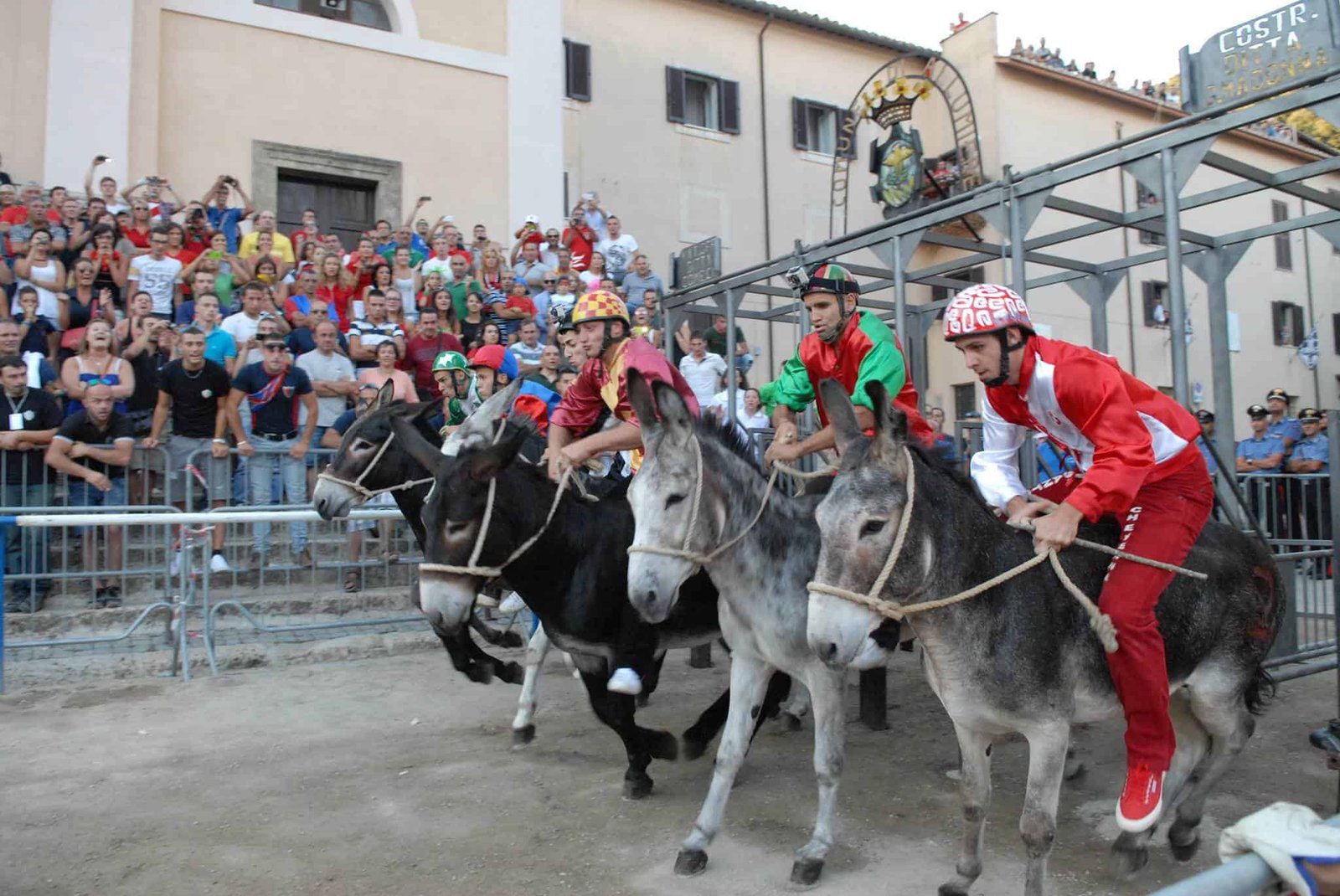
The event that made the town known throughout Lazio is run on the first Sunday after August 15, that is, right after the feast of the Assumption, and it's run with donkeys instead of horses. It's not a folkloric gimmick: the donkey hauled the carts of alum ore, and it is the donkey the community pays homage to. Local tradition traces the idea back to the first years of the 16th century, when Agostino Chigi il Magnifico is said to have organized donkey races in the yard in front of the plant, reviving the customs of his Siena. The modern version, the one run today, was born on September 11, 1965: in 2026 the town celebrates the 60th edition.
The six contrade, the colors and the symbols
The contrade are six and their names tell the mining geography of the town. Burò, white and black, with the arch as its symbol, takes its name from the mines' management office. Ghetto, yellow and red, with the little fountain, corresponds to the first settlement of the miners. La Bianca, white and green, with the holly, recalls the first extraction zone of 1462. Nona, red and green, whose symbol refers to the old alum plants, owes its name to a contrada of Civitavecchia. Polveriera, red and light blue, with the windmill, takes its name from the gunpowder tower. Sant'Antonio, white and red, has as its symbol the shrine of the saint of Padua. Six names, six trades, six pieces of industrial history.
How the race works
The competition is divided into three heats, or carriere. In each one a score is assigned according to the order of arrival: 12 points to the first, 10 to the second, eight to the third, and so on down to the last. At the end of the three runs the contrada with the highest score is proclaimed the winner. If two contrade finish with the same score, a tiebreaker heat is run. Besides the race, the six contrade also compete for the best costumes and for the best flag throwers, and that parallel competition is taken just as seriously.
The cencio
The winner gets the cencio, the painted banner that each year is dedicated to an anniversary, a person or an important event. Before the race it is carried in a parade on the carroccio pulled by oxen and displayed in the church. That same evening the winning contrada celebrates it with a dinner that lasts until dawn. Anyone who wants to understand the town should see the cencio of the year: it says what Allumiere considers worth remembering at that moment.
Rites, superstitions and rivalries
Like every folk tradition, the Palio of Allumiere also has its rites. The assignment of the gabbie, that is, the starting positions, takes place on Sunday morning with a public draw in the council chamber, followed in real time by the people in the square through loudspeakers. Every contradaiolo interprets it in a cabalistic key. Some contrade always hold their convivial dinner on the same day: that of the Polveriera, for example, always falls on the preceding Friday. There are contradaioli who don't want to see the cencio displayed in the church because they consider it bad luck, and others who look at it only on the evening of the procession of the Assunta. The rivalries are precise: the Polveriera is the sworn enemy of the Nona, the Burò is of the Ghetto, while between Sant'Antonio and La Bianca there is no bad blood at all.
The weekend program
On Saturday the provaccia is run, the trial run of the donkeys, and the contrade gather for dinners and dance parties. On Sunday morning solemn Mass is celebrated, the donkeys are blessed and numbered, and the draw for the positions is held. In the afternoon, around 17:00, the historical parade starts along the streets of the town, with sixteenth-century costumes and over 200 extras, groups of flag throwers and musicians. Then the three carriere and the party. In the most recent editions the town has exceeded 20 thousand attendees in the week of preparation, with the peak on the day of the race: many come from the nearby seaside towns, Tarquinia, Santa Severa, Ladispoli, Santa Marinella, Cerenova. Professional advice: arrive by 15:00, park below and walk up, otherwise you'll spend the afternoon in a line of cars.
The festivals and the calendar of the year in Allumiere
In the first half of July the wild boar festival is held, combined with the Sentieri dell'Allume event, which joins long tables and walks on the mining routes. Later in the season comes the festival of the local truffle and of ancient flavors, dedicated to the truffle of the Monti della Tolfa, which few expect to find at this latitude and this altitude. In August everything revolves around the Assunta and the Palio. The exact dates change from year to year and are published by the Comune a few weeks beforehand: before setting out for a festival it's always best to check the municipal website or call the switchboard. The festivals here are still run by the contrade and the associations, not by event companies, and you can tell in the quality of the food.
What to eat in Allumiere
The cooking of Allumiere is that of the mountains of the Tyrrhenian interior, not that of the coast: meat, mushrooms, legumes, bread. Wild boar stewed or in a sauce for fettuccine is the signature dish, and the July festival exists precisely because wild boar is a constant presence in these woods. The truffle of the Monti della Tolfa appears in season on eggs and fresh pasta. Then there are lamb, the sheep cheeses produced by the free-range farms of the pastures, chestnuts, legume soups and game in general, where permitted. Panzanella and wild greens belong to the poor tradition of the miners. I don't name restaurants, because in a town of a little under 4,000 people the management changes and a year-old tip can be wrong: ask in the square, as people have always done, and you'll choose well. One practical recommendation: off-season many kitchens close early and on Sunday evening the town is quiet, so book or have lunch.
Allumiere with kids
It's a destination that works with kids, as long as you pace things. The civic museum has the enlarged insects and the mine dioramas, which hold attention better than any display case of potsherds. The Faggeto offers a real forest with roots, enormous trunks and woodpeckers tapping. The Palio, with the donkeys and the costumes, is a spectacle that kids remember for years. The limit is logistics: mountain roads, few equipped playgrounds, uphill walking distances. With heavy strollers you suffer. The Cavaccia sports center offers an outlet in the afternoon. Rule of thumb: museum early in the morning, long lunch, woods in the afternoon when the sun goes down.
Accessibility in Allumiere
The picture is mixed and it has to be said honestly. The church of Maria Assunta in Cielo and the Santuario della Madonna delle Grazie are listed by the Comune as free of architectural barriers, and the same goes for the Faggeto area at its main entrance, although the internal trails are on natural ground and are not passable in a wheelchair beyond the first stretches. The civic museum, housed in a palace from 1580, instead has stairs and barriers: if you have mobility issues, call ahead to find out what can be reached. The historic center has significant slopes almost everywhere: Allumiere is a mountain town and you can't get around the topography. Those traveling with elderly people can concentrate on the square, which is flat, and on the sanctuary, which can be reached by car.
How much a day in Allumiere costs
Little, and it's one of its merits. The Faggeto, the sanctuaries, the chamber church and the historic center cost nothing. Parking is free. The civic museum asks for a ticket from non-residents, of a modest amount but not published online. What remains is fuel or the train ticket to Civitavecchia plus the Cotral ride, and lunch. A full day for two people, with a museum visit and a trattoria, falls comfortably within the budget of an average Roman outing. If you come as a group, the cost worth paying is the guide: here, without someone to explain the quarries and the necropolises, you only see trees and rocks. For those organizing corporate outings or private experiences in the Monti della Tolfa there are dedicated formulas, for example those of TourLeaderPro for small groups.
What to see around Allumiere
The municipality borders some of the most beautiful places in northern Lazio and the choice is wide. 10 minutes by road is Tolfa, with its rocca and the workshops of the Tolfa hills. Going down toward the sea you reach Civitavecchia, its port and the Michelangelo fort. To the north there are Tarquinia with its painted tombs and the salt pans, a flamingo reserve. On the coast to the south you find the castle of Santa Severa, the beach of Santa Severa and Cerveteri with the Banditaccia necropolis. Inland open the Monterano reserve and Lake Bracciano. If you have two days, the pairing I recommend is Allumiere plus Monterano: mines and ruins, two faces of the same abandonment. More itinerary ideas are in our tourist attractions section.
When to go to Allumiere and when to avoid it
The best period is spring, between April and early June, when the orchids of the undergrowth bloom and the woods are still cool. Autumn, between October and November, is the time of the beech wood's foliage and of mushrooms. Summer is hot but bearable thanks to the altitude, and August brings the Palio with the crowd that goes with it: if you want quiet, August is not for you. If you want the festival, it's the only time. Winter is harsh, with fog and some snowfall: the bare woods have their charm, but the days are short and many services slow down. The day of the week matters: the museum opens only Tuesday and Wednesday, so the classic Sunday outing excludes it. Anyone who wants to see everything should come on a Wednesday.
A curiosity about Allumiere (RM)
The real curiosity is not about the Palio, which everyone knows, but about the beech. In Allumiere the beech grows at around 600 meters above sea level, when in central Italy its belt normally begins above a thousand. The beech wood of these mountains is therefore a climatic relic: a patch of cold forest that survived the end of the last glaciation thanks to a local microclimate made of sea fogs, constant humidity and temperature inversions that hold cold air in the basins while it warms up at altitude. In practice the woods live in a niche that the general climate no longer justifies. The Lazio Region recognized the value of the area with the 2018 decree that established the Natural Monument, protecting over a little more than a hundred hectares not only the trees but also a hibernating colony of bats and bird species of European interest. The detail that makes the matter memorable is the coincidence: those bats spend the winter inside the tunnels dug by the alum miners 500 years ago. An industrial activity of the Renaissance created, without knowing it, the habitat that today justifies a European nature protection. In the same area live together a forest that shouldn't be there, a fauna that depends on a human work and a volcanic landscape of magmatic domes: three different stories in the same square kilometer. Whoever arrives thinking of taking a walk finds, if they look closely, a textbook case of historical ecology.
Something nobody tells you about Allumiere (RM)
Nobody will tell you that the territory of this town of a little under 4,000 people preserves the largest Proto-Villanovan funerary context in Tyrrhenian Italy. The areas of Forchetta di Palano, Campaccio and Pozza, around the hilltop settlement of Monte Rovello, have yielded over a hundred cremation tombs with cinerary urns, dating to the end of the Bronze Age. To understand what that means: in that period, between the twelfth and tenth centuries BC, southern Etruria was going through the transition that would lead to the birth of the great Etruscan cities, and the communities of the Monti della Tolfa were protagonists of that passage before moving toward Cerveteri and Tarquinia. The first burials were identified in the second half of the 1800s by Adolfo Klitsche de la Grange. Systematic work came with Salvatore Bastianelli, Renato Peroni and Vincenzo D'Ercole, and the excavations of the settlements were conducted by Odoardo Toti between 1965 and 1976. These are names that carry a lot of weight in the scientific literature on Italian protohistory. In town, a trace of all this is found only in the display cases of the civic museum, open two mornings a week. The second thing nobody will tell you concerns water: the underground aqueduct known as the aqueduct of Trajan, which carried water from Cinque Bottini to Centumcellae, is one of the best preserved Roman hydraulic works in northern Lazio, and it appears in no structured tourist itinerary. A town that possesses these two records and doesn't advertise them is either an honest town or an absent-minded one, and I lean toward the first.
The advice I give you for visiting Allumiere (RM)
Come on a Wednesday morning and organize the day the opposite way from how everyone else would. At 9:00 be at the civic museum, at Piazza della Repubblica 29: two hours, taking your time, asking the staff to explain the mining section and the model of the alum plant, because that is the key to the town and not the ceramics. Around 11:00 walk down the main street to the Fabbricone, look at the aligned windows of the workers' house and try to imagine the miners' families inside. At noon go up to the Santuario della Madonna delle Grazie: it's always open, free, and from up there the town can be read in its structure as an industrial village. Have lunch in town without hurry. In the afternoon, when the sun gets lower and the light comes in between the trunks, enter the Faggeto from Via del Faggeto: closed shoes, water in your backpack, the short loop if you have an hour and a half, the long one toward the quarries and Monte Elceto if you have four. The mistake I see made most often is the opposite: woods in the morning, museum closed, town crossed in 10 minutes and a departure with the idea that there's nothing in Allumiere. In Allumiere there is a great deal, but almost all of it has to be explained. If you come as a group, spend on a guide: here the difference between a successful outing and a wasted day is made by whoever tells the story of the quarries. Last warning: don't count on Ferragosto for the museum, which closes in those days, and don't count on the Palio to see the town, because in those hours the town is the crowd.
Another well-known fact, yet rarely cited
Everyone knows that Allumiere was born from the alum mines. Almost no one connects that fact to the geopolitics of the 1400s. Alum was used to fix colors in the dyeing of fabrics, and without stable dyeing the European wool industry, that is, the richest manufacturing sector on the continent, couldn't stand. Until 1453 the mineral came from the Anatolian deposits of Phocaea, in Genoese hands. The fall of Constantinople put that trade under Ottoman control and forced Christian Europe to buy from its own political adversary. The discovery of alunite in the Monti della Tolfa, in 1462, reversed the situation: the papacy found itself holding a strategic monopoly and defended it the way an energy resource is defended today, with bans, tariffs and threats of excommunication for those who imported Turkish alum. The revenues of the papal alum works financed the coffers of the Apostolic Chamber for decades. Management passed from contractor to contractor, and it was the discovery that determined the removal of the Frangipane of Tolfa, who until then controlled those lands, in favor of direct papal management. In this sense Allumiere is not a mountain town that gave itself a small industry: it is a strategic infrastructure of the Renaissance, built from nothing for reasons of state, with its workers' village, its aqueduct, its administrative palace and even its forced labor, made in part of convicts for whom work in the quarries earned an exemption. Whoever walks in Piazza della Repubblica walks inside an industrial project with the seal of international politics.
The right photo to take in Allumiere (RM)
The photograph worth the trip is taken from the esplanade of the Santuario della Madonna delle Grazie, on Via delle Grazie, an hour before sunset. From there the town is arranged in steps on the slope, with the dark roofs, the bell tower of the chamber church, the block of the 1580 palace and, behind, the line of the sea that on clear days closes the frame at the horizon: you see the coast of Civitavecchia and, with clean air, the outlines of the islands. The raking light at the end of the day separates the planes and gives back the relief of the mountains, which never happens at noon. Second shot, inside the Faggeto: look for a mature beech trunk, place it at a third of the frame and let the exposed roots lead the eye into the depth. With the November fog the rays filter between the branches and the result needs no retouching. Third possibility, the hardest: the Cava del Silenzio, where the pale rock of the alunite contrasts with the green. You need diffuse light, so an overcast sky. On the days of the Palio the best photo is not the race, which everyone shoots badly, but the historical parade at 17:00 along the narrow streets, with the sixteenth-century costumes standing out against the pale walls, or the cencio on the carroccio pulled by oxen. Technical and common-sense advice: in the Faggeto, no flash toward the walls of the quarries and tunnels, because the hibernating bats wake up and every awakening, in winter, uses up reserves that can cost them their lives.
Some important events that happened here in history
The first event is 1462, the year alunite was identified in the Tolfa Mountains and the Apostolic Camera took control of the deposits: a fact that changed the commercial balance of the Mediterranean and gave rise to the town. The second is the arrival of Agostino Chigi as contractor of the alum mines, at the beginning of the 16th century: with him the factory, the aqueduct and the workers' housing were built, that is, the backbone of the present-day town, and tradition traces the first donkey races in the factory square back to exactly those years, ancestors of the Palio. The third is 1580, when the Palazzo della Reverenda Camera Apostolica was built to house the mine administration and the visiting papal court. Since then that palace has never stopped being the seat of local power. The fourth is 1608, with the construction of the chamber church dedicated to Maria Assunta in Cielo at the wish of the Olgiati family. It became a parish in 1752 and was enlarged in 1857 with the two side aisles. The fifth concerns the sanctuaries: in 1650 the church of the Grazie was entrusted to the Servants of Mary, and by 1710 the church and the convent were completed. The hermitage of the Trinity, documented as early as 1243, was suppressed by Alexander VII in 1656 and housed a hermit until 1818. The sixth is the restoration of Trajan's aqueduct at the end of the 17th century, under Innocent XII, which extended its useful life by two centuries. The seventh is 1850, with the neo-Gothic church of the Farnesiana. The eighth is 1956, the year the Antiquarium was born, followed in 1966 by recognition as a Civic Museum on the occasion of the sixth International Congress of Prehistoric and Protohistoric Sciences, and in 1996 by the reopening after the refitting. The ninth is September 11, 1965, the date of the first modern edition of the Palio delle Contrade, which in 2026 reached its 60th. The tenth, the most recent, is the regional decree of February 15, 2018 that established the Faggeto Natural Monument.
Who has passed through Allumiere (RM)
The first name is Giovanni da Castro, the merchant who, according to tradition, identified alunite on these mountains in 1462 after seeing it in Anatolia: it is doubtful that the scene of the announcement to Pius II went the way the chronicles tell it, but it is certain that his name is tied forever to these quarries. The second is Agostino Chigi, the Sienese banker who financed popes and princes, patron of Raphael at the Farnesina: he was contractor of the papal alum mines and the material founder of the town, and he brought the Sienese idea of the races here. The third, indirect but decisive, is Pope Gregory XIII, under whose pontificate the chamber palace was built in 1580. The Frangipane della Tolfa family passed through here, as owners of lands and jurisdictions, ousted from the papal management of the alum mines after the discovery. Pope Innocent XII left his mark with the restoration of the aqueduct at the end of the 17th century, Alexander VII with the suppression of the hermitage of the Trinity in 1656. In the 19th century comes Adolfo Klitsche de la Grange, naturalist and archaeologist, who discovered the first protohistoric necropolises of the area and after whom the civic museum is named: his is the signature that links Allumiere to the history of the discipline. In the 20th century the central figure is Odoardo Toti, promoter of the Antiquarium of 1956 and in charge of the excavations at Monte Rovello between 1965 and 1971 and at Monte Elceto between 1971 and 1976. Among the scholars who have worked on the materials of the area are Salvatore Bastianelli, Renato Peroni, one of the greatest Italian protohistorians, and Vincenzo D'Ercole. I add a category without names but no less real: the miners, many of them convicts serving their sentence in the quarries, and the donkey drivers who carried the ore to the port of Civitavecchia. The Palio, every August, is the receipt for that debt.
Quick questions about Allumiere (RM)
Where is Allumiere?
In the Tolfa Mountains, at an elevation of 522 meters, in the province of Rome, behind Civitavecchia. The town hall is at Piazza della Repubblica 39.
How far is Allumiere from Rome?
A little over 80 kilometers by the coastal route: you take the Aurelia or the highway to Civitavecchia and then climb toward Tolfa. By car it takes about an hour and a half.
How do you get to Allumiere without a car?
Train to Civitavecchia on the Tyrrhenian line, then a Cotral intercity bus toward Tolfa and Allumiere. Schedules change with the season and should be checked on the Cotral website.
How much does it cost to enter the Allumiere Civic Museum?
Admission is free for residents and paid for other visitors. The amount is not listed online: ask the museum at 0766 967793.
What are the opening hours of the Allumiere museum?
Tuesday and Wednesday from 9 to 14. It is closed on the other days, and in August it observes a closure on the days around Ferragosto.
Do you have to pay for the Faggeto of Allumiere?
No. Access is open and free, the area is always open and you enter from Via del Faggeto.
How much time do you need to visit Allumiere?
A full day: two hours for the museum, one hour for the historic center and the sanctuaries, two to four hours for the Faggeto depending on the route.
When is the Palio delle Contrade of Allumiere run?
The first Sunday after August 15, every year. The first modern edition dates to September 11, 1965 and in 2026 the sixtieth is celebrated.
Why do donkeys race at the Palio di Allumiere?
Because the donkey pulled the carts of alum ore from the quarries to the port. The race is a homage to that animal and to the work of the miners.
How many contrade does Allumiere have?
Six: Burò, Ghetto, La Bianca, Nona, Polveriera and Sant'Antonio, each with its own colors and its own symbol.
Can you visit Allumiere in a wheelchair?
In part. The church of the Assunta, the sanctuary of the Grazie and the main entrance to the Faggeto are listed as free of barriers. The museum, in a 1580 palace, has stairs. The center has steep slopes.
Is Allumiere good for kids?
Yes, especially for the room of the enlarged insects at the museum, for the woods and for the Palio. Better to avoid heavy strollers on the climbs.
Where do you park in Allumiere?
Along the streets of the center and in the open spaces near the square, free of charge. On the Palio weekend it's best to leave the car down below and walk up.
Can you take photographs in Allumiere?
Yes, anywhere outdoors. In the Faggeto avoid flash toward the walls of the quarries and tunnels, where the bats spend the winter hibernating.
What's the difference between Allumiere and Tolfa?
Tolfa is a medieval village with a rocca and an artisan tradition, Allumiere is a Renaissance industrial village born for alum. They are 10 minutes apart and are visited together.
What do you eat in Allumiere?
Wild boar, truffle from the Monti della Tolfa in season, lamb, sheep cheeses, chestnuts, legume soups. The festivals in July and at the end of summer are the best occasion.
When are the festivals held in Allumiere?
The wild boar festival with the Sentieri dell'Allume in the first half of July, the truffle and ancient flavors one later in the season. The Comune publishes the exact dates.
Can you visit the alum mines of Allumiere?
The quarries can be seen from the outside along the trails of the Faggeto, from the Cava del Silenzio to the entrances of the Santa Barbara mine. You do not enter the tunnels.
What to see near Allumiere in a day?
Tolfa, Civitavecchia, the Monterano reserve, the castle of Santa Severa, Cerveteri and Tarquinia. All within an hour by road.
What is the best time to visit Allumiere?
Spring for the orchids of the undergrowth and autumn for the colors of the beech wood. August only if you're interested in the Palio and the crowd doesn't scare you.
Do you need to book to visit Allumiere?
Not for the town and the woods. For the museum, and in particular for groups and for visits outside opening hours, a phone call ahead solves it.
Is Allumiere a good starting point for the sea?
Yes: the beaches of Santa Marinella, Santa Severa and Ladispoli are half an hour away by road, and in August many vacationers come up here from the coast.

I return to Allumiere once a year, usually in November, when the beech wood is the color of copper and there's nobody in town. In our judgment it is the most underrated place in the entire province of Rome: it has the largest Proto-Villanovan burial ground in Tyrrhenian Italy, a forest that botany can't explain without bringing in the glaciations, a 30-kilometer Roman aqueduct and a popular festival that turns 60 in 2026, and despite this it stays outside every circuit. Go before someone notices, and go with someone who knows how to read a quarry. Those planning a broader trip in Lazio will find our page my trip useful, and for foreign visitors the English guides to Rome and to day trips outside the city are gathered in this ItalyPlanner guide and in the section on day trips in Italy.
Article written by the editorial team of TourLeaderPro, contact them for Private/Corporate/V.I.P. Tours and Experiences.
Planning a trip to Rome? The English guides for visiting the city are on ItalyPlanner.com.