Santa Marinella (RM)
In short. Santa Marinella (RM) is a coastal town in the Metropolitan City of Rome Capital, on the Tyrrhenian Sea along Via Aurelia between Ladispoli and Civitavecchia, with the hamlet of Santa Severa and its castle at the southern end of the territory.

Santa Marinella (RM) is a coastal town in the Metropolitan City of Rome Capital, on the Tyrrhenian Sea along Via Aurelia between Ladispoli and Civitavecchia, with the hamlet of Santa Severa and its castle at the southern end of the territory. You can get there by train on the regional FL5 line Roma Termini - Civitavecchia, which stops at both Santa Marinella and Santa Severa. The trip from Termini takes a little over an hour, trains run with an indicative frequency of about every half hour, and the ticket for stations outside the urban area, under the current regional fares, costs between €4 and €5 per trip. Check the schedules and the exact price of the day on the Trenitalia website before you leave. By car, follow the SS1 Aurelia, which runs parallel to the coast, or the A12 Roma - Civitavecchia motorway, exiting at Santa Marinella. The Santa Severa Castle complex, the main site to visit in the town, is at kilometer 52,600 of the SS1 Aurelia, 00058 Santa Marinella (RM). The combined ticket for Museo del Mare e della Navigazione Antica, Museo del Castello and Museo del Territorio costs €8 full price and €6 reduced for children aged 6 to 14, people over 65 and groups of at least 12 people, while admission to the museum alone is listed at €4. Entry is free for children under 6, for residents of Santa Marinella, for people with disabilities and for accredited journalists. Scavi di Pyrgi, Torre Saracena and Antiquarium have separate admission and are not part of the combined ticket. Opening hours are seasonal, with the site open Tuesday to Sunday and closed on Mondays and December 25. In the summer season the operator lists evening opening from 17:00 to midnight, with the ticket office closing at 23:00, so check the official castle website for the time slot of the day you plan to go. The beaches are free and under concession along all 22 kilometers of coastline. Swimming is allowed, and the regional water classification for the 2026 season rates all monitored areas in the town as excellent.
If you want to place Santa Marinella within the broader picture of seaside day trips north of Rome, the natural comparison is with the Santa Severa beach, which belongs to the same town, and with the port of Civitavecchia, eight kilometers further north.

Where Santa Marinella (RM) is and what it really is
It's best to clear up a misunderstanding that the beach's name suggests right away. Santa Marinella is not a beach: it is a town of about 18,000 residents, recognized as such by a 1990 decree, spread over about 40 square kilometers between the sea and the southern foothills of the Tolfa mountains. The territory includes Capo Linaro, the headland that closes the gulf to the north, the Marangone stream at the border with Civitavecchia and, to the south, the hamlet of Santa Severa with its castle on the water. The municipal coastline measures about 20 kilometers, from Baia di Ponente to the castle, and almost all of it is reachable from Via Aurelia, which runs parallel to it.
Geography explains why Romans have been coming here for a century. The coast faces south, which is rare on the Lazio Tyrrhenian coast, and the Tolfa mountains behind it, to the north and northwest, block the cold continental winds. The result is a mild microclimate that extends the season well beyond August. In Santa Marinella people swim at the end of September with a regularity that is not a given in Fregene or Ostia, and you can stroll the seafront in January without suffering. Anyone who knows this coast knows that the real gift of Santa Marinella isn't July, it's October.
Santa Marinella (RM) by the Numbers
An independent municipality since October 4, 1949, when it split off from Civitavecchia together with the hamlet of Santa Severa. Coat of arms and gonfalon granted by presidential decree of February 29, 1992, city title granted by presidential decree number 4743 of August 7, 1990. In 2005 the seabed off the shoreline was designated a site of community interest, which says something about the biological quality of that stretch of sea. In 2020 the Lazio Region designated Santa Marinella Città della Cultura, a recognition the town has spent mostly on the archaeological front.
The town coat of arms deserves a line because it is a heraldic puzzle readable with the naked eye: it combines an anchor, which represents Santa Marinella and its maritime vocation, and a castle, which represents the hamlet of Santa Severa. Two places, one town, one shield. It is the most honest image of the place: two identities stitched together in 1949 and never fully fused.
How to Get to Santa Marinella (RM) from Rome
Here half the success of the day is decided. Santa Marinella is one of the very few stretches of sea in Lazio where the train clearly beats the car, and anyone who arrives by car in summer notices it when looking for parking.
By Train: the FL5 and the Two Stations of Santa Marinella (RM)
The FL5 regional line connects Roma Termini with Civitavecchia along the Tyrrhenian route. The stops, after the urban section of Rome (Termini, Tuscolana, Ostiense, Trastevere, San Pietro, Aurelia), are Maccarese-Fregene, Torre in Pietra-Palidoro, Ladispoli-Cerveteri, Marina di Cerveteri, Santa Severa, Santa Marinella and Civitavecchia. The town therefore has two stations of its own, and this changes how you plan the day: get off at Santa Severa for the castle and the beach below the walls, get off at Santa Marinella for the center, the small harbor and the seafront promenade.
The trip from Termini takes a little over an hour, the indicative frequency is every half hour, and on summer weekdays service runs over a very wide window, from the first morning trains to the last ones late in the evening. My practical advice: take the train that arrives around nine in the morning, not the 11 o'clock one. By 11 you'll find the train packed with people carrying portable fridges and the beach already occupied in the best spots.
Both stations are a few minutes' walk from the sea, which is the decisive advantage. From Santa Severa you leave the station and reach the castle with a flat walk, from Santa Marinella you walk down to the seafront in five minutes. No bus to catch, no connection to chase.
By Car to Santa Marinella (RM): Aurelia, A12 and the Parking Question
From Rome you take the SS1 Aurelia or the A12 Roma - Civitavecchia motorway. The Aurelia is slower but serves every access to the sea one by one. The A12 is faster and makes sense when you're heading straight for Santa Severa or the headland. Travel time from the Grande Raccordo Anulare varies, under normal conditions, around 40 minutes, but Saturday mornings in July and Sunday evening returns are another matter and need to be factored in.
Parking is the real bottleneck. Parking areas along the Aurelia and on the side streets that run down to the sea fill up quickly, and in the busiest stretches parking is paid during the summer months. A blunt opinion: if you go on a Saturday or Sunday in high season, the car is the wrong choice. Leave it at home and use the FL5. If you really have to drive, arrive by half past eight in the morning or aim for an access point on the outskirts, toward Marangone or toward Baia di Ponente, and accept walking for 10 minutes.
How Much Time You Need for Santa Marinella (RM)
A day spent only at the sea wraps up in six or seven hours. A day that combines the sea and the castle of Santa Severa needs at least eight hours, better nine, because the castle's museums want two full hours and the summer evening time slot forces you to reorganize everything: sea in the morning, lunch, rest, castle from late afternoon. If instead you also want to add the Riserva di Macchiatonda and a walk among the 20th-century architecture, you need two days and one night on site.
The Sea of Santa Marinella (RM): Beaches, Coves and Rocky Outcrops
The shoreline of Santa Marinella is not one single continuous beach: it is a series of inlets, sandy at some points and rocky at others, separated by spurs and low rock ledges. This alternation is the reason for its reputation and, at the same time, the reason for its disappointments. Anyone who arrives expecting the kilometer of golden sand along the coast south of Rome is caught off guard. Those who arrive knowing they'll find coves, mixed seabeds and clear water find exactly what they're looking for.
The Water Quality at Santa Marinella (RM)
The figure is clear, and it's worth spelling out. The regional classification of bathing waters for the 2026 season rates 100 percent of the monitored areas in the municipalities of Civitavecchia, Cerveteri, Ladispoli, Nettuno, Roma and Santa Marinella as excellent. The monitoring is based on more than 1,600 samples taken between April and September along the coast and lakes of Lazio, and for the first time no regional area has been classified as poor. In practical terms: the Sea off Santa Marinella is among the best you can reach in an hour by train from Rome, and the rating is not a bather's impression but the result of a historical series of analyses.
Seasonal common sense still applies: after a rough sea or heavy rain, the water gets cloudy for mechanical reasons, not sanitary ones, and the day after a thunderstorm is never the best day for a dip.
Free Beaches of Santa Marinella (RM) and the Establishments
To be frank, since it's the information you really need: the free beaches of Santa Marinella are few and small, and in high season they fill up by half past nine in the morning. The concession system takes up a large share of the coastline, and the quality of services is uneven. Some establishments charge high prices for limited space, with umbrellas set in dense rows and a lukewarm welcome for anyone who isn't a regular customer. Others, usually the ones opened more recently and run by young people, work much better and have brought a modern idea of service to the coast: a bar on the sand, measured music, spaced-out loungers, staff who respond. The stretch toward Santa Severa is where this new management has concentrated, with the downside that the bottom there is often pebbly rather than sandy.
The practical advice is simple. Before spreading out your towel, walk 100 meters and take a look. In 30 seconds you can tell whether a beach club has room between the umbrellas or whether you'll be set up 40 centimeters from your neighbor. And always ask the price before you sit down, even for just a lounger.
The Coves of Santa Marinella (RM) and the Less Crowded Access Points
Il Grottino is a mixed beach of sand and small pebbles, with a bottom that is partly rocky and partly sandy: few services, a rough character, excellent for anyone who brings a mask and snorkel. Access is easy but requires a short walk, and that walk is exactly what filters out the crowds.
Capolinaro, below the promontory of the same name, has fine sand and a shallow bottom, alternates free stretches with stretches equipped with umbrellas, showers and refreshment points, and has several parking spaces nearby. It's the sensible choice for a family with small children, and at sunset the light over the headland alone makes the day worthwhile.
The free beach below Castello Odescalchi is sandy, very central, and served by bars, restaurants and shops within a few steps. It's the most convenient option by far for anyone arriving by train, and it's also the most crowded: the castle behind you makes the photo, and the crowd does the rest.
Fosso della Barca is the opposite: sand and pebbles, moderately difficult access through a wooded stretch, no services. Anyone looking for quiet and snorkeling goes there, bringing their own water and shade from home.
The Black Sands of Santa Severa
At the southern end of the municipality, past the castle, the shoreline changes color. The stretch known as the Black Sands owes its dark color to the volcanic component of the sediments, and for decades it has also been frequented as a naturist oasis. It's a large, windy area with no services, with a completely different character from the town's seafront promenade. If you're going for the first time, bring suitable shoes: the dark sand in August, at midday, scorches much more than the light-colored sand.
Banzai: the surf spot that built Santa Marinella's reputation (RM)
There's a reason Santa Marinella has come up in Italian surfers' conversations for 40 years, and the reason is called Banzai. It's a right-hander that, over a bottom of rocks and rounded boulders, can run for 150 or 200 meters on good days, with the best section between the second and third peaks, where the wave gets steeper and faster. There's also a left, shorter and better suited to longboards. The name came from an analogy with Hawaii's Banzai Pipeline, seen in surf videos that circulated in Italy in the early 1980s. According to the account of Giorgio Pietrangeli, one of the local pioneers, the first documented sessions date to 1983 or 1984.
Banzai's season is winter, not summer: the southwest and west swells of the cold season build the wave. The available parking holds 35 or 40 cars, and on mornings with good forecasts it's full before dawn. The spot is technical and unforgiving: the entry into the water goes through a channel on the left side where the rocks cut in, the crowd in the water is considerable, and right of way must be respected. Over the years the coast has hosted stages of the national championship, including youth finals: without too many metaphors, Santa Marinella is the capital of Tyrrhenian surfing in Lazio.
Personal opinion, and I'll say it plainly: if you do not have solid experience, do not go into the Banzai in winter. Watch from the cliff, which is a free and safe show, and go learn somewhere else.

A Curiosity About Santa Marinella (RM)
The name of this town is a small philological mystery with two chapters and two languages, and it is worth telling in full because almost nobody knows its complete version.
Chapter one, antiquity. Before Santa Marinella existed, there was Punicum, a settlement that arose starting in the 9th century BC along a coast dominated by the Etruscans of Caere and frequented by Phoenician merchants. The name appears in the Peutinger Table, the medieval copy of a Roman road itinerary, in the form of the station ad Punicum, located between Pyrgi, today's Santa Severa, and Castrum Novum. This is where the hypothesis that circulates among scholars, and that the old local common sense has adopted, fits in: the place name would derive from a pomegranate tree, in Latin malum punicum, that is, the Punic apple, grown beside the Roman station where horses were changed. A tree would have given its name to a port. It is a fascinating and plausible reading, and it should be presented for what it is, that is, a philological hypothesis, not a documented fact: the link between the place name and the Carthaginian presence on the coast remains the other explanation in the running, and the two are not mutually exclusive.
Chapter two, the Middle Ages. According to tradition, around the year 1000, a community of Basilian monks from the Middle East, having arrived in southern Italy, sailed up the Tyrrhenian coast and settled on the headland where the Odescalchi Castle stands today. They built a village, a monastery, and a small church dedicated to Saint Marina and Saint Leonard, and with the church they brought the cult of the saint. Of this Marina, a virgin and martyr, the documents preserved in the archives of the suburbicarian dioceses of Ostia and Porto-Santa Rufina record her commemoration on July 17. The small church has disappeared: the current hypothesis is that it was absorbed into the castle as a palace chapel around the 16th century, and that the parish church was later built on the site where it stood.
From Santa Marina to Santa Marinella, the step is an affectionate diminutive, the kind of change that happens in people's mouths and not in chancery documents. In the castle courtyard survives a private chapel built in 1692 and dedicated to Saint Marina, decorated with majolica tiles that depict the saint: it is the most concrete evidence of the link between the town's name and the devotion that generated it. A seaside town named after an Eastern saint brought by Greek monks and remembered through Baroque ceramic tiles: the history of coastal Lazio is rarely linear.
The Odescalchi Castle of Santa Marinella (RM)
On the headland above the small tourist harbor stands the castle that Romans simply call the castle of Santa Marinella, to tell it apart from the one at Santa Severa. It is private property of the Odescalchi family, not a museum: it is not open for free visits and is opened for special occasions or events. This needs to be said right away, because the misunderstanding is common and spoils a few afternoons.
What Lies Beneath the Castle of Santa Marinella (RM)
The headland is a palimpsest. The Etruscans used the inlet as a trading landing. The Romans developed the settlement of Punicum there and built a luxury seaside villa that local scholarly tradition attributes to the great jurist Ulpian, the adviser to Alexander Severus who was killed by the Praetorian Guard in 223 AD. The attribution is tradition, not documentation: what is certain is that along this coast there were many imperial seaside villas, and their fish ponds carved into the rock, still visible in several spots along the shore, enjoyed Mediterranean fame.
From the Norman Tower to the Palace
After the collapse of the Roman system, the coast became indefensible. In the 12th century the Norman tower was built, and it still stands today, as a stronghold against raids from the sea. In 1567 Pope Pius V included the structure in the great system of Tyrrhenian coastal towers, and since then the Santa Marinella tower has given its name to the small settlement that grew up around it for cultivating the fields and grazing. Toward the end of the 16th century the watchtower had already become a fortified castle, with a curtain wall and round towers at the corners.
In the 17th century the Barberini family, under the papacy of Urban VIII, acquired the complex and added a palace wing of considerable size, also expanding the landing point. The property then passed to the Santo Spirito hospital, the Roman institution that, by concession of Pope Eugene IV, had held the Santa Marinella estate since 1435 through the canons of Santo Spirito in Sassia. In 1887 the Archiospedale sold the estate to Prince Baldassarre Odescalchi, who made it the basis of a subdivision plan drawn up by engineer Raffaello Ojetti, father of the writer and critic Ugo Ojetti. That plan is the birth certificate of modern Santa Marinella: without the Odescalchi subdivision there would be no Liberty-style villas along the seafront, nor the seaside town we know.
If you want to see an Odescalchi castle and go inside without waiting for a special opening, there is an alternative half an hour's drive away: the Odescalchi castle in Bracciano, which belongs to the same family and is open to visitors on a regular basis.
Santa Severa: the castle by the sea, the village and the museums
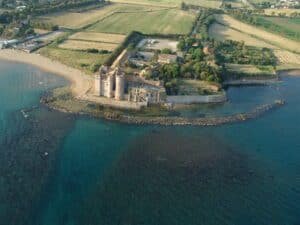
The most important cultural asset in the municipality of Santa Marinella does not carry the name Santa Marinella. The Santa Severa Castle literally stands on the shoreline, with its walls running down into the water and the beach wrapping around it, on the ruins of the ancient Etruscan port of Pyrgi. The present structure, with a quadrangular plan, reinforcing towers and a moat, took shape from the 14th century around an older core that includes an 11th-century tower overlooking the sea.
The history of the Santa Severa castle
In 1068 the Norman knight Gerardo di Galeria gave the castle to the Abbey of Farfa. This is the first document that records the fortress in noble hands. In 1482 Pope Sixtus IV granted it to the Pio Istituto di Santo Spirito, the same institution that held the Santa Marinella estate. From then on, for centuries, the complex remained tied to the Roman hospital, and later to the Lazio Region, which today manages its cultural activities through LAZIOcrea and CoopCulture.
The medieval village and the church
Inside the walls, a village of low houses, a small square and a church have survived. The church of Santa Maria Assunta has a Romanesque interior and holds an altarpiece painting of the Assumption among Saints Severa and Marinella: the two patron saints of the municipality, painted together centuries before the municipality existed. Nearby are the remains of an early Christian church and a baptistery, which document the continuity of worship on the site from late antiquity onward. The Torre Saracena, the highest point of the complex, can be climbed on specific occasions and has access restrictions: the operator excludes children under six, people with heart problems, and pregnant women.
The Museum of the Sea and Ancient Navigation
Established in 1993 and completely renovated in 2016, it is a civic museum dedicated to underwater archaeology and ancient navigation. The route unfolds across seven rooms with over 100 artifacts on display, selected from a collection that, according to the museum's information sheets, exceeds 400 pieces. The guiding theme is the sea of the ancients along the Etruscan coast between Alsium, today's Ladispoli, and Centumcellae, today's Civitavecchia, with particular attention to the port of Pyrgi, which lay exactly here, beneath us.
The display alternates original finds with reconstructions of environments and equipment: anchors, anchor stocks, transport amphorae, onboard tools, mooring gear. The scientific work was carried out by the Centro Studi marittimi in collaboration with Italian and European universities and with the archaeological superintendency for southern Etruria. In 2005 the museum received the regional quality mark, and over the years it has been featured on TV programs such as Linea Blu, Geo and Superquark.
Tip: go in after walking on the beach, not before. The amphorae and anchor stocks say much more when you have just seen where the sea gave them back.
The Castle Museum
Opened to the public for the first time on April 25, 2017, it tells the story of the site from the martyrdom of Severa to the contemporary era, passing through the village, daily life within the walls and the history of its ownership. It is the natural complement to the Museum of the Sea: one looks at the water, the other looks at the stones.
Hours, tickets and practical rules for the complex
The combined ticket for the monument complex costs €8 full price. The reduced rate of €6 applies to children aged 6 to 14, people over 65 and groups of 12 or more people. Entry to the museum alone is listed at €4. For groups, the operator lists a rate of €10 per person and €5 per class for school groups, with booking required. Children under 6, residents of the municipality of Santa Marinella, people with disabilities and accredited journalists get in free. The combined ticket includes Museo del Mare e della Navigazione Antica, Museo del Castello and Museo del Territorio. The Pyrgi excavations, the Torre Saracena and the Antiquarium are excluded.
The complex is closed on Mondays and on December 25. Opening hours depend on the season. In summer, the operator lists opening Tuesday to Sunday from 17:00 to midnight, with the ticket office closing at 23:00 and last entry half an hour before closing. Outside the season, hours change, so checking the castle's official website before setting out is necessary. The operator also notes that some sections may be temporarily closed to the public, and recommends buying tickets in advance because capacity is limited. A large part of the rooms is accessible to people with disabilities. Dogs are allowed only in the outdoor areas that are not part of the museums, on a leash and muzzled.
A hostel also operates inside the walls, which makes the castle one of the very few monuments in Lazio where you can sleep. The complex also hosts a calendar of summer events, concerts and guided sunset visits. In 2021, the castle stage hosted, among others, the Alex Britti concert.
Pyrgi, the Etruscan sanctuary of Santa Marinella (RM)
Below and beside the castle of Santa Severa is one of the key sites of Etruscan archaeology, and those who spend a day at the beach here often walk through it without knowing it. Pyrgi was the main port of Caere, today Cerveteri, and one of the busiest ports of the archaic Tyrrhenian: Greek and Phoenician merchants called there, and the sanctuary standing there had a reputation that went beyond the borders of Etruria. In 264 BC the site became a Roman colony, equipped with fortifications in polygonal masonry.
Temples A and B
The sacred area included two large temple buildings, called by archaeologists by the letters A and B. Temple B is the oldest and dates to the end of the 6th century BC. It was dedicated to the goddess Uni, the Etruscan Juno. Temple A belongs to the first half of the 5th century BC, is the more monumental of the two and is attributed to Thesan, that is, Dawn, identified with the Greek Leucothea. Among the recovered materials, the fragments of a terracotta high relief with mythological scenes of archaic violence stand out, today among the most studied pieces of Etruscan coroplastics.
The gold plates of Pyrgi
On July 8, 1964, during the excavation campaign led by Massimo Pallottino, the most authoritative Italian Etruscologist of the 20th century, three folded and buried gold plates came out of the sanctuary area. They measure about 19 centimeters by nine. They are inscribed and were originally fixed with nails to the doorjamb of Temple B. Current dating places them around 500 BC, between the end of the 6th century and the start of the 5th century BC.
Their content is what makes them famous. Two plates carry a text in the Etruscan language, and the third a text in Phoenician: three documents, two languages, and content that is largely parallel. They record the dedication of Temple B to the goddess Uni, called Astarte in the Phoenician text, by Thefarie Velianas, identified as lord of Caere. For Etruscan linguistics, it is the most important bilingual document we have: a known text, Phoenician, next to a text in a language we can read but only partly understand, Etruscan. For the history of the archaic Mediterranean, it is the material proof of the agreement between Etruscans and Carthaginians against the Greeks, the same agreement that had produced the naval battle of the Sardinian Sea, near Alalia, around 540 BC.
The plates entered state collections in 1964, and today they are displayed at the National Etruscan Museum of Villa Giulia in Rome, in room 13a. Anyone who visits Santa Marinella and then stops at that display case in Rome does the route in the right order: first the place, then the object. In 2024, Villa Giulia dedicated a scientific conference to the 60th anniversary of the discovery, with the testimony of those who were present at the excavation.
What you can see today at the Pyrgi excavations
The Pyrgi excavations and the Antiquarium have a separate access regime from the castle museums and may be closed to the public: check the day's status at the complex. Even with the gates closed, though, the area can be read from the outside: the line of the polygonal masonry walls, the position of the temple platforms in relation to the coastline, and the relationship between the sanctuary and the landing place. It's an exercise that is worth half an hour and changes how you see the beach you're about to lay your towel on.
One thing nobody tells you about Santa Marinella (RM)
Under the uncultivated fields in front of the old Alibrandi farmhouse, a short walk from the Aurelia, there is an entire Roman city. It's called Castrum Novum, and most people who drive over that stretch of road every summer have no idea that under the window there is a paved forum, a theater and a neighborhood of houses.
The colony was founded around 264 BC, during the First Punic War, as a maritime garrison on a coast Rome needed to control. The original castrum measured roughly 130 meters by 70, with walls three meters thick. In the imperial age the settlement grew into a fully developed urban center, with a theater, a forum, a temple dedicated to Apollo, thermal baths, elegant houses and extensive harbor fish tanks carved into the rock. In the 1st century BC, Julius Caesar refounded the settlement under the name Colonia Iulia Castronovo. The site was inhabited for roughly 800 years, from the 3rd century BC to the 5th or 6th century AD, with a gradual abandonment probably linked to the Greco-Gothic War of 535-553 and the instability of the late antique Mediterranean.
The thing almost no one knows is that this city is not a recent discovery. It was identified in 1777, when the papal government commissioned Gaetano Torraca to carry out excavations that brought to light both the inhabited center of Castrum Novum and the Etruscan necropolis of Castellina del Marangone. Then the site went back underground for two centuries. Since 2010 Museo Civico di Santa Marinella has coordinated a systematic research project with the Gruppo Archeologico del Territorio Cerite and with teams from French and Czech universities, under the supervision of the soprintendenza. Recent campaigns have defined the extent of the theater at the northwest corner, identified the forum with a limestone paving about 25 meters wide, a colonnaded portico, Corinthian capitals and fragments of statuary in marble and bronze, the eastern corner of the city walls with the east gate, domus, rooms that can be interpreted as barracks and a probable thermal complex.
In February 2023 Parco Archeologico Urbano project launched, with regional funding, including a visitor center and educational trails. In the meantime the site is opened periodically for free guided tours organized by the town and the research groups, and it has already welcomed over 1,000 visitors. It's not a monument with a ticket office. It's a scientific dig that shows itself to the public at intervals. If you happen to be in Santa Marinella on a weekend when a campaign is underway, that visit is worth more than three hours on the beach.
Torre Chiaruccia in Santa Marinella (RM), where Marconi invented the future
There is another piece of Santa Marinella that almost no one connects to the town, and it concerns the history of world technology. In the locality of Torre Chiaruccia, next to the ruins of Castrum Novum, once stood a 16th-century watchtower about 20 meters high, built to signal the Saracen ships. In the 1930s Guglielmo Marconi installed there the Centro Radioelettrico Sperimentale del Consiglio Nazionale delle Ricerche.
Between 1930 and 1937 Marconi carried out a series of experiments there that changed telecommunications. He verified that microwave transmissions around 500 megahertz, in the UHF band, were more stable than shortwaves. He experimented with mobile radiotelephony, blind navigation and radiolocation. He built the first prototype of a microwave radiotelephone and what is considered an early prototype of radar. The experimental link between Torre Chiaruccia and Castel Gandolfo, in the Alban Hills, was one of the decisive testing grounds.
The tower no longer exists. German troops blew it up on February 1, 1944. The ruins now fall within an area under the control of the Air Force, which has installed a weather station there, and the town has started the process to acquire the area for the public heritage, with the goal of creating a museum center dedicated to Marconi. Every time someone makes a phone call from a sun lounger in Santa Marinella, they do so one kilometer from the point where it was understood that microwaves worked better than shortwaves. It's not a poetic coincidence. It's the history of applied physics.
The advice I give you for visiting Santa Marinella (RM)
The main advice is only one, and it concerns the calendar: step outside the two canonical months. Santa Marinella in August, on a Saturday, is a town that doubles its population, fills the parking lots, takes over the free beaches by 9:30 and presents the bill at the beach establishments. The same town, in the last week of September, is something else entirely. The sea is still warm because of thermal inertia, the Tolfa mountains continue to shield the coast from cold winds, the lidos still have their services open, and you can actually move around on the sand. If you have to choose just one day a year to get to know this place, choose one in September.
Second tip, a practical one. Organize the day in two parts and use the train. Morning at Santa Severa: get off at the station, walk to the beach below the castle, swim with the medieval walls behind you. Light lunch. Late afternoon at the monumental complex, which in the summer season opens in the late afternoon and closes at night: the museums in the hours when the sun beats down would be a waste, while visiting them when it's pleasant outside is exactly the opposite. You go back to Rome on an evening train.
Third tip, on the beaches. Don't stop at the first access you find from the road. The best stretches of the Santa Marinella coast require five or 10 minutes of walking from the parking lot, and those 10 minutes are a very effective filter against the crowd. Bring water shoes: here the seabed alternates sand and rock and anyone who arrives barefoot finds it out the hard way.
Fourth tip, the one Romans never say out loud. Always ask the price before taking a spot in a beach club and look at the distance between the umbrellas before paying. The coast has excellent beach clubs and others that charge rates out of proportion to the service, and you can't tell the difference from the sign. 30 seconds of checking is worth the whole day.
Fifth, for those with only a few hours. If you have half a day and no desire to swim, the sequence that pays off most is this: Santa Severa castle, village, Museo del Mare, a walk on the shore up to the edge of the archaeological area, return. Three and a half hours, zero lines, a piece of maritime Etruria properly understood.

The Macchiatonda Regional Nature Reserve at Santa Marinella (RM)
A few kilometers from the castle, at kilometer 49.900 of the SS1 Aurelia, an area opens up that disproves the idea of an entirely built-up coast. The Macchiatonda Regional Nature Reserve was established by regional law number 54 of July 23, 1983 and covers 244 hectares of plain between the slopes of the Ceriti mountains and the sea.
What Macchiatonda protects
The heart of the reserve is a large wetland that preserves remnants of the ancient coastal marshes and of the Mediterranean scrub behind the dunes, environments that on this stretch of the Tyrrhenian coast have been almost everywhere drained or built over. They are decisive stopover areas for migratory birds along the routes between Africa and northern Europe: the reserve works like a service station for birds, and its importance is measured not by its surface but by its position.
The coastal vegetation includes a dense halophilic cover, that is, adapted to salt. Among the reported species is Cressa cretica, a plant present in only four Italian regions and considered at risk of extinction: one of those cases where a reserve of 200 40 hectares protects something that isn't found along hundreds of kilometers of coast.
How to visit Macchiatonda
Observation takes place from screened blinds placed in the wetlands, which makes birdwatching here doable even for people who aren't experts. Free access is indicated on Thursday afternoons, from 14:30 to 17:00, while on weekends the visit takes place with guided archaeological and nature trekking activities, and in the summer period, roughly from June 2 to September 14, the published events calendar applies. The park office is based at Castello di Santa Severa. Hours and arrangements change from season to season and should be checked with the managing body before you show up at the gate.
The reserve also carries out a substantial educational function, with hundreds of students and dozens of schools from six municipalities involved every year, and it hosts researchers from Roman universities and from bodies such as ENEA and ISPRA.
An opinion: Macchiatonda is not a place to visit at midday in August. You go early in the morning in spring or autumn, with binoculars, and you stay still. Those who arrive expecting the show in 30 minutes go back disappointed. Those who sit in a hide for an hour see things that you no longer see on the Lazio coast.
Another well-known fact, yet rarely mentioned
Everyone knows that Santa Marinella was the Pearl of the Tyrrhenian, or at least every Roman over a certain age does. What is rarely mentioned is the precise reason for that season, and the fact that it left behind three masterpieces of twentieth-century architecture that almost no one today goes looking for.
In the fifties, sixties and seventies, Santa Marinella was the summer destination par excellence for the Roman bourgeoisie and aristocracy, so much so that it also earned the nickname Perla dei Vip. The material reason lies in the Odescalchi land subdivision of the late nineteenth century, which had prepared the lots on the sea, and in the Tyrrhenian railway, which put the coast an hour from the city when the car was still a luxury. The cultural reason is that Rome, in those years, was the capital of world cinema, and cinema moves in groups.
The most interesting legacy of that season is architectural. In 1955 Luigi Moretti, one of the greatest Italian architects of the twentieth century and later the designer of the Watergate complex in Washington, built for Princess Pignatelli a group of three villas on the Santa Marinella coast: La Saracena, La Califfa and La Moresca. These are buildings that architectural history textbooks cite as mature examples of the Morettian language, with the sculptural articulation of volumes, walls that bend, the calibrated relationships between solid and void, and the continuous dialogue with the sea landscape. La Saracena in particular is one of the most studied houses in postwar Italian architecture.
They are private property and cannot be visited. But the fact deserves to be known, because it tells what this town was like 60 years ago: a place where aristocratic clients called the best available architect instead of buying a row house. Anyone walking the seafront with the right eyes recognizes, alongside the Liberty villas of the early twentieth century that came out of the subdivision, also the mark of that brief and very high-end patronage.
The right photo to take in Santa Marinella (RM)
The photograph that defines this place is only one, and it isn't taken in the town of Santa Marinella itself: it's taken in Santa Severa, from the waterline, looking at the castle with the sea in the foreground. It's the only castle in Lazio you can frame while standing with your feet in the water, and this is why that image has circulated for decades.
The right time and position in Santa Marinella (RM)
The right time is late afternoon, when the sun starts to set over the open sea and the low light lights up the tuff and brick of the walls. The best spot is on the sand south of the complex, stepping back 20 or 30 meters from the water's edge so you have the moat and the mass of the castle in full without cutting off the tower. If the water is still, at dawn or sunset, you get the complete reflection of the walls on the wet sand at the waterline. It's the best version of the shot, and it requires only patience and a calm wave.
The other two shots that work
The second photograph of Santa Marinella is the one from the small harbor toward Castello Odescalchi, with the boats in the foreground and the headland behind. It works in the morning, when the sun is behind the photographer and lights up the facade. It is the town's image of the Pearl of the Tyrrhenian, and it shows a Santa Marinella completely different from the medieval one of Santa Severa.
The third is the only truly difficult one: the Banzai rocks during a winter storm surge, with the right-hand break unrolling over the seabed of boulders. You need a telephoto lens, you need a day with good forecasts, and you need to arrive at dawn because the parking lot fills up early. It isn't a vacation photo, it's a stakeout photo. But it best captures the less touristy identity of this coast.
Where not to take photos in Santa Marinella (RM)
One warning worth giving: inside the castle's monument complex, the operator's rules apply, and some museum rooms may have limits on photography. Information can be requested at the ticket office at the entrance. On the beach, in high season, avoid framing the crowded beach establishments. Beyond the privacy issue, the result is ugly. The castle is photographed in the early or late hours, when the beach is empty.
Some important events that took place here in history
This stretch of coast has seen pass, in 2,500 years, a disproportionate number of events relative to its size. I'll tell them in chronological order, because that's how you understand the logic of the place: a landing point that serves whoever controls the sea, whoever that may be.
The Pyrgi sanctuary and the alliance with Carthage
Around 500 BC, Thefarie Velianas, lord of Caere, dedicated Temple B of the Pyrgi sanctuary to the goddess Uni, called Astarte in the Phoenician version of the inscription. The three gold sheets that record the act are the material document of a political and commercial alliance between the Etruscans and the Carthaginians with an anti-Greek aim, the same alliance that had produced the naval clash at Alalia around 540 BC. This is not a scholarly detail: this is where it was decided who controlled the routes of the Tyrrhenian Sea.
The Founding of Castrum Novum, 264 BC
In the same year the First Punic War broke out, Rome founded the colony of Castrum Novum on this coast and also brought Pyrgi under its control, which became a Roman colony with fortifications in polygonal masonry. It was the moment when the Etruscan coast stopped being Etruscan. In the 1st century BC, Julius Caesar refounded the colony under the name Colonia Iulia Castronovo.
Late Antique Abandonment
Between the 5th and 6th centuries AD, Castrum Novum gradually depopulated. The current archaeological hypothesis links the abandonment to the Greco-Gothic War of 535-553 and to the general insecurity of the late antique Mediterranean. A city that lived for 800 years faded away without a single event destroying it: this is the most common way ancient cities die, and also the one least often told.
1068: The Castle Passes to Farfa
The Norman knight Gerardo di Galeria donated the castle of Santa Severa to the Abbey of Farfa. It is the first documented act that captures the medieval fortress in identifiable hands, and it opens the long period in which this coast belonged to ecclesiastical bodies rather than secular lords.
1435: The Estate Goes to the Canons of Santo Spirito
Pope Eugene IV granted ownership of the Santa Marinella estate to the canons of Santo Spirito in Sassia. In 1482, Pope Sixtus IV granted the Santa Severa castle to the same Pio Istituto as well. For over four centuries, therefore, almost all the territory of today's municipality came under the Roman hospital of Santo Spirito: a rare case of continuous ownership on an exposed coast.
1567: Pius V's Towers
Pope Pius V ordered the construction of a system of watchtowers along the Tyrrhenian coast against Barbary raids. Among them was the tower that took the name Santa Marinella, from the small settlement that had sprung up there around the fields and pastures. It is the administrative birth certificate of the town's modern name.
1777: The First Papal Excavations
The papal government commissioned Gaetano Torraca to carry out excavations in the area: the town center of Castrum Novum and the Etruscan necropolis of Castellina del Marangone came to light. It is the first time the subsoil of Santa Marinella enters European antiquarian literature.
1887: The Odescalchi Land Subdivision That Gave Birth to Santa Marinella (RM)
The Archiospedale of Santo Spirito sold the estate to Prince Baldassarre Odescalchi, who carried out a subdivision plan drawn up by the engineer Raffaello Ojetti. From that plan came the urban fabric of the beach town, the seaside villas, and the very idea of Santa Marinella as a holiday destination. Without 1887, the town you see would not exist.
1899: The Discovery of the Roman Villa at Villa Sacchetti
Marquis Sacchetti bought the old post station and, while planting some pines, uncovered the remains of a luxurious Roman villa with statues that later made their way to several museums around the world. A gardener and a few pines: that is how imperial villas were discovered at the end of the 19th century.
1930-1937: Marconi's Experiments at Torre Chiaruccia
The CNR Experimental Radio Center set up by Guglielmo Marconi at Torre Chiaruccia produced, over seven years, verification of the greater stability of microwaves at 500 megahertz compared with shortwaves, the first experiments in mobile radiotelephony, blind navigation, and radiolocation, and a first radar prototype. The link with Castel Gandolfo was the best-known proving ground. It is the most historically significant event ever to have happened in this municipality, and it has a monument that no longer exists.
February 1, 1944: The Destruction of the Tower
German troops in retreat blew up Torre Chiaruccia. In a single night, the war erased the physical site where work on radar had taken place. Today ruins remain in an area under the control of the Italian Air Force, with an active weather station.
October 4, 1949: The Municipality of Santa Marinella (RM) Is Born
Santa Marinella and Santa Severa separated from Civitavecchia and became an autonomous municipality. It has 77 years of its own administrative life: compared with the history of the site, it is the day before yesterday.
1964: The Gold Sheets
On July 8, 1964, during the excavation campaign directed by Massimo Pallottino, the three gold sheets with Etruscan and Phoenician text emerged from the Pyrgi sanctuary. The find had immediate international resonance and remains the most important bilingual document for the study of the Etruscan language. Then, 60 years later, in 2024, Villa Giulia dedicated a commemorative conference to it.
1983-1984: The First Waves at Banzai
According to the account of the pioneer Giorgio Pietrangeli, the first documented surf sessions at the Banzai date back to those years. That is where the sporting vocation was born, the one that brought the most important events of the national championship to the coast and, in recent years, the youth finals too.
2017 and 2023: the castle open to the public and the archaeological park
On April 25, 2017, the Museum of the Castle of Santa Severa opened to the public for the first time, completing the return of the complex to public use. In February 2023 Parco Archeologico Urbano di Castrum Novum project got underway, funded by the Lazio Region. Two dates that mark this town's shift from a holiday resort to a cultural area with a program.
Who has passed through Santa Marinella (RM)
The list of people who spent time on this coast is longer and more surprising than its current reputation would suggest. I'll only cover the documented cases, with the exact circumstances.
Thefarie Velianas, lord of Caere
The first proper name linked to this shore is Etruscan, and we know it thanks to a piece of gold. Thefarie Velianas, whom the gold sheets identify as lord of Caere, dedicated Temple B at Pyrgi around 500 BC. That the name of a man who lived 25 centuries ago is preserved, engraved, in the place where people sunbathe today is a circumstance that the Lazio coast rarely offers.
Ulpian, according to tradition
The Roman seaside villa on whose remains Castello Odescalchi stands is attributed by local scholarly tradition to Domitius Ulpian, the great Severan jurist whose works make up a large part of the Digest. The attribution is tradition, not documentation. What is established is that the villa existed and that it was of the highest level.
Massimo Pallottino
The founder of modern Italian Etruscology directed the excavations here that yielded the gold sheets in 1964. Pallottino is not a gossip-magazine name, but he is the person who made this stretch of coast a reference point in the worldwide bibliography on the Etruscans.
Eugenio Pacelli, Pope Pius XII
The Pacelli family bought a villa along Via Aurelia, opposite the current headquarters of the Ospedale del Bambino Gesù. Eugenio Pacelli spent his holidays there from childhood, long before becoming cardinal, Secretary of State and finally pope in 1939. You can argue at length about the pontificate of Pius XII. What matters here is that the boy who spent his summers on this coast would become the man who led the Church through World War II.
Francesco Pacelli and the Savoys
At the initiative of the consistorial advocate Francesco Pacelli, Eugenio's brother and a central figure in the negotiations for the Lateran Pacts, the royal House of Savoy donated its villa in Santa Marinella to the Ospedale del Bambino Gesù. After the war that facility became a center of pediatric excellence in the area, coordinated by Professor Mario Costici. A royal villa turned into a children's hospital is one of the most concrete and least told episodes in this town's history.
Vittorio Emanuele III
The king had a particular fondness for this resort, which he visited. That kind of visiting is what made a holiday resort socially fashionable in the 1920s and 1930s.
Guglielmo Marconi in Santa Marinella (RM)
Marconi met his future wife, Maria Cristina Bezzi-Scali, at Villa Sacchetti, and their marriage produced a daughter, Elettra. Then he came back as a scientist, setting up the CNR experimental center at Torre Chiaruccia and working there between 1930 and 1937. A man whose private life and most advanced research are both tied to this coast: he is the figure Santa Marinella owes the most to.
Baldassarre Odescalchi and Raffaello Ojetti
The prince who bought the estate in 1887 and the engineer who designed its subdivision did more for the town, in material terms, than anyone else. Raffaello Ojetti was the father of Ugo Ojetti, one of the most widely read art critics and writers in Italy in the first half of the 20th century.
Luigi Moretti and Princess Pignatelli
In 1955 the architect built the villas La Saracena, La Califfa and La Moresca for the client. Moretti is one of the major names in Italian architecture of the century, and these houses are among his most cited works in international critical literature.
The Roman elite and the movies on the beaches of Santa Marinella (RM)
In the 1950s, 1960s and 1970s Santa Marinella was the beach of the Roman bourgeoisie and the film world, to the point that it earned the nickname Perla dei Vip. Anyone who wants names can check the gossip magazines of the time. Here it is enough to record the phenomenon, which is documented and which explains why the name of this town sounds familiar even to those who have never been there.
Giorgio Pietrangeli and the surf pioneers
To wrap up, a recent and less noble but equally true episode. Between 1983 and 1984 a group of young Romans started going into the water at the Banzai with boards that almost no one in Italy knew how to use. 40 years later, the coastline hosts the finals of the national championships. A place's stories aren't made only by popes and princes.
Eating and drinking in Santa Marinella (RM)
The local cuisine is that of the Tyrrhenian Sea: fish soup, spaghetti with clams, pasta with sea urchin in the permitted season. Sea urchins need a serious warning: harvesting is regulated, and in Lazio strict restrictions to protect the species have been introduced over the years, so the dish is seasonal and tied to the current regional regulations. Be wary of anyone who offers it to you 12 months a year.
The seafront and the little harbor area concentrate bars, gelaterias and restaurants. The stretch toward Santa Severa has lower density and more seasonal places. A professional's observation: in Santa Marinella, the value for money improves noticeably when you move 200 meters away from the sea view. The restaurants on the inner side streets, frequented by residents, often serve the same fish for a third less.
For those arriving by train who want to plan the day without hassle, the simplest option is still to buy something in town in the morning and have a light lunch on the beach, saving the restaurant for the evening. In summer, at noon, the line at the seafront places eats up a good hour of the day.
Santa Marinella (RM) with Children
It is one of the seaside destinations best suited to families among those reachable from Rome in an hour, for three concrete reasons. The first: some beaches, particularly in the Capolinaro area and below Odescalchi Castle, have a shallow, sandy bottom for several meters. The second: the train arrives a few minutes' walk from the water, and anyone who has traveled with a stroller and two cooler bags knows how much that matters. The third: Santa Severa Castle is a monument that children understand on their own, without an explanation, because it is a real castle with a moat and towers, on the sand.
The town has public and private parks equipped with play equipment, a municipal library, public sports facilities including a small soccer stadium and a covered amphitheater, and an outdoor cinema that runs in the summer months. These services exist in Santa Marinella because it is a town that lives all year round, not a tourist village that closes in September.
Two warnings. The Torre Saracena at the castle is not accessible to children under 6. And on the rocky stretches of coastline, water shoes are not an accessory: they are the only way to avoid cuts and ruined days.
When to Go to Santa Marinella (RM)
From mid-June to mid-September the beach season is in full swing, all services are running, and the town is crowded. On weekends in July and August the influx from Rome is massive and the experience gets worse: parking lots are full, free beaches are taken by dawn, lines everywhere.
The window I recommend has two parts. The first runs from mid-May to mid-June: water still fresh but excellent air, lower prices, beaches empty on weekdays, long light. The second runs from the second half of September to mid-October: the sea holds on to the heat it has stored, the climate sheltered by the Tolfa mountains holds up, and the days have a quality that doesn't exist in August. During this second window, the castle museums go back to more convenient daytime hours.
Winter is not wasted time. The seafront is great for walking, Santa Severa Castle on a day with a northerly wind is a spectacle, and the Banzai only operates in this season. Anyone who loves the sea out of season finds one of the most rewarding stretches of Lazio here.
What to See Around Santa Marinella (RM)
The town sits at the center of an area with so many things to see that it easily justifies two or three days instead of a day trip.
To the north, 8 kilometers away, the port of Civitavecchia with Forte Michelangelo and the harbor front, a little further on, the natural area of the Frasca, one of the least built-up stretches of coast in northern Lazio. Heading inland, you enter the Tolfa mountains area, with the village of Tolfa and Allumiere, born around the alum quarries that made the fortune of the Apostolic Camera, and the Allumiere beech forest, a depressed beech forest growing at unusually low altitudes.
To the south, the Etruscan necropolis of Cerveteri, a UNESCO World Heritage Site, which is the land counterpart of the port of Pyrgi: the city of the living and the city of the dead of Caere can only be understood together. Nearby, the little waterfalls of Cerveteri and the coastline of Ladispoli, ancient Alsium. Inland, Lake Bracciano with Anguillara Sabazia and Odescalchi Castle in Bracciano. Farther north, in Viterbo Province, the Tarquinia salt pans complete the picture of the coastal wetlands of which Macchiatonda is part.
Frequently asked questions about Santa Marinella (RM)
How far is Santa Marinella (RM) from Rome?
The center of Santa Marinella (RM) is about 60 kilometers from Rome along the SS1 Aurelia, while the nearby Castello di Santa Severa is marked at kilometer 52.600 of the same state road. By train, on the regional line FL5, the trip from Roma Termini takes a little over an hour.
How do you get to Santa Marinella (RM) by train?
You reach Santa Marinella (RM) on the regional line FL5 Roma Termini, Civitavecchia, which runs along the Tyrrhenian route. The town has two stations of its own, and it is one of the few stretches of sea in Lazio where the train beats driving for convenience, especially in summer when finding parking becomes difficult.
Can you visit Castello di Santa Severa in Santa Marinella (RM)?
Yes. Castello di Santa Severa, the most important cultural site in the town of Santa Marinella (RM), stands literally on the shoreline and houses museums you can visit, unlike Castello Odescalchi, which is privately owned and cannot be visited freely. The current structure, square in plan with towers and a moat, dates back to the 14th century.
Is Santa Marinella (RM) suitable for families with children?
Yes, Santa Marinella (RM) is one of the most family-friendly seaside destinations you can reach from Rome in an hour. Some beaches, particularly around Capolinaro and below Castello Odescalchi, have a shallow, sandy seabed for several meters, and the train gets you a few minutes' walk from the water.
When is the best time to go to Santa Marinella (RM)?
The full beach season runs from mid-June to mid-September, but on weekends in July and August the influx from Rome makes the experience worse, with full parking lots and free beaches taken from the morning. The recommended best window runs from mid-May to mid-June, with water still cool, excellent air and lower prices.
What is the food like in Santa Marinella (RM)?
The local cooking of Santa Marinella (RM) is that of the Tyrrhenian sea: fish soup, spaghetti with clams and, in the permitted season, pasta with sea urchin. Sea urchin harvesting is regulated by regional restrictions to protect the species, so the dish is seasonal and should not be offered all year round.
What is there in Santa Marinella (RM) from an archaeological point of view?
Under and beside Castello di Santa Severa in Santa Marinella (RM) lies Pyrgi, the Etruscan sanctuary that was the main port of Caere, today's Cerveteri, and one of the most frequented ports of the Archaic Tyrrhenian. Nearby, under the fields near the Alibrandi farmhouse, there are also the remains of the Roman city of Castrum Novum.
Anyone who wants to plan a multi-day itinerary along this stretch of maritime Etruria with licensed guides will find a professional reference in TourLeaderPro Roma, which operates in Rome and Lazio with tour escorts and licensed guides.
Quick questions about Santa Marinella (RM)
How far is Santa Marinella (RM) from Rome?
The center of Santa Marinella is about 60 kilometers from Rome along the SS1 Aurelia. Castello di Santa Severa is marked at kilometer 52.600 of the same state road. By train, the trip from Roma Termini takes a little over an hour.
How do you get to Santa Marinella (RM) by train?
On the regional line FL5 Roma Termini - Civitavecchia. The town has two stations, Santa Severa and Santa Marinella, both a few minutes' walk from the sea. The indicative frequency is half-hourly.
How much is a train ticket to Santa Marinella (RM)?
Regional fares for stations beyond Rome's urban area fall roughly between 4 and 5 euros per trip. The exact, up-to-date price is checked on the Trenitalia website or at the ticket office.
Is the sea at Santa Marinella (RM) clean?
The regional classification of bathing waters for the 2026 season rates 100 percent of the town's monitored areas as excellent. The monitoring is based on over 1,600 samples taken between April and September along the coast and the lakes of Lazio.
Does Santa Marinella (RM) have a Blue Flag?
In the 2026 edition, the town is not among the awarded locations in Lazio. The award assesses criteria that go beyond water quality, from waste management to services, and its absence does not contradict the excellent classification of the bathing waters.
Are the beaches of Santa Marinella (RM) sandy or rocky?
Both, alternating. The coastline is a succession of sandy coves and rocky stretches. The sandiest areas are the one below Castello Odescalchi and Capolinaro, toward Santa Severa, pebbles prevail.
Are there free beaches in Santa Marinella (RM)?
Yes, but there are few and they are small, and in high season they fill up by the morning. Anyone aiming for a free beach in August has to arrive early.
How much is the ticket for Castello di Santa Severa?
The combined ticket costs 8 euros full price and 6 euros reduced for children aged 6 to 14, people over 65 and groups of at least 12 people. Entry to the museum alone is 4 euros.
What Does the Combined Castle Ticket Include?
One entry to the Museum of the Sea and Ancient Navigation, one to the Castle Museum, and one to the Museum of the Territory. The Pyrgi excavations, the Saracen Tower, and the Antiquarium remain excluded.
Who Gets In Free at Santa Severa Castle?
Children under six, residents of the municipality of Santa Marinella, people with disabilities, and accredited journalists.
When Is Santa Severa Castle Closed?
Mondays and December 25. Hours are seasonal: in summer, the operator indicates opening from Tuesday to Sunday from 17 to midnight, with the ticket office closing at 23. Outside the season, hours change and should be checked on the official website.
Do You Need a Reservation to Visit Santa Severa Castle?
The operator recommends buying tickets in advance because capacity is limited, and reservations are mandatory for groups and school groups.
Is Santa Severa Castle Wheelchair Accessible?
A large part of the rooms is accessible to people with disabilities. The Saracen Tower is an exception and has restrictions that also apply to children under six, people with heart problems, and pregnant women.
Can You Bring Dogs to Santa Severa Castle?
Dogs are allowed only in the outdoor areas that are not part of the museum, on a leash and with a muzzle.
Can You Sleep Inside Santa Severa Castle?
Yes, the complex houses a hostel with several types of rooms. It is one of the very few monuments in Lazio where you can spend the night.
Where Are the Pyrgi Gold Sheets?
At the National Etruscan Museum of Villa Giulia in Rome, in room 13a. They were found on July 8, 1964, in the excavations directed by Massimo Pallottino and entered the state collections the same year.
Can You Visit the Pyrgi Excavations?
They have a separate access regime from the castle museums and may be closed to the public. The day's status is checked at the monumental complex.
Can You Visit the Odescalchi Castle of Santa Marinella (RM)?
It is private property of the Odescalchi family and is not open for free visits: it is opened for special occasions or events. Anyone who wants to visit a regularly open Odescalchi castle will find one in Bracciano.
How Do You Visit the Macchiatonda Reserve?
Free access is indicated on Thursday afternoons from 14:30 to 17, while on weekends you enter with guided activities. During the summer season, the event calendar applies. The park office is based at Santa Severa Castle.
How Big Is the Macchiatonda Reserve?
Covering 244 hectares, it was established by regional law number 54 of July 23, 1983, at kilometer 49.9 of SS1 Aurelia.
Is Santa Marinella (RM) Suitable for Kids?
Very much so. Shallow seabeds in several stretches, train stations close to the sea, equipped parks, and a castle you visit by walking on the sand. Water shoes are needed on the rocky stretches.
Is There Surfing in Santa Marinella (RM)?
Yes, Banzai is one of the historic Italian surf spots, mainly active in winter with storm swells. The seabed is rocky and requires solid experience: it is not a place to learn.
Why Is Santa Marinella (RM) Called the Pearl of the Tyrrhenian?
For the period between the 1950s and 1970s, when it became the leading summer destination for Rome's bourgeoisie and the film world, to the point of also being called the Pearl of the VIPs.
What Is the Difference Between Santa Marinella (RM) and Santa Severa?
Santa Severa is a hamlet of the municipality of Santa Marinella, and it is home to the seaside castle and the Pyrgi archaeological area. Santa Marinella is the main town, with the small harbor, the seafront promenade, and the private Odescalchi Castle. The municipal coat of arms brings together the two identities: the anchor for Santa Marinella, the castle for Santa Severa.
How Much Time Do You Need to Visit Santa Marinella (RM)?
One day for the sea, eight or nine hours if you add the Santa Severa castle with its museums, two days to also cover Macchiatonda, Castrum Novum, and the 20th-century architectural heritage.
When Is the Best Time to Go to Santa Marinella (RM)?
The second half of September and the first half of October, or the window between mid-May and mid-June. The climate, sheltered by the Tolfa Mountains, extends the season in both directions.
Are There Archaeological Sites to Visit in Santa Marinella (RM)?
The Santa Severa castle complex with its museums is the main one. Castrum Novum can be visited during periodic openings and with guided tours, while the Urban Archaeological Park project launched in 2023 moves forward. The Pyrgi excavations have separate access, which is not always guaranteed.
Final Thoughts on Santa Marinella (RM)
Santa Marinella carries an old misunderstanding: it's called a beach and treated like one, but it's a seaside town with 2,500 years of stratigraphy under its feet and two serious civic museums inside a castle that touches the water. Anyone who goes just for a swim still gets a good deal, because the Sea is rated excellent and the weather holds up until October. But if you take the morning train, spend three hours in the water, eat something light, and then enter Museo del Mare to see the amphorae recovered from that seabed, you'll go back to Rome with something a day on a sun lounger can't give.
If I can give readers only one piece of advice, pick a Tuesday in late September, take the FL5, get off at Santa Severa, and walk to the castle with your shoes in your hand. You'll hardly find anyone there. It's the best way to get to know this coast, and it costs almost nothing. For those organizing a visit from abroad or wanting to place Santa Marinella within a broader Roman itinerary, the English guides from ItalyPlanner on day trips and the page on the best beaches in Italy are a good starting point, while for professional assistance for groups and tour operators, the reference is the tour guiding service from TourLeaderPro.
Article written by the editorial team of TourLeaderPro, contact them for Private/Corporate/V.I.P. Tours and Experiences.
Are you planning a trip to Rome? The English guides to visiting the city are on ItalyPlanner.com.