Civitavecchia (RM)
In short. Civitavecchia (RM) is the main town of the northern area of the province of Rome, just over 51,000 inhabitants, with 71 kilometers of Tyrrhenian coast behind it.
Civitavecchia (RM) is the main town of the northern area of the province of Rome, just over 51,000 inhabitants, with 71 kilometers of Tyrrhenian coast behind it. The town hall is at Piazzale Guglielmotti 7, 00053 Civitavecchia (RM), switchboard 0766 5901. From Rome it's about 70 kilometers: by car you take the A12 Rome-Civitavecchia highway from the Grande Raccordo Anulare at the Aurelia exit and get off at Civitavecchia Nord or Civitavecchia Sud, with just under an hour of travel outside summer weekends. The old Via Aurelia SS1 gets to the same place in an hour and a quarter, free and with more traffic lights. By train, the FL5 regional line Rome-Civitavecchia leaves from Roma Termini and stops at Trastevere, San Pietro, Aurelia and Maccarese: there are about 40 runs a day, the fastest connection covers the route in a little over 40 minutes, the regular regional trains in an hour and 10 minutes. Civitavecchia station is five minutes on foot from the historic port and 10 from the center. The Museo archeologico nazionale di Civitavecchia, at Largo Cavour 1 (phone 0766 23604), costs €3 for a full ticket and €2 reduced, opens from 8:30 to 19:30 and is closed on Mondays, January 1 and December 25. It is free on the first Sunday of the month, April 25, June 2 and November 4. The building has a construction site financed by the PNRR and the visit route is reduced to the third floor: a phone call before climbing the steps is a good idea. The archaeological area of the Terme Taurine, on Via delle Terme Taurine on the hill behind the town, costs €5 full and €2 reduced, with the same free admission on the first Sunday of the month. The management of the visits is entrusted to the Pro Loco of Civitavecchia (phone 351 3440202) and here too a consolidation and restoration project with PNRR funds is underway that may limit or suspend access, so the phone call is a must. The Terme della Ficoncella, on Strada della Ficoncella four kilometers from the center, charge €6 to non-residents for the morning or afternoon slot and €10 for the whole day or the evening slot, with reduced rates for residents and free admission under six years old. In summer they stay open in the evening too. The port, the seafront, the historic center, Piazza Leandra and Forte Michelangelo seen from outside cost nothing. To get your bearings in the rest of the region there are the tourist attractions collected on the site, and for those who arrive in Civitavecchia with the idea of using it as a base toward the capital there is the page on the Rome museums.

How to Get to Civitavecchia (RM) and How to Get Around Once You're There
People who come to Civitavecchia almost always come to go somewhere else. It's been this city's destiny for 1,800 years: Trajan built it so that Rome would have a deep, safe port, and ever since Civitavecchia has been the place where you board. In 2025 the port closed with 3,556,559 cruise passengers, 2.81 percent more than 2024, of which 1,829,701 in transit and 1,726,858 embarking and disembarking, on 862 ship calls: Italy's first cruise port and among the top in Europe, the first port in Italy to pass the threshold of 3.5 million. On top of these come the ferries to Sardinia, Sicily, Barcelona and Tunis. It's an enormous flow, and almost all of it slips away without touching the city.
Our opinion is clear: this is the biggest tourist waste in Lazio. Thousands of people a day get off a ship, get on a bus, rush to Rome for eight hours and go back on board with no idea they passed by an imperial bath complex, a fortress designed by Bramante and finished by Michelangelo, and an intact medieval square. Anyone who has only one day and chooses Rome makes a legitimate choice. Anyone who has two and spends both in Rome is wrong.
By Car to Civitavecchia (RM)
The A12 is the fast option. You take it from the Grande Raccordo Anulare at the Aurelia exit, direction Civitavecchia, and run along the coast passing over Ladispoli and Santa Marinella. The Civitavecchia Sud exit drops you directly onto the seafront and the historic port. Civitavecchia Nord serves the Ficoncella area, the Terme Taurine and the road to Tolfa. The toll is modest, the traffic serious only on the Sunday returns in August and on days of heavy cruise activity, when the tour buses fill all the lanes of the port access road between 7:00 and 10:00 in the morning.
Via Aurelia, the SS1, is the road of the Romans and the popes: it passes through Palidoro, Ladispoli, Santa Severa, Santa Marinella and reaches Civitavecchia running alongside the sea for long stretches. It takes a quarter of an hour more and it's worth doing at least once, because it's the only way to understand how the northern coast is put together: the coastal towers, the villas, the castles, the beaches of dark volcanic sand. Parking in town is the real problem. The blue-line spaces in the center are contested, the free spots are in the area uphill of Corso Centocelle and along Viale Baccelli, and on days with two ship calls the seafront becomes impassable.
By Train to Civitavecchia (RM)
The FL5 line is one of the few regional railways in Lazio that really work. It leaves from Roma Termini, stops at Ostiense, Trastevere, San Pietro, Aurelia, Maccarese-Fregene, Ladispoli-Cerveteri, Marina di Cerveteri, Santa Severa, Santa Marinella and arrives in Civitavecchia. The frequency at peak hours is two or three trains an hour. The regional ticket costs a few euros and is valid for the route, not for the time. Whoever gets off at Civitavecchia station is already inside the urban fabric: Michelangelo Fort is eight minutes on foot to the south along Viale Garibaldi, the historic center 12.
A detail few people know: from the station to the Vespucci gate of the port there's a free shuttle service for cruise passengers, but it's meant for those embarking, not for the visitor. If your goal is the town, the port shuttle takes you in the wrong direction. Leave the station and turn left.
If you're organizing the trip to Rome as a stop on a wider tour, you'll find the rail combinations well explained, in English, in the guide to Italian trains by ItalyPlanner, and the day excursions from the capital on the day trips page of the same site.
The Port of Civitavecchia (RM): 2,000 Years of Engineering on the Same Water
The port is the reason Civitavecchia exists, and this has to be said without rhetoric. It isn't a town that gave itself a port: it's a port that gave itself a town. Trajan ordered the works around 107 AD, the basin was completed around 110, and the structure his engineers chose still holds up today as a general layout. Two curved arms that reach out into the sea and close, leaving a narrow mouth protected by an artificial island in front. Whoever has seen Trajan's port at Fiumicino recognizes the same design hand.
Pliny the Younger, who was a guest of the emperor there, wrote about it to a friend named Cornelianus in 107, and his letter is the first document in which the name of the place appears, Centum Cellae. He described the imperial villa with the formula villa pulcherrima cingitur viridissimis agris, and told of the port works as a work destined to preserve the founder's name forever. He was right, even though the name that survived is not Trajan's.
The Antemurale Cristoforo Colombo
The breakwater that protects the basin from the mistral is the Antemurale Cristoforo Colombo, oriented northwest, over 2,000 meters long. It's not just any pier: it's the structure that makes modern cruise traffic possible, because without that barrier the winter libeccio would make mooring 300,000-ton ships impracticable for weeks. You can't freely walk on it, because it's an operating port area, but you can see it very well from the seafront and from the square in front of the Fort.
The commemorative name dates from the 19th century and has its own irony: Columbus was never in Civitavecchia. The town adopted it like all Italian ports of the Umbertine era, in a contest of maritime dedications that left the same name on piers from Genoa to Palermo.

The Lazzaretto Pier and the Old Port
The Lazzaretto pier takes its name from the quarantine building that stood there, when every ship coming from the Levant had to serve days of isolation before landing people and goods. Maritime health, in Civitavecchia, is not a recent invention: Pius VII, back on the throne in 1814 after the Napoleonic interlude, established there a Maritime Health Office with authority over the whole coast of the Papal States. From Civitavecchia the health of an entire country was monitored.
The historic port, the one enclosed between the Fort, the great wall and the ancient piers, has undergone the changes of 20 centuries and the bombings of 1943, but it preserves its layout. Whoever looks at it from above, for example from the panoramic terrace of the Marina, still recognizes the Roman dock basin, the Renaissance reworkings, the Baroque hand of the 17th-century wall. It's a palimpsest, not a single monument, and it has to be read as such.

The Vanvitelli Fountain
Inside the historic port, set in the central part of the great wall of Urban VIII and facing the basin, there's a travertine fountain that represents the head of an old faun inside an aedicule with a curved pediment: water used to come out of the faun's mouth. Pope Benedict XIV promoted it in 1740, to replace an old basin that occupied the same area, and it was built in 1743 to a design by Luigi Vanvitelli.
Vanvitelli, who a few years later would begin the Royal Palace of Caserta, worked in Civitavecchia as a papal architect with port assignments. The fountain served the sailors for taking on water: it was a functional installation disguised as sculpture, like almost all 18th-century papal architecture. Our opinion is that this is the most beautiful thing in the port and the most ignored: thousands of people pass every day and nobody looks at it, because to see it properly you have to know where to turn.

The Wall of Urban VIII and Porta Livorno
The 17th-century wall closes the port toward the town. Urban VIII, the Barberini pope, was one of the pontiffs who invested most in the port, together with Clement VIII and Paul V, to restore it to the efficiency lost with the fall of the Western Empire. The wall is not only defense: it is a scenic backdrop, a quay, a warehouse and a promenade. Porta Livorno, which opens in it, was one of the customs gates through which goods bound for Rome passed.
The name gives away the traffic: Livorno was the free port of the Medici and then of the Lorraines, the great Tyrrhenian competitor, and the connection between the two ports was constant. The grain that fed Rome often passed that way. In the 17th and 18th centuries Civitavecchia was the bottleneck of the capital's supply, and every storm offshore translated into lines in front of the bakeries of Trastevere.
Michelangelo Fort, the Fortress of Civitavecchia (RM)
The fortress that dominates the port is the most photographed building in the town and one of the most misunderstood. It begins with Julius II, the warrior pope, who entrusts the design to Donato Bramante: this is the first decade of the 1500s, the same years as the Belvedere Courtyard and the new Saint Peter's. Bramante designs a quadrangular layout with four corner towers, adapted to firearm artillery, a type found in Rome in the Sangallo bastion. The works continue under several pontiffs. The hexagonal keep, the tall tower at the center of the sea front, is completed only in 1535, commissioned by Paul III, and its upper part is attributed to Michelangelo Buonarroti. The name by which everyone knows the fortress derives from that limited contribution.
This is the distinction worth keeping in mind in front of the walls: the fort is Bramante's in layout, Michelangelo's in its crowning. Calling it Michelangelo Fort is convenient but historically partial, and calling it the Fortress of Civitavecchia, as was done in the past, is perhaps more honest.
The fort is still in the custody of the Italian Navy and the Port System Authority, and has no ordinary, continuous visiting hours. It opens on the occasion of events, FAI initiatives and days promoted by the Comune and the Pro Loco. Whoever wants to enter must find out in advance from the Pro Loco of Civitavecchia or the municipal tourist office. Seeing it from outside, however, is already a lot: the front toward the basin, with the hexagonal keep mirrored in the water and a white cruise ship behind it, is one of the strongest images of the Lazio coast.
Beneath the fortress, according to local tradition, opened the grotto where Saint Fermina is said to have been martyred in 306. The report should be taken for what it is: hagiographic tradition, not archaeological fact. But it explains why the patron saint of the town and of its sailors has her place of memory right there, on the water.

The Historic Center of Civitavecchia (RM), Street by Street
The historic center of Civitavecchia survived by miracle and in pieces. The town was devastated 95 percent by the Allied bombings between 1943 and 1944: the cathedral razed, the medieval quarter largely lost, the church of Santa Maria destroyed, the old Rocca hit. What remains, however, really remains, and has a density that surprises those who arrive convinced they'll find only quays and cranes.
Piazza Leandra, the Oldest Square in Civitavecchia (RM)
It's the point where any serious visit begins. Piazza Leandra is medieval in form and paving, irregular, closed in by tall houses, with a staircase and a fountain. Around it open Vicolo dell'Olmo, Via Colle dell'Olivo, Via di Laura. These plant-based place names are the key to understanding the name of the square: according to the reconstruction of local scholars, Leandra comes from the oleander, following the medieval custom of naming streets and squares after plants, and not from the sailor Leandro of the legend. I'll come back to it later, because the story of old Leandro deserves a chapter of its own.
Practical advice: go around seven in the evening, when the light comes in low between the houses and the square fills with people from the neighborhood. At noon, under the sun, it's a funnel of white stone with no shade.
The Stella Church
Overlooking Piazza Leandra is the Stella Church, identified by the town's Pro Loco as one of the oldest in Civitavecchia, a place of veneration of the Madonna delle Grazie. It has a small, intimate layout, the kind of building that in Rome would go unnoticed and that here, in a town almost entirely rebuilt, counts as a document. It's the only point in the town where you physically sense medieval Civitavecchia, that of the Prefects of Vico and the contests between the pope and the barons.
The Archetto and the Medieval Walls
The medieval walls still encircle the core of the town, and the passage of the Archetto opens in them, the uphill gate of the ancient circuit, whose origin is traced back to the ninth century, to the time of the population's return after the exile at Cencelle. Passing through it is the most instructive urban-planning experience in the town: on one side the 20th-century fabric of the reconstruction, on the other the maze of uphill alleys.
The Medieval Hospital and the Covered Bridge
In the historic center the building of the ancient hospital survives, which the Pro Loco dates to the first half of the 1500s, recognizable by the covered bridge that joins two wings, spanning the alley. It's a solution typical of a maritime town: they built upward and spanned public space because the ground inside the walls was scarce and expensive. A detail that photographs well from below, with a wide-angle lens.
Corso Marconi, the Roman Cardo
The present Corso Marconi follows the cardo maximus of the Roman town, laid out when Centumcellae took urban form in the Trajanic era. It's one of those continuities that make Italian towns different from any other: you walk on a 20th-century shopping street and follow, without knowing it, the axis laid out by Trajan's land surveyors.
The Tower and the Trajan Theater
Along Via Colle dell'Olivo you can see the medieval tower, a remnant of the fortifications. Not far away, on Corso Centocelle, stands the Trajan Theater, built under the pontificate of Gregory XVI and rebuilt in 1948 after the wartime destruction, reopened to the public in 1999. It's the town's civic theater, it hosts drama seasons and concerts, and on April 26 of the patron saint festivities the Italian Navy's band performs there with free admission by reservation. Whoever happens to be in Civitavecchia in those days has in front of them one of the few free chances to hear an ensemble of that level.
The Churches of Civitavecchia (RM): One by One
Civitavecchia's religious heritage divides into two sharp blocks, separated by 1943. There is what was saved, and there is what was rebuilt or built ex novo for a town that in the postwar period was changing shape and neighborhoods.
The Cathedral of Saint Francis of Assisi
The cathedral is in Piazza Vittorio Emanuele. Its story begins on February 8, 1610, when the Franciscan friars obtain the land to build a church and convent there, with the concession of Paul V. The building seen today, however, is 18th-century: in 1769 Clement XIV approves the enlargement and entrusts the design to the architect Francesco Navone. The consecration comes on June 20, 1782, under Pius VI.
The facade has a classical layout, with two Ionic columns flanking the entrance and Composite elements in the upper part. At the ends of the cornice stand the statues of Saint Francis and Saint Anthony of Padua. The interior has a single nave with six chapels arranged symmetrically, three per side.
The bombings of 1943 and 1944 destroyed the interior. The facade, bell tower and perimeter walls held, and on that skeleton Plinio Marconi directed the reconstruction, under Bishop Giulio Bianconi, whom the people of Civitavecchia called the reconstruction bishop. The cathedral reopened on October 4, 1950, Saint Francis's day. Among the works preserved are the silver reliquaries of Saint Fermina and an altarpiece painted in 1518 by the Genoese priest Dominicus de Lanfranchis.
One remark: anyone who enters expecting an intact Baroque cathedral is disappointed, because what you see is a mid-1900s interior inside an 18th-century shell. Anyone who enters knowing it reads instead an extraordinary document of how Italy stitched its churches back together after the war, with scarce means and remarkable dignity.
The Church of Prayer and Death
At Via Gabriele D'Annunzio 23, a few steps from Piazza Saffi, is what I consider Civitavecchia's absolute masterpiece. The Confraternity of Death and Prayer was born in the 1500s with the aim of giving a dignified burial to abandoned dead, a task that in a port city meant above all taking care of sailors who died far from home. The church was built starting in 1685 and completed in 1699, with finishing work concluded in 1702. The Baroque bell tower with a bulb-shaped cupola dates from 1698.
The layout is centralized, a Greek cross with a large elliptical hall, and includes the main altar chapel, the crucifix chapel and other chapels dedicated to saints. The stuccoes were made between 1699 and 1703. In the dome is the Apotheosis of the Madonna del Suffragio, painted by Giuseppe Errante of Trapani between 1786 and 1788. The main altar's altarpiece is an oil painting from 1700 with the Madonna in adoration and intercession.
Then there's the detail that by itself justifies a visit to the city. The balustrade of the organ choir loft is made from part of the stern of the Galera San Pietro, flagship of the Papal States, which fought victoriously at Lepanto in 1571. A piece of carved wood that saw the most talked-about naval battle in European history, recycled as a parapet for the singers of a funerary confraternity in a port church. If there is an object that sums up the relationship between Civitavecchia and the Mediterranean, that's it.
You often read that the Church of Death is the oldest in the city. The municipal records date it to 1685, while the Stella Church in Piazza Leandra is listed by the Pro Loco among the oldest: seniority, therefore, goes elsewhere.
The Santissima Concezione Sanctuary
Originally the church of Sant'Antonio Abate, since 1856 the church of the Santissima Concezione al Ghetto, it took its current name of sanctuary on December 8, 2019. Its fame is tied to an episode that must be told with the greatest caution. From April 20, 1854, for about three months, an image of the Madonna della Pietà painted by Margherita Vannucci Piry and kept in the church supposedly moved its eyes in the presence of the faithful, even in front of Bishop Gaetano Brinciotti and the commissioners of the official inquiry.
The historical context is more interesting than the single case. In 1796, while the French armies were coming down the peninsula, similar phenomena were reported in many Italian places, involving a good 100 sacred images before an enormous crowd of witnesses. In Civitavecchia six Marian images were involved, and the local chronicle records the conversion to Catholicism of some Muslim convicts employed in the port and of a Greek of the Orthodox faith, eyewitnesses. Believe in the prodigies or not, the historical fact is that in the papal port Muslim and Orthodox men worked at the oars, and that their presence was part of the ordinary urban landscape.
The Madonnina delle Lacrime Sanctuary
Outside the center, in the Pantano area, in the parish of Santa Maria della Consolazione and Saint Augustine the Bishop, on Via Ugo Fontanatetta, is the most visited sanctuary in the area. The small Marian statue, which the sanctuary's official website identifies as an image of the Queen of Peace from Medjugorje, supposedly wept 14 times between February 2 and March 15, 1995. The bishop of the time, Girolamo Grillo, set up a theological commission and worked toward official recognition.
It must be said clearly, because it's the point pilgrims always ask about: the Catholic Church has not given a direct and definitive pronouncement on the supernatural nature of the tears. The cult is authorized, the place is a sanctuary, but the judgment on the phenomenon remains suspended. Those who go out of devotion know it. Those who go out of curiosity would do well to know it. The statue is displayed in a dedicated chapel and around the sanctuary a hospitality structure has developed that on weekends moves buses from all over Italy.
The Churches of the Reconstruction
The rest of the town's religious geography tells of the postwar demographic boom, when Civitavecchia filled with new neighborhoods and each neighborhood had its parish. The Gesù Divino Lavoratore Church bears a title that says everything about a working-class, port and centralist town. The Sacra Famiglia Church and the Sacro Cuore Church serve the residential neighborhoods. The San Felice da Cantalice Church is dedicated to the Sabine Capuchin friar, born in Cantalice in the Rieti area, the first saint of his order. Then there are the San Francesco di Paola Church and the San Giuseppe Campo Oro Church. They are not monuments and don't claim to be: they are service architecture, and those who study Italian postwar urban planning find them more eloquent than many ancient churches.
The Civitavecchia (RM) National Archaeological Museum
The museum occupies the monumental seat of the former papal Customs House commissioned by Clement XIII, an 18th-century building at Largo Cavour 1, a few steps from the port exit. Above the entrance runs the inscription recalling the papal commission. That an archaeological museum lives in a customs house is a happy coincidence: both institutions deal with things that come from the sea and have to be cataloged.
The collections gather materials from the territory of Civitavecchia and from nearby districts, Santa Marinella, Allumiere, Tolfa, a large part of them coming from the old Civic Museum. There are prehistoric finds, Etruscan grave goods, Roman materials from the baths, the coastal villas and the seabed. The territory is that of southern Etruria, so the museum speaks directly with the necropolises of Tarquinia and Cerveteri, which remain the major archaeological destinations of the area.
The current situation requires attention. The building is the subject of a PNRR construction site to remove architectural barriers and re-stage the displays. Since May 29, 2026 the visitor route includes only the third floor, with an exhibition dedicated to Etruscan urns and to the theme of the prothesis, the laying out of the body of the deceased. Before going it's best to phone 0766 23604 or consult the website of the Regional Directorate of National Museums of Lazio: hours can change and extraordinary closures have been ordered.
Three euros for a partly open museum are still well spent if you've already seen Tarquinia and Cerveteri and want to understand the coastal territory between the two. If it's your first Etruscan outing in Lazio, go to Tarquinia first and save Civitavecchia for the way back.
The Taurine Baths of Civitavecchia (RM), Trajan's Baths
On the hill behind the town, just over three kilometers from the center, is the best-preserved Roman thermal complex of the whole Etruscan coastal district, and one of the most readable in Lazio after Ostia. It's called the Taurine Baths, or Trajan's Baths, and it has a two-stage building history that you can see with the naked eye walking among the walls.
The Republican Core
The oldest part dates from the Republican era and has circular and basilica-shaped rooms, with pools for high-temperature immersion and halls meant for conversation and rest. It is thermal architecture before the great imperial standardization: more irregular, more domestic, closer to the idea of a private establishment than to that of a monumental public facility. The thermal springs of the area were already exploited by the Etruscans, and Pliny the Elder in the Naturalis Historia, listing the peoples of ancient Etruria, names the Aquenses Taurini: the settlement has been located near the hill of Ficoncella, close to the remains of these baths. The very name, Taurine, points back to that community of the waters.
The Hadrianic Expansion
Under Hadrian a monumental sector is added: a large pool covered by a cross vault, decorative niches, fine marble floors. The scale changes and the ambition changes. The tepidarium, the laconicum and the calidarium remain readable, along with the hypocaust heating system with the small pillars that supported the suspended floor, and a heliocaminus, the room designed for sun baths, which is the rarest element and is found in few other Italian complexes.
Tradition attributes the foundation to Trajan and the link to his villa. The documented fact is that the complex has two main phases, Republican and Hadrianic, and that the current Trajanic attribution reflects the memory of the great building season of Centumcellae more than a commission proven room by room.
The Gallo-Roman poet Rutilius Namatianus, returning by sea to Gaul at the beginning of the fifth century, stopped at Centumcellae and in his De reditu suo described both the vitality of the port and the baths of Trajan, noting that although they were three miles from the coast they were easy for the traveler to reach. It is the best ancient testimony on the use of the complex, and it is also the first tourist review of Civitavecchia that we know of.
How to Visit Today
We have to be precise here. The Comune of Civitavecchia indicates for the archaeological site an opening Monday to Sunday from 09:30 to 13:00, with the ticket office closing at 12:30, a ticket of €5 for adults over 25 and €3 for the 18-25 range and for teachers, free for minors under 18 in a family unit, and a guided visit at €8 on the first Sunday of the month. Management is by the Pro Loco, phone 351 3440202. The Regional Directorate of National Museums of Lazio, which has state authority over the area, instead reports closure to the public for consolidation, restoration and enhancement works funded by the PNRR, with a ticket of €5 full and €2 reduced and free admission on the first Sunday of the month, April 25, June 2 and November 4. The two indications don't match: phone the Pro Loco before going up, because the construction site may have changed access.

The Ficoncella Baths, the Hot Bath of Civitavecchia's Locals
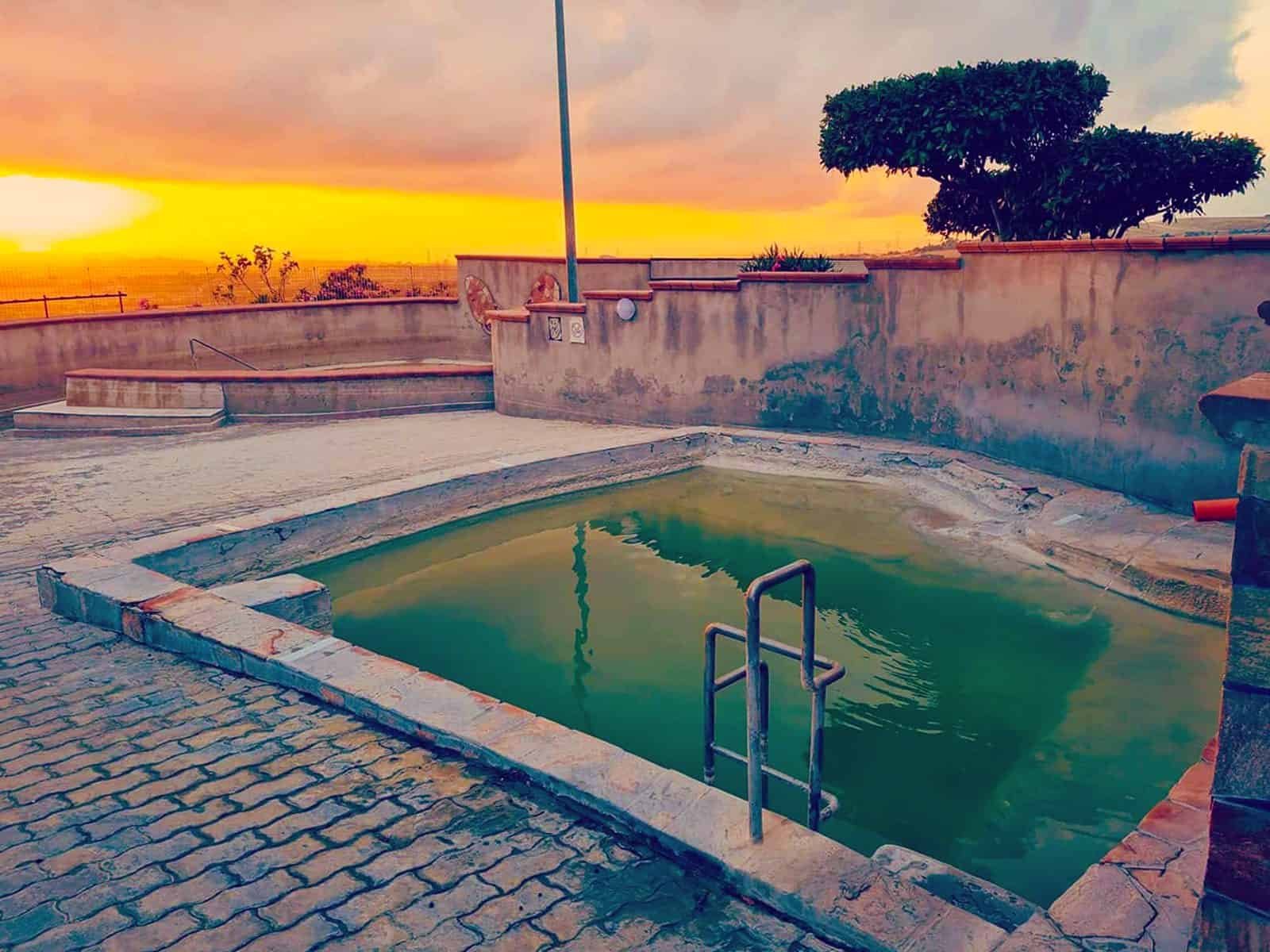
Four kilometers from the center, on Strada della Ficoncella, on the same hill as the Taurine Baths, is one of the best-loved and least touristy places on the northern coast. The Ficoncella Baths, or Ficoncella Bagni, take their name from the fig tree that grows among the pools. It isn't an establishment in the modern sense: they are outdoor stone pools, five according to the municipal indication, with temperatures ranging from 30 to 56 degrees, fed by sulfate-calcium waters indicated for arthropathies, dermatitis, allergies and respiratory disorders.
The view from the pools is double: on one side the valleys and the sea, on the other the Tolfa Mountains of Tolfa. You get there from the A12 by exiting at Civitavecchia Nord and turning right onto Strada della Ficoncella, a couple of kilometers.
The municipal rates distinguish residents and non-residents: for non-residents they are €6 for the morning or afternoon slot and €10 for the full day or the evening, while residents pay €2 for the half day, €3 for the full day and €5 for the evening. Admission is free under six and for people with disabilities in the daytime slot. The ordinary hours cover the morning from 8:00 to 14:00 and the evening from 18:00 on, and in the summer season, roughly from mid-June to the end of August, the evening closing moves to midnight. Useful phone numbers: 366 6323146 and 0766 590241.
An opinion without beating around the bush: the Ficoncella is the best reason to stop in Civitavecchia on a winter evening. With 10 degrees of air and 40 of water, with the steam rising and the lights of the port in the distance, it's an experience that has nothing to envy from establishments that cost 10 times as much. In the middle of August, on the other hand, avoid it: the pools are crowded and boiling water under the sun is a test of endurance, not a pleasure.
The Seafront of Civitavecchia (RM), the Pirgo and the Marina
The historic seafront is the central stretch of Viale Garibaldi, where hotels, restaurants and bars line up. It's the civic promenade par excellence, the one where the town shows itself to itself on Sunday afternoon. Toward the south is the stretch of the Pirgo, much frequented in summer, which takes its name from the ancient Greek-Etruscan place name of the coast.
In recent years the redevelopment has expanded the pedestrian zone and given rise to the area called La Marina, facing the historic basin. It is the most successful urban intervention of recent Civitavecchia and has changed the relationship between the town and its port: for centuries the great wall separated the town from the water, and the Marina has returned a piece of quay to the citizens.
The advice is to walk it at sunset, from north to south, starting from the Fort. The sun sets exactly on the open sea, the light catches the travertine of the wall, and the ships turn on their running lights. It takes 20 minutes and it's free.
The Monumental Cemetery of Civitavecchia (RM)
The monumental cemetery is one of the entries that the old town list reported without explaining it, and it deserves a few lines instead. The monumental Italian cemeteries of the 19th century are open-air sculpture museums and social archives: here you read the names of the families of shipowners, of captains, of papal customs officers, of arsenal workers. After 1943 the painful accounting of the bombings was added to it. The advice is to visit it early in the morning, with respect and without photographing recent burials.
The La Frasca Natural Monument of Civitavecchia (RM)
North of the city, toward Tarquinia, is one of the most interesting stretches of coast in Lazio. La Frasca di Civitavecchia has been a Natural Monument since 2017, established by decree of the President of the Lazio Region of September 29, 2017, number 162, covering 73.77 hectares straddling the municipalities of Civitavecchia and Tarquinia.
The setting is unusual and needs explaining so you won't be disappointed: it is not ancient Mediterranean scrub, but a coastal pine forest planted in the 1950s as a windbreak, alongside herbaceous and shrubby vegetation typical of a salty, rocky environment. The stretch of sea in front is a site of Community importance and hosts posidonia meadows, sea turtles and corals that require special conservation measures.
Archaeology lies beneath the surface. La Frasca includes the area of the ancient Roman port of Columna, built over traces of prehistoric occupation, and you can see the remains of a Roman villa with many ceramic finds and tools that can be dated between the 3rd century BC and the 3rd century AD. Walking on the cliff and recognizing, just below the waterline, the aligned blocks of an ancient quay is an experience you can still have for free in Civitavecchia.
The name comes from the fishermen's habit of planting frasche in the sea, branches set upright, to mark the mouth of the landing place and guide boats in poor visibility. It is pure maritime place-naming, and worth more than many learned etymologies.
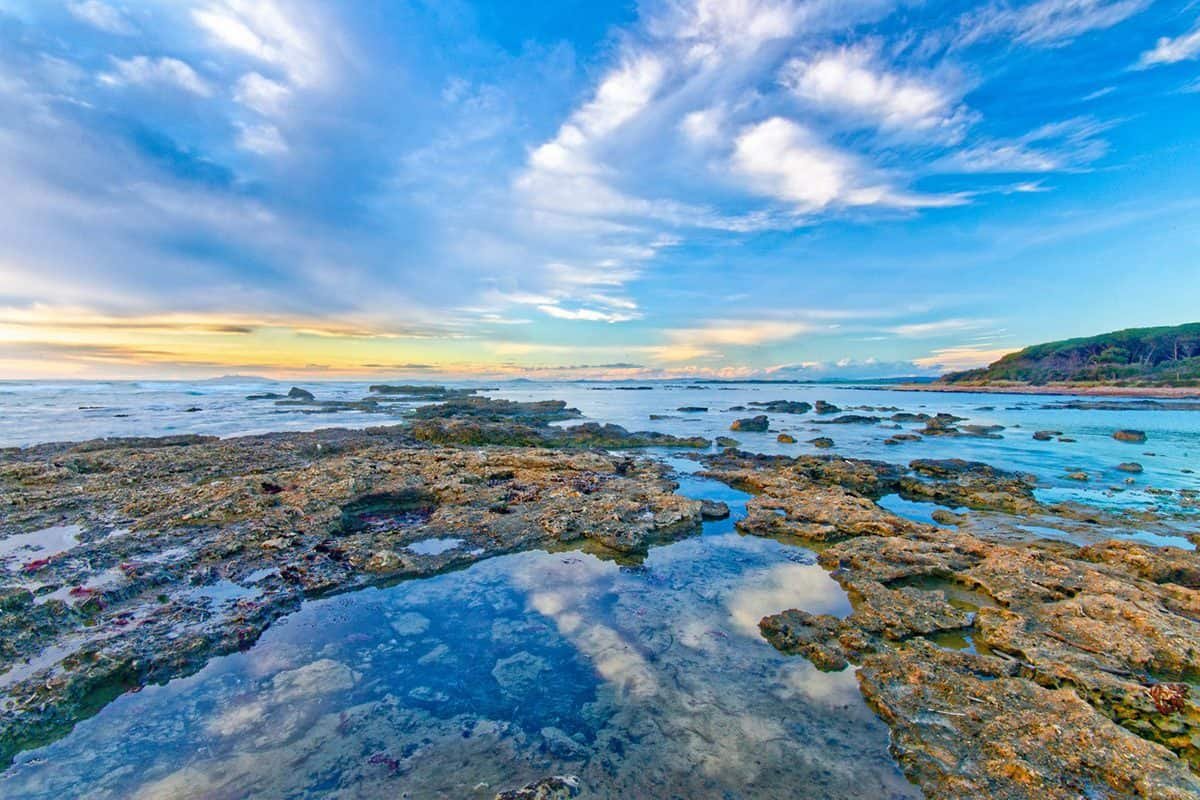
The coast here is low, flat rocks, not sand: if you want a beach, you have to head south, toward Santa Marinella and Santa Severa. If you want clear water and interesting seabeds, stay at La Frasca, with rubber water shoes and a mask. In the warm months the roadside parking fills up early: get there by nine.

Civitavecchia (RM) with Kids and the Aquafelix Park
The Aquafelix water park, opened in 1995 on the Aurelia at the edge of the city, covers 80,000 square meters and remains the summer destination for families all along the north coast. Attractions include the multi-lane Multisplash slide, the two-person Mozza Fiatum, the Vortex and the Aspides, which the park presents as the biggest cone in Italy. The opening calendar is seasonal and prices change from year to year: check them on the park's official website.
Outside the park, Civitavecchia with kids works better than you'd expect. The Fort seen from the pier appeals to anyone under 12. La Ficoncella, in the morning slot and with the milder pools, is an open-air hot bath that little ones remember. La Frasca is a marine biology lab at no cost, with crabs, tide pools and ancient remains below the waterline. And the passing of the cruise ships, seen up close from the waterfront, has an effect on kids that no museum matches.
Anyone organizing a day for families or a group with special needs can rely on licensed professionals: the tour escort service from TourLeaderPro covers the north coast and Rome.
The History of Civitavecchia (RM), from Neolithic Flints to Cruise Ships
Few Italian cities have a biography so orderly and so violent at once. Civitavecchia is born, is destroyed, moves, returns, changes its name, is destroyed again, rebuilds. Every time around the same inlet.
Prehistory
The area was inhabited from very ancient times. Near the Fiumaretta stream, Neolithic flint arrowheads and scrapers have been found. At Mattonara, Malpasso and Torre Chiaruccia, coastal erosion has brought to light many refuse deposits from huts of the Bronze Age and Iron Age. These were peoples who drew their livelihood from the sea: Civitavecchia's maritime vocation predates the first Roman brick by millennia.
The Etruscan Pagi
Pliny the Elder, in the Naturalis Historia, in book III devoted to the geography of the western Mediterranean, listing the peoples of ancient Etruria, names the Aquenses Taurini and the Castronovani. The location of the two settlements has been established: the first near the Ficoncella hill, close to the remains of the Baths of Trajan, the second near the Marangone stream.
The whole area is dotted with the remains of Etruscan tombs, and it is reasonable to assume that even in pre-Roman times a small Etruscan settlement prospered where the city center is today. The Etruscan necropolis of Mattonara, not far from the Molinari plant, was discovered in 2002 and can almost certainly be dated to the 7th-6th century BC. It was probably connected to the nearby Scaglia necropolis.
Historians and archaeologists agree on the existence of a very ancient cellular port, that is, one formed by small parallel basins each able to hold a single boat. The remains of these landing places were still visible at the end of the 19th century near Michelangelo Fort. This is the most elegant hypothesis on the origin of the place name Centum Cellae: a hundred cells, a hundred small basins.
The Roman Period
The area doesn't truly become a city, nor does it appear in Roman documents, until Trajan's return in 103 AD. The first attestation of the name Centumcellae is in the letter of 107 in which Pliny the Younger informs Cornelianus that he has been summoned by the emperor for the Consilium Principis at his villa. Trajan had established his residence there precisely to speed up work on the port.
Centumcellae then appears in the Itinerarium Maritimum among the ports and landing places on the route that led from Rome to Provence: it was a fixed stop on the Tyrrhenian route.
The meaning of the name has been debated for centuries. Some link it to the inlets of the coast, others note that centum in Latin often indicates an indefinite number, a "many", and link it to the rooms of the imperial villa, whose exact location remains disputed. Anyone who wants an idea of what Trajan's residences looked like can go up to the Villa of Trajan at Arcinazzo Romano, in the mountains east of Rome: a different structure, same patron, same taste.
The conventional date for the Roman foundation falls around 107, when the port works should have begun, with completion around 110. During construction the city took on a regular Roman layout and the cardo maximus was laid out, today's Corso Marconi.
At the end of the empire, when many once-flourishing centers were declining rapidly, Centumcellae kept its importance: Rutilius Namatianus attests to this at the beginning of the 5th century.
The Byzantine Early Middle Ages
The Byzantine Empire took control of the city between 537 and 538, wresting it from the Goths. Procopius of Caesarea, narrating the Gothic war, stresses the strategic importance of the occupation, explaining it by the city's size and large number of inhabitants and by a port still in full working order.
Under Byzantium the city formally depended on the Duke based in Rome, but real command lay with the Count at the head of the military garrison. One of them, a certain Theophanius, who lived toward the end of the 6th century, is mentioned in the Dialogues of Pope Gregory the Great, praised for the mildness of his rule. It is a precious detail: it means that the name of a garrison officer of a port city has reached us through a devotional text.
Byzantium kept control until the 8th century. The city passed to the Papal State in 728. Pope Gregory III had the walls restored in 740, and they allowed the city to resist the attempted occupation by the Lombard militias led by Duke Grimoald in 749.
The Saracens, the Destruction and Leopoli-Cencelle
The Gregorian walls were not enough against the Saracens. The danger already shows in 776, when there is news of pirate ships brought to Centumcellae and set on fire. Between the end of 813 and the start of 814, Einhard, court historian of Charlemagne, records in the Vita Karoli a first devastating raid with looting. Other raids followed, until the destruction of the city in 828.
The inhabitants found refuge in the surrounding woods. In 854 Pope Leo IV, to give them a stable and safe home, consecrated a new city not far away, among the hills of the Tolfa Mountains, on the left bank of the Mignone river, on the ruins of a preexisting Etruscan pagus. According to the pontiff's biographer it was to be called Leopoli, but the documents show that it kept the name Centumcellae, also because the bishop had moved there, bringing with him the title of the ancient diocese.
This new city, equipped with 10 towers and three gates, prospered for a long time as a free commune, gradually changing its name to Centocelle and then Cencelle. In 889 part of the population went back to the coast, to the original city, renaming it Civitas Vetula, old city, to distinguish it from Cencelle. That is where the modern name comes from.
The historical research of Odoardo Toti from 1958 and the archaeological investigations carried out at the site of the Leonine city by Professor Letizia Pani Ermini of the University of Rome La Sapienza from 1998 have made clear that Leopoli-Cencelle was not abandoned at all in 889: it died out definitively only in the second half of the 15th century, together with the discovery of alum in the Tolfa Mountains and the resulting commercial development of the coastal city. Around 1072 the latter appears for the first time as a Rocca on the ruins of the port, with the name Civita Vetula or Civita Veccla.
The Late Middle Ages and the Prefects of Vico
Little is known about the first centuries of the reborn city. In the 11th century Count Ranieri of Civitacastellana and the Monastery of Farfa, the imperial abbey of the Sabina that at that time controlled lands and ports across half of central Italy, held lordship over Civita Vetula. Pope Innocent II then granted Civita Vetula as a fief to Pietro called Latro, of the Roman Corsi family.
The feudal lords who held it longest were the Prefects of Vico, to whom sovereignty was initially granted by Frederick Barbarossa and then confirmed by Pope Urban IV. Contesting the fief with them was the noble Romani family, who held power over the Rocca before returning it to Giovanni di Vico in 1347: the source is Carlo Calisse, Storia di Civitavecchia.
The last feudal lord was Giacomo Di Vico, who joined the Colonna against Pope Eugene IV. In 1431 the pope sent against him the army commanded by Cardinal Giovanni Maria Vitelleschi, made up of the best condottieri of the time: Fortebraccio, Ranuccio Farnese and Menicuccio dell'Aquila. Despite overwhelming numerical superiority, the fortress proved impregnable and Giacomo Di Vico managed to negotiate a surrender, ceding the city for 4,000 gold florins. 4,000 florins was a dizzying sum: the pope preferred to pay rather than keep running against those walls.
The Renaissance and the Era of the Building Popes
While the Roman nobility fought over the fief, the people developed their own communal statutes: the first known translation into the vernacular dates to 1451 and is the work of Bartolomeo di Ser Giovanni da Toscanella, vicar of Civitavecchia. At the head of the communal magistracy was a Viscount in office for four years, assisted by a Camerlengo with the functions of treasurer and by two assessors called councilors or officials.
With Eugene IV's victory, papal power was consolidated. Nicholas V restored the walls in 1455, and Sixtus IV gave the city an efficient aqueduct. But it was Julius II who gave the greatest impulse, starting work on the fortress to a design by Bramante.
In 1522 the Order of the Knights Hospitaller, driven out of Rhodes by the Turks, settled in Civitavecchia with Grand Master Philippe de Villiers de L'Isle-Adam and remained there until 1530, the year Charles V granted them the island of Malta, from which they took the name we know them by. For eight years, then, the seat of the future Knights of Malta was a city in Lazio.
In 1535 Paul III blessed at Civitavecchia the ships of the Venetian, Genoese and Spanish fleets that left the port to fight the pirates of Tunis, whose leader was the corsair Aruj Barbarossa. In the same year the keep of the Fort was completed.
Throughout the 16th century the city was fortified: the walls of Sangallo, begun in 1515 and finished in 1555 under Julius III, and defense works later lost in the bombings of the last war, such as the bastion of the old dock and the four watchtowers of Chiaruccia, Marangone, Valdaliga and Bertalda.
Sixtus V established the permanent papal fleet based at Civitavecchia in 1588, supplying the city with water from the San Liborio spring. Clement VIII, Paul V and above all Urban VIII brought the port back to full efficiency.
In the 17th century Alexander VII gave the city an imposing arsenal, destroyed in the Allied bombings, and the port became vital for the capital's grain supply. In less than a century the population went from 1,000 to 3,000 inhabitants. The arsenal was the indispensable support of the papal fleet engaged against piracy and against Ottoman expansionism.
In 1693 Civitavecchia obtained the status of city. The year before, Innocent XII had promoted the restoration of Trajan's ancient aqueduct, with the capture of new springs. On May 6, 1696 the pontiff went to the city in person to spur the completion of the work, 35 kilometers long. At the start of the 18th century Civitavecchia became the seat of a governor and capital of a province, including the territories of Tolfa, Allumiere and Tarquinia. The city authorities, however, remained the Renaissance ones, the viscount and the chamberlain.
The French, Siege and Empire
The golden century ended with the French occupation of the Papal States: the French took possession of the city and the port in 1798. In the same year a French division of 6,000 men led by General Desaix gathered and embarked there, destined by Napoleon Bonaparte for the Egyptian campaign. For this purpose the entire papal fleet was requisitioned. Civitavecchia, that is, is one of the ports from which the army that would find the Rosetta Stone departed.
In November 1798 the Austrian general Mack, at the head of the army of the Kingdom of Naples, invaded the Papal States, and the French troops withdrew from the cities to concentrate. The institutions of Civitavecchia chose neutrality. When the French tried to return, on February 1, 1799, the city closed its gates, starting a siege that lasted over a month. The French forces amounted to about 3,000 men well equipped with heavy artillery, led by General Merlin. Despite the overwhelming superiority they failed to breach the walls, and the people of Civitavecchia were able to negotiate an honorable surrender. This episode, which almost never appears in national textbooks, is the moment when the city exists politically on its own.
In 1809 the Papal States were annexed to the French Empire and Napoleon gave great impetus to the city's infrastructure and institutions: the Court, the Chamber of Commerce and an important Weather Station were created.
From the Restoration to United Italy
With the return of Pius VII in 1814 the Office of Maritime Health was created with authority over the whole coast of the State. Civitavecchia became the capital of a Delegation and the viscount and the chamberlain were replaced by a gonfalonier, with the functions of mayor, assisted by a council of six Elders. Leo XII restored the episcopal seat, suppressed since the fall of Centumcellae and since then united with that of Tuscania. Under Gregory XVI important buildings were constructed, among them the Teatro Traiano.
The people, of liberal sentiments, joined the Risorgimento movement at once. On February 9, 1849, the day the Roman Republic was proclaimed, the first tricolor flew over Forte Michelangelo. The enthusiasm did not last long: on the following March 24 the French troops of Louis Napoleon Bonaparte, commanded by General Oudinot, landed in the city with the thinly veiled intention of putting the pope back in his place. The people offered no resistance, wrongly convinced that the French would play the role of liberators from clerical oppression that had been theirs a few years earlier.
The last 20 years of papal rule, under Pius IX, were marked by important public works, among them the Civitavecchia-Rome railway section of 1859: the same line as the FL5 you travel on today. On September 16, 1870, four days before the Breach of Porta Pia, the Italians led by Nino Bixio entered the city between lines of cheering crowds. A papal power more than 1,000 years old was ending, begun with some discontinuities in 728.
The Second World War and the 76 Bombings
This is the page that the people of Civitavecchia have not forgotten and that the visitor must know to understand the look of the city. Civitavecchia was razed to the ground by Allied bombs in the course of 76 bombings that went on from May 14, 1943 to June 1944.
The political background is old. The city was a place of strong partisan movement, and the roots go back to the Arditi del Popolo, a formation founded in 1921 by Argo Secondari, a former highly decorated assault soldier. That formation brought together mostly anarchists, but also communists, socialists and other left-wing militants. The support of the working masses was so significant in Civitavecchia that the flag of the city's Arditi del Popolo took on national significance as the pennant of the antifascist defense squads. The paradox is that Mussolini made frequent visits to this very city.
On June 10, 1940 Italy entered the war. Civitavecchia's first resource, the port, was the first to feel it: traffic collapsed from 1,000,215 tons handled in 1938 to 39,000 tons in 1944. Food was scarce and prices rose. A police notice of 1941 announced that fish had almost completely disappeared, because the little that was caught was bought by Roman merchants.
The real terror began on May 14, 1943 at 15:20: for 15 minutes, 48 American Flying Fortresses rained destruction on the whole city. The conservative count of the dead comes to about 400, the injured to more than 300. The port became unusable and the railway lines were cut. There was no food, there was no housing: the only solution was to take refuge in the nearby towns.
Other dates followed that are still remembered in the city: August 30, 1943, November 21, 1943, December 16, 1943, six raids in May 1944 alone and the last bombing on May 22, 1944. Civitavecchia was devastated to the extent of 95 percent of its public and private buildings. The cathedral, the medieval quarter, Santa Maria Church and the ancient Rocca were razed to the ground.
Between 1943 and 1944 the city was practically abandoned and the municipal seat was moved to Santa Marinella. With the arrival of the Allies an attempt was made to rebuild an administration, but the population had neither roof nor food, and to the shortage were added bands of refugees and Sardinian soldiers who, in order to return to their island, assaulted farmers and plundered the already scarce livestock. The fallen from Civitavecchia in the armed forces alone were more than 200.
The reconstruction was long and in some respects has never been declared finished. On March 8, 1999 Civitavecchia received the Gold Medal of Civil Valor for the sacrifices of the population and for the damage suffered.
The Administrative 20th Century
Two dates that tell how the municipality shrank in area while the city grew in inhabitants. In 1949 Civitavecchia ceded the hamlet of Ladispoli to the municipality of Cerveteri. On October 4, 1949 Santa Marinella and Santa Severa split from Civitavecchia, becoming an independent municipality. The north coast, as we see it today, was born from those two administrative acts.
The Coat of Arms of Civitavecchia (RM): Leandro, the Oak and the Letters O.C.
On the city coat of arms stands an oak with the letters O.C., and around those two letters one of the most solid municipal legends in Italy has been built.
The account, exalted by Vincenzo Annovazzi and fed by mistaken historical interpretations, says that 60 years after the Saracen invasion of 828 the population of Leopoli was unsure whether to go back among the ruins of the old Centumcellae or to stay in the new settlement, far from the sea but better protected. The young people attached to their native place are said to have gathered in the open countryside in the shade of a great oak to decide. When those against returning were about to win the majority, an old sailor named Leandro is said to have intervened, one of the survivors of the ancient city, whose eloquence was so convincing that it reversed the outcome and made everyone vote unanimously for the return. From that speech, according to the legend, come the letters O.C., "Ottimo Consiglio", and the main square would be named after him, still Piazza Leandra today.
The critical reconstruction is different and, in our judgment, much more beautiful. The name of the square most probably goes back to the oleander, following the medieval custom of dedicating streets and squares to plants: nearby there are in fact Vicolo dell'Olmo, Via Colle dell'Olivo, Via di Laura, that is, the laurel. And the letters O.C. would not be the initials of "Ottimo Consiglio", but of ORDO CENTUMCELLENSIS, in memory and in honor of the city's Roman origins.
The figure of Leandro was born from the romantic imagination of Father Alberto Guglielmotti, historian of the papal navy, was accepted as historical by Carlo Calisse and was uncritically believed up to our own day. The research of Odoardo Toti from 1958 and the excavations of Letizia Pani Ermini on the Leonine city from 1998 have taken it apart.
The verdict is clear: the legend of Leandro is a fake, but it is a fake that tells the truth. It recounts precisely the only thing that matters in the history of this city, namely that the people of Civitavecchia have stubbornly chosen the sea even when the sea brought only trouble. Taking it apart philologically is a duty. Throwing it away would be foolish.

Why Rome Has a Neighborhood Called Centocelle
The question comes up on cue every time someone explains the origin of the name Centumcellae, and the answer is that the two Centocelles have nothing to do with each other. The Roman neighborhood takes its name, according to the current reconstruction, from the 100 best horsemen of Constantine I's imperial guard, the Equites Singulares Augusti, who lived in the military citadel built where the neighborhood now stands. The origin is at least a couple of centuries later than Trajan's Centumcellae. Same word, two separate stories: a mistake you often hear repeated in improvised guides.
Traditions and Folklore of Civitavecchia (RM)
Civitavecchia's civic calendar is packed and almost entirely maritime. If you plan your trip to coincide with one of these dates, you see a different city from the one you find on weekdays.
The Procession of the Dead Christ
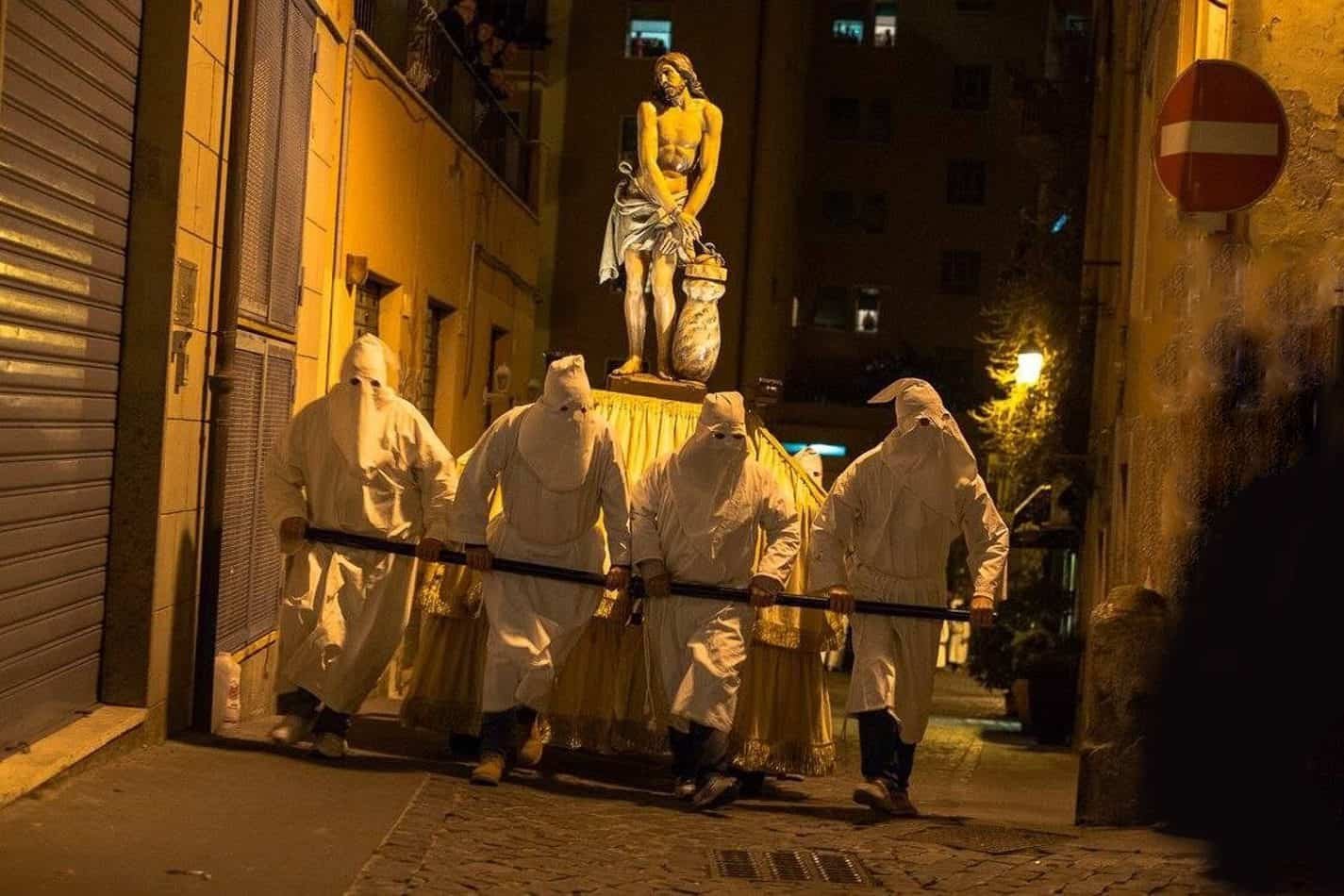
On Good Friday the city reenacts the Passion and Death of Christ with a procession through the center. It is the most deeply felt rite of the year, with the confraternities in their robes, the effigies carried on shoulders and the lights turned off along the route. If you've seen the processions of southern Italy, you'll find a more sober version here, more maritime, without Baroque theatricality but with solid popular participation.
The Pastorelle of December 23
On the day before Christmas Eve, since the postwar period, musical groups go around the city singing traditional Christmas songs. They're called the "Pastorelle" and it's a rite that came from below, with no institutional direction. If you're in Civitavecchia on the evening of December 23, you hear the music arriving from different streets at the same time.
Carnival
On the last Sunday of Carnival before Shrove Tuesday the city holds a parade of costumed participants and themed allegorical floats through the city streets, with the participation of almost all the city's schools, from preschool to high school, and of many associations. It's a school and civic carnival, not a tourist one: which makes it, for those who like watching communities, more interesting than many famous carnivals.
Santa Fermina, April 28
The patron saint of Civitavecchia's sailors is celebrated on April 28. Tradition has her martyred in 306 in a cave where Forte Michelangelo now stands. The celebrations stretch over about 10 days, from April 19 to 28, with a program that in recent years has included a performance of the oratorio Il martirio di Santa Ferma, an 18th-century work by Antonio Caldara, in the Cathedral, a historical lecture on the saints passing through the port, the concert of the Italian Navy Band at Teatro Traiano, free with reservation, the triduum of preparation from April 25 to 27, and on the 28th the bishop's Pontifical Mass, the twinning between the mayors of Civitavecchia and Amelia, an Umbrian city tied to the same saint, and the procession.
The moment to see is the afternoon of the 28th: the statue with the relics is taken out to sea for the blessing and for the offering of a wreath to the seafarers who died on the job. A saint who leaves the church and goes out on the water to count her dead: if I had to choose a single event a year to see in Civitavecchia, I'd choose this one.
The Ferragosto Padellone
On Ferragosto, on Viale Garibaldi, the "Padellone" takes place: a giant fish fry cooked and handed out to everyone present, in memory of the Saracen landing that the armed population pushed back into the sea. On the same occasion the city celebrates the city's birthday, that is, the refoundation in 889, even though the Roman settlement dates back to Trajan. A city birthday celebrated with fried fish is one of the few things that make Italy inimitable.
What to Eat in Civitavecchia (RM)
The cooking is that of the Tyrrhenian catch, simple and unsophisticated. Blue fish, anchovies and sardines, remains the foundation. Soup fish, gurnard, scorpionfish, weever, is the base of the home dish. Mixed fry is the signature dish, and the Ferragosto Padellone is its collective celebration.
From the hinterland come the products of the Tolfa Mountains: Maremma beef, sheep cheeses, mushrooms and chestnuts from the woods of Allumiere, oil from the hills. The local wine is that of coastal Tuscia and Roman Etruria, mostly whites from trebbiano and malvasia grapes. I don't name restaurants, for a simple reason: in port cities the offer turns over fast and a recommendation from two years ago may already be out of date. The practical rule is old and it works: get at least 500 meters away from the port gate and read the menu before sitting down. The trattorias that live off residents are uphill from the Corso, not on the pier.
What to See Around Civitavecchia (RM)
The area is one of the richest in Lazio and Civitavecchia works very well as a base. To the south, along the Aurelia, are Santa Marinella with its sheltered bay and the Castle of Santa Severa, one of the most beautiful monumental complexes on the coast, built on the ancient Etruscan Pyrgi. Further down still, Cerveteri with the Banditaccia necropolis and Ladispoli.
Inland, half an hour on the provincial road, you climb to the Tolfa Mountains: the village of Tolfa with its fortress and Allumiere, which owes its name and its existence to the alum mines discovered in the 15th century, the raw material that dyed the fabrics of Europe and for decades financed the papal coffers. It is the same alum that, enriching the coastal port, helped extinguish Cencelle.
To the north, beyond the provincial border, are Tarquinia with the painted tombs, a UNESCO heritage site, and, further inland, Tuscania with its Romanesque basilicas. In all these directions you are within an hour's drive.
If you arrive by ship and have only one day, you have a choice to make, and the answer is simple: if you have never seen Rome, go to Rome. If you have already seen Rome, stay here and do Tarquinia plus Civitavecchia. It pays off far more than a breathless dash to the Colosseum with the fear of missing the ship.
Accessibility and Practical Visit Information for Civitavecchia (RM)
The waterfront, from the station to the Fort to the Marina, is flat and largely pedestrian or with wide sidewalks: it can be done in a wheelchair without particular difficulty. The Historic Center, instead, is something else entirely: Piazza Leandra and the alleys around it are uphill, with irregular paving, steps and narrow passages.
The National Archaeological Museum is the subject of a PNRR construction site that includes precisely the removal of architectural barriers: it is worth asking the museum's phone number about the state of the work. The Terme Taurine area is an archaeological site on a hill, with dirt paths and level changes. La Ficoncella has open-air pools reached by walkways that are partly rough, but the municipal fees indicate free admission for people with disabilities in the daytime slot.
For duration: half a day is enough for the port, the Fort seen from outside, the Marina and the Historic Center. A full day lets you add the Archaeological Museum and the Terme Taurine. Two days allow you to fit in Ficoncella, La Frasca and a side trip to Tolfa or Tarquinia. For organized groups and visits led by licensed professionals there are the services of TourLeaderPro in Rome and Lazio.
When to Go to Civitavecchia (RM) and When to Avoid It
April and May are the best months: mild temperatures, the sea already readable, Santa Fermina on April 28, the countryside of the Tolfa Mountains in bloom. September and October are equally good, with the advantage that cruise traffic starts to thin out and the water is still warm.
July and August have to be managed. The heat on the waterfront is dry and breezy, but the city works at maximum traffic and the center empties of residents. La Ficoncella in August is not advisable, La Frasca is crowded, parking is impossible to find.
Winter is the season I recommend to anyone who has already seen everything else. From November to February Civitavecchia goes back to being a port city and not a logistics platform for tourists: the pools of La Ficoncella in the steam, the mistral wind on the antemurale, the lights of the ships at anchor. To be avoided without appeal: the days of double or triple ship calls in high season, when between seven and 10 in the morning the port front becomes impassable. The docking calendars are published by the companies that manage port services and are worth a look before leaving.
A Curiosity About Civitavecchia (RM)
For eight years, between 1522 and 1530, the headquarters of the Order of the Knights Hospitaller of St. John was in Civitavecchia. Not in Rhodes, which they had just lost after the Ottoman siege, and not in Malta, which they had not yet received. Grand Master Philippe de Villiers de L'Isle-Adam, who left Rhodes with the honors of war and with what remained of the fleet and the archives, searched for years for a base. The pope granted him Civitavecchia. For eight years the oldest and most famous military order in Europe had its operational base in a port city of Lazio, and from there it negotiated its own survival with the European courts.
It all ended in 1530, when Charles V granted them the island of Malta for a symbolic rent, and from that moment history knows them as the Knights of Malta. But the Lazio piece of their story is documented and almost never told. If you think about it, it also explains why the papal port was considered such a safe place: hosting a military fleet without a homeland for eight years, with all that meant in terms of supplies, shipyards, warehouses and security, is not something you ask of just any landing place.
There is more. In 1535, five years after the knights' departure, the joint fleet of Venice, Genoa and Spain, blessed by Paul III, sailed from the same basin, headed against the pirates of Tunis commanded by Aruj Barbarossa. And 36 years later, at Lepanto, the flagship of the Papal State, the Galley San Pietro, fought the decisive battle: a piece of its stern is today the balustrade of the organ loft in the Orazione e Morte Church. Three episodes, one same stretch of water, a century and a half of Mediterranean naval warfare that all passes through here.
Among all Italian port cities, Civitavecchia is the one that has done the least to tell its military role. Genoa, Venice and Livorno have built whole narratives on much less.
One Thing Nobody Tells You About Civitavecchia (RM)
That the city was founded twice, in two different places, and that the second place still exists, in ruins, about 20 kilometers away, in the middle of the hills.
When the Saracens destroyed Centumcellae in 828, the surviving population did not rebuild on the spot. Pope Leo IV in 854 consecrated a new city for them on the hills of the Tolfa Mountains, on the left of the Mignone river, over the ruins of an Etruscan pagus. The pope's biographer calls it Leopoli, the documents keep calling it Centumcellae, and people will end up calling it Cencelle. 10 towers, three gates, a bishop, its own statutes: a real city, uphill, far from the sea, built on purpose so that the sea would not come back to do what it had done.
The traditional version says that in 889 everyone went back down and Cencelle died out. It is false. The research of Odoardo Toti from 1958 and the excavations carried out since 1998 by Letizia Pani Ermini of the University of Rome La Sapienza have shown that the two cities coexisted for five and a half centuries. Cencelle died out only in the second half of the 15th century, when the discovery of alum at Tolfa definitively shifted the economic center of gravity toward the port, and the coastal city, reappeared around 1072 as Civita Vetula, took everything.
It is a story worth keeping in mind while looking at the port. For 550 years, above these hills, there existed a twin of Civitavecchia that had chosen the mountain instead of the water. It lost. The archaeological site of Leopoli-Cencelle is the object of university excavation campaigns and is not an equipped tourist attraction: if you want to see it, ask the competent bodies about the terms of access. But knowing it is there changes the way you look at the city below.
The Advice I Give You for Visiting Civitavecchia (RM)
Don't arrive by ship. Or rather: if you arrive by ship, don't let the ship decide your day.
The operational advice is this. Take the train from Roma Termini early in the morning, get off at Civitavecchia around nine, turn left on leaving the station and walk along Viale Garibaldi toward the Fort. One hour among the Marina, the sea wall, the Vanvitelli Fountain and the front of the Fort. Then climb toward Piazza Leandra through the Archetto, spend an hour on the Historic Center and the Orazione e Morte Church. Eat uphill from the Corso, not on the pier. In the afternoon take a taxi or the bus to the Terme Taurine, after phoning the Pro Loco to make sure it is open, and finish at La Ficoncella toward sunset. Return by the evening train.
It is a full day and costs very little: a regional round-trip ticket, three euros for the museum, five for the Terme Taurine, six or 10 for La Ficoncella. Under €40 per person, everything included, not counting lunch.
The second piece of advice concerns the opposite of what everyone does. Someone arriving in Civitavecchia on a cruise gives the city, on average, zero minutes. Someone arriving from Rome for a day trip gives it on average two and a half hours. Both go wrong in the same direction: they treat Civitavecchia as an entrance or an exit, never as a destination. Give it a whole day, or two, and you will realize that this city gives you back more than you have granted it. It is exactly the kind of place that rewards those who stop.
Third piece of advice, a technical one: always phone ahead. The Museum, the Terme Taurine and the Fort all three have changing access situations among PNRR construction sites, overlapping responsibilities between the Comune, the State and the Navy, and management entrusted to the volunteers of the Pro Loco. A number dialed the evening before is worth more than any printed program.
Another Well-Known Fact, Yet Rarely Cited
That Michelangelo Fort is not by Michelangelo, or rather, it is only for the upper part of the central tower.
Insiders know it, the scholarly entries say it, and yet in everyday practice it disappears. The design is by Donato Bramante, commissioned by Julius II in the early 16th century: quadrangular plan, four corner towers, sloped walls designed to withstand firearm artillery. It is military architecture at the technological frontier, contemporary with the Belvedere Courtyard and the first drawings for the new basilica of St. Peter. Bramante dies in 1514, the building site continues under others, and only in 1535, by the will of Paul III, is the upper part of the hexagonal keep completed, attributed to Michelangelo Buonarroti.
The name that won is that of the last to arrive, and not by chance: Michelangelo was already selling better than Bramante back then. It is worth dwelling on this point, because it tells how fame works in architecture. The same thing happens to the Vanvitelli Fountain in the port: everyone knows it is by Vanvitelli, almost no one knows it dates from 1743, that Benedict XIV wanted it in 1740 in place of an old basin, that it is in travertine and that it represents the head of an old faun. The author's name has eaten the work.
There is a second well-known fact that is rarely cited, and it is of a different order. Civitavecchia has been a gold medal of civil valor since March 8, 1999. It is not a decoration for show: it is the recognition of 76 bombings, 400 dead on May 14, 1943 alone, 95 percent of the built city destroyed. Anyone strolling today on the rebuilt waterfront should know it, because it explains the look of the city's buildings better than any aesthetic consideration. Cities are not ugly by chance: almost always they were rebuilt in a hurry, with little money, by people who had lost everything.
The Right Photo to Take in Civitavecchia (RM)
The photograph everyone takes is Michelangelo Fort head-on, from the esplanade, with the hexagonal keep in the center. It is a good photograph and it would be foolish not to take it. But it is a postcard photograph, and it renders the fortress as an isolated object, which is exactly what it is not.
The right photograph is taken from the Marina waterfront, an hour before sunset, in autumn or spring, when the sun sets far enough north to light the masonry from the side. You position yourself with the sea wall of Urban VIII in the foreground, the Fort behind it, and you wait for a cruise ship to enter or leave the mouth of the port. When the white side passes behind the 16th-century tower you have the image that tells all of Civitavecchia: defense and commerce, stone and steel, the pope and mass tourism, all in a single frame with no need for captions.
Technical tips. Use a medium focal length, between 50 and 85 millimeters equivalent: the wide angle pushes the ship away and takes away its mass. Expose for the masonry and let the sky blow out a little, or take two shots and merge them. The mistral wind, which often blows here in the afternoon, cleans the air and gives you a sharpness that is not at all a given on the Tyrrhenian.
The second photograph, less obvious, is taken at La Ficoncella in winter, around six in the evening, when the steam from the pools rises into the cold air and the lights of the port come on in the background. It is a difficult photograph, because there is very little light and the steam fools the autofocus. Rest the camera on a low wall, set the sensitivity high and accept a bit of grain: the result resembles something nobody else has in their archive. And the third, for those who love details: the Vanvitelli Fountain, up close, with the mouth of the faun in the center. Look for the light reflected from the water of the basin, which rises from below and draws the volumes of the travertine better than any direct sun.
Some Important Events That Happened Here in History
107 AD, the first document. Pliny the Younger writes to Cornelianus that he has been summoned by the emperor for the Consilium Principis at the villa of Centum Cellae. It is the documentary birth of the city, and it happens in a private letter between two cultured friends.
537-538, the Byzantine capture. The forces of the Eastern Empire wrest the city from the Goths. Procopius of Caesarea explains why it was a first-rate objective: considerable size, large population, a port still in full working order while the rest of Italy was collapsing.
749, the Lombard siege repelled. The walls that Gregory III had restored in 740 hold against the militias of Duke Grimoald. Nine years between a restoration and its test in the field: rarely has a public investment given such a quick return.
828, the Saracen destruction. After the raids of 776 and 813-814, the latter recorded by Einhard in the Vita Karoli, the city is razed. The population flees to the hills. It is the only moment when Civitavecchia truly ceases to exist.
854, the foundation of Leopoli-Cencelle. Leo IV consecrates the new city on the Tolfa Mountains. A pope who founds a city to resettle refugees: an early medieval policy of welcome, with 10 towers and three gates.
1431, the siege of Vitelleschi. The cardinal leads against Giacomo Di Vico the best condottieri of the time, Fortebraccio, Ranuccio Farnese and Menicuccio dell'Aquila. The fortress holds out, but the surrender is bought for 4,000 gold florins. End of Civitavecchia's feudalism.
1535, the blessing of the fleet. Paul III blesses in the port the Venetian, Genoese and Spanish ships leaving against the pirates of Tunis. The same year the keep of the Fort is completed. For a moment, Civitavecchia is the naval base of Western Christendom.
1571, Lepanto. The Galera San Pietro, the papal flagship, fights victoriously. A piece of its stern ends up, carved, in the Orazione e Morte Church.
1696, Innocent XII's aqueduct. The pope arrives in person on May 6 to urge the completion of the 35 kilometers of pipeline, a restoration of the ancient Trajanic aqueduct. In 1693 the city had obtained city status.
1798, departure for Egypt. 6,000 men of General Desaix embark here for Napoleon's Egyptian campaign, with the papal fleet requisitioned for the occasion.
February 1, 1799, the French siege. The city closes its gates to General Merlin's 3,000 men and holds out for over a month, obtaining an honorable surrender. It is the moment of greatest political autonomy in the city's history.
February 9, 1849, the first tricolor. On the day the Roman Republic is proclaimed, the Italian flag flies over Forte Michelangelo. It lasts until March 24, when Oudinot's French land.
1859, the railway. Under Pius IX the Civitavecchia-Rome section is inaugurated. The same route as today's FL5: the first modern infrastructure of the northern coast is almost 170 years old.
September 16, 1870, the Italian entry. Nino Bixio enters the city four days before the Breach of Porta Pia. A papal rule that began in 728 ends.
May 14, 1943, 15:20. 48 American flying fortresses bomb for 15 minutes. About 400 dead, over 300 wounded, port unusable, railway cut. Another 75 bombings will follow until May 22, 1944.
October 4, 1949 and 1949, the separations. Santa Marinella and Santa Severa become an autonomous comune, Ladispoli passes to Cerveteri. The northern coast takes on its current administrative form.
February 2 - March 15, 1995, the Madonnina. The small statue of Pantano reportedly wept 14 times. The case becomes national. The Church does not make a definitive pronouncement on its supernatural nature.
March 8, 1999, the Gold Medal for Civil Valor. The recognition comes 55 years after the last bombing.
2025, the cruise record. 3,556,559 passengers and 862 ship calls: Italy's top cruise port and the first ever to exceed 3,500,000, with the new terminal named after Donato Bramante inaugurated the same year.
Who Passed Through Civitavecchia (RM)
Trajan, emperor, stayed here to follow the work on the port in person around 107: his presence is attested by the letter of Pliny the Younger, who was summoned here for the emperor's council. It is the only case in which the founder of an Italian city left us his home address.
Pliny the Younger, lawyer and man of letters, Trajan's guest in 107, author of the description of the imperial villa with the phrase villa pulcherrima cingitur viridissimis agris. Without that letter we wouldn't even know what the place was called.
Rutilius Namatianus, Gallo-Roman poet and senior official, stopped at Centumcellae at the beginning of the fifth century on his way back by sea to Gaul and described in the De reditu suo the still-active port and the baths of Trajan, noting that although they were three miles away they were easy to reach.
Procopius of Caesarea, Byzantine historian in Belisarius's retinue, dealt with the city in his pages on the Gothic war, underlining its strategic importance at the time of the conquest of 537-538.
Pope Gregory the Great did not live here, but in his Dialogues appears Theophanius, count and head of the Civitavecchia garrison at the end of the sixth century, praised for the mildness of his rule: one of the few individual voices that reach us from the Byzantine city.
Pope Leo IV, the pontiff who in 854 founded Leopoli-Cencelle for the refugees of the destroyed city, and Pope Gregory III, who in 740 had its walls restored.
Donato Bramante, who designed the fortress for Julius II, and Michelangelo Buonarroti, who for Paul III completed in 1535 the upper part of the hexagonal keep, giving the fortress the name by which it is known.
Philippe de Villiers de L'Isle-Adam, Grand Master of the Knights Hospitaller, who after the loss of Rhodes established the seat of the Order here from 1522 to 1530.
Pope Paul III Farnese, who in 1535 blessed in the port the allied fleets departing against the pirates of Tunis.
Luigi Vanvitelli, architect of the Royal Palace of Caserta, who in 1743 signed for Benedict XIV the fountain of the historic port.
Pope Innocent XII, who on May 6, 1696 came in person to press for the completion of the aqueduct.
General Louis Desaix, who in 1798 embarked from here with 6,000 men for Napoleonic Egypt, and General Merlin, who the following year besieged the city in vain.
General Nicolas Oudinot, landed on March 24, 1849 to overthrow the Roman Republic, and Nino Bixio, who entered on September 16, 1870 at the head of the Italian troops.
Francesco Navone, architect of the 18th-century cathedral, and Plinio Marconi, who directed its reconstruction, reopening it on October 4, 1950, and Giuseppe Errante, painter from Trapani, author between 1786 and 1788 of the dome of the Orazione e Morte Church.
Argo Secondari, founder in 1921 of the Arditi del Popolo, whose Civitavecchia section took on national value as an anti-fascist pennant, and Benito Mussolini, who paid the city frequent visits just while the partisan movement was growing there.
Antonio Caldara, Venetian composer of the early 18th century, author of the oratorio Il martirio di Santa Ferma, performed in the cathedral for the patron saint's feast.
Odoardo Toti and Letizia Pani Ermini, the scholars who from 1958 and 1998 respectively have rewritten the early medieval history of the city by taking apart the legend of Leandro, which had been built by Father Alberto Guglielmotti and accepted by Carlo Calisse.
Quick Questions About Civitavecchia (RM)
How far is Civitavecchia (RM) from Rome?
About 70 kilometers. By car on the A12 it takes just under an hour outside rush hours, an hour and a quarter on Via Aurelia. By train the regional FL5 line connects Roma Termini to Civitavecchia with about 40 runs a day. The fastest connection takes a little over 40 minutes, ordinary regional trains about an hour and 10 minutes.
How do you get to Civitavecchia (RM) by train?
With the regional FL5 line from Roma Termini, which also stops at Ostiense, Trastevere, San Pietro, Aurelia, Maccarese-Fregene, Ladispoli-Cerveteri, Santa Severa and Santa Marinella. The regional ticket costs a few euros. The Civitavecchia station is a few minutes' walk from the historic port and Michelangelo Fort.
How much does it cost to enter the National Archaeological Museum of Civitavecchia (RM)?
€3 for a full ticket and €2 reduced. Admission is free on the first Sunday of the month, April 25, June 2 and November 4. The museum is at Largo Cavour 1 and the phone number is 0766 23604.
What are the opening hours of the National Archaeological Museum?
From 8:30 to 19:30, closed on Monday, January 1 and December 25. However, works funded by the PNRR are under way and the visitor route is limited to a single floor, with possible extraordinary closures: a phone call before leaving avoids a closed door.
How much do the Terme Taurine of Civitavecchia (RM) cost?
The municipality indicates €5 for adults over 25, €3 for the 18-25 range and for teachers, free for minors under 18 in a family group, and €8 for the guided visit on the first Sunday of the month. The Lazio Regional Directorate of National Museums indicates €5 full and €2 reduced with the usual free admissions. The visits are run by the Pro Loco, phone 351 3440202.
Are the Terme Taurine open?
The available information differs: the municipality of Civitavecchia indicates daily opening from 09:30 to 13:00, while the Lazio Regional Directorate of National Museums reports a closure for consolidation and restoration works funded by the PNRR. Before going up the hill it is best to call the Pro Loco.
How much does La Ficoncella cost in Civitavecchia (RM)?
For non-residents €6 for the morning or afternoon slot and €10 for the full day or the evening slot. Residents pay €2, €3 and €5 respectively. It is free under six and for people with disabilities in the daytime slot.
What temperature are the waters of La Ficoncella?
The pools, five according to the municipal listing, have temperatures between 30 and 56 degrees. The waters are calcium-sulfate and are indicated as useful for arthropathies, dermatitis, allergies and respiratory disorders. If you are not used to it, start with the mildest pool.
Can you visit Michelangelo Fort?
The fort is in the custody of the Italian Navy and the Port Authority and has no continuous ordinary visiting hours. Openings take place on the occasion of events, FAI days and initiatives of the municipality or the Pro Loco. From the outside it is visible and freely photographable from the waterfront and the port esplanade.
Who designed Michelangelo Fort?
The design is by Donato Bramante, commissioned by Julius II. The upper part of the hexagonal keep was completed in 1535 at the wish of Paul III and is attributed to Michelangelo Buonarroti, hence the current name. The local historical name is Rocca di Civitavecchia.
What do the letters O.C. on the coat of arms of Civitavecchia (RM) mean?
The reading accepted today is Ordo Centumcellensis, in memory of the city's Roman origins. The popular reading, "Ottimo Consiglio", is tied to the legend of the sailor Leandro, born from the imagination of Father Alberto Guglielmotti and dismantled by the research of Odoardo Toti and the excavations of Letizia Pani Ermini.
Why is Civitavecchia (RM) called that?
Because in 889 part of the population, who had taken refuge in Cencelle after the Saracen destruction of 828, returned to the coastal site and called it Civitas Vetula, old city, to distinguish it from the new hilltop settlement. The original Roman name was Centumcellae.
Is Civitavecchia (RM) the same thing as Centocelle in Rome?
No. The Roman neighborhood of Centocelle owes its name, according to the current reconstruction, to the 100 elite horsemen of Constantine I's imperial guard, the Equites Singulares Augusti, and its origin is at least two centuries later than Trajan's Centumcellae by the sea.
How much time do you need to visit Civitavecchia (RM)?
Half a day for the port, the Marina, the Fort seen from outside and the historic center. A full day adding the Archaeological Museum and the Terme Taurine. Two days to include Ficoncella, the La Frasca Natural Monument and a side trip to Tolfa or Tarquinia.
Can you swim in Civitavecchia (RM)?
Yes, but the city coast is largely taken up by the port and infrastructure. The Pirgo stretch, south of the seafront, is the one used in summer. For clear water and interesting seabeds there is the La Frasca Natural Monument, to the north, with low rocks: you need rubber shoes. For sand you have to go down toward Santa Marinella and Santa Severa.
Is Civitavecchia (RM) suitable for children?
Much more than you'd think. The Aquafelix water park, open seasonally along the Aurelia, covers 80,000 square meters. La Frasca works as a free reef lab. Ficoncella, in its warmer pools, appeals to the little ones. And the close passage of cruise ships is a show that no museum matches.
Is Civitavecchia (RM) wheelchair accessible?
The waterfront between the station, the Fort and the Marina is flat and easy. The historic center around Piazza Leandra is uphill, with uneven paving and steps. The Terme Taurine are a hilly archaeological site with dirt paths. The Archaeological Museum is affected by works that include removing barriers: it's best to ask by phone.
What do you eat in Civitavecchia (RM)?
Blue fish, anchovies and sardines, soup fish and above all mixed fry, which is the signature dish and at Ferragosto becomes a collective rite with the Padellone on Viale Garibaldi. From the hinterland of the Tolfa Mountains come Maremma beef, pecorino cheeses, mushrooms and chestnuts.
When is the patron saint of Civitavecchia (RM) celebrated?
Santa Fermina is celebrated on April 28, with celebrations spread from the 19th to the 28th. The most characteristic moment is the afternoon procession that takes the statue with the relics out to sea, for the blessing and for the offering of a wreath to the seafarers who died on the job.
What is the Madonnina of Civitavecchia (RM)?
It is a small Marian statue kept in the sanctuary in the Pantano area, in the parish of Santa Maria della Consolazione and Sant'Agostino, which according to witnesses reportedly wept 14 times between February 2 and March 15, 1995. The sanctuary's official website describes it as an image of the Queen of Peace from Medjugorje. The Catholic Church has not made a definitive pronouncement on the supernatural nature of the phenomenon.
How many cruise ships come to Civitavecchia (RM)?
In 2025 there were 862 ship calls, with 3,556,559 passengers in total, of which 1,829,701 in transit and 1,726,858 embarking and disembarking. It is Italy's top cruise port and the first to exceed the threshold of 3,500,000 passengers.
Should you get off the ship at Civitavecchia (RM) or go to Rome?
If you've never seen Rome, go to Rome: the train from the city station gets there in a little over 40 minutes. If you've already seen Rome, stay and combine Civitavecchia with Tarquinia: it pays off much more than a breathless dash with the anxiety of missing the boarding.
Where do you park in Civitavecchia (RM)?
The blue-line spaces in the center are contested, especially on mornings of heavy cruise traffic. Spots are easier to find in the area uphill from Corso Centocelle and along Viale Baccelli. At La Frasca and Ficoncella parking is along the street and in the warm months it fills up by 09:00.
What is the best time to visit Civitavecchia (RM)?
April and May, with the patron saint festival and the countryside in bloom, or September and October, with the sea still warm and cruise traffic dropping. Winter is the season for true enthusiasts: Ficoncella in the steam, the maestrale on the Antemurale, and a city that goes back to being itself.
The Last Word on Civitavecchia (RM)
Thousands of people pass through this port without seeing it. If I had to name one thing this city deserves, it wouldn't be a new museum or more funding: it would be an hour of attention from the people passing through. An hour in front of the Vanvitelli Fountain, inside Orazione e Morte Church, up the Archetto to Piazza Leandra. 60 minutes are enough to understand that Civitavecchia is not the gateway to Rome: it is a city that Rome has used for 1,800 years and that, every time it was leveled, started over from the same stretch of sea. That's not nothing. It's almost everything.
Article written by the editorial team of TourLeaderPro, contact them for Private/Corporate/V.I.P. Tours and Experiences.
Planning a trip to Rome? The English guides to visiting the city are on ItalyPlanner.com.