Odescalchi Castle in Bracciano
In short. Odescalchi Castle in Bracciano is at Piazza Mazzini 14, in Bracciano (RM), on the edge of the cliff overlooking the lake.


Odescalchi Castle in Bracciano is at Piazza Mazzini 14, in Bracciano (RM), on the edge of the cliff overlooking the lake. The visitor entrance, however, is not on the square but a little lower down, at Via Giulio Volpi 12. The full-price ticket costs €10. The reduced price is €9 (university students, military and law enforcement personnel, residents, and people over 65 on Tuesdays). Children between six and 12 years old pay €8, and children under six enter for free. You can pay with VISA, Maestro and Mastercard, and tickets can be bought in advance on the official website odescalchi.it. Hours change between winter and summer. In winter, Monday to Friday 10:00-17:00 with last entry at 16:00, and Saturday, Sunday and holidays 10:00-18:00 with last entry at 17:00. In summer, Monday to Friday 10:00-18:00 with last entry at 17:00, and Saturday, Sunday and holidays 10:00-19:00 with last entry at 18:00. The ticket office closes one hour before the castle. It is open every day except December 25. But since it is a private residence, some rooms, or the entire castle, may close for weddings and receptions. Unscheduled closures are announced on the official website, and before you leave it's worth taking a look. No reservation is needed for the self-guided visit, but it is required for private guided tours. On Sundays and holidays there are optional guided tours included in the ticket price, departing at 10:30, 11:00, 12:00, 12:30, 15:00, 15:30, 16:30 and 17:00. The phone numbers are +39 06 99804348 and +39 06 99802379. The museum's email is museo@odescalchi.it, and the one for events is events@odescalchi.it. From Rome it takes a little under an hour. Take the FL3 Rome-Viterbo regional train from Roma Ostiense, Roma Trastevere or Valle Aurelia (the latter connects with metro line A) to Bracciano station, which is in town. By car, take via Cassia bis or Aurelia and then the provincial road, about 30 kilometers from the Grande Raccordo Anulare. Small dogs are allowed, carried in arms or in a carrier.
If the castle is one stop on a longer day around the lake, the Tourist Attractions page for Lazio helps you fit in the other stops, starting with Lake Bracciano and the village of Bracciano.

Where it is and how to get to Odescalchi Castle in Bracciano
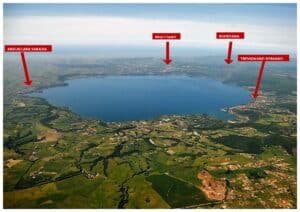
Bracciano is northwest of Rome, on the southern shore of a volcanic lake of 56.5 square kilometers and about 160 meters at its maximum depth. The town sits on a tuff promontory, and the castle occupies its highest and most exposed point, the one from which the lake, the road to Tuscia and the lands of the rivals were controlled together. Anyone who sees it for the first time from the shore immediately grasps the military logic of the place. The five towers rise from the ridge like five fingers closed into a fist, and the cliff serves as a natural base. This is why it's worth taking your time getting there calmly and not jumping straight inside. The way the castle looks changes a great deal depending on whether you approach it from above, from the town, or from below, from the lakefront.
By train from Rome to Odescalchi Castle in Bracciano
The line is the FL3, the one that connects Rome to Viterbo via Cesano and La Storta. Trains leave from Roma Ostiense and Roma Tiburtina, stop at Roma Trastevere and Valle Aurelia, and at Valle Aurelia the transfer to metro line A is on foot, in the same station. On weekdays, on average one train leaves Roma Ostiense every half hour, and the trip to Bracciano takes just over an hour, with the fast regional trains arriving around 10 past the hour. On weekends and holidays services thin out. If you want to take one of the morning guided tours, it's best to check the Trenitalia timetable the night before rather than improvising.
Bracciano station is in the central area, which in practice means about 15 minutes on foot to the castle, almost all of it uphill, with the last stretch through the village's alleyways. It's not a prohibitive walk, but it is a real climb. Anyone traveling with small children, strollers or tired knees should consider this. The train's advantage, on the other hand, is twofold. You avoid the parking problem on busy days, and you can comfortably plan on lunch in town with a glass of wine, which those driving have to keep in check.
By car from Rome and where to park
By car, take the Grande Raccordo Anulare northwest and then the Braccianese, arriving in town after about 30 kilometers. With normal traffic it takes 40 or 50 minutes, a little longer on summer Sundays. The classic mistake is setting the navigator for Piazza Mazzini, which is the castle square but also the town square, with few regulated parking spaces. The ticket office and visitor entrance are at Via Giulio Volpi 12, a little further down, and there are paid parking areas near the historic center. On the busiest days, and on days when the castle hosts a wedding, the upper area gets jammed. The professional tip is simple but it works: park lower down, near the lakefront or along the access roads to the village, and walk up. You save time and you get the view.
How much time you need for the visit
The museum route includes around 20 rooms spread over two noble floors, plus the kitchens, the patrol walkway, the court of honor and the gardens. With a self-guided visit, walking at a good pace and without stopping to read everything, you'll be out in an hour and a quarter. Taking your time, actually looking at the frescoes and looking out of every useful loophole, you'll comfortably take two hours. If you join one of the Sunday guided tours, the total rises to about an hour and a half of talking, plus whatever time you want to spend on your own afterward. The practical suggestion is to plan a full half day for the castle and the village together, and to keep the afternoon for the lake.
Tickets, Hours and Guided Tours at Odescalchi Castle in Bracciano
The castle is not a state museum, and this changes quite a few things. It is a private historic residence owned by the Odescalchi family, whose museum activity is managed by Fondazione Livio IV Odescalchi, which declares more than 60,000 visitors a year. So there are no ministerial free Sundays, there is no public pass system, and the owner makes the rules. Anyone who arrives expecting the conditions of state museums will be caught off guard, so it's better to know in advance.
How much it costs to enter Odescalchi Castle in Bracciano
The official price list sets the full ticket at 10 euros, the reduced ticket at 9 euros, and the child ticket, for ages 6 to 12, at 8 euros. Children under 6 enter for free. The reduced rate applies to residents, university students, military and law enforcement personnel, and people over 65 on Tuesdays only. On this last point it's worth insisting, because it's the classic line nobody reads: a retiree who shows up on a Sunday pays the full price, while the same retiree who comes on a Tuesday pays 9 euros. It's not a difference that changes your life, but for a couple it's 2 euros, and for a group of 12 people it's 24 euros.
Compared with other castles in Lazio, the price is fair. 10 euros for 20 frescoed rooms, one of the most important private collections of arms in Italy, an early Renaissance picture gallery and a patrol walkway with lake views is money well spent. The natural comparison is with the Santa Severa castle, on the coast not far away. They are two very different buildings with two different management models, and in Bracciano you mostly pay for the Renaissance.
Odescalchi Castle in Bracciano opening hours, season by season
In winter the castle opens Monday to Friday from 10:00 to 17:00, with last entry at 16:00, and on Saturday, Sunday and holidays from 10:00 to 18:00, with last entry at 17:00. In summer you gain an hour on each side: Monday to Friday 10:00-18:00 with last entry at 17:00, and Saturday, Sunday and holidays 10:00-19:00 with last entry at 18:00. In both cases the ticket office closes 60 minutes before the castle closes, and there is no entry on December 25.
One recommendation: the last entry isn't the best time to arrive. Entering at 17:00 in summer means rushing through the last rooms while staff start closing the doors behind you. If time is short, it's better to move the visit to another day.
Guided tours included in the ticket
On Sundays and public holidays the castle offers optional guided tours at no extra cost, departing at 10:30, 11:00, noon, 12:30, 15:00, 15:30, 16:30 and 17:00. It's the best opportunity this place offers, and it's strangely underused. Many visitors go in, wander alone, and leave without realizing that half an hour later a guided tour included in the ticket price would have started. Private guided tours, however, must be booked, and for those you go through the museum offices.
Booking or just showing up at Odescalchi Castle in Bracciano
For the standard visit you don't need to book: you arrive, buy a ticket, and go in. The official website does allow advance purchase by credit card, and during spring long weekends, in August and on October weekends, when the village fills up, it's a small insurance policy against the line. For organized groups, school groups and educational workshops it's different. There, advance contact with the museum is required, and the language of the guided visit is also agreed on.
What Odescalchi Castle in Bracciano Really Is
Calling it a castle is correct but reductive. What you visit in Bracciano is a fifteenth-century military machine that was converted, within a century, into a princely residence without ever ceasing to be a fortress. This dual nature is what sets it apart from the castles the public has in mind. It is not a medieval manor remodeled over time, nor a fortified villa in disguise. It is a building designed when artillery was rewriting the rules of defense, and adapted right afterward to the representative needs of a family that dealt on equal terms with the popes.
The Pentagonal Plan and the Five Towers
The plan is an irregular pentagon, with a cylindrical tower at each vertex: five towers, five corners, and a sixth element that complicates the count and that I'll come back to. The choice of circular towers is not aesthetic. Square towers, which the Middle Ages had favored, offer corners where a cannonball concentrates its impact and opens the breach. Cylindrical towers deflect glancing blows and spread the force across the curve. When the construction site in Bracciano opened in 1470, this lesson had only just been learned in the field across half of Italy, and the Orsini castle applied it systematically.
The five towers are not identical in height or diameter, and not for a simple reason: each one faces a different front and has a different job. The one facing the lake protects the least vulnerable flank, and it is the tower where the most refined room in the castle could be built, Sala Papalina. The ones facing the town and the plateau, where the ground is flat and an assault is possible, are the most massive. Anyone looking at the castle's outline from outside sees an asymmetrical profile and attributes it to chance or later additions. In the vast majority of cases, it is actually ballistic calculation.
The Three Walls and the Cliff
The defensive system is organized around three outer walls, which follow one another at different elevations and force any attacker to conquer the same ground three times, each time under fire from above. The tufa cliff does the rest. On the lake side, the natural drop makes any approach almost pointless. At the base of the walls, where the tufa emerges, you can still see hunting scenes carved into the rock, and the layout of the outer wall, marked by pilasters and brick arches. These are details that almost everyone sails past on the way up to the ticket office. Stopping for 30 seconds to look at them changes how you read everything else.
The Patrol Walkway of Odescalchi Castle in Bracciano
The five towers are linked by a patrol walkway that runs along the entire upper perimeter, alternating stairs, passageways, covered loggias and open stretches. It was the nervous system of the defense. It allowed the garrison to move quickly from one front to another without going down into the courtyard, to resupply ammunition to positions under pressure, and to keep watch over the approaches. Today it is the part of the visit that visitors remember most, and for a reason that has little to do with war. From up there you can see the whole lake, the cone of the Sabatini Mountains and, on clear days, the line of the sea toward Civitavecchia.
It's worth walking it twice, clockwise and then counterclockwise. The embrasures and openings face in different directions, so the landscape they frame changes radically. On the second pass, you also stop looking at the view and start looking at the masonry, the joints, the points where a fifteenth-century section is welded to a nineteenth-century repair. That's where the castle tells its own stratigraphy.
The Orsini, Napoleone Orsini and the 1470 Construction Site
To understand Odescalchi Castle in Bracciano, you have to understand the Orsini, and that is not a textbook discussion. In the fifteenth century the Orsini were one of the most powerful families in central Italy, with branches spread across half of Europe, organized, as the castle's own owners describe it, into a kind of family commonwealth: relatives on episcopal thrones, relatives commanding armies, relatives married into ruling houses. Family lore traced the name back to an Ursus nursed by a she-bear, and the bear, with the rose, remained the heraldic emblem you find carved, painted and inlaid throughout the castle.
Before the Castle: Rocca dei Prefetti di Vico
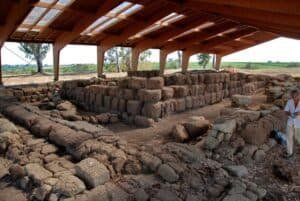
The promontory had been fortified for centuries. The first watchtowers in the area responded to the need to defend against Saracen raids. In the 11th century, the Prefetti di Vico family, lords of the Tuscia, turned the post into a proper fortress, Rocca Vecchia, documented around the 13th century. The Orsini appear as holders of the fief already in the 13th century, according to the reconstruction of Ferdinand Gregorovius, with a period of papal control in the last quarter of the 14th century. In 1419, Pope Martin V, the Colonna pope who brought the papacy back to Rome after the schism, confirmed the fief to the Orsini branch of Tagliacozzo. The castle you visit today does not replace that fortress. It was built around it, enclosed it, and preserves a piece of it.
Napoleone Orsini, the Condottiero Who Wanted the Castle
The commissioner was Napoleone Orsini, son of Orso Orsini of Bracciano, born around 1420 and died in September 1480. His story is not that of a patron of the arts: it is the story of a professional soldier. He fought for Pope Eugene IV against Francesco Sforza in 1443, supported Ferdinand of Aragon in the conflicts between Naples and Milan during the 1450s, led papal troops against Sigismondo Pandolfo Malatesta, and was defeated at Castelleone di Suasa in July 1461. He became commander in chief of the Church's army in 1462 and was wounded in the campaign against Roberto Malatesta, lord of Rimini. And, of course, he fought against the Colonna and the Anguillara in Lazio.
A man with this record, when he opened a worksite on his family's rock in 1470, was not building a whim. He was building the command center of a feudal state, at a time when the Patrimony of Saint Peter was being fought over inch by inch by barons who had private armies. Napoleone Orsini did not see the castle finished: he died in 1480, five years before it was completed.
Who Designed the Odescalchi Castle in Bracciano
Art history moves carefully here, and it's worth doing so in a guide too. The property, in its historical account, indicates that starting in 1470 Napoleone Orsini most likely entrusted the work to the same craftsmen working on the Sistine Chapel, and that Francesco del Borgo and Giovannino de' Dolci, two central names in the Roman architecture of Sixtus IV, may have contributed to the design phase. The most widespread historiographical tradition, repeated by the family itself, instead links the castle to the name of Francesco di Giorgio Martini, the Sienese who was the greatest military engineer of the century. He was supposedly called in by Gentil Virginio Orsini to strengthen the defenses, with work dated to around 1490.
The distinction matters. That the castle was designed by Francesco di Giorgio is a traditional attribution, repeated everywhere and never backed by a contract. That Francesco di Giorgio worked on Bracciano's defenses in the last decade of the 1400s, on the other hand, fits with his documented activity for the lords of central and southern Italy. It should be said: the original design is by Roman craftsmen from the Sistine circle, the military upgrade carries the name of the greatest engineer of the time, and the combination of the two is what makes Bracciano one of the most remarkable examples of Renaissance military architecture in Italy.
Gentil Virginio Orsini and 1485
The work was completed by his son, Gentil Virginio Orsini d'Aragona, born around 1445, who brought the worksite to a close in 1485. Gentil Virginio is the decisive figure in this story, and his career explains almost everything you see in the halls. Captain General of the Aragonese forces from September 5, 1489, Grand Constable of the Kingdom of Sicily in 1494, and invested with the Order of the Ermine in April 1487 with permission to add the Aragonese surname and arms to his own, he wove together loyalty to Ferrante of Aragon and friendship with Lorenzo de' Medici, eventually arranging the marriage of his cousin Alfonsina to Piero de' Medici.
In 1485 the papal troops led by Prospero Colonna devastated the town and the castle: an episode that shows how fragile even a newly finished fortress could be in those years. Also in 1485, local scholarly literature records the stay of Ludovico Gonzaga, bishop of Mantua and son of Marquis Ludovico III, who fled Rome because of the plague. Four years earlier, in 1481, it was Pope Sixtus IV Della Rovere who sought refuge up here from the Roman pestilence, and the Papal Hall takes its name from that stay.
On September 3, 1492, Gentil Virginio bought Anguillara and Cerveteri from Franceschetto Cibo, son of the pope who had just died. It's the deal that will backfire on him: Alexander VI Borgia annulled the sale, then recognized it on August 17, 1493, in exchange for 35,000 ducats, but the bill remains open. Meanwhile, the Bracciano fief had reached the height of its size and wealth, and the castle was its capital.
Orsini vs. Colonna: A Century of War Around Bracciano
You can't understand this castle without understanding the feud. Throughout the 1400s and beyond, Lazio was divided between two baronial families who competed for land, offices, and influence over the papacy: the Orsini, Guelphs, rooted north and east of Rome, and the Colonna, Ghibellines, strong to the south and in the Aniene valley. It was not a symbolic rivalry. It was a war fought with private armies, captured castles, burned harvests, and peace treaties imposed by popes that lasted about as long as a conclave.
Every papal election tipped the balance. A Colonna pope, like Martin V, favored his own family, a pope close to the Orsini returned the favor. Bracciano, with its compact fief around the lake and its control of the road toward Tuscia, was one of the heaviest pieces on the board, and the castle was built precisely to withstand this kind of pressure. When you walk the patrol walkway, it's worth keeping this in mind: those arrow slits were not looking at an abstract enemy, they were looking toward the castles of the neighbors.
The feud left traces everywhere in the area. Anyone who wants to follow its thread can line up the fortresses of the district: from the castle of Palo on the coast, which later also became part of the Odescalchi property, to the fortified villages of southern Tuscia such as Sutri. Bracciano remains the peak of the system because it is the only one that manages to be both an impregnable fortress and a representative palace.
1496: Alexander VI Against Odescalchi Castle in Bracciano
The 1496 siege is the most dramatic episode in the building's history, and also the most misunderstood. The version that circulates says that Pope Alexander VI Borgia, moved by resentment toward the Orsini, seized the castle. The documented reality is more interesting and harsher: the Borgias were pursuing a project to bring the Church's lands back under their own control, and to do so they had to eliminate the baronial families who stood in the way, starting with the Orsini. In February 1496 Gentil Virginio switched to the French side. The pope confiscated his property and set the army in motion.
The papal troops laid siege to Bracciano. The castle did not fall. The papal forces, led first by Giovanni Borgia, Duke of Gandia, and then joined by Guidobaldo da Montefeltro, Duke of Urbino, failed to take it. It is an architectural fact as well as a military one: 25 years after the laying of the first stone, Napoleone Orsini's pentagon did exactly the job it had been built for.
Bartolomea Orsini and the Defense of the Castle
Inside the walls, during the siege, was Bartolomea Orsini. The historical reconstruction of the property credits her with the courage of the defense against the Borgia siege of 1496 and, in all likelihood, with commissioning the frescoes of Sala delle Donne. It is a detail that says a lot about the position of women in the great baronial families: when the men were at the front or prisoners, governing the fief and the military defense of the stronghold passed into the hands of wives, mothers and sisters, and not as a makeshift, but as a recognized role. Bracciano has a municipal library named after her, and in the castle her name should be spoken every time you enter the room with the women's frieze.
Soriano, January 24, 1497
The match ended in the open field. On January 24, 1497, at Soriano, about 500 men deployed by the Borgias clashed with about 300 Orsini, allied with the French king Charles VIII. The battle was very bloody and ended with an Orsini victory and the capture of the papal commander, Guidobaldo da Montefeltro, Duke of Urbino. On February 5, 1497, the peace was signed.
Seven days before the battle that saved his house, on January 17, 1497, Gentil Virginio Orsini died as a prisoner in Castel dell'Ovo, in Naples, where he had been held since September 1496 despite the terms of the capitulation. Contemporary sources suspected poisoning at the hands of King Frederick of Aragon at the instigation of Alexander VI. There is no conclusive proof, and the Dizionario Biografico degli Italiani simply records that he died in circumstances that seemed suspicious. This is the end of the lord who had completed the castle: not on the walls he had strengthened, but in a cell, while his walls held out.
Felice della Rovere, the Gubernatrix of Odescalchi Castle in Bracciano
The next chapter belongs to a woman who would deserve a museum all to herself. Felice della Rovere, born around 1483 in Rome, illegitimate daughter of Cardinal Giuliano della Rovere and Lucrezia Normanni, married Gian Giordano Orsini between May 24 and 25, 1506. The wedding took place at the Cancelleria, in a palace that was then in poor condition and with very few ceremonies, because her father, who in the meantime had become Pope Julius II, did not want to attend. For the Orsini, marrying the daughter of the reigning pope meant buying an insurance policy against the fate that had befallen Gentil Virginio.
Gian Giordano died on October 11, 1517, leaving Felice as regent. Pope Leo X ratified the guardianship with a papal bull, and for over a decade Felice was, in fact, the power in Bracciano: gubernatrix, governor of the state. She administered, dealt with the popes, bought and improved properties, and even handled the grain trade to increase wealth and influence. In 1509 she acquired the castle of Palo, on the coast, which became a papal residence and hunting estate. Her son Girolamo, born on July 7, 1513, would become the fifth lord of Bracciano, and Paolo Giordano I would descend from him. Felice died on September 27, 1536.
The Rediscovered Portrait and the Pastura
Recent art-historical research has added a piece that guidebooks almost never mention. In a study published in the proceedings of Roma nel Rinascimento in 2017, Anna Cavallaro presented an unpublished portrait of Felice della Rovere at Bracciano and recognized in it the work of the painter from Viterbo Antonio del Massaro, known as Pastura, trained in the orbit of Pinturicchio. In the frescoes that portray her, Felice is surrounded by books and inscriptions: not the iconography of the lady, but that of the educated person who governs. Visitors who walk through the rooms with this key in mind look at those friezes differently.
The 1558 Wedding and the Transformation of Odescalchi Castle in Bracciano
The moment when the fortress becomes a palace has one date and two names. On September 3, 1558, in Poggio a Caiano, Paolo Giordano I Orsini married Isabella de' Medici, daughter of Cosimo I. The contract had been signed in Rome on July 11, 1553, when the groom was 12 years old, and the religious ceremony had already taken place in Florence on January 28, 1556. 1558 is the date of the consummation and the start of married life. In 1560 Bracciano became a duchy and Paolo Giordano became its first duke.
With the title came the need for magnificence. Giacomo del Duca, a pupil of Michelangelo, and Nanni di Baccio Bigio were brought in: loggias, triumphal arches and hanging gardens were built. The arch that dominates the entrance driveway, a work by Jacopo del Duca commissioned by Paolo Giordano after the gardens were completed in the last half of the 16th century, alternates the projecting rustication with the Orsini roses, topped by the family coat of arms. It is the first piece of the castle you encounter as you climb, and it already announces the change of tone: no longer defense, but ceremony.
Isabella de' Medici, Duchess of Bracciano
Isabella was born in Florence on August 31, 1542, the third daughter of Cosimo I and Eleonora di Toledo. She lived mainly in Florence, in the Medici palace on via Larga, at her father's wish, even though her husband was lord of Bracciano. It was an unusual arrangement that explains why the castle celebrates the wedding more than the bride. She had an excellent humanist education, was the dedicatee of works by writers, musicians and poets, and protected the madrigalist Maddalena Casulana, one of the first women composers to see her own music printed. In March 1571 Francesca Eleonora was born, and in September 1572 Virginio. Giovanni, the father's natural son, also grew up in the household.
She died in Cerreto Guidi on July 16, 1576. Literary tradition, from the 17th century on, has her strangled by her husband. Modern research documents a solid marriage and a long illness, with intermittent fevers as the probable cause of death. In the rooms of Bracciano you can still hear the dark version told, which is more flavorful. In our view the documented version is preferable: it is less theatrical and does more justice to a woman who was much more than the victim of a crime of passion.
The Zuccari and the Couple's Horoscope
Taddeo and Federico Zuccari, among the most sought-after artists of the second half of the 16th century, were called in to decorate the main rooms for the wedding. In Sala Papalina, set into the north tower, the Zuccari frescoed the ceiling in 1560 with the wedding horoscope set within a grotesque decoration on a gold background. It is a cultural document before it is a pictorial one: putting the birth chart of two spouses on the ceiling means entrusting the dynastic fortune to the stars, in a century when astrology was as much a court practice as music. Elsewhere, the emblems of the two houses intersect, with the coat of arms framed by stuccoes uniting the bears and the Medici balls.
What Became of Paolo Giordano I
The first duke of Bracciano, born in 1541, took part in the Battle of Lepanto in 1571, and the following year served as a general of Spanish infantry in the attempt to retake Navarino in the Peloponnese. After Isabella's death he began a relationship with Vittoria Accoramboni, whose husband was murdered in 1581. He married her on April 20, 1585. Hunted by papal and Tuscan authorities, he took refuge in northern Italy and died in Salò on November 13, 1585. Vittoria Accoramboni's story would become European literary material, from the English Jacobean tragedy to 19th-century French tales. This story too, like Isabella's, leaves the walls of Bracciano and ends up in books.
Paolo Giordano II and the Baroque Court of Bracciano
The 17th century brings to the castle a lord of a completely different type. Paolo Giordano II Orsini, born in Rome in 1591 and died in Bracciano in 1656, duke from 1615 and prince of the Holy Roman Empire from 1625, was one of the most curious patrons of the century. He practiced drawing, painting, sculpture, poetry, music and theater. He published his Rime in 1648 and composed satires on court life and on the comparison between villa and city.
The names of those who entered his service or worked for him are enough to show the level: Gian Lorenzo Bernini, Simon Vouet and Pompeo Caccini among the artists, and Claudio Monteverdi and Girolamo Frescobaldi among the musicians. He modernized the castle with refined furnishings, tried to develop the fief industrially with ironworks, wool processing and silk production, built an aqueduct and set up a ducal printing press. The Duke of Bracciano printing books in his own home is an image worth a whole chapter on seventeenth-century cultural history: in the same building where his ancestors cast cannonballs, movable type is now being set.
The Baroque court of Bracciano also includes its relationship with Queen Christina of Sweden, the queen who abdicated, converted and settled in Rome, becoming the center of the city's intellectual life. The property places the friendship between the queen and Paolo Giordano II among the narrative threads of the visit. A century later, when the queen's collection went on the market, it was an Odescalchi who bought it.
1696: From the Orsini to the Odescalchi
At the end of the seventeenth century the Orsini branch of Bracciano died out, and with it the ability to govern the fief. In 1696 the castle was sold to Livio Odescalchi, and the Odescalchi family has owned it ever since. That is a full 300 years of continuity: very few historic buildings in Italy of this scale can say the same.
Livio Odescalchi and Pope Innocent XI
Livio Odescalchi was born in Como on March 10, 1658, and died in Rome on September 8, 1713. He was the nephew of Cardinal Benedetto Odescalchi, elected pope in 1676 under the name Innocent XI, the pontiff who in European memory is linked to the liberation of Vienna from the Ottoman siege of 1683. His uncle transferred his private estate to him and helped him acquire the fief of Ceri in 1678, later turned into a duchy. Livio accumulated titles methodically: general of the Church and prince of the Holy Roman Empire in 1689, Duke of Sirmium and Sava in 1697, and Knight of the Golden Fleece in 1713. On April 5, 1698, after the death of Flavio Orsini, he was named Duke of Bracciano. He was also the buyer, in 1692, of the famous collection of Queen Christina of Sweden.
It is worth keeping the two dates separate, because they cause confusion: the purchase of the castle and the fief was in 1696, and the investiture of the ducal title of Bracciano was in 1698. The Odescalchi, a family originally from Como, thus entered Roman high society with a piece of baronial history that carried the name of the Orsini with it. Even today, in fact, the castle is commonly called Orsini-Odescalchi.
The Torlonia Interlude and the Return of the Odescalchi
In the nineteenth century the castle changed hands: it remained under Duke Marino Torlonia until the middle of the century, and from 1848 it returned to Prince Livio Odescalchi III. The restoration of the ancestral manor is also linked to the marriage, celebrated in 1841, to the Polish princess Sofia Branicka. These were years when the great Roman families sold, bought and married again to keep their estates together, estates that Italian unification would soon reshuffle.
Baldassarre Odescalchi, Raffaello Ojetti and the Castle as a Museum
The real architect of the castle visitors see today, however, is Prince Baldassarre Odescalchi. A lover of the arts and a refined connoisseur, close to the international and progressive cultural circles of post-unification Rome, he promoted and supported the founding of the Museo artistico industriale di Roma, and he poured the same interest in decorative arts into a massive buying campaign aimed at rebuilding the furnishings lost during the French occupation.
With the architect Raffaello Ojetti, in the early years of the 1900s, he carried out a long restoration campaign that gave back the halls, the gardens and the walls. The criterion, as the property summarizes it, was to respect the identity of the building philologically: an approach that remains remarkable in the landscape of nineteenth-century European restorations, which were often dominated by neo-medieval invention. Baldassarre's historicist culture is nonetheless represented by one declared episode, Sala Gotica, which is a statement of nineteenth-century taste and not a fifteenth-century fake. From 1895 comes the volume by Luigi Borsari and Raffaele Ojetti devoted to the castle, reprinted in recent times: the first modern and systematic description of the building.
1952 and the Opening to the Public
The castle opened to the public in 1952 at the will of Prince Livio IV Odescalchi. It is a date worth considering: in postwar Italy, an aristocratic family decided to turn its home into a museum and to keep it alive with visitor tickets and events. Everything the castle is today follows from that choice: a privately owned museum open to the public and, at the same time, a venue for weddings, receptions, gala dinners and conferences, with Fondazione Livio IV Odescalchi managing its cultural activities and welcoming over 60,000 visitors a year. The property itself openly states the cycle: the events fund the preservation and restoration.
A Room-by-Room Visit of Odescalchi Castle in Bracciano
The museum route covers about 20 rooms spread across two noble floors, and the owners present it as one of the best preserved examples of a Renaissance noble apartment: bedrooms, antechambers, studies and halls with original frescoes and furnishings. To these are added the service areas, the courtyard of honor, the walkway along the walls and the gardens. Below are the rooms one by one, in the order you usually encounter them while going up.

The entrance arch of Odescalchi Castle in Bracciano
The arch over the entrance driveway is the work of Jacopo del Duca, commissioned by Paolo Giordano Orsini after the gardens were built, in the second half of the 16th century. The projecting rustication, that is, the rustic stonework that stands out in relief, alternates with Orsini roses, topped by the family coat of arms. Del Duca, a Sicilian, was one of Michelangelo's most loyal pupils and one of the men who physically carried out his designs in his last Roman building sites. Recognizing his hand on an entrance arch in the provinces means understanding how much it mattered, for a 16th-century Orsini, to be seen as being on the level of Rome.
Take 30 seconds before you walk under it. The rose and the bear, the two heraldic emblems that appear here for the first time, will come back dozens of times during the visit, in the stucco, the friezes and the keystones. This is the castle's alphabet.
The granary and the stables
The first space you encounter going up is the large rectangular granary building, a later construction than the 15th-century core. It had a double function: stables on the ground floor, grain storage on the upper level. It looks like a service detail, but it is one of the most instructive pieces of the entire complex, because it reminds us that the castle was the administrative center of an agricultural fief. The grain stored here was the lord's strategic reserve: it paid the troops, fed the town during a siege, and was sold on the Roman market in good years. Felice della Rovere, who built part of his influence on the grain trade, knew perfectly well what it meant to fill that loft.
The armory and the guardhouse of Odescalchi Castle in Bracciano
Topped by a sturdy arch supported by stone pillars, the door leads into a series of rooms partly carved into the rock and lit by windows, used as the guardhouse and the castle garrison, with storage for weapons and ammunition. From the last of these rooms you reach a drainage tunnel that collected the rainwater falling into the courtyard.
That tunnel deserves a few more words. In a fortress built to withstand sieges, water management is vital in two opposite ways: you have to store it for drinking, and you have to drain it so the earthworks don't collapse and the gunpowder stores don't flood. The collection and drainage system at Bracciano is, in miniature, a manual of 15th-century military engineering, and it is the part of the castle that visitors walk through the fastest and look at the least.
The courtyard of honor of Odescalchi Castle in Bracciano
From the large entrance arch you enter the castle's wide courtyard, which has the shape of an irregular triangle. By the end of the 15th century it had been completed, with a refined portal in the classical style: the courtyard of honor is the point where the language of war gives way to that of humanism. The loggia on the west wall and the entrance portal to the Hall of the Caesars have been linked to Francesco di Giorgio Martini, with the caution that any attribution without a document requires.
Stop in the middle of the courtyard and look up while turning around. In one glance you can see the building's historical sequence: the defensive masonry of the original core, the regular openings of the Renaissance, the 19th-century renovations. No caption explains it better than your own eyes.
The Papal Hall of Odescalchi Castle in Bracciano
Set inside the north tower, the Papal Hall takes its name from the stay of Pope Sixtus IV Della Rovere in 1481, when the pontiff left Rome to escape the plague. Hosting a pope on the run was, for a baron, both an honor and a political investment: it meant having the head of the Church under your roof, and in your debt.
The ceiling was frescoed by the Zuccari brothers in 1560, on the occasion of the wedding between Paolo Giordano Orsini and Isabella de' Medici, with the wedding horoscope set into a grotesque decoration on a gold background. Grotesques, rediscovered in Rome after the exploration of the buried rooms of the Domus Aurea at the end of the 15th century, were still at the height of their popularity: monsters, scrolls, small animals and painted architecture on light or gold backgrounds. Having them spread across the ceiling of a defensive tower, above a wedding star chart, is the gesture that sums up the shift from fortress to palace better than any explanation could.
Personal opinion: this is the room that holds up best against the Roman decorations of its time, and the one worth spending the most time in. The best light is in the late morning.
The Umberto I Room of Odescalchi Castle in Bracciano
The room takes its name from Umberto I of Savoy, who stayed here in 1900. The coffered ceiling is attributed to the school of Antoniazzo Romano and was probably completed at the end of the castle's construction, around 1491. The furnishings retain original 16th-century elements, particularly in the frontals and especially the bed.
The chronological short circuit is all the charm of the room: a late 15th-century ceiling, 16th-century furniture, and the name of a king of unified Italy who slept here a few months after the attack in Monza. In private homes, unlike museums, the layers are not cleaned up. They are lived in. Anyone looking for the tidy museum, with one century per room, will feel lost here. Anyone who accepts the logic of the house gets it.
The Triptych Room of Odescalchi Castle in Bracciano
It takes its name from the triptych composition of an altarpiece from the first half of the 16th century, with two organ shutters by Antoniazzo Romano depicting an Annunciation. Alongside these works are other 15th-century paintings from the collection, probably placed here by Baldassarre Odescalchi during the refurnishing of the castle.
Organ shutters are a painting genre that today's public knows little about. They closed over and protected the organ pipes, were painted on both sides, and carried two alternative images: one with the doors closed and one with the doors open. Finding a pair in a castle, detached from their liturgical setting and placed in dialogue with an altarpiece, is a small lesson in how 19th-century collections came together.
The Pisanello Room
It takes its name from the style of the frieze frescoes, which deliberately refer to that school as a tribute to Gentil Virginio Orsini's ties with the House of Aragon. Pisanello, who died around the middle of the 15th century, had been the portraitist and medallist of the lordly courts of the North and had worked for the Aragonese in Naples. Quoting his language in Bracciano was a way of declaring a political alliance through style.
On the walls, alongside Flemish-school portraits of members of the Odescalchi family from the mid-17th century, is the portrait of Pope Innocent XI. The same room holds part of the ceramics collection, with examples from the main Italian production centers and types and periods ranging from the mid-15th century to the 18th.
The Caesars Room of Odescalchi Castle in Bracciano
It is the largest room in the north wing. Originally the ceiling rose to double height. It was lowered in the second half of the 19th century, creating a second room above it. On the back wall, in 1960, the large fresco by Antoniazzo Romano was installed, celebrating two moments in the life of Gentil Virginio Orsini: the ride at the head of the Aragonese troops toward Bracciano and the meeting with Piero de' Medici. The property describes it as one of the largest secular frescoes of 15th-century Roman painting.
It's worth being precise about this painting, because it's the castle's highlight and is often dismissed in a sentence. It is not a religious scene and it is not an allegory. It is political reporting, painted. A condottiero returning to his fief at the head of a foreign allied army, and meeting the lord of Florence, declares one thing to the visitor of five centuries ago: here is a family in charge that deals as an equal with sovereigns. The current placement on the back wall dates from the 20th century, which means the fresco was moved and relocated. It's a fact an expert eye picks up by looking at the edges.
Around the walls are arranged the busts of the Caesars, in white marble and peperino, 17th century. The 12 Caesars are a classic theme of aristocratic collecting, drawn from Suetonius's Lives: owning them meant placing one's household within the continuity of Rome. Peperino, moreover, is the volcanic stone of the Alban Hills and the Sabatini, the one used to build half of Lazio. Seeing it used for imperial busts is a local detail worth pointing out.
The Orsini Room
Called the Orsini Room because the portraits of the family were originally displayed here, and they have been lost. Today the walls hold portraits of Paolo Giordano and Isabella de' Medici. The coat of arms framed in stucco celebrates their marriage with the union of the emblems of the two houses.
The loss of the family portrait gallery is a wound worth telling visitors about rather than hiding. Italian historic homes suffered, between Napoleonic requisitions, 19th-century sales and 20th-century dispersals, huge losses precisely in their portrait series, which held value as identity more than as market value. Baldassarre Odescalchi's refurnishing arose exactly from the attempt to mend that tear.
The Isabella Room, or Red Room
Also called the Red Room for the color of the tapestries that originally decorated the walls, it is the last room of the first noble floor. A 16th-century bed of the Venetian school is kept here, and on the walls hang two panel paintings from the Odescalchi collection. Tradition identifies this reception room as the apartment of the bride of Paolo Giordano Orsini. The fresco decoration at the base of the ceiling consists of putti holding up festoons, the work of the school of Antoniazzo Romano.
The name of the room calls for an honest clarification: it is tradition, not documentation. Isabella de' Medici lived mainly in Florence, and the link between this room and her person belongs to the memory of the castle more than to its archives. That takes nothing away from the room, which is among the most beautiful on the floor, but it changes how you tell its story.
The Gothic Room of Odescalchi Castle in Bracciano
The story goes that, starting from an original German-school piece of the late 15th century, Baldassarre Odescalchi had all the furnishings of the room made in neo-Gothic style in very short order. Neo-Gothic taste ran across all of 19th-century Europe, and Baldassarre liked it a lot. A connoisseur of the arts, he certainly didn't mean to make anyone believe that style belonged to the period when the castle was built. He wanted instead to give the apartment a period-style room, as was the custom in the palaces of the eclectic intellectuals of his time.
In our judgment, this room is the most misunderstood in the castle. Many visitors consider it a fake or a lapse in taste. It is instead a document of the late 19th century, as authentic as the grotesques of the Zuccari are for the 16th, and it tells how an aristocratic family read its own past in the age of Viollet-le-Duc. Look at it as a work of its century and it works very well.
The Armory and the Hercules Room
The Armory came about from the lowering of the ceiling of the Hall of the Caesars: the portraits of illustrious men and women that decorate the walls at the base of the ceiling were originally the decoration of the room below. It holds the richest part of the Odescalchi family's weapons collection, with weapons and armor from the 15th to the 17th century, lances, halberds and swords. Among the pieces worth noting are a 15th-century equestrian tournament armor of Milanese make and two German tournament armors of the 16th century.
The Hercules Room takes its name from the frieze that runs under the ceiling, with episodes from the life of the classical hero: a late 15th-century frieze with the labors of Hercules that is still legible today. Here is placed the first part of the weapons collection begun by Prince Ladislao Odescalchi in the 19th century and completed by Prince Innocenzo before the last war, with rifles and cannons next to 14th-century gallows axes.
On the Milanese armors there is a technical point that enthusiasts like to hear. Throughout the 15th century, Milan was the European capital of war and parade armor: the workshops of the Missaglia and their competitors exported all over Europe and set the standard. A 15th-century Milanese equestrian tournament armor, in the holdings of a Roman family, says two things: that there was the money to buy it and that there was the expertise to choose it.
The Women's Room and the Frieze of Female Power
Among the rooms decorated between the 15th and 16th centuries, there is one whose frieze shows women engaged in different court pastimes. The owners trace these cycles back to the writings of Boccaccio and Christine de Pizan, that is, to the two great literary sources of the catalog of illustrious women: the De mulieribus claris of the former and the Cité des dames of the latter. The commission is most likely attributed to Bartolomea Orsini, the same woman who defended the castle in 1496.
It is the most modern chapter of the tour and the one that surprises the public most. In a castle built for war, the most refined decoration celebrates the government and the culture of the women of the house. It is not contemporary rhetoric applied to the past: it is the reading that the patronesses gave of themselves, with the literary sources they had at their disposal.
The Room of the Sciences and the Other Rooms of the Second Floor
Besides the main rooms, the tour includes a series of smaller spaces that visitors pass through quickly and that instead tell a lot: the Room of the Sciences, the Canopy Room, the Etruscan Room, the Room of the Coats of Arms, the Room of the Sicilian Bed, the Room of the Orsini Frieze, the Room of Diplomacy, the room named after Felice della Rovere. Not all of them are always accessible, because in a private residence some rooms are closed during events.
The 18th-century Sicilian wrought-iron bed, the rare 16th-century hourglass, the late 15th-century wooden throne of Italian manufacture and the wedding chests in carved wood or pastiglia from Northern Europe are the pieces that recur in the descriptions of the owners. The wedding chests, in particular, are objects that deserve attention: they were the container for the bride's trousseau and were carried in procession through the streets on the wedding day, painted or carved with exemplary stories. A piece of furniture that was at once furnishing, dowry and public message.
The Towers and the Sentry Walk
Linked by the patrol walkway, the five cylindrical towers, plus a sixth truncated tower that belongs to the oldest part of Rocca dei Prefetti di Vico, alternate stairs, passageways, and covered and open loggias where soldiers defended the entire castle. The sixth tower, the truncated one, is the 13th-century piece that survived inside the Renaissance. You can recognize it because it breaks the symmetry.
The practical advice is to walk the patrol walkway slowly and to look down as well as into the distance. From up here you can read the castle's layout better than from any map. You can see how the triangular courtyard fits into the pentagon and where the tufa of the cliff enters the masonry. On windy November days it gets genuinely cold up there, so bring something heavier than what seems necessary in town.
The kitchens of Odescalchi Castle in Bracciano
The old kitchens are the hub of the service area and still have four enormous fireplaces, where receptions for the Renaissance court were set up. On display are the copper pans with their inventory numbers and the censer, a symbol of the Odescalchi family, used to brand property. The kitchens also hold some Odescalchi hunting trophies, taxidermied animals that make a different impression today than they did a century ago.
The inventory number stamped on each pan is the detail that best shows how a noble household worked. Copper was valuable, easy to steal, and even easier to resell. Numbering and marking it meant keeping track of property that passed through the hands of dozens of servants. Four fireplaces of that size, moreover, give a sense of the banquets: you don't light four fires for a family dinner.
The gardens and courtyard of Odescalchi Castle in Bracciano
The hanging garden overlooking the lake was once rich in fountains and laid out as a classic Italian garden. Today it is dominated by two imposing, centuries-old cedars of Lebanon. A hanging garden, that is, one built on supporting structures rather than natural ground, was one of the most expensive luxuries of the 16th century: earth had to be carried in, drainage guaranteed, and water supplied at height. Doing it on a fortified cliff, with a view of the lake, was a declaration of power disguised as pleasure.
At the base of the walls, as already mentioned, there are hunting scenes carved into the rock, and the division of the enclosure wall with pilaster strips and brick arches remains visible. Hunting was the aristocratic pastime par excellence, and game from the Sabatini woods fed the castle's kitchens. The two things, the relief and the fireplaces, should be read together.
The frescoes of Odescalchi Castle in Bracciano
The castle's painted decoration covers at least a century and a half and should be read as a stratigraphy. The earliest decorations date to the years of completion, under Gentil Virginio. Next come the early 16th-century interventions linked to Felice della Rovere. Then the 1560 campaign by the Zuccari. Finally, the 18th- and 19th-century restorations and reorganizations.
Antoniazzo Romano, the painter of Rome
Antonio Aquili, known as Antoniazzo Romano, who died after 1508, was the most important Roman painter of the late 15th century, and his name comes up more than any other at Bracciano. He trained very closely with Benozzo Gozzoli, then absorbed Piero della Francesca, Ghirlandaio, with whom he collaborated in 1475, and Melozzo da Forlì, blending it all into a calm and simple language, by no means lacking in personality. His works include the Madonna and Child of 1464 at the Museo civico di Rieti, the frescoes in the church of the Santi Apostoli in Rome, the stories of Saint Francesca Romana of 1468 at the Tor de' Specchi monastery, and the Annunciation in Santa Maria sopra Minerva.
He ran a large and productive workshop, which explains why at Bracciano people talk so much about the Antoniazzo school: the works of his pupils were long attributed directly to him. Scholarship attributes to the master himself the large celebratory fresco of Gentil Virginio in Sala dei Cesari and the organ shutters with the Annunciation in Sala del Trittico. The school is credited with the coffered ceiling of Sala Umberto I, datable to around 1491, and the putti with garlands in Sala di Isabella. The distinction between master and workshop is exactly the kind of nuance a serious guide must keep.
The school of Pinturicchio and Antonio del Massaro, known as Il Pastura
Alongside Antoniazzo, the circle of Pinturicchio also worked at Bracciano. The link is Antonio del Massaro of Viterbo, known as Il Pastura, a painter trained in Pinturicchio's orbit and active between Viterbo, Rome and the Tuscia between the 15th and 16th centuries. A study by Anna Cavallaro, published in 2017 in the proceedings of Roma nel Rinascimento, attributes to him a contribution at Bracciano, related to an unpublished portrait of Felice della Rovere.
Pinturicchio, an Umbrian, had brought to Rome during the years of Alexander VI a decoration made of gold, raised stucco, small landscapes and grotesques: you can see it in the Borgia Apartments in the Vatican. Finding its reflection in a baronial castle 30 kilometers from the city means understanding how quickly the decorative fashions of the papal court spread into the territory. Anyone who knows the frescoes of the Tuscia recognizes the Viterbo hand right away.
The cycle of the medieval woman
Among the earliest decorations is the cycle devoted to court life in the late Middle Ages, with its female figures engaged in courtly occupations. It is a genre with few surviving comparisons in fifteenth-century Italy: secular cycles of this kind existed in many castles, but they were destroyed in the vast majority of cases, because secular halls were repainted more often than chapels. Survival at Bracciano is therefore, in itself, news.
The Zuccari grotesques
Taddeo Zuccari, who died young in 1566, and his brother Federico were the main interpreters of grotesque decoration in the second half of the sixteenth century, between Rome, Caprarola and Tuscany. Their work at Bracciano in 1560, with the marriage horoscope on a gold ground in the Papal Hall, belongs to the same period as the Farnese building sites in the Tuscia. Anyone who has seen the Palazzo Farnese in Caprarola will find here, on a smaller scale and in a defensive tower, the same decorative grammar.
The Collections of Odescalchi Castle in Bracciano
The rooms hold a rich collection of art objects assembled by Prince Baldassarre Odescalchi starting in the second half of the nineteenth century. The stated goal was to make his historic residence a true museum, where the objects would engage in dialogue with the architecture that houses them, giving visitors a sense of the taste, customs and splendor of a fifteenth-century castle. For the time, the approach was advanced: not to pile up isolated masterpieces, but to rebuild an environment.
Weapons and Armor
The weapons collection takes up a large part of the second floor and, given the importance of its pieces, places Orsini Odescalchi Castle alongside the great public collections in Italy, such as those of Museo Stibbert in Florence and the Museo nazionale di Palazzo Venezia in Rome, the latter moreover of Odescalchi provenance. The property presents it as one of the most prestigious collections in Italy, with pieces from the fourteenth to the seventeenth century.
The core was started by Prince Ladislao Odescalchi in the nineteenth century and completed by Prince Innocenzo before World War II. Collecting antique weapons was a passion typical of the nineteenth century, fed by historical novels and national pride. At Bracciano, however, it has an added foundation, because the family that collects armor is the same one that, three centuries earlier, commanded armies. Anyone visiting the National Museum of Palazzo Venezia in Rome should know that part of that heritage has the same origin.
Ceramics
The ceramics collection reflects the attention paid to Italian maiolica, particularly from the sixteenth century, and offers a representative overview of the main production centers, through functional types and sumptuous display or devotional pieces. The periods represented range from the mid-fifteenth century to the eighteenth.
To find your way around the display cases, it helps to know what sets the centers apart: Deruta and Gubbio in Umbria, Faenza in Romagna, Casteldurante and Urbino in the Marche, Montelupo in Tuscany, each with a recognizable repertoire of colors and subjects. Pieces made for display did not serve for eating: they were showpiece plates, the item placed on view on the sideboard to show that the household knew about painting.
Furniture
The furnishings chosen for the rooms reveal a particular taste for fifteenth- and sixteenth-century furniture from Northern Europe, represented by wedding chests in carved wood or pastiglia, although there are also examples of Italian manufacture, such as the fine wooden throne from the late fifteenth century. The Gothic Hall, by contrast, reflects the historicist taste of the second half of the nineteenth century, with austere furnishings made in the style that gave the room its name.
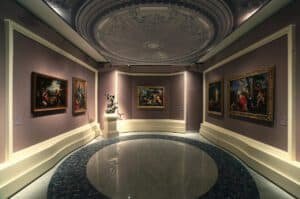
Paintings
The picture gallery offers a selection of early Renaissance painting, mostly from central Italy. It includes a Crucifixion, a Saint Anthony of Padua and a Magdalene that, attributed to the school of Crivelli, instead looks to Venetian art of the fifteenth century. Carlo Crivelli, Venetian by birth and Marchigiano by adoption, is one of the most recognizable painters of the century, with his sharp outlines and his garlands of fruit: a painting that wavers between his school and the Venetian sphere is exactly the kind of attribution problem that makes a private picture gallery interesting.
Odescalchi Castle in Bracciano and its lake
The castle and the lake are the same story. Lake Bracciano sits in a depression of volcanic and tectonic origin, formed when the magma chamber of the Sabatino volcanic complex emptied. It covers 56.5 square kilometers, reaches about 160 meters at its deepest point, and has three lakeside towns: Bracciano, Anguillara Sabazia and Trevignano Romano. The only outlet is the Arrone river, which rises on the southeast shore and flows to the Tyrrhenian Sea.

Since 1999 the lake has been part of a protected natural area, the Parco naturale regionale di Bracciano-Martignano. A regional law bans motorboats, except for licensed fishermen and the public motor ferry service. This is why Lake Bracciano sounds and looks different from any other body of water near a metropolis: no speedboats, no wakes, still water. From the walkway you hear only the wind.
There is also a link that goes back to the Romans and still exists today: since ancient times, these waters have supplied the city. The aqueduct built in the Trajanic era and restored in modern times still feeds the western part of Rome. Anyone looking at the lake from the castle walkway is literally looking at a water reserve for the capital. To learn more about the topic, visit the page for lago di Bracciano and the page for the Bracciano e Martignano park.
The lake seen from the castle and the castle seen from the lake
These are two distinct experiences, and anyone with time should do both on the same day. From the walkway you can take in the whole basin, with Trevignano on the north shore and Anguillara on the southeast tip. From the lakeside promenade, however, the castle looks like a compact mass perched on the tufa ridge, and that is where you understand why no fifteenth century army managed to take it. The stretch of shore below Bracciano is a walk of about 20 minutes downhill from the town center, and the climb back up is harder than the way down. On hot days, it's wise to plan it for sunset.
The Caldara di Manziana, the fire under the lake
A few kilometers from the castle, in the municipality of Manziana, there is a place that explains everything else geologically: the Caldara di Manziana, a natural monument with lunar landscapes, geysers, solfatara and peat bogs. It is the visible proof that the Sabatino volcanism, the activity that carved out the lake basin, has not fully died out. Underground waters are still being heated and rising, and the air smells of sulfur.
The botanical detail is even rarer than the geological one. The Caldara has a birch forest, a typically northern tree, a relic of the last ice age that survived here thanks to the particular soil conditions. A birch grove half an hour from Rome is an anomaly that is worth the trip. The visit requires caution, because the ground is unstable and the gas emissions are real. Guided hikes organized by the park are the most sensible option, and they are not suitable for anyone with mobility problems.
If you want a full day, you can combine the castle with the Caldara di Manziana and the nearby bosco di Macchia Grande, with its centuries-old cerri oaks. The best order is the castle in the morning, lunch in town, and the Caldara in the afternoon. The low light over the steam from the solfatara is the most beautiful thing in the whole area.
A curiosity about Odescalchi Castle in Bracciano
The castle has five towers, one at each corner of the pentagon, and anyone will tell you so. But if you walk the walkway, you come across a sixth tower, truncated, shorter than the others, outside the pattern. It is not a design error and it is not a collapse. It is the part of the castle that existed before the castle. That stumpy tower belongs to the oldest part of Rocca dei Prefetti di Vico, the thirteenth-century fortress the Orsini found on the cliff and around which they built the pentagon starting in 1470. Instead of razing it to the ground, the Renaissance swallowed it up inside.
It is a choice that says a lot about how that century built. Tearing down and starting over cost money and time and, above all, would have left the cliff undefended for months in a territory at permanent war between the Orsini and the Colonna. Absorbing the old fortress made it possible to keep guarding the site while construction moved forward. The result is a building that contains its own ancestor, much like certain Roman churches have, underground, the house where the first community used to gather.
There's a second layer of curiosity, and it's heraldic. The rose and the bear you see everywhere in the castle, on the arch of Del Duca, in the stucco work, in the friezes, are not decorations: they're the family surname translated into imagery. The Orsini traced their name back to an Ursus suckled by a she-bear, a homemade mythology cooked up on purpose to give ancient roots to a power that, in reality, had consolidated in the 13th century. Learn to recognize the five-petaled rose and the bear and you'll notice that the castle is signed in every room. It's worth knowing this from the first minute of your visit: after half an hour you'll start recognizing the coats of arms on your own.
Our opinion: the broken tower is the most exciting spot in the entire castle, and it has no frescoes. You just need to know how to look at it.
One Thing Nobody Tells You About Odescalchi Castle in Bracciano
The castle in Bracciano is a private residence, and this has a practical consequence that no guide points out: the rooms may close, all or in part, when there's a wedding or a reception. It's not a whim, it's the economic model stated by the owners, whereby the events business funds the upkeep and restoration of the building. But for visitors it means that showing up on a Saturday in May or September without checking may mean finding doors closed along the route. The official site reports changes to hours and extraordinary closures: a quick look before you hit the road will save you a bad day.
The second piece of information almost nobody takes advantage of concerns guided tours. On Sundays and holidays the castle offers free guided tours, included in the price of the ticket, with staggered departures from 10:30 to 17:00. In a building this layered, the difference between wandering alone and having the rooms explained to you is enormous: without someone explaining the difference between the 15th-century frieze and the 19th-century neo-Gothic, half the castle stays silent. Yet most visitors walk in, look around and walk out, not knowing that half an hour later a tour included in the ticket they've already paid for would have departed.
Third thing, and here I'm speaking as a professional who has seen plenty of retirees pay more than they had to: the reduced ticket for people over 65 is valid only on Tuesdays. Not Sundays, not holidays, not sometimes. Tuesdays. If you have the freedom to choose the day and there are people over 65 in the group, Tuesday is the right day: you save money, you find the castle almost empty, and you move through it at a pace that's unthinkable on the weekend. The trade-off is giving up the free guided tour, which runs on Sundays and holidays. Between the two, for a group visiting for the first time I recommend Sunday, for those who come back, or who already know the history, Tuesday beats everything.
Fourth and last: the visitors' entrance isn't where you think. The official address is Piazza Mazzini 14, but access for visits is at Via Giulio Volpi 12, just below the square. Every year dozens of people walk around the square looking for a ticket office that is somewhere else.
The Advice I Give You for Visiting Odescalchi Castle in Bracciano
Arrive at opening time, at 10:00 sharp, and do the route in reverse of how everyone else does it. Most visitors go straight into the frescoed rooms, leaving the patrol walkway and the walkways for the end, when your legs are tired and the midday light flattens the view. Do the opposite: go up to the patrol walkway first, while the lake still has low morning haze and the low sun traces the shores, then come down into the rooms, which, being indoors, have steady light all day. The gain, in terms of photos and of understanding the place, is enormous.
Second tip, about the season. The best time for the castle in Bracciano is spring, from late March to the first half of May, and then autumn, from late September to mid-November. In summer the tuff stone soaks up heat, the rooms aren't air-conditioned like a modern museum, and weekends are crowded, in winter the castle is splendid and empty, but the wind on the patrol walkway cuts, and with the days short the last entry at 16:00 squeezes everything. If you have to pick just one day of the year, choose a Tuesday or Wednesday in October: still light, chestnuts in the village, a motionless lake.
Third tip, about time. Don't come to Bracciano just for the castle. It's the mistake I see most often: groups that arrive at 11:00, leave at one, and head back to Rome without having seen either the borgo or the water. The castle is the highlight, but it's the peak of a system, and without the lake below it loses half its meaning. Half a day for the castle and the borgo, half a day for the lakeshore, and possibly the Caldara: that's the right day.
Fourth, about shoes and stairs. The route includes stairs, narrow passages, stretches of patrol walkway with uneven paving, and passages carved into the rock. It's not a place for smooth soles, and it's not a place for heels, even though the castle is full of brides. Wear closed shoes with a sole that holds, and plan on a few hundred steps during the visit.
Fifth, the most clear-cut tip: if you can only come once, come on a Sunday morning and take the 10:30 guided tour. It costs the same as the ticket, meaning nothing extra, and it's the best way to understand a building that, on its own, without a narrative, risks ending up as a sequence of pretty rooms.
Another well-known fact, yet rarely mentioned
Everyone knows that Isabella de' Medici, Duchess of Bracciano, came to a bad end, and at the castle you still hear her told about as the noblewoman strangled by her jealous husband. It's one of the most enduring dark stories of the Italian Renaissance, it has fueled novels, operas and films, and it has the flaw of not being backed up by documents.
The established facts are these. Isabella, born in Florence on August 31, 1542, third-born daughter of Cosimo I and Eleonora di Toledo, died in Cerreto Guidi on July 16, 1576. The literary tradition, which began to take shape as early as the seventeenth century, attributed her killing to her husband Paolo Giordano I Orsini. Modern research, which has worked on the correspondence and the court documents, instead documents a solid marriage and a long illness, with intermittent fevers indicated as the probable cause of death. The Dizionario Biografico degli Italiani records this reading.
Why did the legend win out anyway? Because nine years later, her husband had a second marital affair that seemed made to confirm it: the relationship with Vittoria Accoramboni, the murder of her husband in 1581, the wedding celebrated on April 20, 1585, the flight from Rome hunted by the papal and Tuscan authorities, and his death in Salò on November 13, 1585. With a record like that, attributing the death of his first wife to him too was inevitable. But inevitable doesn't mean true.
Replacing the legend with the documents takes nothing away from the castle, quite the opposite. The documented Isabella, cultured, patron of the madrigal composer Maddalena Casulana, dedicatee of literary and musical works, is a far more interesting figure than the victim of a crime of passion. And the fact that her room in Bracciano bears that name by tradition and not by document, since she lived mainly in Florence, is one more of those nuances that make a story honest.
The right photo to take at Odescalchi Castle in Bracciano
There are three of them, and they're different from each other. The first is the one everyone takes, and it's worth getting right: the castle from below, from the lakeside or from the road that goes down to the shore, with the mass of the pentagon rising on the tuff ridge. It's the only shot that conveys the castle's true military nature, because it shows the change in elevation that no attacker managed to close. The best light is late afternoon, when the sun moves west and lights the front facing the lake at an angle. In the morning, from below, the castle is backlit and looks flat.
The second photo is taken from the patrol walkway and is the opposite: not the castle, but what the castle looked out over. The whole lake basin, with Trevignano opposite, Anguillara on the left and the Sabatini Mountains closing the view. Here the best time is the first hour after opening, when low mist lingers on the water and the colors are cool. One technical tip: include a piece of battlement or loophole in the foreground, otherwise the photo becomes just any landscape and you lose the fact that it was taken from a fifteenth-century fortress.
The third is the photo almost nobody takes and it's the best of the three: the main courtyard from below, aiming upward, capturing together the loggia, the Renaissance windows and a piece of sky framed by the walls. It's the photograph that tells the story of the building's transformation, because the defensive wall and the representative loggia both fit in the same frame. Take it in the middle of the morning, when the light enters the courtyard without creating impossible contrasts.
Two practical notes. The castle is private property, and for photos and filming of a professional nature, or for photo shoots, the rules are set by the owners: anyone with needs beyond a simple personal souvenir should contact the museum first. And second, avoid flash in the frescoed rooms. It's not just a matter of rules: a direct flash on a painted surface at close range produces a worse image than you'd get with ambient light alone.
Some important events that happened here in history
The earliest event in order of time is the founding itself: in 1470 Napoleone Orsini opens the construction site around the old thirteenth-century fortress of the Prefects of Vico. 11 years later, in 1481, Pope Sixtus IV Della Rovere takes refuge in Bracciano to escape the plague raging in Rome, and the Papal Hall takes its name and prestige from that stay. In 1485 the castle is completed by the founder's son, Gentil Virginio Orsini. The same year, the papal troops of Prospero Colonna devastate the town and the castle. Local scholarly literature also recalls the stay of the Bishop of Mantua, Ludovico Gonzaga, who was likewise fleeing the plague from Rome.
The year 1494 brings Bracciano into the great politics of Europe: the troops of Charles VIII of France, descending into Italy, stop here, and the hospitality the Orsini offered the King of France costs the family excommunication. It marks the start of the Italian Wars, the 40-year period that will redraw the balance of power on the peninsula, and Bracciano sits exactly on the fault line.
1496 is the decisive year. Alexander VI Borgia confiscates the property of Gentil Virginio, who had gone over to the French side, and sends the army. The siege of the castle, led by the papal forces with Giovanni Borgia, Duke of Gandia, and later with Guidobaldo da Montefeltro, Duke of Urbino, fails. Inside the walls, the defense is led by Bartolomea Orsini. On January 17, 1497, Gentil Virginio dies a prisoner in Castel dell'Ovo, in Naples, in circumstances that seemed suspicious to his contemporaries. Seven days later, on January 24, 1497, the Orsini win the Battle of Soriano and capture the Duke of Urbino. On February 5, the peace is signed.
In the 16th century, events take a different form. On September 3, 1558, Paolo Giordano I Orsini and Isabella de' Medici begin married life, after the contract of 1553 and the Florentine ceremony of 1556. In 1560 Bracciano becomes a duchy, and the castle fills with building sites, with Giacomo del Duca, Nanni di Baccio Bigio and the Zuccari at work. In 1571 the first duke fights at Lepanto.
The 17th century sees the Baroque court of Paolo Giordano II, with Bernini, Vouet, Monteverdi and Frescobaldi in the duke's orbit, a ducal printing house set up in the fief, and attempts at industrialization with ironworks, wool and silk. In 1696 the castle is sold to Livio Odescalchi, who, on April 5, 1698, after the death of Flavio Orsini, is named Duke of Bracciano.
In the 19th century the manor passes under the Torlonia family, and in 1848 it returns to Prince Livio Odescalchi III. Between the late 19th century and the early 20th century, Baldassarre Odescalchi and architect Raffaello Ojetti carry out the great campaign of restoration and refurnishing, while in 1900 Umberto I of Savoy stays in the hall that today bears his name. In 1952 Prince Livio IV Odescalchi opens the castle to the public. In 1960 the great fresco by Antoniazzo Romano is placed on the back wall of the Hall of the Caesars. And on November 18, 2006, the castle ends up on the front pages across half the world because of the wedding of Tom Cruise and Katie Holmes.
Who Has Passed Through Odescalchi Castle in Bracciano
The list of people who have crossed this courtyard is out of proportion to the size of the town. It starts with a pope: Sixtus IV Della Rovere, the pontiff of the Sistine Chapel, a guest in 1481 while fleeing the plague. It continues with a king: Charles VIII of France, whose troops stop here in 1494, at the start of the Italian Wars. And with an emperor who never was, but a true condottiero: Guidobaldo da Montefeltro, Duke of Urbino, who passed through here as a besieger in 1496 and as a prisoner in 1497.
Among the artists, the most important name is Antoniazzo Romano, the leading Roman painter of the second half of the Quattrocento, present here with the great celebratory fresco of Gentil Virginio and with the organ shutters of the triptych, as well as with his workshop. Around 1490 Francesco di Giorgio Martini arrives, a Sienese, the leading military engineer of the century, called in to update the defenses. In the 16th century Giacomo del Duca, a pupil of Michelangelo, and Nanni di Baccio Bigio pass through for the building work on the loggias and gardens, and the brothers Taddeo and Federico Zuccari for the frescoes in the reception halls. A century later, in the orbit of Paolo Giordano II, Gian Lorenzo Bernini, Simon Vouet and Pompeo Caccini gravitate, while among the musicians serving the duke appear Claudio Monteverdi and Girolamo Frescobaldi.
Women who passed through here count as much as the men, and often more. Bartolomea Orsini leads the defense in 1496 and in all likelihood commissions the frieze of the women's hall. Felice della Rovere, daughter of Pope Julius II, marries Gian Giordano Orsini in 1506 and from 1517 governs the state of Bracciano as gubernatrix for over a decade, buying castles, dealing with popes and having herself painted surrounded by books. Isabella de' Medici gives her name to the most elegant hall on the piano nobile. In the 17th century the duke's court crosses paths with Christina of Sweden, the queen who had abdicated to come and live in Rome.
Then there are the sovereigns of unified Italy: Umberto I of Savoy stays at the castle in 1900. And there are the visitors of our time, who belong to a different category of celebrity but have brought worldwide attention up here: on November 18, 2006, Tom Cruise and Katie Holmes married at the castle, with a ceremony followed by over 150 guests and an unspecified number of photographers waiting on the road. Among the other weddings recorded in the recent history of the building are those of Martin Scorsese and Isabella Rossellini in 1979, Eros Ramazzotti and Michelle Hunziker in 1998, and Petra Ecclestone and James Stunt in 2011.
It's worth ending the list with one observation. A building that has hosted a fleeing pope, an invading king, a military engineer, two generations of painters, an abdicated queen, a king of Italy and a couple of Hollywood stars over 500 years is not a museum: it's a piece of European history that has kept running without ever closing. This, and not the frescoes, is what stays with you at the end of the visit.
The Private Castle You Can Visit: Events, Weddings and Film
Odescalchi Castle in Bracciano is a museum and, at the same time, a place of work. The owners state this openly: in the 21st century the castle combines its role as a museum with an intense event business, which feeds a virtuous circle and makes it possible to fund conservation and restoration. Weddings and ceremonies, receptions and gala dinners, conferences: these are the revenues that keep a building of that scale standing, because a 10-euro ticket multiplied by 60,000 visitors isn't enough to maintain a stone pentagon on a cliff.
Famous Weddings at Odescalchi Castle in Bracciano
The wedding that made the castle famous around the world is that of Tom Cruise and Katie Holmes, held on Saturday, November 18, 2006, with a Scientology rite in front of more than 150 relatives and friends. The international press called it the wedding of the century. The town was locked down, the road up to the castle was guarded for days, and Bracciano suddenly found itself on the front pages from Los Angeles to Tokyo. In residents' memory, that week remains a turning point: the number of foreign visitors has never dropped back since.
It wasn't the first, though. The recent history of the castle lists among the ceremonies held here those of Martin Scorsese and Isabella Rossellini in 1979, Eros Ramazzotti and Michelle Hunziker in 1998, and Petra Ecclestone and James Stunt in 2011. The appeal of the place is easy to understand: a Renaissance courtyard of honor, a hanging garden with two Lebanon cedars overlooking a volcanic lake, and the possibility of privatizing the whole place. For anyone organizing an event, the contact is the castle's dedicated events email address.
A practical tip: if your trip to Bracciano falls on a Saturday between late April and mid-October, check the owners' communications. It's wedding season, and on days when the castle is privatized, the museum route may be reduced or suspended.
The Castle as a Film Set
The halls and the courtyard have been used many times by film and television. Among the titles that recur in lists of productions shot here are Il tormento e l'estasi, the film about the work on the Sistine Chapel, Venere imperiale, and more recently the television series on the Medici. Documentaries and programs are added to these. Anyone who arrives hoping to recognize a specific scene will probably be disappointed, because filming at the castle almost always mixes with filming at other locations: the Bracciano courtyard becomes the courtyard of a Florentine palace, and the patrol walk becomes any bastion. The real reason cinema keeps coming back here is banal and technical: it's one of the few European Renaissance castles with its interiors intact and furnished, and it's half an hour from the studios in Rome.
Visiting Odescalchi Castle in Bracciano with Children
It's one of the places in Lazio that works best with children. The reason isn't the frescoes, which hold relatively little interest for eight-year-olds. It's the armor, the walkways, the spiral staircases in the towers, the four fireplaces of kitchens as big as rooms, and the cannons. A castle with real weapons beats any educational display.
The reduced ticket for children between 6 and 12 costs 8 euros, and children under 6 get in free. The museum also offers visits designed for younger kids and educational workshops, which are organized by contacting the offices directly. School groups need to agree on the route in advance.
There are two practical warnings. The first concerns strollers: between stairs, narrow passages and uneven walkways, a stroller becomes an obstacle, and for the youngest, it's better to bring a child carrier backpack. The second concerns the railings: we're in a real fortress, not a theme park, and in some stretches of the walkway, children should be held by the hand without argument. That said, the tour of the towers remains one of the most beautiful experiences you can give a child half an hour from Rome.
Accessibility and Services at Odescalchi Castle in Bracciano
Clarity is needed here, because this is where wrong expectations most often form. A 15th-century castle built on a cliff, with two principal floors connected by historic staircases, walkways along the battlements and rooms carved into the rock, has objective limitations for anyone who uses a wheelchair or has significant mobility difficulties. Anyone with specific accessibility needs should contact the museum before the visit using the official contact details, at +39 06 99804348 and +39 06 99802379 or at museo@odescalchi.it, and ask which parts of the route are accessible in their case.
As for services, this is a private historic residence: you can pay with the main credit cards, VISA, Maestro and Mastercard, tickets can be bought online on the official website, and small dogs are allowed as long as they are carried or in a carrier. For the bar, bookshop, cloakroom and other services, it's best to check when you buy your ticket, because in a venue that hosts events, availability varies. The village, on the other hand, has bars and restaurants a short walk from the square: nobody goes hungry.
When to Visit and When to Avoid Odescalchi Castle in Bracciano
Spring is the best season: from late March to mid-May the lake is full, the Sabatini woods are green, the light lasts long and the heat doesn't bite yet. Autumn is its equal: from late September to mid-November the color of the woods around the lake is worth the trip alone, and the castle empties out. Summer is the busiest season and the least comfortable, because the halls don't have the climate of a modern museum, and the climb from the town up to the castle, at 30 degrees, is felt. Winter gives you the castle almost empty, but with short days, last entry at 16:00 and icy wind on the wall walk.
As for days of the week, the rule is simple. Tuesday is the quietest day, and for visitors over 65 it's also the cheapest. Sunday is the day for the guided tours included in the ticket, so it has the best value for money, but it's also the most crowded. Saturday, during wedding season, is the day with the highest risk of finding restrictions on the route. If you are particular, the choice is: Sunday morning at 10:30 for the first visit, Tuesday morning for the second.
As for the time of day, avoid the last hour. Arriving an hour before the last entry means rushing, and this castle is not a place to rush.
What to See Around Odescalchi Castle in Bracciano
The castle occupies the highest point of the village, and the village starts right below its walls. It's worth walking through without rushing: narrow alleys, staircases, glimpses of the lake between the houses, and the outline of the old defenses that resurfaces in the walls of the homes. A 40-minute walk is enough to get an idea, and the page dedicated to Bracciano helps you sort out what to see.
The Lakefront and the Other Towns on the Lake
On the same shore, to the north, is Trevignano Romano, with its ruined fortress overlooking the town and one of the most pleasant lakefronts in Lazio. To the southeast is Anguillara Sabazia, the village that stretches out on a promontory like a prow. If you have a full day, you can drive the whole lake in a little over an hour, not counting stops, and the result is one of the best half-day itineraries north of Rome. If you're looking for real nature, head for the pantane di Trevignano or push on to the nearby lago di Martignano, the little sibling with no paved roads on its shore.
Within Half an Hour of the Castle
Inland, the Sabatini woods open up: the faggeta di Oriolo Romano, a stunted beech forest growing at unusually low elevations, and the gorges of Canale Monterano, with the ruins of the abandoned town and the structures attributed to Bernini in the countryside. Toward the sea, you can reach Cerveteri and its Etruscan necropolises in half an hour. It's the best way to understand that the Bracciano Castle is not an isolated episode but the apex of a territory inhabited and contested for 3,000 years.
Isabella de’ Medici and the Castle’s Ghost
At Odescalchi Castle in Bracciano, sooner or later, someone tells you about Isabella de’ Medici: a woman who died at 33, a husband suspected of having killed her, and a ghost that supposedly keeps wandering the halls. It's the most repeated story about the castle, and it's also the one worth taking apart piece by piece, because it contains three different layers: a documented biography, a still-open historiographical controversy, and a tourist legend that has nothing to do with the documents.
Who Was Isabella de’ Medici
Isabella was born in 1542, the daughter of Cosimo I de’ Medici, first Grand Duke of Tuscany, and Eleonora di Toledo. In 1558 she was given in marriage to Paolo Giordano I Orsini, lord of Bracciano: that marriage is the political pivot linking the Florentine family to this castle, and it is documented in sources, including contracts and correspondence. It was an arranged union between two houses, not a personal choice, and it served to strengthen the axis between the Medici and a Roman barony that was coming out of a century of wars with the Colonna.
A detail worth keeping in mind while you visit the rooms: Isabella didn't live in Bracciano. She almost always stayed in Florence and in the Medici villas, where she had her own court, a library, musicians, and an unusual public role for a married woman of her rank. As long as her father was alive, that position protected her. Cosimo I died in 1574, and his brother Francesco I, who took over the government of the grand duchy, had a different attitude toward her. This is also history, not storytelling.
What the documents say about 1576
The date and place of death are established: Isabella died in July 1576 at the Medici villa in Cerreto Guidi, in Tuscany, at 33. The version officially circulated by the court spoke of a sudden illness, a sudden death while she was washing her hair. In the same few days, Leonora di Toledo, wife of another of Isabella's brothers, also died in equally disputed circumstances: two close deaths in a single family, which already at the time got people talking across half of Europe.
This is where the controversial part begins. The dispatches from foreign ambassadors in Florence and Rome almost immediately reported a different rumor: that Isabella had been smothered or strangled by her husband, or on his orders, for reasons of honor. The context those rumors evoked exists and can be documented: the marriage was strained, Paolo Giordano had enormous debts, and around Isabella circulated the name of a relative of her husband, Troilo Orsini, who left Italy and was killed the following year.
Why the question is still open
The uxoricide thesis had its success especially in the nineteenth century, when romantic historiography picked up those dispatches and turned them into a complete picture: the violent husband, the cultured and free wife, the crime of honor. Novels, plays and, much later, tourism were then built on that reconstruction.
More recent studies have called that picture into question, pointing out two things. The first is that the diplomatic dispatches of the sixteenth century are not verbatim records: they were the channel through which rival courts exchanged rumors, and a scandalous story about a ruling family had immediate political value. The second is that a sudden death at 33, in an era without modern medicine, does not in itself need a murderer to be explained. Those who defend the murder thesis respond that the official version was in any case the one the Medici court found it convenient to spread.
The honest point is this: scholars do not agree, and to date no document exists that settles the matter one way or the other. Anyone who tells you the murder as an established fact is skipping one step, anyone who dismisses it as pure nineteenth-century invention is skipping another. If someone on a visit presents it to you as a certainty, know that the certainty isn't there.
The ghost, and the inconsistency nobody points out
The actual legend comes after, and it's the easiest part to frame: it's said that Isabella still appears in the castle's rooms, that someone has heard her footsteps or glimpsed her figure, and on the visit route one room is associated with her name. This part is folk tradition and tourist material, not a historical fact: no documentary source supports it, and there is nothing to verify because there is nothing verifiable.
There is, however, a detail that is worth more than any discussion about ghosts, and it's the reason this chapter exists: Isabella didn't die in Bracciano. She died in Cerreto Guidi, in Tuscany, more than 200 kilometers from here, and she didn't have her residence in this castle. A haunting story that places the ghost in a place where the person did not die and barely lived says a lot about how these things come about: the story doesn't follow the biography, it follows the building that can host it best. An Orsini castle with its gloomy rooms works, a Medici villa in the countryside, much less so. It's exactly the kind of inconsistency that lets you tell the story from the fact, and that's why it's worth knowing before you go in rather than after.
Why the history stays attached to these walls
The link between Isabella and Bracciano is indirect but real, and it runs through her husband. Paolo Giordano I Orsini was lord of a fief that the Orsini held for centuries, and the Bracciano branch of the family reached the seventeenth century burdened with debts: in 1696 the castle and the fief passed to the Odescalchi, whose name it still bears. Isabella therefore belongs to the Orsini phase of this building, the one that left the coats of arms with the rose and the bear that you keep running into in the rooms, and not to the later phase.
The fact remains that here the legend has won out over the biography: of Isabella de' Medici, people remember almost only how she supposedly died, and in a place where she did not die. Of the woman who kept a court in Florence, who wrote, sang and administered, hardly anything is told. It's a curious way to preserve someone's memory, and it's worth noticing while you walk through these rooms.
Quick questions about Odescalchi Castle in Bracciano
How much does the ticket for Odescalchi Castle in Bracciano cost
The full ticket costs €10. The reduced ticket is €9 and applies to residents, university students, military personnel and law enforcement, and to people over 65 on Tuesdays only. Children between six and 12 pay €8, and children under six enter for free.
What are the opening hours of the castle
In winter, Monday to Friday 10:00-17:00 with last entry at 16:00, and Saturday, Sunday and holidays 10:00-18:00 with last entry at 17:00. In summer, Monday to Friday 10:00-18:00 with last entry at 17:00, and Saturday, Sunday and holidays 10:00-19:00 with last entry at 18:00. The ticket office closes one hour earlier.
Odescalchi Castle in Bracciano is open every day
Yes, with the exception of December 25. Since it is a private residence that hosts events, unscheduled closures or reductions of the route can happen. Changes are announced on the official website, odescalchi.it.
Do I need to book a visit
For the self-guided visit, no. You buy your ticket on site. Booking is required for private guided tours, groups, school classes and educational workshops. Tickets can still be bought in advance online on the official website, with a credit card.
Are there guided tours included in the ticket
Yes. On Sundays and public holidays the castle offers optional guided tours at no extra cost, departing at 10:30, 11:00, 12:00, 12:30, 15:00, 15:30, 16:30 and 17:00.
How long does a visit to Odescalchi Castle in Bracciano take
With the self-guided visit, between one hour and 15 minutes and two hours, depending on your pace. With the guided tour, about an hour and a half of guided time plus the time you want to spend on your own. For the castle and the village together, plan on half a day.
How many rooms are there to visit
The route includes about 20 rooms spread over two main floors, plus the kitchens, the courtyard of honor, the walkway along the walls and the gardens. Some rooms may be closed during private events.
Where is the castle entrance
The address is Piazza Mazzini 14, 00062 Bracciano (RM), but the entrance for visits is on Via Giulio Volpi 12, just below the square. It's the most common mistake for first-time visitors.
How do you get to Odescalchi Castle in Bracciano from Rome by train
Take the FL3 Roma-Viterbo regional line from Roma Ostiense, Roma Tiburtina, Roma Trastevere or Valle Aurelia, which connects with metro line A. On weekdays, there is on average one train every half hour from Roma Ostiense, and the trip takes a little over an hour. From Bracciano station to the castle it's about 15 minutes on foot, uphill.
How to get there by car and where to park
From the Grande Raccordo Anulare, head northwest and follow the Braccianese for about 30 kilometers. Parking in the upper part of the village is limited and regulated, so it's better to park lower down and walk up, especially on weekends and on event days.
The castle is wheelchair accessible
This is a fifteenth-century fortress built on a rock, with historic staircases, uneven walkways and rooms carved into the rock. Its limits are objective. Anyone with accessibility needs should contact the museum before the visit at +39 06 99804348 and +39 06 99802379, or at museo@odescalchi.it, to find out which parts of the route are accessible.
Can you take photos inside
The castle is private property, and the rules on photos and filming are set by the owners. For professional services or filming, you must contact the museum in advance. For personal photos, though, please avoid flash in front of the frescoes: it ruins the picture as well as good manners.
Can you enter with a dog
Small dogs are allowed, carried in your arms or in a carrier.
Is Odescalchi Castle in Bracciano suitable for children
Very much so. Suits of armor, cannons, towers, spiral staircases and the large kitchens with four fireplaces do the rest. The museum organizes visits for children and educational workshops by reservation. Be careful with strollers, which are not well suited to stairs and walkways, and with the exposed sections of the walls.
Can you pay by card
Yes, VISA, Maestro and Mastercard are accepted, and tickets can be bought online on the official website with a credit card.
Is there free entry on the first Sunday of the month
No. The castle is not a state museum but a private historic residence open to the public, with its museum section run by Fondazione Livio IV Odescalchi. It therefore does not fall under the Ministry's free-admission initiatives. The only free admission provided for in the price list applies to children up to five years old.
Who built Odescalchi Castle in Bracciano
Construction began in 1470 at the will of Napoleone Orsini and was completed in 1485 by his son Gentil Virginio Orsini, around the earlier 13th-century fortress of the Prefects of Vico. The owners point to the probable involvement of the craftsmen working on the Sistine Chapel, with possible design contributions from Francesco del Borgo and Giovannino de' Dolci. Historical tradition also links Francesco di Giorgio Martini to the castle, called in around 1490 to strengthen the defenses.
Why is it called Odescalchi if the Orsini built it?
In 1696, the castle and the fief were sold to Livio Odescalchi, nephew of Pope Innocent XI, who was named Duke of Bracciano on April 5, 1698, after the death of Flavio Orsini. The Odescalchi family still owns it today, which is why the building is commonly called Orsini Odescalchi Castle.
The castle is still lived in by the family
It is a private historic residence owned by the Odescalchi family, open to the public since 1952 and also used for weddings, receptions, gala dinners and conferences. The museum section is run by the Livio IV Odescalchi Foundation and welcomes over 60,000 visitors a year.
Where Tom Cruise and Katie Holmes got married
Right here, on Saturday, November 18, 2006, with a Scientology ceremony in front of more than 150 guests. It is the wedding that put the name of Bracciano in newspapers around the world.
Can you get married at Odescalchi Castle in Bracciano?
Yes, the castle hosts weddings and ceremonies, receptions and gala dinners. Information and bookings for events go through the owners' dedicated offices, at events@odescalchi.it.
What's the difference between Bracciano Castle and Santa Severa Castle?
They are two different things. Bracciano is a private Renaissance fortress with intact interiors, original furnishings and collections. Santa Severa is a public complex by the sea, with a museum of the sea and ancient navigation, a hostel and a beach. Bracciano is visited for the Renaissance, Santa Severa for the relationship between castle and coastline.
Can you see the lake from the castle?
Yes, and from the wall walk you can take in the whole basin, with Trevignano across the water and Anguillara on the southeast tip. It is the main reason to make the climb up here.
What frescoes can you see at Odescalchi Castle in Bracciano?
The large commemorative fresco of Gentil Virginio Orsini by Antoniazzo Romano in Sala dei Cesari, the organ shutters with the Annunciation by the same painter in Sala del Trittico, the coffered ceiling attributed to his school in Sala Umberto I, the putti with garlands in Sala di Isabella, the frieze with the Labors of Hercules from the late 15th century, the cycle of the court ladies, and the grotesques with the marriage horoscope painted by the Zuccari brothers in 1560 in Sala Papalina.
How large is the weapons collection?
It takes up a large part of the second floor and includes pieces from the 14th to the 17th century: edged weapons, lances, halberds, swords, firearms, cannons, and tournament armor of Milanese and German manufacture. The owners present it as one of the most prestigious collections in Italy, comparable to those of the Stibbert Museum in Florence and the National Museum of Palazzo Venezia in Rome.
What to see near the castle in one day
The village of Bracciano, the lakeside promenade, and, as you prefer, Trevignano Romano or Anguillara Sabazia on the same lake. If you still have energy, you can add the Caldara di Manziana with its sulfur springs and the Macchia Grande woods, or push on toward Cerveteri and its Etruscan necropolises.
What is the best time to visit Odescalchi Castle in Bracciano?
Spring, from late March to mid-May, and autumn, from late September to mid-November. In summer it's hot and there are more people, and in winter the days are short and the last weekday entry is at 16:00.
Is there a line to get in?
Usually not, and booking is not required for the free visit. During spring bridge holidays, in August and on October weekends, some lines can form at the ticket office. Buying tickets online in advance cuts the wait.
When people ask what to take away from Bracciano, the answer is always the same. Not the frescoes, although Antoniazzo Romano alone is worth the trip. Not the armor, although it is among the best in Italy. What makes Odescalchi Castle in Bracciano unique is that it has never stopped being lived in: it has gone from war to court, from court to museum, from museum to events, without ever becoming a ruin or an empty container. Go up to the wall walk early in the morning, when the lake is still motionless, and try to picture someone making that same round 500 years ago with a crossbow in hand. Then head down to the town and take the time for a slow lunch. You've earned the castle.
Article written by the TourLeaderPro editorial team, contact them for Private/Corporate/V.I.P. Tours and Experiences: TourLeaderPro.
Planning a trip to Rome? English guides for visiting the city are on ItalyPlanner.com.