Marturanum Park Nature Museum “Francesco Spallone”
In short. There are museums that explain a territory and museums that force you to cross it.
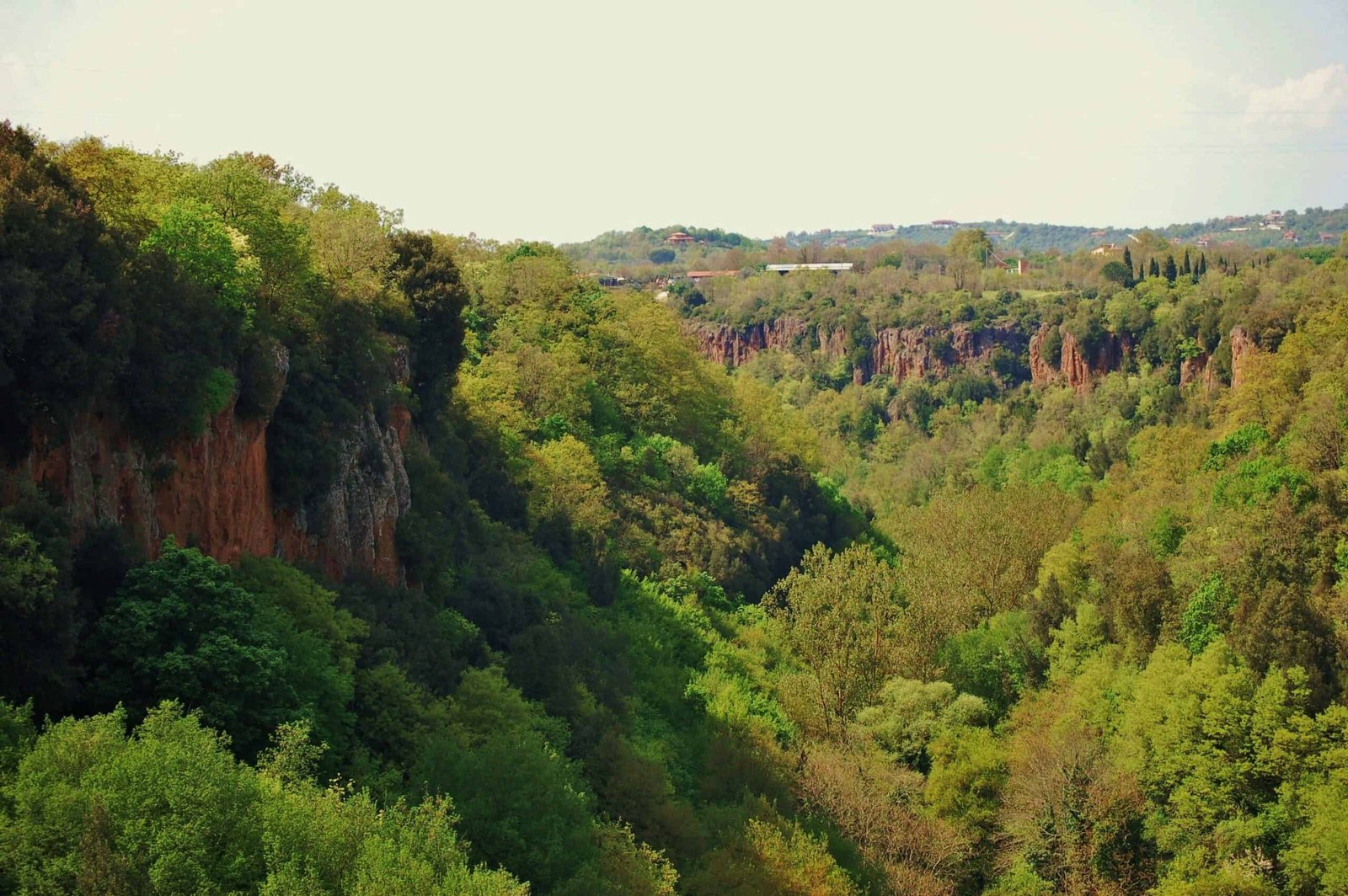
There are museums that explain a territory and museums that force you to cross it. The Marturanum Park Nature Museum "Francesco Spallone" belongs to the second category, and that is why it's worth the trip to Barbarano Romano, just under 70 kilometers northwest of Rome, in that part of the Viterbo Tuscia where tuff is not a building material but the landscape itself. In here, in a few rooms at number 46 on Viale IV Novembre, you find the reproduction of a tuff gorge, a life-size reconstructed Etruscan tomb with its grave goods, a real oak integrated into the display, a freshwater aquarium, microscopes that really work and, on the upper floor, the tools of the peasant civilization that worked these ravines for centuries. Outside, a few hundred meters away, there are 1,240 hectares of regional park, more than 2,000 rock-cut tombs, the Biedano gorges and the Maremma horses grazing in the wild.
The advice, given up front because it's the one that changes the day: don't treat this museum as a stop to tick off before the hike. Treat it as the legend of the map. Whoever enters here before going down toward San Giuliano recognizes on the trail everything they saw in the display case. Whoever skips the museum walks through a beautiful and mute landscape.
Marturanum Park Nature Museum "Francesco Spallone": what it really is
The official definition speaks of a nature museum and visitor center of the protected area. It's correct, but reductive. In practice this is an interpretation center: a place built not to display rare objects, but to teach you to read what you'll find outside. The difference is substantial. In a traditional museum the object is the end. Here the object is an optical instrument, a lens that is lent to you at the entrance and that you symbolically return when you leave, but that you keep using for the rest of your visit to the territory.
The museum is run within the Marturanum Regional Nature Park, the protected area established by the Lazio Region with regional law number 41 of July 17, 1984. The park extends for about 1,240 hectares entirely within the municipality of Barbarano Romano, in the province of Viterbo. The museum opened to the public a few years after the establishment of the protected area, and from the start was born with this double vocation: to tell nature and to tell the millennia-old relationship between man and this nature. Which, in the Tuscia, is the same thing: here there isn't a square meter of woodland that hasn't been dug, cut, cultivated or sanctified by someone in the last 3,000 years.
A small museum that thinks big
I warn you honestly about the size: we're not talking about a monumental complex. The rooms are few and the visit, taken alone, takes a good 40 minutes if you read all the panels, an hour and a half if you stop at the microscopes and ask questions of whoever is on duty. But the density of information per square meter is very high, and the quality of the welcome is of the kind you no longer find in big museums: here there's still someone who has time to answer you.
The Marturanum Park Nature Museum "Francesco Spallone" is part of the RESINA museum system, the thematic network of Lazio's nature museums, and is included in the Regional Museum Organization. It's not a bureaucratic detail: it means the scientific content is validated, that the displays follow network standards and that the staff takes part in shared training programs with the other regional nature museums. Translated for the visitor: what you read on the panels is verified.
Why "Francesco Spallone"
The naming after Francesco Spallone ties the museum to the local memory of the park and of the people who built and defended it in its first decades of life. It's a beautiful and very Italian custom, giving a small museum the name of someone who put years of work into it: in big institutions the names on the facades are almost always those of funders, in small museums they're almost always those of workers. In the village, if you ask, they tell you the name is felt as a family thing, not as a plaque. And in fact the same dedication recurs in the cultural life of the town, tied to the telling of the rock-cut Tuscia.
Where it is and how to get to the Marturanum Park Nature Museum
The address is Viale IV Novembre 46-48, Barbarano Romano, province of Viterbo, postal code 01010. The museum shares the building with the offices of the protected area, which explains why on weekday mornings the information point works even when the exhibition room seems silent: if you find the museum door closed in late morning, try the next door.
From Rome the simplest way is the Cassia bis as far as Monterosi, then the Cassia toward Vetralla and the turnoff for Barbarano Romano. Alternatively you go up on the Braccianese through Oriolo and Vejano. Either way count a good hour and a quarter of driving from the Grande Raccordo Anulare, a little more if you take the scenic road along Lake Bracciano, which however lets you see the change of landscape: first the cultivated hills, then the volcanic cones, then suddenly the tuff that splits the ground into ravines. From Viterbo it's about 30 kilometers to the southeast, 40 minutes of pleasant curves.
Parking and the 100 meters that matter
The advice I give you on logistics is banal but saves nerves: leave the car outside the village walls, in the spaces along the avenue, and don't try to enter the historic center. Barbarano Romano has a medieval structure of three parallel streets enclosed in a double circuit of walls, and the inner roadways were born for carts, not SUVs. From the parking lot to the museum you walk very little, and that little is already part of the visit: the avenue runs along the edge of the settlement, with the countryside opening on the right and the profile of the village on the left.
Anyone arriving by public transportation has to allow for patience: bus connections from the province exist but are designed for students and commuters, not tourists, with runs concentrated in the early hours of the morning and in the early afternoon. If you don't have a car, the realistic solution is to get to Viterbo or Bracciano and arrange the last stretch privately. It's not a place you improvise with a timetable in hand 10 minutes beforehand.
Accessibility
The museum is declared accessible: you enter with strollers and wheelchairs, admission is free and the spaces on the ground floor can be walked without demanding steps. It's news worth underlining, because in the villages of the Tuscia accessibility is often a battle lost from the start against topography. Here the museum also works as a point of contact for those who, for mobility reasons, cannot take on the necropolis trails: inside you find reconstructed, to scale and within reach, what outside requires boots and trained ankles.
The Marturanum Regional Park: 1,240 hectares and a 1984 law
The park was born in 1984, in a season when Lazio established a series of regional protected areas to secure pieces of territory that speculation and abandonment were eroding from opposite sides. Marturanum was one of those cases in which natural protection and archaeological protection coincided perfectly: protecting the gorges meant protecting the necropolises dug into their walls, and vice versa.
The name comes from Marturanum, the ancient settlement that gives identity to the whole area and whose roots go back to the Etruscan phase of the territory. It's a place name that today indicates a park but that, for the inhabitants, indicates above all an area: when in Barbarano they say "let's go to the Marturanum" they don't mean an office or an administrative boundary, they mean the woods, the gorges and the tombs.
A park small in area, enormous in density
1,240 hectares are, in absolute terms, not much: we're talking about 12 square kilometers and a little more, a handkerchief compared with the big Apennine national parks. But the density of noteworthy things per hectare is probably among the highest in Italy. Within these boundaries are more than 2,000 rock-cut tombs of the Etruscan age, stretches of the ancient Via Clodia, sunken roads dug into the tuff, remains of water mills, an isolated medieval church, a village abandoned in the 11th century, ferruginous mineral springs and a faunal community that includes rare raptors and endemic amphibians.
This density is also the reason the museum exists: without a key to reading, a visitor entering the park sees only a thick wood with holes in the rock. With the right key, that wood becomes an open-air archive in which every hole has a date, a type, a function and, often, a name.
Who runs it
Management is in the hands of the municipality of Barbarano Romano, within the system of protected areas of the Lazio Region, with its own operating office in Barbarano Romano, in the spaces adjacent to the museum. Daily oversight is entrusted to the protected area's surveillance service: the park rangers guarantee, besides control of the territory, a large part of the guiding and environmental education activities. It's useful to know, because the cell phone number of the service is often the quickest channel for updated information on routes, temporary closures and trail conditions after rain.
The geology told inside the museum: the Vico volcano and the red tuff with black scoriae
Everything you see in this area begins with an eruption. The Vico volcanic complex, which today holds Lake Vico inside its caldera, shaped the whole of central Tuscia through a series of explosive phases of enormous scale. About 155,000 years ago, one of these phases deposited the so-called red tuff with black scoriae over this sector, one of the most recognizable formations of Lazio volcanism, which settled on top of earlier flysch formations, that is, on much older layered sedimentary rocks of marine origin.
Red tuff with black scoriae is a rock with a distinct personality: compact enough to hold up a vertical wall, soft enough to be dug with iron tools. This double property is the reason, geological even before cultural, why the Etruscans of this area developed a rock-cut funerary architecture that exists nowhere else. Where the rock is granite, you don't dig cube tombs. Where the rock is clay, the walls don't hold. Here nature had already prepared the ideal material, and a civilization noticed.
The color and the name
The name describes exactly what you see: a reddish matrix, from brick to wine-dark depending on weathering, dotted with black scoriae, that is, fragments of rapidly cooled magma embedded in the deposit. When you walk in the sunken roads and find the walls 20 centimeters from your nose, those dark inclusions stand out like raisins in a panettone. Run your fingers over them. They are glassy, harder than the matrix, and in many spots they stick out because erosion has worn away the surrounding material faster.
The museum devotes space to this geological reading because without it the rest doesn't stand up. The gorge, the tomb, the mill, the sunken road and even the vegetation of the damp walls are different consequences of the same rock. This is one of those cases where geology is not the boring chapter at the start of the guide, but the key that opens all the doors that follow.
The iron-rich springs
In the park's territory there are mineralized springs rich in iron, evidence of the lingering residual heat and the hydrothermal circulation tied to the volcanic complex. You recognize them by the ocher deposits on the rocks and by the metallic taste the water leaves in your mouth. They are an element that connects Marturanum to the whole thermal belt of Tuscia, the one that, a few dozen kilometers away, made the sulfurous waters of the Viterbo area famous. Here the phenomenon is discreet, almost domestic, but it's there.
The Biedano and Vesca gorges: the landscape the museum teaches you to read
Two main watercourses cross the park: the Biedano and the Vesca. They are not imposing rivers, and anyone who arrives expecting masses of water is thrown off. Their greatness lies not in their flow but in the work they've done: by cutting into the tuff bank for millennia, they have carved deep, narrow valleys with vertical walls and a damp floor. In Tuscia these cuts are called forre (gorges), and they are the distinctive landscape feature of the whole region between Blera, Barbarano, Norchia and San Giovenale.
The gorge is a world of its own. In a few meters of elevation change you go from a sunny plateau, with clearings and pastures, to a shady valley floor, cool even in August, where the air is saturated with humidity and the sound of the water bounces between the walls. It's a sharp ecological inversion: species you would normally find at much higher elevations, or at more northern latitudes, find refuge here at the bottom of a canyon 200 meters above sea level.
The microclimate of the gorge
The bottom of the gorges works as a trap for cold, damp air. The vertical walls limit direct sunlight to a few hours a day, the water keeps relative humidity high, the tree cover closes the canopy. The result is a stable microclimate that hosts ferns in abundance, mosses, liverworts, and that allows demanding amphibians to survive. If you go in during July with 34 degrees on the plateau, down below you find eight or 10 degrees less. It's a geological air conditioner.
My advice is to spend at least five minutes, once you've gone down, standing still and quiet. The gorges have a particular acoustics: the call of the kingfisher, the slither of a grass snake, the plop of a frog. If you walk while talking, you hear nothing and see nothing. If you stop, within five minutes the valley starts living again around you.
The mills and the Devil's Bridge
Along the Biedano you come across the remains of old mole, that is, water mills that used the drop of the stream to grind grain. They were the village's energy infrastructure before electricity, and their presence explains why a village perched on a hilltop invested so much work in keeping such steep paths passable. People didn't go down for leisure, they went down to grind. In the same area you find the passage known as Ponte del Diavolo, and natural cavities that popular tradition has baptized with evocative names, among them the Grottone del Mostro. These are place names that tell of the ancient fear of the valley floor, a place of necessary work but also of shadow and risk.
Inside the Museo Naturalistico del Parco Marturanum "Francesco Spallone": the reconstructed gorge
We arrive at the heart of the exhibit. The museum's showpiece is the reproduction, on a reduced scale but with a remarkable level of detail, of a tuff gorge of the park. It is not a display-case model. It is a structure you enter visually, with walls that reproduce the stratigraphy of the tuff, vegetation colonizing the cracks, the damp floor, and the fauna the environment hosts, rendered through prepared specimens and fiberglass reproductions.
The choice to reconstruct the gorge in particular is not accidental. It is the hardest environment to reach for the average visitor and, at the same time, the most characteristic one of the park. Anyone with mobility problems, anyone traveling with small children, anyone who arrives with only an hour available, still sees the gorge here. And whoever then really goes down into it recognizes on the spot what they have already seen: the same fern, the same stratification, the same relationship between light and water.
The fiberglass reproductions
Part of the animals on display are fiberglass reproductions, alongside naturalized specimens from findings and recoveries. It is a modern museum choice and, I would add, an ethically correct one: no animal is taken in order to be displayed. The reproductions also make it possible to represent protected and rare species that would be unthinkable to show otherwise, and they hold up better over time to exposure to light and humidity.
The level of realism is good, and there is a detail I always notice and that children like very much: the postures. The animals are not lined up like stamps, but placed in attitudes consistent with the reconstructed environment, one hunting, one lying in wait, one in transit. This turns the display case into a scene and the scene into a story, which is exactly the job a natural history museum has to do.
The environmental reconstructions and the panels
Around the gorge, the other environmental reconstructions develop, dedicated to the characteristic habitats of the Viterbo Tuscia: the woods, the riparian environment, the open areas with pasture. Information panels accompany each section with data on flora and fauna and with geological and historical-archaeological references. The register of the texts is educational but not dumbed down, which is a rare virtue: too many natural history museums swing between impenetrable scientific jargon and children's-book simplification.
The Etruscan tomb reconstructed at full scale
The second coup de théâtre of the exhibit is the full-scale reconstruction of an Etruscan rock-cut tomb, complete with funerary furnishings and votive objects. It's a very intelligent idea, because it solves a practical problem that anyone who has visited the San Giuliano necropolis knows well: the tombs are there, there are thousands of them, they are spectacular, but they have been empty for centuries and for the most part inaccessible inside.
Here instead you enter, or at least lean in to look at, a burial chamber as it must have looked at the moment it was closed: the funerary bed carved in the rock, the pottery arranged according to the logic of the ritual banquet, the personal objects, the votive offerings. The understanding you take away is immediate and physical. Then you go out, walk for 40 minutes in the woods, look into a real chamber dug in the tuff and finally know what you are looking at: not a hole, but a furnished room that is missing its furniture.
Why the tomb is in a natural history museum
Some will turn up their noses: what does an Etruscan tomb have to do with a museum of natural sciences? It has everything to do with it, and this is the institution's strong cultural thesis. In this territory the separation between nature and culture is artificial. The rock that hosts the salamander is the same rock that hosts the burial chamber. The gorge is both a habitat and a monumental cemetery. The woods grow on terraces that someone built. Separating the two readings means mutilating both.
The museum says so openly: its theme is the millennia-old relationship between people and the environment in this corner of rock-cut Tuscia. Not pristine nature, which doesn't exist here and has not existed for the last three millennia, but nature that has been inhabited, dug, used and finally reconquered by the woods when people left.
The grave goods and what they tell
The objects that make up the reconstructed furnishings tell of a precise belief system. The Etruscan dead were accompanied with what they would need in the afterlife, and those grave goods were also a social statement: fine pottery for wine signaled belonging to an elite able to practice the aristocratic banquet, weapons indicated the warrior role, personal ornaments the family's wealth. Looking at a set of grave goods means reading a social identity card written in objects.
The oak inside the museum, the aquarium and the microscopes
The third element that makes this exhibit memorable is the presence of a real tree, an oak integrated into the display and used as a three-dimensional diorama. It's not a model. It is an authentic trunk around which the story of the forest ecosystem develops, with the inhabitants of the different vegetation layers placed at their respective heights.
The educational value is enormous, and I'll explain it with an example. If you tell a kid that the woods are layered, he nods and forgets. If you take him in front of an oak with the porcupine at the base, the woodpecker at mid-height and the raptor at the top, and you point out that each species occupies a precise layer because that's where it finds the food and shelter it needs, that notion stays with him. Verticality is the one thing books can't communicate, because the page is flat.
The oak in Tuscia is not just any tree
It's worth remembering that the oak, in this territory, is the symbol species. The downy oak and Turkey oak woods cover large portions of the plateau, and the big isolated oaks in the pastures are a characteristic landscape element of the traditional Maremma-Lazio agriculture: left standing to shade the livestock, to provide acorns, to mark boundaries. Putting an oak at the center of the museum means putting at the center the tree around which this rural economy turned for centuries.
Look at the bark too. The deep cracks of mature oaks are ecosystems in miniature: they host insects, spiders, lichens, and they are the pantry of woodpeckers and treecreepers. In the museum you can look at them up close and at your leisure, which you never do in the woods because you're busy watching where you put your feet.
The freshwater aquarium
An aquarium dedicated to freshwater fish fauna completes the picture of the aquatic environments. It is the section most often underrated by adult visitors, and yet it tells an important story: the streams of Tuscia host specialized fish communities, adapted to cool, oxygenated waters with variable flow, and they are among the environments most vulnerable to changes in water quality and to water withdrawals.
The park pays specific attention to aquatic habitats, so much so that it builds educational activities and themed excursions on them. Water is the element that makes life possible in the gorges, and the variety of species they host is surprising for anyone who expects only a trickle between the rocks.
The microscopes: the part nobody expects
The exhibit has modern microscopes available for observing the microscopic world. It's a detail that raises the level considerably: it means the museum doesn't just show, it puts visitors in a position to look for themselves. A drop of stream water under the lens is more eloquent than 10 panels on aquatic biodiversity.
My advice if you travel with school-age kids: explicitly ask to use the microscopes. They are not always available to the casual visitor, but if you ask politely and staff are available, that becomes the half hour your child will remember from the trip, much more than the tomb, much more than the view.
The upper floor: the tools of peasant civilization
Going up a floor, the register changes. Here the exhibit gathers tools and implements of the local tradition, the collection of traditional farm equipment that documents how this land was worked before mechanization. Plows, yokes, sickles, grape harvest tools, dairy utensils, containers, forestry tools.
This section answers a question the attentive visitor inevitably asks: if there is so much forest here, who kept it open? The answer is that for centuries this landscape was a mosaic of cultivated fields, pastures, coppice woods and chestnut groves managed with a precision we find hard to imagine today. The closed, continuous forest we walk through today is not original nature. It is the result of the agricultural abandonment of the 1900s, which let vegetation take back the terraces.
Objects as documents
Every tool on display is a technological document. The shape of a hoe tells the consistency of the soil it worked. The size of a yoke tells the size of the animals available. The presence of tools specialized for a single operation tells of an economy in which working time cost less than iron. Looked at carefully, these objects are as precise as a land registry.
Then there is the theme of family memory. Many of the objects in the ethnographic collections of small museums come from donations by families of the village: they are tools that someone really used, often the grandfather or great-grandfather of someone who today lives 200 meters from the museum. This gives the section an emotional weight you don't find in metropolitan museums.
The thread that joins the two floors
The passage from the natural history floor to the ethnographic one is the synthesis of the whole project. Below, the rock, the water, the animals and the Etruscan tomb. Above, the tools with which people have worked that same rock and that same water for 3,000 years. Between the two floors there is no break, there is continuity: the Etruscans dug the tuff with iron tools, the farmers of the 1900s dug the tuff with iron tools, and in between there are 26 centuries of people who did essentially the same thing with the same material.
The fauna of Parco Marturanum: the mammals
The park's mammal community is the one typical of wooded Tuscia, rich and in good condition. Among the species present are the fox, the wild boar, the badger, the porcupine, the wildcat, the European polecat and the nutria, the latter an alien species now widespread in all the watercourses of central Italy.
The wildcat is the most precious presence on the list. It is an elusive, nocturnal feline, extremely hard to observe, and its presence indicates a mature forest structure with good availability of shelter and prey. Confusing it with a feral domestic cat is easy to the naked eye and wrong: the wildcat has a stockier build, a stubby tail with sharp rings and a rounded black tip, a gray-brown coat with a low-contrast tabby pattern. The chances that you will see one while walking in daytime are close to zero, but knowing it's there changes the way you look at the woods.
The porcupine, the noisy neighbor
The porcupine, on the other hand, is the mammal most likely to leave traces of its passage right before your eyes. You will almost never see it, because it is strictly nocturnal, but you will find its fallen quills along the paths, white and black, often near the burrows dug in the tuff. It is the largest rodent in Europe and is protected in central Italy. A quill picked up from the ground is the favorite souvenir of every child who passes through, and it is also an excellent pretext to explain that quills are not thrown, as the legend has it, but come off when the animal drives them into the aggressor by backing up.
The wild boar and forest management
The wild boar is abundant, as throughout Lazio, and its presence is very evident: turned-over soil at the edges of the paths, mud wallows at the foot of trees, trunks with bark polished by rubbing. If you walk at dawn or dusk it's the species you are most likely to cross paths with. No alarmism: a boar that hears you coming runs away. My advice is to make noise when you cross thick scrub with reduced visibility and never to get between a female and her young, which is the only situation truly to be avoided.
The badger and the polecat
The badger is an engineer of the underground: its burrows, complex and reused for generations, are easily recognizable by the wide oval entrance and the cone of loose earth in front. The European polecat, a mustelid tied to wet environments and watercourses, is a good indicator of the quality of the banks. Both are species that betray their presence more through traces than through direct sighting, and that is why in natural history museums like this one the section dedicated to tracks and signs of presence is worth as much as the one dedicated to the animals.
The birds: raptors, black stork and the people of the gorges
The birdlife is probably the most impressive chapter of Marturanum's biodiversity, and the museum treats it with the attention it deserves. The vertical walls of the gorges offer nesting sites inaccessible to ground predators, and this attracts cliff-dwelling species of great conservation value.
Among the raptors reported in the park area are the lanner falcon, the short-toed snake eagle, the red kite, the kestrel and the peregrine falcon. It's a list that would make any European birdwatcher happy. The lanner in particular is one of the rarest falcons in Italy, tied to rocky environments and open areas for hunting: the combination of tuff walls and grazing plateaus that characterizes this territory is the ideal habitat for it.
The short-toed snake eagle, the eagle of the snakes
The short-toed snake eagle deserves a paragraph of its own because it is the most accessible spectacle. It is a large raptor, with a wingspan well over a meter and a half, very pale on the underparts, and it has an unmistakable hunting habit: the spirito santo, that is, hovering with slow wingbeats and head pointed downward, which it keeps up for long seconds while scanning the ground. It feeds almost exclusively on reptiles, snakes above all. Seeing it motionless in the air above a sunny pasture in May is one of those images that by themselves are worth the climb.
It is a migrant: it arrives in spring from sub-Saharan Africa and leaves again at the end of summer. This also defines the best window for observation, which runs roughly from late March to September, with peak activity in the middle hours of the day when the thermals are strong.
The black stork
Among the presences reported in the area is the black stork, a very rare species in Italy and of great value. Unlike its white cousin, which loves bell towers and being near people, the black stork is shy, a forest bird, tied to quiet watercourses in undisturbed environments. Its presence in the rock-cut Tuscia area is one of the most eloquent indicators of the environmental quality of these gorges. If you spot one, consider yourself lucky and keep your distance: it is an extremely disturbance-sensitive species.
The kingfisher and the small passerines
On the valley floor the protagonist is the kingfisher, which along the Biedano announces itself with a shrill whistle and a turquoise flash crossing the gully half a meter above the water. It nests in tunnels dug into earth banks, and its presence requires clear water full of small fish: it's a very strict ecological auditor.
In the undergrowth and the riparian vegetation you find the Cetti's warbler, with a song that is explosive and out of proportion to its size, and the willow warbler, tiny and tireless. In the more open areas, with old trees and walls, the European roller appears, one of the most spectacular birds in Europe for its coloring, with that electric turquoise that seems out of place in a Mediterranean landscape. The museum helps a lot with this identification, because having the still specimen right in front of you at close range is the only way to fix the diagnostic features that in the field you catch for two seconds.
Amphibians and reptiles: the spectacled salamander
Among the amphibians in the park, the spectacled salamander stands out, an Italian endemic of very great value. It is a small salamander, black on the back, with a light spot shaped like eyeglasses between the eyes that gives it its name, and with a bright red belly and underside of the tail that it shows as a warning signal by arching its body when it feels threatened.
The spectacled salamander is extremely demanding: it requires clear, cool, well-oxygenated water, in shady and undisturbed forest environments. That is exactly the profile of the Marturanum gorges. Its presence here is not a detail for enthusiasts. It is a certificate of environmental quality issued by nature itself. Species of this kind are the first indicators to disappear when a stream is tapped, polluted or stripped of its tree cover.
What to do if you meet one
My advice is clear and non-negotiable: just look at it. Don't pick it up, don't move it, don't put it in a bottle to photograph it better. The skin of amphibians is a permeable respiratory organ, and contact with hands, sunscreen or insect repellent is toxic to them. This applies to all amphibians, but for a protected species with a restricted range it applies double.
The rule also applies of not moving stones and logs in the streambed and, if you do it out of curiosity, of putting them back exactly as they were. Under every stone on the valley floor there is a microhabitat that someone is using as a home.
Toads, frogs and reptiles
The park's aquatic environments host a broader community of amphibians, with anurans tied to pools and slow water, and their spring breeding activity turns some stretches of the valley floor into a remarkable nighttime concert. Among the reptiles, besides the grass snakes that frequent the stream, the territory hosts the common lizards and green lizards of the open areas and, like all of Tuscia, the common viper in stony, sunny environments. The museum devotes space to correct identification, which is the best way to dispel fear: the vast majority of the snakes you'll meet here are completely harmless, and learning to tell a round pupil from a vertical one is more useful than any stick.
The park's flora: from riparian woods to oak forest
The vegetation of Marturanum is organized in bands that follow elevation and, above all, humidity. On the damp floor of the gorge a riparian woodland of great interest develops, with black alder, elm, white poplar and black poplar, and several species of willow. It is the formation that holds the banks together, that shades the water and keeps it cool, and that provides the organic debris on which the stream's entire food chain is based.
Under the tree cover, the damp understory is dominated by ferns, which here reach remarkable density and size. They are very ancient plants, without flowers or seeds, that reproduce by spores and require constant humidity: their abundance is the most immediate way to understand, at a glance, that you have entered a particular microclimate.
The helophytes of the streambed
Along the water and in the flooded bank zones grow helophytes, that is, plants that sink their roots into the submerged substrate and develop stem and leaves in the air. In the park, hemp agrimony, water celery and speedwell are reported. These are plants that the distracted visitor tramples without noticing and that actually do an enormous amount of work: they filter, oxygenate, offer shelter to the larval stages of aquatic insects and stabilize the banks.
The oak forest of the plateau
Climbing toward the flat uplands, the vegetation changes completely. The woods become a mixed Mediterranean oak forest with downy oak and Turkey oak, accompanied by hornbeam, maple, manna ash and a shrub entourage of hawthorn, blackthorn, cornelian cherry and dog rose. It is the wood of gathering and grazing, the one that for centuries supplied firewood, acorns for the pigs, wild fruit and mushrooms.
In the clearings and on the edges the pastures open up, and in spring they burst into blooms of wild orchids: Tuscia is orchid country, with species of the genera Ophrys and Orchis that appear between April and May and that deserve a dedicated walk with your eyes down. Here too: you look, you photograph, you don't pick.
The free-ranging Maremma cows and horses
There is one element that surprises almost all visitors: Maremma cows and Maremma horses graze freely in the park. It's not an attraction set up for tourists. It is the last living stretch of an extensive livestock system that for centuries characterized the whole Tyrrhenian strip of central Italy, from the Tuscan Maremma to the Agro Romano.
You recognize the Maremma cow at first glance: gray coat, very long lyre-shaped horns in the females and crescent-shaped in the males, powerful build, rustic temperament. It is a breed selected to survive outdoors all year round, to walk a lot and to digest poor forage. The Maremma horse, just as rustic, is the animal of the butteri, the cattle herders of central Italy.
How to behave with grazing animals
Here the advice I give you is serious, because it concerns safety. These animals are not tame in the sense that a riding-school horse is: they live outdoors, have a sporadic relationship with people and keep very sharp defensive instincts, especially the females with calves or foals. Always keep a generous distance, never try to pet them or give them food, never walk through a group and split it in two, and if you have a dog keep it strictly on a leash: a bovine charges the dog, not you, but a frightened dog runs toward its owner and the problem becomes yours.
That said, meeting them is wonderful. A herd of gray Maremma cattle grazing on a tuff plateau, with the woods in the background and the Etruscan tombs hidden just below the edge, is one of the most authentically Lazio images you can come across.
The ecological role of grazing
Extensive grazing is not just folklore. It is an ecological function. It is the large herbivores that keep the clearings open, that stop shrubland from closing over the meadows, that create the mosaic of different environments that allows species with opposite needs to coexist. Many of the raptors we talked about hunt precisely on the open areas kept up by livestock. A park without grazing, in this context, would be a poorer park.
The San Giuliano necropolis: over 2,000 tombs half an hour's walk away
If the museum is the legend, San Giuliano is the map. The rock-cut necropolis that occupies the plateaus and walls of the area is one of the most extensive and best-preserved Etruscan funerary complexes of inland southern Etruria, with a number of burials that across the park as a whole exceeds 2,000. The San Giuliano plateau, naturally defended by the Biedano and Vesca gorges, hosted the settlement. The walls and ledges around it hosted the dead.
The chronology is impressive in its breadth. It starts from the Bronze Age, passes through the Villanovan phase between the 9th and 8th century BC, arrives at the Orientalizing period between the 8th and 7th century with the great tumuli, then at the Archaic phase between the 6th and 5th century with the cube and half-cube tombs, and finally at the Hellenistic period between the 4th and 2nd century. And it doesn't end there: there is evidence from the Roman era along Via Clodia, and the settlement of San Giuliano remains occupied until the 11th century, when the population moves and the site is abandoned.
Campo Sant'Antonio and the origins
In the area called Campo Sant'Antonio the oldest burials are concentrated, referable to a span between the 10th and 8th century BC: they are cinerary urns placed in pit tombs, following the cremation ritual typical of Villanovan culture. They are humble burials in appearance, but decisive: they document that this plateau was permanently inhabited long before the great monumental season.
The shift from cremation in a pit to inhumation in a chamber is one of the great cultural changes of Etruria, and at San Giuliano you can read it in sequence, walking from one zone of the necropolis to another. It's the kind of thing an archaeologist calls horizontal stratigraphy and a visitor, with the right explanation, simply calls "understanding."
The tombs you absolutely have to see
Not all 2,000 tombs are reachable or equally interesting. Some are worth the detour, and I list them with what makes them special.
Tomba Cima
This is the most imposing monument of the necropolis. It is a tumulus dug between 675 and 650 BC, with a diameter that reaches 36 meters. 36 meters means a circumference of over 110: we are talking about a work that required an enormous investment of labor, and that was meant to be seen from afar, a signal of power planted in the landscape. Inside, the chambers held wall paintings, of which only fragmentary traces remain today. It is one of the very few examples of funerary painting in this area, and its almost total loss is one of the open wounds of local archaeology.
The Cuccumella del Caiolo tumulus
On the Caiolo plateau there is another monumental tumulus that exceeds 30 meters in diameter, notable for the quality of the work on the tuff blocks of the drum, cut and set with a precision that still catches the eye today. The term cuccumella is typically Etruscan-Lazio and indicates precisely the great tumuli: you find it identical at Vulci, for the famous tumulus of the same name. It's a word that farmers handed down for centuries without knowing they were using an archaeological vocabulary.
Le Palazzine
The name is popular and perfect. These are two large half-cube tombs, that is, partly carved out of the rock wall, arranged in such a way that the entrances of the chambers line up on a horizontal plane. The result, seen from below, is the outline of a building with multiple openings, a palace. Whoever gave them this name hadn't read an archaeology manual. They had simply looked at the rock and seen a house. It's the best example of how Etruscan funerary architecture deliberately imitated the architecture of the living.
Tomba del Cervo
Datable between the 4th and 3rd century BC, it takes its name from a graffito incised on the wall of the access staircase: it depicts a wolf biting a deer. It's a tiny detail, a few centimeters wide, and for this reason it is almost always missed. But it is one of those marks that collapse 23 centuries in an instant: someone, with the tip of a tool, incised a hunting scene on the wall of a tomb, and that hand is still there.
My advice: before going to look for it, check the documentation at the museum carefully or ask the staff. A graffito like that is found only if you know exactly where to look and with what raking light. At noon with the sun overhead it is practically invisible.
Tomba della Regina and Tomba Rosi
Among the most cited monuments of the area are also the so-called Tomba della Regina and the Tomba Rosi, which together with the previous ones make up the classic core of the itinerary. The names, as often happens in the archaeological toponymy of these places, mix popular suggestion and the surnames of 19th-century owners or discoverers: a small archive of the history of the studies, set into the local language.
The portico tombs
A particularly elegant type is that of the portico tombs, widespread between the 6th and 4th century BC: they feature an open hall with a gabled roof supported by columns carved directly in the rock. It is not a constructed building, it is a building taken away, obtained by removing material instead of adding it. This conceptual inversion is, in our judgment, the most surprising thing in all of Etruscan rock-cut architecture: carving a house inside a mountain.
The types: cube, half-cube, tumulus, and what they mean
It's worth fixing the vocabulary, because without it the tombs all look alike and with it they become readable in three seconds.
The tumulus is the oldest of the monumental forms: a circular drum of tuff blocks topped by a cap of earth, with one or more chambers dug beneath. It is typical of the Orientalizing phase, between the 8th and 7th century, and reflects an aristocratic society in which a few families concentrated wealth. Building a tumulus 30 meters across means having control over a considerable number of hands.
The cube tomb is the Archaic form par excellence, between the 6th and 5th century: a cubic block isolated from the wall on all sides by vertical cuts, with the chamber dug at the base or below. Seen from outside it looks like an enormous stone cube resting on the ledge. The half-cube tomb is the cheaper and more widespread variant: the block stays attached to the wall on one side, and is isolated only on the other three. The shift from cube to half-cube, and their proliferation, tell of the widening of the right to monumental burial to broader social strata.
The facade as a statement
Many tombs have articulated architectural facades with moldings, cornices, false doors. These are elements with no structural function: they are there to say something. The false door, in particular, is a symbol widespread throughout the ancient Mediterranean and marks the passage between the world of the living and that of the dead, a threshold that can be represented but not crossed.
Looking at a wall of the necropolis with these tools in hand, what was before a perforated wall becomes a neighborhood: the big houses of the important families, the small ones of those who could afford less, the later extensions, the reuses. The Etruscan necropolis is a city, and cities can be read.
The digs of today: the San Giuliano Archaeological Research Project
There is one thing that makes Barbarano Romano different from many archaeological sites in Lazio: here they don't only dig into the past of the studies, they dig now. Since 2016 the San Giuliano Archaeological Research Project has operated on the site, a transdisciplinary research project and international field school led by Davide Zori of Baylor University, with Colleen Zori and Jamie Aprile as co-directors. The project works in full collaboration with the Comune di Barbarano Romano and under the authorization of the Ministry of Culture.
The research team includes specialists from different disciplines: laboratory direction is entrusted to Jerolyn E. Morrison, zooarchaeological analysis to Deirdre Fulton, geological aspects to James Fulton. Every summer dozens of students arrive on the plateau to work in the field, and the town hosts them. It's a model of public archaeology that works: high-level scientific research grafted onto a small community, making it part of the project instead of a spectator.
The intact tomb of 2025
In 2025 the project announced a discovery of the kind that happens only a few times in a career: an intact Etruscan chamber tomb, never violated by tomb robbers in more than 2,600 years. It dates to the 7th century BC and contained the remains of four individuals laid on funerary beds carved in the stone, surrounded by over 100 grave goods in exceptional condition: 74 almost intact ceramic vessels, iron weapons, bronze ornaments and delicate silver hair spirals.
To grasp the significance, you need to know that in southern Etruria the percentage of intact tombs is negligible. The looting of necropolises began in antiquity and intensified from the 1700s onward, with a season of industrial plundering in the 1900s. Finding a sealed context means being able to read the associations between objects, that is, the only information the tomb robber destroys forever when he empties a chamber: it's not only what was there that counts, it's what stood next to what.
The second intact tomb, in 2026
In July 2026 the team announced a second intact chamber tomb, this time on the Caiolo plateau, dated to the end of the 7th century BC. Inside, 13 ceramic vessels were documented, including jars for food storage, elite-level wine vessels and a small perfume jar, together with the exceptionally preserved skeletal remains of at least two or three individuals, an iron spearhead and an iron fibula with extraordinarily preserved textile fragments.
Those fabric fragments are, for a historian of material culture, pure gold. Ancient textiles are almost never preserved, and when it happens it is almost always thanks to the metal salts from the corrosion of iron or bronze that mineralize them. From a fragment like that you get information on fibers, spinning, weave structure, and therefore on an entire production sector about which we would otherwise know practically nothing.
Transitional architecture
The Caiolo tomb shows transitional architectural features: a roof carved in the rock in imitation of a gabled covering and a single funerary bed carved on the north side of the chamber, all inside a tumulus. It is exactly the kind of document that allows a fine dating of the passage from one phase to another and an understanding of how funerary architectural forms evolved in this specific area, which doesn't always follow the timing of the great coastal cities.
My advice if you visit in summer: find out about the outreach initiatives tied to the excavation campaign. During periods of research activity, moments of public opening and presentations are sometimes organized, and it's a rare chance to see archaeologists at work instead of display cases.
Via Clodia and the sunken roads: how people got around here
One of the most fascinating road axes of central Italy passes through this territory: Via Clodia, the Roman road that went from Rome up toward inland Etruria, touching Blera, Tuscania and continuing north. It was not a first-rank consular road like the Aurelia or the Cassia, and it is precisely this relative marginality that saved it: where the great roads have been covered by state highways and motorways, the Clodia has kept stretches of original paving in the woods.
In the park there is evidence of its route, and one of the classic hiking itineraries follows the Clodia itself toward Monte Regolano and the Mandrione. Walking on Roman paving stones in the silence of an oak forest is an experience I recommend to anyone who has ever felt that history is something from books.
The sunken roads, the Etruscan invention
Before the Romans, though, there were the Etruscans, and their solution to the problem of roads is one of the most extraordinary things the ancient Mediterranean produced: the vie cave, or "cuts" (tagliate). They are corridors dug vertically into the tuff bank, sometimes barely more than two meters wide and as much as 10 or 20 deep, which made it possible to overcome elevation differences with gentle slopes and loaded carts.
In the Barbarano area you can walk, among others, the Cava del Castelluzzo and Via Cava delle Quercete. Entering them is a physical and almost acoustic experience: the light shrinks to a strip overhead, the temperature drops, the sound of footsteps booms, the walls sweat humidity and are covered in mosses and maidenhair fern. Many visitors describe them as cathedrals without a roof, and it's an apt image.
Why they dug them so deep
The hypotheses are many and not mutually exclusive. The technical explanation is the most solid: digging deep gave a constant gradient and avoided the steep drops of the tuff terrain, and the removed material was reused. Then there is the drainage factor: the sunken roads channel rainwater and carry it away from the cultivated plateaus. Some scholars have also proposed a defensive function and a ritual dimension, tied to the link between settlements and necropolises. The fact that the sunken roads deepen over the centuries through erosion and continual maintenance makes it hard to establish the original depth.
What is certain is the effect on today's traveler: no other ancient European civilization left a road infrastructure so intimately carved into the landscape. The sunken roads don't cross the territory, they inhabit it.
San Giuliano: the church and the vanished village
On the plateau a building survives that is the visual landmark of the whole excursion: the church of San Giuliano, evidence of the medieval settlement that occupied the site until the 11th century. It's a disorienting presence: you walk among Etruscan tombs of the 7th century BC and suddenly find yourself in front of a Christian place of worship, in the middle of nowhere, with no town around it.
The explanation is that the town was there. The plateau defended by the gorges, which had been a good position for the Etruscans, remained a good position in the early Middle Ages too, when insecurity pushed populations toward naturally defended sites. Then, in the 11th century, the community moved and the settlement we know today as Barbarano Romano was born or consolidated. The old site was abandoned, the woods took it back, and the church remained.
Incastellamento, explained by a landscape
What you see here is the phenomenon historians call incastellamento: between the 10th and 12th century the scattered populations of central Italy concentrate in fortified settlements, often on tuff spurs, under the control of lay or ecclesiastical lords. Marturanum and San Giuliano are a textbook case, because the move is documented by the landscape itself: on one side the abandoned site with its church, on the other the walled village still alive a short distance away.
My advice is to sit on the grass in front of the church and look around for a few minutes before setting off again. From there you can read everything: the gorge that defends, the plateaus that feed, the walls that bury, and the new town glimpsed beyond the valley. 3,000 years of settlement choices at a glance.
The CAI trails: how to walk in Parco Marturanum
The park's hiking network was marked out and is maintained by the Viterbo section of the Club Alpino Italiano, with white-and-red trail markers and official numbering. There are three main routes, and knowing them helps you choose knowingly instead of following the first sign.
The 103B trail connects the historic center of Barbarano Romano directly to the San Giuliano necropolis. It is the busiest itinerary and the most logical for those starting from the museum: you leave the village, go down, cross and climb back up onto the plateau of the tombs. Trails 138A and 105 lead from San Giuliano along the Biedano toward Blera, following the valley floor and its gorges. Trails 103A, 138B and 105 instead let you follow the route of Via Clodia toward Monte Regolano and the Mandrione.
The Sentiero dei Valloni
The itinerary that links the village to the Biedano gorges and the necropolis is known locally as the Sentiero dei Valloni, and you pick it up from Porta Canale, one of the openings in the town's wall circuit. It is classified for experienced hikers, and the classification is not a whim: there are passages on wet rock, exposed stretches, points where the tuff surface becomes slippery as soap after rain.
My advice is clear: high boots that support the ankle, trekking poles, long pants, enough water and a GPS track. It is not a route for sandals, nor for sneakers. And if it has rained in the previous 24 hours, ask the museum or the park rangers before leaving: the difference between a dry valley floor and a wet one, here, is the difference between a nice walk and a problem.
What you meet along the valley floor
On the gorge route you come across the remains of four old mills, the cavity known as Grottone del Mostro, the passage of the Ponte del Diavolo, and the Etruscan cuts of the Cava del Castelluzzo and Via Cava delle Quercete. It's a remarkable concentration of points of interest in a few kilometers, and for this very reason the real travel time is always longer than the theoretical one: you walk little and stop a lot.
Rules of conduct in the protected area
This is a regional park, and the rules of every protected area apply: you don't pick plants or flowers, you don't take away finds, you don't light fires, you don't leave trash, dogs must be kept on a leash, you don't leave the marked trails. I add one recommendation that concerns this site specifically: don't climb on the facades of the tombs and don't enter unstable burial chambers. Tuff crumbles, many structures have 2,600 years of erosion behind them, and the damage you can do to a monument with a clumsy kick of the foot is irreversible. The opposite also holds: the damage the monument can do to you by collapsing is just as irreversible.
The visitor center: what to ask before leaving
The visitor center function is perhaps the most valuable one, and the one visitors use least. Here you find publications on the protected area, brochures on fauna and flora, informational material on Barbarano Romano and its Etruscan necropolises, and above all maps of the tourist and hiking routes.
That map is worth the whole trip. The tracks available online are often approximate or outdated, and the signs on the ground in the wooded stretches can be less frequent than you would like. An up-to-date map, with comments from someone who knows the current condition of the trails, is the difference between a hike and an unrequested adventure.
The right questions to ask at the desk
Here are three precise questions to ask at the visitor centers of protected areas. First: which stretches are currently passable without problems and which have issues. Second: where exactly are the monuments I want to see, with physical landmarks on the ground and not just a dot on the map. Third: is there something worth seeing right now that is not on the map? The third is the one that gives the surprises: a flowering in progress, an occupied nest, an open excavation site.
A practical detail: at the Marturanum Park Nature Museum "Francesco Spallone" there is a bookshop, where you find publications on the territory that you would hardly find elsewhere. The local literature on rock-cut Tuscia is very rich and largely produced by small publishers and associations: buying here is also the most direct way to support the people who do this work.
Openings by reservation
The museum offers the possibility of openings outside normal hours on request, to be arranged by email. It's a concrete opportunity for groups, school classes and associations, but also for the individual visitor who arrives from far away and has a rigid time window. My advice is banal and it works: write a few days ahead, explain who you are, how many of you there are and what interests you. In small museums courtesy produces results that no online booking system can.
Education, workshops and the Ecomuseo della Tuscia Rupestre
The educational vocation is declared and structured. The museum hosts spaces dedicated to environmental education workshops and to conferences, and offers schools educational programs by reservation. The range of activities includes guided visits, workshops for children, geo-archaeological excursions and themed meetings.
The format of the geo-archaeological excursions is particularly successful, and I'll explain why. A purely naturalistic excursion, here, would ignore half the landscape. A purely archaeological visit would ignore the other half. Keeping the two readings together, with someone who can tell both the stratigraphy of the tuff and the typology of the tombs, is the only honest way to guide someone in this territory.
Seasonal activities
During the year the museum organizes seasonal activities, educational workshops, traditional games and cultural events, often in collaboration with the Ecomuseo della Tuscia Rupestre, the network that connects the different cultural players in the area. It's not a minor detail: ecomuseums are born from the idea that heritage is not only in buildings but in the community that lives in them, and in a context like this, where the landscape is to all effects a collective artifact, the approach makes sense.
Why bring children
This is one of the museums I recommend without hesitation to those traveling with children between six and 14, and not for the reason you imagine. Not because it's "kid-friendly" in the reassuring and slightly bland sense of the term, but because it's concrete. There's a real tree. There's a tomb to lean in and look at. There's an aquarium. There are microscopes. And outside there's a forest full of caves dug by the Etruscans. A child who spends a day like this goes home convinced that archaeology and natural science are things you do, not subjects you study. It's a conversion that lasts decades.
Barbarano Romano: the village around the museum
It would be a shame to come all the way here and not give the town at least an hour. Barbarano Romano is a walled medieval village of great character, built on a tuff spur and organized on three parallel streets enclosed by a triple circuit of walls, with two concentric rings, the older of which is largely decayed.
The most recognizable element is the Torrione di Porta Romana, the tower at the entrance to the village, to which the clock was added in 1863. It's the kind of detail I love to point out: a medieval defensive structure that in the 1800s is converted to civic use, because the time to defend is no longer that of assaults but that of the bells and working hours.
The history in brief
The territory probably hosted a settlement already in the Bronze Age, then the Etruscan presence tied to Marturanum. There is reliable news of the present-day settlement from the Middle Ages onward, when the village was contested between Rome and Viterbo, the two powers disputing Tuscia. In the 1300s it became a fief of the Anguillara, then passed to the Orsini and in the 1400s to the Borgia. These are three names that by themselves tell three different seasons of power in central Italy: the local lordship, the great Roman barony, the Spanish papal family.
The churches to see
The church of the Crocifisso dates to the 12th-13th century, with a first documentary mention in 1573, and holds a remarkable 16th-century wooden crucifix. The Sant'Angelo complex, from the late 13th century, today houses the archaeological museum. Santa Maria del Piano is a 13th-century construction in which frescoes have been recovered. The parish church of Santa Maria Assunta is documented from the end of the 11th century and holds a 14th-century work with the Madonna nursing the Child between Saint John and Saint Anthony Abbot.
The Museo Archeologico delle Necropoli Rupestri
In Via di Sant'Angelo, in the heart of the village, the Museo Archeologico delle Necropoli Rupestri has had its home since 1987, housed in the spaces of the former church of Sant'Angelo. Here are kept the materials from the digs in the area: a lapidary with sarcophagi, cippi and sculptures, including the so-called sarcophagus of the priestess and a monumental obelisk-shaped cippus. Also Villanovan ceramics, bucchero, Corinthian, Etruscan and Faliscan vases, anatomical votive terracottas, objects in bone and glass paste. The materials are arranged by topographic and chronological context.
My advice is to treat the two museums as a single visit in two stops: the natural history one gives you the landscape and the environment, the archaeological one gives you the objects that came out of that landscape. Done together, in the same morning, they complete each other perfectly. Done separately, they repeat each other.
When to come: the four seasons of Marturanum
This is a territory that changes radically with the seasons, and the choice of period affects the experience more than any other variable.
Spring is the queen season, with an optimal window running from mid-April to the end of May. The woods are still transparent, the blooms are at their peak, wild orchids appear in the pastures, birds sing to mark their territories and the migrants have returned. The valley floor has enough water flow to be spectacular but not so much as to make the fords problematic. It's also the time when the spectacled salamander is most active.
Summer is the season of the gorge. On the plateau it's hot and the light is harsh, but at the bottom of the gullies it feels great. It's the only place in Tuscia where in August you can walk at noon without suffering. The flip side is the dense vegetation, which reduces visibility on the monuments and makes some trails more tiring. It is, however, the season of the excavation campaigns and the museum's evening activities.
Fall and winter
Fall, from mid-October to the end of November, is the best season for photography. The oak forests turn through the whole range of ocher and bronze, the light drops and becomes raking, the morning mists rise from the gullies creating scenes that look painted. It's also the mushroom time, with the warning that in protected areas gathering is regulated and must be checked beforehand.
Winter is the archaeologists' season. Without leaves, the woods open up and the tomb facades become visible even from a distance: monuments that in summer you discover only by tripping over them, in January you see from the opposite path of the valley. Days are short and the ground can be muddy, but the legibility of the archaeological site is at its maximum. If your main interest is the tombs and not the orchids, come in winter.
The water rule
A general rule that holds all year: after heavy rain, the Biedano swells and the valley-floor stretches become treacherous. Wet tuff has a coefficient of friction close to zero. It's not a question of excessive caution, it's physics. On those days it's best to fall back on the plateau routes, which remain beautiful and far safer, and to save the gorge for better conditions.
Practical information: hours, admission, contacts
Admission is free. It's news worth restating, because in a landscape where everything has a ticket, a public museum that opens its doors without asking for anything is a precise political choice: it means treating knowledge of the territory as a service, not a product.
The stated hours provide for opening Monday to Friday from 9 to 13, with the information point guaranteed at the adjacent offices of the protected area, and opening also on Saturday and Sunday from 9 to 13. In periods with extended hours, the weekend afternoon is also included. Hours may vary seasonally and closures on some holidays are possible: always check before you leave.
Contacts
The reference phone number is 0761 414507. There is also a mobile contact for the surveillance service, 324 8679585, particularly useful for information on the territory and on trail conditions. The email address is parcomarturanum@regione.lazio.it, and it is the right channel for requesting special openings, booking educational visits or organizing groups.
The advice I give you, and I repeat it because it's the one that most often saves the day for people coming from far away: call the day before. Small museums run by reduced staff can have changes in hours linked to service needs, and five minutes of phone call are worth more than any web page.
Services and accessibility
The museum is accessible with strollers and baby carriages and has a bookshop. Spaces for workshops and conferences are available. In the village there are a guesthouse and a hostel, which makes Barbarano Romano a realistic logistical base for those who want to give the area more than a day, perhaps combining the visits with Blera, Norchia, San Giovenale and Tuscania, which together make up the great system of rock-cut Tuscia.
A one-day itinerary, from the museum to the necropolis
Here is a proposed day, taking into account light, fatigue and hunger.
9:00. Arrival in Barbarano Romano, parking outside the walls, breakfast at the town bar. Don't skip it: here the bars are still places where people talk, and it's the quickest way to understand the place you've arrived in.
9:30. Entrance to the Marturanum Park Nature Museum "Francesco Spallone". One hour of visit, with particular attention to the reconstructed gorge and the full-scale tomb. At the desk, the trail map and the three right questions.
10:45. Stroll in the village: Porta Romana and the tower with the clock, the three parallel streets, the parish church, and half an hour at the Museo Archeologico delle Necropoli Rupestri to see the objects that came out of the tombs you are about to visit.
The afternoon
12:00. Departure from Porta Canale along the trail toward the gullies and the San Giuliano necropolis. Allow a generous amount of time: it's not a long route in kilometers, but it is a route where you stop continually.
13:30. Packed-lunch break on the San Giuliano plateau, in front of the church. Bring everything from home or buy in town: there is nothing on the route, and not even guaranteed drinking water.
14:30-16:30. Visit to the necropolis: Tomba Cima, the Palazzine, the Tomba del Cervo, the Caiolo tumuli. In the early afternoon in winter and the late afternoon in summer, the raking light brings out the carved facades.
17:00. Return. If you still have energy and the season allows it, the valley-floor stretch with the mills and the sunken roads closes the circle nicely.
What to put in your backpack
High boots, trekking poles, plenty of water, packed lunch, a sweatshirt even in summer because at the bottom of the gorge the temperature plummets, light binoculars, the GPS track downloaded offline and the phone battery charged. I would add a headlamp, not because you should walk in the dark but because you need it to light the inside of the accessible burial chambers: without it, you see nothing, and photography with a flash flattens everything.
Where to eat and what to taste in the area
Don't expect a gastronomic scene from an international guide: Barbarano Romano is a small town, with a few family-run osterie and trattorie. But the cooking of the Viterbo Tuscia is one of the most solid and least touristy in Lazio, and it's worth arriving with an appetite.
The mainstays are the dishes of peasant civilization: legume soups, acquacotta with onion and stale bread, homemade pasta in the local shapes, grilled meats, offal, mushrooms and truffles in the right season. The bread of Tuscia, often unsalted as throughout central Italy, is designed to go with flavorful cured meats and cheeses, and excellent pecorinos are produced in the area.
Wine and oil
We are in a volcanic territory, and the tuff soils give mineral white wines and medium-bodied reds with that almost saline note recognizable in the Viterbo area. The extra virgin olive oil of Tuscia is a protected designation of origin and deserves buying directly from the mills: it's an oil with a grassy, peppery note, excellent on a slice of bread with just a pinch of salt.
My advice on lunch is practical: if you expect to be on the plateau at lunchtime, eat a packed lunch and save the trattoria for dinner, or flip the day by doing the hike early in the morning and having lunch in town around two. Interrupting a hike halfway to go back to town to eat is the perfect recipe for never setting out again.
Festivals and products
Like all the villages of Tuscia, Barbarano too has its calendar of patron-saint festivals and food fairs, moments when the town opens up and the traditional dishes come out of home kitchens. If you happen to be there on one of those dates, the day changes sign: the best part of these places is not what they display, it's what they do.
A curiosity about the Museo Naturalistico del Parco Marturanum "Francesco Spallone"
The curiosity that surprises almost everyone concerns the oak. Inside the museum there is a real tree, authentic, integrated into the exhibit and used as the load-bearing structure of the ecological story. It's not a sculpture, it's not a reproduction: it's wood that really did put out leaves in this territory. The curious thing is that almost nobody notices right away. Visitors come in, look at the reconstructed gorge, lean in to the tomb, and only after a few minutes does someone look up and ask: wait, is that a real tree?
The reason we don't notice is interesting, and says a lot about how our perception works. We are used to treating trees as background. In the woods a tree is everywhere, so it's invisible. In a museum we automatically classify it as scenery. It takes a mental jolt to recognize that that trunk is an individual that lived, produced acorns, hosted insects and birds, and now stands there as the index of an entire ecosystem. In the Marturanum Park Nature Museum "Francesco Spallone" this jolt usually happens halfway through the visit, and it's the moment when the museum really starts to work.
Then there is a second curiosity, subtler, concerning the coexistence of an Etruscan tomb and an aquarium in the same building. Put like that, it seems a bizarre pairing, almost surreal. In reality it's the programmatic declaration of a museum that refuses to separate natural history from human history, and that in doing so lines up with a way of thinking about heritage much more modern than its modest size would lead you to suspect. Enormous museums, with budgets 10 times larger, still keep the two stories in different buildings. Here they sit in two adjoining rooms, and a visitor understands in 20 minutes what elsewhere they wouldn't understand in two days.
One thing nobody tells you about the Museo Naturalistico del Parco Marturanum "Francesco Spallone"
The thing nobody tells you is that this museum is, in practice, your only safety post for the hike. Reviews talk about the exhibits, about happy children, about free admission. They never talk about the fact that whoever is at the desk is also the person who knows if the valley floor is passable today, if a stretch has collapsed, if the Biedano level is too high, if a trail is temporarily closed.
The Sentiero dei Valloni is classified for experienced hikers. Wet tuff is extremely slippery. Phone signal at the bottom of the gorges is unreliable. None of this information appears on the signs at the start of the route conspicuously enough to stop someone setting out in tennis shoes at two in the afternoon on a Sunday in November. The museum does. And the fact that it costs nothing must not mislead you about its value: going in here before you set out is, statistically, the most useful choice of your day.
The second thing nobody tells you concerns reading the archaeological site. Many arrive at San Giuliano with the idea of seeing Etruscan tombs and come back a bit disappointed, because the chambers are empty, the grass is tall, and without a guide one hypogeum looks a lot like another. The museum solves exactly this problem with the full-scale reconstruction, which puts in your eyes the image of a furnished tomb before you go look at a bare one. It's a job of preparing your gaze, and whoever skips it condemns themselves to seeing holes.
I add a third thing, which holds as a general rule for small Italian museums: here the best service is not in the display cases, it's in the people. If you walk in, say hello and ask real questions, you leave with information you won't find in any printed guide. If you walk in, wander around in silence and leave in 10 minutes, you've seen a small museum. The difference between the two experiences is up to you.
My advice for visiting the Museo Naturalistico del Parco Marturanum "Francesco Spallone"
My advice is to flip the mental order in which most visitors approach the day. Almost everyone treats the museum as an appendix: first I go hiking, then if there's time left I go in. Do the opposite. Go in first, give it a full hour, ask for the map, have the tomb types explained to you along with the signs that distinguish red tuff with black scoriae, take your time with the reconstructed gorge and the full-scale tomb. Then go out and hike. The difference in the quality of the hike is enormous, and it's not a matter of erudition: it's a matter of recognition. You see only what you're prepared to see.
Second piece of advice, just as concrete: call ahead. The number is 0761 414507, and for the territory the surveillance service contact also works very well. A museum of this kind, with reduced staff and multiple functions, can have changes in hours. And besides, by calling you get something worth gold: knowing if someone is available at that moment to accompany you or explain things, and if activities, workshops or guided excursions are scheduled. Special openings on request exist, but nobody offers them if you don't ask.
Third piece of advice, on managing the day: don't try to do everything. Natural history museum, village, archaeological museum, necropolis, gorges, sunken roads and Via Clodia are too much for a single day if you want to enjoy them. If you have one day, choose between the museum-plus-necropolis pair and the museum-plus-gorges pair. If you have two days, use the town's guesthouse and sleep here: rock-cut Tuscia in the evening, when the buses were never here and the lights of the village come on above the gully, is something else compared with Tuscia seen in passing.
Fourth and last: bring serious shoes. I repeat it because it's the advice most often ignored and the one that produces the greatest number of ruined days. Damp tuff doesn't forgive, the trails are real mountain trails in miniature, and the ankle you sprain at the bottom of a gorge is a non-trivial logistical problem to solve.
Another well-known fact, yet rarely cited
It's well known that this territory is Etruscan. All the brochures say so, the very name of Tuscia says so, the 2,000 tombs say so. What is cited much less often is that the settlement of San Giuliano does not end with the Etruscans: it continues into the Roman era along Via Clodia and remains inhabited until the 11th century, when the community moves and the site is abandoned. We are therefore talking about a continuity of settlement that runs from the Bronze Age to the full Middle Ages: almost two and a half millennia of occupation of the same plateau.
This fact completely changes the meaning of what we are looking at. We are not visiting an Etruscan site that was then abandoned and forgotten for 25 centuries: we are visiting a place where successive generations lived alongside the tombs of their predecessors, reused them as shelters, stables, storerooms, and in some cases built them into new structures. The medieval church on the plateau, in the middle of the Etruscan burials, is the most eloquent monument of this stratification.
There is a second well-known yet underestimated fact: most of the Etruscan necropolises we admire today were looted. In the area, documented archaeological research begins in the 1800s, with an archaeological map formalized in 1882, but plundering had been going on for some time. That is why the two intact tombs identified by the international research project in 2025 and 2026 had such resonance: not because they contained treasures, but because they contained context. The tomb robber carries off the objects and destroys the information. The archaeologist leaves the objects in place until he has recorded every spatial relationship among them.
The third rarely cited fact concerns the museum itself: being free is not a fallback. Many free institutions are perceived as minor precisely because they don't ask for a ticket, and this is a mistake of judgment typical of us. The Marturanum Park Nature Museum "Francesco Spallone" is free because it is a service of the protected area to the territory and its visitors, exactly as trail maintenance and surveillance are. Value is not measured by price.
The right photo to take at the Museo Naturalistico del Parco Marturanum "Francesco Spallone"
Inside the museum the right photo is not the panorama of the room. It is the detail of the reconstructed gorge framed from below, with the tuff wall rising out of frame and the vegetation colonizing the cracks. If you crouch down to the height of the gully floor and use a moderately wide-angle lens, you get exactly the perspective you will have a few hours later, at the bottom of the Biedano, looking up. It's a photo that works as a promise: what you see in the display case, you will really see.
The second must-have shot is the full-scale reconstructed Etruscan tomb, photographed from the entrance toward the inside, including the threshold. The threshold is everything: it's the cut between the world of the living and that of the dead, which the Etruscans obsessively depicted on their facades. Including it in the frame turns a photo of objects into a photo of meaning. Avoid direct flash, which flattens things. If you can, rest your phone or camera on a stable surface and use a long exposure.
Outside, the best photo of the day is a different one and I'll point it out precisely: the Palazzine seen from below in raking light, that is, in the first hour of the morning or the last of the afternoon. With the sun high the facades go dark and look like a wall. With raking light every molding, every cornice, every vertical cut casts a shadow, and suddenly the "palace" appears. It's the same principle by which photos of archaeological digs are taken at dawn.
I add a fourth image, the one I recommend to anyone who wants to take away the sense of the place instead of the list of monuments: a herd of gray Maremma cows grazing on the plateau, with the woods behind and the line of the gully cutting across the landscape. Lyre horns, dry grass, tuff. In that single frame you have geology, ecology and 3,000 years of rural economy together. No close-up of a tomb says as much.
Some important events that happened here in history
The first great event is geological and long precedes humans: about 155,000 years ago the Vico volcanic complex deposited the red tuff with black scoriae on this sector, over flysch formations. Without that eruption there would be neither the gorges nor the tombs. It is the founding event of the whole landscape, and everything that happened afterward is, in a sense, a consequence.
The second event is stable settlement. Between the 10th and 8th century BC, in the area of Campo Sant'Antonio, cinerary urns are placed in pit tombs: this is the Villanovan phase, the dawn of Etruscan civilization. From the 7th century to the end of the Orientalizing period the site experiences its monumental season: between 675 and 650 BC the Tomba Cima is built, with its 36 meters of diameter, and on the Caiolo other tumuli of comparable scale rise. It's the moment when an aristocratic society decides to write its power in the rock.
From the ancient world to the Middle Ages
Next comes the Archaic phase, between the 6th and 5th century, with the proliferation of cube and half-cube tombs and of portico tombs, and then the Hellenistic one, between the 4th and 2nd century, to which the Tomba del Cervo belongs, with its graffito of the wolf biting its prey. The Roman era brings Via Clodia and the reorganization of the territory according to the logic of Rome. Then, in the 11th century, the abandonment of San Giuliano and the move of the community: an event that closes 2,500 years of history in one spot and opens just as many in another, a short distance away.
In the Middle Ages Barbarano is contested between Rome and Viterbo, in the 1300s it becomes a fief of the Anguillara, then passes to the Orsini and in the 1400s to the Borgia. In 1863 the tower of Porta Romana receives its clock, a small local event that marks the town's entry into the measured time of modernity. In 1882 an archaeological map of the area is formalized, the birth act of the scientific study of the necropolises.
Recent history
On July 17, 1984 regional law number 41 establishes the Marturanum Regional Nature Park: it's the date that saves this territory, placing the gorges and the tombs under protection together. A few years later the natural history museum opens to the public. In 1987 the complex of the former church of Sant'Angelo, in the village, welcomes the Museo Archeologico delle Necropoli Rupestri. Since 2016 the international research project has brought annual excavation campaigns to the plateau, with the discoveries of the two intact tombs in 2025 and 2026. For a territory that some consider peripheral, it's a remarkable rhythm of events.
Who has come through the Museo Naturalistico del Parco Marturanum "Francesco Spallone"
Every year, generations of students pass through here. They are perhaps the largest and most important audience: school classes from the province of Viterbo and from Lazio who come for the educational programs, the environmental education workshops and the geo-archaeological excursions. For many of them this is the first time tuff stops being a word in the geography book and becomes a rock you can touch, and the first time an Etruscan tomb stops being a photograph and becomes a room you can lean into.
The hikers of the Club Alpino Italiano pass through, who are the builders and maintainers of this trail network: the Viterbo section laid out and marked the routes connecting the village, the necropolis, the Biedano and Via Clodia. The birdwatchers pass through, drawn by a list of species that includes lanner falcon, short-toed snake eagle, red kite, peregrine falcon and black stork. The naturalists and herpetologists pass through, attracted by the spectacled salamander, an Italian endemic that finds one of its habitats of choice here.
Researchers and scholars
Every summer, the international research community of the San Giuliano Archaeological Research Project passes through: the project led by Davide Zori of Baylor University with Colleen Zori and Jamie Aprile, and with specialists such as Jerolyn E. Morrison for the laboratory, Deirdre Fulton for zooarchaeology, James Fulton for geology and Veronica Ikeshoji-Orlati. With them come dozens of students from different countries, who for weeks live in the village, dig on the plateau and turn a town of a few hundred inhabitants into a campus.
The staff of the RESINA museum system and of the Organizzazione Museale Regionale pass through, the networks that hold together the natural history museums of Lazio, and so do those of the Ecomuseo della Tuscia Rupestre. The park rangers pass through, who are the daily voice of this museum and its presence on the territory.
And then you pass through
But the most interesting category of visitors is another one: those who come in by chance. Those who had planned a walk, saw the open door, went in to ask for the map and came out 40 minutes later having understood why that forest is the way it is. They are the proof that this kind of museum works, and that its being free is not a giving up but a strategy: the open door catches those who didn't know they wanted to come in.
The Marturanum Park Nature Museum "Francesco Spallone" is not a stop to collect. It is a tool. Whoever uses it as such takes home a day worth double, and above all takes home the ability to read a landscape that, without instructions, would remain simply a pretty forest full of holes in the rock. In a country that has more heritage than it manages to tell, a small museum that teaches you how to look is worth as much as a big gallery that displays.

Quick questions
Where is the Museo Naturalistico del Parco Marturanum
The museum is in Barbarano Romano, in the province of Viterbo, at Viale IV Novembre 46-48, in the same building as the protected area's offices. From Rome take the Cassia bis to Monterosi, then the Cassia toward Vetralla and the turnoff for Barbarano: count a good hour and a quarter from the Grande Raccordo Anulare. From Viterbo it's about 30 kilometers. Leave the car outside the walls, along the avenue.
How much does it cost to get into the Museo del Parco Marturanum
Nothing, admission is free. The museum is a service of the protected area and also works as a visitor center: at the desk you find trail maps, publications on the park and up-to-date information on trail conditions. There is also a bookshop with books on the territory. It's best to go in before the hike toward the San Giuliano necropolis, so you know if the valley floor is passable that day.
What are the hours of the Museo del Parco Marturanum
The stated hours are Monday to Friday from 9 to 13, and also Saturday and Sunday from 9 to 13. In periods with extended weekend hours it also opens in the afternoon. They can change with the season and there are closures on some holidays, so call the day before at 0761 414507. On request by email, openings outside normal hours can be arranged.
How long does the museum visit take
On its own the visit takes a good 40 minutes if you read all the panels, an hour and a half if you stop at the microscopes and ask the staff questions. The rooms are few but dense: the reconstructed gorge, the full-scale Etruscan tomb with its grave goods, the real oak, the freshwater aquarium and, on the upper floor, the tools of peasant civilization. If you then want to go down to the necropolis, count on the whole day.
Is the museum accessible with strollers and baby carriages
Yes, the museum is declared accessible: you enter with strollers and baby carriages and the ground-floor spaces can be walked without demanding steps. It also serves those who can't take on the necropolis trails, because inside you find the gorge and an Etruscan tomb reconstructed. For the trails the story changes: the Sentiero dei Valloni is classified for experienced hikers and requires high boots.
Can you get to Barbarano Romano by public transport
You can, but with patience. Bus connections from the province exist, but they are designed for students and commuters, with runs concentrated in the early morning and early afternoon. Without a car the realistic solution is to get to Viterbo or Bracciano and arrange the last stretch privately. In the village there are a guesthouse and a hostel, useful if you want to stay more than a day.
Article written by the TourLeaderPro editorial team, contact them for Private/Corporate/V.I.P. Tours and Experiences.
Planning a trip to Rome? The English-language guides to visiting the city are on ItalyPlanner.com.