Leonardo da Vinci Museum – Piazza del Popolo
In short. The Leonardo da Vinci Museum in Piazza del Popolo occupies the Galleria Agostiniana, that is, the underground rooms attached to the basilica of Santa Maria del Popolo, with the entrance at Piazza del Popolo 12, 00187 Rome (on some…
The Leonardo da Vinci Museum in Piazza del Popolo occupies the Galleria Agostiniana, that is, the underground rooms attached to the basilica of Santa Maria del Popolo, with the entrance at Piazza del Popolo 12, 00187 Rome (on some official listings the street number appears as 12/a. It's the same doorway, on the right side of the church as you face it from the square). You get there by Metro Line A, Flaminio - Piazza del Popolo stop, and from there you walk through the Porta del Popolo, barely two minutes on foot. The museum is open every day from 10.00 to 20.00, with last entry at 19.15. The full-price ticket costs €14. The reduced ticket costs €12 and applies to students, people over 65, kids from 6 to 17 and Roma Pass holders. The family rates (two adults with two or three children) and groups of 10 or more pay €10 each. You don't need to book. You buy at the ticket desk, in cash or with the main cards, or online through the sales channel the museum authorizes and lists on its official website, with no extra booking fees. The phone number is +39 06 3200144, the one for groups and schools is 06 88816182, the email address is info@museodavinci.it and the website is museodavinci.it. One warning that matters more than all the others: the route is entirely underground and reached by stairs, so it's not accessible to people in wheelchairs. If you have mobility difficulties, call first.
The museum is private and located in a church-owned building. The MIC Card is not valid, because that card covers only the Civic Museums system of Roma Capitale, and the free state museum Sundays have no effect here either. The Roma Pass entitles you to the reduced rate, not to free entry. If you want to fit the visit into a bigger day, you'll find the rest of the area on the page for Piazza del Popolo and in the general index of Rome's tourist attractions.

Where the Leonardo da Vinci Museum - Piazza del Popolo is and how to get there
The confusion comes from the name. In Rome there are three exhibitions dedicated to Leonardo, all legitimate, all open, all different from one another, and anyone who looks up the generic Leonardo museum on a map regularly ends up on the wrong side of the city. The one discussed here is the most central of the three. You enter from Piazza del Popolo, not from Via della Conciliazione and not from Piazza della Cancelleria. If you bought a ticket online, check the printed address before you set out. Too many people come rushing up from Via della Conciliazione 40 minutes late and with an expression I wouldn't wish on anyone.
The address and entrance of the Leonardo da Vinci Museum
Piazza del Popolo 12. The doorway is set into the right side of the basilica of Santa Maria del Popolo, the one that closes the northeast corner of the square next to the Porta del Popolo. Don't look for a freestanding building with a museum facade. There isn't one. The Galleria Agostiniana is a space carved out of the Augustinians' convent rooms, and from the outside it announces itself with little more than a sign and a flyer. Once you're past the ticket office you go down, and the temperature drops a few degrees even in August. It's the only museum in the historic center where in summer you go in for the cool air and stay for Leonardo.
By metro and surface transport
The stop is Flaminio - Piazza del Popolo, Line A, exit onto Piazzale Flaminio. You come out, you see the Porta del Popolo in front of you, you walk through it and you've arrived. It's 120 meters. Tram 2 also reaches Piazzale Flaminio, coming down from Piazza Mancini along Via Flaminia and serving the whole neighborhood up to the Auditorium Parco della Musica. If you're coming from the north of the city, it's the most convenient option. Several urban bus lines run through the piazzale and the adjacent lungotevere. It's best to check the updated route on the transport company's app, because in the Tridente detours for events and marches are frequent and the square is closed to traffic with notice that is often only a few hours.
On foot from the Tridente, in 10 minutes or less
From Piazza di Spagna to the Leonardo da Vinci Museum it's a good five-minute walk along Via del Babuino, the antiques street, and you never lose your bearings. From the Trevi Fountain it's 20 minutes at a tourist's pace. From the Ara Pacis and the Mausoleum of Augustus about 10, going up Via di Ripetta. From Villa Borghese you come down from the Pincio along Valadier's ramps and come out right in front of the basilica. It's the most beautiful descent in the city, and for anyone arriving from the park it's the right way to make an entrance onto the square. The three streets of the Tridente, Via del Corso, Via del Babuino and Via di Ripetta, all start from here. The museum is the zero point of any walk in the north center.
Hours, tickets and prices of the Leonardo da Vinci Museum - Piazza del Popolo
These are the details people look for first and the ones that go out of date fastest, so I'm writing them out in full and without beating around the bush.
Hours of the Leonardo da Vinci Museum
Open every day from 10.00 to 20.00, last entry at 19.15. In the past the museum kept longer seasonal hours in the warm months, and some institutional listings still report that schedule. Before planning an evening visit in July, check the official website or make a phone call. The only declared annual closure is December 25. The fact that it's also open on Monday, the day when Rome shuts down the Galleria Borghese, Palazzo Barberini and half the city, makes it one of the few cards you can play at the start of the week.
How much a ticket to the Leonardo da Vinci Museum - Piazza del Popolo costs
Full price €14. Reduced €12 for students, people over 65, kids from 6 to 17 and Roma Pass holders. Family rate with two adults and two children, or two adults and three children: €10 per person. Groups of 10 participants or more: €10 per person. These figures put the museum in the middle range of Rome's private museums. It costs more than a church, obviously, and less than almost all the immersive shows that open and close along the Corso within a season. Any free admission for the youngest and the exact conditions of the family rates should be confirmed at the ticket office, because the age thresholds change over time.
Rome's cards: which ones are valid at the Leonardo da Vinci Museum
The MIC Card is not valid, and it's worth explaining why, since it's the question I get asked most often in the square. The MIC is the five-euro annual card reserved for people who live or study in the Metropolitan City of Roma Capitale, and it opens only the civic museums: Capitoline Museums, Ara Pacis, Museo di Roma, Centrale Montemartini, the museums of Villa Torlonia and so on. The Leonardo da Vinci Museum is not a civic museum, it's not a state museum, it's a private initiative housed in spaces that belong to the religious community. No public card covers it. The Roma Pass, which is a paid tourist card, entitles you to the reduction to €12, not to free entry. The Ministry of Culture's free Sundays apply to state museums and have no effect here. Anyone who arrives convinced otherwise gets angry at the ticket desk. Better to know beforehand.
How to buy the ticket
At the museum's ticket desk, in cash or with the main credit cards, without a reservation. Or online, through the sales channel the museum authorizes and lists on its official website, with no advance-sale fees. The practical advice: if you go on any morning in low season, buy on site and save yourself a step. If you go on a Saturday in April, on a long weekend or during the Christmas holidays, the advance ticket spares you a line that forms in a narrow, open-air space with no roof. In Piazza del Popolo, when it rains, there's nowhere to take shelter.
What the Leonardo da Vinci Museum - Piazza del Popolo really is
It's a museum of models, and whoever understands that before going in comes out happy. There are no autograph works by Leonardo: no original drawing, no original codex, no painted panel by his hand. In Italy you can see Leonardo's sheets at the Ambrosiana in Milan, the Royal Library in Turin, the Castello Sforzesco and the Gallerie dell'Accademia in Venice, and they're shown sparingly because 1500s paper can't stand the light. Here you see something else: the three-dimensional translation of the drawings, built in wood, rope, iron and brass by Italian artisans who worked from facsimiles of the manuscripts. More than 50 models, scaled or life-size, many of which you can touch and operate.
This is why the museum works with kids and disappoints anyone who arrives hoping for the Mona Lisa. In these rooms Leonardo is not the painter. He's the engineer who breaks a problem down into parts and draws the mechanism. The sections cover civil engineering, the building site, war machines, hydraulics, flight, optics, anatomy. The explanatory panels are in Italian and English, with translation booklets in French, German, Spanish and Russian. The audioguide, available separately, offers biographical, artistic and scientific insights in seven languages, Italian, English, Spanish, French, Portuguese, German and Russian. Five Leonardo codices are faithfully reproduced and you can leaf through them with your eyes, page by page. There are illustrated educational panels, anatomical plates, life-size reproduced drawings and paintings, multimedia stations and video rooms with popular documentaries.
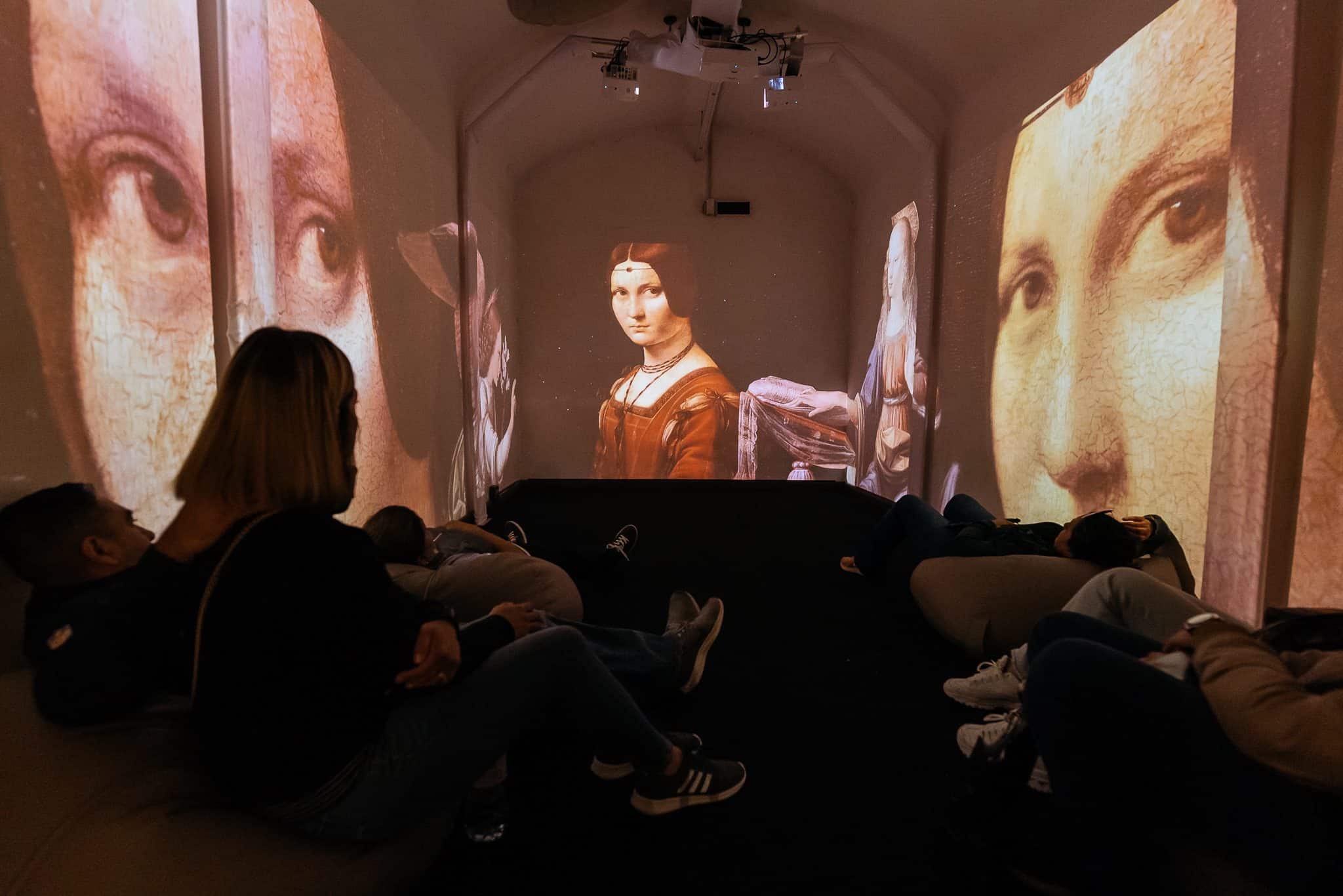
In recent years the exhibit has been enriched with a digital component that the original route didn't have: an interactive installation dedicated to the Vitruvian Man and a virtual reality experience that flies you over Renaissance Florence, expanded from the first version. There's also an art study space where you sit down to draw. The combination of the wooden model you touch with your hands and the headset you strap on your head is the distinctive trait of the current visit.
Who runs the Leonardo da Vinci Museum in Piazza del Popolo
The museum is conceived, set up and run within the Grande Experiences group, the immersive experience company that lists it among its permanent venues together with the Australian and US sites of its circuit, and which for the Rome venue announces the new interactive installation on the Vitruvian Man and the expansion of the virtual flight. The Italian company name that appears on the tax documents belongs to the same group. It's not a bureaucratic detail. It explains why the exhibit has the cut of an international educational show, with bilingual texts, a one-way route and a strong audiovisual component, and not that of a university science museum.
Rome's three Leonardo exhibitions, without mixing them up
It's worth putting things in order, because the overlap of names produces more misunderstandings than anything else in this city. In Piazza del Popolo you find the Leonardo da Vinci Museum, in the Galleria Agostiniana. In Piazza della Cancelleria, inside the Renaissance palace that critical tradition has long linked to Bramante, there is the Leonardo da Vinci Exhibition, dedicated to the genius and his inventions with large interactive machines. At Via della Conciliazione 19, a short walk from St. Peter's, the Leonardo da Vinci Experience opens its doors, with a more multimedia approach. Three separate tickets, three separate managements, three routes that resemble each other in subject and differ in presentation. If you have to pick only one and you're in the north center, this one. If you have small children and you're already at the Vatican, the one on Conciliazione. If you're also interested in the architectural container, the Cancelleria wins hands down.
The Galleria Agostiniana: the place before the museum
A museum of Renaissance machines under the floor of a basilica is not a marketing idea. It's the result of an urban story eight centuries long, and knowing it changes the visit.
The Augustinians, Sixtus IV and the convent of Santa Maria del Popolo
The Hermits of Saint Augustine have served this church since the mid-1200s: first the Tuscan congregation, then, from 1472, the Lombard one. In 1472 Pope Sixtus IV della Rovere started the complete reconstruction of the basilica, completed in 1477 under the direction of Giovannino de' Dolci, and along with the church the convent grew, with cloister, dormitories, refectory, library and gardens that went down to the walls. The 1400s cloister was later reworked in Bramante's circle between the 1470s and the very early 1500s, in the same years in which Bramante was working for Julius II on the church's new apse. In size and prestige it was one of the major religious complexes of the northern Campo Marzio.
The 1800s amputation and why the museum is underground
Then came Giuseppe Valadier. From 1811 the demolition of the convent cloisters opened the building site that would produce the elliptical square we know and the ramps up to the Pincio. The work was concentrated above all between 1818 and 1821, and continued with later arrangements. The salvaged material from the 1400s cloisters ended up reused in the decorative furnishings of the Casina and the belvedere on the hill. The convent was left with a much more modest neoclassical building, and the old service rooms, largely underground, survived as cellars, storerooms and depots. Those are the ones. The Galleria Agostiniana, which in the 2010s and 2020s of our century has also hosted contemporary art shows, is the second life of those rooms: masonry vaults, low and wide spaces, no natural light. A museum that works with projections, headsets and spotlights aimed at the models couldn't have found a better container, and the basilica found a way to make otherwise silent square meters pay off. It's a pact between a mendicant order of the 1200s and an exhibit-design company of the 2000s. Tell it at the dinner table and you'll look good.

The room-by-room visit of the Leonardo da Vinci Museum - Piazza del Popolo
The route is one-way, divided into thematic areas that follow Leonardo's interests. I describe it in the order you meet it, warning that temporary installations can move a few models. The overall structure, though, has been stable for years.
The entrance, the biography and the reproduced codices
The first area sets the scene: a timeline that takes the visitor from April 15, 1452, when Leonardo is born in Anchiano, near Vinci, the illegitimate son of the notary ser Piero and a woman of modest standing, to May 2, 1519, when he dies in Amboise, in Touraine, in the manor of Cloux that the king of France had assigned to him. In between there are Florence and Verrocchio's workshop, the 17 Milan years in the service of Ludovico il Moro, the flight of 1499, Mantua, Venice, the service with Cesare Borgia as a military engineer, the return to Florence, the second Milan period under the French, the three years in Rome and finally France.
Here the five faithfully reproduced Leonardo codices appear, and it's the display case I recommend looking at slowly because it explains everything else. Leonardo never wrote a finished treatise. He left thousands of loose sheets, filled with his famous mirror writing, from right to left, which is read in a mirror. At his death he left them to his pupil Francesco Melzi, who kept them with devotion. After Melzi's death the collection was broken up and scattered across half of Europe. Today the Codex Atlanticus is at the Biblioteca Ambrosiana in Milan, the Codex on the Flight of Birds at the Royal Library in Turin, the Madrid Codices at the Biblioteca Nacional de España, the Codex Trivulzianus at the Castello Sforzesco, the manuscripts from A to M at the Institut de France in Paris, the Codex Arundel at the British Library, the anatomical sheets at the Royal Collection in Windsor, and the Codex Leicester in private hands. Anyone who wants to see the originals has to plan a tour of Europe and be lucky enough to catch a temporary exhibition. The facsimiles you leaf through with your eyes in this room are, for almost everyone, the only possible contact with those pages.
An unpopular opinion: this is the room visitors cross fastest and it's the most important. Without understanding that Leonardo's work is a messy archive and not a book, the whole rest of the museum becomes a fair of nice toys.
The building-site machines and civil engineering
You get to the heart of it with the civil engineering section, and here wood dominates. Revolving cranes, winches, screw jacks, worm screws, differential pulleys, the machine for lifting heavy loads, the cogwheel windlass. Leonardo studied these machines as a young man in Florence, looking at the devices Filippo Brunelleschi had designed for the dome of Santa Maria del Fiore. Verrocchio's workshop worked on the bronze ball that was hoisted onto the lantern in 1471, and the boy who drew winches in those years had the building site before his eyes. In the models you see the point very well: Leonardo doesn't invent the crane, he breaks down the problem of lifting and redesigns its parts, multiplying force by reducing the ratios.
These are models you can operate. Turn the cranks, pull the ropes, count the gear teeth. If you have middle schoolers, this is the room where they light up, and you can stay 20 minutes without noticing. If instead you came for the painting, a fair warning: the painting comes at the end, and it's not autograph.
Leonardo's war machines
The weapons section is the most spectacular and the most misunderstood. There are the covered cart with wheels turned by cranks, the one the manuals improperly call a tank, the mortars with parabolic fire, the giant crossbow, the scythed chariot with rotating blades, the organ of rifle barrels, with batteries of guns mounted on a revolving support to fire in alternating bursts while the other row cools down, the assault ladder and the systems for tipping it over from the walls. Many of these designs appear in the famous letter with which, around 1482, Leonardo offered himself to Ludovico Sforza: a resume in 10 points in which he presented himself first of all as a military engineer, and only in the last paragraph mentioned that he could paint and sculpt as well as anyone else.
The misunderstanding concerns their effectiveness. Almost none of these machines was ever built, and several would not have worked: the covered cart, for example, with the transmission drawn on the sheet would have turned the wheels in opposite directions. Was it a transcription error, a deliberate misdirection or an oversight? It has been debated for a century. The museum has the good taste not to pass these devices off as operational inventions, and the visitor who looks at them as exercises in mechanical imagination gets much more out of it than one who looks for technological primacy at all costs.
The flying machines and the dream of flight
The flight area is the one everyone photographs. There is the ornithopter with beating wings driven by muscle power, the mechanical wing that reproduces the articulation of the bat's wing, the aerial screw that popularizers call the ancestor of the helicopter, the pyramid-shaped parachute, the anemometer, the hygrometer, the models drawn from the studies on the flight of birds. The aerial screw appears in Manuscript B kept at the Institut de France, drawn toward the end of the 1480s. The pyramidal parachute is a sketch in the Codex Atlanticus accompanied by a few lines promising that one can throw oneself from any height without harm. Modern reconstructions in cloth and wood have shown that that pyramidal shape, which by eye seems absurd, descends stably.
The real scientific content of this section, however, is not the devices: it is observation. Leonardo spent years watching birds of prey over the Tuscan hills and describing, with a precision nobody would reach before the 1800s, how air behaves below and above the wing surface, how the bird corrects its attitude with the tail, how it exploits rising currents without flapping its wings. He had understood that the problem of flight is a problem of fluids, not of arms. Then he tried to solve it with arms, because he had no engine. The failure is noble and instructive.
Water, bridges and mechanisms
The hydraulic section is the most underrated at the Leonardo da Vinci Museum and, for an engineer, the most serious. Here you find the Archimedes screw applied to lifting water, the water wheels, the miter gates for canal locks, the dredge, the diving suits and the floats for walking on water, the paddle boat. The two-leaf gates that close at an angle by the very thrust of the water, a system Leonardo studied and applied to the Lombard canals, are an idea that still holds today in every navigation lock in the world. It is his most concretely surviving invention, and in the museum it occupies a small display case in front of which almost nobody stops.
Next to it, pure mechanics: the ball bearing, the universal joint, the belt drive, the pinion and the lantern gear, the reduction ratio, the spiral spring with the fusee to compensate for the loss of force as it unwinds. And then the self-propelled spring cart, the device that part of the critics considers the first documented design of an autonomously propelled vehicle and that some call, with a touch of exaggeration, the first programmable automaton in history. The model is on view, the spring is wound, the cart takes off. On children it has the same effect as a rocket.
The anatomical plates and the study of the body
The anatomical plates and the sketches on human anatomy make up the quietest section of the route, and whoever skips it misses the part in which Leonardo is less legendary and more modern. His dissections, carried out between Florence, Milan and Rome, produced hundreds of sheets in which the body is seen in section, in transparency, in multiple views, with the method we would today call technical drawing applied to the organism. He studied the heart and its valves with a precision that medicine would recognize only in the 1900s, hypothesized the swirling motion of blood in the aortic bulb, drew the fetus in the uterus, the spine, the muscles of the shoulder, the skull in sagittal section.
The method was unscrupulous and it cost him dearly. Giorgio Vasari, in the Lives, tells that in the Roman years a German craftsman of his circle denounced him to the pope, accusing him of impious practices, and that Leonardo was forbidden access to the bodies at the hospital of Santo Spirito in Sassia. Vasari writes decades later and the episode should be taken as biographical tradition, not as a documented fact. But the climate he describes is plausible and explains why the anatomical study stopped. Look at the plates carefully: the hand that drew those muscle bundles is the same one that painted the drapery of the Virgin of the Rocks.
The life-size reproduced paintings
The museum displays life-size reproductions of the major paintings: the Mona Lisa of the Louvre, the Virgin of the Rocks in its two versions, the Lady with an Ermine, the Annunciation of the Uffizi, the Saint Anne. They are reproductions, and the museum doesn't pretend otherwise. Their function here is comparative: placed in a row, they let you follow the evolution of sfumato, the technique in which outlines dissolve in passages of very thin glazes, with no boundary line between the figure and the air. Leonardo theorizes it in his notes by saying that distant things must appear as blurred as the eye sees them, and that the painter must paint the atmosphere between himself and the object.
A clear opinion: don't come here for the paintings. If Leonardo's painting is what you're after, the ticket to buy is a plane ticket to Paris or Krakow. Come here to understand how the mind that produced those paintings worked, and the paintings hanging on the walls will come in handy as a point of comparison.
The Last Supper and the Vitruvian Man at the Leonardo da Vinci Museum
Two video stations explore the two works that more than any other have become universal signs. The Last Supper was painted between 1495 and 1498 on the wall of the refectory of the Dominican convent of Santa Maria delle Grazie in Milan, commissioned by Ludovico il Moro. Leonardo rejected fresco, which requires painting within a day on fresh plaster and allows no second thoughts, and worked dry with an experimental mixed technique that let him go back to the faces as many times as he wanted. It was an artistically coherent and technically ruinous choice. The color began to detach already in the first decades of the 1500s, and since then the history of the work has been the history of its restorations, the last of which, lasting more than 20 years, ended in 1999.
The Vitruvian Man, drawn around 1490 and kept at the Gallerie dell'Accademia in Venice, turns into a figure a passage from the third book of Vitruvius's De architectura on the proportions of the human body inscribed in the circle and the square. Vitruvius poses the problem, Leonardo solves it with the device of two superimposed positions, arms and legs spread and not, and with a different center for the two geometric figures: the navel for the circle, the pubis for the square. It's the most reproduced drawing in the history of Western art and it ends up on Italian one-euro coins. At the museum in Piazza del Popolo, today, there's also a newly made interactive installation dedicated to it, which lets you manipulate the figure instead of just looking at it.
The immersive room and virtual reality at the Leonardo da Vinci Museum - Piazza del Popolo
The audiovisual part is the one that has grown most in recent years. A multimedia room leads you into Leonardo's life and mind with large-format projections, and a virtual reality experience with a headset flies you over Renaissance Florence as if you were aboard one of the machines the master drew without ever seeing them leave the ground. It's a piece of spectacle, declaredly, and should be taken for what it is: it teaches nothing that the wooden models don't teach better, but it does what no wooden model can do, which is give back the point of view. Looking at Florence from above the hills, with the Duomo just finished, is a way to understand why that man was obsessed with the idea of rising into the air.
Rule of thumb: if you suffer from vertigo or motion sickness, sit down, take off the headset if you feel discomfort and don't play the hero. And if you're bringing very small children, think about it: a headset on a four-year-old's head doesn't make much sense.
The art studio and the educational stations
Toward the end of the route the museum provides a space where you sit down to draw, and it's not filler. Leonardo advised his pupil to draw every day, to always carry a notebook, to note down the figures seen in the street, the gestures, the deformities, the expressions of anger and laughter. A space where you pick up a pencil inside a Leonardo museum is consistent with what Leonardo said, and it's also the point where families stay the longest. Nearby you'll find the illustrated educational panels and the multimedia stations with thematic insights.
Languages, audioguides and materials at the Leonardo da Vinci Museum
The panels in the rooms are in Italian and English. For French, German, Spanish and Russian the museum provides booklets with the full translation of the same panels, which you pick up at the entrance. The audioguide, rented separately, adds a layer of reading in seven languages with biographical, artistic and scientific insights. The recommendation depends on the type of visitor. If you come with kids under 12, skip the audioguide and read the panels aloud yourself, because the route is tactile and hands busy holding a device don't turn the cranks. If you come alone or as a couple and have a real interest in the history of technology, take it, because the texts on the walls are necessarily brief and listening fills several gaps.
Leonardo in Rome: the three years at the Belvedere
There's a chapter that makes a Leonardo museum in Rome less arbitrary, and it's worth telling in full because almost nobody knows it. Leonardo lived in this city from the end of 1513 to 1516, in an apartment in the Belvedere, the little palace of Innocent VIII that Bramante was connecting to the Vatican palaces with the great courtyard. He had been called by Giuliano de' Medici, Duke of Nemours, younger brother of Pope Leo X, the first Medici pontiff, elected in March of that year. Leonardo was 61, with the reputation of a brilliant and inconstant man, and a career that in Florence and Milan had ended without a stable position.
They were strange years. The Roman court was taken up by Raphael, who was frescoing the Stanze and directing the building of St. Peter's, and by Michelangelo, fresh from the Sistine ceiling. Leonardo received no major painting commissions. He worked on studies of burning mirrors, geometry, hydraulics, projects for draining the Pontine Marshes, anatomy at the hospital of Santo Spirito, coining machines, apparatus for festivities. According to Vasari's account, he built wax animals inflated with air that flew around the room and a lizard with wings and horns that frightened anyone who came in. At the death of Giuliano de' Medici, in March 1516, he lost his protector. He then accepted the invitation of Francis I of France and left with Melzi and Salaì, taking with him his sheets and some panels, among them, according to the most accredited reconstruction, the Mona Lisa.
Rome, then, had him. It had him tired, suspicious, devoted to research that produced no works, and it let him go. A museum that reconstructs his machines 700 meters from the Tiber, inside a convent of the 1400s, is therefore not a commercial whim. It's the belated compensation of a city that didn't know what to do with Leonardo while he was alive.
A curiosity about the Leonardo da Vinci Museum - Piazza del Popolo
The real curiosity is not about the machines. It's about the floor above your head. While you turn the cranks of the winches, a few meters away vertically are two of the most important canvases of European painting, the Conversion of Saint Paul and the Crucifixion of Saint Peter that Caravaggio painted between 1600 and 1601 for the Cerasi chapel, and the chapel that Raphael designed starting in 1513 for the Sienese banker Agostino Chigi, with the mosaic dome showing the Creator among the planets and their angels. One floor below: wooden models operated by kids on a school trip.
There is no other vertical overlap in all of Rome so dense with art history. And there's a detail that makes the coincidence almost impertinent: the dates. Raphael receives the commission for the Chigi chapel in 1513, the same year Leonardo moves to Rome. In 1513 and 1514 the two are in the same city, both in the service of the Medici circle, one at the Belvedere studying burning mirrors and the other a kilometer away designing a funerary chapel for the richest banker in Europe. Raphael is 30 and the man of the moment. Leonardo is 61 and a legend that nobody knows how to employ anymore. Five centuries later, in that same block, the old man has the museum and the young man has the chapel.
A second curiosity, of a very different kind and useful in practice: in the museum you can touch. In a city where the heritage is almost all behind a cordon, a plexiglass pane or an alarm, the Galleria Agostiniana is one of the very few central places where you can tell a child to put their hands on what they see without having to call them back three seconds later. Anyone who leads school groups knows how much that is worth.
Something nobody tells you about the Leonardo da Vinci Museum - Piazza del Popolo
That it's not accessible. I'm writing it plainly because it's the information missing from most of the pages that promote the museum, and because a person in a wheelchair who comes all the way here, buys the ticket and discovers the stairs has wasted time, money and mood. The route runs through underground rooms and is reached by steps. At present there is no alternative route. If you have reduced mobility but you walk, if you use a cane, if you have breathing or balance problems, call the museum before setting out and ask how many steps there are and whether there's a handrail. In a city where the ancient ground level is always four meters below the modern one, this is a structural problem, not carelessness on the part of those who run it.
A second thing nobody tells you: the commercial push around Rome's three Leonardo museums is such that a good share of the tickets sold online by generic intermediaries end up with people who think they booked for a different address. Buy through the channel listed on the museum's official website, and check that the confirmation order says Piazza del Popolo. It's a 30-second chore that saves you a wasted morning.
Third, and it's about time: the museum is smaller than the promotional photos make you imagine. It's not the Domus Aurea, it's not a half-day route. If you visit with a clear head you're out after an hour, an hour and a half if you operate all the models and watch the videos in full. Planning three hours for it means being late for your next appointment in the opposite sense, that is, early and looking like someone who doesn't know what to do.
The advice I give you for visiting the Leonardo da Vinci Museum - Piazza del Popolo
Go mid-morning on a weekday, around 10:30, and not as a stand-alone stop. Make it the first half of a vertical day, from the underground to the belvedere. A good hour and a half in the underground rooms, then you go back up to the square, enter the basilica of Santa Maria del Popolo, which is three meters from the exit and costs nothing, and look at Caravaggio, Raphael, Pinturicchio and Bernini. Then you take Valadier's ramps, go up to the Pincio and look out from the terrace. If you have breath left, continue into the park of Villa Borghese. That's four and a half centuries of history within a radius of 400 meters, with a single climb.
The operational advice concerns the sequence inside the museum, and it goes against instinct. The temptation is to run to the flying machines, which are the most photogenic, and leave the codex display case for last. Do the opposite. Spend the first 10 minutes on the facsimiles, try to read two lines of mirror writing, look at how a gear, an old man's profile, a shopping list and a thought about the soul coexist on a single sheet. From that moment on, every wooden model stops being an object and becomes the consequence of a page. That's the difference between a visit and a stroll.
One last piece of advice, against the grain of almost every guide: if you have only one afternoon in Rome and you're not a fan of the history of technology, don't come. The museum is excellent for what it is, but with 24 hours in this city there are priorities that admit no discussion. If instead you're in Rome for three days or more, if you have kids between eight and 16, if it's raining, if it's Monday and half the city is closed, if you've already been to the major museums three times, then it's one of the best choices in the historic center.
Another well-known fact, yet rarely cited
That Piazza del Popolo was for centuries Rome's place of capital executions is known to anyone who has read two pages about the city. What is rarely cited is the mechanics of the event and how ordinary it was. In the Papal States executions were public, announced, attended like shows. The most famous executioner, Giovanni Battista Bugatti, known to everyone as Mastro Titta, served from 1796 to 1864, and more than 500 executions are recorded in his memoirs. He lived in Trastevere and crossed the bridge only on working days, so much so that in Rome the saying was born that Mastro Titta crosses the bridge, meaning someone is being put to death. The square where the Leonardo da Vinci Museum stands was one of the main stages of those days, along with Piazza del Ponte, Piazza dei Cerchi and Campo dei Fiori.
The most illustrious witness was Lord Byron. In May 1817, during his stay in Rome, the poet witnessed the beheading of three condemned men and wrote about it to his London publisher in a famous letter, describing the dismay and trembling that seized him, the French-model guillotine introduced in the Papal States, the demeanor of the condemned, the rite of the comfortatorio. The current reconstruction places that scene precisely in Piazza del Popolo. It's useful to remember when you leave the museum with your head full of Renaissance gears: the paving you cross on the way to the cafe has a much less kind memory.
And there is a second well-known fact that almost nobody connects to this address: the convent under which you visit the museum was taken apart, literally, to make room for the beauty of the square. That scenography everyone photographs was born from the demolition of the Augustinians' 1400s cloisters, begun in 1811, and from the reuse of their stones in the furnishings of the Pincio. Rome's most harmonious square was paid for by a religious community with its own building heritage. What the visitor walks through underground today is what survived of the old complex because nobody could see it.
The right photo to take at the Leonardo da Vinci Museum - Piazza del Popolo
Inside, the photo that counts is only one, and it's not the ornithopter. It's a child's hand on the winch crank, with the wooden model blurred behind. The machines, photographed head-on and alone, in a dark room under artificial light, come out badly: black background, wood burned by the spotlights, no reference scale. What makes the image readable is the human body next to it, which gives scale and tells the gesture. Stand with the spotlight at three quarters, rest your elbows if you don't have a tripod (which in narrow spaces is inconvenient anyway and not very courteous to others), lower the shutter speed and raise the sensitivity. The lighting is low and flash flattens everything. Check at the ticket office whether there are filming restrictions and respect the ban in the rooms with projections.
Outside, instead, the right photo is the one almost nobody takes. Everyone shoots from the obelisk toward the twin churches, with the result that the postcard of Piazza del Popolo already exists in 10 million copies. The photo I recommend is from the opposite side: stand beneath the side of the basilica, the one where the museum's doorway opens, and frame together the sign of the Leonardo da Vinci Museum and the church's side wall rising above it. In a single shot you have the Sistine 1400s and the exhibition 2000s, the sacred and the popularization, the convent and the exhibit-design company. It's a photograph that explains something instead of just being beautiful.
The third shot, for those with time, is taken from the Pincio at sunset. From Valadier's terrace the ellipse of the square can be read in full and the volume of the basilica stands out very well on the right. Knowing that under that roof there's a museum of Leonardo machines makes the view more interesting than it already is. The best time is the half hour before sunset, with the sun behind you toward St. Peter's. The worst time is midday in summer, flat light and crowds.
Some important events that happened here in history
This corner of Rome was the first one travelers saw when arriving from the north, and for 15 centuries it has been the backdrop of solemn entrances, legends and urban turning points.
1099: Paschal II's exorcism and Nero's walnut tree
The founding legend says that on the spot stood a walnut tree haunted by demons, spawned by Nero's body buried in the tomb of the gens Domitia Ahenobarbi, at the foot of the Pincio. In 1099 Pope Paschal II is said to have cut down the tree, ordered the remains thrown into the Tiber and founded a chapel to free the neighborhood. It's a tradition, not a documented fact. The topography of the Domitii mausoleum doesn't coincide with that of the church, and modern historiography considers the story a later construction. But it's the reason a church rose right here, and therefore the ultimate reason why today you go down under that floor to look at flying machines.
1472-1477: Sixtus IV's reconstruction
Sixtus IV della Rovere, the pope of the Sistine Chapel, had the basilica rebuilt from the foundations between 1472 and 1477, entrusting the work to Giovannino de' Dolci. In those same years the convent was enlarged with the cloister, later reworked in Bramante's circle. In the following decades the church received Pinturicchio's decoration, the tombs of Cardinals Ascanio Sforza and Girolamo Basso della Rovere sculpted by Andrea Sansovino between 1505 and 1510, and the apse designed by Bramante for Julius II.
1513-1516: Leonardo and Raphael in the same city
In 1513 Agostino Chigi commissions from Raphael his own funerary chapel in Santa Maria del Popolo, with the pyramid, the dome mosaic and the astronomical program. In the same year Leonardo arrives in Rome at the invitation of Giuliano de' Medici and takes lodgings at the Belvedere. The chapel will be completed by Bernini a century and a half later, for Cardinal Fabio Chigi, who became Pope Alexander VII, with the statues of Daniel and Habakkuk.
1600-1601: Caravaggio in the Cerasi chapel
Tiberio Cerasi, treasurer general of Clement VIII, buys the chapel to the left of the high altar and commissions two canvases from Michelangelo Merisi da Caravaggio and the central altarpiece from Annibale Carracci. The result is the Conversion of Saint Paul and the Crucifixion of Saint Peter: two paintings that rewrite the rules of sacred painting, with light cutting through the dark, dirty feet in the foreground and the total absence of heavenly glory. The first version of the two canvases was rejected. The ones you see today are the second draft.
1655: the entrance of Christina of Sweden
On December 23, 1655, Christina of Sweden, an abdicated queen converted to Catholicism, enters Rome through the Porta del Popolo between two wings of crowd. For the occasion Alexander VII entrusts Gian Lorenzo Bernini with the decoration of the inner face of the gate, with the inscription wishing a happy and auspicious entrance and the festoons of Chigi heraldic fruits. In those same years Bernini reworks the interior of the basilica at the will of the same pope. You walk through that gate today coming from the metro. Look up, from the square side.
1786: Goethe arrives from the north
On October 29, 1786, Johann Wolfgang von Goethe enters Rome through Porta del Popolo at the end of his journey in Italy, and writes in his diary about the emotion of someone finally arriving in the city he had imagined all his life. He takes lodgings a little farther on, on Via del Corso, where the house museum dedicated to him can be visited today. For two and a half centuries this gate was the threshold of the Grand Tour: anyone coming from Florence, from Milan, from Germany, from France arrived along Via Flaminia and saw Rome for the first time from here.
1811-1824: Valadier redesigns everything
In 1811 the demolition of the convent cloisters begins. Between 1818 and 1821 Giuseppe Valadier designs and builds the elliptical basin, the hemicycles with the fountains, the retaining walls and the ramps up to the Pincio. The works continue until the 1820s, and the lion fountains at the foot of the obelisk belong to this period. The medieval and Baroque square disappears, and the one the world photographs today is born. Below, the buried convent spaces survive in silence.
2022-2024: the restoration of the basilica
A general restoration project affected the basilica from 2022 until November 2024, giving back surfaces, decorative elements and legibility to the works. Anyone who visits the museum today and then climbs back up into the church finds an interior in much better condition than the one visitors knew 10 years ago. It is one of the few pieces of good architectural news in the historic center in recent years.

Who passed through Museo Leonardo da Vinci - Piazza Del Popolo
The museum has a recent history, but the walls that contain it have seen, over 800 years, a number of people that few Roman addresses can claim. Here is who, with the circumstances.
Martin Luther, Augustinian friar away from home
Between 1510 and 1511 a young German Augustinian friar arrived in Rome over a matter internal to his order and stayed about four weeks. His name was Martin Luther. He was struck by the worldliness of the Roman clergy, and from that experience part of his judgment of the Church took shape. Tradition, also taken up by Italian literature on the subject, says he was a guest at the Augustinian convent of Santa Maria del Popolo, that is, exactly the structures of which the Galleria Agostiniana is what remains. The most recent studies are more cautious about the exact lodging, because in Rome the Augustinian convents were not just one and the congregations were in tension with each other. It is certain, however, that the friar visited the Observant house of the city. Look at the vaults of the museum with this in mind: right below here, or a few meters away, slept the man who seven years later would post his theses in Wittenberg.
Egidio da Viterbo and the great Augustinians
The convent of Santa Maria del Popolo was for centuries one of the most important houses of the Augustinian order in Italy, and prior generals, theologians and preachers of the Roman Renaissance passed through it, among them the generation of Egidio da Viterbo, prior general of the order and cardinal, orator of the Fifth Lateran Council. It is useful to remember that above the machine rooms, for five centuries, people studied, preached, copied and debated theology.
Bramante, Raphael, Sansovino, Caravaggio, Annibale Carracci, Bernini
The list of artists who worked in this block is almost a manual of Italian art history. Pinturicchio frescoes the chapels and the apse vault in the 1470s and 1480s. Bramante rebuilds the apse for Julius II at the beginning of the 1500s and works on the cloister. Andrea Sansovino sculpts the two cardinal tombs between 1505 and 1510. Raphael designs the Chigi chapel from 1513. Caravaggio delivers the two Cerasi canvases in 1601, with Annibale Carracci on the altar. Bernini reorganizes the interior and completes the Chigi chapel between 1655 and 1660, and in 1655 signs the inner face of Porta del Popolo. All of them crossed the courtyard, the cloister, the service rooms of the convent: the same levels on which people walk today.
Christina of Sweden, Goethe and the travelers of the Grand Tour
Christina of Sweden entered Rome through the gate next to the museum in 1655, with Bernini put in charge of making her welcome a beautiful one. Goethe entered in October 1786. And before and after them came thousands of English, German, French and Russian travelers doing the Grand Tour. Stendhal, who stayed in Rome on several occasions in the 1820s and 1830s, described the square in his Roman Walks. Byron, as we have seen, attended a public execution there in 1817. The gate was the diaphragm: outside the countryside of Via Flaminia, inside Rome.
Valadier, and the Romans who worked there
Giuseppe Valadier, the greatest Roman architect between the 1700s and 1800s, designed the current square and the ramps to the Pincio. And it's right to remember also those who left no name: the stonecutters who took apart the 1400s cloister stone by stone, the masons who built the now whitewashed vaults of the museum, the friars who for generations kept the parish registers. The rooms you visit have been, in order, a convent storeroom, a depot, an exhibition space for contemporary art in the 2010s and 2020s of our century, a Leonardo museum. Few Roman buildings have changed their trade so many times while staying standing.
The Leonardo da Vinci Museum - Piazza del Popolo with kids
This is the audience for which the museum works best. The ideal range is between eight and 14: old enough to understand what a worm screw does, young enough to get excited turning a crank. Under six, the ratio between the effort of going down the stairs and the payoff is questionable, unless the child is already obsessed with machines. Over 15, a lot depends on individual curiosity.
The right way to run the visit with kids is to give yourselves missions. Find the smallest gear in the museum. Count how many models work with the same basic idea, that is, turning a rotary motion into a straight one. Pick out the one device that in their opinion could really work and discuss it on the way out. Try writing your own name in mirror writing in the space dedicated to drawing, then read it with the phone camera flipped. These are trivial tricks and they produce double the attention compared with a silent stroll in front of the display cases.
For a whole day at a child's pace, the museum works very well paired with the park. You come out, go back up to the Pincio, get to the little lake of Villa Borghese and, if the day is long, continue toward Explora, the children's museum of Rome, which is a few minutes toward Via Flaminia. Alternatively, for families with older kids, the Etruscan Museum of Villa Giulia rounds out the day with something completely different and just as concrete.
Accessibility of the Leonardo da Vinci Museum - Piazza del Popolo
The route is underground and reached by stairs. The museum is not accessible to people in wheelchairs and at present has no alternative route. There are no elevators. For those with reduced mobility who walk, the advice is to phone the museum before the visit and ask the number of steps, the presence of handrails and the possibility of rests. The underground rooms have no natural light and are on average cooler than outside, a pleasant condition in summer and one to keep in mind in winter. A sweatshirt in your bag is never wrong.
On the sensory side, the rooms with projections and the virtual reality station can be demanding for people with particular sensitivity to sounds and flashing lights. The route, however, can be done skipping them, because the models part is independent. For restrooms, luggage storage and strollers in the narrow rooms, the answer changes over time and it's best to ask the staff at the ticket office.
How long the visit takes and when to go
An hour for an attentive but quick visit. An hour and a half for a full visit, with the videos watched in full and the models operated. Two hours if you're a real enthusiast, if you take the audioguide, if you stop to draw and if you do the virtual reality. With kids, count an hour and a quarter and be patient with the cranks.
The best time of day
Early morning, right at opening, or the last hour and a half of the afternoon. The middle slots, between 12 and 15, gather organized groups and school parties, and in low, narrow rooms you feel the difference. On rainy days the museum fills up because half of Rome is looking for a shelter with something inside. If the sky is black, either arrive at 10 on the dot or put it off.
The season
From November to March, excluding the Christmas holidays, you go around almost alone. Between April and June the square is crowded and the museum becomes so as a result. In July and August the coolness of the underground rooms is a decisive argument. When it's 38 degrees in the square and the obelisk radiates like a hot plate, an hour underground looking at winches is a form of salvation. Monday, as already said, is the day the museum is worth double, because it's open while the big state collections and the Galleria Borghese are closed.
What's around the Leonardo da Vinci Museum - Piazza del Popolo
Few Roman addresses offer as much within a five-minute walk. Here is how to organize the hours around the visit.
The basilica of Santa Maria del Popolo, three meters from the exit
Free entry, hours tied to services, a heritage that in many European cities would justify a trip on its own. The Cerasi chapel with Caravaggio's two canvases of 1600-1601 and Annibale Carracci's Assumption on the altar. The Chigi chapel designed by Raphael from 1513, with the mosaic dome and the two Bernini statues of Daniel and Habakkuk. The Della Rovere chapel with Pinturicchio's frescoes. Sansovino's tombs in the choir. Bramante's apse. The church has come out of a general restoration completed in November 2024. Bring coins for the chapel lighting. Without artificial light, the Caravaggio on the left is just a dark patch.
The square, the obelisk and the twin churches
The Flaminio obelisk, at the center of the ellipse, is one of the oldest in Rome. It was erected in Heliopolis under Ramesses II in the 13th century BC, brought to Rome by Augustus in 10 BC and placed in the Circus Maximus, and moved here in 1589 by Domenico Fontana at the will of Sixtus V, in the great road reorganization plan that connected the basilicas with straight axes marked by obelisks. The two so-called twin churches that frame the mouth of the Corso, Santa Maria in Montesanto and Santa Maria dei Miracoli, were built between 1662 and 1679 to a design by Carlo Rainaldi, with contributions by Bernini and Carlo Fontana. They are not twins at all, because one has an elliptical dome and the other a circular one, and the perspective trick is meant to make them look the same from afar. Look at them from the obelisk and then up close. It's a lesson in urban scenography.
The Pincio, Villa Borghese and the park's museums
Valadier's ramps climb from the eastern hemicycle and in five minutes bring you to the terrace of the Pincio, one of the three or four decisive viewpoints over Rome. From there you enter Villa Borghese, with the little lake, the temple of Aesculapius, the Museo Carlo Bilotti in the orangery and, at the opposite end of the park, the Galleria Borghese, which requires a mandatory reservation with a time slot and which nobody should attempt without a ticket bought in advance.
The Tridente, the Ara Pacis and the lungotevere
From Piazza del Popolo start the three streets that form the Tridente: Via del Corso in the center, Via del Babuino toward Piazza di Spagna, Via di Ripetta toward the Tiber. On the latter you meet the Mausoleum of Augustus, reopened after decades of neglect, and the Ara Pacis in the case designed by Richard Meier. Continuing, you reach Piazza Navona in about 20 minutes, or you cross the river toward Castel Sant'Angelo. On the opposite side, going up Via Flaminia, you reach the Etruscan Museum of Villa Giulia and the Auditorium Parco della Musica.
Schools and groups at the Leonardo da Vinci Museum - Piazza del Popolo
The museum has a phone line dedicated to groups and schools, 06 88816182, and applies the rate of €10 per person from 10 participants up. For a school trip it works well with middle school classes and the first two years of high school, especially if the technology or science teacher prepares the visit with a couple of lessons on simple machines. A practical suggestion: split the class into two subgroups and have one start from the beginning of the route and one from the anatomy section, crossing them in the middle. The rooms are narrow, and a whole class in front of the same model means 20 kids who can't see and start talking about something else.
For adult groups, the museum lends itself well to a visit led by a guide who holds together the three levels of the place: the basilica above, the demolished convent around, the machines below. It's a story that, told well, lasts 90 minutes and has no dead moment.
Quick questions about the Leonardo da Vinci Museum - Piazza del Popolo
Where exactly is the Leonardo da Vinci Museum - Piazza del Popolo?
At Piazza del Popolo 12, 00187 Rome, in the Galleria Agostiniana, that is, in the underground rooms attached to the basilica of Santa Maria del Popolo, on the northeast side of the square next to the Porta del Popolo. On some listings the address appears as 12/a.
Is the Leonardo da Vinci Museum in Piazza del Popolo still open?
Yes. The museum is operating at the same location and opens every day from 10.00 to 20.00, with last entry at 19.15.
How much does the ticket cost?
Full price €14, reduced €12 for students, people over 65, kids from 6 to 17 and Roma Pass holders, €10 per person for the family rates and for groups of 10 participants or more.
Do you need to book to visit the Leonardo da Vinci Museum?
No, booking is not mandatory and tickets are bought at the entrance, in cash or with the main cards. On high-season weekends and during holidays, buying in advance through the channel listed on the official website avoids the outdoor line.
How long does the visit to the Leonardo da Vinci Museum - Piazza del Popolo take?
From an hour to an hour and a half for most visitors, up to two hours for those who watch all the videos, take the audioguide and do the virtual reality.
Is the Leonardo da Vinci Museum wheelchair accessible?
No. The route is underground and reached by stairs, with no alternative route. If you have mobility difficulties, contact the museum before going.
Is the MIC Card valid at the Leonardo da Vinci Museum - Piazza del Popolo?
No. The MIC Card opens only the civic museums of Roma Capitale and this is a private museum housed in church-owned spaces. No public card covers it.
Do you get in free with the Roma Pass?
No, you get in at the reduced rate, that is, €12. The Roma Pass here doesn't entitle you to free entry.
Is entry free on the first Sunday of the month?
No. The free Sundays apply to the state museums of the Ministry of Culture and have no effect on this museum.
Are there original works by Leonardo?
No, and the museum doesn't claim there are. You see three-dimensional models built by Italian artisans from the drawings, faithful reproductions of five codices, anatomical plates and life-size reproductions of the paintings.
How many models are there at the Leonardo da Vinci Museum?
More than 50, scaled or life-size, many of them interactive and operable by the public.
Can you touch the machines?
Many, yes, and it's one of the reasons it's worth coming with kids. The instructions on individual models should be respected, because not all of them can be operated.
Can you take photographs at the Leonardo da Vinci Museum - Piazza del Popolo?
The conditions for amateur photography and any bans in the rooms with projections should be asked about at the ticket office. The light is low. Without flash you need long exposures and high sensitivity.
Is it suitable for children?
Very, especially between eight and 14. Under six, interest drops and the stairs complicate handling strollers.
What's the difference from the Leonardo exhibition at Palazzo della Cancelleria?
They are two separate exhibitions, with different tickets and managements. The one at the Cancelleria is held inside a first-rate Renaissance palace and focuses on large interactive machines. The one in Piazza del Popolo occupies the underground rooms of the Augustinian convent and pairs the models with a multimedia and virtual reality component.
And with the Leonardo da Vinci Experience on Via della Conciliazione?
That too is a different museum, with its address at Via della Conciliazione 19, near St. Peter's, and a more markedly multimedia approach. Always check the address on the ticket you bought.
Is there luggage storage or a coat check?
The spaces are small and conditions change over time, so ask at the ticket office. If you arrive with large suitcases, keep in mind that the route is underground and narrow.
How long is the wait in line?
On most weekdays you get in right away. On spring weekends, long weekends and during the Christmas holidays the wait can exceed half an hour, and you wait outdoors with no shelter from the rain.
Is there an audioguide and in how many languages?
Yes, rented separately, with biographical, artistic and scientific insights in seven languages: Italian, English, Spanish, French, Portuguese, German and Russian.
Are the captions also in English?
Yes, the panels in the rooms are bilingual, Italian and English, and booklets with the translation in French, German, Spanish and Russian are available at the entrance.
Is the museum open on Monday?
Yes, every day, and it's one of its competitive advantages, because on Monday most of Rome's big collections are closed.
Does the Leonardo da Vinci Museum - Piazza del Popolo close at Christmas?
The only declared annual closure is December 25. For other holidays it's best to check the official website.
Can you also visit the basilica with the same ticket?
No, they are two separate things. The basilica of Santa Maria del Popolo is a parish church with free entry and hours tied to services, and the museum ticket has nothing to do with it.
How far is it from the metro?
A little over 100 meters from the Flaminio - Piazza del Popolo stop on Line A. You come out, walk through the Porta del Popolo and you've arrived.
Is there a cafe or refreshment point inside the museum?
The museum is compact and the route is designed for a visit of a good hour. To eat or drink you go out to the square, where the options are many and the prices are those of the Tridente, that is, high. If you want to spend a fair amount, move two blocks toward Via del Babuino or Via di Ripetta.
Is it worth visiting all three Leonardo museums in Rome?
For a fan of the history of technology, yes, and on two different days. For a tourist with three days in Rome, no. You pick one, and if your hotel is in the north center the reasonable choice is this one.
Is it a state or municipal museum?
Neither. It's a private initiative, set up and run within an international group of immersive experiences, housed in rooms that belong to the religious community of the basilica.
Are there guided tours?
The route is designed for self-guided visits with panels and audioguide. For groups and school parties there is a dedicated line, 06 88816182, through which to arrange entry.
The final verdict on the Leonardo da Vinci Museum - Piazza del Popolo
It's an honest museum. It doesn't promise originals it doesn't have, it doesn't inflate Leonardo into a prophet of modernity, it lines up 50 well-built objects and lets them speak. In a historic center that sells immersive experiences by the pound, this restraint is a virtue. If you have kids between eight and 14, if it's raining, if it's Monday, if you've already made the rounds of the major museums three times, go in without thinking. If you have 24 hours in Rome and you're not interested in the history of technology, skip it and go elsewhere. Better to come out happy from another museum than to go in here reluctantly.
One last recommendation, and it's not a formality. When you climb the stairs and come back out into Piazza del Popolo, go into the basilica before leaving. It's 30 meters, it costs nothing, and it takes you in front of two Caravaggios and a Raphael chapel. Leaving the Galleria Agostiniana without walking those 30 meters is the mistake I see made every day, and the most avoidable of all.
Article written by the editorial team of TourLeaderPro, contact them for Private/Corporate/V.I.P. Tours and Experiences.
Planning a trip to Rome? The English guides for visiting the city are on ItalyPlanner.com.