Santa Maria del Popolo
In short. Santa Maria del Popolo is at Piazza del Popolo 12, 00187 Roma, on the north corner of the square, right up against Porta del Popolo.
Santa Maria del Popolo is at Piazza del Popolo 12, 00187 Roma, on the north corner of the square, right up against Porta del Popolo. You can get there on the metro A, Flaminio stop (Flaminio-Piazza del Popolo): exit the station, walk through the arch of the gate, and the church is right there on your right, 40 seconds on foot. The tram 2 also runs through the same square, starting from piazzale Flaminio and heading up toward Piazza Mancini. The basilica entrance has no ticket office, and no fee is published on the official website. It's a parish church that is served by clergy, you go in to pray and to look, and at most you'll find the donation box and the Welcome Desk at the entrance. The hours published on the official website as of August 2026 are these: Monday-Friday 10.30-12.30 and 16.00-18.30, Saturday 10.30-18.30, Sunday and holidays 16.30-18.30. Keep the weekday lunch break in mind, because it's the trap everyone falls into: from 12.30 to 16.00, Monday to Friday, the basilica is closed. On Sunday morning you can't go in as a visitor at all, since it only opens at 16.30.
You don't need a reservation for a regular visit, and there's no online ticket system for the church. If you want a guided visit, the official website has a section for choosing a visit, and there's a Welcome Desk on site. Public sources don't agree on the phone number. The basilica's official website lists +39 392 3612243 as the contact for the Desk Accoglienza. turismoroma.it publishes 06 45675909. The website of the Ordine agostiniano, the order that serves the church, gives 06 3610836 for the parish. These are three different numbers from three different sources, all of them tied to the institution. Try them in this order, and don't be surprised if the first one just rings unanswered during closing hours.
If you're building your day around this area, the natural starting point is Piazza del Popolo, the square the basilica faces and the one it takes its name from. Under the church, with its entrance alongside, is the Museo Leonardo da Vinci of the Galleria Agostiniana. It's a different thing, it's paid, and it has its own hours and tickets.

Why Santa Maria del Popolo Is Worth the Trip, Put Plainly
In a single church, for free, with no line and no reservation, inside Santa Maria del Popolo you'll find two Caravaggios, a chapel designed by Raphael and finished by Bernini, a choir by Bramante, two funerary monuments by Andrea Sansovino, 16th-century stained glass by Guillaume de Marcillat and frescoes by Pinturicchio. If the same concentration were inside a state museum, there would be two hours of waiting in line and a ticket of €20. Here you walk through a wooden door and you're already inside.
In our view Santa Maria del Popolo is the church with the best ratio between what it holds and what it costs in all of Rome. It's not the most beautiful, not the biggest, not the oldest. It's the one where, within 40 square meters of transept, you can see how European painting changes between 1600 and 1601. No other place in the city shows it so bluntly.
There is a flip side, however: it's a living church, not an exhibition hall. The hours are those of a parish, not a museum, the chapel lights are often coin-operated, people pray there, and if you arrive during a service you can't walk around. Anyone who goes in with a museum-visit mindset leaves unhappy. Anyone who goes in knowing they're entering a church and that the masterpieces are a bonus leaves happy.
What Santa Maria del Popolo Means, the Name
The name comes from the square, and the square from the gate. Two readings of populus have coexisted for centuries: in Latin populus means people, but it also means poplar. Some link the name to the poplar grove that stood outside the gate, and others link it to the fact that the first chapel, according to tradition, was paid for at the expense of the Roman people. Neither explanation is proven, and anyone who presents it as certain is selling a story. Serious sources keep both on the table.
What is documented, on the other hand, is that Santa Maria del Popolo is one of the oldest parishes in Rome, as the basilica's official website states, and that the cardinalate title of Santa Maria del Popolo has existed since 1587. This isn't a detail for scholars only. It means this church has had a titular cardinal for almost 450 years, so it counts for much more in the Roman church hierarchy than its modest facade would suggest.
Exactly where it is and how to really get there
Address. Piazza del Popolo 12, 00187 Rome. The basilica's portal faces into the square. The building is the one immediately to the right of Porta del Popolo for anyone entering from the north, that is, for anyone arriving from piazzale Flaminio. The coordinates published by turismoroma.it are 41 degrees 54 minutes 40.8888 seconds north and 12 degrees 28 minutes 33.7152 seconds east.
Metro. Line A, Flaminio station, opened on February 16, 1980, and was renamed Flaminio-Piazza del Popolo in 2005. It's the closest stop and it's no contest: exit onto piazzale Flaminio, you'll have the city gate in front of you, go under it and you're in the square. Just under 200 meters, all flat, all on sidewalks.
Tram. Line 2 terminates at piazzale Flaminio. It's the tram that climbs viale Tiziano up to Piazza Mancini, the one you take for the Auditorium and the MAXXI. If you're coming from the north, it's the easiest way to get there without changing metro lines.
Railway. Also at piazzale Flaminio is the terminus of the Roma-Civita Castellana-Viterbo line, the old Roma Nord. If you're arriving from the Flaminia or from Prima Porta, you get off there and you've already arrived.
Bus. The hub of piazzale Flaminio and Piazza del Popolo is served by urban bus lines and by Cotral intercity lines, but check the exact numbers on the app or the official public transport website before you leave, because routes change often.
On foot. It's the most recommended option. From Piazza di Spagna it's just under 10 minutes going up via del Babuino. From Trevi Fountain it's about 20 minutes. From the Ara Pacis and the Mausoleum of Augustus, going up via di Ripetta, a good 10 minutes. Piazza del Popolo is the apex of the Tridente: the three streets that start there, via del Corso in the middle, via del Babuino on the left and via di Ripetta on the right, take you across half the city without ever needing transport.
By car: forget it. You're inside the ZTL of the Historic Center and there's no parking. If you really do come by car, the place to leave it is the Villa Borghese parking lot, then go down from the Pincio via the Valadier ramp, which drops you exactly in the square. It's also the most beautiful descent in Rome, so it's not a fallback option.
Hours, admission and rules
Hours according to the basilica's official website. Monday-Friday 10.30-12.30 and 16.00-18.30. Saturday 10.30-18.30. Sunday and holidays 16.30-18.30. The site also lists a winter schedule for the Desk Accoglienza with Saturday 10.30-18.30, and it should be noted that the page labels that line as the winter schedule, so in the middle of summer it may not be the one in effect. If you're going on a Saturday and need the Desk, it's worth calling ahead.
Admission. The official website does not list any fee for entering the basilica. In practice in Rome, parish churches are free, and Santa Maria del Popolo is an Augustinian parish in full swing. Entry is therefore free, but there is no official statement online that says so: it's an inference from the fact that it's a church still in use for worship, not a published fact. If you find a fee requested for access to the chapels or the sacristy, don't make a fuss.
Masses. Mass times are not published either on the basilica's official website or on the parish page of the Augustinian Order's website. If you want to attend a service, call.
Rules of behavior. Shoulders and knees covered, hats off, phones on silent. Photographs without flash are standard practice in almost all Roman churches, but in the Cappella Cerasi the rule can be stricter and it changes over time: check the signs at the chapel entrance and, if there's a custodian, ask. Using flash on the Caravaggio canvases is tacky, as well as damaging.
The lights. In Roman churches that house important paintings, the common practice is timed lighting, with a coin box next to the chapel. That there is a coin box at Santa Maria del Popolo, and at what price, is not supported by any official source: the basilica's website doesn't mention it. So here's a practical tip, not a fact: keep a few 1-euro and 50-cent coins in your pocket. If there is a coin box, the Cerasi Chapel stays pitch black without those coins and you won't see the two Caravaggios. If there isn't one, you've lost nothing.
A curiosity about Santa Maria del Popolo
The curious thing is that this church was founded to keep Nero's ghost quiet. It's not a joke, it's what the basilica's official website tells, keeping the different levels clearly separate.
The documented fact is this: tradition holds that in that peripheral, almost deserted area, outside the Porta Flaminia, stood the tomb of the Domitii family, that is the Domitii Ahenobarbi, where Emperor Nero was buried. Pope Paschal II, in 1099, began building a chapel right there.
Then there's the legend, and it's declared as a legend by the official source, which ties it to the arch that surmounts the altar: the Virgin supposedly appeared in a dream to the pope to tell him to build a chapel exactly where that emperor was buried, whose ghost haunted the area. The official reason for the founding, the one the pope put in writing, was instead another and much more political one: to celebrate the liberation of the Holy Sepulchre by the Crusaders. We're in 1099, the year Jerusalem was taken. The timing is no accident.
Notice the structure of this story, because it's wonderful. On one side, a pope who builds a monument to the Crusader victory. On the other, a people who need to believe that the monument serves to crush a demon. Power and fear using the same building for two opposite reasons. To explain to a foreigner how Rome works, you'd only need to tell them this founding story.
One more detail about the documented part, from an encyclopedic and not official source: when Paschal II began work on the site, what had to be demolished was the mausoleum of the Domitii Ahenobarbi. That is, the chapel was not built next to the tomb, but in place of the tomb. The erasure was material, not symbolic.
The history in order, from 1099 to the restoration completed in 2024
It is often read that the church of Santa Maria del Popolo arose in the 15th century from a small chapel dedicated to the Virgin, built at the will of Pope Paschal II. In reality the chapel of Paschal II dates to 1099, that is to the 11th century, not the 15th century. What dates to the 15th century is the complete reconstruction of the church. Said that way, it seems Paschal II was a 15th-century pope, and we're talking about a pope from the year of the First Crusade. The official website of the basilica writes verbatim that it was Pope Paschal II, in 1099, who began building a chapel where Santa Maria del Popolo now stands.
1099. Paschal II has the chapel built, to celebrate the liberation of the Holy Sepulchre, on the site of the mausoleum of the Domitii Ahenobarbi. Tradition adds the contribution of the Roman people and the Marian dream.
1227 or 1235: here the sources don't agree. The basilica's official website writes that in 1235 Pope Gregory IX transferred the image of the Virgin from the Lateran, the one still on the high altar, and that on that occasion the small chapel was turned into a church for the temporary settlement of the Franciscans. The encyclopedic source instead gives 1227 as the year Gregory IX enlarged the chapel. The two reports may also be two different events eight years apart, but since they're told as the same passage, both stay on the table.
1250. The complex passes to the Order of the Augustinians of Tuscia. It's the decisive passage, because the Augustinians are still there today: the parish of Santa Maria del Popolo appears in the list of Augustinian communities of the Province, according to the Order's website. 776 years in the same place.
1472. The church passes to the Lombard Congregation of Augustinians, which will have it reworked in the Lombard style. This explains something that will catch your eye and that is rare in Rome: the late Gothic bell tower in Lombard style with terracotta cladding. It isn't Roman, it's northern, and you can tell.
1472-1477. In the second half of the 15th century the church is completely rebuilt by order of Pope Sixtus IV Della Rovere, and it becomes one of the first Renaissance churches in Rome. People have argued about the architect for centuries: the encyclopedic source attributes the reconstruction to Giovannino de' Dolci and explicitly rejects the attribution to Baccio Pontelli that Vasari had proposed. Around town you'll still find guides that write Pontelli as if it were settled, and it isn't.
Early 16th century. The heavyweights arrive. Bramante builds the apsed choir, Raphael designs the Chigi Chapel, Pinturicchio paints frescoes, Guillaume de Marcillat makes the stained glass windows. Within 20 years this church becomes one of the most important construction sites in Europe.
1600-1601. Caravaggio paints for the Cerasi Chapel. We'll come back to it in due time, because it's the most complicated and most beautiful story of all.
1627. Cardinal Antonio Maria Sauli has the high altar and the decoration of the triumphal arch made.
1655-1660. Gian Lorenzo Bernini works on the church at the behest of Alexander VII Chigi, who had been its titular cardinal. The façade is modified, the interior is made Baroque, the transept altars are designed by him, the choir stalls are added, and the Cappella Chigi is completed. In the same years, in 1655, Alexander VII also commissions him to redesign the interior face of the Porta del Popolo, the one you see when you leave the church and turn your head to the left.
1587. Out of sequence: this year the titular cardinalate of Santa Maria del Popolo comes into existence.
1906. The Vegezzi-Bossi organ is installed in the left transept.
2018. The restoration of the Madonna del Popolo panel reveals the signature of Filippo Rusuti.
From 2022 to November 2024. According to the encyclopedia entry, the church underwent a cycle of restorations. That means what you see now was cleaned only recently, and it shows: the Pinturicchio colors in the choir are no longer the dull ones many Romans remember.

The Façade: What You Can Read from Outside Before Going In
Stop for 30 seconds before you go in, because the façade of Santa Maria del Popolo already tells half the building's history, and almost nobody looks at it.
It is clad in travertine and dates to the time of Pope Sixtus IV, whose coat of arms is set into the tympanum. Then it was modified by Bernini. So in front of you are two overlapping centuries: the 15th-century structure of the Della Rovere and the 17th-century hand of the Chigi.
The composition is tripartite, with two orders of pilasters and three portals. The central one has a Madonna and Child from the workshop of Bregno above it in the lunette. Look up at the tympanum and find the coat of arms: the official source says it is that of Sixtus IV, and Sixtus IV was a Della Rovere. Once you've spotted it, you've figured out who paid.
It is an honest, unlikable façade. It makes no effort to win you over. It sits low and severe in a corner of a spectacular square, and people who cross Piazza del Popolo to photograph the obelisk often don't give it a second look. That is exactly why the inside is rarely as crowded as it deserves to be. The relative ugliness of this façade is the reason you can stand alone in front of a Caravaggio in August.
Above the church, on the right, you can see the late Gothic brick bell tower already mentioned, the one the Lombards brought with them. Look at it from the square, backlit at six in the afternoon: it's the least Roman thing in all of Piazza del Popolo.
Inside Santa Maria del Popolo: How It's Laid Out, in two minutes
Before you go hunting for the masterpieces, keep the layout in mind, because inside Santa Maria del Popolo it's easy to get lost and end up going in circles without seeing half of what's there.
The interior has three naves, a Latin cross plan, with groin vaults. There are four chapels per side along the naves. The church ends with a wide transept, onto which open another four chapels, two per side relative to the presbytery. In the middle is the dome, and at the far end a deep presbytery with Bramante's choir.
That makes 12 side chapels in all, plus the presbytery, plus the choir. Inside these 12 chapels are packed funerary monuments and works of art that date mainly from the 15th to the 19th century, with burials of people from half of Europe: personalities of Spanish, French and Belgian origin, active in the artistic, religious and civil fields. For three centuries, this church was where high-ranking foreigners living in Rome had themselves buried. It was the first church you met entering the city from the north, that is, from Via Flaminia, which means the road everyone arriving from Europe used. Anyone entering Rome passed through here, and anyone who died here stayed here.
The suggested route is counterclockwise, detailed later in the advice section: enter, go left, walk up the left nave to the Cappella Chigi, continue to the left transept where the Cerasi chapel holds the two Caravaggios, look at the presbytery and the choir, then come down the right nave. That way you see everything once and never have to backtrack.
The Cerasi Chapel and the Two Caravaggios: The Real Story
Here's the reason 90 percent of people come in here. The Cappella Cerasi, also called the Cappella dell'Assunta, is in the left transept, next to the presbytery. Inside are two of the most important works by Michelangelo Merisi da Caravaggio: the Conversion of Saint Paul and the Crucifixion of Saint Peter. On the altar, between the two, is the Assumption of the Virgin by Annibale Carracci. The vault was designed by Carracci himself and painted by his collaborator Innocenzo Tacconi. The architect commissioned to renovate the chapel was Carlo Maderno.
Now the dates, which are documented and which will change the way you look at those paintings.
June 8, 1600. Tiberio Cerasi, treasurer general of the Apostolic Camera under Pope Clement VIII, buys the chapel. He's a man of money and power who buys a piece of a church to make his own tomb there.
September 1600. Cerasi commissions Caravaggio for the two side paintings. And here's the detail that almost all the guide entries miss: the contract specifies that both the Crucifixion of Peter and the Conversion of Paul were to be painted on panel. Not on canvas. On wood.
May 1601. Tiberio Cerasi dies. The client never sees his chapel finished.
November 1601. Caravaggio receives the final payment, and the final payment is for the canvas versions, that is, for the ones you see today.
May 1605. The two canvases are placed in the chapel.
Here's a common misunderstanding. You often read that the two canvases, painted in oil, were commissioned from Caravaggio in September 1600. In fact, in September 1600 two canvases were not commissioned, two panels were. The canvases came later, and the final payment is from November 1601. It sounds like nitpicking, but it is actually the heart of the whole story, because the history of the two versions rests on that change of support.
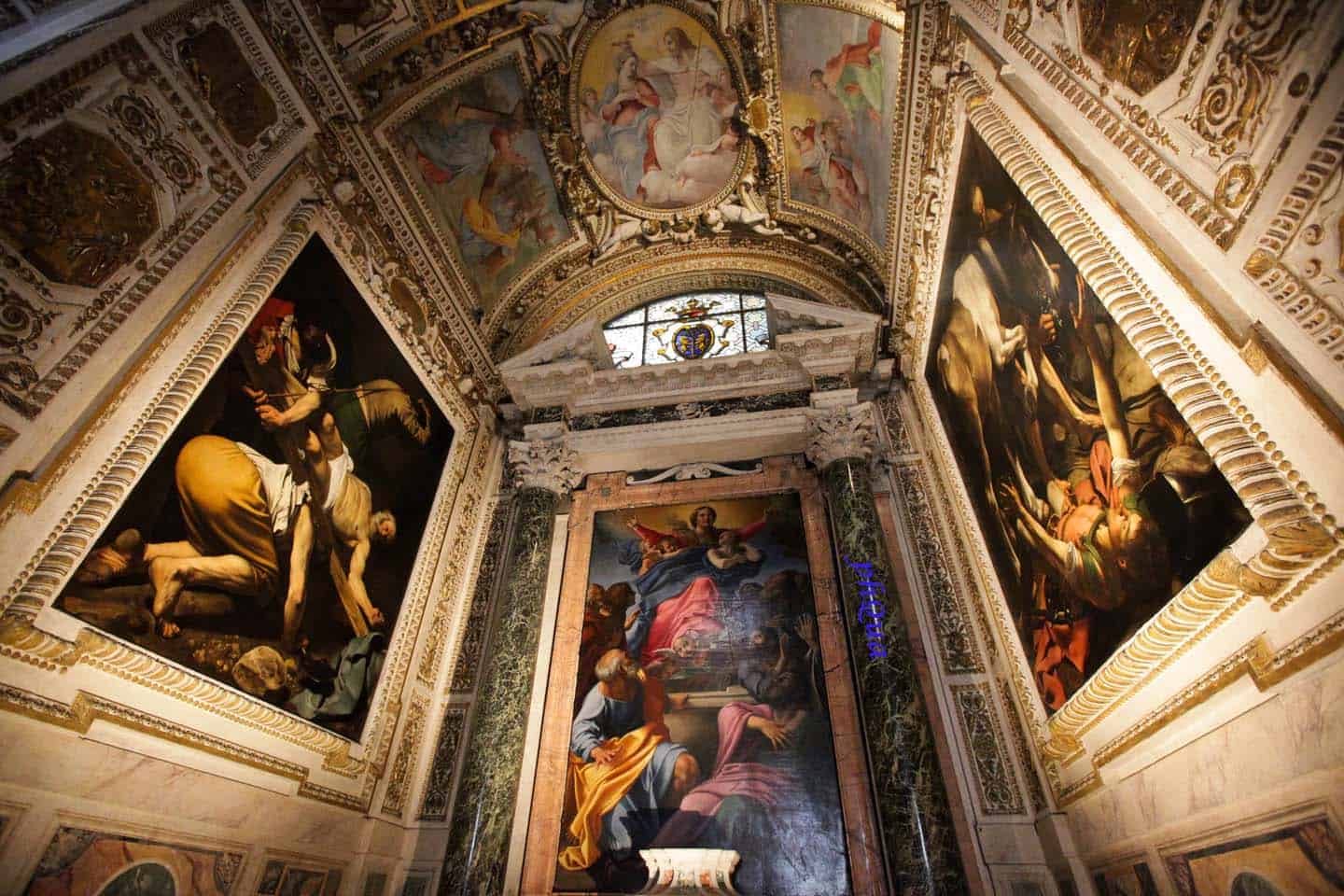
The Two Versions of the Conversion: What We Know and What Gets Told
This is the part where you really have to be careful, because it's where popular accounts have done the most damage. It's best to split it into two columns: what the documents say and what is scholars' reconstruction.
Documented. The September 1600 contract refers to panels. The November 1601 final payment covers works on canvas. So there were two phases of the work, with two different supports. The first version of the Conversion of Saint Paul was on cypress, that is, on a cypress wood panel. The same two-stage path applies to the Crucifixion of Saint Peter: first the cypress, then the redone version on canvas.
Scholars' reconstruction, not documentation. That the original panels were rejected, and by whom, the reasons Caravaggio redid everything from scratch, the idea that the client wanted to pit Caravaggio against Carracci. These are explanations proposed by art historians, explicitly classified as hypothetical. Anyone who tells them as facts is writing fiction.
So where is the first version today? The answer is awkward. The encyclopedia entry says the first version of the Conversion has never been identified with certainty, and it cites the existence of a possible seventeenth-century copy in Seville. You'll find in half the internet the claim that the first Conversion is in the Odescalchi Balbi collection in Rome, but that attribution does not come from a source that declares it verified. It's the version that's going around, and the problem is this: between the panel documented in the contract and the panel held in a private collection there is a gap the sources don't close. If someone takes you around telling it as certain, know that they're skipping a link.
The story of the two versions is more interesting than the paintings themselves, and the paintings are among the most beautiful in the world. Because it tells you that Caravaggio, in the thick of his Roman period and with the most powerful client he had ever had, set about redoing two works already delivered, from scratch. Either they forced it on him, or he wanted to do it himself. In both cases, what you're looking at in the Cerasi Chapel is a second thought. It's not Caravaggio's first idea: it's his rethinking.
How to Really Look at the Two Caravaggios in the Cerasi Chapel
Here's the practical method, because the chapel is narrow, dark and badly laid out, and people stand there for two minutes and leave without having seen anything.
First: stand in the center, not in front. The two paintings are on the side walls, facing each other, and they are painted to be seen at an angle, by anyone entering the chapel from the transept. If you plant yourself straight in front of just one, you get the viewpoint wrong, the one Caravaggio had calculated. The forced perspective of the Conversion, with the enormous horse in the foreground and Saul thrown to the ground, works when you view it in foreshortening.
Second: look at the light before the figures. In both canvases there's no setting, no landscape, no sky. There's a dark background and a beam of light coming in from outside the frame. In the Conversion, that light is the conversion: there's no Christ appearing, no cloud, no angel. There's only a man on the ground with his arms open and a light on him. Caravaggio removed the supernatural from the supernatural scene. In 1601, this was a visual blasphemy.
Third: in the Crucifixion, count the efforts. Three men lifting a cross with an old man on it. One pulls with a rope, one pushes from below, one lifts. You can't see the face of any of the three: one has his back turned, one is bent over, one has his head out of frame. You see dirty feet, a curved back, physical effort. Peter is looking at the nail in his hand. It's a painting about manual labor, disguised as a martyrdom. And if you're familiar with The Calling and the Martyrdom of Saint Matthew in San Luigi dei Francesi, painted very shortly before in the Contarelli Chapel, you'll understand in an instant the distance Caravaggio covers in two years.
Fourth: don't overlook the Carracci in the middle. Annibale Carracci's Assumption of the Virgin over the altar is dismissed by everyone as the boring painting sandwiched between the two beautiful paintings. That's a mistake. Look at it the way you would look at a debate: Carracci answers Caravaggio with bright color, upward movement, idealized bodies, a full sky. In the same chapel, in the same months, there are the two paths European painting will take over the next 100 years. One leads to Rembrandt, the other leads to Rubens. They're two meters apart, and they cost you zero euros.
Something Nobody Tells You About Santa Maria del Popolo
That Martin Luther slept here.
Separating the levels: the encyclopedic source reports that, in the years when the church belonged to the Lombard Congregation of the Augustinians, that is, after 1472, the young Luther was a guest in Rome at the Augustinian church of Santa Maria del Popolo. Luther was an Augustinian friar, he came to Rome over a matter internal to his order, and the Augustinian convent where he stayed was this one. The news is reported as documented by the encyclopedic source, not by an official source of the basilica.
But stop for a moment and think about it. The German friar who, a few years later, would split Western Christianity in two, and who would return from his Rome visit scandalized by what he had seen, slept inside the convent of the church where Sixtus IV had just finished redoing everything, where Pinturicchio was painting frescoes, where Bramante would later dig out the choir. He saw the Roman Renaissance at the exact moment of its greatest splendor, and it disgusted him.
There you go. In guides to Santa Maria del Popolo this almost never appears, and when it does it's a line at the bottom. In our view, though, it's the biggest thing that has happened in this building, more than Caravaggio and more than Raphael. Because it was here, inside a convent cell, that the reaction took shape that would change Europe. Ask at the Welcome Desk whether it's possible to see the convent section. The answer will almost certainly be no, but the question is worth asking.
There's a second thing nobody mentions, much more mundane: the basement of this church houses a museum that has nothing to do with the church. Under Santa Maria del Popolo, in the Galleria Agostiniana, is the Museo Leonardo da Vinci, with machines rebuilt from the codices. Thousands of people go down there every year without knowing that right above their heads there are two free Caravaggios. If you have kids, this combination is gold: first Leonardo's machines, which you can touch, then five minutes of silence in the church. Check the museum's hours and prices before you go.
The Chigi Chapel: Raphael Designs, Bernini Finishes, 140 Years Later
The Chigi Chapel is the second chapel on the left aisle. It's the strangest thing in all of Santa Maria del Popolo and maybe in all of Rome, because it's a work begun by Raphael and completed by Bernini, that is, by two men who could never have met, separated by more than a century.
The client is Agostino Chigi, a banker from Siena, the richest man in Rome, the one who financed the popes. He wants a mausoleum for himself and his family inside the most fashionable church in the city, and to design it he hires the best there is on the market.
The design is by Raphael and it gets underway between 1513 and 1514. Raphael designs everything: the plan, the dome, the mosaics, the tombs. The actual execution is entrusted to Lorenzetto.
1516: the dome mosaics. Raphael supplies the cartoons, and the mosaic work is by the Venetian Luigi de Pace. The subject deserves attention, because it's something you don't expect in a Catholic church: at the center is God the creator of the firmament, and around him are the pagan deities, that is, the Sun, the Moon and the five planets, each accompanied by a motor angel. It's a Neoplatonic layout: the ancient gods aren't erased, they're put in the service of the Christian God, who moves them through the angels. In 1516, inside a parish church, over the heads of the faithful. Try to imagine the face of a parish priest today.
The pyramid tombs. The two pyramids you see against the side walls are designed by Raphael and contain Agostino Chigi and his brother Sigismondo. They were later modified by Bernini. The link with the Pyramid of Cestius is right: the pyramid as a funerary form in Rome has only one monumental precedent, and it's the one of Gaius Cestius at Porta San Paolo. Chigi has a tomb built that references the only Egyptian monument in the city.
The statues in the niches, with their dates, are the part where the gap between the two centuries is most visible:
- Jonah coming out of the whale, by Lorenzetto after a design by Raphael, 1520.
- Elijah, by Lorenzetto, finished by Raffaello da Montelupo, around 1540.
- Daniel and the lion, by Gian Lorenzo Bernini, 1655-1657.
- Habakkuk and the angel, by Bernini, 1656-1661.
Look at them in this order and you'll understand everything without needing a book. Lorenzetto's Jonah is still, composed, enclosed in its own block: it's still Renaissance. Bernini's Daniel is twisted, elongated, praying with his head thrown back, and his foot comes out of the niche. Habakkuk, on the other side, points his finger. Bernini arranged the two statues so that they speak to each other across the space of the chapel: the angel grabs Habakkuk by the hair and directs him toward Daniel, who is on the opposite side. The chapel is no longer a container for statues, it has become the stage for an action. From Jonah in 1520 to Habakkuk, completed in 1661, 141 years pass inside the same room.
The completion dates from 1652-1656, for Cardinal Fabio Chigi, who in the meantime becomes Pope Alexander VII. A descendant of the family who finishes the work begun by his ancestor, with the best sculptor alive, after the project had been on hold for generations.
The altarpiece. The altarpiece is the Nativity of the Virgin, by Sebastiano del Piombo and Francesco Salviati, painted in oil on blocks of peperino. Peperino is a volcanic stone from Lazio, and painting it in oil is a strange technical choice that's worth knowing about when you stand in front of it.
The floor. Don't forget it, because it's the thing that everyone photographs without understanding it. In the floor mosaic there's the tomb of Fabio Chigi with a winged skeleton holding a coat of arms and the inscription Mors ad caelos, with the date in Roman numerals MDCL, that is, 1650. A skeleton under your feet, pointing to the sky. Thank goodness Bernini was there to do these things, because nobody else would have gotten away with them.
And then there's Dan Brown. It has to be mentioned, because it's the reason half the foreign visitors come in here: a scene from Angels & Demons is set in the Chigi Chapel. In the novel, this is the Chapel of Earth. There's no reason to look down on it: if an airport thriller gets people to look at a mosaic dome by Raphael, the thriller has done a public service. One suggestion: after you've looked for the spot from the novel, look up and see the planets. They're worth more than the plot.

Bramante's Choir, Pinturicchio and the stained glass by Guillaume de Marcillat
The deep presbytery you see at the end of the central nave is the piece that visitors look at the least and that architectural historians look at the most.
The choir was renovated by Donato Bramante in the early 16th century, and the basilica's official website specifies that Bramante built the apse-shaped choir in the form of a shell. It is not a decorative detail. In those years Bramante was working on the design of the new St. Peter's, and here he tests on a small scale a solution for joining the apse and the vault that he will need on a colossal scale. Santa Maria del Popolo is one of St. Peter's testing grounds, and you can enter for free.
Inside the choir there are two masterpieces by Andrea Sansovino: the funeral monuments of Cardinals Ascanio Sforza and Girolamo Basso Della Rovere. They are two wall tombs, with the deceased half reclining as if sleeping. Look at both of them, then look at the hands: Sansovino carves the fingers of two old men with a precision that almost hurts.
In the vault of the choir are the frescoes by Pinturicchio, dated 1508-1510. After the restoration completed in November 2024, the colors are legible again, and this is the place where you can best see the difference between a cleaned Pinturicchio and a Pinturicchio as it was remembered before the restoration.
The stained-glass windows are by Guillaume de Marcillat and date from 1509, and they depict Episodes from the Life of Mary and Jesus. This point deserves emphasis because it is a true rarity: in Rome, 16th-century historiated stained-glass windows practically do not exist. Painted glass is a technique from northern Europe, and Marcillat was French. These are among the very few that survive in the city. Go between 16 and 18 on a sunny afternoon and look at them against the light: that is when they work.
If you have only 10 minutes, do Cerasi and Chigi and run. If you have 40, Bramante's choir is the thing that will stay in your head the longest. You have already seen the Caravaggios in 100 reproductions. That shell of a vault with the stained-glass light on it, no.
The high altar and the panel of the Madonna del Popolo
The high altar was commissioned by Cardinal Antonio Maria Sauli in 1627. The decoration of the triumphal arch is also due to Sauli, where the Legend of the Founding of the Church of Santa Maria del Popolo is represented in stucco. That is: above the altar, the story of Pasquale II's dream and Nero's ghost, told above, is narrated in images. The basilica's official website specifically identifies the arch above the altar as the place where the legend is recorded. So the church itself, in stucco, declares its legendary origin. It is an act of great architectural honesty.
On the altar is the most debated panel in the building, and here the sources say two different things.
Version A, the basilica's official website. In 1235, Pope Gregory IX moved from the Lateran the image of the Virgin painted according to tradition by St. Luke, which is still on the high altar.
Version B, the encyclopedic source. The altar includes a 13th-century panel in the Byzantine style, depicting the Madonna del Popolo, which during the 2018 restoration revealed the signature of Filippo Rusuti.
The two versions do not cancel each other out, they layer on top of each other. The attribution to St. Luke is a devotional tradition, the kind that goes with dozens of Marian icons in Italy, and the official website presents it exactly that way, saying according to tradition. The attribution to Filippo Rusuti, on the other hand, is a material fact that emerged from a restoration: a signature found on the panel. The signature is a fact, St. Luke is a tradition, and anyone who puts them on the same level is confusing things. That said, the tradition should not be thrown out: that icon was venerated for eight centuries as a work by Luke, and that veneration is in turn a historical fact that moved thousands of people.
Near the altar, on the right, there are remains of marble with Cosmatesque decoration and the date 1263. It is a fragment and people walk past it without seeing it. Look for it: it is the only piece of Roman Middle Ages left on view in a church that the Renaissance rewrote from top to bottom.
The chapels of the right aisle, one by one
This chapter is for those who want to see everything and not just the two big names. They are listed from the back of the church toward the transept, that is, in the order you meet them if you enter and turn right.
1. Cappella del Presepio. It was commissioned by Cardinal Domenico Della Rovere between 1488 and 1490 and is dedicated to Saint Jerome. The frescoes on the life of the saint are by Tiberio d'Assisi. The Nativity with Saint Jerome on the altar is by Pinturicchio. Inside are the tombs of Cardinals Giovanni de Castro, who died in 1506, Cristoforo, who died in 1478, and Domenico della Rovere. It's the chapel that catches the eye of anyone who walks in first, and most people walk past it in three seconds to rush to the Cerasi. Stop here: Pinturicchio's Nativity is one of his best works in Rome.
2. Cappella Cybo. A monumental chapel with a Greek cross plan, built in the 15th century and initially decorated by Pinturicchio, then completely transformed by Carlo Fontana at the end of the 17th century for Cardinal Alderano Cybo. Inside are the tombs of Cardinals Lorenzo and Alderano Cybo. The altarpiece, an Immaculate Conception with Saints, is by Carlo Maratta. It's the chapel with the most polychrome marble in the church, and the contrast with the sobriety of the Chigi on the other side is violent. Two opposite ways of spending money on a tomb, 20 meters apart.
3. Cappella Basso Della Rovere. Built around 1484 by Cardinal Girolamo Basso della Rovere, decorated by pupils from Pinturicchio's school. The detail to look at, one that almost no guidebook points out, is the floor: it's the original 15th-century one, in Deruta ceramic. 540 years of feet on it, and it's still there. Look at it before the walls.
4. Cappella Costa. Purchased by Cardinal Giorgio Costa in 1488. It contains a marble triptych with Saints Catherine, Vincent and Anthony of Padua, from the school of Bregno. Andrea Bregno is everywhere in this church: the lunette over the central portal, the old high altar, the Cappella Della Rovere, this triptych. He is the sculptor who gave the 15th-century Santa Maria del Popolo its face, and nobody outside the specialist circles knows him.
The chapels of the left nave, one by one
They are listed here from the transept toward the entrance, that is, the way you see them when you walk back, and the Chigi is in this nave.
1. Cappella Cybo-Soderini. There is a 15th-century wooden crucifix. The paintings on the walls and vault, with Stories of the Cross, angels and prophets, are by Pieter van Lint. A Fleming inside a Roman church: that point about the foreigners who passed through here comes up again.
2. Cappella Mellini. The altarpiece with the Virgin and Saint Nicholas of Tolentino is by Agostino Masucci. On the sides are the tombs of Cardinals Savio Mellini, by Pierre-Etienne Monnot, and Garcia Mellini, by Alessandro Algardi. The vault, with Stories of Saint Nicholas of Tolentino and Virtues, is by Giovanni da San Giovanni. Algardi's tomb of Garcia Mellini is the best thing in the chapel: Algardi was Bernini's great rival, the one who always lost out in Rome, and seeing the two of them in the same church makes you understand why he lost and also why he didn't deserve it entirely.
3. Cappella Chigi. Described in full above. Built to a design by Raphael for Agostino Chigi between 1513 and 1514, restored and completed by Bernini for Cardinal Fabio Chigi, future Pope Alexander VII, between 1652 and 1656. Inside are paintings and sculptures by Raphael, Bernini, Lorenzetto, Francesco Salviati, Sebastiano del Piombo, Raffaello da Montelupo and Raffaele Vanni. Seven artists in a room of a few square meters.
4. Cappella del battistero. There are ancient works by Andrea Bregno from the original high altar. That is: when the 15th-century high altar was dismantled, Bregno's pieces were reused here. It's the last chapel before the exit, and nobody looks at it because by then everyone is thinking about the bar. Look at it: it's the oldest piece of the church's Renaissance furnishings, recycled.
The transept chapels and Bernini's altars
The transept of Santa Maria del Popolo has two main altars at its ends, both designed by Bernini, and four chapels, two on each side of the presbytery, open onto it.
Left side:
- Cerasi Chapel, also called the Chapel of the Assumption. The most important in the basilica. Two Caravaggios, the altarpiece by Annibale Carracci, the vault by Innocenzo Tacconi.
- Theodoli Chapel, with the altarpiece depicting Saint Catherine of Alexandria, by Giulio Mazzoni, to whom the vault stucco is also attributed.
Right side:
- Feoli Chapel.
- Cicada Chapel.
For the last two, no confirmed data appears on artists, dates or patrons. If you pass them, read the plaque.
The Two Pipe Organs of Santa Maria del Popolo
The Testa organ, right transept. During the renovation of the Renaissance basilica in the baroque style, its designer, Gian Lorenzo Bernini, presented Alexander VII, who commissioned the restoration and was already the church's titular cardinal, with two designs for a new organ to be placed on a choir loft in the right transept. One was more classical, with three bays, each divided in two by height. The other was innovative, with pipes bound among oak branches, the tree identified as a symbol of the commissioning pope's family. The second one was chosen.
The sound-producing part was entrusted to the organ builder Giuseppe Testa. The sculptors were Gabriele Renzi, Antonio Raggi, Antonio Chiccheri, Marcantonio Inverni and Baldassarre Castelli, who also made the choir lofts. Antonio Raggi is no ordinary name: he was one of Bernini's main collaborators.
Construction of the Testa organ ran from 1656 to 1658. The instrument was rebuilt in 1814. According to a figure reported for 2011, only the 27 façade pipes, the trackers and the windchests remain of the instrument. No more recent sources were found that confirm or deny this. Keep in mind that between 2022 and November 2024 the church underwent a series of restorations, so the situation may have changed.
The Vegezzi-Bossi organ, left transept. In the left transept, Bernini built a choir loft matching the one on the right, and the pipe organ already in the church was placed there. It remained in place until the 18th century before being dismantled. It was replaced only in 1906 by a new instrument from the firm Vegezzi-Bossi, with two manuals and a pedalboard and pneumatic action, built according to the standards of the time. The instrument was later electrified in 1975, with the addition of a new console in the nave, alongside the one already in the choir loft. The façade, set far back from the choir loft's balustrade and recessed in the wall, consists of 33 pipes belonging to the principal stop.
An unpopular tip. Notice the two choir lofts before the two organs. They are symmetrical, they are by Bernini, and they were designed to visually balance the transept. On one side stands a nearly emptied 17th-century instrument, and on the other a 20th-century instrument squeezed into a 17th-century frame. The symmetry you see is fake, and it has 400 years of history inside it. If you know how to read it, that's the most entertaining part of the church.
The Gisleni Monument and the Other Tombs Nobody Looks At
Among particularly famous burials, the unusual funerary monument of Giovanni Battista Gisleni is cited, along with the Chigi Chapel and the Cerasi Chapel.
The sources cite it as unusual but don't report the author, the date or the inscription text. What is on record is this: it is a monument to an architect and musician active in Rome, it is considered one of the city's most unusual tombs, and it is inside Santa Maria del Popolo. Look for it, look at it, and if there are explanatory plaques, trust them.
The general picture of this church's tombs, by contrast, is documented, and it is the key to understanding the building. Santa Maria del Popolo holds many works of art and funerary monuments, mostly dating from between the 15th and 19th centuries, and among those buried are people from countries such as Spain, France and Belgium, active in the artistic, religious and civil fields. Four centuries of high-ranking foreigners who chose to stay here. It isn't a matter of taste, it's a matter of geography: anyone arriving in Rome from the north came through Porta del Popolo, and this was the first church they saw.
Walk along the nave floor and look down every so often. The worn gravestones bear coats of arms from half of Europe. It's a horizontal archive, and you walk over it without noticing.
My Advice for Visiting Santa Maria del Popolo
There is only one piece of advice, in a single line: go at exactly 16:00 on a weekday, with coins in your pocket, and start from the end.
Why 16.00 on a weekday. Monday to Friday, Santa Maria del Popolo reopens at 16.00 after the lunch break. At that moment the church is empty, because organized groups are still wandering around the Tridente and individual tourists are in the gelato phase. You can easily have 20 minutes with almost the whole church to yourselves. By 17.30 the situation is already different. On Sunday just avoid it: it opens at 16.30 and there's the changeover of services.
Why start at the end. Everyone walks in and heads straight for the Cerasi Chapel. Result: at 16.05 there's a crowd in front of the Caravaggios and you're standing behind three heads. Do the opposite. Walk in, go straight to the presbytery to look at Bramante's choir, the Marcillat stained-glass windows and the Pinturicchio on the vault, which is the part nobody looks at first. When the crowd in front of the Caravaggios breaks up, you move 10 meters over and look at them on your own. It's a matter of traffic flow, not taste.
The coins. Already said above, but it needs repeating because it's the thing that ruins the most visits: if the chapel has coin-operated lighting and you don't have change, you've made the trip for nothing. €1.50 in your pocket solves it.
The right amount of time. With 40 minutes you get a serious, complete visit. With 20 you get Cerasi, Chigi and the choir, which is already a great deal. Under 15 minutes there's no point going in, because you'll end up looking at a phone screen instead of the paintings.
What to bring. Coins, a sweater even in summer because Roman churches are cool inside, and nothing else. You don't need audio guides: the basilica has video guides made by D'Uva on three masterpieces, and the official website shows them as videos. Watch them at home before you come, not there in front of them. Watching a video in front of a painting is the best way not to see the painting.
The mistake to avoid. Don't come here right after Galleria Borghese. Geographically it's convenient, you come down from the Pincio and you've arrived. But after two hours of Borghese your eyes are full and the Caravaggio in the Cerasi Chapel slides right past you. Santa Maria del Popolo wants rested eyes. Go in the morning or early in the afternoon, not at the end of a day of museums.
Another well-known fact, yet rarely mentioned
That this is the gateway to Rome.
Everyone knows it in the sense that everyone knows Piazza del Popolo is at the start of Via Flaminia. But almost nobody draws the conclusion, and the conclusion explains everything inside Santa Maria del Popolo.
For 2,000 years, anyone arriving in Rome from the north came in here. Pilgrims from Northern Europe, ambassadors, foreign cardinals, merchants, artists coming to look for work, visiting sovereigns. Via Flaminia ends at the Porta del Popolo, and the first thing you saw once you were inside the city was this church. Not the second: the first.
All the oddities of the building follow from this, one after another:
Why Spanish, French and Belgian people are buried here. Because it was the church of the foreigners who arrived. The personalities from those countries buried here between the 15th and 19th centuries were active in the artistic, religious and civil fields. The reason they're here is the gate.
Why the popes poured so much money into it. Sixtus IV rebuilt it from scratch between 1472 and 1477, Alexander VII had Bernini redo it between 1655 and 1660, and in 1655 he also had the interior façade of the Porta del Popolo sorted out. It's not devotion, it's diplomacy. This church was the calling card of the Papal States. Anyone entering Rome had to understand right away who they were dealing with.
Why there are two Caravaggios in a parish church. Because the Treasurer General of the Apostolic Camera bought a chapel in the most visible church in the city, the one everyone arriving would see.
Why the Augustinians have been here since 1250. Because an order devoted to preaching and welcoming people wants to be where people come in, not where people live.
If you look at Santa Maria del Popolo as a church, it will seem like a strange church, a jumble of masterpieces with no logic. If you look at it as the entrance to a city, everything falls into place. Our opinion: this is the most political church in Rome after Santa Maria sopra Minerva, and nobody tells it that way.

The right photo to take at Santa Maria del Popolo
Here are three photos, in order of difficulty, and one you shouldn't take.
The easy, right shot: the facade backlit from the square, at seven in the evening. Stand in the center of Piazza del Popolo, at the obelisk, and look north. You have the Porta del Popolo, the brick bell tower and the travertine facade all in the same frame, with the sun setting behind them. It's the only time that modest facade becomes photogenic, because the travertine warms up at that hour. Wide-angle lens, the square helps.
The photo that tempts everyone and is worth doing well: the Chigi Chapel dome from below. Stand under the center of the chapel, phone aimed straight up, and capture the whole mosaic tondo with God the creator of the firmament at the center and the planets around him. Practical tips: no flash, rest your elbows against your body to steady yourself, keep the light on if there's a coin slot, and shoot in the first 30 seconds, when your eye has already adjusted but the lamp hasn't gone off yet. If you have steady hands, this photo comes out well even with a phone.
The hard photo and the most beautiful: Bramante's choir with the stained glass lit up. Sunny afternoon, between 16 and 18, from the back of the central nave. The Marcillat stained-glass windows throw color into the apse shell. You need a support, because the light is low: use the back of a pew. Don't use flash, which kills everything and gets you thrown out.
The photo you shouldn't take: the close-up with flash on a Caravaggio. Flash on the Cerasi canvases is useless, because a glare will bounce back off the varnish in the center of the frame anyway, and besides, it's a boorish move. If you really want the image, there are the official reproductions. What the phone won't bring home, but your eye will, is the feeling of that darkness.
One more tip on context. If you want the photo that tells the story of the place rather than the piece, climb up to the Pincio by the Valadier ramp, reach the terrace and look down. From there you have Piazza del Popolo from above, with the ellipse, the obelisk, the two twin churches and, in one corner, the bell tower of Santa Maria del Popolo. It's the photo that explains why this church is where it is.
Some important events that took place here in history
Here are the events in order, with an indication of the type of information for each one.
1099, the foundation. Documented by the basilica's official website: Pasquale II starts construction of the chapel to celebrate the liberation of the Holy Sepulchre. On the site, according to tradition, there was the tomb of the Domizi with Nero inside. The encyclopedic source speaks of the demolition of the mausoleum of the Domizi Enobarbi.
1227 or 1235, the arrival of the Marian image. The sources don't agree: the official website says 1235, with Gregory IX moving the image from the Lateran, while the encyclopedic source says 1227, with Gregory IX enlarging the chapel. On that occasion, according to the official website, the little chapel is turned into a church for the temporary settlement of the Franciscans.
1250, the arrival of the Augustinians. The complex passes to the Order of the Augustinians of Tuscia. Documented by the official website. They're still there.
1472, the transfer to the Lombard Congregation. Documented by the official website. It's the reason the bell tower is Lombard.
1472-1477, the reconstruction under Sixtus IV. One of the first great Renaissance building sites in Rome. The church you see was born here.
1516, the mosaics of the Chigi dome. Luigi de Pace executes them from cartoons by Raphael. Pagan gods inside a church, with the blessing of the pope's banker.
Between 1500 and 1510, the great building site. Bramante rebuilds the shell-shaped apsed choir, Pinturicchio frescoes the choir vault between 1508 and 1510, and Marcillat installs the stained-glass windows in 1509.
September 1600, the contract with Caravaggio. Tiberio Cerasi, who had bought the chapel on June 8 of that same year, commissions two works on panel.
May 1601, the death of Cerasi. The patron dies before seeing the work finished.
November 1601, the final payment to Caravaggio, for the versions on canvas.
May 1605, the placement of the two Caravaggios in the chapel. Four years after the final payment, and what you see today has been there since then.
1627, Sauli's high altar and the decoration of the triumphal arch with the legend of the foundation in stucco.
1655-1660, Bernini's building site for Alexander VII. The church is made Baroque. In 1655 the same pope also has him redo the interior facade of the Porta del Popolo and the upper cornice, that is, the wall you see when you turn around just after leaving the basilica. A clarification: the popular story links that work to the arrival in Rome of Christina of Sweden. The available source attests Alexander VII's commission in 1655, but does not name the occasion. So it's a widespread story, not a confirmed fact.
1656-1658, construction of the Testa organ, based on a case design chosen by Alexander VII from two proposals by Bernini.
1906, installation of the Vegezzi-Bossi organ, and electrification in 1975.
2018, restoration of the Marian panel and the appearance of Filippo Rusuti's signature.
From 2022 to November 2024, the cycle of restorations of the church. Encyclopedic source. If you were here before 2022 and you're coming back now, it's not the same church: it's the same church, just cleaned.
Who Has Passed Through Santa Maria del Popolo
The list is long, and for once that's not rhetoric. It's worth splitting it up, because there are three different kinds of people who have passed through here, and they need to be kept separate.
The popes who built it. Paschal II, who builds the chapel in 1099. Gregory IX, who in the 13th century moves the image of the Virgin here from the Lateran. Sixtus IV Della Rovere, who between 1472 and 1477 rebuilds it from scratch and puts his coat of arms in the tympanum. Alexander VII Chigi, who had been cardinal priest of this church and, as pope, hands it over to Bernini between 1655 and 1660.
The artists who worked on it. And here the list is almost embarrassing: Bramante for the choir, Raphael for the Chigi Chapel, Pinturicchio for the vaults and the chapels, Andrea Bregno and his workshop for the portal and the 15th-century sculptures, Andrea Sansovino for the two cardinals' tombs in the choir, Guillaume de Marcillat for the stained glass, Lorenzetto and Raffaello da Montelupo for the Chigi statues, Sebastiano del Piombo and Francesco Salviati for the Chigi altarpiece, Caravaggio and Annibale Carracci for the Cerasi chapel, Innocenzo Tacconi for the Cerasi vault, Carlo Maderno as architect of the renovation of the Cerasi chapel, Gian Lorenzo Bernini for everything else, Carlo Fontana for the Cybo chapel, Carlo Maratta for the Cybo altarpiece, Alessandro Algardi and Pierre-Etienne Monnot for the Mellini tombs, Giovanni da San Giovanni for the Mellini vault, Pieter van Lint for the Cybo-Soderini chapel, Giulio Mazzoni for the Theodoli chapel, Agostino Masucci for the Mellini altarpiece, Tiberio d'Assisi for the frescoes of the Presepio Chapel, Antonio Raggi and the other sculptors for the organ lofts, Giuseppe Testa as organ builder, Luigi de Pace as mosaicist.
Count them. There are more than 20 first-rate names, inside a church you can enter without a ticket. No Italian museum has that kind of density for €0.
Those who just passed through, and that's the most interesting part. Agostino Chigi, the richest banker in Europe, who had his own tomb made here. Tiberio Cerasi, the general treasurer of the Apostolic Camera, who bought the chapel on June 8, 1600, and died in May 1601 without seeing the work he had commissioned completed. And above all Martin Luther, who according to the encyclopedic source was a guest in Rome precisely at the Augustinian church of Santa Maria del Popolo in his early years, when the church belonged to the Lombard Congregation.
There's also a category that can't be listed: the sovereigns, ambassadors, and foreign pilgrims who entered Rome through the Porta del Popolo from the 15th to the 19th century and saw this church first. There are thousands of them, they're anonymous, and they're the real reason this building is the way it is.
Santa Maria del Popolo with Kids
You can do it, but make a clear agreement with yourselves: 15 minutes inside the church and not one minute more. Then you head out to the piazza, which for a kid is 1,000 times better.
The things that really work with little kids:
The skeleton on the floor of the Chigi Chapel. A winged skeleton in mosaic, underfoot, holding a coat of arms. If you make them search for it like a treasure hunt, they'll stay busy for five good minutes, and they'll remember it for years.
Jonah's whale. In the niche of the Chigi Chapel there is a nude man coming out of a whale, carved by Lorenzetto from a design by Raphael in 1520. Kids always like the story of Jonah, and seeing it in marble works better than any book.
The planets in the dome. The Sun, the Moon, and five planets in mosaic, with angels pushing them along. You can tell it in 30 seconds, and it's a good way to get a kid to look up inside a church.
The horse of the Conversion. In the Cerasi chapel, don't try to explain Saint Paul. Have them look at the horse, which takes up half the painting and has one hoof raised over a man on the ground. From there, if they feel like it, the question comes on its own.
And then there's the Museo Leonardo. Below the church, in the Galleria Agostiniana, is the Museo Leonardo da Vinci, with its reconstructed machines. It charges admission and has its own hours, but for a child of eight or 10, it's the part of the day they'll remember. The church-plus-museum combination works, and in between there's the piazza to run around in.
The thing to avoid. Don't go in with a stroller at rush hour, and don't bring a hungry child: the steps at the entrance, the darkness and the silence are a perfect combination for a meltdown. Have a snack first, in the piazza, and then go in.
Accessibility: what's confirmed and what isn't
On this topic, half-truths do real damage. As of August 2026, there is no official statement on the accessibility of Santa Maria del Popolo. The basilica's website has no page on accessibility. The turismoroma.it listing generically refers to the Roma accessibile section of its portal, with no specific data on this building.
What can be said is the geography of the place, which anyone can verify:
- The approach is flat. From the Flaminio metro station to the church door, there are no slopes, and the paving of Piazza del Popolo is even.
- The church has a raised threshold compared to the level of the piazza, like practically all Roman churches of that period. How many steps there are, and whether there's a side ramp, isn't confirmed by verified sources.
- Inside, the naves are level. The side chapels usually have a threshold step and are narrow. The Cerasi Chapel in particular is cramped.
- The Museo Leonardo da Vinci is in the basement, and that alone is something to keep in mind for anyone with mobility issues.
Practical advice: call ahead. The basilica's Welcome Desk answers at the number listed on the official website, +39 392 3612243, and as an alternative there are the other two numbers given at the beginning. Ask specifically about the entrance threshold and access to the chapels in the transept. A phone call is better than assuming accessibility.
How much it costs and how to save
The shortest section, and for a good reason.
Admission to the basilica. The official website publishes no fee, and Santa Maria del Popolo is a functioning Augustinian parish. In Roman practice, you can enter freely. The caution noted above applies: this is an inference, not a published fact. If you find a donation requested for a specific part, know that beforehand.
Coins for the lights. If there's a coin box, budget one or two euros. It's the real cost of this visit, and nobody mentions it.
Guided tours. The official website has a section dedicated to choosing a guided tour. Prices and hours should be checked in that section.
The Museo Leonardo da Vinci. It charges admission and has its own ticket office. Rates and hours should be checked before you go.
How to really save. Not with a card, but with your head. This church is one of the three or four places in Rome where you can see top-tier works for free. Build a half day around it made only of churches, and don't pay for a single ticket: Santa Maria del Popolo for the Caravaggios and Raphael, San Luigi dei Francesi for the Saint Matthew cycle, San Lorenzo in Lucina if you pass by it,Sant'Ignazio for the fake dome by Pozzo, Santa Maria sopra Minerva for Michelangelo's Christ and the tomb of Saint Catherine. Five stops, four hours, zero euros in tickets. No other European capital gives you a day like that.
What's within a 10-minute walk
The location of Santa Maria del Popolo is about the most convenient there is, and this is the section that saves your day.
At zero minutes. Piazza del Popolo, the square it faces onto. In the center is the Flaminio obelisk, 24 meters tall, inscribed for the pharaohs Ramesses II and Merenptah, brought to Rome under Augustus and initially placed in the Circus Maximus, then moved here in 1589. On the other side of the square are the two twin churches, Santa Maria in Montesanto from 1675 and Santa Maria dei Miracoli from 1678, begun by Carlo Rainaldi and completed by Bernini with the collaboration of Carlo Fontana. The current elliptical layout of the square, which replaced the trapezoidal shape, is the work of Giuseppe Valadier, with interventions mainly between 1810 and 1834.
Five minutes uphill. The Pincio, with the terrace above the square. You go up the Valadier ramp that starts from the square itself. From up there you have Rome on one side and the square on the other. At sunset there are crowds, but it's worth it.
10 minutes away. Villa Borghese, which begins just above the Pincio, with the Galleria Borghese inside, where there are six more Caravaggios and the sculptures of Bernini. The Galleria needs to be booked and has fixed-time entries, so get organized. Inside the park there is also the Museo Carlo Bilotti, which is small, almost empty and very pleasant.
10 minutes downhill. Via del Corso, which starts from the square and cuts through the center down to Piazza Venezia. Via del Babuino, which takes you to Piazza di Spagna and the Barcaccia Fountain. And Via di Ripetta, which runs down toward the Ara Pacis and the Mausoleum of Augustus.
Piazza del Popolo is the best starting point for a day on foot in Rome, and Santa Maria del Popolo is the right way to begin it. Go in at 10.30 when it opens, stay inside for 40 minutes, then come out and choose one of the three streets of the Tridente. Whichever one you choose, the day is already saved.
When to Go and When to Avoid Santa Maria del Popolo
The best time of all. Tuesday, Wednesday or Thursday, at 16.00 sharp. Church just reopened, empty, afternoon light on the windows.
The second best time. Weekdays at 10.30, at opening. Less light on the windows, but the same quiet.
Saturday. Open all day 10.30-18.30, which is very convenient, but it's also the day with the most people in the square and the most weddings. If you find a service in progress, you can't walk around the chapels.
Sunday. It only opens at 16.30. If Sunday is your only option, plan it for late afternoon and expect less calm.
Avoid: the 12.30-16.00 break, Monday to Friday. It's the mistake everyone makes at least once in their life. You arrive at 13.00 full of enthusiasm and find the large door closed.
The season. The month to pick is October or March: low, slanting light that comes in well through the windows, decent temperatures in the square, fewer groups. In August the church is cool and empty, which is an advantage, but the square outside at three in the afternoon is an oven with no tree. In December the light is already gone at 16 and the windows don't show up well.
A warning about services. It's a living parish. Weddings, funerals, celebrations: they can happen at any time and effectively end the visit to the chapels. It's not the church being rude to you, it's the opposite: you are guests in someone else's house. If it happens, stay at the back, look at what you can see from there, and come back.
Three Ways to Fit Santa Maria del Popolo into Your Day
Itinerary 1, the free Caravaggio tour. 10.30 Santa Maria del Popolo for the Cerasi. Then down Via del Corso and into San Luigi dei Francesi for the Contarelli Chapel, which is the cycle immediately before it. Finish at the Sant'Andrea della Valle Basilica to see where the Baroque goes next. Four hours, zero euros, three churches, and you've seen the birth of modern painting.
Itinerary 2, the Tridente loop. Santa Maria del Popolo at 10.30, Piazza del Popolo and the obelisk, climb up to the Pincio for the view, down Via del Babuino to Piazza di Spagna, lunch, and a free afternoon on the Corso. It's the classic loop and it works.
Itinerary 3, the Augustan loop. Santa Maria del Popolo, then down Via di Ripetta to the Mausoleum of Augustus and the Ara Pacis. It's the route that retraces the ancient entrance to the city along the Flaminia, and it has an archaeological logic the other two don't. Recommended for those who have already been there three times and want something different.

Nero's Tomb, the Walnut Tree of the Demons and the Origins of the Church
Santa Maria del Popolo, according to a story that has been told in Rome for eight centuries, was supposedly founded to free the city from Nero. On the slope of the Pincio, where the basilica stands today, the family tomb of the Domitii Ahenobarbi, the emperor's clan, was supposedly located. Above that tomb a huge walnut tree supposedly grew, inhabited by crows that were not crows but demons, and anyone who passed by came out battered or didn't come out at all. In 1099, Pope Paschal II, warned in a dream by the Madonna, supposedly had the tree cut down, the emperor's bones burned and scattered in the Tiber, and right on that spot he supposedly founded a chapel: that is where the church comes from. It's a medieval tale, not a chronicle, and it's worth saying so right away.
What the ancient sources really say about the tomb
The topographical core of the story is not invented, and it is the most interesting part. Suetonius, in his life of Nero, writes that the emperor's ashes were placed in the tomb of the gens Domitia on the Colle degli Orti, that is on the Pincio, in a position visible from the Campus Martius. This is an ancient source, not a legend: that Nero's paternal family had its own tomb in that area is documented. Where exactly that monument stood, however, scholars don't agree. Some place it on the lower slopes of the Pincio, toward the present-day piazza, others higher up the hill. No excavation has ever uncovered the tomb, and its identification with the exact point of the basilica remains a traditional hypothesis. The area is plausible, while the millimeter-level coincidence with the church is a later construction.
The walnut tree and the demons, on the other hand, belong to a specific genre: the medieval hagiographic narrative, in which a pope drives evil out of a place and plants a church there. The story appears in collections of Roman tales between the thirteenth and fourteenth centuries and was later repeated and taken at face value by nineteenth-century popular guidebooks. There is no document from the time of Paschal II that mentions a felled tree, crows, or bones thrown into the river. This part is tradition, not historical fact.
Why Nero specifically, and why a walnut tree
The choice of protagonist is not random. For medieval Christianity, Nero was the persecutor par excellence, the man under whom Peter and Paul had died. Turning him into a soul that haunts the ground and then driving it out is a way of telling the story of the Church's victory over pagan Rome. The walnut is the witches' tree in much of Italian folk tradition, the one of nighttime gatherings, and the walnut of Benevento is the best-known case. And crows have always been birds of ill omen. The legend brings together materials already available and welds them to a place that really did have an ancient funerary memory. The most enduring Roman legends don't come from nothing.
There is also a practical reason. That was Rome's north gate, the Flaminia: the first piece of the city seen by anyone arriving from the north, pilgrims included. It was a transit area, outside the dense built-up area, with ancient tombs all around. Reclaiming it with a Marian church made sense well beyond the story of the dream.
What is documented about the founding
The founding of the church by Paschal II in 1099 is the most solid fact in the story, and historians accept it, even though it reaches us through sources later than the event. It was a chapel, nothing like what can be seen today. In the thirteenth century, under Gregory IX, the church was enlarged and then entrusted to the Augustinians, who are still its custodians. The turning point came in the fifteenth century. Sixtus IV, the della Rovere pope, had the entire basilica rebuilt between 1472 and 1477, and that rebuilding is the building that still holds up the church's structure, with its Renaissance layout. The dates of the fifteenth-century rebuilding are documented. The name of the architect who directed it, however, is debated, with proposals ranging between Baccio Pontelli and Andrea Bregno and no decisive proof for either.
So: Paschal II and 1099, yes. Sixtus IV and the fifteenth century, yes. The Domitii tomb in the area, very probably yes. The walnut of the demons and the ashes in the Tiber, no. The distinction takes nothing away from the story. If anything, it gives it a backdrop.
Where the name “del Popolo” comes from
Here too the sources offer different explanations, and none has been settled once and for all. The first derives the name from the Latin populus, meaning poplar: in that area, outside the gate and close to the river, there supposedly was a poplar grove, and the church would have taken its name from the trees. The second ties it to the Roman people in the proper sense, arguing that the chapel was built with money collected from citizens, and that for this reason the church was called del Popolo. A third, more nuanced reading invokes the medieval term that simply meant the community of the rione. Scholars don't agree, and the name remains open to dispute. Anyone who presents it as settled, in one sense or another, is oversimplifying. The name has since spread to everything else, the square and the gate included. If you want to see how the whole took shape, the page on piazza del Popolo covers it in full.
What remains of the legend in what you see today
Entering, you won't find anything that alludes to the walnut tree or the crows: no plaque, no painting that depicts them. The legend left no material trace. It left a location. It explained, for those who passed through the gate in the Middle Ages, why a Marian church stood right there, guarding the north entrance to the city. And that position, over the centuries, drew into the basilica an artistic heritage out of all proportion to its size: the Chigi Chapel, designed by Raphael for the banker Agostino Chigi and completed by Bernini more than a century later, and the two Caravaggios in the Cerasi Chapel, described in detail above. Anyone arriving in Rome from the north saw this church first, and anyone with money and ambition wanted to be seen here.
Quick questions about Santa Maria del Popolo
How much does it cost to enter Santa Maria del Popolo?
No admission fee is listed on the basilica's official website. Santa Maria del Popolo is a parish run by the Augustinians, and in Roman practice you enter a parish church for free. The caution mentioned above still applies: this is an inference from the fact that it is a working church, not a figure stated by a source. Bring some coins for the donation box and for lighting the chapels, if needed.
What are the opening hours of Santa Maria del Popolo?
The hours published on the official website as of August 2026 are: Monday-Friday 10.30-12.30 and 16.00-18.30, Saturday 10.30-18.30, Sunday and holidays 16.30-18.30. The weekday lunch break is long, and on Sunday mornings you can't enter as a visitor. If you're planning your day around Santa Maria del Popolo, keep in mind that from 12.30 to 16.00, Monday through Friday, the door is closed.
Is there a different schedule in winter?
The official website lists a specific winter schedule for the Desk Accoglienza with Saturday 10.30-18.30. It isn't clear whether the same time slot applies in August, because the page doesn't publish a separate summer table. If you need the Desk and you're going on a Saturday, call ahead.
Do you need to book a visit?
No, you don't need to book for a regular visit, and there is no online ticket system for the basilica. The official website has a section dedicated to choosing a guided visit and mentions D'Uva audio guides, and on site there is a Welcome Desk. For guides, it's best to contact them in advance.
What is the exact address?
Piazza del Popolo 12, 00187 Rome. The coordinates published by turismoroma.it are 41 degrees 54 minutes 40.8888 seconds north and 12 degrees 28 minutes 33.7152 seconds east. The basilica is at the north corner of the square, attached to the Porta del Popolo, on the right as you enter from Piazzale Flaminio.
What is the nearest metro stop?
Flaminio, Line A, renamed Flaminio-Piazza del Popolo in 2005. It's less than 200 meters on level ground: you exit, walk under the arch of the gate, and the church is there. The station has been in service since February 16, 1980.
Does a tram go there?
Yes, Line 2 terminates at Piazzale Flaminio and runs up toward Piazza Mancini. It's the convenient connection if you're coming from the north or from the Auditorium. Piazzale Flaminio is also the terminus of the Roma-Civita Castellana-Viterbo railway.
Which buses stop at Piazza del Popolo?
The Piazzale Flaminio hub is served by city and suburban bus lines, but the route numbers change often. Check them on the public transport app or on the ATAC portal before you leave home.
How many Caravaggios are there in Santa Maria del Popolo?
Two: the Conversion of Saint Paul and the Crucifixion of Saint Peter. They hang facing each other on the side walls of the Cerasi Chapel, in the left transept, next to the presbytery.
What is on the altar of the Cerasi Chapel?
The Assumption of the Virgin by Annibale Carracci. The vault was designed by Carracci and executed by his collaborator Innocenzo Tacconi. The architect of the chapel's renovation was Carlo Maderno. Everyone skips Carracci's painting, and that is a mistake: it is the figurative answer to Caravaggio, painted in the same months and in the same room.
When were the two Caravaggios painted?
The documented dates are these: Tiberio Cerasi buys the chapel on June 8, 1600, commissions the two works in September 1600, dies in May 1601, the final payment to Caravaggio is made in November 1601, and the canvases are installed in May 1605.
Is it true that there are two versions of the Conversion of Saint Paul?
Yes, and it is documented by the change of support: the contract of September 1600 spoke of panels, while the final payment of November 1601 concerns works on canvas. The first version was on a cypress panel. The reasons for the redoing are scholars' reconstruction, not documentation, and are classified as hypothetical. On the current location of the first version, the same source writes that it has never been identified with certainty, and it points to a possible seventeenth-century copy in Seville. The current attribution to the Odescalchi Balbi collection is not confirmed.
Who designed the Chigi Chapel?
Raphael, between 1513 and 1514, for the banker Agostino Chigi. The actual execution was by Lorenzetto. The mosaics of the dome are based on cartoons by Raphael, executed in mosaic by the Venetian Luigi de Pace in 1516, with God as creator of the firmament at the center and the planetary deities around him, each with its own angel motor.
What did Bernini do in the Chigi Chapel?
The completion, between 1652 and 1656, for Cardinal Fabio Chigi, who became Pope Alexander VII. Bernini's are the Daniel and the Lion (1655-1657) and the Habakkuk and the Angel (1656-1661), as well as the modification of the sepulchral pyramids designed by Raphael. The other two statues are Jonah by Lorenzetto after a drawing by Raphael from 1520, and the Elijah by Lorenzetto, finished by Raffaello da Montelupo around 1540.
Is this the chapel from the Dan Brown novel?
Yes. A scene from Angels & Demons is set in the Chigi Chapel, where it is the Chapel of Earth. If that's what brought you here, that's perfectly fine. My suggestion is to look at the dome with the planets after you've found the spot in the book.
What is the inscription with the skeleton on the floor?
It is the floor mosaic with the tomb of Fabio Chigi: a winged skeleton holding a coat of arms, with the inscription Mors ad caelos and the date in Roman numerals MDCL, that is, 1650.
Who built the church you see today?
The Renaissance reconstruction dates from 1472-1477, commissioned by Pope Sixtus IV Della Rovere. The encyclopedia source attributes the construction to Giovannino de' Dolci and considers the old Vasarian attribution to Baccio Pontelli rejected. The brick bell tower is in late Gothic Lombard style.
How old is Santa Maria del Popolo?
The official website traces its origin to 1099, with Pope Paschal II. On Gregory IX's intervention, the sources don't agree on the date: the official website gives 1235 for the transfer of the image of the Virgin from the Lateran, while the encyclopedia source gives 1227 for the enlargement.
Is it true Nero's tomb was here?
It is the founding legend, and it is told by the basilica's own official website. On the site stood the mausoleum of the Domitii Ahenobarbi, Nero's family, demolished in 1099. The story of the ghost and of the chapel built to clear the area is also recorded in stucco on the arch above the high altar, at the wish of Cardinal Antonio Maria Sauli. It remains a legend, declared as such, not a verified archaeological fact.
Who runs the church today?
The Augustinians. The Order's website lists Santa Maria del Popolo among the Augustinian communities, and the tie goes back to 1250, when the church passed to the Augustinian Hermits of Tuscia, and then to the Lombard Congregation in 1472.
What number should I call?
There are three different ones, from three different sources: +39 392 3612243 from the basilica's official website, as Desk Accoglienza, 06 45675909 from turismoroma.it, and 06 3610836 from the Augustinian Order's website for the parish. Try them in this order.
What time are the Masses?
Mass times are not published either on the basilica's website or on the parish page of the Augustinians' website. Call.
How long does it take to visit?
20 minutes if you come only for the two Caravaggios and for the Chigi Chapel. An hour if you want to do things properly, that is, the 12 side chapels, Bramante's choir with Sansovino's monuments, Pinturicchio's vault, and the stained glass windows. An hour and a half if you stay to watch the light change on the stained glass in the late afternoon.
Can you take photographs?
The Roman practice is to take photos without flash, and it works that way in almost all churches. In the Cerasi Chapel the rule may be stricter and it changes over time: read the signs at the entrance to the chapel and, if there is a custodian, ask. Flash on a Caravaggio canvas is simply not allowed.
Is Santa Maria del Popolo wheelchair accessible?
No available source publishes information on the accessibility of the basilica, whether on the steps at the entrance, on accessible restrooms, or on access to the transept chapels. The square in front is flat and paved with sanpietrini. If accessibility is decisive for your trip, call the numbers above and have a person confirm it for you.
Has the church been restored recently?
Yes. The encyclopedic source indicates a restoration from 2022 to November 2024. An earlier restoration, in 2018, brought to light the signature of Filippo Rusuti on the panel of the Madonna del Popolo. If you were there before 2024 and remember dull colors on the vault of the choir, go back: the Pinturicchio can be read now.
Who painted the Madonna over the high altar?
Here too there are two versions. The official website speaks of the image of the Virgin painted according to tradition by Saint Luke, transferred from the Lateran by Gregory IX. The encyclopedic source speaks of a thirteenth-century panel in Byzantine style with the signature of Filippo Rusuti that emerged during the 2018 restoration. The signature is a material fact, the attribution to Luke is a devotional tradition: they don't stand on the same level, but they have coexisted for centuries on the same panel.
What is behind the altar?
The apsidal choir shaped like a shell, built by Donato Bramante in the early sixteenth century, with the two funerary monuments by Andrea Sansovino for cardinals Ascanio Sforza and Girolamo Basso Della Rovere inside, the vault frescoed by Pinturicchio between 1508 and 1510, and the stained glass windows by Guillaume de Marcillat from 1509. It's the part people look at the least and that's worth the most.
Why are the stained glass windows considered rare?
Because in Rome there are very few sixteenth-century historiated stained glass windows. Painted glass is a northern European technique, and Marcillat was French. The ones in Santa Maria del Popolo are among the very few survivors in the city, and they depict episodes from the lives of Mary and Jesus.
What is the museum below the church?
The Museo Leonardo da Vinci, in the Galleria Agostiniana, with machines reconstructed from the codices. It charges admission and has its own hours and tickets: check them before you go.
Is it a visit suitable for children?
Halfway. The church itself asks for silence and attention, and under six, it doesn't last long. From eight years old up, it works if you tell it as a treasure hunt: the skeleton on the floor of the Chigi chapel, the whale of Jonah, the enormous horse of the Conversion, the three men raising the cross. With the Leonardo museum below and the square outside to run around in, the half day holds up.
What is the best time to go?
Late afternoon on a weekday, between 16.30 and 18. The light comes in through the choir windows, the organized groups have already passed, and the church empties out. Saturday is the day with the longest continuous opening hours, so it's the most convenient, but it's also the most crowded. Sunday morning is pointless: it opens at 16.30.
What's the difference with the two twin churches in the square?
They're something entirely different and from an entirely different century. Santa Maria in Montesanto (1675) and Santa Maria dei Miracoli (1678), at the entrance to the Tridente, are the work of Carlo Rainaldi completed by Bernini with Carlo Fontana: they are two Baroque urban backdrops built to frame the streets. Santa Maria del Popolo is nearly two centuries older and is the real church, the one with the works inside.
Did Martin Luther really stay here?
The encyclopedic source reports that the young Luther was a guest in Rome of the Augustinian church of Santa Maria del Popolo. Luther was an Augustinian friar, and this was the Augustinian convent in Rome. This comes from an encyclopedic source, not from an official source of the basilica. If it's true, he saw the Roman Renaissance at its best and came back scandalized.
Is it worth it if I've already seen San Luigi dei Francesi?
Yes, and in fact it's the right order. In San Luigi dei Francesi you see the Caravaggio cycle of Saint Matthew, here you see the one from just after. Just under two years pass between the two churches and an enormous distance. Do them on the same day and you'll understand more than with three books.
What else can I see around there?
Come out at Piazza del Popolo with the Flaminio obelisk, climb up to the Pincio for the view, enter Villa Borghese and, if you've booked, the Galleria Borghese. Heading down, you have Via del Corso, Piazza di Spagna, the Ara Pacis and the Mausoleum of Augustus. If you want to build a wider itinerary, start from tourist attractions and from my trip.
Thousands of people pass in front of this church every day, coming from half the world away. They stop to photograph the obelisk, look at the two twin churches on the other side because they are symmetrical and look good in a photo, and then head down the Corso. Behind them, behind a wooden door that doesn't attract anyone, are two Caravaggios, a chapel designed by Raphael and finished by Bernini, a choir by Bramante, and the only sixteenth-century stained-glass windows in Rome. Free. No line. 40 seconds from the metro exit. With just one afternoon in this city, it's better here than at the Vatican Museums. Bring coins for the lights, go around five, enter on the left, and before leaving stop for 30 seconds in the middle of the transept without looking at anything in particular.