Barcaccia Fountain
In short. Some monuments impose themselves, and others creep in. Without a doubt, the Fontana della Barcaccia belongs to the second category, and that is exactly why I love it.

Fontana della Barcaccia: the boat that has been sinking for four centuries in Piazza di Spagna
Some monuments impose themselves, and others creep in. Without a doubt, the Fontana della Barcaccia belongs to the second category, and that is exactly why I love it. The best way to reach Piazza di Spagna is from the far end of Via dei Condotti, so you see it from there: first the shop windows, then the square opening out like two butterfly wings, then the great staircase climbing toward the bell towers of Trinità dei Monti, and only at the end, almost modest, almost apologetic, an old travertine boat sinking into an oval basin set below the level of the paving. No one notices it first. Everyone remembers it last.
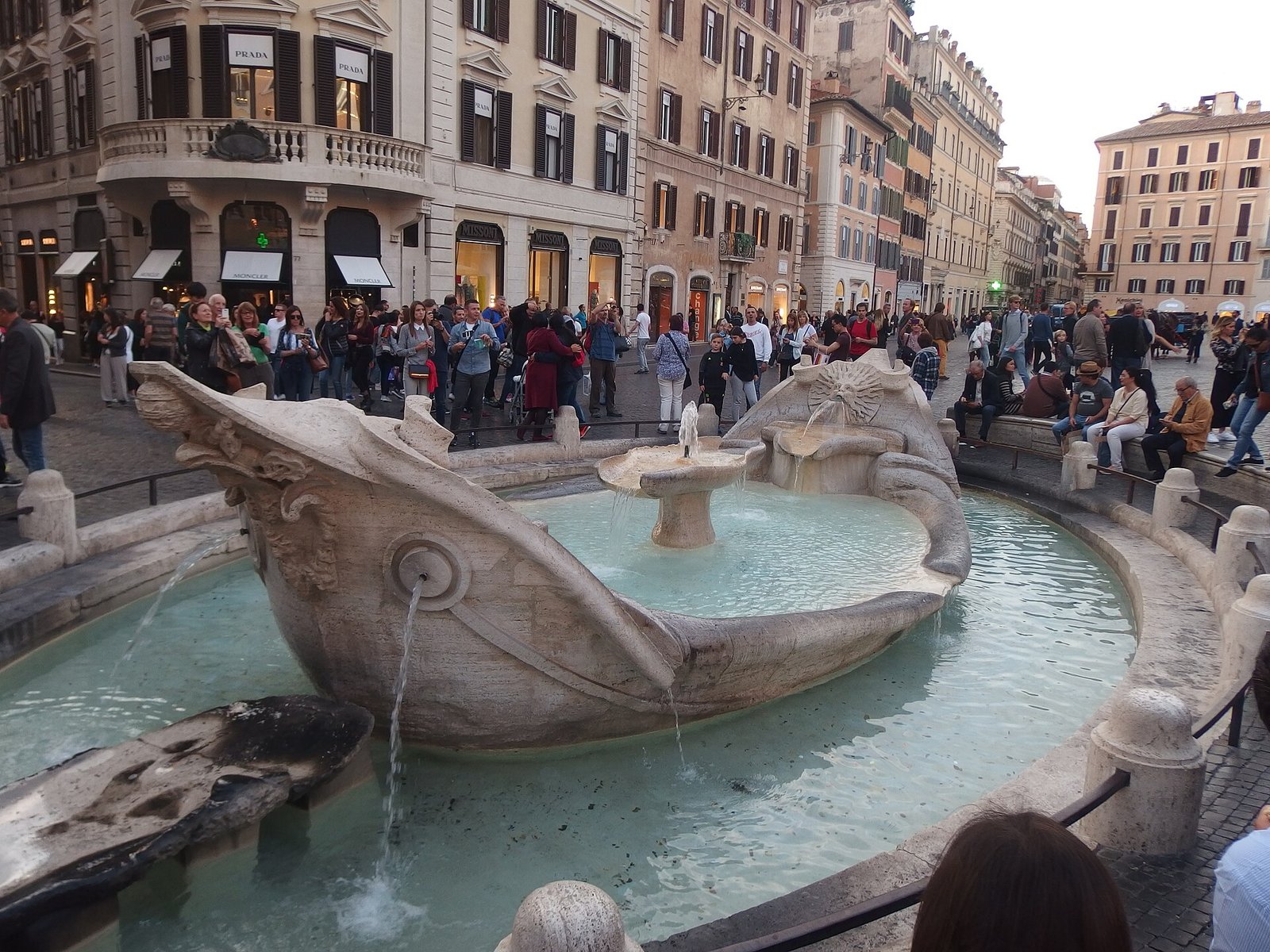
The Fontana della Barcaccia is one of the few works in Rome that doesn't try to overwhelm you. It has no jets shooting into the air, no sea gods looking down at you, none of the theatrical gigantism that seventeenth-century Rome practiced with such conviction. It has a battered boat, half submerged, that takes on water through its sides and lets it spill over. It is a monument to shipwreck. And the reason it looks this way, as we'll see, is not a poetic whim: it is the direct and very honest consequence of a water pressure problem that no one in 1627 was able to solve any other way.
The question everyone asks on their first visit is always the same: why a boat, in the middle of a square, two kilometers from the Tiber? The short answer is that the water didn't have enough force to rise. The long answer takes up the sections that follow, and includes a Barberini pope with bees on his coat of arms, an aqueduct built by a son-in-law of Augustus and still working, a Florentine sculptor transplanted to Naples, his 28-year-old son destined to reshape European sculpture, a legendary flood of the Tiber, an English poet who died of tuberculosis at 25 in the house on the corner, and a group of Dutch fans who in 2015 decided to throw bottles at it. Rome is like that: it can't tell you about a fountain without telling you about four centuries.
A clarification to avoid misunderstandings: the Fontana della Barcaccia does not stand "in front of" the staircase as an accessory element, and it is not even exactly at the geometric center of the square. It stands at the foot of the staircase, but the staircase arrived almost a century after it. When the fountain was built, up there there was no stage set of steps and flowering terraces: there was an earthen embankment, a steep and rather ugly slope, with the French church of Trinità dei Monti jutting out over the edge. The boat is the oldest of this square's residents. Everything else was built around it.
Why the Fontana della Barcaccia deserves more than 30 seconds
The tourist traffic in Piazza di Spagna gives the Barcaccia a handful of seconds and a selfie. That's a shame, because it's one of those works that give back a lot to anyone who stops. Try this: walk all the way around it, all 360 degrees, without rushing. You'll notice that bow and stern are identical. There is no front and no back. It's a boat with no direction of travel, and it has none because it doesn't need to go anywhere: it has to be looked at from every side, like a freestanding sculpture set in the middle of a public space. In 1629 this was a considerable conceptual novelty.
Then look at the edge. The sides are very low, just above the water line of the basin, while the two ends rise high. It is the profile of a vessel taking on water, of course, but it is also the functional profile of a cargo barge: a boat built to load and unload heavy goods from its sides, not to face the sea. We'll come back to this, because it is probably the key to the whole matter, and because it is much less romantic than the legend everyone will tell you.
Finally, listen. Yes, listen: the Barcaccia sounds different from all the other fountains in Rome. It doesn't have the rush of the Trevi Fountain or the powerful gurgle of the fountains in Piazza Navona. It has a low, muted, almost homey sound that, in the early morning hours when the square is empty, can be clearly heard bouncing off the facades. It is the sound of a little water falling from a short height. It is the sound of a technical limitation turned into poetry.
Where exactly the Fontana della Barcaccia is located
The Fontana della Barcaccia is in the Campo Marzio rione, at the heart of the so-called Tridente, the triple fan of streets that opens out from Piazza del Popolo. It occupies the southern part of Piazza di Spagna, at the ideal junction of three axes that matter a great deal for understanding the layout of this part of the city: Via dei Condotti, which heads west toward the Tiber and Ponte Sant'Angelo, Via del Babuino, which climbs toward Piazza del Popolo, Via Due Macelli and Via Frattina, which run down toward the Corso and the Quirinale.
The square has an unusual shape that, seen from above, resembles two triangles joined at their point, which is why Romans have always described it as "butterfly wings." It is not a shape designed on a drawing table: it is the result of successive additions, of houses demolished and rebuilt, of French and Spanish properties that faced each other. The Fontana della Barcaccia sits exactly at the narrowing point between the two wings, which is also the point where the slope of the Pincio begins to make itself felt. It is not a decorative position: it is a hydraulic one, and we will understand this better when we talk about the Acqua Vergine.
The visual landmarks around the Fontana della Barcaccia
With your back to the Spanish Steps and facing the fountain, on your left you will see the brick-red house where John Keats died, today the Keats-Shelley Memorial House, at the right corner of the steps for someone looking at them from below. On the other side, at the left corner, is the Babington's tea room, opened in 1893 by two English ladies at a time when tea was an exotic rarity in Rome. Behind you, toward Via di Propaganda, rises the Column of the Immaculate Conception, inaugurated on December 8, 1857, and behind it the Palazzo di Propaganda Fide, with the façade on the square attributed to Gian Lorenzo Bernini and the side façade, nervous and extraordinary, by Francesco Borromini. On the south side is the Palazzo di Spagna, seat of the Spanish embassy to the Holy See since 1622. It is from the palazzo, and not from some mythical Iberian colony, that the square takes its name.
It's worth keeping this geography in mind, because the Barcaccia is the center of gravity of a system. It is not an isolated object: it is the hinge between French Rome above (the church, the convent, the staircase paid for with French money) and Spanish Rome below (the embassy, the name of the square), with the Barberini papacy putting its own heraldic mark on top and settling who really rules. In a square where two Catholic powers eyed each other with hostility, the water is papal. It is a political message written in travertine, and it still works very well today.
Who Wanted the Fontana della Barcaccia: Urban VIII Barberini
The commission is certain and documented: the Fontana della Barcaccia is due to Pope Urban VIII, known in secular life as Maffeo Barberini, a Florentine, elected in 1623 and on the throne until 1644. 21 years of papacy, one of the longest and one of the most visually intrusive that Rome has ever known. If you walk through the Historic Center today and start counting the bees of the Barberini coat of arms, you'll get a stiff neck: they are on the baldachin of St. Peter's, they are on Palazzo Barberini, they are on the Fontana del Tritone and on the Fontana delle Api in Piazza Barberini, they are on the doors, the friezes, the plaques. And they are on the Barcaccia.
Urban VIII is a figure worth placing in context, because without him this fountain would not exist in the form we know. He was militantly cultured: he wrote Latin verses of good craftsmanship, had them printed, and considered himself a man of letters lent to the government of the Church. He had a very precise idea of power as representation. Governing was not enough for him: he wanted government to be seen, and seen everywhere, with an insistence that seemed excessive to his contemporaries and that has given later generations one of the most extraordinary artistic seasons in European history.
The Pope of the Bees and the Fountain Program
Water policy was one of the main pillars of his papacy, in continuity with what Sixtus V and Paul V had done. Bringing water to the neighborhoods meant three things at once: solving a real health problem, increasing the value of land and therefore encouraging construction, and leaving a permanent mark in every corner of the city. A public fountain is a service, a real estate investment, and a propaganda manifesto, all at once. Urban VIII had understood this perfectly.
It is also worth remembering that the rione around Piazza di Spagna was in full expansion in the early seventeenth century. The Tridente was filling up with hotels, inns, shops of antiquarians and printers, studios of foreign artists. It was the neighborhood where foreigners arrived: you entered through Porta del Popolo and found lodging here. An area like that, without a decent public fountain, was a practical problem and an embarrassing gap in its image. The Fontana della Barcaccia also grew out of this very concrete calculation.
The Bees and the Suns on the Fontana della Barcaccia
Go up to the two ends of the boat and examine the coats of arms. You will find the papal tiara with the crossed keys and, below, the three Barberini bees arranged in a triangle. The bees are not a generic ornament: they were the pillar of the family's self-representation. The bee produces honey, the bee is industrious, the bee belongs to an orderly community led by a sovereign, the bee is chaste according to ancient zoology. An entire moral program in three insects. The court poets built an industry of encomiastic verse on top of it, which today comes across as hard to stomach but which at the time was common currency.
As for the suns with human faces that pour water into the boat, they too are a Barberini undertaking. The rising sun, the light that spreads, the warmth that fertilizes: that is the symbolic repertoire, and its placement here is no accident. In short, the fountain conveys a very simple idea: the water you drink in this square comes from the pope, and the pope is sun and beehive. In the seventeenth century this kind of visual literacy was widespread at every social level. Those who couldn't read letters could read bees.
The Fontana della Barcaccia Between Pietro Bernini and Gian Lorenzo: The Authorship Question Explained Honestly
Now we come to the point that divides the sources, and it has to be tackled without shortcuts, because it is exactly the kind of question on which hasty guidebooks talk nonsense in both directions. Who made the Fontana della Barcaccia: Pietro Bernini or his son Gian Lorenzo?
Let's start with the documentary facts. Pietro Bernini, born in Sesto Fiorentino on May 5, 1562, a sculptor with solid late Mannerist training, who worked for a long time in Naples before settling in Rome, had been appointed architect of the Acqua Vergine in 1623, that is, right at the beginning of the papacy of Urban VIII. It's not a detail: it means the man commissioned to design the fountain was also the technical officer in charge of the aqueduct that was supposed to supply it. He therefore held both the problem and the solution, and he knew the flow rates, the elevations, and the limits of the network better than anyone else.
What the Ancient Sources Say About the Fontana della Barcaccia
The oldest and most cited testimony is that of Giovanni Baglione, painter and biographer, who in his lives of the artists attributes the work to Pietro: he writes that "in Piazza della Trinità de' Monti, with a fine caprice, he made the fountain in the form of a Boat, with the Pope's Devices." Baglione was a contemporary, he knew the milieu, and his attribution to Pietro is clear-cut. On the other side of the scale is the fact that Pietro died on August 29, 1629, precisely in the year the work was being completed, and that Gian Lorenzo, 30 years old, already the author of Apollo and Daphne and The Rape of Proserpina, already architect of St. Peter's since 1629, had been working beside his father for years.
The most balanced formula, and the one modern scholarship tends to accept, is more or less this: the Fontana della Barcaccia is a workshop work, conceived and directed by Pietro Bernini as architect of the Acqua Vergine, carried out with the collaboration of his son, and probably brought to completion by Gian Lorenzo in the final months, when his father was already elderly and close to death. Anyone who tells you "it's by Bernini" while meaning Gian Lorenzo is telling half the truth. Anyone who tells you "Gian Lorenzo had nothing to do with it" tells you another one. The truth lies in the middle, and it is more interesting than both.
Why the Authorship of the Fontana della Barcaccia Is So Hard to Untangle
There is a structural reason why this attribution remains slippery, and it's that in the seventeenth century the notion of a single author did not work the way it does for us. A workshop was an enterprise: there was someone who drew, someone who made the clay model, someone who roughed out the block, someone who finished, and someone who handled the hydraulic system. Payments were recorded in the name of the head of the workshop. The name on administrative documents is that of the person who collects the payment, not necessarily that of the person who had the idea or who picked up the chisel.
There is also a stylistic factor that complicates things further. The Barcaccia does not resemble Gian Lorenzo's early sculptures. There is none of that explosive virtuosity, none of that ability to render flesh yielding under the fingers, which makes The Rape of Proserpina an almost embarrassing experience to look at. The Barcaccia is restrained, almost ironic, built on an idea rather than on a dazzling execution. This has pushed many scholars toward Pietro. On the other hand, the conceptual insight, turning a technical limitation into a metaphor and making the fountain a narrative object rather than a decorated basin, is exactly the kind of mental leap Gian Lorenzo would practice for the following 50 years, from the Triton to the Nile in Piazza Navona.
In our view, the right answer is this: the Barcaccia is the point where the father teaches his son that a fountain can tell a story, and the son grasps the lesson better than the master. It is not an archival answer, it is a reading. But it is a reading that accounts for both the documents and what can be seen.
The Worksite of the Fontana della Barcaccia Between 1627-1629
The dates in circulation vary slightly depending on the source, and it's worth clarifying them. Most studies place the commission between 1626 and 1627, the actual execution, the one documented by payments, is concentrated between 1627-1629, completion is set for 1629. Whoever writes 1627-1629 and whoever writes 1626-1629 are not contradicting each other: they are simply counting from the service order or from the first payment order. These are two legitimate ways of dating a worksite.
What matters is the context. In 1627 Rome is a permanent construction site. At St. Peter's the canopy is being assembled, a colossal operation that absorbs bronze, money and workers. Palazzo Barberini alle Quattro Fontane has just been started. The pope is in a hurry to leave his mark. And in the middle of all this, a 65-year-old Florentine sculptor receives the apparently minor commission to arrange a fountain in a square on the outskirts, because in 1627 Piazza di Spagna, however lively, is still an urban fringe, a place of inns and foreigners, not the city's drawing room.
The Travertine of the Fontana della Barcaccia and Its Workmanship
The material is travertine, the limestone that Rome has quarried for millennia in the Tivoli area and that is responsible for the overall color of the city: that off-white that turns golden at sunset and becomes iron gray in the rain. Travertine is both an obligatory and a smart choice. It is relatively easy to carve when freshly quarried, hardens when exposed to air, resists frost well, and above all costs much less than Carrara marble. For a public fountain, in a square where the budget matters, it is the obvious choice.
It does, however, have a precise character: it is full of vacuoles, irregular cavities left by gases during its formation. It is not a stone that allows the skin-like finish of marble. You can't carve skin into it. You carve volume into it. This explains why the only figures with human faces on the Barcaccia have that schematic, almost archaic cut that some find naive. It isn't naivety, it's material consistency. With that travertine, that was the only possible and right finish.
Now look at how time has worked the surface. The water of the Acqua Vergine is notoriously low in limescale, and that is why the aqueduct has gone 20 centuries without clogging. But four centuries of continuous flow, winter frosts, 20th-century smog and human hands have nonetheless shaped the travertine in visible ways. The areas where the water flows most are polished smooth like soap. The sheltered areas keep traces of the original carving. It is a tactile archive of the monument's life.
How Big Is the Fontana della Barcaccia
The boat measures roughly 10 meters in length, with the oval basin surrounding it being wider still. On paper these measurements seem impressive, and in person they surprise for the opposite reason: the Barcaccia always seems smaller than it is. The reason is optical and depends on two factors. The first is that the basin is sunken. A substantial part of its volume lies below the walking surface, so it drops out of perception. The second is that behind it rises the staircase, 136 steps of Baroque stage design, and anything placed at the foot of such a stage machine looks tiny.
Evidently, the Berninis did not plan this effect, because the staircase did not exist. In 1629 the boat stood alone in front of an embankment of packed earth, and it must have looked far more imposing than it does today. It is one of many cases where time has changed the meaning of a work without touching a single centimeter of it.
The Acqua Vergine, Agrippa's Aqueduct That Feeds the Fontana della Barcaccia
You can't understand anything about the Fontana della Barcaccia without understanding the Acqua Vergine, and you can't understand the Acqua Vergine without going back 20 centuries. This is where the story becomes truly remarkable, because the water you see falling from the sides of the boat reaches Piazza di Spagna through an infrastructure inaugurated on June 9, 19 BC.
The Aqua Virgo was commissioned by Marcus Vipsanius Agrippa, childhood friend, general, collaborator and finally son-in-law of Augustus: the man who won at Actium and built the first Pantheon. Its stated purpose was to supply the baths Agrippa was building in Campus Martius, the city's first great public bath complex. It was the sixth of the 11 aqueducts of ancient Rome, and it has one feature that makes it unique: it is the only one that has never stopped working.
The Route of the Aqueduct That Supplies the Fontana della Barcaccia
The springs are not, strictly speaking, a single spring: they are a vast system of water veins and springs in the Salone area, along Via Collatina, at the eighth mile, not far from the course of the Aniene. A network of underground tunnels collects those waters and channels them into the main conduit. The total route measures just over 20 kilometers, or 14 Roman miles and a fraction, and it is almost entirely underground: only the last stretch, less than two kilometers, ran in the open air or on arches in the Campus Martius area.
The route makes a very wide loop, and the reason is purely altimetric. The springs sit at a low elevation, around 24 meters above sea level. With such a modest drop, every meter of elevation lost unnecessarily is a meter that can never be recovered. Agrippa's engineers therefore chose to lengthen the route enormously in order to keep a very gentle gradient: from the Collatina toward Portonaccio, then Pietralata, then the Nomentana, the Salaria, and then the curve to the south through what are today Villa Ada, the Parioli, Villa Borghese, the Pincio and Villa Medici. From there the conduit descends toward the center, passing through the area of Fontana di Trevi, crossed the modern via del Corso, continued toward the Pantheon and ended at the Baths of Agrippa.
The tunnel is on average one and a half meters wide, navigable in several sections, dug directly into tuff where the rock allowed it and built in masonry where the ground was crumbly. In the area outside the city it runs 30 or 40 meters deep, and at viale Romania it reaches 43. If that seems like an abstract figure, try to imagine what it meant to dig 43 meters of vertical shaft with hand tools, and then repeat the operation dozens of times along the route to ventilate the worksite and remove the material.
Why It's Called Acqua Vergine
There are three explanations for the name, and none can be proven with certainty, which makes all three worth telling. The first, the most technical, holds that the name comes from the purity and lightness of the water, which is practically free of limestone. It is this absence of encrustations that allowed the conduit to survive for 20 centuries without clogging, while the other Roman aqueducts became choked with limestone deposits as thick as an arm.
The second goes back to Sextus Julius Frontinus, who was curator aquarum under Nerva and Trajan and wrote the fundamental treatise on the aqueducts of Rome. Frontinus reports that near the initial basin there was a small shrine with an image of the nymph of the springs, and that the name came from there.
The third is the legend that everyone prefers: a maiden, a virgin indeed, would have pointed out to Agrippa's thirsty soldiers the spot where these until then unknown waters surfaced. It is the version carved in the relief on the Trevi Fountain, and it is the one the Romans have adopted without hesitation. The cautious historian points out that this is an etiology constructed after the fact. The honest guide tells it anyway, saying that it's a good story and specifying that it is a story.
Frontinus, the Quinariae and the Accounting of Rome's Water
Frontinus also leaves us the numbers, and the numbers are fascinating. The Aqua Virgo had a flow of 2,504 quinariae, which translated into modern units comes to about 103,000 cubic meters per day, or roughly 1,200 liters per second. The distribution was meticulously recorded: 200 quinariae reserved for the suburbs, 1,457 for public works, 509 for the imperial household, and the remaining 338 for private concessions. The water was distributed through 18 castella, the secondary distribution tanks spread along the route.
I want to point something out: the imperial administration knew, quinaria by quinaria, who received how much water. It was a water bureaucracy of remarkable refinement, with inspections, reports of illegal connections, and penalties. Frontinus himself bitterly complains about water theft carried out by piercing the conduits, which in his view was endemic. Ancient Rome already had the problem of illegal connections, and it had already put it in writing.
From Ruin to Restoration: How the Aqueduct Reaches the Fountain of the Barcaccia
The later history is a long chain of maintenance. Tiberius intervened in 37, Claudius between 45 and 46, and traces of that restoration remain in an inscription preserved in via del Nazareno, together with three travertine arches that you can still see today, wedged between the buildings. Work followed under Constantine and under Theodoric. In 537 the Goths of Vitiges cut the aqueducts during the siege of Rome, a blow from which the ancient water system never fully recovered.
The Aqua Virgo, however, was stubbornly put back into operation: Pope Adrian I in the eighth century, the Comune di Roma in the twelfth, and then a series of modern popes. Nicholas V, in the mid-fifteenth century, increased the flow by capturing new springs and entrusted the restoration to Leon Battista Alberti in person, which shows how prestigious the operation was considered. Paul IV, Sixtus IV, Pius IV, Pius V, Benedict XIV and Pius VI all intervened. An expansion was carried out in 1840. In 1936 the network was extended as far as the Pincio.
In 1570 the restoration brought water back to the Campo Marzio, and it is to that year that the story that concerns us directly goes back. A document of the Congregazione sopra le fonti identifies «il loco del aquedotto sotto la Trinità» as a suitable site for building a fountain. The project, however, is abandoned. The reason is the one that will become the heart of the story: the pressure is too low. In place of the fountain, a reserve cistern is built, which has since disappeared.
Toponymy Tells the Story of the Fountain of the Barcaccia
That cistern and those conduits have left a mark that nobody notices, and it's touching: the street names. Vicolo del Bottino, which climbs up behind the square, takes its name from "bottino," the term Romans used for the conduits and reservoirs of the aqueducts. And via dei Condotti, today a worldwide synonym for luxury and shop windows, is called that because the conduits of the Acqua Vergine ran underneath it on their way to the Campo Marzio. Italy's most elegant street owes its name to a pipe. It's the kind of detail I always pass along, because it explains Roman layering better than any lecture could: under the boutiques, the plumbing.
The hydraulic problem that shaped the Fontana della Barcaccia
Here's the crux. Everything you've read so far was leading up to this explanation, which is the real key to reading the monument and which surprisingly few people know.
A jet fountain in the 1600s works by gravity and that's all. There are no pumps, no electricity, nothing pushing. The water rises in a vertical jet to a height lower than the reservoir it comes from, and the available drop determines the height of the spout. Period. If you have 20 meters of drop, you can afford spectacular jets. If you have two, you can't afford anything.
Piazza di Spagna, for the Acqua Vergine, was an unlucky spot. The conduit came down from the Pincio already at a low elevation, and in that exact place, at the foot of the slope, the residual head was minimal. Not enough for a jet, not enough for a small cascade, not even enough for a raised basin of decent size. This was why they had given up in 1570. 57 years later, with the aqueduct reinforced but the geography unchanged, the problem was eased but not solved.
The solution: lower the basin instead of raising the water
Pietro Bernini's move is one of those that can be explained in a sentence and stays with you forever: if you can't raise the water, lower the basin. By digging the basin below street level, you artificially gain the drop that's missing. The water no longer has to rise in order to be seen falling. It only needs to fall a short distance to fall into something that sits lower than it does.
Now look at how it works, which is a small masterpiece of economy. At the center of the boat, a short baluster holds up an oblong little basin, lower than the bow and stern ends. From there comes a very modest spout. The little basin fills, and the water spills into the inside of the hull. The hull in turn fills, and since the sides are low and flared outward, the water overflows into the basin below. No jet wastes energy. Every drop works twice before it reaches the bottom.
Six more mouths are added to this: two sun sculptures with human faces that pour water into two shells inside the boat, and four round holes, two per side, facing outward and shaped like cannon muzzles. Those cannons don't fire: they drip. It's a warship leaking water from every side. The irony is deliberate, and in the Baroque context it's a refinement for connoisseurs.
The half-sunken boat is not a whim
This is the key point, because it reverses the common perception. The Barcaccia is not a boat because someone had a poetic vision of shipwreck. It's a boat because the shape of a half-submerged hull is the formal solution that best justifies, or rather makes necessary, the lowering of the basin. If you put a low circular basin in the middle of the square, it looks like a mistake, a flaw, a failed fountain. If you put a sinking boat there, the low level becomes the very meaning of the work. The weakness turns into the subject.
This is the mental attitude that defines the best Roman Baroque: don't hide the constraint, show it transformed. Gian Lorenzo Bernini would do the same thing for the rest of his life, on an ever larger scale, all the way to Piazza San Pietro. But the first exercise in this grammar is here, in this little travertine boat that everyone steps past with their eyes while they photograph the Spanish Steps.
There is one last practical advantage, which everyday experience makes obvious. A sunken basin is reachable. In the 1600s this meant that water carriers and the women of the neighborhood could draw water comfortably, without lifting full buckets over a high edge. The Fontana della Barcaccia was not an ornament: it was the neighborhood's tap. The beauty was the consequence of a function, not the other way around.
The legend of the 1598 flood and the Fontana della Barcaccia
Now we get to the story everyone will tell you, and it deserves to be told with due caution. The popular version, very widespread and much trusted, claims that the shape of the fountain was inspired by a real event: during the great flood of the Tiber in 1598, the water supposedly invaded the Campo Marzio, reaching as far as Piazza di Spagna, and when it receded it left a boat stranded right there. Urban VIII, 30 years later, supposedly wanted to commemorate the event with this fountain.
Let's start with what is certain. The flood of Christmas 1598 exists, is extremely well documented, and is one of the most catastrophic in the history of Rome: the plaques that mark the levels reached by the waters, scattered around the historic center, record it as an exceptional event. The Tiber invaded the Campus Martius, destroyed part of Ponte Emilio, the so-called Ponte Rotto, which has stayed broken ever since, and caused enormous damage. There is no discussion on this.
What Doesn't Add Up in the Legend of the Fontana della Barcaccia
The problems begin when you try to connect the event to the fountain. The first is topographical: Piazza di Spagna lies at the foot of the Pincio, in an area noticeably higher than the low Campus Martius, the one along the river. That the water reached up there with enough force to drag and deposit a boat is, let's say, generous. Not absolutely impossible for an exceptional overflow, but unlikely in the picturesque form in which the story is told.
The second problem is chronological. Between the flood and the commission almost 30 years go by. If the pope had wanted to commemorate the flood, he would have chosen an anniversary, or a symbolically relevant place, or he would have put an explanatory inscription on it. On the Barcaccia there is no inscription alluding to the flood. There are the bees and the suns, that is, the family's signature, nothing else.
The third problem is one of method: the legend appears in the sources in consolidated form rather late, with the typical pattern of explanations built backward. First there is a strange object that needs to be explained. Then comes a narrative explanation that justifies it. Then the explanation becomes more famous than the object. It's a mechanism that has worked in Rome for centuries and has produced dozens of delightful and unfounded stories.
The Alternative Hypotheses on the Shape of the Fontana della Barcaccia
Alongside the flood legend a second one circulates, of a more erudite flavor: that the area was anciently used as a small naumachia, that is, as a basin for staging naval battles. It's a suggestive hypothesis, which would have the merit of also explaining the cannon mouths, but it doesn't rest on solid archaeological evidence at that precise spot. I would put it in the category of learned conjectures.
The explanation I find by far the most convincing, and which is rarely told to visitors, is the lexical one. "Barcaccia" in Roman usage is not simply an ugly boat or a sinking boat: it indicated a specific type of river craft, the barge used on the Tiber for transporting wine barrels and heavy goods. Those boats had a precise construction feature: very low sides, to make loading and unloading by rolling the cargo easier, and raised ends. It is exactly the profile of the fountain.
If we accept this reading, everything falls into place. Pietro Bernini did not sculpt a wreck: he sculpted a means of transport familiar to anyone who frequented the banks of the Tiber, where the wine barges arrived daily from the Castelli and from the upper course of the river. He took an ordinary, popular, almost vulgar object and made it monumental. Which is, if you think about it, a much more modern and much smarter gesture than a learned allegory.
How to Tell the Legend Without Lying
The legend should be told anyway, because it is part of the square's intangible heritage, and because a visitor who hears the flood story and doesn't find it in the guide feels deceived. But I tell it for what it is, that is, a tradition, and right after I explain the hydraulic reason and the lexical one. Hardly anyone ends up disappointed. On the contrary: the true explanation is more beautiful than the legend, because it shows us an artist solving a problem instead of a pope commemorating a disaster.
The Fontana della Barcaccia and the Invention of the Sculpture-Fountain
There is a technical-historical reason why scholars consider the Barcaccia an important date, and it concerns neither the bees nor the legend. It concerns a question of form.
Before 1629, the typical Roman fountain is an architectural object. The dominant model is the one codified by Giacomo Della Porta in the second half of the 16th century: polygonal or circular basins, stacked bowls, geometric profiles, restrained and symmetrical decoration. You can still find them in Piazza Colonna, in Piazza della Rotonda, in Piazza Farnese. They are beautiful and they are, conceptually, noble containers of water.
The Fontana della Barcaccia breaks this scheme. It is not a decorated basin: it is a sculpture that holds water. The form doesn't derive from the geometry of the basin but from a figurative subject, and the basin is subordinate to the subject. It is the first time in Rome that a fountain is conceived entirely as a sculptural work. From this insight descends everything that comes after: the Triton in Piazza Barberini in 1642-43, the Fountain of the Four Rivers in Piazza Navona of 1651, and ultimately Nicola Salvi's Trevi Fountain, where the fountain has even become a theatrical facade with figures in action.
A Small Idea That Changed a City
It's curious to think that a formal revolution of this scale came from a low-pressure problem. Not from a treatise, not from a theory, not from an academic debate: from a pipe that didn't push hard enough. Art history is full of these short circuits between technical necessity and linguistic invention, and the Barcaccia is one of the clearest examples I know in Rome.
If you want to check this hunch with your own eyes, do this exercise on the same day. Look at the Barcaccia, then climb up to Piazza Barberini and look at Gian Lorenzo's Triton, then head down to the Trevi Fountain. You'll see a linear progression. From the narrative object set on the ground, to the mythological figure holding up the shell, to the total stage set that takes over a palace facade. Three stages of the same idea, all fed by the same water, the Acqua Vergine, and all children of the solution found in this square in 1627.
The Spanish Steps of Trinità dei Monti above the Barcaccia Fountain
The staircase arrives almost a century after the fountain, and it radically changes the meaning of the place. Before it, as I said, the side of the Pincio was a poorly resolved slope, a drop in level no one knew how to handle, with the French church of Trinità dei Monti perched at the top and the square below turning its back on it.
The problem had been debated for at least three generations. As early as the mid-17th century, French rulers were toying with the idea of a monumental connection, and the project stalled several times for reasons that were as architectural as they were diplomatic. The church and the convent were under French patronage, the square was de facto under Spanish influence, and neither court wanted the other to take credit for the passage and control it.
De Sanctis, Specchi and the competition for the staircase above the Barcaccia Fountain
The solution arrives in the first quarter of the 18th century, with French funding available starting in 1721. Two designers were in the running: Alessandro Specchi, an architect with a solid reputation who was the author of the Ripetta port, and Francesco De Sanctis. De Sanctis won, and his idea is the one we see: not a staircase, but a system of ramps that open and close, split into three and come back together, with landing terraces that work as resting points and lookouts.
Work runs from 1723 to 1726. Pope Benedict XIII inaugurates the staircase for the Jubilee of 1725, which is why you'll see sometimes the inauguration date and sometimes the completion date. Both are correct, referring to different moments. There are 136 steps, and I promise you that anyone who counts them out loud while climbing gets a different number, because the landings throw you off.
Why the staircase works so well with the Barcaccia Fountain
De Sanctis's stroke of genius, from the perspective of someone standing below, is that you never see the whole staircase at once. From Piazza di Spagna you see one portion, then the first terrace interrupts it, then a narrower section reappears, then it opens up like a fan. It's a stage set that unfolds in stages, and it makes you climb to understand it. In architecture, this is called a perspectival sequence, a typically Baroque principle: building long, deep vistas that culminate in monumental stage wings, pacing the reveal.
Within this setup, the Barcaccia Fountain plays a specific role that nobody planned but that De Sanctis certainly recognized: it's the low note. The horizontal point, muted, almost underground, from which the vertical crescendo begins. If there were a tall jet of water in place of the boat, the staircase would lose half its effect, because the spray would compete with the climb. Chance, or the insufficient pressure of the Acqua Vergine, gave the staircase its only possible starting point.
Azaleas and the staircase restorations
In spring, the staircase is decorated with a great many azalea pots, a long-standing tradition that turns the landings into flowering terraces in pink and fuchsia. It's when Piazza di Spagna reaches the peak of its photogenic appeal and, predictably, the peak of its crowds.
The staircase underwent a full restoration in 1995 and a second intervention in 2015-2016, the latter funded by the fashion house Bulgari, which has its historic home right on Via dei Condotti. It's one of many Roman cases of corporate patronage of public monuments, a formula that has allowed restorations that would otherwise be impossible, and that still sparks debate about the relationship between heritage and commercial brands. Personally, when faced with clean travertine, I tend to be pragmatic.
The church of Trinità dei Monti above the Barcaccia Fountain
Look up from the fountain, and at the top of the staircase you'll see a white facade with two twin bell towers, topped by small octagonal domes, and an obelisk in front. This is the church of Santissima Trinità dei Monti, and it is French. Not "French-inspired": French, legally and historically.
It was founded in 1493 by Charles VIII of France, under the title of S. Trinitatis in Pincio, and entrusted to the Order of Minims, the congregation founded by Saint Francis of Paola, which enjoyed great favor at the French court. Work on the first part probably began in 1502 and continued for a large part of the century. The church was born in the Gothic style, designed by Annibale Lippi and Gregorio Caronica, and, a detail I love, built with stones brought from Narbonne.
From Charles VIII to Sixtus V
The Sack of Rome in 1527 seriously damaged the complex. The choice then was to restore and expand it, buying the surrounding land. During the conclave of 1549-1550, several French cardinals financed the work, which led to the completion of the facade in 1570, designed by Giacomo Della Porta and Carlo Maderno and featuring the two famous bell towers. The consecration took place in 1585 under Pope Sixtus V.
It was Sixtus V who commissioned Domenico Fontana to build the strada Felice, which took its title from his baptismal name, to connect the Pincio to Santa Maria Maggiore. This is the axis we know today as via Sistina and via delle Quattro Fontane. The necessary excavations created a difference in level in front of the church entrance, and Fontana solved it with the monumental two-flight staircase that still gives access to it today. This means that above the De Sanctis staircase there is another staircase, almost 140 years older, and that many visitors climb it without realizing they are changing eras.
What's inside the church that overlooks the Fontana della Barcaccia
The interior has a single nave with six side chapels, and it holds a first-rate collection of paintings that almost none of the photographers in the square suspect. The crossing vault is in French Late Gothic style, with interlaced ribbed vaults: it is the only example of this style in Rome, and that alone would be worth the climb.
Among the chapels, the one of Lucrezia della Rovere stands out, with a remarkable cycle of frescoes by Daniele da Volterra and his collaborators. According to Vasari, the master designed all the cartoons, leaving a large part of the execution to his students, many of whom would later become notable artists. Daniele is certainly responsible for the Assumption on the back wall, datable to between 1548 and 1550, and for the Presentation of the Virgin. The church also contains sixteenth-century funeral monuments by Leonardo Sormani and works by Paris Nogari, as well as a nineteenth-century altarpiece by Louis Vincent Léon Pallière.
A clock and a meridian line are placed on the two bell towers, which, according to tradition, indicate the time in Rome and in Paris, respectively. It's a detail that perfectly sums up the status of the place: a piece of France suspended above a Spanish square in a papal city.
The obelisk in front of the church
In front of the facade stands the Sallustiano obelisk, an obelisk of Imperial Roman workmanship that imitates Egyptian models, coming from the Horti Sallustiani. It was Pope Pius VI who wanted it here, and the preparatory work was seen by Johann Wolfgang von Goethe during his stay in Rome. In his Italian Journey, under the year 1787, Goethe notes that he saw digging at Trinità dei Monti to lay the foundations of the new obelisk, observing that up there the ground is nothing but fill material from the ruins of the gardens that once belonged to Lucullus and later to the Caesars. It is one of the most valuable firsthand accounts of this corner of the city, and it has the merit of reminding us that the Pincio, before becoming a viewpoint, was an enormous late-Republican garden.
Piazza di Spagna around the Fontana della Barcaccia
The square that today surrounds the Fontana della Barcaccia was not born in a day or from a single plan. It is the result of a long sedimentation, and knowing its stages changes the way you look at it.
Until the seventeenth century, this space was called platea Trinitatis, that is, piazza della Trinità. The name derived from the church that overlooked it, and today it remains limited to the upper area, where the church and the obelisk stand. One part, the northern section, was also called "piazza di Francia," because of the French patronage over the Trinità. The current name took hold mainly from the second half of the eighteenth century, and it comes from Palazzo di Spagna, seat of the Iberian embassy to the Holy See from 1622.
The shape of the square took form with the urbanization of the via del Babuino - via Due Macelli axis, then called via Paolina in honor of Pope Paul III Farnese, and with the creation of the Tridente. In the eighteenth century, the staircase came to solve a complicated road junction: here the via Paolina, the via Trinitatis, the via Sistina and the via Gregoriana converged at different levels, and a pedestrian link was needed to bring order. The staircase is not just scenery: it's infrastructure.
The square of hotels and carriages
Very soon the area filled with hotels and inns for foreign visitors, who entered Rome through Porta del Popolo and looked for lodging in the first neighborhood available. Princes, visiting sovereigns, artists, students, clerics and adventurers: Piazza di Spagna was their landing place. Traces of that activity remain in the name Via delle Carrozze, the street used as a depot for the carriages that innkeepers rented out or made available to their guests. A parking lot, in essence, fossilized in the street names.
It's worth imagining this eighteenth-century square: carriages, horses, straw, vendors, models in costume waiting to be hired, cicerones offering guided tours to foreigners with a professional aplomb that we modern guides find rather endearing. And in the middle, the Fontana della Barcaccia, which was used to water horses, fill jugs and wash whatever needed washing. It wasn't a monument: it was a public utility in a nice outfit.
The Immaculate Conception Column Next to the Fontana della Barcaccia
On the south side of the square, in front of the Palazzo di Propaganda Fide, the Column of the Immaculate Conception rises high. It was erected after the proclamation of the dogma of the Immaculate Conception, which took place in 1854, at the wish of King Ferdinand II of the Two Sicilies in thanks for escaping an assassination attempt, and it was inaugurated by Pope Pius IX on December 8, 1857. On top is the statue of the Virgin.
Every year, on December 8, one of the religious ceremonies most loved by Romans takes place here: the floral tribute to the statue. Since 1923, firefighters have carried it out, climbing up with their ladders in an operation that is as acrobatic as it is affectionate. In 1953, Pope Pius XII attended, but it was from 1958, with John XXIII, that the pope's presence became an established tradition, maintained by all his successors. If you're in Rome on that date, the square completely changes character: the crowd is not touristic, it's Roman, and it's one of the rare moments when this space becomes the city's again.
Propaganda Fide, Bernini and Borromini a Stone's Throw from the Fontana della Barcaccia
The Palazzo di Propaganda Fide deserves a 30 meter detour that almost no one takes. The facade facing the square is attributed to Gian Lorenzo Bernini. The side facade, on Via di Propaganda, is by Francesco Borromini, and it is one of his most radical works: a wall that bends and stretches, with giant pilasters, windows that look flattened by internal pressure, and a nervous tension that looks like nothing else.
The fact that the two greatest antagonists of Baroque architecture signed two facades of the same building, a few meters from each other, is one of Rome's great teaching coincidences. Bring anyone who wants to understand the difference between Bernini and Borromini in five minutes here. On one side, the self-assured order and majestic rhetoric. On the other, the geometric unease of a man who considered the wall an elastic material. The Fontana della Barcaccia sits right in the middle, unperturbed, acting as a median strip between two ways of understanding the world.
The Fontana della Barcaccia and the Fontana di Trevi: Two Sisters from the Same Aqueduct
One connection that clears up a lot is this: the Fontana della Barcaccia and the Fontana di Trevi drink from the same source. Both are fed by the Acqua Vergine. They are, quite literally, two terminals of the same Aqueduct of Agrippa.
The difference is all in the elevation. The Fontana di Trevi is located at a point where the residual hydraulic head was still sufficient to guarantee a generous flow and a significant drop: from there come the jets, the cascades, the noise. The Barcaccia sits downstream of a descent that consumed almost all the available energy. Same water, same origin, two opposite architectural outcomes. It's a lesson in physics applied to art that no classroom could teach better.
The Mostra of the Aqueduct and the Theatricalization
The Roman tradition calls "mostra" the monumental fountain that marks the terminal point of an aqueduct: the mostra of the Acqua Paola on the Janiculum, the mostra of the Acqua Felice at Termini with the famous Moses, and the mostra of the Acqua Vergine at Trevi. The Fontana di Trevi in its current form is the work of Nicola Salvi, begun in 1732 and completed in 1762, but the history of the aqueduct's endpoint in that place is much older, and it includes an unrealized Bernini project commissioned by Urban VIII himself.
It's interesting to note that the facade of Trevi features the two reliefs that tell the legends of the aqueduct: Agrippa approving the project, and the young woman pointing out the springs. That story, the same one cited regarding the name, is therefore carved half a kilometer from here. The Barcaccia and Trevi are the two ends of a single tale: one tells it in a whisper, the other with a full orchestra.
An Water Itinerary Starting at the Fontana della Barcaccia
If this thread interests you, there's a walk I often recommend that takes a couple of hours. Start at the Barcaccia. Go up via dei Due Macelli and turn onto via del Nazareno, where the three travertine arches of the ancient aqueduct survive, with the restoration inscription of Claudius. They're there, wedged between the buildings, and most passersby mistake them for an ordinary wall. Then continue toward the Trevi Fountain, where the same water puts on a show. Finally, if you have the energy and the legs, you can climb up to the Pincio and look out toward Villa Medici, below which a spiral staircase in perfect condition, the so-called Chiocciola del Pincio, still leads to the underground conduit.
I'll add a curiosity that always amazes people: during the construction of the Rinascente department store on via del Tritone, remains of the aqueduct were found, and today they are on display inside the building. You can go see the Acqua Vergine among the departments. It's a typically Roman experience, where millennia of stratification coexist with escalators without anyone finding it strange.
The Grand Tour, the models and the artists around the Barcaccia Fountain
Between the eighteenth and nineteenth centuries, this square became the nerve center of international Rome. The Grand Tour, the educational journey that the elites of Northern Europe considered mandatory to complete the education of a young gentleman, had Rome as its final stop, and Rome had Piazza di Spagna as its gateway.
The English, the Germans, the Scandinavians and the Russians arrived through Porta del Popolo, settled into the inns on via del Babuino and via dei Condotti, and found themselves living day to day around the Barcaccia. The area filled with whatever that clientele needed: real antiquarians and skilled forgers, print shops with views by Piranesi and his followers, shops selling paints and easels for painters, agencies that supplied guides and carriage drivers, and bankers who cashed letters of credit.
The models on the steps
There is a phenomenon worth telling because today it has disappeared completely, and at the time it was an institution: the models. On the staircase, for decades, men, women and children in traditional dress could be found waiting to be hired by the foreign painters who had studios in the neighborhood. They were Ciociari with cioce and gaiters, women with white cloth folded over their heads, and old men with beards suited to playing Saint Jerome.
It was a real labor market, with rates, specializations and even family dynasties: certain families from the Ciociaria sent successive generations of models to Rome. Nineteenth-century views of the staircase often show them, seated on the steps in studied poses. When they tell you today that you can't sit on the staircase, remember that for a century, sitting there was a job.
The artists' studios around the Barcaccia Fountain
The streets branching off the square, via Margutta above all but also via del Babuino, via Sistina and via Gregoriana, were full of artists' studios. Via Margutta kept this vocation well into the twentieth century, and it is still one of the prettiest streets in the center today, with its courtyards and the glass windows of the ateliers.
Not far off, on via Sistina, lived Nikolaj Gogol', who wrote a large part of Dead Souls in Rome and spoke of the city with an almost religious enthusiasm. In Piazza di Spagna itself, at number 31, Giorgio de Chirico had his home and studio, and his home is today open to visitors as a house museum. It's no coincidence: those who came to Rome to work with their eyes tried to stay here, where light enters the square from the south and where the travertine returns warm reflections for a large part of the day.
John Keats, Shelley and the house at the corner of the Barcaccia Fountain
Looking at the staircase from below, the brick-colored building on the right is the one where John Keats died, on February 23, 1821. He was 25. He had arrived in Rome just a few months earlier, in November 1820, sent by doctors to look for a remedy for tuberculosis in a milder climate. The disease had already killed his mother and brother, and it did not spare him.
He occupied the second-floor apartment at Piazza di Spagna 26, two modest rooms overlooking the staircase. With him was the painter Joseph Severn, a faithful friend, who stayed by his side until the end in conditions of isolation and anguish that his letters convey with a harshness that is hard to forget. The papal authorities, as was customary in cases of tuberculosis, had the furniture and household items of the room burned after his death, out of fear of contagion. That's why the furnishings you see today are not the originals.
The window above the Barcaccia Fountain
There's a detail worth knowing. From the window of the room where he lay, Keats couldn't see much: a slice of the square, the steps, and the Barcaccia Fountain. But he could hear it. In those last weeks, immobilized, the constant sound of the water from the Barcaccia was one of the few companions he had in sound during his days.
His epitaph, in the Non-Catholic Cemetery near the Pyramid of Cestius, where he is buried, says that here lies one whose name was writ in water. It is a formula Keats himself wanted, and critics have debated it for two centuries: bitterness over his failure, or an intuition of the fluidity of fame? Whatever the answer, the fact that this image of water was conceived a few meters from this fountain has a symmetry that is hard to call coincidental, yet it can't even be turned into a certain anecdote. The sources don't tell us that Keats was thinking of the Barcaccia. They tell us he had it under his window.
The Keats-Shelley Memorial House
In 1903 the Keats-Shelley Memorial Association was founded, with the stated goal of raising funds to save the building from demolition and turn it into a place of memory for the two poets. The association succeeded: a museum was set up in the apartment, with relics, memorabilia of English Romanticism and a specialized library of considerable size. The opening took place on April 3, 1909, in the presence of King Victor Emmanuel III.
During World War II the museum went through a difficult period, which the museum itself calls the "underground period," linked to its relations with Germany, and it resumed normal activity with the arrival of the Allies. Today the apartment is open to the public as a house museum. It is small, you can visit it in 40 minutes, and it has the rare quality of being quiet just meters from one of the noisiest squares in Europe.
Percy Bysshe Shelley and the Connection to This Place
The museum is also dedicated to Percy Bysshe Shelley, who admired Keats and for whose death he wrote the elegy Adonais. Shelley lived in Italy during the last years of his life and died on July 8, 1822, in the Gulf of La Spezia, drowned in a shipwreck, at the age of 29. His ashes also rest in the Non-Catholic Cemetery in Rome, not far from Keats's tomb.
The concentration of English Romanticism in this corner of the city is statistically unlikely and historically very easy to explain: the British community in Rome gravitated here, and here people fell ill, fell in love, wrote and sometimes died. The Fontana della Barcaccia has been a silent witness to all of this, and it continues to be one without the slightest change of expression.
Via dei Condotti, the Caffè Greco and the Fontana della Barcaccia Neighborhood
From the fountain, heading west, runs Via dei Condotti, which in the global imagination means fashion and which in historical reality means, as we have seen, pipes. The street runs straight toward the Tiber and was part of the sixteenth-century road system that connected this area to Ponte Sant'Angelo.
At number 86 is the Antico Caffè Greco, founded in 1760 and considered the oldest café in Rome and the second in Italy after the Florian in Venice. The name comes from the Italian-Levantine origin of its founder, a certain Nicola della Maddalena, who appears as "caffettiere" in the Stati delle Anime of 1760 and in a document from the parish of San Lorenzo in Lucina preserved in the Archive of the Vicariate.
Who Frequented the Caffè Greco
From the beginning of the 1800s the Caffè Greco became the favorite meeting place of German artists and intellectuals working in Italy. Valuable visual evidence of this remains: the pencil sketches and portraits made by Carl Philipp Fohr in preparation for a painting that was never completed, interrupted by the early death of the artist, who drowned in the Tiber. Those drawings, kept in Heidelberg and Frankfurt, depict, among others, the Tyrolean painter Joseph Anton Koch, the poet Friedrich Rückert, Peter von Cornelius, and Friedrich Overbeck playing chess with Philipp Veit.
The philosopher Arthur Schopenhauer and Ernst Theodor Amadeus Hoffmann also frequented the venue. Silvio Pellico passed through it, and Gioacchino Pecci, the future Pope Leo XIII, was a regular. In the Omnibus room, medallions, plaster plaques and miniatures are on display, depicting artists, poets and musicians who passed through over the decades. In total, the rooms hold more than 300 works, which makes the Antico Caffè Greco the largest private art gallery open to the public in the world.
The venue is recognized as a cultural property of particularly important interest and is part of the association Locali storici d'Italia. In recent years its fate has been at the center of a long legal dispute with the owner of the building, the Ospedale Israelitico, which led to a suspension of activity. It's worth checking the situation when you visit, because this is an evolving matter and it cannot yet be declared closed one way or the other.
The 2015 Damage to the Fontana della Barcaccia
February 19, 2015 is a date that Romans remember with anger. That day the Fontana della Barcaccia was damaged by a group of Feyenoord fans from the Netherlands, who had come to the capital for the Europa League match against Roma. In the afternoon, after hours of hanging around the area, dozens of people threw glass bottles at the monument.
The confirmed damage was extensive. A fragment of travertine about 10 centimeters across broke off the edge of the central candelabrum of the basin. Technicians found scratches and chips at several points on the surface, caused by the impact of the glass. The Superintendency's assessment was clear-cut: it was serious damage, and serious above all because it was permanent. Travertine can't be stitched back together. It can be consolidated, it can be filled in, but the loss of original material is final.
Why that day left a mark
Images of the invaded square, broken glasses, and bottles bouncing off the boat went around the world and sparked a fierce debate in Rome about public order management, the responsibility of clubs, compensation, and protecting monuments on days with heavy crowds. It was not a comforting discussion. Errors in forecasting and organizational shortcomings came to light that nobody could really deny.
To be honest, it wasn't the first attack. On May 15, 2007, four drunk men carved into the fountain with a large screwdriver, causing a deep gouge and the detachment of a significant part of the papal coat of arms. The carabinieri who responded were attacked, but they managed to arrest the men and prevent further damage. These episodes differ in scale and context, but they point to the same problem: a monument that is accessible, exposed, and without barriers depends entirely on the behavior of the people around it.
What you can see today of the scar
If you look closely, and I'll tell you where to look, some traces are still visible despite the restoration. These are small changes in color and texture along the edges, where the added material reacts to light differently than the 17th-century travertine. They aren't disfiguring. If you like, they're the most recent chapter in the object's biography.
They're worth looking at, and not as a moral lesson. I show them to you because they help you understand that monuments aren't images. They're bodies, and bodies get hurt. The Barcaccia has survived four centuries of frost, smog, wars, minor earthquakes, and countless hands, and it bears the marks. That's exactly what makes it real rather than decorative.
Restorations of the Barcaccia Fountain
Its location in one of the city's most heavily visited squares means the Barcaccia Fountain needs stricter maintenance than other monuments. There are many documented interventions. Among the most recent are those from 1986, 1993, and the cycle between 1994 and 1999.
Another conservation restoration took place between 2013 and 2014, made possible by a private donation of €209,960. That figure gives a good sense of what it costs to keep an object like this alive. The most recent intervention on record was completed on April 16, 2025, fully funded by National Recovery and Resilience Plan funds.
What a fountain restoration actually involves
It's worth explaining what it involves, because the public imagines a kind of washing, while the reality is much more complex. First, there's documentation: surveys, raking-light photography, and mapping the deterioration point by point. Then comes cleaning, the most delicate phase, because you have to remove deposits, black pollution crusts, and biological buildup without damaging the historic patina, the surface film that is an integral part of the stone's life.
Next comes consolidating the decohesed areas, meaning the zones where the stone is losing cohesion and crumbling. Then the cracks are filled with compatible mortars, the entire hydraulic system is overhauled (pipes, nozzles, recirculation system, drains), and finally protective coatings are applied. In fountains, the hydraulic problem is central. Invisible leaks can seep into the masonry and cause damage far more serious than anything visible on the surface.
I'll add a detail that always stands out. In Roman basins, surprising amounts of coins are recovered every year, which are collected and used for charitable purposes. The custom of tossing coins, famous at Trevi, has spread by imitation to many other fountains, the Barcaccia included. Coins don't harm the travertine, but metal in water can cause oxidation and stains, which is one of the reasons periodic removal is necessary.
The rules of Piazza di Spagna: what you can't do at the Barcaccia Fountain
This section should be written without a preachy tone, because most violations come from ignorance rather than bad intent.
The first rule applies to Rome's monumental fountains in general. You don't go in, you don't bathe, you don't soak your feet, you don't climb on them, you don't wash anything, and you don't let animals drink from them. Municipal regulations are explicit, and surveillance in Piazza di Spagna is constant, with fines and the possibility of being removed from the area. This isn't about prudishness. A body that enters a basin drags sand, sunscreen, sweat, and microorganisms into a recirculating system, and the abrasive load on four-century-old porous stone is not theoretical.
The second rule concerns the Spanish Steps (scalinata di Trinità dei Monti), and it surprises many visitors: you can't sit on the steps. The ban took effect in summer 2019 with the update to the city police regulations, and it is enforced. Nothing forbids stopping, standing, or taking photos. What's banned is sitting, along with eating and drinking on the steps, of course.
Why you can no longer sit on the steps above the Fontana della Barcaccia
The official reason is conservation, and it has a concrete basis. The travertine of the steps wears down, chips, and stains. Food and drink leave residue that sticks to the stone and attracts seagulls and rodents. The number of people sitting during high season made the steps effectively impassable as a route. The measure has been debated. Many have criticized it as excessive, and others have defended it as unavoidable.
It's worth pointing out, because it's the main source of misunderstandings in this square. Watching someone get scolded by a vigile while eating an ice cream, convinced in perfect good faith that they're doing the most natural thing in the world, is a daily classic. If you want to sit down, the Villa Borghese gardens are a 10-minute walk uphill, and the view from the Pincio more than makes up for the effort.
When to see the Fontana della Barcaccia
The square is an open public space, and the fountain can be seen at any hour, which is a huge advantage over monuments that close. The problem isn't access. It's the crowds.
The best time of all is early morning. Between dawn and eight, the square is almost empty, the light comes in low from the east and lights up the travertine, the sound of the water can be heard, and you can walk around the boat without putting a stranger in every frame. It's the only time when the Fontana della Barcaccia becomes an object again instead of a backdrop.
The second useful window is late evening, after 23:00, when the shops have closed and the square gradually empties. The night lighting of the fountain and the steps is warm and well calibrated, and the contrast between the boat in shadow and the lit steps produces very beautiful images.
The seasons at the Fontana della Barcaccia
Spring is the classic and most crowded season: the azaleas on the steps, the ideal weather, and a density of visitors that makes getting through during the central hours exhausting. If you come in April or May, move your visit to the early hours of the day, no discussion.
The Roman summer is harsh. The sun in Piazza di Spagna beats down with nothing to block it, the square has little shade, and the travertine reflects the heat. On the other hand, the evenings of July and August are among the most pleasant of the year, and the neighborhood stays lively late. Bring water. And speaking of water, remember that in Rome the nasoni, the little cast-iron fountains scattered around the city, provide free drinking water, and there are some nearby.
Autumn is, in our view, the best season to visit Rome in general and this square in particular. October and November offer low, golden light, reasonable temperatures, and noticeably lighter tourist pressure. Winter has the advantage of emptiness. On certain January mornings the square belongs to the people who live there, and the Fontana della Barcaccia with frost on its edges is a sight few people have seen.
How to get to the Fontana della Barcaccia
The simplest way is the metro. Line A has a stop dedicated to it, Spagna, whose exit opens directly onto the square, a few steps from the fountain. From the same station, a long pedestrian passage with elevators also rises to the level of the Pincio and Villa Borghese, a valuable option for anyone who has trouble with hills.
On foot, the Barcaccia is easy to reach from nearly all of the Historic Center: 10 minutes from the Trevi Fountain, a quarter of an hour from Piazza del Popolo going down via del Babuino, 20 minutes from the Pantheon, and a little more to Piazza Navona. The area is pedestrian or has limited traffic, which makes getting around on foot not just possible but preferable.
Accessibility of the Fontana della Barcaccia
The square is flat, and the fountain can be approached without steps, which makes it accessible to people with reduced mobility and to those getting around with strollers or wheelchairs. The surface is sampietrini, the typical basalt blocks of Roman paving, which are fascinating to look at and uncomfortable to cross with small wheels. Expect some vibration.
The steps, of course, are not accessible. Those who can't manage the 136 steps do have the alternative of the elevator at Spagna station, which goes up to the upper level and makes it possible to reach the Trinità dei Monti area and the Pincio without climbing on foot. It's information that saves the day for many people, and oddly it's not widely known.
Things to see near the Fontana della Barcaccia
The Barcaccia sits at the center of one of the densest concentrations of notable things in Europe, and a 20-minute walk in any direction produces disproportionate results.
Going up the staircase: the church of Trinità dei Monti, the Sallustiano obelisk, and then the avenue leading to Villa Medici, seat of the Accademia di Francia a Roma, with its gardens open to visitors. From there, continuing on, you reach the terrace of the Pincio, one of the classic belvederes over the city, and Villa Borghese.
Going down west along via dei Condotti: the Caffè Greco, and at the far end the straight line toward the Tiber. Heading north along via del Babuino: churches, antiques dealers, and at the end Piazza del Popolo with its twin churches and Santa Maria del Popolo, which holds two Caravaggios and the Chigi Chapel designed by Raphael. Heading south along via di Propaganda and via del Tritone: the Trevi Fountain, and further on the Quirinal.
A Half-Day Itinerary from the Fontana della Barcaccia
If I had to build a route that starts here and has a narrative logic, I'd do it this way. First, the Barcaccia at a relaxed pace, explaining the aqueduct. Then the climb to the Trinità dei Monti for the change in scale and for the French Late Gothic of the vault. Then down and along via del Babuino to Piazza del Popolo, with a mandatory stop at Santa Maria del Popolo. Back toward the Corso, with a detour onto via del Nazareno for the arches of the Acqua Vergine. Finish at the Trevi Fountain, where the same aqueduct you saw whispering in Piazza di Spagna shouts at you.
It's about three and a half hours of easy walking, with a common thread, water, that ties together 2,000 years. It works with adults, it works with bored teenagers, and it works with kids too, as long as you tell the story of the sinking boat instead of Frontinus's quinariae.
The Fontana della Barcaccia in Art, Literature and Film
Few images of Rome have been reproduced as often as this one. From the eighteenth century on, the view of Piazza di Spagna with the staircase and the fountain becomes a fixture in the repertoire of view painters, engravers and then photographers. Giacomo Brogi, one of the great Italian photographers of the nineteenth century, left views of exceptional quality from the second half of the century, showing the square free of cars and with models sitting on the steps.
The map of Rome by Giovanni Battista Nolli, from 1748, shows the state of the square with topographical precision a few decades after the staircase was built, and it's a document I recommend to anyone who wants to understand how this urban area worked before the nineteenth-century changes.
The Fontana della Barcaccia in Literature
Piazza di Spagna is mentioned in a famous poem by Cesare Pavese, "Passerò da piazza di Spagna," whose text is on a plaque placed near the Babington's tea room. It's one of those cases where twentieth-century Italian literature directly intersects with the topography of the place, and it's worth looking for.
Beyond that, the bibliography of travelers is vast: Goethe, Stendhal, Dickens, Hawthorne, Henry James, Andersen have all crossed this square and written about it in different forms. I don't quote them directly because loose attributions about these authors circulate widely, and I'd rather not add noise. Anyone who wants to dig deeper will find pages about the neighborhood in their travel writings.
The Fontana della Barcaccia in Film
The most famous scene filmed in this place comes from William Wyler's Vacanze romane, from 1953, with Audrey Hepburn and Gregory Peck: the gelato scene on the staircase has become one of the images that define Rome on screen, and it did more than any promotional campaign to fix Piazza di Spagna in the international imagination. The paradox, which I never miss a chance to point out, is that this gesture, sitting on the steps eating a gelato, is today exactly what the rules forbid.
The square also appears in dozens of Italian and foreign productions, usually as an establishing shot: when a film wants to say "Rome" in three seconds, it frames the staircase. The Fontana della Barcaccia often slips into the frame at the bottom, almost always without anyone naming it. It's its destiny, and somehow it suits it.
Can You Drink the Water from the Fontana della Barcaccia?
It's one of the questions I get most often, and the answer requires a distinction.
Rome's monumental fountains today largely run on recirculation: the same water is filtered and sent back into circulation, and it isn't meant for human consumption. Don't drink from the monumental basins, and it's not a matter of etiquette but of basic hygiene, considering what ends up in the basins every day.
The situation is different for the nasoni, the cast-iron fountains with a continuous flow that you'll find everywhere in the city: those dispense drinking water from the city's network, checked, cool and excellent. Filling your water bottle at a nasone is one of the smartest things you can do in Rome in summer, and it's free. The right move is to cover the terminal hole of the pipe with your finger: the water will spurt from a small hole on top, forming a convenient arch for drinking.
The Quality of the Acqua Vergine Today
It's worth clarifying a technical point that directly concerns our fountain. The ancient Acqua Vergine, as I said, was famous for its lightness and purity. Today the situation has changed. A large part of the ancient structures has been replaced with concrete pipes, and intensive urbanization has polluted both the original channel and the groundwater. As a result, Acqua Vergine water is used for irrigation and to feed monumental fountains, not for drinking.
There's something melancholy about this. The aqueduct that for 20 centuries was celebrated as Rome's purest, the one that left no deposits and that popes competed to take credit for restoring, now serves to make water fall from the sides of a travertine boat. It keeps working, though. Since 19 BC, without any long break. Few human-made structures have a record like that.
Frequently asked questions about the Barcaccia Fountain
Who built the Barcaccia Fountain?
It was commissioned by Pope Urban VIII Barberini and built between 1627 and 1629 by Pietro Bernini, who had been architect of the Acqua Vergine since 1623, with the collaboration of his son Gian Lorenzo Bernini, who most likely completed it. Early sources, starting with Giovanni Baglione, attribute the work to Pietro. Modern scholarship recognizes a contribution by the son without being able to quantify it precisely.
Why does the Barcaccia Fountain look like a boat?
The main reason is technical. The low pressure of the Acqua Vergine at that point didn't allow for tall jets or cascades. Lowering the basin below street level made up for the missing height difference, and the shape of a half-sunken boat turns this depression from a flaw into the very subject of the work. The legend that a boat was left in the square by the 1598 flood of the Tiber is appealing, but it should be taken with caution.
What does "barcaccia" mean?
The word means an old, rundown boat, but above all, and this is the most convincing explanation, a specific type of barge used on the Tiber to transport wine barrels, with very low sides to make loading and unloading easier. That's exactly the profile of the fountain.
Where does the water for the Barcaccia Fountain come from?
From the Acqua Vergine, the aqueduct built by Marcus Vipsanius Agrippa and inaugurated on June 9, 19 BC. It collects its water in the Salone area along Via Collatina, and it is the only ancient Roman aqueduct that has never been completely out of service. The same water feeds the Trevi Fountain.
Can you drink water from the Barcaccia Fountain?
No. Monumental fountains run on recirculating water, and their water isn't meant for human consumption. For drinking, there are the nasoni, the cast-iron public fountains that supply free drinking water.
How much time do you need to visit the Barcaccia Fountain?
To really look at it, walking around it and observing the coats of arms, the suns, and the hydraulic system, 15 minutes is enough. To understand the context (the square, the staircase, the church, Keats's house), plan on an hour and a half. For the water route all the way to Trevi, three and a half hours.
Can you sit on the staircase above the Barcaccia Fountain?
No. Since summer 2019, municipal rules have prohibited sitting on the steps of the Trinità dei Monti staircase, as well as eating and drinking there. You can stand and take photos.
A curiosity about the Barcaccia Fountain
The curiosity I've been saving concerns the four round holes on the sides of the boat, shaped like cannon mouths. They're the only element of the fountain with no hydraulic justification at all. The water would have flowed just fine without them, even better, because each extra outlet takes flow away from the main circuit. They're there for a purely narrative reason, and it's an ironic one.
A warship fires from its sides. This boat, from its sides, leaks water. The cannon that should threaten just drips. In an era when papal iconography loved military feats, meaning the Church Militant, Christian fleets, and victories over the Turks, putting four powerless cannon mouths on a pope's fountain is a gesture that, to modern eyes, has an almost humorous flavor. And since Urban VIII was a man of letters who appreciated the witty concept, the Baroque "concetto" par excellence, it's hard to imagine he missed it.
There's more. Those holes, cut through the thickness of the sides, have a secondary function that you only notice if you stay quiet next to the basin: they modulate the sound. Because they're not all perfectly identical in wear and flow, they produce slightly different notes, and the result is that layered, non-monotonous murmur that sets the Barcaccia apart from single-jet fountains. I can't say whether the effect was planned. I know it's there, and if you sit on the stone edge at seven in the morning, you can hear it clearly.
One last twist of curiosity: those very holes were among the most delicate points in every restoration, because they are thin sections, exposed to constant flow and winter frost, where the travertine tends to flake apart before anywhere else. The most playful part of the fountain is also the most fragile. As is often the case.
One thing nobody tells you about the Fontana della Barcaccia
The thing nobody will tell you is that the Fontana della Barcaccia is, in all likelihood, the Roman monument that has undergone the greatest reversal of meaning without anyone noticing.
Born as a public tap for a neighborhood of inns, a daily-use object for water carriers, washerwomen, stablehands and horses, the Barcaccia was for two centuries an infrastructure. Its value was the service, and its beauty was the dress in which the pope signed off on that service. Today it has exactly the opposite value: it is an image, that is, an object whose only recognized function is to be looked at and photographed, and whose original hydraulic function has been so forgotten that almost no one wonders where the water flowing through it comes from.
This reversal has a practical consequence that nobody talks about: the fountain is today much more exposed than it was when it was useful. An object people use is defended by the people who use it. The neighborhood watched over its fountain, because it was their fountain. An object people photograph has no one to defend it except a policeman on duty. That is exactly why what happened on February 19, 2015 could happen. I'm not just talking about the fans. I'm talking about the fact that no one in that square felt like the owner of that boat.
The second thing nobody tells you is more technical and just as invisible. The Barcaccia is not still. It is a structure that works 24 hours a day, with water that flows, overflows, falls, heats up in summer and freezes in winter, subjecting the travertine to a continuous cycle of wetting and drying. If the system were switched off tomorrow, the fountain would begin to deteriorate in new and unforeseen ways: the salts would migrate differently, the biological colonization would change in nature, the cracks would behave otherwise. A monument like this is also preserved because it keeps working. It is alive in the most literal sense available for a block of stone.
The third thing is that the Barcaccia has changed audiences three times. First it belonged to the Romans. Then, from the eighteenth to the nineteenth century, it belonged to Grand Tour travelers, who built an international neighborhood around it. Today it belongs to mass tourism. Each time it went along with its new master without lifting a finger, staying exactly the same. If there is a lesson in survival in this square, it is carved into that boat that is sinking and that, stubbornly, never sinks.
The advice I give you for visiting the Fontana della Barcaccia
The advice is only one and admits no compromises: come early. Not "early enough," not "before lunch." Early for real, between 7:00 and 8:00 in the morning, better still in the months when the sun rises late and so the convenient hour coincides with the good light.
Let me explain why I insist so much. From 10:00 in the morning on, the Fontana della Barcaccia simply stops being visible. Not figuratively: you physically can't see it, because it is surrounded by an unbroken crown of people who turn their backs to it to take photos with the staircase behind them. You will see a ring of backs and, in the middle, something white. At 7:00 in the morning, instead, the square is yours, the light comes in at a low angle, and you can do the only thing this fountain asks of you: walk slowly around it, both ways, clockwise and counterclockwise.
The second piece of advice concerns posture, and it will seem odd to you: get lower. Bend your knees and bring your eye level to the edge of the basin. From that position the boat stops being a sculpture seen from above and becomes a vessel seen from the shore, with the waterline at eye level. It is the viewpoint it was designed for, when the basin was where water was drawn and those who used it stood bent over. It changes everything, and it takes five seconds.
Third: don't stop at the fountain. The sensible minimum package is the Barcaccia, climbing the staircase with a stop at the two landings, the interior of the church of Trinità dei Monti, and the way back down. It takes 40 minutes and gives you the whole scenic setup from below and from above. If you have an extra hour, add the Keats-Shelley House. Going in right after seeing the fountain gives that second-floor window a meaning no caption can convey.
Fourth and last: bring a water bottle and fill it at a nasone. This isn't a conventional eco tip, it's a survival tip. Rome dehydrates you in summer with remarkable efficiency, and the water from the public fountains is good, cold and free. Drinking Rome's water while looking at the fountain that Rome's water has fed for four centuries is, by the way, the most elegant way to close the loop on this visit.
Another well-known fact, yet rarely mentioned
The fact is this: the Barcaccia Fountain is almost a century older than the staircase, so it was never designed to stand where it is today, at the foot of a stage machine. Everyone knows this if they think about it for a moment. Almost nobody draws the conclusions.
The consequences are significant. The first concerns orientation. If the boat had been designed around the staircase, it would have had an axis aligned with the climb, a preferred front, a way of saying "look at me, then climb." Instead, it's symmetrical, with identical bow and stern, and it points to nothing. It's a self-contained object, indifferent to what lies behind it, because when it was carved, there was an earthen embankment behind it.
The second consequence concerns scale. In 1629, the Barcaccia was the main feature of the square. It was the most expensive, the newest, the most debated. Views from before 1723 show it isolated and dominant, the focal point of an otherwise disorderly space. After 1726, it becomes the low note of a vertical composition that rises 50 meters above it. The same work, without losing a gram of travertine, goes from protagonist to prelude.
The third consequence is the most interesting, and it concerns De Sanctis. While designing the staircase, the architect knew perfectly well that this low, horizontal fountain would sit at its base, and he used it. He didn't try to hide it, and he didn't propose moving it. In the 18th century that would have been technically possible and conceptually acceptable, given how much obelisks and monuments were being moved at the time. He left it where it was and built a crescendo above it. It's an act of compositional intelligence we should credit him with more often. De Sanctis understood that a quiet fountain was the best possible opening for a loud staircase.
Let's close with an observation worth thinking about: the Barcaccia Fountain is the only element of Piazza di Spagna that was already there when the square had another name, another shape, and another function. It's the elder of the place. Everything else is a guest who arrived later, including the staircase that steals its photos.
The right photo to take at the Barcaccia Fountain
Almost everyone takes the same photo: standing in front of the fountain, staircase in the background, fountain cut in half in the lower corner of the frame. That photo already exists in some 100,000,000 copies, and above all, it doesn't contain the Barcaccia.
The right photo is a different one, and it takes two things: the early hour mentioned above and a willingness to bend your knees. Get down to the level of the basin's edge, a couple of meters from the fountain, with the low sun to your left or right, never head-on. Frame the whole boat, horizontally, including a bit of paving stone in the foreground and letting the staircase stay blurred and partial in the background. The result is an image where the subject is finally the fountain, and where you can read something no standard photo shows: that the basin sits below street level.
The second shot not to miss
The reverse shot is the one I recommend to anyone who already has the classic photo. Climb the staircase to the first large landing, no farther, and turn around. From there, the Barcaccia reads from above, and only from that position can you grasp the geometry of the oval basin, see the water inside the hull, and immediately understand the overflow mechanism described above. It's the textbook photo, plain and simple. At the far end of the frame, Via dei Condotti runs straight toward the west. If you're there at sunset, the street channels the light and turns it into a golden blade.
Details worth a close-up shot
Three close-up subjects deserve attention. The first is a Barberini coat of arms: tiara, keys, three bees. In raking light, the relief stands out and the bees become readable. The second is a sun with a human face, shot three-quarter view, with a thin stream of water coming out of its mouth. The third, perhaps the most successful, is a cannon mouth in backlight, with a drop breaking off and the blurred square in the background. It's the image that sums up the entire irony of this fountain in one frame.
Mistakes to avoid
Don't use flash. It flattens the travertine and kills the texture, which is all the stone has to offer. Avoid shooting at noon if you can, because the overhead sun erases the relief, and the fountain becomes a shapeless white blob. And don't climb onto the edge of the basin for a better angle. Besides being prohibited and fined, it's the surest way to ruin your morning and a piece of travertine for everyone else.
Some important events that took place here in history
This square has a density of events that surprises anyone who sees it only as a backdrop. I'll try to line them up in chronological order, because the sequence says a lot.
In 1570, a document from the Congregation overseeing the fountains identifies the site below the Trinità as suitable for a fountain fed by the newly restored Acqua Vergine. The project is abandoned due to insufficient pressure, and in its place a reserve cistern is built, now gone. It's the failed birth of the Barcaccia Fountain, and the reason the boat exists in the form we know.
In 1622 the building on the southern side became the seat of the Spanish embassy to the Holy See: from that moment the square slowly begins to change its name. In 1623 Pietro Bernini is appointed architect of the Acqua Vergine, and that same year Maffeo Barberini ascends the papal throne as Urban VIII. Between 1627 and 1629 the fountain is under construction. On August 29, 1629, Pietro Bernini dies, the same year the fountain is completed.
The 1700s and 1800s
Between 1723 and 1726 the Spanish Steps are built to designs by Francesco De Sanctis, with French funding available from 1721. The inauguration by Pope Benedict XIII takes place on the occasion of the Jubilee of 1725. In 1748 Giovanni Battista Nolli publishes his large map of Rome, which captures the square in its new layout. In 1787 Goethe watches the excavations for the foundations of the obelisk in front of Trinità dei Monti, commissioned by Pius VI.
On February 23, 1821, John Keats dies in the second-floor apartment at Piazza di Spagna 26. In 1893 the Babington's tea room opens at the opposite corner of the staircase. On December 8, 1857, Pope Pius IX inaugurates the column of the Immaculate Conception, and from 1923 the Vigili del fuoco begin the annual floral tribute to the statue, a ceremony that from 1958 sees the pope's regular participation.
The 1900s and Recent Years
In 1903 the Keats-Shelley Memorial Association is founded to save the poet's house from demolition. The museum opens on April 3, 1909, in the presence of Vittorio Emanuele III. In 1936 the Acqua Vergine is extended to the Pincio. In 1953 Roman Holiday comes out, and the Spanish Steps definitively enter the global imagination.
In 1995, the first major modern restoration of the Spanish Steps. On May 15, 2007, four drunk men carve into the fountain with a screwdriver, prying off part of the papal coat of arms. Between 2013 and 2014 a conservation restoration of the Barcaccia, funded by a private donation of 209.960 euro. On February 19, 2015, damage caused by Dutch Feyenoord fans. Between 2015 and 2016, the restoration of the Spanish Steps, supported by Bulgari. In the summer of 2019 the ban on sitting on the steps takes effect. On April 16, 2025, the latest restoration of the fountain is completed, funded with PNRR funds.
Look at the list as a whole and you'll notice a rhythm: construction, glory, neglect, damage, restoration, regulation, restoration. It's the life cycle of any Roman monument with great public exposure, and the Fontana della Barcaccia goes through it with an almost textbook regularity.
Who Passed by the Fontana della Barcaccia
Listing who passed through this square is almost the same as listing everyone who visited Rome over the last four centuries, because for a very long time this was the required arrival point for foreigners. I'll try to mention only people whose presence in the area is documented, avoiding the dubious anecdotes that abound here.
Let's start with the builders: Pietro Bernini, who worked here in the last two years of his life, and Gian Lorenzo, who would pass through this square countless times afterward, being the author of the facade of Propaganda Fide a few meters away. And Francesco Borromini, who left one of his most intense works on the other front of the same building: two men who cordially detested each other and who designed two sides of the same block.
Grand Tour Travelers
Johann Wolfgang von Goethe stayed in Rome between 1786 and 1788, living on Via del Corso, and in his Italian Journey he personally records the work on the obelisk at Trinità dei Monti in 1787. Hans Christian Andersen spent a long time in the city and frequented the area around the Caffè Greco. Nikolai Gogol lived on Via Sistina, a few steps from the top of the Spanish Steps, and worked on Dead Souls there.
The Caffè Greco, on Via dei Condotti, has a list of documented regulars that is worth a visit to the neighborhood on its own: the philosopher Arthur Schopenhauer, the writer Ernst Theodor Amadeus Hoffmann, the patriot Silvio Pellico, and Gioacchino Pecci, who would become Pope Leo XIII. The German Nazarene painters passed through here, portrayed in the sketches by Carl Philipp Fohr: Joseph Anton Koch, Peter von Cornelius, Friedrich Overbeck, Philipp Veit, along with the poet Friedrich Rückert.
The English Romantic Poets
John Keats arrived here in November 1820 and died here on February 23, 1821, assisted by the painter Joseph Severn. The house that today preserves his memory also celebrates Percy Bysshe Shelley, who wrote the elegy Adonais about Keats and who drowned in the Gulf of La Spezia on July 8, 1822. Both rest in the Cimitero Acattolico di Roma. The British community that gravitated around this square was large and influential throughout the 1800s, and the founding of the Keats-Shelley Memorial Association in 1903 was one of its last major collective undertakings.
Popes, Artists and the 1900s
Among the popes, besides Urban VIII who wanted the fountain, the square has seen Benedict XIII inaugurate the Spanish Steps in 1725, Pius VI have the obelisk erected, Pius IX inaugurate the column of the Immaculate Conception in 1857, Pius XII attend the floral tribute in 1953, and John XXIII turn that presence into a tradition from 1958 onward, followed by all his successors.
In the twentieth century, Giorgio de Chirico lived and worked in Piazza di Spagna, and his house can today be visited as a house museum: it means that one of the most influential painters of the century looked at the Fontana della Barcaccia from his window for years. Cesare Pavese dedicated a poem to it, which today can be read on a plaque a few meters from the basin. And of course, in 1953, Audrey Hepburn and Gregory Peck passed through, and with a gelato and a staircase they have done more for Roman tourism than any ministry.
Then there is the anonymous crowd, which is the part I like most. Water carriers, models from Ciociaria, carriage drivers, hoteliers, antique dealers, forgers, broke art students, pilgrims of 20 jubilees, and millions of people who over the last four centuries have bent over that low edge to drink, to wash their hands, or simply to watch the water move. The Fontana della Barcaccia has seen them all, never changing its expression, stubbornly continuing to sink without ever sinking.
Article written by the editorial team of TourLeaderPro, contact them for Private/Corporate/V.I.P. Tours and Experiences.
Are you planning a trip to Rome? English-language guides for visiting the city are on ItalyPlanner.com.