Church of San Luigi dei Francesi
In short. Church of San Luigi dei Francesi, Piazza di San Luigi dei Francesi, Sant'Eustachio district, 00186 Rome.

Church of San Luigi dei Francesi, Piazza di San Luigi dei Francesi, Sant'Eustachio district, 00186 Rome. Free admission, no ticket and no reservation. The parish's visiting hours page says it like this: it is a church, so admission is not paid, no ticket is required. Phone +39 06 688271, email saintlouis.rome@gmail.com, official website saintlouis-rome.net. Visiting hours according to the parish's official website: Monday to Friday 9:30-12:45 and 14:30-18:15, Saturday 9:30-12:00 and 14:30-18:30, Sunday 12:00-12:45 and 14:30-18:30, and on the morning of every first Wednesday of the month the church is closed. But be careful, because here the official sources don't say the same thing: the cultura.gov.it listing gives Monday-Wednesday 10:00-19:00, Thursday closed, Friday-Sunday 10:00-19:00. These are two completely different schedules, with a closing day that doesn't exist in one and does in the other. If you have only one afternoon in Rome and the Church of San Luigi dei Francesi is the reason you are crossing the center, call 06 688271 the same morning. The metro doesn't reach this area, and the numbers of the surface lines that run along Corso del Rinascimento are not confirmed by an official source: you get there on foot, which is the right way anyway.
The Church of San Luigi dei Francesi is famous worldwide for three canvases by Caravaggio, and those three canvases have a page all their own on this site. Here we talk about the church: how it came to be, who paid for it, what you see in it besides the Contarelli Chapel, who is buried inside, the organ, the Mass in French and how to visit without looking like a rude tourist. For the long chapter on the three Caravaggios go to Contarelli Chapel, which is the dedicated page.
Where It Is and How to Get to the Church of San Luigi dei Francesi
The Church of San Luigi dei Francesi stands in a small square that bears its name, wedged between Corso del Rinascimento and Via della Dogana Vecchia, inside the Sant'Eustachio district. It is the densest quadrilateral in Rome: on one side Piazza Navona, on the other the Pantheon, in between Palazzo Madama, which is the seat of the Senate of the Republic and which shares practically a wall with the church. If you are in Piazza Navona, leave from the east side, the one with the fountain with the obelisk behind you, cross Corso del Rinascimento and in two minutes you are there. If you are coming from the Pantheon, take Via Giustiniani and walk barely five minutes.
The address the parish writes on its website is Piazza di San Luigi dei Francesi, 00186 Rome, with no street number, and the listing of the Ministry of Culture also gives it without a number, in the form Piazza di San Luigi de Francesi. You also find the spelling Piazza di S. Luigi de' Francesi: it is not a real error, it is an older form that remains on plaques and in documents, but the parish writes dei Francesi. If you are looking for the place with your phone in hand, the square is small and the portal is just one, the large one in the center of the facade: you can't go wrong, because the travertine facade takes up a whole side of the square and there is nothing else that looks like it.
The surface lines serving Corso del Rinascimento and Corso Vittorio Emanuele II change often, and the updated list should be checked on the official sources before you leave. The toll-free number for Rome mobility is 06.57003, active according to the website Monday to Friday from 8:00 to 18:00, and the route planner is on the Roma Servizi per la Mobilità portal. The metro in this part of the historic center doesn't exist: no line passes between Piazza Navona and the Pantheon, and it is no accident, underneath there are 2,000 years of stratification. If you get off at metro A and come on foot you walk a good 20 minutes. If you arrive at Largo Argentina, which is the biggest surface hub in the area, you walk 10 minutes and pass in front of half of Baroque Rome.
A practical tip worth more than a bus number: arrive at the Church of San Luigi dei Francesi from Via della Scrofa and not from Corso del Rinascimento. Corso del Rinascimento is a traffic road, wide, windy, with the Senate buses double-parked. Via della Scrofa and Via della Dogana Vecchia are narrow, in shade, with shops, and they bring you out onto the square from the side: the facade appears in front of you all at once, foreshortened, instead of seeing it come from afar. It is the difference between entering a place and ending up in it.
Hours, Tickets and Visiting Rules of the Church of San Luigi dei Francesi
The hours are what makes you lose or gain your afternoon. The parish's official website, on the visiting hours page, writes: Monday to Friday 9:30-12:45 and 14:30-18:15, Saturday 9:30-12:00 and 14:30-18:30, Sunday 12:00-12:45 and 14:30-18:30. And it adds a line that almost nobody reads and that ruins the plans of quite a few people: on the morning of every first Wednesday of the month the church is closed. Write it down. If your only morning in Rome is the first Wednesday of the month, the Church of San Luigi dei Francesi cannot be seen before 14:30.
The same page warns that the hours may change on the occasion of special events, and that the church is first of all a place dedicated to prayer. It is not a ritual formula: it means that if you arrive at 18:10 on a Thursday and there is a celebration inside, nobody will let you look at the Contarelli Chapel with your phone flashlight. It also means that if you enter during the 19:00 Mass and start taking photos, someone will say something to you, and he is right.
The contradiction between the sources is serious. The Ministry of Culture listing on cultura.gov.it gives continuous hours 10:00-19:00 from Monday to Wednesday and from Friday to Sunday, with Thursday closed. The parish website gives split hours with a lunch break and names no weekly closing, but it names the closing of the first Wednesday morning. The two versions cannot be reconciled. In our judgment, whoever holds the keys, that is the parish, carries more weight, but this doesn't mean the other source is wrong: the two versions are different, and the number to call is 06 688271. Same story for the email address: the parish website publishes saintlouis.rome@gmail.com, the ministerial listing publishes contact@saintlouis-rome.net. If you need to write for a group visit, try the parish one.
On group visits the official website says two useful things. The first: during opening hours you can ask for guided visits with the priests of the community. The second: for private visits outside opening hours you have to contact the parish directly. The contacts page indicates that the pastoral center answers on weekdays from 9:00 to 10:00 or from 14:00 to 15:00, and on Thursday afternoon between 14:00 and 19:00, for group visit requests. If you are bringing a class or a parish group, call in those windows and not at nine in the evening.
The parish website also mentions audio guides in French, English and Italian to activate with your phone. If you are counting on that, bring earbuds: listening to a guide at high volume inside the Church of San Luigi dei Francesi while someone is praying is exactly the behavior that gets churches closed to tourists.
On the coin for the light of the Contarelli Chapel there are no certain figures: it is the piece of data that every guide reports differently, it changes without notice and it is not published by any official source. Go with some coins in your pocket and don't think about it anymore: it is the best-paying expense you will make in Rome, whatever the amount.
Why Rome Has a National Church of the French
The Church of San Luigi dei Francesi is the national church of France in Rome. It is not a figure of speech and it is not folklore: it is a legal and property status that has lasted for centuries and that has concrete consequences on who pays for the restoration of the Caravaggios, who decides the hours, who celebrates Mass and in what language. The Ministry of Culture listing states it in one line: it has been the national church of the French of Rome since 1589.
The mechanism of national churches is one of the things that explains Rome better than a thousand pages of history. In the city of the pope every Catholic nation wanted its own church, with its own saint, its own language, its own hospice for pilgrims and its own cemetery. The Spanish have theirs, the Germans theirs, the Portuguese, the Poles, the English, the people of Lorraine, the Bretons. And the French have the Church of San Luigi dei Francesi, dedicated to Louis IX, the crusader king canonized in the 13th century, who in the Italian name simply becomes San Luigi. Anyone who visits these churches in a row understands that the center of Rome is a kind of 16th-century diplomatic quarter, where every European power planted a flag made of travertine.
Today its management falls to the Pieux Établissements de la France à Rome et Lorette, the foundation that administers French property in the city. On the official website, on the page devoted to the French presence in Rome, it says that the choir and orchestra of the Pieux Établissements give regular concerts at the Church of San Luigi dei Francesi and at Trinità dei Monti under the name Capella Ludovicea. The same page lists the constellation of French institutions that revolves around this parish: the French Pontifical Seminary founded in 1853, the Institut Français Centre Saint-Louis founded in 1945 by the ambassador and philosopher Jacques Maritain, the French lycée Chateaubriand with about 1,500 students, the Institut International Saint-Dominique with about 300 students, the embassy of France to the Holy See and the association Rome Accueil born in 1986. The page refers to five French churches in Rome, without explicitly listing their names. What is certain is that the Church of San Luigi dei Francesi is the main one, and it is the one where the community's Sunday Mass is celebrated.
Our opinion is clear: this is the key that almost all tourists miss. People enter the Church of San Luigi dei Francesi, look at the three Caravaggios for 11 minutes and leave, convinced they have visited a museum with free admission. It is not a museum. It is the spiritual embassy of a foreign country, inside Rome, for more than 400 years, with its language, its lycée, its library and its dead. The Caravaggio canvases are in there because a French cardinal paid for them, and they are still there because that country never took them away. This is the piece of history worth the trip, and no audio guide tells it.
The Founding of the Church of San Luigi dei Francesi, from 1518 to the Consecration of 1589
Before the Church of San Luigi dei Francesi you see today, the French of Rome had a small chapel, in a different location. The Italian and English encyclopedia entries tell the same passage in different words: the French community owned a chapel in the area of Sant'Andrea della Valle and toward the end of the 15th century exchanged it for other properties of the abbey of Farfa in order to build a larger national church. The English version sets at 1480 the moment when the Medici family comes into possession of those lands, and says that a pre-existing church dedicated to Santa Maria was reoriented to the dedication to San Luigi. On the detail of the dates the two entries do not coincide perfectly: what they agree on is that the land comes from Farfa and that the Medici put their hand to it.
The real construction site starts in 1518: the foundation is due to Cardinal Giulio de' Medici, the one who would become Pope Clement VII. The fact is confirmed by the encyclopedic sources. The sequel is also confirmed: the works go on for 70 years, with long pauses, and at a certain point Catherine de' Medici puts money in, who had both the family interest and that of queen of France. The English entry says she donated some properties in the area to bring the work to completion. 70 years for a church are not a Roman anomaly: they are the norm, and anyone who has seen how many building sites in this city dragged on for generations knows it.
The design of the facade is by Giacomo della Porta, the material execution is by Domenico Fontana, and on this the sources agree: the church is completed in 1589. The exact date of the consecration is October 8, 1589, by the hand of Cardinal François de Joyeuse, protector of France to the Holy See. The English encyclopedia entry reports it. 71 years after the start of the works.
It is worth stopping a second on those two names, because they are not just any two craftsmen. Giacomo della Porta is the man who closed the dome of Saint Peter's with Domenico Fontana, and Domenico Fontana is the engineer who raised the obelisk in Saint Peter's Square in 1586, three years before the consecration of the Church of San Luigi dei Francesi. That is: the national church of the French was finished by the strongest technical team Rome had at that moment, the same people who were assembling the big pieces of the papacy of Sixtus V. It is not a scholar's detail, it is the measure of how much France counted in Rome at the end of the 16th century.
The Facade of the Church of San Luigi dei Francesi, Read Line by Line
The facade of the Church of San Luigi dei Francesi is entirely of travertine, late Renaissance, and takes up a whole side of the square. It is divided into five bays by pilasters, has three portals, closes at the top with a triangular pediment bearing the coat of arms of France, and holds four statues.
The four statues depict Charlemagne, Louis IX of France, Saint Clotilde and Saint Joan of Valois. The fact is confirmed by the English encyclopedia entry, which describes them as statues that recall French national history. And it is a political program carved in stone: Charlemagne, that is, the empire. Louis IX, that is, the holy king and the crusade. Clotilde, that is, the queen who brings her husband Clovis to baptism and therefore the conversion of the Franks. Joan of Valois, that is, the saint of the royal house, daughter of Louis XI. Four figures, four ways of saying the same sentence: France has always been Catholic and by its own right. In 1589, with the French wars of religion still burning, that facade was a manifesto.
On the attribution of the statues a clarification is needed. You often read statues by Pierre Lestache (1758), but the attribution and the date are not confirmed by an official source: the sources confirm who the four figures are, not who sculpted the marbles or in what year. There is nothing to say the information is wrong, but it should be treated as information to be confirmed and not as a fact. If you find it repeated elsewhere, it may all derive from the same unchecked source.
The facade of the Church of San Luigi dei Francesi is not beautiful in the way the facade of Sant'Andrea della Valle or that of the Gesù is beautiful. It is squared, a bit rigid, with that second order that seems placed on top of the first instead of being born with it. The reason probably lies in the 70 years of construction: when they finished it, the architectural language had already changed twice. The result is a transitional building, with one foot in the Renaissance and one just inside the Baroque that is arriving. Look at it from the corner of Via della Dogana Vecchia, at an angle, and it will seem less rigid. Head-on, in full light, it shows all its joints.
A Curiosity About the Church of San Luigi dei Francesi
The curiosity is that this church has never been Italian. It stands in the Sant'Eustachio district, 200 meters from the Senate of the Republic, and legally it is not a piece of Rome like the other churches in the area: it is a property administered by the Pieux Établissements de la France à Rome et Lorette, the French body that manages France's property in the city. When a Caravaggio is restored in the Church of San Luigi dei Francesi, the negotiation does not go through the channels that an ordinary Roman parish goes through. When you get married, you get married in the national church of another country. When you go to Mass on Sunday at 10:30, you hear French spoken.
There is more. The Church of San Luigi dei Francesi has a library. Not a shelf in the sacristy: a real library, with a catalog that can be consulted online, a digital section and a collection named after Lesellier, all reachable from the links the official website publishes on its home page. Beneath your feet, while you stand in line in front of the Contarelli Chapel with your phone on, there is a research institute that has studied the French presence in Rome for centuries. The official website, in the multimedia section, also mentions a museum, and specifies in parentheses that it is not open to visits. So no, you can't go in.
Third curiosity, of the kind you notice only if you stop. The Church of San Luigi dei Francesi practically borders Palazzo Madama, that is, the Senate. On session days, on the sidewalk between the church and the palace, there are carabinieri, barriers and official cars. A Japanese tourist comes out of the Calling of Saint Matthew and finds himself in the middle of a security operation of the Italian Republic. Rome is like that: four and a half centuries of French history, an absolute masterpiece of Western painting and today's Italian politics are all inside the same intersection of 50 meters by 50.

What the Inside of the Church of San Luigi dei Francesi Is Like
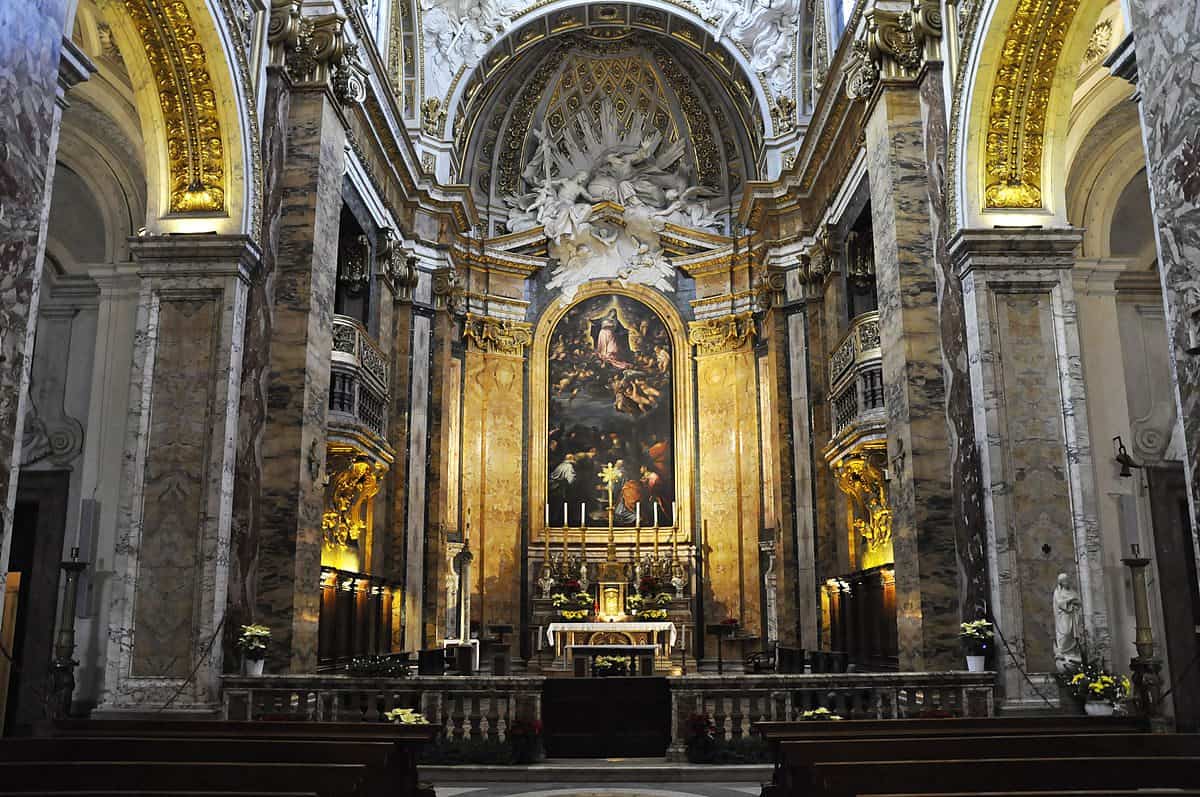
The interior of the Church of San Luigi dei Francesi has three naves. The naves are marked by massive arches separated by pillars, on the sides there are five chapels per side, at the far end a deep presbytery, above an elaborate barrel vault.
There is one fact that changes quite a lot the way you look at the church: the interior you see today is not the one from the 16th century. The encyclopedic sources agree on one point: in the mid-18th century the interior was redone to a design by the French architect Antoine Dérizet. On the dates, however, they don't agree: the Italian entry says the renovation starts in 1749 and the works continue until 1764, the English entry writes that Dérizet restored the interior between 1749 and 1756. The start date is the same in both, 1749, and the end varies between 1756 and 1764 depending on who tells it.
The practical consequence is this, and it is the reason it's worth knowing. When you enter the Church of San Luigi dei Francesi and find that apparatus of polychrome marbles, gilded stuccoes, capitals and panels that seems to shout full Baroque, you are not looking at the church Caravaggio saw. Caravaggio, in 1600, painted for a much more severe church, with less gold on it. His canvases now sit inside a decorative frame that arrived 150 years after him. It is one of the reasons why those canvases, in today's light, seem even blacker and even more out of place: because they are. They are the only things inside that church that don't shine.
The five chapels per side are the structure to start from to find your bearings. The numbering counts from the entrance toward the altar. The two that everyone looks for are the second on the right, which is the chapel with the frescoes of Saint Cecilia, and the last on the left, the fifth, the one closest to the apse, which is the Contarelli Chapel with the Caravaggios. If you remember only this, second on the right and last on the left, you already have 90 percent of the visit in hand.
On the high altar the encyclopedic sources indicate an altarpiece with the Assumption of the Virgin attributed to Francesco Bassano, datable to around 1588. The fact does not come from a catalog entry: consider it an indication to verify on the spot on the label, not a certain fact. The deep presbytery, that you do see with the naked eye: it is the part of the church where the light arrives best, and in the middle hours of the afternoon it is almost the only luminous point of the whole building.
The Chapel of Saint Cecilia and the Frescoes of Domenichino
The second chapel of the right nave of the Church of San Luigi dei Francesi is dedicated to Saint Cecilia and holds the cycle of frescoes with stories from the life of the saint painted by Domenichino, that is, Domenico Zampieri. The Italian and English encyclopedic sources confirm it. The precise date of the frescoes does not come from a verifiable source: the cycle belongs to the mature early 17th century of Domenichino, and the precise figure is given by the label in the chapel.
A note on naming that is useful to anyone who reads more than one guide. The English encyclopedia entry calls this chapel the Polet Chapel, after the name of the French patron, while the Italian entry simply calls it the chapel of Santa Cecilia. It is not a substantial contradiction, it is the same space called in two ways: one after the patron, the other after the dedication. It's good to know, because if you search for Polet chapel in Italian you find nothing, and if you search for Santa Cecilia in English they send you back to the name of the patron.
The Domenichino of this chapel is the reason it's worth entering the Church of San Luigi dei Francesi even if you don't care about the Caravaggios at all. It is painting of the Bolognese school, measured, clear, with the colors kept low and the figures arranged as in a theater: the exact opposite of what stands 20 meters away in the opposite nave. The extraordinary thing is that the two chapels are in the same church, a few steps from each other, and they represent the two opposite roads that Italian painting took at the very same moment. On one side the violent naturalism of Merisi, on the other the Emilian classicism. Anyone who wants to understand the 17th century in 10 minutes enters the Church of San Luigi dei Francesi, looks right, looks left, and has understood.
A piece of advice against the grain: look at the Domenichino first and then the Caravaggios. Everyone does the opposite, they enter, head straight for the Contarelli Chapel, take the blow and then go around the rest of the church with dull eyes. If you do it the other way around, you truly enjoy the chapel of Saint Cecilia, with its light and its colors, and when you then arrive in front of the Calling of Saint Matthew the leap hits you with twice the force. It costs five more minutes. It's worth triple.
The Altarpiece of Saint Cecilia, a Copy by Reni After Raphael
Above the altar of the chapel of Saint Cecilia there is a canvas with Saint Cecilia attributed to Guido Reni. You often read the altarpiece of Saint Cecilia by Guido Reni, and said like that it suggests that it is an original invention of Reni. The Italian and English encyclopedic sources say something else: it is a copy made by Guido Reni of Raphael's Saint Cecilia, that is, of the famous Raphaelesque painting now in the Pinacoteca Nazionale of Bologna. The correct fact is this: the hand is Reni's, the invention is Raphael's.
That it is not a pedant's detail you understand right away. An original by Reni and a copy by Reni after Raphael are two different objects for the history of art, for value, for the meaning of that chapel. And it says something precise about the taste of the patron: whoever paid for that chapel wanted Raphael's Saint Cecilia in their own church, and not being able to have the original had the copy made by the best classicist brush around. It is the same reasoning by which today you buy a high-resolution print of a painting that hangs in a museum on the other side of Europe, only 400 years earlier and with a top-level artist in place of the printer.
A caution is due. The fact rests on encyclopedic entries, Italian and English, that agree with each other, and it is not confirmed by a scholarly catalog entry or by a document of the Soprintendenza. If in the chapel you find a label that says otherwise, the label of the Church of San Luigi dei Francesi prevails.
Something Nobody Tells You About the Church of San Luigi dei Francesi
What nobody tells you is that you enter the Church of San Luigi dei Francesi for free and leave without having paid anything, and that this is the reason there are always too many people inside. It is not a joke. The three most famous canvases by Michelangelo Merisi da Caravaggio still in their original place, that is, not detached, not moved to a museum, not put under glass in an air-conditioned room, can be looked at for free, standing, in a parish church, among people praying and school groups. If the same three canvases were in a museum, the ticket would cost 20 euros, there would be a reservation with a time slot and a two-month line. Not here. Here you enter through the door and you look.
The second thing nobody tells you is that this free admission has a price, and the church pays it. The Church of San Luigi dei Francesi is a living parish, with daily Mass, confessions, baptisms, weddings, a youth group, assistance to the poor: everything the official website lists in the section devoted to the parish. That parish finds thousands of people in its house every day who did not come to pray. And that is why the visiting hours page puts in writing, in kind words, that the church is first of all a place dedicated to prayer. It is a reminder, not a formula.
The third thing nobody tells you concerns the noise. The Church of San Luigi dei Francesi, at peak hours, has a sound level that no museum would tolerate: groups with the guide speaking loudly, phones ringing, children, the light machine clicking. If you go at the wrong time, you look at the Caravaggios inside a din. If you go at the right time, that is, late afternoon on a weekday toward closing, the same chapel is something else. Same paintings, same artificial light, opposite experience. Nobody says so because nobody wants to admit that the moment they arrived was the wrong one.
The Three Caravaggios of the Contarelli Chapel, the Essential Facts
Let's say it openly: nine people out of 10 enter the Church of San Luigi dei Francesi for the three Caravaggios, and the other 10 percent entered by chance and then discovered the three Caravaggios. Here are the essential facts, and for the rest there is the dedicated page, because the long chapter with the painting-by-painting reading is there and it makes no sense to tell it twice.
The Contarelli Chapel is the last chapel of the left nave, the one against the apse. It takes its name from the Italianized form of the French cardinal Matthieu Cointrel, and already here the sources don't agree on the spelling: you find written Mathieu Cointrel, the English encyclopedia entry writes Matthieu Cointerel, and the Italianized name is Matteo Contarelli. They are the same person, only the transcription of the surname changes, and it's good to know, because if you search online for only one spelling you miss half the results.
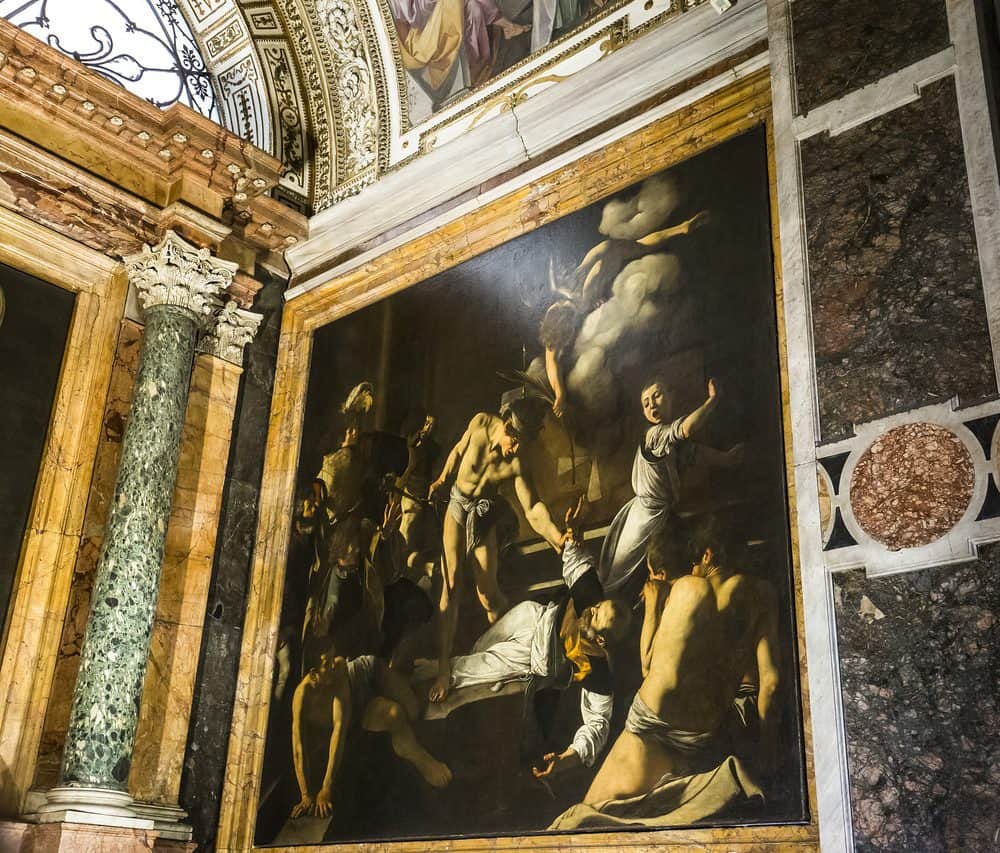
The chronology, reconstructed from the sources, is this. The cardinal buys the chapel in 1565. He dies in 1585, leaving a fund destined for the decoration. The executor entrusts the paintings of the vault to Giuseppe Cesari, called the Cavalier d'Arpino, who completes them by 1593, and entrusts to the Flemish sculptor Jacques Cobaert a marble statue of Saint Matthew with the angel for the altar. The contract with Caravaggio is signed on July 23, 1599. The two large side canvases, the Calling of Saint Matthew and the Martyrdom of Saint Matthew, are recorded as in place by July 1600. The altarpiece with Saint Matthew and the Angel is recorded at its place by 1602. Cobaert's statue was rejected because it represented Matthew without the angel of tradition, and it ended up purchased by the archconfraternity of the Santissima Trinità dei Pellegrini for its own chapel.
The three paintings by Michelangelo Merisi therefore fall between 1599 and 1602, with the frescoes of the Cavalier d'Arpino in the vault. What matters, though, is the internal sequence: the two side canvases arrive in 1600 and the central altarpiece two years later, and so the three canvases were not born together.
There is a much-told story about a first version of Saint Matthew and the Angel that was supposedly rejected and replaced. That episode is not documented in a verifiable way, and so should not be taken as a fact: the only documented rejection is that of Cobaert's statue. If you are looking for the extended treatment, the comparisons between the canvases and the question of the first version, go to the Contarelli Chapel page: it is the page that deals only with that, painting by painting.
The Calling of Saint Matthew works for a technical reason nobody notices: the light Caravaggio painted enters the picture from the same side that the real light enters the chapel. Merisi painted those canvases knowing exactly where they would hang and where the natural light would come from. When the lighting machine switches off and you stay in the dark for a few seconds, look again: in the half-light the Calling reads better than under the spotlights. Try it.
The Other Chapels of the Church of San Luigi dei Francesi
Five chapels per side, 10 in all, and the vast majority of visitors look at two. It's a waste. There is no complete, verified list of the dedication and attribution of each of the other eight: the sources describe in detail only the Santa Cecilia chapel and the Contarelli Chapel, and barely name the others.
What we can say, though, is how to look at them. The chapels of the Church of San Luigi dei Francesi are deep, closed off by gates or barriers, and almost all very dark. Most have an altarpiece, stucco decoration and 18th-century marbles that came with Antoine Dérizet's remodeling. There are funerary monuments against the walls, inscriptions in Latin and French, coats of arms. If you read French you'll have quite a bit of fun: the gravestones tell of a foreign community that in Rome was born, married, made its fortune and died, generation after generation, for four centuries.
The practical advice is to do the full circuit clockwise starting from the right aisle, chapel by chapel, without skipping, and to save the Contarelli Chapel for last. It's 10 minutes more than the hit-and-run visit, and they're the 10 minutes that separate someone who has seen the Church of San Luigi dei Francesi from someone who has seen three paintings inside a building.

The 1881 Merklin Organ Above the Door
On the choir loft above the entrance door of the Church of San Luigi dei Francesi there is an organ built by the French organ builder Joseph Merklin in 1881. The detail is confirmed by the Italian encyclopedia entry, which indicates three manuals and pedalboard and mechanical action. More precise technical details also circulate: three manuals of 56 notes and a pedalboard of 30 notes, with mechanical action and a Barker lever. Those numbers, 56 and 30, and the Barker lever are traditional data, not confirmed by an official source. What is confirmed is the builder, the year, the three manuals with pedalboard and the mechanical action.
Joseph Merklin is not just any name for anyone who knows organs: he is one of the great French builders of the 19th century, the historic rival of Cavaillé-Coll. Having an 1881 Merklin inside the French national church of Rome is perfectly consistent with everything else: the country sent Rome its architects, its painters, its cardinals and its organ builder too. Under a French organ, in a French church, with a French choir singing above it.
The choir still exists and is active. The official site, on the page about the French presence in Rome, says that the choir and orchestra of the Pieux Établissements give regular concerts at the Church of San Luigi dei Francesi and at Trinità dei Monti, under the name Capella Ludovicea. If you happen to be in Rome and find a concert announced in there, go: hearing that organ and that choir in the nave of this church is an experience worth more than any daytime visit with a phone in your hand. For dates and prices, the calendar is on the parish website and in the weekly sheet they publish as a PDF.
My Advice for Visiting the Church of San Luigi dei Francesi
I have only one piece of advice: go at 17:30 on a weekday, not in the morning. The official site's hours say that from Monday to Friday it closes at 18:15, on Saturday and Sunday at 18:30. The last hour is when the organized groups have already left, the tourist buses have finished their round, and inside the Church of San Luigi dei Francesi a third of the people who were there at 11:00 in the morning remain. The natural light at that hour is already scarce and the Contarelli Chapel needs artificial lighting anyway, so you lose nothing. You gain silence, space in front of the canvases and the chance to stand still for two minutes in the same spot without someone pushing you.
Second piece of advice, and this is the one nobody follows. Walk in and look at nothing for a minute. Stand at the back of the central nave, on your feet, and let your eyes get used to the dark. The Church of San Luigi dei Francesi is dark, much darker than you expect when you come in from the square in full sun, and if you go straight to the chapel with your pupils still closed you lose the first 30 seconds in front of Caravaggio, which are the most important. One minute of waiting at the door gives you back the whole picture.
Third piece of advice: bring coins. Not five-euro notes, coins. The chapel lighting in many Roman churches works with tokens or coins, and being left in the dark in front of the Martyrdom of Saint Matthew with only a credit card in your pocket is one of the most frustrating experiences Rome knows how to offer. The exact amount does not appear in any official source, and it changes anyway. A couple of euros in small change keeps you safe.
Fourth piece of advice, a serious one. Don't go to the Church of San Luigi dei Francesi on Sunday morning thinking you'll visit it at leisure. On Sunday the official site opens for visits only from 12:00 to 12:45 and then from 14:30, because in the morning there's the community Mass at 10:30. That 45-minute window at noon on Sunday is the worst time of the week to go in: all the tourism that got the time wrong piles in. If your only day in Rome is Sunday, come at 15:00.
Fifth and last. If you come with a group, even a small one, let them know. The official site says that during opening hours you can ask for guided visits with the priests, and that for private visits outside hours you have to contact the parish, with the pastoral center reachable during the week from 9:00 to 10:00 or from 14:00 to 15:00 and on Thursday afternoon between 14:00 and 19:00. Walking in with 15 people without telling anyone, in a parish church, with the guide talking loudly, is what makes the parish priests of half of Rome angry. And when parish priests get angry, churches close.
The Tombs of Illustrious French People Inside the Church of San Luigi dei Francesi
The Church of San Luigi dei Francesi is also a cemetery, in the sense that quite a few people are buried there, and some of them have a story worth the trip on its own. The encyclopedia sources give five names.
The first name is Pauline de Beaumont. You read that her monument was commissioned by her lover François-René de Chateaubriand, and the sources confirm that Pauline de Beaumont is buried here. Chateaubriand is the writer who invented half of French Romanticism and who lived in Rome as a diplomat: the French high school in Rome still bears his name, and the parish's aumônerie is also called Chateaubriand, as you can read on the official site. A love story gone wrong, in a foreign city, with a funerary monument paid for by a man who couldn't acknowledge her in public. This is the Church of San Luigi dei Francesi, not a museum showcase.
The second name is Cardinal François-Joachim de Pierre de Bernis, in the form used by the English encyclopedia entry: you also find Joachin, with a final n, but that's a typo. You read that he was ambassador of the kings Louis XV and Louis XVI: this is traditional data, not confirmed in these terms by an official source. What is confirmed is that de Bernis was a cardinal and that he is buried in this church.
The third name is Frédéric Bastiat. Bastiat is the 19th-century French liberal economist and writer, the one of the candle makers' petition against the sun, one of the most quoted satirical texts in the history of economic thought. He died in Rome and is buried at the Church of San Luigi dei Francesi. Every now and then, in front of that gravestone, you find someone who has come from halfway around the world who has no idea who Caravaggio is and came only for him.
The encyclopedia sources add two more names: Giuseppe Sisco and Marin Tourlonias. There is no reliable information on who exactly they were: they are two more names to look for on the gravestones.
In a city where everyone runs to photograph the three Caravaggios, the gravestones of the Church of San Luigi dei Francesi are the only place where you see the community that built and used that church. Not the cardinals of the textbooks: the merchants, the doctors, the wives, the chaplains, the diplomats. 200 square meters of floor and walls that tell of four centuries of French people who were born and died in Rome. If you have 10 more minutes, look at the floor and read the inscriptions. You'll feel like you're hearing French being spoken.
Another Well-Known Fact, and Yet Rarely Cited
The well-known fact is that the Church of San Luigi dei Francesi has three Caravaggios. Everybody knows that. What almost nobody cites is the consequence: they are the only Caravaggio canvases in Rome you can see for free, on display, every day, without booking, together with those in two other churches in the center. All the other Roman Caravaggios are in museums, and museums cost money and want a line. The Borghese Gallery wants a reservation with a time slot, Palazzo Barberini wants a ticket, the Doria Pamphilj Gallery too. Churches don't.
This produces a phenomenon well known in Rome and which nobody puts in writing: the Caravaggio day at zero cost. You start from the Church of San Luigi dei Francesi with the three Saint Matthew canvases, walk five minutes to Santa Maria del Popolo for the Cerasi Chapel, and in between you pass through Sant'Agostino. Three churches, seven Caravaggio canvases if you count everything, zero euros in tickets and a few coins for the lights. There is nowhere else in the world where you can do something like this. It doesn't exist, and Romans are so used to it that they forget.
The second well-known but rarely cited fact concerns the patron. Everybody knows that the Caravaggios of the Church of San Luigi dei Francesi are in the Contarelli Chapel. Few connect the fact that Contarelli is the Italian translation of a French surname, Cointrel, and that therefore the most important commission of Caravaggio's early career comes from the French milieu of Rome. The parish's official page says it clearly: in 1600, thanks to his friendships in the pro-French milieu, Merisi obtained the commission for the Calling and the Martyrdom of Saint Matthew. That is: the most Italian Lombard painter there is became Caravaggio thanks to a foreign lobby. Rome has always worked like that.
Third well-known and rarely cited fact. The Church of San Luigi dei Francesi is not dedicated to a Roman saint, or an Italian one, or a martyr of the catacombs. It is dedicated to a king of France who died in 1270 during a crusade at Tunis, Louis IX, canonized 27 years later. In a city full of churches named for martyrs of the first centuries and local saints, this one is named for a foreign medieval sovereign. Anyone who notices understands right away what they are looking at: not a Roman church, but a piece of France built inside Rome.
The Mass in French and Parish Life
The Church of San Luigi dei Francesi is a working parish, and this is the part visitors tend to block out. The celebration times published on the official site are these: Sunday Mass at 10:30. Monday to Friday Mass at 19:00, preceded by vespers at 18:45 except from June to September. Saturday Mass at 12:30. The site's contact page gives the same three times, Sunday 10:30, weekdays 19:00, Saturday 12:30.
Confessions, again according to the official site, during the university year are held on Sunday from 10:00 to 10:30, Monday to Friday from 18:30 to 19:00 and Saturday from 12:00 to 12:30. There is a small discrepancy between two pages of the same site: the home page, in the box of current times, indicated for weekdays confessions from 18:30 to 18:55 and Mass at 18:55, while the celebration times page indicates Mass at 19:00 and confessions until 19:00. It's five minutes of difference and it changes nobody's life, but it is proof of something worth knowing: this parish's times get updated week to week. The site publishes a weekly sheet in PDF format, the feuille hebdomadaire, and that is the document that counts. If you need to go to a particular Mass, open that.
The official site also indicates that the community celebrates some Masses at Saint-Yves-des-Bretons, that is Sant'Ivo dei Bretoni, which is another of the French churches of Rome: on Sunday at 18:30 and on Thursday at 18:30 during the academic year. So be careful: the Sunday evening Mass is not at the Church of San Luigi dei Francesi, it's in another church. It's the kind of detail that gets people to a closed door.
On the language, precision is needed. The official pages give the times but don't explicitly specify the language of each celebration. That the 10:30 Sunday Mass of the French national church of Rome is in French is what anyone expects, and it is consistent with everything else on the site, which is written in French and addressed to the French-speaking community of Rome. But it isn't written explicitly, and so it remains a reasonable expectation and not a verified fact.
If you're in Rome on a Sunday and want to understand what the Church of San Luigi dei Francesi really is, go to the 10:30 Mass instead of the noon visit. You don't need to be a believer and you don't need to understand French. You need to sit for 40 minutes inside a building that for once does the job it was built for, with its people inside, and with the three Caravaggios switched off in the dark of the chapel at the far left. When they then turn on the light, the effect is from another planet compared with what you feel if you came in at 11:00 on a Tuesday morning along with 200 people.

The Right Photo to Take at the Church of San Luigi dei Francesi
The right photo is not the one of the Calling of Saint Matthew. Everybody has taken that one, it always comes out badly because the canvas is high up and at an angle, the reflections of the artificial lighting ruin it, and in any case professional reproductions exist that are better than anything that comes out of your phone. If you really want it, take it and move on, but it isn't the photograph you'll remember.
The right photo at the Church of San Luigi dei Francesi is the facade seen from the start of Via della Dogana Vecchia, at an angle, with the travertine lit from the side and the narrow little square compressing the frame. The best time is late afternoon, when the low sun hits the facade from the side and brings out the reliefs of the pilasters and statues that are flat in the morning. Vertical, not horizontal: the facade is tall and the square is small, and in horizontal half a row of parked scooters ends up in it.
The second right photo is inside, and it's the hardest. It's the central nave seen from the back, from the entrance, with the deep presbytery pulling your gaze to the far end and the dark chapels opening on the sides. You need to rest the phone on something because there's very little light, and you need patience to wait for the frame to empty of people. It works one time out of five. When it works, it's the photograph that tells the story of the Church of San Luigi dei Francesi better than any close-up of a painting: dark, gold, a luminous background far away.
The third photo, the one nobody takes, is the floor. The tomb slabs, the inscriptions worn by footsteps, the lilies and French coats of arms repeated in the marble. You take it from above, standing, without flash, with the phone pointed at the ground. No one will envy you for it on social media and no one will understand what it is. It's the photograph that in 10 years will make you remember having been inside a piece of France inside Rome.
Common-sense rules: no flash, ever, and not only for the paintings, also out of respect for those who are praying. No tripods, which in a crowded parish church are a hazard and an intrusion. No filming during services. And if a sacristan tells you to stop, you stop without arguing: the visiting hours page of the Church of San Luigi dei Francesi reminds you that this is first of all a place of prayer, and whoever reminds you in writing has every right to enforce it.
Some Important Events That Took Place Here in History
The first event is the start of construction in 1518, at the will of Cardinal Giulio de' Medici. It's not just any date: it's one year after Luther's theses, in the full era of Leo X, with Rome at the peak of its Renaissance ambition. The French national church was born in that climate, and nine years later the Sack of Rome of 1527 would sweep over the city and bring to its knees that very Giulio de' Medici who had meanwhile become Pope Clement VII. The construction of the Church of San Luigi dei Francesi goes through all of this.
The second event is the consecration on October 8, 1589, celebrated by Cardinal François de Joyeuse, protector of France at the Holy See, according to the English encyclopedia entry. This too is a heavy date: in the summer of 1589 Henry III, the last of the Valois, had been assassinated, and France was in the midst of a war of succession with the Huguenot Henry of Navarre claiming the throne. Consecrating the French national church of Rome, dedicated to a saintly king, at that moment was not a neutral devotional act. It was a declaration.
The third event is the Contarelli commission and the arrival of Caravaggio. Cardinal Matthieu Cointrel buys the chapel in 1565 and dies in 1585 leaving the money to decorate it. The Cavalier d'Arpino finishes the vault by 1593. The contract with Caravaggio is dated July 23, 1599, the two side canvases are in place by July 1600, the altarpiece by 1602. In those three years, inside the Church of San Luigi dei Francesi, European painting changes direction. It's not an emphatic figure of speech: anyone who saw the Calling of Saint Matthew in 1600 understood that you could paint in another way, and within 20 years half of Europe was painting that way.
The fourth event is the 18th-century remodeling. In 1749 Antoine Dérizet's project starts, and the work continues until 1756 according to the English entry, until 1764 according to the Italian one. This is the moment when the Church of San Luigi dei Francesi takes the look it has today inside. Whenever someone says that inside is the church that saw Caravaggio, they are saying something imprecise: inside is the church remodeled 150 years after him, with his canvases left in their place.
The fifth event has no date and you won't find it in any list: it's the fact that those three canvases are still there. In four centuries Rome's works of art were requisitioned by the French during the Napoleonic occupation, sold, moved to museums, taken to the Vatican, moved for safety during the wars. The three Caravaggios of the Church of San Luigi dei Francesi have never left the chapel they were painted for. For a painting from 1600, this is almost a statistical miracle.
Who Has Passed Through the Church of San Luigi dei Francesi
Michelangelo Merisi da Caravaggio passed through, obviously, and not as a tourist: he worked inside, with scaffolding, between 1599 and 1602, at about 30 years old, staking his career on a public commission that was his first big chance. The parish's official page says he obtained that commission thanks to his friendships in the pro-French milieu of Rome.
Giuseppe Cesari, known as the Cavalier d'Arpino, passed through. In the same chapel he had painted the vault by 1593 and he had been Caravaggio's employer when Merisi, just arrived in Rome, painted flowers and fruit in his workshop. Imagine the two of them, a few years apart, inside the same space: first the established master on the vault, then the workshop boy turned painter on the walls. And guess who people remember today.
Domenichino, Domenico Zampieri, passed through, for the frescoes of the Santa Cecilia chapel, and Guido Reni for the altarpiece that copies Raphael's Saint Cecilia. Two Bolognese inside the church of the French, a few meters from the most scandalous Lombard in the city.
The architects passed through: Giacomo della Porta for the design, Domenico Fontana for the execution, Antoine Dérizet for the 18th-century remodeling of the interiors. Three generations, two countries, one building.
François-René de Chateaubriand passed through, who lived in Rome as a diplomat and who had the monument to Pauline de Beaumont erected here. Cardinal François-Joachim de Pierre de Bernis and the economist Frédéric Bastiat passed through, and stayed. Cardinal François de Joyeuse passed through for the consecration in 1589. And the French of Rome passed through, and still do: the students of the Chateaubriand high school, the seminarians of the French Pontifical Seminary founded in 1853, the regulars of the Centre Saint-Louis founded in 1945 by Jacques Maritain, the members of Rome Accueil, born in 1986, all institutions listed on the parish's official site.
Finally, every year a few million people pass through who know nothing of all this and walk in just for 11 minutes of Caravaggio. No judgment: the hope is that they come back afterward.
At the Church of San Luigi dei Francesi With Kids
With kids the Church of San Luigi dei Francesi works better than you imagine, on one condition: that you don't try to explain art history to them. They don't care about the Contarelli Chapel, naturalism and raking light. What they care about is that it's dark, that there's a machine that turns on the light with a coin, and that on the walls there are swords, severed heads and people on the ground.
The trick that works is turning the Martyrdom of Saint Matthew into a hunt for details. Who's the kid running away screaming. Who's the man with the sword in his hand. Where's the bearded old man looking from behind. In the Calling, who's the figure counting the money on the table who hasn't yet understood what's happening. They're kids' questions and they are also exactly the right questions, the ones art historians ask. An eight-year-old in front of those canvases, if you let him look instead of explaining, stays a good 10 minutes.
The practical things. The visit is short, there are no monumental stairs to climb, no ticket office, no line with a reservation. The floor is smooth and a stroller fits in with no problem. There are no public restrooms inside the church and don't count on it: the nearest bar is in the square or on Via della Dogana Vecchia, and in the center you use the restroom by buying something. There's no coat check, no luggage storage, none of the apparatus of a museum, because it's not a museum.
One rule of conduct that matters more than the others. If the child cries or yells, you go out. Not out of bigotry, but because inside the Church of San Luigi dei Francesi there's almost always someone who is really praying, and because noise in that nave bounces around like inside a drum. You step out to the square, calm down, go back in. It's five minutes and it saves you the looks of half the church.
Accessibility of the Church of San Luigi dei Francesi
On the accessibility of the Church of San Luigi dei Francesi there is no official information. The Ministry of Culture's page reports nothing specific on services and accessibility for people with disabilities, and the parish website has no dedicated section. The information is not published, and the only serious way to find out is to call 06 688271 before leaving.
From what you can see on site, without certified data, the main entrance of the Church of San Luigi dei Francesi faces the square with a few steps, like practically all the Roman churches of that era, and the interior once you're inside is flat, with no level changes between the aisles and the chapels. Anyone in a wheelchair should check in advance whether there is an alternative access. Don't trust map apps for this kind of information: on Roman churches they are almost always wrong.
Another thing to factor in is the lighting. The Church of San Luigi dei Francesi is very dark, and for people with vision problems reading inscriptions, labels and steps takes attention. If you come with an elderly person, hold them by the arm for the first meters after the entrance, which is the point where the eye hasn't adjusted yet and the ancient marble floor is uneven.
How Long a Visit to the Church of San Luigi dei Francesi Takes
The minimum visit, the one most tourists do, takes 11 minutes: you walk in, go to the chapel at the far left, wait your turn in front of the Caravaggios, look for the length of two light activations, and leave. It's not a visit, it's a stamp.
The right visit lasts between 40 and 50 minutes and is organized like this. Five minutes at the back of the nave to get your eyes used to it and take in the whole. 10 minutes on the right aisle, chapel by chapel, with the second on the right, the Santa Cecilia one, worth half the time by itself. Five minutes on the presbytery and the high altar. 10 minutes on the left aisle heading back toward the entrance, skipping for now the last chapel. Then the Contarelli Chapel, with no time limit: as long as you want to stay, you stay, and it's normal for it to be 20 minutes. Finish with five minutes on the floor and the gravestones, and a look at the organ above the door before leaving.
If you have time for only one thing in Rome, the Church of San Luigi dei Francesi is not that thing: go to Saint Peter's, go to the Pantheon, go to the Colosseum. But if you have three days and you're walking between Piazza Navona and the Pantheon anyway, not going in here is an unjustifiable mistake: it's 40 minutes, it costs nothing, and there are three paintings that changed European painting.
When to Go to the Church of San Luigi dei Francesi and When to Avoid It
To avoid: 11:00 in the morning on any day from March to October. It's the time when organized groups arrive en bloc after the tour of Piazza Navona, and inside the Church of San Luigi dei Francesi you wait in line to look. Also avoid the Sunday noon window, which lasts only 45 minutes according to the official site, from 12:00 to 12:45, and which concentrates into a tiny window of time all the people who couldn't get in in the morning.
To avoid, obviously, the morning of the first Wednesday of the month, because the church is closed and the official site says so. If your trip to Rome falls then, move the Church of San Luigi dei Francesi to the afternoon, from 14:30 on, and do something else in the morning.
To prefer: the last hour before closing on a weekday, so around 17:15 or 17:30 knowing that it closes at 18:15. Also to prefer Saturday afternoon from 16:00 on, since it closes at 18:30 and is quieter in the early afternoon than you'd expect. To prefer, if you're there in November, January or February, any time: in the dead months of Roman tourism the Church of San Luigi dei Francesi goes back to being a neighborhood church with three masterpieces inside, and you can be in it the way it should be done.
A seasonal tip that holds for this whole area. On July and August afternoons, when the center of Rome becomes a red-hot griddle, churches are the coolest and the freest place in the city. The Church of San Luigi dei Francesi, with its thick walls and its half-light, is quite a few degrees cooler inside than the square. Romans have always known this. Going in for the cool and coming out half an hour later having seen three Caravaggios is the best deal available in August in Rome.
What's Around the Church of San Luigi dei Francesi Within a 10-Minute Walk
This is the piece of Rome with the highest density of things to see per square meter, and from the door of the Church of San Luigi dei Francesi you don't need to take anything: you walk.
Two minutes away is Piazza Navona, with Bernini's Fountain of the Four Rivers and Sant'Agnese in Agone. Under Piazza Navona are the remains of the Stadium of Domitian, which you visit in the underground and which explain why the square has that elongated shape: it's the plan of a first-century stadium.
Three minutes away is Palazzo Madama, seat of the Senate of the Republic, which borders the church. Five minutes away is the Pantheon, and behind the Pantheon the Basilica of Santa Maria sopra Minerva, the only Gothic church in Rome, with Michelangelo's Christ and the tomb of Saint Catherine of Siena.
Five minutes away, on the other side of Corso del Rinascimento, is the Sant'Ivo alla Sapienza Church by Borromini, with that spiral dome that is one of the freest inventions of Roman Baroque. Eight minutes away is Palazzo Altemps, one of the four sites of the National Roman Museum, with the Ludovisi collection.
At 10 minutes you reach Campo de' Fiori, the Museum of Rome at Palazzo Braschi, the Doria Pamphilj Gallery and Largo Argentina with the Republican sacred area. In the opposite direction, toward Via del Corso, you reach the Basilica of San Lorenzo in Lucina and Sant'Ignazio di Loyola Church, the one with Father Pozzo's painted fake dome. Another quarter of an hour and you're at the Basilica of San Giovanni Battista dei Fiorentini, which pairs with the church of the French: it's the national church of the Florentines.
If you want an itinerary that ties things together, also look at the page on the tourist attractions of Rome. A tip for this area is to do a tour of the national churches: the Church of San Luigi dei Francesi for France, San Giovanni dei Fiorentini for Florence, and as you go you discover how many others there are. It's a way of reading the Historic Center that you won't find in any generalist guide, and that makes you understand Rome much better than a line in front of the Trevi Fountain.
How Much It Costs to Visit the Church of San Luigi dei Francesi
Zero. Entrance to the Church of San Luigi dei Francesi is free and no ticket is needed, and the parish itself writes this on the visiting hours page. The Ministry of Culture's page confirms that reservation is not required. There are no discounted tickets because there are no tickets, there are no reduced rates, there's no free first Sunday of the month for the simple reason that it's free every day.
The only possible expenses are two and both are voluntary. The first is the coin for the chapel lighting, the amount of which does not appear in any official source. The second is the offering: there's a box, and that church lives on offerings and on the support of the French body that administers it. Someone who walks in free to see three Caravaggios and doesn't leave two euros in the box is doing a petty thing. It's not an obligation. It's a matter of manners.
A warning of the kind that really saves money. Be wary of paid guided tours sold in the square that promise access to the Caravaggios of San Luigi dei Francesi as if it were a privileged entrance. Entry is free for everyone, there is no skip-the-line, there is no priority ticket. If you pay for a guide, you're paying for the guide, and that's perfectly fine if the guide is good. But nobody is selling you an access you couldn't get for free by walking to the door.
Quick Questions About the Church of San Luigi dei Francesi
How much does it cost to enter the Church of San Luigi dei Francesi?
Nothing. Entry is free and no ticket is needed. The parish writes it on the visiting hours page: it's a church, so entry is not paid, no ticket is required. The only possible expense is the coin to turn on the chapel light, which is voluntary.
What are the hours of the Church of San Luigi dei Francesi?
According to the parish's official site: Monday-Friday 9:30-12:45 and 14:30-18:15, Saturday 9:30-12:00 and 14:30-18:30, Sunday 12:00-12:45 and 14:30-18:30. The Ministry of Culture's page instead indicates 10:00-19:00 with Thursday closed. The two sources don't agree: call 06 688271 if you have only one chance.
Is the Church of San Luigi dei Francesi closed some days?
The official site notes only one recurring closure: the morning of every first Wednesday of the month. The ministry page instead indicates Thursday as the closing day. Here too the sources diverge.
Do you need to book to visit the Church of San Luigi dei Francesi?
No. The Ministry of Culture's page says explicitly that reservation is not required, and the parish site confirms that no ticket is needed. Reservation is only needed if you want a guided visit with the priests or a private visit outside opening hours.
How many Caravaggios are there at the Church of San Luigi dei Francesi?
Three, all in the Contarelli Chapel: the Calling of Saint Matthew, the Martyrdom of Saint Matthew and Saint Matthew and the Angel. The two side canvases are recorded in place by July 1600, the altarpiece by 1602. For the extended treatment there is the page dedicated to the Contarelli Chapel.
Where exactly is the Contarelli Chapel inside the church?
It's the last chapel of the left aisle, the fifth counting from the entrance, the one against the apse. Entering from the main door, keep left and walk all the way to the back.
Can you take photographs at the Church of San Luigi dei Francesi?
No ban on photography is published on the official site, and in practice people take photos. Flash is never used, though, tripods are not used, and during services you don't take photos. The visiting hours page reminds you that the church is first of all a place dedicated to prayer.
How long does a visit to the Church of San Luigi dei Francesi take?
10 minutes if you look only at the Caravaggios, 40 or 50 minutes if you do the whole church, chapel by chapel, with the presbytery and the floor gravestones. The advice is to allow three quarters of an hour.
Is the Church of San Luigi dei Francesi wheelchair accessible?
The information is not published. The Ministry of Culture's page reports no information on accessibility, and the parish site has no dedicated page. The only serious way to find out is to call 06 688271. The interior, once inside, is flat.
Is there a coat check or luggage storage?
No. It's not a museum: there is no coat check, luggage storage, ticket office, bookshop or restrooms available to visitors. If you have suitcases, this isn't the place to bring them.
How long is the wait in line at the Church of San Luigi dei Francesi?
There's usually no line outside the door, because there's no ticket check. The line is inside, in front of the Contarelli Chapel, and at peak hours it can mean 10 or 15 minutes of waiting on your feet. Go in the last hour before closing and the line almost doesn't exist.
Is the Church of San Luigi dei Francesi suitable for kids?
Yes, as long as you don't give them an art history lesson. It works like a hunt for details inside the paintings: who's running away, who has the sword, who's counting the coins. The stroller fits, the floor is smooth, the visit is short.
Who built the Church of San Luigi dei Francesi?
Construction starts in 1518 at the will of Cardinal Giulio de' Medici, future Pope Clement VII, with the later contribution of Catherine de' Medici. The facade is to a design by Giacomo della Porta, the execution is by Domenico Fontana. The consecration is on October 8, 1589, at the hands of Cardinal François de Joyeuse.
Why is it called the Church of San Luigi dei Francesi?
Because it is the national church of the French in Rome and is dedicated to Louis IX of France, the crusader king who died in 1270 and was canonized a few decades later. The Ministry of Culture's page defines it as the national church of the French in Rome since 1589.
Who runs the Church of San Luigi dei Francesi today?
The parish, with a community of priests led by a rector, within the assets administered by the Pieux Établissements de la France à Rome et Lorette. The official site reports it, in the pages dedicated to the parish and to the French presence in Rome.
What time is Mass at the Church of San Luigi dei Francesi?
According to the official site: Sunday at 10:30, Monday to Friday at 19:00 with vespers at 18:45 except for the June-September period, Saturday at 12:30. Times can change week to week: the parish publishes a weekly sheet in PDF and that is what counts.
Is the Mass in French?
It's what you'd expect from the French national church of Rome, but the official pages indicate the times without specifying the language of each celebration. So it remains a reasonable expectation, not a verified fact.
Are there confessions?
Yes. The official site, for the university year, indicates confessions on Sunday from 10:00 to 10:30, Monday to Friday from 18:30 to 19:00 and Saturday from 12:00 to 12:30. The home page of the same site reported a slightly different window for weekdays, 18:30-18:55: it's five minutes of difference between two pages.
Who is buried at the Church of San Luigi dei Francesi?
Among others Pauline de Beaumont, Cardinal François-Joachim de Pierre de Bernis and the economist Frédéric Bastiat. The encyclopedia sources add the names of Giuseppe Sisco and Marin Tourlonias.
What is in the Santa Cecilia chapel?
The frescoes with stories from the life of the saint painted by Domenichino and, on the altar, a Saint Cecilia which according to the encyclopedia sources is a copy made by Guido Reni from Raphael's painting. It's the second chapel of the right aisle. The English encyclopedia entry calls it Polet Chapel, after the name of the patron.
What is the organ of the Church of San Luigi dei Francesi like?
It's on the choir loft above the entrance door and was built by the French organ builder Joseph Merklin in 1881, with three manuals and pedalboard and mechanical action. The technical details that circulate, 56 notes per manual, 30 pedalboard notes and Barker lever, are traditional data not confirmed by an official source.
How do you get to the Church of San Luigi dei Francesi by public transit?
The subway doesn't reach this area. The surface lines serving Corso del Rinascimento change often: the route calculator is on the Roma Servizi per la Mobilità portal and the number is 06.57003, active according to the site Monday to Friday from 8:00 to 18:00. In practice you get there on foot from Piazza Navona in two minutes and from the Pantheon in five.
Is it free to enter on the first Sunday of the month?
The question doesn't arise here: the free first Sunday concerns state museums. At the Church of San Luigi dei Francesi you get in free every day it's open, first Sunday included.
What is the difference between the Church of San Luigi dei Francesi and the Contarelli Chapel?
The Contarelli Chapel is one of the 10 chapels inside the Church of San Luigi dei Francesi, the last of the left aisle, and it's the one that contains the three Caravaggios. They are not two different places and you pay nothing to go from one to the other: you walk 20 meters. On this site the Contarelli Chapel has its own page because the material on those three paintings is so much that it deserves a whole page.
Is it worth going if I have little time in Rome?
If you have only one day, no: Saint Peter's, the Colosseum and the Pantheon come first. If you have three and you're walking in that area anyway, yes, no discussion. It's 40 free minutes for three paintings that changed European painting, and the church is right in the middle of the road you take anyway.
Can I see other Caravaggios for free near the Church of San Luigi dei Francesi?
Yes, and it's the best thing about this city. A few minutes on foot away is Sant'Agostino, and about 15 minutes away Santa Maria del Popolo with the Cerasi Chapel. Three churches, free entry, and a group of Merisi canvases that no museum in the world can put together.
Is the Church of San Luigi dei Francesi the same thing as Sant'Andrea della Valle?
No, but there is a curious historical link: the encyclopedia sources say that the French community of Rome had a chapel in the area of Sant'Andrea della Valle and that toward the end of the 15th century it swapped it for assets of the Abbey of Farfa to be able to build itself a bigger church. That bigger church is the Church of San Luigi dei Francesi.
Is there a museum inside the Church of San Luigi dei Francesi?
The official site, in the multimedia section, shows photographs of a museum and specifies in parentheses that it is not open to visits. So it exists, but you can't go in.
Are there concerts at the Church of San Luigi dei Francesi?
Yes. The official site says that the choir and orchestra of the Pieux Établissements give regular concerts here and at Trinità dei Monti under the name Capella Ludovicea. For dates and prices, the calendar is on the parish website.