Basilica of San Giovanni Battista dei Fiorentini
In short. The Basilica of San Giovanni Battista dei Fiorentini is at Via Acciaioli 2, 00186 Rome, in the Ponte district, exactly where Via Giulia begins and where the Tiber makes its bend before Ponte Vittorio Emanuele II.
The Basilica of San Giovanni Battista dei Fiorentini is at Via Acciaioli 2, 00186 Rome, in the Ponte district, exactly where Via Giulia begins and where the Tiber makes its bend before Ponte Vittorio Emanuele II. Entrance to the basilica is free, you don't pay a ticket and you don't need to book: it is a living parish church, not a paid museum. The parish phone number is 06 68892059 and the official website is sangiovannibattistadeifiorentini.it. There is a problem with the hours: the official sources don't say the same thing. The "Mass Schedule" page of the parish website says, from October 1 to June 1, opening at 7:00 and 16:00 with closing at 12:00 and 18:00 on weekdays, and opening at 8:30 and 17:30 with closing at 13:00 and 19:45 on Sundays and holidays. The "La Parrocchia Oggi" page of the same site, instead, for the same period gives weekdays 7:30-12:00 and 17:00-18:45, Sundays and holidays 8:30-13:30 and 17:00-19:00. And turismoroma.it, the official tourism portal of Rome, gives a third schedule: winter Monday-Friday 8:30-11:30 and 17:30-19:00, Sundays and holidays 8:30-13:00 and 17:30-19:00, summer July-August Monday-Friday 8:30-12:00 and 17:00-19:00, Sundays and holidays 8:30-13:00 and 17:30-20:00. Three sources, three schedules. The common denominator is morning until noon and afternoon from 17 to 19, which means that in the middle of the afternoon the basilica is almost always closed, and that if you have only one attempt it's best to call 06 68892059 the same day. The annexed Museum of Sacred Art, the one with the San Giovannino and the busts by Bernini, is listed as temporarily closed according to the museum page on the parish website, so don't count on it. To get there: ATAC line 23 passes right under the apse, on Lungotevere dei Sangallo and Lungotevere dei Fiorentini, as shown by the full route of the line. The nearest subway is line A, stops Lepanto and Ottaviano, but both are across the Tiber and you have a good quarter of an hour on foot, so it's not the clever solution. If you are walking around the center, the basilica is five minutes on foot from Castel Sant'Angelo and 10 from Piazza Navona. Anyone who wants to understand which neighborhood it is in can start from Campo de' Fiori and go up the whole length of Via Giulia.

Where exactly the Basilica of San Giovanni Battista dei Fiorentini is
You often read that the Basilica of San Giovanni Battista dei Fiorentini "is located on Lungotevere San Gallo", and it is the kind of mistake that sends people the wrong way: the riverside road is called Lungotevere dei Sangallo, in one word, and it appears under that name in the official list of the streets of the parish territory published by the parish itself. But above all: on the riverside road it is the apse that faces, that is, the back of the church, not the entrance. The real entrance is on the other side, at Via Acciaioli 2, which opens onto Piazza dell'Oro. Whoever arrives along the river and looks for the door on the riverside road goes around in circles. The right way to approach the Basilica of San Giovanni Battista dei Fiorentini is to come from Corso Vittorio Emanuele II, turn into Via Paola or come down from Largo dei Fiorentini, and find the travertine facade in front of you, at the start of Via Giulia. From there the Renaissance street starts straight as a ruler and goes on for a kilometer to Ponte Sisto. The territory of the parish, which the parish itself lists street by street, says well where we are: Via Giulia, Via dei Banchi Nuovi, Via dei Banchi Vecchi, Via del Banco di Santo Spirito, Via Paola, Via di Monte Giordano, Piazza dell'Orologio, Piazza di Ponte Sant'Angelo, Via del Gonfalone, Via degli Orsini, Piazza Sforza Cesarini, Corso Vittorio Emanuele II. If you know these names you already know you are in one of the densest pieces of 16th-century Rome.
How to really get there, without inventing lines
On transport, better a little that is true than a lot that is approximate, because in Rome the surface lines change faster than websites manage to update. According to the official route, line 23, which runs Pincherle/Parravano-Piazzale Clodio, passes along Lungotevere dei Sangallo and Lungotevere dei Fiorentini, that is, literally behind the Basilica of San Giovanni Battista dei Fiorentini, and then takes Ponte Vittorio Emanuele II toward the Vatican. That is the good line, and if you arrive from Ostiense, Testaccio, the Aventine or Lungotevere Aventino it is also the most convenient by far. On line 280, which several guides give as useful for this area, there is a doubt: the list of stops includes neither Lungotevere dei Sangallo nor Lungotevere dei Fiorentini, and shows instead a route on the other bank, toward Lungotevere Sassia. So it is not a line to take for granted: if your itinerary depends on the 280, check the ATAC app the same day. Corso Vittorio Emanuele II, which passes right next to it and is inside the parish territory, is the axis along which most of the surface lines of the historic center run: you get off there almost wherever you come from, but check the exact numbers on the app, because not all of them are confirmed by an official source. The metro, as said, is no use here: line A with Lepanto and Ottaviano is across the river, and line B doesn't come anywhere near. On foot, on the other hand, everything is very close: 10 minutes from Sant'Andrea della Valle, a quarter of an hour from the Pantheon, a good 20 minutes from St. Peter's via Ponte Vittorio.
A curiosity about the Basilica of San Giovanni Battista dei Fiorentini
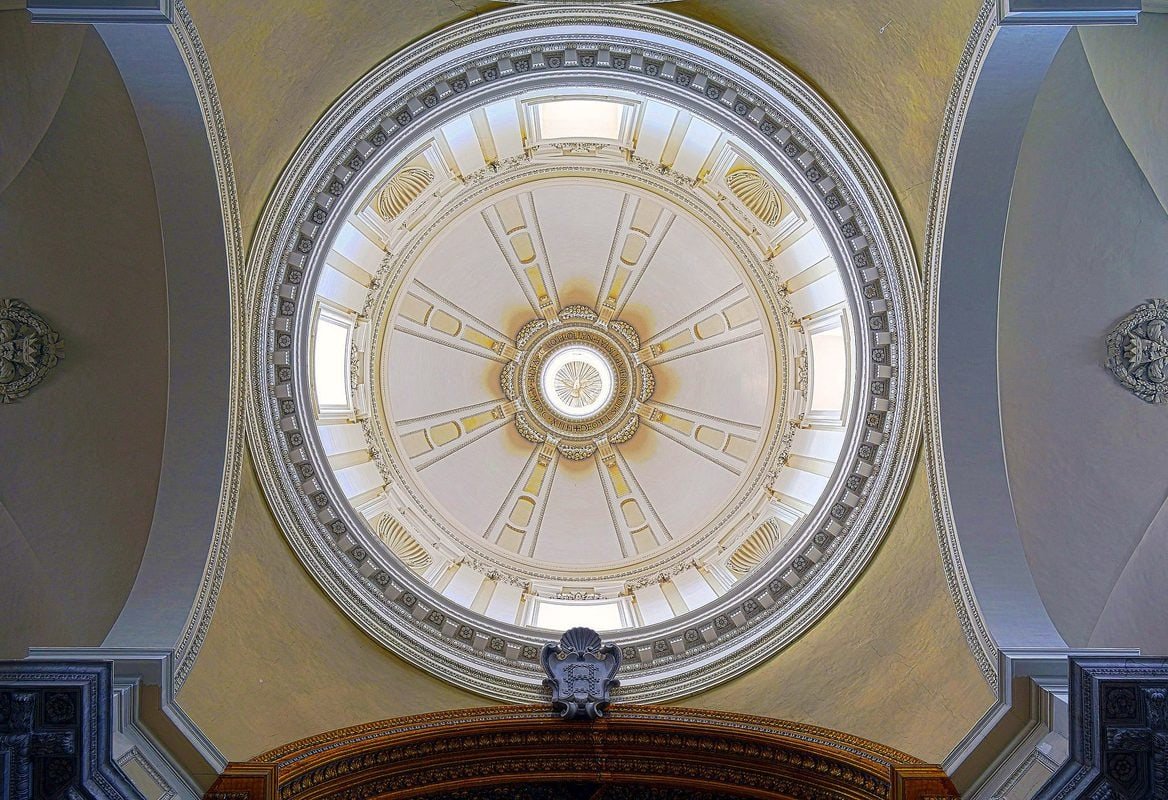
This church's dome has a Roman nickname that says everything about the relationship between Romans and Florentines: they called it "the sucked candy." It isn't a joke invented by a blog, it is reported by both the parish's official website and turismoroma.it. The reason is the shape: Carlo Maderno's dome is tall, narrow, elongated, rests on an octagonal drum in rustic Tuscan rustication and is slightly elliptical instead of hemispherical. Seen from Ponte Vittorio or from Lungotevere it really does look like a worn-down candy, thinned by use. The Romans of the 1600s, who had just watched the round, full domes of half the city go up, found this tapered profile in front of them and made fun of it. The good part is that the nickname survived four centuries and the designer did not: everyone talks about the dome, almost no one about Maderno, and his tomb is there below. In our judgment that profile is the most beautiful thing on the skyline of this stretch of the Tiber, because it is the only Roman dome you recognize at a glance without having to read the sign. Look at it from the bridge, not from the churchyard, and you'll see why.
Why the Florentines in Rome wanted a church of their own
You have to start from something that seems strange today: in the Rome of the 1400s and 1500s, foreign and outsider communities each had their own national church, their own hospital, their own confraternity and often their own cemetery. The French had San Luigi dei Francesi, and the Spanish, the Germans, the Lombards and the Sienese had theirs. And the Florentines, who were a great many in Rome and above all counted for a great deal, because they were the bankers of the Curia, needed theirs. The parish website tells the origin: in 1508 Pope Julius II decided to demolish the small oratory of Sant'Orsola della Pietà on the bank of the Tiber, which was the seat of the Archconfraternity of the Pietà of the Florentine nationals, founded in 1448 to help fellow countrymen struck by the plague, and to build in its place the church of San Giovanni dei Fiorentini, entrusting its realization to Donato Bramante. Note the date: 1448, that is, the confraternity had existed for 60 years before anyone thought of the big church. It is not a papal whim dropped from above, it is a community that had already given itself a welfare organization and that at a certain point demands a building worthy of it. The dedication to Saint John the Baptist is no accident: he is the patron of Florence, the one of the Baptistery, the one of the gold florin. Planting that name in Rome, at the mouth of the new street the pope wanted, was a political statement even before a devotional one. And indeed the Basilica of San Giovanni Battista dei Fiorentini remained for five centuries the reference point of the Florentines in Rome, with the palace of the Florentine Consulate right next to it, as turismoroma.it recalls.
The competition of the 1500s: who really took part
Here the official sources do not agree. The parish website writes that after the death of Julius II it was Leo X, Giovanni de' Medici, who called a competition "in which all the leading architects present in Rome took part: Raphael, Baldassarre Peruzzi, Jacopo Sansovino and Antonio da Sangallo the Younger". Turismoroma.it dates the competition to 1518 and lists as participants Raphael, Michelangelo and Baldassarre Peruzzi, with Jacopo Sansovino winning. The Vatican portal of the 2025 Jubilee, which has a page dedicated to this church, cites among the masters who worked on it Donato Bramante, Raphael Sanzio, Giuliano da Sangallo and Giacomo della Porta, so it names Giuliano and not Antonio da Sangallo. To recap: on the winner everyone agrees, it is Jacopo Sansovino. On who was in the competition, no: Michelangelo appears in only one source, Sangallo changes first name depending on the source, and the date of 1518 is given only by turismoroma. What can be said without forcing anything is that the competition for the Basilica of San Giovanni Battista dei Fiorentini gathered in the 1510s the absolute first rank of Italian architecture, and that a Florentine won. If someone tells you the precise list of competitors as if it were an undisputed fact, know that it isn't.
Sansovino, the Tiber and the construction site that wouldn't stand up
The technical problem of this church is only one, and it is the river. The Basilica of San Giovanni Battista dei Fiorentini was conceived with the apse area inside the bed of the Tiber, or in any case at water level, in a strip of ground that is sand and silt, not tuff. Sansovino begins construction in 1519 on a central plan, and almost immediately crashes against that fact: to keep the apse standing, enormous substructures were needed, that is, gigantic masonry foundations sunk in wet sand, and every meter of that work cost a fortune without anything showing above ground. The construction site bogs down. On why Sansovino leaves, the sources diverge in an interesting way: the parish website writes that he abandoned the site "following a fall from the scaffolding or because of a shortfall in papal funding", putting the two versions as alternatives. Elsewhere you often read that the cause was the second, with "some suspicions about the real use of the funds". But the fall and the shortfall live together in the same sentence of the official source, so the financial suspicion cannot be presented as an established fact. The real lesson is another: in this city, when the project challenges the river, the river wins on points and the project takes a century to get back up. Here it took exactly a century.
Antonio da Sangallo the Younger and the substructures in the sand
After Sansovino, Antonio da Sangallo the Younger takes over, and this is the smartest choice of the whole story. Sangallo was not the most refined draftsman of his generation, but he was by far the best at making things stand: he came from military fortifications, where if you get a calculation wrong they don't criticize you, a curtain wall collapses on you. Sangallo had proven his technical skills in military constructions and brilliantly solved the problem of the substructures. The specialist wiki on the churches of Rome specifies that Sangallo the Younger oversaw the site from 1523 and worked on it until his death in 1546: 23 years. 23 years to secure the foundations of a church and not see it finished. His project aimed to hold together the central plan wanted by the first designs and the longitudinal layout that a real parish church needed, with the nave for the faithful. It is the compromise you'll find, 50 years later, in Giacomo della Porta's solution. When you enter the Basilica of San Giovanni Battista dei Fiorentini and walk toward the altar, what holds up the floor under your feet toward the apse is, in essence, the invisible work of this man. Nobody photographs it. That's the trade.
Michelangelo's five drawings and Tiberio Calcagni's model
In the middle of this story there is an episode worth the trip by itself, and it is the involvement of Michelangelo Buonarroti. The specialist wiki dates it to 1559 and speaks of five Greek-cross schemes, never built, which Michelangelo entrusted to his pupil Tiberio Calcagni. From the same five drawings Calcagni made a wooden model, reproduced several times. The Michelangelo of 1559 is an 84-year-old man who is already working on St. Peter's. Imagine what it would have been: a central-plan church, Michelangelesque, planted on the Tiber at the start of Via Giulia, a kilometer as the crow flies from the dome of St. Peter's. Nothing came of it, for the usual reasons, that is, money and time. But the drawings exist and so does Calcagni's model, and that is why the Basilica of San Giovanni Battista dei Fiorentini appears in every textbook of Renaissance architectural history even though the building you see is by none of the great names who tried. It is a church made of failed projects by very famous people and of a successful project by less famous people. In our opinion it is the most beautiful thing about this place: here the one who finishes wins, not the one who draws best.
The Fabrica of the Florentines and the Fabrica of St. Peter's
A point that deserves telling: the Fabrica of San Giovanni de' Fiorentini proceeded for decades in parallel with the Fabrica of St. Peter's, in themes, in problems and in projects, even coming to copy its decorative schemes. It is not a marginal curiosity, it is the key to understanding why this church seems larger and more solemn than a national church would have needed to be. The two works shared workers, master builders, stonecutters, travertine suppliers and above all architects: Sangallo the Younger, Giacomo della Porta and Carlo Maderno all three worked both here and in the Vatican. Maderno, in particular, is the man of the facade and of the extension of St. Peter's, and here he signs the dome. Whoever visits St. Peter's and then walks down over Ponte Vittorio to Via Giulia, in 20 minutes, is in effect retracing the daily route of those workers. Practical advice: do it in this order, first St. Peter's and then the Fiorentini, and not the other way around, because the scale will seem sensible instead of disappointing. The reverse spoils the second of the two.
Giacomo della Porta and the church you see today
The building you enter is, in substance, the one laid out by Giacomo della Porta. The parish website writes that "from 1583 to 1602 Giacomo della Porta worked on it, resumed the works and in 1592 completed the central nave". The specialist wiki says he resumed the site in 1584 on a Latin-cross plan. Here too, a one-year gap between the sources: 1583 or 1584. A minimal difference, but the difference between a checked fact and a copied fact lies exactly in these trifles. Della Porta lays out a basilica-plan church with three aisles on arched pillars and five chapels per side, with three apsed conches, crossing and dome: five chapels on the right and five on the left make the 10 side chapels that turismoroma.it cites as the home of the funerary monuments of the greatest Baroque sculptors. When you walk along the nave of the Basilica of San Giovanni Battista dei Fiorentini and count the openings at the sides, you are reading Della Porta's project. The central nave is tall and bright, the pillars are massive, the light comes from above and is white, almost cold. It is not a scenographic church like Sant'Andrea della Valle and it is not a theatrical church like the real Borromini constructions: it is a broad, orderly church, made to hold a community that paid.
Carlo Maderno's dome and the date that doesn't add up
You often read that Carlo Maderno completed the project by "building in 1634 the slender dome in brick and stucco". The year 1634 finds no confirmation in any of the sources cited here, and above all it is an impossible date: Carlo Maderno is recorded as dead in 1629, according to the Catholic encyclopedia entry, which dates him 1556-1629. An architect who died in 1629 does not build a dome in 1634. That said, what would the right date be? There is no agreement. The parish website writes that Maderno intervened in 1598 and "erected the transept, the choir and the dome resting on an octagonal drum". Turismoroma.it associates Maderno with the year 1614. The specialist wiki on Roman churches says that Maderno took over the site in 1602 and "finished the dome in 1612". The Catholic encyclopedia gives 1620 as the year in which Maderno completed the dome, which is also the year in which, according to the parish website and turismoroma, the church was finished. Four sources, four numbers: 1598, 1612, 1614, 1620. The honest thing to say is that the dome of the Basilica of San Giovanni Battista dei Fiorentini is by Carlo Maderno, that it was built in the first 20 years of the 17th century, and that whoever gives you a flat date to the day or the year is choosing a single source without saying so.
Something nobody tells you about the Basilica of San Giovanni Battista dei Fiorentini
Under the dome, in the middle nave, there is a slab of the floor that 99 percent of visitors step on without knowing what they are stepping on. Down there are Carlo Maderno and Francesco Borromini, in the same tomb. Not two tombs close together: a single tomb, shared by two. The official parish website writes it in these words: "Borromini, who died a suicide in 1667, is buried in a single tomb together with Carlo Maderno, his relative and preceptor, which is in the middle nave, under the dome". Turismoroma.it confirms both that Borromini is buried in the basilica and that Maderno was his relative, defining him however as "uncle of Francesco Borromini" instead of generically a relative and preceptor. The Vatican portal of the 2025 Jubilee also says that Maderno and Borromini are both buried here. Two terms remain, uncle and relative-preceptor: the exact degree of kinship is not confirmed by a single source. But the point is another. Borromini is the architect who turned the heads of half of Europe, someone who has a church at Sant'Ivo alla Sapienza
that architecture students come to study from all over the world, and his tomb is an anonymous slab under a dome in a church where 20 people a day come in. No line, no big sign, no surcharge. Go, look at the floor under the dome, and be quiet for a minute. It's worth more than a lot of lines.
The facade by Alessandro Galilei, the travertine and the six statues
The facade of the Basilica of San Giovanni Battista dei Fiorentini is entirely in travertine and reads in two orders. The lower order is marked by eight Corinthian half-columns and opens with three large portals. Above the central portal there are two allegorical statues on either side of the coat of arms of Pope Clement XII, Charity on the left and Fortitude on the right, both by Filippo della Valle. On the attic stand six statues, three per side: from left to right Saint Mary Magdalene de' Pazzi, Saint Philip Benizi, Saint Peter Igneus, Saint Bernard degli Uberti, Blessed Eugene the Deacon, Saint Catherine de' Ricci. They are all Florentine saints, and this is the community's final signature on its own church. All of this description comes from the "La Storia" page of the parish website. Turismoroma.it confirms the six statues of great Florentine saints and the travertine. On the dates, as usual, people argue. The parish website writes that "the facade was built in 1732 by Alessandro Galilei, who completed it in two years, at the request of Pope Clement XII", so 1732-1734. Turismoroma.it says 1734. The specialist wiki says begun in 1733 and finished in 1738. The Catholic encyclopedia reports the inscription on the facade, CLEMENS XII PONT MAX A S MDCCXXXIV, that is, 1734, and dates the execution to 1734-1738. One possible reading, as a hypothesis and not as revealed truth: 1734 is the date carved in the stone, that is, the year the pope had written on it, while the material completion of the sculptural decoration came later, around 1738. They are two different things and that is why the sources seem to contradict each other. If you want the date that you see yourself, with your own eyes, lifting your head from the churchyard, that is MDCCXXXIV.
Galilei died before seeing his facade finished
You often read that Alessandro Galilei "died a year before the completion of the facade". Treccani, however, gives Alessandro Galilei as born in Florence in 1691 and died in Rome in 1736. If the facade was completed in 1738, as the specialist wiki and the Catholic encyclopedia say, the years are two, not one. And the Catholic encyclopedia itself writes it explicitly, "he died two years before the completion". A detail worth knowing: Galilei's date of death is not undisputed in all the literature, and here we report the one from the two sources cited, 1736. If you find 1737 elsewhere, know that this date does not come from the sources cited here. Galilei, in any case, is a figure who deserves a couple more lines. A Tuscan, trained in England, called back to Rome by Clement XII, who was Florentine too, in five years he signs the two most classical facades of the Roman 18th century: that of St. John Lateran, which Treccani dates 1731-1735, and this one. If you look at the two one after the other you see the same hand: giant columns, rigorous orders, zero Baroque curves, a dry return to classicism while the rest of the city was still full of stucco. Galilei dies at barely 45 with two facades like these on his résumé, and in Rome nobody ever gave him a square.
Clement XII, and the confusion about the Florentine popes
Here there is a big contradiction between official sources. The "La Storia" page of the parish website at one point writes that the facade was built "at the request of Pope Clement XII", and a few lines further down writes that "only in 1734, under another Florentine Pope, Clement VII, could the Church be said to be completed". Clement XII and Clement VII are two different popes and 200 years apart: the same page contradicts itself. Turismoroma.it, for its part, writes that the facade was built in 1734 "during the papacy of another pope of the Medici family, Clement XII". This doesn't add up either, because inside the basilica there are the memorial and the bust of Clement XII Corsini, and Corsini is not Medici. No institutional source settles the question definitively, so it stays open: CLEMENS XII is carved on the facade, the Catholic encyclopedia confirms it, the pope in office in 1734 is therefore Clement XII, and the mention of Clement VII on the parish website is quite evidently a typo. On the family affiliation, however, the sources are not enough to close it: turismoroma says Medici, the monument inside the church says Corsini. Check it before repeating it around. What is certain, and what all the sources agree on, is that the popes who pushed this church were Tuscan and that the church was born as a Florentine identity operation in someone else's house.
The high altar, Pietro da Cortona and Francesco Borromini
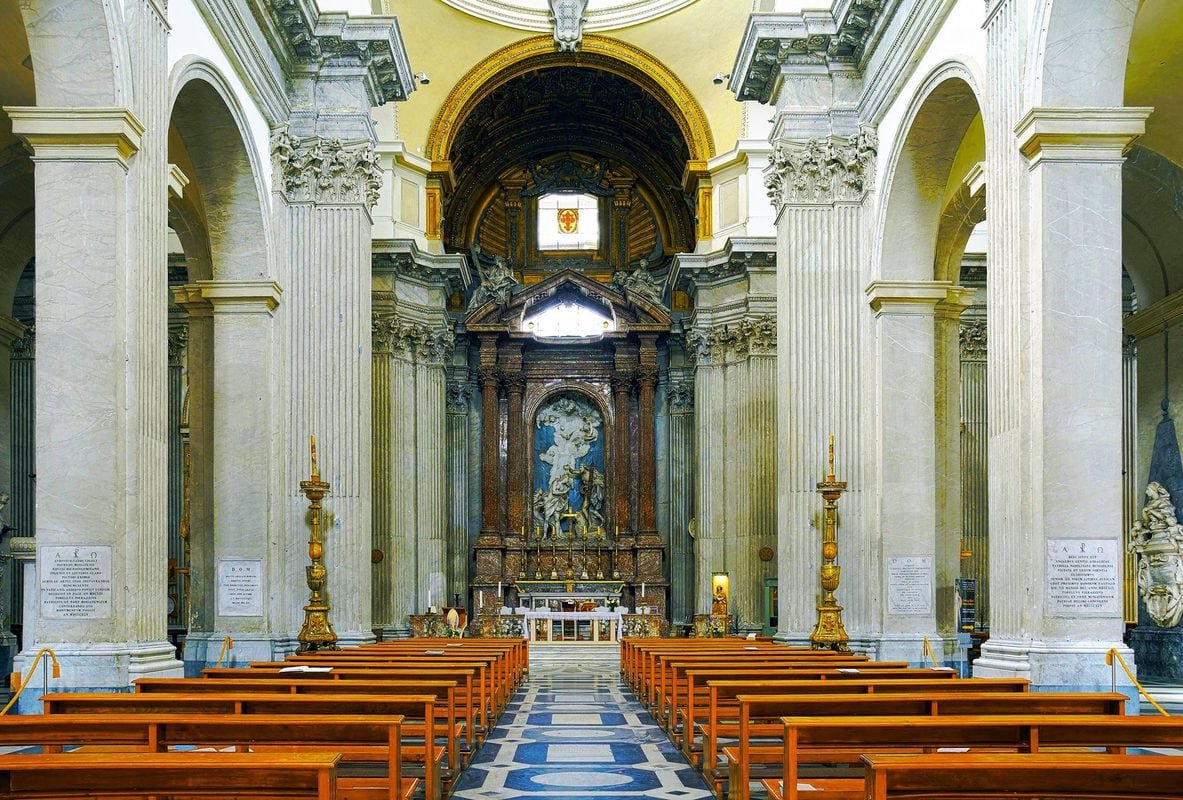
The apse of the Basilica of San Giovanni Battista dei Fiorentini is the most impressive part of the church and the least described by guidebooks. The parish website sums it up like this: "The imposing high altar was erected at the expense of the Falconieri family. Begun by Pietro da Cortona in 1634, it was finished in 1667 by Francesco Borromini, whose hand can be seen in the scenographic aedicule with three columns per side supporting the pediment". The same passage is also told in a more detailed way: the apse remained without decoration until the 1640s, when Pietro da Cortona was commissioned to make a temporary setup of wood and stucco with large canvases borrowed from the Chiesa Nuova. Then, when the patronage of the apse chapel passed to the Falconieri family, they arrived at a final project by Cortona that called for a colossal sculptural group entrusted to Francesco Mochi. Finally, in the 1660s, the current apse was built on a similar theme but in completely different forms by Francesco Borromini. 1667 is the year Borromini dies. It means that this altar is, to all intents and purposes, one of the very last things he made, and that he died leaving it just finished in the church where he would be buried. If you are looking for a piece of Borromini in Rome that is not lined up on any itinerary, this is it. Look at the aedicule: three columns per side, not two, and the pediment that holds the whole scene. It is a way of doing architecture with light that looks like no other.
The Baptism of Christ by Antonio Raggi
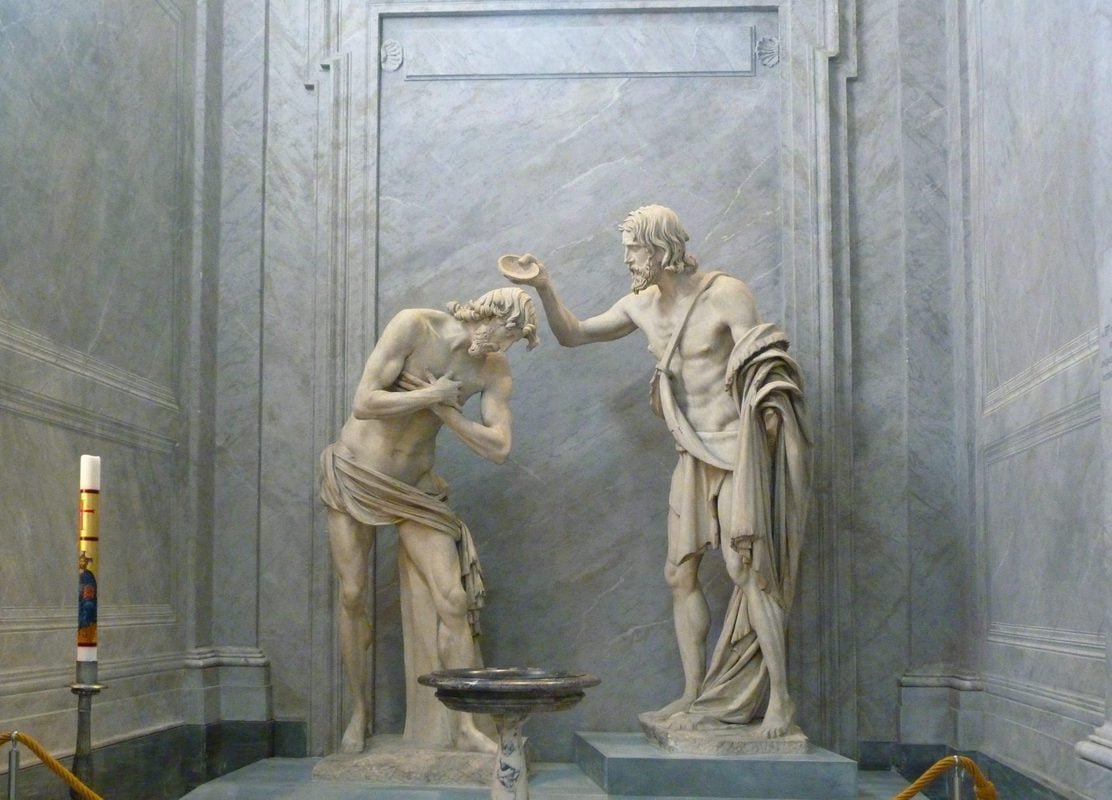
Inside that aedicule there is the sculptural group that is the real focus of the church: the Baptism of Christ by Antonio Raggi. The parish website describes it like this: "Above the high altar is the monumental Baptism of Christ by Antonio Raggi (1686): on a slab of bardiglio, dark gray marble from the Apuan Alps, in bas-relief, the Clouds, the Putti and the Dove of the Holy Spirit, over which, fully in the round, the Eternal Father leans out". The specialist wiki on the churches of Rome dates the same bas-relief instead to 1665. 21 years of difference between two sources, and nothing to settle it. What you can verify with your eyes is the technique, and it is the reason why this group is a piece of first-rate Baroque sculpture: Raggi puts together on the same surface the bas-relief, that is, the figures barely detached from the background, and the full round, that is, the figures that come completely out of the wall. The dark gray bardiglio background serves as sky, and over it float the white clouds, the putti, the dove. The Eternal Father leans forward as if about to fall on you. It is a theatrical effect calculated to be seen from the back of the nave, so don't run up to the altar: look at it from the entrance, then from the middle of the nave, then up close, and you see three different things. The apse has been described as "a true museum of Baroque sculpture immediately after Bernini and Algardi", and it is the most accurate definition.
My advice for visiting the Basilica of San Giovanni Battista dei Fiorentini
The advice is one, short: come at nine in the morning on a weekday, not on Saturday afternoon. Here is why. First, the hours: all three official sources, however much they disagree on the minutes, agree that the basilica is open early in the morning and closed in the middle of the afternoon. The safe window is the morning. Second, the light: the Basilica of San Giovanni Battista dei Fiorentini has the apse toward the Tiber and the facade toward Via Giulia, so in the morning the light comes in high from the octagonal drum and falls on the white nave in a way the afternoon doesn't repeat. Third, and this is the real reason: early in the morning there is no one inside. This is not a church for crowds, it is a parish church in a district emptied of residents, and the difference between seeing it empty and seeing it with 10 tourists talking is enormous, because the space is tall and echoes. Fourth, very practical: if you go in the morning, when you come out you have Via Giulia in front of you in good light and you can walk the whole street to Ponte Sisto in half an hour, passing in front of Sant'Eligio degli Orefici and under the Farnese arch. In the evening that street is beautiful but dark and you can see little. Last thing, in our opinion: plan for 40 minutes inside, not 10. It looks like a church you finish in five, and instead, if you count the 10 chapels, the busts of the transept, the monuments in the pillars and Borromini's apse, you realize there is more to see here than in half the churches people line up for.
The 10 side chapels
Five per side, as Giacomo della Porta laid them out. Turismoroma.it sums them up in a sentence worth taking literally: in the 10 side chapels are preserved "funerary monuments made by the greatest sculptors of the Baroque age". It is not brochure rhetoric, it is literally true: the artists involved in this church include Gian Lorenzo Bernini, Alessandro Algardi, Ercole Ferrata, Domenico Guidi, Antonio Raggi, Filippo della Valle, Pietro Bracci, Francesco Queirolo. They are the names that fill the Baroque sculpture rooms of museums in half the world, and here they are all together in a church where you go in for free. A dense list follows, with a necessary warning: the attributions of the individual chapels are not confirmed piece by piece by an institutional source and should be checked on the spot or in a monograph. In the apse, at the sides of the altar, the tombs of the Falconieri family with the statues of Faith by Ercole Ferrata and Charity by Domenico Guidi, enriched by stucco genii by the same artists, and 18th-century marble portraits of members of the Falconieri family in polychrome medallions held by putti. By Paolo Benaglia the memorial of Alessandro Falconieri and Marianna Lante, in neoclassical taste. The colossal high altar, in red marble from France and red marble from Cottanello, the town in the province of Rieti where that red and white stone that is everywhere in Rome comes from, surmounted by Justice by Michel Anguier and Fortitude by Leonardo Reti. The chapel dedicated to Saint Philip Neri and the chapel of Merciful Jesus, both with modern interventions that are discussed further on. And the Sacchetti chapel, which deserves a chapter of its own.
The Sacchetti chapel and the bronze crucifix
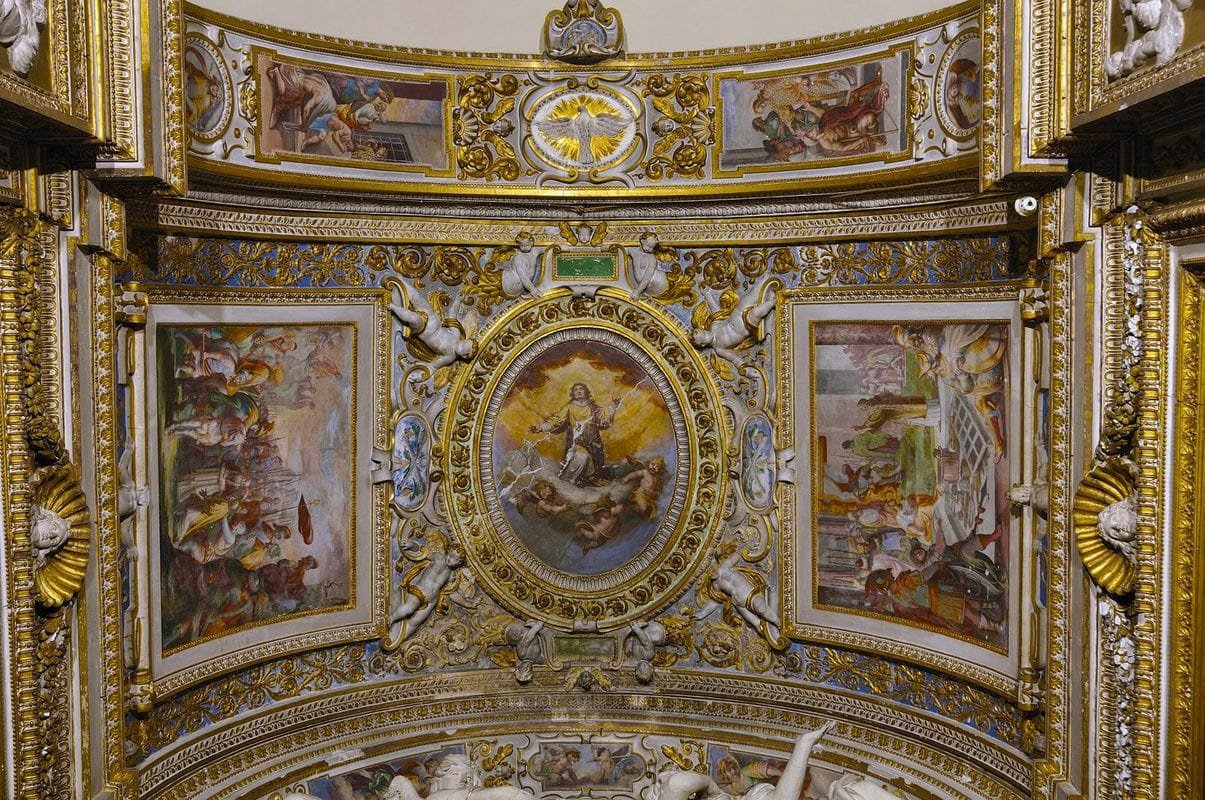
If there is only one chapel to see in the Basilica of San Giovanni Battista dei Fiorentini, it is this one. The chapel of the Sacchetti marquises is to the left of the high altar. The white and gilded stuccoes reach here, and in the chapel of the Madonna della Misericordia, a level of refinement that is not repeated in the rest of the church. But the thing to see is on the altar: a bronze crucifix made by Paolo Sanquirico from a design by Prospero Antichi, framed in a surround of African black marble polished to a mirror finish. Stop on this detail of the black marble polished like a mirror, because it is an idea from goldsmiths more than from architects: the dark bronze of the crucifix stands out against a background of black stone that reflects the light of the windows like a dark mirror, and depending on where you stand the crucifix seems to float or disappear. It is the kind of effect that today is obtained with lighting design and that in the 17th century was obtained by choosing the right stone and polishing it for weeks. Here too, a note: the attribution to Sanquirico from a design by Antichi is traditional, not confirmed by an institutional source. The chapel and the crucifix, however, are there, and you can see them.
The chapel of Saint Philip Neri
Saint Philip Neri and this basilica have a documented link. Turismoroma.it writes that the chapel dedicated to Saint Philip Neri was made by Ferdinando Fuga, 1699-1781, and that Philip Neri was rector of the basilica between 1564 and 1575. The Catholic encyclopedia confirms the same dates, 1564-1575, and adds that right here Philip Neri founded the Oratorians before moving to the Chiesa Nuova. The Vatican portal of the 2025 Jubilee, however, gives a different and stronger version: it says that "the first parish priest called to serve this community, precisely because he was Florentine, was Saint Philip Neri" and that from this church the saint conceived the initiative of the life of the oratories. Rector or parish priest? The difference is not formal. And here there is an element that at least allows us to frame the question: the parish of San Giovanni Battista dei Fiorentini, as a parish institution, was established by Saint Pius X with the apostolic constitution Susceptum Deo inspirante of October 24, 1906, a fact that is read on the parish website. In 1564 the parish in the modern canonical sense did not yet exist, so the phrase "first parish priest" of the Vatican portal should be read in a broad sense, while "rector" is the technically correct term for the role Philip Neri played. The fact remains that two official sources use two different words for the same person in the same place. What nobody doubts is that Philip Neri, Florentine by birth, spent 11 years of his life in this church and invented something here that changed the history of devotion in Rome. In the chapel dedicated to him, according to a report not confirmed by an official source, there is preserved the reliquary bust of the saint of the cross before which he used to pray, a work by Giuseppe Ducrot, that is, by a contemporary sculptor: a piece from the 20th or 21st century in a 16th-century church, and for once it doesn't clash.
The busts of the transept: Bernini, Algardi and the others
The transept of the Basilica of San Giovanni Battista dei Fiorentini is enriched by a series of commemorative busts that, taken together, form a small anthology of Baroque portraiture. The list that circulates is this: the bust of Antonio Barberini, the busts by Bernini, the one of Pietro Francesco De Rossi, the one by Domenico Guidi, the one of Ottaviano Acciaioli by Ercole Ferrata, the one of Ottavio Corsini by Algardi. Turismoroma.it adds the piece of information that was needed: the two busts by the hand of Gian Lorenzo Bernini kept here portray Antonio Coppola and Antonio Cepparelli, and those two gentlemen were neither popes nor cardinals, they were Florentine patricians, benefactors of the Archconfraternity and of the Hospital of the Florentines. This detail changes the meaning of the whole group. We are not looking at portraits of ecclesiastical power, we are looking at portraits of those who put up the money for the assistance of poor and sick fellow countrymen, sculpted by the greatest sculptor of the century. Bernini making the bust of a hospital benefactor is like, today, a Pritzker Prize architect signing the plaque of a soup kitchen. It says how much that community counted and how much that hospital counted. A note here too: on the individual busts turismoroma confirms the two by Bernini, the other names and their respective attributions are not confirmed one by one by an institutional source.
The monuments in the pillars of the aisles
In the pillars that support the aisles there are three monuments worth looking for, walking slowly. The monument to Francesca Calderini Pecori Riccardi, by Antonio Raggi, datable to around 1655. The monument to Alessandro Gregorio Capponi, designed by Ferdinando Fuga and sculpted in 1746 by Michel-Ange Slodtz. And the monument to Girolamo Samminiati by Filippo della Valle, from 1733, by the same Della Valle who signs the two allegories of the facade. Also by Della Valle are the memorial and bust of Clement XII Corsini, from 1750. These attributions and dates too are traditional, not confirmed piece by piece by an institutional source, and need to be confirmed. A useful key to reading them is chronological: Raggi 1655, Slodtz 1746, Della Valle 1733 and 1750. That is 100 years of funerary sculpture inside the same nave, from the full Baroque to early neoclassicism. If you walk from the pillars near the entrance toward the altar and look at the monuments in order, you see the way of sculpting drapery change, the way of treating faces, the temperature of the marble. It is an exercise that is usually done in a museum paying €20, and here it is done for free in a nave.
Another well-known fact, yet rarely cited
Many people know this is a minor basilica, but almost no one knows since when and by whose hand. The parish website gives the complete sequence and it's worth reporting it in full because it is the institutional identity card of the Basilica of San Giovanni Battista dei Fiorentini. The parish was established by Saint Pius X with the apostolic constitution Susceptum Deo inspirante of October 24, 1906. It was recognized civilly on June 11, 1908 by decree of Victor Emmanuel III. Pope Benedict XV confirmed the title of minor basilica on August 19, 1918, and on this date the Catholic encyclopedia agrees exactly. Pope John XXIII elevated it to a cardinal priest's title in March 1960: the parish website writes March 14, 1960, the Catholic encyclopedia writes March 12, 1960, two days of difference between the sources. The cardinal priest of the title is Cardinal Giuseppe Petrocchi, archbishop emeritus of L'Aquila, and on this the two sources agree. One last fact that almost never appears in guidebooks: the ownership of the building is not the Vicariate's or the State's, it belongs to the Archconfraternity of San Giovanni de' Fiorentini called della Pietà, that is, to the same lay institution born in 1448 to assist Florentines sick with the plague. 578 years later, that confraternity is still the owner of the church it had built. In a city where everything changes hands every two centuries, this continuity is the most incredible thing about the Basilica of San Giovanni Battista dei Fiorentini and practically no one talks about it.
The Museum of Sacred Art: what's inside and why you can't see it
Next to the basilica there is a museum of sacred art, and the practical news comes before the list of masterpieces: the official page of the museum on the parish website declares that the museum is temporarily closed. As things stand, don't count on it, and if you care, call 06 68892059 before you go. That said, it is worth knowing what it holds, because when it reopens it will be a serious reason to return. The museum opened in 2001 according to the specialist wiki, keeps 48 works on display and another 20 in storage according to the official page, and covers sacred art from the 16th to the 19th century. The big pieces: the marble statue of Saint John the Baptist attributed to Michelangelo Buonarroti, the busts of Antonio Coppola and Antonio Cepparello by Gian Lorenzo Bernini, works by Pierino da Vinci. Other pieces are also cited: the bust of Pier Cambi by Pompeo Ferrucci, the relief with the Virgin, Saint Anne and the Child by Pierino da Vinci, a bronze crucifix by Antonio Raggi, the reliquary of the foot of Mary Magdalene from the workshop of Benvenuto Cellini in silver, bronze and gold, and the large silver monstrance by Luigi Valadier. Valadier and Cellini are not confirmed by an institutional source. For the reliquary of the foot of Mary Magdalene, however, there is confirmation, and it carries weight: the Vatican portal of the 2025 Jubilee, in its page on this church, writes that "the bone fragment of the foot of Saint Mary Magdalene" is kept here. So that relic is there, and the confirmation comes from the highest possible source.
The San Giovannino disputed between Donatello and Michelangelo
This is the best story of the museum, and it should be told without too much certainty. You often read that the statue of a young Saint John the Baptist was "traditionally attributed to Donatello and recently restored to Michelangelo thanks to the discovery of some documents". The more precise fact is that it is a disputed attribution and not a closed restitution. The page dedicated to the work on an art portal dates it to 1490, specifies that it was originally made for the altar of the church of Sant'Orsola, where it is recorded in 1493, and that only at a later time was it moved to San Giovanni dei Fiorentini. It tells that in the mid-20th century, when it stood by the sacristy door, it was attributed to Donatello, and that "recently it has been linked to the name of Michelangelo, identifying it with a lost Saint John mentioned in the biographies of the great sculptor as a youthful work". Linked and identified with a lost work mentioned in biographies: it is an attribution argument, as strong as you like, but it is not a notarial document. The official website of the museum, for its part, lists it without reservation as "Marble statue of Saint John the Baptist, by Michelangelo Buonarroti", and the specialist wiki writes "attributed to Michelangelo Buonarroti". So: the parish gives it as Michelangelesque, the art literature gives it as attributed. In our opinion it is one of the most interesting attribution stories in Rome, because if it were really by Michelangelo it would be a youthful work, from 1490, that is, from when Buonarroti was 15 years old. A 15-year-old. With that doubt on it, that statue is worth the ticket that for now you can't even buy.
The Historical Archive of the Archconfraternity and the record about Leonardo
In the Basilica of San Giovanni Battista dei Fiorentini is kept the Historical Archive of the Archconfraternity of the Florentines, which gathers writings, documents, projects and scores from the 15th century to today. Turismoroma.it confirms the existence of a historical archive of the Florentines going back to the 15th century. The piece everyone cites is another one, to be taken for what it is: you often read that among the documents there is the record of the expulsion of Leonardo da Vinci from the sodality for non-payment of the entrance fee. The same news is repeated by the Italian page of the free encyclopedia, but no institutional source confirms it. It is a report carried by non-institutional sources, delicious and much repeated, and until it appears in an archive catalog it should not be taken as certain. It is credible, however, and here is why: the Archconfraternity of the Pietà of the Florentines was a mutual aid society on a national basis, with membership fees, registers, defaulters and expulsions, like a club. Leonardo da Vinci lived in Rome from 1513 to 1516, in the years of Leo X, that is, exactly in the years when this church was being designed. That a Florentine living in Rome would join the confraternity of the Florentines is normal. That Leonardo forgot to pay something is, let's say, consistent with what we know of his handling of deadlines. Whoever has access to the registers could verify it: it would be one of the few things still to be discovered in a church in Rome with a magnifying glass and a little patience.
The right photo to take at the Basilica of San Giovanni Battista dei Fiorentini
The right photo is not taken from the churchyard and it is not taken inside. It is taken from Ponte Vittorio Emanuele II, on the uphill sidewalk, looking back toward the city: from there you get Carlo Maderno's dome in profile, the sucked candy, with the octagonal rusticated drum lifting it above the houses and the river in the foreground. It is the only framing that explains the shape of that dome, because from below and up close you can't understand anything. Take it in the first half hour after dawn or the last half hour before sunset: the travertine turns orange and the green of the Tiber below stops looking gray. Second photo, the one nobody takes: stand at the start of Via Giulia with your back to the facade and photograph the street going off straight, with the wall of Bramante's Palazzo dei Tribunali on the right and the Renaissance facades narrowing in perspective. That is the photo that tells why this church is here: it is the stopper of Via Giulia, the point where Julius II's new street was supposed to end. Third, inside, with a warning: ask permission and don't use the flash, because it is a parish church where people really pray and flash on a bardiglio bas-relief is useless anyway. If they let you, the right framing is from the back of the central nave with Borromini's aedicule and Raggi's Baptism of Christ on axis: the tall bright nave acts as a corridor and the eye goes straight there. To avoid, instead, the classic photo of the frontal facade at midday, which is the one everyone takes: the square is narrow, you can't get both orders in full and the sun overhead flattens the travertine. It is the photo that will come out worst for you, and it is the only one that 95 percent of people take home.
Some important events that happened here in history
In 1508 Pope Julius II has the small oratory of Sant'Orsola della Pietà, seat of the Florentine Archconfraternity, demolished and decides to build the national church of the Florentines there, giving the first commission to Donato Bramante. It is the year Via Giulia opens, and it is the birth certificate of the idea. In the 1510s, under Leo X, the competition is held that gathers the first rank of Italian architecture and that Jacopo Sansovino wins. Turismoroma.it dates it to 1518. In 1519 Sansovino opens the construction site. From 1523 to 1546 Antonio da Sangallo the Younger solves the problem of the foundations on the riverbank. In 1559, according to the specialist wiki, Michelangelo draws up five Greek-cross projects that he entrusts to Tiberio Calcagni and that remain on paper and in the wooden model. Between 1564 and 1575 Saint Philip Neri is here, as rector according to turismoroma and the Catholic encyclopedia, as first parish priest according to the Vatican Jubilee portal, and from here the story of the Oratorians starts. Between 1583 and 1602 Giacomo della Porta resumes the works and in 1592 completes the central nave. In the first 20 years of the 17th century Carlo Maderno builds the dome, with the reservations about the date already seen. In 1620 the church can be considered finished, except for the facade. In 1634, according to the parish website, Pietro da Cortona begins the high altar at the expense of the Falconieri. In 1667 Francesco Borromini finishes that altar and in the same year dies, and is buried here. Antonio Raggi's Baptism of Christ arrives in 1665 or 1686 depending on the source. In 1734 the date you can still read is carved on the facade, and between 1734 and 1738 Alessandro Galilei's facade is completed, with Galilei dead in 1736. On October 24, 1906 Saint Pius X establishes the parish. On August 19, 1918 Benedict XV confirms the title of minor basilica. In March 1960 John XXIII elevates it to a cardinal title. In 1992 the basilica is restored, according to turismoroma.it. In 2001 the museum of sacred art opens. On May 7, 2013 the funeral of Giulio Andreotti is celebrated in this basilica. In 2024, according to the parish website, a day center for people with disabilities named after Saint Philip Neri opens in the parish premises. And in 2025 the Basilica of San Giovanni Battista dei Fiorentini was included among the jubilee churches of the Jubilee, with a dedicated page on the official Vatican portal.
Who has passed through the Basilica of San Giovanni Battista dei Fiorentini
The list of those who have passed through here is embarrassing, in the good sense. As designers, in no particular order and with the attribution limits indicated chapter by chapter: Donato Bramante, Jacopo Sansovino, Raphael Sanzio, Baldassarre Peruzzi, Antonio da Sangallo the Younger, Michelangelo Buonarroti with Tiberio Calcagni, Giacomo della Porta, Carlo Maderno, Pietro da Cortona, Francesco Borromini, Ferdinando Fuga, Alessandro Galilei. As sculptors: Gian Lorenzo Bernini, Alessandro Algardi, Antonio Raggi, Ercole Ferrata, Domenico Guidi, Francesco Mochi, Michel Anguier, Leonardo Reti, Filippo della Valle, Paolo Benaglia, Pietro Bracci, Francesco Queirolo, Simone Martinez, Michel-Ange Slodtz, and for the facade also Domenico Scaramuccia, Salvatore Sanni, Gaetano Altobelli, Carlo Pacilli, Giuseppe Canard, the latter not found in an institutional source. As saints: Saint Philip Neri, who spent 11 years here. As popes: Julius II who wanted it, Leo X who called the competition, Clement XII who paid for the facade, Saint Pius X who established the parish, Benedict XV who made it a minor basilica, John XXIII who made it a cardinal title. As illustrious Florentines with their feet on the ground, that is, the benefactors: Antonio Coppola and Antonio Cepparelli, portrayed by Bernini. And then there is the line of lay figures. Onofrio del Grillo, whom turismoroma.it indicates as buried here and who is the historical man behind Alberto Sordi's Marchese del Grillo. Giulio Andreotti, who was a parishioner of this basilica and had his funeral here on May 7, 2013. And Leonardo da Vinci, who according to the tradition reported by the free encyclopedia was thrown out of this confraternity. Not bad for a church with no line.
Who is buried here: what is confirmed and what is not
This is the point where the most caution is needed, because attributing a tomb without a source is the kind of mistake that then circulates for 20 years. A flat list of the buried circulates: Cardinal Ludovico Maria Torriggiani, Carlo Maderno, Francesco Borromini, Ludovico Cardi called Cigoli with the specification that he was later transferred to the church of Santi Michele e Gaetano in Florence, Onofrio del Grillo, the architect Carlo Murena, the jurist and man of letters Ansaldo Ansaldi, and many members of the Sacchetti marquis family in the chapel of that name to the left of the high altar. Here is what the sources show. Carlo Maderno and Francesco Borromini: confirmed, and by three independent sources, the official website of the parish, turismoroma.it and the Vatican portal of the 2025 Jubilee, besides the Catholic encyclopedia which dates them 1556-1629 and 1599-1667 and places them in the central nave. Onofrio del Grillo: confirmed by turismoroma.it, which writes explicitly that he rests inside the basilica. All the other names on the list, that is, Torriggiani, Cigoli, Carlo Murena, Ansaldo Ansaldi and the Sacchetti, appear only on the Italian page of the free encyclopedia, and no institutional source confirms them. They are therefore unverified information, not to be repeated as certain. One more clarification on Giulio Andreotti, because there is often confusion here: what is documented is that on May 7, 2013 his funeral was celebrated in this basilica, and the news reports of that day confirm it. The page of the free encyclopedia goes as far as to say that Andreotti is buried here: that passage is not confirmed by any official source. So: funeral yes, burial unverified.
Via Giulia begins here
Leaving the Basilica of San Giovanni Battista dei Fiorentini you have Via Giulia in front of you, and it would be a shame not to walk it. It is the street that Pope Julius II della Rovere had opened in 1508 as a straight road leading from the city toward the Vatican, and the church of the Florentines was supposed to be its final architectural chapter: a kilometer of straight street, something that did not exist in Rome in the 16th century. What you meet as you walk: the unfinished rusticated wall of Bramante's Palazzo dei Tribunali, which Romans call the sofas of Via Giulia because they look like stone seats. Sant'Eligio degli Orefici, tiny, designed by Raphael. The brick arch of the passetto Farnese covered in ivy that spans the street. The narrow, tall facades of the bankers' houses. The district on this side is empty of shops and full of doorways: it is one of the few streets in the historic center where at nine in the morning you can hear the sound of your own footsteps. If you have an hour after the basilica, this is the thing to do with it. Go all the way to Ponte Sisto, then turn left and you are at Campo de' Fiori in five minutes, or cross the bridge and you are in Trastevere. The opposite, that is, walking Via Giulia from south to north and ending at the basilica, is almost better, because Galilei's facade opens up in front of you at the end of the perspective. It is exactly the effect it was built for.
The Ponte district around the basilica
The page the parish dedicates to the Ponte district tells a story worth repeating because you don't find it in guidebooks. Originally this area was a stretch of marshes, and the page cites Ovid in the Fasti to describe it as a mysterious place full of ambushes. Where Ponte Vittorio Emanuele II is today stood the Tarentum, seat of a sanctuary dedicated to Dis, that is Pluto, and to Proserpina, with an underground altar: we are in the area of the ludi saeculares, the most solemn ceremonies of ancient Rome. In 1890 the remains of an ancient pier used for transporting marble were discovered in this area, which makes perfect sense: the Tiber here was the marble highway, and the blocks that built half of Rome passed under this bank. In the Renaissance, the district was arranged by Pope Sixtus IV della Rovere, who in 1480 carried out important restorations here, including the construction of Santa Maria della Pace. The parish page also notes that Benvenuto Cellini and Borromini lived in this area: that is, Borromini is not only buried here, he lived here. The district was named the fifth district of Rome on May 18, 1743 by chirograph of Pope Benedict XIV. In the 20th century the demolitions for Corso Vittorio and for the riverside roads cut through it, but the district has kept, as the parish says, its typical look with the Renaissance straight roads converging toward Ponte Sant'Angelo. Walk through it: Via dei Banchi Nuovi, Via dei Banchi Vecchi, Via del Banco di Santo Spirito. The street names say what was done here, that is, banking, and who did it, that is, the Florentines.
The parish today, which is not a detail
One thing the guidebooks never write is that the Basilica of San Giovanni Battista dei Fiorentini is not a monument, it is a working parish, and this changes the way you go in. According to the parish website, the parish priest is Don Roberto Paoloni and the parish collaborator is Don Massimo Talamona. The parish has, besides the basilica, five subsidiary churches in its territory, and it is worth listing them because they are a small itinerary in themselves: the rectory of San Biagio della Pagnotta at Via Giulia 64, the rectory of Santa Maria Annunziata del Gonfalone at Via del Gonfalone 34, the rectory of Santa Maria del Suffragio at Via Giulia 59/A, the rectory of Santi Celso e Giuliano at Vicolo del Curato 12 and the annexed church of San Celsino at Vicolo di San Celso 31. Five churches in a few hundred meters, all within the same parish. As for activities, the parish website lists things that say a lot about the district: a listening center of the Circolo San Pietro on Tuesday, the initiative Il Pane di Sant'Antonio on Thursday morning, one evening a month dedicated to homeless people, a day center for people with disabilities open since 2024 in the San Filippo Neri hall, hosting an association from Monday to Friday, a course for the Latin American community on Friday afternoon, a group from Santo Domingo and an Indian community from Kerala that meets on Sunday. It is the piece of truth missing from all the tourist pages on this church: inside there are not only Borromini and Bernini, there are 200 people who pass through every week for reasons that have nothing to do with tourism. Go in with this in mind and behave accordingly.
Masses, parish office, weddings
Here too the sources diverge, and it is best to report them all, because with Mass times people arrive and find the door closed. The Mass Schedule page of the parish website lists weekday Masses at 7:20 and 17:00 from October 1 to April 30, at 7:20 and 18:00 from May 1 to June 30, and at 9:00 from July 1 to September 30. Holiday and Sunday Masses from October 1 to July 1 are Saturday at 18:00 and Sunday at 10:00, 11:00, 18:00 and 19:00, while in July, August and September Saturday at 18:30 and Sunday at 10:00, 11:00 and 19:00. The La Parrocchia Oggi page of the same site lists instead weekdays at 9:00 and 17:30 from October 1 to March 31, at 9:00 and 18:00 from April 1 to July 31, at 9:00 from July to September. Sundays and holidays all year are Saturday at 18:00 and Sunday at 10:00, 11:00 and 18:00. And turismoroma.it gives yet another grid: Monday-Friday at 9:00 and 17:30, Saturday at 18:00, Sunday and holidays at 8:30, 9:30 and 17:00. Three sources, three calendars. If you need to go to Mass on a specific day, call. The parish office, according to the website, is open Monday to Saturday from 10:00 to 12:00 and from 16:00 to 17:00, in the months from September to July of the current pastoral year. On weddings: the basilica is one of the most requested churches in Rome for getting married, the parish website has a menu item dedicated to weddings in the basilica, and for procedure, required documents and any offerings it is best to call 06 68892059 during office hours.
With children
It is a frequent question, and it deserves a serious answer instead of a generic yes. The Basilica of San Giovanni Battista dei Fiorentini with children works on two conditions. The first is duration: there is no interactive path here, no underground, no panels, and a child under 10 gets bored in eight minutes. So put it in the middle of a walk, don't make it the destination. The second is to give them something to look for. The two that work best: the hunt for the dome seen from the bridge, which is a visual game, explain why they call it the sucked candy and have them recognize it from afar. And the hunt for the slab under the dome, with the story of the two related architects buried in the same tomb and of one of the two who killed himself in 1667, which has a remarkable effect on kids from 11 up. Inside, keep in mind that it is an active parish church, so quiet voices and no running: the nave is tall and every noise echoes. Outside, Via Giulia is one of the few streets in the center where children can walk without being crushed by the crowd, and the ivy-covered arch of the passetto Farnese pleases everyone. Public restrooms in the immediate vicinity are not reported, so plan ahead. And if the outing with children should also have a spectacular piece, add Castel Sant'Angelo, which is five minutes away and has ramps, towers and a panoramic terrace that keeps them busy for a good hour.
Accessibility: what is known and what is not
On this we need honesty all the way, because accessibility is the thing on which tourist pages lie most, out of superficiality. None of the official sources contains an explicit statement on the accessibility of the Basilica of San Giovanni Battista dei Fiorentini for people with mobility disabilities: neither the parish website nor turismoroma.it nor the Vatican portal gives any information on steps at the entrance, ramps, accessible restrooms or internal routes. An observation, not a fact from a source: it is a church with the facade on the street preceded by some steps, like almost all the Roman basilicas of this period, and the interior is on a single level, wide and uncluttered, with no internal level changes and no crypt to go down into: once inside, the space is wide and flat. If accessibility is decisive for your visit, the right thing to do is a phone call to 06 68892059 and a direct question, because since 2024 the parish also runs a day center for people with disabilities in its own premises and so they know the subject well. A positive fact that is instead certain: since there is no ticket office, no turnstiles and no mandatory routes, there are none of the bottlenecks typical of museums.
What is around, within 10 minutes on foot
This is one of the best positions in Rome for building half a day on foot without ever taking a vehicle. Five minutes away, toward the river and to the right, Castel Sant'Angelo and its bridge with Bernini's angels. 20 minutes in a straight line, past Ponte Vittorio, St. Peter's Basilica and Vatican City. 10 minutes inland, Piazza Navona with the Fountain of the Four Rivers and, below the level of the square, the Stadium of Domitian. On the same square the Museum of Rome at Palazzo Braschi, and a little further up Palazzo Altemps with the ancient sculptures. At 12 minutes San Luigi dei Francesi, which is the national church of the French as this is that of the Florentines, and inside there are three Caravaggios. At a quarter of an hour Sant'Ivo alla Sapienza, that is, Borromini alive, to see on the same day you saw Borromini dead under the dome of the Fiorentini: it is the smartest pairing you can make in this area. Going down Via Giulia all the way, Sant'Eligio degli Orefici. Past Ponte Sisto, on the opposite bank, Villa Farnesina with Raphael's frescoes. And if you want to finish in style on the river, the Tiber Island is 20 minutes away along the Tiber, with Ponte Rotto right after. One last thematic note: San Giovanni Decollato, below the Capitoline Hill, is the other Roman church linked to a Florentine confraternity, and can be visited only on special occasions.
Quick questions about the Basilica of San Giovanni Battista dei Fiorentini
How much does it cost to enter the Basilica of San Giovanni Battista dei Fiorentini?
Nothing. Entrance to the basilica is free: it is a parish church, not a museum. None of the official sources lists an entrance ticket.
Do I need to book?
No, you don't need to book to enter the church. Just arrive during opening hours, which are the real unknown.
What are the opening hours?
The uncomfortable truth is that the three official sources give three different schedules. The parish website, Mass Schedule page, lists for the period October 1-June 1 opening at 7:00 and 16:00 with closing at 12:00 and 18:00 on weekdays. The La Parrocchia Oggi page of the same site lists 7:30-12:00 and 17:00-18:45. Turismoroma.it lists 8:30-11:30 and 17:30-19:00. The common denominator is: open in the morning until about noon and in the late afternoon between 17 and 19, closed in the middle of the afternoon. Call 06 68892059 if you have only one attempt.
What is the exact address?
Via Acciaioli 2, 00186 Rome, Ponte district, at the start of Via Giulia. The apse faces Lungotevere dei Sangallo and Lungotevere dei Fiorentini, but the entrance is on Via Acciaioli.
What is the parish phone number?
06 68892059. It is the number given on both the parish website and turismoroma.it. Turismoroma also gives an email address for the parish.
How do I get there by public transport?
ATAC line 23 passes on Lungotevere dei Sangallo and Lungotevere dei Fiorentini, that is, behind the basilica, according to the route of the line. Corso Vittorio Emanuele II, right next to it, is served by most of the surface lines of the center, but check the exact numbers on the ATAC app the same day.
Is there a subway stop nearby?
No, not nearby. The most usable stops of line A are Lepanto and Ottaviano, both across the Tiber, and from there it takes a good quarter of an hour on foot. The subway is not the clever choice for this church.
Can the museum of sacred art be visited?
Not at the moment: the official page of the museum on the parish website declares it temporarily closed. When it is open it keeps 48 works on display and 20 in storage, including the statue of Saint John the Baptist attributed to Michelangelo and Bernini's busts.
Who is buried in the Basilica of San Giovanni Battista dei Fiorentini?
With confirmation from official sources: Carlo Maderno and Francesco Borromini, in the same tomb in the central nave under the dome, and Onofrio del Grillo. Other names that circulate, including Cardinal Torriggiani, Cigoli, Carlo Murena, Ansaldo Ansaldi and the Sacchetti marquises, appear only in non-institutional sources and should not be taken as certain.
Is it true that Borromini is buried here?
Yes. It is confirmed by the official website of the parish, turismoroma.it and the Vatican portal of the 2025 Jubilee. The parish website specifies that Borromini, who died a suicide in 1667, rests in a single tomb together with Carlo Maderno, his relative and preceptor, in the middle nave under the dome.
What was the relationship between Maderno and Borromini?
They were relatives, but the sources use different words: turismoroma.it writes that Maderno was "uncle of Francesco Borromini", the parish website writes "his relative and preceptor". The exact degree remains uncertain.
Is Andreotti buried in this basilica?
What is documented is that on May 7, 2013 his funeral was celebrated here, and that he was a parishioner of this basilica. That he is also buried here is not confirmed by any official source.
Why is the dome called the sucked candy?
For its elongated, thinned shape, slightly elliptical instead of hemispherical, resting on an octagonal drum in rustic rustication. The nickname is reported by both the parish website and turismoroma.it, and is of Roman popular origin.
Who built the dome and when?
Carlo Maderno. On the date there is no agreement among the sources: 1598 according to the parish website, 1612 according to the specialist wiki on the churches of Rome, 1614 according to turismoroma.it, 1620 according to the Catholic encyclopedia. Certainly within the first 20 years of the 17th century, and certainly not in 1634, as you often read, given that Maderno is recorded as dead in 1629.
Who made the facade?
Alessandro Galilei, a Tuscan, the same one as the facade of San Giovanni in Laterano. The date MDCCXXXIV, that is, 1734, is carved on the facade, with the name of Clement XII. The sources give a start of 1732, 1733 or 1734 and completion in 1734 or 1738.
How long does the visit take?
If you go in and look only at the altar, 10 minutes. If you count the 10 side chapels, the busts of the transept, the monuments in the pillars and stop under the dome, a full 40 minutes. The advice is to plan for the 40.
Can you take photos inside?
It is an active parish church: ask and use discretion, avoid the flash and don't photograph during services. An official written rule on photography in this basilica is not published.
What is the best spot to photograph the basilica?
From Ponte Vittorio Emanuele II, looking back toward the city: from there you get the dome in profile with the river in the foreground. It is the only framing that explains the shape of the dome.
What is the difference between this and the other great Roman basilicas?
This is not one of the papal basilicas. It is a minor basilica, a title confirmed by Benedict XV on August 19, 1918, and it was born as the national church of a community, the Florentine one, not as a papal devotional foundation. Compared with Santa Maria Maggiore or St. John Lateran
is smaller, much less visited and has no lines.
Are there lines?
No. It is one of the important churches of the center where you practically never have to queue, and it is one of the reasons the visit is worth it.
Is it suitable for children?
Yes, but not as a destination in itself: inside there is nothing interactive and a small child gets tired in a few minutes. It works well inserted into a walk, giving them something to look for, like the dome seen from the bridge or the slab of the two architects under the dome.
Is it accessible to people with mobility disabilities?
No official statement on the accessibility of this basilica is published. As an observation: the facade is preceded by some steps, like almost all the basilicas of this period, while the interior is on a single level with no crypt to go down into. For a certain answer call 06 68892059.
Are there Masses? At what time?
Yes, every day. Here too the sources diverge: the parish website on one page lists weekdays at 7:20 and 17:00 in the winter period, on another page at 9:00 and 17:30, and turismoroma.it lists 9:00 and 17:30 on weekdays, Saturday 18:00, Sunday 8:30, 9:30 and 17:00. If you need to go to Mass on a specific day, call.
Can you get married there?
Yes, it is one of the most requested churches in Rome for weddings and the parish website has a dedicated section. Ask the parish office for procedure, documents and offerings. According to the website it is open Monday to Saturday 10:00-12:00 and 16:00-17:00 from September to July.
Was it a jubilee church of the 2025 Jubilee?
Yes, the official portal of the 2025 Jubilee dedicates a page to it among the jubilee churches, and reminds us that the basilica keeps the bone fragment of the foot of Saint Mary Magdalene.
What does Saint Philip Neri have to do with this church?
He spent 11 years here. Turismoroma.it and the Catholic encyclopedia say he was rector of the basilica from 1564 to 1575 and that here he founded the Oratorians before moving to the Chiesa Nuova. The Vatican Jubilee portal calls him instead "first parish priest". Consider that the parish in the canonical sense was established only in 1906.
Why is it called "dei Fiorentini"?
Because it is the national church of the Florentine community of Rome, wanted starting in 1508 in place of the oratory of Sant'Orsola della Pietà, seat of the Archconfraternity of the Pietà of the Florentine nationals, born in 1448. The dedication to Saint John the Baptist is the dedication to the patron of Florence. The ownership of the building, still today, belongs to that same Archconfraternity.
Is it true that Leonardo da Vinci was expelled from the confraternity?
It is a much repeated report, carried by the page of the free encyclopedia, according to which the record of his expulsion for non-payment of the entrance fee is kept in the historical archive of the Archconfraternity. No institutional source confirms it: it is a tradition, not an established fact.
Did Michelangelo really work on this church?
He drew up projects that were not built. The specialist wiki dates to 1559 five Greek-cross schemes entrusted to his pupil Tiberio Calcagni, who also made a wooden model from them. Turismoroma.it also lists him among the participants in the competition, while other sources do not mention him. The church you see is not his.
What should I absolutely look at, if I have 10 minutes?
Three things. The floor under the dome, where Maderno and Borromini are in the same tomb. Borromini's apse with Antonio Raggi's Baptism of Christ, looked at from the back of the nave and not from underneath. And, on the way out, the dome seen from Ponte Vittorio.
What is the best time of year?
Any, because there is no crowding in any season. Keep in mind that the hours change between the winter period and the summer period, and that in summer, according to the parish website, in some months only one weekday Mass remains. The best light for the dome from the bridge is that of January and February at the end of the day.
Can you climb the dome?
No source indicates a climb to the dome open to the public in this basilica, so the cautious answer is no. If you are looking for a panoramic climb in the area, the one at St. Peter's is 20 minutes on foot.
Is there a bookshop or an information point?
It doesn't appear from the sources. It is a parish, not a museum site: no ticket office, no turnstiles, no mandatory route.
What can I see nearby in half an hour?
All of Via Giulia to Ponte Sisto, Castel Sant'Angelo, Piazza Navona, San Luigi dei Francesi with the Caravaggios, Sant'Ivo alla Sapienza to see Borromini alive after having seen him dead, and across the river Villa Farnesina
.
The Basilica of San Giovanni Battista dei Fiorentini is the church that doesn't make news in Rome: it has no Caravaggio in a chapel, no line, no mascaron to photograph, no ticket to sell. But it has one thing that, in our opinion, is worth more than all of those: it is the place where the professional life of half the Italian Renaissance and half the Baroque ended up, and nobody notices. Sansovino lost his job here, Sangallo spent 23 years here propping up the sand, Michelangelo left five drawings here that were not built, Maderno put a dome here that Romans made fun of for four centuries, Borromini finished his last altar here and had himself buried here, Galilei left a facade here that he didn't live to see finished. The right moment is early morning, when the basilica is open and there is no one: a minute under the dome looking at the floor, and then outside, along Via Giulia. Look at the floor under the dome and don't pretend otherwise. Down there are two who built this city.