Stadium of Domitian – Piazza Navona Underground
In short. The entrance to the Stadium of Domitian is at Via di Tor Sanguigna 3, at the northern end of Piazza Navona, a few steps from the church of Sant'Agnese and beside Palazzo Braschi.

The entrance to the Stadium of Domitian is at Via di Tor Sanguigna 3, at the northern end of Piazza Navona, a few steps from the church of Sant'Agnese and beside Palazzo Braschi. It is a discreet little door that goes below street level, where a section of the curve of the oldest masonry stadium Rome ever had comes back to light. There are no Metro stops right in front of the square. Line A is far away, so it is best to get there by bus or on foot. Lines 70, 81, 87, 130, 186, 492 and 628 stop along Corso del Rinascimento and at Senato, on the long side of Piazza Navona, two minutes from the entrance. From Largo di Torre Argentina, a hub served by tram 8 and buses 40 and 64, it is about a 10-minute walk heading back up toward the Pantheon and Corso del Rinascimento. The entrance ticket to the archaeological route starts from about 8 euros, with an audio guide included in several languages. Guided walking tours and combined packages with other central sites exist, at higher prices. Hours, opening days and fares are set by the Sovrintendenza Capitolina and by the concessionaire that has managed the site since 2014, and they have changed several times. Before you go, it is best to check them on the official site stadiodomiziano.com, where you can also book entry. The visit lasts between 40 and 60 minutes. The route is largely underground, with stairs and uneven paving.
If you want to place this site within the map of the square that swallowed it, it is best to read the guide to Piazza Navona first. The Stadium of Domitian is literally its skeleton, and understanding one explains the other.
What the Stadium of Domitian Beneath Piazza Navona Is
Let's start with a fact that surprises almost everyone: Piazza Navona does not have that shape by chance, and it is not even a square in the ordinary sense of the word. It is the negative image of a building. Its elongated plan, closed in a horseshoe shape on the north side and straight along the long sides, traces exactly the arena of a Roman stadium built almost 2,000 years ago. The buildings that surround the square today sit, one after another, on the foundations of the tiers of seats, and the cellars of many of them still preserve stretches of ancient masonry. What you visit on Via di Tor Sanguigna is the only slice that has been brought back to light and made accessible: the northern curve, the one that gave the stadium its curved end and that today corresponds to the rounded part of the square, in front of the church of Sant'Agnese.
The Stadium of Domitian was the first and only masonry stadium in ancient Rome. Before it, athletic events in the Greek style were held on temporary wooden structures, raised for the occasion in the Campus Martius and then dismantled. Domitian, the third and last emperor of the Flavian dynasty, decided to give those games a permanent home in stone, worthy of comparison with Greece. He did so during the same building campaign that earned him a reputation as a great builder, the one that produced the Odeon for musical contests just steps away. The result was an enormous building, about 275 meters long and 106 wide, with an inner arena of about 193 meters by 54, which according to ancient catalogues could hold around 30,000 seated spectators.
Why the Stadium of Domitian Does Not Look Like the Colosseum
Let's clear up a common misunderstanding right away. A stadium is not an amphitheater and not a circus. The amphitheater, like the Colosseum, is elliptical and was used for gladiator fights and hunts. The circus, very long and narrow, was used for chariot races. The stadium has a U shape, with a short straight side for the starts and a curved one for the turn, and it is tailored to athletics: running, wrestling, boxing, jumping, throwing. Domitian did not build it for a taste for blood, but out of a cultured, pro-Greek fashion. He wanted Rome to run and compete as they did in Olympia. Anyone who goes down into the underground today can feel this difference firsthand, because the masonry that survives is that of the curved end, the point where the athletes turned.
Where the Stadium of Domitian Is and How to Get There
The exact address is Via di Tor Sanguigna 3, 00186 Rome. The street is a small lane running just north of Piazza Navona, between the square and Via dei Coronari. Anyone who knows the area recognizes it by the medieval tower that gives it its name. The entrance is discreet, almost camouflaged in the wall. It is one of the reasons large numbers of people walk over the stadium every day without knowing it is there.
How to Get to the Stadium of Domitian by Bus
This is the most practical way. The long side of Piazza Navona, along Corso del Rinascimento and at the Senato stop, is served by lines 70, 81, 87, 130, 186, 492 and 628. From there, it is two or three minutes on foot across the square to the entrance on Via di Tor Sanguigna. Anyone arriving from Termini or the Forums can get off at Largo di Torre Argentina, a terminus and transfer hub for tram 8 and buses 40 and 64, and walk back up in about 10 minutes, passing the church of Sant'Andrea della Valle.
How to Get to the Stadium of Domitian by Metro or on Foot
The subway doesn't serve this part of the Historic Center directly, and it's good to know that so you don't waste time. The nearest Line A stop, Spagna or Barberini, is a good 20 minutes on foot. The center of Rome, after all, is enjoyed on foot. From the Pantheon to the Stadium of Domitian it's 5 minutes, from Campo de' Fiori it's 7, and from Castel Sant'Angelo it's a quarter of an hour along Via dei Coronari, which is one of the most beautiful walks in the city. If you visit Campo de' Fiori too, on the same morning, you can fit the two stops in without ever taking a vehicle.
Tickets and hours for the Stadium of Domitian
The archaeological route is visited with a ticket starting from about €8 for basic entry, which includes an audio guide in Italian, English and other languages. Reductions are available for children, students and partner categories, along with richer options: the guided walking tour with a guide, which costs more but explains the context of the square well, and combined tickets that link the stadium to other sites in the center. Since 2014 the site has been managed by a private concessionaire under the Sovrintendenza Capitolina, and the hours change with the season. Opening is generally concentrated in daytime hours, with the last entry about 40 minutes before closing. Because days and prices have been changed several times, the safe way to avoid mistakes is to check stadiodomiziano.com and book online before you show up. Tickets are bought on the official site or from the reseller that the site itself lists. It's wise to be wary of anyone selling entry on their own in front of the square.
A practical warning that no price list mentions: the stadium is not as big as the name suggests. You visit only the north curve, not the whole ring, and the route is compact. The ticket makes sense for people who love archaeology and want to understand Piazza Navona from below, less so for anyone looking for a major museum for half a day. It's one of the best ratios of price to surprise in the center, but you need to approach it with the right expectations.
The history of the Stadium of Domitian
The construction in 85 and the Capitoline agon
The stadium was inaugurated between 85 and 86 AD. The reason has a precise name: the Capitoline agon, in Latin Certamen Capitolinum, the great competition that Domitian established in 86 on the model of the sacred Greek games, and wanted repeated every four years. These were not gladiator contests. They were contests of poetry, music and eloquence, horse races and athletic trials, all in honor of Capitoline Jupiter. The gymnastic part, the running and wrestling, needed a real stadium. The musical part had its place in the adjoining Odeon. For an emperor who posed as the new patron of the arts and letters, building in masonry what others improvised in wood was also a political statement. The Greek word agon, contest, is the root from which, centuries later, the very name of Piazza Navona would come.
The architecture of the Stadium of Domitian
From a construction standpoint, the Stadium of Domitian was a masterpiece of brick and travertine engineering. The outer perimeter ran along a facade with a double tier of arches, with Ionic columns on the lower level and Corinthian above, following the pattern already tested at the Theater of Marcellus and the Colosseum. Behind the facade, three concentric ambulatories, meaning three corridors with stacked arches, supported the tiers and moved the crowd. Stairways cut out every few arches led to the three sectors of the cavea, from the podium reserved for dignitaries up to the highest seats. The seats ran along the two long sides and closed off at the north curve. When the stadium fell into ruin, the travertine of the facade became an open-air quarry. For centuries Roman builders removed it block by block for their palaces, and this is why almost nothing remains at the surface today, and you have to go underground to see the ancient structure.
The decline, the restorations and the burial of the Stadium of Domitian
The stadium remained in use for a long time, perhaps until the fifth century. In the third century the emperor Severus Alexander carried out a major restoration, so much so that some late sources call it Circus Alexandrinus. Then, with the end of the ancient world and the depopulation of Rome, the great machine stopped. The empty arches were walled up and reoccupied. In the Middle Ages they became workshops, warehouses, homes and even fortifications for powerful families. The ground level rose slowly, buried under debris and new constructions, until the floor of the ancient arena lay about four or five meters below today's street. This is the reason the visit is underground. It isn't because the stadium was buried from the start, but because Rome grew up over it.
The underground visit to the Stadium of Domitian room by room
The route under Via di Tor Sanguigna is short but dense, and it helps to know in advance what you're looking at, because to the naked eye the remains need some explanation. Here is what to expect, room by room, as you go down.
The descent and the Five Meters of Rome
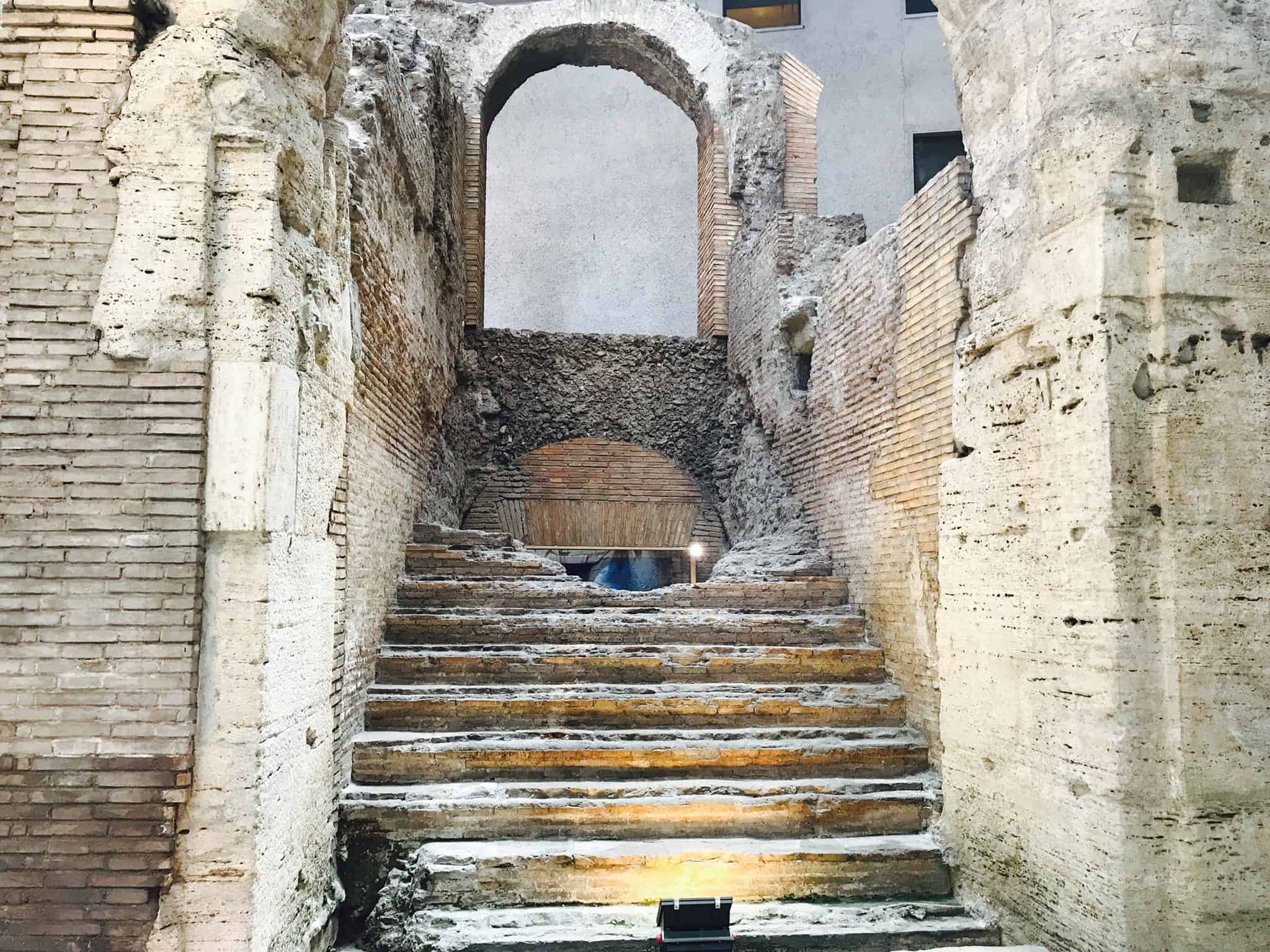
The first impression is the difference in level. You go down a ramp and in a few steps you move from 2026 to the first century, with the ancient walking surface about five meters below the street. This vertical drop is already half a lesson: it shows how much the city has built up on itself over the centuries, layer by layer. The walls show the passage: at the bottom the Roman work, above it the medieval and modern patches.
The north curve in travertine and brick
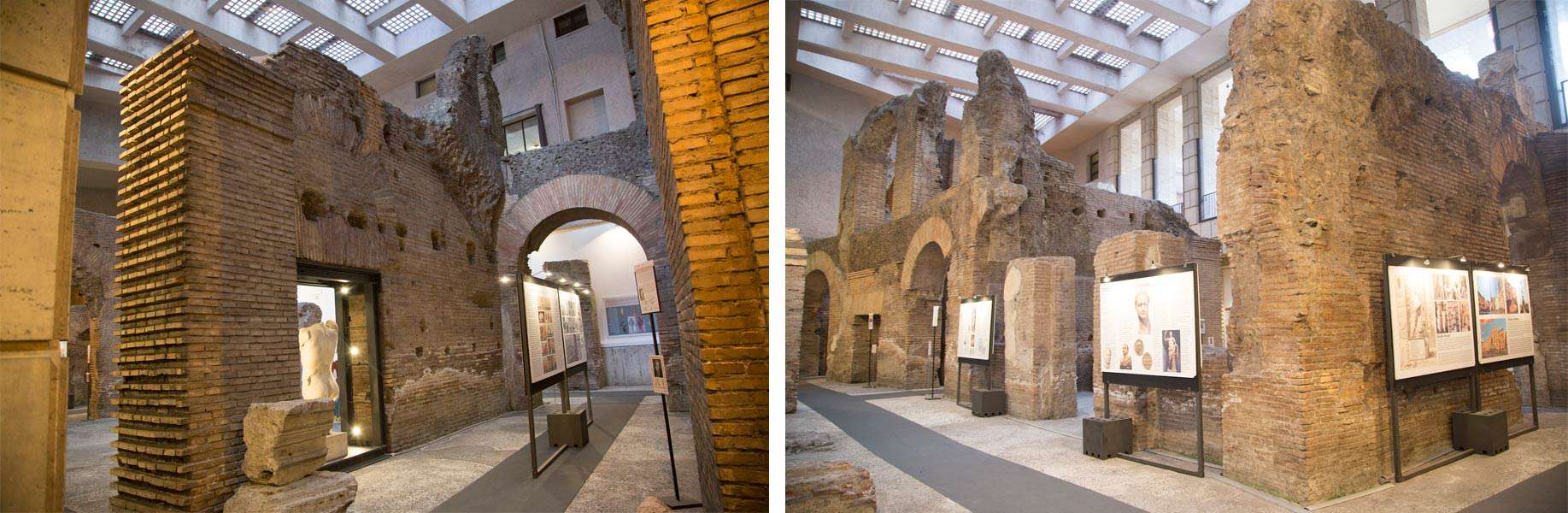
The heart of the visit is the section of the northern curve, brought back to light in the excavations of the 1930s. Here you can read the piers and arches that supported the tiers of seats, the brick facing and the stretches of travertine facing that survived the spoliation. This is the point where the stadium turned, where the athletes reversed their run. Standing before these arches, you understand better than before any model how a Roman grandstand was built to be at once light, tall and stable.
The ambulatories and the reoccupied rooms
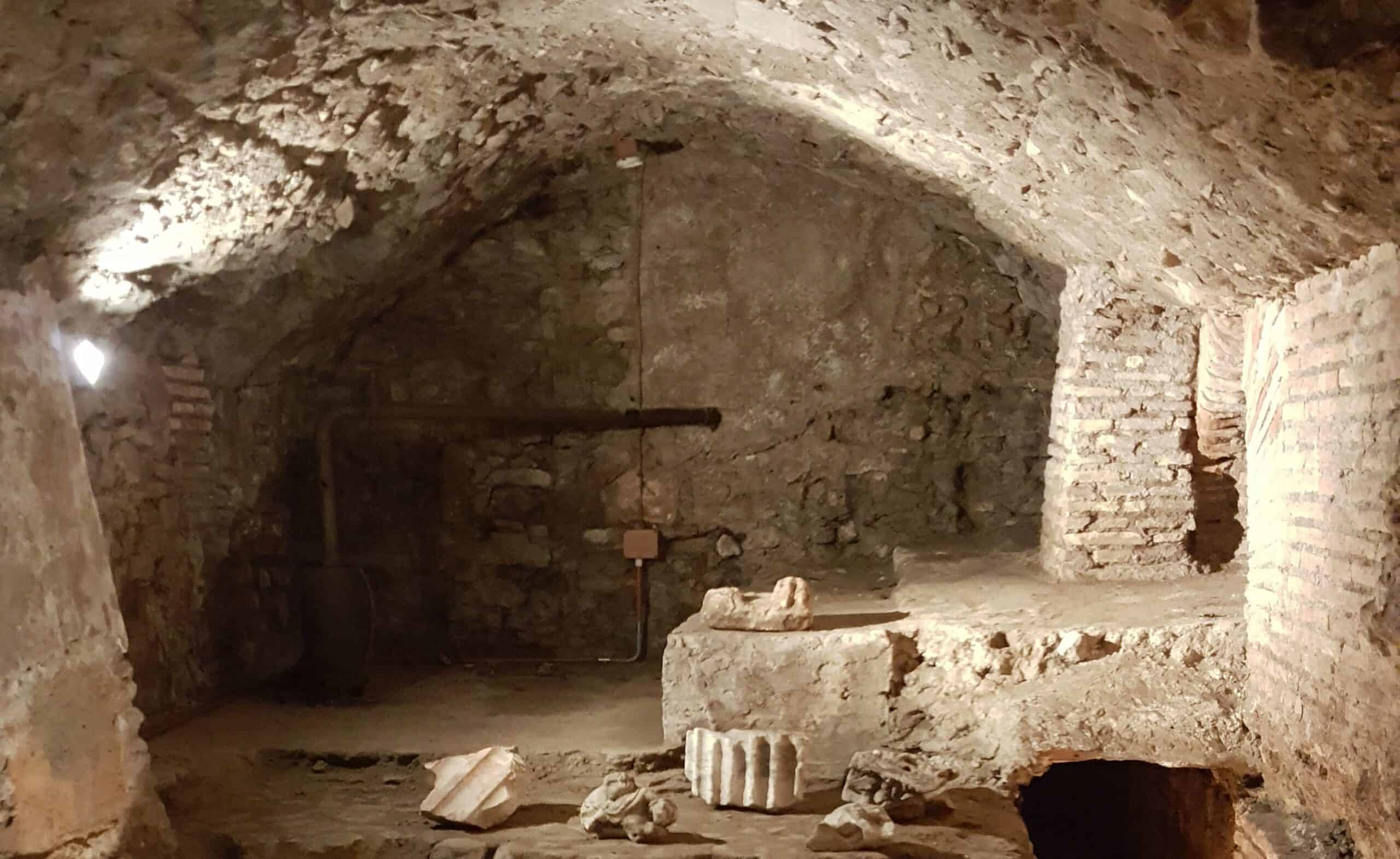
Walking along the vaulted corridors, you notice the traces of later uses: thresholds, infill walls, putlog holes, openings cut when the ancient service rooms became cellars and storerooms in the Middle Ages. It is one of the most instructive things on the site, because it shows how Rome never fully abandoned its ruins: it constantly reused them. The panels along the route reconstruct, with drawings and axonometric views, the original appearance of the building, helping to imagine what is missing.
The finds, the panels and the 3D video
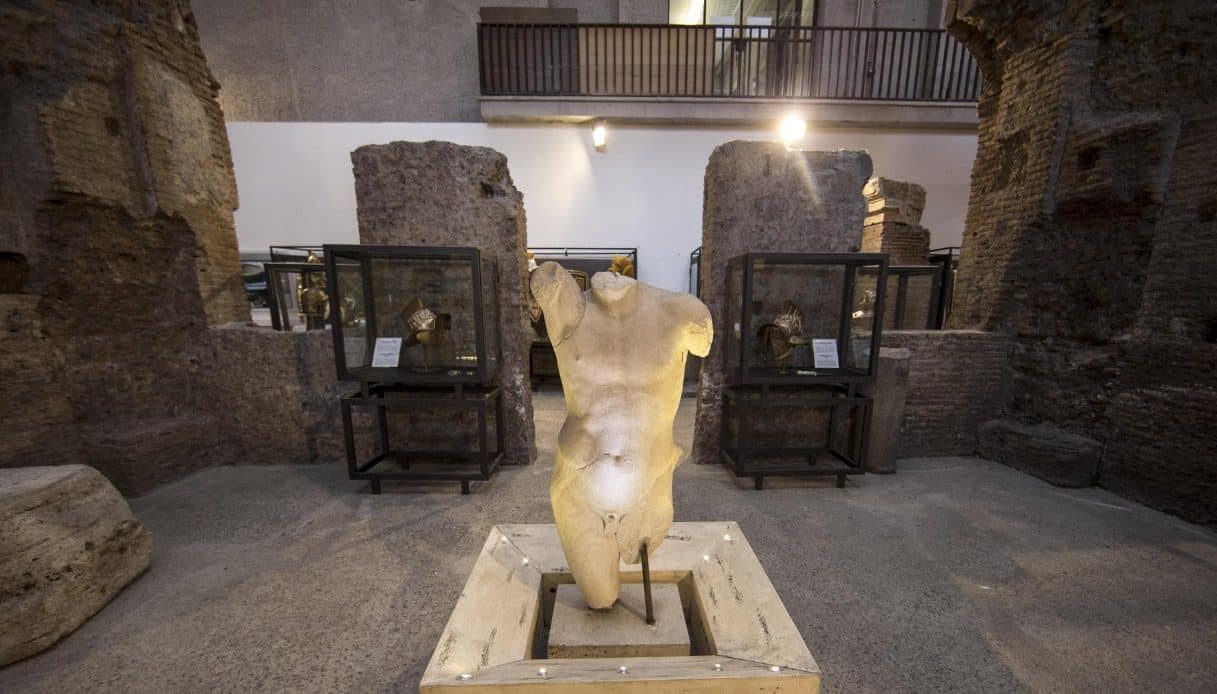
The route is set up with illustrative panels, reproductions and multimedia materials, including a three-dimensional reconstruction that virtually raises the stadium around the visitor. Don't expect large collections of statues: this is not a museum of finds, but an archaeological site in situ, whose real highlight is the masonry itself. The included audio guide marks the stops, and it is worth listening to all of it, because much of what you see would stay silent without the story.
Why Piazza Navona has the shape of the Stadium of Domitian
Here is the most beautiful story, the one that turns an ordinary stroll into a small discovery. When the stadium stopped working and the tiers were occupied by houses, the arena remained free: a long, clear space in the middle of the urban fabric. Romans continued to call it by the name of the contests held there, the campus agonis, the field of the agon. From agone, in the mouth of the people, it became n'agone, then nagone, and finally Navona. The shape of the square is the memory of the arena, the name of the square is the memory of the contests. Walking today along Piazza Navona means walking on the track where Domitian's athletes used to run.
Pasquino and the marbles of the stadium
At one corner of the square, toward Palazzo Braschi, survives a fragment of an ancient statue among the most famous in Rome: the Pasquino, a badly damaged Hellenistic group that tradition identifies as Menelaus supporting the body of Patroclus, found right in this area. From the sixteenth century it became the most famous of the talking statues, on which Romans would hang satires and jokes against the powerful at night. That such a fragment resurfaced here is no accident: the area of the ancient stadium, rich in marble, was for centuries a reservoir of reused materials, ending up in the foundations and facades of the nearby palaces. Anyone who wants to see where part of those marbles ended up can drop in at the Museo di Roma di Palazzo Braschi, which occupies the south corner of the square.
Sant'Agnese in Agone and the martyrdom under the Stadium of Domitian
On the curved side of the square, exactly above the part of the stadium that you can visit, rises the church of Sant'Agnese in Agone. The name has nothing to do with agony, as many believe: agone is once again the contest, the Greek agon. The church is linked to one of the oldest Christian traditions in Rome. According to the story handed down, the very young Agnes was led to martyrdom right among the arches of the ancient stadium, in a time of persecution, and exposed to public mockery in one of the fornices that opened beneath the tiers. To be historically honest, very little is known about Agnes's real story, and the precise location belongs more to tradition than to the documents. But it is precisely that tradition that fixed the place of worship here, above the fornix.
The Baroque church of the Rainaldi and Borromini
The church we see is a construction site of the seventeenth century, commissioned by Pope Innocent X Pamphilj, whose family had their residence palace facing the square. Work began in 1652 to a design by Girolamo Rainaldi and his son Carlo. The following year the direction passed to Francesco Borromini, who redesigned the facade, making it concave, the inward curve that still makes it seem to suck in the space, and set the dome on a tall drum, flanked by the two bell towers. After 1657 the site returned to Carlo Rainaldi and others, and inside, Gian Lorenzo Bernini also intervened. It is one of the rare places in the world where you can measure side by side the two great rivals of Roman Baroque.
The Fountain of the Four Rivers and the Pamphilj
In the center of the square, in front of the church, stands the Fountain of the Four Rivers, a masterpiece that Bernini created between 1648 and 1651 for Innocent X himself, topped by an Egyptian obelisk from the Roman period. The four river figures, the Nile, the Ganges, the Danube and the Rio de la Plata, personify the continents known at the time. Popular legend says the Nile covers its face so it won't have to look at Borromini's facade, or that a statue raises its hand to protect itself from the collapse of the rival bell tower. These are anecdotes passed down, not facts, because the fountain was completed before the church reached that form. Still, it is a perfect sign of how, in this corner of Rome, art and rivalry have come together above the ruins of a forgotten stadium.
A Curiosity About the Stadium of Domitian - Piazza Navona Underground
The best curiosity is discovered by looking up after coming back up from the underground. The proportions of Piazza Navona are not an urban invention of the Renaissance. They are the measurements of the ancient arena, preserved nearly intact for almost two millennia. The square is about 275 meters long, exactly as long as the stadium. Its curved side, in front of Sant'Agnese, follows the north curve that you visit underground. The buildings on the long sides rest on the stands. In very few other places in the world has an ancient building survived not as a ruin, but as a negative mold of a square that is still alive. There is one detail almost no one notices: the street that closes the square to the north is called Via Agonale, and it keeps in its name, without changing a single letter, the memory of the Greek agon where everything began. Domitian, an emperor whom later generations condemned to have his memory erased, saw his stadium survive more than any of his other works, disguised as a Baroque parlor. Few historical revenges are this elegant.
One Thing Nobody Tells You About the Stadium of Domitian - Piazza Navona Underground
No guidebook writes this down, but the Stadium of Domitian you visit is only a tiny fragment of a gigantic building, and this changes how you should prepare for the visit. Under Via di Tor Sanguigna you see only the north curve, perhaps a twentieth of the entire ring. The rest is still there, but walled up inside the cellars of the buildings around the square, invisible and largely inaccessible. Anyone who goes in expecting to walk the whole stadium is thrown off. Anyone who goes in knowing they are looking at a single, precious slice leaves happy. There is also a practical aspect that is worth its weight in gold: the opening hours and even the opening of this site have changed several times over the years, because management depends on concessions and temporary exhibition setups. It isn't a place you can take for granted like the Pantheon, open every day for centuries. For this reason, my advice is short and simple: book online and check the official site for opening times a few hours before you go. Many visitors arrive at the little door and find it closed for a private event or a change of setup, a disappointment that is very easy to avoid with one click.
My Advice for Visiting the Stadium of Domitian - Piazza Navona Underground
There is only one piece of advice, and it is worth more than 10. Do the underground visit before you look at the square, not after. Most tourists arrive at Piazza Navona, admire the fountains, take photos and leave without suspecting what lies under their feet. Do the opposite. Go down to the underground first, look at the travertine curve, listen to the audio guide all the way through, and then come back up to the surface. From that moment on, you won't see a square anymore, but a stadium. The fountains will seem to rest on the track, the church of Sant'Agnese will appear to be planted above the vault of the martyrdom, and the buildings will show you what they really are, disguised stands. It is the right way to read this place. In practice, book an entrance early in the morning, when the square above is still half-empty, plan on a good 40 minutes underground and one hour above to enjoy the contrast. Avoid late afternoon in summer, when Piazza Navona becomes a crush of stalls and portrait painters and loses all its quiet. And bring a light sweater even in July. Underground, it gets cooler and the air is damp.
The History of the Site and the Excavations of the Stadium of Domitian
The rediscovery of the Stadium of Domitian did not happen all at once, but in stages over five centuries. As early as the sixteenth century, while digging foundations and cellars around the square, fragments and ancient structures came to light. In the nineteenth century, with the demolitions and street widenings, sections of the perimeter arches resurfaced. The decisive turning point came in the 1930s: the demolitions pursued in that era, controversial as they were, led to excavating and bringing to light the wide sector of the north curve that is visited today. Since then, the site has been studied, consolidated and finally, in 2014, opened to the public on a permanent basis under dedicated management. The long path from buried find to visitable museum is, at heart, the same story as Rome itself: a city that never truly buries its past, but keeps tripping over it and, every so often, puts it back on display.
Another Well-Known Fact, Yet Rarely Mentioned
Many people know, or sense, that there is something ancient under Piazza Navona. Very few connect that something to a word they say every day without noticing: the name of the square. Navona does not come from nave, meaning ship, as popular imagination later embroidered by picturing the square flooded like a lake of naval battles. It comes from agone, the contest. The path is documented: in agone, that is, in the place of contests, became in everyday use n'agone, then nagone, and finally Navona, through the natural phonetic change of Roman dialect. The legend of naval battles arose later, when from the seventeenth century on the custom developed, in summer, of plugging the fountains' drains and deliberately flooding the concave floor of the square to cool off and put on a show. It was a Baroque game, not an ancient rite. The stadium was never a naumachia, never a basin for ships. Knowing that the name comes from athletics and not from water is one of those details that, once learned, are never forgotten and that make you look at the square with different eyes.
The right photo to take at the Stadium of Domitian - Piazza Navona Underground
There are millions of photographs of Piazza Navona, nearly all alike: the Fountain of the Four Rivers with the church behind it. The right photo, the one that truly tells the story of this place, is a different one, and it is taken underground. Stand facing the north curve in travertine and brick, with the audio guide still in your ear, and frame the ancient arches, letting part of the modern masonry stay at the top of the image. In a single shot you'll have the five meters of Rome, the ancient at the bottom and the present above. It is the photograph that explains why the visit is underground. If you'd rather take the surface shot nobody takes, don't point at the fountain. Move away toward the northern end of the square, near Via Agonale, and photograph the curve of the square lengthwise, so that the horseshoe shape can be read. With the low, raking light of early morning or late afternoon, the outline of the ancient stadium emerges from the paving almost on its own. One last technical tip: underground, the light is scarce and warm, so keep the camera or phone steady and resting on something, and avoid direct flash on the travertine, which flattens its grain. Ancient stone looks much better in ambient light.
Some important events that happened here in history
This corner of Rome has seen almost 20 centuries of events pass through it, and it's worth listing some of them to understand how much history has built up on top of the track.
The first event is the founding itself: the inauguration of the stadium between 85 and 86 AD and the establishment of the Capitoline agone, the four-year competition that for generations brought athletes and artists from across the Greek world to Rome. For a century and a half, every four years, this space was the stage of the most ambitious sporting and cultural contest in the Roman West.
The second is the restoration by Alexander Severus, in the third century, which put the structure back in shape to the point of earning it, for a while, a new name. The third, handed down by Christian tradition, is the martyrdom of Saint Agnes among the arches of the stadium, an event that gave rise to an unbroken cult and, 12 centuries later, to one of the most famous Baroque churches in Rome.
Then came the long medieval period: the arcades turned into houses and fortresses, the games forgotten, the arena become a market and a field. In the Renaissance and the seventeenth century, the square filled with the Pamphilj family's construction sites, with fountains and churches. The talking statues were born, with Pasquino leading popular satire. In the Baroque age, the flooded square became the setting for summer water games. And finally, in the twentieth century, the excavations that brought the north curve to light and returned it to visitors a century later. Every layer of this list can still be read, going up and down the few meters that separate the street from the arena.
Who passed through the Stadium of Domitian - Piazza Navona Underground
The first name is that of the patron, the emperor Domitian himself, who wanted and inaugurated the stadium and presided over its games, probably seated in the honor section of the curve. An uncomfortable presence: at his death, in 96, the senate decreed the erasure of his memory, yet the building outlived him. After him, in the third century, Emperor Alexander Severus worked on it with his restoration.
In the centuries of Christian Rome, according to tradition, the young Agnes passed through here on her way, led to martyrdom, and her memory has continued without interruption to the present day. In the seventeenth century, this square was the personal construction site of Pope Innocent X Pamphilj and of the greatest artists of the Baroque: Gian Lorenzo Bernini, who sculpted the Fountain of the Four Rivers here, and Francesco Borromini, who designed the concave facade of Sant'Agnese here, together with Girolamo and Carlo Rainaldi. Two rivals destined to measure themselves here, one facing the other, forever.
On the popular side, the most tenacious character of this corner of Rome is not a man but a statue: Pasquino, resurfaced from the marbles of the ancient stadium and, since the 16th century, the anonymous voice of the Romans against the powerful, with its verses posted at night. And then, simply, everyone: because over this track have passed, without knowing it, millions of Grand Tour travelers, painters, writers and curious visitors who have crossed Piazza Navona over the centuries, walking on the arena of Domitian convinced they were only walking through a beautiful Baroque square.
Things to see around the Stadium of Domitian
The good thing about this address is that it sits in the most concentrated spot in Rome: within a 10 minute walk there is more art than in entire cities. Here is how to plan a sensible half day around it.
Piazza Navona and its fountains
As soon as you come back up, the square itself is the first stop. Besides the Fountain of the Four Rivers in the center, the Fountain of the Moor to the south and the Fountain of Neptune to the north are worth a stop, both 16th-century in their layout and completed in the 19th century. The complete guide to Piazza Navona helps you read every corner.
Palazzo Altemps and the Crypta Balbi
A short walk toward Via dei Coronari is Palazzo Altemps, one of the four venues of the National Roman Museum, with a collection of ancient sculptures among the finest in the world. If you've developed a taste for archaeology under Piazza Navona, you can continue the story at the Crypta Balbi, just beyond Largo Argentina, which tells the story of the layering of the Campus Martius from antiquity to the Middle Ages, the same phenomenon you can touch under the stadium.
The Pantheon, Castel Sant'Angelo and beyond
Five minutes to the east takes you to the Pantheon, the best-preserved ancient building in Rome. A quarter of an hour to the west, along Via dei Coronari, takes you to Castel Sant'Angelo and the Bridge of Angels by Bernini. Anyone who wants to widen their view will find the Trevi Fountain nearby and, for a full day, sites such as Ostia Antica, the Trajan's Markets and the Domus Aurea, which complete the picture of imperial Rome that you see in miniature at the Stadium of Domitian.
The Stadium of Domitian with children
It can be an excellent visit for children, as long as you sell it well. The idea of races and athletes under the square captures the imagination of the youngest visitors, and the 3D reconstruction that virtually raises the stadium helps make the leap. The short duration, under an hour, is an advantage with children, who get tired in long museums. Be careful, though, with the stairs and uneven floors of the underground level: strollers must be left behind or carried in your arms, and the youngest need to be kept an eye on. The game that always works is asking them, once you're back up, to walk along the square imagining they're on the running track: nearly all of them, at that point, start running.
Accessibility of the Stadium of Domitian
It needs to be said clearly, so as not to create false expectations: the site is an underground archaeological route, with a descent, stairs and uneven ancient surfaces. Access for people with mobility difficulties or who use a wheelchair is therefore limited and must be arranged in advance with the site management, by contacting the site before the visit to find out which sections are reachable. The surface of Piazza Navona, by contrast, is flat and fully accessible: those who cannot go down can still enjoy reading the shape of the stadium from above, which remains the most poetic part of the experience.
What could be seen during the races in the Stadium of Domitian
To really understand this building, you have to imagine it full. On the days of the Capitoline agon, every four years, the stadium filled with tens of thousands of Romans who had come to watch contests that, to their eyes, seemed exotic. These were athletic competitions in the Greek style: running on the straight track, distance running around the laps, wrestling, boxing, pankration, and the long jump and the throwing of the discus and javelin. In the Greek manner, the athletes competed naked and covered in oil, a custom that seemed scandalous to the more traditional Romans and that the moralists of the time openly criticized. Winners did not receive money on the spot but crowns and honors, following the model of the sacred games, although victory could later turn into wealth and prestige in their home cities. Alongside the gymnastic events, the agon included musical, poetic and oratorical contests, held in the nearby Odeon: some recited verses in Greek or Latin, some sang while accompanying themselves on the lyre, and some improvised speeches. Domitian presided in person, dressed in Greek robes and wearing a gold crown, surrounded by the priests of Jupiter. Athletes arrived from across the Mediterranean, from Greece, Asia Minor and Egypt, drawn by the prestige of the Roman contest. Standing today in front of the travertine curve, with a little imagination, you can reconstruct that roar: the crowd thundering on the wooden and stone stands, the sand of the arena, the Greek shouts of the trainers. This contrast is what makes the visit valuable. You aren't looking at old bricks: you're looking at the physical remains of a spectacle that, for a century and a half, was among the greatest in the ancient world.
Domitian, the emperor who built the Stadium of Domitian
It's worth saying a few words about the man who wanted this building, because his figure explains a lot about the square. Titus Flavius Domitian reigned from 81 to 96 AD, the third emperor of the Flavian dynasty after his father Vespasian and his brother Titus, the same men who had given Rome the Colosseum. He was an energetic and suspicious ruler, a great builder and a capable administrator, but he was hated by the Senate, which after his assassination condemned his memory with damnatio memoriae, ordering that his name be erased from inscriptions. Domitian loved Greek culture and wanted to imitate the great sacred games of Olympia and Delphi in Rome: from this passion came both the Capitoline agon and the stadium built to host it. This is not a minor detail. While the Colosseum, commissioned by his family, celebrated the Rome of gladiators and blood, the stadium celebrated a different Rome, one that wanted to measure itself against Greece on the ground of sport and the arts. That of all his works, it is this stadium, and not his palaces on the Palatine, that survives as one of the most beloved squares in the world, is one of the finest ironies in Roman history. The man whom power wanted to forget is remembered every day by anyone who walks through Piazza Navona.
The Odeon and the Campus Martius around the Stadium of Domitian
The Stadium of Domitian was not isolated: it was part of a true quarter of games and spectacles that Domitian set up in the Campus Martius, the great plain north of the republican monumental center. Next to the stadium, toward today's Corso del Rinascimento, stood the Odeon, a covered theater for the musical and poetic contests of the Capitoline agon, capable of holding a few thousand spectators. The two buildings worked as a pair: the stadium for running and athletics, the Odeon for singing, the lyre and recitation. The Campus Martius, which still gives its name to this part of Rome, was the area where military drills and censuses had taken place for centuries, and which the imperial age transformed into a dense complex of temples, porticoes, baths and monuments. Walking between Piazza Navona, the Pantheon and the Montecitorio area, you still pass through that ancient layout without noticing: the curved streets follow buried walls, the palaces rest on Roman foundations, and every excavation for a cellar or a pipe brings to light a piece of that world. If you want the full story of this layering, the Crypta Balbi, which has made this phenomenon its theme, is just a few minutes away.
Palaces built from the stones of the Stadium of Domitian
One of the most fascinating aspects of this story is that the stadium didn't disappear: it was transformed into the buildings that surround it. When the great structure fell into disuse, its travertine and its bricks became, for centuries, a mine of building material within easy reach. The stones of the ancient stadium can be found, reused, in the foundations and walls of the palaces that define the square today: the great Palazzo Pamphilj, residence of the family of Innocent X, the nearby Palazzo Braschi at the south corner, and several other buildings in the area also came into being thanks to that reservoir of ancient material. That is why, on the surface, almost nothing remains visible of a stadium with 30,000 seats: its physical substance was recycled, block by block, into the modern city. This way of reusing the ancient is not an exception but the rule in Rome: the same thing happened to the Colosseum, the baths, and the temples. Looking at the palaces of Piazza Navona knowing that they are made, in part, of the tiers where the spectators of Domitian sat changes the stroll completely. You are not walking in front of a baroque backdrop, but inside an ancient building that has only changed its shape.
How much time to set aside and when to go to the Stadium of Domitian
To plan the visit well, two concrete pieces of information are needed. The first concerns time: the underground route takes 40 minutes, or one hour if you listen to the entire audio guide calmly and stop in front of every panel. It's not a half-day place, and that is a plus: it fits perfectly into a historic center itinerary that includes Piazza Navona, the Pantheon, and Campo de' Fiori in the same morning. I'll warn you about a common mistake: those who arrive expecting a major attraction that needs a long visit are disappointed, while those who treat it as a dense and surprising stop within a broader stroll come away enthusiastic. The second piece of information concerns the season and the hour. The best time is early in the morning, right after opening, when the square above ground is still quiet and the contrast between the silence of the underground and the life of the square is best enjoyed. Roman summer, between June and September, turns Piazza Navona into a crowd from the afternoon on: if you come in those months, aim for the early hours. In winter the square is emptier, and the low, raking light of January is perfect for reading the shape of the stadium on the paving stones. Anyone planning their Roman itinerary can lean on the page Il mio viaggio to line up the stops without wasting time.
Quick questions about the Stadium of Domitian - Piazza Navona Underground
How much does a ticket for the Stadium of Domitian cost?
Entry to the archaeological route starts at around 8 euros with the audio guide included. Guided tours and combined tickets cost more. Prices change, so it is worth checking them on the official website stadiodomiziano.com when you book.
How long does the visit to the Stadium of Domitian take?
Between 40 and 60 minutes, audio guide included. It is a compact route, suitable for fitting into a historic center morning together with Piazza Navona and the Pantheon.
Where exactly is the entrance to the Stadium of Domitian?
At Via di Tor Sanguigna 3, at the north end of Piazza Navona, near the church of Sant'Agnese in Agone. It is a discreet little door at street level, from which you go down underground.
Do I need to book to visit the Stadium of Domitian?
Booking is strongly recommended. Hours and even opening itself vary, the site hosts temporary exhibitions and closes for events, and booking online through the official site avoids the disappointment of finding the door closed.
How do you get to the Stadium of Domitian by public transport?
By bus with lines 70, 81, 87, 130, 186, 492, and 628, stopping at Corso del Rinascimento or Senato. Alternatively, take tram 8 and buses 40 and 64 as far as Largo di Torre Argentina, then walk for 10 minutes. The metro does not serve the square directly.
Can you see the whole ancient stadium?
No. Only the north curve is visited, a small section of the original building. The rest is buried in the cellars of the palaces around the square and is not accessible.
Why is the Stadium of Domitian visited underground?
Because in 2,000 years the level of the city has risen by four or five meters. The floor of the ancient arena is today below the street. It was not underground originally. It is Rome that grew up over it.
What is the difference between the Stadium of Domitian and the Colosseum?
The Colosseum is an elliptical amphitheater for gladiators and hunts. The Stadium of Domitian is a horseshoe-shaped stadium for athletics on the Greek model. They are two different types of building, with different functions.
Why does Piazza Navona have this shape?
Because it exactly traces the arena of the stadium: the palaces rest on the tiers, and the curved part in front of Sant'Agnese is the north curve of the ancient building. The square is the negative mold of the stadium.
Where does the name Navona come from?
From the word agone, meaning contest. Agone became n'agone and then Navona. It does not derive from nave, nor from naval battles, which are a later legend.
Can you take photos at the Stadium of Domitian?
Generally yes, without flash and without a professional tripod. The light underground is dim and warm: it's best to keep the phone steady and make use of the ambient light on the travertine.
Is the Stadium of Domitian suitable for children?
Yes, the short length and the 3D reconstruction appeal to younger children. Watch out for the stairs and the uneven floors: strollers aren't comfortable and kids need to be supervised.
Is the Stadium of Domitian wheelchair accessible?
Accessibility is limited because of the descent and the uneven ancient surfaces. It should be arranged in advance with the management. The square at street level, however, is flat and accessible.
What was the Capitoline agon?
A competition established by Domitian in 86 AD, held every four years, with contests in athletics, music, poetry and eloquence in honor of Jupiter Capitolinus. The stadium hosted the athletic part.
Who built the Stadium of Domitian?
The emperor Domitian, who inaugurated it between 85 and 86 AD. It was the first and only masonry stadium in ancient Rome, restored in the third century by Alexander Severus.
What is the connection between the Stadium of Domitian and the church of Sant'Agnese?
The church rises right above the sector of the stadium you visit, at the spot where tradition places the martyrdom of Sant'Agnese among the vaults of the tiers. It was built in the 17th century for Innocent X.
When is the best time to visit the Stadium of Domitian?
Early in the morning, when the square at street level is still quiet. It's best to avoid late summer afternoons, when Piazza Navona fills up with stalls and portrait artists.
Is there a cloakroom or luggage storage at the Stadium of Domitian?
The site is small and the facilities are basic. It's best to arrive without bulky bags and in comfortable clothing, keeping in mind that underground the temperature is cooler and the air is damp even in summer.
How long is the wait in line at the Stadium of Domitian?
Much less than at the major monuments: entry is limited and bookable, so with a reservation the wait is minimal. Without a reservation, on exhibition days, there may be some lines.
If I had to say in one sentence why it's worth going down into Via di Tor Sanguigna, I'd say this: it's the visit that changes forever the way you see one of the most famous squares in the world. It's not a major museum, it's not a monumental site that takes half a day, and it should be approached with the right expectations. But 40 minutes underground, in front of the travertine curve of a stadium nobody expects, are worth more than many celebrated stops. Go early, book ahead, listen to the audio guide to the end, and come back up to look at Piazza Navona knowing, at last, what you're walking on.


Article written by the editorial team at TourLeaderPro, contact them for Tours and Private/Corporate/V.I.P. Experiences.
Planning a trip to Rome? English-language guides to visiting the city are available at ItalyPlanner.com.