Campo de’ Fiori
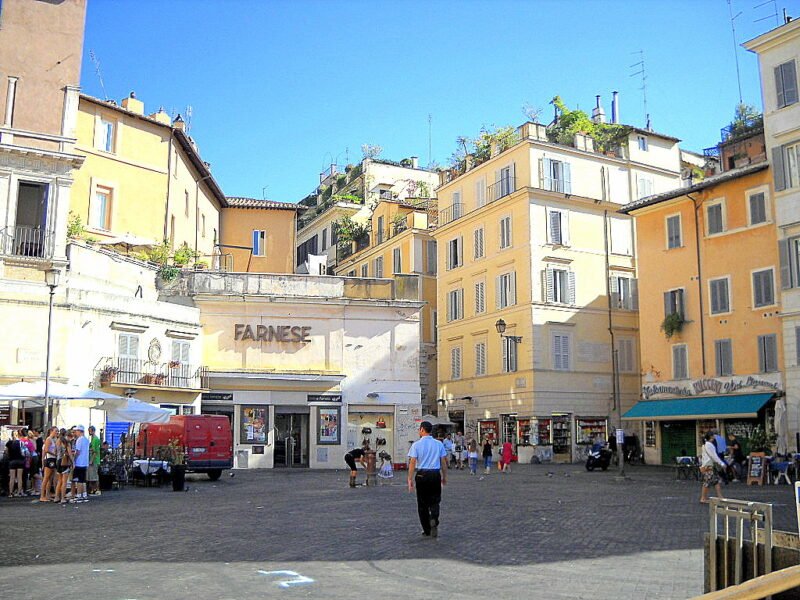
In short. Campo de’ Fiori is the rectangular piazza that opens between Via dei Giubbonari and Piazza della Cancelleria, on the border between the Parione district and the Regola district, in Rome’s Historic Center.
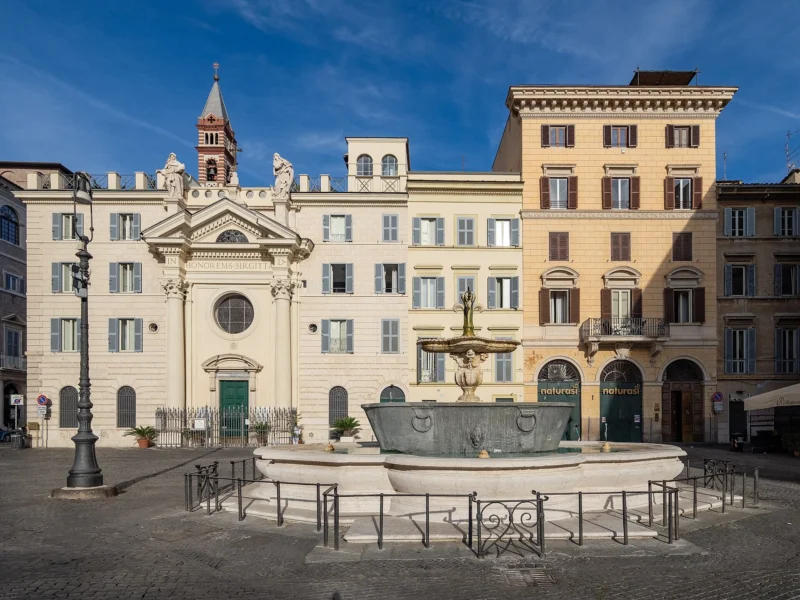
Campo de’ Fiori is the rectangular piazza that opens between Via dei Giubbonari and Piazza della Cancelleria, on the border between the Parione district and the Regola district, in Rome’s Historic Center. The postal address is simply Piazza Campo de’ Fiori, 00186 Roma. You can come and go freely at any hour, there is no gate, no ticket office, no opening hours: the piazza is public space 24 hours a day and visiting costs nothing. The neighborhood market takes over the paving every morning from Monday to Saturday and closes on Sunday, and around lunchtime the vendors pack up and the piazza empties out: for the exact setup and teardown times, it's best to check Roma Capitale's guidelines on neighborhood markets, which can change with the season and with local ordinances. There is no metro station nearby: the most convenient transport hubs are Largo di Torre Argentina and Corso Vittorio Emanuele II, both four or five minutes on foot, served by many surface lines. Check the route and the active lines on the Atac route planner, which is the only reliable source because detours in the Historic Center are frequent. The whole area is inside the Historic Center's Limited Traffic Zone, so arriving by car is a terrible idea. A detail worth more than a thousand adjectives: Campo de’ Fiori is the only historic piazza in Rome that no church faces.
If this is your first time planning a day in the Historic Center, the page on Tourist Attractions in Rome helps you fit Campo de’ Fiori in with the rest of the day, because the piazza works well as a starting point in the morning and as a place to come back to in the evening, much less as a stand-alone destination.
Campo de’ Fiori in practice: hours, costs, access
Where exactly Campo de’ Fiori is
The piazza is an elongated rectangle of about 120 meters by 50, oriented from northwest to southeast, wedged between four streets that define its character. To the east starts Via dei Giubbonari, the street of the jerkin makers, which leads toward Via Arenula and the Tiber. To the west opens Via del Pellegrino, the old route of pilgrims heading to St. Peter's. To the north Via dei Baullari cuts toward Corso Vittorio Emanuele II and toward Palazzo della Cancelleria. To the south Vicolo del Gallo and Via dei Cappellari run down toward Piazza Farnese and the Regola district. If you arrive from Corso Vittorio Emanuele II, you take Via dei Baullari and find the piazza in front of you in 30 seconds. If you arrive from the Tiber, you climb up Via dei Giubbonari and see it open up suddenly, which is the best way to meet it the first time.
How much it costs to visit Campo de’ Fiori
Nothing. There's no ticket, no reduced rate, no reservation, and no free first Sunday of the month because every day is free. The only expenses are the ones you choose: a kilo of fruit at the market, a slice of pizza bianca, a coffee at the counter. Be wary of anyone who offers you a paid entrance to Campo de’ Fiori: it doesn't exist. What does exist are paid guided tours of the district, which are something else and only make sense if the guide is licensed and really knows the stratigraphy of the area.
The best time of day
Campo de’ Fiori changes its skin three times in 24 hours, and if you visit only once you know a third of it. From first light until mid-morning it's a market: the noise of crates, vegetable stalls, vans reversing. From early afternoon until sunset it's an empty, swept piazza, with the bronze of Giordano Bruno finally visible in full and the facades catching the low light. After dinner it becomes one of the most crowded and loudest places in the city. Our opinion: the right time is 14:30, when the market has been taken down and the evening crowd hasn't arrived yet. It's the only moment when the piazza reads as architecture instead of a backdrop.
How to get to Campo de’ Fiori
On foot, which is the right way
From Piazza Navona you get there in 7 minutes via Corso Vittorio Emanuele II and Via dei Baullari. From the Pantheon it takes a good 12 minutes, again crossing Corso Vittorio. From Largo di Torre Argentina 5 minutes is enough, along Via dei Giubbonari or Corso Vittorio. From Trastevere you go by Ponte Sisto and Via dei Pettinari, just under a quarter of an hour. From Piazza Venezia it's 20 minutes. From St. Peter's, following the pilgrims' route over Ponte Sant’Angelo, along Via dei Banchi Vecchi and Via del Pellegrino, it's a little over half an hour's walk, and you retrace exactly the road that in the 15th century was called Via Florea. It's the best way to understand why this piazza became important: not for its beauty, but for its position.
By public transport
There is no metro nearby and no active project to bring one here: Line C, when it reaches the central archaeological area, will still be far away. There are two reference points. The first is Corso Vittorio Emanuele II, with stops near Chiesa Nuova and Piazza San Pantaleo, served by several bus lines that connect the Vatican and Trastevere with Largo di Torre Argentina and Piazza Venezia. The second is Largo di Torre Argentina, the most important hub of the Historic Center, where buses and trams converge. Lines change with detours and construction sites, so the exact number should be checked on the Atac website or the official app on the same day: it's not worth memorizing a number here that in six months might no longer run.
By car, taxi, bike
You can't get here by car. Campo de’ Fiori is inside the Historic Center's Limited Traffic Zone, the gates are electronic and the fine arrives at your home. There is no parking in the piazza and the few side spaces are reserved for residents and market operators. A taxi can get you as far as Corso Vittorio Emanuele II or Piazza Farnese, but the last stretch is on foot anyway. Biking works well, with the warning that the sampietrini paving is uneven and that in the morning, with the market set up, the piazza is effectively pedestrian. Shared scooters are regulated and the permitted parking areas change often: it's best to check the app before leaving one wherever you happen to be.
Why it's called Campo de’ Fiori
The flowering meadow that was here before the piazza
The most solid explanation is also the most literal. Until the 15th century Campo de’ Fiori didn't exist as a piazza: in its place was a flowering meadow with a few cultivated gardens, a green void between the ancient ruins and the medieval houses. Hence the name, which in medieval Latin appears as Campus Florae, field of flowers. There is no mystery and no legend: there was grass, there were flowers, there were gardens, and the Romans called things by their name. The fact that today the piazza hosts a fruit and vegetable market, and for decades cut-flower stalls too, is a coincidence that everyone likes but that has no causal link to the place name.
The legend of Flora, Pompey's lover
There is a second explanation, much more novelistic and much less reliable: the name would derive from Flora, the woman loved by Pompey the Great, who had built his theater right next door. The tradition is old and keeps circulating in guidebooks, but scholars consider it unreliable. It should be told for what it is, a nice story born after the fact to lend dignity to an agricultural place name: the link with Pompey, in this piazza, is real and imposing, but it runs under the paving and doesn't pass through the name.
That apostrophe after the de
Campo de’ Fiori is written with an apostrophe after the de, and it's not a typographic whim. That mark is a truncation of the old plural article dei, the same form found in Lorenzo de’ Medici or in Lungotevere de’ Cenci. Writing Campo dei Fiori is not a serious spelling mistake, but it betrays the historical form of the name. Those who work with tourists notice right away: the correct spelling is the one with the truncated de, and it's also the one that appears on the marble street signs of the district.
The piazza with no church: the anomaly of Campo de’ Fiori
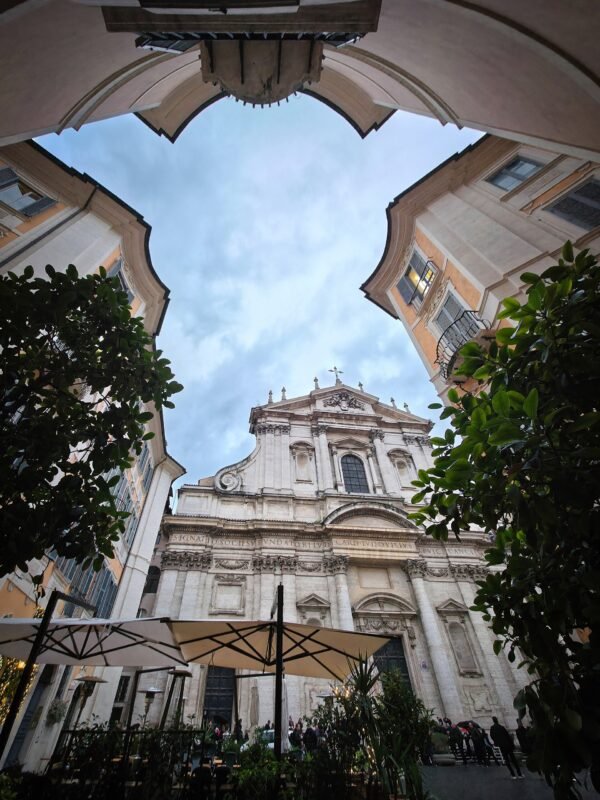
It's the fact that usually strikes people most the first time they hear it. In a city where every open space has its sacred facade, Campo de’ Fiori is the only historic piazza in Rome that no church faces. Look at the four sides: palaces, houses, shops, hotels, restaurants, not a single bell. The churches are there, and they are huge, but they begin right after the corner: San Lorenzo in Damaso Church absorbed into Palazzo della Cancelleria to the north, Santa Brigida Church on Piazza Farnese to the south, Sant’Andrea della Valle Church just past Corso Vittorio, Trinità dei Pellegrini Church toward the Tiber. It's not by chance and it's not an anticlerical choice: the piazza came late, it formed in a leftover agricultural space already surrounded by established parishes, and when it took urban shape there was no longer room or reason for a new church. The result, though, carries enormous symbolic weight, because it is exactly in this piazza, secular by accident, that the Inquisition decided to burn Giordano Bruno.
The Theater of Pompey under Campo de’ Fiori
Rome's first stone theater
Under Campo de’ Fiori and under the blocks immediately east of the piazza, the base of the Theater of Pompey is preserved, built between 61 and 55 BC at the wish of Pompey the Great. It was the city's first permanent stone theater, at a time when Roman law required dismountable wooden theaters for religious and moral reasons. The dimensions were out of scale even for Rome: an outer diameter of about 150 meters and an estimated capacity of around 17,000 seats, arranged on a cavea supported by stacked orders of arches. For a couple of centuries it was the largest entertainment building in the Roman world, before the Colosseum.
The trick of the Temple of Venus Victrix
Pompey got around the ban with a ploy that is both legal and architectural: he built at the top of the cavea a temple dedicated to Venus Victrix, so that the whole seating area could be presented as the monumental staircase leading up to the temple. Formally it wasn't a theater with an attached sanctuary: it was a sanctuary with a very comfortable staircase where people sat. The Senate couldn't object without attacking the cult of Venus, and the theater stayed standing. It's one of the most elegant examples of how in Rome religion was used as a tool of urban planning.
The curve you can still see, on Via di Grotta Pinta
The theater is gone, but its shape survived in the land registry. Leave Campo de’ Fiori toward Piazza del Biscione and turn into Via di Grotta Pinta: the street draws a clean arc, and the houses lining it are built on top of the radial walls of the cavea. That arc is the outline of Pompey's hemicycle, fossilized in a medieval block. Via del Biscione and Via dei Giubbonari keep alignments that depend on the same structure. It's the clearest example I know, in all of Rome, of how a monument can disappear and still leave its imprint on the city's plan for 20 centuries.
The Curia of Pompey and the Ides of March
The complex also included the Curia Pompeia, a large hall for Senate meetings overlooking the portico behind it, in the area that today corresponds to the sector between Largo di Torre Argentina and Teatro Argentina. It's there that on the Ides of March in 44 BC Gaius Julius Caesar was assassinated, at the foot of the statue of Pompey, because that day the Senate was meeting in the Curia of his old rival and not in the Forum. Whoever walks through Campo de’ Fiori and then reaches the Largo Argentina sacred area is walking, without knowing it, the two extremes of the same Pompeian building site. In the same area there is also the Largo Argentina cat sanctuary, which occupies a corner of the excavations and is one of the few cat colonies in the center that can be visited.
What remains visible of the theater
The ancient structures survive in the cellars and basements of the buildings that were put up on top: some are absorbed into the basements of hotels and restaurants in the Biscione area and on Via di Grotta Pinta, and every now and then they are accessible on request or during special openings. There is no public, permanent archaeological route of the Theater of Pompey, so any promise of a visit should be checked directly with whoever organizes it. One trace, however, is public and free, and almost no one notices it: the red Egyptian granite columns in the courtyard of Palazzo della Cancelleria come, according to the tradition documented by studies of the palace, from the ruins of the theater itself. Ancient material recycled 150 meters from the point where it was quarried.
Campo de’ Fiori in the Middle Ages: the Orsini de Campoflore
Before the piazza there was the fortress. Already from the second half of the 13th century the Orsini family, partly taking over from their ancestors the Boboni, acquired an imposing estate in this sector: houses with towers, crenellated walls, landholdings that occupied the whole southeast side of today's Campo de’ Fiori and that rested in large part on the ruined structures of the Theater of Pompey. A portion of that land belonged to the church of Sant’Angelo in Pescheria, the same one that still today is wedged into the ruins of the Portico of Octavia on the edge of the Ghetto.
The position was strategic: the complex guarded the stretch of Via Florea between today's Piazza del Biscione and Via dei Giubbonari, and leaned on the fortified structures of the nearby Torre dell’Arpacata. From that foothold came the name of the family branch, the Orsini de Campoflore, or simply Orsini de Campo, which included the Vicovaro and Tagliacozzo lines. The detail that surprises is how long it lasted: still at the beginning of the 18th century the Orsini family claimed baronial rights over the piazza, that is, over a space that in the meantime had become public, mercantile and papal. The main body of the residence, with access from Piazza del Biscione, was sold in the 15th century to the Condulmer, returned to the Orsini in the 16th century, then passed to the Pio di Savoia who completely renovated the building, and finally to the Righetti and other owners. The palace that today faces Piazza del Biscione under the name Palazzo Pio Righetti is the last layer of this sequence.
The 15th century: how Campo de’ Fiori became a piazza
The paving ordered by Callixtus III in 1456
The birth date of the modern piazza is 1456. Campo de’ Fiori lay on the border with the Regola district, near the Banchi area, along the route that led to the Vatican, and the growing importance of the place made it unsustainable to leave it as a meadow. Pope Callixtus III had the area paved, as part of a broader project to reorganize the whole Parione district. It was that paving that turned a field into a piazza: from then on a market could be set up there, processions could pass through, and building around it could be done with some criteria.
Via Florea and Via Mercatoria
The piazza gave its name to the road axis known in the 15th century as Via Florea, which connected Sant’Angelo in Pescheria with Ponte Sant’Angelo by way of today's Via del Portico d’Ottavia, Via dei Giubbonari (then Via Pelamantelli), Via del Pellegrino and Via dei Banchi Vecchi. It was the artery that carried pilgrims and merchants from one end of the bend of the Tiber to the other. The same route, from Via dei Giubbonari to Via del Pellegrino, also took on the name Via Mercatoria from the 15th century, and the double name says it all: the same street was traveled by devotion and by commerce, at the same time and on the same feet.
Paul III, Via dei Baullari and the great palaces
The reorganization continued for a large part of the 16th century. At the will of Paul III, the cross street of Via dei Baullari was opened and straightened, running from Via Papalis, near the houses of the Massimo family, to Piazza del Duca, that is, Piazza Farnese. That urban cut stitched Campo de’ Fiori to the official route of the papal processions and multiplied its value. Within a few decades the two buildings that still define its setting today rose around the piazza: the new Palazzo della Cancelleria to the north and Palazzo Farnese to the south. Campo de’ Fiori became a daily passage for ambassadors, cardinals, bankers, attorneys. A service piazza that suddenly found itself at center stage.
The horse market, the inns and the workshops
Twice a week, Monday and Saturday
The prosperity brought by the new layout turned into specialized trade. Campo de’ Fiori became home to a thriving horse market held twice a week, on Monday and Saturday, and hotels, inns and craft workshops rose around the piazza. Whoever had to travel bought their mount here, found the farrier here, slept here the night before leaving. It's the functional origin of the piazza's commercial vocation, and it explains why the 19th-century fruit and vegetable market settled right here and not elsewhere: the habit was already there, the paved space was already there, the rules were already there.
Vannozza Cattanei and the Locanda del Gallo
At the corner with Via dei Cappellari the building of the Locanda del Gallo, also called the Locanda della Vacca, is still recognizable. It was owned by Vannozza Cattanei. It's worth knowing who she was. Vannozza Cattanei, born in 1442 and died on November 26, 1518, was the longtime partner of Cardinal Rodrigo Borgia, the future Pope Alexander VI, and the mother of his four recognized children: Cesare, born in 1475, Giovanni duke of Gandia, Lucrezia, born in 1480, and Goffredo. She was not a passive figure. She ran inns frequented by high-ranking clients, lent money at interest and built up a considerable fortune, moving with notable independence in a Rome that granted women little. She died at 76 and received a solemn funeral, with burial in Santa Maria del Popolo Church. Her gravestone, found in 1948, is kept in the Basilica of San Marco. Whoever walks down Vicolo del Gallo passes a few meters from her business, and there's no sign saying so.
The street names are a list of trades
Around Campo de’ Fiori the street names work like a register of guilds. Via dei Giubbonari were the sellers of jerkins. Via dei Cappellari were the hatmakers. Via dei Balestrari were the crossbow makers. Via dei Chiavari were the key smiths. Via dei Baullari were the makers of travel trunks, a trade that made sense here precisely because of the horse market and the inns. Walking for five minutes along these streets means reading the merchandise index of a Renaissance city. Many of those craft workshops have been replaced by clothing stores and bars, but on Via dei Cappellari a few restoration and carpentry workshops still hold out, and they're worth the detour.
The gallows: Campo de’ Fiori as a place of execution
Alongside the fruit crates, for centuries this piazza was a place of public death. Campo de’ Fiori was where executions and punishments with the strappado took place, the torture that consisted of lifting the condemned by the wrists tied behind the back and letting him drop suddenly, dislocating his shoulders. It was not a Roman exception: the cities of the ancien régime carried out sentences in the piazza because the punishment had to be seen, and the busiest piazza guaranteed the largest audience. Campo de’ Fiori had all the right features: big, central, paved, with no church to desecrate, crossed every day by thousands of people.
This double nature, market by day and gallows when needed, explains the mental physiognomy of the piazza much better than any architectural description. Romans came here to buy horses and came here to watch people die, and the two acts were not separated by any threshold. It's an uncomfortable thought, and it's exactly the thought that the monument to Giordano Bruno wanted to fix at the center of the paving in 1889.
Giordano Bruno: the trial and the burning of February 17, 1600
From Nola to Europe
Filippo Bruno was born in Nola in 1548 and took the name Giordano when he entered the Dominican order. He left the habit, traveled half of Europe, taught and published in France, England, Germany. His main works were printed in 1584 in London: De l’infinito, universo e mondi and the Spaccio de la bestia trionfante. Bruno did not merely defend the Copernican system: he argued for the infinity of the universe and the plurality of inhabited worlds, a position that demolished the hierarchical structure of the cosmos on which a large part of the theology of the time rested. He was not an astronomer who measured, he was a philosopher who reasoned about the consequences, and it was for those consequences that he was tried.
The arrest, the eight years in prison, the sentence
Bruno was arrested in Venice on May 23, 1592 after the denunciation of Giovanni Francesco Mocenigo, the Venetian patrician who had hosted him and who accused him of blasphemy, of denying the Trinity and transubstantiation, and of practicing magic arts. In 1593 he was handed over to the Roman Inquisition. Eight years of imprisonment and interrogations followed. The sentence of condemnation for heresy came on February 8, 1600. Tradition reports that Bruno, having heard the sentence, turned to the judges with a phrase that remained famous: perhaps you pronounce this sentence against me with greater fear than I receive it, in Latin Maiori forsan cum timore sententiam in me fertis quam ego accipiam.
The morning of February 17
On Thursday, February 17, 1600 Giordano Bruno was taken to Campo de’ Fiori and burned alive. The sources report that he was prevented from speaking by a gag on his tongue, the so-called mordacchia, a routine precaution for the condemned whose last words were feared. The ashes were scattered in the Tiber. For almost three centuries the exact spot stayed unmarked: a market piazza where every morning vegetables were sold on the point where the pyre had been lit. The choice of Campo de’ Fiori was not random, because it guaranteed maximum visibility and maximum foot traffic: the execution had to be a message, and the message had to be delivered to the largest possible number of Romans.
The monument to Giordano Bruno by Ettore Ferrari
The 1876 committee
In 1876 a group of university students, committed republicans, formed a committee with the aim of erecting a bronze monument to the philosopher from Nola on the very spot of the pyre. The proposal quickly became an international cause: intellectuals from half the world joined, among them Walt Whitman, Ernest Renan, Victor Hugo, Silvio Spaventa and Henrik Ibsen. On the other side was the very harsh hostility of the ecclesiastical world, which correctly read the operation for what it was, that is, a political act in a Rome that had just become capital of the Kingdom of Italy.
The inauguration on June 9, 1889
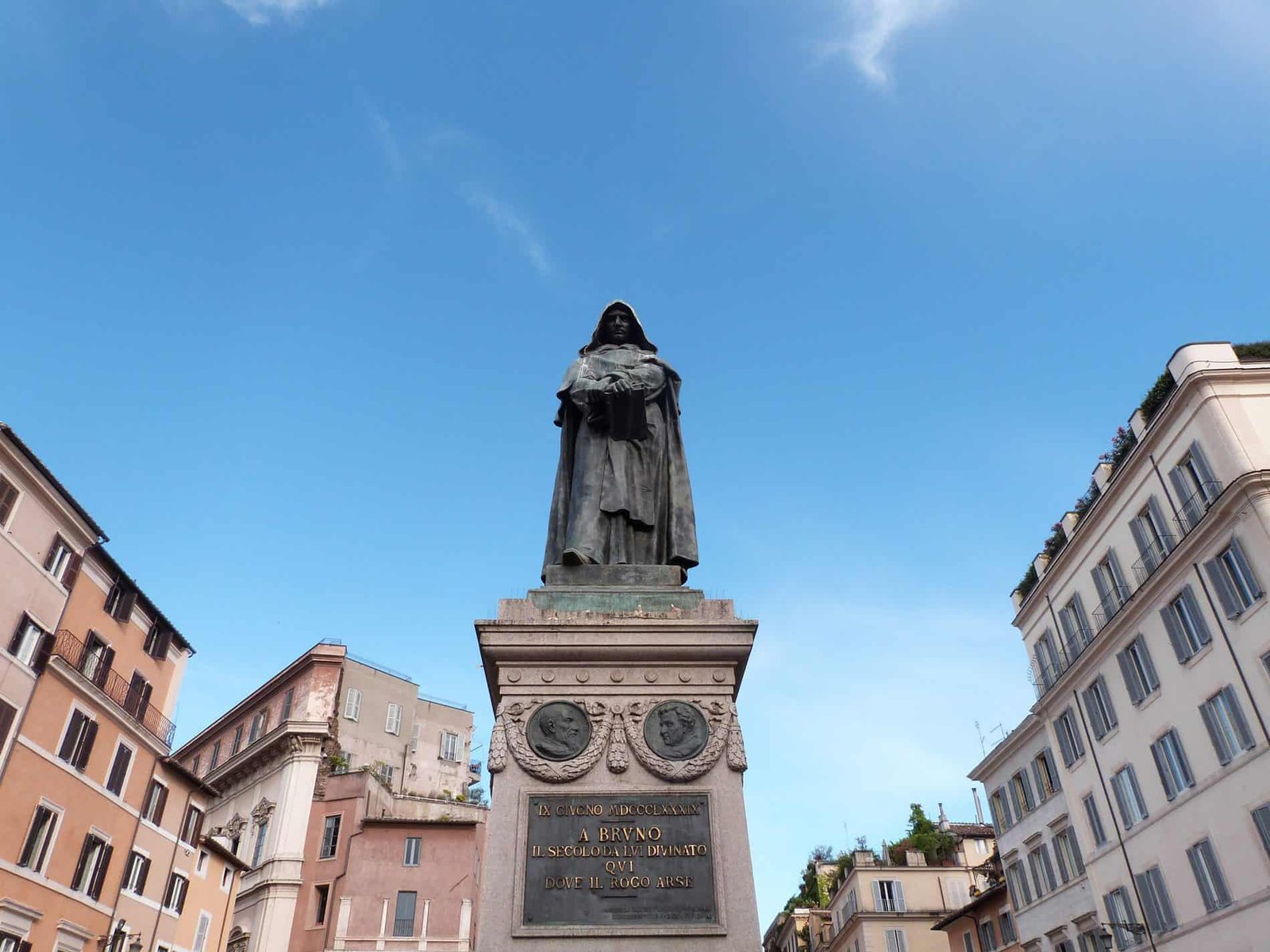
The monument, the work of the sculptor Ettore Ferrari, was inaugurated on June 9, 1889. Ferrari was a Freemason, and the statue was openly born as a manifesto of free thought. The reaction was proportionate: Pope Leo XIII spent the day fasting and praying, and for years the Holy See tried to obtain the removal of the statue, an attempt that died out only when the Fascist regime refused to proceed. Today the bronze is one of the most recognizable meeting points in Rome, and every February 17 it draws secular commemorations and offerings of flowers.
The eight medallions: who the faces on the base are
The base is a parallelepiped of pink Baveno granite, and it carries eight medallions and four plates cast in bronze by the Crescenzi foundry of Rome. The medallions portray eight figures united by their clash with ecclesiastical authority: Paolo Sarpi and Tommaso Campanella, Petrus Ramus and Giulio Cesare Vanini, Aonio Paleario and Michael Servetus, John Wyclif and Jan Hus. The presence of Servetus, put to death by the Calvinists and not by the Catholics, is the key to reading the whole program: the monument did not want to be an anti-Catholic act, but an act against every oppression of thought, from whatever side it came. Try walking all the way around the base reading the names: it's 90 seconds that are worth more than many guided tours.
The plates and Giovanni Bovio's epigraph
Three of the four plates carry relief scenes: Bruno teaching at Oxford, Bruno before the Holy Office that condemns him, Bruno at the stake. The front plate bears the inscription dictated by Giovanni Bovio: to Bruno, the century he foresaw, here where the pyre burned. It's 11 words and they sum up an entire cultural season. The statue looks toward the Vatican, with the hood pulled down over the face and the hands crossed on a large closed book, an image of knowledge silenced. The orientation is deliberate and allows no neutral readings.

The Campo de’ Fiori market
From 1869 to today
The fruit and vegetable market of Campo de’ Fiori has been running since 1869, when the administration moved here the food trade that until then occupied Piazza Navona. Since then, every morning from Monday to Saturday, the stalls occupy the paving around the statue. It's one of the oldest neighborhood markets still active in the Historic Center and, together with the Esquilino one and the Testaccio one, one of the few that survived the transformation of the center into a tourist area. If you want an honest comparison between a historic market and a real neighborhood market, the new Testaccio market is the proof: there you go to do your shopping, here you also go to look.
What you actually buy
The fruit and vegetable stalls remain the heart of the market, and some are run by the same families for three generations. Alongside them the stalls of spices, colorful dried pasta, chili peppers, packaged condiments and food souvenirs have multiplied, selling mostly to people passing through once. You can tell the difference by eye in half a minute: where the goods are displayed in wooden crates, with handwritten tags and seasonal produce, you buy well. Where the stall is a display of identical jars with labels in English, you are buying a memento, not food. Neither is a scandal, but it's good to know what you're taking home.
How to behave at a Roman stall
Rule number one: don't touch the fruit. At a traditional stall the vendor chooses, you point. Rule number two: ask the price first, and ask what it goes for per kilo, not how much that one there costs. Rule number three: if you buy half a kilo of tomatoes and ask whether they're good for salad or for sauce, you'll get a serious answer, because it's exactly the question Romans have always asked. Rule number four, the most important for travelers: check the displayed price and count your change. In a piazza crossed every day by thousands of people passing through, personal vigilance is the only defense that always works.
The 1943 film with Anna Magnani and Aldo Fabrizi
The popular atmosphere of the market is fixed forever in Campo de’ fiori, the 1943 film directed by Mario Bonnard with Anna Magnani as the fishmonger Elide and Aldo Fabrizi as the fruit seller Peppino. It was shot while the war was going on and it gives back a piazza that no longer exists: that of vendors shouting at each other, of rivalries between stalls, of a neighborhood where everyone knows each other by name. If you've seen the film and then walk into the piazza at eight in the morning, you still recognize the geography, less the people. It works as preparation, and it lasts an hour and a half.

The Terrina Fountain and the water of Campo de’ Fiori
Giacomo della Porta, 1590
The fountain that today occupies the northern side of the piazza is the copy of an original with a long history. The Terrina Fountain was designed and built by Giacomo della Porta in 1590, commissioned by Pope Gregory XIII, and it is the last of the many public fountains the architect built for Rome's water network. The inner basin was in white marble, with a rounded profile that already in itself suggested the shape of a bowl.
The 1622 lid and the inscription
In 1622 a dome-shaped travertine lid with a central knob was added to the basin, and from then on the fountain took on the look of a gigantic kitchen tureen, which earned it its popular nickname. At the base of the knob the inscription was carved that is the real reason it's worth going to see it: LOVE GOD AND DON'T FAIL. DO GOOD AND LET THEM TALK. MDCXXII. It's a maxim of common sense in Roman vernacular, carved on a papal fountain, and it says a lot about the relationship between Rome and official rhetoric.
The moves: where the original is today
The original fountain stayed in Campo de’ Fiori until 1899, then was dismantled and put in the municipal warehouses, where it stayed for 25 years. Since 1924 it has stood in Piazza della Chiesa Nuova, along Corso Vittorio Emanuele II, and it's the one Romans today call the soup tureen of Corso Vittorio. In that same year, 1924, a copy without the lid was placed in Campo de’ Fiori, in the middle of the north side of the square, in the area gained after 1858 with the demolition of the houses between Via dei Baullari and Vicolo del Gallo. Anyone who wants to see both versions needs six minutes on foot, and the comparison between the lidless copy and the original with its dome is one of the most instructive exercises you can do on the reuse of street furnishings in Rome.

Piazza Farnese, a Few Steps from Campo de’ Fiori
Two Opposite Squares 100 Meters Apart
Just cross Vicolo del Gallo or Via dei Baullari and in a minute you go from the chaos of Campo de’ Fiori to the silence of Piazza Farnese. The contrast is violent and should be used: a commercial, noisy square, without churches and without symmetry, and right after it an aristocratic, geometric square, guarded by a single facade. No other spot in the historic center lets you grasp in 30 steps the difference between the Rome of trades and the Rome of power.
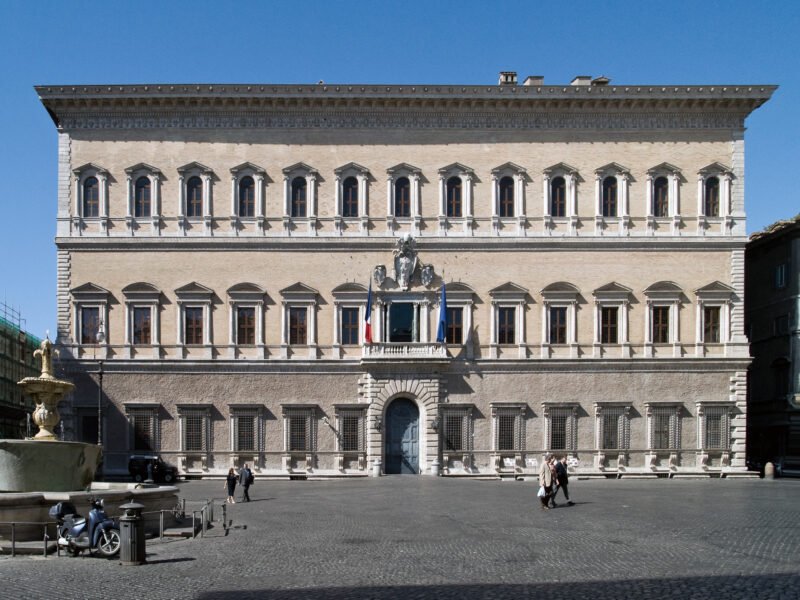
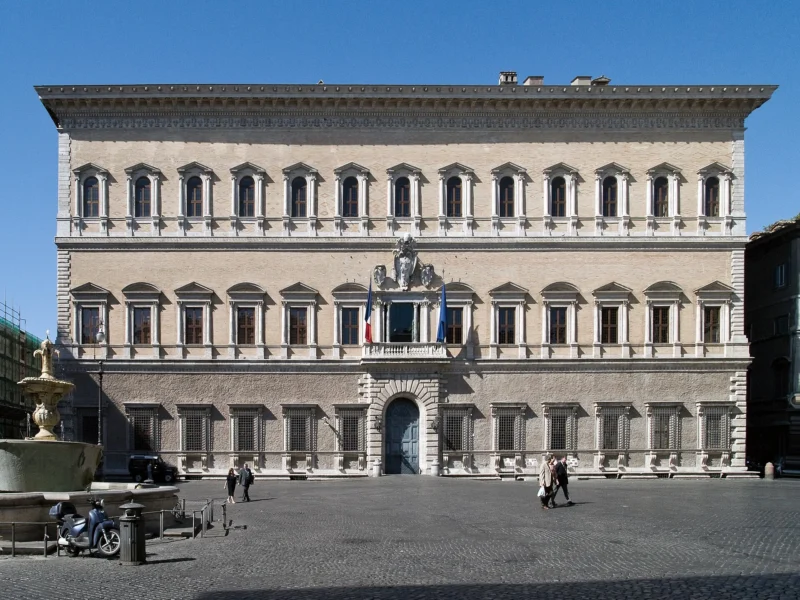
Palazzo Farnese
The palace was commissioned by Cardinal Alessandro Farnese, the future Pope Paul III, and begun by Antonio da Sangallo the Younger around 1514. Work stopped with the Sack of Rome in 1527 and resumed afterward. Michelangelo worked on the cornice and the central balcony, giving the facade its definitive proportion. Giacomo della Porta completed the front toward the Tiber by 1589. Inside worked Daniele da Volterra in the cardinal's room in 1547, Francesco Salviati and Taddeo Zuccari in Sala dei Fasti Farnesiani between 1552 and 1563, and above all Annibale Carracci, author between 1597 and 1607 of the frescoes of the Camerino and of the famous Gallery with mythological subjects, one of the absolute peaks of Italian painting. The palace also housed the Farnese Hercules, now in the National Archaeological Museum of Naples. Puccini set the second act of Tosca there.
How to Visit Palazzo Farnese
The palace has been Italian property since 1936 and is leased to France under a long-term contract: it houses the Embassy of France in Italy and the library of the École française de Rome. It's not a museum and you can't walk in freely. Guided tours exist, are limited in size, require advance booking and an ID document, and the terms change over time: the updated conditions, the calendar and the official booking channel are published by the Embassy of France on its own website. Don't trust intermediaries who promise immediate entry.
The Granite Basins of Piazza Farnese
In the center of the square there are two enormous basins of Egyptian granite, fished out of antiquity and arrived here at different times, one under the pontificate of Paul II and one under Paul III. The traditional attribution has them coming from the Baths of Caracalla, but the question among scholars is still debated, so caution is required. What is certain is that they were turned into monumental fountains by Girolamo Rainaldi around 1626, after Pope Gregory XV granted the Farnese the water right. The Farnese lily stands out on the rims, and the scale of the two basins against the passersby is one of the things that best conveys the real dimensions of the imperial bath complexes.
Palazzo della Cancelleria, the Quiet Neighbor
The north front of the area is occupied by the bulk of Palazzo della Cancelleria, probably built between 1486 and 1496 for Cardinal Raffaele Riario. According to Pietro Aretino's account, the cardinal supposedly financed the enterprise with a gambling win: a tasty anecdote that can't be verified, to be treated as such. Incorporated in the very long facade is San Lorenzo in Damaso Basilica, a palatine church and titular church of the cardinal vice-chancellor, of late antique origin and built over a Roman mithraeum. The courtyard, generally attributed to Bramante, is one of the most elegant of the Roman Renaissance, with two-order porticoes and red Egyptian granite columns recovered from the ruins of the Theater of Pompey. In the Hall of the 100 Days Giorgio Vasari painted a vast fresco in 100 days of work, something he boasted about to Michelangelo, receiving in reply a two-word comment that went down in the history of art as an example of the perfect putdown.
After the Lateran Pacts of 1929 the building enjoys extraterritorial status: it is property of the Holy See, houses three pontifical tribunals and cannot be visited freely. The ground-floor spaces, however, are regularly used for large temporary exhibitions, like the Leonardo da Vinci exhibition held right here: it's the simplest way to legally get into Bramante's courtyard by paying an exhibition ticket.
Galleria Spada and Borromini's trick
Five minutes from Campo de’ Fiori, in Piazza Capo di Ferro, one of the smallest and smartest museums in Rome opens up. The Galleria Spada keeps the picture collection of Cardinal Bernardino Spada, with paintings of the 16th and 17th centuries, including works by Titian, Guercino and Artemisia Gentileschi, still arranged according to the taste of Baroque collecting, that is, with the walls covered with paintings from floor to ceiling. The Italian State bought the palace in 1926 and the gallery opened in 1927. The building also houses the Council of State.
The real reason to go, though, is the perspective colonnade made by Francesco Borromini between 1652 and 1653. The gallery actually measures 8.82 meters, but the architect made walls, floor and ceiling converge toward a single vanishing point, progressively raising the mosaic floor and lowering the vault: the eye reads a perspective of about 35 meters. When the custodian lets someone into the garden and the human figure appears at the end of the colonnade, the illusion collapses at once and the statue that looked life-size turns out to be a little over half a meter tall. It's the most famous optical trick in Rome and it takes up less space than a hallway at home. Hours and tickets should be checked on the museum's official website before you show up.

The Passetto del Biscione and the Madonna nobody finds
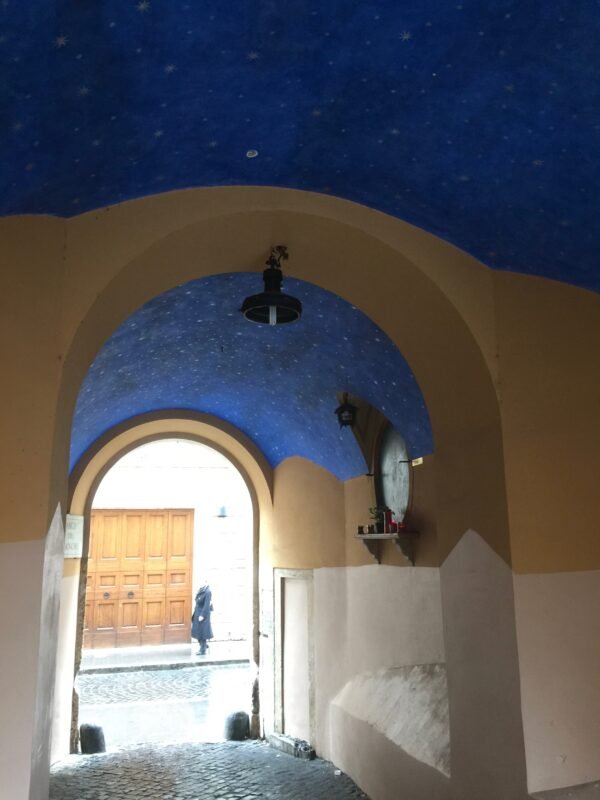
Leaving Campo de’ Fiori toward the east you enter Piazza del Biscione, and from there you take a covered passage that connects the piazza to Via di Grotta Pinta: it's the Passetto del Biscione. The corridor runs over the structures of the Theater of Pompey and preserves, on the vault and on the walls, decorations and the Marian image around which the cult of the Madonna of Divine Providence formed. For many years the passage stayed closed and decayed, before a restoration that recovered its paintings and returned it to pedestrian traffic.
Here a Roman saying was born that many quote without knowing where it comes from: that of someone who goes looking for Maria all over Rome, that is, who searches a long time for something that passes right next to them every day. The reference is precisely to this image of the Madonna, a few meters from Campo de’ Fiori, in front of which thousands of people pass every week without looking up. If you go through, look up: it takes two seconds, and it's the difference between crossing an alley and understanding why that alley exists.
The streets around Campo de’ Fiori
Via dei Giubbonari
It's the street that leaves from the southeast corner of the piazza and runs down toward Via Arenula. Narrow, long, pedestrian for a large part, today it's a sequence of mid-priced clothing stores, and it keeps the irregular course of the 15th-century layout. Halfway along, alleys open that lead toward the Tiber and toward Trinità dei Pellegrini. It's the most direct way to connect Campo de’ Fiori with the Ghetto and the Synagogue of Rome.
Via dei Cappellari
The most interesting street of the group, and the least visited. Dark, very narrow, with laundry hung out and the workshops of restorers and carpenters that escaped the commercial transformation. It comes out on Via del Pellegrino. If you have 20 minutes and want to understand what the district was like before mass tourism, this is where you need to walk, not in the piazza.
Via del Pellegrino and Via di Monserrato
Via del Pellegrino continues the axis of the old Via Florea toward the Banchi and toward Ponte Sant’Angelo: it was the route of pilgrims arriving from the north on their way to St. Peter's. A little further south, running parallel, is Via di Monserrato, one of the most elegant and least crowded streets of the center, flanked by 16th-century palaces and national churches. The stretch between Campo de’ Fiori and Via Giulia, walked slowly, is one of the best strolls you can take in Rome in an afternoon.
Piazza del Biscione and Via di Grotta Pinta
The small open space east of the piazza keeps the front of Palazzo Pio Righetti, heir of the Orsini fortification, and leads into Via di Grotta Pinta, the curved street built on the cavea of the Theater of Pompey. The semicircular shape of the block is best grasped in the evening, when there are fewer people. It's one of the places where the archaeology of Rome can't be seen but can be walked.
What's within a 10-minute walk of Campo de’ Fiori
This is perhaps the real reason it's worth coming through here: Campo de’ Fiori is the geometric center of an area that packs in more monuments per square meter than almost any other point in the city. In seven minutes you reach Piazza Navona, built on the plan of the Stadium of Domitian, and under the piazza you can visit the underground of the Stadium of Domitian, which show the travertine structures of the imperial arena. On the side of Piazza Navona opens the Museo di Roma at Palazzo Braschi, the right museum for understanding how the city changed between the 17th and 19th centuries.
In 10 minutes you reach the Pantheon, the Basilica of Sant’Andrea della Valle with its 17th-century dome, the Bramante Cloister on Via della Pace and Tiber Island, crossing Ponte Sisto or going through the Ghetto. In a quarter of an hour you're in Trastevere. In 25 minutes of walking, following the historic route of the pilgrims, you get to St. Peter's. Whoever organizes a day on foot in the Historic Center would do well to build it around this piazza, not around the Trevi Fountain, which is much further north and much more congested.
Eating and drinking at Campo de’ Fiori
The bakery and the pizza bianca
The food institution of the piazza is the historic bakery on the western corner, which turns out Roman pizza bianca from the morning, the kind two fingers thick, salty, greased with oil, eaten standing up while walking. It's the most Roman thing you can buy in this piazza and it costs a few euros. You buy it by weight, ask for a piece of the size you want and eat it right away, hot: cold it loses half its point. The version with mortadella is a classic, the version with figs exists only in season and when it's there it's worth the wait.
Restaurants on the piazza: how to choose
Let's be clear. The places with tables directly on the paving of Campo de’ Fiori pay enormous rents and live off passing trade: the average quality is modest and the prices are high. It's not a moral condemnation, it's commercial arithmetic. The practical rule is simple: if there's someone inviting passersby to come in, if the menu is displayed with photos of the dishes and translated into six languages, go elsewhere. 150 meters is enough: Via dei Cappellari, Via dei Balestrari, Via di Monserrato and the alleys toward Piazza Farnese have trattorias where you eat better and spend less. The cover charge and the service charge must be indicated on the menu: if they aren't, ask before sitting down.
Coffee and aperitivo
In the morning, while the market is set up, having a coffee at the counter in one of the bars on the piazza while watching the stalls at work is an experience worth the price, which at the counter stays low. Sitting at a table the same order costs noticeably more: it's legitimate, it's stated on the price list, but you need to know it. For aperitivo, the hour between seven and eight is when the piazza is still enjoyable. After nine the noise level becomes something else.
Night at Campo de’ Fiori
How the piazza became the movida spot
In recent decades Campo de’ Fiori has become one of the favorite nighttime hangouts of the young, Italian and foreign, because of the density of pubs and venues facing the piazza and the adjacent alleys. The phenomenon has produced recurring episodes of rowdiness, vandalism and brawls, and for this reason the piazza is often patrolled by law enforcement during the night hours. Coexistence between residents and night-time visitors is one of the longest and most unresolved urban conflicts of the Roman Historic Center.
Rules that can change from one season to the next
Roma Capitale periodically issues ordinances that regulate the hours for selling alcoholic drinks, the ban on drinking alcohol in the street beyond certain hours, takeout service and the use of outdoor tables in the movida areas. These measures have a limited validity in time, are renewed or modified, and can differ between summer and winter. Whoever plans to spend the evening here would do well to take a look at the ordinances currently in force published by the Capitoline administration, because the penalties also apply to consumers and not only to operators.
An opinion on the night in the piazza
I'll be blunt, because it's needed. Campo de’ Fiori at night is not the right place to get to know Rome, and whoever comes for that ends up disappointed: it's a crowded, noisy piazza, with inflated prices and a clientele almost entirely passing through. If you're looking for a real Roman evening, Trastevere in the side alleys, Testaccio, Pigneto or San Lorenzo offer much more. Campo de’ Fiori at night makes sense for one thing only, and it's a beautiful thing: passing through very late, when the venues have closed and the street sweepers have finished, and finding it completely empty with Giordano Bruno lit from below. At three in the morning this piazza is one of the most impressive places in Rome.
Campo de’ Fiori with kids
It works better than you'd think, as long as you come in the morning. The market is a natural show for children: colors, voices, smells, stalls at the right height, fruit you can buy and eat right away. Many vendors are patient and happily hand a taste to a child who asks. The piazza is entirely pedestrian during market hours, so there's no traffic, and the open space around the fountain lets you stop without worry.
The thing to watch is the sampietrini paving, which with a small-wheeled stroller becomes torture: if you have a stroller, pick one with big wheels or plan to carry the child in your arms on the worst stretches. The monument to Giordano Bruno, with its hooded figure, can impress the youngest: telling the story in an age-appropriate way works better than skipping over it, because the question comes anyway. There are no public restrooms in the piazza: you use the one in a bar where you buy something, as you do everywhere in the Historic Center.
Accessibility at Campo de’ Fiori
The piazza is flat and without steps, and this is a notable advantage over many other places in the center. The problem is the paving: irregular sampietrini over the whole surface, with wide joints and dips, which make it tiring to get through in a wheelchair and problematic for anyone with difficulty walking. The less uneven strips are generally those along the edges, in front of the venues. During market hours the passageways between the stalls narrow quite a lot and maneuvering becomes difficult: for those who move by wheelchair, the afternoon, with the market taken down, is clearly preferable. The entrances of the venues on the piazza often have a threshold step and restrooms that aren't always adequate, so it's best to ask first. The sidewalks of the access streets, in particular Via dei Baullari and Via dei Giubbonari, are narrow or absent, with mixed pedestrian and vehicle traffic at certain hours.
When to go and when to avoid Campo de’ Fiori
The best season is the in-between one: April, May, late September, October. In July and August the piazza is exposed and without shade, and at noon the paving gives off heat like a griddle. In winter the market morning has a low, raking light that is the best of the year for photography. On Sunday there's no market, and whoever arrives on a Sunday morning expecting the stalls finds an empty piazza: it's a frequent disappointment and can be avoided by checking beforehand.
There are two dates to note. On February 17, the anniversary of the burning, the piazza hosts secular commemorations around the monument, with flowers and speeches: it's the day when Campo de’ Fiori goes back to being what it has been, a political place. June 9, the anniversary of the monument's inauguration in 1889, is observed more discreetly. In periods of heavy tourist flow, and during large Jubilee events, the pressure on the Historic Center increases noticeably and the piazza becomes a funnel: in those cases seven 30 in the morning is the only time that gives you a decent visit.
A curiosity about Campo de’ Fiori
The curiosity almost nobody knows is about water, and more precisely the fact that the fountain you see in the piazza today is a declared copy, missing a piece. The original, the Terrina Fountain made by Giacomo della Porta in 1590 on commission from Gregory XIII, had received in 1622 a domed travertine lid, added for a very practical reason: to stop Romans from throwing trash into it and the market's fishmongers from dumping their scraps. The lid transformed the look of the basin into that of a table tureen, and hence the nickname that has stuck to it for four centuries.
At the base of the lid's knob a phrase in the vernacular was carved that is worth the trip to Piazza della Chiesa Nuova, where the original has stood since 1924: AMA DIO E NON FALLIRE. FA DEL BENE E LASSA DIRE. MDCXXII. Loose translation: behave well and shrug off the gossip. Finding a maxim of this kind, in dialect and not in Latin, carved on street furniture commissioned by the papacy is one of the most instructive things Rome can offer to anyone who believes that papal power spoke only one language.
The full sequence is this: the fountain stays in Campo de’ Fiori until 1899, then ends up in the municipal warehouses for a quarter of a century, and in 1924 it is put back in Piazza della Chiesa Nuova along Corso Vittorio Emanuele II, where Romans call it the tureen. In the same year a copy without the lid is placed in Campo de’ Fiori, moved from the center of the piazza to the northern side, in the space gained through the 19th-century demolitions. Result: two almost identical objects 600 meters from each other, one real and covered, one fake and uncovered, and no sign explaining it. Whoever knows this story looks at the fountain in Campo de’ Fiori with completely different eyes, because they know they are looking at it incomplete.
One thing nobody tells you about Campo de’ Fiori
Nobody will tell you that the piazza you're walking in has the shape it has because of a theater that hasn't existed for 1,500 years, and that you can measure that shape with your feet in under five minutes. Leave from the eastern corner of Campo de’ Fiori, enter Piazza del Biscione and turn into Via di Grotta Pinta. The street makes a regular curve, almost a semicircle. It's not chance and it's not picturesque medieval disorganization: the houses lining it rest on the radial walls of the cavea of the Theater of Pompey, and the curve you're walking is the exact outline of the hemicycle where 17,000 Romans sat to watch the shows in 55 BC.
The second part of the information is even less widely known. The ancient walls are not only under the street: they are inside the cellars. Several buildings between Piazza del Biscione, Via di Grotta Pinta and Via dei Giubbonari keep in their basements blocks of concrete work and radial arches of the theater, reused as foundations and storerooms. Some of these spaces belong to hotels and venues in the area and are visible only on the owners' initiative or on special openings: there is no public, permanent archaeological circuit, so anyone who promises you a visit to the Theater of Pompey as if it were a museum is selling you something that isn't guaranteed.
Then there's a third step, which ties everything together. The Theater of Pompey was not just a theater: it included an enormous portico and the Curia Pompeia, the hall where the Senate met when the Curia in the Forum was not available. It's there that Caesar was killed on the Ides of March in 44 BC, at the foot of the statue of Pompey, at a point corresponding to the area between Largo di Torre Argentina and Teatro Argentina. It means that between the paving of the market where you buy tomatoes and the place of Julius Caesar's assassination there are barely 300 meters, and no sign in the piazza says so.
Frequently asked questions about Campo de’ Fiori
How much does it cost to enter Campo de’ Fiori?
Entering Campo de’ Fiori costs nothing, because it's a public piazza that is always accessible, with no ticket or opening hours. The only expenses are those at the market stalls or in the venues around the piazza.
When is the market at Campo de’ Fiori?
The Campo de’ Fiori market is held every morning from Monday to Saturday, without interruption since 1869, when the food trade was moved here from Piazza Navona. On Sunday the market is not held, and the stalls set up very early and come down around lunchtime.
How do you get to Campo de’ Fiori?
The best way to get to Campo de’ Fiori is on foot: from Piazza Navona seven minutes is enough via Corso Vittorio Emanuele II and Via dei Baullari, from the Pantheon about 12 minutes, and from Largo di Torre Argentina five minutes via Via dei Giubbonari.
Why doesn't Campo de’ Fiori have a church on the piazza?
Campo de’ Fiori is the only historic piazza in Rome that no church faces, an anomaly that strikes whoever discovers it for the first time. The churches are there, like San Lorenzo in Damaso, but they begin right after the corner of the piazza, not on its perimeter.
What does the statue in the middle of Campo de’ Fiori commemorate?
The statue in the middle of Campo de’ Fiori commemorates Giordano Bruno, the philosopher who was tried and burned alive in this very piazza on February 17, 1600 for heresy. The bronze monument, the work of Ettore Ferrari, came out of a committee formed in 1876 by republican university students, with international support including Victor Hugo and Henrik Ibsen.
Is Campo de’ Fiori wheelchair accessible?
Campo de’ Fiori is flat and without steps, an advantage over many other places in the Historic Center. The problem is the paving of irregular sampietrini, with wide joints and dips, which makes it tiring to get through in a wheelchair. The less uneven strips are usually those along the edges, in front of the venues.
Is Campo de’ Fiori suitable for a visit with children?
Campo de’ Fiori works better than you'd think with children, as long as you come in the morning during the market: colors, voices, smells and stalls at the right height make it a natural show, and many vendors happily give a taste of fruit to a child who asks.
What do you eat at Campo de’ Fiori?
At Campo de’ Fiori, the food institution of the square is the historic bakery on the western corner, which turns out Roman pizza bianca from the morning on, two fingers thick, salty and oily, sold by weight and eaten right away standing up. It's considered one of the most Roman things you can buy in this square.
My advice for visiting Campo de’ Fiori
There is only one practical piece of advice, and it goes against every habit: come twice on the same day. It's not a whim, it's the right way to use this square, and it costs you 40 minutes of extra walking in all.
The first visit at eight in the morning, when the market has been set up for a couple of hours and the stalls are really working. Buy something, even a little: 100 grams of cherries, two peaches, a bunch of basil. The act of buying completely changes how the vendor treats you and turns you from a spectator into a customer, which in a market is the only condition that opens the conversation. Stop for five minutes and watch how the Romans who do their shopping get served: they don't take photos, they point. Then go to the bakery and get the pizza bianca fresh out of the oven.
The second visit at half past two in the afternoon, when the vendors have packed up, the square has been washed and it looks completely empty. It's the only moment of the day when you can see the design of the square: the length of the rectangle, the asymmetry of the fronts, the monument isolated in the center, the fountain on the north side. Walk all the way around the base of the Giordano Bruno monument reading the eight medallions. Then cross toward Piazza Farnese and look back after 30 steps: in the same mental frame you have the square of commerce and the square of power, which is the most effective lesson in urban planning that Rome offers for free.
Third part of the advice, for those who have time: don't stop at the square. Campo de’ Fiori without Via dei Cappellari, without the Passetto del Biscione and without the curve of Via di Grotta Pinta is a photograph. With those three passages it becomes a visit. And if you're organizing a whole day in the district, the help of a professional guide makes the difference between seeing and understanding: the team at TourLeaderPro in Rome works on exactly this kind of walking itinerary in the Historic Center.
Another well-known fact, yet rarely mentioned
Everybody knows that Campo de’ Fiori is the only historic square in Rome without a church. Almost nobody asks why, and the answer is more interesting than the fact.
In Rome the church is not just any building. It is the administrative and social center of the parish, and for centuries it performed functions that today we would call registry and welfare. Every established urban nucleus has one, because it needs one. Campo de’ Fiori has none, for a precise chronological reason: the square was born in 1456 with the paving ordered by Callixtus III, that is, when the surrounding fabric was already completely covered by working parishes. San Lorenzo in Damaso Church, of late antique origin, was to the north and served the whole sector. The other churches surrounded the area a few meters away. Opening a new parish on a space that was born as a market served no one, and no one did it.
The consequence is an urban fact that becomes a symbolic one. Campo de’ Fiori is a secular void surrounded by a very dense sacred fabric: 300 meters away are the Cancelleria with its palatine basilica, Santa Brigida Church on Piazza Farnese, Trinità dei Pellegrini Church, Sant’Andrea della Valle Church, San Girolamo della Carità Church, Santa Maria di Monserrato Church. Inside the square, nothing. When the Inquisition chose where to carry out the sentence on Giordano Bruno, it chose the only large public space in the center that was not the churchyard of anybody. Historians debate how much this consideration really weighed, and prudence requires us not to turn a coincidence into a motive. The fact remains that the monument to free thought could be planted in 1889 in the middle of the only Roman square where no parish could claim the ground. Whoever designed it knew that perfectly well.
The right photo to take at Campo de’ Fiori
Everyone takes the wrong photograph: statue in the center, market around it, sun overhead, noon. The result is a flat image, with the dark bronze against a burned-out sky and the white awnings of the stalls eating up all the light. Here is how to take the right one, in three versions.
First version, the portrait of the market. Time: between seven and eight in the morning, when the sun is low and comes in raking from the east along the axis of the square. Position: at the mouth of Via dei Baullari, so you have the row of stalls in depth and the statue emerging among the awnings. The secret is to wait for a vendor to move: a market photographed without people is a row of tables. Ask before framing close on someone who is working, a nod is enough and it's usually granted gladly.
Second version, the monument. Time: late afternoon in winter, or right after sunset in summer, when the ground spotlights come on and the bronze is lit from below. Position: from the southwest, so that the hooded face is backlit against the still blue sky. Frame from below, leaning almost against the pink granite base: the statue becomes enormous and the hood casts the shadow that Ferrari had calculated. Add a close-up detail of one of the eight medallions, for example the one of Tommaso Campanella: it's a photograph that almost nobody has.
Third version, the one you'll take home. The square completely empty, late at night or at the crack of dawn on Sunday, when the market isn't there and the bars have closed. The wet paving after the washing reflects the lights and the statue stands alone in the center of a black rectangle. You need a support for the long exposure, the edge of the fountain works too. It's the image that truly tells this square, and it's the only one that no other tourist will have taken that day.
A technical note that applies everywhere in the center: in Campo de’ Fiori, using a tripod during market hours is impractical for reasons of space, and in certain conditions professional filming requires authorization. For an amateur photo with your phone there is no problem, but if you work with set equipment, ask first at the competent offices of Roma Capitale.
Some important events that took place here in history
1456: the square exists
The first event is administrative and doesn't make the news, but without it nothing else would have happened. In 1456 Callixtus III has the area paved as part of the plan to reorganize the Parione district. From meadow with vegetable gardens to paved urban space: from that moment a market can be set up, ceremonies can be hosted, buildings can go up around it. All the later events depend on this decision.
The 1500s: the square of everyday politics
With the opening of Via dei Baullari ordered by Paul III and with the construction of Palazzo della Cancelleria and Palazzo Farnese, Campo de’ Fiori becomes an obligatory passage for ambassadors and cardinals headed to the Vatican or to the papal courts. Power and commerce pass through the same space every day. The inns, among them the one of Vannozza Cattanei at the corner of Via dei Cappellari, host a clientele that ranges from merchants to the relatives of cardinals.
February 17, 1600: the burning of Giordano Bruno
This is the event that gave this square a place in the European history of thought. Condemned for heresy on February 8 after eight years in prison, the philosopher from Nola is brought here and burned alive, with his tongue immobilized. The ashes end up in the Tiber. For two and a half centuries the place bears no mark.
1858: the square changes shape
After 1858 the houses on the north side of the square are demolished, between Via dei Baullari and Vicolo del Gallo. Campo de’ Fiori reaches its current extent and gains the space where the fountain will later be placed. It's the last major intervention on the layout of the square.
1869: the fruit and vegetable market arrives
The food trade is moved here, and since then the market has occupied the square every morning from Monday to Saturday. It's the event that determined the everyday identity of Campo de’ Fiori for the last 150 years and that continues to determine it today.
June 9, 1889: the inauguration of the monument
After 13 years of political battle started by the student committee of 1876, and despite the head-on opposition of the Church, Ettore Ferrari's monument is inaugurated. The day is a national and international political event. Leo XIII spends it in fasting and prayer. The Vatican's attempts to have it removed will continue for decades without success.
1943: cinema enters the square
The film Campo de’ fiori comes out, with Anna Magnani and Aldo Fabrizi, shot while the war is going on. The film captures the life of the market at a time when the square is still entirely working-class, and it becomes the most important visual document on this place before the tourist transformation.
From the 1990s to today: the square at night
In recent decades the square has turned into one of the main nightlife hubs of the city. Episodes of vandalism and nighttime violence lead to a frequent police presence and a long series of municipal ordinances on alcohol and hours, which are periodically modified. It's the open chapter of the history of Campo de’ Fiori, and it concerns those who live here at least as much as those who pass through.
Who passed through Campo de’ Fiori
Pompey the Great and Julius Caesar
The first two names come from beneath the paving. Gnaeus Pompeius Magnus built here between 61 and 55 BC the first stone theater in Rome, equipping it with a temple to Venus Victrix to get around the ban. Gaius Julius Caesar was assassinated on the Ides of March in 44 BC in the Curia attached to that complex, at the foot of the statue of his rival. Their biographies cross exactly here, within a radius of 300 meters from Campo de’ Fiori.
The Orsini, the Condulmer, the Pio di Savoia
From the 1200s onward the Orsini family dominates the southeast side of the square with houses, towers and crenellated walls, and gives rise to the branch of the Orsini de Campoflore, which included the lines of Vicovaro and Tagliacozzo. The palace passes to the Condulmer in the 1400s, returns to the Orsini in the 1500s, is renovated by the Pio di Savoia and ends up with the Righetti. Even in the early 1700s the Orsini were still claiming baronial rights over the square.
Callixtus III and Paul III
Two popes decided the shape of Campo de’ Fiori. Callixtus III, the Valencian Alfonso Borgia, orders the paving of 1456. Paul III, that is Alessandro Farnese, opens Via dei Baullari and builds the palace that bears his name, shifting the center of gravity of the district to the south. Without these two interventions the square would have remained an agricultural void.
Vannozza Cattanei and the Borgia
Vannozza Cattanei, companion of Cardinal Rodrigo Borgia and mother of Cesare and Lucrezia, ran the Locanda del Gallo here. Through her, the Borgia family frequented these streets for decades, at a time when the square was the rest stop for travelers headed to the Vatican.
Giordano Bruno
The man from Nola passed through here only once and did not leave. On February 17, 1600 he was brought to this square from the prison of the Holy Office and burned alive. He is the only figure whose presence in Campo de’ Fiori is marked by a monument, and the only one whose memory still summons people to this square every year on the same date.
Ettore Ferrari and the signatories of 1876
The sculptor Ettore Ferrari worked for years on the monument and made it a manifesto of free thought. The promoting committee gathered weighty international endorsements: Walt Whitman, Ernest Renan, Victor Hugo, Silvio Spaventa, Henrik Ibsen. None of them came to Rome for the inauguration, but their names made the square a reference point for European secular culture. The front inscription bears the intellectual signature of Giovanni Bovio.
Anna Magnani and Aldo Fabrizi
In 1943 the two most recognizable Roman actors of the 20th century worked on this paving for the film that bears the name of the square. Anna Magnani played a fishmonger, Aldo Fabrizi a greengrocer, and their characters are modeled on the people who really ran the market. The film comes two years before Rome, Open City, which would make Magnani a world icon.
Michelangelo, Bramante, Borromini, Carracci
Within a radius of 300 meters some of the greatest names of Italian art worked. Bramante, according to the current attribution, for the courtyard of the Cancelleria. Michelangelo for the cornice and the balcony of Palazzo Farnese. Annibale Carracci for Galleria Farnese between 1597 and 1607. Francesco Borromini for the illusionistic perspective of Palazzo Spada between 1652 and 1653. None of them left a work inside Campo de’ Fiori, and this is one of the most curious things about the square: masterpieces surround it on all sides, and in the center there is only a market and a bronze man.
Quick questions about Campo de’ Fiori
How much does it cost to enter Campo de’ Fiori?
Nothing. It's a public square, always accessible, with no ticket or opening hours. The only expenses are the ones you make at the stalls or in the bars and restaurants.
When is the market at Campo de’ Fiori?
Every morning from Monday to Saturday, since 1869. On Sunday there is no market. The stalls go up very early and come down around lunchtime. The precise hours are those set by Roma Capitale for neighborhood markets and may vary.
Who is the hooded statue in the center of Campo de’ Fiori?
It's Giordano Bruno, the Dominican philosopher from Nola burned alive in this square on February 17, 1600. The bronze monument is the work of Ettore Ferrari and was inaugurated on June 9, 1889.
Why does the statue of Giordano Bruno face the Vatican?
The orientation is deliberate. Ferrari and the promoting committee conceived the monument as an act of free thought against the authority that had condemned Bruno, and placed the figure's gaze in the direction of St. Peter's.
Why is there no church at Campo de’ Fiori?
Because the square only took shape in the mid-1400s, when the surrounding fabric was already served by established parishes such as San Lorenzo in Damaso. There was no need for a new church, and it remained the only historic Roman square without a sacred building facing it.
Where does the name Campo de’ Fiori come from?
From the flowering meadow with cultivated vegetable gardens that occupied the area until the 1400s, the Campus Florae of the medieval documents. The version that ties it to Flora, Pompey's lover, is a tradition considered unreliable.
Is it written Campo de’ Fiori or Campo dei Fiori?
The historic and correct form is Campo de’ Fiori, with the truncation of the plural article, as in Lorenzo de’ Medici. It's the spelling that appears on the district's plaques.
How much time do you need to visit Campo de’ Fiori?
20 minutes are enough for the square itself. An hour and a half is needed to do it properly, including the walk around the monument, Via dei Cappellari, the Passetto del Biscione, the curve of Via di Grotta Pinta and a quick stop in Piazza Farnese.
What is the best time to go to Campo de’ Fiori?
Seven 30 in the morning for the active market and the raking light, half past two in the afternoon to see the square empty and read its architecture. These two hours tell two different places.
Is Campo de’ Fiori safe at night?
It's very busy and regularly patrolled by law enforcement, but it's also a place where crowds gather at night, with recurring episodes of rowdy noise and vandalism. The precautions are those of any crowded area: watch your belongings and watch for pickpockets.
Are there rules on alcohol consumption at Campo de’ Fiori?
Roma Capitale periodically issues ordinances that limit the sale and consumption of alcohol in the street at certain times in nightlife areas. The measures change over time, so it's worth checking the ones in force, because the penalties apply to consumers too.
Is Campo de’ Fiori wheelchair accessible?
The square is flat and without steps, but the sampietrini paving is uneven and tiring. During market hours the passages between the stalls get very narrow. In the afternoon, with the stalls down, it's decidedly easier.
Are there public restrooms at Campo de’ Fiori?
Not in the square. As in a large part of the Historic Center, you use the restrooms of the bars by buying something.
Can you take photographs at Campo de’ Fiori?
Yes, freely, since it's a public space. For professional filming with set equipment, the municipal rules on public land occupation apply. At the market stalls it's good manners to ask before photographing close up someone who is working.
Is Campo de’ Fiori suitable for children?
Yes, especially in the morning: colorful market, pedestrian area, no traffic. The only serious obstacle is the sampietrini for strollers with small wheels.
What do you eat at Campo de’ Fiori?
The Roman pizza bianca from the historic bakery on the corner of the square is the most characteristic thing and costs a few euros. For a sit-down meal, the trattorias on the side streets generally offer better quality and lower prices than the places with tables in the square.
How far is Campo de’ Fiori from Piazza Navona?
About seven minutes on foot via Via dei Baullari and Corso Vittorio Emanuele II.
What is the nearest subway station to Campo de’ Fiori?
None is really close. The Historic Center in this sector is not served by the subway: you get there with the surface lines that run along Corso Vittorio Emanuele II and Largo di Torre Argentina, or on foot.
Can you get to Campo de’ Fiori by car?
No. The area is inside the Limited Traffic Zone of the Historic Center, with electronic gates, and there is no parking in the square.
What is the difference between the Campo de’ Fiori market and the Testaccio one?
Campo de’ Fiori is a historic open-air market in the middle of the tourist center, with a significant share of stalls aimed at visitors. The Testaccio market is covered, modern and used mostly by residents: that's where you go to do real shopping.
Can you visit the Theater of Pompey?
There is no public, permanent archaeological route. Some structures survive in the cellars of private buildings in the Biscione area and Via di Grotta Pinta, and are accessible only at the owners' initiative or during special openings.
Where did the original Terrina Fountain end up?
In Piazza della Chiesa Nuova, along Corso Vittorio Emanuele II, since 1924. The one in Campo de’ Fiori is a copy without the lid, placed in the same year.
What can you visit near Campo de’ Fiori?
Within a 10-minute walk: Piazza Farnese, Galleria Spada with Borromini's perspective, Palazzo della Cancelleria, the Passetto del Biscione, Piazza Navona with the underground remains of the Stadium of Domitian, Museo di Roma at Palazzo Braschi, the Ghetto with the Synagogue, Tiber Island and the Pantheon.
When is Giordano Bruno commemorated at Campo de’ Fiori?
On February 17, the anniversary of the burning in 1600. On that date the square hosts secular events and flowers laid at the foot of the monument.
Do you need a guide to visit Campo de’ Fiori?
For the square itself, no. To understand the stratigraphy of the district, the Theater of Pompey, the palaces and the relationship between Campo de’ Fiori and Piazza Farnese, a licensed guide radically changes the experience.
Is Campo de’ Fiori worth a visit if I have little time in Rome?
Yes, but in the morning and not in the evening, and as part of a walk that includes Piazza Farnese and Piazza Navona. As a stand-alone destination, half an hour in the afternoon is enough.
If I had to sum up in one line the right way to be in this square, I'd say that Campo de’ Fiori is not looked at, it's crossed several times. It's the only space in the Historic Center that changes identity three times over the course of the same day, and whoever arrives once, at the wrong time, leaves convinced it's a square of restaurants with a statue in the middle. Go back in the morning with a shopping bag in your hand and then pass through again in the silence of early afternoon: you'll understand why the Romans, who have as many beautiful squares as they want, keep getting attached to this very one, which isn't beautiful and never claimed to be. To prepare the rest of your day on foot in the Historic Center, the English guides from ItalyPlanner on things to do in Rome and the three-day itinerary in Rome are a good starting point, while for professional accompaniment in the district you go straight to the TourLeaderPro contacts.
Article written by the editorial team of TourLeaderPro, contact them for Private/Corporate/V.I.P. Tours and Experiences.
Planning a trip to Rome? The English guides to visiting the city are on ItalyPlanner.com.
Contact Information
Nearby
 Cinema Farnese100 m
- Passetto del Biscione100 m
- Piazza Farnese and Palazzo Farnese100 m
- Cappella Orsini100 m
- Santa Brigida100 m
- Palazzo della Cancelleria100 m
Upcoming events nearby
- Keith Haring at Museo di Roma in Palazzo Braschi, from October 6, 2026 to April 11, 2027200 m
- «Canova-Cicognara. Epistolario (1822-1833)», book presentation at Museo di Roma, Tuesday, November 17, 2026200 m
- Primarosa Cesarini Sforza, Ines Fontenla, Thorsten Kirchhoff, Daniela Monaci, Luana Perilli at Galleria Emmeotto, from October 3 to November 27, 2026200 m
- Memoria di ragazza at Teatro Valle, November 10 to 22, 2026300 m